experiment · JAMA network open · la publicación, 1 sep 2026 · gratis
Un programa de respuestas aclaró dudas sobre la vacuna del VPH, pero no cambió las decisiones
Madres en Japón respondieron mejor un cuestionario con ayuda de inteligencia artificial que con un folleto oficial, aunque la intención de vacunar a sus hijas quedó igual.
Versión breve · la versión detallada sigue, unos 8 min
Pregunte al chat de weeklyAI
Pregúnteme sobre la IA en su vida: le señalo las notas que weeklyAI ha publicado sobre el tema, esta semana y antes.
Las conversaciones se guardan mientras exista weeklyAI, para mejorar la publicación. Se responde en el idioma en que usted escribe.
- El estudio, de un vistazo
- Quiénes
- Madres cuidadoras de hijas sin vacunar
- Cuántos
- 848
- Dónde
- Japón
- Cuándo
- entre el 30 de noviembre y el 27 de diciembre de 2024
- Tipo de estudio
- experiment
- Quién lo hizo
- Escuela de Higiene y Medicina Tropical de Londres y Universidad de Nagasaki
- El límite que importa
- Midió respuestas correctas en una pantalla, no vacunas aplicadas; la decisión la reportaron las madres
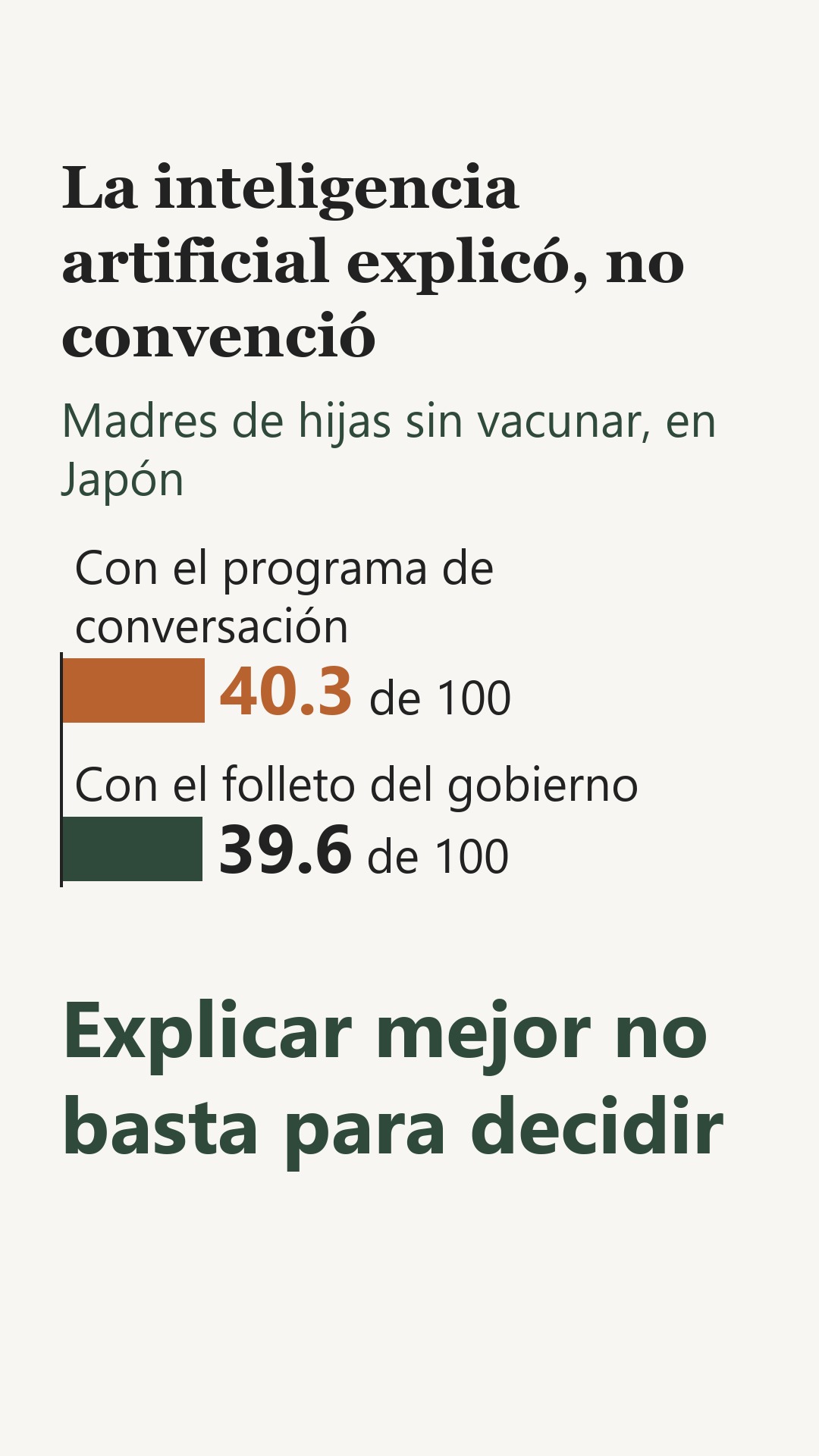
Son los porcentajes de madres que dijeron que sí pensaban vacunar, no vacunas aplicadas; la diferencia entre ambos grupos no tuvo peso estadístico.
El programa de conversación frente al folleto oficial del gobierno
Ventaja de 0.30 puntos en un examen de siete preguntas, justo al terminar
La misma ventaja de 0.30 puntos dos semanas después
40.3% frente a 39.6% dijeron que pensaban vacunar; sin diferencia de peso
Lo que muestra este trabajo es que una máquina bien ajustada sirve para explicar dosis o riesgos con claridad medible.
Usted tiene dudas sobre una vacuna para su hija y busca respuestas directas, en privado, sin esperar semanas por una cita médica. En Japón, investigadores probaron si un programa de conversación con inteligencia artificial explicaba mejor la vacuna contra el virus del papiloma humano que el folleto del gobierno. Participaron 848 madres de hijas de 12 a 18 años que no estaban vacunadas.
La mitad leyó el folleto oficial y la otra mitad usó el programa durante al menos cinco minutos. El sistema se apoyaba en una colección de materiales hecha para Japón, con documentos oficiales sobre vacunas, estudios revisados por otros especialistas y otras fuentes de salud. Cuando la pregunta era sobre un caso personal, invitaba a la madre a consultar a un médico.
El programa ayudó con los datos. Al terminar la lectura, las madres contestaron un examen de siete preguntas sobre la vacuna. Quienes usaron el programa obtuvieron una ventaja promedio de 0.30 puntos frente a quienes leyeron el folleto. Dos semanas después, entre las madres que siguieron en el estudio, la ventaja volvió a ser de 0.30 puntos.
Tener la información más clara no movió la balanza en casa. A las dos semanas, 102 de 253 madres del grupo del programa decidieron vacunar a sus hijas, un 40.3%. En el grupo del folleto fueron 103 de 260 madres, un 39.6%. La diferencia entre ambos grupos no tuvo peso estadístico.
El estudio midió respuestas en una pantalla, no vacunas aplicadas en un brazo. Además, poco más de la mitad de las participantes completó el seguimiento a las dos semanas. Entre las que contestaron el primer examen, la mayoría tenía estudios universitarios e ingresos de cuatro millones de yenes al año o más. En familias con menos recursos o menor acceso a internet, la historia podría ser distinta. Un plazo de dos semanas tampoco permite asegurar qué harán las familias con el paso de los meses.
Lo que muestra este trabajo es que una máquina bien ajustada sirve para explicar dosis o riesgos con claridad medible. No sustituye la plática en persona con el personal de salud ni la confianza en las clínicas. Si su centro de salud o la escuela de sus hijos le ofrecen un programa similar para resolver dudas sobre vacunas, busque que venga acompañado por la recomendación directa de un médico de carne y hueso.
Qué significa para usted
Ese programa de computadora, en un ensayo con madres japonesas, mejoró el conocimiento sobre la vacuna del VPH frente al folleto del gobierno, con una ventaja de 0.30 puntos en siete preguntas. No cambió la decisión de vacunar a sus hijas. Si en su clínica o escuela le ofrecen una herramienta así para resolver dudas, puede usarla, pero la pregunta sobre su propia hija sigue siendo para el personal de salud.
Kobayashi, K., Wu, Z., Tomoi, H. et al. (2026). AI Chatbot Use for Human Papillomavirus Vaccine Literacy in Japan. JAMA Network Open. https://doi.org/10.1001/jamanetworkopen.2026.34696
Quién pagó: El trabajo recibió apoyo de AIR@InnoHK, administrado por la Innovation and Technology Commission, y el artículo indica que el financiador no tuvo ningún papel en el diseño, la ejecución, el manejo de datos, el análisis, la interpretación, la redacción, la revisión, la aprobación ni la decisión de publicar.
No tome esto como consejo médico profesional.
Versión detalladaLos pasajes copiados del artículo, las ilustraciones y cada fuente con cuánto leímos de ella · 1643 palabras · unos 8 minLeerla →Cerrar
Un chatbot respondió mejor que el folleto oficial las dudas de madres japonesas sobre la vacuna del VPH; no las convenció de vacunar
Un ensayo con 848 cuidadoras midió respuestas correctas, no vacunas puestas. La diferencia entre saber y decidir es el centro de la historia.
En Japón, el programa de vacunación contra el virus del papiloma humano (VPH) lleva más de una década arrastrando una herida. La vacuna previene el VPH y, con él, el cáncer cervicouterino. Un grupo de investigadores de varias instituciones, entre ellas la Escuela de Higiene y Medicina Tropical de Londres y la Universidad de Nagasaki, quiso probar si un chatbot de inteligencia artificial podía explicar mejor esa vacuna que el folleto que reparte el Ministerio de Salud, Trabajo y Bienestar de Japón. Reclutaron a 848 madres con hijas de 12 a 18 años sin vacunar y las sortearon en dos grupos iguales: una conversación con el chatbot o la lectura del folleto; después quedaron 841 al excluir a siete que vivían fuera de Japón o en una categoría de residencia distinta. El estudio se hizo entre el 30 de noviembre y el 27 de diciembre de 2024, con una revisión dos semanas después. El trabajo recibió apoyo de AIR@InnoHK, un fondo administrado por la Comisión de Innovación y Tecnología de Hong Kong; los autores declaran que el financiador no intervino en el diseño, la recogida de datos, el análisis, la preparación del texto ni la decisión de publicarlo.
Para entender el tamaño del asunto, conviene mirar las cifras que el propio artículo pone sobre la mesa. El artículo describe un estudio en el que el cáncer cervicouterino deja en Japón más de 10 000 casos nuevos y alrededor de 3000 muertes cada año1. El artículo describe un estudio en el que, en 2013, la vacuna entró al programa nacional de inmunización; poco después, reportajes y videos en internet sobre presuntos efectos adversos encendieron la alarma pública, aunque los vínculos causales no estuvieran respaldados por la evidencia2. El ministerio suspendió la recomendación activa. El artículo describe un estudio en el que la vacuna siguió siendo gratuita, pero la cobertura cayó de cerca del 70% a menos del 1%3. El artículo describe un estudio en el que la recomendación se reinstaló en 2022, después de que una revisión confirmara que la vacuna es segura y eficaz; aun así, la confianza y la cobertura se han recuperado despacio4. Pasa lo mismo con un vecino que promete arreglar la fuga después de haber inundado el departamento: la promesa puede ser cierta, pero uno ya no abre la puerta con la misma cara.
El chatbot que se probó no era un buscador cualquiera. Funcionaba con GPT-4o y se apoyaba en una biblioteca de referencia hecha para Japón, armada con materiales oficiales de vacunación, literatura revisada por especialistas y otras fuentes de salud5. Estaba diseñado para responder preguntas sobre la vacuna del VPH, mantenerse dentro del tema, no dar consejo médico individual y mandar a quien preguntara con un profesional de la salud cuando el asunto fuera personal6. El grupo de comparación no recibió nada parecido: vio el folleto público del ministerio, el mismo que hoy se entrega en Japón. Ambos grupos tenían que pasar al menos cinco minutos con su material.
Las participantes fueron mujeres cuidadoras, no padres ni tutores en general. El artículo describe un estudio en el que, en Japón, las madres son quienes toman las decisiones de salud de los hijos y están en el centro de la decisión sobre la vacuna del VPH7. Todas vivían en Japón, tenían hijas sin vacunar de entre 12 y 18 años, acceso a internet y firmaron su consentimiento por vía electrónica8. La invitación llegó por correo electrónico, a través de un panel nacional de investigación.
Lo que se midió no fue si las niñas se vacunaron. Fue la "alfabetización" sobre la vacuna: siete preguntas de hechos sobre el VPH y su vacuna, con una escala de 0 a 7 donde más puntos significan más respuestas correctas. En la medición inmediata después de la intervención, el grupo del chatbot sacó en promedio 0.30 puntos más que el del folleto, ya ajustado por el punto de partida y otras características de las madres (intervalo de confianza de 0.18 a 0.43; P < .001)9. Dos semanas después, la ventaja se mantuvo idéntica: 0.30 puntos (intervalo de 0.13 a 0.47; P < .001)10. En números que se pueden imaginar: de cada siete preguntas, el chatbot ayudó a acertar una fracción de una, no una pregunta completa más.
La decisión de vacunar no se movió. A las dos semanas, 102 de 253 madres del grupo del chatbot (40.3%) dijeron que sí pensaban vacunar a su hija, frente a 103 de 260 del grupo del folleto (39.6%). La diferencia no fue significativa (P = .31)1112. El dato tiene una trampa que el propio artículo señala: esa decisión la reportaron las madres, no se verificó contra vacunas aplicadas, y el estudio se diseñó para detectar diferencias en conocimiento, no efectos pequeños en la decisión13. Un cambio chico pudo haberse escapado.
Hay que decir con claridad qué no muestra este estudio. No muestra que el chatbot haya aumentado la vacunación: eso no se midió. No muestra que haya convencido a más madres de vacunar. No dice nada sobre padres varones, sobre hijos hombres, sobre niñas fuera de los 12 a 18 años ni sobre otros países. Tampoco compara el chatbot con la recomendación de un médico: lo compara con un folleto. Las participantes tenían en general estudios universitarios e ingresos familiares altos, lo que limita cuánto se puede generalizar14. El análisis de conocimiento a las dos semanas incluyó a 477 de las 841 participantes residentes en Japón, y los registros internos del chatbot solo coincidieron con 176 de las 424 participantes asignadas a él, así que los análisis de quienes realmente conversaron pueden estar sesgados. No se reportaron eventos adversos ni efectos no previstos ligados a ninguna de las dos intervenciones.
Otros trabajos que se han hecho con chatbots de salud ayudan a ubicar este resultado, siempre con la advertencia de que solo se pudo leer su resumen. Según el resumen de un ensayo hecho en clínicas de atención primaria, lo único disponible de él, un chatbot que aplicaba técnicas de entrevista motivacional durante 12 semanas mejoró la actividad física, el consumo de frutas y verduras y una medida de compromiso con el cambio en adultos con hipertensión o diabetes, y los efectos se sostenían a los nueve meses15161718. Según el resumen de otro estudio, también lo único disponible, un asistente pediátrico basado en modelos de lenguaje recibió más de 16 000 consultas de cuidadores de niños en China, y casi la mitad llegó fuera del horario de clínica1920. Y según el resumen de un tercer trabajo, lo único disponible, pedirle a ChatGPT que simplificara informes médicos mejoró la comprensión de pacientes sin conocimientos médicos21. La familia de historias es esta: la inteligencia artificial conversacional sirve, cuando se mide, para explicar mejor.
El artículo ofrece una explicación de por qué el conocimiento subió y la decisión no. El artículo describe un estudio en el que convertir lo entendido en una decisión de vacunar probablemente requiere integrarse con recomendaciones de confianza: del médico, de la escuela o del municipio22. Proponen que los materiales oficiales den la guía estándar y que el chatbot ofrezca aclaraciones a la medida, antes o después de esa recomendación23. Dicho de otro modo: el chatbot puede preparar la conversación con el doctor, no sustituirla.
Así lo lee weeklyAI. Hay una escena que se repite en muchas familias: la madre entiende los datos, los repite bien en la encuesta y a la hora de decidir sigue esperando que alguien de carne y hueso le diga que sí. Lo que este ensayo sugiere no es que la información no sirva, sino que la información sola tiene un techo. Si eso es cierto, lo esperable es que el chatbot funcione mejor como antesala de una consulta médica o de una plática con otra madre que como sustituto de ellas. Esta lectura se equivocaría si un estudio encontrara que madres sin ninguna recomendación cercana, solo con el chat, deciden vacunar igual que las que sí la tuvieron.
También vale notar el costo emocional de equivocarse con un hijo. Una madre puede entender perfectamente los hechos y aun así no moverse, porque el miedo a la decisión pesa más que un punto más en un cuestionario. Eso explicaría por qué el conocimiento subió y la intención se quedó quieta. Lo que el lector puede hacer con esto es sencillo: cuando una herramienta nueva le explique algo de salud, pregunte quién la respalda y lleve sus dudas concretas a alguien de confianza. Y si su duda viene del miedo y no de la falta de datos, dígalo así en voz alta en la consulta: pedir que le expliquen los riesgos en términos comparables ayuda más que acumular datos sueltos.
El detalle que más debería mirar quien lea el estudio original es la escala. Siete preguntas, 0.30 puntos de diferencia. Es una mejora real y medida, y es pequeña. Ningún chatbot ha demostrado todavía, en un ensayo como este, que logre que más niñas se vacunen; lo que hay es evidencia de que explica mejor. Esa diferencia entre saber y hacer es la que decide si una herramienta de este tipo complementa al sistema de salud o se queda como un folleto con mejores modales.
La próxima vez que una aplicación o una página le responda una duda de salud de su familia, fíjese en dos cosas: si le dice con claridad cuándo debe ir con un profesional, y si lo que promete coincide con lo que hace. Y si de vacunas se trata, lleve la pregunta a su clínica. ¿Qué le preguntaría usted a su médico que un chatbot no le puede contestar?
De dónde sale cada dato de contexto, y cuánto leímos de cada documento
- Kobayashi, K., Wu, Z., Tomoi, H. et al. (2026). AI Chatbot Use for Human Papillomavirus Vaccine Literacy in Japan. JAMA Network Open. https://doi.org/10.1001/jamanetworkopen.2026.34696 - el artículo del que trata esta nota — el artículo completo — el pasaje: "Cervical cancer remains a major public health concern in Japan, with more than 10 000 new cases and approximately 3000 deaths annually."
- Kobayashi, K., Wu, Z., Tomoi, H. et al. (2026). AI Chatbot Use for Human Papillomavirus Vaccine Literacy in Japan. JAMA Network Open. https://doi.org/10.1001/jamanetworkopen.2026.34696 - el artículo del que trata esta nota — el artículo completo — el pasaje: "After introduction into the national immunization program in 2013, media reports and online videos describing suspected adverse events contributed to public concern"
- Kobayashi, K., Wu, Z., Tomoi, H. et al. (2026). AI Chatbot Use for Human Papillomavirus Vaccine Literacy in Japan. JAMA Network Open. https://doi.org/10.1001/jamanetworkopen.2026.34696 - el artículo del que trata esta nota — el artículo completo — el pasaje: "Vaccination remained publicly funded, but uptake fell from approximately 70% to less than 1%."
- Kobayashi, K., Wu, Z., Tomoi, H. et al. (2026). AI Chatbot Use for Human Papillomavirus Vaccine Literacy in Japan. JAMA Network Open. https://doi.org/10.1001/jamanetworkopen.2026.34696 - el artículo del que trata esta nota — el artículo completo — el pasaje: "The proactive recommendation was reinstated in 2022 after review reaffirmed vaccine safety and effectiveness, yet confidence and uptake have recovered slowly."
- Kobayashi, K., Wu, Z., Tomoi, H. et al. (2026). AI Chatbot Use for Human Papillomavirus Vaccine Literacy in Japan. JAMA Network Open. https://doi.org/10.1001/jamanetworkopen.2026.34696 - el artículo del que trata esta nota — el artículo completo — el pasaje: "Participants assigned to the intervention accessed an AI-driven chatbot powered by GPT-4o. A Japan-specific reference library assembled from official vaccine materials, peer-reviewed literature, and other health sources supported the chatbot."
- Kobayashi, K., Wu, Z., Tomoi, H. et al. (2026). AI Chatbot Use for Human Papillomavirus Vaccine Literacy in Japan. JAMA Network Open. https://doi.org/10.1001/jamanetworkopen.2026.34696 - el artículo del que trata esta nota — el artículo completo — el pasaje: "It was designed to answer HPV vaccine questions, remain within scope, avoid individualized medical advice, and direct users to health care practitioners for personal clinical concerns."
- Kobayashi, K., Wu, Z., Tomoi, H. et al. (2026). AI Chatbot Use for Human Papillomavirus Vaccine Literacy in Japan. JAMA Network Open. https://doi.org/10.1001/jamanetworkopen.2026.34696 - el artículo del que trata esta nota — el artículo completo — el pasaje: "Female caregivers were the focus of this study because they are the primary health decision-makers for children in Japan and are central to HPV vaccination decisions."
- Kobayashi, K., Wu, Z., Tomoi, H. et al. (2026). AI Chatbot Use for Human Papillomavirus Vaccine Literacy in Japan. JAMA Network Open. https://doi.org/10.1001/jamanetworkopen.2026.34696 - el artículo del que trata esta nota — el artículo completo — el pasaje: "Eligible participants were invited by email. Eligibility criteria were female caregivers residing in Japan with unvaccinated daughters aged 12 to 18 years, internet access, and electronic informed consent."
- Kobayashi, K., Wu, Z., Tomoi, H. et al. (2026). AI Chatbot Use for Human Papillomavirus Vaccine Literacy in Japan. JAMA Network Open. https://doi.org/10.1001/jamanetworkopen.2026.34696 - el artículo del que trata esta nota — el artículo completo — el pasaje: "Immediately after the intervention, analysis of covariance-adjusted literacy was higher with the chatbot (adjusted mean difference, 0.30 points on the 0 to 7 scale; 95% CI, 0.18-0.43 points; P < .001)."
- Kobayashi, K., Wu, Z., Tomoi, H. et al. (2026). AI Chatbot Use for Human Papillomavirus Vaccine Literacy in Japan. JAMA Network Open. https://doi.org/10.1001/jamanetworkopen.2026.34696 - el artículo del que trata esta nota — el artículo completo — el pasaje: "At the prespecified 2-week follow-up assessment evaluating durability, the corresponding ANCOVA model also favored the chatbot group (adjusted mean difference, 0.30 points; 95% CI, 0.13-0.47; P < .001)."
- Kobayashi, K., Wu, Z., Tomoi, H. et al. (2026). AI Chatbot Use for Human Papillomavirus Vaccine Literacy in Japan. JAMA Network Open. https://doi.org/10.1001/jamanetworkopen.2026.34696 - el artículo del que trata esta nota — el artículo completo — el pasaje: "At follow-up, 102 of 253 caregivers (40.3%) in the chatbot group and 103 of 260 caregivers (39.6%) in the leaflet group reported met the definition for decision to vaccinate."
- Kobayashi, K., Wu, Z., Tomoi, H. et al. (2026). AI Chatbot Use for Human Papillomavirus Vaccine Literacy in Japan. JAMA Network Open. https://doi.org/10.1001/jamanetworkopen.2026.34696 - el artículo del que trata esta nota — el artículo completo — el pasaje: "The aOR comparing the chatbot group with the leaflet group was 0.74 (95% CI, 0.41 to 1.33; P = .31)"
- Kobayashi, K., Wu, Z., Tomoi, H. et al. (2026). AI Chatbot Use for Human Papillomavirus Vaccine Literacy in Japan. JAMA Network Open. https://doi.org/10.1001/jamanetworkopen.2026.34696 - el artículo del que trata esta nota — el artículo completo — el pasaje: "Second, decision to vaccinate was self-reported, assessed over only 2 weeks, and not verified against uptake; the trial was powered for literacy and may not have detected small decision-making effects."
- Kobayashi, K., Wu, Z., Tomoi, H. et al. (2026). AI Chatbot Use for Human Papillomavirus Vaccine Literacy in Japan. JAMA Network Open. https://doi.org/10.1001/jamanetworkopen.2026.34696 - el artículo del que trata esta nota — el artículo completo — el pasaje: "Sixth, participants had relatively high educational attainment and household income, limiting generalizability."
- Wong CHY, Wong MNK, Hou WK, Ting FST, Ng YM, Che Hin Chan C. (2026). Motivational interviewing chatbot improves lifestyle in primary healthcare settings in a pragmatic randomised controlled trial. npj Digital Medicine. 10.1038/s41746-026-02728-w — solo el resumen - no se pudo obtener el texto completo — el pasaje: "We conducted the first pragmatic trial evaluating whether an automated chatbot operationalising MI principles could improve lifestyle behaviours when integrated into routine PHC settings."
- Wong CHY, Wong MNK, Hou WK, Ting FST, Ng YM, Che Hin Chan C. (2026). Motivational interviewing chatbot improves lifestyle in primary healthcare settings in a pragmatic randomised controlled trial. npj Digital Medicine. 10.1038/s41746-026-02728-w — solo el resumen - no se pudo obtener el texto completo — el pasaje: "Participants received either a 12-week automated MI chatbot intervention plus usual care or usual care alone."
- Wong CHY, Wong MNK, Hou WK, Ting FST, Ng YM, Che Hin Chan C. (2026). Motivational interviewing chatbot improves lifestyle in primary healthcare settings in a pragmatic randomised controlled trial. npj Digital Medicine. 10.1038/s41746-026-02728-w — solo el resumen - no se pudo obtener el texto completo — el pasaje: "Modified intention-to-treat analysis (n = 460) showed significant improvements in the intervention group compared to usual care in physical activity (576 MET-min/week), fruit/vegetable intake (0.27 portions/day), and committed action (0.95 a.u.) at 12 weeks."
- Wong CHY, Wong MNK, Hou WK, Ting FST, Ng YM, Che Hin Chan C. (2026). Motivational interviewing chatbot improves lifestyle in primary healthcare settings in a pragmatic randomised controlled trial. npj Digital Medicine. 10.1038/s41746-026-02728-w — solo el resumen - no se pudo obtener el texto completo — el pasaje: "Effects were sustained at 9-month follow-up."
- Wei Q, Xiao L, Zhang X, Wei H, Wang R, Ou S, et al. (2026). Real-World Use and Expert-Guided Optimization of a Large Language Model–Based Pediatric Health Assistant: Retrospective Observational Study. Journal of Medical Internet Research. 10.2196/105346 — solo el resumen - el texto completo está tras una suscripción — el pasaje: "Caregivers of 8266 children (median age 4.2, IQR 1.3-8 years; 4705/8266, 56.9% male) from 31 of 34 provincial-level divisions in China initiated 16,074 sessions"
- Wei Q, Xiao L, Zhang X, Wei H, Wang R, Ou S, et al. (2026). Real-World Use and Expert-Guided Optimization of a Large Language Model–Based Pediatric Health Assistant: Retrospective Observational Study. Journal of Medical Internet Research. 10.2196/105346 — solo el resumen - el texto completo está tras una suscripción — el pasaje: "of which 7046 (43.8%) occurred outside routine clinic hours (08:00-17:30)"
- Stephan D, Schumacher S, Al-Nawas B, Kämmerer PW, Thiem DGE. (2026). Improving patient communication and understanding of medical reports through text simplification with ChatGPT: a comparative study. Oral and Maxillofacial Surgery. 10.1007/s10006-026-01643-4 — solo el resumen - no se pudo obtener el texto completo — el pasaje: "ChatGPT appears to be capable of simplifying complex medical documents while preserving clinically relevant information, leading to improvements in both perceived readability and objective understanding under the conditions of this study."
- Kobayashi, K., Wu, Z., Tomoi, H. et al. (2026). AI Chatbot Use for Human Papillomavirus Vaccine Literacy in Japan. JAMA Network Open. https://doi.org/10.1001/jamanetworkopen.2026.34696 - el artículo del que trata esta nota — el artículo completo — el pasaje: "The absence of a corresponding short-term difference in vaccination decision highlights an implementation-relevant distinction: scalable AI tools can strengthen factual literacy, but conversion of literacy into vaccination decisions likely requires integration with trusted clinician, school, or municipal recommendations."
- Kobayashi, K., Wu, Z., Tomoi, H. et al. (2026). AI Chatbot Use for Human Papillomavirus Vaccine Literacy in Japan. JAMA Network Open. https://doi.org/10.1001/jamanetworkopen.2026.34696 - el artículo del que trata esta nota — el artículo completo — el pasaje: "Official materials could provide standard guidance, while chatbots offer tailored clarification before or after clinician, school, or municipal recommendations."
Kobayashi, K., Wu, Z., Tomoi, H. et al. (2026). AI Chatbot Use for Human Papillomavirus Vaccine Literacy in Japan. JAMA Network Open. https://doi.org/10.1001/jamanetworkopen.2026.34696
Quién pagó: El trabajo recibió apoyo de AIR@InnoHK, administrado por la Innovation and Technology Commission, y el artículo indica que el financiador no tuvo ningún papel en el diseño, la ejecución, el manejo de datos, el análisis, la interpretación, la redacción, la revisión, la aprobación ni la decisión de publicar.
No tome esto como consejo médico profesional.
Los hallazgos de otros estudios que aquí se mencionan provienen de este documento; esos estudios no se consultaron uno por uno.
experiment · JAMA network open · the paper, 1 Sep 2026 · free
A Chatbot Answered Mothers' Vaccine Questions Better Than a Leaflet. Their Decisions Didn't Budge.
A randomized trial of 848 caregivers in Japan found a small, measured gain in correct answers and no change in whether they chose to vaccinate their daughters.
Short version · the longer version follows, about 7 min
Ask the weeklyAI chat
Ask me about AI in your life: I point you to the stories weeklyAI has published on it, this week and before.
Conversations are saved for as long as weeklyAI exists, to improve the publication. Answers come in the language you write in.
- The study at a glance
- Who
- Female caregivers of unvaccinated daughters aged 12 to 18
- How many
- 848
- Where
- Japan
- When
- November 30 to December 27, 2024
- Kind of study
- experiment
- Who did it
- London School of Hygiene and Tropical Medicine and Nagasaki University, with colleagues in Hong Kong
- The limit that matters
- The outcome was what caregivers said, not shots given, and it covered only two weeks.
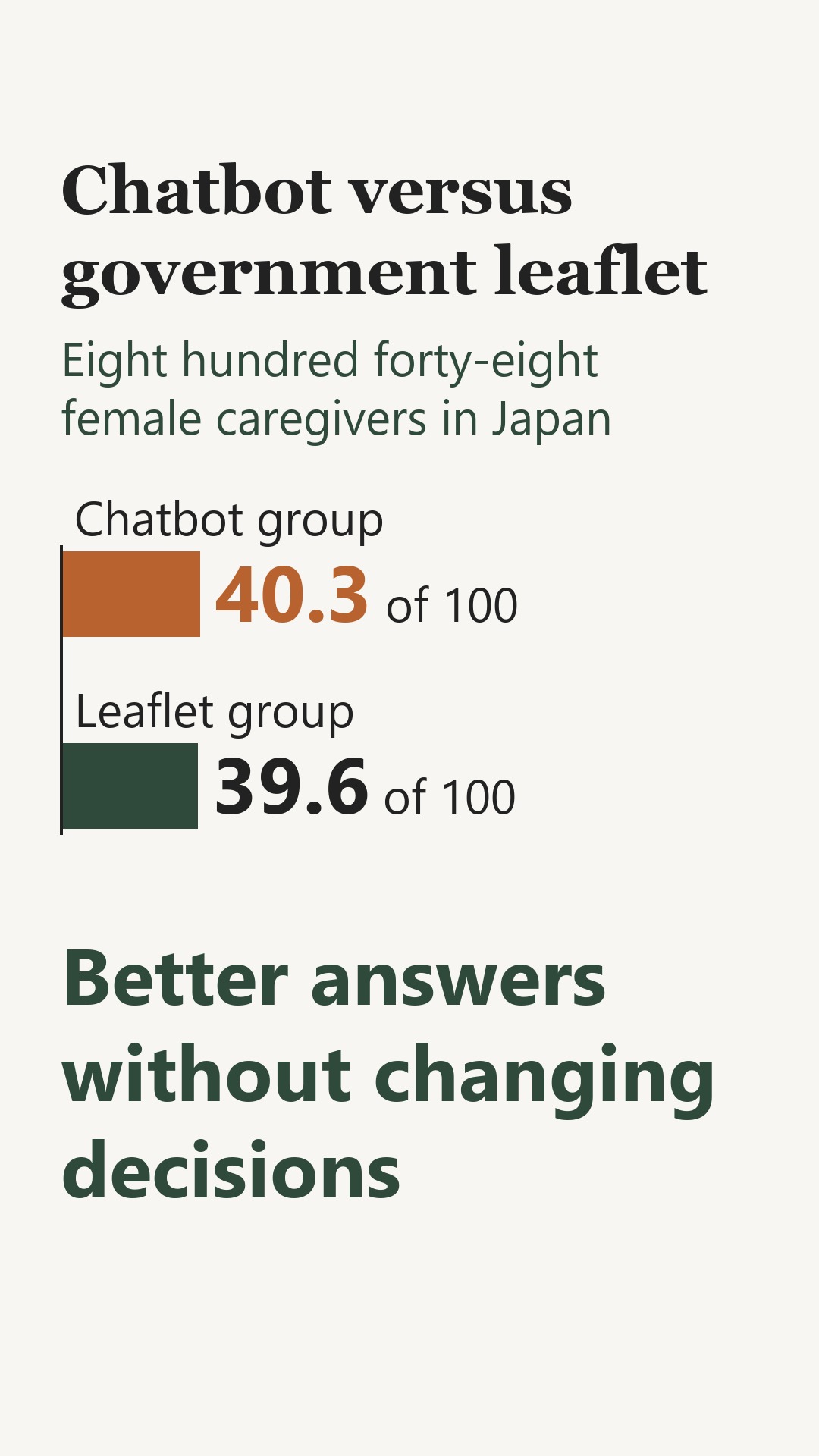
These are shares of caregivers who said they were willing, not shares who got their daughters vaccinated; the study did not check whether anyone was actually vaccinated.
Chatbot versus the government leaflet
Higher scores on seven factual questions right after the session, by 0.30 points on a 0 to 7 scale
The same 0.30-point edge on the seven questions two weeks later
About the same share willing to vaccinate: 40.3% against 39.6%, a difference the researchers called not significant
Better answers did not move the choice.
You have a question about a vaccine for your child. You want a straight answer, in private, and you do not want to wait for an appointment to hear it.
Researchers at universities in the UK, Hong Kong and Japan tested an AI chatbot against the government's leaflet, which caregivers read on screen. The chatbot ran on GPT-4o, with a library built from official Japanese vaccine materials. The trial enrolled 848 female caregivers with unvaccinated daughters aged 12 to 18. Half used the chatbot, half the leaflet, and everyone had to spend at least 5 minutes with their material.
The test was seven factual questions about HPV and the HPV vaccine, scored from 0 to 7. Right after the session, the chatbot group scored 0.30 points higher than the leaflet group. Two weeks later, the gap was still 0.30 points. Both differences were small, and the researchers reported them as significant.
Then came the decision. At two weeks, 40.3 percent of the chatbot group said they were willing or very willing to vaccinate, against 39.6 percent of the leaflet group. That is about the same, and the difference was not significant. Better answers did not move the choice.
Keep that count in view. The outcome was what caregivers said, not shots given, and it covered only two weeks. The trial was built to detect differences in answers, so a small effect on decisions could have been missed.
Look at who took part. Most had a college or university degree and a household income of 4 million yen or more, about $25,000 US. Just over half of the caregivers were included in the two-week check.
What the study does show is that a conversational tool explained dosing, safety, vaccine types and effectiveness clearly enough to be measured. Among chatbot users whose records were matched, the most-asked topic was dosing, followed by safety. The authors say a chatbot can sit alongside official materials and a clinician's advice. They do not present it as a replacement for either.
Watch for clinics, schools or health departments that offer a chatbot next to a real person to talk to. Judge it by one thing: whether it answers your particular question about your particular child.
What this means for you
For now, this is a gain in understanding, not in shots given, and it was measured only among Japanese mothers of unvaccinated daughters aged 12 to 18. If a clinic or school near you offers a chatbot beside a real person to answer questions, you can try it and see whether it addresses your own child's case.
Kobayashi, K., Wu, Z., Tomoi, H. et al. (2026). AI Chatbot Use for Human Papillomavirus Vaccine Literacy in Japan. JAMA Network Open. https://doi.org/10.1001/jamanetworkopen.2026.34696
Who paid: The work was supported by AIR@InnoHK, administered by the Innovation and Technology Commission, and the article states the funder had no role in design, conduct, data handling, analysis, interpretation, writing, review, approval or the decision to publish.
Do not take this as professional medical advice.
The longer versionThe passages copied from the paper, the pictures, and every source with how much of it we read · 1321 words · about 7 minRead it →Close
A Chatbot Taught Mothers More About the HPV Vaccine. It Didn't Change Their Minds.
A randomized trial in Japan found better scores on seven factual questions after a chatbot than after the government leaflet, and no difference in the decision to vaccinate.
Japan has watched one vaccine go quiet. Cervical cancer is a major public health concern there, with more than 10,000 new cases and approximately 3,000 deaths annually1. The HPV vaccine prevents the infections behind it. The country introduced the vaccine into its national immunization program in 20132. After media reports of suspected adverse events, the government suspended its proactive recommendation; vaccination stayed publicly funded, but uptake fell from approximately 70% to less than 1%3.
Media reports and online videos describing suspected adverse events contributed to public concern after the program began2. The government suspended its proactive recommendation. Vaccination stayed publicly funded, and few families took it up3. The proactive recommendation was reinstated in 2022 after a review reaffirmed vaccine safety and effectiveness, yet confidence and uptake have recovered slowly4. The facts came back before the trust did.
Into that gap stepped a chatbot. Researchers at the London School of Hygiene and Tropical Medicine and Nagasaki University, with colleagues in Hong Kong, carried out a randomized trial; participants were recruited online through a national research panel run by ORB International, which administered the recruitment and surveys. Female caregivers of unvaccinated daughters aged 12 to 18 were sorted by computer into two groups of 424: one talked with an AI chatbot, the other read the standard leaflet from Japan's Ministry of Health, Labour and Welfare. Seven were later excluded because they lived outside Japan or in another residence category, leaving 841. Everyone had to spend at least five minutes with their material. The study ran from November 30 to December 27, 2024. It was paid for by AIR@InnoHK, administered by the Innovation and Technology Commission, and the funder had no role in the design, conduct, analysis or publication; no conflicts of interest were reported.
The chatbot was built on GPT-4o, a large language model, and a Japan-specific reference library assembled from official vaccine materials, peer-reviewed literature and other health sources5. It was designed to answer HPV vaccine questions, remain within scope, avoid individualized medical advice, and direct users to health care practitioners for personal clinical concerns6. In plain terms: a question goes in, the model draws on a shelf of vetted documents, and an answer comes back in conversation. The leaflet does none of that; it is a fixed page of official information.
Literacy was measured with seven factual questions about HPV and HPV vaccination, scored from 0 to 7. Immediately after the intervention, the chatbot group scored higher by an adjusted 0.30 points, with a 95% confidence interval of 0.18 to 0.43 points7. At two weeks, the gap held at 0.30 points, interval 0.13 to 0.478. Picture a quiz of seven questions: the difference is about a third of one right answer, on average, between two groups who already scored near 5 out of 7. On the decision to vaccinate, 102 of 253 caregivers in the chatbot group (40.3%) and 103 of 260 in the leaflet group (39.6%) met the study's definition9. The adjusted odds ratio was 0.74, with a wide interval of 0.41 to 1.3310.
The authors are direct about what that gap in decision means. The absence of a short-term difference highlights a distinction: scalable AI tools can strengthen factual literacy, but conversion of literacy into vaccination decisions likely requires integration with trusted clinician, school, or municipal recommendations11. The tool informs; it does not authorize.
Consider what the trial was not built to see. Decision to vaccinate was self-reported, assessed over only two weeks, and not verified against uptake; the trial was powered for literacy and may not have detected small decision-making effects12. Some participants dropped out: 704 of 841 were in the immediate analysis, and 477 of 841 at two weeks. Participants had relatively high educational attainment and household income, limiting generalizability13. Backend chatbot logs matched only 176 of the 424 chatbot participants, so the per-protocol estimates carry selection risk. Attention could not be fully verified online, and the leaflet group left no equivalent engagement record. Findings apply to this chatbot configuration, this reference library and this Japanese context.
Here is weeklyAI's reading. A person can learn the facts and still wait. What the trial shows is a split between knowing and doing: the chatbot moved the first and left the second where it was. That pattern leads weeklyAI to expect that in homes like the reader's, a free conversational tool will be good at answering the question asked and poor at settling the fear behind it. This reading would be wrong if mothers whose scores rose most were also the ones most likely to decide to vaccinate, or if a chatbot built to address fear directly, not just facts, moved the decision. When you hear a vaccine alarm, ask whether the worry is about the size of the risk or about the feeling itself, and ask a clinic to put the actual numbers next to it.
There is a second reading. A conversation that answers back feels different from a folded sheet of paper, even when the answers follow rules. weeklyAI would expect the warmth of the exchange to be part of why scores rose, and would not expect warmth alone to be enough to change a decision made for a daughter. This reading is not supported by the trial's own check: time spent chatting and the number of questions asked were not significantly linked to how much a mother's understanding changed. When a chatbot or a hotline feels comforting, check whether you came away able to repeat the key facts to someone else.
The authors' own suggestion is the practical one: official materials could provide standard guidance, while chatbots offer tailored clarification before or after clinician, school, or municipal recommendations14. That points to a division of labor rather than a replacement. A chatbot can prepare your questions; a nurse or doctor still gives the go-ahead.
Other work in this family has gone further. According to the summary of a study of a motivational-interviewing chatbot in Hong Kong primary care, the only part of it available, the automated conversation improved physical activity and fruit and vegetable intake among adults at risk of hypertension or diabetes, and the effects were sustained at nine-month follow-up1516. According to the summary of a study of a pediatric health assistant in China, the only part available, caregivers started more than 16,000 chat sessions and 43.8% of them fell outside routine clinic hours1718. The pattern is consistent: these tools reach people at hours and in places where a clinic desk is closed.
The trial reported no adverse events or unintended effects related to either intervention. It did not test whether anyone was vaccinated, and it cannot show that a chatbot is better than a clinician's recommendation, a school nurse's word or a mother's own doctor. What it shows is narrower and worth having: a free tool, fed on official material, taught caregivers more of the facts than the official paper did, and kept that edge for two weeks.
For the reader, the useful part is the question to carry into a clinic or a school office. Ask what the vaccine protects against, what the known risks are, and what the local recommendation is, in plain words. Then ask whether the clinic has a phone line or a walk-in hour for vaccine questions. A chatbot can get you ready for that conversation. It cannot have it for you.
The leaflet is still in the clinic waiting room, one page, no conversation. The chatbot is on the phone, ready at midnight, and it will not tell you what to do. The next step is the one neither can take: asking a person you trust, face to face, whether your daughter should get the shot.
Where each piece of context comes from, and how much of it we read
- Kobayashi, K., Wu, Z., Tomoi, H. et al. (2026). AI Chatbot Use for Human Papillomavirus Vaccine Literacy in Japan. JAMA Network Open. https://doi.org/10.1001/jamanetworkopen.2026.34696 - the article this story is about — the whole article — the passage: "Cervical cancer remains a major public health concern in Japan, with more than 10 000 new cases and approximately 3000 deaths annually."
- Kobayashi, K., Wu, Z., Tomoi, H. et al. (2026). AI Chatbot Use for Human Papillomavirus Vaccine Literacy in Japan. JAMA Network Open. https://doi.org/10.1001/jamanetworkopen.2026.34696 - the article this story is about — the whole article — the passage: "After introduction into the national immunization program in 2013, media reports and online videos describing suspected adverse events contributed to public concern"
- Kobayashi, K., Wu, Z., Tomoi, H. et al. (2026). AI Chatbot Use for Human Papillomavirus Vaccine Literacy in Japan. JAMA Network Open. https://doi.org/10.1001/jamanetworkopen.2026.34696 - the article this story is about — the whole article — the passage: "Vaccination remained publicly funded, but uptake fell from approximately 70% to less than 1%."
- Kobayashi, K., Wu, Z., Tomoi, H. et al. (2026). AI Chatbot Use for Human Papillomavirus Vaccine Literacy in Japan. JAMA Network Open. https://doi.org/10.1001/jamanetworkopen.2026.34696 - the article this story is about — the whole article — the passage: "The proactive recommendation was reinstated in 2022 after review reaffirmed vaccine safety and effectiveness, yet confidence and uptake have recovered slowly."
- Kobayashi, K., Wu, Z., Tomoi, H. et al. (2026). AI Chatbot Use for Human Papillomavirus Vaccine Literacy in Japan. JAMA Network Open. https://doi.org/10.1001/jamanetworkopen.2026.34696 - the article this story is about — the whole article — the passage: "Participants assigned to the intervention accessed an AI-driven chatbot powered by GPT-4o. A Japan-specific reference library assembled from official vaccine materials, peer-reviewed literature, and other health sources supported the chatbot."
- Kobayashi, K., Wu, Z., Tomoi, H. et al. (2026). AI Chatbot Use for Human Papillomavirus Vaccine Literacy in Japan. JAMA Network Open. https://doi.org/10.1001/jamanetworkopen.2026.34696 - the article this story is about — the whole article — the passage: "It was designed to answer HPV vaccine questions, remain within scope, avoid individualized medical advice, and direct users to health care practitioners for personal clinical concerns."
- Kobayashi, K., Wu, Z., Tomoi, H. et al. (2026). AI Chatbot Use for Human Papillomavirus Vaccine Literacy in Japan. JAMA Network Open. https://doi.org/10.1001/jamanetworkopen.2026.34696 - the article this story is about — the whole article — the passage: "Immediately after the intervention, analysis of covariance-adjusted literacy was higher with the chatbot (adjusted mean difference, 0.30 points on the 0 to 7 scale; 95% CI, 0.18-0.43 points; P < .001)."
- Kobayashi, K., Wu, Z., Tomoi, H. et al. (2026). AI Chatbot Use for Human Papillomavirus Vaccine Literacy in Japan. JAMA Network Open. https://doi.org/10.1001/jamanetworkopen.2026.34696 - the article this story is about — the whole article — the passage: "At the prespecified 2-week follow-up assessment evaluating durability, the corresponding ANCOVA model also favored the chatbot group (adjusted mean difference, 0.30 points; 95% CI, 0.13-0.47; P < .001)."
- Kobayashi, K., Wu, Z., Tomoi, H. et al. (2026). AI Chatbot Use for Human Papillomavirus Vaccine Literacy in Japan. JAMA Network Open. https://doi.org/10.1001/jamanetworkopen.2026.34696 - the article this story is about — the whole article — the passage: "At follow-up, 102 of 253 caregivers (40.3%) in the chatbot group and 103 of 260 caregivers (39.6%) in the leaflet group reported met the definition for decision to vaccinate."
- Kobayashi, K., Wu, Z., Tomoi, H. et al. (2026). AI Chatbot Use for Human Papillomavirus Vaccine Literacy in Japan. JAMA Network Open. https://doi.org/10.1001/jamanetworkopen.2026.34696 - the article this story is about — the whole article — the passage: "The aOR comparing the chatbot group with the leaflet group was 0.74 (95% CI, 0.41 to 1.33; P = .31)"
- Kobayashi, K., Wu, Z., Tomoi, H. et al. (2026). AI Chatbot Use for Human Papillomavirus Vaccine Literacy in Japan. JAMA Network Open. https://doi.org/10.1001/jamanetworkopen.2026.34696 - the article this story is about — the whole article — the passage: "The absence of a corresponding short-term difference in vaccination decision highlights an implementation-relevant distinction: scalable AI tools can strengthen factual literacy, but conversion of literacy into vaccination decisions likely requires integration with trusted clinician, school, or municipal recommendations."
- Kobayashi, K., Wu, Z., Tomoi, H. et al. (2026). AI Chatbot Use for Human Papillomavirus Vaccine Literacy in Japan. JAMA Network Open. https://doi.org/10.1001/jamanetworkopen.2026.34696 - the article this story is about — the whole article — the passage: "Second, decision to vaccinate was self-reported, assessed over only 2 weeks, and not verified against uptake; the trial was powered for literacy and may not have detected small decision-making effects."
- Kobayashi, K., Wu, Z., Tomoi, H. et al. (2026). AI Chatbot Use for Human Papillomavirus Vaccine Literacy in Japan. JAMA Network Open. https://doi.org/10.1001/jamanetworkopen.2026.34696 - the article this story is about — the whole article — the passage: "Sixth, participants had relatively high educational attainment and household income, limiting generalizability."
- Kobayashi, K., Wu, Z., Tomoi, H. et al. (2026). AI Chatbot Use for Human Papillomavirus Vaccine Literacy in Japan. JAMA Network Open. https://doi.org/10.1001/jamanetworkopen.2026.34696 - the article this story is about — the whole article — the passage: "Official materials could provide standard guidance, while chatbots offer tailored clarification before or after clinician, school, or municipal recommendations."
- Wong CHY, Wong MNK, Hou WK, Ting FST, Ng YM, Che Hin Chan C. (2026). Motivational interviewing chatbot improves lifestyle in primary healthcare settings in a pragmatic randomised controlled trial. npj Digital Medicine. 10.1038/s41746-026-02728-w — only the abstract - the full text could not be fetched — the passage: "Modified intention-to-treat analysis (n = 460) showed significant improvements in the intervention group compared to usual care in physical activity (576 MET-min/week), fruit/vegetable intake (0.27 portions/day), and committed action (0.95 a.u.) at 12 weeks."
- Wong CHY, Wong MNK, Hou WK, Ting FST, Ng YM, Che Hin Chan C. (2026). Motivational interviewing chatbot improves lifestyle in primary healthcare settings in a pragmatic randomised controlled trial. npj Digital Medicine. 10.1038/s41746-026-02728-w — only the abstract - the full text could not be fetched — the passage: "Effects were sustained at 9-month follow-up."
- Wei Q, Xiao L, Zhang X, Wei H, Wang R, Ou S, et al. (2026). Real-World Use and Expert-Guided Optimization of a Large Language Model–Based Pediatric Health Assistant: Retrospective Observational Study. Journal of Medical Internet Research. 10.2196/105346 — only the abstract - the full paper is behind a subscription — the passage: "Caregivers of 8266 children (median age 4.2, IQR 1.3-8 years; 4705/8266, 56.9% male) from 31 of 34 provincial-level divisions in China initiated 16,074 sessions"
- Wei Q, Xiao L, Zhang X, Wei H, Wang R, Ou S, et al. (2026). Real-World Use and Expert-Guided Optimization of a Large Language Model–Based Pediatric Health Assistant: Retrospective Observational Study. Journal of Medical Internet Research. 10.2196/105346 — only the abstract - the full paper is behind a subscription — the passage: "of which 7046 (43.8%) occurred outside routine clinic hours (08:00-17:30)"
Kobayashi, K., Wu, Z., Tomoi, H. et al. (2026). AI Chatbot Use for Human Papillomavirus Vaccine Literacy in Japan. JAMA Network Open. https://doi.org/10.1001/jamanetworkopen.2026.34696
Who paid: The work was supported by AIR@InnoHK, administered by the Innovation and Technology Commission, and the article states the funder had no role in design, conduct, data handling, analysis, interpretation, writing, review, approval or the decision to publish.
Do not take this as professional medical advice.