experiment · Nature communications · la publicación, 7 may 2026 · gratis
La IA ya ayuda a leer radiografías de tórax, pero el trabajo sigue siendo humano
En un estudio con 296 pacientes en China, los radiólogos que usaron un borrador de IA entregaron mejores informes y tardaron 18.3% menos. Los pacientes eran chinos y todos los informes los firmó un médico.
Versión breve · la versión detallada sigue, unos 6 min
Pregunte a weeklyAI
Pregúnteme por este estudio: a quiénes se estudió, qué encontró y qué no dice.
Las conversaciones se guardan mientras exista weeklyAI, para mejorar la publicación. Se responde en el idioma en que usted escribe.
- El estudio, de un vistazo
- Quiénes
- Pacientes con sospecha de enfermedad torácica y radiólogos jóvenes
- Cuántos
- 296 pacientes
- Dónde
- China
- Cuándo
- No lo dice el pasaje
- Tipo de estudio
- experiment
- Quién lo hizo
- Investigadores en China, con datos de 27 hospitales
- El límite que importa
- Solo se probó en China, con radiografías frontales y sin comparar con otros sistemas
El grupo con IA tardó 120.6 segundos por informe y el grupo sin IA 147.6 segundos, una reducción del 18.3%; son promedios de 296 pacientes en tres hospitales de China.
Radiólogos jóvenes con borrador de IA frente a radiólogos jóvenes sin IA
Mejor calificación de calidad del informe: 4.36 frente a 4.12
Informes escritos más rápido: 120.6 segundos frente a 147.6 segundos
Más diagnósticos positivos de neumonía: 52.4% frente a 36.1%
El sistema tampoco reemplaza al especialista: su capacidad para reconocer hallazgos complejos o sutiles, como las fracturas, todavía necesita mejorar.
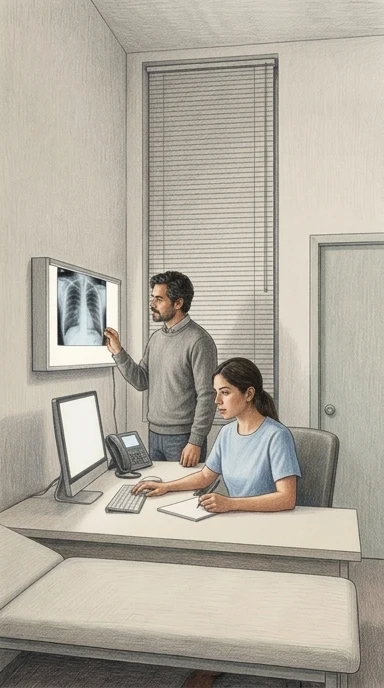
Imagine una sala de urgencias. Llega una placa de tórax y hay una sola persona para leerla, y otras cien esperando.
Según el artículo, en los países de bajos ingresos hay 1.9 radiólogos por millón de habitantes; en los de altos ingresos, 97.9. El artículo describe un estudio en el que las radiografías de tórax son de los estudios más pedidos, y su lectura pesa sobre esa escasez.
El artículo describe un estudio en el que un grupo de investigadores en China tomó Janus-Pro, un modelo de lenguaje e imágenes de código abierto, y lo entrenó con radiografías para que escribiera informes. El sistema se llama Janus-Pro-CXR. Lo ajustaron con imágenes de 27 hospitales chinos, y tiene mil millones de parámetros: un tamaño pequeño para lo que se usa hoy.
Luego hicieron una prueba con 296 pacientes en tres hospitales. Veinte radiólogos fueron asignados al azar a dos grupos: uno usaba el borrador de la IA y otro trabajaba sin ella. Cada paciente fue leído por un radiólogo de cada grupo.
Los informes del grupo con IA obtuvieron 4.36 puntos sobre 5, frente a 4.12 del grupo sin IA. Y terminaron más rápido: 120.6 segundos frente a 147.6, una reducción de 18.3%. En casos con tres o más hallazgos, la ventaja se mantuvo.
La IA nunca trabajó sola: un radiólogo joven editaba su borrador y un radiólogo senior revisaba y firmaba cada informe. El resultado es de un equipo entre persona y máquina, no de una máquina leyendo su placa por su cuenta. El sistema tampoco reemplaza al especialista: su capacidad para reconocer hallazgos complejos o sutiles, como las fracturas, todavía necesita mejorar. Además, su desempeño es más limitado en hallazgos como el edema y el engrosamiento pleural.
Los 296 pacientes estaban en China. El tamaño de la ventaja en una clínica de América Latina, Estados Unidos o Canadá no está medido. Tampoco se probó con tomografías, resonancias ni ecografías.
Lo que este estudio sí muestra es que el sistema corre en una laptop con una tarjeta gráfica de 8GB, y que la arquitectura del modelo se publicará como código abierto. Para una clínica pública que no puede pagar grandes equipos ni depender de servidores costosos, eso es lo que vuelve la idea algo que se puede intentar.
Es si en su hospital hay un radiólogo disponible, cuánto espera un informe, y si alguien está midiendo eso.
Pregunte en su centro de salud: ¿cuánto tarda hoy un informe de tórax, y quién lo firma?
Qué significa para usted
Este estudio se hizo con 296 pacientes en China, así que no puede saber todavía cuánto tardaría un informe donde usted vive. Lo que sí puede hacer es preguntar en su centro de salud cuánto demora hoy un informe de tórax y quién lo firma, y observar si esa espera se mide. Si le dicen que un programa escribe el borrador, el radiólogo sigue siendo quien lo revisa y lo firma.
Bai, Y., Zhang, R., Lei, Y. et al. (2026). A DeepSeek-powered AI system for automated chest radiograph interpretation in clinical practice. Nature Communications. https://doi.org/10.1038/s41467-026-72680-6
Quién pagó: El estudio fue financiado por la Fundación Nacional de Ciencias Naturales de China, el Programa Nacional Clave de Investigación y Desarrollo de China, la Fundación de Ciencias Naturales de la Provincia de Hubei y la New Cornerstone Science Foundation a través del XPLORER PRIZE; el artículo no indica si los financiadores tuvieron alguna influencia, y no se nombra a ningún proveedor de equipos o software.
No tome esto como consejo médico profesional.
Los hallazgos de otros estudios que aquí se mencionan los conocemos por este documento, que fue el que leímos; no abrimos cada uno de esos estudios.
Versión detalladaLos pasajes copiados del artículo, las ilustraciones y cada fuente con cuánto leímos de ella · 1216 palabras · unos 6 minLeerla →Cerrar
La IA que redacta informes de radiografías: lo que un ensayo en China midió y lo que aún no
Un estudio prospectivo con 296 pacientes halló que los informes hechos con ayuda de un sistema automático fueron mejor calificados y tomados en menos tiempo. La letra pequeña importa.
Un grupo de investigadores en China probó un sistema de inteligencia artificial llamado Janus-Pro-CXR para interpretar radiografías de tórax y redactar el informe. Lo hicieron en un estudio prospectivo, es decir, con pacientes reales atendidos en el momento, en tres hospitales chinos. En total participaron 296 pacientes. El sistema produjo un borrador de informe que radiólogos jóvenes podían usar como referencia y modificar; un radiólogo senior revisaba y firmaba cada informe antes de que saliera12.
Los resultados principales fueron tres. Primero, la calidad del informe: el grupo que trabajó con ayuda de la IA obtuvo una calificación media de 4,36 sobre 5, frente a 4,12 del grupo que trabajó sin ella. Segundo, la concordancia con el informe de referencia, medida con un sistema estándar de puntuación: 4,30 frente a 4,14. Tercero, el tiempo: el grupo con IA tardó en promedio 120,6 segundos por informe; el grupo sin IA, 147,6 segundos. La diferencia fue de 27 segundos, una reducción del 18.3%34.
Los autores calculan que, si un radiólogo lee unos 200 estudios en una jornada, esos 27 segundos por informe se acumulan en aproximadamente 90 minutos de tiempo ahorrado al día5. El sistema es pequeño: funciona en una laptop con una tarjeta gráfica de gama media y tarda entre uno y dos segundos en analizar la imagen6.
Hay límites que los propios autores señalan. El modelo reconoce peor los hallazgos complejos o sutiles, como las fracturas7. El estudio no comparó Janus-Pro-CXR con otros sistemas similares desarrollados específicamente para radiografías de tórax. Y el sistema, en esta etapa, solo puede servir como herramienta auxiliar: no reemplaza al radiólogo8. La validación prospectiva de la capacidad de integrar radiografías anteriores del mismo paciente todavía no se ha hecho.
Para entender por qué esto importa, hay que mirar la escasez. La falta de radiólogos en el mundo ha aumentado la carga de interpretar radiografías de tórax, sobre todo en la atención primaria y en lugares con pocos recursos9. La diferencia entre regiones es enorme: en los países de bajos ingresos hay 1,9 radiólogos por millón de habitantes; en los de altos ingresos, 97,9 por millón10. La radiografía de tórax sigue siendo el estudio de imagen más básico y más usado, indispensable para detectar infecciones pulmonares y para tamizar tumores11.
El mecanismo del sistema es sencillo de describir. El equipo tomó un modelo multimodal de código abierto —Janus-Pro, de la empresa DeepSeek— y lo entrenó con cientos de miles de radiografías y sus informes ya publicados. Luego lo ajustó con imágenes de 27 centros médicos chinos para adaptarlo al estilo de redacción local. Cuando llega una radiografía nueva, el sistema genera un borrador de informe en uno o dos segundos. Ese borrador aparece en la pantalla del radiólogo, que puede editarlo, corregirlo o descartarlo. Después, como siempre, un radiólogo senior revisa y firma62.
Es útil comparar los dos grupos del ensayo. En el grupo con IA, el radiólogo joven partía de un texto ya redactado y lo modificaba según su criterio. En el grupo sin IA, el radiólogo joven redactaba desde cero, como se ha hecho siempre2. La diferencia de tiempo fue de 27 segundos por informe.
Los mismos autores reconocen que su estudio tiene otra limitación importante: el patrón de referencia contra el cual compararon los informes fueron los informes radiológicos publicados, que no son un patrón de oro perfecto. Su precisión depende de la complejidad de cada caso y del criterio individual de cada radiólogo. Además, el sistema se probó solo en China, con pacientes que tenían sospecha clínica de enfermedad torácica y que se hicieron solo radiografías de tórax frontales, sin proyección lateral ni comparación con estudios anteriores.
Así lo leemos nosotros. Este estudio pertenece a una familia de trabajos que intentan medir si la inteligencia artificial realmente ayuda en la práctica clínica, no solo en el laboratorio. La diferencia entre un resultado de laboratorio y un resultado clínico es la diferencia entre "el sistema acierta en las pruebas" y "el sistema mejora la atención que recibe una persona real". Eso es lo que este ensayo intentó medir, y lo midió bien: con pacientes reales, con radiólogos reales, con un grupo de comparación.
Pero conviene ser precisos sobre qué se midió. No se midió si la IA diagnostica mejor que un médico. Se midió si un radiólogo joven, con un borrador de IA en la mano, produce un informe mejor calificado y en menos tiempo que un radiólogo joven sin ese borrador. La respuesta fue sí, en ese contexto. Eso no significa que la IA lea bien su radiografía. Significa que ayuda a un profesional a redactar más rápido un informe que ese profesional luego revisa y firma.
Lo que quisiéramos ver a continuación es si ese tiempo ahorrado se traduce en algo que el paciente note: menos estudios acumulados en la bandeja de entrada, lecturas menos apuradas al final del día, diagnósticos que no se pasan por alto porque el radiólogo llevaba doce horas leyendo imágenes. Eso no se midió aquí. También quisiéramos ver estudios en otros países, con otras poblaciones, con otras enfermedades y con otros sistemas de salud. Un resultado obtenido en tres hospitales chinos puede no repetirse en un hospital público de América Latina, donde las condiciones de trabajo, los equipos y los flujos de pacientes son distintos.
Para el lector que algún día se haga una radiografía de tórax, hay algo concreto que puede preguntar. Si el informe menciona hallazgos que no coinciden con sus síntomas, o si el resultado es un diagnóstico cerrado y usted sigue sintiéndose mal, puede pedir una segunda lectura. Puede preguntar si el informe se redactó con ayuda de algún sistema automático y si un médico lo revisó antes de firmarlo. Puede preguntar si se comparó con radiografías anteriores suyas, si las hay. Y si trabaja en salud o estudia una profesión técnica, la lección práctica es tratar cualquier salida de un sistema automático como un borrador que hay que verificar, no como una respuesta final.
Los autores anunciaron que el código del modelo será de acceso abierto, lo que facilitaría que otros centros lo adapten a sus propias poblaciones12. También planean mejorar la capacidad del sistema para generar informes de manera independiente y explorar un flujo de trabajo en el que los borradores de la IA lleguen directamente al radiólogo senior13. Eso, si se prueba y funciona, sería un cambio distinto: ya no un apoyo para el radiólogo joven, sino una reorganización completa de quién hace qué en el servicio de radiología.
Lo que este ensayo deja claro es que la pregunta ya no es si la IA puede escribir un informe de radiografía. Puede. La pregunta es si ese informe, después de pasar por manos humanas, mejora algo que le importe al paciente. En este caso, en este lugar, con estos pacientes, los autores encontraron que sí. La próxima vez que le entreguen el resultado de una radiografía, pregunte quién lo revisó y si alguien lo firmó. Esa pregunta sigue siendo la más importante, con IA o sin ella.
De dónde sale cada dato de contexto, y cuánto leímos de cada documento
- Bai, Y., Zhang, R., Lei, Y. et al. (2026). A DeepSeek-powered AI system for automated chest radiograph interpretation in clinical practice. Nature Communications. https://doi.org/10.1038/s41467-026-72680-6 - el artículo del que trata esta nota — el artículo completo — el pasaje: "Here we show that Janus-Pro-CXR, a lightweight artificial intelligence system optimized for chest radiograph interpretation, improves report quality and workflow efficiency in a multicenter prospective study ( NCT07117266 )."
- Bai, Y., Zhang, R., Lei, Y. et al. (2026). A DeepSeek-powered AI system for automated chest radiograph interpretation in clinical practice. Nature Communications. https://doi.org/10.1038/s41467-026-72680-6 - el artículo del que trata esta nota — el artículo completo — el pasaje: "In the prospective study, junior radiologists in the AI-assisted group used reports generated by Janus-Pro-CXR as references and modified the content as needed, while radiologists in the standard care group independently drafted their reports."
- Bai, Y., Zhang, R., Lei, Y. et al. (2026). A DeepSeek-powered AI system for automated chest radiograph interpretation in clinical practice. Nature Communications. https://doi.org/10.1038/s41467-026-72680-6 - el artículo del que trata esta nota — el artículo completo — el pasaje: "In terms of report quality, the AI-assisted group achieved a mean score of 4.36 ± 0.50, statistically significantly higher than the standard care group’s score of 4.12 ± 0.80 (Mean of differences = 0.25, P < 0.001, 95% CI = 0.216-0.283)"
- Bai, Y., Zhang, R., Lei, Y. et al. (2026). A DeepSeek-powered AI system for automated chest radiograph interpretation in clinical practice. Nature Communications. https://doi.org/10.1038/s41467-026-72680-6 - el artículo del que trata esta nota — el artículo completo — el pasaje: "The analysis of work efficiency showed that the AI-assisted group wrote reports in an average of 120.6 ± 45.6 s, significantly faster than the standard care group, which took 147.6 ± 51.1 s (Mean of differences = 27.0, 18.3% reduction, P < 0.001, 95% CI = 19.2–34.8)"
- Bai, Y., Zhang, R., Lei, Y. et al. (2026). A DeepSeek-powered AI system for automated chest radiograph interpretation in clinical practice. Nature Communications. https://doi.org/10.1038/s41467-026-72680-6 - el artículo del que trata esta nota — el artículo completo — el pasaje: "Based on the 27 s saved per report in the AI-assisted group in this study, radiologists can accumulate a total of 90 min of savings per day."
- Bai, Y., Zhang, R., Lei, Y. et al. (2026). A DeepSeek-powered AI system for automated chest radiograph interpretation in clinical practice. Nature Communications. https://doi.org/10.1038/s41467-026-72680-6 - el artículo del que trata esta nota — el artículo completo — el pasaje: "With 1 billion parameters, the model achieves rapid imaging analysis with a latency of 1–2 s on a laptop equipped with a GeForce RTX 4060 (8GB)."
- Bai, Y., Zhang, R., Lei, Y. et al. (2026). A DeepSeek-powered AI system for automated chest radiograph interpretation in clinical practice. Nature Communications. https://doi.org/10.1038/s41467-026-72680-6 - el artículo del que trata esta nota — el artículo completo — el pasaje: "However, the model’s ability to recognize the complex or subtle findings, such as fractures, requires further improvement."
- Bai, Y., Zhang, R., Lei, Y. et al. (2026). A DeepSeek-powered AI system for automated chest radiograph interpretation in clinical practice. Nature Communications. https://doi.org/10.1038/s41467-026-72680-6 - el artículo del que trata esta nota — el artículo completo — el pasaje: "It indicates that Janus-Pro-CXR can only serve as an auxiliary tool for radiologists at the current stage and cannot replace them."
- Bai, Y., Zhang, R., Lei, Y. et al. (2026). A DeepSeek-powered AI system for automated chest radiograph interpretation in clinical practice. Nature Communications. https://doi.org/10.1038/s41467-026-72680-6 - el artículo del que trata esta nota — el artículo completo — el pasaje: "A global shortage of radiologists has increased the burden of chest X-ray interpretation, particularly in primary and resource-limited settings."
- Bai, Y., Zhang, R., Lei, Y. et al. (2026). A DeepSeek-powered AI system for automated chest radiograph interpretation in clinical practice. Nature Communications. https://doi.org/10.1038/s41467-026-72680-6 - el artículo del que trata esta nota — el artículo completo — el pasaje: "This issue is particularly pronounced in low-income regions, where countries report just 1.9 radiologists per million residents, compared to 97.9 per million in high-income countries."
- Bai, Y., Zhang, R., Lei, Y. et al. (2026). A DeepSeek-powered AI system for automated chest radiograph interpretation in clinical practice. Nature Communications. https://doi.org/10.1038/s41467-026-72680-6 - el artículo del que trata esta nota — el artículo completo — el pasaje: "Chest X-ray (CXR), the most fundamental and widely utilized imaging modality, remains indispensable in clinical practices such as detecting pulmonary infections and screening for tumors."
- Bai, Y., Zhang, R., Lei, Y. et al. (2026). A DeepSeek-powered AI system for automated chest radiograph interpretation in clinical practice. Nature Communications. https://doi.org/10.1038/s41467-026-72680-6 - el artículo del que trata esta nota — el artículo completo — el pasaje: "The model architecture will be open-sourced to facilitate the clinical translation of AI-assisted radiology solutions."
- Bai, Y., Zhang, R., Lei, Y. et al. (2026). A DeepSeek-powered AI system for automated chest radiograph interpretation in clinical practice. Nature Communications. https://doi.org/10.1038/s41467-026-72680-6 - el artículo del que trata esta nota — el artículo completo — el pasaje: "In future research, we will further optimize Janus-Pro-CXR’s independent report generation capability. We will also explore the workflow model where AI-generated reports are directly submitted to senior physicians for review."
Bai, Y., Zhang, R., Lei, Y. et al. (2026). A DeepSeek-powered AI system for automated chest radiograph interpretation in clinical practice. Nature Communications. https://doi.org/10.1038/s41467-026-72680-6
Quién pagó: El estudio fue financiado por la Fundación Nacional de Ciencias Naturales de China, el Programa Nacional Clave de Investigación y Desarrollo de China, la Fundación de Ciencias Naturales de la Provincia de Hubei y la New Cornerstone Science Foundation a través del XPLORER PRIZE; el artículo no indica si los financiadores tuvieron alguna influencia, y no se nombra a ningún proveedor de equipos o software.
No tome esto como consejo médico profesional.
experiment · Nature communications · the paper, 7 May 2026 · free
AI Shaved 18% Off Chest X-Ray Reading Time in a Chinese Hospital Study
A small trial found junior radiologists wrote better, faster reports with an AI assistant — but every report was still checked by a human, and the patients were all in China.
Short version · the longer version follows, about 7 min
Ask weeklyAI
Ask me about this study: who was studied, what it found, and what it does not say.
Conversations are saved for as long as weeklyAI exists, to improve the publication. Answers come in the language you write in.
- The study at a glance
- Who
- junior radiologists and 296 patients getting chest X-rays
- How many
- 296 patients
- Where
- three hospitals in China
- When
- not stated in the passages
- Kind of study
- experiment
- Who did it
- Wuhan University and Tongji Medical College, Huazhong University of Science and Technology, China
- The limit that matters
- The AI only assisted; it cannot replace radiologists and misses subtle findings like fractures.
Average seconds to write one report for 296 patients in three Chinese hospitals; the AI-assisted group was 27.0 seconds faster, an 18.3% reduction.
AI-assisted reports versus standard care reports
Report quality score 4.36 versus 4.12
Reading time 120.6 seconds versus 147.6 seconds
Pneumonia diagnosis rate 52.4% versus 36.1%
The AI never worked alone.
The article describes a study in which some countries have 1.9 radiologists for every million people, while wealthier countries have 97.9 per million. In between, chest X-rays keep piling up.
Researchers built an AI assistant for exactly that bottleneck. They started with Janus-Pro, an open-source model from the Chinese company DeepSeek, and trained it on chest X-ray images and reports: a public dataset called MIMIC-CXR, another called CheXpert Plus, and 11,156 images from 27 hospitals across China. The result, Janus-Pro-CXR, has about 1 billion parameters — small by the standards of today's biggest AI systems.
Then they tested it with people. The study, published in Nature Communications, took place at three hospitals in China and involved 296 patients. Twenty junior radiologists were split into two groups. One group drafted reports on their own. The other started from the AI's draft and edited it as needed. A senior radiologist reviewed and signed every report in both groups — nobody sent an AI's work straight to a patient.
The AI-assisted group scored 4.36 out of 5 on report quality, against 4.12 for standard care. They finished in 120.6 seconds on average, versus 147.6 seconds — an 18.3% reduction, about 27 seconds saved per report. Evaluators who didn't know which reports had AI help preferred the AI-assisted versions in 54.3% of cases.
Two things temper that. First, the AI never worked alone. The improvement is about teamwork — an AI draft, a junior radiologist's edit, a senior's signature. The study did not test AI replacing a radiologist, and its authors say it can only assist, not substitute. Second, the system was weaker at complex or subtle findings such as fractures, and the article describes a study in which recognition of edema and pleural thickening was also limited, a common challenge with current multimodal models. It missed things a trained eye might catch.
And all 296 patients were in China. Whether the same time savings and quality gains would appear in a clinic in Mexico, Missouri or Manitoba hasn't been measured. The size of the benefit elsewhere is unknown.
What may travel is the setup. The system runs on an ordinary laptop with an 8-gigabyte graphics card — hardware a small clinic might already own — and the model code is being released openly, meaning health systems with limited budgets could try it without buying expensive infrastructure.
If your clinic is short on radiologists, ask what tools it uses to help the ones it has — and who signs off on every report.
What this means for you
You do not need to decide anything about this today; the study only shows that in three Chinese hospitals, an AI draft helped junior radiologists write better, faster reports, and a senior still signed every one. Where you live, ask your clinic whether it uses such tools and who reviews each report.
Bai, Y., Zhang, R., Lei, Y. et al. (2026). A DeepSeek-powered AI system for automated chest radiograph interpretation in clinical practice. Nature Communications. https://doi.org/10.1038/s41467-026-72680-6
Who paid: The study was funded by the National Natural Science Foundation of China, the National Key Research and Development Program of China, the Natural Science Foundation of Hubei Province, and the New Cornerstone Science Foundation through the XPLORER PRIZE; the article does not say whether funders had any say, and no equipment or software lenders are named.
Do not take this as professional medical advice.
The findings of other studies mentioned here are known to us through this document, which is the one we read; we did not open each of those studies.
The longer versionThe passages copied from the paper, the pictures, and every source with how much of it we read · 1456 words · about 7 minRead it →Close
AI Drafted the X-Ray Report. A Radiologist Still Had to Sign It.
In a randomized study at three Chinese hospitals, junior doctors reading chest X-rays finished faster and scored higher when a lightweight AI wrote the first draft. The AI never worked alone.
A shortage of radiologists has made chest X-ray reading a bottleneck, especially in clinics with fewer specialists1. A new study tested whether a small AI system could help. The system, called Janus-Pro-CXR, was built by fine-tuning an open-source multimodal model from DeepSeek on public and Chinese chest X-ray collections2. In a prospective study across three hospitals in China, 296 patients were enrolled, and 20 radiologists were randomly assigned either to draft reports with the AI's draft as a reference or to work independently23.
The results favored the AI-assisted group on every measured outcome. Report quality scores averaged 4.36 for the AI-assisted group versus 4.12 for standard care4. Agreement between the AI-assisted reports and the reference standard averaged 4.30 versus 4.144. Reading time averaged 120.6 seconds with AI help versus 147.6 seconds without it — a reduction of 27 seconds per report, or 18.3 percent5. The authors calculated that across a full day of reading, that saving could add up to 90 minutes6. The pneumonia diagnosis rate was also higher in the AI-assisted group: 52.4 percent versus 36.1 percent7.
The system is tiny by the standards of modern AI: 1 billion parameters, running on a laptop with an 8-gigabyte graphics card, producing a draft in one to two seconds8. The authors say the model architecture will be open-sourced9. But the study also names what the system does poorly. It struggles with complex or subtle findings such as fractures10. The authors state plainly that it can only serve as an auxiliary tool and cannot replace radiologists11. And the comparison standard was the published radiological report, which the authors themselves describe as not an absolutely perfect gold standard.
The radiologist shortage is not evenly distributed. Low-income countries report 1.9 radiologists per million residents; high-income countries report 97.9 per million12. Chest X-rays remain the most fundamental imaging tool, indispensable for detecting lung infections and screening for tumors13. In that gap, a tool that writes a usable first draft in seconds and runs on ordinary hardware is not a luxury — it is a question of whether a patient's image gets a careful reading at all128.
The workflow tested was deliberately conservative. A junior radiologist opened the AI's draft, edited it as needed, and sent it up for review by a senior radiologist, who signed every report before it went to the patient's file3. The AI did not diagnose anyone. It drafted; a person decided. That distinction is the study's actual subject: not whether AI can read a chest X-ray alone, but whether a human working with a draft does better than a human working without one311.
The pattern is not unique to this study. In Nigeria, a separate program used portable chest X-rays with AI software to screen 9,585 people across 93 community outreach events; 33 percent of the images were flagged as abnormal, 204 people were diagnosed with confirmed tuberculosis, and 194 of them started treatment1415. The same program found that 75 percent of abnormal radiographs showed signs of heart or lung disease beyond TB — but only 12 percent of those people completed the referral to a specialist1617. The screening worked; the next step in the chain did not18. That gap is a warning for any AI screening program: finding something is only useful if the system around it can act on what was found1920.
A different study, in Hong Kong, tested a chatbot that delivered motivational interviewing — a counseling technique — to 627 adults at risk of hypertension or diabetes. According to the summary of that study, which we could read only in its abstract, participants who used the chatbot improved their physical activity, fruit and vegetable intake and commitment to change, and the effects held at nine months212223. A third study, in Lagos, had 36 frontline health workers answer patient questions with and without ChatGPT; clinician evaluators rated the AI-assisted responses higher on accuracy, empathy, completeness and safety2425. In each case, the AI extended what a person could do. It did not do the job alone26.
Here is how we read it. When a tool drafts and a person edits, the person keeps authority — but the draft quietly sets the terms. The vocabulary, the list of findings worth mentioning, the order of the report: all of that comes from the machine. The junior doctor who edits may accept the draft's framing without noticing what it left out, especially for the subtle findings the system handles poorly10. We would expect that in a busy clinic, the draft becomes the default, and the edit becomes lighter over time. We would be wrong if junior doctors routinely discard or substantially rewrite the AI's draft, or if the reports show the same attention to hairline fractures and early edema as to the findings the system handles well. When you or a family member gets a report, you can ask who actually read the image — and whether the software's draft was checked or simply signed.
We also read a second pattern in this story. A model tuned once on old image collections and then left alone drifts away from the patients and equipment of the clinics now using it. The fix is not one big launch but constant small retraining and checking against local images. This study tested the system in three hospitals in China; it cannot tell us how the system performs on different machines, different patient populations or different disease patterns. We would be wrong if the system's accuracy on local images held steady for years with no retraining, no new local data and no one assigned to watch it. A dated system is not automatically a wrong one — but it is worth a question.
And a third: the published results tell us that reports got faster and scored higher. They do not tell us what the system is optimized to catch. Speed, agreement with past reports, and catching dangerous findings are three different goals, and the numbers alone do not distinguish among them. We would be wrong if the makers stated plainly what the system is tuned to do and published checks showing it catches the dangerous findings, not just that reports improved. You can ask what the system is set up to catch and what it tends to miss — and whether anyone has measured that. Faster reports are only good news if the things that matter are still being found.
The authors are upfront about what remains untested. The study did not prospectively validate the system's ability to compare a current X-ray with a patient's historical X-rays — a common need in follow-up care. The comparison standard was the published report, not an independent clinical outcome. And the system was never tested against other chest X-ray-specific AI models such as MAIRA-2 or CheXagent in the prospective study, partly because those models are not open-source or require more powerful hardware. The next steps the authors describe are optimizing the system's independent report generation and testing a workflow where AI drafts go directly to senior physicians for review27.
The study was conducted entirely in China, and the measured benefit — 27 seconds saved, 0.25 points gained on a quality score — belongs to that setting. It may not transfer to a crowded public clinic in Latin America or a hospital in the United States. That is not a reason to dismiss the result. It is a reason to ask what the evidence is where you live.
The study was funded by the National Natural Science Foundation of China and other Chinese research grants; the authors declare no competing interests. The subjective evaluations were performed by five radiologists with 8 to 15 years of experience, who scored the reports without knowing which came from AI. The study was registered with ClinicalTrials.gov.
What this makes possible for you is a question, not a promise. If you or someone you love gets a chest X-ray in a busy clinic, you can ask whether the reading was done with software assistance and whether a radiologist reviewed the final report. You can ask what the system is set up to catch and what it tends to miss. And you can ask whether the clinic checks its software against local patients — or installed it once and stopped looking. The study's most useful finding is not that AI reads chest X-rays. It is that a person with a good draft does better than a person alone — and that the person still has to do the reading.
Where each piece of context comes from, and how much of it we read
- Bai, Y., Zhang, R., Lei, Y. et al. (2026). A DeepSeek-powered AI system for automated chest radiograph interpretation in clinical practice. Nature Communications. https://doi.org/10.1038/s41467-026-72680-6 - the article this story is about — the whole article — the passage: "A global shortage of radiologists has increased the burden of chest X-ray interpretation, particularly in primary and resource-limited settings."
- Bai, Y., Zhang, R., Lei, Y. et al. (2026). A DeepSeek-powered AI system for automated chest radiograph interpretation in clinical practice. Nature Communications. https://doi.org/10.1038/s41467-026-72680-6 - the article this story is about — the whole article — the passage: "Here we show that Janus-Pro-CXR, a lightweight artificial intelligence system optimized for chest radiograph interpretation, improves report quality and workflow efficiency in a multicenter prospective study ( NCT07117266 )."
- Bai, Y., Zhang, R., Lei, Y. et al. (2026). A DeepSeek-powered AI system for automated chest radiograph interpretation in clinical practice. Nature Communications. https://doi.org/10.1038/s41467-026-72680-6 - the article this story is about — the whole article — the passage: "In the prospective study, junior radiologists in the AI-assisted group used reports generated by Janus-Pro-CXR as references and modified the content as needed, while radiologists in the standard care group independently drafted their reports."
- Bai, Y., Zhang, R., Lei, Y. et al. (2026). A DeepSeek-powered AI system for automated chest radiograph interpretation in clinical practice. Nature Communications. https://doi.org/10.1038/s41467-026-72680-6 - the article this story is about — the whole article — the passage: "In terms of report quality, the AI-assisted group achieved a mean score of 4.36 ± 0.50, statistically significantly higher than the standard care group’s score of 4.12 ± 0.80 (Mean of differences = 0.25, P < 0.001, 95% CI = 0.216-0.283)"
- Bai, Y., Zhang, R., Lei, Y. et al. (2026). A DeepSeek-powered AI system for automated chest radiograph interpretation in clinical practice. Nature Communications. https://doi.org/10.1038/s41467-026-72680-6 - the article this story is about — the whole article — the passage: "The analysis of work efficiency showed that the AI-assisted group wrote reports in an average of 120.6 ± 45.6 s, significantly faster than the standard care group, which took 147.6 ± 51.1 s (Mean of differences = 27.0, 18.3% reduction, P < 0.001, 95% CI = 19.2–34.8)"
- Bai, Y., Zhang, R., Lei, Y. et al. (2026). A DeepSeek-powered AI system for automated chest radiograph interpretation in clinical practice. Nature Communications. https://doi.org/10.1038/s41467-026-72680-6 - the article this story is about — the whole article — the passage: "Based on the 27 s saved per report in the AI-assisted group in this study, radiologists can accumulate a total of 90 min of savings per day."
- Bai, Y., Zhang, R., Lei, Y. et al. (2026). A DeepSeek-powered AI system for automated chest radiograph interpretation in clinical practice. Nature Communications. https://doi.org/10.1038/s41467-026-72680-6 - the article this story is about — the whole article — the passage: "Furthermore, the positive rate of pneumonia diagnosis in the AI-assisted group was higher than in the standard care group (52.4% vs. 36.1%, P < 0.001)."
- Bai, Y., Zhang, R., Lei, Y. et al. (2026). A DeepSeek-powered AI system for automated chest radiograph interpretation in clinical practice. Nature Communications. https://doi.org/10.1038/s41467-026-72680-6 - the article this story is about — the whole article — the passage: "With 1 billion parameters, the model achieves rapid imaging analysis with a latency of 1–2 s on a laptop equipped with a GeForce RTX 4060 (8GB)."
- Bai, Y., Zhang, R., Lei, Y. et al. (2026). A DeepSeek-powered AI system for automated chest radiograph interpretation in clinical practice. Nature Communications. https://doi.org/10.1038/s41467-026-72680-6 - the article this story is about — the whole article — the passage: "The model architecture will be open-sourced to facilitate the clinical translation of AI-assisted radiology solutions."
- Bai, Y., Zhang, R., Lei, Y. et al. (2026). A DeepSeek-powered AI system for automated chest radiograph interpretation in clinical practice. Nature Communications. https://doi.org/10.1038/s41467-026-72680-6 - the article this story is about — the whole article — the passage: "However, the model’s ability to recognize the complex or subtle findings, such as fractures, requires further improvement."
- Bai, Y., Zhang, R., Lei, Y. et al. (2026). A DeepSeek-powered AI system for automated chest radiograph interpretation in clinical practice. Nature Communications. https://doi.org/10.1038/s41467-026-72680-6 - the article this story is about — the whole article — the passage: "It indicates that Janus-Pro-CXR can only serve as an auxiliary tool for radiologists at the current stage and cannot replace them."
- Bai, Y., Zhang, R., Lei, Y. et al. (2026). A DeepSeek-powered AI system for automated chest radiograph interpretation in clinical practice. Nature Communications. https://doi.org/10.1038/s41467-026-72680-6 - the article this story is about — the whole article — the passage: "This issue is particularly pronounced in low-income regions, where countries report just 1.9 radiologists per million residents, compared to 97.9 per million in high-income countries."
- Bai, Y., Zhang, R., Lei, Y. et al. (2026). A DeepSeek-powered AI system for automated chest radiograph interpretation in clinical practice. Nature Communications. https://doi.org/10.1038/s41467-026-72680-6 - the article this story is about — the whole article — the passage: "Chest X-ray (CXR), the most fundamental and widely utilized imaging modality, remains indispensable in clinical practices such as detecting pulmonary infections and screening for tumors."
- Okoye C, Ilozumba J, Oko J, Effiong A, Oluokun Y, Eze C, et al. (2026). Implementing AI-enabled chest X-ray for community-based integrated screening for tuberculosis, chronic respiratory diseases, and cardiovascular diseases in Nigeria. BMC Global and Public Health. 10.1186/s44263-026-00313-7 — only the abstract - the full text could not be fetched — the passage: "In total, 9,585 individuals were screened through 93 outreach activities, and 3,166 (33%) chest radiographs were flagged as abnormal by AI."
- Okoye C, Ilozumba J, Oko J, Effiong A, Oluokun Y, Eze C, et al. (2026). Implementing AI-enabled chest X-ray for community-based integrated screening for tuberculosis, chronic respiratory diseases, and cardiovascular diseases in Nigeria. BMC Global and Public Health. 10.1186/s44263-026-00313-7 — only the abstract - the full text could not be fetched — the passage: "204 were diagnosed with bacteriologically confirmed TB, and 194 (95%) were initiated on treatment."
- Okoye C, Ilozumba J, Oko J, Effiong A, Oluokun Y, Eze C, et al. (2026). Implementing AI-enabled chest X-ray for community-based integrated screening for tuberculosis, chronic respiratory diseases, and cardiovascular diseases in Nigeria. BMC Global and Public Health. 10.1186/s44263-026-00313-7 — only the abstract - the full text could not be fetched — the passage: "Among abnormal radiographs, 2,367 (75%) showed features suggestive of CVDs or CRDs."
- Okoye C, Ilozumba J, Oko J, Effiong A, Oluokun Y, Eze C, et al. (2026). Implementing AI-enabled chest X-ray for community-based integrated screening for tuberculosis, chronic respiratory diseases, and cardiovascular diseases in Nigeria. BMC Global and Public Health. 10.1186/s44263-026-00313-7 — only the abstract - the full text could not be fetched — the passage: "All such individuals were referred to tertiary facilities; however, only 12% completed the referral."
- Okoye C, Ilozumba J, Oko J, Effiong A, Oluokun Y, Eze C, et al. (2026). Implementing AI-enabled chest X-ray for community-based integrated screening for tuberculosis, chronic respiratory diseases, and cardiovascular diseases in Nigeria. BMC Global and Public Health. 10.1186/s44263-026-00313-7 — only the abstract - the full text could not be fetched — the passage: "Programmatic adaptations supported TB linkage but had limited impact on non-TB referral completion."
- Okoye C, Ilozumba J, Oko J, Effiong A, Oluokun Y, Eze C, et al. (2026). Implementing AI-enabled chest X-ray for community-based integrated screening for tuberculosis, chronic respiratory diseases, and cardiovascular diseases in Nigeria. BMC Global and Public Health. 10.1186/s44263-026-00313-7 — only the abstract - the full text could not be fetched — the passage: "Limited decentralisation of non-communicable disease services constrains care continuity for CVDs and CRDs."
- Okoye C, Ilozumba J, Oko J, Effiong A, Oluokun Y, Eze C, et al. (2026). Implementing AI-enabled chest X-ray for community-based integrated screening for tuberculosis, chronic respiratory diseases, and cardiovascular diseases in Nigeria. BMC Global and Public Health. 10.1186/s44263-026-00313-7 — only the abstract - the full text could not be fetched — the passage: "Integrated screening programmes should be paired with strengthened primary healthcare capacity, complementary tools such as blood pressure measurement, and context-specific community engagement strategies."
- Wong CHY, Wong MNK, Hou WK, Ting FST, Ng YM, Che Hin Chan C. (2026). Motivational interviewing chatbot improves lifestyle in primary healthcare settings in a pragmatic randomised controlled trial. npj Digital Medicine. 10.1038/s41746-026-02728-w — only the abstract - the full text could not be fetched — the passage: "This pragmatic, open-label, multicentre randomised controlled trial across three Hong Kong PHC facilities randomised 627 adults aged 45-75 with or at risk of hypertension or diabetes."
- Wong CHY, Wong MNK, Hou WK, Ting FST, Ng YM, Che Hin Chan C. (2026). Motivational interviewing chatbot improves lifestyle in primary healthcare settings in a pragmatic randomised controlled trial. npj Digital Medicine. 10.1038/s41746-026-02728-w — only the abstract - the full text could not be fetched — the passage: "Modified intention-to-treat analysis (n = 460) showed significant improvements in the intervention group compared to usual care in physical activity (576 MET-min/week), fruit/vegetable intake (0.27 portions/day), and committed action (0.95 a.u.) at 12 weeks."
- Wong CHY, Wong MNK, Hou WK, Ting FST, Ng YM, Che Hin Chan C. (2026). Motivational interviewing chatbot improves lifestyle in primary healthcare settings in a pragmatic randomised controlled trial. npj Digital Medicine. 10.1038/s41746-026-02728-w — only the abstract - the full text could not be fetched — the passage: "Effects were sustained at 9-month follow-up."
- Moosa M, Malumi O, Chinedu S, Okah W, Ogboye A, Abiakam C, et al. (2025). Evaluating Frontline Health Workers’ Responses to Patient Inquiries With and Without Large Language Model Support in Nigeria: Observational Study (Preprint). Journal of Medical Internet Research. 10.2196/86578 — only the abstract - the full paper is behind a subscription — the passage: "In this observational study, 36 licensed FLWs (doctors, nurses, community health workers) practicing general or primary care in Lagos, Nigeria, generated responses to 15 patient-generated health questions covering maternal and neonatal health, family planning, and sexually transmitted infections."
- Moosa M, Malumi O, Chinedu S, Okah W, Ogboye A, Abiakam C, et al. (2025). Evaluating Frontline Health Workers’ Responses to Patient Inquiries With and Without Large Language Model Support in Nigeria: Observational Study (Preprint). Journal of Medical Internet Research. 10.2196/86578 — only the abstract - the full paper is behind a subscription — the passage: "Across 1080 responses from 36 FLWs, GPT-aided responses significantly outperformed human-only responses on all clinician-rated metrics (P<.001), with the largest gains observed in completeness, empathy, and overall preference, particularly among Community Health Extension Workers (CHEWs)."
- Moosa M, Malumi O, Chinedu S, Okah W, Ogboye A, Abiakam C, et al. (2025). Evaluating Frontline Health Workers’ Responses to Patient Inquiries With and Without Large Language Model Support in Nigeria: Observational Study (Preprint). Journal of Medical Internet Research. 10.2196/86578 — only the abstract - the full paper is behind a subscription — the passage: "This study provides empirical evidence that a large language model (ChatGPT-3.5) enhances the completeness, empathy, and perceived trust of responses by frontline health workers in Lagos, Nigeria."
- Bai, Y., Zhang, R., Lei, Y. et al. (2026). A DeepSeek-powered AI system for automated chest radiograph interpretation in clinical practice. Nature Communications. https://doi.org/10.1038/s41467-026-72680-6 - the article this story is about — the whole article — the passage: "In future research, we will further optimize Janus-Pro-CXR’s independent report generation capability. We will also explore the workflow model where AI-generated reports are directly submitted to senior physicians for review."
Bai, Y., Zhang, R., Lei, Y. et al. (2026). A DeepSeek-powered AI system for automated chest radiograph interpretation in clinical practice. Nature Communications. https://doi.org/10.1038/s41467-026-72680-6
Who paid: The study was funded by the National Natural Science Foundation of China, the National Key Research and Development Program of China, the Natural Science Foundation of Hubei Province, and the New Cornerstone Science Foundation through the XPLORER PRIZE; the article does not say whether funders had any say, and no equipment or software lenders are named.
Do not take this as professional medical advice.