other · Frontiers in oncology · la publicación, 10 abr 2026 · gratis
En Colombia, la inteligencia artificial llevó el tamizaje de mama a mujeres que no tenían cómo hacérselo
Un programa comunitario alcanzó a casi 55,000 mujeres en zonas de bajos recursos y confirmó 15 casos de cáncer. Es un reporte de funcionamiento, no una prueba de que salve vidas.
Versión breve · la versión detallada sigue, unos 9 min
Pregunte a weeklyAI
Pregúnteme por este estudio: a quiénes se estudió, qué encontró y qué no dice.
Las conversaciones se guardan mientras exista weeklyAI, para mejorar la publicación. Se responde en el idioma en que usted escribe.
- El estudio, de un vistazo
- Quiénes
- mujeres afiliadas a aseguradoras de salud en Colombia
- Cuántos
- 54,970 mujeres tamizadas
- Dónde
- Colombia
- Cuándo
- entre marzo de 2023 y septiembre de 2024
- Tipo de estudio
- análisis de lo que hizo un programa real (recuento de su operación, sin comparación ni medición de muertes)
- Quién lo hizo
- Cure Latam Health Technologies, Universidad de la Costa, una clínica de Barranquilla y Universidad de Córdoba
- El límite que importa
- No midió muertes ni supervivencia: es un recuento de funcionamiento, no una prueba de que salve vidas.
El dispositivo portátil frente al examen de mama hecho a mano
El dispositivo mostró hasta 86% de sensibilidad para cualquier hallazgo positivo y hasta 94% de especificidad; valores predictivos negativo y positivo de 98% y 66%.
No midió muertes ni supervivencia, así que no puede decirse que salve vidas ni que mejore los desenlaces.
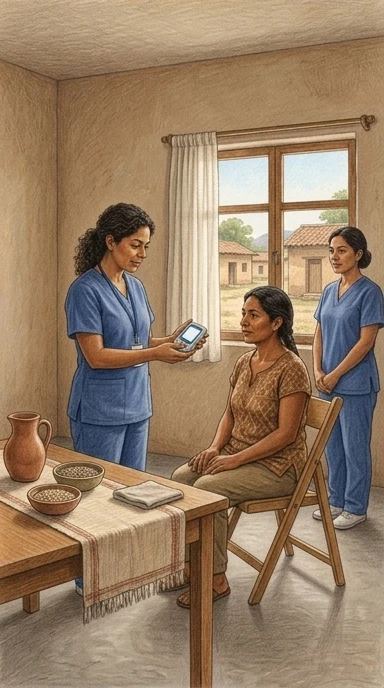
El artículo recoge un estudio según el cual en 244 municipios de Colombia —el 22% del país— no hay ningún servicio de salud de mama. El artículo recoge un estudio según el cual en el 55% de los municipios solo existe un hospital público. Para muchas mujeres, la mamografía o el examen clínico de mama simplemente no están a la mano.
Para llegar a ellas se diseñó el Programa Cuídalas, una iniciativa comunitaria de atención primaria apoyada en inteligencia artificial y dispositivos portátiles. En la práctica, todos los tamizajes iniciales los realizaron enfermeras o auxiliares de enfermería, que recibieron una semana de entrenamiento estandarizado.
Entre marzo de 2023 y septiembre de 2024, el programa alcanzó a 346,534 mujeres afiliadas a varias aseguradoras de salud del país y practicó tamizaje a 54,970 de ellas. En el 6.22% se encontraron hallazgos que requerían evaluación adicional. El dispositivo usado, llamado iBreastExam™, mide diferencias de rigidez en el tejido mamario y envía los resultados de forma inalámbrica; no emite un diagnóstico.
Este informe describe cómo funcionó el programa en la práctica, no un ensayo clínico. No midió muertes ni supervivencia, así que no puede decirse que salve vidas ni que mejore los desenlaces. Tampoco el programa creó un seguro aparte: el tamizaje se integró a los servicios de salud habituales, y la atención posterior dependió de la cobertura que cada mujer ya tenía. Además, como toda herramienta de tamizaje, puede arrojar resultados positivos que después no se confirman, lo que genera referencias innecesarias, ansiedad y exámenes adicionales. Una parte de esos falsos positivos causó preocupación entre las mujeres.
De las participantes con hallazgos sospechosos, el 75.65% recibió evaluación por médico general o ginecólogo. Se realizaron 151 mamografías y 1,319 ecografías de mama, y 533 exámenes quedaron clasificados como categorías que exigen seguimiento. A través de las rutas clínicas habituales se confirmaron 15 casos de cáncer de mama. Al momento del reporte, 12 mujeres estaban en tratamiento, dos habían terminado sin evidencia de enfermedad y se documentó una muerte.
Los equipos de enfermería también enfrentaron tropiezos: fallas de calibración y conectividad en zonas remotas, desconfianza cultural y poca familiaridad digital. El informe reconoce que algunas enfermeras tuvieron dificultades iniciales con el dispositivo.
Los autores plantean que, si el modelo se ampliara a nivel nacional, podría contribuir a cerrar brechas de detección temprana y fortalecer la capacidad de enfermería donde faltan servicios. Su impacto real y su costo siguen en evaluación.
Si en su municipio no hay servicios de salud de mama, pregunte en su centro de salud o en su aseguradora qué tamizaje le corresponde según su edad y dónde puede hacérselo.
Qué significa para usted
Lo que este reporte muestra es que una enfermera con un dispositivo portátil puede llegar donde antes no llegaba nadie, y que de 54,970 mujeres tamizadas, 15 recibieron un diagnóstico confirmado. No es prueba de que se salven vidas ni de que cueste menos. Si en su municipio no hay servicios de mama, pregunte en su centro de salud qué tamizaje le corresponde según su edad.
Xiques-Molina, W., Lozada-Martinez, I. D., Barceló-Martinez, E. et al. (2026). The Cuídalas program: an AI-supported community-based approach to breast cancer screening in low-resource settings. Frontiers in Oncology. https://doi.org/10.3389/fonc.2026.1794792
Quién pagó: El cargo por procesamiento del artículo fue financiado por la Universidad de Córdoba, Montería, Colombia; el autor WX-M estaba empleado por Cure Latam Health Technologies, y los demás autores declararon no tener relaciones comerciales o financieras que pudieran constituir un conflicto de interés potencial.
No tome esto como consejo médico profesional.
Los hallazgos de otros estudios que aquí se mencionan los conocemos por este documento, que fue el que leímos; no abrimos cada uno de esos estudios.
Versión detalladaLos pasajes copiados del artículo, las ilustraciones y cada fuente con cuánto leímos de ella · 1725 palabras · unos 9 minLeerla →Cerrar
Un programa colombiano examinó los senos de 54,970 mujeres con un dispositivo portátil apoyado por inteligencia artificial
La iniciativa usó un dispositivo portátil con inteligencia artificial, operado por enfermeras, en varias regiones de Colombia. Los propios autores advierten que aún no puede decirse que salve vidas.
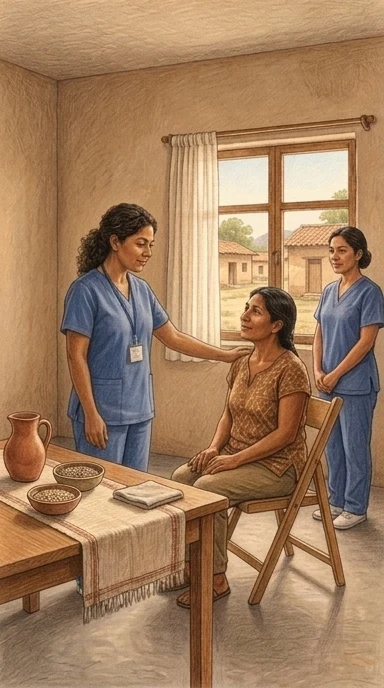
En Colombia, entre marzo de 2023 y septiembre de 2024, un programa llamado Cuídalas examinó los senos de 54,970 mujeres con un dispositivo portátil apoyado por inteligencia artificial1. De ellas, el 6.20 por ciento presentó hallazgos que requerían más evaluación clínica2, y quince recibieron un diagnóstico de cáncer de mama confirmado por los caminos clínicos habituales3. El programa alcanzó a 346,534 mujeres registradas en las redes de varias aseguradoras nacionales de salud4. Los autores son W. Xiques-Molina, I. D. Lozada-Martinez, E. Barceló-Martinez y V. M. Noble-Ramos, de una unidad de investigación de Cure Latam Health Technologies en Barranquilla, de la Universidad de la Costa, de una clínica en Barranquilla y de la Universidad de Córdoba en Montería. La publicación la pagó la Universidad de Córdoba. Uno de los autores trabaja para Cure Latam Health Technologies5.
Conviene decir con claridad qué es y qué no es este trabajo. No es un experimento ni un estudio con hipótesis: es la descripción de cómo funcionó un programa real, con cifras agregadas de su operación rutinaria6. No hubo comparación con otro método, no se midió si las mujeres vivieron más ni si el programa redujo muertes. Los propios autores escriben que el objetivo no es demostrar la efectividad clínica, sino presentar el diseño, la estrategia y el alcance operativo6. Las cifras son un recuento de lo que ocurrió, no una prueba de que ocurrió gracias al programa.
El artículo describe un estudio en el que el cáncer de mama sigue siendo una de las principales causas de enfermedad, muerte y gasto en salud por cáncer en el mundo7. El artículo describe un estudio en el que, a pesar de los avances en diagnóstico temprano y tratamiento, la mortalidad sigue siendo desproporcionadamente alta en países de ingresos bajos y medios, por falta de acceso oportuno a programas de tamizaje y servicios de salud8. El artículo describe un estudio en el que las estadísticas nacionales estiman que el 52 por ciento de los casos de cáncer de mama se detectan en etapas avanzadas9. El artículo describe un estudio en el que, en 244 municipios del país, el 22 por ciento, no hay servicios de salud mamaria disponibles, y en el 55 por ciento de los municipios solo hay un hospital público10. El artículo describe un estudio en el que, según el índice de Gini, Colombia es uno de los países más inequitativos del mundo, con un valor de 54,811.
¿Cómo funciona el aparato? El artículo describe un estudio en el que el dispositivo se llama iBreastExam™ y se basa en elastografía: mide el modelo elástico entre el tejido mamario normal y el anormal, a partir de las diferencias de rigidez del tejido12. El artículo describe un estudio en el que el dispositivo es portátil, funciona con batería y está apoyado por inteligencia artificial y aprendizaje automático; al terminar el examen interpreta y reproduce los resultados de forma automática, y los envía tanto a la aseguradora de salud como a la paciente13. Cada mama se divide en dieciséis regiones que se analizan una por una; escanear cada región toma tres segundos y el aparato se calibra solo. El programa lo llevó a instituciones públicas y privadas, a acuerdos voluntarios y hasta a la casa de la mujer, y quien lo operaba era personal de salud entrenado: enfermeras, auxiliares de enfermería o agentes comunitarios.

La comparación que el artículo sí permite es con el examen clínico manual. El artículo describe un estudio en el que, frente a un examen de mama hecho a mano, el iBreastExam™ ha mostrado hasta un 86 por ciento de sensibilidad para cualquier hallazgo positivo, hasta un 94 por ciento de especificidad, y valores predictivos negativo y positivo del 98 por ciento y el 66 por ciento, respectivamente14. Vale la pena detenerse en qué significa eso: el aparato está hecho para no dejar pasar casos sospechosos, y por eso mismo genera más falsas alarmas. El propio artículo lo dice: el tamizaje no diagnostica la enfermedad, y quien recibe un resultado positivo necesita evaluación adicional con pruebas diagnósticas. Los autores también reconocen que hubo ansiedad comprensible entre algunas mujeres por hallazgos falsos positivos, sobre todo en comunidades con poca exposición previa a programas de tamizaje, y que la calibración y la conectividad fallaron a veces en zonas remotas con infraestructura inestable.
La familia de estudios a la que pertenece este trabajo es amplia, y conviene mirarla con honestidad. Un trabajo sobre inteligencia artificial en cáncer de mama encontró que los sistemas diagnósticos mostraron mejor precisión, sensibilidad, especificidad y eficiencia que los enfoques convencionales, y que las aplicaciones en mamografía y ecografía redujeron la carga de trabajo de los radiólogos y los costos de salud; pero según el resumen de ese estudio, que pudimos leer solo en su resumen porque el texto completo está detrás de una suscripción, todavía se requieren validaciones clínicas a gran escala y estudios de implementación en el mundo real antes de adoptarlos de forma generalizada151617. Otro trabajo probó un sistema de mamografía con inteligencia artificial en 404,502 mamografías de 206 organizaciones médicas y tres fabricantes de equipos, con 336 radiólogos participantes, y a lo largo del tiempo la precisión subió del 77 al 90 por ciento y la especificidad del 70 al 91 por ciento; según el resumen de ese estudio, que también pudimos leer solo en su resumen, la clave fue la prueba iterativa con monitoreo en el mundo real y la retroalimentación de los radiólogos181920. Un tercer trabajo desarrolló un dispositivo no invasivo para reconocer el cáncer de mama y lo aplicó en el tamizaje de 6,817 personas en 107 hospitales, con alta consistencia frente a las evaluaciones clínicas; según el resumen de ese estudio, que igualmente pudimos leer solo en su resumen, la inteligencia artificial todavía enfrenta dificultades para generalizar en ecografía de mama y su potencial clínico sigue subutilizado en escenarios reales complejos2122.
Los límites que el lector necesita tener presentes son varios y son importantes. El programa no creó un seguro aparte: funcionó como una iniciativa de tamizaje y navegación dentro de los servicios de salud habituales, y la atención posterior, incluidas imágenes, biopsia o manejo oncológico, se dio a través de la cobertura de salud que cada mujer ya tenía. No se asignó ninguna intervención experimental y no se creó un conjunto de datos identificable para esta publicación, por lo que no se requirió aprobación de un comité de ética. Los autores escriben que las etapas futuras se centrarán en evaluar el impacto en resultados clínicos, la relación costo-efectividad y la posibilidad de ampliarlo a otras regiones23. Y el informe no incluye datos sociodemográficos ni clínicos desglosados, que harían falta para entender los patrones por región y por grupo de edad.
Así lo leemos nosotros. Cuando una tecnología llega desde afuera a una comunidad, esa comunidad puede adoptarla para sus propias necesidades o puede terminar usándola según los intereses de quien la trajo. La diferencia se ve en quién decide cómo se usa, quién la opera y si la gente local entiende lo que la herramienta hace. En este programa colombiano, quienes operan el dispositivo y acompañan a las mujeres son enfermeras y auxiliares locales. Si eso se sostiene, esperaríamos que la adopción sea más sólida donde ellas tengan formación continua y respaldo técnico, y más frágil donde el equipo rote o falte supervisión. Sabríamos que nos equivocamos si las decisiones sobre el uso del aparato se tomaran fuera de la comunidad, si el personal local no pudiera explicar los resultados a las mujeres, o si la participación decayera cuando el equipo externo se retira.

Hay una segunda cosa que nos parece que el lector debe llevarse. Cuando un sistema automático marca algo importante para una persona, esa persona rara vez puede saber cómo se llegó a esa decisión ni a quién reclamarle. En este programa, una mujer que recibe un resultado del dispositivo podría no entender por qué se le marca como sospechosa ni qué sigue después; si no hay una persona que explique y acompañe, algunas podrían angustiarse o abandonar el seguimiento. Sabríamos que nos equivocamos si las mujeres recibieran explicaciones claras y accesibles, si supieran a quién preguntar, y si el seguimiento no dependiera solo del resultado automático sino de una conversación con personal capacitado. También notamos que las innovaciones no llegan igual a todos los lugares: las zonas más apartadas o con menos personal capacitado tendrán más dificultades para sostener el uso del dispositivo, porque la calibración, la conectividad, los repuestos y la formación continua son más difíciles ahí que en las ciudades. Sabríamos que nos equivocamos si las zonas rurales y dispersas mostraran la misma calidad de uso y seguimiento que las urbanas, sin necesidad de más supervisión, más capacitación o más apoyo técnico.
Nada de esto quiere decir que el programa no haya servido. Quiere decir que lo que se midió fue la capacidad de llegar y de sostener el proceso, no el resultado final en la salud de las mujeres. Es una diferencia que importa cuando alguien, en una campaña o en un consultorio, presenta un aparato nuevo como si ya estuviera probado que salva vidas.
¿Qué puede hacer usted con esto donde vive? Puede preguntar quién opera la herramienta en su clínica o en su campaña, si esa persona es de la zona y si sabe explicar en palabras sencillas qué mide y qué no mide. Puede pedir que le expliquen su resultado en su idioma y a su manera, y preguntar si hay una persona responsable de acompañarla y a quién dirigirse si algo no le queda claro. Puede preguntar si el servicio llega igual de bien a la zona rural que a la urbana, cada cuánto se revisa el equipo y qué pasa si algo falla. Y si le ofrecen un tamizaje con un dispositivo portátil, recuerde que un resultado positivo no es un diagnóstico: es una señal para hacerse las pruebas que corresponden. La pregunta que vale la pena llevar a la próxima campaña de salud es sencilla: ¿quién me va a explicar esto y quién me va a acompañar hasta el final?
De dónde sale cada dato de contexto, y cuánto leímos de cada documento
- Xiques-Molina, W., Lozada-Martinez, I. D., Barceló-Martinez, E. et al. (2026). The Cuídalas program: an AI-supported community-based approach to breast cancer screening in low-resource settings. Frontiers in Oncology. https://doi.org/10.3389/fonc.2026.1794792 - el artículo del que trata esta nota — el artículo completo — el pasaje: "As part of its community-based induced-demand strategy, 54,970 women accessed screening services during this period."
- Xiques-Molina, W., Lozada-Martinez, I. D., Barceló-Martinez, E. et al. (2026). The Cuídalas program: an AI-supported community-based approach to breast cancer screening in low-resource settings. Frontiers in Oncology. https://doi.org/10.3389/fonc.2026.1794792 - el artículo del que trata esta nota — el artículo completo — el pasaje: "Aggregated program records indicate that 6.22% of screened women presented findings requiring further clinical assessment."
- Xiques-Molina, W., Lozada-Martinez, I. D., Barceló-Martinez, E. et al. (2026). The Cuídalas program: an AI-supported community-based approach to breast cancer screening in low-resource settings. Frontiers in Oncology. https://doi.org/10.3389/fonc.2026.1794792 - el artículo del que trata esta nota — el artículo completo — el pasaje: "Within the continuum of care activated by the program, 15 breast cancer diagnoses were confirmed through standard clinical pathways (Table 1)."
- Xiques-Molina, W., Lozada-Martinez, I. D., Barceló-Martinez, E. et al. (2026). The Cuídalas program: an AI-supported community-based approach to breast cancer screening in low-resource settings. Frontiers in Oncology. https://doi.org/10.3389/fonc.2026.1794792 - el artículo del que trata esta nota — el artículo completo — el pasaje: "Between March 2023 and September 2024, the Cuídalas Program operated across multiple regions of Colombia in collaboration with several national health insurance providers, reaching 346,534 women registered within participating networks."
- Xiques-Molina, W., Lozada-Martinez, I. D., Barceló-Martinez, E. et al. (2026). The Cuídalas program: an AI-supported community-based approach to breast cancer screening in low-resource settings. Frontiers in Oncology. https://doi.org/10.3389/fonc.2026.1794792 - el artículo del que trata esta nota — el artículo completo — el pasaje: "Author WX-M was employed by Cure Latam Health Technologies."
- Xiques-Molina, W., Lozada-Martinez, I. D., Barceló-Martinez, E. et al. (2026). The Cuídalas program: an AI-supported community-based approach to breast cancer screening in low-resource settings. Frontiers in Oncology. https://doi.org/10.3389/fonc.2026.1794792 - el artículo del que trata esta nota — el artículo completo — el pasaje: "The objective of this report is not to demonstrate the clinical effectiveness of the Cuídalas Program, but rather to present its structural design, implementation strategy, and operational reach."
- Xiques-Molina, W., Lozada-Martinez, I. D., Barceló-Martinez, E. et al. (2026). The Cuídalas program: an AI-supported community-based approach to breast cancer screening in low-resource settings. Frontiers in Oncology. https://doi.org/10.3389/fonc.2026.1794792 - el artículo del que trata esta nota — el artículo completo — el pasaje: "Breast cancer remains one of the leading causes of morbidity, mortality, and healthcare costs related to cancer worldwide."
- Xiques-Molina, W., Lozada-Martinez, I. D., Barceló-Martinez, E. et al. (2026). The Cuídalas program: an AI-supported community-based approach to breast cancer screening in low-resource settings. Frontiers in Oncology. https://doi.org/10.3389/fonc.2026.1794792 - el artículo del que trata esta nota — el artículo completo — el pasaje: "Despite advances in early diagnosis and treatment, mortality rates remain disproportionately high in low- and middle-income countries, due to the lack of access to timely and adequate screening programs and healthcare services."
- Xiques-Molina, W., Lozada-Martinez, I. D., Barceló-Martinez, E. et al. (2026). The Cuídalas program: an AI-supported community-based approach to breast cancer screening in low-resource settings. Frontiers in Oncology. https://doi.org/10.3389/fonc.2026.1794792 - el artículo del que trata esta nota — el artículo completo — el pasaje: "National statistics estimate that 52% of breast cancer cases detected in Colombia are in advanced stages."
- Xiques-Molina, W., Lozada-Martinez, I. D., Barceló-Martinez, E. et al. (2026). The Cuídalas program: an AI-supported community-based approach to breast cancer screening in low-resource settings. Frontiers in Oncology. https://doi.org/10.3389/fonc.2026.1794792 - el artículo del que trata esta nota — el artículo completo — el pasaje: "In 244 municipalities (22%) across the country, there are no breast health services available, and in 55% of municipalities, there is only one public hospital."
- Xiques-Molina, W., Lozada-Martinez, I. D., Barceló-Martinez, E. et al. (2026). The Cuídalas program: an AI-supported community-based approach to breast cancer screening in low-resource settings. Frontiers in Oncology. https://doi.org/10.3389/fonc.2026.1794792 - el artículo del que trata esta nota — el artículo completo — el pasaje: "According to the Gini index, Colombia is one of the most inequitable countries in the world (54.8 value)."
- Xiques-Molina, W., Lozada-Martinez, I. D., Barceló-Martinez, E. et al. (2026). The Cuídalas program: an AI-supported community-based approach to breast cancer screening in low-resource settings. Frontiers in Oncology. https://doi.org/10.3389/fonc.2026.1794792 - el artículo del que trata esta nota — el artículo completo — el pasaje: "The iBreastExam™ measures the elastic model between normal and abnormal breast tissue, based on differences in tissue stiffness."
- Xiques-Molina, W., Lozada-Martinez, I. D., Barceló-Martinez, E. et al. (2026). The Cuídalas program: an AI-supported community-based approach to breast cancer screening in low-resource settings. Frontiers in Oncology. https://doi.org/10.3389/fonc.2026.1794792 - el artículo del que trata esta nota — el artículo completo — el pasaje: "This portable and scalable device, based on elastography and supported by AI and machine learning, automatically interprets and reproduces the results upon completion of the exam, which are then sent to both the health insurance company and the patient."
- Xiques-Molina, W., Lozada-Martinez, I. D., Barceló-Martinez, E. et al. (2026). The Cuídalas program: an AI-supported community-based approach to breast cancer screening in low-resource settings. Frontiers in Oncology. https://doi.org/10.3389/fonc.2026.1794792 - el artículo del que trata esta nota — el artículo completo — el pasaje: "Compared to a manual clinical breast exam, the iBreastExam™ has demonstrated up to 86% sensitivity for any positive findings, up to 94% specificity, and negative and positive predictive values of 98% and 66%, respectively."
- Bothou A, Bolou A, Dinas K, Kyrkou G, Hardy D, Pappou P, et al. (2026). Artificial Intelligence in Early Breast Cancer Detection: A Systematic Review of Innovations in Preventive Women’s Healthcare. Healthcare. 10.3390/healthcare14121674 — solo el resumen - no se pudo obtener el texto completo — el pasaje: "AI-driven diagnostic systems demonstrated improved accuracy, sensitivity, specificity, and efficiency compared with conventional approaches."
- Bothou A, Bolou A, Dinas K, Kyrkou G, Hardy D, Pappou P, et al. (2026). Artificial Intelligence in Early Breast Cancer Detection: A Systematic Review of Innovations in Preventive Women’s Healthcare. Healthcare. 10.3390/healthcare14121674 — solo el resumen - no se pudo obtener el texto completo — el pasaje: "AI applications in mammography and ultrasound reduced radiologists' workload and healthcare costs while enhancing cancer detection rates, particularly in women with high breast density."
- Bothou A, Bolou A, Dinas K, Kyrkou G, Hardy D, Pappou P, et al. (2026). Artificial Intelligence in Early Breast Cancer Detection: A Systematic Review of Innovations in Preventive Women’s Healthcare. Healthcare. 10.3390/healthcare14121674 — solo el resumen - no se pudo obtener el texto completo — el pasaje: "However, further large-scale clinical validation and real-world implementation studies are required before widespread clinical implementation."
- Vasilev Y, Rumyantsev D, Vladzymyrskyy A, Omelyanskaya O, Arzamasov K, Bazhin A, et al. (2026). Implementation of an artificial intelligence-based system for mammography in the compulsory medical insurance program: results of a 3-year study. Quantitative Imaging in Medicine and Surgery. 10.21037/qims-2026-0864 — solo el resumen - no se pudo obtener el texto completo — el pasaje: "The test dataset comprised 404,502 mammograms from 206 medical organizations and three mammography equipment manufacturers. A total of 336 radiologists participated."
- Vasilev Y, Rumyantsev D, Vladzymyrskyy A, Omelyanskaya O, Arzamasov K, Bazhin A, et al. (2026). Implementation of an artificial intelligence-based system for mammography in the compulsory medical insurance program: results of a 3-year study. Quantitative Imaging in Medicine and Surgery. 10.21037/qims-2026-0864 — solo el resumen - no se pudo obtener el texto completo — el pasaje: "Over this time, AUC increased by 10.8% (from 0.83 to 0.92), accuracy by 16.9% (from 0.77 to 0.90), sensitivity by 4.8% (from 0.84 to 0.88), and specificity by 30.0% (from 0.70 to 0.91)."
- Vasilev Y, Rumyantsev D, Vladzymyrskyy A, Omelyanskaya O, Arzamasov K, Bazhin A, et al. (2026). Implementation of an artificial intelligence-based system for mammography in the compulsory medical insurance program: results of a 3-year study. Quantitative Imaging in Medicine and Surgery. 10.21037/qims-2026-0864 — solo el resumen - no se pudo obtener el texto completo — el pasaje: "Iterative testing with prospective real-world monitoring, interleaved developer updates, and radiologist feedback substantially enhanced mammography AI performance."
- Zhou J, Si P, Zhang Y, Song J, He T, Liu Q, et al. (2026). A non-invasive end-to-end intelligent assistance system for breast ultrasound. Nature Communications. 10.1038/s41467-026-73170-5 — solo el resumen - no se pudo obtener el texto completo — el pasaje: "BIRD is applied in breast cancer screening for 6,817 individuals and shows high consistency (Cohen's kappa: 0.702 (95% confidence interval: 0.628-0.777)) with clinical assessments in real-world application across 107 hospitals."
- Zhou J, Si P, Zhang Y, Song J, He T, Liu Q, et al. (2026). A non-invasive end-to-end intelligent assistance system for breast ultrasound. Nature Communications. 10.1038/s41467-026-73170-5 — solo el resumen - no se pudo obtener el texto completo — el pasaje: "Although artificial intelligence enhances medical image classification to effectively improve lesion diagnosis accuracy and efficiency, it still faces generalization challenges in breast ultrasound and its clinical potential remains underutilized in complex real-world scenarios."
- Xiques-Molina, W., Lozada-Martinez, I. D., Barceló-Martinez, E. et al. (2026). The Cuídalas program: an AI-supported community-based approach to breast cancer screening in low-resource settings. Frontiers in Oncology. https://doi.org/10.3389/fonc.2026.1794792 - el artículo del que trata esta nota — el artículo completo — el pasaje: "Future stages of the program will focus on evaluating its impact on clinical outcomes, cost-effectiveness, and scalability across different regions."
Xiques-Molina, W., Lozada-Martinez, I. D., Barceló-Martinez, E. et al. (2026). The Cuídalas program: an AI-supported community-based approach to breast cancer screening in low-resource settings. Frontiers in Oncology. https://doi.org/10.3389/fonc.2026.1794792
Quién pagó: El cargo por procesamiento del artículo fue financiado por la Universidad de Córdoba, Montería, Colombia; el autor WX-M estaba empleado por Cure Latam Health Technologies, y los demás autores declararon no tener relaciones comerciales o financieras que pudieran constituir un conflicto de interés potencial.
No tome esto como consejo médico profesional.
Los hallazgos de otros estudios que aquí se mencionan los conocemos por este documento, que fue el que leímos; no abrimos cada uno de esos estudios.
other · Frontiers in oncology · the paper, 10 Apr 2026 · free
AI-Assisted Breast Screening Reached 54,970 Women in Colombia — and Found 15 Cancers
Nurses carried portable scanners into areas with almost no breast health services. The report shows who was reached, not whether lives were saved.
Short version · the longer version follows, about 8 min
Ask weeklyAI
Ask me about this study: who was studied, what it found, and what it does not say.
Conversations are saved for as long as weeklyAI exists, to improve the publication. Answers come in the language you write in.
- The study at a glance
- Who
- Women registered with participating national health insurance providers in Colombia
- How many
- 346,534 women reached; 54,970 screened
- Where
- Colombia
- When
- March 2023 to September 2024
- Kind of study
- analysis of what people did
- Who did it
- Cure Latam Health Technologies, Universidad de la Costa, Clínica Colsanitas, Universidad de Córdoba
- The limit that matters
- The report describes reach and feasibility, not whether the program saves lives.
The iBreastExam device compared with a manual clinical breast exam
The device has shown up to 86% sensitivity for any positive findings and up to 94% specificity.
The report is a description of routine program operations, not a clinical trial.
The article describes a study in which 244 municipalities — about 22 percent of the country — have no breast health services at all. The article describes a study in which, in 55 percent of municipalities, there is only one public hospital. Many women live where a mammogram or a clinical breast exam by trained staff is simply not available.
The Cuídalas Program was built for them. It is a community-based primary care effort supported by artificial intelligence and portable devices, designed to bring screening to women who cannot reach standard services. Nurses and nursing assistants performed the screenings, each after a one-week training program covering breast anatomy, communication, device handling and how to judge which patients needed further care. The article describes a study in which the portable tool they carried, the iBreastExam, uses sensors to measure differences in breast tissue and sends results wirelessly.
Between March 2023 and September 2024, working with several national health insurance providers, the program reached 346,534 women registered in those networks. Of them, 54,970 were screened, and 6.22 percent had findings that needed further assessment. Education efforts reached another 291,330 people.
The report is a description of routine program operations, not a clinical trial. It shows that the program was feasible and how far it reached. It does not show whether it saves lives or improves outcomes — no such comparison was made.
Two things stayed outside the program's hands. It did not provide separate insurance; women who needed follow-up care depended on their regular health coverage. And the portable device is a screening tool, not a diagnostic one. A positive result means more evaluation is needed, not that cancer is present. The article notes that in real-world use of the AI-supported device, some false-positive findings caused concern and anxiety among women.
Of those with suspicious findings, 75.65 percent were seen by a general practitioner or gynecologist. The program arranged 151 mammograms and 1,319 breast ultrasounds. Imaging classified 533 exams as needing attention or follow-up. Fifteen breast cancers were confirmed through standard clinical pathways. At the time of reporting, 12 women were in treatment and two had finished therapy with no sign of disease.
If scaled nationally, this model could help expand early detection and strengthen nursing capacity in underserved areas. Whether it lowers costs or improves survival is still being studied.
Wherever you live, you can ask your clinic or insurer one question: if a screening finds something, what is the next step, and who pays for it?
What this means for you
What this report offers is not proof that anyone lived longer, only that in parts of Colombia a screening program reached 54,970 women and that most of those with suspicious findings were seen afterward. If you live somewhere screening is hard to reach, ask your clinic or insurer what happens after a positive result and who covers the next test, and watch whether anyone is actually measuring whether people do better.
Xiques-Molina, W., Lozada-Martinez, I. D., Barceló-Martinez, E. et al. (2026). The Cuídalas program: an AI-supported community-based approach to breast cancer screening in low-resource settings. Frontiers in Oncology. https://doi.org/10.3389/fonc.2026.1794792
Who paid: The article processing charge for this work was funded by the Universidad de Córdoba, Monteria, Colombia; author WX-M was employed by Cure Latam Health Technologies, and the remaining authors declared no commercial or financial relationships that could be construed as a potential conflict of interest.
Do not take this as professional medical advice.
The findings of other studies mentioned here are known to us through this document, which is the one we read; we did not open each of those studies.
The longer versionThe passages copied from the paper, the pictures, and every source with how much of it we read · 1582 words · about 8 minRead it →Close
An AI-Assisted Breast Screening Program in Colombia Reached Tens of Thousands of Women. What It Found—and What It Did Not Test.
A report describes a nursing-led program that used a portable handheld device to screen women in areas where mammography is often out of reach. It measured reach, not survival.
In Colombia, between March 2023 and September 2024, a program called Cuídalas reached 346,534 women who were registered with participating national health insurance providers, and 54,970 of them went on to be screened with an artificial-intelligence-supported handheld device12. Among the women screened, 6.22 percent had findings that needed a closer look, 75.60 percent of those received follow-up from a general practitioner or gynecologist, and 15 breast cancers were confirmed through standard clinical pathways34. The authors are explicit that this report was not designed to show the program works in the sense of saving lives: its stated objective was to present the program's structure, its implementation strategy, and its operational reach5.
The device at the center of it, the iBreastExam™, is not a mammogram and does not diagnose cancer. It measures how stiff breast tissue is—harder areas can suggest a lump—and its software reads the result automatically, then sends it to both the insurance company and the patient67. The article describes a study in which, compared with a manual clinical breast exam, the device showed up to 86 percent sensitivity for any positive finding, up to 94 percent specificity, and predictive values of 98 percent and 66 percent8. That last number matters: it means a positive result on this device is a signal to go get checked properly, not a diagnosis. The article states plainly that screening itself does not diagnose disease.
The reason a program like this exists at all is a gap in services. The article describes a study in which, in 244 municipalities across Colombia—22 percent of them—there are no breast health services available, and in 55 percent of municipalities there is only one public hospital9. The article describes a study in which national statistics estimate that 52 percent of breast cancer cases detected in Colombia are already in advanced stages10. The article describes a study in which breast cancer remains one of the leading causes of illness, death and healthcare cost related to cancer worldwide, and mortality stays disproportionately high in low- and middle-income countries because timely, adequate screening and services are out of reach1112. The article describes a study in which Colombia is also one of the most unequal countries in the world by the Gini index, at 54.813.
The program belongs to a wider family of attempts to bring AI into breast imaging. According to the summary of one review of the field—we could read only the summary, the full paper is behind a subscription—AI systems using deep learning and machine learning have shown improved accuracy, sensitivity, specificity and efficiency compared with conventional approaches, and in mammography and ultrasound have reduced radiologists' workload and healthcare costs while improving detection, particularly in women with dense breast tissue141516. The same summary cautions that further large-scale clinical validation and real-world implementation studies are needed before widespread clinical use17. A separate study of a mammography AI system—again, only its summary was available to us—reported that over a period of iterative testing, accuracy rose from 0.77 to 0.90 and specificity from 0.70 to 0.91, and that the system was ultimately integrated into a regional program; that study's own stated limitation was that it lacked validation on independent datasets from other regions or countries181920.
Another team developed a non-invasive device for breast recognition and tested it across 107 hospitals, screening 6,817 individuals; according to the summary we could read, it showed high consistency with clinical assessments, and its authors note that AI still faces generalization challenges in breast ultrasound and remains underused in complex real-world settings2122. What distinguishes the Cuídalas report from these is the setting and the staffing: this was a nursing-led, community-based effort, not a hospital radiology study.
Here is how the screening actually worked, step by step. First came demand induction: the program used messaging software to contact women and schedule appointments, with human assistants handling women who could not use digital scheduling or could not read. Then trained personnel—nurses, nursing assistants or community health workers—performed the screening, either at an institution or at the woman's home, using the handheld device, which scans each breast in 16 regions and takes about three seconds per region. Suspicious findings triggered referral to higher-level services for ultrasound, mammography or biopsy, and the program stayed in contact to coordinate appointments and track referrals. Where cancer was confirmed, the program worked directly with insurers to establish a treatment plan.
Two things about this structure deserve a reader's attention. The program did not create a separate insurance policy or a parallel system—it functioned as screening and care navigation inside Colombia's existing health services, meaning that whatever follow-up a woman needed depended on her own coverage. And the implementers named real problems: device calibration and connectivity were occasionally difficult in remote areas with unstable infrastructure; cultural mistrust and low digital literacy limited participation in some communities; some nurses struggled at first with the device because they had little prior exposure to digital health tools; and there is a risk of false-positive results, which can lead to unnecessary referrals, anxiety or extra tests. The authors also say the findings are preliminary and reflect only the initial implementation phase.
Here is how we read it. The pattern is familiar from every attempt to move a medical test out of the hospital and into a home: the technology travels faster than the trust does. A device can be carried into a village in an afternoon. The willingness to be touched by a stranger, in your own house, with a machine that beeps and colors a screen—that cannot be delivered. It has to be built, and it is built by the people who already live there. That is why the nurses in this account are described not as operators but as the ones who explained, reassured and followed up. If that is right, then in homes like yours, the thing that will decide whether a program like this works is not the software but whether the person holding the device is someone you would let through the door. You would know we were wrong if women accepted the exam at the same rate no matter who performed it, where, and whether someone they knew was in the room. If you are offered a screening at home or at a community site, you can ask who will be present, whether a relative or friend can stay, and whether you can choose where it happens. A woman's hesitation is a question about privacy, not a refusal of care.
We also read, in the other work we looked at, a caution that applies to this whole family of tools: a finding like this one has not been shown to carry over to other countries, other populations or other health systems. That is a statement about carrying over, not about what happened in Colombia. And there is a risk that comes with any highly sensitive screening test, in any country: it will flag things that turn out to be nothing, and those flags cost money, time and sleep. We are not in a position to weigh that cost against the benefit here, and neither, on this evidence, is anyone else—the report itself says its job was reach, not outcomes. So watch for whether the next report counts the worry alongside the women reached.

What comes next, according to the authors, is evaluation: future stages of the program will focus on assessing its impact on clinical outcomes, cost-effectiveness and scalability across different regions23. Until that work is done and published, the honest summary of this report is that a large, nurse-led, AI-assisted screening effort was feasible in places where the alternative was often nothing—and that whether it saves lives is still an open question.
One more thing a reader should know about where this account comes from. One of the authors was employed by Cure Latam Health Technologies, and the article's publication charge was paid by Universidad de Córdoba in Montería, Colombia24. No independent outside evaluator is named. That does not make the numbers wrong, but it tells you who is telling the story.
So what can you do with this where you live? If a screening program comes to your clinic, your church or your street, the useful questions are not about the algorithm. Ask who is performing the exam and what training they had. Ask what happens if the result is flagged—who calls you, how soon, and who pays for the next test. Ask how often a flagged result turns out to be nothing, and whether anyone will sit with you and explain it. If you are a nurse or a community health worker, notice that what you already know about the women in your neighborhood—who will come, who is afraid, how to say it in a way that lands—is not outside the program. It is the part that makes the rest of it work. And if you organize anything at all, count the anxious phone calls along with the appointments booked. That is the number nobody puts on the poster, and it is the one that tells you whether the thing you built is actually good.
What would you want to know before you let a machine touch you in your own home?
Where each piece of context comes from, and how much of it we read
- Xiques-Molina, W., Lozada-Martinez, I. D., Barceló-Martinez, E. et al. (2026). The Cuídalas program: an AI-supported community-based approach to breast cancer screening in low-resource settings. Frontiers in Oncology. https://doi.org/10.3389/fonc.2026.1794792 - the article this story is about — the whole article — the passage: "Between March 2023 and September 2024, the Cuídalas Program operated across multiple regions of Colombia in collaboration with several national health insurance providers, reaching 346,534 women registered within participating networks."
- Xiques-Molina, W., Lozada-Martinez, I. D., Barceló-Martinez, E. et al. (2026). The Cuídalas program: an AI-supported community-based approach to breast cancer screening in low-resource settings. Frontiers in Oncology. https://doi.org/10.3389/fonc.2026.1794792 - the article this story is about — the whole article — the passage: "As part of its community-based induced-demand strategy, 54,970 women accessed screening services during this period."
- Xiques-Molina, W., Lozada-Martinez, I. D., Barceló-Martinez, E. et al. (2026). The Cuídalas program: an AI-supported community-based approach to breast cancer screening in low-resource settings. Frontiers in Oncology. https://doi.org/10.3389/fonc.2026.1794792 - the article this story is about — the whole article — the passage: "Aggregated program records indicate that 6.22% of screened women presented findings requiring further clinical assessment."
- Xiques-Molina, W., Lozada-Martinez, I. D., Barceló-Martinez, E. et al. (2026). The Cuídalas program: an AI-supported community-based approach to breast cancer screening in low-resource settings. Frontiers in Oncology. https://doi.org/10.3389/fonc.2026.1794792 - the article this story is about — the whole article — the passage: "Within the continuum of care activated by the program, 15 breast cancer diagnoses were confirmed through standard clinical pathways (Table 1)."
- Xiques-Molina, W., Lozada-Martinez, I. D., Barceló-Martinez, E. et al. (2026). The Cuídalas program: an AI-supported community-based approach to breast cancer screening in low-resource settings. Frontiers in Oncology. https://doi.org/10.3389/fonc.2026.1794792 - the article this story is about — the whole article — the passage: "The objective of this report is not to demonstrate the clinical effectiveness of the Cuídalas Program, but rather to present its structural design, implementation strategy, and operational reach."
- Xiques-Molina, W., Lozada-Martinez, I. D., Barceló-Martinez, E. et al. (2026). The Cuídalas program: an AI-supported community-based approach to breast cancer screening in low-resource settings. Frontiers in Oncology. https://doi.org/10.3389/fonc.2026.1794792 - the article this story is about — the whole article — the passage: "The iBreastExam™ measures the elastic model between normal and abnormal breast tissue, based on differences in tissue stiffness."
- Xiques-Molina, W., Lozada-Martinez, I. D., Barceló-Martinez, E. et al. (2026). The Cuídalas program: an AI-supported community-based approach to breast cancer screening in low-resource settings. Frontiers in Oncology. https://doi.org/10.3389/fonc.2026.1794792 - the article this story is about — the whole article — the passage: "This portable and scalable device, based on elastography and supported by AI and machine learning, automatically interprets and reproduces the results upon completion of the exam, which are then sent to both the health insurance company and the patient."
- Xiques-Molina, W., Lozada-Martinez, I. D., Barceló-Martinez, E. et al. (2026). The Cuídalas program: an AI-supported community-based approach to breast cancer screening in low-resource settings. Frontiers in Oncology. https://doi.org/10.3389/fonc.2026.1794792 - the article this story is about — the whole article — the passage: "Compared to a manual clinical breast exam, the iBreastExam™ has demonstrated up to 86% sensitivity for any positive findings, up to 94% specificity, and negative and positive predictive values of 98% and 66%, respectively."
- Xiques-Molina, W., Lozada-Martinez, I. D., Barceló-Martinez, E. et al. (2026). The Cuídalas program: an AI-supported community-based approach to breast cancer screening in low-resource settings. Frontiers in Oncology. https://doi.org/10.3389/fonc.2026.1794792 - the article this story is about — the whole article — the passage: "In 244 municipalities (22%) across the country, there are no breast health services available, and in 55% of municipalities, there is only one public hospital."
- Xiques-Molina, W., Lozada-Martinez, I. D., Barceló-Martinez, E. et al. (2026). The Cuídalas program: an AI-supported community-based approach to breast cancer screening in low-resource settings. Frontiers in Oncology. https://doi.org/10.3389/fonc.2026.1794792 - the article this story is about — the whole article — the passage: "National statistics estimate that 52% of breast cancer cases detected in Colombia are in advanced stages."
- Xiques-Molina, W., Lozada-Martinez, I. D., Barceló-Martinez, E. et al. (2026). The Cuídalas program: an AI-supported community-based approach to breast cancer screening in low-resource settings. Frontiers in Oncology. https://doi.org/10.3389/fonc.2026.1794792 - the article this story is about — the whole article — the passage: "Breast cancer remains one of the leading causes of morbidity, mortality, and healthcare costs related to cancer worldwide."
- Xiques-Molina, W., Lozada-Martinez, I. D., Barceló-Martinez, E. et al. (2026). The Cuídalas program: an AI-supported community-based approach to breast cancer screening in low-resource settings. Frontiers in Oncology. https://doi.org/10.3389/fonc.2026.1794792 - the article this story is about — the whole article — the passage: "Despite advances in early diagnosis and treatment, mortality rates remain disproportionately high in low- and middle-income countries, due to the lack of access to timely and adequate screening programs and healthcare services."
- Xiques-Molina, W., Lozada-Martinez, I. D., Barceló-Martinez, E. et al. (2026). The Cuídalas program: an AI-supported community-based approach to breast cancer screening in low-resource settings. Frontiers in Oncology. https://doi.org/10.3389/fonc.2026.1794792 - the article this story is about — the whole article — the passage: "According to the Gini index, Colombia is one of the most inequitable countries in the world (54.8 value)."
- Bothou A, Bolou A, Dinas K, Kyrkou G, Hardy D, Pappou P, et al. (2026). Artificial Intelligence in Early Breast Cancer Detection: A Systematic Review of Innovations in Preventive Women’s Healthcare. Healthcare. 10.3390/healthcare14121674 — only the abstract - the full text could not be fetched — the passage: "Artificial Intelligence (AI), particularly deep learning (DL) and machine learning (ML) algorithms, has emerged as a promising tool for improving the accuracy and efficiency of BC diagnosis."
- Bothou A, Bolou A, Dinas K, Kyrkou G, Hardy D, Pappou P, et al. (2026). Artificial Intelligence in Early Breast Cancer Detection: A Systematic Review of Innovations in Preventive Women’s Healthcare. Healthcare. 10.3390/healthcare14121674 — only the abstract - the full text could not be fetched — the passage: "AI-driven diagnostic systems demonstrated improved accuracy, sensitivity, specificity, and efficiency compared with conventional approaches."
- Bothou A, Bolou A, Dinas K, Kyrkou G, Hardy D, Pappou P, et al. (2026). Artificial Intelligence in Early Breast Cancer Detection: A Systematic Review of Innovations in Preventive Women’s Healthcare. Healthcare. 10.3390/healthcare14121674 — only the abstract - the full text could not be fetched — the passage: "AI applications in mammography and ultrasound reduced radiologists' workload and healthcare costs while enhancing cancer detection rates, particularly in women with high breast density."
- Bothou A, Bolou A, Dinas K, Kyrkou G, Hardy D, Pappou P, et al. (2026). Artificial Intelligence in Early Breast Cancer Detection: A Systematic Review of Innovations in Preventive Women’s Healthcare. Healthcare. 10.3390/healthcare14121674 — only the abstract - the full text could not be fetched — the passage: "However, further large-scale clinical validation and real-world implementation studies are required before widespread clinical implementation."
- Vasilev Y, Rumyantsev D, Vladzymyrskyy A, Omelyanskaya O, Arzamasov K, Bazhin A, et al. (2026). Implementation of an artificial intelligence-based system for mammography in the compulsory medical insurance program: results of a 3-year study. Quantitative Imaging in Medicine and Surgery. 10.21037/qims-2026-0864 — only the abstract - the full text could not be fetched — the passage: "Over this time, AUC increased by 10.8% (from 0.83 to 0.92), accuracy by 16.9% (from 0.77 to 0.90), sensitivity by 4.8% (from 0.84 to 0.88), and specificity by 30.0% (from 0.70 to 0.91)."
- Vasilev Y, Rumyantsev D, Vladzymyrskyy A, Omelyanskaya O, Arzamasov K, Bazhin A, et al. (2026). Implementation of an artificial intelligence-based system for mammography in the compulsory medical insurance program: results of a 3-year study. Quantitative Imaging in Medicine and Surgery. 10.21037/qims-2026-0864 — only the abstract - the full text could not be fetched — the passage: "The study culminated in the integration of the AI system into the regional CMI program."
- Vasilev Y, Rumyantsev D, Vladzymyrskyy A, Omelyanskaya O, Arzamasov K, Bazhin A, et al. (2026). Implementation of an artificial intelligence-based system for mammography in the compulsory medical insurance program: results of a 3-year study. Quantitative Imaging in Medicine and Surgery. 10.21037/qims-2026-0864 — only the abstract - the full text could not be fetched — the passage: "A key limitation of this study is the relatively small retrospective calibration testing dataset (100 mammograms) and the lack of external validation on independent datasets from other regions or countries."
- Zhou J, Si P, Zhang Y, Song J, He T, Liu Q, et al. (2026). A non-invasive end-to-end intelligent assistance system for breast ultrasound. Nature Communications. 10.1038/s41467-026-73170-5 — only the abstract - the full text could not be fetched — the passage: "BIRD is applied in breast cancer screening for 6,817 individuals and shows high consistency (Cohen's kappa: 0.702 (95% confidence interval: 0.628-0.777)) with clinical assessments in real-world application across 107 hospitals."
- Zhou J, Si P, Zhang Y, Song J, He T, Liu Q, et al. (2026). A non-invasive end-to-end intelligent assistance system for breast ultrasound. Nature Communications. 10.1038/s41467-026-73170-5 — only the abstract - the full text could not be fetched — the passage: "Although artificial intelligence enhances medical image classification to effectively improve lesion diagnosis accuracy and efficiency, it still faces generalization challenges in breast ultrasound and its clinical potential remains underutilized in complex real-world scenarios."
- Xiques-Molina, W., Lozada-Martinez, I. D., Barceló-Martinez, E. et al. (2026). The Cuídalas program: an AI-supported community-based approach to breast cancer screening in low-resource settings. Frontiers in Oncology. https://doi.org/10.3389/fonc.2026.1794792 - the article this story is about — the whole article — the passage: "Future stages of the program will focus on evaluating its impact on clinical outcomes, cost-effectiveness, and scalability across different regions."
- Xiques-Molina, W., Lozada-Martinez, I. D., Barceló-Martinez, E. et al. (2026). The Cuídalas program: an AI-supported community-based approach to breast cancer screening in low-resource settings. Frontiers in Oncology. https://doi.org/10.3389/fonc.2026.1794792 - the article this story is about — the whole article — the passage: "Author WX-M was employed by Cure Latam Health Technologies."
Xiques-Molina, W., Lozada-Martinez, I. D., Barceló-Martinez, E. et al. (2026). The Cuídalas program: an AI-supported community-based approach to breast cancer screening in low-resource settings. Frontiers in Oncology. https://doi.org/10.3389/fonc.2026.1794792
Who paid: The article processing charge for this work was funded by the Universidad de Córdoba, Monteria, Colombia; author WX-M was employed by Cure Latam Health Technologies, and the remaining authors declared no commercial or financial relationships that could be construed as a potential conflict of interest.
Do not take this as professional medical advice.
The findings of other studies mentioned here are known to us through this document, which is the one we read; we did not open each of those studies.