analysis of texts · Nature · la publicación, 24 jun 2026 · gratis
Si sus estudios médicos ayudaron a entrenar una IA, un desconocido podría saber que usted fue paciente
Un estudio con siete bases de datos clínicas encontró que el ataque funcionó casi perfecto en algunos pacientes y fue inútil en la mayoría; no probó que ningún hospital haya filtrado datos.
Versión breve · la versión detallada sigue, unos 7 min
Pregunte al chat de weeklyAI
Pregúnteme sobre la IA en su vida: le señalo las notas que weeklyAI ha publicado sobre el tema, esta semana y antes.
Las conversaciones se guardan mientras exista weeklyAI, para mejorar la publicación. Se responde en el idioma en que usted escribe.
- El estudio, de un vistazo
- Quiénes
- Pacientes en siete bases de datos clínicas reales (radiografías, mamografías, retina, electrocardiogramas, urgencias, piel)
- Cuántos
- siete bases de datos clínicas
- Dónde
- Estados Unidos (Stanford, Boston, Emory, Harvard) y Alemania (PTB-XL)
- Cuándo
- No lo dice el estudio
- Tipo de estudio
- experiment
- Quién lo hizo
- Universidad Técnica de Múnich, Imperial College de Londres y Universidad de Potsdam
- El límite que importa
- Atacaron modelos que ellos entrenaron o descargaron; no probaron el sistema en vivo de ningún hospital.
Son los pacientes con ataque casi perfecto en el conjunto de imágenes de piel; las cifras son de cada 10,000, de cada 1,000 y de cada 10, no el mismo total, así que no se suman.
Frecuencia de los registros más expuestos frente al conjunto completo (expedientes de urgencias)
Aparecieron 31% más de lo esperado entre los más expuestos
Aparecieron 126% más de lo esperado entre los más expuestos
Aparecieron 18% más de lo esperado entre los más expuestos
Para la mayoría de los pacientes el ataque no sirvió de nada. Para un grupo pequeño fue casi perfecto.
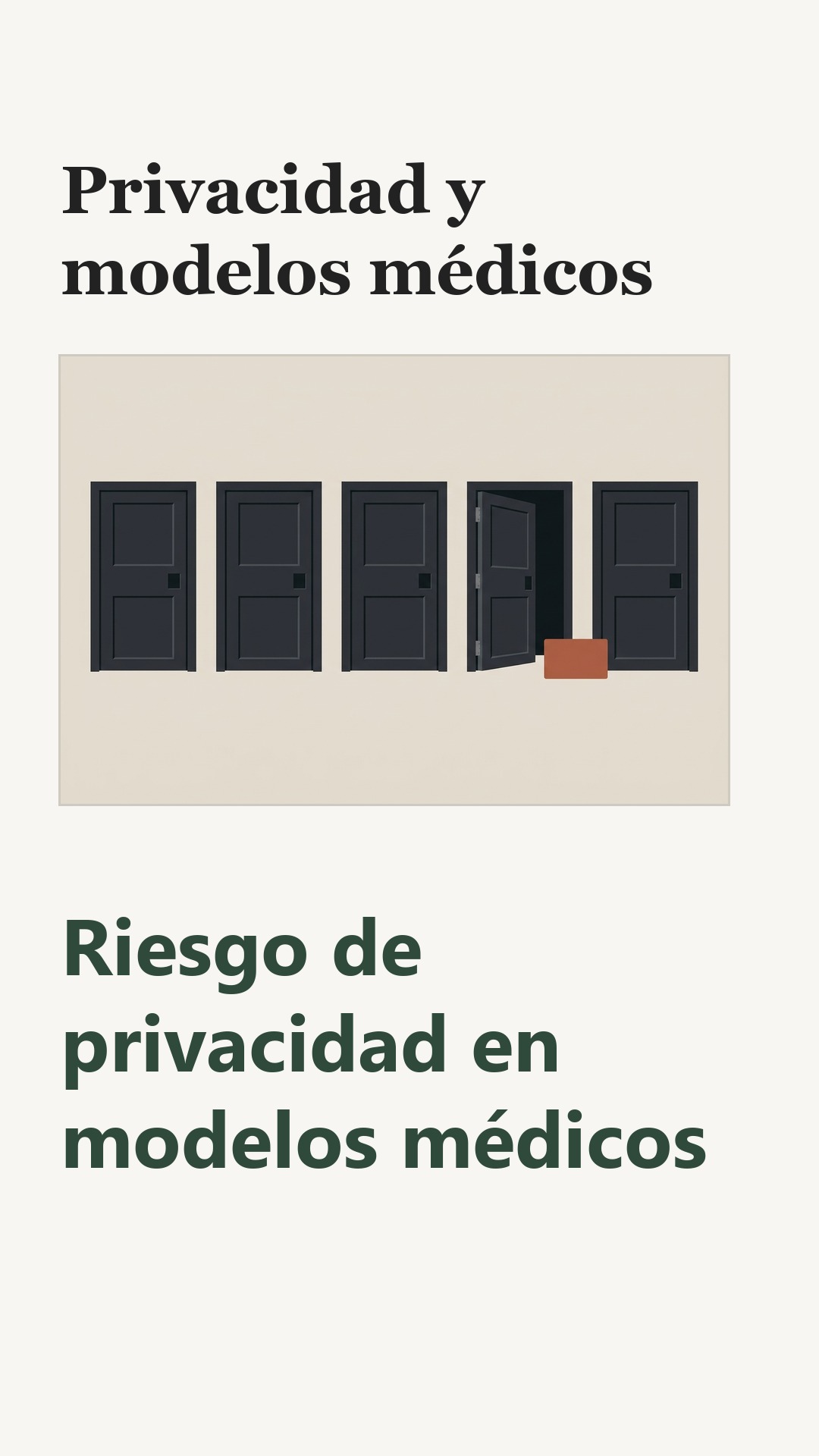
Imagine que un día le dicen que sus radiografías, sus electrocardiogramas o su expediente de urgencias sirvieron para entrenar un programa de inteligencia artificial que lee estudios médicos. La pregunta que sigue es qué tanto revela eso sobre usted.
Un grupo de investigadores de Múnich, Londres y Potsdam hizo esa pregunta con un tipo de ataque llamado inferencia de pertenencia. El atacante solo pide al programa una predicción, como la probabilidad de neumonía en una placa de tórax, y con eso intenta adivinar si los datos de una persona estuvieron en el entrenamiento. Lo probaron con siete bases de datos clínicas reales: imágenes de tórax de Stanford y de un hospital de Boston, mamografías de Emory, imágenes de retina de Harvard, electrocardiogramas, registros de urgencias y fotos de piel.
Para la mayoría de los pacientes el ataque no sirvió de nada. Para un grupo pequeño fue casi perfecto. El promedio de todos los registros decía que el ataque apenas superaba la suposición al azar, y ese promedio escondía por completo al grupo vulnerable.
Cuando los modelos crecieron, más pacientes quedaron expuestos. En el conjunto de dermatología, los pacientes con ataque casi perfecto pasaron de ninguno a uno de cada diez al usar el modelo más grande. Los grupos con menos registros en la base, como pacientes negros o con seguro Medicaid en los datos de urgencias, aparecieron con más frecuencia entre los registros más expuestos.
El ataque lo ejecutaron los investigadores contra modelos que ellos entrenaron o descargaron. No atacaron el sistema de ningún hospital ni de ninguna empresa. Nadie ha demostrado aquí que una clínica haya filtrado datos suyos.
El estudio midió este tipo de ataque en modelos de diagnóstico, con estas siete bases. Los autores señalan que el mismo ataque podría aplicarse a programas que escriben o dibujan, y piden más investigación sobre esos programas.
Los autores señalan que las diferencias entre grupos se explican en parte por el tamaño de cada grupo en los datos, y que algunas comparaciones podrían estar mezcladas con otros factores. Es un patrón, no una certeza sobre una persona.
La próxima vez que una clínica o una empresa anuncie una IA entrenada con datos de pacientes, busque si reporta el riesgo paciente por paciente o por grupo, y pregunte si la protección de privacidad se aplicó por paciente y no solo por cada estudio.
Qué significa para usted
Cuando una clínica o una empresa anuncie un programa entrenado con estudios de pacientes, pregunte si informa el riesgo de cada paciente y no solo el promedio de todos. Pregunte también si la protección se aplicó por paciente. El estudio no probó que ningún hospital haya filtrado datos, así que la duda razonable es qué tanto se sabe de quién estuvo en el entrenamiento.
Knolle, M. A., Menten, M. J., Jungmann, F. et al. (2026). Disparate privacy risks from medical AI. Nature. https://doi.org/10.1038/s41586-026-10688-0
Quién pagó: El trabajo fue financiado en parte por la Konrad Zuse School of Excellence in Reliable AI (relAI), la beca ERC Deep4MI (n.º 884622) y la Fundación Alemana de Investigación (proyecto n.º 532139938), con B.G. apoyado por una Cátedra de Investigación de la Royal Academy of Engineering; el artículo no indica si los financiadores tuvieron alguna influencia, y dos autores son empleados a tiempo parcial de DeepHealth y Google DeepMind.
No tome esto como consejo médico profesional.
Versión detalladaLos pasajes copiados del artículo, las ilustraciones y cada fuente con cuánto leímos de ella · 1432 palabras · unos 7 minLeerla →Cerrar
Un modelo médico puede delatar quién estuvo en él, y no a todos por igual
Una auditoría de privacidad paciente por paciente encontró que algunos pueden identificarse casi con certeza, aunque el promedio del modelo parezca inofensivo.
Imagine un consultorio donde el radiólogo ya no es una persona sino un programa: usted entra con su placa de tórax, el sistema la lee y devuelve un número, por ejemplo 78 por ciento de probabilidad de neumonía. Para entrenar ese programa se usaron miles de estudios de pacientes reales. La pregunta del estudio es sencilla y algo incómoda: ¿puede un desconocido, con solo consultar ese programa, averiguar si su estudio estuvo entre los que lo entrenaron?
El artículo describe un estudio en el que se probó ese ataque, llamado ataque de inferencia de pertenencia: busca determinar si los datos de un paciente específico se usaron para entrenar un modelo1. El artículo describe un estudio en el que el ataque funciona por una debilidad de estos sistemas: suelen mostrarse un poco más seguros con los datos que ya vieron que con los que no2. El artículo describe un estudio en el que un usuario sin permiso especial puede aprovechar ese detalle para hacer el ataque, y basta con consultar el modelo una sola vez para obtener la predicción del estudio en cuestión34.
Piense en lo que eso significa cuando el modelo se entrenó con un grupo muy específico. El artículo describe un estudio en el que un ataque exitoso contra un modelo que predice la eficacia de una inmunoterapia contra el cáncer a partir de análisis de sangre revela que esa persona tiene cáncer5. Ahí la pertenencia al grupo no es un dato menor: es el diagnóstico.
Los autores son Moritz A. Knolle, Martin J. Menten, Friederike Jungmann, Felix Meissen, Ben Glocker, Daniel Rueckert y Georgios Kaissis, de la Universidad Técnica de Múnich, el Imperial College de Londres y la Universidad de Potsdam. Lo financiaron en parte la escuela Konrad Zuse de IA confiable, una beca del Consejo Europeo de Investigación y la fundación alemana de investigación.
El estudio revisó siete conjuntos de datos clínicos, entre ellos radiografías de tórax de dos hospitales estadounidenses, mamografías, imágenes de fondo de ojo, electrocardiogramas y expedientes de urgencias. Para cada conjunto entrenaron 200 modelos, cada uno con la mitad de los pacientes elegidos al azar, y midieron qué tan bien se distinguía a un paciente incluido de uno excluido. El artículo describe un estudio cuyo hallazgo central es que para algunos pacientes el ataque alcanza una precisión casi perfecta, aunque el promedio general del modelo no se aleje mucho de lanzar una moneda al aire6.
Lo que falla es la forma de medir. El artículo describe un estudio en el que las métricas de privacidad que se usan hoy promedian el riesgo entre todos los registros, y ese promedio esconde a los más expuestos7. El artículo describe un estudio que lo dice sin rodeos: esas medidas no reflejan que unos cuantos registros o pacientes pueden ser muy vulnerables mientras la gran mayoría no lo es8.
La desigualdad aparece en dos niveles. En el individual, hay pacientes con éxito de ataque casi perfecto y otros prácticamente sin riesgo. El artículo describe un estudio en el que, en el nivel de grupo, los pacientes poco representados en los datos de entrenamiento suelen sobrar entre los registros más vulnerables9. El artículo describe un estudio en el que, en el conjunto de expedientes de urgencias, por ejemplo, los registros de pacientes negros, de pacientes con seguro Medicaid o de pacientes con diagnóstico de cáncer aparecieron con más frecuencia de la esperada entre los más expuestos: 31 por ciento más, 126 por ciento más y 18 por ciento más, respectivamente, frente al conjunto completo10.
El artículo describe un estudio en el que los autores conectan ese patrón con lo que ya se sabe de las desigualdades en salud, que han documentado peores resultados y menor esperanza de vida para grupos marginados y minoritarios11. La consecuencia práctica es incómoda: si el riesgo se concentra en quienes menos datos aportan, el modelo puede volverse más seguro para la mayoría y más delator para los demás.
También probaron qué pasa al crecer el modelo. El artículo describe un estudio en el que el éxito del ataque sube con la capacidad del modelo12. El artículo describe un estudio en el que, en el conjunto de imágenes de piel, la proporción de pacientes con ataque casi perfecto pasó de cero en el modelo más pequeño a uno de cada diez mil, luego a uno de cada mil y finalmente a uno de cada diez en el modelo más grande13. Más capacidad suele significar mejor diagnóstico y, al mismo tiempo, mayor exposición.
Así lo lee weeklyAI: el patrón que se repite es el de la gente que entrega datos sin saberlo a sistemas que los ordenan y los usan para otros fines. Es razonable esperar que muchos pacientes ni siquiera sepan que sus estudios formaron parte del entrenamiento de un modelo, y que tampoco exista un aviso claro de que alguien puede consultarlo y deducir que estuvieron ahí. Esta lectura se equivocaría si los hospitales informaran por escrito a cada paciente, antes de que el modelo quede disponible, que sus imágenes o su expediente se usan para entrenar inteligencia artificial.
Hay un segundo patrón que conviene mirar de frente: cuando un grupo es pequeño frente a la mayoría, sus diferencias se vuelven invisibles para quien diseña y decide, y las soluciones pensadas para todos no lo toman en cuenta. Cabe esperar que los pacientes con enfermedades raras, con seguros poco comunes o de grupos poco representados en los datos sean justamente los más fáciles de identificar, y que ninguna autoridad lo esté midiendo así. La lectura se equivocaría si los reguladores exigieran reportes de riesgo separados por grupo de pacientes y esos reportes mostraran riesgos parejos.
Los propios autores ponen límites. No se demostró que estos ataques hayan causado filtraciones reales ni que se haya identificado a pacientes con nombre y apellido: se midió el éxito del ataque, no el daño consumado. Tampoco probaron el método contra el sistema en vivo de algún hospital: atacaron modelos que ellos entrenaron o que descargaron de una biblioteca pública. El artículo describe un estudio en el que queda abierto si estos perfiles desiguales se extienden a ataques distintos del de pertenencia14. En el conjunto de imágenes de piel no había identificadores de paciente, así que cada imagen se trató como una persona distinta.
La defensa que probaron se llama privacidad diferencial: durante el entrenamiento se añade ruido a los ajustes del modelo para que el aporte de cualquier persona quede diluido. Con protección más fuerte, el riesgo bajó, pero hicieron falta niveles más altos de los que se creía para cubrir a todos los pacientes, y la protección tendría que plantearse a nivel de paciente y no de cada estudio por separado. Los autores recomiendan que los modelos vulnerables se protejan con estas técnicas o con controles de acceso estrictos15, y El artículo describe un estudio en el que se pide que las auditorías de privacidad reporten el éxito de los ataques por persona, no solo en promedio16.
Aquí está lo que un lector puede hacer con esto. Primero, preguntar en su hospital o clínica si sus estudios se usan para entrenar sistemas de inteligencia artificial y pedir la respuesta por escrito; también puede revisar los avisos de privacidad que firma antes de un estudio. Segundo, preguntar a la autoridad de protección de datos de su país si los modelos médicos se auditan por separado para grupos pequeños de pacientes, y guardar esa respuesta como punto de partida para una queja. Tercero, averiguar si en su país existe derecho de acceso y oposición sobre datos de salud y ejercerlo por escrito ante el hospital, o pedir copia de la política de uso de datos para inteligencia artificial. Esta lectura se equivocaría si esos procedimientos ya existieran, fueran gratuitos, tuvieran plazo y se cumplieran.
Conviene decirlo con claridad: el estudio no dice que su clínica haya filtrado nada, ni que usted deba evitar un diagnóstico por imagen. Lo que muestra es que la forma habitual de reportar el riesgo de privacidad puede estar midiendo mal, y que los más expuestos no son necesariamente los que uno imaginaría. Esa distancia entre el promedio y la persona es la noticia.
Ese número que el programa devuelve, 78 por ciento de probabilidad de neumonía, puede ser correcto y aun así llevar, escondida, otra respuesta: si usted estuvo ahí. Vale la pena preguntar quién más puede leerla.
De dónde sale cada dato de contexto, y cuánto leímos de cada documento
- Knolle, M. A., Menten, M. J., Jungmann, F. et al. (2026). Disparate privacy risks from medical AI. Nature. https://doi.org/10.1038/s41586-026-10688-0 - el artículo del que trata esta nota — el artículo completo — el pasaje: "For example, a membership inference attack (MIA) 2 attempts to determine whether the data of a specific patient were included in the training dataset of a model."
- Knolle, M. A., Menten, M. J., Jungmann, F. et al. (2026). Disparate privacy risks from medical AI. Nature. https://doi.org/10.1038/s41586-026-10688-0 - el artículo del que trata esta nota — el artículo completo — el pasaje: "To infer membership status, MIAs typically make use of the fact that AI models are often slightly more confident about their predictions on training than on non-training data."
- Knolle, M. A., Menten, M. J., Jungmann, F. et al. (2026). Disparate privacy risks from medical AI. Nature. https://doi.org/10.1038/s41586-026-10688-0 - el artículo del que trata esta nota — el artículo completo — el pasaje: "This black-box access to a model can be exploited by an untrusted user to conduct a MIA that shows the membership status of a target record, that is, whether the target record was a member of the training dataset of a model or not (Fig. 1a )."
- Knolle, M. A., Menten, M. J., Jungmann, F. et al. (2026). Disparate privacy risks from medical AI. Nature. https://doi.org/10.1038/s41586-026-10688-0 - el artículo del que trata esta nota — el artículo completo — el pasaje: "By contrast, the type of attack we consider here requires querying the target model only once (to obtain a prediction for the target record) and may thus be executed by any attacker posing as a real user of an AI system."
- Knolle, M. A., Menten, M. J., Jungmann, F. et al. (2026). Disparate privacy risks from medical AI. Nature. https://doi.org/10.1038/s41586-026-10688-0 - el artículo del que trata esta nota — el artículo completo — el pasaje: "For example, a successful MIA against the model in ref. 10 , which predicts anti-cancer immunotherapy efficacy from routine blood test data, reveals that an individual has cancer."
- Knolle, M. A., Menten, M. J., Jungmann, F. et al. (2026). Disparate privacy risks from medical AI. Nature. https://doi.org/10.1038/s41586-026-10688-0 - el artículo del que trata esta nota — el artículo completo — el pasaje: "Across a diverse range of medical datasets, we show that MIAs can achieve near-perfect success rates for individual patients, even when the aggregate performance does not substantially deviate from random guessing."
- Knolle, M. A., Menten, M. J., Jungmann, F. et al. (2026). Disparate privacy risks from medical AI. Nature. https://doi.org/10.1038/s41586-026-10688-0 - el artículo del que trata esta nota — el artículo completo — el pasaje: "Together, our findings show that aggregate privacy metrics can severely underestimate individual privacy risk."
- Knolle, M. A., Menten, M. J., Jungmann, F. et al. (2026). Disparate privacy risks from medical AI. Nature. https://doi.org/10.1038/s41586-026-10688-0 - el artículo del que trata esta nota — el artículo completo — el pasaje: "This suggests that average-case metrics of attack success, as used in the standard evaluation protocol, are unsuitable measures of privacy risk. They do not accurately reflect that some records or patients may be highly vulnerable, whereas the vast majority are not."
- Knolle, M. A., Menten, M. J., Jungmann, F. et al. (2026). Disparate privacy risks from medical AI. Nature. https://doi.org/10.1038/s41586-026-10688-0 - el artículo del que trata esta nota — el artículo completo — el pasaje: "We show that this disparity exists at two levels: (1) the individual patient level, at which some patients experience near-perfect attack success, whereas others remain essentially unaffected; and (2) the group level, at which patient groups underrepresented in a training dataset are often overrepresented among records most vulnerable to MIAs."
- Knolle, M. A., Menten, M. J., Jungmann, F. et al. (2026). Disparate privacy risks from medical AI. Nature. https://doi.org/10.1038/s41586-026-10688-0 - el artículo del que trata esta nota — el artículo completo — el pasaje: "For example, in MIMIC-IV-ED, records from Black patients, patients with Medicaid insurance or patients diagnosed with cancer were observed more frequently than expected among the most vulnerable records (+31%, +126%, and +18% relative change to the overall dataset, respectively)."
- Knolle, M. A., Menten, M. J., Jungmann, F. et al. (2026). Disparate privacy risks from medical AI. Nature. https://doi.org/10.1038/s41586-026-10688-0 - el artículo del que trata esta nota — el artículo completo — el pasaje: "This finding—that a disproportionately large share of the AI privacy risk burden rests on underrepresented groups—complements the existing literature on health inequalities, which has reported worse health outcomes and life expectancy for marginalized and minority groups 46 ."
- Knolle, M. A., Menten, M. J., Jungmann, F. et al. (2026). Disparate privacy risks from medical AI. Nature. https://doi.org/10.1038/s41586-026-10688-0 - el artículo del que trata esta nota — el artículo completo — el pasaje: "We find that MIA success (both at the aggregate and patient levels) increases with model capacity."
- Knolle, M. A., Menten, M. J., Jungmann, F. et al. (2026). Disparate privacy risks from medical AI. Nature. https://doi.org/10.1038/s41586-026-10688-0 - el artículo del que trata esta nota — el artículo completo — el pasaje: "However, simultaneously, the number of patients with near-perfect attack success (AUC score of 0.95 or higher) increases substantially: 0 (WRN-28-2), 1 out of 10,000 (WRN-40-4), 1 out of 1,000 (ViT-B/16-64) and 1 out of 10 (ViT-B/16-128)."
- Knolle, M. A., Menten, M. J., Jungmann, F. et al. (2026). Disparate privacy risks from medical AI. Nature. https://doi.org/10.1038/s41586-026-10688-0 - el artículo del que trata esta nota — el artículo completo — el pasaje: "Whether the disparate risk profiles we observe extend to attacks beyond MIAs remains an open question, motivating the further development of risk assessment and mitigation techniques that cater to all data-contributing patients."
- Knolle, M. A., Menten, M. J., Jungmann, F. et al. (2026). Disparate privacy risks from medical AI. Nature. https://doi.org/10.1038/s41586-026-10688-0 - el artículo del que trata esta nota — el artículo completo — el pasaje: "To prevent privacy harm, we recommend that vulnerable models be protected by verifiable risk mitigation strategies and/or strict access controls."
- Knolle, M. A., Menten, M. J., Jungmann, F. et al. (2026). Disparate privacy risks from medical AI. Nature. https://doi.org/10.1038/s41586-026-10688-0 - el artículo del que trata esta nota — el artículo completo — el pasaje: "Thus, reporting standards for AI privacy audits need to change. Audits should report the success of privacy attacks at the level of individual data contributors or, if the necessary patient- or person-level identifiers are unavailable, at the record level."
Knolle, M. A., Menten, M. J., Jungmann, F. et al. (2026). Disparate privacy risks from medical AI. Nature. https://doi.org/10.1038/s41586-026-10688-0
Quién pagó: El trabajo fue financiado en parte por la Konrad Zuse School of Excellence in Reliable AI (relAI), la beca ERC Deep4MI (n.º 884622) y la Fundación Alemana de Investigación (proyecto n.º 532139938), con B.G. apoyado por una Cátedra de Investigación de la Royal Academy of Engineering; el artículo no indica si los financiadores tuvieron alguna influencia, y dos autores son empleados a tiempo parcial de DeepHealth y Google DeepMind.
No tome esto como consejo médico profesional.
Los hallazgos de otros estudios que aquí se mencionan provienen de este documento; esos estudios no se consultaron uno por uno.
analysis of texts · Nature · the paper, 24 Jun 2026 · free
Some Patients Are Easy to Spot in a Medical AI. The Average Says Nothing.
A privacy audit of seven clinical datasets found near-perfect attack success for a few patients, mostly from underrepresented groups, while average scores looked like random guessing.
Short version · the longer version follows, about 6 min
Ask the weeklyAI chat
Ask me about AI in your life: I point you to the stories weeklyAI has published on it, this week and before.
Conversations are saved for as long as weeklyAI exists, to improve the publication. Answers come in the language you write in.
- The study at a glance
- Who
- Patients in seven real clinical datasets (X-rays, mammograms, eye images, heart tracings, skin photos, health records)
- How many
- seven clinical datasets
- Where
- Stanford, Boston, Atlanta, Harvard ophthalmoscopy data and public datasets (researchers in Munich, London, Potsdam)
- When
- published 2026
- Kind of study
- experiment
- Who did it
- Technical University of Munich, Imperial College London, University of Potsdam
- The limit that matters
- Researchers attacked models they trained or downloaded, not any hospital in operation.
These are patients out of every 10,000 with near-perfect attack success in one skin-image dataset; the passage gives them as 0, 1 out of 10,000, 1 out of 1,000 and 1 out of 10, so the last bar is 10 per 10,000.
How often groups appeared among the most exposed records versus their share of the data (emergency-department dataset)
appeared 31% more often than expected among the most vulnerable records
appeared 126% more often than expected among the most vulnerable records
appeared 18% more often than expected among the most vulnerable records
A low average is exactly what this study found alongside near-perfect identification of a few.
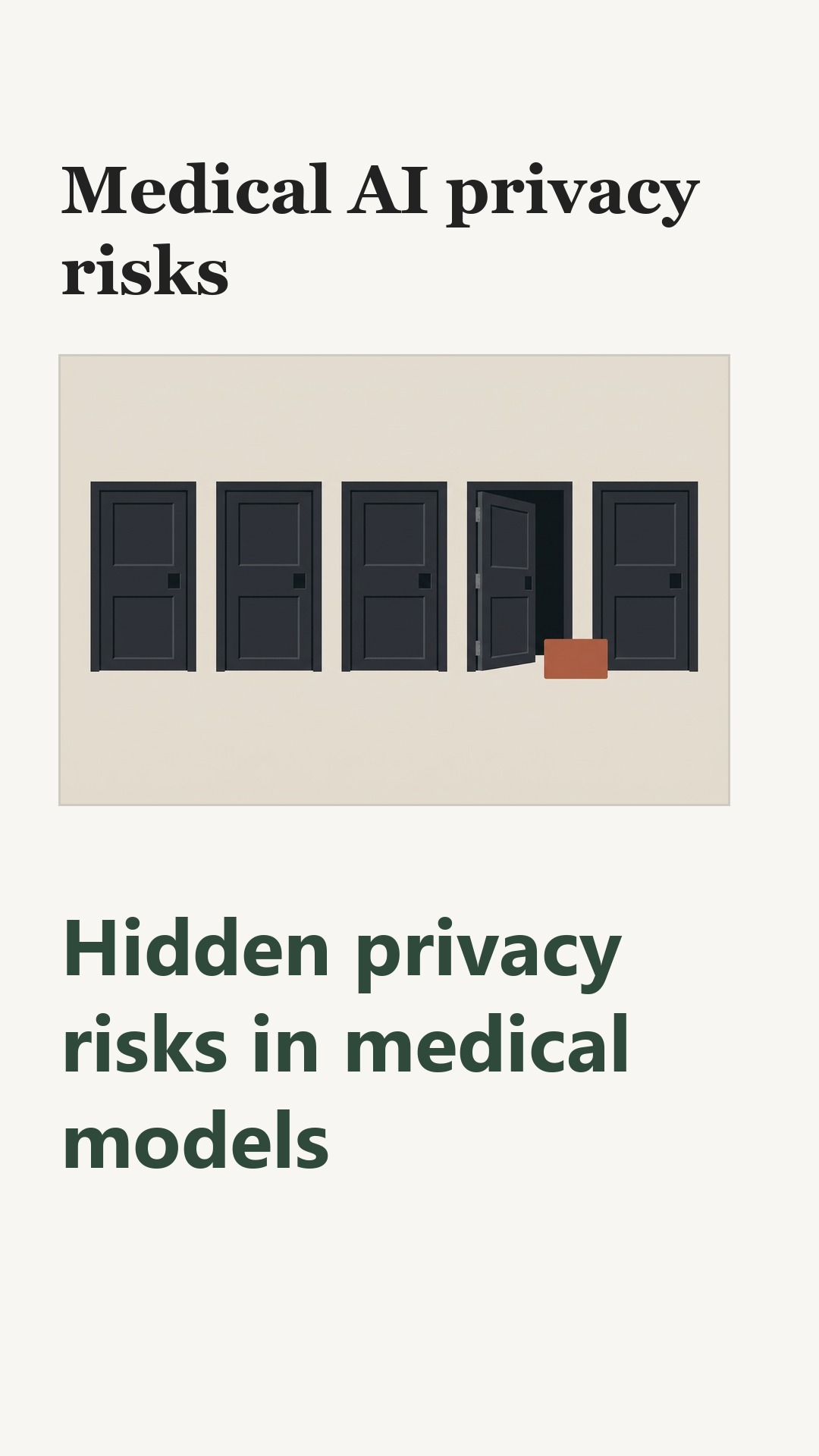
You may one day be asked, or simply find, that your scans or health records were used to train a medical AI. The question that follows is what that exposes about you.
Researchers in Munich, London and Potsdam ran membership inference attacks against seven real clinical datasets: images, electrocardiograms and health records. The attack asks a model's predictions a single question: was this person's data part of your training set? It needs one query, the kind any ordinary user of a system could make.
For most patients the attack was near useless. For a small subset it was close to perfect, meaning a stranger could learn you were a patient with almost no false alarms. The averages hid this completely. Across the datasets, the overall attack score stayed near random guessing, the level of a coin toss, even while some individual patients were wide open.
Picture a row of doors, each with its own lock. Most hold firm. A few give way at a touch, and the average tells you nothing about which.
The number of highly vulnerable patients grew by orders of magnitude as models got larger. In a dermatology dataset, the share of patients with near-perfect attack success rose from none, in the smallest model, to 1 out of 10 in the largest. Underrepresented groups were overrepresented among the most exposed records. In one emergency-department dataset, records from Black patients, patients on Medicaid insurance and patients diagnosed with cancer appeared among the most vulnerable more often than their share of the data would predict: 31 percent, 126 percent and 18 percent more, respectively.
Grant the authors this much: the disparities are driven at least in part by how few records a group contributes, and one dataset's race comparison is probably confounded by breast density. The group numbers describe a pattern, not a certainty about any one person.
The study tested only this one kind of attack, on diagnostic models the researchers trained or downloaded. It does not show that any hospital or company has leaked your data. It cannot tell you what a chatbot or image generator trained on health records might reveal; the authors name that as future work.
When you are told an AI was trained on patient data, look for whether anyone reports risk per patient or per group, and ask whether privacy protection was applied at the patient level.
What this means for you
When you are told a medical AI was trained on patient data, look for whether anyone reports risk per patient or per group, and ask whether protection was applied at the patient level. The study measured only how well this one kind of attack worked on diagnostic models. It did not show that any hospital or company leaked your data, so there is nothing here to act on yet.
Knolle, M. A., Menten, M. J., Jungmann, F. et al. (2026). Disparate privacy risks from medical AI. Nature. https://doi.org/10.1038/s41586-026-10688-0
Who paid: The work was partially funded by the Konrad Zuse School of Excellence in Reliable AI (relAI), ERC Grant Deep4MI (no. 884622) and the German Research Foundation (project no. 532139938), with B.G. supported by a Royal Academy of Engineering Research Chair; the article does not state whether funders had any say, and two authors are part-time employees of DeepHealth and Google DeepMind.
Do not take this as professional medical advice.
The longer versionThe passages copied from the paper, the pictures, and every source with how much of it we read · 1264 words · about 6 minRead it →Close
A Hospital Trained an AI on Your Scan. The Study Found Some Patients Can Be Picked Out Almost Perfectly.
A privacy audit of seven clinical datasets found that a stranger querying a diagnostic model could identify some patients with near-perfect accuracy — while the average number looked like a coin toss.
Consider what the clinic visit covers: a chest X-ray, a blood test, a line in an emergency record. Those files often go on to train the software that reads scans and flags risk. A new audit asks what a patient gives up when that happens, and finds the answer is not the same for everyone.
The study, published in *Nature* in 2026, comes from researchers at the Technical University of Munich, Imperial College London and the University of Potsdam. It was funded in part by the Konrad Zuse School of Excellence in Reliable AI, an European Research Council grant and the German Research Foundation. Two of the authors hold part-time jobs at DeepHealth and Google DeepMind. The work is a privacy audit, not a clinical trial: nobody's care was changed, and no hospital's live system was attacked.
The technique at the centre is called a membership inference attack. In plain words, it tries to answer one question about a person: was this patient's data used to train the model?1 The attack works on a small habit of these systems. A model tends to be a little more confident about the cases it learned from than about cases it has never seen.2
What makes the attack practical is how little it needs. A user who can send the model an input and read back a prediction — a percentage, a label — can run it, and one query per record is enough.3 No insider access, no stolen files: the attacker poses as an ordinary user of the system.4 That matters because the answer itself can be the secret. A model that predicts whether a cancer treatment will work, trained on patients who have cancer, reveals a diagnosis to anyone who can confirm that a person was in its training set.5
The authors did not settle for the usual score. Standard practice measures attack success across a whole dataset at once, which averages the risk away. Instead, they trained 200 models per dataset, each on a random half of the patients, and estimated how identifiable each patient was on their own. Across the datasets, some patients could be identified almost perfectly, while most were barely affected at all.6 The average, meanwhile, sat close to random guessing.7
Two patterns ran through the results. Attack success rose with model size.8 On a dermatology dataset, the share of patients who could be identified with near-perfect confidence went from none, to one in 10,000, to one in 1,000, to one in 10 as the models grew larger.9 And the risk was not spread evenly: groups that make up a small share of the training data were over-represented among the most exposed records.10 In one emergency-department dataset, records from Black patients, patients on Medicaid and patients diagnosed with cancer appeared among the most vulnerable more often than their share of the data would predict, by 31, 126 and 18 percent.11 The authors tie this to a wider body of work on health inequalities.12
The datasets were real hospital and public records: chest X-rays from Stanford and from Beth Israel Deaconess in Boston, mammograms from Emory University in Atlanta, eye images from a Harvard Medical School ophthalmoscopy dataset, heart tracings, skin photographs and emergency-department files. Nothing here was measured in a live clinic.
The authors are direct about what their numbers mean for the usual way of reporting. A single average figure can badly understate what an individual faces.7 They call the standard measure unsuitable, because it hides the few who are highly exposed behind the many who are not.13
Grant the hospitals and the vendors their point. A model that performs well on rare conditions has to learn from rare cases, and privacy protection usually costs some accuracy. The authors themselves note that privacy risk grows with model size and predictive power, and that this trade-off looks hard to avoid for uncommon diseases. Some comfort is also real: the researchers took explicit steps against overfitting, the habit that most worsens these risks, and their models still came within a few points of published results. Stronger formal privacy protection did reduce the attack's success, though the authors found it takes protection at the level of the patient, not the single record, to close the gap — and that this is stronger protection than earlier work assumed was needed.
There are limits a reader should hold onto. The attacks were run by researchers against models they trained or downloaded, not against any hospital in operation, so this is not evidence that a particular clinic has leaked anything. The audit measured whether a patient could be singled out, not whether anyone was named or a record reconstructed. Whether the same uneven pattern appears with other kinds of attack remains an open question, as the authors say.14 One dermatology dataset carried no patient identifiers, so each image was treated as a separate person. And images were mostly shrunk to 64 by 64 pixels to keep the computing bill down.
Here is weeklyAI's reading. The pattern is older than the software. An institution holds a great deal of information about people, describes how carefully it guards that information in averages, and the people most easily picked out are those who were already a minority in the room. Expect the next hospital or insurer that mentions AI training to tell you the overall risk is low. A low average is exactly what this study found alongside near-perfect identification of a few. This reading would be wrong if institutions routinely disclosed each patient's own risk of being singled out, and if the most exposed patients turned out not to cluster among minorities and rare conditions.
What can you do with that? When a clinic or insurer says your data helped train a model, ask a narrower question: can you tell me my own risk of being identified, not the average? Ask who checks that claim, and whether the answer differs for patients like you. Put it in writing and keep the reply. If the reply is only an average, that is your answer.
A second thing to keep in view: removing names is not the same as making a record anonymous. Ask whether your scans were stripped of names only, or protected by a stronger technical method, and ask what other information about you sits in the same system. A determined outsider with public records and repeated queries is the threat this study models.
The authors' own recommendations are procedural, not technological. Privacy audits, they write, should report attack success at the level of the individual patient or record, not the dataset.15 And vulnerable models should carry verifiable protections or strict limits on who can query them.16 Neither is a law anywhere yet; both are proposals from a research group.
The ending returns to the X-ray. The file that helped teach a model to read lungs also carries a trace of you, and how strong that trace is depends on how common a patient you are. The question worth carrying to your next appointment is not whether the hospital uses AI. It is whether anyone there can tell you what the model gives away about you in particular.
What would you ask your hospital first: whether your data trained a model, or how identifiable that makes you?
Where each piece of context comes from, and how much of it we read
- Knolle, M. A., Menten, M. J., Jungmann, F. et al. (2026). Disparate privacy risks from medical AI. Nature. https://doi.org/10.1038/s41586-026-10688-0 - the article this story is about — the whole article — the passage: "For example, a membership inference attack (MIA) 2 attempts to determine whether the data of a specific patient were included in the training dataset of a model."
- Knolle, M. A., Menten, M. J., Jungmann, F. et al. (2026). Disparate privacy risks from medical AI. Nature. https://doi.org/10.1038/s41586-026-10688-0 - the article this story is about — the whole article — the passage: "To infer membership status, MIAs typically make use of the fact that AI models are often slightly more confident about their predictions on training than on non-training data."
- Knolle, M. A., Menten, M. J., Jungmann, F. et al. (2026). Disparate privacy risks from medical AI. Nature. https://doi.org/10.1038/s41586-026-10688-0 - the article this story is about — the whole article — the passage: "By contrast, the type of attack we consider here requires querying the target model only once (to obtain a prediction for the target record) and may thus be executed by any attacker posing as a real user of an AI system."
- Knolle, M. A., Menten, M. J., Jungmann, F. et al. (2026). Disparate privacy risks from medical AI. Nature. https://doi.org/10.1038/s41586-026-10688-0 - the article this story is about — the whole article — the passage: "This black-box access to a model can be exploited by an untrusted user to conduct a MIA that shows the membership status of a target record, that is, whether the target record was a member of the training dataset of a model or not (Fig. 1a )."
- Knolle, M. A., Menten, M. J., Jungmann, F. et al. (2026). Disparate privacy risks from medical AI. Nature. https://doi.org/10.1038/s41586-026-10688-0 - the article this story is about — the whole article — the passage: "For example, a successful MIA against the model in ref. 10 , which predicts anti-cancer immunotherapy efficacy from routine blood test data, reveals that an individual has cancer."
- Knolle, M. A., Menten, M. J., Jungmann, F. et al. (2026). Disparate privacy risks from medical AI. Nature. https://doi.org/10.1038/s41586-026-10688-0 - the article this story is about — the whole article — the passage: "Across a diverse range of medical datasets, we show that MIAs can achieve near-perfect success rates for individual patients, even when the aggregate performance does not substantially deviate from random guessing."
- Knolle, M. A., Menten, M. J., Jungmann, F. et al. (2026). Disparate privacy risks from medical AI. Nature. https://doi.org/10.1038/s41586-026-10688-0 - the article this story is about — the whole article — the passage: "Together, our findings show that aggregate privacy metrics can severely underestimate individual privacy risk."
- Knolle, M. A., Menten, M. J., Jungmann, F. et al. (2026). Disparate privacy risks from medical AI. Nature. https://doi.org/10.1038/s41586-026-10688-0 - the article this story is about — the whole article — the passage: "We find that MIA success (both at the aggregate and patient levels) increases with model capacity."
- Knolle, M. A., Menten, M. J., Jungmann, F. et al. (2026). Disparate privacy risks from medical AI. Nature. https://doi.org/10.1038/s41586-026-10688-0 - the article this story is about — the whole article — the passage: "However, simultaneously, the number of patients with near-perfect attack success (AUC score of 0.95 or higher) increases substantially: 0 (WRN-28-2), 1 out of 10,000 (WRN-40-4), 1 out of 1,000 (ViT-B/16-64) and 1 out of 10 (ViT-B/16-128)."
- Knolle, M. A., Menten, M. J., Jungmann, F. et al. (2026). Disparate privacy risks from medical AI. Nature. https://doi.org/10.1038/s41586-026-10688-0 - the article this story is about — the whole article — the passage: "We show that this disparity exists at two levels: (1) the individual patient level, at which some patients experience near-perfect attack success, whereas others remain essentially unaffected; and (2) the group level, at which patient groups underrepresented in a training dataset are often overrepresented among records most vulnerable to MIAs."
- Knolle, M. A., Menten, M. J., Jungmann, F. et al. (2026). Disparate privacy risks from medical AI. Nature. https://doi.org/10.1038/s41586-026-10688-0 - the article this story is about — the whole article — the passage: "For example, in MIMIC-IV-ED, records from Black patients, patients with Medicaid insurance or patients diagnosed with cancer were observed more frequently than expected among the most vulnerable records (+31%, +126%, and +18% relative change to the overall dataset, respectively)."
- Knolle, M. A., Menten, M. J., Jungmann, F. et al. (2026). Disparate privacy risks from medical AI. Nature. https://doi.org/10.1038/s41586-026-10688-0 - the article this story is about — the whole article — the passage: "This finding—that a disproportionately large share of the AI privacy risk burden rests on underrepresented groups—complements the existing literature on health inequalities, which has reported worse health outcomes and life expectancy for marginalized and minority groups 46 ."
- Knolle, M. A., Menten, M. J., Jungmann, F. et al. (2026). Disparate privacy risks from medical AI. Nature. https://doi.org/10.1038/s41586-026-10688-0 - the article this story is about — the whole article — the passage: "This suggests that average-case metrics of attack success, as used in the standard evaluation protocol, are unsuitable measures of privacy risk. They do not accurately reflect that some records or patients may be highly vulnerable, whereas the vast majority are not."
- Knolle, M. A., Menten, M. J., Jungmann, F. et al. (2026). Disparate privacy risks from medical AI. Nature. https://doi.org/10.1038/s41586-026-10688-0 - the article this story is about — the whole article — the passage: "Whether the disparate risk profiles we observe extend to attacks beyond MIAs remains an open question, motivating the further development of risk assessment and mitigation techniques that cater to all data-contributing patients."
- Knolle, M. A., Menten, M. J., Jungmann, F. et al. (2026). Disparate privacy risks from medical AI. Nature. https://doi.org/10.1038/s41586-026-10688-0 - the article this story is about — the whole article — the passage: "Thus, reporting standards for AI privacy audits need to change. Audits should report the success of privacy attacks at the level of individual data contributors or, if the necessary patient- or person-level identifiers are unavailable, at the record level."
- Knolle, M. A., Menten, M. J., Jungmann, F. et al. (2026). Disparate privacy risks from medical AI. Nature. https://doi.org/10.1038/s41586-026-10688-0 - the article this story is about — the whole article — the passage: "To prevent privacy harm, we recommend that vulnerable models be protected by verifiable risk mitigation strategies and/or strict access controls."
Knolle, M. A., Menten, M. J., Jungmann, F. et al. (2026). Disparate privacy risks from medical AI. Nature. https://doi.org/10.1038/s41586-026-10688-0
Who paid: The work was partially funded by the Konrad Zuse School of Excellence in Reliable AI (relAI), ERC Grant Deep4MI (no. 884622) and the German Research Foundation (project no. 532139938), with B.G. supported by a Royal Academy of Engineering Research Chair; the article does not state whether funders had any say, and two authors are part-time employees of DeepHealth and Google DeepMind.
Do not take this as professional medical advice.