analysis of texts · Interpersona An International Journal on Personal Relationships · la publicación, 12 nov 2026 · gratis
Tres universidades escribieron quién responde por tu nota cuando usas IA
Un estudio leyó los reglamentos de tres universidades de Asia y encontró reglas claras sobre declarar el uso de la IA y mantener a una persona a cargo; no miró qué pasa en el salón de clases.
Versión breve · la versión detallada sigue, unos 7 min
Pregunte al chat de weeklyAI
Pregúnteme sobre la IA en su vida: le señalo las notas que weeklyAI ha publicado sobre el tema, esta semana y antes.
Las conversaciones se guardan mientras exista weeklyAI, para mejorar la publicación. Se responde en el idioma en que usted escribe.
- El estudio, de un vistazo
- Quiénes
- Reglamentos sobre IA de tres universidades del sudeste asiático
- Cuántos
- 50 fuentes en total
- Dónde
- Singapur y Malasia
- Cuándo
- publicado el 11 de noviembre de 2026
- Tipo de estudio
- analysis of what people did
- Quién lo hizo
- Universidades de Ucrania
- El límite que importa
- Solo leyó documentos: no muestra lo que hacen profesores y estudiantes.
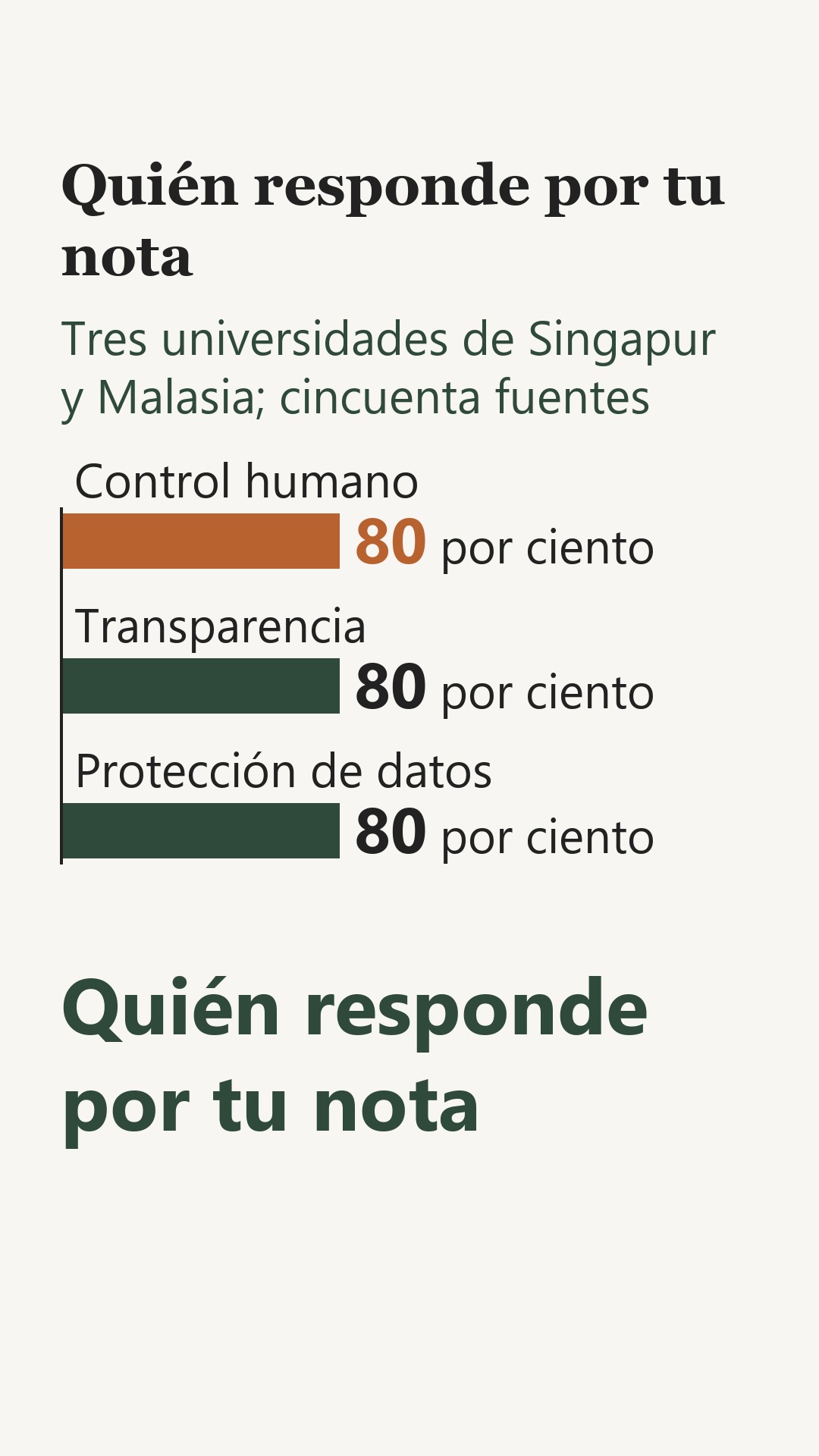
Porcentaje de cinco documentos del sudeste asiático que fijan claramente cada garantía; no dice nada sobre lo que ocurre en el salón de clases.
Apelar una decisión tomada con IA: universidades del estudio frente a la ley ucraniana
Ninguna de las dos universidades tenía un procedimiento propio para apelar; la ley ucraniana sí prevé mecanismos para apelar una evaluación injusta.
El resultado de un detector de contenido hecho por IA no basta, por sí solo, como prueba de mala conducta.
Tienes una tarea que la inteligencia artificial puede escribir en un minuto. La pregunta ya no es si está permitida. Es quién tiene que saber que la usaste y quién responde por la calificación.
Un grupo de investigadores comparó los reglamentos oficiales sobre IA de tres universidades: la Nacional de Singapur, la Tecnológica de Nanyang, también en Singapur, y la Universiti Malaya, en Malasia. También revisaron documentos regionales y nacionales de cinco países del sudeste asiático. Reunieron 50 fuentes en total. Después clasificaron los documentos en 13 categorías.
Lo más detallado no fue cómo calificar con IA. Fue el cerco alrededor. Declarar el uso de la IA, la vigilancia humana, la responsabilidad del profesor, la integridad académica y la transparencia quedaron bien definidas en dos de las tres universidades. En la Universiti Malaya, 12 de las 13 categorías recibieron la nota máxima de claridad.
En la Universidad Nacional de Singapur hay una regla que vale la pena mirar de cerca. El resultado de un detector de contenido hecho por IA no basta, por sí solo, como prueba de mala conducta. Y en las dos universidades con documentos aplicables no se encontró un procedimiento propio para apelar una decisión tomada con ayuda de IA.
Esto es una lectura de documentos, en tres universidades. Muestra lo que está escrito, no lo que hacen profesores y estudiantes. El material de Nanyang era solo orientativo, y una sola persona hizo la clasificación.
En Ucrania, el estudio encontró otra mezcla. La ley ya exige declarar el material hecho con IA y da derecho a apelar una nota injusta. Pero los procedimientos para calificar con IA, generar retroalimentación y usar detectores están menos desarrollados.
Cuando recibas tu próxima tarea, busca si tu institución dice por escrito cómo se declara el uso de la IA y quién revisa el resultado antes de poner la nota.
Qué significa para usted
Para su propia universidad, la pregunta útil es si existe un documento escrito que diga cómo se declara el uso de la IA y quién revisa el resultado antes de poner la nota. En las tres universidades de Asia que se leyeron, ese cerco estaba detallado en dos, pero no se halló un procedimiento propio para apelar una decisión tomada con ayuda de IA.
Melnyk, A., Ptashchenko, O., Grytsyshen, D. et al. (2026). Using artificial intelligence in university knowledge assessment systems: experience of ASEAN universities and prospects for Ukraine. Interpersona An International Journal on Personal Relationships. https://doi.org/10.54899/iij.v20i4.1877
Quién pagó: El artículo no indica ninguna fuente de financiación, ningún papel de los financiadores ni equipos o programas informáticos prestados.
Versión detalladaLos pasajes copiados del artículo, las ilustraciones y cada fuente con cuánto leímos de ella · 1462 palabras · unos 7 minLeerla →Cerrar
Las universidades escriben sus reglas sobre la IA en los exámenes. La mayoría no dice cómo reclamar.
Un estudio comparó tres universidades del sudeste asiático y encontró reglas detalladas sobre el uso de la IA en las calificaciones, pero ningún procedimiento propio para impugnar una decisión tomada con ella.
Un trabajo escolar puede llevar hoy la firma de dos autores: el estudiante y el programa que lo redactó. Esa es la situación que describe un estudio publicado en la revista *Interpersona* el 11 de noviembre de 2026. El equipo lo forman Alla Melnyk, Olena Ptashchenko, Dymytrii Grytsyshen, Liudmyla Hetmanenko y Valentyn Boichenko, de universidades de Ucrania. Analizaron 50 documentos: 17 artículos científicos y 33 normas, estrategias y materiales de universidades. No entrevistaron a nadie: usaron solo documentos públicos y datos estadísticos agregados1.
Lo que buscaban era el grado de detalle con que cada documento fija trece puntos: si se permite la IA, cómo se declara su uso, si se rediseñan las tareas, quién controla la calificación, qué pasa con los detectores de texto generado, quién responde por la nota. Cada punto recibió 0, 1 o 2 según qué tan claramente estuviera escrito. La lectura de esos documentos la hizo una sola persona, sin calcular el acuerdo con un segundo lector2.
En el nivel regional y nacional, tres garantías aparecieron bien formalizadas en cuatro de cada cinco documentos: el control humano, la transparencia y la protección de datos3. En el nivel de las universidades, el resultado se parte en dos. La Universidad Nacional de Singapur y la Universiti Malaya tienen los procedimientos más detallados. Los materiales de la Universidad Tecnológica de Nanyang, en cambio, son sobre todo recomendaciones4.
Ahí aparece el hueco. Para los mecanismos de apelación solo había dos documentos aplicables, y ninguno de los dos contenía un procedimiento propio para impugnar una decisión relacionada con la IA5. Las dos universidades detalladas sí escriben que, cuando la tecnología interviene, su papel debe ser transparente y la responsabilidad final de la calificación sigue siendo del profesor6. También distinguen entre tareas controladas, donde la IA puede prohibirse, y tareas libres, donde se permite si el estudiante la declara7. Y en la Universidad Nacional de Singapur el resultado de un detector de IA no basta por sí solo como prueba de falta académica8.
Conviene mirar de cerca qué es un detector de IA. Es un programa que recibe un texto y devuelve una estimación de si lo escribió una máquina. No ve el proceso: no sabe si el estudiante consultó, corrigió, reescribió. Solo mira el resultado. Por eso una regla que le quite a ese resultado el valor de prueba única cambia quién carga con la duda: sin ella, el estudiante tendría que demostrar que no copió; con ella, la institución tiene que reunir algo más8.
La comparación con Ucrania muestra un reparto distinto. La ley ucraniana sobre integridad académica exige declarar el uso de IA cuando lo generado forma parte de un trabajo9. Esa misma ley vincula el uso deshonesto con la falta académica y prevé mecanismos para apelar una evaluación injusta10. En las dos universidades del estudio que tenían reglas aplicables no había un procedimiento específico para la IA5. Ucrania tiene además bases normativas o recomendatorias para la declaración, la protección de datos, la transparencia, el control humano y las apelaciones; lo que queda menos desarrollado son los procedimientos de evaluación asistida, la retroalimentación generada por IA, el uso de detectores y la formación en alfabetización de IA11.
Otros trabajos ayudan a ubicar este. Según el resumen de un estudio sobre gobernanza universitaria de la IA generativa, el único fragmento disponible, porque el texto completo está detrás de una suscripción, se compararon documentos oficiales de cinco universidades brasileñas y cinco internacionales1213. Ese trabajo encontró puntos en común en la responsabilidad humana, la transparencia y la verificación del contenido, y diferencias en la autonomía del profesor y en cuánto obligan esos documentos14. También halló predominio de permisos condicionados y prohibiciones concretas15, y concluyó que gobernar estas herramientas exige reglas claras, protección de datos, formación e investigación que resguarde los derechos de los involucrados16. La selección de esas instituciones fue intencionada, no al azar17.
Un segundo trabajo, según su resumen, el único disponible, revisó 34 artículos sobre IA en la educación indonesia18. Reportó mejoras medibles en rendimiento, motivación y participación en entornos bien implementados19, y al mismo tiempo riesgos: caída del pensamiento crítico, amenazas a la integridad académica y ausencia de políticas completas de privacidad20. Ese crecimiento se concentra en universidades y zonas urbanas de Java, con ausencia marcada fuera de ahí y en primaria y secundaria21. El estudio pedía un marco nacional y formación para profesores22.
Un tercer resumen, también el único material disponible, describe una taxonomía para decidir cómo adoptar modelos de lenguaje en instituciones2324. Señala una paradoja: las ganancias de rendimiento pueden coincidir con menos precisión del estudiante para juzgar su propio aprendizaje25. Y advierte que recoger datos con mucho detalle amplifica los sesgos, por lo que recomienda pedir los mínimos necesarios26. Ese marco no ha sido validado todavía en ninguna institución real27, y se apoya en evidencia de corto plazo y en literatura sobre todo en inglés y de Occidente28.
Los propios autores del estudio principal señalan sus límites. La muestra fue intencionada, de solo tres universidades, y los documentos disponibles tenían distinto nivel de detalle2. La revisión de documentos muestra reglas escritas, no lo que pasa en el salón. No se calcularon pruebas estadísticas, y los resultados no se pueden extender a todas las universidades del sudeste asiático.
Así lo lee weeklyAI. Cuando una institución empieza a exigir que cada trabajo lleve el nombre de quién lo hizo, no lo hace solo para saber el origen: ese dato se vuelve el criterio con el que se decide si la obra se acepta o se rechaza. Es de esperar que, en universidades como las descritas, la declaración del uso de IA deje de ser un aviso y se convierta en el filtro que decide si la nota se acepta o se anula, aunque el trabajo sea bueno. Esta lectura se equivocaría si los reglamentos trataran la declaración como un dato informativo que no altera la calificación, o si hubiera trabajos sin declaración clara que igual se evaluaran por su contenido. Si usted estudia o tiene familia en una universidad, pida por escrito el reglamento y fíjese si la declaración de IA cambia la nota o solo informa. Pregunte quién decide cuando la declaración es dudosa.
La segunda pieza es la responsabilidad. Quien tiene autoridad sobre otro puede corregirlo o sancionarlo, pero cuando esa autoridad se ejerce sin asumir su parte, el que queda abajo carga solo con el error. Es de esperar que en los sistemas de evaluación con IA la responsabilidad se diluya: el profesor culpa al detector, el detector a la herramienta, y el estudiante queda solo frente a la sanción. O al revés: que las universidades más detalladas pongan por escrito que la decisión final es del docente y no del algoritmo, como aquí aparece. Lo desmentiría encontrar reglamentos donde la responsabilidad recaiga explícitamente en la herramienta o en un comité sin rostro, sin ningún humano que firme. Antes de aceptar una sanción por uso de IA, pregunte por escrito quién firmó la decisión y con qué prueba. Exija que le digan qué persona revisó su caso y qué puede apelar.
La tercera pieza es la costumbre de aceptar. Las personas aceptan decisiones que las afectan cuando vienen envueltas en un relato que las hace parecer inevitables, y dejan de distinguir entre lo comprobado y lo supuesto. Cabe esperar que estudiantes y docentes acepten sin discutir un veredicto de detector de IA si la universidad lo presenta como técnico e infalible, aunque el propio reglamento admita que esa herramienta no basta como prueba. Veríamos lo contrario si los estudiantes cuestionaran sistemáticamente esos resultados y exigieran revisión humana antes de cualquier sanción. Cuando le digan que un sistema automático decidió algo sobre su trabajo o sus datos, pida la revisión humana y pregunte qué evidencia concreta se usó. No acepte "lo dijo el sistema" como respuesta final.
El estudio no midió si estas reglas mejoran el aprendizaje, la integridad o las calificaciones. Tampoco dice si los profesores y estudiantes las cumplen en la práctica. Muestra qué está escrito y qué no. Eso es lo que hay.
La escena con la que abrió esta pieza sigue igual: un trabajo con dos autores, uno de ellos invisible. Lo que ahora puede hacer es pedir el papel. El reglamento de la institución, la firma de quien calificó, la prueba concreta. ¿Sabe usted qué dice el reglamento de la universidad donde estudia o estudiará alguien de su familia sobre declarar el uso de IA, y quién firma la nota cuando la IA intervino?
De dónde sale cada dato de contexto, y cuánto leímos de cada documento
- Melnyk, A., Ptashchenko, O., Grytsyshen, D. et al. (2026). Using artificial intelligence in university knowledge assessment systems: experience of ASEAN universities and prospects for Ukraine. Interpersona An International Journal on Personal Relationships. https://doi.org/10.54899/iij.v20i4.1877 - el artículo del que trata esta nota — el artículo completo — el pasaje: "The spread of generative artificial intelligence is changing assessment practices in higher education and at the same time raising questions about academic integrity, transparency and reliability of learning outcomes."
- Melnyk, A., Ptashchenko, O., Grytsyshen, D. et al. (2026). Using artificial intelligence in university knowledge assessment systems: experience of ASEAN universities and prospects for Ukraine. Interpersona An International Journal on Personal Relationships. https://doi.org/10.54899/iij.v20i4.1877 - el artículo del que trata esta nota — el artículo completo — el pasaje: "The sample was purposive and covered only three main university cases, while the nature of the available documents differed: detailed AI-specific policies were available for NUS and Universiti Malaya, while the public NTU material was mainly recommendatory."
- Melnyk, A., Ptashchenko, O., Grytsyshen, D. et al. (2026). Using artificial intelligence in university knowledge assessment systems: experience of ASEAN universities and prospects for Ukraine. Interpersona An International Journal on Personal Relationships. https://doi.org/10.54899/iij.v20i4.1877 - el artículo del que trata esta nota — el artículo completo — el pasaje: "At the regional and national levels, human control, transparency, and data protection were most clearly formalized: 4 out of 5 documents, or 80.0%, received a score of 2 for each of these criteria."
- Melnyk, A., Ptashchenko, O., Grytsyshen, D. et al. (2026). Using artificial intelligence in university knowledge assessment systems: experience of ASEAN universities and prospects for Ukraine. Interpersona An International Journal on Personal Relationships. https://doi.org/10.54899/iij.v20i4.1877 - el artículo del que trata esta nota — el artículo completo — el pasaje: "The most detailed procedures were found in the National University of Singapore and Universiti Malaya; the materials of Nanyang Technological University were mainly advisory in nature."
- Melnyk, A., Ptashchenko, O., Grytsyshen, D. et al. (2026). Using artificial intelligence in university knowledge assessment systems: experience of ASEAN universities and prospects for Ukraine. Interpersona An International Journal on Personal Relationships. https://doi.org/10.54899/iij.v20i4.1877 - el artículo del que trata esta nota — el artículo completo — el pasaje: "For appeal mechanisms, neither of the two applicable documents contained a separate formalized artificial intelligence-specific procedure, so the score was 0/2, or 0%."
- Melnyk, A., Ptashchenko, O., Grytsyshen, D. et al. (2026). Using artificial intelligence in university knowledge assessment systems: experience of ASEAN universities and prospects for Ukraine. Interpersona An International Journal on Personal Relationships. https://doi.org/10.54899/iij.v20i4.1877 - el artículo del que trata esta nota — el artículo completo — el pasaje: "Where technology is used in these processes, its role should be transparent, and the ultimate responsibility for assessment and feedback remains with the teacher."
- Melnyk, A., Ptashchenko, O., Grytsyshen, D. et al. (2026). Using artificial intelligence in university knowledge assessment systems: experience of ASEAN universities and prospects for Ukraine. Interpersona An International Journal on Personal Relationships. https://doi.org/10.54899/iij.v20i4.1877 - el artículo del que trata esta nota — el artículo completo — el pasaje: "The document distinguishes between controlled forms of assessment, where the use of artificial intelligence may be prohibited, and uncontrolled tasks, in which the technology may be allowed, provided that proper declaration is made."
- Melnyk, A., Ptashchenko, O., Grytsyshen, D. et al. (2026). Using artificial intelligence in university knowledge assessment systems: experience of ASEAN universities and prospects for Ukraine. Interpersona An International Journal on Personal Relationships. https://doi.org/10.54899/iij.v20i4.1877 - el artículo del que trata esta nota — el artículo completo — el pasaje: "At the same time, the result of the work of an artificial intelligence detector is not considered sufficient independent evidence of academic misconduct."
- Melnyk, A., Ptashchenko, O., Grytsyshen, D. et al. (2026). Using artificial intelligence in university knowledge assessment systems: experience of ASEAN universities and prospects for Ukraine. Interpersona An International Journal on Personal Relationships. https://doi.org/10.54899/iij.v20i4.1877 - el artículo del que trata esta nota — el artículo completo — el pasaje: "The Law of Ukraine “On Academic Integrity” directly concerns the use of results created with the help of artificial intelligence: the fact of such use must be disclosed if the generated object is included in academic work."
- Melnyk, A., Ptashchenko, O., Grytsyshen, D. et al. (2026). Using artificial intelligence in university knowledge assessment systems: experience of ASEAN universities and prospects for Ukraine. Interpersona An International Journal on Personal Relationships. https://doi.org/10.54899/iij.v20i4.1877 - el artículo del que trata esta nota — el artículo completo — el pasaje: "The law also links the dishonest use of artificial intelligence results with academic misconduct and provides mechanisms for appealing against unfair evaluation"
- Melnyk, A., Ptashchenko, O., Grytsyshen, D. et al. (2026). Using artificial intelligence in university knowledge assessment systems: experience of ASEAN universities and prospects for Ukraine. Interpersona An International Journal on Personal Relationships. https://doi.org/10.54899/iij.v20i4.1877 - el artículo del que trata esta nota — el artículo completo — el pasaje: "Comparison with Ukraine showed that the declaration of the use of artificial intelligence, data protection, transparency, human control and appeal mechanisms already have a normative or recommendatory basis, but the procedures for artificial intelligence-supported assessment, feedback, the use of detectors and the development of artificial intelligence literacy remain less operationalized."
- Souza Lara CA, Mallmann Ramos T, Moura do Carmo V. (2026). Governança Universitária da Inteligência Artificial Generativa: uma análise comparativa de Políticas Institucionais. Revista Brasileira de Direito. https://doi.org/10.18256/2238-0604.2026.v22i1.5415 — solo el resumen - no se pudo obtener el texto completo — el pasaje: "This article compares institutional policies on the use of generative artificial intelligence in university activities."
- Souza Lara CA, Mallmann Ramos T, Moura do Carmo V. (2026). Governança Universitária da Inteligência Artificial Generativa: uma análise comparativa de Políticas Institucionais. Revista Brasileira de Direito. https://doi.org/10.18256/2238-0604.2026.v22i1.5415 — solo el resumen - no se pudo obtener el texto completo — el pasaje: "Official documents from five Brazilian and five international universities were examined."
- Souza Lara CA, Mallmann Ramos T, Moura do Carmo V. (2026). Governança Universitária da Inteligência Artificial Generativa: uma análise comparativa de Políticas Institucionais. Revista Brasileira de Direito. https://doi.org/10.18256/2238-0604.2026.v22i1.5415 — solo el resumen - no se pudo obtener el texto completo — el pasaje: "The analysis identified common ground concerning human responsibility, transparency, and content verification, alongside differences in instructor autonomy, scope, and the binding force of the documents."
- Souza Lara CA, Mallmann Ramos T, Moura do Carmo V. (2026). Governança Universitária da Inteligência Artificial Generativa: uma análise comparativa de Políticas Institucionais. Revista Brasileira de Direito. https://doi.org/10.18256/2238-0604.2026.v22i1.5415 — solo el resumen - no se pudo obtener el texto completo — el pasaje: "The findings indicate a predominance of conditional permissions and specific prohibitions."
- Souza Lara CA, Mallmann Ramos T, Moura do Carmo V. (2026). Governança Universitária da Inteligência Artificial Generativa: uma análise comparativa de Políticas Institucionais. Revista Brasileira de Direito. https://doi.org/10.18256/2238-0604.2026.v22i1.5415 — solo el resumen - no se pudo obtener el texto completo — el pasaje: "The study concludes that university governance of these tools requires clear rules, data protection, education and training for the academic community, and investigation procedures that safeguard the rights of those involved."
- Souza Lara CA, Mallmann Ramos T, Moura do Carmo V. (2026). Governança Universitária da Inteligência Artificial Generativa: uma análise comparativa de Políticas Institucionais. Revista Brasileira de Direito. https://doi.org/10.18256/2238-0604.2026.v22i1.5415 — solo el resumen - no se pudo obtener el texto completo — el pasaje: "The institutions were purposively selected based on their academic standing, the availability of sources, and the diversity of institutional instruments."
- Riski A, Paais RL, Komariah A, Novebri N, Alang LP, Ataupah WV, et al. (2026). AI Integration in Indonesian Education: Trends, Outcomes, and Challenges - A Comprehensive Review. F1000Research. 10.12688/f1000research.188536.3 — solo el resumen - no se pudo obtener el texto completo — el pasaje: "Using the PRISMA protocol, 34 peer-reviewed articles indexed in the Scopus and Google Schoolar databases (2020-2026) were systematically selected and thematically analyzed across four main themes."
- Riski A, Paais RL, Komariah A, Novebri N, Alang LP, Ataupah WV, et al. (2026). AI Integration in Indonesian Education: Trends, Outcomes, and Challenges - A Comprehensive Review. F1000Research. 10.12688/f1000research.188536.3 — solo el resumen - no se pudo obtener el texto completo — el pasaje: "Several studies included in this review reported that AI has contributed to measurable improvements in student outcomes including learning achievement, motivation, engagement, and teaching efficiency in well-implemented AI environments."
- Riski A, Paais RL, Komariah A, Novebri N, Alang LP, Ataupah WV, et al. (2026). AI Integration in Indonesian Education: Trends, Outcomes, and Challenges - A Comprehensive Review. F1000Research. 10.12688/f1000research.188536.3 — solo el resumen - no se pudo obtener el texto completo — el pasaje: "Nonetheless, its adoption also poses significant risks, including a decline in students' critical thinking skills, threats to academic integrity, and the absence of comprehensive data privacy policies and ethical standards governing AI use in education."
- Riski A, Paais RL, Komariah A, Novebri N, Alang LP, Ataupah WV, et al. (2026). AI Integration in Indonesian Education: Trends, Outcomes, and Challenges - A Comprehensive Review. F1000Research. 10.12688/f1000research.188536.3 — solo el resumen - no se pudo obtener el texto completo — el pasaje: "However, this growth remains unevenly distributed, concentrated in higher education institutions and urban centers on the island of Java, with a marked absence in primary and secondary education levels and in regions outside Java."
- Riski A, Paais RL, Komariah A, Novebri N, Alang LP, Ataupah WV, et al. (2026). AI Integration in Indonesian Education: Trends, Outcomes, and Challenges - A Comprehensive Review. F1000Research. 10.12688/f1000research.188536.3 — solo el resumen - no se pudo obtener el texto completo — el pasaje: "These findings underscore the urgent need for a responsible AI implementation framework in Indonesia one that incorporates standardized AI literacy competencies for teachers, locally contextualized ethical policies, and a functional national roadmap for AI-enabled educational transformation."
- Baradziej S, Kochanska A. (2026). The adaptive learning taxonomy for responsible large language model integration in higher education. Discover Artificial Intelligence. 10.1007/s44163-026-01528-1 — solo el resumen - no se pudo obtener el texto completo — el pasaje: "Large Language Models (LLMs) are being rapidly deployed in higher education, yet institutions lack integrated, theoretically grounded frameworks to guide responsible adoption."
- Baradziej S, Kochanska A. (2026). The adaptive learning taxonomy for responsible large language model integration in higher education. Discover Artificial Intelligence. 10.1007/s44163-026-01528-1 — solo el resumen - no se pudo obtener el texto completo — el pasaje: "Through a targeted narrative synthesis of 35 empirical studies published between January 2024 and February 2025, supplemented by selected post-window studies incorporated during peer review, and grounded in four learning theories-Connectivism, Distributed Cognition, Cognitive Load Theory, and Self-Regulated Learning-this paper develops the Adaptive Learning Taxonomy for Educational Decision-Making (ALT-ED)."
- Baradziej S, Kochanska A. (2026). The adaptive learning taxonomy for responsible large language model integration in higher education. Discover Artificial Intelligence. 10.1007/s44163-026-01528-1 — solo el resumen - no se pudo obtener el texto completo — el pasaje: "While meta-analytic evidence reports large positive effects on academic performance (g = 0.867; Wang and Fan 2025), emerging research reveals a "cognitive paradox": performance gains may coincide with diminished metacognitive accuracy and self-regulation"
- Baradziej S, Kochanska A. (2026). The adaptive learning taxonomy for responsible large language model integration in higher education. Discover Artificial Intelligence. 10.1007/s44163-026-01528-1 — solo el resumen - no se pudo obtener el texto completo — el pasaje: "(2) high-resolution data collection amplifies algorithmic bias, supporting a default of progressive data minimisation;"
- Baradziej S, Kochanska A. (2026). The adaptive learning taxonomy for responsible large language model integration in higher education. Discover Artificial Intelligence. 10.1007/s44163-026-01528-1 — solo el resumen - no se pudo obtener el texto completo — el pasaje: "The framework has not yet been empirically validated through prospective institutional implementation."
- Baradziej S, Kochanska A. (2026). The adaptive learning taxonomy for responsible large language model integration in higher education. Discover Artificial Intelligence. 10.1007/s44163-026-01528-1 — solo el resumen - no se pudo obtener el texto completo — el pasaje: "Additional limitations include reliance on predominantly short-term quasi-experimental evidence, the absence of standardised metrics for real-time metacognitive efficiency, and a literature base that is overwhelmingly English-language and Western-centric."
Melnyk, A., Ptashchenko, O., Grytsyshen, D. et al. (2026). Using artificial intelligence in university knowledge assessment systems: experience of ASEAN universities and prospects for Ukraine. Interpersona An International Journal on Personal Relationships. https://doi.org/10.54899/iij.v20i4.1877
Quién pagó: El artículo no indica ninguna fuente de financiación, ningún papel de los financiadores ni equipos o programas informáticos prestados.
analysis of texts · Interpersona An International Journal on Personal Relationships · the paper, 12 Nov 2026 · free
Three Universities Wrote AI Rules for Graded Work. None Had a Rule for Appeals.
A document review of three universities in Southeast Asia found clear rules on declaring AI use and on who answers for a grade. It found no separate appeal procedure for AI-related decisions, and it read documents only.
Short version · the longer version follows, about 7 min
Ask the weeklyAI chat
Ask me about AI in your life: I point you to the stories weeklyAI has published on it, this week and before.
Conversations are saved for as long as weeklyAI exists, to improve the publication. Answers come in the language you write in.
- The study at a glance
- Who
- Three Southeast Asian universities' AI assessment rules
- How many
- 50 sources, 13 categories
- Where
- Singapore and Malaysia
- When
- August 2026
- Kind of study
- analysis of what people did
- Who did it
- Researchers in Ukraine, journal Interpersona
- The limit that matters
- It read documents only, not what teachers and students actually do
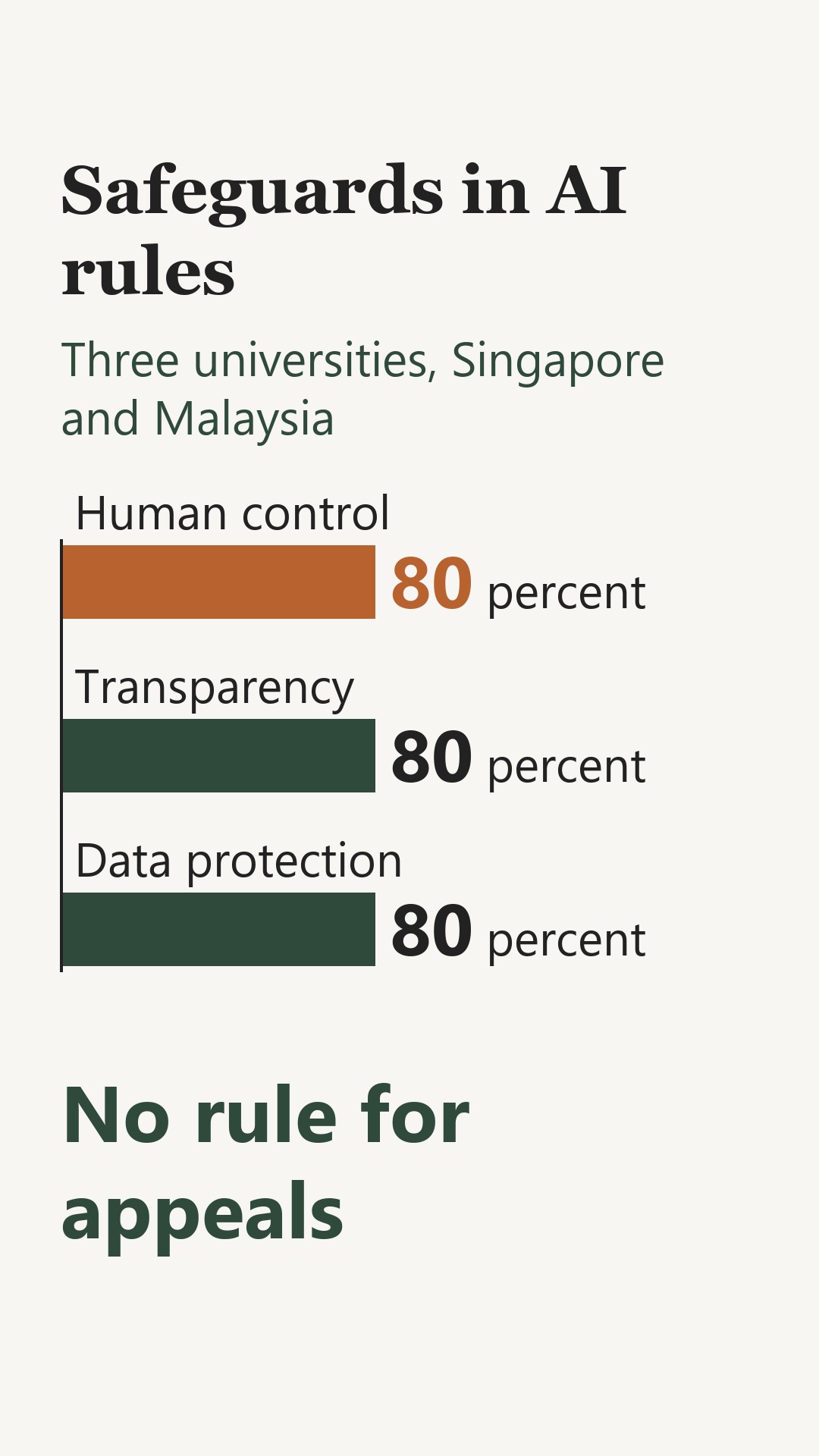
Share of five ASEAN and national documents that clearly set out each safeguard; the study scored documents, not real practice.
Written appeal routes: three Southeast Asian universities against Ukraine's law
No separate written AI appeal procedure at the universities; Ukraine's law names a way to appeal an unfair evaluation
The universities that wrote the most rules also kept the teacher in charge of the final judgment.
Take an assignment that a chatbot could write in a minute. The question for the student is no longer whether the tool is allowed. It is who has to know that it was used, and who answers for the grade when it was.
Researchers looked at three universities: the National University of Singapore, Nanyang Technological University and Universiti Malaya. The Singapore and Malaya documents set out rules for AI in assessment. The Nanyang material was mainly advice on how to design assignments, so the researchers did not score it where the full document could not confirm a rule. The researchers also looked at ASEAN documents and national documents from five countries. Their database covered 50 sources, and their coding matrix covered 13 categories.
Consider what the documents emphasised. The clearest rules were not about letting software grade. They were about the constraints around it. In two of the three universities, the documents fully set out seven of the 13 categories. These were whether AI is allowed, how a student declares its use, how assignments are redesigned, how a person stays in charge, what counts as academic integrity, what must be transparent and who is responsible.
At the National University of Singapore, the documents say a detector's output is not enough on its own to prove misconduct. At Universiti Malaya, the document sets out levels of permitted use and requires students to report the tools they used.
Neither of the two universities whose documents covered appeals had a separate procedure for challenging a decision that involved AI. That count was zero out of two.
This is a reading of documents at three universities. It shows what is written down, not what teachers and students do in a classroom. The Nanyang material was advisory only, so the three cases show different levels of detail in written rules rather than a picture of universities in general.
In Ukraine, the comparison runs differently. A law requires students to disclose material produced with AI, and it gives students the right to appeal an unfair grade. The 2025 ministry recommendations cover human control, transparency and feedback. The detailed procedures for AI-assisted grading, for AI-generated feedback and for the limits of detector evidence are less developed.
The study also projected college enrolment to 2030 from past yearly figures, using a straight-line trend. Those figures say nothing about how much AI a student will meet. The data had gaps, and the fit was weak for Thailand.
When you next get an assignment, look for whether your institution states, in writing, how you declare AI use and who verifies the result.
What this means for you
What the documents at these three universities show is where the written rules stop. If a grade at your institution is questioned because software helped produce or mark it, ask whether there is a separate procedure for that kind of decision, since neither of the two universities whose documents covered appeals had one. Watch for a policy that names who verifies the result, rather than one that only permits or bans the tool.
Melnyk, A., Ptashchenko, O., Grytsyshen, D. et al. (2026). Using artificial intelligence in university knowledge assessment systems: experience of ASEAN universities and prospects for Ukraine. Interpersona An International Journal on Personal Relationships. https://doi.org/10.54899/iij.v20i4.1877
Who paid: The article states no funding source, no funder role and no equipment or software lent.
The longer versionThe passages copied from the paper, the pictures, and every source with how much of it we read · 1323 words · about 7 minRead it →Close
Who Decides What Counts as Your Own Work? Three Universities Wrote It Down. The Rules Stop Short of an Appeal.
In a comparison of three universities in Southeast Asia, the paperwork on AI use in grading is detailed. The route for a student who disagrees with a machine-assisted grade is not.
A student submits an essay. A program may have helped draft it, or check it, or grade it. The university's rules now have to say what part of that was allowed, who knows about it, and who answers for the final mark. Researchers Alla Melnyk, Olena Ptashchenko, Dymytrii Grytsyshen, Liudmyla Hetmanenko and Valentyn Boichenko read the rulebooks of three universities in Southeast Asia to see how far that writing has gone12.
The study, published in the journal Interpersona, was a documentary comparison conducted in August 2026. The authors examined 50 sources, 17 of them peer-reviewed papers and 33 official documents, and sorted the rules into 13 categories. Each category got a score: 0 for no rule, 1 for a partial one, 2 for a clearly written one. Cases that did not apply to a document were left out of the count rather than scored as zero2.
The three universities were the National University of Singapore, Nanyang Technological University and Universiti Malaya. The first and third had detailed policies on AI in assessment. The public material from Nanyang was mostly advisory, so it received low scores and several "not applicable" marks34.
At the university level, seven of the 13 categories were clearly written down in two of the three cases. Those were: whether AI is allowed, whether students must declare its use, redesign of assignments, human oversight, academic integrity, transparency and responsibility. Where the rules applied at all, AI-assisted grading, AI-generated feedback and rules for AI content detectors were fully written down in both applicable cases2.
The most detailed procedures were at the National University of Singapore and Universiti Malaya3. Singapore's policy says that where AI is used in teaching, feedback or marking, its role should be transparent, and the teacher keeps final responsibility for the assessment and the feedback5. It separates controlled assessments, where AI may be banned, from unsupervised tasks, where it may be allowed if the student declares it6. It also states that the output of an AI detector is not enough on its own to prove academic misconduct7.
The gap sits in one place. For appeal mechanisms, neither of the two applicable university documents contained a separate written procedure for challenging a decision about AI. The score was 0 out of 28.
At the regional and national level, the picture was broader and less detailed. Among five documents from ASEAN and member states, human control, transparency and data protection were clearly set out in four of the five, or 80 percent9. These documents set principles. They rarely reach into the classroom92.
The authors also compared this with Ukraine. Ukrainian law requires students to disclose when work includes material made with AI10, ties dishonest use of AI results to academic misconduct, and provides a way to appeal an unfair evaluation11. The authors found that disclosure, data protection, transparency, human control and appeal already have a legal or advisory basis in Ukraine, while procedures for AI-supported assessment, feedback, detector use and AI literacy are less developed12.
What the study cannot tell you is what happens in a classroom. It read documents, not people. The sample was small and chosen on purpose, the coding was done by one researcher, and no measure of agreement between independent coders was calculated. The authors say plainly that written rules do not show whether teachers and students follow them4.
The article says only that a detector's result is not enough on its own to prove academic misconduct. The article says only that a detector's result is not enough on its own to prove academic misconduct7. The rule is narrow and useful, and it is also the kind of safeguard that lives or dies on whether someone checks it.
Compare the two kinds of document the study read. A national AI strategy talks about who controls the technology, how it stays transparent and how data is protected9. A university assessment policy has to answer a smaller, harder question: for this assignment, on this day, what did the student do and what did the program do56. The first is a principle. The second is a procedure, and procedures are where a student actually stands.
The consequence of the consequence: if appeal is the thinnest category in the documents, then a student who believes a machine-assisted grade is wrong may find no written route specific to that complaint8. Ukraine's framework, by contrast, does name a route for appealing an unfair evaluation11. A right that exists in law and a procedure that exists in a course handbook are not the same thing, and the study found the first more often than the second12.
The trade-off is visible in the documents themselves. The universities that wrote the most rules also kept the teacher in charge of the final judgment5. Detail bought clarity about who is responsible. It did not buy a student a stated way to disagree.
Here is weeklyAI's reading. The pattern in these documents is that the written form becomes the whole obligation. A declaration form and a detector rule are easy to point at, and once they exist, the harder question can quietly stop being anyone's job: does this piece of work still show what this student can do? weeklyAI expects that where such forms spread, students will learn to fill them in correctly and staff will learn to run the check, while the reasoning behind the rule goes unasked. This reading would be wrong if universities with detailed declaration and detector rules also required teachers to put in writing why a given task still measures the student's own learning, and had someone other than the teacher review those explanations.
A second pattern is deference. People follow whoever appears to be in charge, even when their own judgment says otherwise. weeklyAI expects that where grading or feedback passes through a system, teachers and students will treat its output as an authority, and formal language naming a responsible human may not change that. This reading would be wrong if, at universities with human-oversight rules, teachers routinely overrode the system and recorded why, and students reported that objecting to a machine-assisted grade actually changed the outcome.
There is also the older habit of treating a score as a measure of a person. The article says only that a detector's result is not enough on its own to prove academic misconduct. What a reader can do with all this is narrow and practical. If you or someone you know is studying, ask the institution for the document that says who decides whether a task still measures the student's own work, not just who checks the form. If a decision about you is made with a system's help, ask for the name of the person who can change it and what you must say to reach them. And if you are scored low, ask in writing which criterion you failed, so the answer can be checked against the stated learning goals.
The study closes on a question it cannot answer from documents: whether a university can explain where technological help supports learning and where it replaces the student's own contribution. That is the same question a student faces at the moment of submission, and the same one an employer faces when a policy lands on the desk. The difference is that the student has a form to fill in, and the reader usually does not.
The essay comes back with a mark and a note that a program was involved. What the reader can now ask is not whether the program was used, but who decided that the work still counted as the student's own, and where that decision is written down.
Where each piece of context comes from, and how much of it we read
- Melnyk, A., Ptashchenko, O., Grytsyshen, D. et al. (2026). Using artificial intelligence in university knowledge assessment systems: experience of ASEAN universities and prospects for Ukraine. Interpersona An International Journal on Personal Relationships. https://doi.org/10.54899/iij.v20i4.1877 - the article this story is about — the whole article — the passage: "The spread of generative artificial intelligence is changing assessment practices in higher education and at the same time raising questions about academic integrity, transparency and reliability of learning outcomes."
- Melnyk, A., Ptashchenko, O., Grytsyshen, D. et al. (2026). Using artificial intelligence in university knowledge assessment systems: experience of ASEAN universities and prospects for Ukraine. Interpersona An International Journal on Personal Relationships. https://doi.org/10.54899/iij.v20i4.1877 - the article this story is about — the whole article — the passage: "In these conditions, institutional regulation becomes decisive, outlining the permissible limits of artificial intelligence use, the procedure for declaring its participation and responsibility for the final academic decision."
- Melnyk, A., Ptashchenko, O., Grytsyshen, D. et al. (2026). Using artificial intelligence in university knowledge assessment systems: experience of ASEAN universities and prospects for Ukraine. Interpersona An International Journal on Personal Relationships. https://doi.org/10.54899/iij.v20i4.1877 - the article this story is about — the whole article — the passage: "The most detailed procedures were found in the National University of Singapore and Universiti Malaya; the materials of Nanyang Technological University were mainly advisory in nature."
- Melnyk, A., Ptashchenko, O., Grytsyshen, D. et al. (2026). Using artificial intelligence in university knowledge assessment systems: experience of ASEAN universities and prospects for Ukraine. Interpersona An International Journal on Personal Relationships. https://doi.org/10.54899/iij.v20i4.1877 - the article this story is about — the whole article — the passage: "The sample was purposive and covered only three main university cases, while the nature of the available documents differed: detailed AI-specific policies were available for NUS and Universiti Malaya, while the public NTU material was mainly recommendatory."
- Melnyk, A., Ptashchenko, O., Grytsyshen, D. et al. (2026). Using artificial intelligence in university knowledge assessment systems: experience of ASEAN universities and prospects for Ukraine. Interpersona An International Journal on Personal Relationships. https://doi.org/10.54899/iij.v20i4.1877 - the article this story is about — the whole article — the passage: "Where technology is used in these processes, its role should be transparent, and the ultimate responsibility for assessment and feedback remains with the teacher."
- Melnyk, A., Ptashchenko, O., Grytsyshen, D. et al. (2026). Using artificial intelligence in university knowledge assessment systems: experience of ASEAN universities and prospects for Ukraine. Interpersona An International Journal on Personal Relationships. https://doi.org/10.54899/iij.v20i4.1877 - the article this story is about — the whole article — the passage: "The document distinguishes between controlled forms of assessment, where the use of artificial intelligence may be prohibited, and uncontrolled tasks, in which the technology may be allowed, provided that proper declaration is made."
- Melnyk, A., Ptashchenko, O., Grytsyshen, D. et al. (2026). Using artificial intelligence in university knowledge assessment systems: experience of ASEAN universities and prospects for Ukraine. Interpersona An International Journal on Personal Relationships. https://doi.org/10.54899/iij.v20i4.1877 - the article this story is about — the whole article — the passage: "At the same time, the result of the work of an artificial intelligence detector is not considered sufficient independent evidence of academic misconduct."
- Melnyk, A., Ptashchenko, O., Grytsyshen, D. et al. (2026). Using artificial intelligence in university knowledge assessment systems: experience of ASEAN universities and prospects for Ukraine. Interpersona An International Journal on Personal Relationships. https://doi.org/10.54899/iij.v20i4.1877 - the article this story is about — the whole article — the passage: "For appeal mechanisms, neither of the two applicable documents contained a separate formalized artificial intelligence-specific procedure, so the score was 0/2, or 0%."
- Melnyk, A., Ptashchenko, O., Grytsyshen, D. et al. (2026). Using artificial intelligence in university knowledge assessment systems: experience of ASEAN universities and prospects for Ukraine. Interpersona An International Journal on Personal Relationships. https://doi.org/10.54899/iij.v20i4.1877 - the article this story is about — the whole article — the passage: "At the regional and national levels, human control, transparency, and data protection were most clearly formalized: 4 out of 5 documents, or 80.0%, received a score of 2 for each of these criteria."
- Melnyk, A., Ptashchenko, O., Grytsyshen, D. et al. (2026). Using artificial intelligence in university knowledge assessment systems: experience of ASEAN universities and prospects for Ukraine. Interpersona An International Journal on Personal Relationships. https://doi.org/10.54899/iij.v20i4.1877 - the article this story is about — the whole article — the passage: "The Law of Ukraine “On Academic Integrity” directly concerns the use of results created with the help of artificial intelligence: the fact of such use must be disclosed if the generated object is included in academic work."
- Melnyk, A., Ptashchenko, O., Grytsyshen, D. et al. (2026). Using artificial intelligence in university knowledge assessment systems: experience of ASEAN universities and prospects for Ukraine. Interpersona An International Journal on Personal Relationships. https://doi.org/10.54899/iij.v20i4.1877 - the article this story is about — the whole article — the passage: "The law also links the dishonest use of artificial intelligence results with academic misconduct and provides mechanisms for appealing against unfair evaluation"
- Melnyk, A., Ptashchenko, O., Grytsyshen, D. et al. (2026). Using artificial intelligence in university knowledge assessment systems: experience of ASEAN universities and prospects for Ukraine. Interpersona An International Journal on Personal Relationships. https://doi.org/10.54899/iij.v20i4.1877 - the article this story is about — the whole article — the passage: "Comparison with Ukraine showed that the declaration of the use of artificial intelligence, data protection, transparency, human control and appeal mechanisms already have a normative or recommendatory basis, but the procedures for artificial intelligence-supported assessment, feedback, the use of detectors and the development of artificial intelligence literacy remain less operationalized."
Melnyk, A., Ptashchenko, O., Grytsyshen, D. et al. (2026). Using artificial intelligence in university knowledge assessment systems: experience of ASEAN universities and prospects for Ukraine. Interpersona An International Journal on Personal Relationships. https://doi.org/10.54899/iij.v20i4.1877
Who paid: The article states no funding source, no funder role and no equipment or software lent.