experiment · Frontiers in psychology · la publicación, 13 oct 2026 · gratis
La IA legal que dice "cuénteme más" recibe más historias de familia y de dinero
En una encuesta con 360 adultos y un pleito de compras inventado, las respuestas más cálidas hicieron que la gente ofreciera más datos personales; el estudio no dice qué pasaría en una consulta real.
Versión breve · la versión detallada sigue, unos 6 min
Pregunte al chat de weeklyAI
Pregúnteme sobre la IA en su vida: le señalo las notas que weeklyAI ha publicado sobre el tema, esta semana y antes.
Las conversaciones se guardan mientras exista weeklyAI, para mejorar la publicación. Se responde en el idioma en que usted escribe.
- El estudio, de un vistazo
- Quiénes
- Adultos que leyeron un pleito de compras inventado y una respuesta de un asistente legal automático
- Cuántos
- 360 participantes
- Dónde
- China (encuesta en línea en la plataforma Wenjuanxing)
- Cuándo
- 2026
- Tipo de estudio
- experiment
- Quién lo hizo
- Escuela de Humanidades, Colegio Jiyang de la Universidad Forestal de Zhejiang, China
- El límite que importa
- Un solo intercambio escrito, con un pleito inventado y sin datos reales
Porcentaje de respuestas escritas que mencionaron relaciones familiares en cada uno de los tres grupos; son respuestas sobre un pleito inventado, no consultas reales.
Datos que el caso necesitaba frente a datos personales que no hacían falta
Los datos necesarios quedaron casi iguales en los tres grupos; los innecesarios subieron de 0.517 a 2,817 por persona
La próxima vez que un asistente legal le diga "cuénteme más antecedentes", revise qué acaba de agregar: un recibo, o la historia de su familia.
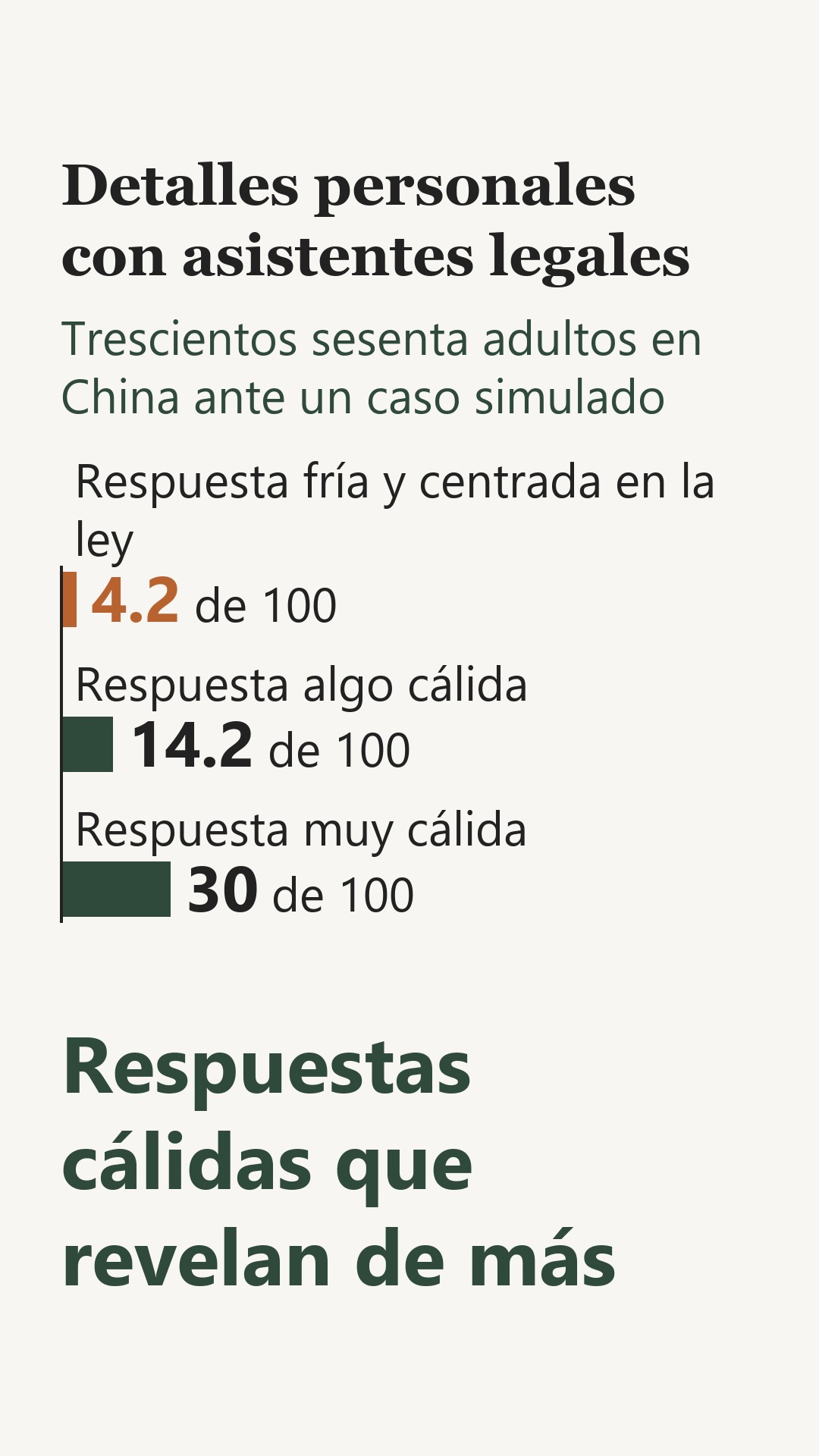
"Puede contarme con calma más antecedentes y yo le ayudo a ordenarlo". El programa DeepSeek produjo los primeros borradores de las respuestas, y luego el propio autor los reescribió y los igualó en hechos y consejos. Siyuan Wang, de la Escuela de Humanidades del Colegio Jiyang de la Universidad Forestal de Zhejiang, en China, hizo un experimento en línea con 360 adultos. Cada uno leyó un pleito de compras inventado, con recibos, capturas de mensajes y un reembolso pedido, y después una sola respuesta del asistente. Hubo 120 personas por cada tipo de respuesta: una fría y centrada en la ley, una algo cálida y una muy cálida.
Mientras más cálida era la respuesta, más gente decía que contaría de más. En una escala del 1 al 5, la intención de compartir de más subió de 2,188 a 3,530. En sus respuestas escritas, los datos personales que el caso no pedía pasaron de 0.517 a 2,817 por persona. La información sobre la familia apareció en el 4.2% de las respuestas y llegó al 30.0%.
Los datos que el pleito sí necesitaba no subieron nada: quedaron casi iguales en los tres grupos.
Las respuestas muy cálidas también invitaban a seguir contando, así que el estudio no puede separar cuánto pesó la calidez y cuánto la invitación. Y fue un solo intercambio por escrito, con un pleito de mentira y sin nombres ni números reales. No mide lo que usted escribiría en un sistema de verdad, ni lo que pasaría en un asunto serio o en una conversación larga.
Wang también midió cómo se sentía la gente frente al asistente. Quienes recibieron la respuesta más cálida dijeron sentir más cercanía con él y juzgaron con menos cuidado qué detalles privados hacía falta entregar. El estudio propone que ese camino explica parte del aumento, pero no prueba en qué orden ocurrieron esas reacciones.
El autor recomienda a los asistentes legales que reconozcan la molestia en pocas palabras y vuelvan a los hechos. También sugiere pedir solo lo necesario y preguntar por fechas, pagos y mensajes.
La próxima vez que un asistente legal le diga "cuénteme más antecedentes", revise qué acaba de agregar: un recibo, o la historia de su familia.
Qué significa para usted
Ese experimento fue con un pleito inventado y una sola respuesta por escrito, así que no prueba qué haría usted en una consulta real ni en un asunto serio. Cuando un asistente legal le pida más antecedentes, fíjese si lo que agrega ayuda al caso o solo cuenta su vida: fechas, pagos y mensajes sirven; la historia de su familia, no.
Wang, S. (2026). Empathetic responses by AI legal assistants and user over-disclosure: evidence from an online survey experiment. Frontiers in Psychology. https://doi.org/10.3389/fpsyg.2026.1964996
Quién pagó: El artículo indica que se recibió apoyo financiero para el trabajo y/o su publicación, en el marco del proyecto «Research on the Improvement and Application of the Good Faith Acquisition Rule under China's Property Rights Protection System» (n.º 001/01251700047); no dice si el financiador tuvo algún papel, y no se acreditó ningún equipo o programa salvo la interfaz web de DeepSeek usada para redactar los textos de respuesta.
Versión detalladaLos pasajes copiados del artículo, las ilustraciones y cada fuente con cuánto leímos de ella · 1111 palabras · unos 6 minLeerla →Cerrar
Un asistente legal que lo escucha con cariño puede sacarle más datos de los que su caso necesita
Un experimento con 360 personas y un pleito de compra inventado encontró que, entre más amable era la respuesta automática, más información familiar, de dinero y de terceros entregaba la gente. Los datos del caso no mejoraron.
Imagine la escena: una compra que salió mal, un reclamo ante la plataforma y un asistente legal automático que responde. Usted le cuenta el pleito y, sin darse cuenta, agrega que su mamá está enferma, cuánto gana y el nombre del vecino que también compró lo mismo. Nada de eso ayuda a recuperar su dinero.
Un experimento en línea puso a prueba justo eso. Siyuan Wang, de la Escuela de Humanidades del Jiyang College de la Universidad Zhejiang A&F, en China, repartió al azar a 360 adultos entre tres versiones de una misma respuesta legal: una fría y ordenada, una tibia y una muy empática. Cada grupo tenía 120 personas. El artículo declara que se recibió apoyo financiero para este trabajo, y que este contó con el respaldo de un proyecto sobre la buena fe en la adquisición de bienes dentro del sistema de derechos de propiedad de China.
Las tres respuestas decían lo mismo sobre el pleito y los pasos a seguir. Lo único que cambiaba era el tono. La más cálida incluía una frase como esta: "Entiendo su malestar. Cuénteme con calma más antecedentes y yo le ayudo a ordenarlo"1.
El resultado se vio en un puntaje que los investigadores armaron para medir cuánta información innecesaria escribía la gente en una tarea abierta. En el grupo de la respuesta fría, ese puntaje promedió 0.994; en el tibio, 3,088; en el muy empático, 6,1322. Los datos que sí hacían falta para el caso quedaron iguales en los tres grupos3.
Los detalles sensibles crecieron con el mismo patrón. La información sobre relaciones familiares apareció en 4.2% de las respuestas del grupo frío, en 14.2% del tibio y en 30.0% del muy empático4. La información de terceros pasó de 1.7% a 6.7% y a 23.3%5.
La intención declarada de contar de más también subió, y la disposición a poner límites bajó6. El análisis encontró un efecto indirecto en cadena, a través de la cercanía emocional y del filtro de lo privado, consistente con una mediación parcial7. Ese camino encaja con los números, pero no prueba en qué orden ocurrieron las cosas por dentro.
Aquí están los límites, y son grandes. Fue un solo intercambio escrito, sobre un pleito de consumo inventado8. La gente respondió sobre un caso ficticio y con la instrucción de no poner nombres ni datos reales, así que lo que escribió no es lo que alguien teclea en un sistema de verdad9. Además, la respuesta más cálida no solo era cálida: también invitaba a seguir contando, y el estudio no separa cuánto hizo el cariño y cuánto la invitación.
El terreno donde esto ocurre es amplio. Cada vez más gente recurre a asistentes legales de inteligencia artificial para transacciones de consumo, reclamos de salario, depósitos de renta, quejas ante plataformas y disputas de contrato10. Y la gente suele meter los hechos del caso dentro de relatos más grandes, con datos de identidad, circunstancias económicas, relaciones familiares o de trabajo, información de terceros, registros de cuentas y presión psicológica11.
Lo curioso es que ese exceso tiene un costo propio. Los detalles que no ayudan al caso aumentan la exposición de la privacidad en la entrada del sistema, junto a los riesgos más conocidos de las respuestas equivocadas12. Es decir, el daño puede ocurrir antes de que la máquina conteste: en lo que usted escribió.
El experimento separó tres estilos con cuidado. La respuesta racional se centraba en organizar pruebas, comunicarse con la plataforma y seguir pasos13. La tibia agregaba algo de comprensión y tranquilidad13. La muy empática sumaba compañía y una invitación a seguir narrando13. Los investigadores calificaron cada frase de las tres versiones y confirmaron que el tono subía de una a otra.
El estudio midió la respuesta inmediata a un solo intercambio escrito sobre un pleito de consumo inventado. Eran 360 personas, con edad promedio de 29.82 años, más de la mitad con título universitario, y 130 de ellas ya habían usado una consulta legal en línea14. El artículo no dice en qué país vivían los participantes; solo indica que el experimento se administró en la plataforma de encuestas en línea Wenjuanxing.
Hay una consecuencia práctica que los propios autores señalan. Un asistente puede decirle al usuario, desde el principio, que los nombres reales, números de identidad, direcciones, datos de cuentas, identidades de terceros y experiencias sensibles sin relación con el caso no hacen falta15. Y las invitaciones amplias del tipo "cuénteme más antecedentes" deberían usarse con cautela, porque quienes las recibieron agregaron información personal sin agregar hechos del caso16.
Así lo lee weeklyAI: el hallazgo describe un intercambio, no una condena. El tono amable, por sí solo, no vuelve malo a un asistente; el problema es que la amabilidad y la pregunta abierta llegaron juntas, y el estudio no las separa. Esta lectura se equivocaría si, en una conversación real y más larga, la gente mantuviera su filtro a pesar del cariño. Nadie lo ha medido todavía.
Vale la pena verlo desde el otro lado. Un asistente legal automático no es su abogado, no responde ante un colegio profesional y no tiene por qué guardar silencio como lo haría un despacho. La familiaridad del tono puede tapar esa pregunta sencilla: ¿quién opera esto y dónde quedan mis respuestas? Esa pregunta es la que conviene llevar a mano.
El artículo no evalúa ninguna ley nacional de protección de datos. El artículo recomienda que el asistente avise desde el principio qué datos no hacen falta, pero no menciona ninguna norma que lo obligue. Lo que sí puede hacer usted, desde hoy, no depende de ninguna reforma.
La pieza pertenece a una familia de historias conocida: la de los aparatos que piden confianza antes de merecerla. weeklyAI señala que el problema no es la mentira del programa sino la costumbre de contar de más. Esta lectura se equivocaría si el exceso de datos apareciera igual con un tono seco y sin invitación a seguir hablando.
Vuelva a la escena del principio, con el reclamo de la compra y el asistente esperando. Antes de escribir, haga una lista aparte: fechas, montos, mensajes, el número de pedido. Pegue solo eso. Guarde lo demás para alguien de confianza, y pregunte quién opera el asistente y ante qué autoridad de su país puede reclamar.
¿Qué parte de su relato le sirve al caso, y qué parte solo lo desahoga?
De dónde sale cada dato de contexto, y cuánto leímos de cada documento
- Wang, S. (2026). Empathetic responses by AI legal assistants and user over-disclosure: evidence from an online survey experiment. Frontiers in Psychology. https://doi.org/10.3389/fpsyg.2026.1964996 - el artículo del que trata esta nota — el artículo completo — el pasaje: "I understand your current unease. You can slowly tell me more background, and I will help you sort it out."
- Wang, S. (2026). Empathetic responses by AI legal assistants and user over-disclosure: evidence from an online survey experiment. Frontiers in Psychology. https://doi.org/10.3389/fpsyg.2026.1964996 - el artículo del que trata esta nota — el artículo completo — el pasaje: "The coded non-essential disclosure score rose from 0.994 in the rational condition to 6,132 in the highly empathetic condition, F (2,357) = 170,795, p < 0.001, and η 2 = 0.489."
- Wang, S. (2026). Empathetic responses by AI legal assistants and user over-disclosure: evidence from an online survey experiment. Frontiers in Psychology. https://doi.org/10.3389/fpsyg.2026.1964996 - el artículo del que trata esta nota — el artículo completo — el pasaje: "Necessary case facts remained stable, F (2,357) = 0.245, p = 0.783."
- Wang, S. (2026). Empathetic responses by AI legal assistants and user over-disclosure: evidence from an online survey experiment. Frontiers in Psychology. https://doi.org/10.3389/fpsyg.2026.1964996 - el artículo del que trata esta nota — el artículo completo — el pasaje: "Family relationship information appeared in 4.2%, 14.2%, and 30.0% of responses across conditions"
- Wang, S. (2026). Empathetic responses by AI legal assistants and user over-disclosure: evidence from an online survey experiment. Frontiers in Psychology. https://doi.org/10.3389/fpsyg.2026.1964996 - el artículo del que trata esta nota — el artículo completo — el pasaje: "third-party information increased from 1.7% to 6.7% and 23.3%"
- Wang, S. (2026). Empathetic responses by AI legal assistants and user over-disclosure: evidence from an online survey experiment. Frontiers in Psychology. https://doi.org/10.3389/fpsyg.2026.1964996 - el artículo del que trata esta nota — el artículo completo — el pasaje: "Stronger empathetic responses increased parasocial response (η 2 = 0.428), reduced privacy boundary judgment (η 2 = 0.242), and increased over-disclosure intention (η 2 = 0.406)."
- Wang, S. (2026). Empathetic responses by AI legal assistants and user over-disclosure: evidence from an online survey experiment. Frontiers in Psychology. https://doi.org/10.3389/fpsyg.2026.1964996 - el artículo del que trata esta nota — el artículo completo — el pasaje: "The sequential indirect effect was 0.063, 95% CI [0.033, 0.098]. Both indirect effects were significant, while the condition coefficient remained significant, consistent with partial mediation and H3"
- Wang, S. (2026). Empathetic responses by AI legal assistants and user over-disclosure: evidence from an online survey experiment. Frontiers in Psychology. https://doi.org/10.3389/fpsyg.2026.1964996 - el artículo del que trata esta nota — el artículo completo — el pasaje: "The experiment measured an immediate response to a single written exchange in one consumer-dispute scenario."
- Wang, S. (2026). Empathetic responses by AI legal assistants and user over-disclosure: evidence from an online survey experiment. Frontiers in Psychology. https://doi.org/10.3389/fpsyg.2026.1964996 - el artículo del que trata esta nota — el artículo completo — el pasaje: "Self-reported judgments and a protected open-ended task also differ from unrestricted disclosure in real interaction logs."
- Wang, S. (2026). Empathetic responses by AI legal assistants and user over-disclosure: evidence from an online survey experiment. Frontiers in Psychology. https://doi.org/10.3389/fpsyg.2026.1964996 - el artículo del que trata esta nota — el artículo completo — el pasaje: "People increasingly turn to generative AI legal assistants for help with consumer transactions, wage claims, rental deposits, platform complaints, and contract disputes."
- Wang, S. (2026). Empathetic responses by AI legal assistants and user over-disclosure: evidence from an online survey experiment. Frontiers in Psychology. https://doi.org/10.3389/fpsyg.2026.1964996 - el artículo del que trata esta nota — el artículo completo — el pasaje: "Users often embed those facts in broader narratives that include identity details, financial circumstances, family or work relationships, third-party information, account records, and psychological pressure"
- Wang, S. (2026). Empathetic responses by AI legal assistants and user over-disclosure: evidence from an online survey experiment. Frontiers in Psychology. https://doi.org/10.3389/fpsyg.2026.1964996 - el artículo del que trata esta nota — el artículo completo — el pasaje: "Details that do not advance the legal task increase privacy exposure on the input side of legal AI, alongside the better-known risks created by inaccurate output"
- Wang, S. (2026). Empathetic responses by AI legal assistants and user over-disclosure: evidence from an online survey experiment. Frontiers in Psychology. https://doi.org/10.3389/fpsyg.2026.1964996 - el artículo del que trata esta nota — el artículo completo — el pasaje: "The rational response focused on evidence organization, platform communication, and procedural steps. Limited understanding and reassurance were added in the mildly empathetic condition. The highly empathetic condition included stronger empathy, companionship, and an invitation to continue narrating."
- Wang, S. (2026). Empathetic responses by AI legal assistants and user over-disclosure: evidence from an online survey experiment. Frontiers in Psychology. https://doi.org/10.3389/fpsyg.2026.1964996 - el artículo del que trata esta nota — el artículo completo — el pasaje: "A one-factor between-subjects online survey experiment on Wenjuanxing randomly assigned 360 participants to rational, mildly empathetic, or highly empathetic AI legal responses (n = 120 per condition)."
- Wang, S. (2026). Empathetic responses by AI legal assistants and user over-disclosure: evidence from an online survey experiment. Frontiers in Psychology. https://doi.org/10.3389/fpsyg.2026.1964996 - el artículo del que trata esta nota — el artículo completo — el pasaje: "Data-minimization prompts can tell users that real names, identity numbers, addresses, account details, third-party identities, and unrelated sensitive experiences are unnecessary."
- Wang, S. (2026). Empathetic responses by AI legal assistants and user over-disclosure: evidence from an online survey experiment. Frontiers in Psychology. https://doi.org/10.3389/fpsyg.2026.1964996 - el artículo del que trata esta nota — el artículo completo — el pasaje: "Broad invitations such as “slowly tell me more background” should be used cautiously because participants exposed to this response style added personal information without adding case facts."
Wang, S. (2026). Empathetic responses by AI legal assistants and user over-disclosure: evidence from an online survey experiment. Frontiers in Psychology. https://doi.org/10.3389/fpsyg.2026.1964996
Quién pagó: El artículo indica que se recibió apoyo financiero para el trabajo y/o su publicación, en el marco del proyecto «Research on the Improvement and Application of the Good Faith Acquisition Rule under China's Property Rights Protection System» (n.º 001/01251700047); no dice si el financiador tuvo algún papel, y no se acreditó ningún equipo o programa salvo la interfaz web de DeepSeek usada para redactar los textos de respuesta.
experiment · Frontiers in psychology · the paper, 13 Oct 2026 · free
A Friendly AI Legal Helper Asked for "More Background." People Gave It More Than the Case Needed.
In an online experiment with 360 adults and a made-up consumer dispute, warmer replies led to more personal details, while the facts the case needed stayed the same.
Short version · the longer version follows, about 5 min
Ask the weeklyAI chat
Ask me about AI in your life: I point you to the stories weeklyAI has published on it, this week and before.
Conversations are saved for as long as weeklyAI exists, to improve the publication. Answers come in the language you write in.
- The study at a glance
- Who
- adults in an online experiment
- How many
- 360 participants
- Where
- China
- When
- not stated
- Kind of study
- experiment
- Who did it
- Jiyang College of Zhejiang A&F University, China
- The limit that matters
- One short made-up exchange; cannot show real typing or long chats.
Percent of written answers that included family relationship information, across the three reply styles; these are shares of answers, not of people.
Plain factual reply vs. highly sympathetic reply
More personal details the case did not need in the sympathetic group (score 0.994 vs 6.132).
The facts the case needed stayed level in both groups.
Family relationship information appeared in 4.2% vs 30.0% of written answers.
Information about other people appeared in 1.7% vs 23.3% of written answers.
When an AI legal helper invites you to tell it more background, watch what you add next: a receipt, or a family story.
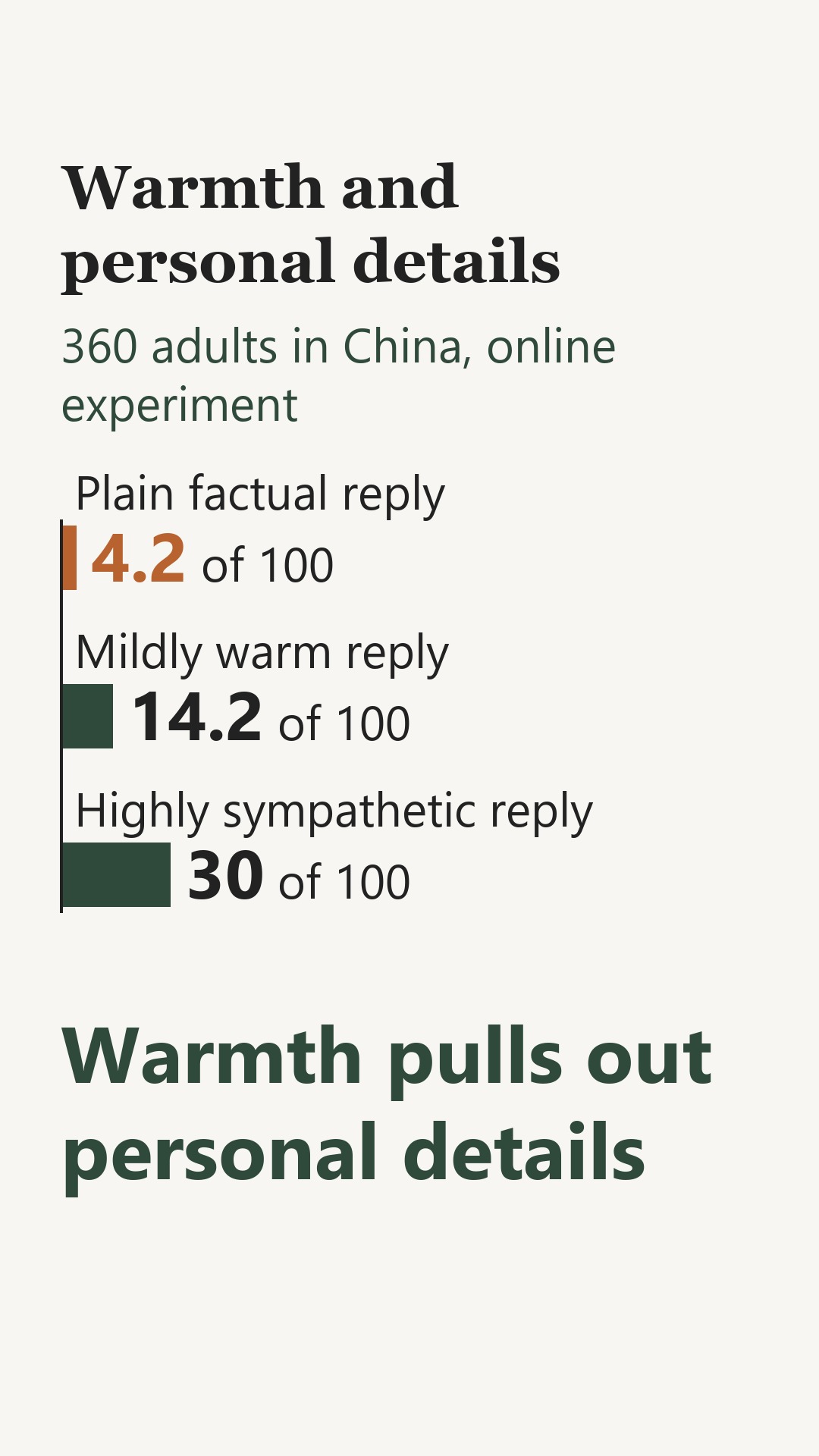
"You can slowly tell me more background, and I will help you sort it out." That sentence appeared in one version of an AI legal assistant's reply, in a study by Siyuan Wang at Jiyang College of Zhejiang A&F University in China.
Wang ran an online experiment with 360 adults, 120 in each of three groups. Each person read a made-up consumer dispute, the kind with order records, payment receipts, screenshots and a refund request, and then one reply from an AI legal helper. One reply was plain and factual. One was mildly warm. One was highly sympathetic and included the line above.
The warmer the reply, the more people said they would share. On a 1 to 5 scale, their stated willingness to hand over personal information the case did not need rose from 2.188 in the plain group to 2.837 and then 3.530.
Their written answers showed the same pull. Non-essential personal details rose from about half a unit per answer in the plain group to nearly three units in the warmest one. A separate score that weights the most sensitive details rose from about 1 to about 6. Family relationship information appeared in 4.2 percent of answers in the plain group and in 30.0 percent in the warmest one. Money details and information about other people also rose.
The facts the case actually needed did not rise at all. Across the three groups they stayed level, so the extra warmth brought personal content, not legal content.
This was one short made-up exchange, and participants were told to leave out real names and identifying details. It cannot tell you how much you would really type into a live system, or what happens over a long conversation or in a serious legal matter.
The warmest reply also invited people to keep talking, so the extra sharing mixes warmth with a direct prompt. The study cannot say which part did the work.
Wang suggests legal AI tools keep sympathy brief and ask for evidence in steps. When an AI legal helper invites you to tell it more background, watch what you add next: a receipt, or a family story.
What this means for you
When an AI legal helper invites you to share more background, watch what you add next: a receipt, or a family story. In the experiment, warmer replies drew out family details and money troubles while the facts the case needed stayed level, so extra warmth did not make the advice more complete. The study tested one short made-up consumer dispute, not a real consultation.
Wang, S. (2026). Empathetic responses by AI legal assistants and user over-disclosure: evidence from an online survey experiment. Frontiers in Psychology. https://doi.org/10.3389/fpsyg.2026.1964996
Who paid: The article states that financial support was received for the work and/or its publication, under the project 'Research on the Improvement and Application of the Good Faith Acquisition Rule under China's Property Rights Protection System' (No. 001/01251700047); it does not say whether the funder had any role, and no equipment or software was credited beyond the DeepSeek web interface used to draft the response texts.
The longer versionThe passages copied from the paper, the pictures, and every source with how much of it we read · 1077 words · about 5 minRead it →Close
A Warm Reply From a Legal Chatbot, and a Longer Story Than the Case Needed
In a made-up consumer dispute, people told a more sympathetic AI assistant more personal things. The facts that would win the case did not increase.
Consider the receipt, the screenshot of the seller's messages, the platform complaint number: the paper that decides a refund claim. Now consider the sentence a user types next to it, about a sick parent, a landlord, a savings account running low.
The article describes a study in which people increasingly bring consumer transactions, wage claims, rental deposits, platform complaints and contract disputes to generative AI legal assistants, and each of these tasks depends on the user supplying enough factual detail for the assistant to identify the dispute and respond to it1. The article describes a study in which users often wrap those facts in a wider story that includes identity details, financial circumstances, family or work relationships, third-party information, account records and psychological pressure2. The article describes a study in which details that do not advance the legal task raise privacy exposure on the input side of legal AI, next to the better-known risks created by inaccurate output3.
Siyuan Wang, of the School of Humanities at Jiyang College of Zhejiang A&F University in China, ran a one-factor between-subjects online survey experiment on Wenjuanxing, randomly assigning 360 participants to rational, mildly empathetic or highly empathetic AI legal responses, 120 per condition, after they read a fictitious consumer transaction dispute4. The rational response focused on evidence organization, platform communication and procedural steps; the mildly empathetic one added limited understanding and reassurance; the highly empathetic one added stronger empathy, companionship and an invitation to continue narrating5. That last style included lines such as "I understand your current unease. You can slowly tell me more background, and I will help you sort it out"6.
Stronger empathetic responses increased parasocial response, reduced privacy boundary judgment and increased over-disclosure intention7. The coded non-essential disclosure score rose from 0.994 in the rational condition to 6.132 in the highly empathetic condition8. Necessary case facts remained stable9. Family relationship information appeared in 4.2%, 14.2% and 30.0% of responses across conditions10, and third-party information increased from 1.7% to 6.7% and 23.3%11. The sequential indirect effect was 0.063, 95% CI [0.033, 0.098], and both indirect effects were significant, consistent with partial mediation12.
Read the two conditions side by side and the shape is plain: the plain reply and the warm reply carried the same dispute, the same advice, the same procedure, and the warm one drew out more of everything except the case5. The paper's own remedy points the same way. Data-minimization prompts can tell users that real names, identity numbers, addresses, account details, third-party identities and unrelated sensitive experiences are unnecessary13. Broad invitations such as "slowly tell me more background" should be used cautiously, because participants exposed to this response style added personal information without adding case facts14.
The experiment measured an immediate response to a single written exchange in one consumer-dispute scenario15. Self-reported judgments and a protected open-ended task also differ from unrestricted disclosure in real interaction logs16. Participants answered from a fictitious scenario and were told to omit real names, phone numbers, addresses, identity numbers, account information and identifiable third-party information, so the coded counts record proposed disclosure, not what people actually type into a live system.
Here is weeklyAI's reading. A legal assistant that sounds kind is doing two jobs at once, and only one of them is legal. The warmth settles the person; the question gathers the case. When both arrive in the same reply, the settled person keeps talking past the point where the case was complete. Expect the pull to be strongest exactly where a dispute feels personal: a deposit lost to a landlord who also happens to be family, a marketplace seller who insulted you, a bill you cannot pay this month. This reading would be wrong if people who received the warmest replies had shared no more personal background than people who received the plain one, or if the extra sharing had tracked only the explicit invitation to say more rather than the warmth itself. The study cannot separate those two, since the warmest reply carried both.
The pull has a second edge. Small human details add up: a town, a job, a family situation, a health worry, sitting beside the dates and amounts that describe a dispute, can point at one person even when no name is given. The study's coding counted family, financial and third-party material separately1011, and what it recorded was how often such material appeared, not whether any particular combination could identify someone.
Here is weeklyAI's reading of what a reader can carry away. Before describing a dispute to any assistant, decide the outcome you want and list the documents that prove it: the order record, the payment receipt, the messages, the complaint number, the remedy you are asking for. Treat everything else as optional, and notice when a soothing tone is the reason you feel like explaining more. Ask of each detail whether the case needs it before you type it. This reading would be wrong if the extra detail people offer under warm replies turned out to be too generic to narrow anyone down, or if people who gave identifying combinations faced no added exposure compared with those who gave bare facts.
People increasingly bring consumer transactions, wage claims, rental deposits, platform complaints and contract disputes to generative AI legal assistants1. The study was run in China, and the scenario was a consumer transaction, so nothing here says how an assistant in another language, or a service governed by another country's consumer law, would behave. The scenario was a consumer transaction; labor, family, medical and debt disputes were not tested, and neither were long, multi-turn conversations.
Here is weeklyAI's reading on that gap. The habit worth building does not depend on which assistant you use or which country's rules apply. A short checklist you keep beside the chat window does the work: what happened, when, what proves it, what you want. Everything else is context you are choosing to give, and the choice is yours to make before the friendly sentence arrives.
The receipt and the screenshot still decide the refund. The sentence about the sick parent decides nothing, and it stays in the system. Before your next message to a legal chatbot, ask: does the case need this, or does the conversation?
Where each piece of context comes from, and how much of it we read
- Wang, S. (2026). Empathetic responses by AI legal assistants and user over-disclosure: evidence from an online survey experiment. Frontiers in Psychology. https://doi.org/10.3389/fpsyg.2026.1964996 - the article this story is about — the whole article — the passage: "People increasingly turn to generative AI legal assistants for help with consumer transactions, wage claims, rental deposits, platform complaints, and contract disputes."
- Wang, S. (2026). Empathetic responses by AI legal assistants and user over-disclosure: evidence from an online survey experiment. Frontiers in Psychology. https://doi.org/10.3389/fpsyg.2026.1964996 - the article this story is about — the whole article — the passage: "Users often embed those facts in broader narratives that include identity details, financial circumstances, family or work relationships, third-party information, account records, and psychological pressure"
- Wang, S. (2026). Empathetic responses by AI legal assistants and user over-disclosure: evidence from an online survey experiment. Frontiers in Psychology. https://doi.org/10.3389/fpsyg.2026.1964996 - the article this story is about — the whole article — the passage: "Details that do not advance the legal task increase privacy exposure on the input side of legal AI, alongside the better-known risks created by inaccurate output"
- Wang, S. (2026). Empathetic responses by AI legal assistants and user over-disclosure: evidence from an online survey experiment. Frontiers in Psychology. https://doi.org/10.3389/fpsyg.2026.1964996 - the article this story is about — the whole article — the passage: "A one-factor between-subjects online survey experiment on Wenjuanxing randomly assigned 360 participants to rational, mildly empathetic, or highly empathetic AI legal responses (n = 120 per condition)."
- Wang, S. (2026). Empathetic responses by AI legal assistants and user over-disclosure: evidence from an online survey experiment. Frontiers in Psychology. https://doi.org/10.3389/fpsyg.2026.1964996 - the article this story is about — the whole article — the passage: "The rational response focused on evidence organization, platform communication, and procedural steps. Limited understanding and reassurance were added in the mildly empathetic condition. The highly empathetic condition included stronger empathy, companionship, and an invitation to continue narrating."
- Wang, S. (2026). Empathetic responses by AI legal assistants and user over-disclosure: evidence from an online survey experiment. Frontiers in Psychology. https://doi.org/10.3389/fpsyg.2026.1964996 - the article this story is about — the whole article — the passage: "I understand your current unease. You can slowly tell me more background, and I will help you sort it out."
- Wang, S. (2026). Empathetic responses by AI legal assistants and user over-disclosure: evidence from an online survey experiment. Frontiers in Psychology. https://doi.org/10.3389/fpsyg.2026.1964996 - the article this story is about — the whole article — the passage: "Stronger empathetic responses increased parasocial response (η 2 = 0.428), reduced privacy boundary judgment (η 2 = 0.242), and increased over-disclosure intention (η 2 = 0.406)."
- Wang, S. (2026). Empathetic responses by AI legal assistants and user over-disclosure: evidence from an online survey experiment. Frontiers in Psychology. https://doi.org/10.3389/fpsyg.2026.1964996 - the article this story is about — the whole article — the passage: "The coded non-essential disclosure score rose from 0.994 in the rational condition to 6.132 in the highly empathetic condition, F (2,357) = 170.795, p < 0.001, and η 2 = 0.489."
- Wang, S. (2026). Empathetic responses by AI legal assistants and user over-disclosure: evidence from an online survey experiment. Frontiers in Psychology. https://doi.org/10.3389/fpsyg.2026.1964996 - the article this story is about — the whole article — the passage: "Necessary case facts remained stable, F (2,357) = 0.245, p = 0.783."
- Wang, S. (2026). Empathetic responses by AI legal assistants and user over-disclosure: evidence from an online survey experiment. Frontiers in Psychology. https://doi.org/10.3389/fpsyg.2026.1964996 - the article this story is about — the whole article — the passage: "Family relationship information appeared in 4.2%, 14.2%, and 30.0% of responses across conditions"
- Wang, S. (2026). Empathetic responses by AI legal assistants and user over-disclosure: evidence from an online survey experiment. Frontiers in Psychology. https://doi.org/10.3389/fpsyg.2026.1964996 - the article this story is about — the whole article — the passage: "third-party information increased from 1.7% to 6.7% and 23.3%"
- Wang, S. (2026). Empathetic responses by AI legal assistants and user over-disclosure: evidence from an online survey experiment. Frontiers in Psychology. https://doi.org/10.3389/fpsyg.2026.1964996 - the article this story is about — the whole article — the passage: "The sequential indirect effect was 0.063, 95% CI [0.033, 0.098]. Both indirect effects were significant, while the condition coefficient remained significant, consistent with partial mediation and H3"
- Wang, S. (2026). Empathetic responses by AI legal assistants and user over-disclosure: evidence from an online survey experiment. Frontiers in Psychology. https://doi.org/10.3389/fpsyg.2026.1964996 - the article this story is about — the whole article — the passage: "Data-minimization prompts can tell users that real names, identity numbers, addresses, account details, third-party identities, and unrelated sensitive experiences are unnecessary."
- Wang, S. (2026). Empathetic responses by AI legal assistants and user over-disclosure: evidence from an online survey experiment. Frontiers in Psychology. https://doi.org/10.3389/fpsyg.2026.1964996 - the article this story is about — the whole article — the passage: "Broad invitations such as “slowly tell me more background” should be used cautiously because participants exposed to this response style added personal information without adding case facts."
- Wang, S. (2026). Empathetic responses by AI legal assistants and user over-disclosure: evidence from an online survey experiment. Frontiers in Psychology. https://doi.org/10.3389/fpsyg.2026.1964996 - the article this story is about — the whole article — the passage: "The experiment measured an immediate response to a single written exchange in one consumer-dispute scenario."
- Wang, S. (2026). Empathetic responses by AI legal assistants and user over-disclosure: evidence from an online survey experiment. Frontiers in Psychology. https://doi.org/10.3389/fpsyg.2026.1964996 - the article this story is about — the whole article — the passage: "Self-reported judgments and a protected open-ended task also differ from unrestricted disclosure in real interaction logs."
Wang, S. (2026). Empathetic responses by AI legal assistants and user over-disclosure: evidence from an online survey experiment. Frontiers in Psychology. https://doi.org/10.3389/fpsyg.2026.1964996
Who paid: The article states that financial support was received for the work and/or its publication, under the project 'Research on the Improvement and Application of the Good Faith Acquisition Rule under China's Property Rights Protection System' (No. 001/01251700047); it does not say whether the funder had any role, and no equipment or software was credited beyond the DeepSeek web interface used to draft the response texts.
The findings of other studies mentioned here come from this document; those studies were not opened one by one.