experiment · Frontiers in psychology · la publicación, 17 jun 2026 · gratis
Un taller de cuatro pasos mejoró los personajes que estudiantes chinos crearon con inteligencia artificial
El grupo que siguió una hoja de ruta con preguntas de autoevaluación superó al que usó las mismas herramientas sin guía. Las imágenes finales se calificaron solo al terminar el curso y en parte las hizo la máquina.
Versión breve · la versión detallada sigue, unos 8 min
Pregunte al chat de weeklyAI
Pregúnteme sobre la IA en su vida: le señalo las notas que weeklyAI ha publicado sobre el tema, esta semana y antes.
Las conversaciones se guardan mientras exista weeklyAI, para mejorar la publicación. Se responde en el idioma en que usted escribe.
- El estudio, de un vistazo
- Quiénes
- Estudiantes de segundo año de animación
- Cuántos
- 120 estudiantes, repartidos en tres grupos de 40
- Dónde
- Una universidad del centro de China
- Cuándo
- Del 20 de octubre al 14 de noviembre de 2025
- Tipo de estudio
- experiment
- Quién lo hizo
- Universiti Sains Malaysia, Centro de Tecnología Educativa y Multimedia
- El límite que importa
- El diseño se calificó solo al final y parte del puntaje puede reflejar lo que produjo la máquina.
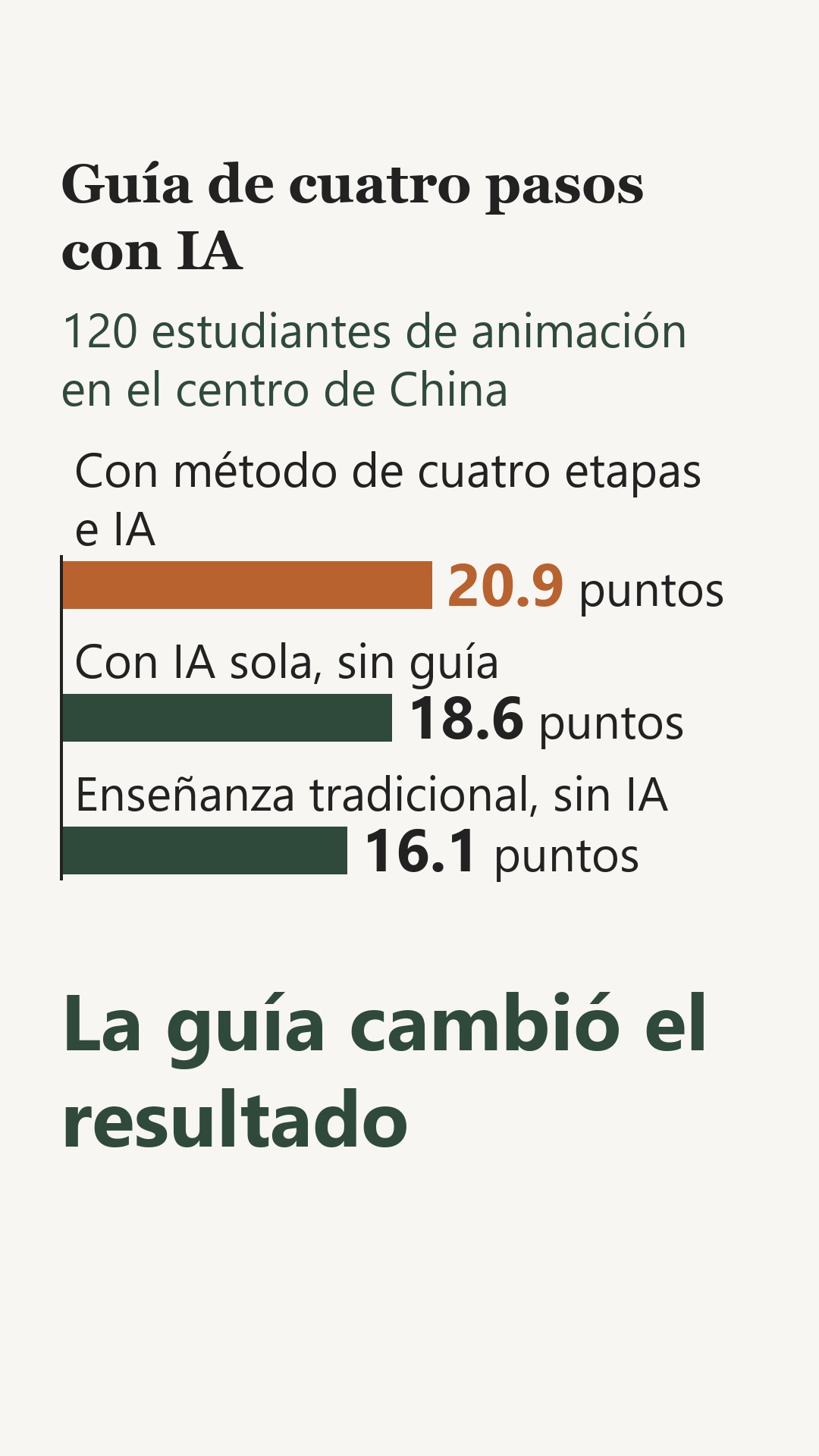
Son los promedios de la rúbrica con que dos profesores calificaron los personajes finales; se calificó solo al terminar el curso, sin medida previa, y los dos grupos con IA generaron sus imágenes con la máquina.
Tres formas de enseñar diseño de personajes
El grupo con método quedó arriba en calidad del diseño, confianza creativa y capacidad percibida para resolver problemas.
El grupo con IA sola quedó arriba del tradicional en las tres medidas.
Metas claras por etapa, preguntas para que el estudiante revise su propio avance y un momento señalado para cada herramienta: eso separó al grupo que quedó arriba.
Cuatro semanas, del 20 de octubre al 14 de noviembre de 2025, en una universidad del centro de China. 120 estudiantes de segundo año de animación, de 19 a 22 años, tenían que diseñar un personaje para un juego de cartas. Los autores del estudio trabajan en la Universiti Sains Malaysia, y el curso lo dio un profesor con más de 15 años de experiencia en enseñanza del diseño.
Un grupo trabajó con dos herramientas de inteligencia artificial, Deepseek y Dreamina. Lo hizo dentro de una hoja llamada Doble Diamante, con cuatro etapas: descubrir, definir, desarrollar y entregar. En cada etapa había preguntas para revisar el avance y una indicación de cuándo usar cada herramienta.
Otro grupo usó las mismas dos herramientas sin ninguna hoja de ruta. El tercero trabajó a la manera tradicional, sin inteligencia artificial: hizo bocetos a mano y terminó sus diseños en programas como Photoshop.
Los personajes del primer grupo recibieron las calificaciones más altas: 20.90 puntos en promedio, frente a 18.65 del grupo con inteligencia artificial sola y 16.13 del grupo tradicional. Ese mismo grupo también reportó más confianza en su propia creatividad y una percepción más fuerte de su capacidad para resolver problemas. En las tres medidas, el orden fue el mismo.
Hay que leer esos puntajes con cuidado. El trabajo de diseño se calificó solo al final, sin una prueba previa, así que no se ve cuánto mejoró cada estudiante. Además, los dos grupos con inteligencia artificial generaron y ajustaron sus imágenes con la máquina. Las notas pueden reflejar en parte la calidad de lo que produjo la herramienta, no la habilidad de la persona.
Con la resolución de problemas pasa algo parecido. Se midió con un cuestionario general, no con una prueba de diseño. Lo que subió fue la opinión de los estudiantes sobre su capacidad. Nadie observó esa habilidad en acción.
Son 120 estudiantes de una sola universidad y una sola carrera, en un solo país. El estudio no dice nada sobre otros niveles educativos ni sobre lo que ocurre con el tiempo. Tampoco midió riesgos como depender demasiado de la máquina.
Metas claras por etapa, preguntas para que el estudiante revise su propio avance y un momento señalado para cada herramienta: eso separó al grupo que quedó arriba. Si en su escuela se usa inteligencia artificial para crear, pregunte si existe algo así.
Qué significa para usted
En su escuela puede preguntar si quien usa inteligencia artificial para crear sigue una guía por etapas, con preguntas para revisar el avance y un momento claro para cada herramienta. Eso fue lo que distinguió al grupo con mejores resultados en un curso de diseño en China, y no se sabe todavía si serviría en otro nivel educativo. Conviene mirar también qué tanto del trabajo final hizo la máquina.
Song, F., Xu, B. (2026). Effects of integrating a structured design thinking strategy into generative AI-supported design learning on students’ design achievement, creative self-efficacy, and problem-solving skills. Frontiers in Psychology. https://doi.org/10.3389/fpsyg.2026.1847432
Quién pagó: Los autores declararon que no recibieron apoyo financiero para este trabajo ni para su publicación, y declararon no tener conflictos de interés comerciales o financieros.
Versión detalladaLos pasajes copiados del artículo, las ilustraciones y cada fuente con cuánto leímos de ella · 1700 palabras · unos 8 minLeerla →Cerrar
Con la IA y un método de diseño, estudiantes chinos superaron a quienes usaron la IA sola
Un curso de cuatro semanas comparó tres formas de enseñar diseño. El orden de los resultados fue claro; lo que no se puede saber es cuánto de ese trabajo era de los estudiantes.
Imagine a un estudiante de animación con una idea de personaje en la cabeza y sin la destreza para dibujarla. Un compañero le pasa una herramienta de inteligencia artificial que genera imágenes con una frase escrita. En segundos hay un personaje en pantalla. ¿Aprendió algo el estudiante? Esa es la pregunta que un grupo de investigadores puso a prueba en un curso universitario de China.
El estudio se hizo en una universidad del centro de China, con 120 estudiantes de segundo año de animación, de 19 a 22 años, repartidos en tres grupos de 40. El curso era de diseño de personajes para un juego de cartas y duró cuatro semanas intensivas, del 20 de octubre al 14 de noviembre de 2025. Un grupo usó inteligencia artificial guiada por una estrategia de pensamiento de diseño basada en el modelo Doble Diamante, con una hoja de trabajo que marcaba las etapas. Otro usó las mismas herramientas sin ninguna guía. El tercero trabajó a la manera tradicional, con materiales impresos y programas de dibujo.
Las herramientas que se usaron fueron Deepseek, para conversar por escrito, y Dreamina, para generar imágenes a partir de texto1. Esa es la tecnología de fondo: se escribe una instrucción, la máquina produce una imagen, se ajusta la instrucción y se produce otra2. Nada más. Lo que cambia entre un grupo y otro no es la herramienta, sino lo que se les pide a los estudiantes mientras la usan.
El método que guió a uno de los grupos viene del Consejo de Diseño del Reino Unido y se conoce como Doble Diamante3. Tiene cuatro etapas: descubrir, definir, desarrollar y entregar3. En la primera se explora sin cerrar nada; en la segunda se decide qué personaje se va a hacer y para quién; en la tercera se producen varias versiones y se comparan; en la cuarta se elige, se pule y se explica por qué3. La hoja de trabajo que recibió ese grupo tenía preguntas para que cada estudiante se revisara a sí mismo antes de pasar a la siguiente etapa. Nadie calificaba esa revisión: era el propio alumno quien decidía cuándo avanzar.
Los resultados siguieron un orden constante. En la calidad del diseño final, evaluada con una rúbrica de cinco criterios calificados de 1 a 5, el grupo con método e IA obtuvo 20.90 puntos; el grupo con IA sola, 18.65; y el grupo tradicional, 16.134. Las tres diferencias fueron estadísticamente significativas4. En confianza creativa, ya descontado el punto de partida de cada estudiante, los promedios ajustados fueron 4.25, 3.84 y 3.54, en ese mismo orden, sobre una escala de 1 a 55. En capacidad percibida para resolver problemas, 4.44, 4.04 y 3.716.
La confianza creativa se midió con 21 preguntas sobre dos cosas: qué tan capaz se siente alguien de tener ideas originales y qué tan capaz se siente de convertirlas en un trabajo bien hecho. La resolución de problemas se midió con un cuestionario general de 32 preguntas sobre la vida diaria, no sobre diseño ni sobre trabajo con IA. Ahí está la primera frontera: lo que mejoró fue lo que los estudiantes reportan de sí mismos, no lo que se les vio hacer al resolver un problema nuevo.
Hay tres límites que conviene tener presentes. El primero: la calidad del diseño se calificó solo al final, sin una medición previa, así que no se sabe cuánto mejoró cada estudiante, solo cómo quedó su trabajo. El segundo: los dos grupos con IA generaron y refinaron imágenes con la máquina, de modo que parte del puntaje puede reflejar la calidad de lo que produjo la herramienta y no la destreza del alumno7. El tercero: no hubo un grupo que usara el método del Doble Diamante sin IA, así que no se puede separar cuánto aportó el método por sí solo y cuánto la herramienta8.
La preocupación de fondo no es nueva. La revisión recoge un estudio en el que muchos estudiantes con buenas ideas no logran expresarlas por falta de destreza técnica, y a veces el programa mismo se vuelve un obstáculo que frena la exploración9. La revisión recoge un estudio en el que, cuando un estudiante usa la IA sin ninguna guía, puede concentrarse en que el resultado se vea bien y descuidar el razonamiento que hay detrás10. La revisión recoge un estudio en el que el estudiante puede aceptar lo que la máquina le entrega sin pensarlo dos veces, y con eso pierde práctica para entender al usuario, justificar sus decisiones o corregir con base en comentarios11.
Lo que se ha probado antes apunta en una dirección parecida. La revisión recoge estudios en los que enseñar con pensamiento de diseño aumenta la confianza creativa, sostiene el interés en tareas abiertas y mejora la capacidad de resolver problemas complejos12. La revisión recoge estudios en los que integrar IA en actividades de diseño sube la participación, mejora los resultados creativos y reduce la carga mental en tareas difíciles13. Y la revisión recoge un estudio que sugiere que la IA rinde más cuando funciona como compañera de aprendizaje y no como expendedora de respuestas14. Aun así, la revisión recoge que muy pocos trabajos habían examinado cómo se combina el Doble Diamante con herramientas de IA en la educación superior15.
Esa evidencia es de límites: habla de si un hallazgo de este tipo se puede trasladar a otros lugares, no de lo que ocurrió en este curso.
Un estudio con 196 universitarios, del que solo se pudo consultar el resumen, comparó tres formas de resolver una tarea creativa: sin IA, con ChatGPT libre y con ChatGPT bajo una regla de "primero pienso yo, luego la IA"16. En la primera tarea, el grupo con IA libre produjo soluciones más creativas17. En la segunda, sin ninguna ayuda, su creatividad cayó al nivel del grupo sin IA18. El grupo guiado, que no había destacado en la primera tarea, superó a los otros dos cuando trabajó por su cuenta19. Los autores lo atribuyen a que ese grupo usaba la IA para mejorar ideas propias, mientras el otro le dictaba las soluciones2021.
Otro estudio, en un internado militar de Vietnam, del que solo se consultó el resumen, siguió a 42 estudiantes de 16 y 17 años durante seis semanas22. El grupo con ChatGPT escribió con más fluidez al principio, pero cayó en fórmulas repetidas y en un menor compromiso crítico23. El grupo con enseñanza del maestro fue mejorando en originalidad y en sentido de autoría24. La conclusión de esos autores es que la IA puede mejorar la superficie de un texto y a la vez frenar el aprendizaje profundo si no hay un andamio pedagógico25.
Hay una advertencia sobre cómo se usa la IA que va más allá de la imagen. Un estudio con 90 maestros de matemáticas de secundaria en China, del que solo se consultó el resumen, encontró que cuando la IA aportaba el planteamiento de las preguntas, los maestros hacían menos preguntas de orden superior y aprovechaban menos lo que sus alumnos decían en clase26. Cuando la IA solo ayudaba con la redacción, el efecto no apareció27. La confianza de los maestros subía mientras más delegaban, pero esa confianza no anticipaba nada bueno de la clase que venía28.
Así lo lee weeklyAI. El patrón que se repite en estos trabajos no está en la herramienta sino en el orden: primero el problema, después la máquina. Quien explora, define, compara y justifica antes de pedir una imagen parece quedarse con algo que no se va cuando se apaga la computadora. Quien empieza por la imagen se queda con la imagen. En un salón como los que el lector conoce, eso llevaría a esperar que los estudiantes con guía puedan explicar por qué eligieron un personaje y no otro, y que los demás entreguen trabajos vistosos sin poder defenderlos. Esta lectura se equivocaría si un grupo sin guía resultara igual de capaz de comparar versiones y justificar decisiones. También se equivocaría si, al evaluar el proceso y no solo la imagen final, el orden de los grupos se mantuviera idéntico.
Hay un riesgo que este estudio no midió y que otros trabajos señalan. Cuando la IA resuelve la parte difícil, el estudiante puede seguir aprobando sin ejercitar el criterio, y notarlo solo cuando la herramienta ya no esté disponible. Un salón puede verse productivo y estar aprendiendo menos. Para el lector que enseña, la pregunta práctica no es si prohibir la herramienta, sino qué evidencia pedir del paso intermedio: el registro de instrucciones escritas, las versiones descartadas, la frase que explica la elección final. Pida ese rastro y no solo la entrega.
También conviene decir lo que este estudio no alcanza. Se hizo en una sola universidad, con un solo grupo de estudiantes de animación, en un solo curso y con una sola tarea. No siguió a nadie después del curso, así que no dice si el hábito de revisar y comparar se conserva meses después, ni si el estudiante depende cada vez más de la máquina. Y no incluyó la crítica del maestro ni la de los compañeros, que en un taller de diseño es donde suele aprenderse a defender una decisión. Todo eso queda pendiente.
Los autores son Fenglin Song y Biao Xu, del Centro de Tecnología Educativa y Multimedia de la Universiti Sains Malaysia. Declararon no haber recibido financiamiento y no tener conflictos de interés. El curso lo impartió un profesor con más de 15 años en enseñanza del diseño y más de dos años usando herramientas de IA. Dos profesores con ocho años de experiencia calificaron los trabajos finales sin saber de qué grupo venían.
Queda una pregunta útil para la próxima vez que alguien ponga una herramienta de IA frente a un estudiante: ¿qué parte del trabajo tiene que salir de la cabeza del alumno antes de que la máquina toque nada? En la respuesta está la diferencia entre formar diseñadores y formar buenos usuarios de un programa.
De dónde sale cada dato de contexto, y cuánto leímos de cada documento
- Song, F., Xu, B. (2026). Effects of integrating a structured design thinking strategy into generative AI-supported design learning on students’ design achievement, creative self-efficacy, and problem-solving skills. Frontiers in Psychology. https://doi.org/10.3389/fpsyg.2026.1847432 - el artículo del que trata esta nota — el artículo completo — el pasaje: "Tools such as ChatGPT, Midjourney, and Stable Diffusion allow students to generate images, explore visual styles, and receive text-based feedback using simple prompts ( Derevyanko and Zalevska, 2023 )."
- Song, F., Xu, B. (2026). Effects of integrating a structured design thinking strategy into generative AI-supported design learning on students’ design achievement, creative self-efficacy, and problem-solving skills. Frontiers in Psychology. https://doi.org/10.3389/fpsyg.2026.1847432 - el artículo del que trata esta nota — el artículo completo — el pasaje: "These tools can help students express abstract ideas more quickly, reduce the time needed for trial and error, and support visual exploration even when technical drawing skills are limited ( Rong et al., 2025 ; Yao et al., 2025 )."
- Song, F., Xu, B. (2026). Effects of integrating a structured design thinking strategy into generative AI-supported design learning on students’ design achievement, creative self-efficacy, and problem-solving skills. Frontiers in Psychology. https://doi.org/10.3389/fpsyg.2026.1847432 - el artículo del que trata esta nota — el artículo completo — el pasaje: "The Double Diamond model, developed by the UK Design Council (2007) , is one such approach that has been widely applied in both professional and educational design contexts. It consists of four key stages: Discover, Define, Develop, and Deliver."
- Song, F., Xu, B. (2026). Effects of integrating a structured design thinking strategy into generative AI-supported design learning on students’ design achievement, creative self-efficacy, and problem-solving skills. Frontiers in Psychology. https://doi.org/10.3389/fpsyg.2026.1847432 - el artículo del que trata esta nota — el artículo completo — el pasaje: "As shown in Table 1 , the GAI-SDTS group ( M = 20.90, SD = 7.64) achieved significantly higher scores than both the GAI group ( M = 18.65, SD = 7.41) and the TDL group ( M = 16.13, SD = 6.85)."
- Song, F., Xu, B. (2026). Effects of integrating a structured design thinking strategy into generative AI-supported design learning on students’ design achievement, creative self-efficacy, and problem-solving skills. Frontiers in Psychology. https://doi.org/10.3389/fpsyg.2026.1847432 - el artículo del que trata esta nota — el artículo completo — el pasaje: "After adjusting for pre-test scores, the GAI-SDTS group (adjusted M = 4.25) performed significantly better than both the GAI group (adjusted M = 3.84) and the TDL group (adjusted M = 3.54)."
- Song, F., Xu, B. (2026). Effects of integrating a structured design thinking strategy into generative AI-supported design learning on students’ design achievement, creative self-efficacy, and problem-solving skills. Frontiers in Psychology. https://doi.org/10.3389/fpsyg.2026.1847432 - el artículo del que trata esta nota — el artículo completo — el pasaje: "After adjusting for pre-test scores, the GAI-SDTS group (adjusted M = 4.44) scored higher than the GAI group (adjusted M = 4.04), and both outperformed the TDL group (adjusted M = 3.71), as shown in Table 3 ."
- Song, F., Xu, B. (2026). Effects of integrating a structured design thinking strategy into generative AI-supported design learning on students’ design achievement, creative self-efficacy, and problem-solving skills. Frontiers in Psychology. https://doi.org/10.3389/fpsyg.2026.1847432 - el artículo del que trata esta nota — el artículo completo — el pasaje: "However, it should be noted that students in the GAI-SDTS and GAI groups used AI tools to generate and refine visual outputs. Therefore, design achievement scores may partly reflect the quality of AI-generated artifacts rather than students’ independent design ability."
- Song, F., Xu, B. (2026). Effects of integrating a structured design thinking strategy into generative AI-supported design learning on students’ design achievement, creative self-efficacy, and problem-solving skills. Frontiers in Psychology. https://doi.org/10.3389/fpsyg.2026.1847432 - el artículo del que trata esta nota — el artículo completo — el pasaje: "Second, this study compared the GAI-SDTS, GAI, and TDL groups, but did not include a structured DT strategy without GAI-supported learning group."
- Song, F., Xu, B. (2026). Effects of integrating a structured design thinking strategy into generative AI-supported design learning on students’ design achievement, creative self-efficacy, and problem-solving skills. Frontiers in Psychology. https://doi.org/10.3389/fpsyg.2026.1847432 - el artículo del que trata esta nota — el artículo completo — el pasaje: "Many students with creative ideas may find it difficult to express those ideas due to their limited technical proficiency. In some cases, the tools themselves become a barrier, restricting both the fluency of design expression and the confidence to explore alternative solutions ( Rong et al., 2025 )."
- Song, F., Xu, B. (2026). Effects of integrating a structured design thinking strategy into generative AI-supported design learning on students’ design achievement, creative self-efficacy, and problem-solving skills. Frontiers in Psychology. https://doi.org/10.3389/fpsyg.2026.1847432 - el artículo del que trata esta nota — el artículo completo — el pasaje: "When students engage with GAI tools independently, they may focus too heavily on output quality while neglecting the underlying thinking process ( Saritepeci and Yildiz Durak, 2024 )."
- Song, F., Xu, B. (2026). Effects of integrating a structured design thinking strategy into generative AI-supported design learning on students’ design achievement, creative self-efficacy, and problem-solving skills. Frontiers in Psychology. https://doi.org/10.3389/fpsyg.2026.1847432 - el artículo del que trata esta nota — el artículo completo — el pasaje: "For example, students may accept AI-generated results without independent thinking ( Darvishi et al., 2024 ), which limits their ability to identify user needs, justify design decisions, or revise based on feedback."
- Song, F., Xu, B. (2026). Effects of integrating a structured design thinking strategy into generative AI-supported design learning on students’ design achievement, creative self-efficacy, and problem-solving skills. Frontiers in Psychology. https://doi.org/10.3389/fpsyg.2026.1847432 - el artículo del que trata esta nota — el artículo completo — el pasaje: "Prior studies have shown that DT-based instruction can enhance students’ creative confidence ( Balakrishnan, 2022 ), increase their engagement in open-ended tasks ( Saad et al., 2020 ), and improve their ability to solve complex and real-world problems ( Tsai et al., 2023 )."
- Song, F., Xu, B. (2026). Effects of integrating a structured design thinking strategy into generative AI-supported design learning on students’ design achievement, creative self-efficacy, and problem-solving skills. Frontiers in Psychology. https://doi.org/10.3389/fpsyg.2026.1847432 - el artículo del que trata esta nota — el artículo completo — el pasaje: "Several studies have shown that integrating GAI into design activities can increase student engagement, improve creative outcomes, and reduce cognitive load during complex design tasks ( Bian et al., 2025 ; Montenegro, 2024 ; Zeng et al., 2025 )."
- Song, F., Xu, B. (2026). Effects of integrating a structured design thinking strategy into generative AI-supported design learning on students’ design achievement, creative self-efficacy, and problem-solving skills. Frontiers in Psychology. https://doi.org/10.3389/fpsyg.2026.1847432 - el artículo del que trata esta nota — el artículo completo — el pasaje: "This result supports earlier study that AI systems should be provided instructional scaffolding and possess the key attributes of a learning partner in order to strengthen the interaction between students and AI ( Kim et al., 2022 )."
- Song, F., Xu, B. (2026). Effects of integrating a structured design thinking strategy into generative AI-supported design learning on students’ design achievement, creative self-efficacy, and problem-solving skills. Frontiers in Psychology. https://doi.org/10.3389/fpsyg.2026.1847432 - el artículo del que trata esta nota — el artículo completo — el pasaje: "However, few studies have examined how the Double Diamond model can be integrated with GAI tools to support design learning in higher education settings ( Grau and Rockett, 2026 )."
- Wong SSH, Qiu SX. (2026). Think First, ChatGPT Later: Guiding Human–AI Collaboration for Learning Gains in Independent Human Creativity. Educational Psychology Review. 10.1007/s10648-026-10118-7 — solo el resumen - no se pudo obtener el texto completo — el pasaje: "University students (N = 196) solved a creative product improvement task either independently (human-only group) or using ChatGPT freely (general-AI group) or using ChatGPT in a guided way (regulated-AI group)."
- Wong SSH, Qiu SX. (2026). Think First, ChatGPT Later: Guiding Human–AI Collaboration for Learning Gains in Independent Human Creativity. Educational Psychology Review. 10.1007/s10648-026-10118-7 — solo el resumen - no se pudo obtener el texto completo — el pasaje: "On the first task, the general-AI group produced more creative solutions than the human-only and regulated-AI groups."
- Wong SSH, Qiu SX. (2026). Think First, ChatGPT Later: Guiding Human–AI Collaboration for Learning Gains in Independent Human Creativity. Educational Psychology Review. 10.1007/s10648-026-10118-7 — solo el resumen - no se pudo obtener el texto completo — el pasaje: "But without ChatGPT assistance on the second task, the general-AI group's creativity declined to levels comparable to the human-only group."
- Wong SSH, Qiu SX. (2026). Think First, ChatGPT Later: Guiding Human–AI Collaboration for Learning Gains in Independent Human Creativity. Educational Psychology Review. 10.1007/s10648-026-10118-7 — solo el resumen - no se pudo obtener el texto completo — el pasaje: "In striking contrast, despite a lack of performance gains on the first task, the regulated-AI group outperformed both the human-only and general-AI groups in independent creativity on the second task."
- Wong SSH, Qiu SX. (2026). Think First, ChatGPT Later: Guiding Human–AI Collaboration for Learning Gains in Independent Human Creativity. Educational Psychology Review. 10.1007/s10648-026-10118-7 — solo el resumen - no se pudo obtener el texto completo — el pasaje: "Process analyses revealed that the general-AI group most often simply dictated ChatGPT to directly generate the solutions."
- Wong SSH, Qiu SX. (2026). Think First, ChatGPT Later: Guiding Human–AI Collaboration for Learning Gains in Independent Human Creativity. Educational Psychology Review. 10.1007/s10648-026-10118-7 — solo el resumen - no se pudo obtener el texto completo — el pasaje: "Conversely, the regulated-AI group more frequently collaborated with ChatGPT to improve their self-generated ideas, in turn mediating their later advantage over the general-AI group in independent originality."
- Mai HT. (2026). Evaluating the impact of using ChatGPT on EFL students’ argumentative skills. Discover Education. 10.1007/s44217-026-01153-1 — solo el resumen - no se pudo obtener el texto completo — el pasaje: "A quasi-experimental design with little outside interference was made possible by this rigorous environment. 42 students, ages 16 to 17, were divided into two groups over the course of six weeks."
- Mai HT. (2026). Evaluating the impact of using ChatGPT on EFL students’ argumentative skills. Discover Education. 10.1007/s44217-026-01153-1 — solo el resumen - no se pudo obtener el texto completo — el pasaje: "The experimental group initially outperformed the control group in fluency and structure, according to the results; however, formulaic writing and a decreased level of critical engagement were indicators of an over-reliance on AI."
- Mai HT. (2026). Evaluating the impact of using ChatGPT on EFL students’ argumentative skills. Discover Education. 10.1007/s44217-026-01153-1 — solo el resumen - no se pudo obtener el texto completo — el pasaje: "In contrast, the control group gradually improved its originality, argumentation, and cognitive ownership despite starting out slower. Additionally, students in this group reported feeling more confident and growing personally."
- Mai HT. (2026). Evaluating the impact of using ChatGPT on EFL students’ argumentative skills. Discover Education. 10.1007/s44217-026-01153-1 — solo el resumen - no se pudo obtener el texto completo — el pasaje: "These results imply that, even though ChatGPT can improve writing at the surface level, it might impede deeper learning if instructional scaffolding isn't used."
- Chen H, Wang N, Chen C, Zhang D, Dang X. (2026). The layer of lesson preparation delegated to AI predicts classroom discourse quality: a four-wave video study of 90 junior secondary mathematics teachers. Frontiers in Psychology. 10.3389/fpsyg.2026.1962005 — solo el resumen - no se pudo obtener el texto completo — el pasaje: "Within teachers, generative-layer offloading was associated with less higher-order questioning, less substantive uptake of student talk, weaker maintenance of high cognitive demand, and lower recognition and substantive use of unplanned student contributions"
- Chen H, Wang N, Chen C, Zhang D, Dang X. (2026). The layer of lesson preparation delegated to AI predicts classroom discourse quality: a four-wave video study of 90 junior secondary mathematics teachers. Frontiers in Psychology. 10.3389/fpsyg.2026.1962005 — solo el resumen - no se pudo obtener el texto completo — el pasaje: "Formulation-layer offloading was unrelated to four of those indicators, positively associated with the length and variety of designed variation sequences, and positively associated with recognition of unplanned contributions"
- Chen H, Wang N, Chen C, Zhang D, Dang X. (2026). The layer of lesson preparation delegated to AI predicts classroom discourse quality: a four-wave video study of 90 junior secondary mathematics teachers. Frontiers in Psychology. 10.3389/fpsyg.2026.1962005 — solo el resumen - no se pudo obtener el texto completo — el pasaje: "Teachers' post-preparation confidence rose with generative-layer offloading by 0.23 standard deviations per within-teacher standard deviation. It carried no positive information about the lesson that followed, a confidence-performance dissociation."
Song, F., Xu, B. (2026). Effects of integrating a structured design thinking strategy into generative AI-supported design learning on students’ design achievement, creative self-efficacy, and problem-solving skills. Frontiers in Psychology. https://doi.org/10.3389/fpsyg.2026.1847432
Quién pagó: Los autores declararon que no recibieron apoyo financiero para este trabajo ni para su publicación, y declararon no tener conflictos de interés comerciales o financieros.
Los hallazgos de otros estudios que aquí se mencionan provienen de este documento; esos estudios no se consultaron uno por uno.
experiment · Frontiers in psychology · the paper, 17 Jun 2026 · free
The Worksheet That Beat the Chatbot
A four-week study of 120 design students found that guiding them through a design process while they used AI raised their scores and their confidence. The scores were taken once, at the end, and the images were partly machine-made.
Short version · the longer version follows, about 7 min
Ask the weeklyAI chat
Ask me about AI in your life: I point you to the stories weeklyAI has published on it, this week and before.
Conversations are saved for as long as weeklyAI exists, to improve the publication. Answers come in the language you write in.
- The study at a glance
- Who
- second-year animation majors
- How many
- 120
- Where
- a university in central China
- When
- October 20 to November 14, 2025
- Kind of study
- experiment
- Who did it
- Centre for Instructional Technology and Multimedia, Universiti Sains Malaysia
- The limit that matters
- Design scores may partly reflect the quality of AI-made images, not students' own ability.
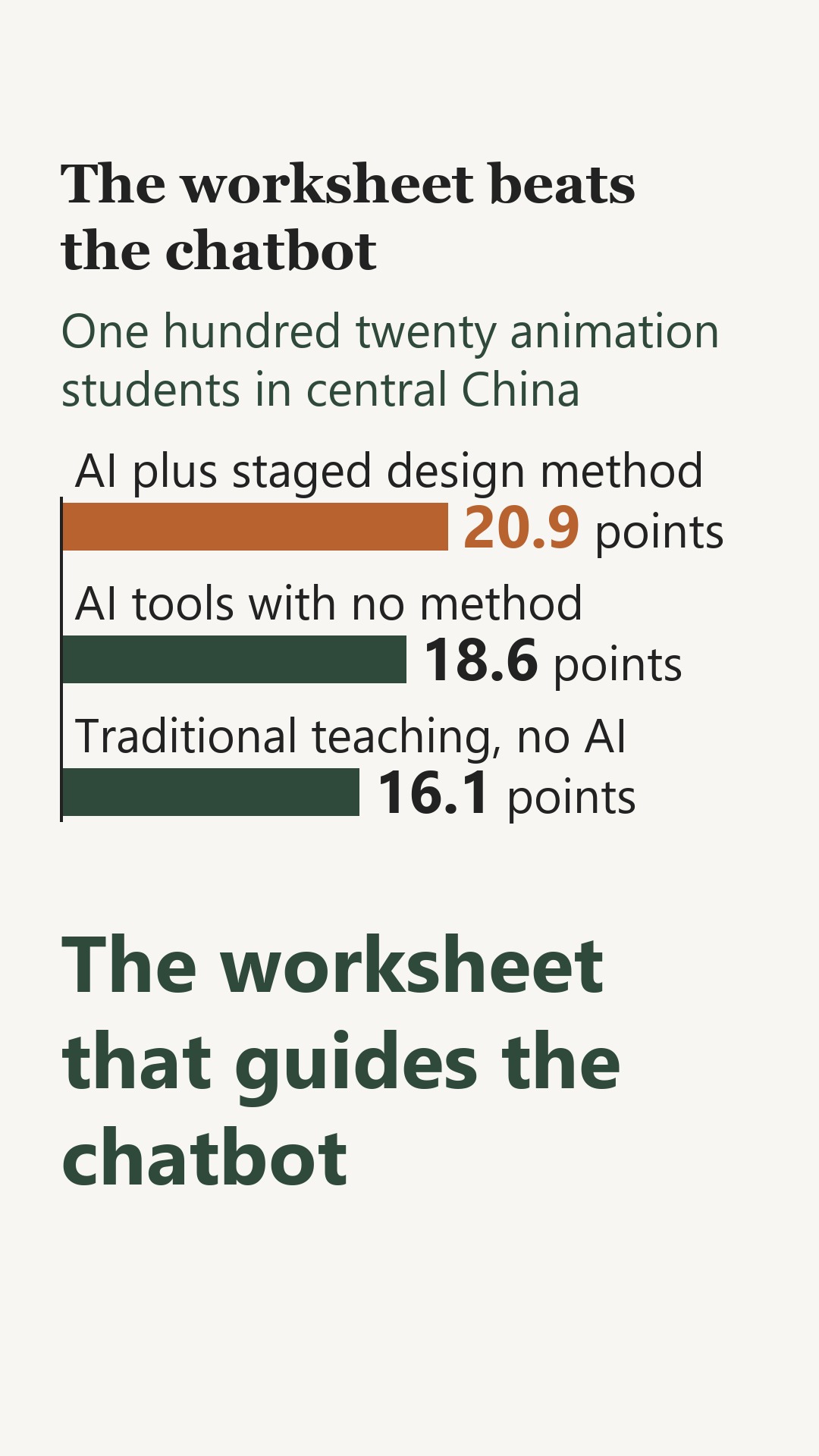
These are average scores on the finished character designs, graded once at the end; part of each score may reflect the quality of AI-generated images rather than the student's own design ability.
Design scores: AI with a staged method vs. AI alone vs. traditional teaching
The staged-method group scored higher on average.
The staged-method group scored higher on average.
The AI-only group scored higher on average.
The worksheet added something on top.
Picture a card game character: a face, a costume, a personality, a story to tell in one small frame.
In a university in central China, 120 second-year animation students spent four weeks last fall designing characters like this. The course was taught by an instructor with more than 15 years of design teaching experience, who was trained beforehand to teach all three groups the same way. One group of forty students worked with two AI tools, Deepseek and Dreamina, alongside a worksheet built on the Double Diamond design model. The worksheet broke the work into four stages: Discover, Define, Develop, Deliver. Each stage carried its own goals, self-check questions, and a note on when to use which tool. A second group of forty used the same two tools freely, with no worksheet. A third group of forty worked the traditional way, sketching by hand and finishing in Photoshop, with no AI.
At the end, two instructors graded the finished characters after the work had been made anonymous and put in random order. The worksheet group scored highest, at 20.90 on average. The AI-only group followed at 18.65, and the traditional group at 16.13. The researchers also asked students about their confidence in their own creativity and their problem-solving. On both, the worksheet group reported the most, then the AI group, then the traditional group. All the gaps were large enough that chance is an unlikely explanation.
Students using the AI tools without any guidance still beat the ones working by hand. The study did not measure harms such as students leaning too heavily on the AI. The worksheet added something on top.
What that something is, the numbers cannot fully settle. The characters were graded only after the course, so there is no picture of where each student started. Students in both AI groups generated and refined images with the tools, so part of a score may reflect the machine's output rather than the student's own hand. Problem-solving was measured with a general questionnaire about how people handle difficulties in life, not a test of design skill. What rose was students' belief in their problem-solving, not a demonstrated ability.
The course was one character-design task, at one university, for animation majors aged 19 to 22. The study did not follow anyone past the final week, so nothing here speaks to whether these gains last.
If you teach design, or any studio course where students now reach for AI, the worksheet is the thing to look for: stage goals, self-check questions, and a stated point in each stage for the tool.
What this means for you
If you teach, the thing to watch for is the worksheet: stage goals, self-check questions, and a stated point in each stage for the tool. A single course of 120 animation students at one Chinese university cannot tell you whether that structure would hold in your own classroom, or whether the gains outlast the final week.
Song, F., Xu, B. (2026). Effects of integrating a structured design thinking strategy into generative AI-supported design learning on students’ design achievement, creative self-efficacy, and problem-solving skills. Frontiers in Psychology. https://doi.org/10.3389/fpsyg.2026.1847432
Who paid: The authors declared that no financial support was received for this work or its publication, and they declared no commercial or financial conflicts of interest.
The longer versionThe passages copied from the paper, the pictures, and every source with how much of it we read · 1396 words · about 7 minRead it →Close
Students given a step-by-step design method alongside AI tools scored highest
A four-week test in one Chinese animation course found that students given a staged design method alongside image-generating AI outscored those given the same tools with no method, and those taught without AI at all.
In a card-game character design course at a university in central China, 120 second-year animation majors were split into three groups of 40. One group used generative AI tools inside a structured design thinking method; one used the same tools with no method to follow; one worked the traditional way, with printed references, hand sketches and software such as Photoshop. Students taught with the method plus AI scored higher on their finished designs, on their belief in their own creative ability, and on a general measure of how they handle problems, than students in either other group1. The course ran from October 20 to November 14, 2025, and the paper was published on 17 June 2026.
Picture the tool first. ChatGPT, Midjourney and Stable Diffusion let a student make images, try out visual styles and get written feedback from a short typed instruction2. That matters because design teaching has long asked students to learn software through repeated technical exercises, and some students with good ideas stall at the point of drawing them3. AI narrows that gap: it shortens trial and error and lets someone explore visually even with weak drawing skills4.
The method is the older half of the pairing. The Double Diamond, developed by the UK Design Council in 2007, walks a designer through four stages: Discover, Define, Develop and Deliver5. In this course the stages became a printed operation sheet. In Discover, students talked with Deepseek to brainstorm themes and browsed Dreamina for visual keywords. In Define, they used Deepseek alone to pin down a character concept, deliberately keeping images away so they would not fix on a picture too early. In Develop, they generated several character variations in Dreamina and compared them. In Deliver, they refined the chosen design and wrote a statement of why it worked.
Consider what the AI-only group was doing at the same moments. Students handed the same two tools with no sheet had no stage gates and no self-check questions. The paper's concern is that such students focus on how good the output looks and skip the thinking underneath6, and that they accept what the machine produces without asking whether it meets a user's need or can be defended7. The sheet was designed to interrupt exactly that: a student could not move on until deciding, alone, that the stage was done.
The numbers, in the paper's own terms. On design achievement, scored out of a five-part rubric by two instructors who rated anonymized, randomly ordered submissions independently, the guided group averaged 20.90, the AI-only group 18.65, and the traditional group 16.138. On creative self-efficacy, a 21-item confidence scale, the adjusted averages were 4.25, 3.84 and 3.549. On problem-solving, measured by a 32-item self-report inventory, they were 4.44, 4.04 and 3.7110. Every gap between every pair of groups was reported as statistically significant.
Now the limits, which the authors state themselves. Students in both AI groups generated and refined their images with AI, so the design scores may partly reflect the quality of what the machines produced rather than the students' own design ability11. Design achievement was scored only at the end, with no starting measure, so the ranking is a snapshot, not a record of growth. Problem-solving was self-reported and general, not a design test and not an AI test. And no group used the design method without AI, so how much the sheet alone would have done is unknown12.
Other work points the same way, and it is worth naming. A study of 196 university students, according to its abstract, the only part available, compared working alone, using ChatGPT freely, and a "think first, ChatGPT later" routine in which students wrote their own ideas before asking the tool to improve them13. The free-AI group produced the most creative solutions on the first task, but when the tool was taken away its creativity fell back to the level of students who had never used it1415. The guided group, slower at first, beat both others on independent creativity the second time16. A separate study of 42 Vietnamese high-school students, again from its abstract alone, found that a ChatGPT group led early on fluency and structure, while formulaic writing and thinner critical engagement set in; the teacher-taught group caught up and passed them on originality1718. And a year-long study of 90 mathematics teachers in eastern China, abstract only, found that the more of a lesson's questioning a model supplied, the less demanding the classroom talk became19.
Here is weeklyAI's reading. The pattern in these studies is not that AI helps or harms. It is that AI helps most when something forces the learner to think before, during and after the prompt. The operation sheet did that with stage gates and self-check questions; the "think first" routine did it by making students commit ideas before opening the tool. What weeklyAI expects in classrooms, on this pattern, is that a school buying the same two tools but skipping the staged guidance will see much smaller gains, and that the gap will be widest where students have to compare options and say why they chose one. This reading would be wrong if students given the tools with only a vague instruction to be creative matched the guided group on design quality and on confidence. It would also be wrong if the guided group's edge vanished when the sheet was removed and the tools kept.
One more thing weeklyAI read, offered as a caution about carrying results across settings, not as doubt about this one. Design disciplines differ, tasks differ, and a method that suits character design may not suit the next studio down the corridor.
The self-check questions deserve their own line. A student who can see progress on a sheet is less likely to read a stalled draft as personal failure, and more likely to keep working. That suggests the confidence gains here came from structure and reflection rather than from easier work. weeklyAI would expect the unguided students to have leaned on the tool, or quit, when a design got hard, with nobody noticing. This reading would be wrong if guided and unguided students showed the same willingness to rework a failed draft and the same persistence after a setback.
The authors are Fenglin Song and Biao Xu, at the Centre for Instructional Technology and Multimedia at Universiti Sains Malaysia. They declared no financial support and no conflicts of interest. The instructor who taught all three groups had more than 15 years in design education and more than two years using AI tools in class; two instructors with eight years of teaching experience each rated the final work.
What would have to happen next is plain from the paper's own gaps. A fourth group, using the Double Diamond method with no AI, would separate the sheet's contribution from the tools'. A design-specific problem-solving measure would test whether students can actually solve design problems rather than feel better about solving them. A follow-up months later would show whether anything stuck, and whether students who leaned on the tools could still work without them. The authors also note they left out instructor and peer critique, a staple of the design studio, and say that choice strengthened control while reducing how much the classroom resembled a real one.
What can a teacher or a parent do with this? When a student hands in polished AI-assisted work, ask them to walk through how they got there, stage by stage, and to redo one step without the tool. Watch whether the confidence sits in their own decisions or only in the finished picture. Before a school adopts an AI tool, ask what explicit steps and practice will surround it, and whether staff will be trained to teach those steps. Judge the tool by the process it sits inside.
The operation sheet is a humble object: four headings, a few questions, a box to tick. In this course it was worth more than the software. The next time a student shows you a beautiful image and cannot say how it came to be, you will know which question to ask first.
Where each piece of context comes from, and how much of it we read
- Song, F., Xu, B. (2026). Effects of integrating a structured design thinking strategy into generative AI-supported design learning on students’ design achievement, creative self-efficacy, and problem-solving skills. Frontiers in Psychology. https://doi.org/10.3389/fpsyg.2026.1847432 - the article this story is about — the whole article — the passage: "Results showed that students in the GAI-SDTS group achieved higher design achievement, creative self-efficacy, and problem-solving skills than those in the other two groups."
- Song, F., Xu, B. (2026). Effects of integrating a structured design thinking strategy into generative AI-supported design learning on students’ design achievement, creative self-efficacy, and problem-solving skills. Frontiers in Psychology. https://doi.org/10.3389/fpsyg.2026.1847432 - the article this story is about — the whole article — the passage: "Tools such as ChatGPT, Midjourney, and Stable Diffusion allow students to generate images, explore visual styles, and receive text-based feedback using simple prompts ( Derevyanko and Zalevska, 2023 )."
- Song, F., Xu, B. (2026). Effects of integrating a structured design thinking strategy into generative AI-supported design learning on students’ design achievement, creative self-efficacy, and problem-solving skills. Frontiers in Psychology. https://doi.org/10.3389/fpsyg.2026.1847432 - the article this story is about — the whole article — the passage: "Many students with creative ideas may find it difficult to express those ideas due to their limited technical proficiency. In some cases, the tools themselves become a barrier, restricting both the fluency of design expression and the confidence to explore alternative solutions ( Rong et al., 2025 )."
- Song, F., Xu, B. (2026). Effects of integrating a structured design thinking strategy into generative AI-supported design learning on students’ design achievement, creative self-efficacy, and problem-solving skills. Frontiers in Psychology. https://doi.org/10.3389/fpsyg.2026.1847432 - the article this story is about — the whole article — the passage: "These tools can help students express abstract ideas more quickly, reduce the time needed for trial and error, and support visual exploration even when technical drawing skills are limited ( Rong et al., 2025 ; Yao et al., 2025 )."
- Song, F., Xu, B. (2026). Effects of integrating a structured design thinking strategy into generative AI-supported design learning on students’ design achievement, creative self-efficacy, and problem-solving skills. Frontiers in Psychology. https://doi.org/10.3389/fpsyg.2026.1847432 - the article this story is about — the whole article — the passage: "The Double Diamond model, developed by the UK Design Council (2007) , is one such approach that has been widely applied in both professional and educational design contexts. It consists of four key stages: Discover, Define, Develop, and Deliver."
- Song, F., Xu, B. (2026). Effects of integrating a structured design thinking strategy into generative AI-supported design learning on students’ design achievement, creative self-efficacy, and problem-solving skills. Frontiers in Psychology. https://doi.org/10.3389/fpsyg.2026.1847432 - the article this story is about — the whole article — the passage: "When students engage with GAI tools independently, they may focus too heavily on output quality while neglecting the underlying thinking process ( Saritepeci and Yildiz Durak, 2024 )."
- Song, F., Xu, B. (2026). Effects of integrating a structured design thinking strategy into generative AI-supported design learning on students’ design achievement, creative self-efficacy, and problem-solving skills. Frontiers in Psychology. https://doi.org/10.3389/fpsyg.2026.1847432 - the article this story is about — the whole article — the passage: "For example, students may accept AI-generated results without independent thinking ( Darvishi et al., 2024 ), which limits their ability to identify user needs, justify design decisions, or revise based on feedback."
- Song, F., Xu, B. (2026). Effects of integrating a structured design thinking strategy into generative AI-supported design learning on students’ design achievement, creative self-efficacy, and problem-solving skills. Frontiers in Psychology. https://doi.org/10.3389/fpsyg.2026.1847432 - the article this story is about — the whole article — the passage: "As shown in Table 1 , the GAI-SDTS group ( M = 20.90, SD = 7.64) achieved significantly higher scores than both the GAI group ( M = 18.65, SD = 7.41) and the TDL group ( M = 16.13, SD = 6.85)."
- Song, F., Xu, B. (2026). Effects of integrating a structured design thinking strategy into generative AI-supported design learning on students’ design achievement, creative self-efficacy, and problem-solving skills. Frontiers in Psychology. https://doi.org/10.3389/fpsyg.2026.1847432 - the article this story is about — the whole article — the passage: "After adjusting for pre-test scores, the GAI-SDTS group (adjusted M = 4.25) performed significantly better than both the GAI group (adjusted M = 3.84) and the TDL group (adjusted M = 3.54)."
- Song, F., Xu, B. (2026). Effects of integrating a structured design thinking strategy into generative AI-supported design learning on students’ design achievement, creative self-efficacy, and problem-solving skills. Frontiers in Psychology. https://doi.org/10.3389/fpsyg.2026.1847432 - the article this story is about — the whole article — the passage: "After adjusting for pre-test scores, the GAI-SDTS group (adjusted M = 4.44) scored higher than the GAI group (adjusted M = 4.04), and both outperformed the TDL group (adjusted M = 3.71), as shown in Table 3 ."
- Song, F., Xu, B. (2026). Effects of integrating a structured design thinking strategy into generative AI-supported design learning on students’ design achievement, creative self-efficacy, and problem-solving skills. Frontiers in Psychology. https://doi.org/10.3389/fpsyg.2026.1847432 - the article this story is about — the whole article — the passage: "However, it should be noted that students in the GAI-SDTS and GAI groups used AI tools to generate and refine visual outputs. Therefore, design achievement scores may partly reflect the quality of AI-generated artifacts rather than students’ independent design ability."
- Song, F., Xu, B. (2026). Effects of integrating a structured design thinking strategy into generative AI-supported design learning on students’ design achievement, creative self-efficacy, and problem-solving skills. Frontiers in Psychology. https://doi.org/10.3389/fpsyg.2026.1847432 - the article this story is about — the whole article — the passage: "Second, this study compared the GAI-SDTS, GAI, and TDL groups, but did not include a structured DT strategy without GAI-supported learning group."
- Wong SSH, Qiu SX. (2026). Think First, ChatGPT Later: Guiding Human–AI Collaboration for Learning Gains in Independent Human Creativity. Educational Psychology Review. 10.1007/s10648-026-10118-7 — only the abstract - the full text could not be fetched — the passage: "University students (N = 196) solved a creative product improvement task either independently (human-only group) or using ChatGPT freely (general-AI group) or using ChatGPT in a guided way (regulated-AI group)."
- Wong SSH, Qiu SX. (2026). Think First, ChatGPT Later: Guiding Human–AI Collaboration for Learning Gains in Independent Human Creativity. Educational Psychology Review. 10.1007/s10648-026-10118-7 — only the abstract - the full text could not be fetched — the passage: "On the first task, the general-AI group produced more creative solutions than the human-only and regulated-AI groups."
- Wong SSH, Qiu SX. (2026). Think First, ChatGPT Later: Guiding Human–AI Collaboration for Learning Gains in Independent Human Creativity. Educational Psychology Review. 10.1007/s10648-026-10118-7 — only the abstract - the full text could not be fetched — the passage: "But without ChatGPT assistance on the second task, the general-AI group's creativity declined to levels comparable to the human-only group."
- Wong SSH, Qiu SX. (2026). Think First, ChatGPT Later: Guiding Human–AI Collaboration for Learning Gains in Independent Human Creativity. Educational Psychology Review. 10.1007/s10648-026-10118-7 — only the abstract - the full text could not be fetched — the passage: "In striking contrast, despite a lack of performance gains on the first task, the regulated-AI group outperformed both the human-only and general-AI groups in independent creativity on the second task."
- Mai HT. (2026). Evaluating the impact of using ChatGPT on EFL students’ argumentative skills. Discover Education. 10.1007/s44217-026-01153-1 — only the abstract - the full text could not be fetched — the passage: "The experimental group initially outperformed the control group in fluency and structure, according to the results; however, formulaic writing and a decreased level of critical engagement were indicators of an over-reliance on AI."
- Mai HT. (2026). Evaluating the impact of using ChatGPT on EFL students’ argumentative skills. Discover Education. 10.1007/s44217-026-01153-1 — only the abstract - the full text could not be fetched — the passage: "In contrast, the control group gradually improved its originality, argumentation, and cognitive ownership despite starting out slower. Additionally, students in this group reported feeling more confident and growing personally."
- Chen H, Wang N, Chen C, Zhang D, Dang X. (2026). The layer of lesson preparation delegated to AI predicts classroom discourse quality: a four-wave video study of 90 junior secondary mathematics teachers. Frontiers in Psychology. 10.3389/fpsyg.2026.1962005 — only the abstract - the full text could not be fetched — the passage: "Within teachers, generative-layer offloading was associated with less higher-order questioning, less substantive uptake of student talk, weaker maintenance of high cognitive demand, and lower recognition and substantive use of unplanned student contributions"
Song, F., Xu, B. (2026). Effects of integrating a structured design thinking strategy into generative AI-supported design learning on students’ design achievement, creative self-efficacy, and problem-solving skills. Frontiers in Psychology. https://doi.org/10.3389/fpsyg.2026.1847432
Who paid: The authors declared that no financial support was received for this work or its publication, and they declared no commercial or financial conflicts of interest.