survey · The Journal of rural health : official journal of the American Rural Health Association and the National Rural Health Care Association · la publicación, 1 sep 2026 · gratis
En los hospitales rurales de EE. UU., la mitad usa inteligencia artificial predictiva
El dato viene de una encuesta de 2023: 51% frente a 81% en los urbanos. Tres de cada cinco que la usan revisan sus modelos, y el estudio no puede decir por qué.
Versión breve · la versión detallada sigue, unos 5 min
Pregunte al chat de weeklyAI
Pregúnteme sobre la IA en su vida: le señalo las notas que weeklyAI ha publicado sobre el tema, esta semana y antes.
Las conversaciones se guardan mientras exista weeklyAI, para mejorar la publicación. Se responde en el idioma en que usted escribe.
- El estudio, de un vistazo
- Quiénes
- Hospitales rurales de EE. UU.
- Cuántos
- 1,018 hospitales rurales
- Dónde
- Estados Unidos
- Cuándo
- 2023
- Tipo de estudio
- survey
- Quién lo hizo
- Universidad Estatal de Oklahoma y Universidad de Kentucky
- El límite que importa
- Es una foto de un año, con datos que cada hospital reportó sobre sí mismo, y no prueba causa.
Porcentaje de hospitales de EE. UU. que usaban modelos predictivos en 2023, según una encuesta respondida por cada hospital sobre sí mismo.
Revisión de los modelos entre quienes ya los usan: rurales frente a urbanos
59% frente a 65%
39% frente a 47%
23% frente a 35%
Antes de confiar en una recomendación automática, pregunte quién la revisó con datos de sus propios clientes.
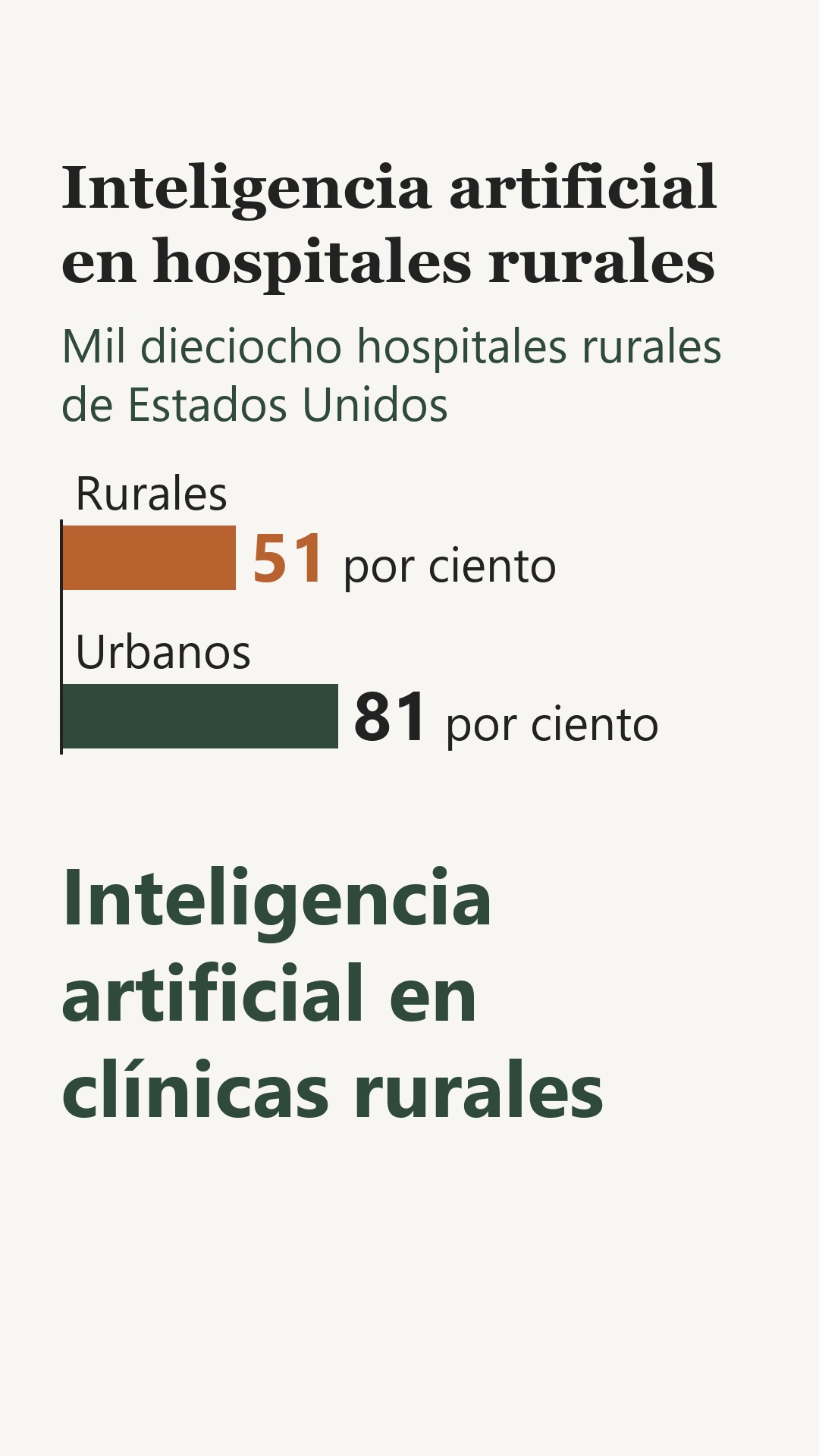
Un hospital rural, un sistema de expedientes médicos y una herramienta que calcula riesgos y lanza recomendaciones dentro de la pantalla. Esa herramienta se llama inteligencia artificial predictiva. En 2023, la mitad de los hospitales rurales de Estados Unidos la tenía encendida: 51%. Entre los urbanos, 81%.
Investigadores de la Universidad Estatal de Oklahoma y de la Universidad de Kentucky analizaron la encuesta de tecnología del hospitalario estadounidense de ese año, la primera que preguntó por estos modelos. Reunieron respuestas de 1,018 hospitales rurales.
Entre los que adoptaron la herramienta, la revisión fue menor. El 59% comprobó la precisión de sus modelos. El 39% revisó si trataban peor a ciertos pacientes. En los urbanos fueron 65% y 47%.
Ocho de cada diez hospitales rurales que usan estas herramientas las reciben del proveedor de su sistema de expedientes. También hay hospitales rurales que usan herramientas de otros desarrolladores o que las hacen ellos mismos.
El estudio no puede probar causa. Es una fotografía de un año, con datos que cada hospital reportó sobre sí mismo. Además, uno de cada seis hospitales rurales contestó que no sabía si su hospital usaba estos modelos. Algunos podrían venir activados por defecto dentro del sistema, sin que nadie lo supiera.
Los autores encontraron que los hospitales que pertenecen a una red grande y los de mejores márgenes de ganancia tenían más probabilidad de adoptar. Eso es una asociación, no una promesa: entrar a una red no garantiza que la herramienta llegue. Y el estudio explica bien la adopción, pero muy poco la revisión. No dice qué hace que alguien compruebe de verdad lo que la máquina le entrega.
Lo mismo pasa con el software que usted ya paga. Las funciones nuevas llegan dentro de una actualización, sin aviso.
Antes de confiar en una recomendación automática, pregunte quién la revisó con datos de sus propios clientes.
Qué significa para usted
Lo que sí puede hacer con sus propios números: cuando el proveedor le presente una herramienta que recomienda sola, pida que le muestren cómo se revisó con datos de sus clientes. Si no hay esa revisión, usted queda igual que uno de cada seis hospitales rurales que ni sabía que la tenía encendida.
Cruikshank, J. A., Whitacre, B. E., Davis, A. F. (2026). Rural Hospital AI Use and Evaluation. The Journal of Rural Health. https://doi.org/10.1111/jrh.70237
Quién pagó: El estudio fue financiado por la Oficina Federal de Política de Salud Rural (FORHP) de la Administración de Recursos y Servicios de Salud (HRSA) del Departamento de Salud y Servicios Humanos de EE. UU., mediante el acuerdo de cooperación #U1ZRH33331-03-01; los autores declaran que no se pretende ni debe inferirse ningún respaldo por parte de FORHP, HRSA, HHS, Oklahoma State University o University of Kentucky, y que no tienen conflictos de interés.
No tome esto como consejo médico profesional.
Versión detalladaLos pasajes copiados del artículo, las ilustraciones y cada fuente con cuánto leímos de ella · 1053 palabras · unos 5 minLeerla →Cerrar
Los hospitales rurales de EE. UU. usan la IA predictiva mucho menos que los urbanos, y la revisan menos
Una encuesta nacional de 2023 muestra una brecha de 30 puntos entre unos y otros, y una dependencia casi total del proveedor del expediente clínico.
En 2023, el 51% de los hospitales rurales de Estados Unidos usaba algún modelo predictivo de inteligencia artificial, frente al 81% de los urbanos1. La encuesta que lo midió fue la primera en preguntar por estos modelos: la del suplemento de tecnología de la Asociación Americana de Hospitales, respondida por 2,547 hospitales de 4,159 posibles, el 61%. Los autores son Josiah A. Cruikshank y Brian E. Whitacre, de la Universidad Estatal de Oklahoma, y Alison F. Davis, de la Universidad de Kentucky, cada uno en su institución. Pagó la Oficina Federal de Política de Salud Rural, del gobierno de EE. UU. Los autores declaran no tener conflictos de interés.
Conviene aclarar qué es la herramienta de la que se habla. Un modelo predictivo es un programa que, con los datos del paciente, arroja un número o una recomendación dentro del expediente clínico: un puntaje de riesgo, una alerta, una sugerencia de tratamiento. La encuesta separa el aprendizaje automático de los modelos estadísticos más viejos, como el APACHE, que estima la gravedad de un paciente en terapia intensiva. Todo eso cuenta como IA en este estudio. Lo que no distingue es la técnica por dentro ni el producto concreto que usa cada hospital.
Entre los hospitales que sí adoptaron la herramienta, los rurales la revisaban menos. El 59% evaluó la exactitud de sus modelos, frente al 65% de los urbanos; el 39% revisó sesgos, frente al 47%2. Solo el 23% de los rurales revisó ambas cosas, doce puntos por debajo del 35% urbano3. Un sesgo, en palabras llanas, es cuando el modelo se equivoca más con ciertos grupos de pacientes que con otros. Un modelo entrenado con datos de una ciudad puede fallar en un pueblo con otra población.
Un dato ayuda a entender la magnitud del desconocimiento. El 16% de los hospitales rurales respondió que no sabía si su hospital usaba estos modelos, más del doble que los urbanos4. Muchos proveedores de expediente clínico activan herramientas predictivas por omisión, y el personal puede no enterarse.
Pasa lo mismo con el proveedor. Los hospitales rurales que usan IA se surten casi el doble de veces del desarrollador de su expediente clínico (88%) que de modelos propios (49%) o de un tercero (47%)5. El artículo no dice que esa opción sea más barata ni más fácil; señala que algunas herramientas de IA tienen costos altos y que muchos hospitales rurales carecen de infraestructura de datos, validación y personal.
Los autores buscaron qué distingue a los hospitales rurales que adoptan de los que no. La pertenencia a un sistema hospitalario es lo que más pesa: un hospital dentro de un sistema tenía 72% de probabilidad prevista de adoptar, contra 29% de uno independiente6. También pesa el dinero: los de margen operativo en el quintil más alto tenían 65% de probabilidad, contra 49% de los demás7. En cambio, ser Hospital de Acceso Crítico, una de las figuras de Medicare que reciben un reembolso mayor para sostener el acceso en zonas desatendidas, baja la probabilidad; también la baja ser con fines de lucro o de propiedad gubernamental8.
Sobre la revisión de sesgos, el hallazgo es menos claro. Estar en el quintil más alto de desventaja social del condado reduce la probabilidad de que un hospital revise sus modelos para exactitud y sesgo9. Los modelos estadísticos explican bien la adopción y mal la revisión, y los propios autores lo señalan como límite: hay factores que la encuesta no captura.
Hay que decir con claridad qué no muestra este estudio. Es un corte en el tiempo, y los autores advierten que sus hallazgos son asociaciones, no relaciones de causa10. Nadie puede prometer que entrar a un sistema o ganar margen haga que un negocio adopte IA. Los datos son autoinformados y no se verificaron. La encuesta pregunta por la IA en términos generales. Y la foto es de 2023: los autores la llaman línea base, no retrato actual.
Hubo un intento parecido antes, y sirve de referencia. El artículo describe un estudio según el cual, en 2009, la ley HITECH creó 62 Centros Regionales de Extensión y pagó incentivos a los hospitales que usaran el expediente clínico de forma significativa11. El artículo describe un estudio según el cual, para 2012, cerca de un tercio de los hospitales rurales tenía al menos un expediente básico, cuando en 2008 eran menos del 5%12. Los autores proponen algo similar para la IA: centros de extensión que compartan la revisión de modelos. Es una sugerencia de política, no algo que este estudio haya probado.
Así lo lee weeklyAI: cuando la herramienta llega ya montada en el sistema que se usa a diario, se emplea sin saber bien qué hace por dentro ni cómo comprobar si funciona. Es de esperar que muchos negocios pequeños usen herramientas predictivas solo porque su proveedor principal las trae activadas, sin revisar si los resultados sirven para su propia clientela. Esta lectura se equivocaría si los negocios sin personal técnico supieran nombrar qué herramienta usan, quién la hizo y cómo la probaron contra sus propios datos.
La otra cara es la dependencia. Si el proveedor decide qué herramienta hay y cómo se mide, el negocio pierde margen para elegir. Antes de firmar o renovar, pregunte si puede llevarse sus datos a otro sistema y a qué costo, y tenga al menos una alternativa identificada. Y cuando una recomendación automática pese en una decisión, pida ver con qué datos se alimentó y pruébela con sus propios clientes o pacientes; anote qué decidió con ella y qué pasó después.
La encuesta abre una puerta que el lector de negocios puede reconocer. En las cuentas de un hospital pequeño, el dinero y el personal pesan más que la curiosidad tecnológica. Lo que este estudio deja claro es que la distancia entre adoptar y saber revisar es tan grande como la distancia entre tener y no tener.
Lo que usted puede llevarse es una pregunta para su proveedor la próxima vez que le muestre una función nueva: ¿con qué datos se entrenó esto y cómo lo probamos con los míos?
De dónde sale cada dato de contexto, y cuánto leímos de cada documento
- Cruikshank, J. A., Whitacre, B. E., Davis, A. F. (2026). Rural Hospital AI Use and Evaluation. The Journal of Rural Health. https://doi.org/10.1111/jrh.70237 - el artículo del que trata esta nota — el artículo completo — el pasaje: "Rural hospitals adopted and used predictive AI at substantially lower rates than urban hospitals (51% vs. 81%) in 2023."
- Cruikshank, J. A., Whitacre, B. E., Davis, A. F. (2026). Rural Hospital AI Use and Evaluation. The Journal of Rural Health. https://doi.org/10.1111/jrh.70237 - el artículo del que trata esta nota — el artículo completo — el pasaje: "Among hospitals that adopted AI, rural facilities were less likely to evaluate their models for accuracy (59% vs. 65%) and bias (39% vs. 47%)."
- Cruikshank, J. A., Whitacre, B. E., Davis, A. F. (2026). Rural Hospital AI Use and Evaluation. The Journal of Rural Health. https://doi.org/10.1111/jrh.70237 - el artículo del que trata esta nota — el artículo completo — el pasaje: "When considered in aggregate, rural rates of evaluating for both accuracy and bias are 12 percentage points lower than their urban counterparts (23% vs. 35%)."
- Cruikshank, J. A., Whitacre, B. E., Davis, A. F. (2026). Rural Hospital AI Use and Evaluation. The Journal of Rural Health. https://doi.org/10.1111/jrh.70237 - el artículo del que trata esta nota — el artículo completo — el pasaje: "Importantly, a sizeable percentage (16%) of rural hospitals do not know whether their facility has adopted these models—more than twice the rate of their urban counterparts."
- Cruikshank, J. A., Whitacre, B. E., Davis, A. F. (2026). Rural Hospital AI Use and Evaluation. The Journal of Rural Health. https://doi.org/10.1111/jrh.70237 - el artículo del que trata esta nota — el artículo completo — el pasaje: "In terms of the developers used to implement AI models, rural hospitals are almost twice as likely to utilize models developed by their EHR provider (88%) than they are to develop their own or to hire a third-party developer (49% and 47%, respectively)."
- Cruikshank, J. A., Whitacre, B. E., Davis, A. F. (2026). Rural Hospital AI Use and Evaluation. The Journal of Rural Health. https://doi.org/10.1111/jrh.70237 - el artículo del que trata esta nota — el artículo completo — el pasaje: "System membership shows the largest difference: system‐affiliated hospitals had a 0.72 predicted probability of model adoption, compared with 0.29 among standalone hospitals."
- Cruikshank, J. A., Whitacre, B. E., Davis, A. F. (2026). Rural Hospital AI Use and Evaluation. The Journal of Rural Health. https://doi.org/10.1111/jrh.70237 - el artículo del que trata esta nota — el artículo completo — el pasaje: "Rural hospitals in the top operating‐margin quintile have a substantially higher predicted probability of AI or predictive model adoption (0.65) compared with those in lower quintiles (0.49)."
- Cruikshank, J. A., Whitacre, B. E., Davis, A. F. (2026). Rural Hospital AI Use and Evaluation. The Journal of Rural Health. https://doi.org/10.1111/jrh.70237 - el artículo del que trata esta nota — el artículo completo — el pasaje: "Regression analyses show that system membership and stronger financial performance were positively associated with AI adoption, while Critical Access Hospital and for‐profit status were negatively associated."
- Cruikshank, J. A., Whitacre, B. E., Davis, A. F. (2026). Rural Hospital AI Use and Evaluation. The Journal of Rural Health. https://doi.org/10.1111/jrh.70237 - el artículo del que trata esta nota — el artículo completo — el pasaje: "Being in the top quintile of the county‐level social deprivation index decreases the likelihood of being evaluated for both accuracy and bias (OR = 0.57, [95% CI: 0.34–0.95])."
- Cruikshank, J. A., Whitacre, B. E., Davis, A. F. (2026). Rural Hospital AI Use and Evaluation. The Journal of Rural Health. https://doi.org/10.1111/jrh.70237 - el artículo del que trata esta nota — el artículo completo — el pasaje: "The cross‐sectional design means our findings are associations and cannot be interpreted causally."
- Cruikshank, J. A., Whitacre, B. E., Davis, A. F. (2026). Rural Hospital AI Use and Evaluation. The Journal of Rural Health. https://doi.org/10.1111/jrh.70237 - el artículo del que trata esta nota — el artículo completo — el pasaje: "In response, the Health Information Technology for Economic and Clinical Health (HITECH) Act of 2009 provided financial incentives tied to “meaningful use” of EHRs and established 62 Regional Extension Centers to support implementation."
- Cruikshank, J. A., Whitacre, B. E., Davis, A. F. (2026). Rural Hospital AI Use and Evaluation. The Journal of Rural Health. https://doi.org/10.1111/jrh.70237 - el artículo del que trata esta nota — el artículo completo — el pasaje: "By 2012, approximately one‐third of rural hospitals had adopted at least a basic EHR system, up from fewer than 5% in 2008."
Cruikshank, J. A., Whitacre, B. E., Davis, A. F. (2026). Rural Hospital AI Use and Evaluation. The Journal of Rural Health. https://doi.org/10.1111/jrh.70237
Quién pagó: El estudio fue financiado por la Oficina Federal de Política de Salud Rural (FORHP) de la Administración de Recursos y Servicios de Salud (HRSA) del Departamento de Salud y Servicios Humanos de EE. UU., mediante el acuerdo de cooperación #U1ZRH33331-03-01; los autores declaran que no se pretende ni debe inferirse ningún respaldo por parte de FORHP, HRSA, HHS, Oklahoma State University o University of Kentucky, y que no tienen conflictos de interés.
No tome esto como consejo médico profesional.
Los hallazgos de otros estudios que aquí se mencionan provienen de este documento; esos estudios no se consultaron uno por uno.
survey · The Journal of rural health : official journal of the American Rural Health Association and the National Rural Health Care Association · the paper, 1 Sep 2026 · free
Rural hospitals use AI less than city hospitals and check it less
In a 2023 US survey, 51% of rural hospitals used predictive AI against 81% of urban ones, and only 23% of the rural users checked their models for both accuracy and bias.
Short version · the longer version follows, about 6 min
Ask the weeklyAI chat
Ask me about AI in your life: I point you to the stories weeklyAI has published on it, this week and before.
Conversations are saved for as long as weeklyAI exists, to improve the publication. Answers come in the language you write in.
- The study at a glance
- Who
- US rural hospitals, compared with urban hospitals
- How many
- 1,018 rural hospitals
- Where
- United States
- When
- 2023
- Kind of study
- survey
- Who did it
- Oklahoma State University and University of Kentucky
- The limit that matters
- The survey shows patterns, not causes; answers are self-reported and unverified.
Percent of US hospitals using predictive AI in 2023, from a survey where hospitals that resemble non-responders were counted more; the figures are shares of hospitals, not of patients.
Rural vs urban hospitals that adopted AI
Checked models for accuracy: 59% vs 65%
Checked models for bias: 39% vs 47%
Checked for both accuracy and bias: 23% vs 35%
Did not know whether they used these models: 16% vs more than twice the urban rate
Look at the software you already pay for, and ask what is switched on inside it, and who checked it against your own customers.
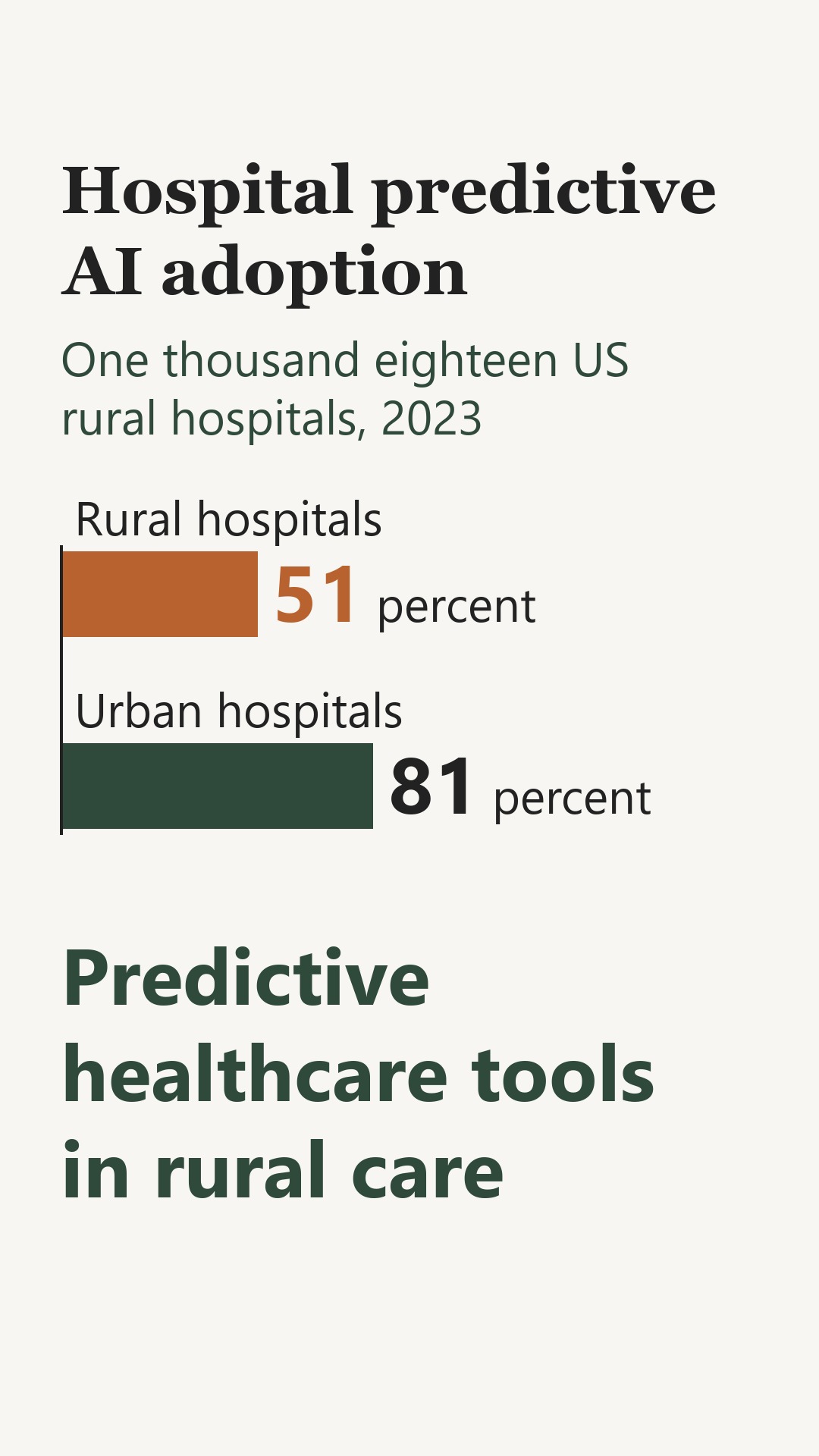
Take 1,018 rural hospitals in the United States. About half of them, 51%, used a computer model that scores patients or suggests care. Among urban hospitals the figure was 81%.
The numbers come from the 2023 American Hospital Association IT Supplement, the first survey to ask US hospitals about these tools. Researchers at Oklahoma State University and the University of Kentucky analyzed the answers. Rural hospitals here mean the government's rural definition, which includes some tracts inside city counties.
The article says each gap is worrying for rural health advocates. Among the hospitals that used these models, 59% of rural ones had checked them for accuracy against their own patients, and 39% for bias. Urban hospitals did so 65% and 47% of the time.
Where do the tools come from? Mostly the company that sells the hospital its records system. Rural hospitals used models built by that vendor 88% of the time, against 48% for outside developers and 46% for their own.
The study can show patterns, not causes. It cannot say that joining a hospital group or earning more would make any business adopt AI. What it did find is that hospitals in larger systems were far more likely to use these tools, and so were hospitals with the strongest finances. For-profit and government-owned hospitals used them less.
The answers are also self-reported. One in six rural hospitals said it did not know whether it used predictive models at all. Tools in the records software may already be switched on without the person answering knowing.
What drives good checking of these tools, the study cannot say. Its figures explain adoption reasonably well and evaluation poorly.
Look at the software you already pay for, and ask what is switched on inside it, and who checked it against your own customers.
What this means for you
Ask the vendor who supplies your scheduling or records software what predictive features are already switched on, since many rural hospitals relied on tools their records company built and some did not know they were running. The study cannot say these tools helped patients or cut costs, and it cannot say joining a group or earning more would make a business adopt them.
Cruikshank, J. A., Whitacre, B. E., Davis, A. F. (2026). Rural Hospital AI Use and Evaluation. The Journal of Rural Health. https://doi.org/10.1111/jrh.70237
Who paid: The study was supported by the Federal Office of Rural Health Policy, Health Resources and Services Administration, U.S. Department of Health and Human Services, under cooperative agreement #U1ZRH33331-03-01; the authors state that no endorsement by FORHP, HRSA, HHS, Oklahoma State University or University of Kentucky is intended or should be inferred, and they declare no conflicts of interest.
Do not take this as professional medical advice.
The longer versionThe passages copied from the paper, the pictures, and every source with how much of it we read · 1279 words · about 6 minRead it →Close
Rural Hospitals Adopt and Check Predictive AI Less Than Urban Ones
In 2023 US survey data, half of rural hospitals used the tools and a third of those that did checked them for bias.
Half of rural hospitals used predictive artificial intelligence in 2023. Among urban hospitals, eight in ten did. The figures come from a national survey of US hospitals, and they describe a gap of thirty points at a single moment.
Predictive AI here means software inside a patient's electronic record that displays a risk score or a recommendation: a warning that someone may deteriorate, a list of patients who need a follow-up call. The 2023 American Hospital Association survey was the first to ask hospitals about it. Josiah Cruikshank and Brian Whitacre of Oklahoma State University and Alison Davis of the University of Kentucky analyzed the answers. The work was paid for by the Federal Office of Rural Health Policy, part of the US health department, and the authors declare no conflicts of interest.
Of 4,159 hospitals in the sampling frame, 2,547 answered, a response rate of 61 percent. The rural analysis covers 1,018 rural hospitals. The authors weighted the answers so that hospitals resembling non-responders count more, because responders were more likely to be system members or nonprofits and less likely to be rural or for-profit.
Among the hospitals that did adopt, fewer rural ones checked the models against their own patients. Fifty-nine percent checked for accuracy, against 65 percent in cities. Thirty-nine percent checked for bias, against 47 percent. Just 23 percent checked for both, against 35 percent in urban hospitals.
The authors are explicit about what this design can show: associations, not causes. The survey also asked about AI only in broad terms, without naming products or separating one kind of machine learning from another. The answers are self-reported and unverified.
Consider what a bias check actually does. A model trained on one set of patients may not be useful for a specific hospital's patients. Checking it on local data is how a hospital learns whether the tool fits the people in front of it. The rural hospitals that adopted were less likely to do that check for bias than their urban counterparts, 39 percent against 47 percent1.
A hospital's choice of supplier narrows its options. Rural hospitals were almost twice as likely to use models built by their records-system vendor, 88 percent, as to build their own, 49 percent, or hire a third party, 47 percent2. Urban hospitals relied on their vendor too, at 75 percent, but reached for outside and in-house models far more often. A single supplier means a single set of terms to accept.
The cost side is not hypothetical. Some AI tools carry high upfront or per-use prices that limit feasibility for hospitals short of resources, many of them rural3. Clinical and administrative AI systems also need solid data infrastructure, ongoing validation and staff capacity, which many rural hospitals lack4. Buying the tool is one bill; keeping it honest is another.
The rural regressions point the same way. System membership and stronger financial performance were positively associated with adoption, while Critical Access Hospital status and for-profit ownership were negatively associated5. System-affiliated hospitals had a predicted adoption probability of 0.72, against 0.29 for standalone ones6. Hospitals in the top operating-margin quintile reached 0.65, against 0.49 for the rest7. For-profits sat at 0.24, against 0.53 for nonprofits8.
The models explain adoption reasonably well and checking poorly. The authors report that evaluation practices depend on factors their data do not capture, such as governance or vendor support. Sixteen percent of rural respondents did not know whether their hospital used these models at all, more than twice the urban rate9. Some may be running tools switched on by default inside software they already pay for.
This pattern has a precedent. The article describes a study in which, in the early 2000s, rural hospitals adopted electronic records far more slowly than urban ones. The article describes a study in which the 2009 HITECH Act tied money to "meaningful use" and set up 62 Regional Extension Centers to help with implementation10. The article describes a study in which, by 2012, about a third of rural hospitals had at least a basic record system, up from fewer than 5 percent in 200811. The authors propose AI extension centers on that model12. They also note that the term "rural" is not found in the White House's 2025 AI action plan, and that a similar omission is found in a health department request for comment.
Here is weeklyAI's reading. The pattern is familiar from any small operation that buys software: the purchase price is visible and the running cost is not. A hospital can find the licence fee, and then discover that keeping the model accurate on its own patients takes staff time it does not have. weeklyAI expects that some rural adopters will quietly stop using tools within a year or two, not because the tools failed but because nobody could say what they saved. This reading would be wrong if rural hospitals report that running costs are trivial or covered by vendors, or if adopting hospitals can point to concrete savings from the tools. Before signing anything, ask the vendor in writing what the tool costs per month to keep running after the first year, and ask two customers of similar size whether they still use it and what it costs them now.
A second pattern is worth naming. People often do not know what is already running inside the software they pay for. The survey's own numbers hint at it: one in six rural respondents could not say whether their hospital used predictive models. weeklyAI expects that some hospitals counted as non-adopters are in fact using predictions switched on by default, and the same may hold for small firms whose main software now bundles scores and recommendations. This reading would be wrong if small hospitals and firms reliably know which predictive features their software includes and can name them when asked. Ask your main software supplier for a plain list of any automatic predictions, scores or recommendations already switched on in your account, and ask who inside the business is responsible for knowing about them.
The risk sits with whoever signs. The study finds that 39 percent of rural adopters check their models for bias, against 47 percent of urban adopters1, and that hospitals serving the most deprived areas are less likely to check for both accuracy and bias13. The party carrying the cost of a wrong recommendation is often the party least able to test it.
The authors call these findings a baseline. The article describes a study in which federal data show hospital predictive AI use rising from 66 percent in 2023 to 71 percent in 2024, with rural, critical access and independent hospitals still trailing. The 2023 survey asked only about predictive models, not the newer generative tools, and the authors note that rural, critical access and independent hospitals are the most likely to be delayed adopters there too.
The bill for a model that gives bad advice does not arrive with a label. It arrives as a missed follow-up or a denied claim, and it lands on the hospital that signed. Read the liability section before the price section, and ask the vendor to put in writing who bears the cost when the tool is wrong. If the answer is you, price that risk into the decision.
The record system in the exam room was already making predictions before anyone thought to ask. The question worth carrying into the next contract meeting: who checks the model, and on whose patients?
Where each piece of context comes from, and how much of it we read
- Cruikshank, J. A., Whitacre, B. E., Davis, A. F. (2026). Rural Hospital AI Use and Evaluation. The Journal of Rural Health. https://doi.org/10.1111/jrh.70237 - the article this story is about — the whole article — the passage: "Among hospitals that adopted AI, rural facilities were less likely to evaluate their models for accuracy (59% vs. 65%) and bias (39% vs. 47%)."
- Cruikshank, J. A., Whitacre, B. E., Davis, A. F. (2026). Rural Hospital AI Use and Evaluation. The Journal of Rural Health. https://doi.org/10.1111/jrh.70237 - the article this story is about — the whole article — the passage: "In terms of the developers used to implement AI models, rural hospitals are almost twice as likely to utilize models developed by their EHR provider (88%) than they are to develop their own or to hire a third-party developer (49% and 47%, respectively)."
- Cruikshank, J. A., Whitacre, B. E., Davis, A. F. (2026). Rural Hospital AI Use and Evaluation. The Journal of Rural Health. https://doi.org/10.1111/jrh.70237 - the article this story is about — the whole article — the passage: "Some AI tools carry high upfront or per-use costs, limiting feasibility for resource-constrained hospitals—many of which are rural."
- Cruikshank, J. A., Whitacre, B. E., Davis, A. F. (2026). Rural Hospital AI Use and Evaluation. The Journal of Rural Health. https://doi.org/10.1111/jrh.70237 - the article this story is about — the whole article — the passage: "Clinical and administrative AI systems require robust data infrastructure, ongoing validation, and workforce capacity, which many rural hospitals lack."
- Cruikshank, J. A., Whitacre, B. E., Davis, A. F. (2026). Rural Hospital AI Use and Evaluation. The Journal of Rural Health. https://doi.org/10.1111/jrh.70237 - the article this story is about — the whole article — the passage: "Regression analyses show that system membership and stronger financial performance were positively associated with AI adoption, while Critical Access Hospital and for‐profit status were negatively associated."
- Cruikshank, J. A., Whitacre, B. E., Davis, A. F. (2026). Rural Hospital AI Use and Evaluation. The Journal of Rural Health. https://doi.org/10.1111/jrh.70237 - the article this story is about — the whole article — the passage: "System membership shows the largest difference: system‐affiliated hospitals had a 0.72 predicted probability of model adoption, compared with 0.29 among standalone hospitals."
- Cruikshank, J. A., Whitacre, B. E., Davis, A. F. (2026). Rural Hospital AI Use and Evaluation. The Journal of Rural Health. https://doi.org/10.1111/jrh.70237 - the article this story is about — the whole article — the passage: "Rural hospitals in the top operating‐margin quintile have a substantially higher predicted probability of AI or predictive model adoption (0.65) compared with those in lower quintiles (0.49)."
- Cruikshank, J. A., Whitacre, B. E., Davis, A. F. (2026). Rural Hospital AI Use and Evaluation. The Journal of Rural Health. https://doi.org/10.1111/jrh.70237 - the article this story is about — the whole article — the passage: "For‐profit hospitals have a significantly lower predicted probability of adoption (0.24) compared with not‐for‐profit facilities (0.53), and government‐owned hospitals similarly show reduced predicted adoption (0.41) relative to non‐government hospitals (0.55)."
- Cruikshank, J. A., Whitacre, B. E., Davis, A. F. (2026). Rural Hospital AI Use and Evaluation. The Journal of Rural Health. https://doi.org/10.1111/jrh.70237 - the article this story is about — the whole article — the passage: "Importantly, a sizeable percentage (16%) of rural hospitals do not know whether their facility has adopted these models—more than twice the rate of their urban counterparts."
- Cruikshank, J. A., Whitacre, B. E., Davis, A. F. (2026). Rural Hospital AI Use and Evaluation. The Journal of Rural Health. https://doi.org/10.1111/jrh.70237 - the article this story is about — the whole article — the passage: "In response, the Health Information Technology for Economic and Clinical Health (HITECH) Act of 2009 provided financial incentives tied to “meaningful use” of EHRs and established 62 Regional Extension Centers to support implementation."
- Cruikshank, J. A., Whitacre, B. E., Davis, A. F. (2026). Rural Hospital AI Use and Evaluation. The Journal of Rural Health. https://doi.org/10.1111/jrh.70237 - the article this story is about — the whole article — the passage: "By 2012, approximately one‐third of rural hospitals had adopted at least a basic EHR system, up from fewer than 5% in 2008."
- Cruikshank, J. A., Whitacre, B. E., Davis, A. F. (2026). Rural Hospital AI Use and Evaluation. The Journal of Rural Health. https://doi.org/10.1111/jrh.70237 - the article this story is about — the whole article — the passage: "Policies that subsidize analytic infrastructure, provide shared validation resources, or create regional AI extension centers modeled after the HITECH‐era Regional Extension Centers (which boosted rural adoption of EHRs [17]) could help mitigate these disparities."
- Cruikshank, J. A., Whitacre, B. E., Davis, A. F. (2026). Rural Hospital AI Use and Evaluation. The Journal of Rural Health. https://doi.org/10.1111/jrh.70237 - the article this story is about — the whole article — the passage: "Being in the top quintile of the county‐level social deprivation index decreases the likelihood of being evaluated for both accuracy and bias (OR = 0.57, [95% CI: 0.34–0.95])."
Cruikshank, J. A., Whitacre, B. E., Davis, A. F. (2026). Rural Hospital AI Use and Evaluation. The Journal of Rural Health. https://doi.org/10.1111/jrh.70237
Who paid: The study was supported by the Federal Office of Rural Health Policy, Health Resources and Services Administration, U.S. Department of Health and Human Services, under cooperative agreement #U1ZRH33331-03-01; the authors state that no endorsement by FORHP, HRSA, HHS, Oklahoma State University or University of Kentucky is intended or should be inferred, and they declare no conflicts of interest.
Do not take this as professional medical advice.
The findings of other studies mentioned here come from this document; those studies were not opened one by one.