analysis of texts · Journal of medical Internet research · la publicación, 2 jul 2026 · gratis
La mitad de los formularios de consentimiento para estudios con IA no dicen qué hace la IA
Un análisis de 114 formularios publicados en un registro de Estados Unidos halló que muchos omiten el tipo de IA y los riesgos; cubre solo documentos públicos y no prueba que se haya violado ninguna ley.
Versión breve · la versión detallada sigue, unos 7 min
Pregunte al chat de weeklyAI
Pregúnteme sobre la IA en su vida: le señalo las notas que weeklyAI ha publicado sobre el tema, esta semana y antes.
Las conversaciones se guardan mientras exista weeklyAI, para mejorar la publicación. Se responde en el idioma en que usted escribe.
- El estudio, de un vistazo
- Quiénes
- Formularios de consentimiento de ensayos clínicos con inteligencia artificial
- Cuántos
- 114 formularios
- Dónde
- ClinicalTrials.gov, un registro de Estados Unidos
- Cuándo
- Búsqueda hecha el 21 de junio de 2025
- Tipo de estudio
- analysis of what people did
- Quién lo hizo
- Hospital Xiangya, Universidad Central del Sur, Changsha, China
- El límite que importa
- Solo revisó documentos públicos de un registro; pueden diferir de la versión final que se firma en el sitio.
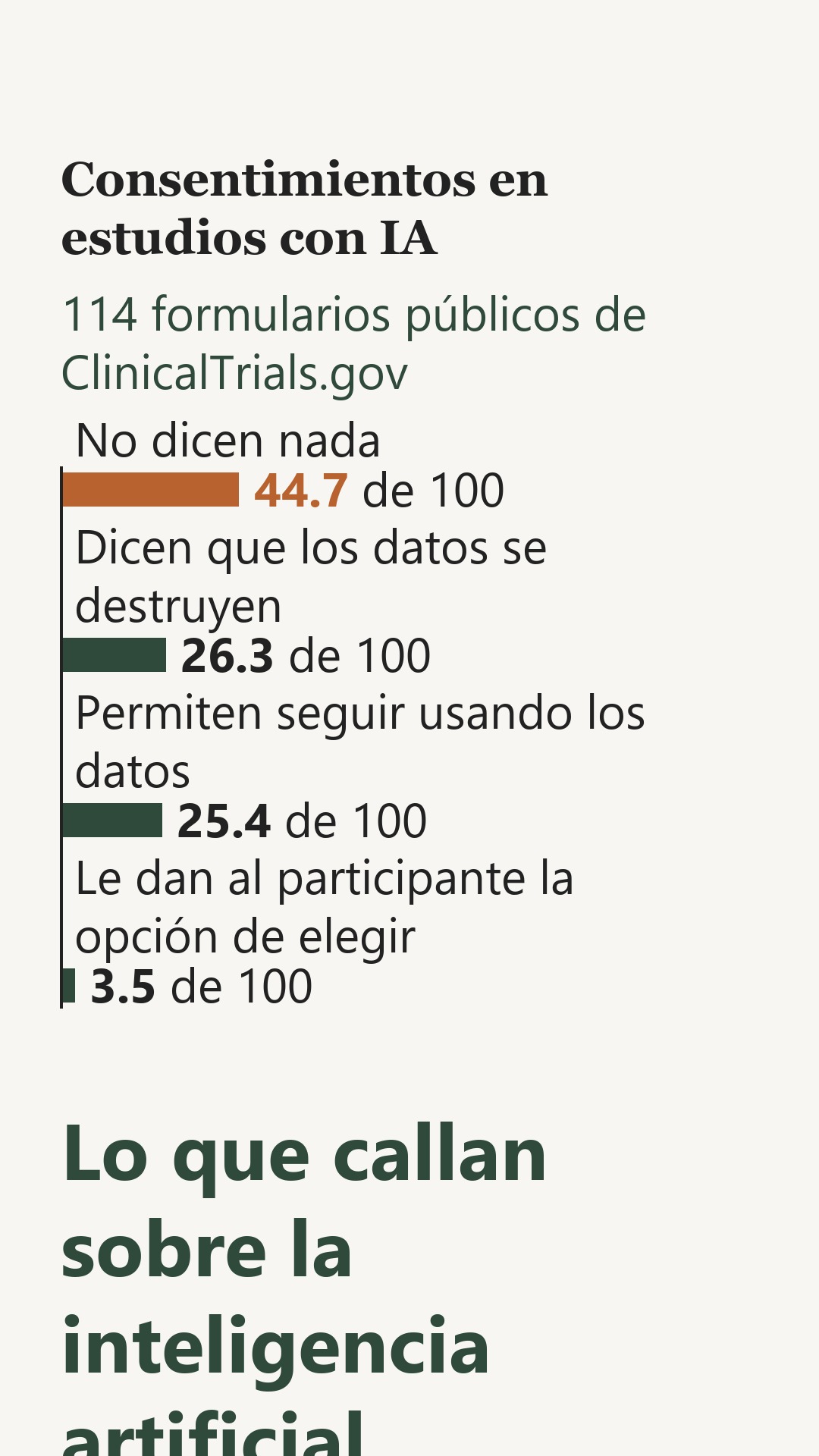
Porcentaje de los 114 formularios analizados, según qué dicen sobre los datos ya recopilados cuando el participante se retira; son documentos públicos de un solo registro y pueden no coincidir con la versión que se firma en el sitio.
Lo que dice el registro del ensayo frente a lo que dice el formulario del participante
El registro suele describir el método de IA con más detalle; el formulario lo omite o lo dice de forma vaga.
En otras palabras, la información existe en algún lado, pero no llega al papel que la persona firma.
Un formulario de consentimiento es la hoja que una persona firma antes de entrar a un estudio médico. Ahí debe decir qué le van a hacer, qué riesgos hay y qué pasa con sus datos. Investigadores del Hospital Xiangya, en China, revisaron 114 de esos formularios, todos de estudios que usan inteligencia artificial y que estaban publicados en ClinicalTrials.gov, un registro de Estados Unidos. La búsqueda se hizo el 21 de junio de 2025.
Los formularios venían de 32 campos de la medicina. Los más frecuentes eran estudios de cáncer (19), de corazón (15), de psiquiatría (11) y de neurología (10). La mayoría de los estudios se clasificaron como de riesgo bajo o medio.
Más de la mitad de los formularios, 66 de 114, no decían qué tipo de IA se usaba ni para qué. Y 21 de ellos, cerca de uno de cada cinco, no mencionaban ningún riesgo. A veces el registro del estudio describía la IA con detalle, pero el formulario que leería el participante no.
Solo 16 de los 114 formularios eran a la vez cortos (menos de 15,000 caracteres, unos diez minutos de lectura) y fáciles de leer para una persona sin estudios universitarios. Los estudios de mayor riesgo no tenían formularios más claros.
El manejo de los datos después de que alguien deja el estudio también variaba. En 51 formularios no se decía nada. En 30 se indicaba que los datos se destruirían, en 29 que se seguirían usando y en solo 4 se le daba al participante la opción de elegir.
El análisis tiene límites claros. Revisó únicamente documentos públicos de un solo registro, y los propios autores advierten que pueden no coincidir con la versión final que se firma en el sitio. El estudio describe lo que dicen los papeles; no midió si algún participante se confundió de verdad. Los formularios citaban leyes de protección de datos distintas según el estudio, y no hubo una norma que dominara.
Cuando le entreguen un formulario para un estudio que usa inteligencia artificial, busque tres cosas: qué hace la IA, qué riesgos aparecen por escrito y qué pasará con sus datos si usted decide salirse.
Qué significa para usted
Ese formulario es la hoja que firma antes de entrar a un estudio, y en la mayoría de los 114 revisados no decía qué hacía la inteligencia artificial. En 21 de los 114 no se mencionaba ningún riesgo. Si le toca uno, puede preguntar quién responde por esa omisión y pedir por escrito qué pasará con sus datos si se sale. Lo que el estudio no muestra es que alguien se haya confundido ni que se haya violado una ley.
Su, H., Xiao, F., Chau, H. et al. (2026). Informed Consent Disclosures and Minimum Requirements in AI Clinical Trials: Cross-Sectional Analysis. Journal of Medical Internet Research. https://doi.org/10.2196/94504
Quién pagó: El artículo no indica quién financió el estudio ni si algún financiador tuvo algún papel, y no menciona equipos ni programas informáticos prestados a los investigadores.
No tome esto como consejo médico profesional.
Versión detalladaLos pasajes copiados del artículo, las ilustraciones y cada fuente con cuánto leímos de ella · 1350 palabras · unos 7 minLeerla →Cerrar
Los formularios de consentimiento de estudios con IA: casi seis de cada diez no dicen qué hace el sistema
Un análisis de 114 ensayos registrados en ClinicalTrials.gov encontró que la mayoría de los documentos públicos omiten el tipo de inteligencia artificial, los riesgos o qué pasa con los datos si el participante se retira.
Imagine la escena: llega a un hospital, le ofrecen entrar a un estudio clínico y le ponen enfrente un formulario de consentimiento. Lo firma. En algún punto del estudio, un programa de inteligencia artificial participa en leer sus imágenes, clasificar su riesgo o procesar sus datos. El análisis que se publicó el 2 de julio de 2026 en el Journal of Medical Internet Research revisó 114 ensayos clínicos con IA registrados en ClinicalTrials.gov que tenían su documento de consentimiento disponible al público, con búsqueda hecha el 21 de junio de 2025. En 66 de los 114 (58%), el documento no decía qué tipo de IA se usaba ni para qué. En 21 (18.4%), no se mencionaba ningún riesgo.
Los autores trabajan en el Departamento de Medicina Reproductiva del Hospital Xiangya, de la Universidad Central del Sur, en Changsha, China. El artículo no dice que los ensayos se hayan hecho ahí: los 114 son registros de ClinicalTrials.gov, el único registro de ensayos que publica los documentos de consentimiento, según los propios autores. El estudio no tuvo participantes humanos. Es un análisis de contenido de documentos públicos, preregistrado en Open Science Framework.
Lo que un consentimiento informado debe decir tiene una lógica sencilla: qué se va a hacer, qué riesgos hay, qué beneficios se esperan y qué pasará con los datos1. Con la IA, esa lógica se complica. El sistema puede cambiar con el tiempo, su funcionamiento interno no es visible para el paciente y su papel en la decisión médica varía de un ensayo a otro1. El formulario tendría que explicar todo eso en un lenguaje que la persona entienda.
El análisis midió qué tanto los documentos cumplían con estándares de la Organización Mundial de la Salud y de los Institutos Nacionales de Salud de Estados Unidos. Además de omitir el tipo de IA, 87 de los 114 (76.3%) no identificaban poblaciones vulnerables que necesitarían protección especial2. Solo 16 de los 114 (14%) cumplían a la vez dos criterios básicos: menos de 15,000 caracteres de extensión y un nivel de lectura de preparatoria o menos según la fórmula SMOG3. Solo 13 (11.4%) incluían algún apoyo visual4.
Hay una asimetría que vale la pena ver de cerca. Lo que el registro público del ensayo dice sobre el método de IA y lo que dice el formulario que recibe el participante no coinciden: los registros suelen ser más detallados que los documentos de consentimiento5. En otras palabras, la información existe en algún lado, pero no llega al papel que la persona firma.
El manejo de datos después del retiro fue el punto más disperso. Aunque todos los documentos garantizaban el derecho a retirarse, 51 (44.7%) no decían nada sobre qué pasaría con los datos ya recopilados67. De los que sí lo decían, 30 (26.3%) especificaban que los datos se destruirían, 29 (25.4%) permitían seguir usándolos y solo 4 (3.5%) le daban al participante la opción de elegir6. Las leyes de protección de datos citadas variaban tanto que no había un estándar dominante8.
Sobre los riesgos, el patrón es claro: 21 documentos no mencionaban ninguno9. Entre los que sí los describían, el más frecuente era el de privacidad y confidencialidad, mencionado en 26 (22.8%). Los riesgos clínicos o físicos aparecían en 21 (18.4%), y los psicológicos o emocionales en 15 (13.2%).
La comparación entre el nivel de riesgo del ensayo y la facilidad de lectura del documento no mostró relación: los ensayos de mayor riesgo no tenían formularios más claros10. Los autores lo midieron con una correlación estadística y el resultado no fue significativo, lo que significa que no pueden afirmar que exista esa relación. Solo 13 (11.4%) incluían algún apoyo visual4.
El estudio tiene límites que conviene tener presentes. Solo revisó los documentos publicados en el registro, que según los propios autores pueden diferir de la versión final que se firma en el sitio11. No probó si los participantes entendieron o no: midió lo que dicen los papeles, no lo que pasa en la cabeza de quien los lee. No verificó si algún país o institución violó su propia ley de consentimiento; comparó contra estándares de la OMS y los NIH. La herramienta para clasificar el riesgo de cada ensayo partió de un marco ya descrito en la literatura y los autores la adaptaron y afinaron; tanto esa herramienta como la propuesta de requisitos mínimos fueron validadas por solo cuatro expertos.
Hay un dato que ayuda a dimensionar el interés público en este tema. El artículo describe una encuesta nacional hecha en Estados Unidos en la que más de 80% de los encuestados cree que debería avisárseles siempre que se use IA en su atención médica, sin importar el nivel de riesgo12. Ese dato viene de una encuesta que los autores citan, no de este estudio.
Así lo lee weeklyAI: el patrón que se repite aquí es el del clic de "acepto". La gente firma términos de servicio que no lee porque son largos y están en un idioma que casi nadie entiende, y así entrega sus datos sin saber para qué se usan. Los formularios de estos ensayos parecen seguir la misma suerte: la mayoría son cortos pero difíciles de leer, y más de la mitad ni siquiera dicen qué tecnología interviene en la atención. Si eso se sostiene, muchos participantes habrían aceptado sin entender qué papel jugaba la IA en su estudio. Esta lectura se equivocaría si los formularios que se firman en el sitio resultan ser claros, breves y explican con precisión el tipo y la función del sistema, y si los participantes pueden contar después qué hace la IA en el ensayo.
Lo que el lector puede hacer con esto es concreto. Antes de firmar un consentimiento para un estudio con IA, pida que le expliquen en palabras simples qué hace el sistema, si su resultado decide algo sobre su atención y qué pasará con sus datos si se retira. Si el formulario no lo dice, pídalo por escrito al equipo de investigación. Compare lo que dice el registro público del ensayo con lo que dice el papel que le entregan: si el registro menciona algo que el formulario omite, pregunte por qué. Y si el documento le parece incompleto, pregunte quién lo aprobó y con qué criterios; puede pedir al comité de ética de la institución que le explique qué revisó.
Los autores proponen un conjunto de requisitos mínimos para los consentimientos en ensayos con IA13. Entre ellos: especificar el tipo de IA, su papel y su nivel de autonomía; describir la desviación del estándar de atención cuando aplique; explicar las interacciones con el paciente; presentar los riesgos clínicos, de privacidad y algorítmicos con la misma prominencia que los beneficios; limitar el documento a 15,000 caracteres (unos diez minutos de lectura) y a un nivel SMOG de 13 o menos, o de 10 o menos en ensayos de alto riesgo; incluir al menos un apoyo visual probado con pacientes; ofrecer opciones de consentimiento digital por capas cuando sea posible14; y aclarar qué pasa con los datos después del retiro, ofrecer una opción al respecto y citar en lenguaje llano las protecciones aplicables15.
Ninguna de esas propuestas es obligatoria hoy. Son una sugerencia de los autores, validada por cuatro expertos que les pusieron calificaciones en una escala, y nada más. Lo que sí es un hecho verificado es que los documentos públicos analizados, en su mayoría, no cumplen ni con lo básico.
Volvamos al formulario sobre la mesa. Usted tiene derecho a preguntar qué hace ese sistema, quién responde si algo falla y qué ley protege sus datos. La pregunta que puede llevar a la próxima cita es una sola: ¿me puede explicar, en palabras que yo entienda, qué hace la inteligencia artificial en este estudio y qué pasa con mi información si decido retirarme?
De dónde sale cada dato de contexto, y cuánto leímos de cada documento
- Su, H., Xiao, F., Chau, H. et al. (2026). Informed Consent Disclosures and Minimum Requirements in AI Clinical Trials: Cross-Sectional Analysis. Journal of Medical Internet Research. https://doi.org/10.2196/94504 - el artículo del que trata esta nota — el artículo completo — el pasaje: "Traditional IC frameworks require clear disclosure of study procedures, risks, benefits, and data use; however, the complexity, opacity, and adaptive nature of AI challenge these principles, making meaningful comprehension difficult"
- Su, H., Xiao, F., Chau, H. et al. (2026). Informed Consent Disclosures and Minimum Requirements in AI Clinical Trials: Cross-Sectional Analysis. Journal of Medical Internet Research. https://doi.org/10.2196/94504 - el artículo del que trata esta nota — el artículo completo — el pasaje: "Identification of vulnerable populations was inadequate, with 76.3% (87/114) of ICs failing to specify any such groups, despite the need for special protections."
- Su, H., Xiao, F., Chau, H. et al. (2026). Informed Consent Disclosures and Minimum Requirements in AI Clinical Trials: Cross-Sectional Analysis. Journal of Medical Internet Research. https://doi.org/10.2196/94504 - el artículo del que trata esta nota — el artículo completo — el pasaje: "Only 14% (n=16) of ICs met the dual criteria of brevity (<15,000 characters) and readability (Simple Measure of Gobbledygook <13)."
- Su, H., Xiao, F., Chau, H. et al. (2026). Informed Consent Disclosures and Minimum Requirements in AI Clinical Trials: Cross-Sectional Analysis. Journal of Medical Internet Research. https://doi.org/10.2196/94504 - el artículo del que trata esta nota — el artículo completo — el pasaje: "Additionally, only 11.4% (13/114) of the ICs included a visual aid to facilitate understanding."
- Su, H., Xiao, F., Chau, H. et al. (2026). Informed Consent Disclosures and Minimum Requirements in AI Clinical Trials: Cross-Sectional Analysis. Journal of Medical Internet Research. https://doi.org/10.2196/94504 - el artículo del que trata esta nota — el artículo completo — el pasaje: "Additionally, we identified a significant discrepancy in the reporting of AI methods between trial registries and IC documents."
- Su, H., Xiao, F., Chau, H. et al. (2026). Informed Consent Disclosures and Minimum Requirements in AI Clinical Trials: Cross-Sectional Analysis. Journal of Medical Internet Research. https://doi.org/10.2196/94504 - el artículo del que trata esta nota — el artículo completo — el pasaje: "Data handling protocols after participant withdrawal were inconsistent: 51 (44.7%) ICs provided no information, 30 (26.3%) specified data destruction, 29 (25.4%) allowed continued use, and only 4 (3.5%) offered participants a choice."
- Su, H., Xiao, F., Chau, H. et al. (2026). Informed Consent Disclosures and Minimum Requirements in AI Clinical Trials: Cross-Sectional Analysis. Journal of Medical Internet Research. https://doi.org/10.2196/94504 - el artículo del que trata esta nota — el artículo completo — el pasaje: "Although the right to withdraw was universally guaranteed in all ICs, the protocols for handling participant data after withdrawal were inconsistent."
- Su, H., Xiao, F., Chau, H. et al. (2026). Informed Consent Disclosures and Minimum Requirements in AI Clinical Trials: Cross-Sectional Analysis. Journal of Medical Internet Research. https://doi.org/10.2196/94504 - el artículo del que trata esta nota — el artículo completo — el pasaje: "Cited data protection laws varied widely, with no dominant standard."
- Su, H., Xiao, F., Chau, H. et al. (2026). Informed Consent Disclosures and Minimum Requirements in AI Clinical Trials: Cross-Sectional Analysis. Journal of Medical Internet Research. https://doi.org/10.2196/94504 - el artículo del que trata esta nota — el artículo completo — el pasaje: "More than half (66/114, 58%) of ICs failed to disclose the AI type or its intended use, and 18.4% (n=21) omitted risks entirely."
- Su, H., Xiao, F., Chau, H. et al. (2026). Informed Consent Disclosures and Minimum Requirements in AI Clinical Trials: Cross-Sectional Analysis. Journal of Medical Internet Research. https://doi.org/10.2196/94504 - el artículo del que trata esta nota — el artículo completo — el pasaje: "Higher-risk trials did not demonstrate improved readability (Spearman correlation P >.05)."
- Su, H., Xiao, F., Chau, H. et al. (2026). Informed Consent Disclosures and Minimum Requirements in AI Clinical Trials: Cross-Sectional Analysis. Journal of Medical Internet Research. https://doi.org/10.2196/94504 - el artículo del que trata esta nota — el artículo completo — el pasaje: "However, it should be noted that these findings are limited to publicly available consent documents in the registry and may differ from final onsite versions."
- Su, H., Xiao, F., Chau, H. et al. (2026). Informed Consent Disclosures and Minimum Requirements in AI Clinical Trials: Cross-Sectional Analysis. Journal of Medical Internet Research. https://doi.org/10.2196/94504 - el artículo del que trata esta nota — el artículo completo — el pasaje: "A recent US national survey found that more than 80% of respondents believe they should be notified whenever AI is used in their health care, regardless of risk level."
- Su, H., Xiao, F., Chau, H. et al. (2026). Informed Consent Disclosures and Minimum Requirements in AI Clinical Trials: Cross-Sectional Analysis. Journal of Medical Internet Research. https://doi.org/10.2196/94504 - el artículo del que trata esta nota — el artículo completo — el pasaje: "We propose the “Minimum Requirements for Informed Consent in AI‑related Clinical Trials” as a possible framework to improve consent quality."
- Su, H., Xiao, F., Chau, H. et al. (2026). Informed Consent Disclosures and Minimum Requirements in AI Clinical Trials: Cross-Sectional Analysis. Journal of Medical Internet Research. https://doi.org/10.2196/94504 - el artículo del que trata esta nota — el artículo completo — el pasaje: "Limit document length to ≤15,000 characters (approximately 10 minutes of reading time) Achieve a Simple Measure of Gobbledygook readability score ≤13 (≤10 for high-risk trials) Include at least 1 comprehension-tested visual aid Offer layered or interactive digital consent options, if feasible"
- Su, H., Xiao, F., Chau, H. et al. (2026). Informed Consent Disclosures and Minimum Requirements in AI Clinical Trials: Cross-Sectional Analysis. Journal of Medical Internet Research. https://doi.org/10.2196/94504 - el artículo del que trata esta nota — el artículo completo — el pasaje: "Clarify postwithdrawal data handling and offer choice Disclose future data use and consent mechanisms Cite applicable protections in plain language"
Su, H., Xiao, F., Chau, H. et al. (2026). Informed Consent Disclosures and Minimum Requirements in AI Clinical Trials: Cross-Sectional Analysis. Journal of Medical Internet Research. https://doi.org/10.2196/94504
Quién pagó: El artículo no indica quién financió el estudio ni si algún financiador tuvo algún papel, y no menciona equipos ni programas informáticos prestados a los investigadores.
No tome esto como consejo médico profesional.
Los hallazgos de otros estudios que aquí se mencionan provienen de este documento; esos estudios no se consultaron uno por uno.
analysis of texts · Journal of medical Internet research · the paper, 2 Jul 2026 · free
The Form Says "AI." It Doesn't Say What the AI Does.
Researchers read 114 consent forms for AI-related trials on one US registry. Most never named the AI or its purpose, and some listed no risks at all.
Short version · the longer version follows, about 5 min
Ask the weeklyAI chat
Ask me about AI in your life: I point you to the stories weeklyAI has published on it, this week and before.
Conversations are saved for as long as weeklyAI exists, to improve the publication. Answers come in the language you write in.
- The study at a glance
- Who
- consent forms for AI-related clinical trials
- How many
- 114
- Where
- ClinicalTrials.gov, a US registry
- When
- searched on June 21, 2025
- Kind of study
- analysis of what people did
- Who did it
- Xiangya Hospital, Central South University, Changsha, China
- The limit that matters
- Only forms posted on one registry; they may differ from versions signed on site.
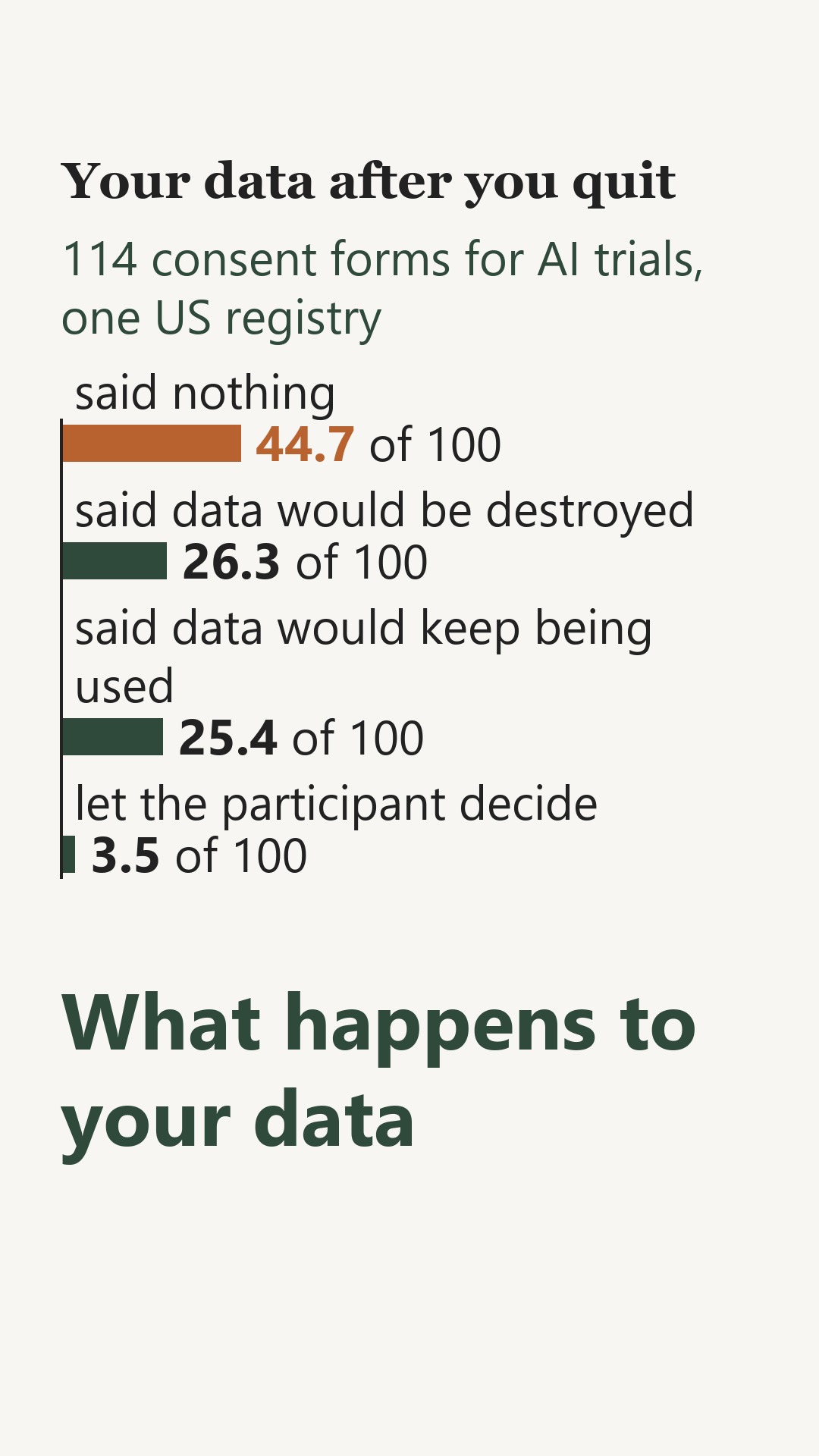
Shares of 114 consent forms for AI-related trials posted on one US registry, by what they said about data already collected after a participant withdraws; the forms are from the registry only and may differ from versions signed on site.
When a form for an AI study is placed in front of you, three things are worth finding before you sign: what the AI does, which risks are written down, and what happens to your data if you leave.
Open a consent form for a medical study that uses artificial intelligence. Look for the sentence that explains what the AI does. In 66 of 114 forms, more than half, there was no such sentence: the type of AI and its intended use went unstated.
Researchers at Xiangya Hospital in China searched ClinicalTrials.gov, a US registry, on June 21, 2025. Two of them first checked which trials had consent forms available. Five researchers then read the forms and recorded what they found. The 114 trials spanned 32 medical fields, most often cancer, heart, psychiatry and neurology. Most were rated low or medium risk by the authors' own scoring.
What the forms did and did not say:
About one in five, 21 forms, mentioned no risks at all. Of those that did, privacy and confidentiality came up most often. Most forms, 98 of 114, carried basic study information and confirmation of ethics approval; 16 did not mention ethics review.
Only 16 of the 114 forms were both short enough to read in about ten minutes and written simply enough for a general reader. Riskier trials were not written more clearly.
If you quit a study, the form should say what happens to the data you already gave. In 51 forms it said nothing. Thirty said the data would be destroyed, 29 said it would keep being used, and only 4 let the participant decide.
The forms came from one public registry, and the authors say they may differ from the final versions people sign on site. The study compared forms against World Health Organization and National Institutes of Health standards. It did not check whether any law was broken, and it did not test whether anyone was actually misled.
When a form for an AI study is placed in front of you, three things are worth finding before you sign: what the AI does, which risks are written down, and what happens to your data if you leave.
What this means for you
The forms came from one public registry, and the authors say they may differ from what people sign on site. So when a form for an AI study is placed in front of you, look for what the AI does, which risks are written down, and what happens to your data if you leave.
Su, H., Xiao, F., Chau, H. et al. (2026). Informed Consent Disclosures and Minimum Requirements in AI Clinical Trials: Cross-Sectional Analysis. Journal of Medical Internet Research. https://doi.org/10.2196/94504
Who paid: The article does not state who funded the study or whether any funder had a role, and it names no equipment or software lent to the researchers.
Do not take this as professional medical advice.
The longer versionThe passages copied from the paper, the pictures, and every source with how much of it we read · 1088 words · about 5 minRead it →Close
# The Consent Form Said AI. It Didn't Say What the AI Did.
Most publicly posted consent documents in AI-related clinical trials left out the AI's role or its risks, a study of one registry found. The forms people actually sign may differ.
Consider what a consent form is supposed to cover: the procedure, the risks, the benefits, what happens to your data. Now add a system whose workings even its makers cannot fully explain, and the page has to carry more weight than it was built for.
That is the gap a study published in the Journal of Medical Internet Research set out to measure. The authors, whose affiliations include the Department of Reproductive Medicine at Xiangya Hospital, Central South University, in Changsha, China, examined consent documents posted publicly on ClinicalTrials.gov, the only clinical trial registry that provides such documents. They found 114 trials involving AI with forms available, searched on June 21, 2025, and read each one against World Health Organization and National Institutes of Health standards for what a consent document must disclose.
More than half of those documents, 66 of 114 or 58 percent, never stated what kind of AI the trial used or what it was for. Twenty-one forms, 18.4 percent, mentioned no risks at all. The pattern held across the rest: 87 forms, 76.3 percent, named no vulnerable populations needing special protection, and 13 forms, 11.4 percent, left out any mention of possible benefit.
Readability fared no better. Only 16 of the 114 forms, 14 percent, met both tests the authors set: fewer than 15,000 characters, about ten minutes of reading, and a readability score below 13 on a formula called SMOG that estimates the school grade needed to follow the text. Fewer still, 13 forms or 11.4 percent, included any picture or diagram. The authors also checked whether the riskiest trials used simpler language. They did not: the study found that higher-risk trials did not show improved readability.
Then there is the question of what happens if you quit. Every form guaranteed the right to withdraw. What would happen to data already collected was another matter: 51 forms, 44.7 percent, said nothing. Thirty, 26.3 percent, promised destruction. Twenty-nine, 25.4 percent, said the data would keep being used. Four, 3.5 percent, offered the participant a choice. The laws cited for data protection varied widely, from the European Union's General Data Protection Regulation to the United States' HIPAA to Spain's Organic Law 3/2018, with no single standard dominating.
The study has limits it states plainly. It read only documents posted on the registry, which the authors say may differ from the final versions signed on site. It tested no participants, so it shows a gap in paperwork, not proof that anyone was misled. It compared forms against WHO and NIH standards, not against any country's consent law, so it is not a finding that a trial or sponsor broke a rule. The risk scoring framework and the proposed checklist were developed by the authors and reviewed by four experts.
The technology at issue is not one thing. The trials named machine learning most often, 39 of the 92 that specified a type, followed by deep learning at 19, with smaller numbers for convolutional neural networks, natural language processing, reinforcement learning and large language models. What these systems share is the quality that makes a short form hard to write: they adapt, their reasoning is opaque even to their operators, and their behavior can shift as they learn1. A static page describing a moving system will always trail behind it.
Participants have said what they want. A United States national survey cited in the paper found more than 80 percent of respondents believe they should be told whenever AI is used in their health care, whatever the risk level2. The forms in this sample did not meet that expectation. Consent forms often failed to disclose the AI method, or described it only vaguely, while registry entries typically carried more detail3.
The authors' answer is a checklist. They call it the Minimum Requirements for Informed Consent in AI-Related Clinical Trials, and it asks for the AI's type, role and level of independence; risks stated as prominently as benefits, including algorithmic bias and what remains unknown; a length cap of 15,000 characters and a readability score of 13 or lower, tightened to 10 for high-risk trials; at least one tested visual aid; a clear statement of what happens to data after withdrawal, with a choice offered; and plain-language citation of the protections that apply456. None of this is binding on anyone. It is a proposal, and whether regulators or review boards adopt any part of it is a separate question the study does not answer.
Here is weeklyAI's reading. The pattern is familiar from other contracts: the side holding the technical knowledge writes the account, and the side signing sees the polished front. A form can be smooth, brief and reassuring while the substance sits in the registry entry or the sponsor's files. Expect consent documents in AI trials to keep reading that way for now, and expect a reader who only reads the form to believe they understood more than they did. This reading would be wrong if forms began plainly stating what the AI does, what is not yet known about it, and what happens to data on quitting, in words a layperson could check against the registry entry.
A second pattern is the take-it-or-leave-it offer. Data handling after withdrawal looked less like a choice than house policy: only four forms in this sample offered one. Expect most participants who object to be told to accept the terms or not enroll. That reading would be wrong if forms routinely offered a real menu about continued use, or if study staff could amend terms on request.
What can you do with this? Before signing anything for a study that mentions AI, ask for the registry number and compare what the form says about the AI and the data with what the registry says. Ask, in writing, what happens to your data if you quit and whether you can choose destruction instead of continued use, and keep the answer. Ask for the ethics approval, the data protection rules cited, and who to contact with a complaint. These are questions, not accusations, and a study team with nothing to hide should not mind them.
The form on the clipboard is still the form on the clipboard. What it leaves out, you can now ask for by name.
Where each piece of context comes from, and how much of it we read
- Su, H., Xiao, F., Chau, H. et al. (2026). Informed Consent Disclosures and Minimum Requirements in AI Clinical Trials: Cross-Sectional Analysis. Journal of Medical Internet Research. https://doi.org/10.2196/94504 - the article this story is about — the whole article — the passage: "Traditional IC frameworks require clear disclosure of study procedures, risks, benefits, and data use; however, the complexity, opacity, and adaptive nature of AI challenge these principles, making meaningful comprehension difficult"
- Su, H., Xiao, F., Chau, H. et al. (2026). Informed Consent Disclosures and Minimum Requirements in AI Clinical Trials: Cross-Sectional Analysis. Journal of Medical Internet Research. https://doi.org/10.2196/94504 - the article this story is about — the whole article — the passage: "A recent US national survey found that more than 80% of respondents believe they should be notified whenever AI is used in their health care, regardless of risk level."
- Su, H., Xiao, F., Chau, H. et al. (2026). Informed Consent Disclosures and Minimum Requirements in AI Clinical Trials: Cross-Sectional Analysis. Journal of Medical Internet Research. https://doi.org/10.2196/94504 - the article this story is about — the whole article — the passage: "Additionally, we identified a significant discrepancy in the reporting of AI methods between trial registries and IC documents."
- Su, H., Xiao, F., Chau, H. et al. (2026). Informed Consent Disclosures and Minimum Requirements in AI Clinical Trials: Cross-Sectional Analysis. Journal of Medical Internet Research. https://doi.org/10.2196/94504 - the article this story is about — the whole article — the passage: "We propose the “Minimum Requirements for Informed Consent in AI‑related Clinical Trials” as a possible framework to improve consent quality."
- Su, H., Xiao, F., Chau, H. et al. (2026). Informed Consent Disclosures and Minimum Requirements in AI Clinical Trials: Cross-Sectional Analysis. Journal of Medical Internet Research. https://doi.org/10.2196/94504 - the article this story is about — the whole article — the passage: "Limit document length to ≤15,000 characters (approximately 10 minutes of reading time) Achieve a Simple Measure of Gobbledygook readability score ≤13 (≤10 for high-risk trials) Include at least 1 comprehension-tested visual aid Offer layered or interactive digital consent options, if feasible"
- Su, H., Xiao, F., Chau, H. et al. (2026). Informed Consent Disclosures and Minimum Requirements in AI Clinical Trials: Cross-Sectional Analysis. Journal of Medical Internet Research. https://doi.org/10.2196/94504 - the article this story is about — the whole article — the passage: "Clarify postwithdrawal data handling and offer choice Disclose future data use and consent mechanisms Cite applicable protections in plain language"
Su, H., Xiao, F., Chau, H. et al. (2026). Informed Consent Disclosures and Minimum Requirements in AI Clinical Trials: Cross-Sectional Analysis. Journal of Medical Internet Research. https://doi.org/10.2196/94504
Who paid: The article does not state who funded the study or whether any funder had a role, and it names no equipment or software lent to the researchers.
Do not take this as professional medical advice.
The findings of other studies mentioned here come from this document; those studies were not opened one by one.