analysis of texts · Frontiers in Communication · la publicación, 21 oct 2026 · gratis
Un modelo para separar una foto real de una inventada, sin datos de votantes
Versión breve · la versión detallada sigue, unos 7 min
Pregunte al chat de weeklyAI
Pregúnteme sobre la IA en su vida: le señalo las notas que weeklyAI ha publicado sobre el tema, esta semana y antes.
Las conversaciones se guardan mientras exista weeklyAI, para mejorar la publicación. Se responde en el idioma en que usted escribe.
- El estudio, de un vistazo
- Quiénes
- un modelo de cinco capas para revisar imágenes periodísticas, ilustrado con dos episodios de fotoperiodismo político en Estados Unidos
- Cuántos
- cinco capas y dos episodios
- Dónde
- Estados Unidos (los episodios); autores de España y Ecuador
- Cuándo
- publicado el 21 de octubre de 2026; episodios de marzo de 2023 y agosto de 2024
- Tipo de estudio
- analysis of what people did
- Quién lo hizo
- universidades de Málaga, España, y Universidad Politécnica Salesiana, Ecuador
- El límite que importa
- El modelo no fue probado con personas: sus cinco proposiciones son expectativas, no hallazgos.
Los dos episodios que el artículo compara
Las primeras eran inventadas y circularon como si fueran noticia; la segunda era auténtica y fue acusada de ser inventada.
La escena inventada se volvió creíble por la expectativa de una acusación inminente; la foto real fue puesta en duda por sospecha partidista y mala lectura de rasgos ópticos.
La meta no es creerlo todo ni desconfiar de todo, sino confiar en proporción a la evidencia y a quién responde por ella.
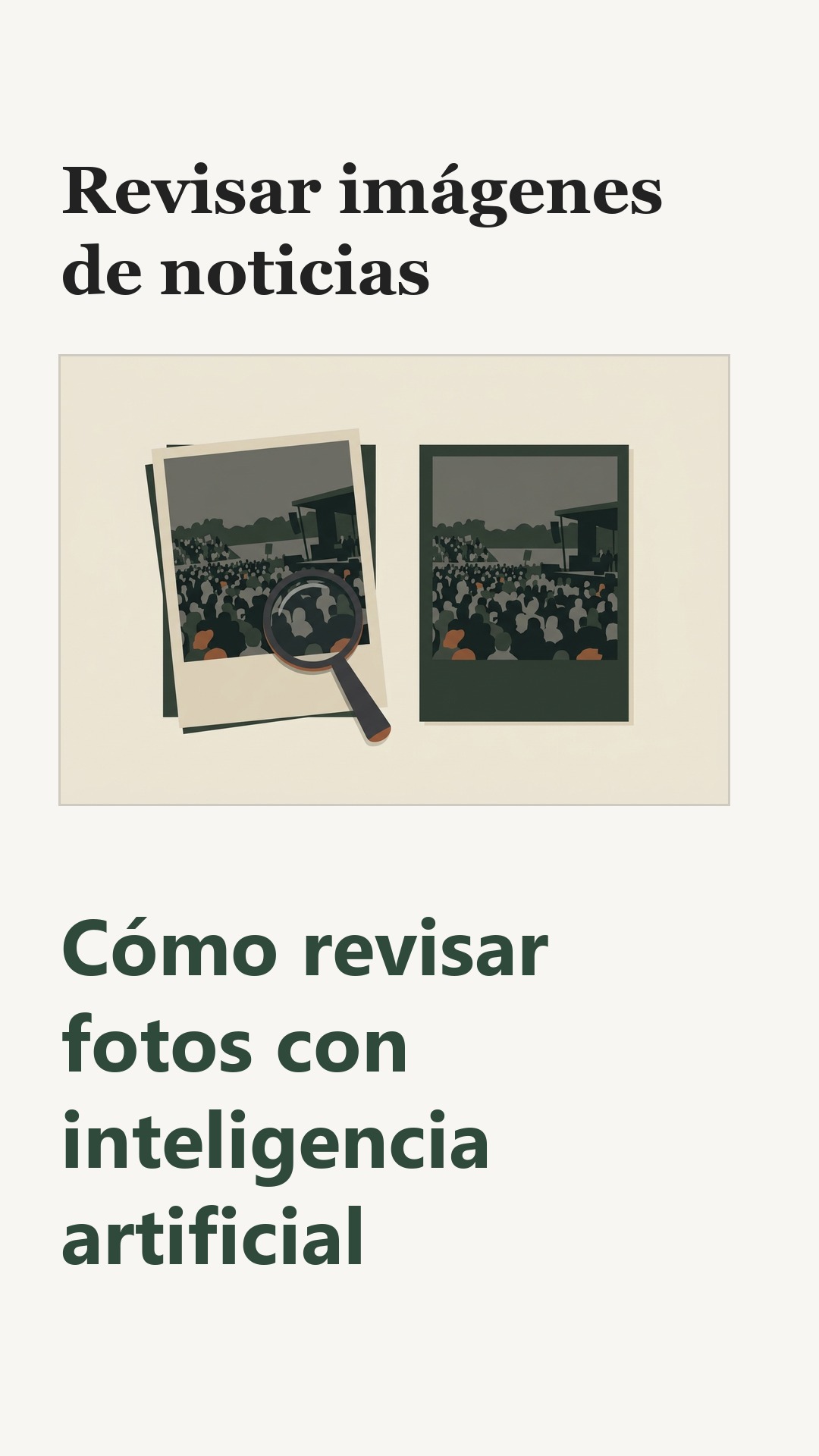
Un artículo de octubre de 2026 propone una forma de revisar imágenes de noticias en cinco pasos, pero no midió cómo votan ni cómo reaccionan las personas.
1. ¿Qué pasó?
El artículo es un análisis conceptual publicado el 21 de octubre de 2026. Sus autores, de universidades en España y Ecuador, proponen el Modelo de Confianza Visual por Capas. El modelo tiene cinco capas: si la imagen corresponde al hecho, cómo se produjo, su historial de origen, quién responde por ella y cómo la interpreta el público. Lo aplicaron a dos casos de fotoperiodismo político en Estados Unidos. En marzo de 2023 circularon imágenes hechas con inteligencia artificial que mostraban la detención de Donald Trump; la escena no ocurrió. En agosto de 2024 se acusó de falsa una foto auténtica de un mitin de Harris y Walz en Michigan. Los autores no recogieron datos propios ni entrevistaron a votantes.
2. ¿Qué puede revisar usted?
El artículo sí da una guía para revisar una imagen. Propone preguntar qué afirma la imagen junto con su texto, quién la publicó primero, si el hecho y su alcance están documentados por otras fuentes, qué muestran los registros de su origen y quién responde por la verificación. También recomienda buscar lo que otros medios publicaron sobre la misma imagen.
3. ¿Qué dice la autoridad?
El artículo no menciona ninguna regla ni resolución de una autoridad electoral.
Qué significa para usted
Para su voto, lo que este análisis propone es una costumbre: antes de creer o de desmentir una imagen de campaña, fíjese quién la publicó primero y si el hecho está confirmado por otras fuentes. El modelo no mide todavía cuánta gente cae en estos engaños, así que conviene mirar con calma y pedir la explicación de quien verifica.
Ruiz San Miguel, F. J., Torres-Toukoumidis, A., Hinojosa-Becerra, M. et al. (2026). From daguerreotype to deepfake: a layered model of visual trust in AI-era photojournalism. Frontiers in Communication. https://doi.org/10.3389/fcomm.2026.1959537
Quién pagó: El artículo indica que el trabajo recibió apoyo del Programa de Investigación, Transferencia del Conocimiento y Divulgación Científica de la Universidad de Málaga bajo la subvención PPRO-B3-2023-25 y de la Universidad Politécnica Salesiana (Ecuador) bajo la Resolución N.º 056-003-2026-04-16; declara no tener conflictos comerciales o financieros y no menciona prestadores de equipos o software.
Versión detalladaLos pasajes copiados del artículo, las ilustraciones y cada fuente con cuánto leímos de ella · 1392 palabras · unos 7 minLeerla →Cerrar
La regla y la evidencia: un modelo para separar una foto real de una inventada, sin datos de votantes
### EL ACTO
Esta semana no hay una resolución, una sentencia, una auditoría ni una ley que citar. Lo que hay es un artículo conceptual, publicado el 21 de octubre de 2026, que propone algo en lugar de ordenar algo: un modelo de cinco capas para diagnosticar por dónde se rompe la confianza en una imagen periodística1. No es una norma en vigor, no tiene autoridad que la haga cumplir y no fija plazos para nadie. Es una propuesta de trabajo para investigadores, medios y autoridades, y sus propios autores lo dicen sin adornos: "El LVTM no ha sido validado empíricamente, y las cinco proposiciones siguen siendo expectativas conceptuales y no hallazgos establecidos"1.
Las cinco capas que propone son estas: la relación con lo que la imagen dice mostrar, el proceso con que se produjo, la procedencia y rastreabilidad del archivo, el respaldo de una institución que responda por ella y la interpretación que hace el público1. Ninguna capa basta sola, y el modelo sirve para ubicar en cuál se rompió la cadena y qué actor podría repararla. Eso es todo lo que ofrece: un mapa para preguntar mejor, no un veredicto sobre ninguna imagen concreta. Si usted busca algo que obligue a alguien a hacer algo, esta semana no lo tiene en este documento.
### EL CASO QUE RESPONDE
Esta semana no se encontró ningún caso real que contar. Ninguna instancia verificada con nombre, lugar y fecha, y ninguna con un segundo origen independiente. Lo único que el artículo ofrece son dos episodios que sus autores eligieron a propósito para ilustrar su modelo, y eso es lo que son: ilustraciones escogidas, no una muestra de lo que pasa en el país de nadie2.
El primero: en marzo de 2023 circularon imágenes que mostraban a Donald Trump forcejeando con policías, mientras la atención noticiosa seguía la posibilidad de que lo acusaran formalmente. Las escenas no ocurrieron3. El creador declaró que las había generado con Midjourney y que las publicó primero como parodia, pero se redistribuyeron fuera de ese marco y se encontraron como aparentes fotografías de noticia4. En ese episodio, la expectativa de una acusación inminente volvió verosímil la escena inventada5. Da la impresión de que esto es la clase de cosa que el modelo quiere diagnosticar: la apariencia fotográfica ocupando el lugar de la evidencia.
El segundo: en agosto de 2024, una fotografía auténtica de una multitud en un acto de campaña de Harris-Walz en Michigan fue acusada de haber sido generada por inteligencia artificial6. Reuters comparó la imagen en disputa con sus propias fotografías y con otros registros visuales del acto; la campaña identificó al fotógrafo de planta; y un analista forense no encontró indicios de generación por IA7. Ahí la sospecha partidista y la mala lectura de rasgos ópticos sostuvieron una narrativa alternativa de fabricación8. También parece ser la clase de cosa que el modelo describe: la desconfianza interpretativa pisando evidencia que sí estaba respaldada.
Los dos episodios son de fotoperiodismo político en Estados Unidos y fueron escogidos por contraste extremo, uno de aceptación falsa y otro de rechazo falso. El artículo no dice que sean frecuentes, ni que se parezcan a lo que usted verá en su país: solo dice que le sirven para ilustrar su simetría central2. Tratarlos como muestra de algo sería leerlos mal.
### LO QUE SE MIDIÓ
No se midió nada. El artículo no reporta efecto, ni muestra, ni denominador, ni país de medición, porque no recogió datos: es un análisis conceptual que compara dos episodios públicos2. Nadie midió cuántas personas creen una foto falsa ni cuántas descartan una verdadera. Tampoco se midió en una elección ni en un laboratorio, porque no hubo medición de ningún tipo.
Lo que sí hay son estudios de otras cosas, y conviene decirlas con su tamaño. Ciento treinta y tres futuros maestros de primaria en la Región de Murcia, España, participaron de forma voluntaria en un estudio que encontró bajos niveles de confianza en la respuesta del gobierno frente a estas amenazas en línea910. Ciento cincuenta y dos estudiantes españoles de entre 10 y 14 años participaron en un estudio sobre evaluación de desinformación11, y entre los ochenta que tenían datos de antes y después el conjunto de sus indicadores subió de 11.90 a 15.90 en una escala cuyo máximo no reporta el resumen; las mejoras más claras se dieron en pistas visibles dentro del propio mensaje, mientras la lectura lateral no cambió de forma confiable1213. Y cinco arquitecturas de detección de rostros falsos, entrenadas con un conjunto de 140 mil rostros reales y falsos, alcanzaron hasta 95 por ciento de acierto en ese conjunto14. Son tres estudios distintos, y ninguno mide a un votante frente a una foto de campaña.
### LA RESPUESTA DE LA OTRA REGIÓN AL MISMO ASUNTO
Esta semana no encontramos ninguna corte, ley o autoridad de otro país que se haya pronunciado sobre este mismo método.
### LA LECTURA DE LA CASA
Aquí es donde hablamos nosotros, y lo decimos claro: lo que hemos leído no prueba nada sobre su elección, pero nos deja una sospecha razonable. Cuando revisar cada dato cuesta tiempo y ganas, la gente se queda con lo que parece más fácil de creer: la imagen nítida, la etiqueta llamativa, lo que confirma lo que ya pensaba. Esperamos que muchos votantes acepten o rechacen una foto de campaña por su realismo o por quién la comparte, sin buscar la foto original, la fecha ni quién la tomó. Sabríamos que nos equivocamos si viéramos a una parte amplia del público revisando por su cuenta la fuente y la fecha antes de reenviar, y haciéndolo de forma sostenida, no solo cuando la imagen le incomoda.
Hay una segunda trampa, y es la que más nos preocupa para la jornada electoral. Cuando las instituciones pierden prestigio, cualquiera con cámara queda habilitado para actuar como denunciante y juez. Esperamos que una foto real de una concentración sea tratada como prueba de fraude o de manipulación por cuentas sin responsabilidad editorial, y que esa acusación corra más rápido que la verificación de la agencia o del fotógrafo. También esperamos que el miedo exagerado a ser engañado lleve a otra parte del electorado a cruzar los brazos: si ya nada se puede creer, para qué informarse. Nos equivocaríamos si viéramos que esa gente sigue buscando la fuente y la corroboración de las fotos que le importan, y que su interés no baja. Lo que usted puede hacer con esto es barato: antes de reenviar una foto de campaña, hágase una sola pregunta: ¿quién la publicó primero y en qué fecha? Si no hay respuesta rápida, trátela como no verificada. Y cuando alguien diga que una foto prueba un fraude, pida el nombre de quien la tomó y las otras tomas del mismo acto.
### LO QUE NO SE SABE
No se sabe con qué frecuencia ocurre ninguna de las dos cosas. El propio artículo lo dice: la comparación no establece cuán seguido aparece cada camino, solo ilustra la simetría que propone2. Tampoco se sabe si las etiquetas, los sellos de procedencia o las explicaciones que el artículo recomienda mejoran el juicio de alguien, porque eso no se probó1. Y no se sabe cómo combinan las personas las cinco capas en la vida real: no hubo datos de audiencia ni entrevistas en redacciones1.
Lo que el artículo sí sostiene, con cautela, es que la procedencia puede reducir la incertidumbre pero no establecer por sí sola si lo que la imagen afirma es cierto, y que la confianza visual se sostiene mejor cuando la rastreabilidad técnica, la verificación editorial, la rendición de cuentas, la explicación del contexto y la educación del público operan juntas15. Eso es una sugerencia, no un resultado.
Nos queda una tarea para usted, y es la misma que el artículo deja abierta: pasar de buscar defectos en la imagen a reconstruir de dónde salió16. La meta no es creerlo todo ni desconfiar de todo, sino confiar en proporción a la evidencia y a quién responde por ella17. Cuando llegue a la casilla con su celular en la mano y una foto dando vueltas, pregúntese quién la publicó primero y quién responde por ella. Esa pregunta, y no el píxel, es la que puede contestar solo.
De dónde sale cada dato de contexto, y cuánto leímos de cada documento
- Ruiz San Miguel, F. J., Torres-Toukoumidis, A., Hinojosa-Becerra, M. et al. (2026). From daguerreotype to deepfake: a layered model of visual trust in AI-era photojournalism. Frontiers in Communication. https://doi.org/10.3389/fcomm.2026.1959537 - el artículo del que trata esta nota — el artículo completo — el pasaje: "The LVTM has not been empirically validated, and the five propositions remain conceptual expectations rather than established findings."
- Ruiz San Miguel, F. J., Torres-Toukoumidis, A., Hinojosa-Becerra, M. et al. (2026). From daguerreotype to deepfake: a layered model of visual trust in AI-era photojournalism. Frontiers in Communication. https://doi.org/10.3389/fcomm.2026.1959537 - el artículo del que trata esta nota — el artículo completo — el pasaje: "The comparison does not establish how frequently either pathway occurs, but it illustrates the central symmetry proposed by the LVTM."
- Ruiz San Miguel, F. J., Torres-Toukoumidis, A., Hinojosa-Becerra, M. et al. (2026). From daguerreotype to deepfake: a layered model of visual trust in AI-era photojournalism. Frontiers in Communication. https://doi.org/10.3389/fcomm.2026.1959537 - el artículo del que trata esta nota — el artículo completo — el pasaje: "In March 2023, images depicting Donald Trump struggling with police officers circulated while news attention focused on the possibility of his indictment. The scenes had not occurred."
- Ruiz San Miguel, F. J., Torres-Toukoumidis, A., Hinojosa-Becerra, M. et al. (2026). From daguerreotype to deepfake: a layered model of visual trust in AI-era photojournalism. Frontiers in Communication. https://doi.org/10.3389/fcomm.2026.1959537 - el artículo del que trata esta nota — el artículo completo — el pasaje: "The creator stated that the images were generated with Midjourney and initially posted as parody, yet they were redistributed outside that framing and encountered as apparent news photographs"
- Ruiz San Miguel, F. J., Torres-Toukoumidis, A., Hinojosa-Becerra, M. et al. (2026). From daguerreotype to deepfake: a layered model of visual trust in AI-era photojournalism. Frontiers in Communication. https://doi.org/10.3389/fcomm.2026.1959537 - el artículo del que trata esta nota — el artículo completo — el pasaje: "At the audience layer, contemporaneous expectations about an imminent indictment made the invented scenes narratively plausible."
- Ruiz San Miguel, F. J., Torres-Toukoumidis, A., Hinojosa-Becerra, M. et al. (2026). From daguerreotype to deepfake: a layered model of visual trust in AI-era photojournalism. Frontiers in Communication. https://doi.org/10.3389/fcomm.2026.1959537 - el artículo del que trata esta nota — el artículo completo — el pasaje: "In August 2024, an authentic photograph showing a crowd at a Harris-Walz campaign event in Michigan was accused of being AI-generated."
- Ruiz San Miguel, F. J., Torres-Toukoumidis, A., Hinojosa-Becerra, M. et al. (2026). From daguerreotype to deepfake: a layered model of visual trust in AI-era photojournalism. Frontiers in Communication. https://doi.org/10.3389/fcomm.2026.1959537 - el artículo del que trata esta nota — el artículo completo — el pasaje: "Reuters compared the disputed image with its own photographs and other visual records of the event; the campaign identified the staff photographer; and a forensic analyst found no indications of AI generation"
- Ruiz San Miguel, F. J., Torres-Toukoumidis, A., Hinojosa-Becerra, M. et al. (2026). From daguerreotype to deepfake: a layered model of visual trust in AI-era photojournalism. Frontiers in Communication. https://doi.org/10.3389/fcomm.2026.1959537 - el artículo del que trata esta nota — el artículo completo — el pasaje: "At the audience layer, partisan suspicion and misread optical features supported an alternative narrative of fabrication."
- Miralles Sánchez P, Campillo-Ferrer JM, López-García A. (2026). Trust of Pre-Service Teachers in Government Response to Gen AI Generated Deepfakes. Education Sciences. https://doi.org/10.3390/educsci16101753 — solo el resumen - no se pudo obtener el texto completo — el pasaje: "A quantitative methodology was employed, involving 133 pre-service teachers pursuing a Primary Education degree in the Region of Murcia (Spain) who participated voluntarily."
- Miralles Sánchez P, Campillo-Ferrer JM, López-García A. (2026). Trust of Pre-Service Teachers in Government Response to Gen AI Generated Deepfakes. Education Sciences. https://doi.org/10.3390/educsci16101753 — solo el resumen - no se pudo obtener el texto completo — el pasaje: "The results revealed low levels of confidence in the government’s response to these online threats."
- Lopez-Lora L, Vazquez-Cano E. (2027). Message scrutiny and claim verification: Changes in preadolescent reasoning about disinformation across AI-supported instruction. Thinking Skills and Creativity. https://doi.org/10.1016/j.tsc.2026.102390 — solo el resumen - no se pudo obtener el texto completo — el pasaje: "The sample comprised 152 Spanish students aged 10–14 years."
- Lopez-Lora L, Vazquez-Cano E. (2027). Message scrutiny and claim verification: Changes in preadolescent reasoning about disinformation across AI-supported instruction. Thinking Skills and Creativity. https://doi.org/10.1016/j.tsc.2026.102390 — solo el resumen - no se pudo obtener el texto completo — el pasaje: "The overall composite increased from M = 11.90 to M = 15.90, t(79) = 6.18, p < .001, d_z = 0.69."
- Lopez-Lora L, Vazquez-Cano E. (2027). Message scrutiny and claim verification: Changes in preadolescent reasoning about disinformation across AI-supported instruction. Thinking Skills and Creativity. https://doi.org/10.1016/j.tsc.2026.102390 — solo el resumen - no se pudo obtener el texto completo — el pasaje: "Indicator-level changes were differentiated: the clearest increases clustered around cues available within the focal message, including sensationalism, alarmist format, writing quality, tone/style, and timeliness, whereas triangulation/lateral reading did not change reliably and externally oriented verification remained mixed."
- Koudad Z, Bekkouche A, Benahmed H, Hadjila M, Merzoug M. (2026). Trustworthy Deepfake Detection: Explainable LIME Method of ViT and CNN Architectures. Cybernetics and Information Technologies. 10.2478/cait-2026-0014 — solo el resumen - no se pudo obtener el texto completo — el pasaje: "In this work, we develop and evaluate five deepfake detection architectures, including a Vision Transformer and four Convolutional Neural Networks, trained on the 140K Real and Fake Faces dataset, with the best models achieving an accuracy of 95 percent."
- Ruiz San Miguel, F. J., Torres-Toukoumidis, A., Hinojosa-Becerra, M. et al. (2026). From daguerreotype to deepfake: a layered model of visual trust in AI-era photojournalism. Frontiers in Communication. https://doi.org/10.3389/fcomm.2026.1959537 - el artículo del que trata esta nota — el artículo completo — el pasaje: "The analysis suggests that provenance can reduce uncertainty but cannot establish semantic veracity by itself; visual trust is more plausibly supported when technical traceability, editorial verification, institutional accountability, contextual explanation, and audience-facing media literacy operate together."
- Ruiz San Miguel, F. J., Torres-Toukoumidis, A., Hinojosa-Becerra, M. et al. (2026). From daguerreotype to deepfake: a layered model of visual trust in AI-era photojournalism. Frontiers in Communication. https://doi.org/10.3389/fcomm.2026.1959537 - el artículo del que trata esta nota — el artículo completo — el pasaje: "For audiences and media-literacy educators, the interpretive task should shift from spotting visual defects to reconstructing evidential chains."
- Ruiz San Miguel, F. J., Torres-Toukoumidis, A., Hinojosa-Becerra, M. et al. (2026). From daguerreotype to deepfake: a layered model of visual trust in AI-era photojournalism. Frontiers in Communication. https://doi.org/10.3389/fcomm.2026.1959537 - el artículo del que trata esta nota — el artículo completo — el pasaje: "The goal is calibrated trust: reliance proportional to the available evidence and accountability, rather than automatic belief or blanket disbelief."
Ruiz San Miguel, F. J., Torres-Toukoumidis, A., Hinojosa-Becerra, M. et al. (2026). From daguerreotype to deepfake: a layered model of visual trust in AI-era photojournalism. Frontiers in Communication. https://doi.org/10.3389/fcomm.2026.1959537
Quién pagó: El artículo indica que el trabajo recibió apoyo del Programa de Investigación, Transferencia del Conocimiento y Divulgación Científica de la Universidad de Málaga bajo la subvención PPRO-B3-2023-25 y de la Universidad Politécnica Salesiana (Ecuador) bajo la Resolución N.º 056-003-2026-04-16; declara no tener conflictos comerciales o financieros y no menciona prestadores de equipos o software.
analysis of texts · Frontiers in Communication · the paper, 21 Oct 2026 · free
A fake arrest photo can pass as news, and a real rally photo can be called fake: a framework for spotting both, untested.
Short version · the longer version follows, about 5 min
Ask the weeklyAI chat
Ask me about AI in your life: I point you to the stories weeklyAI has published on it, this week and before.
Conversations are saved for as long as weeklyAI exists, to improve the publication. Answers come in the language you write in.
- The study at a glance
- Who
- Two episodes of political images in the United States
- How many
- two episodes
- Where
- United States
- When
- March 2023 and August 2024
- Kind of study
- analysis of what people did
- Who did it
- University of Málaga and Universidad Politécnica Salesiana
- The limit that matters
- The framework was never tested; the authors say so themselves.
A fake picture believed, a real picture called fake
The first showed scenes that had not occurred and were met as news photos; the second was real and was accused of being AI-generated.
Reuters compared the disputed image with its own photographs and other visual records, the campaign named the staff photographer, and a forensic analyst found no indications of AI generation.
The picture on your screen has no memory of the scene it shows.
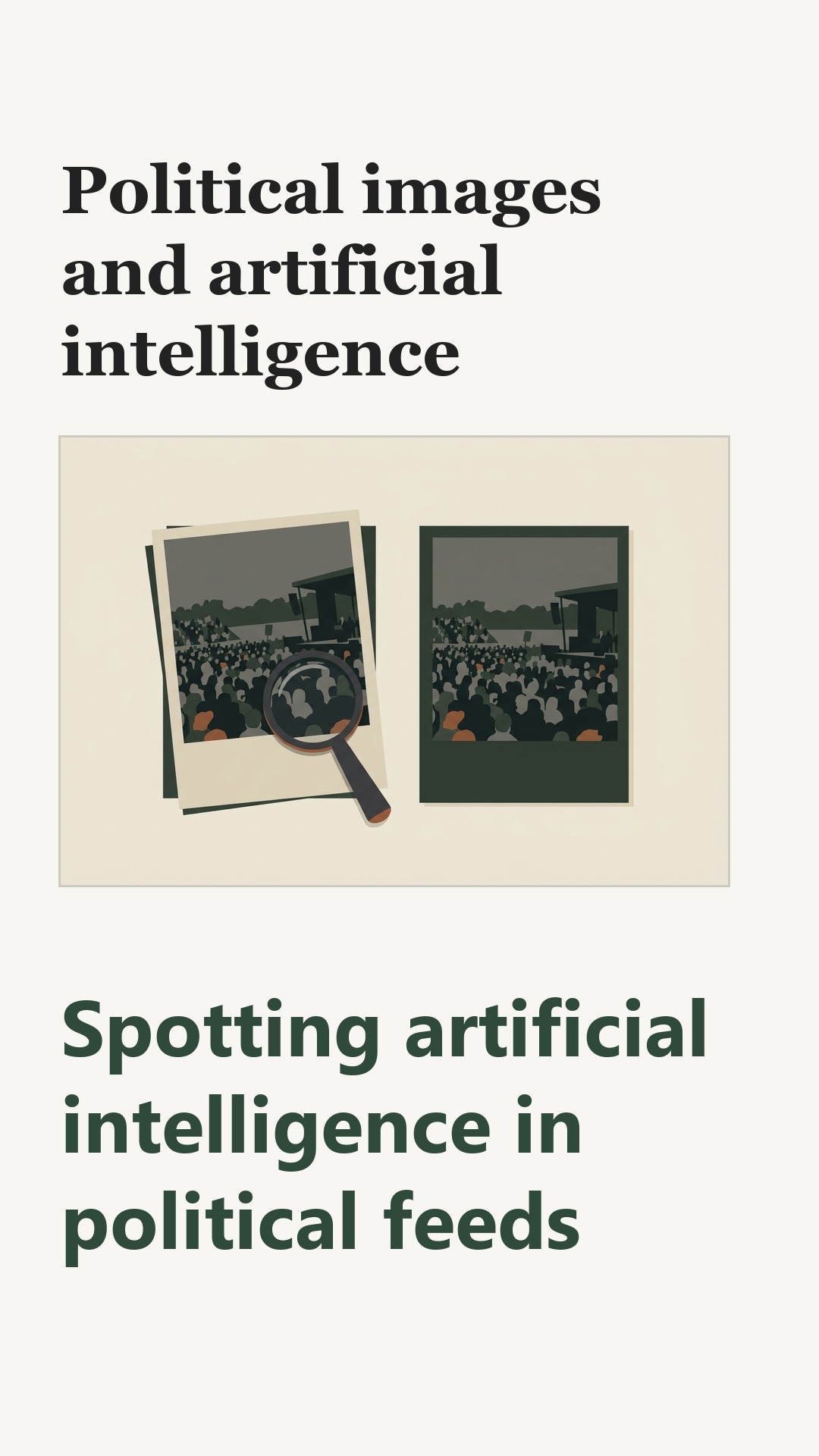
In March 2023, images of Donald Trump being arrested spread while news focused on a possible indictment. The scenes never happened. The creator said the images were made with Midjourney and first posted as parody, but reposts dropped that framing and people met them as news photos. In August 2024, an authentic Harris-Walz rally photo was accused of being AI-generated. Reuters compared it with its own photos and other records, the campaign named its photographer, and a forensic analyst found no sign of AI generation.
To check an image that moves you before a vote, look for who first published it and whether independent photos, video or event records back the scene. You can also look for a content credential, the signed record of how an image was made, where a platform shows one.
The article names no electoral authority and no rule in force. It reports only that the EU AI Act's Article 50, which requires machine-readable marking of AI-generated content, applies from 2 August 2026.
What this means for you
The framework is a proposal, not a tested tool, and its authors say so. Before a vote, ask who first published a photo and whether independent records back the scene, and treat a missing content credential as no verdict either way. Watch whether electoral authorities later say what they audited.
Ruiz San Miguel, F. J., Torres-Toukoumidis, A., Hinojosa-Becerra, M. et al. (2026). From daguerreotype to deepfake: a layered model of visual trust in AI-era photojournalism. Frontiers in Communication. https://doi.org/10.3389/fcomm.2026.1959537
Who paid: The article says the work was supported by the University of Málaga's Research, Knowledge Transfer and Scientific Dissemination Program under Grant PPRO-B3-2023-25 and by Universidad Politécnica Salesiana (Ecuador) under Resolution No. 056-003-2026-04-16; it declares no commercial or financial conflicts and names no equipment or software lenders.
The findings of other studies mentioned here are known to us through this document, which is the one we read; we did not open each of those studies.
The longer versionThe passages copied from the paper, the pictures, and every source with how much of it we read · 1064 words · about 5 minRead it →Close
The rule and the evidence: A fake arrest photo can pass as news, and a real rally photo can be called fake: a framework for spotting both, untested
### THE ACT
The document before us is not a law, a ruling or an audit. It is a conceptual article, published 21 October 2026, that proposes a five-layer diagnostic framework for judging photographs in the AI era and tests nothing1. Its authors describe it as "a conceptual diagnostic framework rather than an empirically validated theory"1. No authority enforces it. No date obliges anyone to do anything under it.
What it does offer is a question to carry into an election season: when a picture arrives in your feed, which link in its chain has broken? The authors name five: whether the scene happened, how the image was made, whether its history can be traced, who stands behind it, and how you read it. The article's own limit is stated plainly: the model "has not been empirically validated, and the five propositions remain conceptual expectations rather than established findings"1.
### THE CASE IT ANSWERS
No real instance was found this week.
### WHAT WAS MEASURED
No passage gives a measurement of how often either failure happens, to whom, or with what effect. The authors say so themselves: "The comparison does not establish how frequently either pathway occurs, but it illustrates the central symmetry proposed by the LVTM"2.
What the article does describe is a pair of episodes, not a study. The article describes a case in which, in March 2023, images showing Donald Trump struggling with police officers circulated while news attention focused on a possible indictment, and the scenes had not occurred3. The article describes a case in which the creator said the images were made with Midjourney and first posted as parody, yet they were passed along outside that framing and met as apparent news photographs4. The article describes a case in which, in August 2024, an authentic photograph of a crowd at a Harris-Walz campaign event in Michigan was accused of being AI-generated5. The article describes a case in which Reuters compared it with its own photographs and other visual records, the campaign named the staff photographer, and a forensic analyst found no indications of AI generation6.
The article describes two cases side by side. In the first, a picture of something that never happened was believed; in the second, a picture of something that did happen was called fake35. The authors call this a double crisis: "the false can acquire the appearance of evidence, while evidence can be recoded as false"7. The mechanism is not that pictures became easy to alter. It is that "the visual rhetoric of the photograph can be generated independently of the event whose existence the image seems to attest"8. A machine can now produce the look of a news photo without any scene in front of a lens9.
### THE OTHER REGION'S ANSWER TO THE SAME THING
We found none this week: no passage gives another country's court, law or authority addressing this same method.
### THE LIBRARY'S READING
Here is how we read it. A false rumor about a candidate has always worked by attaching itself to a suspicion already in the air, and a picture has always made the suspicion feel like proof. What is new is that the picture no longer needs a scene behind it, so the rumor can arrive with its own evidence attached. Expect the pull to be strongest when the news already feels imminent: a voter who has been told all week that something is about to happen will meet a photo of it happening and feel confirmed, and a voter who distrusts the source will meet a real photo and feel tricked. You would know we are wrong if people shown a plausible fake and an implausible real photo judged both by checking who published them and whether the event is documented, rather than by how well each fit the week's story.
A public can learn to check some things alone: who first published a picture, whether the event is reported elsewhere, whether the caption claims more than the frame shows. What it cannot check alone is whether a file came from a camera, because that record lives with the publisher and the platform, and most of us never see it. So the practical question shifts from "does this look real?" to "who will put their name behind it, and what did they check?" The authors make a similar turn: the task "should shift from spotting visual defects to reconstructing evidential chains"10. Their goal is "calibrated trust: reliance proportional to the available evidence and accountability, rather than automatic belief or blanket disbelief"11. Our own reading goes one step further: a named source that explains its checks is worth more to you than any badge, and a badge without a name is worth very little.
### WHAT IS NOT KNOWN
The article is candid about its own gaps, and they matter for a voter. It examines only two politically salient U.S. episodes, chosen for contrast, so it cannot estimate how common either failure is2. It collected no audience data and interviewed no newsrooms, so it cannot show how real voters weigh these layers or whether labels help. The authors used an AI model for editing and drafting support and say they verified the text themselves.
One thing the record is silent on: whether any of the proposed repairs — traceable file histories, camera signing, professional rules, disclosure laws — actually improves anyone's judgment. The article says provenance "can reduce uncertainty but cannot establish semantic veracity by itself"12. It does not claim the fixes work.
Here is what you can do with it before you vote. When a photo lands in your feed at the moment you expected big news, ask whether you believe it because of the evidence or because of the timing. Find who first published it, and look for the event reported somewhere other than the post that showed it to you. When someone tells you a real photo is fake, ask the same questions in reverse. The article gives you five places to look; none of them requires a machine.
The picture on your screen has no memory of the scene it shows. Someone else keeps that memory, or no one does. Before you vote, ask who.
Where each piece of context comes from, and how much of it we read
- Ruiz San Miguel, F. J., Torres-Toukoumidis, A., Hinojosa-Becerra, M. et al. (2026). From daguerreotype to deepfake: a layered model of visual trust in AI-era photojournalism. Frontiers in Communication. https://doi.org/10.3389/fcomm.2026.1959537 - the article this story is about — the whole article — the passage: "The LVTM has not been empirically validated, and the five propositions remain conceptual expectations rather than established findings."
- Ruiz San Miguel, F. J., Torres-Toukoumidis, A., Hinojosa-Becerra, M. et al. (2026). From daguerreotype to deepfake: a layered model of visual trust in AI-era photojournalism. Frontiers in Communication. https://doi.org/10.3389/fcomm.2026.1959537 - the article this story is about — the whole article — the passage: "The comparison does not establish how frequently either pathway occurs, but it illustrates the central symmetry proposed by the LVTM."
- Ruiz San Miguel, F. J., Torres-Toukoumidis, A., Hinojosa-Becerra, M. et al. (2026). From daguerreotype to deepfake: a layered model of visual trust in AI-era photojournalism. Frontiers in Communication. https://doi.org/10.3389/fcomm.2026.1959537 - the article this story is about — the whole article — the passage: "In March 2023, images depicting Donald Trump struggling with police officers circulated while news attention focused on the possibility of his indictment. The scenes had not occurred."
- Ruiz San Miguel, F. J., Torres-Toukoumidis, A., Hinojosa-Becerra, M. et al. (2026). From daguerreotype to deepfake: a layered model of visual trust in AI-era photojournalism. Frontiers in Communication. https://doi.org/10.3389/fcomm.2026.1959537 - the article this story is about — the whole article — the passage: "The creator stated that the images were generated with Midjourney and initially posted as parody, yet they were redistributed outside that framing and encountered as apparent news photographs"
- Ruiz San Miguel, F. J., Torres-Toukoumidis, A., Hinojosa-Becerra, M. et al. (2026). From daguerreotype to deepfake: a layered model of visual trust in AI-era photojournalism. Frontiers in Communication. https://doi.org/10.3389/fcomm.2026.1959537 - the article this story is about — the whole article — the passage: "In August 2024, an authentic photograph showing a crowd at a Harris-Walz campaign event in Michigan was accused of being AI-generated."
- Ruiz San Miguel, F. J., Torres-Toukoumidis, A., Hinojosa-Becerra, M. et al. (2026). From daguerreotype to deepfake: a layered model of visual trust in AI-era photojournalism. Frontiers in Communication. https://doi.org/10.3389/fcomm.2026.1959537 - the article this story is about — the whole article — the passage: "Reuters compared the disputed image with its own photographs and other visual records of the event; the campaign identified the staff photographer; and a forensic analyst found no indications of AI generation"
- Ruiz San Miguel, F. J., Torres-Toukoumidis, A., Hinojosa-Becerra, M. et al. (2026). From daguerreotype to deepfake: a layered model of visual trust in AI-era photojournalism. Frontiers in Communication. https://doi.org/10.3389/fcomm.2026.1959537 - the article this story is about — the whole article — the passage: "Together, these processes create a double crisis: the false can acquire the appearance of evidence, while evidence can be recoded as false."
- Ruiz San Miguel, F. J., Torres-Toukoumidis, A., Hinojosa-Becerra, M. et al. (2026). From daguerreotype to deepfake: a layered model of visual trust in AI-era photojournalism. Frontiers in Communication. https://doi.org/10.3389/fcomm.2026.1959537 - the article this story is about — the whole article — the passage: "The central rupture is not that images suddenly became manipulable; it is that the visual rhetoric of the photograph can be generated independently of the event whose existence the image seems to attest."
- Ruiz San Miguel, F. J., Torres-Toukoumidis, A., Hinojosa-Becerra, M. et al. (2026). From daguerreotype to deepfake: a layered model of visual trust in AI-era photojournalism. Frontiers in Communication. https://doi.org/10.3389/fcomm.2026.1959537 - the article this story is about — the whole article — the passage: "Generative artificial intelligence introduces a different possibility: a photorealistic image can be produced without a prior event, person, or scene corresponding to the depicted content."
- Ruiz San Miguel, F. J., Torres-Toukoumidis, A., Hinojosa-Becerra, M. et al. (2026). From daguerreotype to deepfake: a layered model of visual trust in AI-era photojournalism. Frontiers in Communication. https://doi.org/10.3389/fcomm.2026.1959537 - the article this story is about — the whole article — the passage: "For audiences and media-literacy educators, the interpretive task should shift from spotting visual defects to reconstructing evidential chains."
- Ruiz San Miguel, F. J., Torres-Toukoumidis, A., Hinojosa-Becerra, M. et al. (2026). From daguerreotype to deepfake: a layered model of visual trust in AI-era photojournalism. Frontiers in Communication. https://doi.org/10.3389/fcomm.2026.1959537 - the article this story is about — the whole article — the passage: "The goal is calibrated trust: reliance proportional to the available evidence and accountability, rather than automatic belief or blanket disbelief."
- Ruiz San Miguel, F. J., Torres-Toukoumidis, A., Hinojosa-Becerra, M. et al. (2026). From daguerreotype to deepfake: a layered model of visual trust in AI-era photojournalism. Frontiers in Communication. https://doi.org/10.3389/fcomm.2026.1959537 - the article this story is about — the whole article — the passage: "The analysis suggests that provenance can reduce uncertainty but cannot establish semantic veracity by itself; visual trust is more plausibly supported when technical traceability, editorial verification, institutional accountability, contextual explanation, and audience-facing media literacy operate together."
Ruiz San Miguel, F. J., Torres-Toukoumidis, A., Hinojosa-Becerra, M. et al. (2026). From daguerreotype to deepfake: a layered model of visual trust in AI-era photojournalism. Frontiers in Communication. https://doi.org/10.3389/fcomm.2026.1959537
Who paid: The article says the work was supported by the University of Málaga's Research, Knowledge Transfer and Scientific Dissemination Program under Grant PPRO-B3-2023-25 and by Universidad Politécnica Salesiana (Ecuador) under Resolution No. 056-003-2026-04-16; it declares no commercial or financial conflicts and names no equipment or software lenders.
The findings of other studies mentioned here are known to us through this document, which is the one we read; we did not open each of those studies.