survey · Studia Universitatis „Vasile Goldis” Arad – Economics Series · la publicación, 25 oct 2026 · gratis
Las pymes de Kosovo que más usaban IA decían tener mejor manejo de su personal
En una encuesta a 210 pymes de Kosovo, las que más usaban IA calificaron peor su propia atención al cliente. Son opiniones de dueños y gerentes, no de clientes, y el estudio no prueba que una cosa cause la otra.
Versión breve · la versión detallada sigue, unos 6 min
Pregunte al chat de weeklyAI
Pregúnteme sobre la IA en su vida: le señalo las notas que weeklyAI ha publicado sobre el tema, esta semana y antes.
Las conversaciones se guardan mientras exista weeklyAI, para mejorar la publicación. Se responde en el idioma en que usted escribe.
- El estudio, de un vistazo
- Quiénes
- dueños y gerentes de pymes que ya usaban al menos una herramienta de inteligencia artificial
- Cuántos
- 210 pymes
- Dónde
- Kosovo, en siete ciudades del país
- Cuándo
- no lo dice el pasaje
- Tipo de estudio
- survey
- Quién lo hizo
- Universidad de Prishtina y Universidad Ss. Cyril y Methodius de Skopje
- El límite que importa
- Son opiniones de dueños y gerentes sobre su propia empresa, no calificaciones de clientes.
Lo que pasó hacia adentro de la empresa frente a lo que pasó en el trato al cliente
Hacia adentro la relación fue positiva; hacia el cliente salió al revés, a más uso un poco peor la experiencia reportada
En los dos análisis la asociación con el trato al cliente salió negativa y significativa
La capacitación fue la que más pesó en el manejo del personal, por encima del uso de la herramienta
La pregunta útil no es si su herramienta de IA funciona, sino qué está reemplazando.

Usted tiene un negocio pequeño, sin ingenieros en la nómina, y está pensando si meter herramientas de inteligencia artificial en sus operaciones. Un equipo de investigadores les hizo esa misma pregunta a dueños y gerentes de 210 pymes en Kosovo, repartidas en siete ciudades del país. Todas ya usaban al menos una herramienta de IA. Les preguntaron cuánto la usaban, si habían entrenado a su personal y qué resultados veían.
Hacia adentro, les fue bien. El entrenamiento del personal fue lo que más se relacionó con un mejor manejo del área de recursos humanos: contratación, evaluación y desarrollo de empleados. El uso de la IA y la preparación digital de la empresa también mostraron una relación positiva con esos resultados internos. El estudio calcula que el uso de la IA, el entrenamiento y la preparación digital juntos explican cerca de la mitad de las diferencias en ese punto entre las empresas que estudió.
Hacia afuera, el cuadro cambia. La experiencia del cliente no mejoró. Las empresas que más usaban IA tendieron a calificarla peor, y esa relación fue estadísticamente significativa. El entrenamiento y la preparación digital no mostraron efecto ahí. El estudio menciona varias explicaciones posibles, como menos personalización, clientes que rechazan la automatización o una puesta en marcha deficiente. Ninguna se probó.
Ese resultado sobre el cliente sale de las calificaciones de los propios gerentes, no de encuestas a clientes. Tómelo como una señal de alerta, no como prueba de que sus clientes vayan a quedar insatisfechos. Además, el estudio no permite afirmar que la IA haya causado el deterioro del trato. Quitar una herramienta no arregla solo el servicio.
Son 210 empresas de Kosovo, un país de Europa del Este. Ninguna está en América Latina, Estados Unidos o Canadá. Conviene tomar la dirección de los hallazgos, no el tamaño de las diferencias.
La pregunta útil no es si su herramienta de IA funciona, sino qué está reemplazando. Si su sistema nuevo contesta solo, recorta tiempos o clasifica clientes, fíjese si el trato se volvió más rápido y más frío al mismo tiempo. Y pregunte a los clientes usted mismo, en lugar de confiar en la calificación interna de su equipo.
Qué significa para usted
Ese resultado viene de lo que dicen los propios dueños y gerentes, no los clientes, así que no concluya todavía que su herramienta de IA le está enfriando el trato. Si su sistema nuevo contesta solo o clasifica clientes, pregunte usted mismo a unos cuantos si notaron la diferencia, y compare lo que le dicen con la calificación que hace su equipo por dentro.
Dragusha, B., Josimovski, S. (2026). The Impact of Artificial Intelligence on the Performance of Small and Medium Enterprises in Kosovo. Studia Universitatis „Vasile Goldis” Arad – Economics Series. https://doi.org/10.2478/sues-2026-0017
Quién pagó: El artículo indica que la investigación no recibió ninguna subvención específica de agencias de financiación públicas, comerciales o sin ánimo de lucro, y no menciona prestadores de equipos o software.
Versión detalladaLos pasajes copiados del artículo, las ilustraciones y cada fuente con cuánto leímos de ella · 1232 palabras · unos 6 minLeerla →Cerrar
En 210 pymes de Kosovo, más inteligencia artificial vino con mejor trabajo interno y peor trato al cliente
Un cuestionario respondido por los propios dueños y gerentes. Lo que dice de sus clientes es la percepción de la empresa, no la opinión de los clientes.
Imagine el expediente de personal de una empresa pequeña: las vacantes, las entrevistas, la evaluación de cada empleado, los turnos. En 210 pequeñas y medianas empresas de Kosovo que ya usaban al menos una herramienta de inteligencia artificial, los dueños y gerentes respondieron un cuestionario sobre ese trabajo interno y sobre el trato a sus clientes. El estudio lo firmaron Blerim Dragusha, de la Universidad de Prishtina, y Saso Josimovski, de la Universidad Ss. Cyril y Methodius de Skopje. No tuvo financiamiento de ninguna agencia, y los autores declaran que no tienen intereses económicos ni profesionales en el asunto.
Los resultados se parten en dos. En el trabajo interno de personal, las tres cosas que midieron (el uso de la herramienta, la capacitación del personal y la preparación digital de la empresa) se movieron junto con mejores resultados. La que más pesó fue la capacitación de los empleados: por encima del uso mismo de la herramienta, según el modelo estadístico que aplicaron1. En el trato al cliente, en cambio, la asociación salió al revés: a más uso de inteligencia artificial, un poco peor la experiencia reportada23. El estudio no puede decir que la herramienta haya causado ninguna de las dos cosas.
Hay que decirlo con cuidado, porque es fácil leer de más. Los datos son lo que los dueños y gerentes dicen de su propia empresa4; no son calificaciones de clientes ni registros de ventas. El diseño es correlacional: mira cómo se acomodan las respuestas en un mismo momento, no compara antes y después, ni un grupo con otro. El artículo dice que el cuestionario se aplicó en dos fases, y en otro punto señala que el diseño transversal limita el estudio de la dinámica a largo plazo. Tampoco hay datos de costos, de proveedores, de seguridad de la información ni de exposición legal.
Piense en el peso que tienen estas empresas donde están. En Kosovo, las pymes son más del 99% de las empresas registradas y sostienen buena parte del empleo y del producto5. Son, además, empresas con recursos limitados, poco personal calificado y una infraestructura digital insuficiente6. Lo curioso es que el estudio no las eligió al azar: buscó a propósito 210 que ya usaran alguna herramienta, en siete ciudades del país78. Es decir, retrató a las que ya dieron el primer paso, no a las que se quedaron atrás.
¿Y qué es exactamente eso de "inteligencia artificial" en una empresa así? En la práctica, programas que clasifican, predicen o responden solos: un filtro que ordena solicitudes, un motor que sugiere qué cliente llamar primero, un chat que contesta preguntas repetidas. El estudio no detalla qué herramienta usó cada empresa; mide cuánto se usa, cuánta capacitación hubo y qué tan preparada está la empresa en lo digital.
Otros trabajos que leímos, y que solo pudimos consultar en su resumen porque el texto completo está detrás de una suscripción, describen el mismo patrón desde otro ángulo. Una revisión de estudios publicados entre enero de 2021 y diciembre de 2025 encontró que muchas pymes experimentan con inteligencia artificial pero batallan para convertir ese uso inicial en valor sostenido9; entre los frenos aparecen los datos dispersos, la falta de habilidades, la dependencia del proveedor, la poca confianza y la incertidumbre regulatoria10. Otra investigación, un experimento de campo con vendedores de una empresa de educación en línea, halló que forzarlos a usar un algoritmo durante tres semanas elevó su uso después del experimento en 15.8 puntos porcentuales, y que el aprendizaje, no la costumbre, explicaba el cambio1112. Esa gente desconfiaba del algoritmo antes de probarlo13.
Tampoco esta es la primera vez que se estudia el tema. La mayoría de los trabajos sobre inteligencia artificial y desempeño se han hecho en empresas grandes o en economías digitalmente avanzadas14; los estudios que sí miran pymes suelen ubicarse en Europa occidental o en Asia. La novedad aquí es el lugar: una economía de transición, con empresas chicas y recursos apretados.
Volvamos a los números, que son pocos y conviene verlos como lo que son. El modelo del trabajo interno explicó cerca de la mitad de las diferencias entre una empresa y otra; el del trato al cliente, apenas una fracción pequeña. En otras palabras: la herramienta y la capacitación se asocian con claridad a la manera en que la empresa maneja a su gente, y casi no dicen nada de lo que el cliente siente. El estudio no midió ganancias, productividad ni ventas.
Así lo leemos nosotros. Cuando una empresa adopta una herramienta nueva, primero la usa para vigilar y apretar el trabajo de su propia gente, y solo después piensa en el cliente. Esperaríamos que en empresas como estas el beneficio se sienta sobre todo en el control interno, en la evaluación del personal, mientras el trato al cliente queda igual o empeora, y que casi nadie haya rediseñado el puesto de atención para acompañar la herramienta. Sabríamos que nos equivocamos si las empresas que reportan mejor trato al cliente fueran justamente las que más capacitaron a su personal de ventas y atención. Antes de firmar, pregunte para qué puesto concreto se compró la herramienta y quién la usa en el mostrador o al teléfono. Anote qué cambió para el cliente en las primeras semanas, no solo cuánto tiempo ahorró la oficina.
También leímos un trabajo hecho en Indonesia, en pymes con recursos limitados, que describe cómo la inteligencia artificial y los aparatos conectados apoyan la innovación sostenible cuando hay restricciones. Eso no desmiente nada; señala que el resultado depende de cómo se implante la herramienta y de dónde se mida. Y hay una advertencia que vale para cualquier empresa: conviene revisar que toda decisión automática sobre un cliente o un empleado tenga una vía visible para hablar con una persona y que quede registrada la razón. Pruebe usted mismo el canal de atención como si fuera cliente y vea si puede salir del menú automático.
El propio estudio propone el camino que sigue. Para equilibrar la ganancia interna con el valor para el cliente, las empresas deberían invertir en herramientas que atiendan directamente al cliente, como chats automáticos, sistemas de recomendación y análisis de comentarios15. Y la capacitación, hoy concentrada en el personal técnico, tendría que incluir a ventas, servicio al cliente y mercadotecnia16.
Aquí va lo que el estudio no puede contestar y usted sí debería preguntar. Si su empresa depende de un solo proveedor, ¿cómo saca sus datos si se va, cuánto cuesta y quién los ve? ¿Qué pasa si ese proveedor sube el precio o cierra? ¿Tiene por escrito qué se hace con la información de sus clientes y quién responde si se filtra? Nada de eso se midió en Kosovo, y es justo donde una pyme se puede lastimar. Guarde una copia propia de los datos de clientes y empleados que no dependa del proveedor.
El expediente de personal de aquella empresa pequeña quedó más ordenado. El cliente que llamó por teléfono, quizá no lo notó. Antes de comprar la siguiente herramienta, pregunte quién la va a usar del lado del cliente, y anote en una hoja qué cambió para esa persona en la primera semana.
De dónde sale cada dato de contexto, y cuánto leímos de cada documento
- Dragusha, B., Josimovski, S. (2026). The Impact of Artificial Intelligence on the Performance of Small and Medium Enterprises in Kosovo. Studia Universitatis „Vasile Goldis” Arad – Economics Series. https://doi.org/10.2478/sues-2026-0017 - el artículo del que trata esta nota — el artículo completo — el pasaje: "AI training emerged as the strongest predictor (β = .398, p < .001), emphasizing the central role of human capital development in leveraging AI technologies effectively (Bianchi et al., 2020)."
- Dragusha, B., Josimovski, S. (2026). The Impact of Artificial Intelligence on the Performance of Small and Medium Enterprises in Kosovo. Studia Universitatis „Vasile Goldis” Arad – Economics Series. https://doi.org/10.2478/sues-2026-0017 - el artículo del que trata esta nota — el artículo completo — el pasaje: "However, AI usage shows a negative correlation with customer experience (r = – .12), indicating that higher levels of AI adoption may not currently translate into improved customer-facing outcomes."
- Dragusha, B., Josimovski, S. (2026). The Impact of Artificial Intelligence on the Performance of Small and Medium Enterprises in Kosovo. Studia Universitatis „Vasile Goldis” Arad – Economics Series. https://doi.org/10.2478/sues-2026-0017 - el artículo del que trata esta nota — el artículo completo — el pasaje: "Interestingly, AI usage demonstrates a significant negative effect on customer experience (β = –.184, p = .047), suggesting that current implementations may be reducing the perceived quality of customer interactions."
- Dragusha, B., Josimovski, S. (2026). The Impact of Artificial Intelligence on the Performance of Small and Medium Enterprises in Kosovo. Studia Universitatis „Vasile Goldis” Arad – Economics Series. https://doi.org/10.2478/sues-2026-0017 - el artículo del que trata esta nota — el artículo completo — el pasaje: "The respondents included executive-level managers and business owners with direct authority over technological investment and organizational performance decisions."
- Dragusha, B., Josimovski, S. (2026). The Impact of Artificial Intelligence on the Performance of Small and Medium Enterprises in Kosovo. Studia Universitatis „Vasile Goldis” Arad – Economics Series. https://doi.org/10.2478/sues-2026-0017 - el artículo del que trata esta nota — el artículo completo — el pasaje: "In the specific context of Kosovo, SMEs play a particularly vital role. According to the Kosovo Agency of Statistics (KAS, 2021), SMEs account for over 99% of all registered enterprises, contributing significantly to employment, innovation, and gross domestic product (GDP)."
- Dragusha, B., Josimovski, S. (2026). The Impact of Artificial Intelligence on the Performance of Small and Medium Enterprises in Kosovo. Studia Universitatis „Vasile Goldis” Arad – Economics Series. https://doi.org/10.2478/sues-2026-0017 - el artículo del que trata esta nota — el artículo completo — el pasaje: "Kosovar SMEs often contend with resource constraints, limited access to skilled personnel, and insufficient digital infrastructure, factors that collectively hinder their ability to fully capitalize on the advantages of intelligent technologies (KCC, 2019)."
- Dragusha, B., Josimovski, S. (2026). The Impact of Artificial Intelligence on the Performance of Small and Medium Enterprises in Kosovo. Studia Universitatis „Vasile Goldis” Arad – Economics Series. https://doi.org/10.2478/sues-2026-0017 - el artículo del que trata esta nota — el artículo completo — el pasaje: "The target population for this study comprises small and medium-sized enterprises (SMEs) operating in the Republic of Kosovo. To ensure representativeness across different economic zones, the sampling frame was drawn from seven major administrative centers: Prishtina, Mitrovica, Gjilan, Peja, Gjakova, Prizren, and Ferizaj."
- Dragusha, B., Josimovski, S. (2026). The Impact of Artificial Intelligence on the Performance of Small and Medium Enterprises in Kosovo. Studia Universitatis „Vasile Goldis” Arad – Economics Series. https://doi.org/10.2478/sues-2026-0017 - el artículo del que trata esta nota — el artículo completo — el pasaje: "A total of 210 SMEs were selected through purposive sampling, which is appropriate for identifying firms with specific characteristics, in this case, the adoption of at least one AI-related system or tool (Etikan et al., 2016)."
- Sheik I, van der Nest D. (2026). Scaling small- and medium-sized enterprise artificial intelligence through governance: A Technology–Organisation–Environment readiness synthesis for information management. South African Journal of Information Management. https://doi.org/10.4102/sajim.v28i1.2225 — solo el resumen - no se pudo obtener el texto completo — el pasaje: "Small- and medium-sized enterprises (SMEs) are increasingly experimenting with artificial intelligence (AI), yet many struggle to translate early use into scalable and trusted organisational value."
- Sheik I, van der Nest D. (2026). Scaling small- and medium-sized enterprise artificial intelligence through governance: A Technology–Organisation–Environment readiness synthesis for information management. South African Journal of Information Management. https://doi.org/10.4102/sajim.v28i1.2225 — solo el resumen - no se pudo obtener el texto completo — el pasaje: "Fragmented data, skills scarcity, vendor dependence, low trust and regulatory uncertainty constrained scaling."
- Cao X, Hu C, Sun J, Zhang DJ. (2026). How Forced Intervention Facilitates AI Adoption. Manufacturing & Service Operations Management. 10.1287/msom.2024.1137 — solo el resumen - no se pudo obtener el texto completo — el pasaje: "Experimental results show that forcing workers to use the algorithm during the experiment causally increases their algorithm usage over the month after the experiment by 15.8 percentage points."
- Cao X, Hu C, Sun J, Zhang DJ. (2026). How Forced Intervention Facilitates AI Adoption. Manufacturing & Service Operations Management. 10.1287/msom.2024.1137 — solo el resumen - no se pudo obtener el texto completo — el pasaje: "Contrary to the traditional literature focusing on habit formation, our findings suggest learning is a key driver for algorithm adoption among workers over the month after the experiment."
- Cao X, Hu C, Sun J, Zhang DJ. (2026). How Forced Intervention Facilitates AI Adoption. Manufacturing & Service Operations Management. 10.1287/msom.2024.1137 — solo el resumen - no se pudo obtener el texto completo — el pasaje: "Whereas artificial intelligence (AI) technologies are increasingly becoming powerful and useful in operations, human workers often resist adopting algorithms, known as algorithm aversion."
- Dragusha, B., Josimovski, S. (2026). The Impact of Artificial Intelligence on the Performance of Small and Medium Enterprises in Kosovo. Studia Universitatis „Vasile Goldis” Arad – Economics Series. https://doi.org/10.2478/sues-2026-0017 - el artículo del que trata esta nota — el artículo completo — el pasaje: "As shown in Table 1, while numerous studies confirm the positive effects of AI on efficiency, decision making, and innovation, most focus on large firms or SMEs in advanced economies."
- Dragusha, B., Josimovski, S. (2026). The Impact of Artificial Intelligence on the Performance of Small and Medium Enterprises in Kosovo. Studia Universitatis „Vasile Goldis” Arad – Economics Series. https://doi.org/10.2478/sues-2026-0017 - el artículo del que trata esta nota — el artículo completo — el pasaje: "To balance the internal gains of AI with customer value creation, SMEs should invest in AI applications that directly enhance customer service, such as AI-powered chatbots, recommendation systems, and sentiment analysis tools (Grewal et al., 2020)."
- Dragusha, B., Josimovski, S. (2026). The Impact of Artificial Intelligence on the Performance of Small and Medium Enterprises in Kosovo. Studia Universitatis „Vasile Goldis” Arad – Economics Series. https://doi.org/10.2478/sues-2026-0017 - el artículo del que trata esta nota — el artículo completo — el pasaje: "While existing training efforts focus heavily on technical or backend employees, there is a critical need to include sales, customer service, and marketing personnel in AI upskilling programs."
Dragusha, B., Josimovski, S. (2026). The Impact of Artificial Intelligence on the Performance of Small and Medium Enterprises in Kosovo. Studia Universitatis „Vasile Goldis” Arad – Economics Series. https://doi.org/10.2478/sues-2026-0017
Quién pagó: El artículo indica que la investigación no recibió ninguna subvención específica de agencias de financiación públicas, comerciales o sin ánimo de lucro, y no menciona prestadores de equipos o software.
survey · Studia Universitatis „Vasile Goldis” Arad – Economics Series · the paper, 25 Oct 2026 · free
Firms in Kosovo That Used More AI Rated Their Customer Experience Lower
A survey of 210 firms in Kosovo that already used AI found better HR management where training was stronger. The same firms rated their customer experience lower as AI use rose, and the study cannot say AI caused it.
Short version · the longer version follows, about 7 min
Ask the weeklyAI chat
Ask me about AI in your life: I point you to the stories weeklyAI has published on it, this week and before.
Conversations are saved for as long as weeklyAI exists, to improve the publication. Answers come in the language you write in.
- The study at a glance
- Who
- Owners and senior managers of small and medium firms that already used AI
- How many
- 210
- Where
- Kosovo
- When
- not stated in the passages
- Kind of study
- survey
- Who did it
- University of Prishtina and Ss. Cyril and Methodius University in Skopje
- The limit that matters
- The customer score is the firm's own opinion, and the design cannot show AI caused anything.
What AI use moved together with, inside the firm versus at the customer's end
The first moved up together, the second moved slightly down together
The link was negative, slightly below zero
AI Helped the Back Office. The Front Desk Got Worse.
You run a small firm. There is no technical staff, and someone is deciding whether the next tool goes into the books or into the customer's hands.
Researchers from the University of Prishtina in Kosovo and Ss. Cyril and Methodius University in Skopje, North Macedonia, asked owners and senior managers at 210 small and medium companies, all of them already using at least one AI tool. The questions covered how much they used AI, how much training staff had, how ready their systems were, and how well the business was doing. The firms came from seven cities, among them Prishtina, Prizren and Peja.
Inside the firm, the picture was good. Training was the strongest factor linked to better human resource management: hiring, development, performance reviews. AI use and digital readiness were also linked to it, more weakly. Three factors together explained about half the differences between firms in that score.
At the customer's end, the picture turned. Firms that used AI more rated their customer experience slightly worse. Training and digital readiness made no significant difference there. The researchers offer possible reasons: less personalization, customers pushing back against automation, or tools brought in without much thought. They cannot say which.
Read that customer result with care. It is the managers' own rating of their customers' experience, not the customers' rating. A firm that suspects its service has thinned may score itself harshly. And the link runs one way in the statistics only: the study cannot show that AI caused the decline, so pulling out a tool will not automatically fix service.
The sample is 210 firms in one country, so take the direction and leave the sizes. How large these effects would be in your market, the study does not say.
Keep one question at hand: is the tool at your customer's end buying speed by spending personal attention? Ask a few customers how the last order felt, and set their answers against what your own report card tells you.
What this means for you
Before you trust a vendor's promise that a tool will improve service, weigh what these firms reported: those using more AI rated their customers' experience slightly worse, though the study cannot say the tool caused it. Ask a few customers how their last order felt, and set their answers against your own numbers.
Dragusha, B., Josimovski, S. (2026). The Impact of Artificial Intelligence on the Performance of Small and Medium Enterprises in Kosovo. Studia Universitatis „Vasile Goldis” Arad – Economics Series. https://doi.org/10.2478/sues-2026-0017
Who paid: The article states the research received no specific grant from any funding agency in the public, commercial or not-for-profit sectors, and names no equipment or software lenders.
The longer versionThe passages copied from the paper, the pictures, and every source with how much of it we read · 1400 words · about 7 minRead it →Close
AI Helped the Back Office in 210 Kosovo Firms. Owners and Managers Saw the Customer Side Slip.
Owners and managers reported better HR work and slightly worse customer experience as AI use rose. Both numbers are their own impressions of their firms, not customer ratings, and neither proves cause.
The study looked at 210 small and medium enterprises in Kosovo that had already adopted at least one AI-related system or tool. The authors are Blerim Dragusha of the University of Prishtina and Saso Josimovski of Ss. Cyril and Methodius University in Skopje. No grant paid for the work, and the authors declare no competing interests. The customer-experience answers came from owners and managers describing their own firms, not from customers.
They surveyed 210 small and medium enterprises in Kosovo, drawn from seven administrative centers: Prishtina, Mitrovica, Gjilan, Peja, Gjakova, Prizren and Ferizaj1. Every firm had already adopted at least one AI-related system or tool, and the firms were chosen on purpose for that reason, not drawn at random2. The people answering were owners and executive-level managers with authority over technology spending and performance decisions3. They filled in a questionnaire with five-point agreement scales, and the authors ran two kinds of correlation analysis and two regression models on the answers.
In the first model, AI usage, AI-related training and digital readiness together accounted for roughly half the variation in reported HR performance. Training carried the most weight, then usage, then readiness, and all three were statistically significant4. In plain terms: the firms that trained people and used the tools more reported smoother recruitment, development and evaluation work.
The second model is where the story turns. The same three factors explained only about six percent of the variation in customer experience. AI usage, on its own, was linked to *lower* reported customer experience, and that link was statistically significant5. Training and digital readiness were not significant there at all. The authors' own reading is that poorly integrated or over-automated systems can erode personalization, which they call critical for customer satisfaction6.
The correlation tables tell the same story in a different form. AI usage moved together with training, readiness and HR performance, and the numbers were modest but clear7. With customer experience it moved the other way, slightly but in the negative direction8. The authors suggest a trade-off: tools deployed mainly to streamline internal processes rather than to improve what the customer receives9.
Three limits matter before anyone acts on this. The customer-experience figure is the firm's own opinion of its service, not a customer's rating of it. The design is correlational, so it cannot show that AI caused the HR gains or the service dip. And the paper describes a two-phase questionnaire, administered shortly after implementation and again a year later, yet also calls the design cross-sectional, which cannot track change over time. The authors also note that relying on self-reported survey answers may introduce bias, and that a correlational design cannot capture causal mechanisms.
Set the size of the thing first. In Kosovo, firms of this size make up more than 99 percent of all registered enterprises and carry a large share of employment and output10. The same firms struggle with money, skilled staff and digital infrastructure, and those three shortages together limit what they can do with intelligent tools11.
Consider what the training result covers. The strongest predictor of better HR outcomes was training, not the software itself4. That fits a pattern other researchers have documented: enterprises that integrate AI report gains in productivity, decision speed and service, but the gains depend on readiness and on how the organization adapts, not on the tool alone12.
Most of that evidence, though, comes from large firms or from small firms in wealthy economies13. That is the gap this paper claims to fill, and it is a real one. A study of firms in a post-transition economy with thin digital infrastructure is not the same study as one of firms in a mature market.
The technology itself is not exotic. In one field experiment at an online education company, sales staff were given a matching algorithm and mostly ignored it, or used it only on the weakest leads14. When the company forced them to use it for three weeks, their use of the algorithm rose by 15.8 percentage points in the month afterward, and they began applying it to better leads, because they had seen it work without bias1516. The lesson is about learning, not habit: people adopt a tool once they can judge it fairly17.
That finding sits oddly beside the Kosovo numbers, and usefully so. Workers resist algorithms even when the algorithms help18, and that resistance can drag down the tool's performance in practice19. A firm that trains staff on a tool is, in effect, doing what the experiment did by force: giving people a fair look at what the thing can do20. The Kosovo paper found training mattered most for internal work4. It did not find that training fixed the customer side, and it should not be read as saying so.
A wider review of the field, which we read only in its summary, found that small firms keep experimenting with AI but many struggle to turn early use into value they can trust and repeat21. That review gathered 486 records and kept 7222. It found adoption shaped by readiness, organizational capability, environmental support and governance quality23, and it found scaling held back by fragmented data, scarce skills, dependence on vendors, low trust and regulatory uncertainty24. Its authors argue that responsible governance is not paperwork added at the end but a practical way to reduce uncertainty and turn pilots into repeatable value25.
Put the two together and the trade-off sharpens. Kosovo firms report internal gains from AI while customer experience slips5. The review says the capabilities that would let a firm use AI well on the service side — trusted data, systems that talk to each other, leadership commitment, mixed skills, process discipline — are exactly the ones small firms lack26. Where those capabilities exist, the review says they support responsiveness, forecasting and customer engagement27. Where they do not, the tool runs and the relationship thins.
Here is how we read it. The firms in this survey appear to have pointed AI inward: at the paperwork, the scheduling, the screening. The customer-facing side got the same tools without the same thought. We would expect a small firm that automates its front desk while measuring staff on speed to see complaints rise even as its internal numbers improve. We would be wrong if firms that automated customer contact heavily reported service holding steady, or if the dip turned out to come from something else entirely, such as price changes or staff cuts.
The article also cites a study from Indonesia, where AI and related tools were used to support low-cost innovation in firms with limited resources, but it says nothing about customer experience there. That is about carrying a result from one market to another, not about doubting what the Kosovo firms said. It does mean the direction of the customer finding is not settled.
And we read a familiar risk in this family of tools. Vendors hold the data and the terms, and a firm that cannot export its own records or move to another supplier is exposed in ways no satisfaction score will show. Ask what happens to your data if you leave, and price in the cost of keeping a second option open.
One more thing to watch: the people who use the tool. Before rolling it out, ask who was consulted and who was not, and watch whether quiet resistance shows up as slower work or departures. A short, honest feedback step costs little. The HR scores in this survey would not have caught that kind of friction.
The authors' own recommendations point the same way. They suggest firms invest in tools that directly serve customers, such as chatbots, recommendation systems and sentiment analysis28. They note that training today leans heavily on technical and back-office staff, and argue that sales, customer service and marketing people need to be included29.
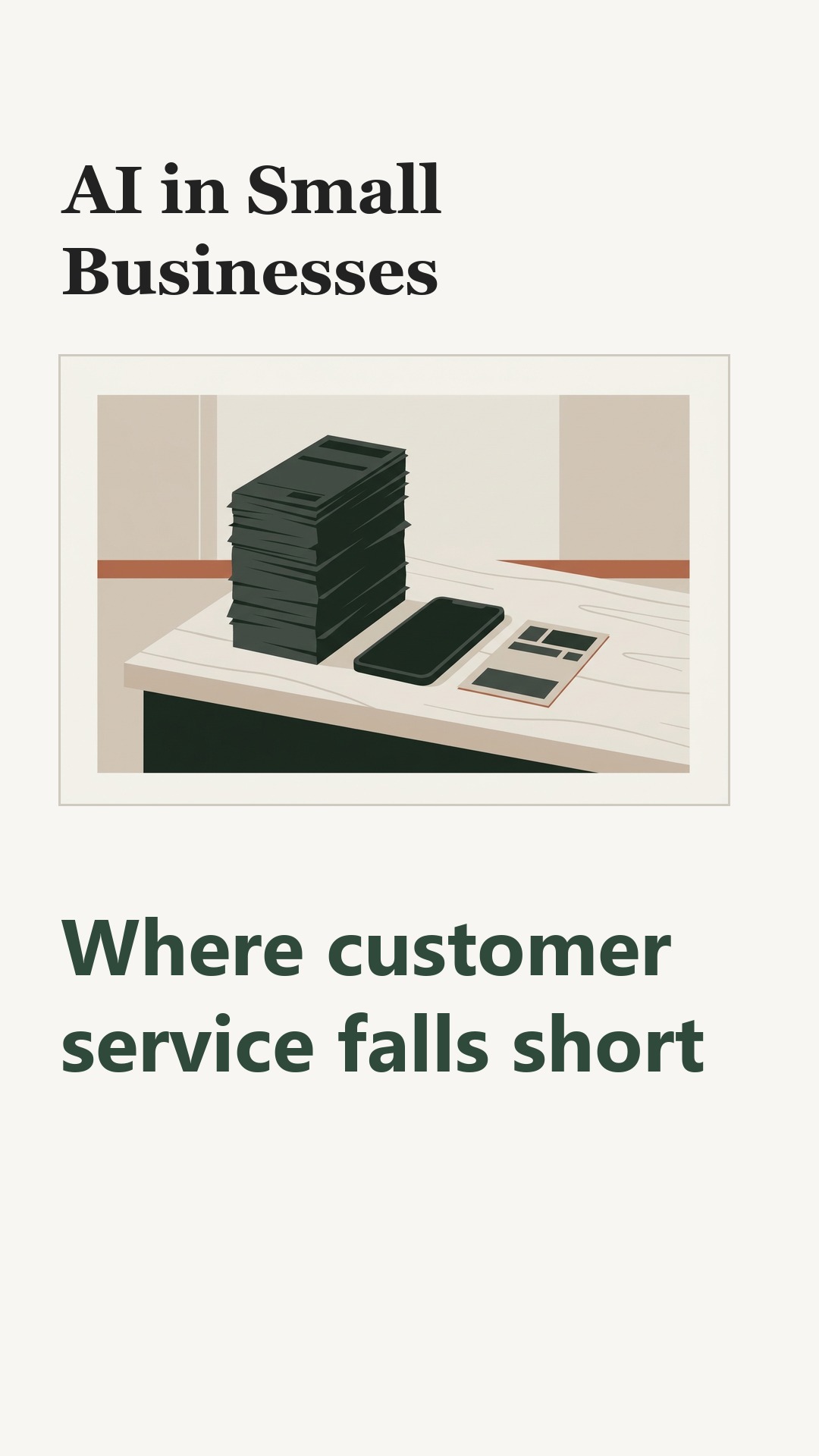
The stack of CVs, the training calendar, the waiting customer: the same three objects, and the study found the first two improving while the third got worse. Before your next tool goes live, ask the person who answers your customers what they think it will do to them.
Where each piece of context comes from, and how much of it we read
- Dragusha, B., Josimovski, S. (2026). The Impact of Artificial Intelligence on the Performance of Small and Medium Enterprises in Kosovo. Studia Universitatis „Vasile Goldis” Arad – Economics Series. https://doi.org/10.2478/sues-2026-0017 - the article this story is about — the whole article — the passage: "The target population for this study comprises small and medium-sized enterprises (SMEs) operating in the Republic of Kosovo. To ensure representativeness across different economic zones, the sampling frame was drawn from seven major administrative centers: Prishtina, Mitrovica, Gjilan, Peja, Gjakova, Prizren, and Ferizaj."
- Dragusha, B., Josimovski, S. (2026). The Impact of Artificial Intelligence on the Performance of Small and Medium Enterprises in Kosovo. Studia Universitatis „Vasile Goldis” Arad – Economics Series. https://doi.org/10.2478/sues-2026-0017 - the article this story is about — the whole article — the passage: "A total of 210 SMEs were selected through purposive sampling, which is appropriate for identifying firms with specific characteristics, in this case, the adoption of at least one AI-related system or tool (Etikan et al., 2016)."
- Dragusha, B., Josimovski, S. (2026). The Impact of Artificial Intelligence on the Performance of Small and Medium Enterprises in Kosovo. Studia Universitatis „Vasile Goldis” Arad – Economics Series. https://doi.org/10.2478/sues-2026-0017 - the article this story is about — the whole article — the passage: "The respondents included executive-level managers and business owners with direct authority over technological investment and organizational performance decisions."
- Dragusha, B., Josimovski, S. (2026). The Impact of Artificial Intelligence on the Performance of Small and Medium Enterprises in Kosovo. Studia Universitatis „Vasile Goldis” Arad – Economics Series. https://doi.org/10.2478/sues-2026-0017 - the article this story is about — the whole article — the passage: "AI training emerged as the strongest predictor (β = .398, p < .001), emphasizing the central role of human capital development in leveraging AI technologies effectively (Bianchi et al., 2020)."
- Dragusha, B., Josimovski, S. (2026). The Impact of Artificial Intelligence on the Performance of Small and Medium Enterprises in Kosovo. Studia Universitatis „Vasile Goldis” Arad – Economics Series. https://doi.org/10.2478/sues-2026-0017 - the article this story is about — the whole article — the passage: "Interestingly, AI usage demonstrates a significant negative effect on customer experience (β = –.184, p = .047), suggesting that current implementations may be reducing the perceived quality of customer interactions."
- Dragusha, B., Josimovski, S. (2026). The Impact of Artificial Intelligence on the Performance of Small and Medium Enterprises in Kosovo. Studia Universitatis „Vasile Goldis” Arad – Economics Series. https://doi.org/10.2478/sues-2026-0017 - the article this story is about — the whole article — the passage: "This supports earlier findings that poorly integrated or overly automated AI systems can undermine personalization, which is critical for customer satisfaction (Marr & Ward, 2019; Shrestha et al., 2019)."
- Dragusha, B., Josimovski, S. (2026). The Impact of Artificial Intelligence on the Performance of Small and Medium Enterprises in Kosovo. Studia Universitatis „Vasile Goldis” Arad – Economics Series. https://doi.org/10.2478/sues-2026-0017 - the article this story is about — the whole article — the passage: "As shown in Table 2, AI usage demonstrates significant positive relationships with AI training (r = .58), digital readiness (r = .55), and HRM performance (r = .61), confirming that firms investing in AI are more likely to also prioritize employee training and possess greater digital maturity."
- Dragusha, B., Josimovski, S. (2026). The Impact of Artificial Intelligence on the Performance of Small and Medium Enterprises in Kosovo. Studia Universitatis „Vasile Goldis” Arad – Economics Series. https://doi.org/10.2478/sues-2026-0017 - the article this story is about — the whole article — the passage: "However, AI usage shows a negative correlation with customer experience (r = – .12), indicating that higher levels of AI adoption may not currently translate into improved customer-facing outcomes."
- Dragusha, B., Josimovski, S. (2026). The Impact of Artificial Intelligence on the Performance of Small and Medium Enterprises in Kosovo. Studia Universitatis „Vasile Goldis” Arad – Economics Series. https://doi.org/10.2478/sues-2026-0017 - the article this story is about — the whole article — the passage: "This result could suggest a potential trade-off, where AI tools are being deployed primarily for internal process optimization rather than enhancing external value delivery (Marr, 2018)."
- Dragusha, B., Josimovski, S. (2026). The Impact of Artificial Intelligence on the Performance of Small and Medium Enterprises in Kosovo. Studia Universitatis „Vasile Goldis” Arad – Economics Series. https://doi.org/10.2478/sues-2026-0017 - the article this story is about — the whole article — the passage: "In the specific context of Kosovo, SMEs play a particularly vital role. According to the Kosovo Agency of Statistics (KAS, 2021), SMEs account for over 99% of all registered enterprises, contributing significantly to employment, innovation, and gross domestic product (GDP)."
- Dragusha, B., Josimovski, S. (2026). The Impact of Artificial Intelligence on the Performance of Small and Medium Enterprises in Kosovo. Studia Universitatis „Vasile Goldis” Arad – Economics Series. https://doi.org/10.2478/sues-2026-0017 - the article this story is about — the whole article — the passage: "Kosovar SMEs often contend with resource constraints, limited access to skilled personnel, and insufficient digital infrastructure, factors that collectively hinder their ability to fully capitalize on the advantages of intelligent technologies (KCC, 2019)."
- Dragusha, B., Josimovski, S. (2026). The Impact of Artificial Intelligence on the Performance of Small and Medium Enterprises in Kosovo. Studia Universitatis „Vasile Goldis” Arad – Economics Series. https://doi.org/10.2478/sues-2026-0017 - the article this story is about — the whole article — the passage: "García-Murillo and Annabi (2023) highlight that enterprises integrating AI into their operations witness substantial improvements in productivity, decision-making speed, and customer service, often resulting in enhanced competitiveness on the global stage."
- Dragusha, B., Josimovski, S. (2026). The Impact of Artificial Intelligence on the Performance of Small and Medium Enterprises in Kosovo. Studia Universitatis „Vasile Goldis” Arad – Economics Series. https://doi.org/10.2478/sues-2026-0017 - the article this story is about — the whole article — the passage: "As shown in Table 1, while numerous studies confirm the positive effects of AI on efficiency, decision making, and innovation, most focus on large firms or SMEs in advanced economies."
- Cao X, Hu C, Sun J, Zhang DJ. (2026). How Forced Intervention Facilitates AI Adoption. Manufacturing & Service Operations Management. 10.1287/msom.2024.1137 — only the abstract - the full text could not be fetched — the passage: "Data from a leading online education company reveal that sales workers underutilize a new matching algorithm and often selectively use it on low-quality leads."
- Cao X, Hu C, Sun J, Zhang DJ. (2026). How Forced Intervention Facilitates AI Adoption. Manufacturing & Service Operations Management. 10.1287/msom.2024.1137 — only the abstract - the full text could not be fetched — the passage: "Experimental results show that forcing workers to use the algorithm during the experiment causally increases their algorithm usage over the month after the experiment by 15.8 percentage points."
- Cao X, Hu C, Sun J, Zhang DJ. (2026). How Forced Intervention Facilitates AI Adoption. Manufacturing & Service Operations Management. 10.1287/msom.2024.1137 — only the abstract - the full text could not be fetched — the passage: "Consequently, after the experiment, workers use the algorithm not only more frequently but also more on high-quality leads."
- Cao X, Hu C, Sun J, Zhang DJ. (2026). How Forced Intervention Facilitates AI Adoption. Manufacturing & Service Operations Management. 10.1287/msom.2024.1137 — only the abstract - the full text could not be fetched — the passage: "Contrary to the traditional literature focusing on habit formation, our findings suggest learning is a key driver for algorithm adoption among workers over the month after the experiment."
- Cao X, Hu C, Sun J, Zhang DJ. (2026). How Forced Intervention Facilitates AI Adoption. Manufacturing & Service Operations Management. 10.1287/msom.2024.1137 — only the abstract - the full text could not be fetched — the passage: "Whereas artificial intelligence (AI) technologies are increasingly becoming powerful and useful in operations, human workers often resist adopting algorithms, known as algorithm aversion."
- Cao X, Hu C, Sun J, Zhang DJ. (2026). How Forced Intervention Facilitates AI Adoption. Manufacturing & Service Operations Management. 10.1287/msom.2024.1137 — only the abstract - the full text could not be fetched — the passage: "This aversion can undermine the algorithm performance in practice."
- Cao X, Hu C, Sun J, Zhang DJ. (2026). How Forced Intervention Facilitates AI Adoption. Manufacturing & Service Operations Management. 10.1287/msom.2024.1137 — only the abstract - the full text could not be fetched — the passage: "Specifically, forced algorithm use allows workers to experience the unbiased algorithm performance and positively adjust their beliefs about it."
- Sheik I, van der Nest D. (2026). Scaling small- and medium-sized enterprise artificial intelligence through governance: A Technology–Organisation–Environment readiness synthesis for information management. South African Journal of Information Management. https://doi.org/10.4102/sajim.v28i1.2225 — only the abstract - the full text could not be fetched — the passage: "Small- and medium-sized enterprises (SMEs) are increasingly experimenting with artificial intelligence (AI), yet many struggle to translate early use into scalable and trusted organisational value."
- Sheik I, van der Nest D. (2026). Scaling small- and medium-sized enterprise artificial intelligence through governance: A Technology–Organisation–Environment readiness synthesis for information management. South African Journal of Information Management. https://doi.org/10.4102/sajim.v28i1.2225 — only the abstract - the full text could not be fetched — the passage: "Database searching and citation chaining identified 486 records, of which 72 met the inclusion criteria."
- Sheik I, van der Nest D. (2026). Scaling small- and medium-sized enterprise artificial intelligence through governance: A Technology–Organisation–Environment readiness synthesis for information management. South African Journal of Information Management. https://doi.org/10.4102/sajim.v28i1.2225 — only the abstract - the full text could not be fetched — the passage: "Small- and medium-sized enterprise AI adoption and assimilation were shaped by technological readiness, organisational capability, environmental support and governance quality."
- Sheik I, van der Nest D. (2026). Scaling small- and medium-sized enterprise artificial intelligence through governance: A Technology–Organisation–Environment readiness synthesis for information management. South African Journal of Information Management. https://doi.org/10.4102/sajim.v28i1.2225 — only the abstract - the full text could not be fetched — the passage: "Fragmented data, skills scarcity, vendor dependence, low trust and regulatory uncertainty constrained scaling."
- Sheik I, van der Nest D. (2026). Scaling small- and medium-sized enterprise artificial intelligence through governance: A Technology–Organisation–Environment readiness synthesis for information management. South African Journal of Information Management. https://doi.org/10.4102/sajim.v28i1.2225 — only the abstract - the full text could not be fetched — the passage: "Responsible AI governance functions not as a downstream compliance add-on but as a practical scaling mechanism through which SMEs reduce uncertainty, preserve trust and convert pilots into repeatable value."
- Sheik I, van der Nest D. (2026). Scaling small- and medium-sized enterprise artificial intelligence through governance: A Technology–Organisation–Environment readiness synthesis for information management. South African Journal of Information Management. https://doi.org/10.4102/sajim.v28i1.2225 — only the abstract - the full text could not be fetched — the passage: "Trusted data, interoperable systems, leadership commitment, hybrid skills and process discipline supported routinised use."
- Sheik I, van der Nest D. (2026). Scaling small- and medium-sized enterprise artificial intelligence through governance: A Technology–Organisation–Environment readiness synthesis for information management. South African Journal of Information Management. https://doi.org/10.4102/sajim.v28i1.2225 — only the abstract - the full text could not be fetched — the passage: "These capabilities enabled service responsiveness, forecasting and customer engagement that may strengthen market access and cash-flow visibility."
- Dragusha, B., Josimovski, S. (2026). The Impact of Artificial Intelligence on the Performance of Small and Medium Enterprises in Kosovo. Studia Universitatis „Vasile Goldis” Arad – Economics Series. https://doi.org/10.2478/sues-2026-0017 - the article this story is about — the whole article — the passage: "To balance the internal gains of AI with customer value creation, SMEs should invest in AI applications that directly enhance customer service, such as AI-powered chatbots, recommendation systems, and sentiment analysis tools (Grewal et al., 2020)."
- Dragusha, B., Josimovski, S. (2026). The Impact of Artificial Intelligence on the Performance of Small and Medium Enterprises in Kosovo. Studia Universitatis „Vasile Goldis” Arad – Economics Series. https://doi.org/10.2478/sues-2026-0017 - the article this story is about — the whole article — the passage: "While existing training efforts focus heavily on technical or backend employees, there is a critical need to include sales, customer service, and marketing personnel in AI upskilling programs."
Dragusha, B., Josimovski, S. (2026). The Impact of Artificial Intelligence on the Performance of Small and Medium Enterprises in Kosovo. Studia Universitatis „Vasile Goldis” Arad – Economics Series. https://doi.org/10.2478/sues-2026-0017
Who paid: The article states the research received no specific grant from any funding agency in the public, commercial or not-for-profit sectors, and names no equipment or software lenders.
The findings of other studies mentioned here are known to us through this document, which is the one we read; we did not open each of those studies.