experiment · Frontiers in psychology · la publicación, 1 sep 2026 · gratis
Dos avisos breves cambian cómo los estudiantes juzgan un chatbot de salud mental
Un experimento con 768 universitarios en China usó escenarios escritos, no conversaciones reales, y midió lo que la gente dice que haría, no lo que hizo.
Versión breve · la versión detallada sigue, unos 7 min
Pregunte al chat de weeklyAI
Pregúnteme por este estudio: a quiénes se estudió, qué encontró y qué no dice.
Las conversaciones se guardan mientras exista weeklyAI, para mejorar la publicación. Se responde en el idioma en que usted escribe.
- El estudio, de un vistazo
- Quiénes
- estudiantes universitarios
- Cuántos
- 768
- Dónde
- China
- Cuándo
- entre marzo y abril de 2026
- Tipo de estudio
- experimento
- Quién lo hizo
- investigadores chinos
- El límite que importa
- Leyeron una situación imaginaria, no conversaron con un chatbot real; se midieron intenciones, no lo que la gente hace.
Puntajes promedio de confianza equilibrada (ver el chatbot como útil pero acotado) en cada uno de los cuatro grupos del experimento; son respuestas a una situación imaginaria, no el resultado de conversar con un chatbot real.
Lo que cambió con cada aviso, según el estudio
Mayor sensación de que la información estaría protegida
Mayor comprensión de que el chatbot tiene un alcance limitado
La confianza equilibrada llegó a su punto más alto
Antes de contarle algo íntimo a una máquina, busque dos cosas: que diga en palabras claras qué guarda de su conversación y quién puede verla, y que diga en qué momento su ayuda termina y hay que llamar a una persona.
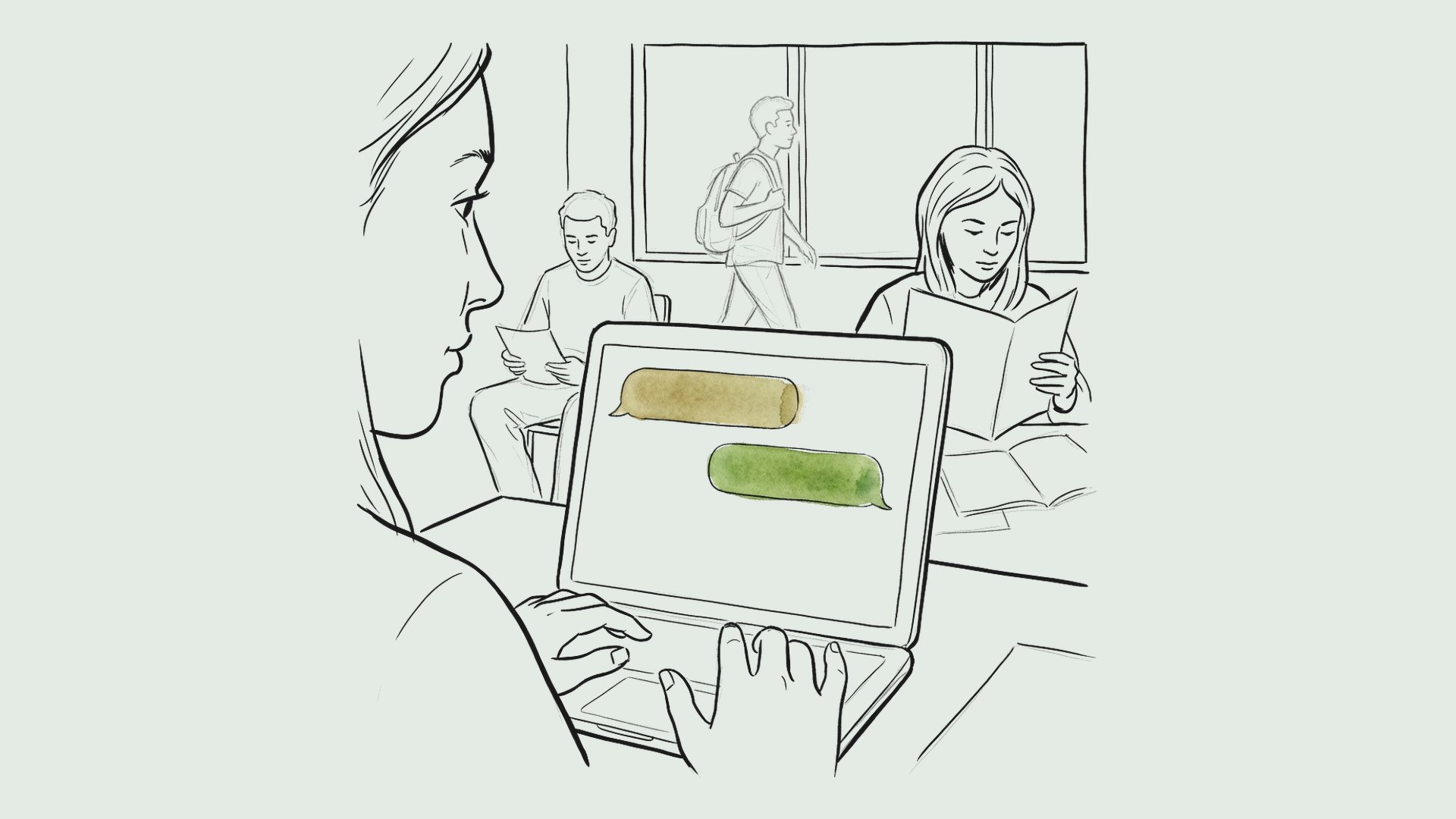
Imagine que su universidad pone un chatbot. Usted le cuenta que no duerme, que está agotado. Antes de escribir, aparecen dos mensajes cortos: uno dice qué hará el sistema con sus datos; el otro aclara que no diagnostica, no da terapia y no atiende urgencias.
Unos 768 estudiantes de pregrado en China fueron repartidos al azar en cuatro grupos por la plataforma que hizo la encuesta. Cada grupo leyó un escenario distinto: sin ningún aviso, sólo con el aviso de privacidad, sólo con el aviso de límites profesionales, o con los dos. Nadie conversó con un chatbot: leyeron una situación imaginaria y respondieron preguntas.
Quienes vieron el aviso de privacidad dijeron sentirse más protegidos con su información. Quienes vieron el aviso de límites entendieron mejor que el chatbot no reemplaza a un profesional. Y la confianza más equilibrada, ver la herramienta como útil pero acotada, apareció cuando estaban los dos mensajes juntos.
El aviso de límites se relacionó además con menos riesgo de depender del chatbot y con más intención de buscar ayuda profesional si el malestar se agravaba.
Aquí conviene frenar. El estudio no observó a nadie usando un chatbot de verdad. Preguntó qué harían. Decir que uno pedirá ayuda no es pedirlo. Tampoco midió si alguien acudió a un servicio, ni si los avisos cambian el uso real.
Y los 768 estudiantes eran de un solo país, con sus propias reglas de datos y sus propios servicios de salud mental. Lo que aquí funcionó puede no funcionar donde usted vive.
Aun así, la idea es concreta. Antes de contarle algo íntimo a una máquina, busque dos cosas: que diga en palabras claras qué guarda de su conversación y quién puede verla, y que diga en qué momento su ayuda termina y hay que llamar a una persona. Si esos dos mensajes no están, pídalos.
Qué significa para usted
Estos dos avisos son un requisito que usted puede pedir, no una promesa de que la máquina cuide mejor su salud. Si su universidad o su clínica ofrece un chatbot así, pida que le digan con claridad qué guarda de la conversación y en qué momento hay que llamar a una persona. Nadie ha medido todavía si esos avisos cambian lo que la gente hace de verdad.
Zhang, Z., Lu, X., Zhang, Y. et al. (2026). Privacy assurances and professional-boundary warnings in generative AI mental health chatbots: a randomized vignette experiment on calibrated trust, overreliance risk, and professional help-seeking intentions. Frontiers in Psychology. https://doi.org/10.3389/fpsyg.2026.1934264
Quién pagó: Los autores declararon que no recibieron apoyo financiero para este trabajo ni para su publicación.
No tome esto como consejo médico profesional.
Versión detalladaLos pasajes copiados del artículo, las ilustraciones y cada fuente con cuánto leímos de ella · 1332 palabras · unos 7 minLeerla →Cerrar
Dos mensajes breves cambian cómo los estudiantes juzgan un chatbot de salud mental
Un experimento con 768 universitarios en China probó avisos de privacidad y de límites profesionales. Lo que midió fueron intenciones, no lo que la gente hace después.
Imagine que su universidad pone a disposición de los estudiantes un chatbot que responde preguntas sobre estrés, sueño, presión de estudios y recursos de ayuda. Usted lo prueba. Antes de escribir lo que le pasa, la pantalla le dice dos cosas: qué se hace con sus datos y que ese programa no reemplaza a un profesional. Eso es exactamente lo que un equipo de investigadores chinos quiso medir: si esos dos mensajes cambian la forma en que un estudiante evalúa la herramienta. Reclutaron a 768 universitarios, todos mayores de 18 años y matriculados, entre marzo y abril de 2026. A cada uno le tocó al azar una de cuatro versiones de la misma situación: sin ningún aviso, solo con el aviso de privacidad, solo con el aviso de límites, o con los dos. Cada versión tenía 192 participantes1.
Los resultados fueron claros en dos puntos. El aviso de privacidad subió la sensación de que la información estaría protegida. El aviso de límites subió la comprensión de que el chatbot tiene un alcance limitado. Y cuando aparecían los dos juntos, la confianza "calibrada" —esa mezcla de verlo útil sin creerle más de la cuenta— llegó a su punto más alto: 3.98 en una escala de 5, frente a 3.34 cuando no había ningún aviso234. Los autores lo dicen sin rodeos: la meta no es que los estudiantes confíen más en un chatbot, sino que esa confianza vaya acompañada de información clara sobre lo que el sistema puede y no puede hacer5.
Ahora, lo que este estudio no es. No probó un chatbot real: describió una situación imaginaria y preguntó después. Los propios autores advierten que lo que alguien dice que haría puede no coincidir con lo que hace mientras conversa con una máquina6. Lo que se midió fueron intenciones y percepciones, no si alguien buscó ayuda de verdad, ni si llegó a una consulta, ni si dejó de ir. Y fueron 768 estudiantes universitarios de un solo país, así que no puede darse por sentado que el mismo efecto aparezca en otros países, donde el estigma, los servicios disponibles y las reglas sobre datos son distintos.
Para entender de qué hablamos, conviene saber qué son estas herramientas hoy. Los chatbots de inteligencia artificial generativa se usan cada vez más entre estudiantes para buscar información de salud mental, pedir tranquilidad, explorar formas de sobrellevar un mal momento o identificar dónde pedir apoyo7. También es cierto por qué resultan atractivos: muchas personas dudan en contarle a un compañero, a un docente o a un profesional que están mal, por vergüenza, por falta de tiempo o porque no hay servicios cerca; un chatbot, en cambio, parece siempre disponible y no juzga8. El problema es que esa fluidez para responder puede hacer que se le atribuya una autoridad que no tiene, y dejar en sombras sus errores o la ausencia de responsabilidad profesional detrás de sus respuestas9. Los propios autores lo enmarcan así: puede servir como fuente de información general y para orientarse hacia dónde pedir ayuda, pero no debe tratarse como herramienta de diagnóstico, de psicoterapia, de intervención en crisis ni de decisión médica10.
En términos simples, los dos mensajes que se probaron atacan dos miedos distintos. El aviso de privacidad es una frase que explica cómo se maneja, se protege y se limita el uso de la información relacionada con la salud mental11. El aviso de límites profesionales es una frase que aclara que el chatbot no sustituye la atención calificada, el diagnóstico clínico, la psicoterapia, la intervención en crisis ni los servicios de emergencia12. Uno responde a la pregunta "¿es seguro contar esto?". El otro responde a "¿hasta dónde me sirve esto?". El estudio sugiere que juntos funcionan mejor que por separado3.
No es un hallazgo aislado. Otros trabajos que solo pudimos leer en su resumen —el texto completo está detrás de una suscripción— han intentado medir si estos programas ayudan de verdad. Una revisión de chatbots psicológicos orientados a terapia cognitivo-conductual encontró una reducción moderada de síntomas depresivos al terminar la intervención y una reducción pequeña de ansiedad, aunque en el seguimiento posterior esos efectos se volvieron pequeños para la depresión y no significativos para la ansiedad131415. Otra revisión, esta vez sobre adultos mayores, reunió ocho ensayos con 611 participantes y halló una reducción estadísticamente significativa de síntomas depresivos, pero ningún efecto significativo sobre la soledad161718. Y un tercer estudio sobre compañeros conversacionales observó que ambos estilos de respuesta reducían el malestar inmediato, sin diferencias claras entre ellos, y que las respuestas orientadas a regular las emociones se asociaban con mayor confianza de la persona en su propia capacidad de regularlas1920. Al menos uno de esos resúmenes, el de la revisión sobre adultos mayores, insiste en que hace falta más investigación y que nada de esto reemplaza la atención convencional21.
Así lo leemos nosotros. Cuando una herramienta responde con fluidez, sin pausas y sin contradecirnos, tendemos a tratarla como si supiera de lo que habla. Ese hábito se instala rápido y cuesta desarmarlo. Por eso nos parece probable que los avisos de privacidad y de límites solo sirvan si aparecen desde el primer contacto, antes de que la costumbre se forme, y que su efecto sea más débil en alguien que ya lleva meses consultando el chatbot a diario. Podríamos estar equivocados: si estudiantes con ese uso prolongado cambiaran su manera de confiar en la herramienta después de ver los mensajes una sola vez, nuestra expectativa quedaría en duda. Lo que usted puede hacer con esto es concreto. Si usted o alguien en su casa usa un chatbot para temas de ánimo o de sueño, fíjese en si lo consulta por costumbre y sin revisar lo que le dice. Pregúntese si esa costumbre le está quitando tiempo para hablar con una persona de confianza o con un profesional.
Hay una segunda manera de mirarlo. La información que circula sin un responsable claro se mezcla con rumores, y la gente suele creer lo que le llega por grupos informales o por voces que no puede verificar. Es probable, entonces, que las respuestas de un chatbot sobre salud mental se compartan o se crean sin comprobar de dónde vienen, y que los avisos ayuden sobre todo a quien ya desconfiaba de antemano. Sabríamos que nos equivocamos si quienes vieron la advertencia de límites igual trataran esas respuestas como consejo médico o las reenviaran sin dudar. Antes de creer o reenviar lo que un chatbot dice sobre salud, pregunte de dónde sale esa información y si una persona capacitada la respaldaría. Y en su comunidad, apoye que existan canales claros hacia servicios de salud verificados.
Los autores van más allá del experimento y proponen qué debería decir un chatbot responsable. En lugar de promesas vagas, la pantalla debería explicar qué información se recoge, qué no se recoge, si la conversación se guarda, quién puede verla, cuánto tiempo se conserva y cómo se puede cerrar o borrar una sesión22. Y desde el primer momento debería quedar dicho que no puede diagnosticar trastornos mentales, dar psicoterapia, reemplazar a un consejero o a un médico, ni atender una emergencia23. Es, por ahora, una recomendación de investigación, no una garantía que pueda exigir en el mostrador.
Cuando un chatbot le hable de salud mental, pregúntese si está actuando como un buen maestro: claro sobre lo que sabe y honesto sobre lo que no. Exija que los servicios que lo usan digan por escrito quién responde y hasta dónde llega. Y si los mensajes funcionan como este estudio sugiere, lo que usted debería notar no es que el chatbot le inspire más confianza, sino que usted confíe en él con más cuidado —y que sepa, sin dudar, en qué momento levantar la vista de la pantalla y buscar a una persona.
De dónde sale cada dato de contexto, y cuánto leímos de cada documento
- Zhang, Z., Lu, X., Zhang, Y. et al. (2026). Privacy assurances and professional-boundary warnings in generative AI mental health chatbots: a randomized vignette experiment on calibrated trust, overreliance risk, and professional help-seeking intentions. Frontiers in Psychology. https://doi.org/10.3389/fpsyg.2026.1934264 - el artículo del que trata esta nota — el artículo completo — el pasaje: "We conducted a 2 × 2 randomized vignette experiment with 768 college students. Participants were assigned to one of four chatbot scenarios that either included or omitted privacy assurance and professional-boundary warning."
- Zhang, Z., Lu, X., Zhang, Y. et al. (2026). Privacy assurances and professional-boundary warnings in generative AI mental health chatbots: a randomized vignette experiment on calibrated trust, overreliance risk, and professional help-seeking intentions. Frontiers in Psychology. https://doi.org/10.3389/fpsyg.2026.1934264 - el artículo del que trata esta nota — el artículo completo — el pasaje: "Privacy assurance increased perceived privacy protection, F (1, 764) = 159.30, p < 0.001, ηp 2 = 0.172, d = 0.91. Professional-boundary warning increased boundary awareness, F (1, 764) = 176.40, p < 0.001, ηp 2 = 0.188, d = 0.96."
- Zhang, Z., Lu, X., Zhang, Y. et al. (2026). Privacy assurances and professional-boundary warnings in generative AI mental health chatbots: a randomized vignette experiment on calibrated trust, overreliance risk, and professional help-seeking intentions. Frontiers in Psychology. https://doi.org/10.3389/fpsyg.2026.1934264 - el artículo del que trata esta nota — el artículo completo — el pasaje: "Calibrated trust was highest when both messages were present."
- Zhang, Z., Lu, X., Zhang, Y. et al. (2026). Privacy assurances and professional-boundary warnings in generative AI mental health chatbots: a randomized vignette experiment on calibrated trust, overreliance risk, and professional help-seeking intentions. Frontiers in Psychology. https://doi.org/10.3389/fpsyg.2026.1934264 - el artículo del que trata esta nota — el artículo completo — el pasaje: "Calibrated trust was highest in the both-cues condition (M = 3.98, 95% CI [3.89, 4.07]) compared with privacy assurance only (M = 3.55, 95% CI [3.46, 3.64]), boundary warning only (M = 3.49, 95% CI [3.40, 3.58]), and no cues (M = 3.34, 95% CI [3.24, 3.44])."
- Zhang, Z., Lu, X., Zhang, Y. et al. (2026). Privacy assurances and professional-boundary warnings in generative AI mental health chatbots: a randomized vignette experiment on calibrated trust, overreliance risk, and professional help-seeking intentions. Frontiers in Psychology. https://doi.org/10.3389/fpsyg.2026.1934264 - el artículo del que trata esta nota — el artículo completo — el pasaje: "The point is not to make students trust AI chatbots more in general; rather, the results suggest that trust is more useful when it is accompanied by clear information about what the system can and cannot do."
- Zhang, Z., Lu, X., Zhang, Y. et al. (2026). Privacy assurances and professional-boundary warnings in generative AI mental health chatbots: a randomized vignette experiment on calibrated trust, overreliance risk, and professional help-seeking intentions. Frontiers in Psychology. https://doi.org/10.3389/fpsyg.2026.1934264 - el artículo del que trata esta nota — el artículo completo — el pasaje: "The study used a vignette experiment rather than observation of actual chatbot interactions. Vignettes allow strong control over design cues, but participants' responses may differ from behavior during real-time conversation with an AI system."
- Zhang, Z., Lu, X., Zhang, Y. et al. (2026). Privacy assurances and professional-boundary warnings in generative AI mental health chatbots: a randomized vignette experiment on calibrated trust, overreliance risk, and professional help-seeking intentions. Frontiers in Psychology. https://doi.org/10.3389/fpsyg.2026.1934264 - el artículo del que trata esta nota — el artículo completo — el pasaje: "Generative artificial intelligence (AI) chatbots are increasingly used by students to look up mental health information, seek reassurance, explore coping strategies, and identify possible sources of support."
- Zhang, Z., Lu, X., Zhang, Y. et al. (2026). Privacy assurances and professional-boundary warnings in generative AI mental health chatbots: a randomized vignette experiment on calibrated trust, overreliance risk, and professional help-seeking intentions. Frontiers in Psychology. https://doi.org/10.3389/fpsyg.2026.1934264 - el artículo del que trata esta nota — el artículo completo — el pasaje: "Students may hesitate to disclose distress to peers, teachers, or professionals because of stigma, uncertainty, time constraints, or lack of access to services. A chatbot can appear available, non-judgmental, and easy to approach."
- Zhang, Z., Lu, X., Zhang, Y. et al. (2026). Privacy assurances and professional-boundary warnings in generative AI mental health chatbots: a randomized vignette experiment on calibrated trust, overreliance risk, and professional help-seeking intentions. Frontiers in Psychology. https://doi.org/10.3389/fpsyg.2026.1934264 - el artículo del que trata esta nota — el artículo completo — el pasaje: "Fluency may increase perceived competence, but it may also obscure uncertainty, hallucinated information, or the lack of professional accountability."
- Zhang, Z., Lu, X., Zhang, Y. et al. (2026). Privacy assurances and professional-boundary warnings in generative AI mental health chatbots: a randomized vignette experiment on calibrated trust, overreliance risk, and professional help-seeking intentions. Frontiers in Psychology. https://doi.org/10.3389/fpsyg.2026.1934264 - el artículo del que trata esta nota — el artículo completo — el pasaje: "AI chatbots may serve as sources of general information and support navigation, but they should not be treated as diagnostic, psychotherapeutic, crisis-intervention, or medical decision-making tools"
- Zhang, Z., Lu, X., Zhang, Y. et al. (2026). Privacy assurances and professional-boundary warnings in generative AI mental health chatbots: a randomized vignette experiment on calibrated trust, overreliance risk, and professional help-seeking intentions. Frontiers in Psychology. https://doi.org/10.3389/fpsyg.2026.1934264 - el artículo del que trata esta nota — el artículo completo — el pasaje: "Privacy assurance refers to a clear statement that informs users how mental health-related information is handled, protected, and limited in use."
- Zhang, Z., Lu, X., Zhang, Y. et al. (2026). Privacy assurances and professional-boundary warnings in generative AI mental health chatbots: a randomized vignette experiment on calibrated trust, overreliance risk, and professional help-seeking intentions. Frontiers in Psychology. https://doi.org/10.3389/fpsyg.2026.1934264 - el artículo del que trata esta nota — el artículo completo — el pasaje: "Professional-boundary warning refers to a clear statement that the chatbot is not a substitute for qualified mental health care, clinical diagnosis, psychotherapy, crisis intervention, or emergency services."
- Gong B, Yao N, Xie H, Huang C, Kishimoto T, Berenbaum H, et al. (2026). Efficacy, User Engagement, and Acceptability of Cognitive Behavioral Therapy–Oriented Psychological Chatbots for Adults With Depressive and/or Anxiety Symptoms: Systematic Review and Meta-Analysis of Randomized Controlled Trials. Journal of Medical Internet Research. 10.2196/82677 — solo el resumen - no se pudo obtener el texto completo — el pasaje: "CBT-oriented psychological chatbots produced a moderate reduction in depressive symptoms at postintervention (g=-0.55, 95% CI -0.70 to -0.40, 95% PI -1.23 to 0.13)"
- Gong B, Yao N, Xie H, Huang C, Kishimoto T, Berenbaum H, et al. (2026). Efficacy, User Engagement, and Acceptability of Cognitive Behavioral Therapy–Oriented Psychological Chatbots for Adults With Depressive and/or Anxiety Symptoms: Systematic Review and Meta-Analysis of Randomized Controlled Trials. Journal of Medical Internet Research. 10.2196/82677 — solo el resumen - no se pudo obtener el texto completo — el pasaje: "and a small reduction in anxiety symptoms (g=-0.26, 95% CI -0.37 to -0.14, 95% PI -0.67 to 0.15)"
- Gong B, Yao N, Xie H, Huang C, Kishimoto T, Berenbaum H, et al. (2026). Efficacy, User Engagement, and Acceptability of Cognitive Behavioral Therapy–Oriented Psychological Chatbots for Adults With Depressive and/or Anxiety Symptoms: Systematic Review and Meta-Analysis of Randomized Controlled Trials. Journal of Medical Internet Research. 10.2196/82677 — solo el resumen - no se pudo obtener el texto completo — el pasaje: "At follow-up, effects were small for depression (g=-0.32, 95% CI -0.55 to -0.09, 95% PI -0.93 to 0.29) and nonsignificant for anxiety (g=-0.19, 95% CI -0.43 to 0.04, 95% PI -0.84 to 0.46)."
- Gou W, Lefebvre F, Yang T, Recours R, Yang J. (2026). Effectiveness of AI-based conversational and socially assistive agents in older adults: a systematic review and meta-analysis. BMC Geriatrics. 10.1186/s12877-026-07418-6 — solo el resumen - no se pudo obtener el texto completo — el pasaje: "Eight RCTs comprising 611 participants met the inclusion criteria."
- Gou W, Lefebvre F, Yang T, Recours R, Yang J. (2026). Effectiveness of AI-based conversational and socially assistive agents in older adults: a systematic review and meta-analysis. BMC Geriatrics. 10.1186/s12877-026-07418-6 — solo el resumen - no se pudo obtener el texto completo — el pasaje: "Compared with control conditions, AI-based conversational and socially assistive agent interventions were associated with a statistically significant reduction in depressive symptoms (Hedges' g = - 0.25, 95% CI - 0.48 to - 0.02; I² = 10.7%)."
- Gou W, Lefebvre F, Yang T, Recours R, Yang J. (2026). Effectiveness of AI-based conversational and socially assistive agents in older adults: a systematic review and meta-analysis. BMC Geriatrics. 10.1186/s12877-026-07418-6 — solo el resumen - no se pudo obtener el texto completo — el pasaje: "In contrast, no significant effect was observed for loneliness, and substantial heterogeneity was detected across studies (Hedges' g = - 0.67, 95% CI - 2.57 to 1.23; I² = 89%)."
- Wang C. (2026). How emotional response styles of generative AI companions shape adaptive emotion regulation and short-term AI reliance. Frontiers in Psychology. 10.3389/fpsyg.2026.1950163 — solo el resumen - no se pudo obtener el texto completo — el pasaje: "Both response styles substantially reduced immediate negative affect, with no significant between-condition difference in relief ( b = 0.055, p = 0.323)."
- Wang C. (2026). How emotional response styles of generative AI companions shape adaptive emotion regulation and short-term AI reliance. Frontiers in Psychology. 10.3389/fpsyg.2026.1950163 — solo el resumen - no se pudo obtener el texto completo — el pasaje: "Adaptive regulation-oriented responses were associated with higher emotion-regulation self-efficacy ( b = 0.500, p"
- Gou W, Lefebvre F, Yang T, Recours R, Yang J. (2026). Effectiveness of AI-based conversational and socially assistive agents in older adults: a systematic review and meta-analysis. BMC Geriatrics. 10.1186/s12877-026-07418-6 — solo el resumen - no se pudo obtener el texto completo — el pasaje: "AI-based conversational and socially assistive agents may serve as a promising adjunct to conventional mental health care for older adults; however, further high-quality trials are needed to clarify their role in addressing lonelines"
- Zhang, Z., Lu, X., Zhang, Y. et al. (2026). Privacy assurances and professional-boundary warnings in generative AI mental health chatbots: a randomized vignette experiment on calibrated trust, overreliance risk, and professional help-seeking intentions. Frontiers in Psychology. https://doi.org/10.3389/fpsyg.2026.1934264 - el artículo del que trata esta nota — el artículo completo — el pasaje: "Rather than using broad assurances, interfaces should state what information is collected, what is not collected, whether conversation content is stored, who can access it, how long it is retained, and how users can stop or delete a session where applicable."
- Zhang, Z., Lu, X., Zhang, Y. et al. (2026). Privacy assurances and professional-boundary warnings in generative AI mental health chatbots: a randomized vignette experiment on calibrated trust, overreliance risk, and professional help-seeking intentions. Frontiers in Psychology. https://doi.org/10.3389/fpsyg.2026.1934264 - el artículo del que trata esta nota — el artículo completo — el pasaje: "A responsible chatbot should clearly state at onboarding that it cannot diagnose mental disorders, provide psychotherapy, replace counselors or physicians, or handle emergencies."
Zhang, Z., Lu, X., Zhang, Y. et al. (2026). Privacy assurances and professional-boundary warnings in generative AI mental health chatbots: a randomized vignette experiment on calibrated trust, overreliance risk, and professional help-seeking intentions. Frontiers in Psychology. https://doi.org/10.3389/fpsyg.2026.1934264
Quién pagó: Los autores declararon que no recibieron apoyo financiero para este trabajo ni para su publicación.
No tome esto como consejo médico profesional.
experiment · Frontiers in psychology · the paper, 1 Sep 2026 · free
Two Lines on a Chatbot Screen Changed How Students Trusted It
In a made-up test with 768 college students in China, privacy and limits messages raised careful trust. The students never talked to a real chatbot.
Short version · the longer version follows, about 6 min
Ask the weeklyAI chat
Ask me about this study: who was studied, what it found, and what it does not say.
Conversations are saved for as long as weeklyAI exists, to improve the publication. Answers come in the language you write in.
- The study at a glance
- Who
- college students
- How many
- 768
- Where
- China
- When
- not stated
- Kind of study
- experiment
- Who did it
- Xinjiang University of Political Science and Law and hospitals in China
- The limit that matters
- Students only imagined the chatbot; nobody watched them use one.
Average balanced-trust scores (on a 1-to-5 scale) that students reported after reading one of four made-up chatbot scenes; these are what students said they felt, not what they did with a real chatbot.
What each message changed
Felt their information was better protected
Better understood the chatbot was not a substitute for professional care
So when a chatbot offers to talk about your sleep or your mood, look for two plain statements before you type anything personal: what it does with what you tell it, and where its help stops.
The university introduces a chatbot. It answers questions about stress, sleep and study pressure. On the screen, two short sentences can appear, or they can be left out.
One sentence says what happens to your information. The other says the chatbot is not a doctor and cannot handle an emergency.
Researchers at a law university in Tumxuk, China, wrote four versions of that scene. They put them in front of 768 college students, each student seeing only one version. The groups were built to match each other: 192 students in each, similar in age, year of study and prior chatbot use.
Students who saw the privacy message felt their information was better protected. Students who saw the limits message better understood that the chatbot was not a substitute for professional care. Both changes were clear and strong, not small wobbles.
When both messages appeared together, students reported the most balanced trust: useful, but limited. They also said they would use the chatbot as a low-threshold extra source, and that they would turn to a real person if distress got severe.
The limits message was tied to lower overreliance risk and to a stronger stated intention to seek professional help. The privacy message was tied instead to feeling safer about sharing information and to a stronger stated intention to use the chatbot as an extra source of support.
Now the caution. The students only imagined the chatbot. Nobody watched them use one, and the study measured what they said they would do. A stated intention to seek help is not proof that help is sought. The results come from college students in one country, where stigma, counseling services and data rules may differ from yours.
So when a chatbot offers to talk about your sleep or your mood, look for two plain statements before you type anything personal: what it does with what you tell it, and where its help stops.
What this means for you
When a chatbot offers to talk about your sleep or your mood, look for those two plain statements before you type anything personal: what it does with what you tell it, and where its help stops. Students in this study only imagined the chatbot, so nobody knows yet whether such messages change what people actually do. The honest answer is that there is nothing to do yet but watch for the words on the screen.
Zhang, Z., Lu, X., Zhang, Y. et al. (2026). Privacy assurances and professional-boundary warnings in generative AI mental health chatbots: a randomized vignette experiment on calibrated trust, overreliance risk, and professional help-seeking intentions. Frontiers in Psychology. https://doi.org/10.3389/fpsyg.2026.1934264
Who paid: The authors declared that no financial support was received for this work and/or its publication.
Do not take this as professional medical advice.
The longer versionThe passages copied from the paper, the pictures, and every source with how much of it we read · 1196 words · about 6 minRead it →Close
Two Short Messages Changed How Students Judged a Mental-Health Chatbot
A randomized experiment in China found that a privacy notice and a limits warning raised what students felt they knew — about their data and about the tool's reach. It did not test whether anyone actually got help.
The study is a randomized trial, but not of a chatbot. Eight hundred thirty-two responses were collected from college students, all at least eighteen and currently enrolled, and after exclusions the final sample was seven hundred sixty-eight valid responses. Each student was shown one of four written scenarios describing a university generative AI chatbot that could answer general questions about stress, sleep, study pressure and where to find help. It was never described as a clinical service. The four scenarios either included or omitted two short messages: a privacy assurance, explaining that the chatbot would collect as little personal information as possible and protect mental-health-related data, and a professional-boundary warning, explaining that it was not a substitute for diagnosis, psychotherapy, crisis intervention or medical treatment. Each student read one scenario, then answered questions about what they thought1.
Students noticed the difference. Those who read the privacy message reported significantly higher perceived privacy protection; those who read the boundary warning reported significantly higher boundary awareness. The boundary message was also tied to lower overreliance risk and stronger intention to seek professional help23.
The two messages worked best together. Calibrated trust — a balanced view of the chatbot as useful but limited — was highest when both were present, and lower with one alone or neither45.
The authors are explicit about what this does not mean. The point, they write, is not to make students trust chatbots more in general; trust is more useful when it comes with clear information about what the system can and cannot do6. A clearly framed limits message may help users see a chatbot as a possible first step, not a replacement for qualified care7.
Three limits matter before anyone draws a lesson. The study used written vignettes, not real conversations with a chatbot, and what people say they would feel may differ from what they do while typing to a system8. The outcomes were self-reported intentions and risk perceptions, not actual help-seeking. And the sample was college students in one national context. The study did not test clinical effectiveness, diagnosis, psychotherapy or crisis support.
The technology is the one already in many pockets. Generative AI chatbots are increasingly used by students to look up mental health information, seek reassurance, explore coping strategies and find possible sources of support9. Their appeal is easy to understand: students may hesitate to disclose distress to peers, teachers or professionals because of stigma, uncertainty, time constraints or lack of access to services, while a chatbot can appear available, non-judgmental and easy to approach10.
The catch is fluency. A system that writes smoothly may increase perceived competence, but it may also obscure uncertainty, invented information, or the absence of professional accountability11. Chatbots may serve as sources of general information and support navigation, but they should not be treated as diagnostic, psychotherapeutic, crisis-intervention or medical decision-making tools12.
So what are the two messages? A privacy assurance is a clear statement about how mental-health-related information is handled, protected and limited in use13. A professional-boundary warning is a clear statement that the chatbot is not a substitute for qualified mental health care, clinical diagnosis, psychotherapy, crisis intervention or emergency services14. One addresses whether it is reasonable to type something personal; the other addresses how far the tool's answers should be trusted.
Similar tools have been tested for symptoms, with modest results. According to the summary of a review of chatbot therapies for depression and anxiety — we could read only the summary, the full paper sits behind a subscription — CBT-oriented psychological chatbots produced a moderate reduction in depressive symptoms right after treatment and a small reduction in anxiety symptoms1516. At follow-up, the depression effect was small and the anxiety effect was not significant17. User engagement met digital intervention standards and satisfaction ratings were generally favorable18.
Another summary we could read only in abstract form, of eight randomized trials with 611 older adults, found that AI-based conversational and socially assistive agents were associated with a statistically significant reduction in depressive symptoms compared with control conditions, but no significant effect on loneliness, with substantial variation between studies192021. That review concluded such agents may serve as a promising adjunct to conventional mental health care, and that further high-quality trials are needed22.
A third abstract-only study, of how generative AI companions respond to negative emotions, found that both response styles substantially reduced immediate negative affect in the short term. Adaptive, regulation-oriented responses were associated with higher confidence in one's own ability to manage emotions2324. Its author cautions that the reliance outcomes were short-term beliefs and intentions, not emotional dependence, and that immediate relief does not establish improved independent emotion regulation2526.
Here is how we read it. The finding is small and clean, and it is about the wrapper, not the medicine. Nobody in this study talked to a chatbot. They read a page and answered questions. What the page changed was not the tool but the frame around it — and the frame is the part a university, a hospital or a developer actually controls.
So expect this, and watch for it. If you or your child opens a mental-health chatbot and the first screen says plainly what happens to what you type and what the tool cannot do, that screen is doing work. If the first screen says nothing, the silence is also doing work, just in the other direction. You will know we are wrong if the messages turn out to be decoration — if real users scroll past them, or if the students who most need the limits warning are the ones it fails to reach. We also read other work on this family of tools, and we would tell you plainly: what a student says on a survey about seeking help is not the same as walking into a counselling office, and a result from one country's students is not a result about your town.
What you can do with it is small and immediate. Before typing anything you would not want repeated, look for where the words go, who can read them and how long they are kept — the study's authors argue interfaces should say exactly this, in plain language, before inviting any disclosure27. And treat a limits statement as a feature, not fine print: the same authors argue a responsible chatbot should state at onboarding that it cannot diagnose, provide psychotherapy, replace counselors or physicians, or handle emergencies28. If the tool you are looking at does neither, you have learned something about the tool.
The study cannot tell you that a chatbot helped anyone. It can tell you that two sentences changed how a group of students weighed one. That is a thin result and a real one. The next time a mental-health chatbot greets you, ask the screen the question the study could not: where does what I type go, and what happens when the answer isn't enough?
Where each piece of context comes from, and how much of it we read
- Zhang, Z., Lu, X., Zhang, Y. et al. (2026). Privacy assurances and professional-boundary warnings in generative AI mental health chatbots: a randomized vignette experiment on calibrated trust, overreliance risk, and professional help-seeking intentions. Frontiers in Psychology. https://doi.org/10.3389/fpsyg.2026.1934264 - the article this story is about — the whole article — the passage: "We conducted a 2 × 2 randomized vignette experiment with 768 college students. Participants were assigned to one of four chatbot scenarios that either included or omitted privacy assurance and professional-boundary warning."
- Zhang, Z., Lu, X., Zhang, Y. et al. (2026). Privacy assurances and professional-boundary warnings in generative AI mental health chatbots: a randomized vignette experiment on calibrated trust, overreliance risk, and professional help-seeking intentions. Frontiers in Psychology. https://doi.org/10.3389/fpsyg.2026.1934264 - the article this story is about — the whole article — the passage: "Privacy assurance increased perceived privacy protection, F (1, 764) = 159.30, p < 0.001, ηp 2 = 0.172, d = 0.91. Professional-boundary warning increased boundary awareness, F (1, 764) = 176.40, p < 0.001, ηp 2 = 0.188, d = 0.96."
- Zhang, Z., Lu, X., Zhang, Y. et al. (2026). Privacy assurances and professional-boundary warnings in generative AI mental health chatbots: a randomized vignette experiment on calibrated trust, overreliance risk, and professional help-seeking intentions. Frontiers in Psychology. https://doi.org/10.3389/fpsyg.2026.1934264 - the article this story is about — the whole article — the passage: "Boundary awareness was linked to lower overreliance risk and stronger professional help-seeking intention."
- Zhang, Z., Lu, X., Zhang, Y. et al. (2026). Privacy assurances and professional-boundary warnings in generative AI mental health chatbots: a randomized vignette experiment on calibrated trust, overreliance risk, and professional help-seeking intentions. Frontiers in Psychology. https://doi.org/10.3389/fpsyg.2026.1934264 - the article this story is about — the whole article — the passage: "Calibrated trust was highest when both messages were present."
- Zhang, Z., Lu, X., Zhang, Y. et al. (2026). Privacy assurances and professional-boundary warnings in generative AI mental health chatbots: a randomized vignette experiment on calibrated trust, overreliance risk, and professional help-seeking intentions. Frontiers in Psychology. https://doi.org/10.3389/fpsyg.2026.1934264 - the article this story is about — the whole article — the passage: "Calibrated trust was highest in the both-cues condition (M = 3.98, 95% CI [3.89, 4.07]) compared with privacy assurance only (M = 3.55, 95% CI [3.46, 3.64]), boundary warning only (M = 3.49, 95% CI [3.40, 3.58]), and no cues (M = 3.34, 95% CI [3.24, 3.44])."
- Zhang, Z., Lu, X., Zhang, Y. et al. (2026). Privacy assurances and professional-boundary warnings in generative AI mental health chatbots: a randomized vignette experiment on calibrated trust, overreliance risk, and professional help-seeking intentions. Frontiers in Psychology. https://doi.org/10.3389/fpsyg.2026.1934264 - the article this story is about — the whole article — the passage: "The point is not to make students trust AI chatbots more in general; rather, the results suggest that trust is more useful when it is accompanied by clear information about what the system can and cannot do."
- Zhang, Z., Lu, X., Zhang, Y. et al. (2026). Privacy assurances and professional-boundary warnings in generative AI mental health chatbots: a randomized vignette experiment on calibrated trust, overreliance risk, and professional help-seeking intentions. Frontiers in Psychology. https://doi.org/10.3389/fpsyg.2026.1934264 - the article this story is about — the whole article — the passage: "When framed clearly, they may help users view a chatbot as a possible first step, not as a replacement for qualified care."
- Zhang, Z., Lu, X., Zhang, Y. et al. (2026). Privacy assurances and professional-boundary warnings in generative AI mental health chatbots: a randomized vignette experiment on calibrated trust, overreliance risk, and professional help-seeking intentions. Frontiers in Psychology. https://doi.org/10.3389/fpsyg.2026.1934264 - the article this story is about — the whole article — the passage: "The study used a vignette experiment rather than observation of actual chatbot interactions. Vignettes allow strong control over design cues, but participants' responses may differ from behavior during real-time conversation with an AI system."
- Zhang, Z., Lu, X., Zhang, Y. et al. (2026). Privacy assurances and professional-boundary warnings in generative AI mental health chatbots: a randomized vignette experiment on calibrated trust, overreliance risk, and professional help-seeking intentions. Frontiers in Psychology. https://doi.org/10.3389/fpsyg.2026.1934264 - the article this story is about — the whole article — the passage: "Generative artificial intelligence (AI) chatbots are increasingly used by students to look up mental health information, seek reassurance, explore coping strategies, and identify possible sources of support."
- Zhang, Z., Lu, X., Zhang, Y. et al. (2026). Privacy assurances and professional-boundary warnings in generative AI mental health chatbots: a randomized vignette experiment on calibrated trust, overreliance risk, and professional help-seeking intentions. Frontiers in Psychology. https://doi.org/10.3389/fpsyg.2026.1934264 - the article this story is about — the whole article — the passage: "Students may hesitate to disclose distress to peers, teachers, or professionals because of stigma, uncertainty, time constraints, or lack of access to services. A chatbot can appear available, non-judgmental, and easy to approach."
- Zhang, Z., Lu, X., Zhang, Y. et al. (2026). Privacy assurances and professional-boundary warnings in generative AI mental health chatbots: a randomized vignette experiment on calibrated trust, overreliance risk, and professional help-seeking intentions. Frontiers in Psychology. https://doi.org/10.3389/fpsyg.2026.1934264 - the article this story is about — the whole article — the passage: "Fluency may increase perceived competence, but it may also obscure uncertainty, hallucinated information, or the lack of professional accountability."
- Zhang, Z., Lu, X., Zhang, Y. et al. (2026). Privacy assurances and professional-boundary warnings in generative AI mental health chatbots: a randomized vignette experiment on calibrated trust, overreliance risk, and professional help-seeking intentions. Frontiers in Psychology. https://doi.org/10.3389/fpsyg.2026.1934264 - the article this story is about — the whole article — the passage: "AI chatbots may serve as sources of general information and support navigation, but they should not be treated as diagnostic, psychotherapeutic, crisis-intervention, or medical decision-making tools"
- Zhang, Z., Lu, X., Zhang, Y. et al. (2026). Privacy assurances and professional-boundary warnings in generative AI mental health chatbots: a randomized vignette experiment on calibrated trust, overreliance risk, and professional help-seeking intentions. Frontiers in Psychology. https://doi.org/10.3389/fpsyg.2026.1934264 - the article this story is about — the whole article — the passage: "Privacy assurance refers to a clear statement that informs users how mental health-related information is handled, protected, and limited in use."
- Zhang, Z., Lu, X., Zhang, Y. et al. (2026). Privacy assurances and professional-boundary warnings in generative AI mental health chatbots: a randomized vignette experiment on calibrated trust, overreliance risk, and professional help-seeking intentions. Frontiers in Psychology. https://doi.org/10.3389/fpsyg.2026.1934264 - the article this story is about — the whole article — the passage: "Professional-boundary warning refers to a clear statement that the chatbot is not a substitute for qualified mental health care, clinical diagnosis, psychotherapy, crisis intervention, or emergency services."
- Gong B, Yao N, Xie H, Huang C, Kishimoto T, Berenbaum H, et al. (2026). Efficacy, User Engagement, and Acceptability of Cognitive Behavioral Therapy–Oriented Psychological Chatbots for Adults With Depressive and/or Anxiety Symptoms: Systematic Review and Meta-Analysis of Randomized Controlled Trials. Journal of Medical Internet Research. 10.2196/82677 — only the abstract - the full text could not be fetched — the passage: "CBT-oriented psychological chatbots produced a moderate reduction in depressive symptoms at postintervention (g=-0.55, 95% CI -0.70 to -0.40, 95% PI -1.23 to 0.13)"
- Gong B, Yao N, Xie H, Huang C, Kishimoto T, Berenbaum H, et al. (2026). Efficacy, User Engagement, and Acceptability of Cognitive Behavioral Therapy–Oriented Psychological Chatbots for Adults With Depressive and/or Anxiety Symptoms: Systematic Review and Meta-Analysis of Randomized Controlled Trials. Journal of Medical Internet Research. 10.2196/82677 — only the abstract - the full text could not be fetched — the passage: "and a small reduction in anxiety symptoms (g=-0.26, 95% CI -0.37 to -0.14, 95% PI -0.67 to 0.15)"
- Gong B, Yao N, Xie H, Huang C, Kishimoto T, Berenbaum H, et al. (2026). Efficacy, User Engagement, and Acceptability of Cognitive Behavioral Therapy–Oriented Psychological Chatbots for Adults With Depressive and/or Anxiety Symptoms: Systematic Review and Meta-Analysis of Randomized Controlled Trials. Journal of Medical Internet Research. 10.2196/82677 — only the abstract - the full text could not be fetched — the passage: "At follow-up, effects were small for depression (g=-0.32, 95% CI -0.55 to -0.09, 95% PI -0.93 to 0.29) and nonsignificant for anxiety (g=-0.19, 95% CI -0.43 to 0.04, 95% PI -0.84 to 0.46)."
- Gong B, Yao N, Xie H, Huang C, Kishimoto T, Berenbaum H, et al. (2026). Efficacy, User Engagement, and Acceptability of Cognitive Behavioral Therapy–Oriented Psychological Chatbots for Adults With Depressive and/or Anxiety Symptoms: Systematic Review and Meta-Analysis of Randomized Controlled Trials. Journal of Medical Internet Research. 10.2196/82677 — only the abstract - the full text could not be fetched — the passage: "The CBT-oriented chatbots received an adequate level of engagement that complied with digital intervention standards. Although user satisfaction ratings were generally favorabl"
- Gou W, Lefebvre F, Yang T, Recours R, Yang J. (2026). Effectiveness of AI-based conversational and socially assistive agents in older adults: a systematic review and meta-analysis. BMC Geriatrics. 10.1186/s12877-026-07418-6 — only the abstract - the full text could not be fetched — the passage: "Eight RCTs comprising 611 participants met the inclusion criteria."
- Gou W, Lefebvre F, Yang T, Recours R, Yang J. (2026). Effectiveness of AI-based conversational and socially assistive agents in older adults: a systematic review and meta-analysis. BMC Geriatrics. 10.1186/s12877-026-07418-6 — only the abstract - the full text could not be fetched — the passage: "Compared with control conditions, AI-based conversational and socially assistive agent interventions were associated with a statistically significant reduction in depressive symptoms (Hedges' g = - 0.25, 95% CI - 0.48 to - 0.02; I² = 10.7%)."
- Gou W, Lefebvre F, Yang T, Recours R, Yang J. (2026). Effectiveness of AI-based conversational and socially assistive agents in older adults: a systematic review and meta-analysis. BMC Geriatrics. 10.1186/s12877-026-07418-6 — only the abstract - the full text could not be fetched — the passage: "In contrast, no significant effect was observed for loneliness, and substantial heterogeneity was detected across studies (Hedges' g = - 0.67, 95% CI - 2.57 to 1.23; I² = 89%)."
- Gou W, Lefebvre F, Yang T, Recours R, Yang J. (2026). Effectiveness of AI-based conversational and socially assistive agents in older adults: a systematic review and meta-analysis. BMC Geriatrics. 10.1186/s12877-026-07418-6 — only the abstract - the full text could not be fetched — the passage: "AI-based conversational and socially assistive agents may serve as a promising adjunct to conventional mental health care for older adults; however, further high-quality trials are needed to clarify their role in addressing lonelines"
- Wang C. (2026). How emotional response styles of generative AI companions shape adaptive emotion regulation and short-term AI reliance. Frontiers in Psychology. 10.3389/fpsyg.2026.1950163 — only the abstract - the full text could not be fetched — the passage: "Both response styles substantially reduced immediate negative affect, with no significant between-condition difference in relief ( b = 0.055, p = 0.323)."
- Wang C. (2026). How emotional response styles of generative AI companions shape adaptive emotion regulation and short-term AI reliance. Frontiers in Psychology. 10.3389/fpsyg.2026.1950163 — only the abstract - the full text could not be fetched — the passage: "Adaptive regulation-oriented responses were associated with higher emotion-regulation self-efficacy ( b = 0.500, p"
- Wang C. (2026). How emotional response styles of generative AI companions shape adaptive emotion regulation and short-term AI reliance. Frontiers in Psychology. 10.3389/fpsyg.2026.1950163 — only the abstract - the full text could not be fetched — the passage: "The reliance outcomes are short-term, state-like beliefs and intentions and should not be interpreted as emotional dependence."
- Wang C. (2026). How emotional response styles of generative AI companions shape adaptive emotion regulation and short-term AI reliance. Frontiers in Psychology. 10.3389/fpsyg.2026.1950163 — only the abstract - the full text could not be fetched — the passage: "However, immediate emotional relief does not establish improved independent emotion regulation or emotional dependence."
- Zhang, Z., Lu, X., Zhang, Y. et al. (2026). Privacy assurances and professional-boundary warnings in generative AI mental health chatbots: a randomized vignette experiment on calibrated trust, overreliance risk, and professional help-seeking intentions. Frontiers in Psychology. https://doi.org/10.3389/fpsyg.2026.1934264 - the article this story is about — the whole article — the passage: "Rather than using broad assurances, interfaces should state what information is collected, what is not collected, whether conversation content is stored, who can access it, how long it is retained, and how users can stop or delete a session where applicable."
- Zhang, Z., Lu, X., Zhang, Y. et al. (2026). Privacy assurances and professional-boundary warnings in generative AI mental health chatbots: a randomized vignette experiment on calibrated trust, overreliance risk, and professional help-seeking intentions. Frontiers in Psychology. https://doi.org/10.3389/fpsyg.2026.1934264 - the article this story is about — the whole article — the passage: "A responsible chatbot should clearly state at onboarding that it cannot diagnose mental disorders, provide psychotherapy, replace counselors or physicians, or handle emergencies."
Zhang, Z., Lu, X., Zhang, Y. et al. (2026). Privacy assurances and professional-boundary warnings in generative AI mental health chatbots: a randomized vignette experiment on calibrated trust, overreliance risk, and professional help-seeking intentions. Frontiers in Psychology. https://doi.org/10.3389/fpsyg.2026.1934264
Who paid: The authors declared that no financial support was received for this work and/or its publication.
Do not take this as professional medical advice.