interviews · JMIR Aging · la publicación, 28 may 2026 · gratis
Adultos mayores diseñaron cómo quieren que les hable su altavoz inteligente
En un estudio pequeño, 29 residentes de vivienda de bajo costo en una sola ciudad de Estados Unidos pidieron funciones para acompañarse y cuidarse, con control claro sobre quién los contacta y qué datos se comparten. Son prototipos, no un producto disponible.
Versión breve · la versión detallada sigue, unos 7 min
Pregunte al chat de weeklyAI
Pregúnteme por este estudio: a quiénes se estudió, qué encontró y qué no dice.
Las conversaciones se guardan mientras exista weeklyAI, para mejorar la publicación. Se responde en el idioma en que usted escribe.
- El estudio, de un vistazo
- Quiénes
- Personas mayores que viven solas en vivienda de bajo costo
- Cuántos
- 29
- Dónde
- Richmond, Virginia, Estados Unidos
- Cuándo
- entre abril de 2021 y abril de 2022
- Tipo de estudio
- interviews
- Quién lo hizo
- Universidad Emory y otras universidades de Estados Unidos
- El límite que importa
- Son historias de uso imaginadas, nunca probadas en la vida real.
Lo que aportaron quienes ya usaban un altavoz inteligente y quienes nunca lo habían usado
Aportaron la misma cantidad de observaciones útiles y la profundidad de las ideas fue parecida.
Los residentes también insistieron en que la máquina no reemplace las visitas.
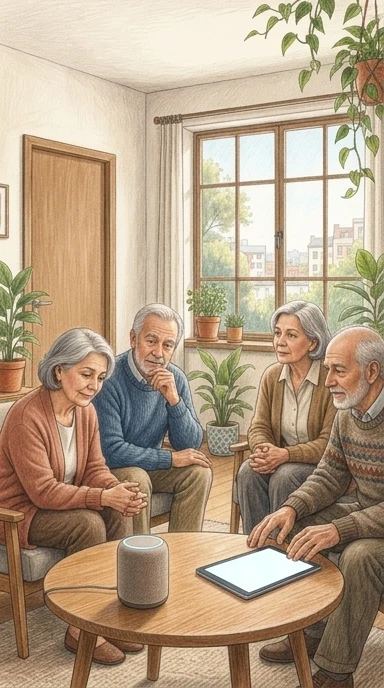
Usted vive solo y las personas que lo cuidan están lejos o no siempre pueden llegar. Investigadores de varias universidades de Estados Unidos reunieron a 29 adultos mayores que vivían solos en edificios de vivienda de bajo costo en Richmond, Virginia, para diseñar cómo un altavoz inteligente podría ayudarlos en esa situación. El estudio se hizo entre abril de 2021 y abril de 2022, y cada persona participó en una o más reuniones.
Primero preguntaron y anotaron ideas. Después armaron historias con los pedidos de los propios residentes y volvieron a reunirse para que ellos las corrigieran.
Lo que pidieron se repartió en cuatro grupos: que alguien confirme que están bien, una voz con quien conversar, avisos de las actividades del edificio y seguimiento de la salud. Entre las 153 ideas que propusieron, las más frecuentes fueron la ayuda diaria y la salud y la seguridad.
El mismo grupo puso condiciones. Quisieron opción de no ser molestados, listas cortas de contactos en vez de que todo el edificio pudiera llamarlos, y que la información de salud no se compartiera durante una llamada de verificación. Un grupo describió el seguimiento automático del ánimo como "demasiado orwelliano".
Los residentes también insistieron en que la máquina no reemplace las visitas. Prefirieron que la voz los animara a llamar a un amigo, a caminar con un vecino o a avisarle a su médico.
El estudio produjo siete historias de uso. Voice2Connect es el nombre que los investigadores piensan darle más adelante al sistema completo, cuando lo construyan. Estas historias todavía no se han puesto a prueba en la vida real, así que sus efectos sobre la soledad o la salud no se conocen. Tampoco existen para pedirlas ni comprarlas.
La investigación es pequeña y muy local: 29 personas, tres edificios y una sola ciudad. Para participar había que hablar y entender inglés. Casi ocho de cada diez participantes eran afroamericanos, y siete de cada diez tenían secundaria completa o menos. Las preferencias de otros grupos podrían ser distintas. Cuatro de cada diez participantes nunca había usado internet.
Los investigadores concluyen que la tecnología sola no crea comunidad, y que hacen falta personal, programas y confianza para sostenerla.
Cuando vea un altavoz o una aplicación que ofrezca cuidar y acompañar a un adulto mayor, pregunte quién puede contactarlo, qué datos se comparten y quién decidió esas reglas.
Qué significa para usted
Cuando alguien le ofrezca un aparato o una aplicación que promete acompañarlo y cuidarlo, pregunte quién puede llamarlo, qué datos suyos se comparten y quién fijó esas reglas. Los siete guiones que estos residentes imaginaron todavía no existen ni se han probado, así que nadie puede asegurarle que funcionen.
Chung, J., Mansion, N., Gendron, T. et al. (2026). Smart Speaker–Based Applications to Support Social Connectedness in Older Adult Residents in Affordable Housing: User-Centered Design Study. JMIR Aging. https://doi.org/10.2196/90053
Quién pagó: Este trabajo fue financiado por los Institutos Nacionales de Salud (R03AG069816 a JC); el artículo no indica si los financiadores tuvieron alguna influencia, y no se prestó ningún equipo o software.
No tome esto como consejo médico profesional.
Versión detalladaLos pasajes copiados del artículo, las ilustraciones y cada fuente con cuánto leímos de ella · 1464 palabras · unos 7 minLeerla →Cerrar
Diseñaron su propio asistente de voz: residentes de vivienda asequible piden compañía, pero con control
Un estudio con 29 personas mayores que viven solas en Richmond, Virginia, no probó un aparato: les pidió que imaginaran cómo debería funcionar. Lo que pidieron dice tanto de nosotros como de la máquina.
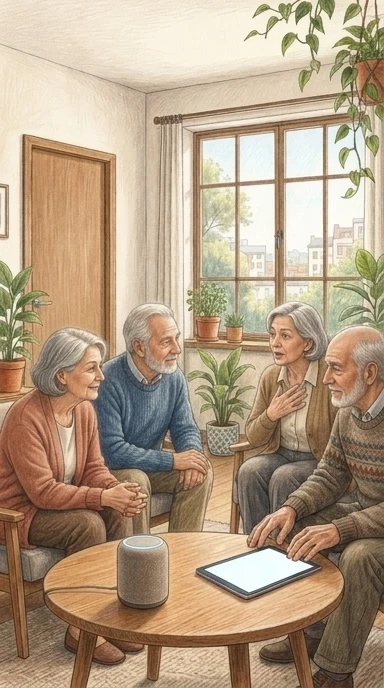
Veintinueve personas mayores que viven solas en tres edificios de vivienda asequible en Richmond, Virginia, se sentaron a diseñar un asistente de voz para sus propias vidas. No era un aparato real. Era un ejercicio de imaginación guiada: qué querrían que hiciera un parlante inteligente, cómo querrían que sonara, qué no permitirían nunca. La investigación, dirigida por Jane Chung, de la Universidad Emory, y sus colegas, fue financiada por los Institutos Nacionales de Salud de Estados Unidos. El estudio duró un año, entre abril de 2021 y abril de 2022. No probó un aparato terminado; no midió si algo funcionó. Preguntó, escuchó y redactó.
El resultado fueron siete escenarios de uso, agrupados en cuatro funciones. La primera es el chequeo: un vecino puede decir "Alexa, conéctame con Juana", y la administración del edificio puede preguntar si alguien está bien. La segunda es la compañía: el asistente conversa, recuerda lo que se habló antes, lee un libro en voz alta y comenta la lectura. La tercera es la comunidad: un tablero virtual de actividades, coordinación de salidas, avisos de clases o del servicio religioso. La cuarta es el chequeo de bienestar: con datos de una pulsera de actividad, el sistema detecta que alguien se mueve menos y le ofrece conectarse con un amigo o con su médico1.
Para llegar a esos siete escenarios, los participantes generaron 153 ideas en hojas con dibujos y palabras. Las dos categorías más frecuentes no fueron la conversación ni el entretenimiento, sino la salud y la seguridad, y la ayuda para las tareas del día2. Y aquí está el hallazgo que más se repite en el texto: para estas personas, la necesidad de conexión social no se puede separar de la preocupación por la seguridad de vivir solas3. Una frase de una participante lo resume: querían que el aparato sirviera para que cada uno pudiera decir "estoy bien", o para que alguien llamara y preguntara por todos.
Los participantes no aceptaron nada sin condiciones. Pidieron personalización, controles para entrar o salir de cada función, un modo "no molestar" y protecciones explícitas para que la máquina no reemplazara el contacto humano4. Les preocupaba que otros residentes o la administración pudieran verificar su estado en cualquier momento, que se compartiera sin querer información sobre su ubicación o su actividad, y que la tecnología ejerciera demasiado control. Un grupo lo describió como "demasiado orwelliano"5. Sobre la detección automática del ánimo, la reacción fue clara: prefirieron que el sistema avise y ofrezca hablar con alguien, en lugar de sacar conclusiones sobre cómo se sienten1.
Vale la pena entender qué es un parlante inteligente y qué no es. Es un aparato de voz que se conecta a internet y responde a órdenes habladas, como el Echo de Amazon o el Home de Google6. No es un robot, no tiene manos, no se mueve. Su ventaja para una persona mayor es que se controla sin tocar nada: sirve para quien tiene problemas de vista, dificultad para moverse o poca fuerza en las manos7. Y su promesa, todavía por demostrar en la vida real, es que un agente de voz con inteligencia artificial puede ayudar a personas con recursos limitados a sentirse menos solas y a participar más en actividades sociales, por ejemplo facilitando el contacto con otros8.
El problema que este estudio intenta rozar no es menor. Entre los adultos mayores de Estados Unidos, la soledad y el aislamiento social son frecuentes: las cifras que cita el artículo llegan a casi una de cada cuatro personas para el aislamiento, y van del 17% al 57% para la soledad, según cómo se mida9. No es un malestar menor: se asocia con depresión, enfermedades cardiovasculares, deterioro de la memoria, peor calidad de vida y mayor mortalidad10. En vivienda asequible el riesgo es mayor, porque las redes de contacto, el transporte y el acceso a la tecnología son más escasos11. Por eso el estudio no se hizo con cualquier grupo: se hizo con quienes suelen quedar fuera del diseño de la tecnología que se crea para ellos.

Hubo un detalle de método que conviene contar. En los edificios participantes, trece personas ya usaban un parlante inteligente —el edificio A había repartido dispositivos Echo Dot desde enero de 2020— y dieciséis no lo habían usado nunca12. Los investigadores separaron los grupos por experiencia previa. Al final, la profundidad de las ideas fue parecida: los que conocían el aparato y los que no aportaron la misma cantidad de observaciones útiles. Es un dato relevante para quien piense que "esto no es para mí porque no entiendo de tecnología".
Aquí es como lo leemos nosotros. La conversación sobre la vejez y la tecnología suele plantearse como una elección entre dos extremos: un aparato que vigila, o un aparato que entretiene. Este ejercicio sugiere que la gente mayor no elige ninguno de los dos. Elige un aparato que sirva de puente. Y un puente solo tiene sentido si hay algo del otro lado: un vecino, una hija, una clase de español a las tres de la tarde, una salida al supermercado en grupo.
Lo que esperamos, si esto avanza, es que las funciones que sobrevivan sean las que conectan personas concretas, y que las que prometen compañía automática permanente se queden cortas. También esperamos que la pregunta difícil no sea técnica sino de convivencia: quién decide cuándo el sistema avisa, a quién avisa y qué cuenta. Nos equivocaríamos si los usuarios, con el aparato ya en casa, aceptaran sin más el monitoreo del ánimo o el acceso abierto de la administración. Usted puede comprobarlo en su propia familia: pregunte a su familiar qué función usaría y cuál apagaría el primer día.
Y hay un punto que este estudio deja abierto y que conviene no confundir. Los siete escenarios son deseos bien argumentados, no productos. Nadie los ha instalado en un edificio real. Nadie ha medido si reducen la soledad, si evitan una caída o si la gente los sigue usando al mes siguiente13. Los propios autores lo dicen: el siguiente paso exige control del usuario, protección de la privacidad y un diseño donde la persona siga en el centro, con la tecnología facilitando el contacto y no reemplazándolo14. Para que algo así llegue a un edificio de su ciudad faltan años, financiamiento, personal capacitado y, sobre todo, que alguien pregunte a los residentes antes de instalar.
La otra cosa que este estudio hace visible es menos cómoda. Los participantes pidieron límites claros —no molestar, listas cerradas de contactos, poder salir de cada función— antes de que existiera nada que limitar. Eso sugiere que la desconfianza no es un obstáculo que haya que vencer, sino un requisito de diseño que hay que incorporar. Cuando alguien le ofrezca a su familiar un aparato de estos, la pregunta útil no es "¿sabe usarlo?", sino "¿puede apagarlo, y sabe cómo?".
El estudio tiene límites que hay que decir con claridad. Fueron 29 personas, en tres edificios, en una sola ciudad de Estados Unidos, todas de habla inglesa. La mayoría eran afroamericanas y muchas tenían poca experiencia previa con tecnología12. Sus preferencias pueden no coincidir con las de otros grupos de mayores, en otros países, en otro tipo de vivienda o en otro idioma. La pandemia complicó el seguimiento de algunos participantes, y las reuniones se hicieron fuera del edificio, con transporte en camioneta, lo que pudo dejar fuera a personas con dificultades para desplazarse. Además, el equipo ya tenía vínculos de confianza con esas comunidades, lo que pudo inclinar las respuestas hacia lo favorable. Y hubo un tema que no apareció solo: la pérdida de audición, que afecta directamente a la hora de hablar con un asistente de voz, no surgió espontáneamente en las conversaciones.
Con todo, hay algo que este trabajo deja claro y que sirve más allá del aparato. Preguntar antes de instalar no es una cortesía: cambia el resultado. Los participantes no eran expertos en tecnología y produjeron criterios que a los ingenieros no se les habían ocurrido, como una lista cerrada de contactos en lugar de acceso para todo el edificio, o que el sistema avise sin diagnosticar. La próxima vez que en su edificio, su cooperativa o su residencial se hable de poner cámaras, sensores o asistentes de voz para los mayores, usted puede pedir que los propios residentes opinen antes, no después: qué función quieren, quién recibe la información y cómo se apaga.
¿Qué le preguntaría usted a su familiar antes de que alguien instale un asistente de voz en su casa?
De dónde sale cada dato de contexto, y cuánto leímos de cada documento
- Chung, J., Mansion, N., Gendron, T. et al. (2026). Smart Speaker–Based Applications to Support Social Connectedness in Older Adult Residents in Affordable Housing: User-Centered Design Study. JMIR Aging. https://doi.org/10.2196/90053 - el artículo del que trata esta nota — el artículo completo — el pasaje: "Through iterative co-design, we developed 7 prototype scenarios across 4 functional categories: Checking-In (peer and management safety verification with privacy controls), Social Companion (conversational artificial intelligence–based companionship and emotional support), Community Involvement (virtual bulletin boards and activity coordination), and Wellness Check (system-initiated monitoring of activity and behavioral patterns as health indicators with user-controlled interventions)."
- Chung, J., Mansion, N., Gendron, T. et al. (2026). Smart Speaker–Based Applications to Support Social Connectedness in Older Adult Residents in Affordable Housing: User-Centered Design Study. JMIR Aging. https://doi.org/10.2196/90053 - el artículo del que trata esta nota — el artículo completo — el pasaje: "Participants generated 153 ideas for smart speaker use, with Health and Safety and Daily Assistance being the most frequent categories."
- Chung, J., Mansion, N., Gendron, T. et al. (2026). Smart Speaker–Based Applications to Support Social Connectedness in Older Adult Residents in Affordable Housing: User-Centered Design Study. JMIR Aging. https://doi.org/10.2196/90053 - el artículo del que trata esta nota — el artículo completo — el pasaje: "Analysis revealed that social connection needs were inseparable from safety concerns related to living alone."
- Chung, J., Mansion, N., Gendron, T. et al. (2026). Smart Speaker–Based Applications to Support Social Connectedness in Older Adult Residents in Affordable Housing: User-Centered Design Study. JMIR Aging. https://doi.org/10.2196/90053 - el artículo del que trata esta nota — el artículo completo — el pasaje: "Participants emphasized requirements for personalization, opt-in/opt-out controls, “Do-Not-Disturb” functionality, and safeguards preventing replacement of human connection."
- Chung, J., Mansion, N., Gendron, T. et al. (2026). Smart Speaker–Based Applications to Support Social Connectedness in Older Adult Residents in Affordable Housing: User-Centered Design Study. JMIR Aging. https://doi.org/10.2196/90053 - el artículo del que trata esta nota — el artículo completo — el pasaje: "Participants worried about other residents or management checking-in at any time, unintentional sharing of location and activity information, and technology exerting excessive control (described as “too Orwellian” by one group)."
- Chung, J., Mansion, N., Gendron, T. et al. (2026). Smart Speaker–Based Applications to Support Social Connectedness in Older Adult Residents in Affordable Housing: User-Centered Design Study. JMIR Aging. https://doi.org/10.2196/90053 - el artículo del que trata esta nota — el artículo completo — el pasaje: "The growing interest in voice-operated smart speakers (eg, Amazon Echo and Google Home) has increased an exploration into how this technology can enhance social connectedness in community-dwelling older adults [ 16-18 ]."
- Chung, J., Mansion, N., Gendron, T. et al. (2026). Smart Speaker–Based Applications to Support Social Connectedness in Older Adult Residents in Affordable Housing: User-Centered Design Study. JMIR Aging. https://doi.org/10.2196/90053 - el artículo del que trata esta nota — el artículo completo — el pasaje: "The hands-free voice control may improve accessibility and usability for people with vision impairment, mobility limitation, or poor dexterity."
- Chung, J., Mansion, N., Gendron, T. et al. (2026). Smart Speaker–Based Applications to Support Social Connectedness in Older Adult Residents in Affordable Housing: User-Centered Design Study. JMIR Aging. https://doi.org/10.2196/90053 - el artículo del que trata esta nota — el artículo completo — el pasaje: "Artificial intelligence (AI)–based voice agents (eg, Amazon Alexa) on smart speakers have the potential to help older adults in limited-resource settings feel less lonely and engage more in social activities, for example, by providing easy access to communicate with others."
- Chung, J., Mansion, N., Gendron, T. et al. (2026). Smart Speaker–Based Applications to Support Social Connectedness in Older Adult Residents in Affordable Housing: User-Centered Design Study. JMIR Aging. https://doi.org/10.2196/90053 - el artículo del que trata esta nota — el artículo completo — el pasaje: "Social isolation and loneliness, the main constructs of social disconnectedness, are prevalent in Americans aged 65 years and older, with prevalence rates approaching nearly 25% for the former [ 1 ] and ranging from 17% to 57% for the latter [ 2-4 ]."
- Chung, J., Mansion, N., Gendron, T. et al. (2026). Smart Speaker–Based Applications to Support Social Connectedness in Older Adult Residents in Affordable Housing: User-Centered Design Study. JMIR Aging. https://doi.org/10.2196/90053 - el artículo del que trata esta nota — el artículo completo — el pasaje: "Older adults who are socially isolated or feel lonely exhibit a wide range of negative health outcomes, including depression, cardiovascular diseases, poor cognitive function, reduced quality of life, and increased mortality [ 2 5 7 8 ]."
- Chung, J., Mansion, N., Gendron, T. et al. (2026). Smart Speaker–Based Applications to Support Social Connectedness in Older Adult Residents in Affordable Housing: User-Centered Design Study. JMIR Aging. https://doi.org/10.2196/90053 - el artículo del que trata esta nota — el artículo completo — el pasaje: "Social isolation and loneliness are pressing concerns for older adults living in affordable housing (hereafter referred to as “residents”) because they have limited social networks, transportation options, and access to information and communication technology (ICT) [ 9 ]."
- Chung, J., Mansion, N., Gendron, T. et al. (2026). Smart Speaker–Based Applications to Support Social Connectedness in Older Adult Residents in Affordable Housing: User-Centered Design Study. JMIR Aging. https://doi.org/10.2196/90053 - el artículo del que trata esta nota — el artículo completo — el pasaje: "We conducted a 3-stage UCD study with 29 older adults (mean age 70, SD 6.8 years; 23/29, 79% African American; 20/29, 69% high school education or less) living alone in affordable housing between April 2021 and April 2022."
- Chung, J., Mansion, N., Gendron, T. et al. (2026). Smart Speaker–Based Applications to Support Social Connectedness in Older Adult Residents in Affordable Housing: User-Centered Design Study. JMIR Aging. https://doi.org/10.2196/90053 - el artículo del que trata esta nota — el artículo completo — el pasaje: "Finally, this study focused on early-stage prototyping and scenario development. The scenarios represent participant aspirations and preferences but have not been validated through implementation."
- Chung, J., Mansion, N., Gendron, T. et al. (2026). Smart Speaker–Based Applications to Support Social Connectedness in Older Adult Residents in Affordable Housing: User-Centered Design Study. JMIR Aging. https://doi.org/10.2196/90053 - el artículo del que trata esta nota — el artículo completo — el pasaje: "Implementation should prioritize user control, privacy protection, and human-in-the-loop design ensuring that technology facilitates rather than replaces human connection and community programming, alongside consideration of user characteristics to build trust and ensure effective, sustained use of the intended technology platform."
Chung, J., Mansion, N., Gendron, T. et al. (2026). Smart Speaker–Based Applications to Support Social Connectedness in Older Adult Residents in Affordable Housing: User-Centered Design Study. JMIR Aging. https://doi.org/10.2196/90053
Quién pagó: Este trabajo fue financiado por los Institutos Nacionales de Salud (R03AG069816 a JC); el artículo no indica si los financiadores tuvieron alguna influencia, y no se prestó ningún equipo o software.
No tome esto como consejo médico profesional.
Los hallazgos de otros estudios que aquí se mencionan los conocemos por este documento, que fue el que leímos; no abrimos cada uno de esos estudios.
interviews · JMIR Aging · the paper, 28 May 2026 · free
Older Adults Helped Design the Voice Assistant They Want. It Doesn't Exist Yet.
Twenty-nine people living alone in subsidized housing in one US city designed seven smart speaker scenarios. Nothing was built or tested, and the study covered one city.
Short version · the longer version follows, about 8 min
Ask the weeklyAI chat
Ask me about this study: who was studied, what it found, and what it does not say.
Conversations are saved for as long as weeklyAI exists, to improve the publication. Answers come in the language you write in.
- The study at a glance
- Who
- Older adults living alone in affordable housing
- How many
- 29
- Where
- Richmond, Virginia, United States
- When
- April 2021 to April 2022
- Kind of study
- interviews
- Who did it
- Virginia Commonwealth University, Emory University, Longwood University, University of Pennsylvania
- The limit that matters
- The scenarios are only stories; no one has used them in real life
When a voice assistant is designed for older adults, ask who was in the room when it was designed.
You live alone. The people who check on you may be far away, or hard to reach on a bad day.
Researchers in Richmond, Virginia, worked for a year with 29 older adults who live alone in affordable housing. They were all older than 55, and the average age was 70. The residents helped design features for a smart speaker, the kind of device that answers to your voice from across the room.
The residents asked for four kinds of help. A way to check on a neighbor and to be checked on. A voice to talk with. News of what is happening in the building. And monitoring that notices when someone has stopped moving around as usual.
Safety came first. In one exercise the residents produced 153 ideas, and health and safety was one of the two biggest groups. As one resident put it: "A lot of people here have nobody they can talk to."
They also set firm conditions. They wanted a Do-Not-Disturb switch. They wanted to choose who could reach them, rather than opening the whole building. They wanted management to see only that they were all right, not what they had said. One group said the technology could take too much control, calling it "too Orwellian." The researchers then rewrote the scenarios to add those controls.
The study produced seven written scenarios, not a working product. No one has used them in real life, so they are not for sale and cannot be requested. The small study drew on 29 people in three buildings in one city. All spoke English, and most were African American, so their preferences may not match other places or other groups.
What the residents insisted on is worth watching for. When a voice assistant is designed for older adults, ask who was in the room when it was designed.
What this means for you
Your part is to ask questions, not to buy anything yet. This study shows only what 29 residents in Richmond, Virginia, said they wanted from a voice assistant, and nothing was built or tested, so no product out there exists to help you today. When a device is offered to you later, ask who was in the room when it was designed, and check whether it lets you choose who reaches you and turn it off when you want quiet.
Chung, J., Mansion, N., Gendron, T. et al. (2026). Smart Speaker–Based Applications to Support Social Connectedness in Older Adult Residents in Affordable Housing: User-Centered Design Study. JMIR Aging. https://doi.org/10.2196/90053
Who paid: This work was supported by the National Institutes of Health (R03AG069816 to JC); the article does not say whether the funders had any say, and no equipment or software was lent.
Do not take this as professional medical advice.
The longer versionThe passages copied from the paper, the pictures, and every source with how much of it we read · 1507 words · about 8 minRead it →Close
Older Adults in Subsidized Housing Helped Design the Voice Assistant They'd Actually Use
Twenty-nine residents in Richmond, Virginia, spent a year co-designing seven smart-speaker scenarios. What they asked for says as much about privacy and control as about loneliness.
Older adults who live alone in subsidized housing face a particular kind of isolation: limited social networks, few transportation options, and less access to information and communication technology. So a research team asked 29 of them—residents of three housing buildings in Richmond, Virginia—to help design a voice-assistant system from the ground up. The study ran from April 2021 to April 2022 in Richmond, Virginia, and was funded by the National Institutes of Health. The authors are affiliated with Virginia Commonwealth University, Emory University, Longwood University, and the University of Pennsylvania. The findings appear in JMIR Aging.12
The participants were mostly African American (23 of 29), most had a high school education or less (20 of 29), and their average age was 70. Thirteen already used a smart speaker; sixteen did not. They met in focus groups across three stages: first to talk about their social needs and brainstorm ideas, then to react to early prototype stories, and finally to validate refined versions.2
The brainstorming produced 153 ideas. The two most frequent categories were not social at all—they were Daily Assistance and Health and Safety. But when researchers analyzed the discussions, a pattern emerged: for these residents, the wish for connection could not be separated from the fear of living alone. As one participant put it, the best thing the device could do would be to let everyone say "I'm okay," or have someone check in.34
Out of this came seven prototype scenarios, grouped into four categories. Checking-In covered both neighbor-to-neighbor and management-to-resident safety verification, with privacy controls. Social Companion described a conversational voice agent offering company and emotional support. Community Involvement included virtual bulletin boards and coordinated group activities. Wellness Check involved system-initiated monitoring of activity patterns—with the user deciding what to do with the information.5
The prototypes are stories, not products. No one has used them in real life. The study did not test whether they reduce loneliness or improve safety. It tested what residents wanted and what concerned them.6
And what concerned them was substantial. Participants worried about other residents or management checking in at any time, about location and activity information being shared unintentionally, and about technology exerting too much control—one group called it "too Orwellian." They wanted do-not-disturb functions, opt-in and opt-out controls, personalization, and explicit safeguards against the technology replacing human contact rather than supporting it.789
The problem this study addresses is not small. Social isolation affects nearly 25 percent of Americans aged 65 and older, and loneliness ranges from 17 to 57 percent depending on how it is measured. Both are linked to depression, cardiovascular disease, poorer cognitive function, reduced quality of life, and increased mortality.1011
Smart speakers—Amazon Echo, Google Home—have drawn interest as a low-effort way to reach older adults. The hands-free voice control can help people with vision impairment, mobility limitations, or poor dexterity. AI-based voice agents like Alexa might help people in limited-resource settings feel less lonely and engage more in social activities by making communication easier.121314
But technology alone does not solve isolation. A scoping review of smart home systems—we could read only the summary; the full paper is behind a subscription—found that these systems often combine sensors, wearables, voice assistants, and AI. They aim at independence, safety, and social connection. Benefits like greater autonomy and improved quality of life were reported. But so were privacy concerns, usability problems, high costs, and questions about reliability. The reviewers concluded that user-centered design and strong privacy protections are needed for these systems to work well.1516171819
A separate study of robot-assisted task support—also read only in summary—found that older adults performed less accurately and reported higher mental effort when a robot helped them, compared with human help. Their stress hormones rose after robot-assisted interaction. The younger adults in the study showed no such difference. The point is not that voice assistants are robots. The point is that how help is delivered matters, and older adults may experience machine assistance differently than younger ones do.202122
Another study—again, summary only—tested a mobile app that uses AI to create memory videos from photos and generate summaries for caregivers. Users rated it easy to use and engaging, and perceived usefulness was strongly linked to whether they intended to keep using it. The researchers noted that few AI apps have been designed and tested for memory engagement in older adults, and fewer still with privacy-preserving design.23242526
What these studies share is a recognition that the technology is not the hard part. Trust is. And trust depends on who controls the data, who decides when the device speaks, and who can see what it records.1927
Here is how we read it. The residents in this study were not asking for a companion. They were asking for a witness—someone or something that would notice if they did not appear, that would mark the day's passing, that would make the small repeated acts of connection easier to keep. A greeting at the same hour. A reminder to call the same daughter. A weekly check-in that someone is expecting. The need for those small acts does not go away when daily rhythms scatter. It just goes unmet.
What this leads us to expect in homes like yours: a voice device will be valued less for what it can do than for giving a fixed, repeatable moment each day—and the people who use it most will be the ones most insistent on setting the schedule themselves. If residents in this study had been indifferent to when or how often the assistant spoke, or had wanted the system to choose on its own, we would be wrong. Watch for that.
We also read the privacy demands as central, not incidental. When a machine is built to seem like a person—a voice, a polite manner—people open up more in some ways and hold back in others, and the same warmth that makes it comforting makes its data collection harder to see. The residents who wanted companion features most may also, over months, tell the device more than they intended—about health, moods, who visits. This is why the demand for close contact lists, do-not-disturb, and limits on what management learns was strongest. If residents who used companion features most were also least concerned about what the device recorded, we would be wrong.
And we read the monitoring features—activity tracking, mood detection, management check-ins—as something residents treated as being graded, not helped. They wanted the machine to prompt them toward a person, not decide anything about them. Their suspicion was sharpest where housing management, not a chosen friend, would receive the information. If residents had welcomed unrestricted management access to their activity and mood data, or wanted the system to make judgments on its own, we would be wrong.
What you can do with this: if you are setting up a voice device for yourself or a parent, pick one or two fixed daily or weekly moments—a morning greeting, a Sunday call reminder—and set the times yourself. Notice whether the regularity, not the novelty, is what makes it useful. Before adding any companion or monitoring feature, ask plainly: what does it record, who can see it, and how do I turn it off? Treat the device as a helpful tool that is also listening. Keep the list of people it can reach short and chosen by you. And when a care program or device asks for monitoring data, ask who receives it, whether you can opt out feature by feature, and whether a person—not the system—makes any decision that affects you.
The study has limits the authors name. The pandemic disrupted follow-up, and some participants were lost. Meetings were held off-site with van transportation, which may have excluded people with mobility limitations. Recruitment relied on established trust relationships, which may have introduced a bias toward favorable feedback. The study did not systematically prioritize competing design demands. Hearing-related concerns did not come up on their own. And the scenarios represent what participants wanted—not what has been shown to work.6
The researchers say the next step is to build these prototypes into working applications, test them in real settings, and see whether they actually help. They note that implementation should prioritize user control, privacy protection, and keeping a person in the loop—so that technology facilitates human connection rather than replacing it.28
What this makes possible for you is not a product to buy. It is a set of questions to bring to the next conversation about a device, an app, or a care program that wants to watch, remind, or connect you. Ask who decides when it speaks. Ask who sees what it records. Ask whether it points you toward a person or replaces one. The residents in Richmond already did.
What would you want a voice assistant to notice—and who would you want it to tell?
Where each piece of context comes from, and how much of it we read
- Chung, J., Mansion, N., Gendron, T. et al. (2026). Smart Speaker–Based Applications to Support Social Connectedness in Older Adult Residents in Affordable Housing: User-Centered Design Study. JMIR Aging. https://doi.org/10.2196/90053 - the article this story is about — the whole article — the passage: "Social isolation and loneliness are pressing concerns for older adults living in affordable housing (hereafter referred to as “residents”) because they have limited social networks, transportation options, and access to information and communication technology (ICT) [ 9 ]."
- Chung, J., Mansion, N., Gendron, T. et al. (2026). Smart Speaker–Based Applications to Support Social Connectedness in Older Adult Residents in Affordable Housing: User-Centered Design Study. JMIR Aging. https://doi.org/10.2196/90053 - the article this story is about — the whole article — the passage: "We conducted a 3-stage UCD study with 29 older adults (mean age 70, SD 6.8 years; 23/29, 79% African American; 20/29, 69% high school education or less) living alone in affordable housing between April 2021 and April 2022."
- Chung, J., Mansion, N., Gendron, T. et al. (2026). Smart Speaker–Based Applications to Support Social Connectedness in Older Adult Residents in Affordable Housing: User-Centered Design Study. JMIR Aging. https://doi.org/10.2196/90053 - the article this story is about — the whole article — the passage: "Participants generated 153 ideas for smart speaker use, with Health and Safety and Daily Assistance being the most frequent categories."
- Chung, J., Mansion, N., Gendron, T. et al. (2026). Smart Speaker–Based Applications to Support Social Connectedness in Older Adult Residents in Affordable Housing: User-Centered Design Study. JMIR Aging. https://doi.org/10.2196/90053 - the article this story is about — the whole article — the passage: "Analysis revealed that social connection needs were inseparable from safety concerns related to living alone."
- Chung, J., Mansion, N., Gendron, T. et al. (2026). Smart Speaker–Based Applications to Support Social Connectedness in Older Adult Residents in Affordable Housing: User-Centered Design Study. JMIR Aging. https://doi.org/10.2196/90053 - the article this story is about — the whole article — the passage: "Through iterative co-design, we developed 7 prototype scenarios across 4 functional categories: Checking-In (peer and management safety verification with privacy controls), Social Companion (conversational artificial intelligence–based companionship and emotional support), Community Involvement (virtual bulletin boards and activity coordination), and Wellness Check (system-initiated monitoring of activity and behavioral patterns as health indicators with user-controlled interventions)."
- Chung, J., Mansion, N., Gendron, T. et al. (2026). Smart Speaker–Based Applications to Support Social Connectedness in Older Adult Residents in Affordable Housing: User-Centered Design Study. JMIR Aging. https://doi.org/10.2196/90053 - the article this story is about — the whole article — the passage: "Finally, this study focused on early-stage prototyping and scenario development. The scenarios represent participant aspirations and preferences but have not been validated through implementation."
- Chung, J., Mansion, N., Gendron, T. et al. (2026). Smart Speaker–Based Applications to Support Social Connectedness in Older Adult Residents in Affordable Housing: User-Centered Design Study. JMIR Aging. https://doi.org/10.2196/90053 - the article this story is about — the whole article — the passage: "Participants emphasized requirements for personalization, opt-in/opt-out controls, “Do-Not-Disturb” functionality, and safeguards preventing replacement of human connection."
- Chung, J., Mansion, N., Gendron, T. et al. (2026). Smart Speaker–Based Applications to Support Social Connectedness in Older Adult Residents in Affordable Housing: User-Centered Design Study. JMIR Aging. https://doi.org/10.2196/90053 - the article this story is about — the whole article — the passage: "Participants worried about other residents or management checking-in at any time, unintentional sharing of location and activity information, and technology exerting excessive control (described as “too Orwellian” by one group)."
- Chung, J., Mansion, N., Gendron, T. et al. (2026). Smart Speaker–Based Applications to Support Social Connectedness in Older Adult Residents in Affordable Housing: User-Centered Design Study. JMIR Aging. https://doi.org/10.2196/90053 - the article this story is about — the whole article — the passage: "Participants stressed the need for safeguards against AI technology replacing human interaction or enabling abusive behaviors. They wanted technology that facilitated human connection rather than substituted for it."
- Chung, J., Mansion, N., Gendron, T. et al. (2026). Smart Speaker–Based Applications to Support Social Connectedness in Older Adult Residents in Affordable Housing: User-Centered Design Study. JMIR Aging. https://doi.org/10.2196/90053 - the article this story is about — the whole article — the passage: "Social isolation and loneliness, the main constructs of social disconnectedness, are prevalent in Americans aged 65 years and older, with prevalence rates approaching nearly 25% for the former [ 1 ] and ranging from 17% to 57% for the latter [ 2-4 ]."
- Chung, J., Mansion, N., Gendron, T. et al. (2026). Smart Speaker–Based Applications to Support Social Connectedness in Older Adult Residents in Affordable Housing: User-Centered Design Study. JMIR Aging. https://doi.org/10.2196/90053 - the article this story is about — the whole article — the passage: "Older adults who are socially isolated or feel lonely exhibit a wide range of negative health outcomes, including depression, cardiovascular diseases, poor cognitive function, reduced quality of life, and increased mortality [ 2 5 7 8 ]."
- Chung, J., Mansion, N., Gendron, T. et al. (2026). Smart Speaker–Based Applications to Support Social Connectedness in Older Adult Residents in Affordable Housing: User-Centered Design Study. JMIR Aging. https://doi.org/10.2196/90053 - the article this story is about — the whole article — the passage: "The growing interest in voice-operated smart speakers (eg, Amazon Echo and Google Home) has increased an exploration into how this technology can enhance social connectedness in community-dwelling older adults [ 16-18 ]."
- Chung, J., Mansion, N., Gendron, T. et al. (2026). Smart Speaker–Based Applications to Support Social Connectedness in Older Adult Residents in Affordable Housing: User-Centered Design Study. JMIR Aging. https://doi.org/10.2196/90053 - the article this story is about — the whole article — the passage: "The hands-free voice control may improve accessibility and usability for people with vision impairment, mobility limitation, or poor dexterity."
- Chung, J., Mansion, N., Gendron, T. et al. (2026). Smart Speaker–Based Applications to Support Social Connectedness in Older Adult Residents in Affordable Housing: User-Centered Design Study. JMIR Aging. https://doi.org/10.2196/90053 - the article this story is about — the whole article — the passage: "Artificial intelligence (AI)–based voice agents (eg, Amazon Alexa) on smart speakers have the potential to help older adults in limited-resource settings feel less lonely and engage more in social activities, for example, by providing easy access to communicate with others."
- Looti M, Abd-alazim M. (2026). A scoping review of integrated smart home technology supporting older adults and people with disabilities. Discover Internet of Things. https://doi.org/10.1007/s43926-026-00334-6 — only the abstract - the full text could not be fetched — the passage: "The reviewed systems often combined technologies such as ambient sensors, wearables, voice assistants, and IoT frameworks. These were often supported by artificial intelligence (AI) or robotics."
- Looti M, Abd-alazim M. (2026). A scoping review of integrated smart home technology supporting older adults and people with disabilities. Discover Internet of Things. https://doi.org/10.1007/s43926-026-00334-6 — only the abstract - the full text could not be fetched — the passage: "The systems are mainly aimed at meeting several core needs: enabling functional independence, tracking activities of daily living (ADLs), and improving safety and security. Other goals included offering cognitive support and helping users maintain social connections."
- Looti M, Abd-alazim M. (2026). A scoping review of integrated smart home technology supporting older adults and people with disabilities. Discover Internet of Things. https://doi.org/10.1007/s43926-026-00334-6 — only the abstract - the full text could not be fetched — the passage: "Across studies, benefits such as greater user autonomy, better safety, and improved quality of life were consistently reported."
- Looti M, Abd-alazim M. (2026). A scoping review of integrated smart home technology supporting older adults and people with disabilities. Discover Internet of Things. https://doi.org/10.1007/s43926-026-00334-6 — only the abstract - the full text could not be fetched — the passage: "Significant challenges also emerged, including privacy concerns, usability and access issues, high costs, and questions about technical dependability."
- Looti M, Abd-alazim M. (2026). A scoping review of integrated smart home technology supporting older adults and people with disabilities. Discover Internet of Things. https://doi.org/10.1007/s43926-026-00334-6 — only the abstract - the full text could not be fetched — the passage: "For these systems to be more effective, a focus on user-centered design and dependable AI is clearly needed. Ethical use of this technology also depends heavily on strong privacy protections and clear operational transparency."
- Varrasi S, Vagnetti R, Camp N, Hough J, Di Nuovo A, Castellano S, et al. (2026). Human and Robot Assistance for Cognitive Load in Younger and Older Adults: Multimodal Within-Subject Experimental Study. Journal of Medical Internet Research. https://doi.org/10.2196/94738 — only the abstract - the full text could not be fetched — the passage: "This study aimed to examine how robot-assisted (human-robot interaction [HRI]) and human-assisted (human-human interaction [HHI]) support influences cognitive load during task performance in younger and older adults."
- Varrasi S, Vagnetti R, Camp N, Hough J, Di Nuovo A, Castellano S, et al. (2026). Human and Robot Assistance for Cognitive Load in Younger and Older Adults: Multimodal Within-Subject Experimental Study. Journal of Medical Internet Research. https://doi.org/10.2196/94738 — only the abstract - the full text could not be fetched — the passage: "Older adults demonstrated lower accuracy and higher perceived cognitive load during robot-assisted conditions compared with human-assisted conditions, whereas no such differences were observed in younger adults."
- Varrasi S, Vagnetti R, Camp N, Hough J, Di Nuovo A, Castellano S, et al. (2026). Human and Robot Assistance for Cognitive Load in Younger and Older Adults: Multimodal Within-Subject Experimental Study. Journal of Medical Internet Research. https://doi.org/10.2196/94738 — only the abstract - the full text could not be fetched — the passage: "Physiological analysis revealed a significant age×assistance× time interaction (F1, 156=5.16; P=.02), with older adults showing increased posttask cortisol concentrations during robot-assisted interaction, indicating higher physiological stress."
- Shin H, Shin M. (2026). An AI-Assisted Cognitive Engagement Mobile App for Older Adults: Development and Mixed Methods Usability Study. JMIR Formative Research. https://doi.org/10.2196/103986 — only the abstract - the full text could not be fetched — the passage: "RecallLive integrates metadata-based photo clustering to generate memory videos, an on-device convolutional neural network that classifies frame-level emotional responses, and a large language model (LLM)–based module that converts these outputs into caregiver summaries."
- Shin H, Shin M. (2026). An AI-Assisted Cognitive Engagement Mobile App for Older Adults: Development and Mixed Methods Usability Study. JMIR Formative Research. https://doi.org/10.2196/103986 — only the abstract - the full text could not be fetched — the passage: "few AI-based apps have been developed and evaluated for memory engagement in this population, and fewer incorporate on-device emotional analysis with privacy-preserving design"
- Shin H, Shin M. (2026). An AI-Assisted Cognitive Engagement Mobile App for Older Adults: Development and Mixed Methods Usability Study. JMIR Formative Research. https://doi.org/10.2196/103986 — only the abstract - the full text could not be fetched — the passage: "Ease of use (mean 3.77, SD 0.78) and engagement (mean 4.09, SD 0.67) significantly exceeded the scale midpoint ( t 201 =14.00 and t 201 =23.19; both P <.001), and perceived usefulness was also rated highly (mean 4.06, SD 0.82)."
- Shin H, Shin M. (2026). An AI-Assisted Cognitive Engagement Mobile App for Older Adults: Development and Mixed Methods Usability Study. JMIR Formative Research. https://doi.org/10.2196/103986 — only the abstract - the full text could not be fetched — the passage: "Perceived usefulness was strongly associated with the stated intention to use or recommend the app (β=.796; R ²=0.634; F 1,200 =346.18; P <.001)."
- Looti M, Abd-alazim M. (2026). A scoping review of integrated smart home technology supporting older adults and people with disabilities. Discover Internet of Things. https://doi.org/10.1007/s43926-026-00334-6 — only the abstract - the full text could not be fetched — the passage: "Smart home devices significantly improve daily autonomy and overall quality of life. Users still struggle with system reliability, expensive setups, and invasive monitoring."
- Chung, J., Mansion, N., Gendron, T. et al. (2026). Smart Speaker–Based Applications to Support Social Connectedness in Older Adult Residents in Affordable Housing: User-Centered Design Study. JMIR Aging. https://doi.org/10.2196/90053 - the article this story is about — the whole article — the passage: "Implementation should prioritize user control, privacy protection, and human-in-the-loop design ensuring that technology facilitates rather than replaces human connection and community programming, alongside consideration of user characteristics to build trust and ensure effective, sustained use of the intended technology platform."
Chung, J., Mansion, N., Gendron, T. et al. (2026). Smart Speaker–Based Applications to Support Social Connectedness in Older Adult Residents in Affordable Housing: User-Centered Design Study. JMIR Aging. https://doi.org/10.2196/90053
Who paid: This work was supported by the National Institutes of Health (R03AG069816 to JC); the article does not say whether the funders had any say, and no equipment or software was lent.
Do not take this as professional medical advice.