analysis of texts · Frontiers in Public Health · la publicación, 30 jul 2026 · gratis
Qué se sabe del niño diagnosticado por IA: quién pone los datos y quién carga con la culpa
Un estudio revisó 89 documentos y 17 disputas en un solo hospital de China. Los propios autores advierten que no puede aplicarse a otros países ni a otras instituciones.
Versión breve · la versión detallada sigue, unos 8 min
Pregunte al chat de weeklyAI
Pregúnteme por este estudio: a quiénes se estudió, qué encontró y qué no dice.
Las conversaciones se guardan mientras exista weeklyAI, para mejorar la publicación. Se responde en el idioma en que usted escribe.
- El estudio, de un vistazo
- Quiénes
- documentos hospitalarios y casos de disputa médica sobre diagnóstico infantil con IA
- Cuántos
- 89 documentos y 17 casos de disputa
- Dónde
- un solo hospital de tercer nivel en China
- Cuándo
- entre 2021 y 2025
- Tipo de estudio
- analysis of what people did
- Quién lo hizo
- Facultad de Derecho de la Universidad de Shanxi y Christus Health, Texas
- El límite que importa
- Es un solo hospital; no puede aplicarse a otros países ni instituciones sin verificación multicéntrica.
Porcentaje de las causas del error de diagnóstico entre las 17 disputas de un solo hospital chino; los autores advierten que con tan pocos casos no se pueden sacar conclusiones firmes.
Tiempo para decidir quién era responsable, según el contrato
El trámite se alargó un 55.2% más cuando el contrato no dejaba claro a quién pertenecían los derechos
Este estudio no dice nada sobre las leyes de su país ni sobre los derechos que usted puede exigir donde vive.
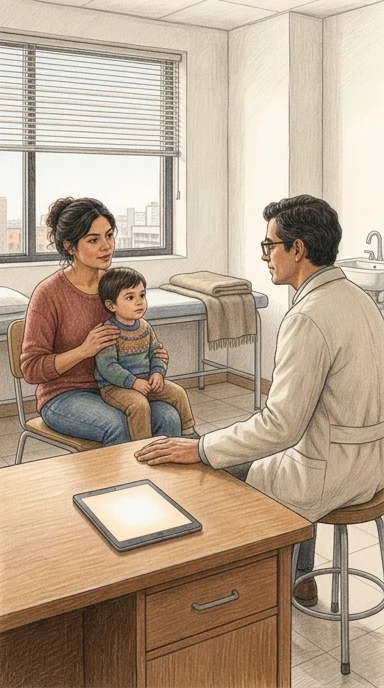
Su hijo entra a una sala de urgencias. Un programa de computadora mira los exámenes, propone un diagnóstico y el médico decide. Usted no sabe quién programó ese sistema, de dónde salieron los datos del niño ni a quién reclamar si la máquina se equivoca.
Un grupo de investigadores chinos revisó 89 documentos hospitalarios sobre sistemas de diagnóstico infantil con inteligencia artificial y 17 casos de disputa médica. Todos venían de un mismo hospital universitario de China, entre 2021 y 2025.
En 73 de cada 100 documentos no estaba escrito a quién pertenecían los derechos sobre el sistema. En 24 de los 89 documentos estaba escrito a quién pertenecían los derechos sobre el sistema. Solo en 8 de los documentos sobre bebés de 0 a 3 años estaba escrito a quién pertenecían los datos clínicos de los niños. Los hospitales aportan los casos y las anotaciones; las empresas aportan el algoritmo. Cuando eso no queda firmado, la pelea empieza después.
De los 17 casos de disputa, 11 terminaron con la culpa mal repartida: se responsabilizó a quien no había causado el daño. Eso pasó en casi dos de cada tres casos. Las causas del error se repartieron casi por igual: fallas del algoritmo en 7 casos y mala operación del hospital en otros 7.
El tiempo promedio para decidir quién era responsable fue de 66,8 días. Cuando el contrato no dejaba claro a quién pertenecían los derechos sobre el sistema, el trámite se alargó un 55,2% más.
Los bebés de 0 a 3 años aparecieron en 9 de los 17 casos de disputa, un poco más de la mitad. Sus sistemas tenían las puntuaciones más bajas de transparencia: 0,71 sobre 1. El estudio propone 0,85 como umbral, pero aclara que es solo un valor de referencia interna de ese hospital.
Los autores lo repiten: es un solo centro, sin verificación externa, y con 17 casos no se pueden sacar conclusiones firmes para nadie más. No prueba que la falta de claridad cause las demoras. Tampoco cubre bebés prematuros ni niños migrantes.
Este estudio no dice nada sobre las leyes de su país ni sobre los derechos que usted puede exigir donde vive.
Cuando una IA ayude a diagnosticar a un niño cerca de usted: ¿de quién son esos datos, quién responde si falla, y cuánto tendría que esperar para obtener una respuesta?
Qué significa para usted
Ese estudio no dice nada sobre las leyes de su país. Si un programa ayuda a diagnosticar a un niño cerca de usted, puede preguntar quién firmó el contrato, de dónde salieron los datos del menor y quién responde si algo falla. Anote también cuánto tarda la respuesta, porque en ese hospital los casos sin contrato claro tardaron más.
Yang, Z., Yang, W. (2026). Research on intellectual property rights and legal liability definition of artificial intelligence-assisted pediatric disease diagnosis system. Frontiers in Public Health. https://doi.org/10.3389/fpubh.2026.1922644
Quién pagó: Los autores declararon que no recibieron apoyo financiero para este trabajo ni para su publicación.
No tome esto como consejo médico profesional.
Versión detalladaLos pasajes copiados del artículo, las ilustraciones y cada fuente con cuánto leímos de ella · 1698 palabras · unos 8 minLeerla →Cerrar
Derechos y culpas del diagnóstico infantil por IA: lo que un hospital chino documentó
Un estudio revisa 89 documentos y 17 disputas en un solo hospital de China: en la mayoría faltaban cláusulas de propiedad intelectual, y casi la mitad de los algoritmos no eran explicables.
Cuando un sistema de inteligencia artificial ayuda a diagnosticar a un niño, quedan dos preguntas abiertas: de quién son los datos y el programa, y a quién se culpa cuando la máquina se equivoca. Un equipo de investigadores chinos revisó 89 documentos internos y 17 casos de disputa médica de un solo hospital de tercer nivel en China, entre 2021 y 2025, para ver cómo se reparten esas dos cosas. Los autores son Zhijun Yang, de la Facultad de Derecho de la Universidad de Shanxi, y Wensi Yang, de Christus Health, en Texas. No recibieron financiamiento y declararon no tener conflictos de interés. El estudio fue aprobado por el comité de ética de la Universidad de Shanxi.
Los números que encontraron describen una sola institución. En el 73% de los documentos revisados no había cláusulas claras sobre quién es dueño de qué1. En el 47.1% de los algoritmos, la puntuación de "explicabilidad" —qué tan bien puede reconstruirse por qué el sistema llegó a una conclusión— quedó por debajo de 0,8 sobre 11. El tiempo promedio para determinar quién era responsable en una disputa fue de 66,8 días, y en el 55.2% de los casos ese plazo se consideró excesivo2. Entre las causas de los errores de diagnóstico, los defectos del algoritmo y la negligencia hospitalaria aparecieron cada uno con 41.2%, y la tasa de responsabilidad mal asignada llegó al 64.7%3. En los bebés de 0 a 3 años, la tasa de responsabilidad mal asignada fue del 76.2%, y las consecuencias de daño fueron más graves4.
Para entender lo que se juega aquí, conviene saber qué es esta tecnología. La revisión recoge un estudio en el que el sistema de diagnóstico pediátrico con IA revisa grandes cantidades de casos clínicos e indicadores fisiológicos de niños y hace un cribado rápido y un diagnóstico auxiliar de enfermedades comunes y raras5. No reemplaza al médico: le da una segunda señal, más rápida, basada en patrones. La revisión recoge un estudio en el que los niños son un grupo especialmente delicado porque su desarrollo fisiológico es inmaduro, sus síntomas son ocultos y su margen de tolerancia a un error de diagnóstico es estrecho6. Por eso cualquier falla pesa más que en un adulto.
El estudio también describe cómo se reparten hoy las cosas en la práctica. Los datos clínicos pertenecen a los hospitales, y los algoritmos y el software pertenecen a las empresas7. Esa división parece ordenada, pero no siempre está escrita. La revisión recoge un estudio en el que, en el modelo de investigación conjunta, las empresas suelen quedarse con el código del algoritmo, mientras que la inversión del hospital —recoger datos, obtener aprobaciones éticas, etiquetar casos, verificar clínicamente— no entra en el reparto de la propiedad, y eso genera disputas sobre licencias, transformación de resultados y regalías8. La revisión recoge un estudio en el que, en 2024, el Tribunal Popular Supremo de China publicó casos típicos que muestran que las disputas de propiedad intelectual relacionadas con IA se volvieron un tipo de conflicto frecuente en el campo médico, y que los pleitos por propiedad de datos médicos y modelos de algoritmo aumentaron de forma notable9.
¿Qué dicen las reglas fuera de China? El estudio menciona que la Organización Mundial de la Salud tiene reglas de ética médica para la IA infantil que aclaran la explicabilidad de estos sistemas, la clasificación y confirmación de datos de menores, y la carga de la prueba sin culpa para las empresas que investigan y desarrollan10. La Ley de Inteligencia Artificial de la Unión Europea clasifica la IA de diagnóstico pediátrico como sistema de alto riesgo y exige acuerdo escrito sobre transparencia algorítmica, trazabilidad de responsabilidades en toda la cadena y propiedad intelectual en la colaboración entre universidad, industria e investigación10. Son marcos distintos, pero apuntan en la misma dirección: separar lo que es responsabilidad del algoritmo de lo que es responsabilidad de quien lo opera.
El estudio propone un camino. Los autores sugieren que la empresa responda por el algoritmo y el hospital por la operación, y que se equilibren la equidad y la privacidad11. También plantean construir mecanismos de descripción algorítmica, evaluación de propiedad intelectual y seguros para promover el uso conforme en hospitales de tercer nivel12. Y calculan que si la explicabilidad del algoritmo sube por encima de 0,85, la eficiencia para identificar responsabilidades podría mejorar un 64.9% y la correlación con disputas reducirse un 30.6%13.
Hay que ser muy claro con los límites. El umbral de 0,85 es solo un valor exploratorio de un solo centro y no puede convertirse en un estándar obligatorio universal14. Todo el estudio se basa en datos de un solo hospital, y sus hallazgos no pueden generalizarse sin verificación multicéntrica15. Los 17 casos de disputa son demasiado pocos para sacar conclusiones estables, y el propio estudio reconoce que no hizo un cálculo previo de potencia estadística. Los resultados describen correlaciones dentro de esa muestra, no causas. El estudio no cubrió bebés prematuros ni niños migrantes o dejados atrás. Además, el análisis legal se centra en las leyes civiles y de dispositivos médicos de China y no aborda los flujos transfronterizos de datos ni los tratados internacionales de propiedad intelectual. Tampoco se puede decir que la explicabilidad cause menos disputas: el diseño solo permite observar que ambas cosas se mueven juntas en esa muestra.
Otros trabajos que leímos sobre sistemas de IA en salud, aunque no sobre diagnóstico pediátrico, sugieren que esta preocupación por la seguridad no es exclusiva de China. Una revisión de alcance sobre chatbots de IA para salud mental —de la que solo pudimos leer el resumen, el texto completo está detrás de una suscripción— encontró que la mayoría de las intervenciones incluía al menos un mecanismo técnico de seguridad, como ajuste fino o ingeniería de instrucciones16. Un subconjunto más pequeño usaba capas de seguridad combinadas: sistemas de recuperación, filtros de contenido o clasificadores de riesgo y algoritmos basados en reglas17. Durante la entrega de la intervención, la incorporación detallada con clarificación de roles era común, pero la supervisión humana era limitada18. Los protocolos de derivación en crisis variaban en rigor pero en su mayoría estaban poco desarrollados, y el monitoreo sistemático de eventos adversos era escaso19. Entre las fallas documentadas se incluyeron ideación suicida no detectada y provisión de información clínica inexacta20. Los autores de esa revisión concluyen que estos sistemas requieren un enfoque sociotécnico robusto que integre salvaguardas técnicas con codiseño de usuarios, controles de procedimiento y supervisión humana21. La revisión incluyó 21 estudios de 11 países22.
Así lo leemos nosotros. El patrón que aparece en este estudio chino no es solo un problema legal: es un problema de poder. Quien tiene los datos y quien tiene el código negocian desde posiciones distintas, y quien recibe el diagnóstico —el niño y su familia— casi nunca está en esa mesa. Lo que cabe esperar, en un hogar como el suyo, es que cuando un sistema automático falle en el diagnóstico de un niño, la discusión se centre en cuántos casos se parecen entre sí y no en por qué falló ese caso concreto. Eso dificulta que alguien examine la situación individual. Sabríamos que nos equivocamos si en los casos de error la autoridad exigiera reconstruir paso a paso el razonamiento del sistema y separara explícitamente lo que es coincidencia estadística de lo que es causa del daño. Mientras tanto, lo que usted puede hacer es concreto: si un ser querido sufre un daño tras un diagnóstico asistido por IA, pida que se explique el caso concreto y no solo las estadísticas generales del sistema, y anote desde el primer día qué se dijo, quién lo dijo y cuándo. Esa constancia es la que después permite discutir responsabilidades.
También vale la pena mirar quién queda fuera del registro. Las personas que aportan los datos y las observaciones clínicas de los niños —familias, personal de salud, cuidadores— no aparecen como titulares de nada cuando ese material se convierte en un producto comercial. Lo que cabe esperar es que ni siquiera se les pregunte cómo quieren que se use. Sabríamos que estamos equivocados si en los contratos y en las normas aparecieran nombrados quienes aportan los datos, con derechos reconocidos y con voz en las decisiones sobre su uso posterior. Antes de firmar cualquier autorización para el uso de datos de salud de un menor, usted puede preguntar quién será dueño de esa información, para qué se usará después y cómo puede retirarse el consentimiento. Pedir esa respuesta por escrito es un derecho que se puede ejercer hoy.
Y hay una tercera cosa que este estudio deja ver sin decirlo. Cuando un saber experto y un saber cotidiano se encuentran, la gente no elige uno y descarta el otro: los combina. Las familias que llegan a un hospital con un diagnóstico hecho por una máquina probablemente no lo acepten como palabra final. Lo contrastarán con lo que ellas mismas observan en el niño, con lo que les dice un médico de confianza y con lo que han oído en su entorno. Esa mezcla de fuentes es la que realmente decide qué hacen. Sabríamos que nos equivocamos si las familias aceptaran sin más el resultado de la máquina y no buscaran ninguna otra opinión. Cuando un diagnóstico por IA esté sobre la mesa, usted puede preguntar qué parte del resultado proviene de los datos del niño y qué parte de reglas generales, y contrastarlo con lo que observa en casa y con la opinión de otro profesional. Guardar por escrito esas preguntas y respuestas ayuda si después hay que reclamar.
En resumen: este estudio describe un hospital, no un país ni un continente. Sus hallazgos no pueden trasladarse a América Latina ni a Estados Unidos sin verificación multicéntrica15. Pero la pregunta que deja abierta sí es suya: cuando la máquina opina sobre la salud de un niño, ¿quién responde si se equivoca, y con qué puede contar la familia para reclamar?
De dónde sale cada dato de contexto, y cuánto leímos de cada documento
- Yang, Z., Yang, W. (2026). Research on intellectual property rights and legal liability definition of artificial intelligence-assisted pediatric disease diagnosis system. Frontiers in Public Health. https://doi.org/10.3389/fpubh.2026.1922644 - el artículo del que trata esta nota — el artículo completo — el pasaje: "The data indicate that 73.0% of documents lack clear intellectual property ownership clauses, while 47.1% of algorithms score below 0.8 in interpretability."
- Yang, Z., Yang, W. (2026). Research on intellectual property rights and legal liability definition of artificial intelligence-assisted pediatric disease diagnosis system. Frontiers in Public Health. https://doi.org/10.3389/fpubh.2026.1922644 - el artículo del que trata esta nota — el artículo completo — el pasaje: "The average liability attribution cycle reaches 66.8 days, with 55.2% of cases exceeding the reasonable time limit."
- Yang, Z., Yang, W. (2026). Research on intellectual property rights and legal liability definition of artificial intelligence-assisted pediatric disease diagnosis system. Frontiers in Public Health. https://doi.org/10.3389/fpubh.2026.1922644 - el artículo del que trata esta nota — el artículo completo — el pasaje: "Among the main causes of misdiagnosis, algorithm defects and hospital negligence accounted for 41.2% respectively, and the responsibility mismatch rate reached 64.7%."
- Yang, Z., Yang, W. (2026). Research on intellectual property rights and legal liability definition of artificial intelligence-assisted pediatric disease diagnosis system. Frontiers in Public Health. https://doi.org/10.3389/fpubh.2026.1922644 - el artículo del que trata esta nota — el artículo completo — el pasaje: "64.7% of infants aged 0 ~ 3 years are involved in AI misdiagnosis disputes, and the medical adverse damage consequences with higher severity."
- Yang, Z., Yang, W. (2026). Research on intellectual property rights and legal liability definition of artificial intelligence-assisted pediatric disease diagnosis system. Frontiers in Public Health. https://doi.org/10.3389/fpubh.2026.1922644 - el artículo del que trata esta nota — el artículo completo — el pasaje: "The pediatric AI diagnosis system can realize rapid screening and auxiliary diagnosis of common and rare diseases of children by integrating massive clinical cases and physiological index data of children, effectively making up for the shortcomings of high experience dependence and insufficient diagnosis efficiency in traditional pediatric diagnosis and treatment, and promoting the transformation of intelligent public health management mode in pediatric diagnosis and treatment mode."
- Yang, Z., Yang, W. (2026). Research on intellectual property rights and legal liability definition of artificial intelligence-assisted pediatric disease diagnosis system. Frontiers in Public Health. https://doi.org/10.3389/fpubh.2026.1922644 - el artículo del que trata esta nota — el artículo completo — el pasaje: "Children's physiological development is immature, their symptoms are hidden and their diagnostic fault tolerance window is low, so they are the key protected population of public health."
- Yang, Z., Yang, W. (2026). Research on intellectual property rights and legal liability definition of artificial intelligence-assisted pediatric disease diagnosis system. Frontiers in Public Health. https://doi.org/10.3389/fpubh.2026.1922644 - el artículo del que trata esta nota — el artículo completo — el pasaje: "In terms of ownership, clinical data belongs to hospitals, and algorithms and software belong to enterprises."
- Yang, Z., Yang, W. (2026). Research on intellectual property rights and legal liability definition of artificial intelligence-assisted pediatric disease diagnosis system. Frontiers in Public Health. https://doi.org/10.3389/fpubh.2026.1922644 - el artículo del que trata esta nota — el artículo completo — el pasaje: "In the cooperative R&D mode, R&D institutions often take advantage of algorithm codes, while a large amount of investment in data collection, ethical approval, case labeling and clinical verification of medical institutions is not included in the ownership distribution system, which leads to a series of disputes such as subsequent achievement transformation, exclusive licensing and non-exclusive licensing and IP royalty distribution."
- Yang, Z., Yang, W. (2026). Research on intellectual property rights and legal liability definition of artificial intelligence-assisted pediatric disease diagnosis system. Frontiers in Public Health. https://doi.org/10.3389/fpubh.2026.1922644 - el artículo del que trata esta nota — el artículo completo — el pasaje: "The typical case of intellectual property rights in 2024 released by the Supreme People's Court shows that AI-related intellectual property rights disputes have become a high-incidence dispute type in the field of medical science and technology, among which the ownership disputes involving medical data and algorithm models have increased significantly, highlighting the urgency of clarifying the ownership of intellectual property rights in the field of AI medical care."
- Yang, Z., Yang, W. (2026). Research on intellectual property rights and legal liability definition of artificial intelligence-assisted pediatric disease diagnosis system. Frontiers in Public Health. https://doi.org/10.3389/fpubh.2026.1922644 - el artículo del que trata esta nota — el artículo completo — el pasaje: "At the international level, a differentiated governance system is formed: WHO medical ethics rules for children's AI clarify the interpretability of minors' AI diagnosis and treatment system, the classification and confirmation of children's data, and the no-fault burden of proof of R&D enterprises; The European Union's “Artificial Intelligence Act” lists pediatric diagnostic AI as a high-risk system, and enforces the written agreement on algorithm transparency, full chain responsibility traceability and intellectual property rights in Industry-University-Research;"
- Yang, Z., Yang, W. (2026). Research on intellectual property rights and legal liability definition of artificial intelligence-assisted pediatric disease diagnosis system. Frontiers in Public Health. https://doi.org/10.3389/fpubh.2026.1922644 - el artículo del que trata esta nota — el artículo completo — el pasaje: "Clarify the rights and responsibilities of pediatric AI: the enterprise is responsible for the algorithm and the hospital is responsible for the operation; Give consideration to fairness and privacy."
- Yang, Z., Yang, W. (2026). Research on intellectual property rights and legal liability definition of artificial intelligence-assisted pediatric disease diagnosis system. Frontiers in Public Health. https://doi.org/10.3389/fpubh.2026.1922644 - el artículo del que trata esta nota — el artículo completo — el pasaje: "Construct algorithm description, IP evaluation and insurance mechanism to promote compliance application of 3A hospitals."
- Yang, Z., Yang, W. (2026). Research on intellectual property rights and legal liability definition of artificial intelligence-assisted pediatric disease diagnosis system. Frontiers in Public Health. https://doi.org/10.3389/fpubh.2026.1922644 - el artículo del que trata esta nota — el artículo completo — el pasaje: "The calculation shows that if the interpretability of the algorithm rises above 0.85, the identification efficiency can be improved by 64.9% and the dispute correlation can be reduced by 30.6%."
- Yang, Z., Yang, W. (2026). Research on intellectual property rights and legal liability definition of artificial intelligence-assisted pediatric disease diagnosis system. Frontiers in Public Health. https://doi.org/10.3389/fpubh.2026.1922644 - el artículo del que trata esta nota — el artículo completo — el pasaje: "The 0.85 interpretability threshold is only an exploratory single-center cutoff value and cannot serve as a universal mandatory industrial standard."
- Yang, Z., Yang, W. (2026). Research on intellectual property rights and legal liability definition of artificial intelligence-assisted pediatric disease diagnosis system. Frontiers in Public Health. https://doi.org/10.3389/fpubh.2026.1922644 - el artículo del que trata esta nota — el artículo completo — el pasaje: "This study is limited to single-center data, and its findings cannot be generalized without multi-center verification."
- Olisaeloka L, Richardson CG, Wang AY, Munthali RJ, Vigo DV. (2026). Safety Mechanisms and Risk Mitigation in Generative AI Mental Health Chatbots: A Systematic Scoping Review. Healthcare. https://doi.org/10.3390/healthcare14101395 — solo el resumen - no se pudo obtener el texto completo — el pasaje: "Most interventions incorporated at least one technical safety mechanism, most commonly fine-tuning and prompt engineering."
- Olisaeloka L, Richardson CG, Wang AY, Munthali RJ, Vigo DV. (2026). Safety Mechanisms and Risk Mitigation in Generative AI Mental Health Chatbots: A Systematic Scoping Review. Healthcare. https://doi.org/10.3390/healthcare14101395 — solo el resumen - no se pudo obtener el texto completo — el pasaje: "A smaller subset implemented layered safety architectures combining retrieval systems, content filters or risk classifiers, and rule-based algorithms."
- Olisaeloka L, Richardson CG, Wang AY, Munthali RJ, Vigo DV. (2026). Safety Mechanisms and Risk Mitigation in Generative AI Mental Health Chatbots: A Systematic Scoping Review. Healthcare. https://doi.org/10.3390/healthcare14101395 — solo el resumen - no se pudo obtener el texto completo — el pasaje: "During intervention delivery, detailed onboarding with role clarification was common, but human oversight was limited."
- Olisaeloka L, Richardson CG, Wang AY, Munthali RJ, Vigo DV. (2026). Safety Mechanisms and Risk Mitigation in Generative AI Mental Health Chatbots: A Systematic Scoping Review. Healthcare. https://doi.org/10.3390/healthcare14101395 — solo el resumen - no se pudo obtener el texto completo — el pasaje: "Crisis referral protocols varied in rigour but were mostly underdeveloped, and systematic adverse event monitoring was sparse."
- Olisaeloka L, Richardson CG, Wang AY, Munthali RJ, Vigo DV. (2026). Safety Mechanisms and Risk Mitigation in Generative AI Mental Health Chatbots: A Systematic Scoping Review. Healthcare. https://doi.org/10.3390/healthcare14101395 — solo el resumen - no se pudo obtener el texto completo — el pasaje: "Documented safety failures included missed suicidal ideation and provision of inaccurate clinical information."
- Olisaeloka L, Richardson CG, Wang AY, Munthali RJ, Vigo DV. (2026). Safety Mechanisms and Risk Mitigation in Generative AI Mental Health Chatbots: A Systematic Scoping Review. Healthcare. https://doi.org/10.3390/healthcare14101395 — solo el resumen - no se pudo obtener el texto completo — el pasaje: "GenAI chatbot interventions require a robust sociotechnical approach that integrates technical safeguards with user co-design, procedural controls, and human oversight."
- Olisaeloka L, Richardson CG, Wang AY, Munthali RJ, Vigo DV. (2026). Safety Mechanisms and Risk Mitigation in Generative AI Mental Health Chatbots: A Systematic Scoping Review. Healthcare. https://doi.org/10.3390/healthcare14101395 — solo el resumen - no se pudo obtener el texto completo — el pasaje: "Twenty-one studies across 11 countries were included."
Yang, Z., Yang, W. (2026). Research on intellectual property rights and legal liability definition of artificial intelligence-assisted pediatric disease diagnosis system. Frontiers in Public Health. https://doi.org/10.3389/fpubh.2026.1922644
Quién pagó: Los autores declararon que no recibieron apoyo financiero para este trabajo ni para su publicación.
No tome esto como consejo médico profesional.
Los hallazgos de otros estudios que aquí se mencionan los conocemos por este documento, que fue el que leímos; no abrimos cada uno de esos estudios.
analysis of texts · Frontiers in Public Health · the paper, 30 Jul 2026 · free
Who Owns the Data When a Machine Helps Diagnose a Child?
A study of one Chinese hospital found unclear ownership and slow answers about blame. It cannot tell you what your own country's rules say.
Short version · the longer version follows, about 6 min
Ask the weeklyAI chat
Ask me about this study: who was studied, what it found, and what it does not say.
Conversations are saved for as long as weeklyAI exists, to improve the publication. Answers come in the language you write in.
- The study at a glance
- Who
- hospital documents and child medical dispute cases involving AI diagnosis systems
- How many
- 89 documents and 17 dispute cases
- Where
- one tertiary hospital in China
- When
- 2021 to 2025
- Kind of study
- analysis of what people did
- Who did it
- Shanxi University, China and Christus Health, Irving, Texas, United States
- The limit that matters
- One hospital in China only; cannot be generalized without multi-center verification.
What happened when the algorithm could explain itself versus when it could not
When the score rose above 0.85, the study calculated that the time to decide who was responsible improved by 64.9% and the link to disputes fell by 30.6%.
The study does not prove that unclear ownership or low interpretability caused the delays or the mismatches.
A hospital starts using a computer program to help diagnose sick children. The program looks at the child's records, suggests a disease, and a doctor decides what to do. If the diagnosis is wrong, who is at fault?
The authors of the study are from Shanxi University in China and Christus Health in Irving, Texas, United States. They looked at one tertiary hospital in China. They read 89 documents about AI diagnosis systems and 17 dispute cases tied to children, covering the years 2021 to 2025. The children were grouped by age: babies and toddlers up to 3, preschoolers 4 to 7, and school-age children 8 to 12.
In 73 out of 100 documents, no one had written down who owned what. The hospital supplies the children's health records and marks the cases; the company builds the software. When that split is left unwritten, disputes follow.
In the 17 cases, nearly two thirds ended with the wrong party blamed. Of the misdiagnoses, 41 out of 100 came from flaws in the software, and another 41 out of 100 from mistakes in how the hospital used it.
The wait for an answer was long. On average, it took about 67 days to decide who was responsible. Where ownership was unclear, cases took more than half again as long as where it was written down.
The study also scored how well the software explained its reasoning. Nearly half the programs scored below 0.8 on a scale from 0 to 1. The youngest patients, babies up to age 3, were using the least explanatory programs. In the study, infants aged 0 to 3 years made up 64.7% of the AI misdiagnosis disputes.
But all of this comes from a single hospital in China. The study watched what happened; it cannot prove that unclear ownership or poor explanations caused the delays. The researchers themselves say the 0.85 score they mention is only a cutoff for their own sample, not a rule any country must adopt. And the 17 cases are too few to speak for hospitals elsewhere.
So the study cannot tell you what the law where you live says about a hospital using AI on a child's records, or who you could demand answers from if something went wrong. That depends on your country's rules, and this study did not examine them.
When an AI helps diagnose a child where you live, who owns the data, who answers when it fails, and how long would you wait to find out?
What this means for you
In one Chinese hospital, unclear ownership and poor explanations went with slower answers about blame, but that tells you nothing about the rules where you live. So when a clinic near you starts using a program on a child's records, ask who owns that data and who answers when it is wrong. The study cannot say, and neither can anyone else yet.
Yang, Z., Yang, W. (2026). Research on intellectual property rights and legal liability definition of artificial intelligence-assisted pediatric disease diagnosis system. Frontiers in Public Health. https://doi.org/10.3389/fpubh.2026.1922644
Who paid: The authors declared that financial support was not received for this work and/or its publication.
Do not take this as professional medical advice.
The longer versionThe passages copied from the paper, the pictures, and every source with how much of it we read · 1285 words · about 6 minRead it →Close
AI Is Already Helping Diagnose Children. When It Fails, Who Is Responsible?
A study from one Chinese hospital found that most contracts don't say who owns the data or who is to blame—and that disputes take longer when the system can't explain itself.
A new study examined how intellectual property and legal responsibility are defined when artificial intelligence helps diagnose children's diseases. The research was conducted at a single tertiary hospital in China, using 89 hospital documents about AI diagnosis systems and 17 medical dispute cases filed between 2021 and 2025. The findings describe what one institution observed—not what happens everywhere.
The numbers point to a gap between the technology and the rules meant to govern it. Among the 89 documents reviewed, 73.0 percent lacked clear clauses about who owns the intellectual property1. Nearly half the algorithms—47.1 percent—scored below 0.8 on a scale measuring how well they can explain their own reasoning1. When disputes arose, the average time to determine who was responsible reached 66.8 days, and 55.2 percent of cases exceeded what the researchers considered a reasonable time limit2.
The technology at the center of this study is not a chatbot that answers questions. A pediatric AI diagnosis system integrates large collections of children's clinical cases and physiological data to screen for and help diagnose common and rare childhood diseases3. It is meant to compensate for two persistent problems: the heavy reliance on individual physician experience and the shortage of diagnostic efficiency in traditional pediatric care3.
Children are not simply small adults when it comes to diagnosis. Their physiological development is immature, their symptoms are hidden, and the window for catching a diagnostic error before harm occurs is narrow—which is why the article calls them a key protected population of public health4. The study found that when responsibility was assigned in disputes, it went to the wrong party in 64.7 percent of cases, and that the youngest children were the most likely to be affected5.
When the researchers analyzed what went wrong in misdiagnosis cases, they found that algorithm defects and hospital negligence each accounted for 41.2 percent of the causes6. The rate at which responsibility was assigned to the wrong party—a mismatch between who was blamed and who actually contributed to the harm—reached 64.7 percent6.
The ownership question has a similar shape. In principle, the article states, clinical data belongs to hospitals, while algorithms and software belong to enterprises7. But in practice, research institutions often hold the algorithm code while hospitals make substantial investments in data collection, ethical approval, case labeling and clinical verification that are not included in the ownership distribution system—leading to disputes over licensing, royalties and the transformation of research into products8.
This is not only a Chinese concern. At the international level, the World Health Organization has issued medical ethics rules for children's AI that address interpretability, classification of children's data, and the burden of proof for research enterprises9. The European Union's Artificial Intelligence Act lists pediatric diagnostic AI as a high-risk system and requires written agreements on algorithm transparency, full-chain responsibility traceability, and intellectual property rights in industry-university-research cooperation9. The study is limited to single-center data, and its findings cannot be generalized without multi-center verification10.
The Chinese Supreme People's Court released a typical case in 2024 showing that AI-related intellectual property disputes have become a high-incidence dispute type in medical science and technology, with ownership disputes involving medical data and algorithm models increasing significantly11. That ruling highlighted the urgency of clarifying who owns what when AI is used in medical care11.
The study's authors describe a specific proposal: clarify that the enterprise is responsible for the algorithm and the hospital is responsible for the operation, while giving consideration to both fairness and privacy12. They also call for constructing algorithm description requirements, intellectual property evaluation mechanisms and insurance arrangements to promote compliant application in top-tier hospitals13.
The calculation at the heart of the study suggests that if an algorithm's interpretability rises above 0.85, the efficiency of identifying responsibility could improve by 64.9 percent and the correlation with disputes could be reduced by 30.6 percent14. But the authors are explicit: this 0.85 threshold is only an exploratory single-center cutoff value and cannot serve as a universal mandatory industrial standard15. And the study is limited to single-center data—its findings cannot be generalized without multi-center verification10.
Here is how we read it. The pattern is familiar from other places where machines take over decisions people used to make: when something goes wrong, the blame does not land cleanly on the company that built the system or on the doctor who used it. Instead, the dispute drags on while each side points at the other, and the person harmed waits longer for an answer. In a hospital using AI to help diagnose children, we would expect the same thing—not because anyone is acting in bad faith, but because the contracts and the rules have not caught up with the technology. If hospitals and AI companies had clear, pre-written agreements saying exactly who is responsible for what, and if disputes were resolved quickly with the responsible party identified without argument, this expectation would be wrong. If you or a child in your care is ever harmed by an AI-assisted diagnosis, ask who wrote the algorithm, who operated it, and who was supposed to check its output. Ask for the records that show the chain of responsibility, because without them the blame can stay stuck between parties.
We also notice something about who bears the risk. The youngest children—whose bodies compensate poorly and whose symptoms are hardest to read—were the most likely to be involved in AI-related misdiagnosis disputes in this sample. That is not surprising, but it is worth sitting with. It suggests that the people least able to advocate for themselves may be the ones most affected when the system fails and the responsibility is unclear. What would show this reading is wrong? If the youngest children were no more likely than older children to be involved in AI-related misdiagnosis disputes, or if responsibility were consistently and quickly assigned to the correct party. If a very young child in your family is diagnosed with AI help, ask what data the system was trained on for that age group and whether a human clinician reviewed the output. If something goes wrong, ask for the algorithm's explanation and the hospital's review process. Those records are what make accountability possible.
The study does not prove that unclear ownership or low interpretability caused the delays or the mismatches. It describes what was observed in one place, at one time, in one legal system. The authors themselves note that the 17 dispute cases are too few for stable statistical conclusions, that no prior sample size calculation was performed, and that the original scoring tools have not been tested for reproducibility at other institutions.
What it does offer is a way of seeing a problem that will not stay inside one hospital's walls. As AI moves deeper into pediatric care—in Latin America, in the United States, in Canada—the question of who owns the data and who answers for the algorithm will follow. The study's authors propose a starting point: enterprises responsible for the algorithm, hospitals responsible for the operation, and mechanisms for evaluation and insurance to make that division real.
For a parent or caregiver, the practical takeaway is simpler. You do not need to understand how the algorithm works to ask who is responsible when it does not. That question—asked early, asked plainly, asked of the right people—is the one that keeps accountability from disappearing into the space between the company and the clinic.
What would you ask if a machine helped diagnose your child—and got it wrong?
Where each piece of context comes from, and how much of it we read
- Yang, Z., Yang, W. (2026). Research on intellectual property rights and legal liability definition of artificial intelligence-assisted pediatric disease diagnosis system. Frontiers in Public Health. https://doi.org/10.3389/fpubh.2026.1922644 - the article this story is about — the whole article — the passage: "The data indicate that 73.0% of documents lack clear intellectual property ownership clauses, while 47.1% of algorithms score below 0.8 in interpretability."
- Yang, Z., Yang, W. (2026). Research on intellectual property rights and legal liability definition of artificial intelligence-assisted pediatric disease diagnosis system. Frontiers in Public Health. https://doi.org/10.3389/fpubh.2026.1922644 - the article this story is about — the whole article — the passage: "The average liability attribution cycle reaches 66.8 days, with 55.2% of cases exceeding the reasonable time limit."
- Yang, Z., Yang, W. (2026). Research on intellectual property rights and legal liability definition of artificial intelligence-assisted pediatric disease diagnosis system. Frontiers in Public Health. https://doi.org/10.3389/fpubh.2026.1922644 - the article this story is about — the whole article — the passage: "The pediatric AI diagnosis system can realize rapid screening and auxiliary diagnosis of common and rare diseases of children by integrating massive clinical cases and physiological index data of children, effectively making up for the shortcomings of high experience dependence and insufficient diagnosis efficiency in traditional pediatric diagnosis and treatment, and promoting the transformation of intelligent public health management mode in pediatric diagnosis and treatment mode."
- Yang, Z., Yang, W. (2026). Research on intellectual property rights and legal liability definition of artificial intelligence-assisted pediatric disease diagnosis system. Frontiers in Public Health. https://doi.org/10.3389/fpubh.2026.1922644 - the article this story is about — the whole article — the passage: "Children's physiological development is immature, their symptoms are hidden and their diagnostic fault tolerance window is low, so they are the key protected population of public health."
- Yang, Z., Yang, W. (2026). Research on intellectual property rights and legal liability definition of artificial intelligence-assisted pediatric disease diagnosis system. Frontiers in Public Health. https://doi.org/10.3389/fpubh.2026.1922644 - the article this story is about — the whole article — the passage: "64.7% of infants aged 0 ~ 3 years are involved in AI misdiagnosis disputes, and the medical adverse damage consequences with higher severity."
- Yang, Z., Yang, W. (2026). Research on intellectual property rights and legal liability definition of artificial intelligence-assisted pediatric disease diagnosis system. Frontiers in Public Health. https://doi.org/10.3389/fpubh.2026.1922644 - the article this story is about — the whole article — the passage: "Among the main causes of misdiagnosis, algorithm defects and hospital negligence accounted for 41.2% respectively, and the responsibility mismatch rate reached 64.7%."
- Yang, Z., Yang, W. (2026). Research on intellectual property rights and legal liability definition of artificial intelligence-assisted pediatric disease diagnosis system. Frontiers in Public Health. https://doi.org/10.3389/fpubh.2026.1922644 - the article this story is about — the whole article — the passage: "In terms of ownership, clinical data belongs to hospitals, and algorithms and software belong to enterprises."
- Yang, Z., Yang, W. (2026). Research on intellectual property rights and legal liability definition of artificial intelligence-assisted pediatric disease diagnosis system. Frontiers in Public Health. https://doi.org/10.3389/fpubh.2026.1922644 - the article this story is about — the whole article — the passage: "In the cooperative R&D mode, R&D institutions often take advantage of algorithm codes, while a large amount of investment in data collection, ethical approval, case labeling and clinical verification of medical institutions is not included in the ownership distribution system, which leads to a series of disputes such as subsequent achievement transformation, exclusive licensing and non-exclusive licensing and IP royalty distribution."
- Yang, Z., Yang, W. (2026). Research on intellectual property rights and legal liability definition of artificial intelligence-assisted pediatric disease diagnosis system. Frontiers in Public Health. https://doi.org/10.3389/fpubh.2026.1922644 - the article this story is about — the whole article — the passage: "At the international level, a differentiated governance system is formed: WHO medical ethics rules for children's AI clarify the interpretability of minors' AI diagnosis and treatment system, the classification and confirmation of children's data, and the no-fault burden of proof of R&D enterprises; The European Union's “Artificial Intelligence Act” lists pediatric diagnostic AI as a high-risk system, and enforces the written agreement on algorithm transparency, full chain responsibility traceability and intellectual property rights in Industry-University-Research;"
- Yang, Z., Yang, W. (2026). Research on intellectual property rights and legal liability definition of artificial intelligence-assisted pediatric disease diagnosis system. Frontiers in Public Health. https://doi.org/10.3389/fpubh.2026.1922644 - the article this story is about — the whole article — the passage: "This study is limited to single-center data, and its findings cannot be generalized without multi-center verification."
- Yang, Z., Yang, W. (2026). Research on intellectual property rights and legal liability definition of artificial intelligence-assisted pediatric disease diagnosis system. Frontiers in Public Health. https://doi.org/10.3389/fpubh.2026.1922644 - the article this story is about — the whole article — the passage: "The typical case of intellectual property rights in 2024 released by the Supreme People's Court shows that AI-related intellectual property rights disputes have become a high-incidence dispute type in the field of medical science and technology, among which the ownership disputes involving medical data and algorithm models have increased significantly, highlighting the urgency of clarifying the ownership of intellectual property rights in the field of AI medical care."
- Yang, Z., Yang, W. (2026). Research on intellectual property rights and legal liability definition of artificial intelligence-assisted pediatric disease diagnosis system. Frontiers in Public Health. https://doi.org/10.3389/fpubh.2026.1922644 - the article this story is about — the whole article — the passage: "Clarify the rights and responsibilities of pediatric AI: the enterprise is responsible for the algorithm and the hospital is responsible for the operation; Give consideration to fairness and privacy."
- Yang, Z., Yang, W. (2026). Research on intellectual property rights and legal liability definition of artificial intelligence-assisted pediatric disease diagnosis system. Frontiers in Public Health. https://doi.org/10.3389/fpubh.2026.1922644 - the article this story is about — the whole article — the passage: "Construct algorithm description, IP evaluation and insurance mechanism to promote compliance application of 3A hospitals."
- Yang, Z., Yang, W. (2026). Research on intellectual property rights and legal liability definition of artificial intelligence-assisted pediatric disease diagnosis system. Frontiers in Public Health. https://doi.org/10.3389/fpubh.2026.1922644 - the article this story is about — the whole article — the passage: "The calculation shows that if the interpretability of the algorithm rises above 0.85, the identification efficiency can be improved by 64.9% and the dispute correlation can be reduced by 30.6%."
- Yang, Z., Yang, W. (2026). Research on intellectual property rights and legal liability definition of artificial intelligence-assisted pediatric disease diagnosis system. Frontiers in Public Health. https://doi.org/10.3389/fpubh.2026.1922644 - the article this story is about — the whole article — the passage: "The 0.85 interpretability threshold is only an exploratory single-center cutoff value and cannot serve as a universal mandatory industrial standard."
Yang, Z., Yang, W. (2026). Research on intellectual property rights and legal liability definition of artificial intelligence-assisted pediatric disease diagnosis system. Frontiers in Public Health. https://doi.org/10.3389/fpubh.2026.1922644
Who paid: The authors declared that financial support was not received for this work and/or its publication.
Do not take this as professional medical advice.
The findings of other studies mentioned here are known to us through this document, which is the one we read; we did not open each of those studies.