other · Journal of Regional Analysis & Policy · la publicación, 9 nov 2026 · gratis
Un estudio de 254 condados de Texas no halló empleos duraderos por los centros de datos
Comparó condados con y sin estas instalaciones entre 2000 y 2024. Solo mide empleo: no dice nada de su recibo de luz, su agua ni su tierra.
Versión breve · la versión detallada sigue, unos 6 min
Pregunte al chat de weeklyAI
Pregúnteme sobre la IA en su vida: le señalo las notas que weeklyAI ha publicado sobre el tema, esta semana y antes.
Las conversaciones se guardan mientras exista weeklyAI, para mejorar la publicación. Se responde en el idioma en que usted escribe.
- El estudio, de un vistazo
- Quiénes
- Condados de Texas con y sin centros de datos
- Cuántos
- 254 condados
- Dónde
- Texas, Estados Unidos
- Cuándo
- 2000 a 2024
- Tipo de estudio
- analysis of what people did
- Quién lo hizo
- Universidad Shenandoah, Universidad Estatal de Oklahoma y Universidad Ball State
- El límite que importa
- Solo mide empleo; no mide luz, agua ni tierra, y cubre únicamente condados de Texas.
Empleos que sumaron los sectores ligados a centros de datos en el condado de Taylor frente al total de empleos que sumó el condado
Unos 320 empleos, menos del 5 por ciento de los cerca de 6,700 que agregó el condado
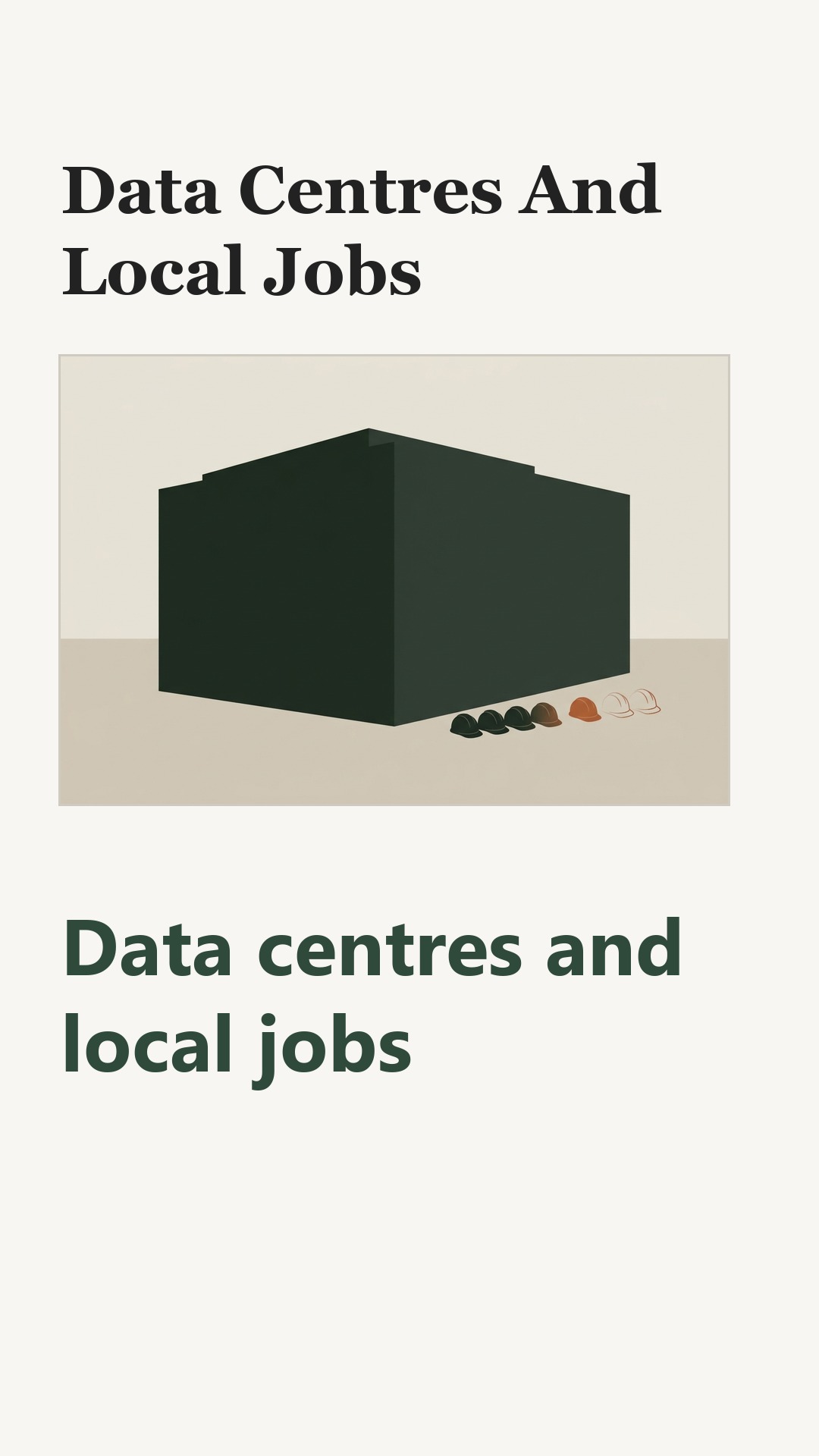
El edificio que se ve desde el camino consume energía y terreno, y devuelve pocos puestos de trabajo.

Cuando anuncian un centro de datos cerca de donde usted vive, el argumento suele ser el mismo: traerá empleos y más impuestos. Un estudio revisó ese argumento en Texas, el segundo mercado de centros de datos más grande de Estados Unidos.
Cuatro investigadores, de la Universidad Shenandoah, la Universidad Estatal de Oklahoma y la Universidad Ball State, compararon 254 condados de Texas entre 2000 y 2024. Unos tenían centros de datos y otros no. En total estudiaron 64 instalaciones, 42 pequeñas (menos de 100,000 pies cuadrados) y 22 grandes. Para saber cuándo llegaba cada una, usaron los registros de exenciones fiscales de la oficina del contralor estatal.
El resultado: cada centro nuevo sumó apenas 0.08 puntos porcentuales al crecimiento del empleo del condado. Los autores lo describen como una cifra demasiado pequeña para tener peso. En construcción, información y servicios técnicos y profesionales no encontraron un aumento sostenido. Hubo un breve repunte en la construcción que se desvaneció en unos dos años.
El estudio cuenta empleos, y nada más. No midió su recibo de luz, su agua ni su tierra, y por eso no puede decirle cuánto le costaría a usted un centro de datos. Los propios autores advierten que estas instalaciones consumen mucha energía y terreno, y que eso podría encarecer la vida local o desplazar a industrias que dan más empleo.
Tampoco conviene llevar esta conclusión a otros lugares. El estudio cubre solo condados de Texas, y sus fechas salen de trámites fiscales, no de la apertura real de cada instalación. Además, los autores piden cautela: la construcción de estos centros apenas empieza.
El estado calcula gastar 9,000 millones de dólares en incentivos para centros de datos entre 2025 y 2030, según el artículo. Los autores no calcularon ese costo por empleo. Solo señalan que, con esa cifra proyectada, el costo por empleo de los incentivos parece altísimo y que en muchos lugares puede ser infinito.
Cuando propongan un centro de datos en su zona, pida ver el expediente de tarifas de la empresa eléctrica y el permiso de agua. Ahí se ve lo que la instalación pide.
Qué significa para usted
Los autores no calcularon cuánto de esos 9,000 millones de dólares en incentivos corresponde a cada empleo, y ellos mismos piden cautela porque la construcción de estos centros apenas empieza. Cuando anuncien uno en su zona, el expediente de tarifas de la empresa eléctrica y el permiso de agua son los documentos donde se ve qué pide la instalación en energía y en agua.
Hicks, M., Boyce, M., Whitacre, B. et al. (2026). Data Centers and Local Labor Markets: Evidence from the Texas Experience. Journal of Regional Analysis & Policy. https://doi.org/10.68479/001c.172680
Quién pagó: El artículo no dice quién financió el estudio ni si algún financiador tuvo influencia, y no menciona equipos ni programas informáticos prestados a los autores.
Versión detalladaLos pasajes copiados del artículo, las ilustraciones y cada fuente con cuánto leímos de ella · 1143 palabras · unos 6 minLeerla →Cerrar
Los centros de datos en Texas no dejaron empleo duradero; el estado calcula que sus exenciones fiscales costarán 9,000 millones de dólares
Un estudio comparó 254 condados texanos con y sin centros de datos entre 2000 y 2024. Mide empleo, no la factura de luz ni el agua.
En el condado de Taylor, en Texas, cuatro centros de datos llegaron a partir de 2021. Entre el último trimestre de 2020 y el último de 2024, los sectores que más se relacionan con estas instalaciones sumaron unos 320 empleos: menos del 5 por ciento de los cerca de 6,700 que agregó el condado en ese periodo1. El dato viene de un estudio sobre 254 condados de Texas, publicado en el Journal of Regional Analysis & Policy por Michael Hicks, Mckenzie Boyce, Brian Whitacre y Dagney Faulk.
El estudio siguió cada trimestre el empleo de los condados entre 2000 y 2024 y comparó los que recibieron un centro de datos con los que no. En total fueron 64 instalaciones: 42 "registradas", de menos de 100,000 pies cuadrados, y 22 "grandes", de más. La conclusión: los centros de datos apenas aumentan la demanda de empleo a largo plazo2. En la construcción solo hubo un aumento breve del empleo tras la llegada del centro, y no hubo efecto sostenido en los servicios de información ni en los servicios profesionales y técnicos3. Solo apareció un pulso breve de obra, de uno a dos años, que se desvanece después.
Piense en lo que hace un centro de datos: guarda y procesa información para empresas que están lejos. Una vez construido, funciona con poco personal permanente, porque es una inversión en máquinas, no en trabajadores4. La parte que exige gente es la obra. Y es posible que esa obra recaiga en cuadrillas especializadas que vienen de fuera y se van.
Los estudios que los desarrolladores suelen encargar usan modelos de insumo-producto, que cuentan empleos brutos como si cada puesto nuevo fuera una ganancia neta para la región5. De ahí salen cifras como 3,592 empleos para un solo centro en Oregón o 95,000 para Ohio, según la tabla que reúne el propio artículo. El estudio de Texas buscó el efecto neto: cuántos puestos existen de más, no cuántos se anuncian.
Otros trabajos llegaron a algo parecido por otro camino. Un estudio de control sintético sobre un solo grupo de centros de datos en Oregón reportó fuertes aumentos de empleo en construcción durante la obra y ninguna ganancia neta después6.
¿Por qué no se forma un polo tecnológico alrededor? La respuesta que dan los autores tiene que ver con la geografía de la inteligencia artificial. Un análisis de McKinsey & Company citado en el artículo proyectó que para 2030 solo alrededor del 30 por ciento del uso de IA necesitará estar a menos de 20 millas del centro de datos; esa parte es la respuesta en tiempo real, no el entrenamiento ni el almacenamiento7. El entrenamiento no necesita vecinos. Por eso ni los centros grandes ni los pequeños funcionaron como ancla para empleos de alta tecnología8.
Hay un costo que el estudio no midió pero sí menciona: las instalaciones piden mucha energía y mucho terreno, y esa presión puede encarecer la infraestructura local y desplazar a industrias que sí emplean más gente9. Para los centros grandes, los autores incluso hallaron una caída en el crecimiento del empleo en servicios de información, que leen como un posible desplazamiento10. Las fechas de tratamiento son las de la solicitud de exención fiscal, no las de apertura, así que el momento exacto de cualquier efecto es aproximado.
La cifra fiscal es la que más pesa. A principios de 2023, la Contraloría de Texas calculaba que los subsidios a centros de datos costarían 130 millones de dólares en el año fiscal 2025. En enero de 2025 la proyección subió a 1,000 millones. Ahora estima 9,000 millones entre 2025 y 203011. Con esos números, los autores concluyen que el gasto fiscal es un mecanismo ineficiente para crear empleo local12. Ellos mismos aclaran que no evaluaron de forma directa la relación entre subsidio y empleo.
La propia industria dice que la exención no decide dónde se instala. Un ejecutivo de Microsoft declaró en 2024 que no recordaba una sola decisión de ubicación determinada por incentivos13. La electricidad disponible, la fibra y el terreno mandan más que el descuento fiscal.
Según el resumen de un estudio sobre el proyecto Este-Datos-Oeste, lo único disponible de él, el país lanzó en 2020 un plan para mover grupos de centros de datos y tareas que toleran retraso desde el este, donde está la demanda, hacia el centro y el oeste14. El mismo resumen advierte que el plan puede redistribuir los costos ecológicos y concentrarlos en las regiones receptoras, con beneficios que no siempre corresponden a lo que cargan15.
Así lo lee weeklyAI. El patrón se repite: una obra grande llega, se negocia con la empresa y la autoridad antes de que los vecinos tengan voz, y el beneficio se concentra mientras el costo se reparte. Es una expectativa, no un hallazgo del estudio. En su municipio, lo más probable es que el convenio de exención y el permiso de agua se firmen antes de que alguien pregunte por los litros y los megavatios. Esta lectura se equivocaría si en esos lugares hubo audiencias públicas previas, con acta de quién asistió, y si los contratos incluyeron compromisos de empleo verificables y cumplidos. Antes de que se firme nada, pida ver el convenio y el acta de la sesión donde se aprobó. Anote quién habló y quién no.
Lo que el estudio mide es empleo. No mide la factura de luz, ni el recibo del agua, ni el ruido, ni lo que pierde el distrito escolar. Tampoco cubre más que condados de Texas, y los propios autores advierten que están en los primeros años de esta industria: el gran complejo de Abilene, de unos 2 millones de pies cuadrados, apenas empieza a aparecer en sus datos16. Para el lector de otra latitud, esto es una advertencia sobre lo que se puede trasladar y lo que no. Tampoco hay que leerlo como una condena general: los autores piden investigar si hay otros beneficios, como el aumento del valor del suelo o de los impuestos prediales17.
Queda una pregunta útil para llevar a la próxima junta municipal: ¿qué empleos concretos, verificables y en qué plazo se prometieron a cambio de la exención? Guarde sus recibos de luz y agua de antes y después de que el centro empiece a operar. Compare. Y pida el registro de lo que el proyecto aporta en impuestos prediales frente a lo que el municipio dejó de cobrar.
El edificio que se ve desde el camino consume energía y terreno, y devuelve pocos puestos de trabajo. Lo que se firma antes de que abra es lo que decide quién paga la diferencia.
De dónde sale cada dato de contexto, y cuánto leímos de cada documento
- Hicks, M., Boyce, M., Whitacre, B. et al. (2026). Data Centers and Local Labor Markets: Evidence from the Texas Experience. Journal of Regional Analysis & Policy. https://doi.org/10.68479/001c.172680 - el artículo del que trata esta nota — el artículo completo — el pasaje: "Summing the aggregate job growth in these four sectors before any data center entry (Q4 2020) and the latest period in our dataset (Q4 2024) implies total job increases of only approximately 320 jobs – less than 5% of the roughly 6,700 jobs Taylor County added during this period."
- Hicks, M., Boyce, M., Whitacre, B. et al. (2026). Data Centers and Local Labor Markets: Evidence from the Texas Experience. Journal of Regional Analysis & Policy. https://doi.org/10.68479/001c.172680 - el artículo del que trata esta nota — el artículo completo — el pasaje: "While traditional input-output (I-O) models often project significant job multipliers, our causal estimates find that data centers experience negligible long-term increases in labor demand."
- Hicks, M., Boyce, M., Whitacre, B. et al. (2026). Data Centers and Local Labor Markets: Evidence from the Texas Experience. Journal of Regional Analysis & Policy. https://doi.org/10.68479/001c.172680 - el artículo del que trata esta nota — el artículo completo — el pasaje: "We find no statistically significant impacts to employment growth in Information (NAICS 51) or Professional and Technical Services (NAICS 54) sectors beyond a transient, pre-operational pulse and only a short-term increase in Construction (NAICS 23) employment growth following treatment."
- Hicks, M., Boyce, M., Whitacre, B. et al. (2026). Data Centers and Local Labor Markets: Evidence from the Texas Experience. Journal of Regional Analysis & Policy. https://doi.org/10.68479/001c.172680 - el artículo del que trata esta nota — el artículo completo — el pasaje: "In contrast, data centers are highly capital-intensive and require little labor during operations. Once the initial construction phase is completed, the operational phase typically requires minimal permanent staff."
- Hicks, M., Boyce, M., Whitacre, B. et al. (2026). Data Centers and Local Labor Markets: Evidence from the Texas Experience. Journal of Regional Analysis & Policy. https://doi.org/10.68479/001c.172680 - el artículo del que trata esta nota — el artículo completo — el pasaje: "The I-O methodology typically estimates gross rather than net effects, which is equivalent to assuming perfectly elastic labor markets where every new data center job results in a net gain for the region (Thompson, 2019)."
- Hicks, M., Boyce, M., Whitacre, B. et al. (2026). Data Centers and Local Labor Markets: Evidence from the Texas Experience. Journal of Regional Analysis & Policy. https://doi.org/10.68479/001c.172680 - el artículo del que trata esta nota — el artículo completo — el pasaje: "Tian et al. (2026) perform a synthetic control study of a single data center cluster in Oregon. They report large increases in construction employment during the construction phase, but no net employment gains after this phase."
- Hicks, M., Boyce, M., Whitacre, B. et al. (2026). Data Centers and Local Labor Markets: Evidence from the Texas Experience. Journal of Regional Analysis & Policy. https://doi.org/10.68479/001c.172680 - el artículo del que trata esta nota — el artículo completo — el pasaje: "A McKinsey & Company (2025b) analysis projected that by 2030, only about 30 percent of AI use will require physical proximity (within 20 miles) to a data center. This proximity-dependent share is comprised of real time inference, rather than training or storage of data."
- Hicks, M., Boyce, M., Whitacre, B. et al. (2026). Data Centers and Local Labor Markets: Evidence from the Texas Experience. Journal of Regional Analysis & Policy. https://doi.org/10.68479/001c.172680 - el artículo del que trata esta nota — el artículo completo — el pasaje: "Furthermore, neither large nor small data centers appear to act as anchors for high-tech employment clusters, likely due to the proximity-agnostic nature of AI training workloads."
- Hicks, M., Boyce, M., Whitacre, B. et al. (2026). Data Centers and Local Labor Markets: Evidence from the Texas Experience. Journal of Regional Analysis & Policy. https://doi.org/10.68479/001c.172680 - el artículo del que trata esta nota — el artículo completo — el pasaje: "Furthermore, the substantial energy and land requirements of these facilities may impose localized costs. Strains on public infrastructure or upward pressure on utility prices may reduce the competitiveness of more labor-intensive manufacturing or industrial sectors, producing “crowding out” effects that offset any direct employment gains."
- Hicks, M., Boyce, M., Whitacre, B. et al. (2026). Data Centers and Local Labor Markets: Evidence from the Texas Experience. Journal of Regional Analysis & Policy. https://doi.org/10.68479/001c.172680 - el artículo del que trata esta nota — el artículo completo — el pasaje: "The results do show a significant negative effect on Information Services, meaning an increase in large data centers in a county results in a decrease in the growth rate of Information Services employment. This could signal a “crowding out” effect, where labor-intensive local information service firms might be pushed out of the market through higher energy and infrastructure costs."
- Hicks, M., Boyce, M., Whitacre, B. et al. (2026). Data Centers and Local Labor Markets: Evidence from the Texas Experience. Journal of Regional Analysis & Policy. https://doi.org/10.68479/001c.172680 - el artículo del que trata esta nota — el artículo completo — el pasaje: "In early 2023, the state Comptroller projected data center subsidies for fiscal year 2025 would cost $130 million. By January 2025, this projection was revised upward to $1 billion. The Comptroller now estimates the total cost of the program will reach $9 billion between 2025 and 2030 (LeRoy and Tarczynska, 2025)."
- Hicks, M., Boyce, M., Whitacre, B. et al. (2026). Data Centers and Local Labor Markets: Evidence from the Texas Experience. Journal of Regional Analysis & Policy. https://doi.org/10.68479/001c.172680 - el artículo del que trata esta nota — el artículo completo — el pasaje: "Given that Texas tax incentives for these facilities are projected to cost $9 billion by 2030, our findings suggest that such fiscal outlays are an inefficient mechanism for local job creation."
- Hicks, M., Boyce, M., Whitacre, B. et al. (2026). Data Centers and Local Labor Markets: Evidence from the Texas Experience. Journal of Regional Analysis & Policy. https://doi.org/10.68479/001c.172680 - el artículo del que trata esta nota — el artículo completo — el pasaje: "Industry executives have noted that site selection is primarily driven by power availability, fiber connectivity, and infrastructure rather than tax breaks, with one Microsoft executive stating in 2024 that they could not recall a single placement decision determined by incentives (Nguyen and Green, 2025)."
- Deng H, He Y. (2026). Computing Corridor or Ecological Cost Conveyor? Regional Equity in China’s East‐Data‐West‐Computing Project. Urban Planning. https://doi.org/10.17645/up.12612 — solo el resumen - no se pudo obtener el texto completo — el pasaje: "In response, China launched the East-Data-West-Computing Project in 2020. With eight national computing hubs designated, the project seeks to redirect both large-scale data center clusters and latency-tolerant computing tasks from eastern regions, where demand is concentrated, to central and western China."
- Deng H, He Y. (2026). Computing Corridor or Ecological Cost Conveyor? Regional Equity in China’s East‐Data‐West‐Computing Project. Urban Planning. https://doi.org/10.17645/up.12612 — solo el resumen - no se pudo obtener el texto completo — el pasaje: "As a result, central and western regions may face growing belated ecological risks, together with resource and fiscal bottlenecks, while the benefits they receive may not be commensurate with the responsibilities they bear."
- Hicks, M., Boyce, M., Whitacre, B. et al. (2026). Data Centers and Local Labor Markets: Evidence from the Texas Experience. Journal of Regional Analysis & Policy. https://doi.org/10.68479/001c.172680 - el artículo del que trata esta nota — el artículo completo — el pasaje: "This conclusion must be viewed with some caution, given that we are still in the early days of data center construction and use. Texas is home to one of the largest data center clusters in the world, now under construction in Abilene."
- Hicks, M., Boyce, M., Whitacre, B. et al. (2026). Data Centers and Local Labor Markets: Evidence from the Texas Experience. Journal of Regional Analysis & Policy. https://doi.org/10.68479/001c.172680 - el artículo del que trata esta nota — el artículo completo — el pasaje: "Future research should consider whether other economic benefits such as increased land values or property taxes occur because of these data center incentives."
Hicks, M., Boyce, M., Whitacre, B. et al. (2026). Data Centers and Local Labor Markets: Evidence from the Texas Experience. Journal of Regional Analysis & Policy. https://doi.org/10.68479/001c.172680
Quién pagó: El artículo no dice quién financió el estudio ni si algún financiador tuvo influencia, y no menciona equipos ni programas informáticos prestados a los autores.
Los hallazgos de otros estudios que aquí se mencionan provienen de este documento; esos estudios no se consultaron uno por uno.
other · Journal of Regional Analysis & Policy · the paper, 9 Nov 2026 · free
Texas Counties That Got Data Centers Saw Almost No Lasting Job Growth
Across 254 counties from 2000 to 2024, new data centres added almost nothing to local job growth; the study did not measure power bills, water or land.
Short version · the longer version follows, about 7 min
Ask the weeklyAI chat
Ask me about AI in your life: I point you to the stories weeklyAI has published on it, this week and before.
Conversations are saved for as long as weeklyAI exists, to improve the publication. Answers come in the language you write in.
- The study at a glance
- Who
- Texas counties that received a data centre
- How many
- 254 counties, 64 data centres
- Where
- Texas, United States
- When
- 2000 to 2024
- Kind of study
- analysis of what people did
- Who did it
- Shenandoah University, Oklahoma State University, Ball State University
- The limit that matters
- Dates come from tax filings, not opening days, so the timing of any effect is approximate.
What earlier job-counting models said versus what the Texas counties showed
The models project large job gains; the county study found almost no lasting job growth.
Oregon saw big construction hiring during the build and no net job gains after; Texas saw a short building pulse that faded.
Data centres brought a short pulse of building work and nothing durable after it.
A data centre is proposed near where you live. You are told it will bring jobs and tax revenue. Texas has attracted more of these buildings than almost any other state, and a study has now followed what happened to jobs in the counties that got them.
Researchers at Shenandoah University, Oklahoma State University and Ball State University compared 254 Texas counties from 2000 to 2024. They used state records of data centres that applied for and received tax exemptions, 64 in all, and quarterly employment data for each county. They compared counties that got a data centre with counties that did not.
Each new data centre added 0.08 percentage points to a county's employment growth rate. That is too small to matter. When the researchers used a stricter method that avoids comparing new data centres with counties that already had one, even that small effect disappeared. For five years after a data centre arrived, no job effect showed up at all.
Construction hiring rose briefly and faded within about two years. Jobs in information services and in professional and technical services showed no lasting increase. Large data centres, those over 100,000 square feet, went with a slight fall in information services jobs. The authors suggest higher energy and infrastructure costs may push out other employers.
The study counts jobs only. It says nothing measured about your power bill, your water or your land. The authors note that these facilities use large amounts of energy and land, and that strains on public infrastructure or higher utility prices may raise costs for others.
The findings cover Texas counties. The authors say records of when facilities open are uncertain in much of the data outside Texas. The findings cover Texas counties. The dates also come from tax filings, not from the day a building opened, so the timing of any effect is approximate.
Texas is projected to spend $9 billion on data centre incentives between 2025 and 2030. The authors say the cost per job of these incentives is very high, and in many places it may be impossible to work out. They also say the results must be read with caution, since construction is still early.
When a data centre is proposed near you, look for the utility rate filing and the water permit. The jobs promise is the part this study could check, and it did not hold.
What this means for you
For anyone near a planned data centre, the jobs promise is the part this Texas study could check, and it did not hold: counties saw almost no lasting job growth. The study did not measure power bills, water or land, so watch for the utility rate filing and the water permit.
Hicks, M., Boyce, M., Whitacre, B. et al. (2026). Data Centers and Local Labor Markets: Evidence from the Texas Experience. Journal of Regional Analysis & Policy. https://doi.org/10.68479/001c.172680
Who paid: The article does not say who funded the study or whether any funder had a say, and it names no equipment or software lent to the authors.
The longer versionThe passages copied from the paper, the pictures, and every source with how much of it we read · 1369 words · about 7 minRead it →Close
Data Centres Came to Texas. The Jobs Mostly Didn’t.
A study of 254 counties found no lasting local employment growth from data centre entry, while state tax breaks for the facilities are projected to cost $9 billion by 2030.
Picture the morning a county judge stands at a podium to announce a data centre: a warehouse of servers, a promise of construction crews, and the suggestion of a high-tech future. Four researchers tested that promise across every county in Texas, from 2000 through 2024. Their answer is blunt. Data centres brought a short pulse of building work and nothing durable after it.
The study, in the Journal of Regional Analysis & Policy, was written by Michael Hicks of Shenandoah University, Mckenzie Boyce and Brian Whitacre of Oklahoma State University, and Dagney Faulk of Ball State University. Funding is not stated. It compared Texas counties that received a data centre with counties that did not, using records of the state tax exemptions operators applied for and received. Sixty-four data centres in the sample, 42 of them under 100,000 square feet and 22 larger. Each new facility added only 0.08 percentage points to a county's employment growth rate, an amount the authors call too small to matter, and that small figure did not survive their stricter checks.
The sector results are where the promise breaks. Across the counties as a whole, there was no statistically significant effect on jobs in construction, in information services, or in professional and technical services. A short burst of construction hiring appeared, then faded within about a year to a year and a half. Neither large nor small data centres acted as anchors for a cluster of high-tech employers. For large facilities, the authors even found a negative effect on information-sector employment growth, which they suggest could mean local information firms were squeezed out by higher energy and infrastructure costs.
Why would a building the size of several football fields hire so few people? The answer is in how the operation works. A data centre is a warehouse of computers that run continuously, and it is built to be managed remotely. Its cost sits in the machines, the power and the land, and once construction ends it needs a small permanent staff1. The work of training an artificial intelligence model does not need to happen near the people who use it; a consulting analysis cited in the study projected that by 2030 only about 30 percent of AI use would require being within 20 miles of a data centre, and that share is the part that answers questions in real time, not the training or storage2.
Consider what the county is being asked to trade. The study notes that these facilities have substantial energy and land needs, which may impose local costs; strains on public infrastructure or upward pressure on utility prices could make more labour-intensive manufacturing less competitive, offsetting any direct job gains3. That is a trade-off, not a verdict: a county may gain property tax base while giving up the kind of employer that hires many people per acre. The authors could not include industrial electricity prices or water availability in their models, because these are not consistently observable at the county level over the study period.
This is not the first attempt to count the jobs. Earlier work has mostly used input-output models, which estimate gross effects and assume that every new data centre job is a net gain for the region4. The numbers from those models run to the thousands. A synthetic-control study of a single Oregon cluster reported large construction employment during the build and no net employment gains after it5. The Texas study is the wider test.
The money is the part that reaches every taxpayer. In early 2023 the Texas Comptroller projected data centre subsidies for fiscal year 2025 at $130 million; by January 2025 that figure had been revised to $1 billion; the Comptroller now estimates the programme will reach $9 billion between 2025 and 20306. The authors conclude that such outlays are an inefficient mechanism for local job creation7.
The study has limits a reader should hold onto. Its treatment dates are the dates operators filed for tax exemptions, not the dates construction began or the doors opened, so the timing of any local effect is approximate. The largest Texas cluster, in Abilene, is only partly observed, so later effects remain unmeasured8. One test for large data centres did not pass cleanly. And the authors say the conclusion needs caution because data centre construction and use are still young8.
Here is weeklyAI's reading. The pattern is old: a large facility is sold to a town as a source of good jobs, while the design of the operation treats workers as a cost to be kept small. The Texas counties that took data centres should therefore show almost no lasting payroll growth, and any construction hiring should be brief and partly pulled from other local building work. This reading would be wrong if sustained, measurable growth in county payrolls or in technical and information jobs appeared several years after a facility opened, beyond what similar counties without one experienced. The reader's move is concrete: when a project is pitched, ask how many permanent staff the operator will employ on site and for how many years, and ask for that number in writing rather than in a brochure.
A second reading concerns the public money. Tax exemptions are handed to private investors on the argument that nothing would be built otherwise, and the money often goes to those who would have come anyway. The exemptions granted in Texas are likely to have bought little that power, land and fibre would not have attracted on their own. This reading would be wrong if projects were cancelled when an incentive was refused, or if job gains were clearly tied to the subsidy. The reader's move: ask your council or tax authority what the exemption will cost in revenue each year and what job or investment conditions are attached, then compare that with what the operator says it will hire.
Industry executives themselves describe site selection as driven by power availability, fibre connectivity and infrastructure rather than tax breaks; one Microsoft executive said in 2024 that he could not recall a single placement decision determined by incentives9. Grant the companies this much: they are choosing where the electricity and the connections are. That makes the tax break a gift on top of a decision already made.
The authors also point to what they did not study: whether data centres raise land values or property tax revenue10. That is the question a county actually needs answered, and the Texas paper leaves it open.
A third reading concerns time. Decisions about large, long-lived projects are made on a short political clock, while the people who will live with the results are rarely asked about the decades ahead. Local approval is likely to rest on near-term promises of tax base and construction activity, with little structured scrutiny of the long draw on power, water and land. This reading would be wrong if records showed councils or regulators formally weighing long-horizon utility, water and land costs against the incentive, with resident input on those terms before approval. At a planning or rate hearing, ask for the projected power and water demand over ten to twenty years and who bears the cost of new lines or wells, and put that question on the record.
Readers outside Texas should treat the finding as a boundary, not a prophecy. The authors note that uncertainty about facility-opening dates plagues much of the commercially available data, and all the publicly available data outside of Texas. That is a limit on carrying over, not a doubt about what happened in those counties.
What the study makes possible is a sharper question at the next announcement. The podium, the rendering and the promise will sound the same. The number to ask for is the one nobody puts on the slide: how many people will work there, on site, five years after the doors open.
How many permanent jobs will this building have in five years—and will the operator put that number in writing?
Where each piece of context comes from, and how much of it we read
- Hicks, M., Boyce, M., Whitacre, B. et al. (2026). Data Centers and Local Labor Markets: Evidence from the Texas Experience. Journal of Regional Analysis & Policy. https://doi.org/10.68479/001c.172680 - the article this story is about — the whole article — the passage: "In contrast, data centers are highly capital-intensive and require little labor during operations. Once the initial construction phase is completed, the operational phase typically requires minimal permanent staff."
- Hicks, M., Boyce, M., Whitacre, B. et al. (2026). Data Centers and Local Labor Markets: Evidence from the Texas Experience. Journal of Regional Analysis & Policy. https://doi.org/10.68479/001c.172680 - the article this story is about — the whole article — the passage: "A McKinsey & Company (2025b) analysis projected that by 2030, only about 30 percent of AI use will require physical proximity (within 20 miles) to a data center. This proximity-dependent share is comprised of real time inference, rather than training or storage of data."
- Hicks, M., Boyce, M., Whitacre, B. et al. (2026). Data Centers and Local Labor Markets: Evidence from the Texas Experience. Journal of Regional Analysis & Policy. https://doi.org/10.68479/001c.172680 - the article this story is about — the whole article — the passage: "Furthermore, the substantial energy and land requirements of these facilities may impose localized costs. Strains on public infrastructure or upward pressure on utility prices may reduce the competitiveness of more labor-intensive manufacturing or industrial sectors, producing “crowding out” effects that offset any direct employment gains."
- Hicks, M., Boyce, M., Whitacre, B. et al. (2026). Data Centers and Local Labor Markets: Evidence from the Texas Experience. Journal of Regional Analysis & Policy. https://doi.org/10.68479/001c.172680 - the article this story is about — the whole article — the passage: "The I-O methodology typically estimates gross rather than net effects, which is equivalent to assuming perfectly elastic labor markets where every new data center job results in a net gain for the region (Thompson, 2019)."
- Hicks, M., Boyce, M., Whitacre, B. et al. (2026). Data Centers and Local Labor Markets: Evidence from the Texas Experience. Journal of Regional Analysis & Policy. https://doi.org/10.68479/001c.172680 - the article this story is about — the whole article — the passage: "Tian et al. (2026) perform a synthetic control study of a single data center cluster in Oregon. They report large increases in construction employment during the construction phase, but no net employment gains after this phase."
- Hicks, M., Boyce, M., Whitacre, B. et al. (2026). Data Centers and Local Labor Markets: Evidence from the Texas Experience. Journal of Regional Analysis & Policy. https://doi.org/10.68479/001c.172680 - the article this story is about — the whole article — the passage: "In early 2023, the state Comptroller projected data center subsidies for fiscal year 2025 would cost $130 million. By January 2025, this projection was revised upward to $1 billion. The Comptroller now estimates the total cost of the program will reach $9 billion between 2025 and 2030 (LeRoy and Tarczynska, 2025)."
- Hicks, M., Boyce, M., Whitacre, B. et al. (2026). Data Centers and Local Labor Markets: Evidence from the Texas Experience. Journal of Regional Analysis & Policy. https://doi.org/10.68479/001c.172680 - the article this story is about — the whole article — the passage: "Given that Texas tax incentives for these facilities are projected to cost $9 billion by 2030, our findings suggest that such fiscal outlays are an inefficient mechanism for local job creation."
- Hicks, M., Boyce, M., Whitacre, B. et al. (2026). Data Centers and Local Labor Markets: Evidence from the Texas Experience. Journal of Regional Analysis & Policy. https://doi.org/10.68479/001c.172680 - the article this story is about — the whole article — the passage: "This conclusion must be viewed with some caution, given that we are still in the early days of data center construction and use. Texas is home to one of the largest data center clusters in the world, now under construction in Abilene."
- Hicks, M., Boyce, M., Whitacre, B. et al. (2026). Data Centers and Local Labor Markets: Evidence from the Texas Experience. Journal of Regional Analysis & Policy. https://doi.org/10.68479/001c.172680 - the article this story is about — the whole article — the passage: "Industry executives have noted that site selection is primarily driven by power availability, fiber connectivity, and infrastructure rather than tax breaks, with one Microsoft executive stating in 2024 that they could not recall a single placement decision determined by incentives (Nguyen and Green, 2025)."
- Hicks, M., Boyce, M., Whitacre, B. et al. (2026). Data Centers and Local Labor Markets: Evidence from the Texas Experience. Journal of Regional Analysis & Policy. https://doi.org/10.68479/001c.172680 - the article this story is about — the whole article — the passage: "Future research should consider whether other economic benefits such as increased land values or property taxes occur because of these data center incentives."
Hicks, M., Boyce, M., Whitacre, B. et al. (2026). Data Centers and Local Labor Markets: Evidence from the Texas Experience. Journal of Regional Analysis & Policy. https://doi.org/10.68479/001c.172680
Who paid: The article does not say who funded the study or whether any funder had a say, and it names no equipment or software lent to the authors.
The findings of other studies mentioned here come from this document; those studies were not opened one by one.