analysis of texts · Pharmacy (Basel, Switzerland) · la publicación, 20 sep 2026 · gratis
Diez avisos de empleo pidieron farmacéuticos para revisar lo que responde la inteligencia artificial
Un investigador revisó 34 vacantes publicadas en Estados Unidos entre 2023 y 2026. Diez pedían trabajo con IA, varias por contrato, y las cifras no dicen qué tan común es esto.
Versión breve · la versión detallada sigue, unos 6 min
Pregunte al chat de weeklyAI
Pregúnteme sobre la IA en su vida: le señalo las notas que weeklyAI ha publicado sobre el tema, esta semana y antes.
Las conversaciones se guardan mientras exista weeklyAI, para mejorar la publicación. Se responde en el idioma en que usted escribe.
- El estudio, de un vistazo
- Quiénes
- Avisos de empleo para farmacéuticos
- Cuántos
- 34 avisos revisados; 10 pedían trabajo con IA
- Dónde
- Estados Unidos
- Cuándo
- de enero de 2023 a agosto de 2026
- Tipo de estudio
- analysis of what people did
- Quién lo hizo
- Universidad California Northstate, California
- El límite que importa
- Diez avisos escogidos a propósito: son señales, no cuántos puestos así existen
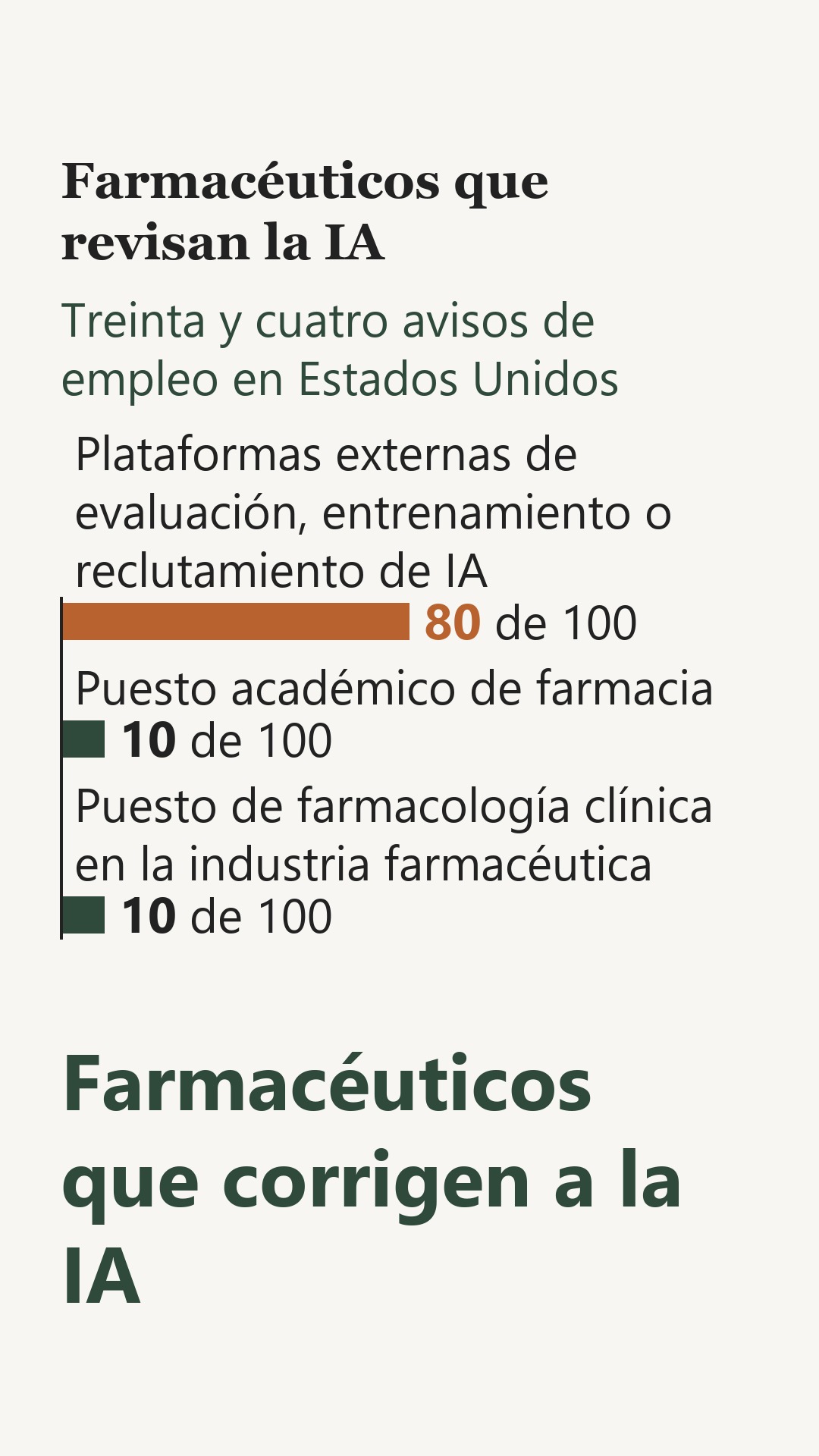
Reparto de los diez avisos según el tipo de empleador; son diez avisos escogidos a propósito, no un conteo de cuántos puestos así existen en el país.
Qué pedían los avisos que mencionaban IA frente a los que no la mencionaban
Fueron diez los primeros y veintiuno los segundos; los segundos quedaron solo como comparación y no se contaron como prueba de que se pida IA
Son diez avisos, y el autor los presenta como señales, no como un conteo de qué tan común es este trabajo.
Usted es farmacéutico, o estudia para serlo, y quiere saber si la inteligencia artificial cambia lo que le van a pedir en el trabajo. Un investigador de una universidad de California revisó 34 avisos de empleo para farmacéuticos, publicados en portales de trabajo de Estados Unidos entre enero de 2023 y agosto de 2026. De esos 34, 31 cumplían los requisitos del estudio. Diez pedían de forma explícita trabajo relacionado con inteligencia artificial.
Esos diez avisos pedían algo concreto. El farmacéutico debía detectar errores de dosis, de interacciones entre medicamentos y de seguimiento en las respuestas de la IA. Debía comparar dos respuestas y explicar cuál era mejor. Debía escribir respuestas modelo y casos clínicos. En otros avisos, debía calificar el desempeño de la máquina con reglas fijas.
Ocho de los diez avisos venían de plataformas que entrenan y evalúan sistemas de IA, muchas veces como trabajo por contrato o por proyecto. Ninguno era una vacante normal de farmacia comunitaria o de hospital. Son diez avisos, y el autor los presenta como señales, no como un conteo de qué tan común es este trabajo. Un aviso dice lo que la empresa busca; no muestra cómo es el día a día del puesto.
El autor agrupó las tareas en cinco capacidades. Juzgar y validar lo que responde la IA. Entender cómo el sistema llegó a esa respuesta. Diseñar las pruebas y los casos con que se mide. Evaluar el desempeño entre versiones del modelo y dar retroalimentación. Y decidir si una IA debe usarse en un flujo de trabajo y cómo vigilarla. Las cinco se apoyan en lo que un farmacéutico ya sabe: farmacoterapia, seguridad de medicamentos, lectura de evidencia y cálculos.
El autor deja una advertencia clara. El estudio no prueba que estas contrataciones estén creciendo en el país. Y como los avisos viejos se borran de internet, no se puede comparar un año con otro.
La próxima vez que vea una vacante que le pida evaluar o corregir respuestas clínicas generadas por IA, lea con cuidado si es un puesto fijo o un contrato corto, y pregunte en la entrevista qué tareas hará en un día normal.
Qué significa para usted
Cuando vea un aviso que pida corregir o calificar respuestas clínicas escritas por una máquina, fíjese si ofrecen plaza fija o trabajo por proyecto, y pregunte qué haría en una jornada normal. El estudio no muestra que estos puestos se estén multiplicando ni que las farmacias de barrio ya los pidan. Son diez avisos de Estados Unidos, y el autor los llama señales.
Malhotra, A., Cheung, A. (2026). Distilling AI Workforce-Readiness Competencies for U.S. Pharmacists from Job Advertisements: Implications for Pharmacy Education. Pharmacy. https://doi.org/10.3390/pharmacy14060138
Quién pagó: El artículo indica que esta investigación no recibió financiación externa y declara que no hay conflictos de interés; no dice si algún financiador, equipo o software fue aportado, aunque el autor usó OpenAI ChatGPT/Codex como herramienta.
No tome esto como consejo médico profesional.
Versión detalladaLos pasajes copiados del artículo, las ilustraciones y cada fuente con cuánto leímos de ella · 1201 palabras · unos 6 minLeerla →Cerrar
Les pagan por corregirle los errores a la IA: qué piden diez anuncios de farmacéuticos
Un escaneo piloto de ofertas de empleo en Estados Unidos encontró cinco habilidades que los patrones buscan. Son señales, no tendencias.
Diez anuncios de empleo en Estados Unidos pedían, con todas sus letras, que un farmacéutico trabajara con inteligencia artificial. Los autores los separaron de otros veintiún anuncios que pedían manejo de expedientes clínicos electrónicos, automatización o sistemas de apoyo a decisiones, pero que no mencionaban IA. Esos veintiuno quedaron solo como comparación1.
La tarea principal era revisar si lo que produce un modelo de IA es correcto, completo, lógico y seguro. Ocho de los diez anuncios pedían evaluar las respuestas del modelo; siete pedían validar directamente la exactitud clínica o la seguridad del medicamento2. Los patrones querían que el farmacéutico detectara errores de dosis, de interacciones, de contraindicaciones, de seguimiento o de consejería al paciente, que comparara dos respuestas posibles y explicara cuál era mejor y por qué3. No bastaba con aprobar o rechazar: había que dejar por escrito la razón4.
Siete anuncios pedían además construir casos clínicos, preguntas, conjuntos de datos o respuestas de referencia. El caso debía poner a prueba si el modelo reconoce una falla de órganos, un embarazo, la edad, otros medicamentos, resultados de laboratorio o datos que faltan5. Armar casos para sacar a la luz respuestas insegadas o sesgadas se describió como una prueba de seguridad hecha a propósito6.
Ocho de los diez anuncios venían de plataformas externas de evaluación, entrenamiento o reclutamiento de IA. Uno era un puesto académico y uno era un puesto de farmacología clínica en la industria farmacéutica7. Ninguno era una vacante común de farmacia comunitaria ni de farmacia de hospital8. Varios eran encargos por contrato, de bolsa de talento o por proyecto, no plazas permanentes9.
El estudio tiene un límite que conviene decir sin rodeos: diez anuncios son una muestra pequeña y escogida a propósito. Sus porcentajes describen lo que se encontró, no cuántos puestos así existen en el país10. Un anuncio dice lo que el patrón desea, no lo que el trabajo es en el día a día11.
Piense en un farmacéutico sentado frente a dos respuestas que un sistema le ofrece a la misma pregunta: cuál dosis ajustar en un paciente con riñón dañado. Ambas suenan bien. Una está mal. Su trabajo es señalar cuál falla, por qué falla y cómo debería decirse la respuesta correcta. Así funciona esta evaluación por dentro: alguien lee, compara, verifica contra la guía clínica y deja constancia3.
El estudio también revisó cálculos. En la ruta del evaluador, el farmacéutico revisaba las cuentas del modelo, los supuestos, las unidades y la interpretación clínica12. Y revisaba las fuentes: ubicar la afirmación, buscar la evidencia que la respalde, ver si sigue vigente y si aplica al paciente, y anotar la discrepancia13.
La conclusión de los autores es que el conocimiento de farmacia no se vuelve una habilidad de IA por sí solo. Lo que se suma son cinco capacidades dirigidas al sistema: evaluar y validar lo que produce, entender cómo se genera, diseñar pruebas, medir el desempeño y decidir si se implanta y cómo se vigila. La farmacoterapia, la seguridad del medicamento y el cálculo quedan como el piso profesional sobre el que se ejercen esas cinco.
Los propios autores describen una paradoja: la IA actual necesita revisión experta, y a la vez esos mismos expertos son contratados para mejorar el sistema que algún día podría hacer parte de su trabajo14. Lo que el estudio sí permite decir es que las tareas se reparten distinto: buscar, redactar un primer borrador, calcular lo rutinario y razonar de primera pasada pueden automatizarse más, mientras la responsabilidad se corre hacia precisar el problema, validar, manejar excepciones y responder por lo que se firma15. El valor del oficio pasaría por dejar el razonamiento escrito y supervisarlo, no por guardar la información del medicamento16.
Según el resumen de un estudio sobre la brecha entre lo que enseñan las universidades y lo que esperan los patrones, lo único disponible de él, los empleadores percibían que los recién egresados estaban poco preparados, sobre todo en la verificación de lo que produce la IA y en la ética de la IA17. Ese mismo resumen señala que los patrones valoran tanto la comunicación, la colaboración y el criterio humano como las habilidades técnicas18.
Según el resumen de un estudio sobre un curso intensivo de ocho semanas en un hospital de Corea del Sur, lo único disponible de él, el personal que no venía de sistemas de cómputo fue el que más avanzó, y algunos escribieron código por primera vez19. El mismo resumen advierte que, aun con 56 horas de clase, quedó una brecha entre lo aprendido y lo que se logra aplicar en el puesto20.
Aquí está la lectura de weeklyAI. El anuncio de "entrenador de IA" o "experto en farmacia" suele presentarse como flexible y colaborativo. Rara vez dice quién fija qué cuenta como respuesta correcta, cuánto se paga por tarea ni qué pasa con las correcciones que usted entrega. Lo que weeklyAI esperaría ver en su casa es esto: si el encargo es por proyecto y sin continuidad, el evaluador tenderá a corregir lo mínimo y a guardarse el razonamiento fino que lo hace valioso. La empresa obtendría respuestas correctas, pero no el criterio completo. Esta lectura se equivocaría si aparecen contratos con permanencia, pago por calidad sostenida o cláusulas de continuidad, y evaluadores que dicen haber entregado todo su criterio sin reservas.
Hay otra cosa que weeklyAI esperaría. Cuando una decisión clínica venga de un sistema, parte del trabajo será corregir sesgos que la empresa no reconoce como propios, y la decisión difícil se justificará diciendo que "lo sugirió el sistema". El farmacéutico quedaría como responsable visible de un error que no originó. Esta lectura se equivocaría si las empresas documentan y corrigen los sesgos con responsables nombrados, y si los evaluadores tienen autoridad formal para rechazar una salida sin presión de aprobarla. Lo que usted puede hacer es concreto: cuando una decisión venga de un sistema, deje registrado quién la revisó, con qué evidencia y qué se corrigió. No firme como validado lo que no pudo verificar.
Ahí, solo 18 de cada 100 encuestados habían tenido contacto previo con IA, y la mayoría mostró alfabetización digital baja o moderada21. El estudio proponía formación contextualizada y aprendizaje en comunidad, no un curso genérico22.
Los autores no presentan estas cinco habilidades como requisitos de acreditación ni como plan de estudios obligatorio. Las llaman prioridades preliminares que necesitan validación. Proponen entrevistar a quienes contratan y a quienes ocupan los puestos, repetir la búsqueda con el registro archivado y buscar consenso entre farmacéuticos, informáticos, reguladores, docentes, estudiantes, desarrolladores y pacientes.
Esta lectura se equivocaría si los anuncios de farmacia comunitaria y de hospital empiezan a pedir estas habilidades de forma explícita, o si los contratos de evaluación se vuelven permanentes y con pago por calidad sostenida.
Lo que queda para usted es una pregunta que puede llevar a una entrevista o a una conversación con su empleador: ¿quién define qué es una respuesta correcta, cuánto dura el encargo y qué uso se dará a las correcciones que yo entregue?
De dónde sale cada dato de contexto, y cuánto leímos de cada documento
- Malhotra, A., Cheung, A. (2026). Distilling AI Workforce-Readiness Competencies for U.S. Pharmacists from Job Advertisements: Implications for Pharmacy Education. Pharmacy. https://doi.org/10.3390/pharmacy14060138 - el artículo del que trata esta nota — el artículo completo — el pasaje: "Ten explicitly required AI-related work and formed the primary analytic sample, while 21 AI-enabling informatics, electronic-health-record, automation, analytics, and clinical-decision-support roles were retained as contextual comparators."
- Malhotra, A., Cheung, A. (2026). Distilling AI Workforce-Readiness Competencies for U.S. Pharmacists from Job Advertisements: Implications for Pharmacy Education. Pharmacy. https://doi.org/10.3390/pharmacy14060138 - el artículo del que trata esta nota — el artículo completo — el pasaje: "The dominant task was determining whether AI-generated clinical content was accurate, complete, logical, and safe. Eight of 10 advertisements supported evaluation of model output or reasoning, while seven directly supported clinical-accuracy or medication-safety validation."
- Malhotra, A., Cheung, A. (2026). Distilling AI Workforce-Readiness Competencies for U.S. Pharmacists from Job Advertisements: Implications for Pharmacy Education. Pharmacy. https://doi.org/10.3390/pharmacy14060138 - el artículo del que trata esta nota — el artículo completo — el pasaje: "Employers asked pharmacists to identify dosing, interaction, contraindication, monitoring, counseling, or therapeutic errors; compare competing responses; justify the preferable answer; and supply corrected reasoning or structured feedback."
- Malhotra, A., Cheung, A. (2026). Distilling AI Workforce-Readiness Competencies for U.S. Pharmacists from Job Advertisements: Implications for Pharmacy Education. Pharmacy. https://doi.org/10.3390/pharmacy14060138 - el artículo del que trata esta nota — el artículo completo — el pasaje: "Pharmacist expertise therefore served as a reference standard against which model performance was judged. The role was not simply to approve or reject an answer, but to externalize why it was acceptable, incomplete, or unsafe."
- Malhotra, A., Cheung, A. (2026). Distilling AI Workforce-Readiness Competencies for U.S. Pharmacists from Job Advertisements: Implications for Pharmacy Education. Pharmacy. https://doi.org/10.3390/pharmacy14060138 - el artículo del que trata esta nota — el artículo completo — el pasaje: "Pharmacists were expected to construct cases that revealed whether a model recognized organ dysfunction, pregnancy, age, concurrent drugs, laboratory findings, contraindications, missing information, or other variables that change medication decisions."
- Malhotra, A., Cheung, A. (2026). Distilling AI Workforce-Readiness Competencies for U.S. Pharmacists from Job Advertisements: Implications for Pharmacy Education. Pharmacy. https://doi.org/10.3390/pharmacy14060138 - el artículo del que trata esta nota — el artículo completo — el pasaje: "Designing cases to surface unsafe or biased output was interpreted as adversarial medication-safety testing."
- Malhotra, A., Cheung, A. (2026). Distilling AI Workforce-Readiness Competencies for U.S. Pharmacists from Job Advertisements: Implications for Pharmacy Education. Pharmacy. https://doi.org/10.3390/pharmacy14060138 - el artículo del que trata esta nota — el artículo completo — el pasaje: "Eight advertisements (80%) originated from external AI evaluation, training, expert-network, or recruitment platforms; one (10%) was an academic pharmacy faculty position; and one (10%) was a pharmaceutical-industry clinical-pharmacology implementation position."
- Malhotra, A., Cheung, A. (2026). Distilling AI Workforce-Readiness Competencies for U.S. Pharmacists from Job Advertisements: Implications for Pharmacy Education. Pharmacy. https://doi.org/10.3390/pharmacy14060138 - el artículo del que trata esta nota — el artículo completo — el pasaje: "No AI-explicit advertisement in the primary sample was a conventional community-pharmacist or hospital/health-system pharmacist vacancy."
- Malhotra, A., Cheung, A. (2026). Distilling AI Workforce-Readiness Competencies for U.S. Pharmacists from Job Advertisements: Implications for Pharmacy Education. Pharmacy. https://doi.org/10.3390/pharmacy14060138 - el artículo del que trata esta nota — el artículo completo — el pasaje: "Several were contractor, expert-network, project-intake, or talent-pool opportunities rather than conventional permanent pharmacist positions."
- Malhotra, A., Cheung, A. (2026). Distilling AI Workforce-Readiness Competencies for U.S. Pharmacists from Job Advertisements: Implications for Pharmacy Education. Pharmacy. https://doi.org/10.3390/pharmacy14060138 - el artículo del que trata esta nota — el artículo completo — el pasaje: "First, the 10 AI-explicit advertisements constitute a small, purposively retrieved sample; frequencies are descriptive signals and not estimates of national prevalence."
- Malhotra, A., Cheung, A. (2026). Distilling AI Workforce-Readiness Competencies for U.S. Pharmacists from Job Advertisements: Implications for Pharmacy Education. Pharmacy. https://doi.org/10.3390/pharmacy14060138 - el artículo del que trata esta nota — el artículo completo — el pasaje: "Job advertisements express desired qualifications rather than verified daily practice, while employers may use AI without naming it in advertisements."
- Malhotra, A., Cheung, A. (2026). Distilling AI Workforce-Readiness Competencies for U.S. Pharmacists from Job Advertisements: Implications for Pharmacy Education. Pharmacy. https://doi.org/10.3390/pharmacy14060138 - el artículo del que trata esta nota — el artículo completo — el pasaje: "In the evaluator pathway, pharmacists checked model calculations, assumptions, units, and clinical interpretation."
- Malhotra, A., Cheung, A. (2026). Distilling AI Workforce-Readiness Competencies for U.S. Pharmacists from Job Advertisements: Implications for Pharmacy Education. Pharmacy. https://doi.org/10.3390/pharmacy14060138 - el artículo del que trata esta nota — el artículo completo — el pasaje: "The pharmacist must identify claims, locate appropriate evidence, determine whether it supports the response, assess currency and patient applicability, and document discrepancies."
- Malhotra, A., Cheung, A. (2026). Distilling AI Workforce-Readiness Competencies for U.S. Pharmacists from Job Advertisements: Implications for Pharmacy Education. Pharmacy. https://doi.org/10.3390/pharmacy14060138 - el artículo del que trata esta nota — el artículo completo — el pasaje: "The advertisements demonstrate that current AI systems require expert review, yet pharmacists are simultaneously being recruited to improve those systems."
- Malhotra, A., Cheung, A. (2026). Distilling AI Workforce-Readiness Competencies for U.S. Pharmacists from Job Advertisements: Implications for Pharmacy Education. Pharmacy. https://doi.org/10.3390/pharmacy14060138 - el artículo del que trata esta nota — el artículo completo — el pasaje: "Retrieval, preliminary drafting, routine calculations, and first-pass reasoning may become more automated, while pharmacist responsibility shifts toward problem specification, validation, exception management, uncertainty, workflow integration, communication, and accountability."
- Malhotra, A., Cheung, A. (2026). Distilling AI Workforce-Readiness Competencies for U.S. Pharmacists from Job Advertisements: Implications for Pharmacy Education. Pharmacy. https://doi.org/10.3390/pharmacy14060138 - el artículo del que trata esta nota — el artículo completo — el pasaje: "The profession’s strategic value may increasingly depend on its ability to codify and supervise medication reasoning rather than merely retain exclusive possession of drug information."
- McNeill L, Uddin MM, Abu S, Pei M, Awoyemi ID, Regalado L. (2026). Bridging the AI literacy gap: mixed-methods evidence from employers on workforce readiness and curriculum priorities. Frontiers in Education. https://doi.org/10.3389/feduc.2026.1876200 — solo el resumen - no se pudo obtener el texto completo — el pasaje: "Employers also perceived recent graduates as underprepared, particularly in AI output verification and AI ethics."
- McNeill L, Uddin MM, Abu S, Pei M, Awoyemi ID, Regalado L. (2026). Bridging the AI literacy gap: mixed-methods evidence from employers on workforce readiness and curriculum priorities. Frontiers in Education. https://doi.org/10.3389/feduc.2026.1876200 — solo el resumen - no se pudo obtener el texto completo — el pasaje: "Findings indicated that employer-defined AI readiness is fundamentally socio-technical: task-specific prompting and tool fluency must be coupled with professional communication, collaboration, human oversight, and judgment, soft skills that employers rated as highly as technical AI competencies."
- Baek G, Lee H, Yang DH, Kang M, Lee KH, Choi M, et al. (2026). Teaching Model Context Protocol, Retrieval-Augmented Generation, and AI Agents to a Multidisciplinary Hospital Workforce: Single-Group Pre-Post Survey Study. JMIR Medical Education. 10.2196/97822 — solo el resumen - no se pudo obtener el texto completo — el pasaje: "Non-IT professionals, clinicians, health information managers, researchers, and administrative staff showed consistently larger gains than IT specialists; several reported coding for the first time through vibe coding, challenging the assumption that advanced AI training requires technical backgrounds."
- Baek G, Lee H, Yang DH, Kang M, Lee KH, Choi M, et al. (2026). Teaching Model Context Protocol, Retrieval-Augmented Generation, and AI Agents to a Multidisciplinary Hospital Workforce: Single-Group Pre-Post Survey Study. JMIR Medical Education. 10.2196/97822 — solo el resumen - no se pudo obtener el texto completo — el pasaje: "Despite significant overall gains, a knowledge-practice gap persisted: job-specific competency remained below the scale midpoint, though participants spontaneously reported generating workplace application ideas."
- Ayuni D, Prasetyaningtyas SW, Pujiwati A, Ramaditya M. (2026). Developing an AI Driven Human Resource Development Framework for Sustainable Tourism Villages. Aptisi Transactions on Technopreneurship (ATT). https://doi.org/10.34306/att.v9i1.744 — solo el resumen - no se pudo obtener el texto completo — el pasaje: "The findings reveal substantial gaps in digital competence and AI readiness, with only 18% of respondents reporting prior exposure to AI technologies and 82% demonstrating low-to-moderate digital literacy."
- Ayuni D, Prasetyaningtyas SW, Pujiwati A, Ramaditya M. (2026). Developing an AI Driven Human Resource Development Framework for Sustainable Tourism Villages. Aptisi Transactions on Technopreneurship (ATT). https://doi.org/10.34306/att.v9i1.744 — solo el resumen - no se pudo obtener el texto completo — el pasaje: "Based on these findings, this study proposes a four-pillar HRD framework consisting of digital literacy and AI awareness, contextualized training programs, collaborative learning models, and continuous monitoring and evaluation."
Malhotra, A., Cheung, A. (2026). Distilling AI Workforce-Readiness Competencies for U.S. Pharmacists from Job Advertisements: Implications for Pharmacy Education. Pharmacy. https://doi.org/10.3390/pharmacy14060138
Quién pagó: El artículo indica que esta investigación no recibió financiación externa y declara que no hay conflictos de interés; no dice si algún financiador, equipo o software fue aportado, aunque el autor usó OpenAI ChatGPT/Codex como herramienta.
No tome esto como consejo médico profesional.
analysis of texts · Pharmacy (Basel, Switzerland) · the paper, 20 Sep 2026 · free
Pharmacists Are Being Hired to Check the Chatbot's Drug Answers
One researcher read 10 US job ads that asked for AI work. They show a new kind of task, not proof that such jobs are spreading.
Short version · the longer version follows, about 6 min
Ask the weeklyAI chat
Ask me about AI in your life: I point you to the stories weeklyAI has published on it, this week and before.
Conversations are saved for as long as weeklyAI exists, to improve the publication. Answers come in the language you write in.
- The study at a glance
- Who
- U.S. pharmacist job advertisements
- How many
- 10 advertisements that explicitly asked for AI-related work
- Where
- United States
- When
- posted or available between January 2023 and August 2026
- Kind of study
- analysis of what people did
- Who did it
- Ashim Malhotra and Alvin Cheung, California Northstate University
- The limit that matters
- Ten advertisements are a small, deliberately gathered sample; counts are signals, not national estimates.
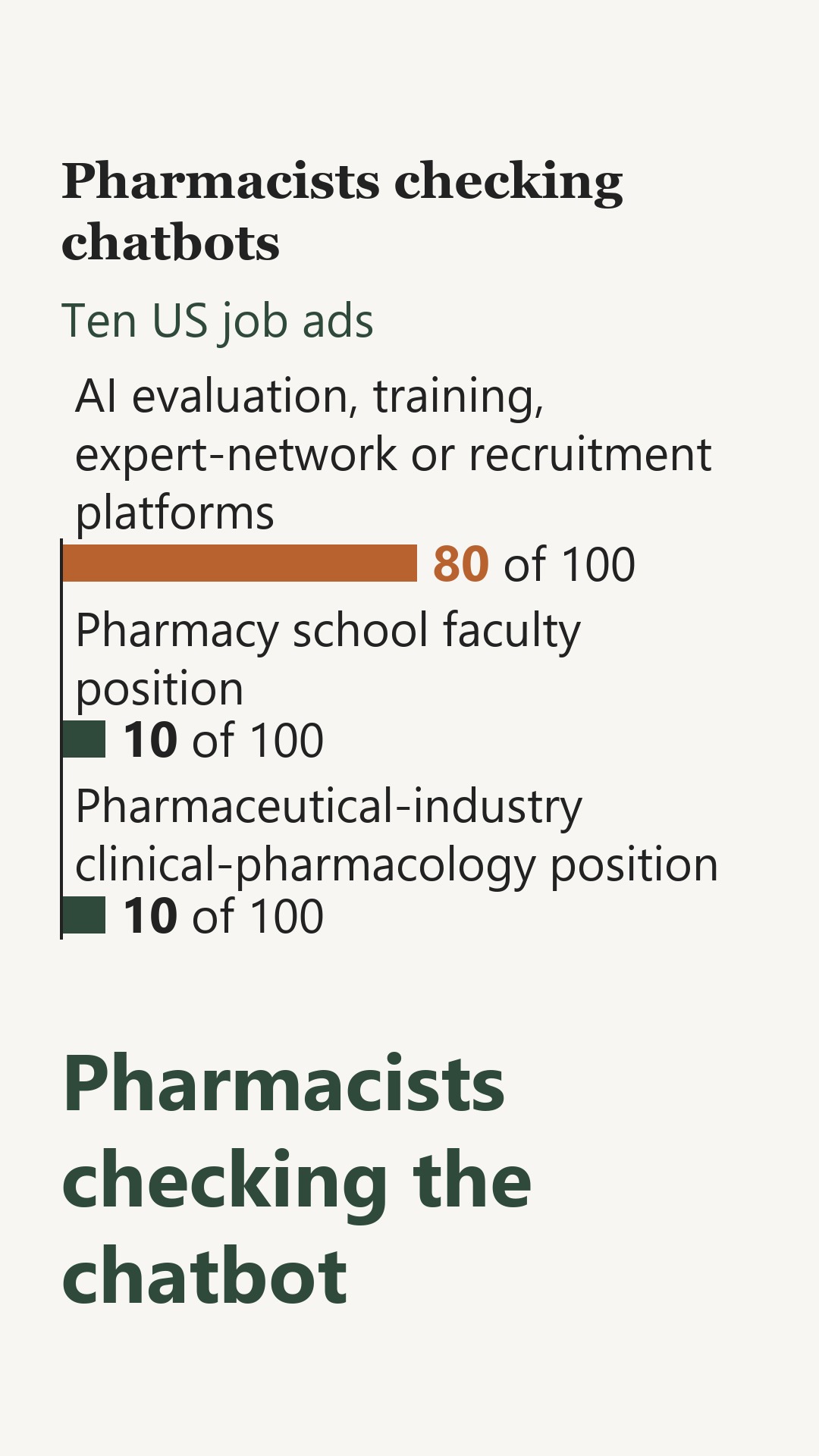
Shares of the 10 U.S. job advertisements that explicitly asked for AI-related work; a small, deliberately gathered sample, so read them as signals, not national shares.
The pharmacist's expertise served as the yardstick against which the machine was measured, and the role was not to approve or reject an answer but to spell out why it was acceptable, incomplete or unsafe.
You are a pharmacist, or training to become one, and the question is whether AI changes what you are hired to do. Ten job advertisements from the United States offer an early picture of the answer.
One researcher assessed 34 US job postings for pharmacists posted or available between January 2023 and August 2026. Of those, 31 qualified for the study, and 10 of them explicitly asked for AI-related work. The other 21 described informatics, electronic health records, automation or clinical decision support without naming AI, and were kept only for comparison.
Read what those 10 employers wanted. The pharmacist should catch dosing, interaction and monitoring errors in an AI answer. The pharmacist should compare two answers to the same question and explain which is safer and why. The pharmacist should write gold-standard answers, build test cases, and set the scoring rules used to judge a model.
Eight of the ten advertisements came from AI training, evaluation and recruitment platforms. Several were contract, project or talent-pool postings rather than permanent staff jobs, so read them as project work. None was an ordinary community pharmacy or hospital pharmacy vacancy.
The author calls these findings signals. Ten advertisements cannot say how common AI work is among pharmacists, and the online postings that vanish over time mean the study cannot show the work is growing. An advertisement states what an employer wants, not what the job is really like from day to day.
The skills the advertisements named sit on top of ordinary drug knowledge. The author grouped them into five: judging an AI answer, tracing how a system produced it, designing test cases, measuring a model's performance across versions, and overseeing safe use. Three of the five had support from several advertisements: judging an AI answer, designing test cases, and measuring a model's performance. Tracing how a system produced an answer and overseeing safe use had less support.
Watch for postings that ask you to evaluate or correct AI-generated clinical content, and read whether the role is permanent or a short contract.
What this means for you
The change is in what a pharmacist is asked to do, and the ten ads are too few to say how common that work is or whether it is spreading. For now, watch the postings that ask you to correct or grade an AI answer, and read whether they offer a permanent job or a short contract.
Malhotra, A., Cheung, A. (2026). Distilling AI Workforce-Readiness Competencies for U.S. Pharmacists from Job Advertisements: Implications for Pharmacy Education. Pharmacy. https://doi.org/10.3390/pharmacy14060138
Who paid: The article states that this research received no external funding and declares no conflicts of interest; it does not say whether any funder, equipment or software was provided, though the author used OpenAI ChatGPT/Codex as a tool.
Do not take this as professional medical advice.
The longer versionThe passages copied from the paper, the pictures, and every source with how much of it we read · 1207 words · about 6 minRead it →Close
Pharmacists Are Being Hired to Check AI's Drug Answers. Ten Job Ads Show What They're Asked to Do.
A small scan of U.S. pharmacy job postings finds five skills employers name when they want a pharmacist to test, correct or supervise an AI system. It is an early signal, not a count of the field.
A pharmacist opens a chat window and types a question about a patient: kidney function falling, two drugs that interact, a dose that needs adjusting. The machine answers in fluent, confident sentences. The job is to decide whether that answer is right, and to say exactly why it is wrong when it isn't. That task sits at the center of a pilot study led by Ashim Malhotra, with Alvin Cheung credited as a co-author, published in the journal *Pharmacy* on 20 September 2026 and funded by no outside source. The authors read publicly posted U.S. pharmacist job advertisements, retrieved between 2023 and August 2026, and asked a simple question: when an employer explicitly wants a pharmacist for AI work, what work is that?
They audited 34 distinct job postings. Thirty-one met their criteria. Ten of those explicitly described AI-related duties and became the main sample; the other 21 mentioned informatics, electronic health records, automation, analytics or clinical decision support but no AI duty, and were kept only as a comparison group1. Of the ten, eight came from outside AI evaluation, training, expert-network or recruitment platforms, one was a pharmacy school faculty post, and one was a pharmaceutical-industry clinical-pharmacology position2. Not one was an ordinary community pharmacy or hospital pharmacy vacancy3.
The work itself was mostly judgment. Eight of the ten postings asked the pharmacist to evaluate what a model produced; seven asked specifically for checking clinical accuracy or medication safety4. Employers wanted dosing, interaction, contraindication, monitoring and counseling errors caught, competing answers compared, the better one justified, and corrected reasoning or structured feedback supplied5. The pharmacist's expertise served as the yardstick against which the machine was measured, and the role was not to approve or reject an answer but to spell out why it was acceptable, incomplete or unsafe6.
Consider what such a posting asks for. Some wanted test cases built to see whether a model noticed kidney problems, pregnancy, age, other drugs, lab results, missing information — the variables that change a medication decision7. Designing cases meant to expose unsafe or biased output was read by the authors as a kind of safety testing aimed at the machine8. Others wanted calculations, assumptions, units and clinical interpretation checked9, and claims traced back to guidelines, with currency, applicability to the patient, and any discrepancy written down10.
From these tasks the authors built eleven activity groups and folded them into five skills: judging and validating an AI's output; understanding how inputs, models, retrieval sources and human oversight produce that output; designing prompts and evaluation tasks; measuring performance across cases and model versions and giving structured feedback; and implementing and governing AI responsibly. All five could still be found even in the strictest cut of the data, five postings, though support was not even: the two governance-and-workflow skills rested mainly on the academic post. The authors are careful: the two governance-and-workflow skills leaned mainly on the academic post, and they call those two less settled.
The limits are as plain as the findings. Ten advertisements are a small, deliberately gathered sample, and the authors say their counts are signals, not estimates of how common such jobs are nationally11. Several of the postings were contractor, expert-network, project-intake or talent-pool arrangements rather than permanent pharmacist positions12. An advertisement states what an employer wants, not what the job is like day to day, and employers may use AI without ever naming it in a posting13. No complete log was kept of which of 336 generated search strings were actually run, so the search cannot be called exhaustive. Web postings expire, so no trend after ChatGPT's release can be shown.
Here is weeklyAI's reading. The pattern is a quiet split in who gets to learn the new tools. The pharmacists being paid to correct a model's drug answers and write its test cases sit mostly outside the ordinary pharmacy — short contracts, outside platforms, project work12 — while the staff pharmacist behind a counter or on a hospital floor was not among the ten postings at all3. When a company needs this expertise, it appears to buy it in rather than grow it in its own staff. This reading would be wrong if ordinary community and hospital employers were writing AI-checking into regular staff roles, or paying their own pharmacists to learn these skills. If you work in a pharmacy, the question worth asking your employer is whether AI-checking is a paid part of your job or something you would have to do on your own time through an outside platform.
A second thing weeklyAI expects, and it is only an expectation: the pharmacists who turn out to be best at catching a model's dosing and safety errors will likely be those with the deepest clinical training, not the most computer background. The postings describe the work as checking, but what they are buying is judgment about a specific patient. Watch whether these roles are paid and credited as expert work, or priced per task like piecework. This reading would be wrong if employers were choosing evaluators mainly on programming credentials, or if clinical depth made no difference to who catches the errors. Before taking an AI-training or evaluation gig, ask what the pay per task works out to per hour, whether hours are capped, and whether the work carries your name.
The worry is not imaginary across other fields. According to the summary of a study of employers and recent graduates — the only part of it available; the full paper is behind a subscription — employers rated human oversight and judgment as highly as technical AI skill, and saw new graduates as underprepared in verifying AI output and in AI ethics1415. A separate summary of a training program at a large Korean hospital reports that non-IT staff, including clinicians, gained more than IT specialists, which challenges the idea that advanced AI training requires a technical background16.
What would have to happen next is validation, not adoption. The authors call their five skills workforce-anchored hypotheses rather than accreditation standards, and ask for repeated searches, a second independent coder, interviews with hiring managers and people in the roles, and agreement among pharmacists, informaticists, regulators, educators and patients before any curriculum is built on them.
Here is what this makes possible for you. If you are a pharmacist, the skill being bought is the one you already have — knowing when a dose is wrong and why — and the new part is saying it out loud in a form a machine can be tested against. If you are hiring, look at whether your best error-catchers are paid and recognized as experts. This reading would be wrong if the next round of ordinary pharmacy postings starts listing AI-checking among the regular duties. The thing to watch is the next job ad on the board at your workplace: does it mention AI at all, and does it pay for the checking?
Where each piece of context comes from, and how much of it we read
- Malhotra, A., Cheung, A. (2026). Distilling AI Workforce-Readiness Competencies for U.S. Pharmacists from Job Advertisements: Implications for Pharmacy Education. Pharmacy. https://doi.org/10.3390/pharmacy14060138 - the article this story is about — the whole article — the passage: "Ten explicitly required AI-related work and formed the primary analytic sample, while 21 AI-enabling informatics, electronic-health-record, automation, analytics, and clinical-decision-support roles were retained as contextual comparators."
- Malhotra, A., Cheung, A. (2026). Distilling AI Workforce-Readiness Competencies for U.S. Pharmacists from Job Advertisements: Implications for Pharmacy Education. Pharmacy. https://doi.org/10.3390/pharmacy14060138 - the article this story is about — the whole article — the passage: "Eight advertisements (80%) originated from external AI evaluation, training, expert-network, or recruitment platforms; one (10%) was an academic pharmacy faculty position; and one (10%) was a pharmaceutical-industry clinical-pharmacology implementation position."
- Malhotra, A., Cheung, A. (2026). Distilling AI Workforce-Readiness Competencies for U.S. Pharmacists from Job Advertisements: Implications for Pharmacy Education. Pharmacy. https://doi.org/10.3390/pharmacy14060138 - the article this story is about — the whole article — the passage: "No AI-explicit advertisement in the primary sample was a conventional community-pharmacist or hospital/health-system pharmacist vacancy."
- Malhotra, A., Cheung, A. (2026). Distilling AI Workforce-Readiness Competencies for U.S. Pharmacists from Job Advertisements: Implications for Pharmacy Education. Pharmacy. https://doi.org/10.3390/pharmacy14060138 - the article this story is about — the whole article — the passage: "The dominant task was determining whether AI-generated clinical content was accurate, complete, logical, and safe. Eight of 10 advertisements supported evaluation of model output or reasoning, while seven directly supported clinical-accuracy or medication-safety validation."
- Malhotra, A., Cheung, A. (2026). Distilling AI Workforce-Readiness Competencies for U.S. Pharmacists from Job Advertisements: Implications for Pharmacy Education. Pharmacy. https://doi.org/10.3390/pharmacy14060138 - the article this story is about — the whole article — the passage: "Employers asked pharmacists to identify dosing, interaction, contraindication, monitoring, counseling, or therapeutic errors; compare competing responses; justify the preferable answer; and supply corrected reasoning or structured feedback."
- Malhotra, A., Cheung, A. (2026). Distilling AI Workforce-Readiness Competencies for U.S. Pharmacists from Job Advertisements: Implications for Pharmacy Education. Pharmacy. https://doi.org/10.3390/pharmacy14060138 - the article this story is about — the whole article — the passage: "Pharmacist expertise therefore served as a reference standard against which model performance was judged. The role was not simply to approve or reject an answer, but to externalize why it was acceptable, incomplete, or unsafe."
- Malhotra, A., Cheung, A. (2026). Distilling AI Workforce-Readiness Competencies for U.S. Pharmacists from Job Advertisements: Implications for Pharmacy Education. Pharmacy. https://doi.org/10.3390/pharmacy14060138 - the article this story is about — the whole article — the passage: "Pharmacists were expected to construct cases that revealed whether a model recognized organ dysfunction, pregnancy, age, concurrent drugs, laboratory findings, contraindications, missing information, or other variables that change medication decisions."
- Malhotra, A., Cheung, A. (2026). Distilling AI Workforce-Readiness Competencies for U.S. Pharmacists from Job Advertisements: Implications for Pharmacy Education. Pharmacy. https://doi.org/10.3390/pharmacy14060138 - the article this story is about — the whole article — the passage: "Designing cases to surface unsafe or biased output was interpreted as adversarial medication-safety testing."
- Malhotra, A., Cheung, A. (2026). Distilling AI Workforce-Readiness Competencies for U.S. Pharmacists from Job Advertisements: Implications for Pharmacy Education. Pharmacy. https://doi.org/10.3390/pharmacy14060138 - the article this story is about — the whole article — the passage: "In the evaluator pathway, pharmacists checked model calculations, assumptions, units, and clinical interpretation."
- Malhotra, A., Cheung, A. (2026). Distilling AI Workforce-Readiness Competencies for U.S. Pharmacists from Job Advertisements: Implications for Pharmacy Education. Pharmacy. https://doi.org/10.3390/pharmacy14060138 - the article this story is about — the whole article — the passage: "The pharmacist must identify claims, locate appropriate evidence, determine whether it supports the response, assess currency and patient applicability, and document discrepancies."
- Malhotra, A., Cheung, A. (2026). Distilling AI Workforce-Readiness Competencies for U.S. Pharmacists from Job Advertisements: Implications for Pharmacy Education. Pharmacy. https://doi.org/10.3390/pharmacy14060138 - the article this story is about — the whole article — the passage: "First, the 10 AI-explicit advertisements constitute a small, purposively retrieved sample; frequencies are descriptive signals and not estimates of national prevalence."
- Malhotra, A., Cheung, A. (2026). Distilling AI Workforce-Readiness Competencies for U.S. Pharmacists from Job Advertisements: Implications for Pharmacy Education. Pharmacy. https://doi.org/10.3390/pharmacy14060138 - the article this story is about — the whole article — the passage: "Several were contractor, expert-network, project-intake, or talent-pool opportunities rather than conventional permanent pharmacist positions."
- Malhotra, A., Cheung, A. (2026). Distilling AI Workforce-Readiness Competencies for U.S. Pharmacists from Job Advertisements: Implications for Pharmacy Education. Pharmacy. https://doi.org/10.3390/pharmacy14060138 - the article this story is about — the whole article — the passage: "Job advertisements express desired qualifications rather than verified daily practice, while employers may use AI without naming it in advertisements."
- McNeill L, Uddin MM, Abu S, Pei M, Awoyemi ID, Regalado L. (2026). Bridging the AI literacy gap: mixed-methods evidence from employers on workforce readiness and curriculum priorities. Frontiers in Education. https://doi.org/10.3389/feduc.2026.1876200 — only the abstract - the full text could not be fetched — the passage: "Findings indicated that employer-defined AI readiness is fundamentally socio-technical: task-specific prompting and tool fluency must be coupled with professional communication, collaboration, human oversight, and judgment, soft skills that employers rated as highly as technical AI competencies."
- McNeill L, Uddin MM, Abu S, Pei M, Awoyemi ID, Regalado L. (2026). Bridging the AI literacy gap: mixed-methods evidence from employers on workforce readiness and curriculum priorities. Frontiers in Education. https://doi.org/10.3389/feduc.2026.1876200 — only the abstract - the full text could not be fetched — the passage: "Employers also perceived recent graduates as underprepared, particularly in AI output verification and AI ethics."
- Baek G, Lee H, Yang DH, Kang M, Lee KH, Choi M, et al. (2026). Teaching Model Context Protocol, Retrieval-Augmented Generation, and AI Agents to a Multidisciplinary Hospital Workforce: Single-Group Pre-Post Survey Study. JMIR Medical Education. 10.2196/97822 — only the abstract - the full text could not be fetched — the passage: "Non-IT professionals, clinicians, health information managers, researchers, and administrative staff showed consistently larger gains than IT specialists; several reported coding for the first time through vibe coding, challenging the assumption that advanced AI training requires technical backgrounds."
Malhotra, A., Cheung, A. (2026). Distilling AI Workforce-Readiness Competencies for U.S. Pharmacists from Job Advertisements: Implications for Pharmacy Education. Pharmacy. https://doi.org/10.3390/pharmacy14060138
Who paid: The article states that this research received no external funding and declares no conflicts of interest; it does not say whether any funder, equipment or software was provided, though the author used OpenAI ChatGPT/Codex as a tool.
Do not take this as professional medical advice.