interviews · JMIR aging · la publicación, 16 oct 2026 · gratis
Un asistente de IA para moverse: la mayoría lo probaría, con condiciones
En entrevistas con 20 personas de 65 años o más en Estados Unidos, 14 dijeron que estarían dispuestas a usar un asistente de inteligencia artificial en una app de actividad física. El grupo tenía estudios universitarios y opinó mirando imágenes, no usando una app real.
Versión breve · la versión detallada sigue, unos 7 min
Pregunte al chat de weeklyAI
Pregúnteme sobre la IA en su vida: le señalo las notas que weeklyAI ha publicado sobre el tema, esta semana y antes.
Las conversaciones se guardan mientras exista weeklyAI, para mejorar la publicación. Se responde en el idioma en que usted escribe.
- El estudio, de un vistazo
- Quiénes
- Adultos de 65 años o más que viven en Estados Unidos
- Cuántos
- 20
- Dónde
- Estados Unidos
- Cuándo
- entrevistas entre mayo de 2024 y enero de 2025
- Tipo de estudio
- entrevistas
- Quién lo hizo
- Universidad de Illinois Urbana-Champaign y City University of New York
- El límite que importa
- Grupo pequeño, muy educado y de una sola región; opinó sobre imágenes, no usó una app real.
Son las preferencias de 20 personas entrevistadas, todas con estudios universitarios y de una sola región de Estados Unidos; no representan a todos los adultos mayores.
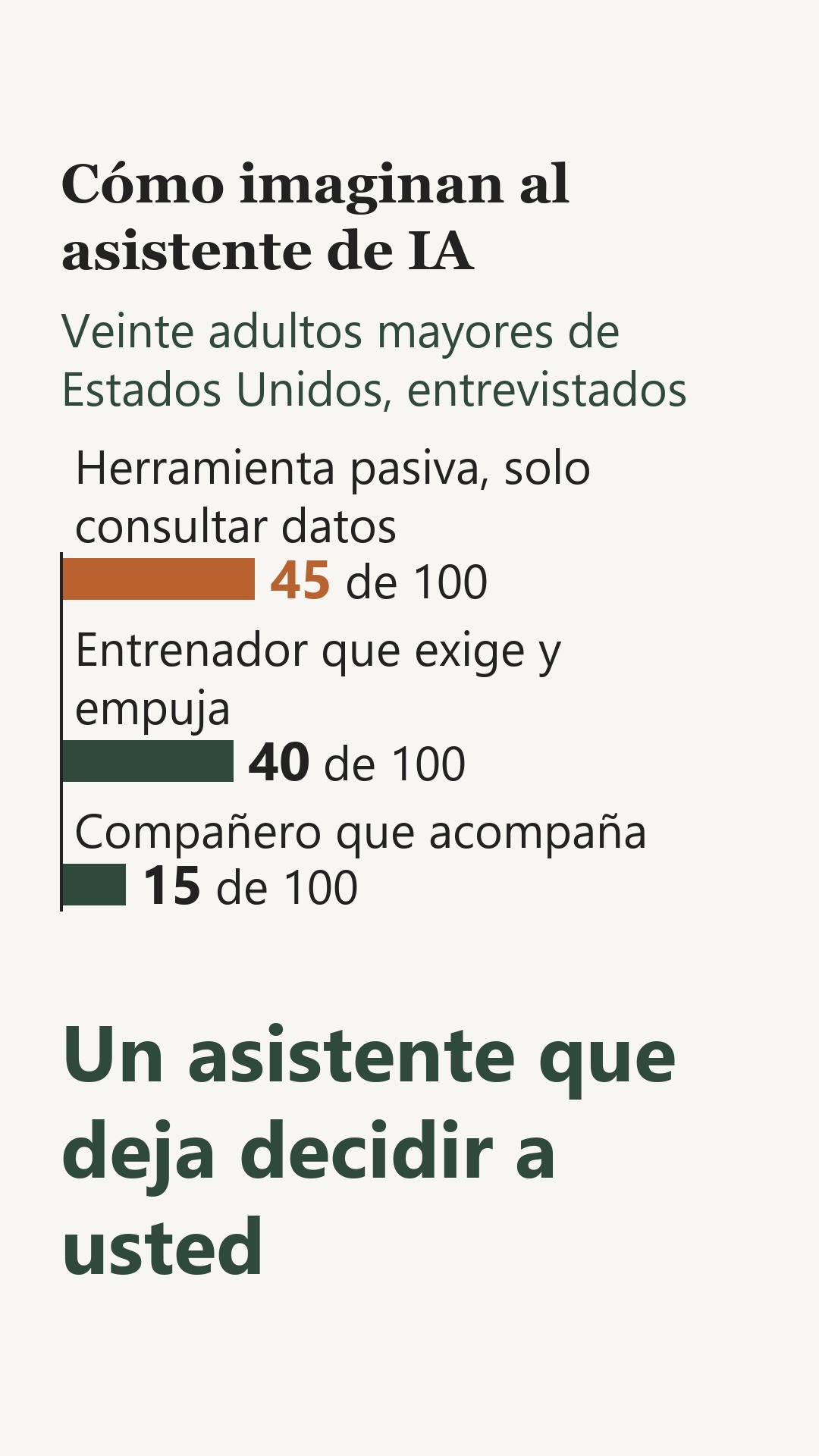
Lo que este estudio deja es una pregunta que usted puede llevar consigo la próxima vez que le ofrezcan una app de salud: ¿esta herramienta me deja decidir a mí, o decide ella por mí?
Un teléfono o un reloj ya está en casa, y con él llegan las apps de salud. Investigadores de la Universidad de Illinois y de la City University of New York entrevistaron a 20 adultos de 65 años o más que viven en Estados Unidos. Cada entrevista duró cerca de una hora y trató sobre actividad física y apps de salud.
Lo que más querían era conservar la independencia y la rutina que ya tenían. Muchos se dijeron conformes con su nivel de actividad y ajustaban el ejercicio a sus enfermedades o lesiones. Una mujer lo resumió: "No me estoy preparando para un maratón, pero camino, hago jardinería. A mi edad, creo que voy bien".
La mayoría, 14 de las 20 personas, se mostró dispuesta a probar un asistente de inteligencia artificial que ayudara con la actividad física. No todas lo imaginaban igual. Nueve lo veían como una herramienta pasiva, que sirve sobre todo para consultar datos. Ocho lo querían como un entrenador que empuja. Tres lo imaginaban como un compañero que acompaña.
Las mismas personas nombraron lo que estorba. Pantallas pequeñas, menús llenos de símbolos, procesos de diez o doce pasos para llegar a algo. Cinco expresaron preocupación fuerte por la privacidad de sus datos. Varias dudaban de que la IA acierte. Una dijo que quiere "sentir que controlo el teléfono, y no que el teléfono me controla a mí".
Las 20 personas tenían al menos un título universitario y casi todas eran blancas. Casi todos vivían en una zona urbana del Medio Oeste estadounidense. Su comodidad con la tecnología puede ser mayor que la de muchos lectores. Tampoco usaron una app de verdad: reaccionaron a escenarios imaginados y a imágenes de avatares. Lo que alguien dice que aceptaría puede no ser lo que acepta en el uso diario. Y los niveles de actividad fueron lo que cada quien reportó de sí mismo, sin medición.
Cuando una app o un aparato ofrezca un asistente de inteligencia artificial, busque uno que le deje fijar sus propias metas, que muestre de dónde sale su consejo y que se pueda apagar.
Qué significa para usted
Cuando una aplicación o un aparato le ofrezca un asistente de inteligencia artificial, fíjese si le deja fijar sus propias metas y si muestra de dónde sale su consejo. Pregunte también qué hace con sus datos y si puede apagarlo cuando quiera. Nada de esto se probó en uso real: lo que la gente dijo que aceptaría puede no ser lo que acepta en su día a día.
Choudhry, A., Mshvelidze, J., Mullen, S. P. et al. (2026). Motivations, Barriers, and the Potential of AI in Physical Activity Apps for US Older Adults: Interview Study. JMIR Aging. https://doi.org/10.2196/96114
Quién pagó: Los autores declararon que no recibieron apoyo financiero para este trabajo, y no se atribuye ningún papel a financiadores, proveedores de equipos ni de software.
No tome esto como consejo médico profesional.
Versión detalladaLos pasajes copiados del artículo, las ilustraciones y cada fuente con cuánto leímos de ella · 1461 palabras · unos 7 minLeerla →Cerrar
Les ofrecieron un entrenador con inteligencia artificial. La mayoría dijo que sí, con tres condiciones.
Un estudio entrevistó a veinte personas mayores de 65 años en Estados Unidos sobre lo que quieren de una app de actividad física y qué les preocupa de la IA.
Imagine la escena: una persona de 75 años, sentada frente a una computadora, mirando en la pantalla una serie de imágenes de posibles "entrenadores" generadas por inteligencia artificial. Hay un joven, una mujer mayor, un perro de caricatura, un robot sonriente. Le preguntan cuál elegiría para que la acompañara a moverse. Y ella responde.
Esa escena se repitió veinte veces, entre mayo de 2024 y enero de 2025, en entrevistas de una hora por videollamada. Así trabajaron Abhinav Choudhry, Jonathan Mshvelidze, Sean P. Mullen, Devorah Kletenik y Rachel F. Adler, de la Universidad de Illinois Urbana-Champaign y de la Universidad de la Ciudad de Nueva York. Los autores declararon no haber recibido financiamiento y no tener conflictos de interés. El estudio se publicó en JMIR Aging.
Los veinte participantes tenían 65 años o más y vivían en Estados Unidos: siete hombres y trece mujeres. Todos tenían al menos un título universitario, y casi todos eran de raza blanca. No se midió nada con aparatos: la actividad física y el uso de tecnología fueron lo que cada persona contó de sí misma. Las reacciones a la IA salieron de mirar imágenes fijas e imaginar cómo sería usarla, no de probar una app funcionando.
Primero, lo que los motivaba. El deseo principal era mantener la independencia, física y mental: seguir haciendo su vida como hasta ahora, no mejorar marcas. "No me estoy entrenando para un maratón, pero camino, hago jardinería... me siento bien. A mi edad, creo que voy bien", dijo una participante. Muchos ajustaban lo que hacían a sus enfermedades y lesiones: una cambió las caminatas largas por aerobics en el agua por la artritis en la rodilla. También pesaba la familia, y para varios, el grupo: la clase, la pareja, los hijos.
Segundo, la tecnología que ya usan. Los veinte usaban aparatos con regularidad; dieciocho tenían reloj inteligente y solo dos no tenían teléfono inteligente, aunque usaban computadora. Y aquí aparece lo que estorba: pantallas táctiles que fallan con dedos artríticos, letras pequeñas, menús llenos de símbolos que nadie entiende. "Cuando abro una app que está llena de símbolos y no tengo idea de qué son, la apago y me voy a otra cosa", contó una persona. Otra se compró un teclado de teclas grandes. Varias preferían la computadora al teléfono: se ve más, se escribe mejor.
Tercero, la inteligencia artificial. Catorce de los veinte se mostraron dispuestos a probar un entrenador con IA, aunque con reservas. Al imaginar su papel, se dividieron: nueve lo veían como una herramienta pasiva, que solo da datos cuando uno pregunta; ocho, como un entrenador que exige y empuja; tres, como un compañero que acompaña. Once expresaron un fuerte deseo de personalización: que la app se adapte a sus enfermedades y les deje fijar sus propias metas. Catorce de los veinte mostraron afinidad por los puntos, las medallas y las rachas, y siete de los veinte dijeron que no les motivan, y algunos las sentían condescendientes o angustiantes. Cinco expresaron preocupaciones muy fuertes por la privacidad de sus datos. Y trece de los veinte prefirieron avatares con forma humana y rechazaron los robots por no sentirlos cercanos.
Las condiciones aparecen en las palabras de la gente. "Quiero sentir que yo controlo el teléfono, no que el teléfono me controla a mí", dijo una persona. Otra pidió un entrenador directo, no suave: "No necesito un sargento, pero necesito algo más que una persona blanda". Y sobre la IA misma: desconfianza. Dudas sobre si lo que dice es cierto, miedo a que la vigilen, fastidio con quienes la crean. "Quiero cuestionar quién está armando esto", dijo un participante.
Los propios autores señalan los límites. La muestra vino sobre todo de una zona urbana del Medio Oeste estadounidense, con buena educación, estabilidad económica y alta comodidad con la tecnología, probablemente mayor que la del resto de la población mayor. Los autores advierten que estas opiniones pueden representar "el mejor de los casos" y no trasladarse a grupos más diversos. Además, la actividad física se reportó de memoria y tiende a sobreestimarse.
Piense en el tamaño del asunto. Según el Censo de 2020 de Estados Unidos, la población mayor de 65 años llegó a 55.8 millones de personas, el 16.8% del total, y creció casi cinco veces más rápido que la población general entre 1920 y 20201. Buena parte de esa población no cumple las recomendaciones de actividad física2. Y aunque las apps, los relojes y los asistentes conversacionales con IA se presentan como soluciones baratas y fáciles de extender3, la adopción entre personas mayores sigue siendo baja: existe una desconexión entre lo que la tecnología ofrece y lo que esta gente necesita4.
Lo curioso es que esta no es la única investigación que encuentra lo mismo. Según el resumen de un estudio sobre personas con demencia y sus cuidadores, lo único disponible de él, los participantes vieron con buenos ojos el uso de IA para revisar medicamentos, siempre que las herramientas estuvieran bien validadas y ayudaran a los médicos en lugar de reemplazarlos; también les preocupaban la seguridad del paciente y la protección de datos56.
Otro trabajo, del que también solo se pudo leer el resumen, probó un programa de doce semanas con un chatbot para personas mayores con hipertensión: el grupo que lo usó mejoró en conocimientos, hábitos y control de la presión, comparado con el grupo que recibió atención habitual78. El diseño no fue aleatorio, así que los propios autores lo llaman preliminar9. Y en China, entrevistas con trece adultos mayores con problemas ortopédicos encontraron barreras parecidas a las de este estudio: preferencia por lo tradicional, poca información sobre la IA, dudas sobre el costo y falta de apoyo de la familia101112.
Así lo lee weeklyAI. La autonomía no se entrega de golpe ni se impone desde afuera: se forma en muchas decisiones pequeñas, tomadas por uno mismo, a su ritmo. Por eso este estudio sugiere que un ayudante de IA solo será aceptado si la persona fija sus metas, ajusta sus avisos y puede pausar las rachas cuando se enferma. Un sistema que decide por ella, aunque sea amable, se sentirá como una pérdida de control. Esta lectura se equivocaría si las personas mayores aceptaran de buen grado metas y recordatorios fijados por el sistema, sin querer cambiarlos, y eso no les molestara.
La confianza, en cambio, nace cuando lo que alguien dice coincide con lo que hace. Una app que da respuestas seguras pero sin decir de dónde salen, o que pide permisos que no explica, perderá la confianza aunque funcione bien. Esta lectura se equivocaría si la gente siguiera usando y recomendando la app aunque dé respuestas sin fuente y pida permisos amplios, sin que eso le importe.
Y hay algo más. Lo nuevo no fracasa solo por ser nuevo: despierta resistencias cuando amenaza lo que ya funcionaba. Aunque la mayoría se mostró abierta a probar la IA, la desconfianza hacia quienes la crean pesará más que la novedad. Las apps que se presenten como ruptura total, sin apoyarse en el teléfono o el reloj que la persona ya usa, encontrarán más rechazo. Esta lectura se equivocaría si las personas adoptaran con entusiasmo un aparato completamente nuevo y separado de lo que ya usan, sin preguntar quién lo hizo ni para qué.
Para el lector, esto deja algo concreto. Al probar una app de salud, revise primero si le deja poner y cambiar sus propias metas y silenciar avisos. Si no puede, pida ayuda a alguien de confianza para configurarla a su manera, o busque otra. Antes de confiar en un consejo de salud que le dé una app, busque si indica de dónde viene. Y revise qué permisos pide: si no explica para qué los usa, pregunte antes de darlos.
Conviene tener claro qué no dice este estudio. No midió si una app con IA mejora la actividad física, la salud o la independencia de nadie: solo preguntó qué opina la gente. No probó ningún avatar ni ninguna función de juego en uso real. Y no puede hablar por todos los adultos mayores de Estados Unidos, mucho menos de México o de América Latina, porque la muestra era pequeña, muy educada y de una sola región.
La escena del principio vuelve: una persona frente a la pantalla, eligiendo a su entrenador imaginario. Lo que este estudio deja es una pregunta que usted puede llevar consigo la próxima vez que le ofrezcan una app de salud: ¿esta herramienta me deja decidir a mí, o decide ella por mí?
De dónde sale cada dato de contexto, y cuánto leímos de cada documento
- Choudhry, A., Mshvelidze, J., Mullen, S. P. et al. (2026). Motivations, Barriers, and the Potential of AI in Physical Activity Apps for US Older Adults: Interview Study. JMIR Aging. https://doi.org/10.2196/96114 - el artículo del que trata esta nota — el artículo completo — el pasaje: "According to the 2020 Census, the US population aged >65 years stood at 55.8 million, or 16.8% of the general population [ 2 ]. This demographic grew nearly 5 times faster than the total population over the 100 years from 1920 to 2020 [ 2 ]."
- Choudhry, A., Mshvelidze, J., Mullen, S. P. et al. (2026). Motivations, Barriers, and the Potential of AI in Physical Activity Apps for US Older Adults: Interview Study. JMIR Aging. https://doi.org/10.2196/96114 - el artículo del que trata esta nota — el artículo completo — el pasaje: "Despite these known benefits, a large portion of the older adult population in the United States does not meet recommended PA guidelines [ 5 ], making the development of effective, scalable interventions for sustained PA in older adults increasingly important."
- Choudhry, A., Mshvelidze, J., Mullen, S. P. et al. (2026). Motivations, Barriers, and the Potential of AI in Physical Activity Apps for US Older Adults: Interview Study. JMIR Aging. https://doi.org/10.2196/96114 - el artículo del que trata esta nota — el artículo completo — el pasaje: "Such technologies, including smartphone apps, wearables, and AI-powered conversational agents, have shown the potential to be scalable and cost-effective solutions [ 8 ]."
- Choudhry, A., Mshvelidze, J., Mullen, S. P. et al. (2026). Motivations, Barriers, and the Potential of AI in Physical Activity Apps for US Older Adults: Interview Study. JMIR Aging. https://doi.org/10.2196/96114 - el artículo del que trata esta nota — el artículo completo — el pasaje: "However, a persistent gap has been observed between the high potential of these tools and their low adoption and sustained engagement by older adults [ 12 ]. This suggests a fundamental disconnect between the technological solutions offered and the actual needs, motivations, and practices of this user group."
- Linder B, Du J, Tavares N, Zhu T, Tiwari P, Jawad S, et al. (2026). Attitudes of people living with dementia and their carers towards the use of generative artificial intelligence to inform structured medication reviews. Age and Ageing. 10.1093/ageing/afag320 — solo el resumen - no se pudo obtener el texto completo — el pasaje: "Participants viewed AI use in SMRs positively, provided that such tools were well validated and used to assist rather than replace healthcare professionals."
- Linder B, Du J, Tavares N, Zhu T, Tiwari P, Jawad S, et al. (2026). Attitudes of people living with dementia and their carers towards the use of generative artificial intelligence to inform structured medication reviews. Age and Ageing. 10.1093/ageing/afag320 — solo el resumen - no se pudo obtener el texto completo — el pasaje: "However, some had concerns regarding patient safety and data security, highlighting the need for appropriate regulation and human oversight."
- Ransinyo K, Banharak S, Panpanit L, Thiengtham S, Visetsittikul P, Sommana C, et al. (2026). Effectiveness of a Chatbot-Based Hypertension Management Program on Selected Outcomes Among Community-Dwelling Older Adults: A Quasi-Experimental Study. Journal of Multidisciplinary Healthcare. 10.2147/jmdh.s635820 — solo el resumen - no se pudo obtener el texto completo — el pasaje: "The experimental group received a 12-week chatbot-based program combining education, behavioral monitoring, and lifestyle counseling. The control group received usual care using a hypertension education manual."
- Ransinyo K, Banharak S, Panpanit L, Thiengtham S, Visetsittikul P, Sommana C, et al. (2026). Effectiveness of a Chatbot-Based Hypertension Management Program on Selected Outcomes Among Community-Dwelling Older Adults: A Quasi-Experimental Study. Journal of Multidisciplinary Healthcare. 10.2147/jmdh.s635820 — solo el resumen - no se pudo obtener el texto completo — el pasaje: "The experimental group showed improvements in hypertension-related knowledge, health behaviors, medication adherence, and blood pressure control. The control group showed no improvement in systolic and a rise in diastolic blood pressure."
- Ransinyo K, Banharak S, Panpanit L, Thiengtham S, Visetsittikul P, Sommana C, et al. (2026). Effectiveness of a Chatbot-Based Hypertension Management Program on Selected Outcomes Among Community-Dwelling Older Adults: A Quasi-Experimental Study. Journal of Multidisciplinary Healthcare. 10.2147/jmdh.s635820 — solo el resumen - no se pudo obtener el texto completo — el pasaje: "although the non-randomized design and recruitment from different settings mean that the findings are preliminary. Longer follow-up is needed to determine effects on biological indicators."
- Xu L, Fu J, Jiang N, Zhai B, Li C, Li J. (2026). Barriers to AI-supported health management among older adults with chronic orthopedic conditions in China: implications for healthcare delivery and access. BMC Health Services Research. 10.1186/s12913-026-15119-4 — solo el resumen - no se pudo obtener el texto completo — el pasaje: "(1) preference for traditional health management over AI;"
- Xu L, Fu J, Jiang N, Zhai B, Li C, Li J. (2026). Barriers to AI-supported health management among older adults with chronic orthopedic conditions in China: implications for healthcare delivery and access. BMC Health Services Research. 10.1186/s12913-026-15119-4 — solo el resumen - no se pudo obtener el texto completo — el pasaje: "(3) perceived constraints in technological capability and affordability;"
- Xu L, Fu J, Jiang N, Zhai B, Li C, Li J. (2026). Barriers to AI-supported health management among older adults with chronic orthopedic conditions in China: implications for healthcare delivery and access. BMC Health Services Research. 10.1186/s12913-026-15119-4 — solo el resumen - no se pudo obtener el texto completo — el pasaje: "(4) lack of external support from family and community;"
Choudhry, A., Mshvelidze, J., Mullen, S. P. et al. (2026). Motivations, Barriers, and the Potential of AI in Physical Activity Apps for US Older Adults: Interview Study. JMIR Aging. https://doi.org/10.2196/96114
Quién pagó: Los autores declararon que no recibieron apoyo financiero para este trabajo, y no se atribuye ningún papel a financiadores, proveedores de equipos ni de software.
No tome esto como consejo médico profesional.
interviews · JMIR aging · the paper, 16 Oct 2026 · free
An AI Helper in a Health App? Most Older Adults in One US Study Said They'd Try It
In hour-long interviews, 14 of 20 adults aged 65 and over were open to an AI activity helper. They judged it from pictures and imagined use, and the group was unusually well educated.
Short version · the longer version follows, about 8 min
Ask the weeklyAI chat
Ask me about AI in your life: I point you to the stories weeklyAI has published on it, this week and before.
Conversations are saved for as long as weeklyAI exists, to improve the publication. Answers come in the language you write in.
- The study at a glance
- Who
- adults aged 65 and over in the United States
- How many
- 20
- Where
- United States
- When
- between May 2024 and January 2025
- Kind of study
- interviews
- Who did it
- University of Illinois Urbana-Champaign and City University of New York
- The limit that matters
- All 20 held at least an undergraduate degree; most were white and lived in a US Midwest city.
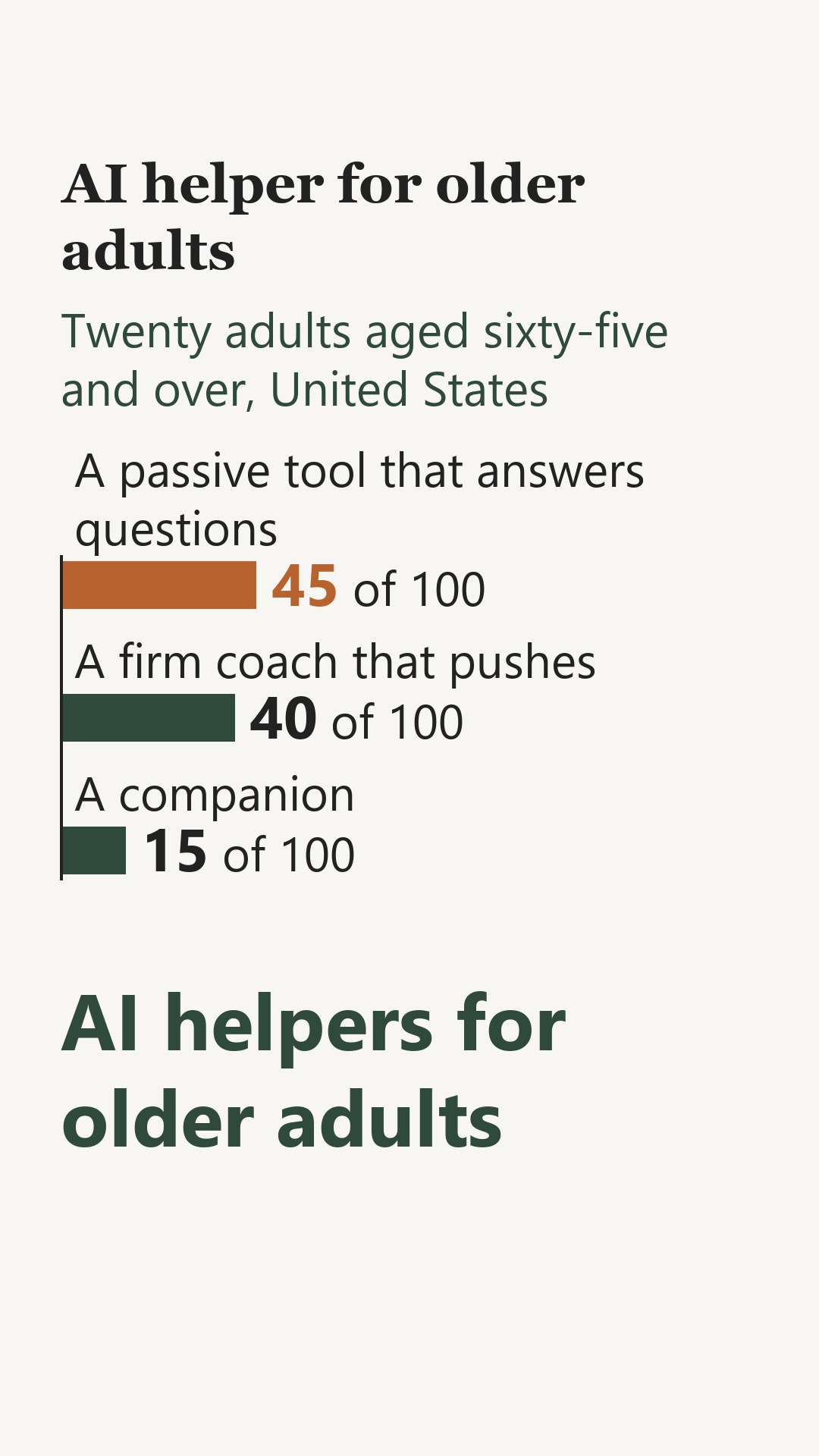
Shares of the 20 people interviewed, who judged AI from pictures and imagined scenes rather than from using a working app.
When an app or device offers an AI helper, look for one that lets you set your own goals, shows where its advice comes from, and lets you switch it off.
A phone or a watch already sits in the house. It counts steps, maybe reminds you to move. In 20 interviews with adults aged 65 and over in the United States, researchers asked what such devices get right and what an AI helper might add.
The interviews ran about an hour each, by video call, between May 2024 and January 2025. Researchers at the University of Illinois Urbana-Champaign and the City University of New York did the asking. Most participants, 12 of 20, described themselves as active, through gardening, walking the dog, classes, or workouts with a trainer. They wanted to keep the routine and independence they already had. They were not training for a marathon, as one woman put it. One woman said losing weight would let her play with her grandson, because getting back up was hard for her with the extra weight.
Fourteen of the 20 said they would try an AI coach. They did not agree on what it should be. Nine saw it as a passive tool that answers questions. Eight wanted a firm coach that pushes, in the words of one, more than "a soft person." Three wanted something closer to a companion. One man looked at a picture of an older male avatar and said he felt he could sit down and have a beer with him.
The same people named what gets in the way. Small screens and tiny keys hurt arthritic fingers. Cluttered menus and too many steps to reach one task led some to give up. Five of the 20 voiced strong worries about privacy, and several doubted whether AI gets facts right. One woman said she skips the AI answer and reads further down the page.
Take the openness with care. All 20 held at least an undergraduate degree, most were white, and most lived in a city in the US Midwest. Their ease with technology may run higher than many readers'. They also judged AI from pictures and imagined scenes, not from using a working app. And they reported their own activity; it was not measured.
When an app or device offers an AI helper, look for one that lets you set your own goals, shows where its advice comes from, and lets you switch it off.
What this means for you
When an app or device offers an AI helper, ask whether it lets you set your own goals, shows where its advice comes from, and can be switched off. These 20 people judged such helpers from pictures and imagined scenes, not from daily use, and their comfort with technology may run higher than many readers'. The study cannot say whether an AI helper would keep anyone more active, so treat the openness as a starting point, not a promise.
Choudhry, A., Mshvelidze, J., Mullen, S. P. et al. (2026). Motivations, Barriers, and the Potential of AI in Physical Activity Apps for US Older Adults: Interview Study. JMIR Aging. https://doi.org/10.2196/96114
Who paid: The authors declared that no financial support was received for this work, and no funders, equipment or software providers are credited with any role.
Do not take this as professional medical advice.
The longer versionThe passages copied from the paper, the pictures, and every source with how much of it we read · 1648 words · about 8 minRead it →Close
Older Adults Were Open to an AI Coach in a Health App, With Conditions: Privacy, Accuracy, and a Say in the Goal
A US interview study of 20 older adults found most would try a conversational AI for physical activity, but trust in it was thin and personal.
A phone on the kitchen counter, a watch on the wrist, and a voice that asks whether the walk happened today: that is the picture the study is about, and 20 people aged 65 and over were asked what they thought of it. The picture did not exist yet. It was an idea, and the study was about what people thought of it.
The study, published in JMIR Aging, was run by researchers at the University of Illinois Urbana-Champaign and the City University of New York. The authors declared no financial support, and they declared no conflicts of interest. Twenty older adults, 7 men and 13 women, sat for hour-long video interviews between May 2024 and January 2025. All held at least an undergraduate degree, and nearly all were White. They were asked about their health goals, their current apps and gadgets, and what they made of an AI helper. To draw out design opinions, they were shown AI-generated pictures of possible "health coach" avatars: young and older humans, robots, and dogs and cats, realistic and cartoonish.
What the participants wanted first was to hold their ground. They aimed to keep their independence, physical and mental, and to stay at the level they had rather than push for more. A typical answer came from one woman: "I'm not training for a marathon, but I get my steps in, I do my gardening... I feel good. At my age, I think I'm doing just fine."1 They adjusted activity around arthritis, heart trouble, old injuries and past surgeries, swapping one exercise for another.
Their health technology habits were already deep. All 20 used technology regularly, 18 of 20 owned a smartwatch, and 8 of 20 used voice assistants. Only 2 of 20 did not use a smartphone, though both used computers2. The barriers were not about willingness. They were about small type, touchscreens that misread arthritic fingers, and menus that nested task inside task. One participant bought a keyboard with larger keys: "My fingers miss a lot... the print's bigger... I can see more on the screen"3. Another gave up on an app "filled with symbols" and simply turned it off4.
On the AI itself, 14 of 20 were pragmatically willing to try an AI coach, and outright rejection was rare5. The researchers sorted them by what they wanted the AI to be: a passive "tool" for 9 of 20, a directive "coach" for 8 of 20, a relational "companion" for 3 of 206. Personalization was wanted by 11 of 20, who wanted advice fitted to their conditions and their own goals7. Gamification, the points and badges and rings, motivated 14 of 20 but left 7 of 20 cold, some calling it condescending or anxiety-inducing. A quarter of the group, 5 of 20, voiced very strong privacy fears: hacking, commercial use of supposedly anonymous data, scams aimed at their age group8.
The backdrop is a population shift. In the 2020 US Census, people over 65 numbered 55.8 million, 16.8 percent of the country, and that group grew nearly five times faster than the total population over the century from 1920 to 20209. Physical activity protects independence and thinking, yet a large share of older Americans do not meet recommended levels10. Apps, wearables and AI conversational agents have been pitched as scalable, low-cost ways to help11. The trouble has been the gap between that promise and real uptake: older adults adopt these tools and then drop them12.
Here is what a conversational agent actually is, in plain terms. It is software that takes ordinary speech or typed words, works out what is being asked, and answers in sentences rather than menus. The version described in this study would know a person's goals, remember the last conversation, and speak up when a walk was skipped. The participants were not using one. They were imagining one.
Similar questions are being asked about AI in other corners of care. According to the summary of a study of people living with dementia and their carers, the only part of it available; the full paper is behind a subscription, participants saw AI use in medication reviews positively, provided the tools were well validated and used to assist rather than replace clinicians, and some raised concerns about safety and data security1314. The same summary reports that they stressed the importance of patient-clinician contact and of lived experience in building such tools15. According to the summary of a trial of a chatbot program for older adults with high blood pressure, the only part of it available; the full paper is behind a subscription, the group using the chatbot showed better knowledge, health behaviors, medication adherence and blood pressure control than the group given usual care1617. That summary also notes the design was not randomized and calls the findings preliminary18. According to the summary of interviews with 13 older adults in Beijing and Harbin about AI-supported health management, the only part of it available; the full paper is behind a subscription, barriers included a preference for traditional care, limited understanding of AI, cost and capability constraints, little support from family and community, and expectations of AI that ran ahead of what it can do1920212223.
The study's own limits are plain in its text. The participants came mostly from an urban part of the Midwest, were well educated and relatively well off, and their comfort with technology likely exceeds that of the wider older population24. Activity was self-reported and not measured, and people tend to overestimate it. The reactions to AI came from looking at pictures, not from living with a working app. The authors themselves call their sample a possible best case.
Here is weeklyAI's reading. The people in this study were not asking one question of the AI; they were asking two, and the two pull in different directions. Is this thing knowledgeable, and is it on my side? A helper that presents itself as an expert may be doubted on honesty, while one that presents itself as a familiar peer may be doubted on competence. The participants who wanted citations and the ones who wanted someone to have a beer with may be reaching for the same thing by different roads.
That leads weeklyAI to expect a split in homes like the reader's. The helper that wins trust may be the one that does one job plainly and admits what it does not know, rather than the one that sounds most like a person. This reading would be wrong if older adults turned out to trust a single helper equally for its facts and its intentions, or judged only one of the two and ignored the other. When you try a health app or a voice helper, ask both questions out loud: does it get the facts right, and is it on my side? Say which one you are judging when you tell a family member or a developer what went wrong.
A second expectation follows from the same evidence. A confident voice that tells you to do one more set can be useful and can also be followed past the point where your own body says stop. The participants who asked for a blunt, pushing coach are the ones most exposed to that. Treat any app's instructions as advice you are free to question, and practice saying why you are stopping or changing a suggestion. Ask the helper to show its reasoning before you act on it.
A third expectation is about the tool itself. Health apps that lock a person into one fixed way of working, or that need a relative to set them up, tend to be abandoned by capable adults even when the purpose is good. The complaints about clutter, many steps and shifting screens are signs of a tool that stopped being usable by anybody. Judge an app by whether you can start, stop and set your own goal without help. If setup needs someone else, that is worth telling the maker.
What the authors say would have to happen next is trust, earned in specific ways. AI that is personalized, transparent and privacy-protecting, and that shows its sources and explains its reasoning, is much more likely to be trusted, and wider use of these tools depends on that trust25. Their design suggestions are modest: reward consistency rather than constant increases, let streaks pause during illness, offer a larger view on a tablet or computer, collect data automatically so nobody has to type it in, and count gardening and housework as activity.
For a reader in Latin America or in the US and Canada, the practical question is not whether an AI coach is coming. Apps with chat features are already on phones. The question is what to ask of one. The study cannot say whether any such app improves activity, health or independence, because it measured none of those. It cannot say these views are typical, because the group was small, highly educated and mostly White. What it can say is what a group of capable older adults wanted from such a tool, and what made them wary.
Go back to the phone on the kitchen counter. The voice that asks about the walk can be built to push, to fetch facts, or to keep company, and it can be built to do all three badly or one well. The people in this study have told the makers which they would accept, and on what terms.
The next time an app asks you to trust it, ask it two things: where does this advice come from, and can I set my own goal?
Where each piece of context comes from, and how much of it we read
- Choudhry, A., Mshvelidze, J., Mullen, S. P. et al. (2026). Motivations, Barriers, and the Potential of AI in Physical Activity Apps for US Older Adults: Interview Study. JMIR Aging. https://doi.org/10.2196/96114 - the article this story is about — the whole article — the passage: "I’m not training for a marathon, but I get my steps in, I do my gardening... I feel good. At my age, I think I’m doing just fine ."
- Choudhry, A., Mshvelidze, J., Mullen, S. P. et al. (2026). Motivations, Barriers, and the Potential of AI in Physical Activity Apps for US Older Adults: Interview Study. JMIR Aging. https://doi.org/10.2196/96114 - the article this story is about — the whole article — the passage: "All (20/20, 100%) our participants used technology regularly in their lives with many also possessing smartwatches (18/20, 90%) and voice-based personal assistants (8/20, 40%). Only 2 (10%) participants did not use smartphones, although they used computers."
- Choudhry, A., Mshvelidze, J., Mullen, S. P. et al. (2026). Motivations, Barriers, and the Potential of AI in Physical Activity Apps for US Older Adults: Interview Study. JMIR Aging. https://doi.org/10.2196/96114 - the article this story is about — the whole article — the passage: "I got myself a keyboard with larger keys...My fingers miss a lot, especially if I’m doing texting... [Computer’s more comfortable] because the print’s bigger... I can see more on the screen."
- Choudhry, A., Mshvelidze, J., Mullen, S. P. et al. (2026). Motivations, Barriers, and the Potential of AI in Physical Activity Apps for US Older Adults: Interview Study. JMIR Aging. https://doi.org/10.2196/96114 - the article this story is about — the whole article — the passage: "When I go to an app that’s just filled with symbols and I have no idea what they are, I just turn it off and go to something else ."
- Choudhry, A., Mshvelidze, J., Mullen, S. P. et al. (2026). Motivations, Barriers, and the Potential of AI in Physical Activity Apps for US Older Adults: Interview Study. JMIR Aging. https://doi.org/10.2196/96114 - the article this story is about — the whole article — the passage: "The majority of participants (14/20, 70%) demonstrated a pragmatic willingness to try an AI-powered coach. Even in the case of skepticism, outright rejection was rare and participants were curious and wished to give it a chance to prove its utility."
- Choudhry, A., Mshvelidze, J., Mullen, S. P. et al. (2026). Motivations, Barriers, and the Potential of AI in Physical Activity Apps for US Older Adults: Interview Study. JMIR Aging. https://doi.org/10.2196/96114 - the article this story is about — the whole article — the passage: "Participants viewed AI in different ways based on desired power dynamics: a relatively passive “tool” (n=9, 45%), a directive “coach” (n=8, 40%), or a relational “companion” (n=3, 15%)."
- Choudhry, A., Mshvelidze, J., Mullen, S. P. et al. (2026). Motivations, Barriers, and the Potential of AI in Physical Activity Apps for US Older Adults: Interview Study. JMIR Aging. https://doi.org/10.2196/96114 - the article this story is about — the whole article — the passage: "A strong desire for personalization was expressed by 11 (55%) participants. They wanted an app that would adapt to their specific health conditions and allow them to control their own goals."
- Choudhry, A., Mshvelidze, J., Mullen, S. P. et al. (2026). Motivations, Barriers, and the Potential of AI in Physical Activity Apps for US Older Adults: Interview Study. JMIR Aging. https://doi.org/10.2196/96114 - the article this story is about — the whole article — the passage: "A quarter (5/20, 25%) of participants expressed very strong concerns about use of their data and privacy, citing fears of hacking (eg, P4), the commercial exploitation of even ostensibly anonymized personal data (eg, P5), and the financial extortion targeting their age demographic (eg, P13)."
- Choudhry, A., Mshvelidze, J., Mullen, S. P. et al. (2026). Motivations, Barriers, and the Potential of AI in Physical Activity Apps for US Older Adults: Interview Study. JMIR Aging. https://doi.org/10.2196/96114 - the article this story is about — the whole article — the passage: "According to the 2020 Census, the US population aged >65 years stood at 55.8 million, or 16.8% of the general population [ 2 ]. This demographic grew nearly 5 times faster than the total population over the 100 years from 1920 to 2020 [ 2 ]."
- Choudhry, A., Mshvelidze, J., Mullen, S. P. et al. (2026). Motivations, Barriers, and the Potential of AI in Physical Activity Apps for US Older Adults: Interview Study. JMIR Aging. https://doi.org/10.2196/96114 - the article this story is about — the whole article — the passage: "Despite these known benefits, a large portion of the older adult population in the United States does not meet recommended PA guidelines [ 5 ], making the development of effective, scalable interventions for sustained PA in older adults increasingly important."
- Choudhry, A., Mshvelidze, J., Mullen, S. P. et al. (2026). Motivations, Barriers, and the Potential of AI in Physical Activity Apps for US Older Adults: Interview Study. JMIR Aging. https://doi.org/10.2196/96114 - the article this story is about — the whole article — the passage: "Such technologies, including smartphone apps, wearables, and AI-powered conversational agents, have shown the potential to be scalable and cost-effective solutions [ 8 ]."
- Choudhry, A., Mshvelidze, J., Mullen, S. P. et al. (2026). Motivations, Barriers, and the Potential of AI in Physical Activity Apps for US Older Adults: Interview Study. JMIR Aging. https://doi.org/10.2196/96114 - the article this story is about — the whole article — the passage: "However, a persistent gap has been observed between the high potential of these tools and their low adoption and sustained engagement by older adults [ 12 ]. This suggests a fundamental disconnect between the technological solutions offered and the actual needs, motivations, and practices of this user group."
- Linder B, Du J, Tavares N, Zhu T, Tiwari P, Jawad S, et al. (2026). Attitudes of people living with dementia and their carers towards the use of generative artificial intelligence to inform structured medication reviews. Age and Ageing. 10.1093/ageing/afag320 — only the abstract - the full text could not be fetched — the passage: "Participants viewed AI use in SMRs positively, provided that such tools were well validated and used to assist rather than replace healthcare professionals."
- Linder B, Du J, Tavares N, Zhu T, Tiwari P, Jawad S, et al. (2026). Attitudes of people living with dementia and their carers towards the use of generative artificial intelligence to inform structured medication reviews. Age and Ageing. 10.1093/ageing/afag320 — only the abstract - the full text could not be fetched — the passage: "However, some had concerns regarding patient safety and data security, highlighting the need for appropriate regulation and human oversight."
- Linder B, Du J, Tavares N, Zhu T, Tiwari P, Jawad S, et al. (2026). Attitudes of people living with dementia and their carers towards the use of generative artificial intelligence to inform structured medication reviews. Age and Ageing. 10.1093/ageing/afag320 — only the abstract - the full text could not be fetched — the passage: "Participants were supportive of AI use in SMRs, despite concerns about safety, data security and disclosure of AI use, and emphasised the importance of patient-clinician interactions and lived experience involvement in AI tool development."
- Ransinyo K, Banharak S, Panpanit L, Thiengtham S, Visetsittikul P, Sommana C, et al. (2026). Effectiveness of a Chatbot-Based Hypertension Management Program on Selected Outcomes Among Community-Dwelling Older Adults: A Quasi-Experimental Study. Journal of Multidisciplinary Healthcare. 10.2147/jmdh.s635820 — only the abstract - the full text could not be fetched — the passage: "The experimental group showed improvements in hypertension-related knowledge, health behaviors, medication adherence, and blood pressure control. The control group showed no improvement in systolic and a rise in diastolic blood pressure."
- Ransinyo K, Banharak S, Panpanit L, Thiengtham S, Visetsittikul P, Sommana C, et al. (2026). Effectiveness of a Chatbot-Based Hypertension Management Program on Selected Outcomes Among Community-Dwelling Older Adults: A Quasi-Experimental Study. Journal of Multidisciplinary Healthcare. 10.2147/jmdh.s635820 — only the abstract - the full text could not be fetched — the passage: "the experimental group demonstrated better knowledge (p = 0.002), health behaviors (p = 0.018), medication adherence (p< 0.001) and blood pressure control than the control group"
- Ransinyo K, Banharak S, Panpanit L, Thiengtham S, Visetsittikul P, Sommana C, et al. (2026). Effectiveness of a Chatbot-Based Hypertension Management Program on Selected Outcomes Among Community-Dwelling Older Adults: A Quasi-Experimental Study. Journal of Multidisciplinary Healthcare. 10.2147/jmdh.s635820 — only the abstract - the full text could not be fetched — the passage: "although the non-randomized design and recruitment from different settings mean that the findings are preliminary. Longer follow-up is needed to determine effects on biological indicators."
- Xu L, Fu J, Jiang N, Zhai B, Li C, Li J. (2026). Barriers to AI-supported health management among older adults with chronic orthopedic conditions in China: implications for healthcare delivery and access. BMC Health Services Research. 10.1186/s12913-026-15119-4 — only the abstract - the full text could not be fetched — the passage: "(1) preference for traditional health management over AI;"
- Xu L, Fu J, Jiang N, Zhai B, Li C, Li J. (2026). Barriers to AI-supported health management among older adults with chronic orthopedic conditions in China: implications for healthcare delivery and access. BMC Health Services Research. 10.1186/s12913-026-15119-4 — only the abstract - the full text could not be fetched — the passage: "(2) limited understanding of AI-supported health management;"
- Xu L, Fu J, Jiang N, Zhai B, Li C, Li J. (2026). Barriers to AI-supported health management among older adults with chronic orthopedic conditions in China: implications for healthcare delivery and access. BMC Health Services Research. 10.1186/s12913-026-15119-4 — only the abstract - the full text could not be fetched — the passage: "(3) perceived constraints in technological capability and affordability;"
- Xu L, Fu J, Jiang N, Zhai B, Li C, Li J. (2026). Barriers to AI-supported health management among older adults with chronic orthopedic conditions in China: implications for healthcare delivery and access. BMC Health Services Research. 10.1186/s12913-026-15119-4 — only the abstract - the full text could not be fetched — the passage: "(4) lack of external support from family and community;"
- Xu L, Fu J, Jiang N, Zhai B, Li C, Li J. (2026). Barriers to AI-supported health management among older adults with chronic orthopedic conditions in China: implications for healthcare delivery and access. BMC Health Services Research. 10.1186/s12913-026-15119-4 — only the abstract - the full text could not be fetched — the passage: "(5) optimistic yet unrealistic expectations of AI capabilities."
- Choudhry, A., Mshvelidze, J., Mullen, S. P. et al. (2026). Motivations, Barriers, and the Potential of AI in Physical Activity Apps for US Older Adults: Interview Study. JMIR Aging. https://doi.org/10.2196/96114 - the article this story is about — the whole article — the passage: "The participant sample consisted predominantly of individuals in an urban area of the Midwestern United States who are well educated, relatively financially secure, and relatively ethnically homogeneous. Importantly, they possess a high baseline of technological literacy that likely exceeds that of the broader older adult population."
- Choudhry, A., Mshvelidze, J., Mullen, S. P. et al. (2026). Motivations, Barriers, and the Potential of AI in Physical Activity Apps for US Older Adults: Interview Study. JMIR Aging. https://doi.org/10.2196/96114 - the article this story is about — the whole article — the passage: "AI that is personalized, transparent, and privacy protecting and that provides detailed referencing and explainable outputs when necessary is much more likely to be trusted. Greater use of AI-supported technologies for PA ultimately hinges on gaining user trust."
Choudhry, A., Mshvelidze, J., Mullen, S. P. et al. (2026). Motivations, Barriers, and the Potential of AI in Physical Activity Apps for US Older Adults: Interview Study. JMIR Aging. https://doi.org/10.2196/96114
Who paid: The authors declared that no financial support was received for this work, and no funders, equipment or software providers are credited with any role.
Do not take this as professional medical advice.