experiment · Nature communications · la publicación, 20 may 2026 · gratis
Una IA leyó ecografías de mama junto a radiólogos en China, y en las pruebas los radiólogos acertaron más con ella
Funcionó en hospitales chinos y en dos bases de imágenes de Egipto y España, donde acertó menos. Todo ocurrió en China, y nadie midió si salva vidas.
Versión breve · la versión detallada sigue, unos 7 min
Pregunte al chat de weeklyAI
Pregúnteme sobre la IA en su vida: le señalo las notas que weeklyAI ha publicado sobre el tema, esta semana y antes.
Las conversaciones se guardan mientras exista weeklyAI, para mejorar la publicación. Se responde en el idioma en que usted escribe.
- El estudio, de un vistazo
- Quiénes
- mujeres que se hicieron ecografías de mama
- Cuántos
- 6,817
- Dónde
- China
- Cuándo
- entre marzo de 2022 y mayo de 2023
- Tipo de estudio
- experiment
- Quién lo hizo
- Hospital Central de Dazhou y universidades de China
- El límite que importa
- El seguimiento se centró en el grupo de alto riesgo; no prueba que salve vidas.
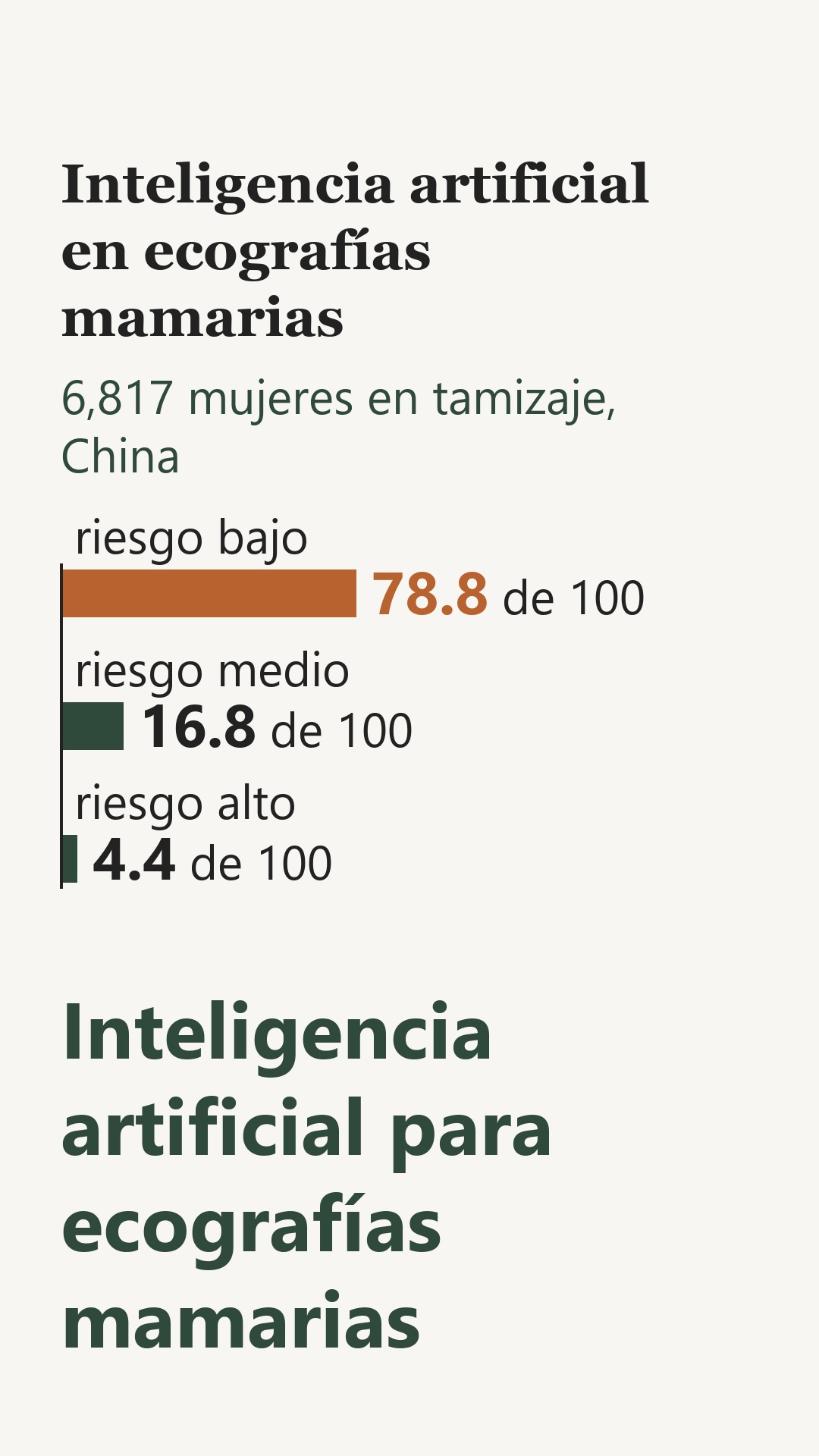
Son los porcentajes de 6,817 mujeres clasificadas por el sistema en un programa de tamizaje en China; solo al grupo de alto riesgo se le hizo seguimiento, así que no dicen cuántos cánceres había en el resto.
Exactitud de los radiólogos con y sin la ayuda del sistema
pasaron de 0.687 a 0.736 de exactitud
La herramienta ayuda, y arrastra.
Entre abril de 2017 y agosto de 2020, en el Hospital Central de Dazhou, en China, se juntaron 147,862 ecografías de 20,445 personas. Después de limpiarlas y revisarlas, quedaron 26,418 imágenes para el estudio. Con esas 26,418 imágenes construyeron un sistema de inteligencia artificial llamado BIRD. El sistema marca cada lesión y le pone su categoría BI-RADS, la escala que usan los radiólogos para decir qué tan sospechosa es una imagen.
Lo probaron primero con imágenes de ese mismo hospital. Acertó la categoría el 0.837 de las veces (una escala donde 1 sería siempre). Luego lo probaron con imágenes de ocho hospitales chinos más: acertó entre el 0.708 y el 0.913. En dos colecciones públicas, una de Egipto y otra de España, bajó a 0.661 y 0.604. Los propios autores dicen que antes de usarlo fuera de China hace falta más validación.
Después vinieron las pruebas con radiólogos. En una, seis radiólogos leyeron 527 imágenes sin ayuda y luego con BIRD. Con la ayuda acertaron más, y la diferencia fue clara. En otra, 1,000 imágenes se repartieron al azar en dos grupos de 500, y cuatro médicos en formación las leyeron; con BIRD también acertaron más. Hubo un caso en contra: cuando BIRD se equivocaba, tres radiólogos acertaron menos. La herramienta ayuda, y arrastra.
Lo llevaron a 107 hospitales chinos. En 38 de ellos, con 9,320 mujeres, compararon la categoría que ponía BIRD con la del radiólogo local: coincidieron bastante, con un índice de 0.702. Ese número mide cuánto se parecen las dos lecturas, no quién tenía razón.
En un programa de tamizaje analizaron 6,817 mujeres. BIRD clasificó al 78.82% como riesgo bajo, al 16.77% como medio y al 4.42% como alto. En el grupo de alto riesgo, tras un seguimiento de 13 meses como mediana, se encontraron 3 cánceres. El seguimiento se centró en ese grupo, así que no dice cuántos cánceres habría encontrado o dejado pasar en toda la población.
Desarrollaron también tres modelos que leen la ecografía para estimar si la lesión es benigna o maligna, si es cáncer invasor o un tipo temprano llamado DCIS, y de qué subtipo molecular es. Midieron su capacidad de distinguir, no que reemplacen una biopsia.
Cuando le toque una ecografía de mama, pregunte en su clínica si el informe lo lee una sola persona o si hay una segunda lectura, humana o de una máquina.
Qué significa para usted
Cuando le toque una ecografía de mama, pregunte si el informe lo lee una sola persona o si hay una segunda lectura, humana o de una máquina. En las pruebas con radiólogos en China, el sistema ayudó a acertar más, aunque también arrastra cuando se equivoca. Nadie ha medido todavía si eso salva vidas, así que pida que le expliquen bien su resultado.
Zhou, J., Si, P., Zhang, Y. et al. (2026). A non-invasive end-to-end intelligent assistance system for breast ultrasound. Nature Communications. https://doi.org/10.1038/s41467-026-73170-5
Quién pagó: El estudio fue financiado por el Programa Nacional Clave de Investigación y Desarrollo de China, la Comisión de Salud de la Provincia de Henan, el Departamento Provincial de Ciencia y Tecnología de Henan, la Comisión de Salud de la Provincia de Sichuan, el Departamento de Ciencia y Tecnología de la Provincia de Sichuan y un proyecto de cooperación escuela-ciudad de Dazhou; el artículo no dice si los financiadores tuvieron voz alguna ni menciona equipos o programas cedidos por una empresa.
No tome esto como consejo médico profesional.
Versión detalladaLos pasajes copiados del artículo, las ilustraciones y cada fuente con cuánto leímos de ella · 1424 palabras · unos 7 minLeerla →Cerrar
La inteligencia artificial que leyó ultrasonidos de mama y, cuando acompañó a los radiólogos, mejoró su lectura
Un sistema probado en 107 hospitales de China clasificó imágenes de ultrasonido de mama y, en pruebas controladas, mejoró la lectura de los médicos. Lo que todavía no muestra es si eso salva vidas fuera de ese país.
El cáncer de mama es el tumor más frecuente entre las mujeres del mundo, y detectarlo temprano es la base para sobrevivir mejor1. En mujeres asiáticas, que suelen tener tejido mamario denso, la mamografía pierde sensibilidad, y el ultrasonido se volvió la herramienta principal de revisión2. El problema es que leer un ultrasonido depende mucho de quién lo lee: aunque existe una clasificación estándar llamada BI-RADS, sigue siendo subjetiva y puede llevar a biopsias innecesarias o a diagnósticos tardíos3. Ahí entra el sistema que este estudio describe: un aparato llamado BIRD, que localiza lesiones en la imagen y las clasifica según BI-RADS4. Por dentro usa dos programas de reconocimiento de imágenes: uno para encontrar la lesión y otro para clasificarla5.
Los números del estudio, en su prueba interna, dieron una exactitud de 0.837, con un margen de 0.827 a 0.8466. En dos estudios de lectura, cuando el sistema acompañó a los radiólogos, su exactitud subió de forma medible6. En uno de esos estudios, con seis radiólogos, la diferencia entre leer con y sin el sistema fue estadísticamente significativa7. En la prueba aleatorizada, un grupo de radiólogos pasó de 0.687 a 0.736 de exactitud con la ayuda del sistema, y también subió su capacidad de detectar casos positivos8. En el tamizaje de 6,817 mujeres, el sistema coincidió con la evaluación clínica con un índice kappa de 0.7029. De esas mujeres, 5,373 (78.82%) quedaron en riesgo bajo, 1,143 (16.77%) en riesgo medio y 301 (4.42%) en riesgo alto10. En seguimiento de ese grupo de alto riesgo, con mediana de 13 meses, se diagnosticaron 3 cánceres11.
Los límites importan tanto como los aciertos. En los dos conjuntos públicos internacionales, uno de Egipto y otro de España, la exactitud del sistema bajó a 0.661 y 0.60412. Los propios autores concluyen que el sistema necesita más validación antes de usarse clínicamente fuera de China13. El kappa de 0.702 mide qué tanto coincidió el sistema con los radiólogos locales, no si el sistema tenía razón14. El tamizaje siguió sobre todo al grupo de alto riesgo, y los autores lo describen como un estudio de viabilidad: la eficacia definitiva tendría que establecerse con ensayos aleatorizados controlados15.
Piense en la sala de ultrasonido de un hospital de segundo nivel: un aparato, una pantalla y una persona que decide si lo que ve es benigno o sospechoso. Esa decisión, repetida miles de veces, es donde se juega el diagnóstico temprano. Lo curioso es que el estudio no solo midió si el sistema acertaba solo, sino si ayudaba a acertar a quien ya estaba leyendo. En el estudio prospectivo, cuando el sistema acertaba, los seis radiólogos mejoraban7; cuando el sistema se equivocaba, tres de ellos empeoraban. La herramienta arrastra en las dos direcciones.
Hay otra familia de estudios que intenta lo mismo con otros aparatos y otras enfermedades. Un grupo presentó un aditamento de bajo costo para microscopios que analiza muestras de médula ósea y detecta leucemia sin necesidad de un escáner de portaobjetos completo, según el resumen de ese trabajo, lo único disponible de él16. Los sistemas actuales para detectar leucemia suelen depender de escáneres caros, lo que limita su acceso en lugares con pocos recursos17. Ese aditamento se entrenó con más de 11,000 regiones y 130,000 células anotadas, y se validó en cohortes de varias instituciones18. Algo parecido ocurre con los electrocardiogramas: un programa aplicado al trazo estándar de 12 derivaciones busca disfunción del ventrículo izquierdo y apoya la decisión de a quién mandar a un ecocardiograma19. En atención primaria, ese sistema aumentó el número de diagnósticos nuevos de baja fracción de eyección y dirigió el ecocardiograma sobre todo a los pacientes que salieron positivos en la prueba20. La diferencia con BIRD es de alcance: BIRD ya se desplegó en 107 hospitales de China y se usó en el tamizaje de 6,817 mujeres.
El detalle que cambia la escala está en cómo se instaló. El sistema se aplicó en el tamizaje de 6,817 mujeres y coincidió con la evaluación clínica de los radiólogos en 107 hospitales de China9. En el proyecto de tamizaje gratuito, hecho en 10 sitios, el sistema clasificó a las mujeres en riesgo bajo, medio y alto10. El resultado práctico fue una lista: casi ocho de cada diez mujeres quedaron en riesgo bajo, y el grupo de alto riesgo fue el que recibió seguimiento1011. Conceda lo que el estudio tiene de razón: clasificar a miles de mujeres en riesgo alto, medio y bajo es una forma de ordenar el trabajo de un servicio saturado. La vuelta es que ordenar no es lo mismo que curar, y el propio estudio lo dice al llamarse de viabilidad.
Así lo lee weeklyAI: lo que más cambiaría para una mujer en una comunidad con pocos recursos no sería la precisión del programa en sí, sino que el servicio llegue cerca y sin costo, como en el proyecto de tamizaje gratuito que el estudio describe. Esta lectura se equivocaría si el acceso cercano y gratuito no importara: si las mujeres con menos recursos buscaran el estudio igual cuando es lejano o de pago, o si la herramienta solo se usara donde ya había especialistas y dinero. Usted puede preguntar en su centro de salud si existe tamizaje gratuito o de bajo costo cerca, y si no existe, preguntar por qué. También puede notar si la tecnología llega solo a los lugares que ya tenían recursos.
Hay una segunda cosa que vigilar. A las máquinas se les atribuye no cansarse y no tener preferencias; por eso las instituciones les van pasando decisiones, a veces para no cargar con el costo de decidir. Es probable que en los hospitales donde se instaló el sistema parte del atractivo sea poder decir que la clasificación la hizo una herramienta pareja, sobre todo donde faltan especialistas; y que cuando el sistema se equivoque, sea más difícil saber quién responde por ese error. Esta lectura se equivocaría si los hospitales usan el sistema solo como apoyo y siempre hay un profesional identificable que revisa y firma cada lectura, con registros claros de quién decidió qué. Usted puede preguntar quién revisa el resultado de la imagen y quién firma el informe: una persona con nombre, no solo un programa. Y pedir que le expliquen qué pasa si la herramienta se equivoca.
Una tercera cosa, sobre el idioma. Los saberes especializados se separan cada vez más de la vida cotidiana, y crece la distancia entre lo que entiende un experto y lo que entiende el público. Aunque el estudio reporte mejoras medidas, muchas mujeres y muchos trabajadores de salud de primera línea no sabrán leer ni cuestionar esos números; la herramienta puede quedar en manos de pocos y el resto solo escuchar el anuncio. Esta lectura se equivocaría si hubiera materiales, capacitaciones o reportes en lenguaje sencillo que llegaran a las pacientes y al personal no especializado, y si la gente pudiera preguntar y entender qué significó su resultado. Usted puede pedir que le expliquen su resultado en palabras claras y preguntar qué significa cada categoría de riesgo.
Queda una pregunta que el estudio deja abierta y que conviene decir sin adorno: ¿un sistema que coincide con los radiólogos en siete de cada diez casos, y que bajó su exactitud en los conjuntos internacionales, está listo para el consultorio de su colonia? Los autores responden que no del todo: piden más validación antes de usarlo fuera de China13, y reconocen que el tamizaje fue un estudio de viabilidad, no una prueba de eficacia15. Los modelos que predicen subtipos moleculares del cáncer, que también se describen en el trabajo, todavía no se han desplegado en la rutina clínica.
Lo que sí queda claro es dónde está el valor real de este tipo de estudio: no en el anuncio de que una máquina superó a un médico, sino en la posibilidad de que un servicio con pocos especialistas tenga una segunda lectura pareja y rápida. Para una mujer que se hace un ultrasonido de mama, la pregunta útil no es si la inteligencia artificial es mejor que su radiólogo, sino si el lugar donde se atiende tiene una revisión adicional, gratuita y cercana. Esa pregunta se puede hacer hoy, sin esperar a que llegue la próxima generación de aparatos.
De dónde sale cada dato de contexto, y cuánto leímos de cada documento
- Zhou, J., Si, P., Zhang, Y. et al. (2026). A non-invasive end-to-end intelligent assistance system for breast ultrasound. Nature Communications. https://doi.org/10.1038/s41467-026-73170-5 - el artículo del que trata esta nota — el artículo completo — el pasaje: "Breast cancer is the most prevalent malignancy among women worldwide 1 , 2 , with early detection being the cornerstone of improved survival."
- Zhou, J., Si, P., Zhang, Y. et al. (2026). A non-invasive end-to-end intelligent assistance system for breast ultrasound. Nature Communications. https://doi.org/10.1038/s41467-026-73170-5 - el artículo del que trata esta nota — el artículo completo — el pasaje: "In Asian women, who tend to have dense breast tissue, mammography’s sensitivity is markedly reduced, and ultrasound has emerged as the primary screening modality 3 ."
- Zhou, J., Si, P., Zhang, Y. et al. (2026). A non-invasive end-to-end intelligent assistance system for breast ultrasound. Nature Communications. https://doi.org/10.1038/s41467-026-73170-5 - el artículo del que trata esta nota — el artículo completo — el pasaje: "However, ultrasound interpretation is highly operator-dependent, and although the Breast Imaging Reporting and Data System (BI-RADS) classification is standardized, it remains subjective 4 , 5 , leading to inter-reader variability that may cause unnecessary biopsies or delayed diagnosis."
- Zhou, J., Si, P., Zhang, Y. et al. (2026). A non-invasive end-to-end intelligent assistance system for breast ultrasound. Nature Communications. https://doi.org/10.1038/s41467-026-73170-5 - el artículo del que trata esta nota — el artículo completo — el pasaje: "Here, we develop and test an end-to-end breast intelligent recognition device (BIRD) for women across diverse institution/population datasets."
- Zhou, J., Si, P., Zhang, Y. et al. (2026). A non-invasive end-to-end intelligent assistance system for breast ultrasound. Nature Communications. https://doi.org/10.1038/s41467-026-73170-5 - el artículo del que trata esta nota — el artículo completo — el pasaje: "The BIRD utilized the YOLOv5 localization algorithm to identify lesions in breast ultrasound images and the EfficientNet classification algorithm for BI-RADS classification of the identified lesions"
- Zhou, J., Si, P., Zhang, Y. et al. (2026). A non-invasive end-to-end intelligent assistance system for breast ultrasound. Nature Communications. https://doi.org/10.1038/s41467-026-73170-5 - el artículo del que trata esta nota — el artículo completo — el pasaje: "The accuracy of BIRD in the internal test set is 0.837 (95% confidence interval: 0.827–0.846), which significantly improves radiologists’ accuracy in 2 reader studies ( P < 0.05)."
- Zhou, J., Si, P., Zhang, Y. et al. (2026). A non-invasive end-to-end intelligent assistance system for breast ultrasound. Nature Communications. https://doi.org/10.1038/s41467-026-73170-5 - el artículo del que trata esta nota — el artículo completo — el pasaje: "When BIRD was used for AI assistance and made correct predictions, the accuracy of the 6 radiologists was improved. Significant differences were observed in the performance of radiologists with and without AI assistance ( P = 1.02e-10)"
- Zhou, J., Si, P., Zhang, Y. et al. (2026). A non-invasive end-to-end intelligent assistance system for breast ultrasound. Nature Communications. https://doi.org/10.1038/s41467-026-73170-5 - el artículo del que trata esta nota — el artículo completo — el pasaje: "In the unassisted phase, the accuracy of group A2 radiologists was 0.687 (95% CI: 0.648–0.726). With AI assistance, accuracy significantly increased to 0.736 (95% CI: 0.696–0.776, P = 0.028), accompanied by increased sensitivity from 0.508 (95% CI: 0.465–0.556) to 0.528 (95% CI: 0.469–0.623)"
- Zhou, J., Si, P., Zhang, Y. et al. (2026). A non-invasive end-to-end intelligent assistance system for breast ultrasound. Nature Communications. https://doi.org/10.1038/s41467-026-73170-5 - el artículo del que trata esta nota — el artículo completo — el pasaje: "BIRD is applied in breast cancer screening for 6,817 individuals and shows high consistency (Cohen’s kappa: 0.702 (95% confidence interval: 0.628-0.777)) with clinical assessments in real-world application across 107 hospitals."
- Zhou, J., Si, P., Zhang, Y. et al. (2026). A non-invasive end-to-end intelligent assistance system for breast ultrasound. Nature Communications. https://doi.org/10.1038/s41467-026-73170-5 - el artículo del que trata esta nota — el artículo completo — el pasaje: "Among them, 5373 individuals (78.82%) were classified as low risk (BI-RADS 1-2), 1143 (16.77%) as medium risk (BI-RADS 0 and 3), and 301 (4.42%) as high risk (BI-RADS 4-5)"
- Zhou, J., Si, P., Zhang, Y. et al. (2026). A non-invasive end-to-end intelligent assistance system for breast ultrasound. Nature Communications. https://doi.org/10.1038/s41467-026-73170-5 - el artículo del que trata esta nota — el artículo completo — el pasaje: "A subsequent follow-up of the high-risk group ( n = 301), which had a median follow-up of 13 months, found that 3 patients were diagnosed with breast cancer."
- Zhou, J., Si, P., Zhang, Y. et al. (2026). A non-invasive end-to-end intelligent assistance system for breast ultrasound. Nature Communications. https://doi.org/10.1038/s41467-026-73170-5 - el artículo del que trata esta nota — el artículo completo — el pasaje: "For the international datasets BUSI and BUS, the accuracies of BIRD were 0.661 (95% CI: 0.625–0.697) and 0.604 (95% CI: 0.529–0.680)."
- Zhou, J., Si, P., Zhang, Y. et al. (2026). A non-invasive end-to-end intelligent assistance system for breast ultrasound. Nature Communications. https://doi.org/10.1038/s41467-026-73170-5 - el artículo del que trata esta nota — el artículo completo — el pasaje: "Performance variations across international datasets indicate that BIRD requires further validation before clinical deployment outside the development and domestic validation setting."
- Zhou, J., Si, P., Zhang, Y. et al. (2026). A non-invasive end-to-end intelligent assistance system for breast ultrasound. Nature Communications. https://doi.org/10.1038/s41467-026-73170-5 - el artículo del que trata esta nota — el artículo completo — el pasaje: "Furthermore, agreement (Cohen’s kappa) with local radiologists reflects implementation concordance rather than diagnostic accuracy."
- Zhou, J., Si, P., Zhang, Y. et al. (2026). A non-invasive end-to-end intelligent assistance system for breast ultrasound. Nature Communications. https://doi.org/10.1038/s41467-026-73170-5 - el artículo del que trata esta nota — el artículo completo — el pasaje: "The screening program’s verification bias and follow-up duration reflect its feasibility study design; definitive efficacy metrics will be established through future randomized controlled trials."
- Yan ES, Sun S, Yin Z, Kamali A, Van Cleave J, Isgor IS, et al. (2026). An AI-powered self-driving microscope for low-cost acute leukemia detection. Nature Communications. 10.1038/s41467-026-77130-x — solo el resumen - no se pudo obtener el texto completo — el pasaje: "We present ALLocate, a low-cost, artificial intelligence-powered microscope plugin that enables self-driving microscopy for leukemia detection. ALLocate attaches directly to conventional microscopes and provides automated analysis at a fraction of the cost of a whole-slide scanner."
- Yan ES, Sun S, Yin Z, Kamali A, Van Cleave J, Isgor IS, et al. (2026). An AI-powered self-driving microscope for low-cost acute leukemia detection. Nature Communications. 10.1038/s41467-026-77130-x — solo el resumen - no se pudo obtener el texto completo — el pasaje: "Current artificial intelligence systems for leukemia detection typically rely on costly whole-slide scanners, limiting accessibility in low-resource settings."
- Yan ES, Sun S, Yin Z, Kamali A, Van Cleave J, Isgor IS, et al. (2026). An AI-powered self-driving microscope for low-cost acute leukemia detection. Nature Communications. 10.1038/s41467-026-77130-x — solo el resumen - no se pudo obtener el texto completo — el pasaje: "The system is trained and evaluated using more than 11,000 annotated regions and 130,000 annotated cells and is further validated using independent multi-institutional cohorts, including 165 physical bone marrow smear slides."
- Bollmann A, Pradler V, Husser D, Kim I, Hohenstein S, Nitsche A, et al. (2026). Artificial intelligence–enabled electrocardiography for assessment of left ventricular systolic dysfunction in the era of foundation models. Frontiers in Cardiovascular Medicine. 10.3389/fcvm.2026.1899224 — solo el resumen - no se pudo obtener el texto completo — el pasaje: "Artificial intelligence (AI) applied to the standard 12-lead electrocardiogram (AI-ECG) is being developed as a scalable approach to screen for left ventricular systolic dysfunction (LVSD) and support triage for confirmatory testing."
- Bollmann A, Pradler V, Husser D, Kim I, Hohenstein S, Nitsche A, et al. (2026). Artificial intelligence–enabled electrocardiography for assessment of left ventricular systolic dysfunction in the era of foundation models. Frontiers in Cardiovascular Medicine. 10.3389/fcvm.2026.1899224 — solo el resumen - no se pudo obtener el texto completo — el pasaje: "In primary care, AI-ECG increased the number of new low-ejection-fraction diagnoses and directed echocardiography preferentially to screen-positive patients."
Zhou, J., Si, P., Zhang, Y. et al. (2026). A non-invasive end-to-end intelligent assistance system for breast ultrasound. Nature Communications. https://doi.org/10.1038/s41467-026-73170-5
Quién pagó: El estudio fue financiado por el Programa Nacional Clave de Investigación y Desarrollo de China, la Comisión de Salud de la Provincia de Henan, el Departamento Provincial de Ciencia y Tecnología de Henan, la Comisión de Salud de la Provincia de Sichuan, el Departamento de Ciencia y Tecnología de la Provincia de Sichuan y un proyecto de cooperación escuela-ciudad de Dazhou; el artículo no dice si los financiadores tuvieron voz alguna ni menciona equipos o programas cedidos por una empresa.
No tome esto como consejo médico profesional.
experiment · Nature communications · the paper, 20 May 2026 · free
An AI Second Reader for Breast Ultrasound, Tested at Scale in China
The system raised radiologists' accuracy in controlled comparisons. It is not validated for use outside China, and matching a radiologist's call is not the same as being right.
Short version · the longer version follows, about 6 min
Ask the weeklyAI chat
Ask me about AI in your life: I point you to the stories weeklyAI has published on it, this week and before.
Conversations are saved for as long as weeklyAI exists, to improve the publication. Answers come in the language you write in.
- The study at a glance
- Who
- women having breast ultrasound
- How many
- 6,817 individuals
- Where
- China
- When
- not stated in the passages
- Kind of study
- experiment
- Who did it
- researchers at Chinese hospitals and universities
- The limit that matters
- Matching a radiologist's call is not the same as being right.
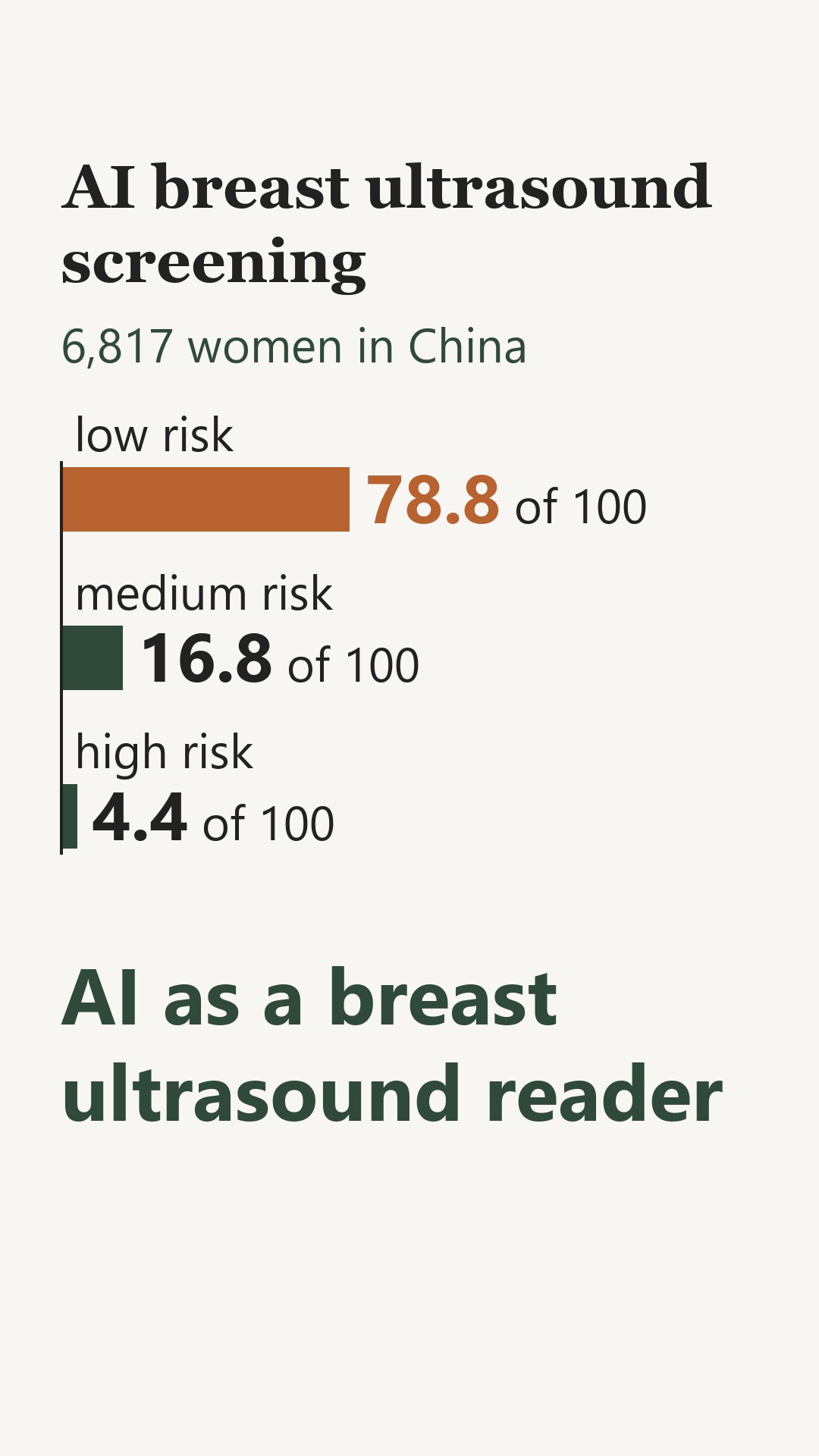
Shares of the 6,817 women screened, as the study sorted them; the program followed mainly the high-risk women, so it cannot show how many cancers a whole population would yield.
Radiologists reading with and without BIRD
accuracy rose from 0.687 to 0.736
all six did better
This study tested BIRD as a helper beside a radiologist. It did not test it replacing one.
Researchers in China built a system called BIRD. It reads breast ultrasound images and assigns each one a BI-RADS category, the standard scale radiologists use to sort findings from normal to highly suspicious. They trained it on images from Dazhou Central Hospital collected between 2017 and 2020.
Then they tested it on images it had never seen. Across eight other Chinese hospitals, its accuracy ranged from 0.708 to 0.913, meaning it got roughly 7 to 9 of every 10 images right. On two public datasets from Egypt and Spain, accuracy fell to 0.661 and 0.604. The authors say the lower scores mostly come from reading single still pictures, where unusual scan angles and unclear in-between cases make the call harder. They also say BIRD needs more testing before it is used outside China. Nothing here tells you what is approved or available where you live.
Next came the reader studies, where the comparison is direct. In one, six radiologists read 527 images, then read them again with BIRD's help. All six did better when BIRD's answer was right. When BIRD's answer was wrong, three of the six did worse. In a randomized trial of 1,000 images, four trainee radiologists also read more accurately with the system.
The system went into 107 Chinese hospitals. In 38 that sent usable records, covering 9,320 people, BIRD's categories matched the local radiologists' closely, a kappa of 0.702. The authors are clear about what that number is: a measure of how often the machine and the doctor agreed, not of whether the machine was correct.
A screening program then used BIRD on 6,817 women. It sorted 78.82 percent as low risk and 4.42 percent as high risk. A median of 13 months later, follow-up of the high-risk group had found 3 breast cancers. The program followed mainly the high-risk women, not everyone, so it cannot show how many cancers the system would catch or miss across a whole population.
What to look for where you live: whether an ultrasound report comes with a second read, by another radiologist or by a machine. This study tested BIRD as a helper beside a radiologist. It did not test it replacing one.
What this means for you
The next time an ultrasound report lands in front of you, look at how many people signed it. This study tested the machine as a helper beside a radiologist, so a second opinion is the thing worth asking about where you live. Whether any such tool is approved or offered near you, the article does not say.
Zhou, J., Si, P., Zhang, Y. et al. (2026). A non-invasive end-to-end intelligent assistance system for breast ultrasound. Nature Communications. https://doi.org/10.1038/s41467-026-73170-5
Who paid: The study was funded by China's National Key Research and Development Program, the Health Commission of Henan Province, the Henan Provincial Department of Science and Technology, the Health Commission of Sichuan Province, the Science and Technology Department of Sichuan Province, and a Dazhou City school-cooperation project; the article does not say whether funders had any say, and names no equipment or software lent by a company.
Do not take this as professional medical advice.
The longer versionThe passages copied from the paper, the pictures, and every source with how much of it we read · 1188 words · about 6 minRead it →Close
AI Read the Breast Ultrasounds Alongside Radiologists. In China, It Raised Their Accuracy.
A 64,940-image study tested a system that sorts scans by suspicion and predicts tumor type. The testing happened in Chinese hospitals, and the authors say it needs more validation before use elsewhere.
Consider what happens in a breast ultrasound exam: the wand moves, the screen fills with gray, and a radiologist decides whether a shadow is harmless tissue or something that needs a needle. That judgment is where the trouble lives. Ultrasound interpretation is highly operator-dependent, and although the standard reporting categories (BI-RADS) are standardized, they remain subjective, leading to disagreement between readers that may cause unnecessary biopsies or delayed diagnosis1.
Breast cancer is the most prevalent malignancy among women worldwide, with early detection the cornerstone of improved survival2. In Asian women, who tend to have dense breast tissue, mammography's sensitivity is markedly reduced, and ultrasound has emerged as the primary screening modality3. A tool that steadies that shaky judgment would matter.
The tool is called BIRD, an end-to-end breast intelligent recognition device developed and tested on women across diverse institution and population datasets4. Inside, two known pieces of software work in sequence: YOLOv5 finds the lesion in the image, and EfficientNet assigns it a BI-RADS category5. On the internal test set, BIRD's accuracy was 0.837 (95% confidence interval 0.827–0.846), and it significantly improved radiologists' accuracy in two reader studies (P < 0.05)6.
The improvement was measured, not assumed. When BIRD was used as assistance and made correct predictions, the accuracy of the six radiologists improved, with significant differences between reading with and without AI (P = 1.02e-10)7. In the randomized comparison, group A2 radiologists read at 0.687 without help and 0.736 with it (P = 0.028), and their sensitivity rose from 0.508 to 0.5288.
Then the system was deployed. In a screening program for 6,817 individuals, BIRD showed high consistency with clinical assessments across 107 hospitals, with a Cohen's kappa of 0.702 (95% confidence interval 0.628–0.777)9. Of those women, 5,373 (78.82%) were classified as low risk, 1,143 (16.77%) as medium risk, and 301 (4.42%) as high risk10. Follow-up of the high-risk group, median 13 months, found three patients diagnosed with breast cancer11.
Three further models were built from multi-hospital data: a benign-malignant model (BMM), an invasive carcinoma–DCIS model (ICM), and a molecular subtype model (MSM). On the international public datasets BUSI and BUS, the BMM's AUC was 0.895 and 0.809, respectively12. The article describes these three as classification models, developed and tested on data from several hospitals.
The limits are stated by the authors themselves. On those same international datasets, BIRD's accuracy fell to 0.661 and 0.60413, and performance variations across international datasets indicate that BIRD requires further validation before clinical deployment outside the development and domestic validation setting14. Agreement with local radiologists, the authors write, reflects implementation concordance rather than diagnostic accuracy15. The screening program's verification bias and follow-up duration reflect its feasibility study design; definitive efficacy metrics will be established through future randomized controlled trials16.
Picture the difference between a single frozen frame and a moving exam. A radiologist sweeps the wand, watches a lesion shift and change across planes, and builds a judgment from that motion. A model trained on still images gets one plane and no context. The authors attribute the drop on the international datasets largely to this: static-frame interpretation, nonstandard scanning planes, and subtle lesions with low contrast.
The same family of problem shows up in other corners of medicine. An AI-powered microscope plugin called ALLocate attaches to conventional microscopes and analyzes bone marrow slides for leukemia at a fraction of the cost of a whole-slide scanner, according to the summary of a study of the device, the only part available; the full paper is behind a subscription17. Current AI systems for leukemia detection typically rely on costly whole-slide scanners, limiting accessibility in low-resource settings, that summary says18. The pattern repeats: the algorithm is the cheap part; the machine that feeds it is the expensive one. Here, the feed is an ordinary ultrasound wand, already in the room.
Another comparison sits in the reader studies. The retrospective study enrolled 14 radiologists across four experience levels, and BIRD's accuracy of 0.701 was statistically similar to that of 11 of them. The randomized trial used four trainee radiologists, each with about two years of experience. In the randomized trial, a comparison of the four radiologists' accuracy with and without BIRD assistance showed a significant improvement attributed to BIRD (P = 4.61e-06). Whether a senior radiologist gains as much is a question the study did not answer.
The economics of adoption are also visible in the article. BIRD ran on Lenovo Legion laptops with a consumer graphics card, positioned next to ultrasound devices in the department so results appeared in real time. That is a deployment decision, not a clinical finding, but it tells you what the authors think the barrier is: not computing power, but workflow.
Here is weeklyAI's reading. Two patterns from other machine-learning deployments bear on this one, and both are expectations, not findings.
The first is that a tool tested only where it was built tends to look excellent until it meets unfamiliar scanners, unfamiliar patients, and unfamiliar scanning habits. Expect the published accuracy to be an upper bound for a clinic in another country, not a promise. This reading would be wrong if BIRD held its accuracy in clinics with different equipment and populations without retraining.
The second is about trust. When people are told a machine is highly reliable, they tend to stop checking it; when they know it can be wrong, they stay alert. Expect radiologists assisted by a confident AI to catch fewer of its errors than the headline suggests. This reading would be wrong if radiologists told the AI was strong caught its mistakes at the same rate as those told it was fallible.
What can a reader do with this? If a clinic says an AI read your scan, ask two questions: did a radiologist review the images independently, and what happens when the AI and the radiologist disagree? Ask whether the system was tested at clinics like yours, with equipment like yours, and whether the results were checked against biopsy or follow-up rather than only against other doctors' opinions. Ask who is accountable for the final reading.
None of this replaces a biopsy, and the authors do not claim it does. BIRD was evaluated as an adjunct, a second reader in the room. It did not measure whether women lived longer or were diagnosed earlier in a way that changed outcomes; no such outcome was measured. The three cancers found in 301 high-risk women establish that the pipeline ran, not how many cancers a whole population would yield.
The exam is the same exam: the wand, the gel, the gray screen. What changed, in 107 Chinese hospitals, is that a second set of eyes was watching, and someone measured whether those eyes helped. The question to carry into your own clinic is the one the study leaves open: who checks the machine, and who checks the person reading with it?
Where each piece of context comes from, and how much of it we read
- Zhou, J., Si, P., Zhang, Y. et al. (2026). A non-invasive end-to-end intelligent assistance system for breast ultrasound. Nature Communications. https://doi.org/10.1038/s41467-026-73170-5 - the article this story is about — the whole article — the passage: "However, ultrasound interpretation is highly operator-dependent, and although the Breast Imaging Reporting and Data System (BI-RADS) classification is standardized, it remains subjective 4 , 5 , leading to inter-reader variability that may cause unnecessary biopsies or delayed diagnosis."
- Zhou, J., Si, P., Zhang, Y. et al. (2026). A non-invasive end-to-end intelligent assistance system for breast ultrasound. Nature Communications. https://doi.org/10.1038/s41467-026-73170-5 - the article this story is about — the whole article — the passage: "Breast cancer is the most prevalent malignancy among women worldwide 1 , 2 , with early detection being the cornerstone of improved survival."
- Zhou, J., Si, P., Zhang, Y. et al. (2026). A non-invasive end-to-end intelligent assistance system for breast ultrasound. Nature Communications. https://doi.org/10.1038/s41467-026-73170-5 - the article this story is about — the whole article — the passage: "In Asian women, who tend to have dense breast tissue, mammography’s sensitivity is markedly reduced, and ultrasound has emerged as the primary screening modality 3 ."
- Zhou, J., Si, P., Zhang, Y. et al. (2026). A non-invasive end-to-end intelligent assistance system for breast ultrasound. Nature Communications. https://doi.org/10.1038/s41467-026-73170-5 - the article this story is about — the whole article — the passage: "Here, we develop and test an end-to-end breast intelligent recognition device (BIRD) for women across diverse institution/population datasets."
- Zhou, J., Si, P., Zhang, Y. et al. (2026). A non-invasive end-to-end intelligent assistance system for breast ultrasound. Nature Communications. https://doi.org/10.1038/s41467-026-73170-5 - the article this story is about — the whole article — the passage: "The BIRD utilized the YOLOv5 localization algorithm to identify lesions in breast ultrasound images and the EfficientNet classification algorithm for BI-RADS classification of the identified lesions"
- Zhou, J., Si, P., Zhang, Y. et al. (2026). A non-invasive end-to-end intelligent assistance system for breast ultrasound. Nature Communications. https://doi.org/10.1038/s41467-026-73170-5 - the article this story is about — the whole article — the passage: "The accuracy of BIRD in the internal test set is 0.837 (95% confidence interval: 0.827–0.846), which significantly improves radiologists’ accuracy in 2 reader studies ( P < 0.05)."
- Zhou, J., Si, P., Zhang, Y. et al. (2026). A non-invasive end-to-end intelligent assistance system for breast ultrasound. Nature Communications. https://doi.org/10.1038/s41467-026-73170-5 - the article this story is about — the whole article — the passage: "When BIRD was used for AI assistance and made correct predictions, the accuracy of the 6 radiologists was improved. Significant differences were observed in the performance of radiologists with and without AI assistance ( P = 1.02e-10)"
- Zhou, J., Si, P., Zhang, Y. et al. (2026). A non-invasive end-to-end intelligent assistance system for breast ultrasound. Nature Communications. https://doi.org/10.1038/s41467-026-73170-5 - the article this story is about — the whole article — the passage: "In the unassisted phase, the accuracy of group A2 radiologists was 0.687 (95% CI: 0.648–0.726). With AI assistance, accuracy significantly increased to 0.736 (95% CI: 0.696–0.776, P = 0.028), accompanied by increased sensitivity from 0.508 (95% CI: 0.465–0.556) to 0.528 (95% CI: 0.469–0.623)"
- Zhou, J., Si, P., Zhang, Y. et al. (2026). A non-invasive end-to-end intelligent assistance system for breast ultrasound. Nature Communications. https://doi.org/10.1038/s41467-026-73170-5 - the article this story is about — the whole article — the passage: "BIRD is applied in breast cancer screening for 6,817 individuals and shows high consistency (Cohen’s kappa: 0.702 (95% confidence interval: 0.628-0.777)) with clinical assessments in real-world application across 107 hospitals."
- Zhou, J., Si, P., Zhang, Y. et al. (2026). A non-invasive end-to-end intelligent assistance system for breast ultrasound. Nature Communications. https://doi.org/10.1038/s41467-026-73170-5 - the article this story is about — the whole article — the passage: "Among them, 5373 individuals (78.82%) were classified as low risk (BI-RADS 1-2), 1143 (16.77%) as medium risk (BI-RADS 0 and 3), and 301 (4.42%) as high risk (BI-RADS 4-5)"
- Zhou, J., Si, P., Zhang, Y. et al. (2026). A non-invasive end-to-end intelligent assistance system for breast ultrasound. Nature Communications. https://doi.org/10.1038/s41467-026-73170-5 - the article this story is about — the whole article — the passage: "A subsequent follow-up of the high-risk group ( n = 301), which had a median follow-up of 13 months, found that 3 patients were diagnosed with breast cancer."
- Zhou, J., Si, P., Zhang, Y. et al. (2026). A non-invasive end-to-end intelligent assistance system for breast ultrasound. Nature Communications. https://doi.org/10.1038/s41467-026-73170-5 - the article this story is about — the whole article — the passage: "The AUC of BMM in the BUSI and BUS datasets was 0.895 (95% CI: 0.894–0.896) and 0.809 (95% CI: 0.805–0.810), respectively"
- Zhou, J., Si, P., Zhang, Y. et al. (2026). A non-invasive end-to-end intelligent assistance system for breast ultrasound. Nature Communications. https://doi.org/10.1038/s41467-026-73170-5 - the article this story is about — the whole article — the passage: "For the international datasets BUSI and BUS, the accuracies of BIRD were 0.661 (95% CI: 0.625–0.697) and 0.604 (95% CI: 0.529–0.680)."
- Zhou, J., Si, P., Zhang, Y. et al. (2026). A non-invasive end-to-end intelligent assistance system for breast ultrasound. Nature Communications. https://doi.org/10.1038/s41467-026-73170-5 - the article this story is about — the whole article — the passage: "Performance variations across international datasets indicate that BIRD requires further validation before clinical deployment outside the development and domestic validation setting."
- Zhou, J., Si, P., Zhang, Y. et al. (2026). A non-invasive end-to-end intelligent assistance system for breast ultrasound. Nature Communications. https://doi.org/10.1038/s41467-026-73170-5 - the article this story is about — the whole article — the passage: "Furthermore, agreement (Cohen’s kappa) with local radiologists reflects implementation concordance rather than diagnostic accuracy."
- Zhou, J., Si, P., Zhang, Y. et al. (2026). A non-invasive end-to-end intelligent assistance system for breast ultrasound. Nature Communications. https://doi.org/10.1038/s41467-026-73170-5 - the article this story is about — the whole article — the passage: "The screening program’s verification bias and follow-up duration reflect its feasibility study design; definitive efficacy metrics will be established through future randomized controlled trials."
- Yan ES, Sun S, Yin Z, Kamali A, Van Cleave J, Isgor IS, et al. (2026). An AI-powered self-driving microscope for low-cost acute leukemia detection. Nature Communications. 10.1038/s41467-026-77130-x — only the abstract - the full text could not be fetched — the passage: "We present ALLocate, a low-cost, artificial intelligence-powered microscope plugin that enables self-driving microscopy for leukemia detection. ALLocate attaches directly to conventional microscopes and provides automated analysis at a fraction of the cost of a whole-slide scanner."
- Yan ES, Sun S, Yin Z, Kamali A, Van Cleave J, Isgor IS, et al. (2026). An AI-powered self-driving microscope for low-cost acute leukemia detection. Nature Communications. 10.1038/s41467-026-77130-x — only the abstract - the full text could not be fetched — the passage: "Current artificial intelligence systems for leukemia detection typically rely on costly whole-slide scanners, limiting accessibility in low-resource settings."
Zhou, J., Si, P., Zhang, Y. et al. (2026). A non-invasive end-to-end intelligent assistance system for breast ultrasound. Nature Communications. https://doi.org/10.1038/s41467-026-73170-5
Who paid: The study was funded by China's National Key Research and Development Program, the Health Commission of Henan Province, the Henan Provincial Department of Science and Technology, the Health Commission of Sichuan Province, the Science and Technology Department of Sichuan Province, and a Dazhou City school-cooperation project; the article does not say whether funders had any say, and names no equipment or software lent by a company.
Do not take this as professional medical advice.