experiment · Journal of education and health promotion · la publicación, 31 ago 2026 · gratis
En aldeas de Odisha, un asistente por WhatsApp mejoró la higiene bucal en cuatro semanas
Un ensayo con mil adultos en aldeas de la India halló mejoras en la higiene bucal tras cuatro semanas, pero no midió si el hábito duró más tiempo.
Versión breve · la versión detallada sigue, unos 6 min
Pregunte al chat de weeklyAI
Pregúnteme sobre la IA en su vida: le señalo las notas que weeklyAI ha publicado sobre el tema, esta semana y antes.
Las conversaciones se guardan mientras exista weeklyAI, para mejorar la publicación. Se responde en el idioma en que usted escribe.
- El estudio, de un vistazo
- Quiénes
- Adultos de aldeas rurales
- Cuántos
- 1000 participantes de 20 aldeas
- Dónde
- Odisha, India
- Cuándo
- enero a junio de 2025
- Tipo de estudio
- experiment
- Quién lo hizo
- Investigadores de universidades de India y Arabia Saudita
- El límite que importa
- Solo midió cuatro semanas; no se sabe si el hábito duró después.
Porcentaje de adultos que se cepillaban dos veces al día antes y cuatro semanas después; solo cubre ese periodo corto.
Asistente por WhatsApp frente a plática y folleto, tras cuatro semanas
El conocimiento subió de 9.8 a 15.2 puntos sobre 20, frente a 10.1 a 11.3
La suciedad y placa dental bajaron 1.2 puntos, frente a 0.3
Las visitas al dentista subieron 18 por ciento, frente a 4 por ciento
Una aplicación no sustituye la visita al consultorio.
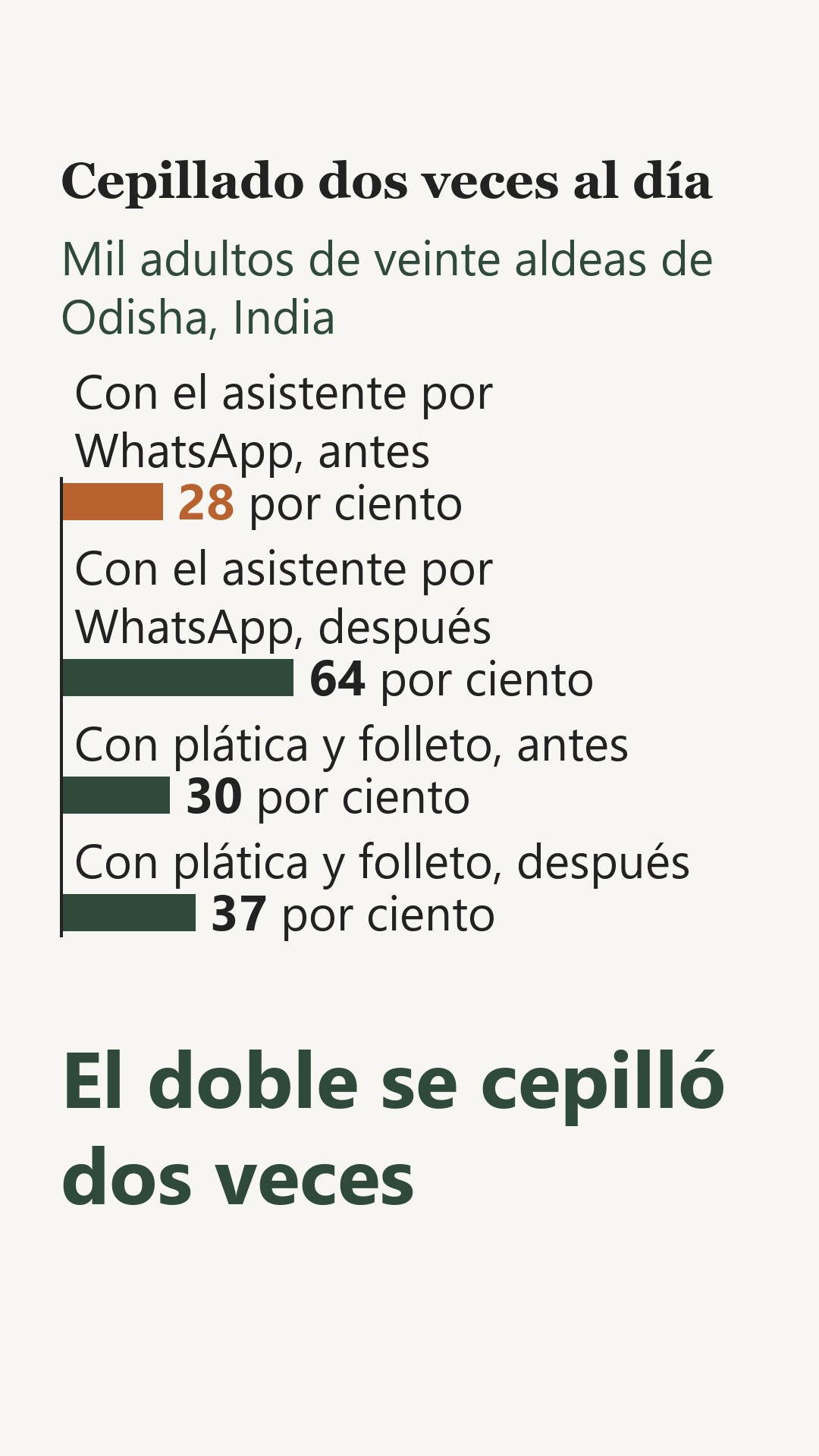
Veintiocho de cada cien personas se cepillaban dos veces al día. Cuatro semanas después, fueron sesenta y cuatro de cada cien.
El cambio ocurrió en veinte aldeas rurales del estado de Odisha, en la India. Un equipo de investigadores dividió a mil adultos en dos grupos de quinientas personas. Un grupo recibió durante un mes mensajes y audios de un programa de inteligencia artificial por medio de WhatsApp, con recordatorios y consejos para cuidar la boca. El otro grupo asistió a una plática de salud y se llevó un folleto en papel.
En el grupo del folleto, quienes se lavaban los dientes dos veces al día pasaron de treinta a treinta y siete por ciento. La diferencia favoreció a la pantalla: el grupo del asistente telefónico redujo la suciedad y la placa dental en 1.2 puntos según la escala usada por los dentistas, frente a una reducción de 0.3 puntos con el papel. Además, las visitas a una consulta dental subieron dieciocho por ciento entre quienes usaron el programa, frente a cuatro por ciento en el otro grupo.
Pasa lo mismo con la pasta dental con fluoruro. Su uso creció cuarenta y dos por ciento con el asistente virtual y sólo ocho por ciento con la plática tradicional.
El ensayo sólo observó lo que pasó en el corto plazo, durante esas cuatro semanas. Nadie sabe si los participantes mantuvieron la costumbre de cepillarse después de que terminaron los mensajes. El estudio se hizo en una sola región de la India y sólo con adultos. Cerca de dos de cada tres participantes tenían teléfono inteligente, y esa cifra fue parecida en los dos grupos.
El programa daba consejos por escrito y por audio sobre cómo cepillarse, el uso de fluoruro, el cuidado de las encías y la alimentación. Una aplicación no sustituye la visita al consultorio.
Si en su clínica o centro de salud le ofrecen un servicio gratuito de recordatorios y orientación por mensaje, busque si está disponible en su lengua y pregunte si alguien midió ya los resultados en su comunidad.
Qué significa para usted
Si en su centro de salud le ofrecen recordatorios por mensaje para el cuidado de los dientes, pregunte si el servicio está en su lengua y si alguien midió los resultados en su propia comunidad. El estudio sólo siguió a los participantes durante cuatro semanas y en aldeas de una región de la India, así que todavía no se sabe si el hábito se mantiene. Lleve sus dudas al dentista, que es quien puede valorar su caso.
Kapoor, D., Achalli, S., Reddy, N. et al. (2026). Artificial intelligence and its impact on oral health care education. A randomized study. Journal of Education and Health Promotion. https://doi.org/10.4103/jehp.jehp_1971_25
Quién pagó: El artículo indica que la financiación fue nula y no menciona préstamo de equipos o programas ni papel alguno de financiadores.
No tome esto como consejo médico profesional.
Versión detalladaLos pasajes copiados del artículo, las ilustraciones y cada fuente con cuánto leímos de ella · 1290 palabras · unos 6 minLeerla →Cerrar
Un chatbot por WhatsApp logró que más adultos de aldeas en India se cepillaran los dientes dos veces al día
El estudio comparó el chatbot con pláticas y folletos en 20 pueblos de Odisha. Midió cuatro semanas, y nada más.
Un chatbot en el teléfono, con recordatorios y preguntas de práctica, que se pidió usar al menos tres veces por semana: así recibió la mitad de los participantes su clase de salud bucal. La otra mitad escuchó una plática una sola vez y se llevó un folleto impreso. Al cabo de cuatro semanas, el grupo del chatbot sabía más, se cepillaba más y tenía la boca más limpia. El estudio se hizo en aldeas rurales del estado de Odisha, en India, entre enero y junio de 20251.
Fueron mil adultos de 20 aldeas, repartidos en dos grupos de 500; las aldeas se asignaron por sorteo a uno u otro método, no las personas una por una. El conocimiento sobre salud bucal subió de 9.8 a 15.2 puntos sobre 20 en el grupo del chatbot, y de 10.1 a 11.3 en el grupo de los folletos2. El cepillado dos veces al día pasó de 28% a 64% en el primer grupo, y de 30% a 37% en el segundo3. El índice de higiene bucal que usó el estudio bajó 1.2 puntos con el chatbot y 0.3 con el folleto4. Las visitas al dentista subieron 18% frente a 4%5.
El estudio tiene un techo claro, y sus propios autores lo escriben: solo midió cuatro semanas. No hay seguimiento para saber si la gente siguió cepillándose dos veces al día cuando terminaron los mensajes6.
Piense en el folleto. Lo recibe, lo hojea, lo guarda en un cajón y a la semana ya no lo encuentra. La plática comunitaria funciona, pero según los propios autores de este trabajo suele quedarse corta para sostener un cambio de hábito en el tiempo7. Lo curioso es que el chatbot ataca justo ese punto flojo: simula una conversación y da información interactiva y fácil de usar8, y además manda recordatorios y respuestas ajustadas a cada persona9.
El aparato no es un consultorio. Es WhatsApp, con texto y audio, en el teléfono que la persona ya tenía10. El contenido era de lo más terreno: cómo cepillarse, para qué sirve el flúor, cómo prevenir enfermedades de las encías, qué comer, y los riesgos del tabaco y el alcohol; con cuestionarios y hasta un localizador de clínicas11. Todo eso se ofreció en aldeas donde el acceso a los dentistas es limitado, el dinero escasea y la información es poca, tres cosas que los autores señalan como causa de más enfermedad bucal12.
La salud de la boca, dicen los autores, es parte del bienestar general y aun así se descuida, sobre todo entre quienes viven en el campo13. Ahí está el tamaño del asunto: no es una caries, es una población entera a la que la clase básica, según los autores, suele quedársele corta para sostener el cambio. El estudio no dice que el chatbot sustituya al dentista; enseña, y nada más.
Este tipo de estudio es nuevo, y por eso importa. Los propios autores reconocen que hay poca investigación seria que mida si un chatbot de salud bucal mejora la conciencia y los resultados clínicos14. En otras áreas ya se probó algo parecido. Según el resumen de un estudio de Hong Kong sobre un chatbot que aplica entrevistas motivacionales para cambiar hábitos, lo único disponible de él porque el texto completo está detrás de una suscripción, el método que imita —la entrevista motivacional— funciona pero es difícil de llevar a escala por falta de personal y de capacitación15; ese ensayo reunió a 627 adultos de entre 45 y 75 años en tres centros de salud16, y los efectos se mantenían a los nueve meses17.
La otra cara de la moneda también está documentada. Según el resumen de un estudio sobre chatbots de lenguaje amplio usados por el público para informarse de salud, lo único disponible de él porque el texto completo está detrás de una suscripción, esas herramientas son muy accesibles y cada vez más usadas18, pero una respuesta incorrecta puede dar falsa tranquilidad y retrasar el tratamiento19. En ese trabajo la precisión cambió según el caso: alta en padecimientos de mano programados y en lesiones menores, y bastante menor en traumatismos20, y los propios autores concluyen que no conviene apoyarse en esas respuestas para decidir a dónde acudir en una lesión urgente21.
Aquí está la lectura de weeklyAI. El patrón es el de casi todo servicio de salud por mensajes: la cercanía con la pantalla es intermitente. Uno siente que lo acompañan, pero también que puede haber distancia dentro de esa cercanía. Si eso se cumple, lo esperable es que quienes más mejoraron fueran los que más usaron el chatbot y más le preguntaron, y que quienes lo abrieron pocas veces mejoraran menos aunque tuvieran el mismo acceso. Esta lectura se equivocaría si aparecieran mejoras iguales entre quienes casi no interactuaron, o si el aumento de conocimiento y de cepillado no guardara relación con cuánto se usó. Para el lector, la pregunta práctica es sencilla: si le ofrecen un servicio de salud por mensajes, fíjese si le responden, si insiste y si le queda claro a quién preguntar cuando algo no entiende. Pregunte cuánta gente lo usa de verdad y qué pasa con quienes no lo usan.
La segunda lectura tiene que ver con la costumbre. Un hábito que se repite muchas veces, aunque no siempre dé un premio, se graba y después cuesta cambiarlo; por eso las rutinas se sostienen solas, para bien o para mal. Lo esperable es que lo aprendido en cuatro semanas con recordatorios se desarme cuando terminen los mensajes, y que el cepillado dos veces al día vuelva a los niveles de antes en pocos meses. Esta lectura se equivocaría si el cepillado y la mejora de las encías se mantuvieran iguales varios meses después, sin recordatorios. En casa, conviene preguntar si el programa incluye recordatorios que sigan después de las primeras semanas o si solo dura un tiempo; y anotar en un lugar visible el hábito que se quiere sostener, para revisar a las semanas si sigue igual.
Los autores piden más estudios, en más centros y con seguimiento largo, para saber si esto se sostiene y si aplica más allá6. También proponen integrar estas herramientas a los programas comunitarios de salud, convencidos de que pueden cerrar la brecha de atención bucal22. La declaración de financiamiento dice "ninguno", y los autores declaran no tener conflictos de interés. El artículo reparte las tareas entre sus autores: unos diseñaron el estudio, otros hicieron la validación, el análisis y la investigación, y otro se encargó de los recursos y del manejo de los datos.
Lo que el lector puede hacer con esto no es pedir un chatbot en su clínica mañana. Es preguntar por él. Donde viva, la pregunta útil es si su centro de salud ofrece algún acompañamiento por mensajes para hábitos, y si ese acompañamiento tiene recordatorios que duren más de un mes. Si algún día le llega una respuesta automática sobre salud, la prueba es la misma que la de este estudio: ¿me responde claro, me sirve para mi vida, y sé a quién acudir si no entiendo? Y una cosa que el estudio no dice y que conviene tener presente: enseñar no es diagnosticar. Un chatbot que le explica cómo cepillarse no es razón para dejar de ir al dentista.
Ese folleto en el cajón sigue ahí. Lo que cambió es que ahora hay una manera de saber si la clase llegó a la boca, y no solo al oído. ¿Sabe usted si su centro de salud manda recordatorios, y por cuánto tiempo?
De dónde sale cada dato de contexto, y cuánto leímos de cada documento
- Kapoor, D., Achalli, S., Reddy, N. et al. (2026). Artificial intelligence and its impact on oral health care education. A randomized study. Journal of Education and Health Promotion. https://doi.org/10.4103/jehp.jehp_1971_25 - el artículo del que trata esta nota — el artículo completo — el pasaje: "This cluster-randomized controlled trial was conducted from January 2025 to June 2025 in rural villages of Odisha state, India, after obtaining approval from the Institutional Ethics Committee (IEC/MM2409) and permission from Village Panchayats."
- Kapoor, D., Achalli, S., Reddy, N. et al. (2026). Artificial intelligence and its impact on oral health care education. A randomized study. Journal of Education and Health Promotion. https://doi.org/10.4103/jehp.jehp_1971_25 - el artículo del que trata esta nota — el artículo completo — el pasaje: "The intervention group showed a marked rise in mean knowledge scores (9.8 to 15.2) compared to controls (10.1 to 11.3; P < 0.001)."
- Kapoor, D., Achalli, S., Reddy, N. et al. (2026). Artificial intelligence and its impact on oral health care education. A randomized study. Journal of Education and Health Promotion. https://doi.org/10.4103/jehp.jehp_1971_25 - el artículo del que trata esta nota — el artículo completo — el pasaje: "Twice-daily brushing improved from 28% to 64% (vs. 30% to 37% in controls)."
- Kapoor, D., Achalli, S., Reddy, N. et al. (2026). Artificial intelligence and its impact on oral health care education. A randomized study. Journal of Education and Health Promotion. https://doi.org/10.4103/jehp.jehp_1971_25 - el artículo del que trata esta nota — el artículo completo — el pasaje: "OHI-S scores improved significantly more in the chatbot group (reduction = 1.2) than in controls (0.3; P < 0.001)."
- Kapoor, D., Achalli, S., Reddy, N. et al. (2026). Artificial intelligence and its impact on oral health care education. A randomized study. Journal of Education and Health Promotion. https://doi.org/10.4103/jehp.jehp_1971_25 - el artículo del que trata esta nota — el artículo completo — el pasaje: "Also, professional dental visits were found to increaseby 18% among the intervention group when compared to a 4% increase in the control group."
- Kapoor, D., Achalli, S., Reddy, N. et al. (2026). Artificial intelligence and its impact on oral health care education. A randomized study. Journal of Education and Health Promotion. https://doi.org/10.4103/jehp.jehp_1971_25 - el artículo del que trata esta nota — el artículo completo — el pasaje: "The study was limited to short-term outcomes, without assessment of long-term behavioral adherence. Larger multi-center trials with extended follow-up are needed to evaluate the sustainability and broader applicability of chatbot-based interventions."
- Kapoor, D., Achalli, S., Reddy, N. et al. (2026). Artificial intelligence and its impact on oral health care education. A randomized study. Journal of Education and Health Promotion. https://doi.org/10.4103/jehp.jehp_1971_25 - el artículo del que trata esta nota — el artículo completo — el pasaje: "Preventive oral health education using conventional strategies such as pamphlets, community talks, and postershasbeen shown to significantly reduce disease incidence but often fails to achieve sustained behavioral changes."
- Kapoor, D., Achalli, S., Reddy, N. et al. (2026). Artificial intelligence and its impact on oral health care education. A randomized study. Journal of Education and Health Promotion. https://doi.org/10.4103/jehp.jehp_1971_25 - el artículo del que trata esta nota — el artículo completo — el pasaje: "AI-driven chatbotssimulate human conversation to provide accessible, interactive, and user-friendly health information."
- Kapoor, D., Achalli, S., Reddy, N. et al. (2026). Artificial intelligence and its impact on oral health care education. A randomized study. Journal of Education and Health Promotion. https://doi.org/10.4103/jehp.jehp_1971_25 - el artículo del que trata esta nota — el artículo completo — el pasaje: "Chatbots offer real-time engagement, reminders, and tailored responses, making them highly effective in promoting behavioral modifications in targeted individuals."
- Kapoor, D., Achalli, S., Reddy, N. et al. (2026). Artificial intelligence and its impact on oral health care education. A randomized study. Journal of Education and Health Promotion. https://doi.org/10.4103/jehp.jehp_1971_25 - el artículo del que trata esta nota — el artículo completo — el pasaje: "The intervention arm received 4 weeks of AI chatbot-delivered oral health education via WhatsApp text/audio through their smartphones."
- Kapoor, D., Achalli, S., Reddy, N. et al. (2026). Artificial intelligence and its impact on oral health care education. A randomized study. Journal of Education and Health Promotion. https://doi.org/10.4103/jehp.jehp_1971_25 - el artículo del que trata esta nota — el artículo completo — el pasaje: "Oral health module included—toothbrushing techniques, benefits of fluoride use, prevention of gum diseases, dietary advice, and risks associated with tobacco/alcohol use. The features included reminders, quizzes, and clinic locator information."
- Kapoor, D., Achalli, S., Reddy, N. et al. (2026). Artificial intelligence and its impact on oral health care education. A randomized study. Journal of Education and Health Promotion. https://doi.org/10.4103/jehp.jehp_1971_25 - el artículo del que trata esta nota — el artículo completo — el pasaje: "Limited accessibility to dental professionals, financial constraints, and poor awareness contribute to a higher burden of oral diseases such as dental caries and periodontal conditions."
- Kapoor, D., Achalli, S., Reddy, N. et al. (2026). Artificial intelligence and its impact on oral health care education. A randomized study. Journal of Education and Health Promotion. https://doi.org/10.4103/jehp.jehp_1971_25 - el artículo del que trata esta nota — el artículo completo — el pasaje: "Oral health is an essential component of overall well-being, yet it remains to be a neglected aspect of general health, particularly in rural populations."
- Kapoor, D., Achalli, S., Reddy, N. et al. (2026). Artificial intelligence and its impact on oral health care education. A randomized study. Journal of Education and Health Promotion. https://doi.org/10.4103/jehp.jehp_1971_25 - el artículo del que trata esta nota — el artículo completo — el pasaje: "However, there is limited empirical research evaluating the effectiveness of chatbot-based oral health education in improving awareness and clinical outcomes."
- Wong CHY, Wong MNK, Hou WK, Ting FST, Ng YM, Che Hin Chan C. (2026). Motivational interviewing chatbot improves lifestyle in primary healthcare settings in a pragmatic randomised controlled trial. npj Digital Medicine. 10.1038/s41746-026-02728-w — solo el resumen - no se pudo obtener el texto completo — el pasaje: "Motivational interviewing (MI) is effective but difficult to scale due to resource and training constraints."
- Wong CHY, Wong MNK, Hou WK, Ting FST, Ng YM, Che Hin Chan C. (2026). Motivational interviewing chatbot improves lifestyle in primary healthcare settings in a pragmatic randomised controlled trial. npj Digital Medicine. 10.1038/s41746-026-02728-w — solo el resumen - no se pudo obtener el texto completo — el pasaje: "This pragmatic, open-label, multicentre randomised controlled trial across three Hong Kong PHC facilities randomised 627 adults aged 45-75 with or at risk of hypertension or diabetes."
- Wong CHY, Wong MNK, Hou WK, Ting FST, Ng YM, Che Hin Chan C. (2026). Motivational interviewing chatbot improves lifestyle in primary healthcare settings in a pragmatic randomised controlled trial. npj Digital Medicine. 10.1038/s41746-026-02728-w — solo el resumen - no se pudo obtener el texto completo — el pasaje: "Effects were sustained at 9-month follow-up."
- Counihan CM, Duncan RJD, Bullock MG, Mallina R. (2026). Diagnostic and Triage Performance of Large Language Models in Hand and Wrist Complaints: A Standardised Vignette Evaluation. HAND. 10.1177/15589447261497439 — solo el resumen - el texto completo está tras una suscripción — el pasaje: "Large language model (LLM) chatbots are widely accessible and increasingly used by the public for health information and as a tool to diagnose health conditions."
- Counihan CM, Duncan RJD, Bullock MG, Mallina R. (2026). Diagnostic and Triage Performance of Large Language Models in Hand and Wrist Complaints: A Standardised Vignette Evaluation. HAND. 10.1177/15589447261497439 — solo el resumen - el texto completo está tras una suscripción — el pasaje: "While this may improve access to information, incorrect responses may lead to false reassurance and treatment delays."
- Counihan CM, Duncan RJD, Bullock MG, Mallina R. (2026). Diagnostic and Triage Performance of Large Language Models in Hand and Wrist Complaints: A Standardised Vignette Evaluation. HAND. 10.1177/15589447261497439 — solo el resumen - el texto completo está tras una suscripción — el pasaje: "Diagnostic accuracy differed by presentation type: 96.7% for elective, 65.0% for trauma, and 100% for minor injuries"
- Counihan CM, Duncan RJD, Bullock MG, Mallina R. (2026). Diagnostic and Triage Performance of Large Language Models in Hand and Wrist Complaints: A Standardised Vignette Evaluation. HAND. 10.1177/15589447261497439 — solo el resumen - el texto completo está tras una suscripción — el pasaje: "Given the potential for false reassurance and delayed care in time-critical injuries, LLM outputs should not be relied upon for triage decisions."
- Kapoor, D., Achalli, S., Reddy, N. et al. (2026). Artificial intelligence and its impact on oral health care education. A randomized study. Journal of Education and Health Promotion. https://doi.org/10.4103/jehp.jehp_1971_25 - el artículo del que trata esta nota — el artículo completo — el pasaje: "Integrating such digital interventions into community programs can significantly bridge oral health disparities, as evident from the current study findings, which underlined increased responsiveness after training using a chatbot application."
Kapoor, D., Achalli, S., Reddy, N. et al. (2026). Artificial intelligence and its impact on oral health care education. A randomized study. Journal of Education and Health Promotion. https://doi.org/10.4103/jehp.jehp_1971_25
Quién pagó: El artículo indica que la financiación fue nula y no menciona préstamo de equipos o programas ni papel alguno de financiadores.
No tome esto como consejo médico profesional.
experiment · Journal of education and health promotion · the paper, 31 Aug 2026 · free
In 10 Indian Villages, a WhatsApp Chatbot Got More Adults Brushing Twice a Day
In a four-week trial, adults who got lessons by chatbot brushed and cleaned better than those given leaflets. Nobody knows whether the habit lasted past the month.
Short version · the longer version follows, about 6 min
Ask the weeklyAI chat
Ask me about AI in your life: I point you to the stories weeklyAI has published on it, this week and before.
Conversations are saved for as long as weeklyAI exists, to improve the publication. Answers come in the language you write in.
- The study at a glance
- Who
- adults in rural villages
- How many
- 1,000 adults, 500 in villages assigned to a chatbot on WhatsApp and 500 in villages given a single health talk and a printed leaflet
- Where
- Odisha, India
- When
- four weeks
- Kind of study
- experiment
- Who did it
- dental schools in India and Saudi Arabia
- The limit that matters
- Nobody checked whether the twice-daily brushing lasted past the four weeks.
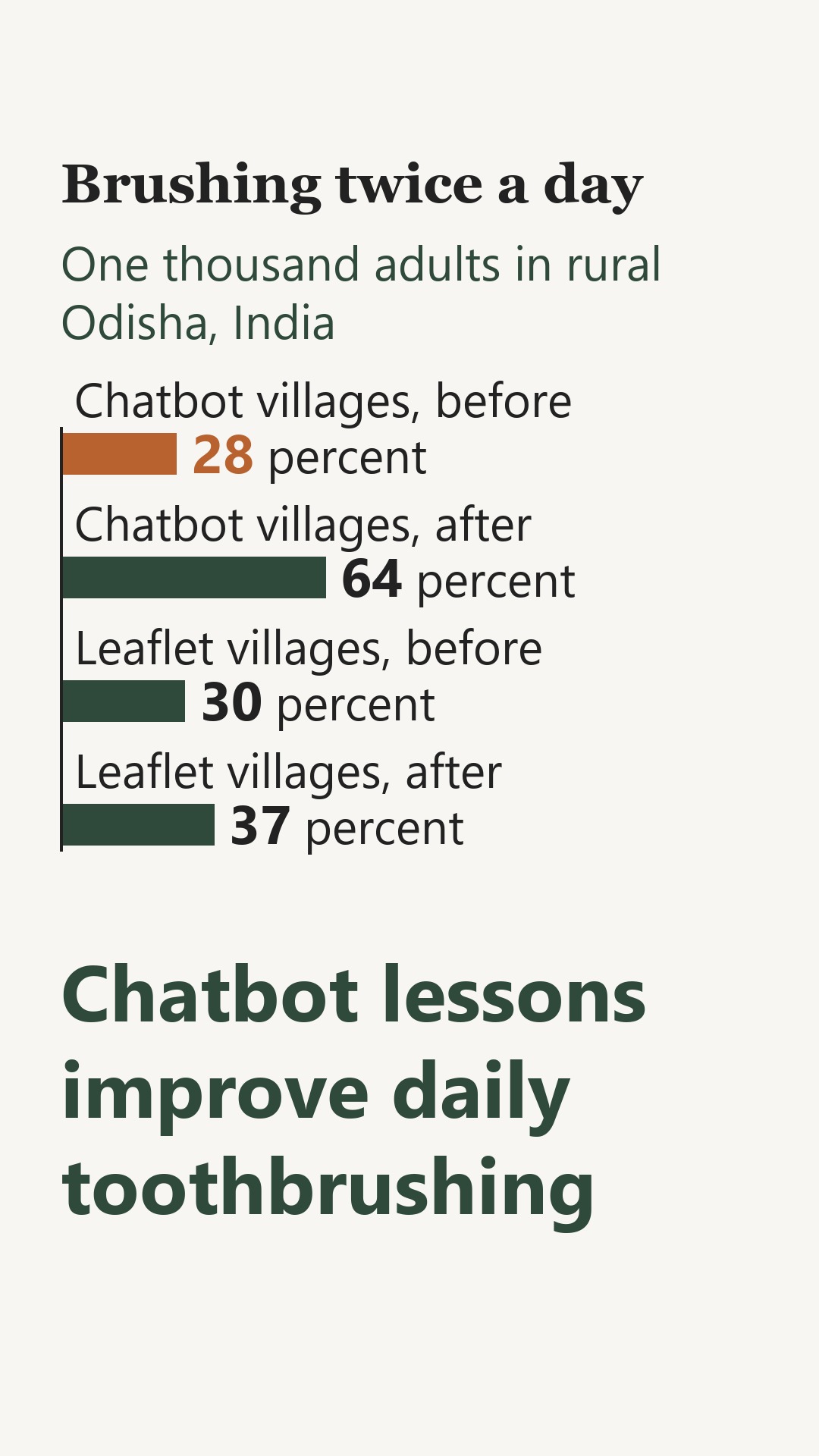
These are shares of adults brushing twice a day in each group, measured only at the start and after four weeks; no one checked whether the habit held after that.
Chatbot lessons on WhatsApp against a single health talk and a printed leaflet
Knowledge score rose from 9.8 to 15.2 out of 20, against 10.1 to 11.3
Brushing twice a day went from 28% to 64%, against 30% to 37%
Plaque and gum score fell by 1.2 points, against 0.3
Dental visits rose by 18%, against 4%
One month is the whole story so far.
Take the toothbrush. Twice a day, two minutes, is the advice most people have heard and few follow. In 20 villages in Odisha, India, researchers put that advice on a phone.
They ran a randomized trial with 1,000 adults, 500 in villages assigned to a chatbot on WhatsApp and 500 in villages given a single health talk and a printed leaflet. The chatbot answered in text or audio for four weeks, sent reminders, set quizzes and told people where to find a clinic.
In the chatbot villages, the share of adults brushing twice a day rose by about 36 points, from 28 percent to 64 percent. In the leaflet villages it moved from 30 percent to 37 percent.
Their teeth and gums showed it. A standard score of plaque and gum health, where lower is cleaner, fell by 1.2 points in the chatbot group and by 0.3 in the leaflet group. Use of fluoride toothpaste rose by 42 percent against 8 percent, and visits to a dentist rose by 18 percent against 4 percent.
One month is the whole story so far. The researchers say they did not check whether anyone kept brushing after the four weeks ended, and they call for longer studies in more places. Everyone in the trial was 18 or older, and about two in three people in each group owned a smartphone. Villages in one Indian state cannot speak for people elsewhere, or for anyone without a phone.
The chatbot gave lessons on brushing, fluoride, gum disease, diet and tobacco and alcohol. It also sent reminders, set quizzes and told people where to find a clinic. A sore gum or a loose tooth still needs a professional, and this study gives no reason to wait.
If a clinic or health program near you offers advice by phone, by text or by a chat service, this is the kind of thing that was tested. Ask whether it is free, whether it answers in your language, and whether anyone has measured what it changed where you live.
What this means for you
In the villages where the chatbot was tested, adults brushed and cleaned their teeth better after four weeks, and more of them went to a dentist. That much was measured. Whether anyone kept it up past the month was not, so watch for a clinic or health program near you that offers advice by text or chat, and ask if it is free and whether anyone has checked what it changed.
Kapoor, D., Achalli, S., Reddy, N. et al. (2026). Artificial intelligence and its impact on oral health care education. A randomized study. Journal of Education and Health Promotion. https://doi.org/10.4103/jehp.jehp_1971_25
Who paid: The article states the funding was nil, and it names no equipment or software lenders and no funder role.
Do not take this as professional medical advice.
The longer versionThe passages copied from the paper, the pictures, and every source with how much of it we read · 1159 words · about 6 minRead it →Close
A chatbot on WhatsApp taught villagers to brush twice a day and clean their teeth better.
A randomized trial in rural India tested a phone-based teacher against leaflets and health talks. The gains were real and short-term.
In twenty villages in the state of Odisha, India, five hundred adults were given four weeks of oral health lessons from an AI chatbot on WhatsApp, in text and audio. Another five hundred, in ten other villages, got a single health talk and a printed leaflet. Everyone was asked the same questions before and after.
The chatbot group's knowledge score rose from 9.8 to 15.2 out of 20; the leaflet group's moved from 10.1 to 11.31. The share brushing twice a day went from 28 percent to 64 percent in the chatbot villages, and from 30 percent to 37 percent in the others2. A standard measure of plaque and debris on the teeth fell by 1.2 points in the chatbot group and 0.3 in the control group3. Visits to a dentist rose by 18 percent against 4 percent4.
Consider what the chatbot actually did. It held a conversation: it answered, reminded, and quizzed, the way a person texting would5. Its lessons covered how to brush, why fluoride helps, how to prevent gum disease, what to eat, and the risks of tobacco and alcohol; it sent reminders, set quizzes, and could point someone to a clinic6. Participants were asked to use it at least three times a week, on their own smartphones, for four weeks7.
The comparison is worth naming plainly. On one side, a leaflet and a talk, given once. On the other, a voice in a pocket that comes back day after day. Printed material and community talks have been shown to reduce disease, but they often fail to hold a habit in place8. That gap — between knowing and keeping on — is the one the chatbot was built to cross.
The problem it addresses is old and stubborn. Oral health is a neglected corner of general health, especially in rural places9. Dentists are far away, money is short, and awareness is thin, and together those raise the burden of cavities and gum disease10. Phone-based teaching is not a new idea, but evidence testing it for oral health, especially in rural communities, has been scarce11.
The study has limits a reader should hold onto. It followed people for four weeks only, and nobody checked whether the twice-daily brushing survived the study's end; the authors themselves say longer trials in more places are needed12. Participants had to be 18 or older and to own a smartphone. The villages were in Odisha, and nowhere else.
The authors declare no funding and no conflicts of interest. Their affiliations are dental schools in India and Saudi Arabia. The authors' roles are listed: some designed the study, some carried out validation, analysis, and investigation, and one managed resources, data curation, and visualization.
Here is weeklyAI's reading. The first week is the one that counts. People take up a new daily routine most reliably when they make the switch in one go and repeat it without an early miss; a single stumble drains the will to continue. Expect the largest gum-score gains among villagers who used the chatbot several times a week from the start, and little change among those who tried it once or twice and drifted away — even though they lived in the same villages. This reading would be wrong if the gum-score improvements turned out just as large among rare users as among frequent ones. If a clinic or community program offers you a phone-based health reminder, treat the first seven days as the test: fix a time, do it daily, and do not let one missed day become two. Ask whether the program tracks how often people actually use the tool, not merely whether they were handed it.
A second expectation: habits travel between neighbors. When people are unsure what to do, they copy what those around them are doing. Expect the rise in twice-daily brushing and dental visits to have spread partly person to person — once a visible share of neighbors were brushing twice a day or seeing a dentist, others followed — so the village-wide gain may be larger than what any one person learned from the phone alone. This reading would be wrong if people with many chatbot-using neighbors improved no more than those with few. Notice who in your own circle already does the healthy thing you are considering; a few people openly changing a habit can move more people than a leaflet.
And a caution about the voice itself. A tool that arrives as an authoritative, personalized presence on your own phone sits closer at hand than a distant dentist, and that nearness may carry as much weight as the content. Its hold weakens once the advice sounds generic or contradicts what a local nurse says. When a phone tool gives you health advice, ask who stands behind it and whether it matches what your own dentist tells you. A tool that invites questions and gives reasons deserves more trust than one that only says "do this."
What the study did not test matters as much as what it did. The chatbot taught; it did not diagnose or treat anyone. It is no reason to skip a dental visit — if anything, the group that used it went to the dentist more. Cavities and gum disease as such were not measured, only the plaque and debris score. And a chatbot that works in Odisha's villages is not thereby proven to work in a city, another country, or with people who share a phone or have none.
The authors see a path from here: folding such tools into community health programs, as an addition to talks and leaflets rather than a replacement for them13. That is a claim about what could be tried next, not a result. A funder weighing it would want costs, dropout rates, and evidence that the habit lasts — none of which this four-week trial reports.
The thing to carry away is modest and usable. A free messaging app, a set of plain lessons, and a reminder that comes back: that combination measurably moved knowledge, brushing, and a clinical score in one poor rural district, in four weeks. Whether it holds past the fourth week is an open question. If your clinic, insurer, or community group starts offering a phone-based health coach, the questions to ask are simple: What does it teach, who wrote it, how often will it reach me, and does anyone check whether I — and my neighbors — keep using it?
The leaflet on the clinic counter still says brush twice a day. The phone in the pocket said it back, every day, and for four weeks in Odisha that made the difference. What would it take for the reminder you already carry to be one you trust?
Where each piece of context comes from, and how much of it we read
- Kapoor, D., Achalli, S., Reddy, N. et al. (2026). Artificial intelligence and its impact on oral health care education. A randomized study. Journal of Education and Health Promotion. https://doi.org/10.4103/jehp.jehp_1971_25 - the article this story is about — the whole article — the passage: "The intervention group showed a marked rise in mean knowledge scores (9.8 to 15.2) compared to controls (10.1 to 11.3; P < 0.001)."
- Kapoor, D., Achalli, S., Reddy, N. et al. (2026). Artificial intelligence and its impact on oral health care education. A randomized study. Journal of Education and Health Promotion. https://doi.org/10.4103/jehp.jehp_1971_25 - the article this story is about — the whole article — the passage: "Twice-daily brushing improved from 28% to 64% (vs. 30% to 37% in controls)."
- Kapoor, D., Achalli, S., Reddy, N. et al. (2026). Artificial intelligence and its impact on oral health care education. A randomized study. Journal of Education and Health Promotion. https://doi.org/10.4103/jehp.jehp_1971_25 - the article this story is about — the whole article — the passage: "OHI-S scores improved significantly more in the chatbot group (reduction = 1.2) than in controls (0.3; P < 0.001)."
- Kapoor, D., Achalli, S., Reddy, N. et al. (2026). Artificial intelligence and its impact on oral health care education. A randomized study. Journal of Education and Health Promotion. https://doi.org/10.4103/jehp.jehp_1971_25 - the article this story is about — the whole article — the passage: "Also, professional dental visits were found to increaseby 18% among the intervention group when compared to a 4% increase in the control group."
- Kapoor, D., Achalli, S., Reddy, N. et al. (2026). Artificial intelligence and its impact on oral health care education. A randomized study. Journal of Education and Health Promotion. https://doi.org/10.4103/jehp.jehp_1971_25 - the article this story is about — the whole article — the passage: "AI-driven chatbotssimulate human conversation to provide accessible, interactive, and user-friendly health information."
- Kapoor, D., Achalli, S., Reddy, N. et al. (2026). Artificial intelligence and its impact on oral health care education. A randomized study. Journal of Education and Health Promotion. https://doi.org/10.4103/jehp.jehp_1971_25 - the article this story is about — the whole article — the passage: "Oral health module included—toothbrushing techniques, benefits of fluoride use, prevention of gum diseases, dietary advice, and risks associated with tobacco/alcohol use. The features included reminders, quizzes, and clinic locator information."
- Kapoor, D., Achalli, S., Reddy, N. et al. (2026). Artificial intelligence and its impact on oral health care education. A randomized study. Journal of Education and Health Promotion. https://doi.org/10.4103/jehp.jehp_1971_25 - the article this story is about — the whole article — the passage: "The intervention arm received 4 weeks of AI chatbot-delivered oral health education via WhatsApp text/audio through their smartphones."
- Kapoor, D., Achalli, S., Reddy, N. et al. (2026). Artificial intelligence and its impact on oral health care education. A randomized study. Journal of Education and Health Promotion. https://doi.org/10.4103/jehp.jehp_1971_25 - the article this story is about — the whole article — the passage: "Preventive oral health education using conventional strategies such as pamphlets, community talks, and postershasbeen shown to significantly reduce disease incidence but often fails to achieve sustained behavioral changes."
- Kapoor, D., Achalli, S., Reddy, N. et al. (2026). Artificial intelligence and its impact on oral health care education. A randomized study. Journal of Education and Health Promotion. https://doi.org/10.4103/jehp.jehp_1971_25 - the article this story is about — the whole article — the passage: "Oral health is an essential component of overall well-being, yet it remains to be a neglected aspect of general health, particularly in rural populations."
- Kapoor, D., Achalli, S., Reddy, N. et al. (2026). Artificial intelligence and its impact on oral health care education. A randomized study. Journal of Education and Health Promotion. https://doi.org/10.4103/jehp.jehp_1971_25 - the article this story is about — the whole article — the passage: "Limited accessibility to dental professionals, financial constraints, and poor awareness contribute to a higher burden of oral diseases such as dental caries and periodontal conditions."
- Kapoor, D., Achalli, S., Reddy, N. et al. (2026). Artificial intelligence and its impact on oral health care education. A randomized study. Journal of Education and Health Promotion. https://doi.org/10.4103/jehp.jehp_1971_25 - the article this story is about — the whole article — the passage: "However, there is limited empirical research evaluating the effectiveness of chatbot-based oral health education in improving awareness and clinical outcomes."
- Kapoor, D., Achalli, S., Reddy, N. et al. (2026). Artificial intelligence and its impact on oral health care education. A randomized study. Journal of Education and Health Promotion. https://doi.org/10.4103/jehp.jehp_1971_25 - the article this story is about — the whole article — the passage: "The study was limited to short-term outcomes, without assessment of long-term behavioral adherence. Larger multi-center trials with extended follow-up are needed to evaluate the sustainability and broader applicability of chatbot-based interventions."
- Kapoor, D., Achalli, S., Reddy, N. et al. (2026). Artificial intelligence and its impact on oral health care education. A randomized study. Journal of Education and Health Promotion. https://doi.org/10.4103/jehp.jehp_1971_25 - the article this story is about — the whole article — the passage: "Integrating such digital interventions into community programs can significantly bridge oral health disparities, as evident from the current study findings, which underlined increased responsiveness after training using a chatbot application."
Kapoor, D., Achalli, S., Reddy, N. et al. (2026). Artificial intelligence and its impact on oral health care education. A randomized study. Journal of Education and Health Promotion. https://doi.org/10.4103/jehp.jehp_1971_25
Who paid: The article states the funding was nil, and it names no equipment or software lenders and no funder role.
Do not take this as professional medical advice.