analysis of texts · Cadernos Cajuína · la publicación, 27 oct 2026 · gratis
Fotos y audios falsos de candidatas: qué protege la ley brasileña y qué no
Versión breve · la versión detallada sigue, unos 6 min
Pregunte al chat de weeklyAI
Pregúnteme sobre la IA en su vida: le señalo las notas que weeklyAI ha publicado sobre el tema, esta semana y antes.
Las conversaciones se guardan mientras exista weeklyAI, para mejorar la publicación. Se responde en el idioma en que usted escribe.
- El estudio, de un vistazo
- Quiénes
- Candidatas y precandidatas a cargos electivos en Brasil, atacadas con contenido falso hecho con inteligencia artificial
- Cuántos
- 137 contenidos sintéticos con connotación política entre diciembre de 2025 y febrero de 2026
- Dónde
- Brasil
- Cuándo
- de diciembre de 2025 a febrero de 2026, antes de la primera vuelta de 2026
- Tipo de estudio
- analysis of what people did
- Quién lo hizo
- Universidade do Estado do Amazonas (UEA)
- El límite que importa
- Cuenta contenidos que circularon y decisiones judiciales; no mide cuánta gente los vio ni los creyó.
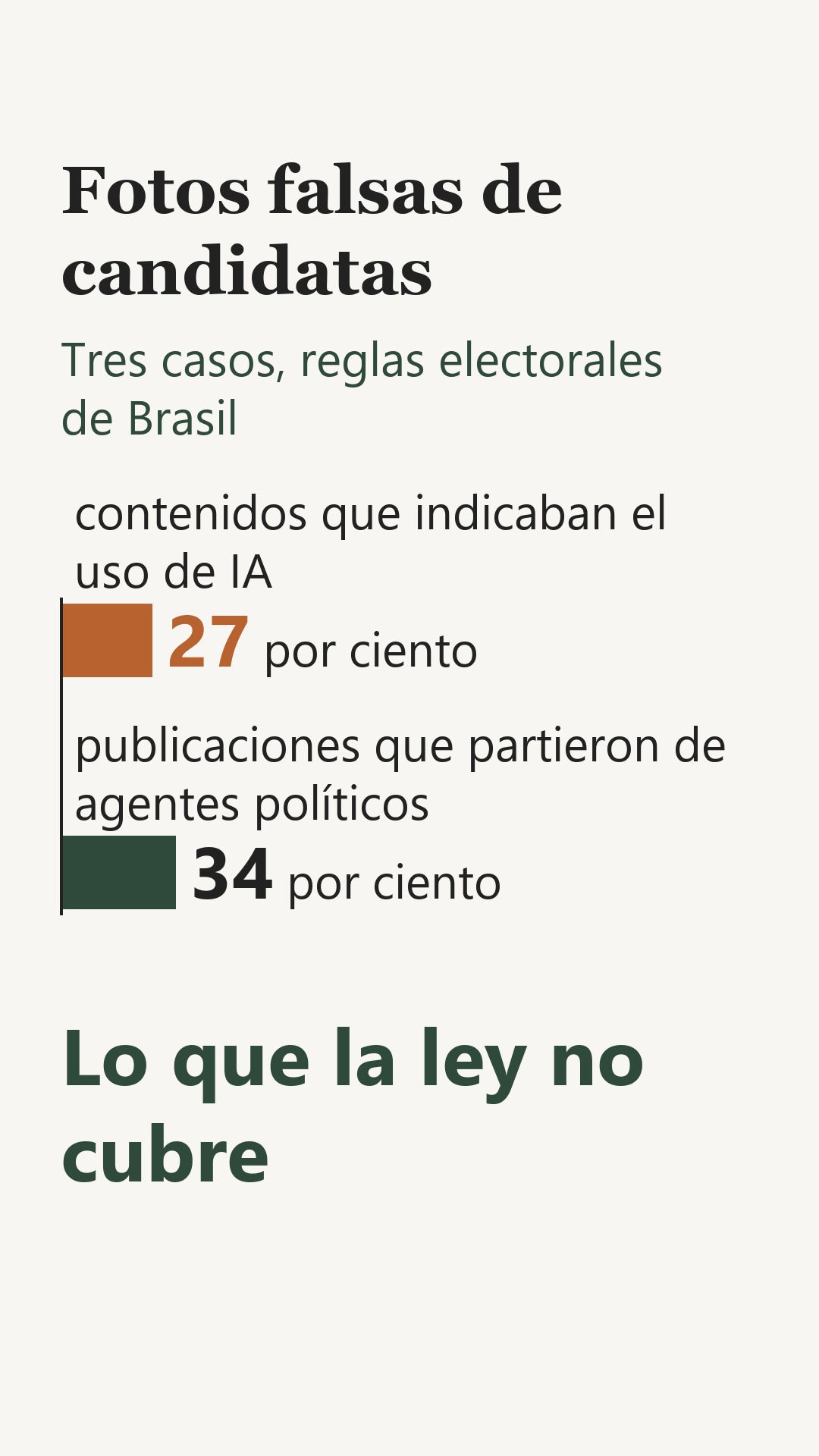
Son porcentajes de los 137 contenidos sintéticos con connotación política registrados entre diciembre de 2025 y febrero de 2026; miden cuánto circuló, no cuánta gente lo vio ni lo creyó.
Decisiones relevantes de la Justicia Electoral brasileña sobre deepfakes, por año
36 decisiones relevantes en 2024 frente a 164 en 2026, un crecimiento de cerca del 356%, todas anteriores al inicio oficial de la campaña
El art. 326-B del Código Electoral protege a candidatas y a quienes ya tienen mandato.
Un artículo revisó las reglas electorales de Brasil contra la violencia digital de género con inteligencia artificial, a partir de tres casos: fotos falsas de desnudos de las candidatas a la alcaldía de São Paulo en 2024, videos sobre Manuela d'Ávila en la precampaña de 2026 y ataques a Vanda Witoto en Amazonas en 2022. El estudio es un análisis legal, no una medición de cuánta gente vio o creyó esos contenidos.
Usted puede revisar la resolución 23,755/2026 del Tribunal Superior Electoral. Fija que las plataformas retiren de inmediato la violencia política contra la mujer durante el periodo electoral, y permite al juez invertir la carga de la prueba cuando sea muy difícil demostrar que un contenido fue manipulado.
La ley 14,192/2021 define la violencia política contra la mujer de forma amplia. El delito del artículo 326-B del Código Electoral es el que cubre solo a las candidatas y a las mujeres con mandato. No cubre a las precandidatas, y la definición de contenido falso vive en una resolución, no en una ley. La tesis del Tribunal de septiembre de 2026 exige realismo y contexto de propaganda. El estudio cerró antes de la primera vuelta y propone cambios que no fueron probados.
Qué significa para usted
La ley brasileña tiene tipos penales para estos ataques, y el estudio lo dice con claridad. Lo que falta está en los bordes: el artículo 326-B no alcanza a las precandidatas, y la definición de contenido falso vive en una resolución que se renueva cada elección. Si usted es candidata, maestra o periodista local, guarde la fecha y el enlace de lo que vea circular antes de creerlo o compartirlo.
Almeida, E. A. d., Souza, L. B. d. (2026). VIOLÊNCIA POLÍTICA DIGITAL CONTRA MULHERES CANDIDATAS E INTELIGÊNCIA ARTIFICIAL: LIMITES DA PROTEÇÃO JURÍDICO-ELEITORAL BRASILEIRA NAS ELEIÇÕES DE 2026. Cadernos Cajuína. https://doi.org/10.52641/cadcajv11i16.090
Quién pagó: El artículo no dice quién financió el estudio ni si algún financiador tuvo injerencia; no menciona equipos ni programas cedidos a los autores.
Versión detalladaLos pasajes copiados del artículo, las ilustraciones y cada fuente con cuánto leímos de ella · 1185 palabras · unos 6 minLeerla →Cerrar
La regla y la evidencia: fotos y audios falsos de candidatas: qué protege la ley brasileña y qué no
### LO QUE LA NORMA DICE
La regla que más se acerca a este problema es la Resolución nº 23,755/2026 del Tribunal Superior Electoral de Brasil. Incluyó la violencia política contra la mujer entre los casos de riesgo del art. 9º-E (inciso VII), lo que obliga a las plataformas a indisponibilizar inmediatamente ese tipo de contenido durante el período electoral, bajo pena de responsabilidad solidaria1.
El mismo tribunal fijó en septiembre de 2026, en la Representación nº 0601315-97.2026.6.00.0000, de relatoría del ministro Nunes Marques, una tesis sobre qué es un deepfake, aprobada por cinco votos contra dos2. Según la tesis, hace falta contenido sintético hecho o manipulado con inteligencia artificial, "dotado de grau de realismo ou verossimilhança", y que ese contenido esté dentro de un contexto de propaganda electoral3.
Hay un límite que conviene mirar de frente. El art. 326-B del Código Electoral protege a candidatas y a quienes ya tienen mandato. La precandidata que no ejerce el cargo queda fuera del tipo, aunque el ataque tenga la finalidad evidente de inviabilizar su candidatura4. Si usted es precandidata, la tutela penal específica no la cubre todavía.
### EL CASO QUE RESPONDE
Ninguna instancia real fue hallada esta semana.
### LO QUE SE MIDIÓ
El Observatorio IA nas Eleições, iniciativa de Data Privacy Brasil y Aláfia Lab, registró 137 contenidos sintéticos con connotación política entre diciembre de 2025 y febrero de 2026, un promedio de 1.5 casos por día y un crecimiento del 50% frente al promedio diario del año anterior5. El período abarca de diciembre de 2025 a febrero de 2026 y ya suma más de un centenar de piezas.
Solo 37 de esos contenidos (el 27%) indicaban el uso de IA, y un tercio de las publicaciones (34%) partió de agentes políticos: 32 de parlamentarios y precandidatos y 15 de partidos6. No todo viene de cuentas anónimas. Parte viene de gente con nombre en la política.
En el Poder Judicial, una investigación del IDP con Jusbrasil identificó 403 decisiones de la Justicia Electoral sobre deepfakes entre enero de 2020 y el 17 de julio de 2026. De ellas, 36 fueron relevantes en 2024 y 164 en 2026, un crecimiento de cerca del 356%, todas anteriores al inicio oficial de la campaña7. Ese dato importa para quien vota: los ataques llegan antes de que la campaña empiece formalmente.
Sobre la exposición, el artículo reporta que las imágenes falsas de Tabata Amaral en sitios para adultos acumularon más de 145 mil visualizaciones8. Es un conteo de monitoreo civil, no una tasa de población: no dice cuántas personas las creyeron ni cuántas votantes las vieron.
Aquí lo lee weeklyAI. Lo que estos números permiten decir es más angosto de lo que parece: miden cuánto contenido circuló y cuántas decisiones tomó la justicia, no cuánto de eso cambió un voto. Lo que sí se puede esperar en casa es esto: que la mayor parte del contenido sintético llegue sin señalización, y que buena parte de lo que usted reciba por mensajería no pase por ningún tribunal antes del día de la elección. Esta lectura se equivocaría si los estudios de exposición mostraran que la gente distingue bien entre lo señalado y lo que no, y que la desconfianza no se derrama sobre el proceso entero. Mientras tanto, cuando le llegue una foto o un audio raro de una candidata, fíjese primero en quién lo publicó y en qué gana con eso.
### LA RESPUESTA DE OTRA REGIÓN AL MISMO PROBLEMA
No encontramos esta semana ninguna respuesta de otro país al mismo método.
### LA LECTURA DE LA BIBLIOTECA
Lo que la propaganda ha hecho siempre es tomar un pedazo de verdad y estirarlo hasta que la mentira quepa adentro. Lo nuevo no es el truco: es la velocidad con que se fabrica y la facilidad con que se copia. Un público puede aprender a revisar quién firma lo que ve, a buscar la fecha y el lugar de un hecho, a notar cuándo una imagen no coincide con lo que dice el texto. Lo que no puede verificar solo es si esa voz que suena como la de una candidata salió de su boca o de una máquina, y para eso necesita que alguien más lo confirme. En la historia electoral de la región, el rumor falso siempre ha encontrado grietas abiertas: el miedo, la desconfianza vieja, el prejuicio que ya estaba ahí. La IA no abre esas grietas; las ensancha. Si usted ve una burla sexualizada contra una candidata y piensa "se nota que es falsa", vale la pena preguntarse si igual la descalifica. Y si es candidata o trabaja en una campaña, piense qué fotos suyas circulan y quién puede reeditarlas.
### LO QUE NO SE SABE
El estudio no midió cuántas mujeres fueron atacadas ni con qué frecuencia ocurren los deepfakes en todo el país; reporta conteos de monitoreo civil, no una tasa de población. Tampoco evaluó si alguna ley, resolución o tesis del TSE redujo los ataques o protegió a las mujeres: no hay efecto medido.
La investigación cerró antes de la primera vuelta de las elecciones de 2026 y parte de la información sobre decisiones judiciales vino de fuentes periodísticas. Lo que los tribunales hicieron después de ese corte no está cubierto. Los tres casos fueron elegidos por variedad, no por representatividad, y los propios autores lo dicen.
El requisito del contexto de propaganda electoral deja fuera del art. 9º-C los contenidos producidos por terceros sin vínculo con campañas, como los deepnudes de 2024, que circularon en sitios pornográficos y grupos de mensajes9. Y el decreto que reglamenta el Marco Civil excluye de su alcance los servicios de mensajería privada10. Dos de los tres casos analizados pasaron justamente por ahí.
Lo que no se sabe es lo que más pesa para quien vota solo: cuánta de esa avalancha llegó de verdad a sus ojos, cuánta la creyó, y si la respuesta rápida de la justicia electoral funciona en un municipio del interior donde no hay asistencia jurídica especializada. El estudio nombra esa distancia institucional11 pero no la mide. Tampoco examina cuánto cumplen las plataformas con las órdenes de retiro: no hay datos de enforcement.
Una cosa sí está clara en el documento: el problema brasileño no es la falta de tipos penales. Una candidata víctima de un deepnude tiene, en teoría, al menos cuatro encuadres posibles. Las dificultades están en el alcance de cada tipo, en identificar a los autores, en el tiempo de la respuesta y en la circulación por canales de difícil control.
Esta lectura se equivocaría si los datos de acatamiento mostraran que las plataformas retiran casi todo en horas y que las víctimas de regiones remotas obtienen respuesta igual de rápida que las del centro. Ante un contenido sospechoso sobre una candidata, la pregunta útil no es solo "¿es falso?" sino "¿quién lo publicó, por dónde circula y qué puedo hacer antes de que desaparezca?". Guarde la captura con fecha y hora. Eso, en Brasil, puede servir como elemento indiciario.
De dónde sale cada dato de contexto, y cuánto leímos de cada documento
- Almeida, E. A. d., Souza, L. B. d. (2026). VIOLÊNCIA POLÍTICA DIGITAL CONTRA MULHERES CANDIDATAS E INTELIGÊNCIA ARTIFICIAL: LIMITES DA PROTEÇÃO JURÍDICO-ELEITORAL BRASILEIRA NAS ELEIÇÕES DE 2026. Cadernos Cajuína. https://doi.org/10.52641/cadcajv11i16.090 - el artículo del que trata esta nota — el artículo completo — el pasaje: "Primeiro, incluiu a violência política contra a mulher entre os casos de risco do art. 9º-E (inciso VII), o que obriga as plataformas a indisponibilizar imediatamente esse tipo de conteúdo durante o período eleitoral, sob pena de responsabilidade solidária."
- Almeida, E. A. d., Souza, L. B. d. (2026). VIOLÊNCIA POLÍTICA DIGITAL CONTRA MULHERES CANDIDATAS E INTELIGÊNCIA ARTIFICIAL: LIMITES DA PROTEÇÃO JURÍDICO-ELEITORAL BRASILEIRA NAS ELEIÇÕES DE 2026. Cadernos Cajuína. https://doi.org/10.52641/cadcajv11i16.090 - el artículo del que trata esta nota — el artículo completo — el pasaje: "Em setembro de 2026, no julgamento da Representação nº 0601315- 97.2026.6.00.0000, de relatoria do Ministro Nunes Marques, o TSE fixou, por cinco votos a dois, tese sobre o conceito de deepfake."
- Almeida, E. A. d., Souza, L. B. d. (2026). VIOLÊNCIA POLÍTICA DIGITAL CONTRA MULHERES CANDIDATAS E INTELIGÊNCIA ARTIFICIAL: LIMITES DA PROTEÇÃO JURÍDICO-ELEITORAL BRASILEIRA NAS ELEIÇÕES DE 2026. Cadernos Cajuína. https://doi.org/10.52641/cadcajv11i16.090 - el artículo del que trata esta nota — el artículo completo — el pasaje: "Segundo a tese, a caracterização de deepfake pressupõe conteúdo sintético produzido ou manipulado mediante IA ou tecnologia equivalente, “dotado de grau de realismo ou verossimilhança”, que crie, reproduza ou altere imagem, voz ou manifestação de pessoa, e a incidência da vedação pressupõe que o conteúdo esteja inserido em contexto de propaganda eleitoral (Tribunal Superior Eleitoral, 2026b)."
- Almeida, E. A. d., Souza, L. B. d. (2026). VIOLÊNCIA POLÍTICA DIGITAL CONTRA MULHERES CANDIDATAS E INTELIGÊNCIA ARTIFICIAL: LIMITES DA PROTEÇÃO JURÍDICO-ELEITORAL BRASILEIRA NAS ELEIÇÕES DE 2026. Cadernos Cajuína. https://doi.org/10.52641/cadcajv11i16.090 - el artículo del que trata esta nota — el artículo completo — el pasaje: "O art. 326-B do Código Eleitoral protege candidatas e detentoras de mandato. A pré-candidata que não exerce mandato fica fora do tipo, ainda que o ataque tenha a finalidade evidente de inviabilizar sua candidatura."
- Almeida, E. A. d., Souza, L. B. d. (2026). VIOLÊNCIA POLÍTICA DIGITAL CONTRA MULHERES CANDIDATAS E INTELIGÊNCIA ARTIFICIAL: LIMITES DA PROTEÇÃO JURÍDICO-ELEITORAL BRASILEIRA NAS ELEIÇÕES DE 2026. Cadernos Cajuína. https://doi.org/10.52641/cadcajv11i16.090 - el artículo del que trata esta nota — el artículo completo — el pasaje: "O Observatório IA nas Eleições, iniciativa do Data Privacy Brasil e do Aláfia Lab, registrou 137 conteúdos sintéticos com conotação política entre dezembro de 2025 e fevereiro de 2026, média de 1,5 caso por dia e crescimento de 50% em relação à média diária do ano anterior."
- Almeida, E. A. d., Souza, L. B. d. (2026). VIOLÊNCIA POLÍTICA DIGITAL CONTRA MULHERES CANDIDATAS E INTELIGÊNCIA ARTIFICIAL: LIMITES DA PROTEÇÃO JURÍDICO-ELEITORAL BRASILEIRA NAS ELEIÇÕES DE 2026. Cadernos Cajuína. https://doi.org/10.52641/cadcajv11i16.090 - el artículo del que trata esta nota — el artículo completo — el pasaje: "Apenas 37 conteúdos (27%) indicavam o uso de IA, e um terço das publicações (34%) partiu de agentes políticos: 32 conteúdos de parlamentares e pré-candidatos e 15 de partidos (Barcellos, 2026)."
- Almeida, E. A. d., Souza, L. B. d. (2026). VIOLÊNCIA POLÍTICA DIGITAL CONTRA MULHERES CANDIDATAS E INTELIGÊNCIA ARTIFICIAL: LIMITES DA PROTEÇÃO JURÍDICO-ELEITORAL BRASILEIRA NAS ELEIÇÕES DE 2026. Cadernos Cajuína. https://doi.org/10.52641/cadcajv11i16.090 - el artículo del que trata esta nota — el artículo completo — el pasaje: "Foram 36 decisões relevantes em 2024 e 164 em 2026, crescimento de cerca de 356%, todas estas anteriores ao início oficial da campanha (Fujimoto; Junquilho, 2026)."
- Almeida, E. A. d., Souza, L. B. d. (2026). VIOLÊNCIA POLÍTICA DIGITAL CONTRA MULHERES CANDIDATAS E INTELIGÊNCIA ARTIFICIAL: LIMITES DA PROTEÇÃO JURÍDICO-ELEITORAL BRASILEIRA NAS ELEIÇÕES DE 2026. Cadernos Cajuína. https://doi.org/10.52641/cadcajv11i16.090 - el artículo del que trata esta nota — el artículo completo — el pasaje: "No caso de Tabata Amaral, as montagens partiram de fotos verdadeiras da candidata, e os rostos foram sobrepostos a corpos nus, com indícios de uso de IA. Nos sites adultos, as imagens acumularam mais de 145 mil visualizações."
- Almeida, E. A. d., Souza, L. B. d. (2026). VIOLÊNCIA POLÍTICA DIGITAL CONTRA MULHERES CANDIDATAS E INTELIGÊNCIA ARTIFICIAL: LIMITES DA PROTEÇÃO JURÍDICO-ELEITORAL BRASILEIRA NAS ELEIÇÕES DE 2026. Cadernos Cajuína. https://doi.org/10.52641/cadcajv11i16.090 - el artículo del que trata esta nota — el artículo completo — el pasaje: "O requisito do contexto de propaganda eleitoral, por sua vez, deixa fora do art. 9º-C os conteúdos produzidos por terceiros sem vínculo com campanhas, como os deepnudes de 2024, que circularam em sites pornográficos e grupos de mensagens."
- Almeida, E. A. d., Souza, L. B. d. (2026). VIOLÊNCIA POLÍTICA DIGITAL CONTRA MULHERES CANDIDATAS E INTELIGÊNCIA ARTIFICIAL: LIMITES DA PROTEÇÃO JURÍDICO-ELEITORAL BRASILEIRA NAS ELEIÇÕES DE 2026. Cadernos Cajuína. https://doi.org/10.52641/cadcajv11i16.090 - el artículo del que trata esta nota — el artículo completo — el pasaje: "O primeiro regulamenta o Marco Civil à luz da decisão do STF, prevendo deveres de cuidado e presunção de responsabilidade por conteúdos ilícitos impulsionados, mas exclui de seu alcance os serviços de mensagens privadas."
- Almeida, E. A. d., Souza, L. B. d. (2026). VIOLÊNCIA POLÍTICA DIGITAL CONTRA MULHERES CANDIDATAS E INTELIGÊNCIA ARTIFICIAL: LIMITES DA PROTEÇÃO JURÍDICO-ELEITORAL BRASILEIRA NAS ELEIÇÕES DE 2026. Cadernos Cajuína. https://doi.org/10.52641/cadcajv11i16.090 - el artículo del que trata esta nota — el artículo completo — el pasaje: "A terceira é a distância institucional: candidatas de regiões remotas tendem a enfrentar mais obstáculos para produzir prova técnica, contratar assistência jurídica especializada e obter respostas rápidas da Justiça Eleitoral."
Almeida, E. A. d., Souza, L. B. d. (2026). VIOLÊNCIA POLÍTICA DIGITAL CONTRA MULHERES CANDIDATAS E INTELIGÊNCIA ARTIFICIAL: LIMITES DA PROTEÇÃO JURÍDICO-ELEITORAL BRASILEIRA NAS ELEIÇÕES DE 2026. Cadernos Cajuína. https://doi.org/10.52641/cadcajv11i16.090
Quién pagó: El artículo no dice quién financió el estudio ni si algún financiador tuvo injerencia; no menciona equipos ni programas cedidos a los autores.
Los hallazgos de otros estudios que aquí se mencionan provienen de este documento; esos estudios no se consultaron uno por uno.
analysis of texts · Cadernos Cajuína · the paper, 27 Oct 2026 · free
Brazil's election court created new rules for AI in campaigns, but three gaps leave women candidates partly uncovered, a legal analysis found
Short version · the longer version follows, about 4 min
Ask the weeklyAI chat
Ask me about AI in your life: I point you to the stories weeklyAI has published on it, this week and before.
Conversations are saved for as long as weeklyAI exists, to improve the publication. Answers come in the language you write in.
- The study at a glance
- Who
- Brazil's rules against AI-made attacks on women in politics, with three cases
- How many
- 137 synthetic political contents logged between December 2025 and February 2026
- Where
- Brazil
- When
- December 2025 to February 2026; published 27 October 2026
- Kind of study
- analysis of what people did
- Who did it
- University of the State of Amazonas
- The limit that matters
- It counts logged contents, not voters who saw or believed them, and closed before the first round
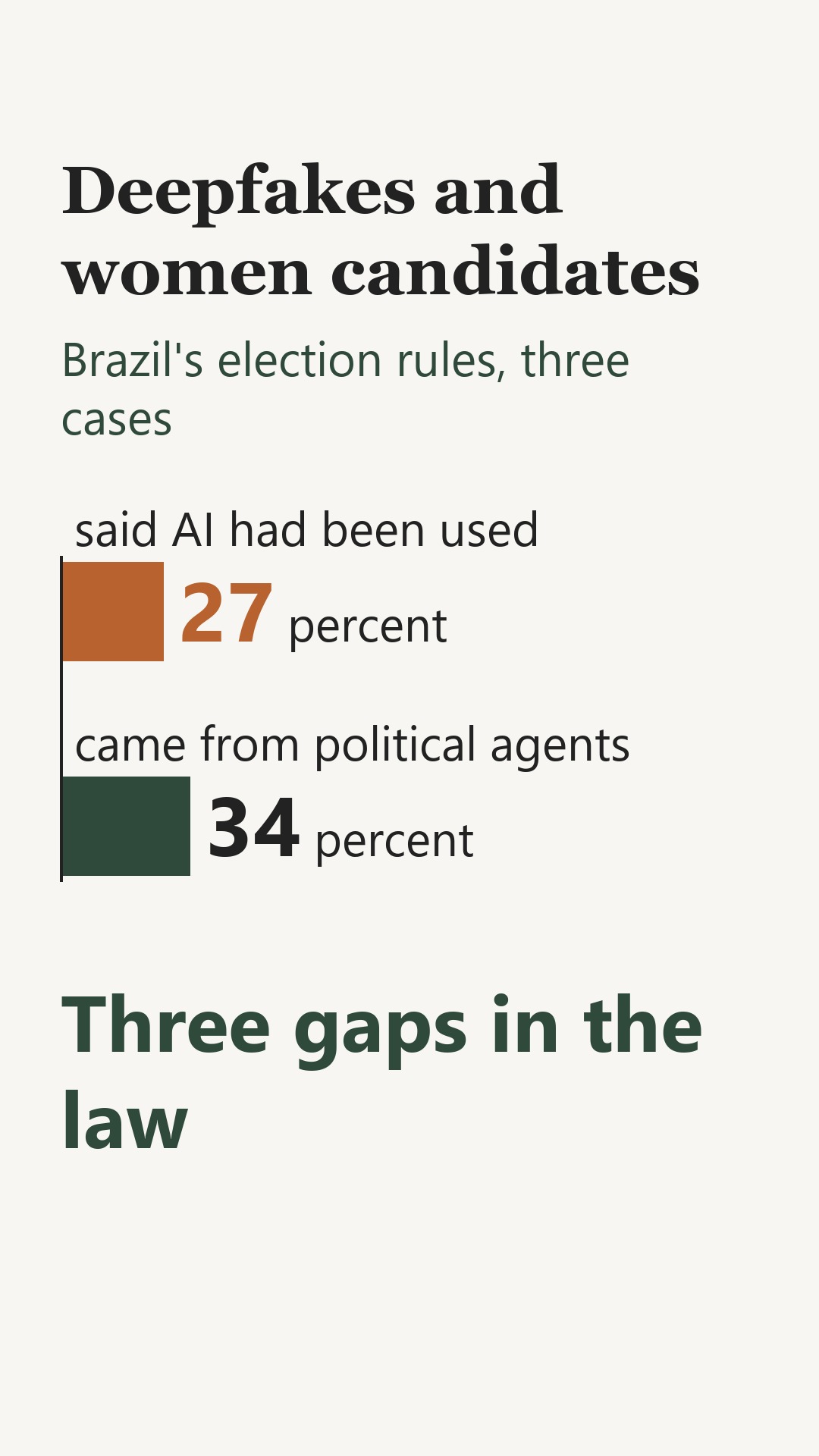
Shares of the 137 synthetic political contents logged by the Observatório IA nas Eleições between December 2025 and February 2026; the two shares overlap, so they do not add up to 100.
Relevant Electoral Justice decisions on deepfakes, 2024 against 2026
36 relevant decisions in 2024 and 164 in 2026, all of the 2026 ones before the official campaign opened
A false story about a candidate has always done one job before a ballot is marked: it leaves a residue that the candidate cannot scrub off, and people pass it along with a shrug.
In a qualitative legal analysis published 27 October 2026, two researchers at the University of the State of Amazonas reviewed Brazil's rules against AI-made attacks on women in politics, using three cases from São Paulo (2024), Rio Grande do Sul (2026) and Amazonas (2022). They found the law's crime against political violence covers candidates and officeholders but not pre-candidates. The court's definition of a deepfake sits in a resolution and requires an election-advertising context. Attacks also travel through messaging apps and reach regions with less access to justice, such as the Amazon.
The article names no register page or ad library for voters to use. It does name fact-checking agencies and news reporting as groups that document these attacks and can supply evidence.
The Superior Electoral Court's Resolution 23.755/2026 lists political violence against women among the risk cases where platforms must make content unavailable right away during the electoral period, or share liability. In September 2026, the court set a deepfake standard: it requires a realistic synthetic image, voice or statement, inside election advertising.
What this means for you
For your own vote, keep this limit in view: the analysis found gaps in Brazil's rules, and it did not test whether any rule stopped an attack. When you see a picture or video of a woman candidate, look for a label saying it was made or changed by a machine, and treat a missing label as a question to ask.
Almeida, E. A. d., Souza, L. B. d. (2026). VIOLÊNCIA POLÍTICA DIGITAL CONTRA MULHERES CANDIDATAS E INTELIGÊNCIA ARTIFICIAL: LIMITES DA PROTEÇÃO JURÍDICO-ELEITORAL BRASILEIRA NAS ELEIÇÕES DE 2026. Cadernos Cajuína. https://doi.org/10.52641/cadcajv11i16.090
Who paid: The article does not say who funded the study or whether any funder had a say; it names no equipment or software lent to the authors.
The longer versionThe passages copied from the paper, the pictures, and every source with how much of it we read · 859 words · about 4 minRead it →Close
The rule and the evidence: Brazil's election court created new rules for AI in campaigns, but three gaps leave women candidates partly uncovered, a legal analysis found
### THE ACT, quoted exactly and linked
In Brazil, a woman running for office can point to a crime written into the Electoral Code. Article 326-B punishes anyone who "Assediar, constranger, humilhar, perseguir ou ameaçar, por qualquer meio, candidata a cargo eletivo ou detentora de mandato eletivo," using contempt or discrimination based on her being a woman or on her color, race or ethnicity, to hinder her campaign or her mandate1. The phrase "por qualquer meio" reaches digital conduct, including synthetic content.
The reach of that word "candidata" is the first gap. The article protects "candidatas e detentoras de mandato"; a pre-candidate without a mandate stays outside the type, even when the attack plainly aims to sink her candidacy1.
The electoral court added rules on top of the law. Resolution No. 23,755/2026 put political violence against women among the cases where platforms must make content unavailable immediately during the electoral period, under joint liability2. It let a judge shift the burden of proof when showing that an image was manipulated is technically too costly for the person who filed3.
In September 2026, by five votes to two, the Superior Electoral Court fixed a thesis on what counts as a deepfake: synthetic content "dotado de grau de realismo ou verossimilhança" that creates, reproduces or alters a person's image, voice or statement — and the ban applies only when the content sits inside electoral advertising45.
The Supreme Court widened platform liability in June 2025, requiring providers to take down certain grave content without delay, including crimes against women because of their sex, on pain of liability for systemic failure6. The decree that regulates this leaves private messaging services out of its scope7.
### THE CASE IT ANSWERS
No real instance was found this week.
### WHAT WAS MEASURED
The count comes from civil society, not from a population rate. The Observatório IA nas Eleições, run by Data Privacy Brasil and Aláfia Lab, logged 137 synthetic political contents between December 2025 and February 2026 — about one and a half a day, half again the daily average of the year before8. Only 37 of them, 27 percent, said AI had been used9. A third of the posts came from political agents: 32 from parliamentarians and pre-candidates, 15 from parties9.
In the courts, a survey by the IDP and Jusbrasil found 403 Electoral Justice decisions on deepfakes from January 2020 to 17 July 2026, 234 of them classed as high relevance; 36 relevant ones came in 2024 and 164 in 2026, all before the official campaign opened10.
One case carries a view count: images of a woman candidate gathered more than 145 thousand views on adult sites11. That is a number of clicks on pages hosting the images, not a count of voters who believed them.
### THE OTHER REGION'S ANSWER TO THE SAME THING
We found none this week.
### THE LIBRARY'S READING
Here is weeklyAI's reading. A false story about a candidate has always done one job before a ballot is marked: it leaves a residue that the candidate cannot scrub off, and people pass it along with a shrug. What is new is the speed and the finish. A still photo and a voice can now be turned into something that looks and sounds like a recording, and the cheaper that gets, the less anyone trusts their own eyes — including when the recording is real. Expect a second harm alongside the fakes: a woman with an authentic recording will hear that it is probably AI, and a court asked to rule on what is genuine will face people who no longer believe any clip.
This reading would be wrong if the attacks stalled in group chats, if recipients routinely checked before forwarding, or if labels and corrections reached the same audiences at the same speed. What you can do with it: when a shocking image of a candidate lands in your group chat, ask who else has checked it and where it first appeared before you pass it on. Notice whether your own anger is doing the persuading. Learn one check you can run yourself — where the image first appeared — so your judgment does not wait on a court ruling that may arrive after the vote.
### WHAT IS NOT KNOWN
The article does not measure how many voters saw or believed any attack, and it does not test whether any rule reduced harm.
It closed before the first round of the 2026 elections, and part of what it reports about court decisions came from news coverage rather than the full rulings.
Pre-candidates sit outside the criminal type1; content made by outsiders with no campaign link sits outside the advertising ban12; private messaging sits outside the decree7; and candidates far from a courthouse face longer odds producing technical proof and fast answers13.
The three cases were chosen for variety, not to stand for all candidates.
Before you forward the next one: who checked it, and where did it first appear?
Where each piece of context comes from, and how much of it we read
- Almeida, E. A. d., Souza, L. B. d. (2026). VIOLÊNCIA POLÍTICA DIGITAL CONTRA MULHERES CANDIDATAS E INTELIGÊNCIA ARTIFICIAL: LIMITES DA PROTEÇÃO JURÍDICO-ELEITORAL BRASILEIRA NAS ELEIÇÕES DE 2026. Cadernos Cajuína. https://doi.org/10.52641/cadcajv11i16.090 - the article this story is about — the whole article — the passage: "O art. 326-B do Código Eleitoral protege candidatas e detentoras de mandato. A pré-candidata que não exerce mandato fica fora do tipo, ainda que o ataque tenha a finalidade evidente de inviabilizar sua candidatura."
- Almeida, E. A. d., Souza, L. B. d. (2026). VIOLÊNCIA POLÍTICA DIGITAL CONTRA MULHERES CANDIDATAS E INTELIGÊNCIA ARTIFICIAL: LIMITES DA PROTEÇÃO JURÍDICO-ELEITORAL BRASILEIRA NAS ELEIÇÕES DE 2026. Cadernos Cajuína. https://doi.org/10.52641/cadcajv11i16.090 - the article this story is about — the whole article — the passage: "Primeiro, incluiu a violência política contra a mulher entre os casos de risco do art. 9º-E (inciso VII), o que obriga as plataformas a indisponibilizar imediatamente esse tipo de conteúdo durante o período eleitoral, sob pena de responsabilidade solidária."
- Almeida, E. A. d., Souza, L. B. d. (2026). VIOLÊNCIA POLÍTICA DIGITAL CONTRA MULHERES CANDIDATAS E INTELIGÊNCIA ARTIFICIAL: LIMITES DA PROTEÇÃO JURÍDICO-ELEITORAL BRASILEIRA NAS ELEIÇÕES DE 2026. Cadernos Cajuína. https://doi.org/10.52641/cadcajv11i16.090 - the article this story is about — the whole article — the passage: "Quarto, autorizou o juiz a inverter o ônus da prova quando, em razão da dificuldade técnica de comprovação da manipulação digital, for excessivamente oneroso ao autor demonstrar a irregularidade do conteúdo (art. 9º-I) (Tribunal Superior Eleitoral, 2026a)."
- Almeida, E. A. d., Souza, L. B. d. (2026). VIOLÊNCIA POLÍTICA DIGITAL CONTRA MULHERES CANDIDATAS E INTELIGÊNCIA ARTIFICIAL: LIMITES DA PROTEÇÃO JURÍDICO-ELEITORAL BRASILEIRA NAS ELEIÇÕES DE 2026. Cadernos Cajuína. https://doi.org/10.52641/cadcajv11i16.090 - the article this story is about — the whole article — the passage: "Em setembro de 2026, no julgamento da Representação nº 0601315- 97.2026.6.00.0000, de relatoria do Ministro Nunes Marques, o TSE fixou, por cinco votos a dois, tese sobre o conceito de deepfake."
- Almeida, E. A. d., Souza, L. B. d. (2026). VIOLÊNCIA POLÍTICA DIGITAL CONTRA MULHERES CANDIDATAS E INTELIGÊNCIA ARTIFICIAL: LIMITES DA PROTEÇÃO JURÍDICO-ELEITORAL BRASILEIRA NAS ELEIÇÕES DE 2026. Cadernos Cajuína. https://doi.org/10.52641/cadcajv11i16.090 - the article this story is about — the whole article — the passage: "Segundo a tese, a caracterização de deepfake pressupõe conteúdo sintético produzido ou manipulado mediante IA ou tecnologia equivalente, “dotado de grau de realismo ou verossimilhança”, que crie, reproduza ou altere imagem, voz ou manifestação de pessoa, e a incidência da vedação pressupõe que o conteúdo esteja inserido em contexto de propaganda eleitoral (Tribunal Superior Eleitoral, 2026b)."
- Almeida, E. A. d., Souza, L. B. d. (2026). VIOLÊNCIA POLÍTICA DIGITAL CONTRA MULHERES CANDIDATAS E INTELIGÊNCIA ARTIFICIAL: LIMITES DA PROTEÇÃO JURÍDICO-ELEITORAL BRASILEIRA NAS ELEIÇÕES DE 2026. Cadernos Cajuína. https://doi.org/10.52641/cadcajv11i16.090 - the article this story is about — the whole article — the passage: "O Tribunal fixou que os provedores devem indisponibilizar sem demora determinados conteúdos graves, entre eles os crimes contra a mulher em razão da condição do sexo feminino, sob pena de responsabilidade por falha sistêmica (Brasil, 2014; Brasil, 2025b)."
- Almeida, E. A. d., Souza, L. B. d. (2026). VIOLÊNCIA POLÍTICA DIGITAL CONTRA MULHERES CANDIDATAS E INTELIGÊNCIA ARTIFICIAL: LIMITES DA PROTEÇÃO JURÍDICO-ELEITORAL BRASILEIRA NAS ELEIÇÕES DE 2026. Cadernos Cajuína. https://doi.org/10.52641/cadcajv11i16.090 - the article this story is about — the whole article — the passage: "O primeiro regulamenta o Marco Civil à luz da decisão do STF, prevendo deveres de cuidado e presunção de responsabilidade por conteúdos ilícitos impulsionados, mas exclui de seu alcance os serviços de mensagens privadas."
- Almeida, E. A. d., Souza, L. B. d. (2026). VIOLÊNCIA POLÍTICA DIGITAL CONTRA MULHERES CANDIDATAS E INTELIGÊNCIA ARTIFICIAL: LIMITES DA PROTEÇÃO JURÍDICO-ELEITORAL BRASILEIRA NAS ELEIÇÕES DE 2026. Cadernos Cajuína. https://doi.org/10.52641/cadcajv11i16.090 - the article this story is about — the whole article — the passage: "O Observatório IA nas Eleições, iniciativa do Data Privacy Brasil e do Aláfia Lab, registrou 137 conteúdos sintéticos com conotação política entre dezembro de 2025 e fevereiro de 2026, média de 1,5 caso por dia e crescimento de 50% em relação à média diária do ano anterior."
- Almeida, E. A. d., Souza, L. B. d. (2026). VIOLÊNCIA POLÍTICA DIGITAL CONTRA MULHERES CANDIDATAS E INTELIGÊNCIA ARTIFICIAL: LIMITES DA PROTEÇÃO JURÍDICO-ELEITORAL BRASILEIRA NAS ELEIÇÕES DE 2026. Cadernos Cajuína. https://doi.org/10.52641/cadcajv11i16.090 - the article this story is about — the whole article — the passage: "Apenas 37 conteúdos (27%) indicavam o uso de IA, e um terço das publicações (34%) partiu de agentes políticos: 32 conteúdos de parlamentares e pré-candidatos e 15 de partidos (Barcellos, 2026)."
- Almeida, E. A. d., Souza, L. B. d. (2026). VIOLÊNCIA POLÍTICA DIGITAL CONTRA MULHERES CANDIDATAS E INTELIGÊNCIA ARTIFICIAL: LIMITES DA PROTEÇÃO JURÍDICO-ELEITORAL BRASILEIRA NAS ELEIÇÕES DE 2026. Cadernos Cajuína. https://doi.org/10.52641/cadcajv11i16.090 - the article this story is about — the whole article — the passage: "Foram 36 decisões relevantes em 2024 e 164 em 2026, crescimento de cerca de 356%, todas estas anteriores ao início oficial da campanha (Fujimoto; Junquilho, 2026)."
- Almeida, E. A. d., Souza, L. B. d. (2026). VIOLÊNCIA POLÍTICA DIGITAL CONTRA MULHERES CANDIDATAS E INTELIGÊNCIA ARTIFICIAL: LIMITES DA PROTEÇÃO JURÍDICO-ELEITORAL BRASILEIRA NAS ELEIÇÕES DE 2026. Cadernos Cajuína. https://doi.org/10.52641/cadcajv11i16.090 - the article this story is about — the whole article — the passage: "No caso de Tabata Amaral, as montagens partiram de fotos verdadeiras da candidata, e os rostos foram sobrepostos a corpos nus, com indícios de uso de IA. Nos sites adultos, as imagens acumularam mais de 145 mil visualizações."
- Almeida, E. A. d., Souza, L. B. d. (2026). VIOLÊNCIA POLÍTICA DIGITAL CONTRA MULHERES CANDIDATAS E INTELIGÊNCIA ARTIFICIAL: LIMITES DA PROTEÇÃO JURÍDICO-ELEITORAL BRASILEIRA NAS ELEIÇÕES DE 2026. Cadernos Cajuína. https://doi.org/10.52641/cadcajv11i16.090 - the article this story is about — the whole article — the passage: "O requisito do contexto de propaganda eleitoral, por sua vez, deixa fora do art. 9º-C os conteúdos produzidos por terceiros sem vínculo com campanhas, como os deepnudes de 2024, que circularam em sites pornográficos e grupos de mensagens."
- Almeida, E. A. d., Souza, L. B. d. (2026). VIOLÊNCIA POLÍTICA DIGITAL CONTRA MULHERES CANDIDATAS E INTELIGÊNCIA ARTIFICIAL: LIMITES DA PROTEÇÃO JURÍDICO-ELEITORAL BRASILEIRA NAS ELEIÇÕES DE 2026. Cadernos Cajuína. https://doi.org/10.52641/cadcajv11i16.090 - the article this story is about — the whole article — the passage: "A terceira é a distância institucional: candidatas de regiões remotas tendem a enfrentar mais obstáculos para produzir prova técnica, contratar assistência jurídica especializada e obter respostas rápidas da Justiça Eleitoral."
Almeida, E. A. d., Souza, L. B. d. (2026). VIOLÊNCIA POLÍTICA DIGITAL CONTRA MULHERES CANDIDATAS E INTELIGÊNCIA ARTIFICIAL: LIMITES DA PROTEÇÃO JURÍDICO-ELEITORAL BRASILEIRA NAS ELEIÇÕES DE 2026. Cadernos Cajuína. https://doi.org/10.52641/cadcajv11i16.090
Who paid: The article does not say who funded the study or whether any funder had a say; it names no equipment or software lent to the authors.
The findings of other studies mentioned here come from this document; those studies were not opened one by one.