survey · Observatorio (OBS*) · la publicación, 11 nov 2026 · gratis
Falta de formación, no de ganas: lo que frena la inteligencia artificial en las agencias
Una encuesta a 122 profesionales de la publicidad encontró que quienes ya usan estas herramientas reportan más apoyo de su empresa, más acceso y más tiempo. Es un solo grupo, sin costos ni resultados, y no prueba que comprar herramientas rinda.
Versión breve · la versión detallada sigue, unos 6 min
Pregunte al chat de weeklyAI
Pregúnteme sobre la IA en su vida: le señalo las notas que weeklyAI ha publicado sobre el tema, esta semana y antes.
Las conversaciones se guardan mientras exista weeklyAI, para mejorar la publicación. Se responde en el idioma en que usted escribe.
- El estudio, de un vistazo
- Quiénes
- Profesionales de la comunicación y la publicidad
- Cuántos
- 122 participantes
- Dónde
- España (Universidad de Valladolid, Segovia)
- Cuándo
- Entre mayo y octubre de 2024
- Tipo de estudio
- survey
- Quién lo hizo
- Universidad de Valladolid, Segovia, España
- El límite que importa
- Se reclutaron de boca en boca, no al azar: no representan a todos los publicistas.
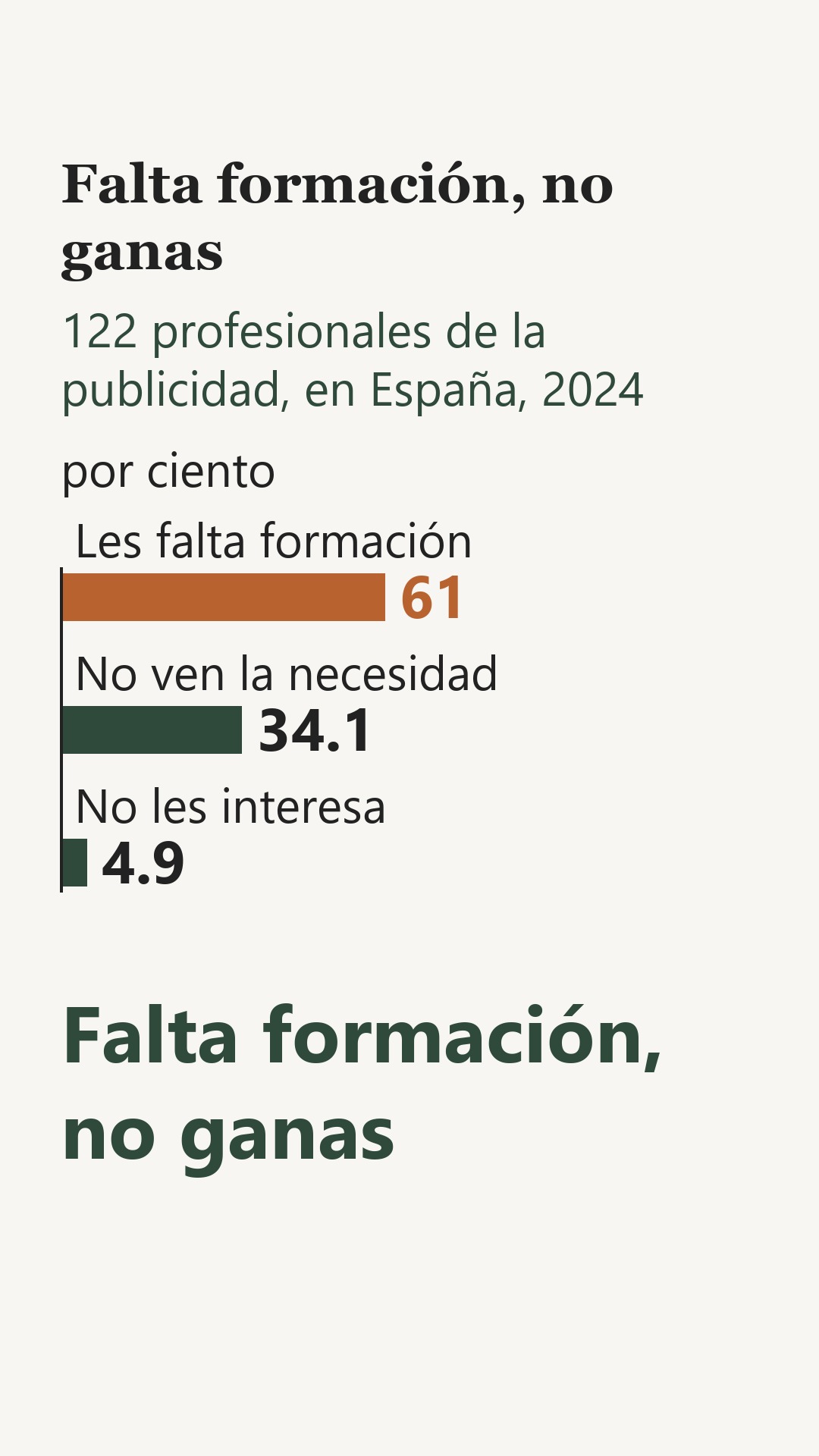
Porcentajes de los 41 encuestados que no usaban herramientas de inteligencia artificial; es un solo grupo, reclutado de boca en boca, y no representa a todos los publicistas.
Lo que reportan quienes ya usan inteligencia artificial frente a quienes no la usan (escala de 1 a 5)
3.65 contra 2.35
3.44 contra 2.43
3.11 contra 2.05
3.70 contra 3.20
Cuando alguien de su equipo no usa estas herramientas, la razón puede no ser el desgano.
Usted tiene un taller, una tienda o una agencia pequeña, sin gente de sistemas. La pregunta es si vale la pena meterse con la inteligencia artificial. Una encuesta hecha por investigadores de la Universidad de Valladolid, en España, ofrece una pista sobre dónde se atora la gente.
Entre mayo y octubre de 2024 preguntaron a 122 profesionales de la comunicación y la publicidad. Ochenta y uno ya usaban herramientas de inteligencia artificial en su trabajo; 41 no. Los autores trabajan en la Universidad de Valladolid, en Segovia, España, y el cuestionario se redactó en español.
Los dos grupos ven la inteligencia artificial sobre todo como una oportunidad para su trabajo, y en esa opinión no hubo diferencia entre ellos. Quienes ya las usan reportaron más acceso a las herramientas, más respaldo de su empresa y más tiempo para aprender que quienes no las usan. También calificaron mejor sus propias habilidades: 3.70 contra 3.20 en una escala de 1 a 5.
Entre los 41 que no las usan, 61% dijo que le falta formación. Sólo 4.9% dijo que no le interesa. Y 78% quería probarlas para mejorar su trabajo.
Hay que leer esos porcentajes con cuidado. Los 122 se reclutaron de boca en boca, no al azar, así que no representan a todos los publicistas. La encuesta no midió costos, ingresos ni resultados, y fue una sola foto en el tiempo. No puede mostrar que comprar herramientas o pagar cursos dé frutos. Las habilidades son lo que cada quien dice de sí mismo, y los autores anotan que los usuarios quizá ya eran los más confiados de entrada.
Lo que sí muestra es un patrón que puede revisar en su propio negocio. Cuando alguien de su equipo no usa estas herramientas, la razón puede no ser el desgano. Puede ser que no tenga con qué, ni cuándo, ni quién le enseñe.
Antes de gastar en licencias o en capacitación, pregunte a su gente cuál de las tres le falta: formación, tiempo o acceso. La respuesta le dice por dónde empezar.
Qué significa para usted
Lo que puede hacer con esto es sencillo y no cuesta: pregunte a cada persona de su equipo si el obstáculo es la formación, el tiempo o el acceso a la herramienta. La encuesta no midió costos ni resultados, así que no concluya todavía que comprar licencias o pagar cursos le va a rendir.
Martín García, N., Núñez Cansado, M. Á., Laguna Garcia, M. (2026). Factors associated with artificial intelligence adoption among advertising professionals: evidence from the Motivation–Opportunity–Ability (MOA) framework. Observatorio (OBS*). https://doi.org/10.15847/obs20262955
Quién pagó: Los autores no recibieron apoyo financiero para esta investigación y declaran no tener conflicto de interés; el artículo no menciona préstamo de equipos ni de software, solo que se usaron herramientas de IA generativa para revisar el inglés del manuscrito.
Versión detalladaLos pasajes copiados del artículo, las ilustraciones y cada fuente con cuánto leímos de ella · 1192 palabras · unos 6 minLeerla →Cerrar
La IA en la publicidad: el freno no es el desinterés, es la falta de capacitación
Una encuesta a 122 profesionales del sector compara a quienes usan herramientas de inteligencia artificial con quienes no, y encuentra más diferencias en apoyo de la empresa y formación que en ganas.
En una agencia pequeña, el dueño compra una licencia de una herramienta de inteligencia artificial, la prueba una tarde y la deja ahí, en la lista de pagos mensuales. La encuesta que aquí se cuenta ayuda a entender por qué pasa eso. Un equipo de la Universidad de Valladolid, en Segovia, España, preguntó a 122 profesionales de la comunicación y la publicidad por sus motivos, por el apoyo que reciben y por sus habilidades con la inteligencia artificial. El 66% (81 personas) ya la usaba en su trabajo; el 34% (41) no1. El cuestionario se administró a través de la plataforma Forms entre mayo y octubre de 2024.
Entre quienes no usaban las herramientas, el motivo principal no fue el desinterés. El 61% dijo que le faltaba capacitación, el 34.1% que no veía la necesidad y solo el 4.9% que no le interesaba2. Las ganas, de hecho, estaban ahí: el 78% de los encuestados se declaró bastante o muy interesado en usar estas tecnologías para mejorar su trabajo3. Lo curioso es que el obstáculo se parece más a un candado que a una puerta cerrada.
La encuesta midió tres familias de factores: lo que motiva a la persona, lo que la empresa pone a su alcance y lo que la persona cree saber hacer. En las tres, quienes ya usaban la inteligencia artificial salieron mejor calificados que quienes no. En motivación funcional, los usuarios dieron sus notas más altas a la mejora de la productividad, 4.21, y de la eficacia en el trabajo, 4.074. En acceso a los recursos tecnológicos, 3.65 contra 2.35; en apoyo de la empresa, 3.44 contra 2.43, y en tiempo disponible para usar o aprender, 3.11 contra 2.0556. En habilidades tecnológicas percibidas, los usuarios se dieron un 3.707.
Hay un matiz que conviene no perder. Aun entre los usuarios, la destreza avanzada quedó a media tabla: ante la frase "se me da bien usar la inteligencia artificial", el promedio fue 3.218. Y la intención de seguir usándola fue alta, 4.21, con solo el 7.4% de los usuarios diciendo que no piensa continuar9.
Todo esto tiene límites que el propio artículo reconoce. La muestra se reclutó por recomendación entre conocidos, sin sorteo, y su tamaño limita lo que puede generalizarse10. Fue una sola fotografía en el tiempo, sin seguimiento. Se hicieron muchas comparaciones estadísticas sin corregir por azar, lo que aumenta la posibilidad de dar por bueno un hallazgo que no lo sea11. Y las medidas son la opinión de cada quien sobre sus propias habilidades, no una prueba de ellas. Los autores lo apuntan: es posible que quienes ya se sentían más capaces fueran justamente los que adoptaron las herramientas, y no al revés.
Piense en el taller de un barrio de Lima o de Monterrey, con cuatro empleados y sin nadie de sistemas. Según el resumen de un estudio sobre micro y pequeñas empresas del distrito de Los Olivos, en Lima Norte, lo único disponible de él, la percepción sobre la inteligencia artificial era mayoritariamente desfavorable, atada al poco conocimiento técnico, a la falta de capacitación y a la idea de que estas herramientas son caras y complicadas12. Ese mismo trabajo encontró una asociación débil pero positiva entre la percepción de la inteligencia artificial y el desempeño en marketing digital13. Y sus autores concluyen que hacen falta programas de capacitación y apoyo técnico dirigidos a ese tipo de negocios14.
Hay otra razón para no prometer milagros. Según el resumen de un análisis sobre digitalización y productividad laboral en empresas europeas, lo único disponible de él, la adopción de inteligencia artificial apareció asociada de forma positiva pero no significativa con la productividad, mientras que la adopción de análisis de datos sí mostró una asociación positiva y significativa1516. Esa asociación se debilitaba al controlar a la vez las diferencias entre países e industrias17. Los propios autores la interpretan como una relación observada en un momento, no como un efecto causal18. La lección para un negocio chico: la herramienta sola no es la palanca; lo que se hace con los datos, sí puede serlo.
Y no todos los equipos arrancan igual. Según el resumen de un estudio con 30 pequeñas y medianas empresas turísticas de China, lo único disponible de él, ninguna condición por sí sola resultó necesaria para un buen desempeño percibido en la transformación digital19. Lo que apareció fueron combinaciones: en dos configuraciones de alto desempeño se repetían la disposición tecnológica y el acceso a un ecosistema digital20. Los autores concluyen que desarrollar las capacidades del equipo debe considerarse junto con la disposición tecnológica, el acceso al ecosistema digital y el apoyo institucional21.
Aquí está la lectura de weeklyAI. El patrón que se repite en estos trabajos es que la capacitación ayuda, pero no basta ni garantiza resultados por sí sola. Por eso, en una agencia como la suya, cabe esperar que al ofrecer un curso el uso no suba de inmediato ni en la misma proporción: parte de quienes se capaciten seguirán sin equipo adecuado, sin tiempo pagado para practicar o sin un permiso claro de la empresa para equivocarse. Esta lectura se equivocaría si, en talleres o negocios comparables, tras un curso breve y con acceso a las herramientas, casi todos los que antes decían no tener formación empezaran a usarlas de forma sostenida y reportaran mejoras concretas. Antes de pagar capacitación, pregunte a su equipo qué le falta además del curso. Y mida el uso real a las cuatro y a las ocho semanas, no solo la satisfacción al final del taller.
También vale mirar el entusiasmo con lupa. El alto interés que muestra la encuesta entre quienes no usan estas herramientas puede quedarse en intención si no va acompañado de saber práctico del oficio y de conocimiento de cómo trabaja de verdad su clientela; el estudio midió intención, no si esa intención se convirtió en trabajo entregado. No confunda las ganas de su equipo con capacidad instalada: pida que cada quien muestre un entregable hecho con la herramienta antes de prometerle clientes. Combine la práctica técnica con lo que usted ya sabe de sus clientes; eso es lo que la herramienta no le va a dar.
Queda una pregunta que el artículo no responde: qué pasaría si esas 41 personas sin herramientas recibieran capacitación y equipo. Los autores proponen invertir en formación dirigida y en políticas de personal que cierren la brecha entre usuarios y no usuarios, para evitar una plantilla de dos velocidades22. Su encuesta no probó que eso funcione; solo mostró que la brecha existe y por dónde corre.
Volvamos a la licencia olvidada en la lista de pagos. La encuesta sugiere que el problema no suele ser la falta de ganas, sino el tiempo, el equipo y el permiso para practicar. ¿Qué le falta a su gente, además del curso, para que esa herramienta deje de ser un gasto y empiece a trabajar?
De dónde sale cada dato de contexto, y cuánto leímos de cada documento
- Martín García, N., Núñez Cansado, M. Á., Laguna Garcia, M. (2026). Factors associated with artificial intelligence adoption among advertising professionals: evidence from the Motivation–Opportunity–Ability (MOA) framework. Observatorio (OBS*). https://doi.org/10.15847/obs20262955 - el artículo del que trata esta nota — el artículo completo — el pasaje: "The final sample consisted of 122 participants, of whom 61% (n = 75) were women and 39% (n = 47) were men. In addition, 66% reported having used AI tools in their professional activity (n = 81), whereas 34% indicated that they had not (n = 41)."
- Martín García, N., Núñez Cansado, M. Á., Laguna Garcia, M. (2026). Factors associated with artificial intelligence adoption among advertising professionals: evidence from the Motivation–Opportunity–Ability (MOA) framework. Observatorio (OBS*). https://doi.org/10.15847/obs20262955 - el artículo del que trata esta nota — el artículo completo — el pasaje: "Among professionals who did not use artificial intelligence tools, the main barrier identified was the lack of training (61%), followed by the absence of perceived need (34.1%). In contrast, only 4.9% explicitly reported a lack of interest in using these technologies within their professional activity (Fig. 2)."
- Martín García, N., Núñez Cansado, M. Á., Laguna Garcia, M. (2026). Factors associated with artificial intelligence adoption among advertising professionals: evidence from the Motivation–Opportunity–Ability (MOA) framework. Observatorio (OBS*). https://doi.org/10.15847/obs20262955 - el artículo del que trata esta nota — el artículo completo — el pasaje: "A total of 78.0% of participants reported being fairly or highly interested in using these technologies to improve the quality of their work, whereas only 17.1% expressed low levels of interest (Fig. 3)."
- Martín García, N., Núñez Cansado, M. Á., Laguna Garcia, M. (2026). Factors associated with artificial intelligence adoption among advertising professionals: evidence from the Motivation–Opportunity–Ability (MOA) framework. Observatorio (OBS*). https://doi.org/10.15847/obs20262955 - el artículo del que trata esta nota — el artículo completo — el pasaje: "In particular, the items related to improved productivity (M = 4.21) and work effectiveness (M = 4.07) recorded the highest scores among AI users."
- Martín García, N., Núñez Cansado, M. Á., Laguna Garcia, M. (2026). Factors associated with artificial intelligence adoption among advertising professionals: evidence from the Motivation–Opportunity–Ability (MOA) framework. Observatorio (OBS*). https://doi.org/10.15847/obs20262955 - el artículo del que trata esta nota — el artículo completo — el pasaje: "Among AI users, the highest scores were recorded in the dimensions related to access to the technological resources required to use these tools (M = 3.65) and organizational support for AI use (M = 3.44)."
- Martín García, N., Núñez Cansado, M. Á., Laguna Garcia, M. (2026). Factors associated with artificial intelligence adoption among advertising professionals: evidence from the Motivation–Opportunity–Ability (MOA) framework. Observatorio (OBS*). https://doi.org/10.15847/obs20262955 - el artículo del que trata esta nota — el artículo completo — el pasaje: "By contrast, professionals who did not use artificial intelligence tools reported considerably lower scores across all dimensions analysed, particularly regarding time availability to use or learn AI (M = 2.05), access to technological resources (M = 2.35), and perceived organizational support provided by their companies (M = 2.43)."
- Martín García, N., Núñez Cansado, M. Á., Laguna Garcia, M. (2026). Factors associated with artificial intelligence adoption among advertising professionals: evidence from the Motivation–Opportunity–Ability (MOA) framework. Observatorio (OBS*). https://doi.org/10.15847/obs20262955 - el artículo del que trata esta nota — el artículo completo — el pasaje: "Among users, the highest scores were observed in variables related to technological updating and the ease of keeping up to date with digital innovations (M = 3.88), as well as in the perception of technological abilities applied to the professional use of AI (M = 3.70)."
- Martín García, N., Núñez Cansado, M. Á., Laguna Garcia, M. (2026). Factors associated with artificial intelligence adoption among advertising professionals: evidence from the Motivation–Opportunity–Ability (MOA) framework. Observatorio (OBS*). https://doi.org/10.15847/obs20262955 - el artículo del que trata esta nota — el artículo completo — el pasaje: "However, scores associated with advanced mastery of these technologies were more moderate, as reflected in the evaluation of the item “I am good at using AI” (M = 3.21)."
- Martín García, N., Núñez Cansado, M. Á., Laguna Garcia, M. (2026). Factors associated with artificial intelligence adoption among advertising professionals: evidence from the Motivation–Opportunity–Ability (MOA) framework. Observatorio (OBS*). https://doi.org/10.15847/obs20262955 - el artículo del que trata esta nota — el artículo completo — el pasaje: "The results reveal a high intention to continue using artificial intelligence tools among professionals who already employ these technologies within the advertising sector (M = 4.21). In this regard, only 7.4% of users reported no intention of continuing to use AI tools in their future professional activities."
- Martín García, N., Núñez Cansado, M. Á., Laguna Garcia, M. (2026). Factors associated with artificial intelligence adoption among advertising professionals: evidence from the Motivation–Opportunity–Ability (MOA) framework. Observatorio (OBS*). https://doi.org/10.15847/obs20262955 - el artículo del que trata esta nota — el artículo completo — el pasaje: "First, the non-probabilistic nature of the sample and its size limit the statistical generalizability of the findings."
- Martín García, N., Núñez Cansado, M. Á., Laguna Garcia, M. (2026). Factors associated with artificial intelligence adoption among advertising professionals: evidence from the Motivation–Opportunity–Ability (MOA) framework. Observatorio (OBS*). https://doi.org/10.15847/obs20262955 - el artículo del que trata esta nota — el artículo completo — el pasaje: "Additionally, the multiple Mann–Whitney U tests and Pearson correlations conducted across dimensions did not include a correction for multiple comparisons (e.g., Bonferroni), which increases the risk of Type I error and should be considered when interpreting the pattern of significant results."
- BEJARANO AUQUI JF, SEGURA MONTAÑEZ LJ, MAMANI PEREZ JL. (2026). Micro and Small Enterprises’ Perceptions of Artificial Intelligence Adoption in Digital Marketing: Evidence from the Los Olivos District, North Lima. IBIMA Business Review. https://doi.org/10.5171/2026.657754 — solo el resumen - no se pudo obtener el texto completo — el pasaje: "The findings reveal a predominantly unfavorable perception of AI, linked to limited technical knowledge, insufficient training, and the belief that these tools are costly and complex;"
- BEJARANO AUQUI JF, SEGURA MONTAÑEZ LJ, MAMANI PEREZ JL. (2026). Micro and Small Enterprises’ Perceptions of Artificial Intelligence Adoption in Digital Marketing: Evidence from the Los Olivos District, North Lima. IBIMA Business Review. https://doi.org/10.5171/2026.657754 — solo el resumen - no se pudo obtener el texto completo — el pasaje: "nevertheless, a weak yet statistically significant positive association was found between AI perception and digital marketing performance, particularly regarding social media."
- BEJARANO AUQUI JF, SEGURA MONTAÑEZ LJ, MAMANI PEREZ JL. (2026). Micro and Small Enterprises’ Perceptions of Artificial Intelligence Adoption in Digital Marketing: Evidence from the Los Olivos District, North Lima. IBIMA Business Review. https://doi.org/10.5171/2026.657754 — solo el resumen - no se pudo obtener el texto completo — el pasaje: "These results highlight the need for targeted training and technical support programs to help micro and small enterprises bridge this gap, strengthen their digital marketing capabilities, and remain competitive in an increasingly AI-driven business environment."
- Kahrović E, Safiye T, Zimonjić V, Popović S, Bilalović M, Mahmutović E, et al. (2026). Artificial Intelligence Adoption, Complementary Digital Technologies, and Business Performance: Evidence from Labour Productivity Across European Industries. Sci. https://doi.org/10.3390/sci8110368 — solo el resumen - no se pudo obtener el texto completo — el pasaje: "Baseline multivariate regression with HC3 heteroskedasticity-robust standard errors shows that AI adoption is positively but not significantly associated with labour productivity, while cloud-computing adoption has a negative but statistically insignificant association."
- Kahrović E, Safiye T, Zimonjić V, Popović S, Bilalović M, Mahmutović E, et al. (2026). Artificial Intelligence Adoption, Complementary Digital Technologies, and Business Performance: Evidence from Labour Productivity Across European Industries. Sci. https://doi.org/10.3390/sci8110368 — solo el resumen - no se pudo obtener el texto completo — el pasaje: "Data-analytics adoption is positively and significantly associated with labour productivity (β = 0.500, p = 0.012)."
- Kahrović E, Safiye T, Zimonjić V, Popović S, Bilalović M, Mahmutović E, et al. (2026). Artificial Intelligence Adoption, Complementary Digital Technologies, and Business Performance: Evidence from Labour Productivity Across European Industries. Sci. https://doi.org/10.3390/sci8110368 — solo el resumen - no se pudo obtener el texto completo — el pasaje: "This association remains significant under several robustness specifications but becomes insignificant when country and industry differences are controlled for simultaneously."
- Kahrović E, Safiye T, Zimonjić V, Popović S, Bilalović M, Mahmutović E, et al. (2026). Artificial Intelligence Adoption, Complementary Digital Technologies, and Business Performance: Evidence from Labour Productivity Across European Industries. Sci. https://doi.org/10.3390/sci8110368 — solo el resumen - no se pudo obtener el texto completo — el pasaje: "The results are interpreted as cross-sectional associations rather than causal effects."
- Ren Y, Li H. (2026). Human–machine collaborative literacy and tourism SMEs’ perceived digital transformation performance: a configurational fsQCA. Frontiers in Psychology. https://doi.org/10.3389/fpsyg.2026.1974536 — solo el resumen - no se pudo obtener el texto completo — el pasaje: "No individual condition or its negation was necessary for high perceived performance (HC necessity consistency = 0.845)."
- Ren Y, Li H. (2026). Human–machine collaborative literacy and tourism SMEs’ perceived digital transformation performance: a configurational fsQCA. Frontiers in Psychology. https://doi.org/10.3389/fpsyg.2026.1974536 — solo el resumen - no se pudo obtener el texto completo — el pasaje: "Two high-performance configurations shared core TI and IO: H1 included peripheral CN, with HC unspecified, whereas H2 included peripheral HC and PS."
- Ren Y, Li H. (2026). Human–machine collaborative literacy and tourism SMEs’ perceived digital transformation performance: a configurational fsQCA. Frontiers in Psychology. https://doi.org/10.3389/fpsyg.2026.1974536 — solo el resumen - no se pudo obtener el texto completo — el pasaje: "The findings suggest that workforce capability development should be considered alongside technological readiness, digital ecosystem access, and institutional support."
- Martín García, N., Núñez Cansado, M. Á., Laguna Garcia, M. (2026). Factors associated with artificial intelligence adoption among advertising professionals: evidence from the Motivation–Opportunity–Ability (MOA) framework. Observatorio (OBS*). https://doi.org/10.15847/obs20262955 - el artículo del que trata esta nota — el artículo completo — el pasaje: "From a workforce planning standpoint, targeted training investment and HR policies could close resource and competency gaps between AI users and non-users, preventing a two-tier advertising workforce."
Martín García, N., Núñez Cansado, M. Á., Laguna Garcia, M. (2026). Factors associated with artificial intelligence adoption among advertising professionals: evidence from the Motivation–Opportunity–Ability (MOA) framework. Observatorio (OBS*). https://doi.org/10.15847/obs20262955
Quién pagó: Los autores no recibieron apoyo financiero para esta investigación y declaran no tener conflicto de interés; el artículo no menciona préstamo de equipos ni de software, solo que se usaron herramientas de IA generativa para revisar el inglés del manuscrito.
survey · Observatorio (OBS*) · the paper, 11 Nov 2026 · free
Advertising staff who use AI say they get more company backing and training time
A survey of 122 people in advertising found users reported more access, more company backing and more time to learn. It cannot show that any of it made their work better.
Short version · the longer version follows, about 6 min
Ask the weeklyAI chat
Ask me about AI in your life: I point you to the stories weeklyAI has published on it, this week and before.
Conversations are saved for as long as weeklyAI exists, to improve the publication. Answers come in the language you write in.
- The study at a glance
- Who
- advertising and communication professionals
- How many
- 122 participants
- Where
- University of Valladolid, Segovia, Spain (the article does not say where the survey was administered)
- When
- May to October 2024
- Kind of study
- survey
- Who did it
- University of Valladolid, Spain
- The limit that matters
- Small, self-selected group of 122; it describes only these people, not the field.
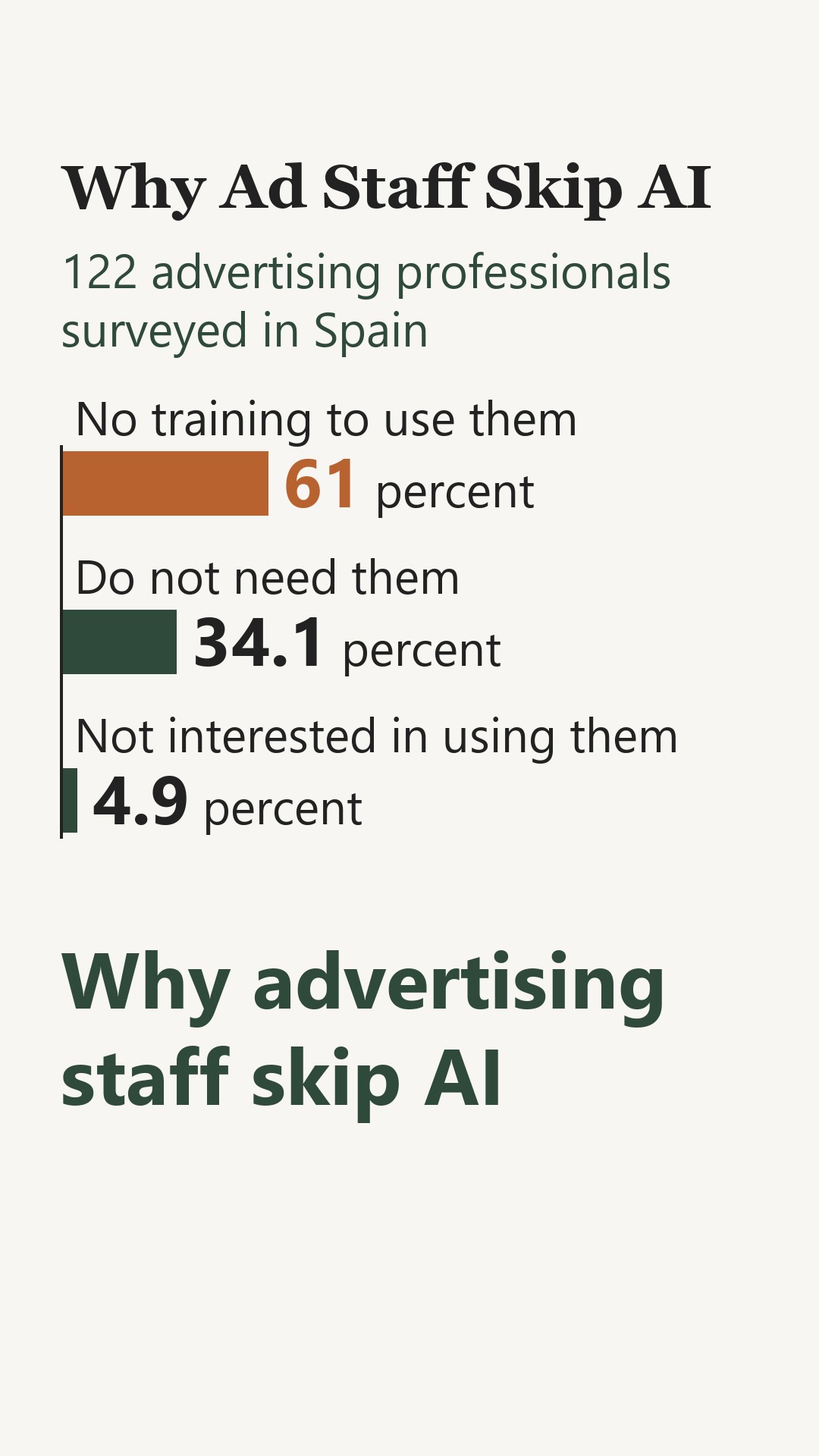
Reasons given by the 41 advertising professionals who did not use AI tools at work; each could give more than one reason, so the shares need not add to 100.
What AI users and non-users reported about their workplace and skills (five-point scale)
3.65 against 2.35
3.44 against 2.43
3.11 against 2.05
3.70 against 3.20
Before you spend on tools or on a course, look at which of the three your staff actually lack.
You run a small agency or a marketing shop. There is no technical staff, and the question is whether AI tools are worth the trouble.
Researchers at the University of Valladolid, in Spain, asked 122 people who work in advertising about AI, through an online questionnaire filled in between May and October 2024. Eighty-one of them already used AI tools at work, and 41 did not.
The users did not rate the fun of AI higher than the non-users. They did rate one item, how pleasurable AI is to use, a little higher. They reported more access to the tools they needed, at 3.65 on a five-point scale against 2.35 for non-users. They reported more support from their company, 3.44 against 2.43, and more time to use or learn AI, 3.11 against 2.05. They also rated their own skills higher, 3.70 against 3.20.
Among the 41 non-users, the reason given most often was not dislike. Sixty-one percent blamed a lack of training, and 34 percent said they did not need AI. Only 4.9 percent said they were not interested. Seventy-eight percent said they were quite or very interested in using AI to improve their work.
That is one snapshot of 122 people, recruited by asking contacts to pass the survey on. No costs were recorded, no revenue or output was measured, and nobody was followed over time. The survey cannot show that buying tools or paying for training improves a business, or that training alone would turn a non-user into a user. The authors note that people who rated their skills higher may have been the more confident ones to begin with.
What the survey does show is a pattern you can check in your own business. Most of the non-users said they were quite or very interested in using AI. The users reported more time, more access and more support around them.
Before you spend on tools or on a course, look at which of the three your staff actually lack.
What this means for you
What the 41 non-users said is the part to carry into your own shop. Before paying for a tool or a course, ask your staff which of the three they lack: access, time, or the confidence to use it. That answer tells you more than a sales pitch will.
Martín García, N., Núñez Cansado, M. Á., Laguna Garcia, M. (2026). Factors associated with artificial intelligence adoption among advertising professionals: evidence from the Motivation–Opportunity–Ability (MOA) framework. Observatorio (OBS*). https://doi.org/10.15847/obs20262955
Who paid: The authors received no financial support for this research, and they declare no conflict of interest; the article names no equipment or software lenders, only that generative AI tools were used to revise the English of the manuscript.
The longer versionThe passages copied from the paper, the pictures, and every source with how much of it we read · 1284 words · about 6 minRead it →Close
AI in the Agency Is Mostly a Training Gap, a Survey of 122 Advertising Professionals Finds
Users and non-users of AI tools differ far less in curiosity than in what their workplaces gave them: time, tools, support. The catch is that this is one snapshot of a self-selected group.
Start with the people who avoid the tools. In a survey of 122 advertising and communication professionals, 41 of them said they did not use artificial intelligence at work. Asked why, 61 percent named a lack of training. About 34 percent said they did not need it. Only about 5 percent said they were simply not interested1.
The interest is there. Among those same non-users, 78 percent said they were fairly or highly interested in using AI to improve the quality of their work, and about 17 percent reported low interest2. Among the 81 professionals who did use the tools, most use was regular but not constant: about 38 percent used them occasionally, about 24 percent frequently and about 15 percent very frequently3.
The study was built on a framework called Motivation–Opportunity–Ability, which asks three things about any new tool: does the person want to use it, does the workplace allow it, and does the person feel able to. The authors are Noemí Martín-García and Marian Núñez-Cansado, of the Department of Audiovisual Communication and Advertising at the University of Valladolid in Segovia, Spain, and Marta Laguna-García, of the Department of Business and Marketing at the same university. They received no financial support and declare no conflict of interest. The questionnaire ran on the Forms platform between May and October 2024, and participants were recruited by snowball sampling, meaning each person passed it on to others.
Users scored significantly higher than non-users on functional motivation, and they also reported greater organizational opportunity and greater technological ability. On a five-point scale, users rated AI's contribution to productivity at 4.21 and to work effectiveness at 4.07, against 3.28 and 3.40 for non-users4. Users rated their access to the technology at 3.65 against 2.35, their company's support at 3.44 against 2.43, and their time to use or learn the tools at 3.11 against 2.0556. Users also rated their ease of keeping up to date with new developments at 3.88 against 3.03, and their technological abilities for using AI at work at 3.70 against 3.207. Their intention to keep using AI averaged 4.21, and only 7.4 percent of users said they had no plans to continue8. Non-users' intention to adopt averaged 3.059.
The limits matter as much as the numbers. The sample is small and was not drawn at random, so it describes these 122 people and cannot be projected onto advertising professionals generally10. The article gives the authors' affiliation in Segovia, Spain, but does not say where the survey was administered. All measures are people's own ratings of their skills and their workplaces. The design is a single snapshot, so it cannot show that AI use raised anyone's productivity or that training would convert a non-user. The authors also note that the many comparisons were run without correction for multiple testing, which raises the chance of a false positive somewhere in the set11.
Consider what a tool has to clear before it earns its place in a small shop. A study of 184 micro and small enterprises in the Los Olivos district of North Lima, Peru, found a mostly unfavorable view of AI, tied to limited technical knowledge, insufficient training, and the belief that these tools are costly and complex; the summary is the only part of that paper available, with the full text behind a subscription1213. The same summary reports that entrepreneurs there do see AI's potential to streamline operations and strengthen customer relationships, while gaps in knowledge and resources keep holding adoption back14. The pattern is the same one the advertising survey describes: the obstacle sits in what people were given, not in what they want.
The promise of a productivity gain is also less settled than vendors suggest. A study using harmonized European statistics for 2025, covering 119 country-and-industry observations across 29 countries, found that AI adoption was positively but not significantly linked to labor productivity, while data-analytics adoption was positively and significantly linked to it; that link faded when country and industry differences were controlled for together, and the authors describe all of it as association rather than cause15161718. The summary is the only part of that paper available. Put plainly: the tool a business buys is only part of the story, and the surrounding skills and systems carry weight too19.
Then there is the question of who gets let in to learn. A study of 401 managers across 30 tourism small and medium-sized enterprises in China found that no single condition, including workforce skill, was necessary for strong perceived performance; skill mattered in some combinations and not others2021. The summary is the only part of that paper available. What it suggests, as one reading among several, is that training and technology readiness travel together rather than one delivering the other22.
Here is weeklyAI's reading. The dividing line in this survey is not enthusiasm. It is whether someone was handed the hours, the tools and the permission to learn. A small agency that buys a subscription and tells the team to figure it out has done half of what the users in this study describe; the other half is time and someone to ask. This reading would be wrong if non-users in small shops reported the same access to time, tools and support as users and still stayed away; the survey does not break its answers down that way, so the question stays open.
The tool itself is part of that. Tools a colleague can pick up by watching and trying spread through a small team; tools that need a paid course or a vendor's specialist turn learning into a purchase. Before signing, ask the vendor to have one of your own staff do a real task with the tool after an hour of use, unaided, and watch what happens. Prefer the tool your team can teach each other.
One more thing to weigh before rolling anything out: who was asked. In most small shops the decision to bring in AI is made by the owner or a senior person, and staff are expected to adapt. Reluctance that looks like disinterest may be people who were never consulted. Ask the team in writing what they would need to use the tool well and what they fear it will do to their role, and keep a record of who answered. A genuine option to decline, without it counting against anyone, tells you more about your shop than any survey can.
The authors' own recommendation follows the same line: targeted training and human-resources policies could narrow the gap between users and non-users, and head off a two-tier advertising workforce23. That is a proposal, not a result; the survey tested no training program.
In this survey, 66 percent of the 122 professionals said they had used AI tools in their work. What this survey adds is the view from the individual desk: the person who has the interest and lacks the training, and the person who has both and keeps using the tools.
The bill for a subscription is easy to picture. The hours set aside for someone to learn the tool are harder, and they are the ones this survey keeps pointing at. Before the next renewal, name one person to own the learning, put a few paid hours on the calendar, and ask your team what they would need. What would your shop look like if the training gap closed first, before the next tool arrived?
Where each piece of context comes from, and how much of it we read
- Martín García, N., Núñez Cansado, M. Á., Laguna Garcia, M. (2026). Factors associated with artificial intelligence adoption among advertising professionals: evidence from the Motivation–Opportunity–Ability (MOA) framework. Observatorio (OBS*). https://doi.org/10.15847/obs20262955 - the article this story is about — the whole article — the passage: "Among professionals who did not use artificial intelligence tools, the main barrier identified was the lack of training (61%), followed by the absence of perceived need (34.1%). In contrast, only 4.9% explicitly reported a lack of interest in using these technologies within their professional activity (Fig. 2)."
- Martín García, N., Núñez Cansado, M. Á., Laguna Garcia, M. (2026). Factors associated with artificial intelligence adoption among advertising professionals: evidence from the Motivation–Opportunity–Ability (MOA) framework. Observatorio (OBS*). https://doi.org/10.15847/obs20262955 - the article this story is about — the whole article — the passage: "A total of 78.0% of participants reported being fairly or highly interested in using these technologies to improve the quality of their work, whereas only 17.1% expressed low levels of interest (Fig. 3)."
- Martín García, N., Núñez Cansado, M. Á., Laguna Garcia, M. (2026). Factors associated with artificial intelligence adoption among advertising professionals: evidence from the Motivation–Opportunity–Ability (MOA) framework. Observatorio (OBS*). https://doi.org/10.15847/obs20262955 - the article this story is about — the whole article — the passage: "A total of 38.3% of participants reported using these tools occasionally, whereas 23.5% indicated frequent use and 14.8% reported very frequent use. In contrast, only 9.9% stated that they used them very sporadically"
- Martín García, N., Núñez Cansado, M. Á., Laguna Garcia, M. (2026). Factors associated with artificial intelligence adoption among advertising professionals: evidence from the Motivation–Opportunity–Ability (MOA) framework. Observatorio (OBS*). https://doi.org/10.15847/obs20262955 - the article this story is about — the whole article — the passage: "In particular, the items related to improved productivity (M = 4.21) and work effectiveness (M = 4.07) recorded the highest scores among AI users."
- Martín García, N., Núñez Cansado, M. Á., Laguna Garcia, M. (2026). Factors associated with artificial intelligence adoption among advertising professionals: evidence from the Motivation–Opportunity–Ability (MOA) framework. Observatorio (OBS*). https://doi.org/10.15847/obs20262955 - the article this story is about — the whole article — the passage: "Among AI users, the highest scores were recorded in the dimensions related to access to the technological resources required to use these tools (M = 3.65) and organizational support for AI use (M = 3.44)."
- Martín García, N., Núñez Cansado, M. Á., Laguna Garcia, M. (2026). Factors associated with artificial intelligence adoption among advertising professionals: evidence from the Motivation–Opportunity–Ability (MOA) framework. Observatorio (OBS*). https://doi.org/10.15847/obs20262955 - the article this story is about — the whole article — the passage: "By contrast, professionals who did not use artificial intelligence tools reported considerably lower scores across all dimensions analysed, particularly regarding time availability to use or learn AI (M = 2.05), access to technological resources (M = 2.35), and perceived organizational support provided by their companies (M = 2.43)."
- Martín García, N., Núñez Cansado, M. Á., Laguna Garcia, M. (2026). Factors associated with artificial intelligence adoption among advertising professionals: evidence from the Motivation–Opportunity–Ability (MOA) framework. Observatorio (OBS*). https://doi.org/10.15847/obs20262955 - the article this story is about — the whole article — the passage: "Among users, the highest scores were observed in variables related to technological updating and the ease of keeping up to date with digital innovations (M = 3.88), as well as in the perception of technological abilities applied to the professional use of AI (M = 3.70)."
- Martín García, N., Núñez Cansado, M. Á., Laguna Garcia, M. (2026). Factors associated with artificial intelligence adoption among advertising professionals: evidence from the Motivation–Opportunity–Ability (MOA) framework. Observatorio (OBS*). https://doi.org/10.15847/obs20262955 - the article this story is about — the whole article — the passage: "The results reveal a high intention to continue using artificial intelligence tools among professionals who already employ these technologies within the advertising sector (M = 4.21). In this regard, only 7.4% of users reported no intention of continuing to use AI tools in their future professional activities."
- Martín García, N., Núñez Cansado, M. Á., Laguna Garcia, M. (2026). Factors associated with artificial intelligence adoption among advertising professionals: evidence from the Motivation–Opportunity–Ability (MOA) framework. Observatorio (OBS*). https://doi.org/10.15847/obs20262955 - the article this story is about — the whole article — the passage: "By contrast, non-users showed a moderate predisposition towards the future adoption of AI in their professional activities (M = 3.05)."
- Martín García, N., Núñez Cansado, M. Á., Laguna Garcia, M. (2026). Factors associated with artificial intelligence adoption among advertising professionals: evidence from the Motivation–Opportunity–Ability (MOA) framework. Observatorio (OBS*). https://doi.org/10.15847/obs20262955 - the article this story is about — the whole article — the passage: "First, the non-probabilistic nature of the sample and its size limit the statistical generalizability of the findings."
- Martín García, N., Núñez Cansado, M. Á., Laguna Garcia, M. (2026). Factors associated with artificial intelligence adoption among advertising professionals: evidence from the Motivation–Opportunity–Ability (MOA) framework. Observatorio (OBS*). https://doi.org/10.15847/obs20262955 - the article this story is about — the whole article — the passage: "Additionally, the multiple Mann–Whitney U tests and Pearson correlations conducted across dimensions did not include a correction for multiple comparisons (e.g., Bonferroni), which increases the risk of Type I error and should be considered when interpreting the pattern of significant results."
- BEJARANO AUQUI JF, SEGURA MONTAÑEZ LJ, MAMANI PEREZ JL. (2026). Micro and Small Enterprises’ Perceptions of Artificial Intelligence Adoption in Digital Marketing: Evidence from the Los Olivos District, North Lima. IBIMA Business Review. https://doi.org/10.5171/2026.657754 — only the abstract - the full text could not be fetched — the passage: "The methodology employed was a descriptive and correlational study using a quantitative, non-experimental, and cross-sectional approach with a convenience sample of 184 micro and small enterprises in the Los Olivos district of North Lima; validated Likert-scale instruments and Spearman correlation analysis were used."
- BEJARANO AUQUI JF, SEGURA MONTAÑEZ LJ, MAMANI PEREZ JL. (2026). Micro and Small Enterprises’ Perceptions of Artificial Intelligence Adoption in Digital Marketing: Evidence from the Los Olivos District, North Lima. IBIMA Business Review. https://doi.org/10.5171/2026.657754 — only the abstract - the full text could not be fetched — the passage: "The findings reveal a predominantly unfavorable perception of AI, linked to limited technical knowledge, insufficient training, and the belief that these tools are costly and complex;"
- BEJARANO AUQUI JF, SEGURA MONTAÑEZ LJ, MAMANI PEREZ JL. (2026). Micro and Small Enterprises’ Perceptions of Artificial Intelligence Adoption in Digital Marketing: Evidence from the Los Olivos District, North Lima. IBIMA Business Review. https://doi.org/10.5171/2026.657754 — only the abstract - the full text could not be fetched — the passage: "Although entrepreneurs recognize AI’s potential to optimize operations and strengthen customer relationships, persistent knowledge and resource gaps continue to limit its adoption."
- Kahrović E, Safiye T, Zimonjić V, Popović S, Bilalović M, Mahmutović E, et al. (2026). Artificial Intelligence Adoption, Complementary Digital Technologies, and Business Performance: Evidence from Labour Productivity Across European Industries. Sci. https://doi.org/10.3390/sci8110368 — only the abstract - the full text could not be fetched — the passage: "Baseline multivariate regression with HC3 heteroskedasticity-robust standard errors shows that AI adoption is positively but not significantly associated with labour productivity, while cloud-computing adoption has a negative but statistically insignificant association."
- Kahrović E, Safiye T, Zimonjić V, Popović S, Bilalović M, Mahmutović E, et al. (2026). Artificial Intelligence Adoption, Complementary Digital Technologies, and Business Performance: Evidence from Labour Productivity Across European Industries. Sci. https://doi.org/10.3390/sci8110368 — only the abstract - the full text could not be fetched — the passage: "Data-analytics adoption is positively and significantly associated with labour productivity (β = 0.500, p = 0.012)."
- Kahrović E, Safiye T, Zimonjić V, Popović S, Bilalović M, Mahmutović E, et al. (2026). Artificial Intelligence Adoption, Complementary Digital Technologies, and Business Performance: Evidence from Labour Productivity Across European Industries. Sci. https://doi.org/10.3390/sci8110368 — only the abstract - the full text could not be fetched — the passage: "This association remains significant under several robustness specifications but becomes insignificant when country and industry differences are controlled for simultaneously."
- Kahrović E, Safiye T, Zimonjić V, Popović S, Bilalović M, Mahmutović E, et al. (2026). Artificial Intelligence Adoption, Complementary Digital Technologies, and Business Performance: Evidence from Labour Productivity Across European Industries. Sci. https://doi.org/10.3390/sci8110368 — only the abstract - the full text could not be fetched — the passage: "The results are interpreted as cross-sectional associations rather than causal effects."
- Kahrović E, Safiye T, Zimonjić V, Popović S, Bilalović M, Mahmutović E, et al. (2026). Artificial Intelligence Adoption, Complementary Digital Technologies, and Business Performance: Evidence from Labour Productivity Across European Industries. Sci. https://doi.org/10.3390/sci8110368 — only the abstract - the full text could not be fetched — the passage: "Artificial intelligence (AI) adoption has become an important component of enterprise digitalisation, yet its relationship with business performance may depend on complementary digital technologies."
- Ren Y, Li H. (2026). Human–machine collaborative literacy and tourism SMEs’ perceived digital transformation performance: a configurational fsQCA. Frontiers in Psychology. https://doi.org/10.3389/fpsyg.2026.1974536 — only the abstract - the full text could not be fetched — the passage: "No individual condition or its negation was necessary for high perceived performance (HC necessity consistency = 0.845)."
- Ren Y, Li H. (2026). Human–machine collaborative literacy and tourism SMEs’ perceived digital transformation performance: a configurational fsQCA. Frontiers in Psychology. https://doi.org/10.3389/fpsyg.2026.1974536 — only the abstract - the full text could not be fetched — the passage: "These findings position manager-perceived workforce HC as a configuration-specific complement rather than a universally necessary condition for favourable perceived transformation performance."
- Ren Y, Li H. (2026). Human–machine collaborative literacy and tourism SMEs’ perceived digital transformation performance: a configurational fsQCA. Frontiers in Psychology. https://doi.org/10.3389/fpsyg.2026.1974536 — only the abstract - the full text could not be fetched — the passage: "The findings suggest that workforce capability development should be considered alongside technological readiness, digital ecosystem access, and institutional support."
- Martín García, N., Núñez Cansado, M. Á., Laguna Garcia, M. (2026). Factors associated with artificial intelligence adoption among advertising professionals: evidence from the Motivation–Opportunity–Ability (MOA) framework. Observatorio (OBS*). https://doi.org/10.15847/obs20262955 - the article this story is about — the whole article — the passage: "From a workforce planning standpoint, targeted training investment and HR policies could close resource and competency gaps between AI users and non-users, preventing a two-tier advertising workforce."
Martín García, N., Núñez Cansado, M. Á., Laguna Garcia, M. (2026). Factors associated with artificial intelligence adoption among advertising professionals: evidence from the Motivation–Opportunity–Ability (MOA) framework. Observatorio (OBS*). https://doi.org/10.15847/obs20262955
Who paid: The authors received no financial support for this research, and they declare no conflict of interest; the article names no equipment or software lenders, only that generative AI tools were used to revise the English of the manuscript.