other · Healthcare (Basel, Switzerland) · la publicación, 21 oct 2026 · gratis
"No quiero incomodar a nadie": por qué los jóvenes buscan desahogo en un robot
Un grupo de jóvenes en Hong Kong pidió privacidad ante el temor al qué dirán. Un programa hecho con adultos con depresión todavía no ha demostrado que sirva como tratamiento.
Versión breve · la versión detallada sigue, unos 8 min
Pregunte al chat de weeklyAI
Pregúnteme sobre la IA en su vida: le señalo las notas que weeklyAI ha publicado sobre el tema, esta semana y antes.
Las conversaciones se guardan mientras exista weeklyAI, para mejorar la publicación. Se responde en el idioma en que usted escribe.
- El estudio, de un vistazo
- Quiénes
- Jóvenes atendidos en una consulta psiquiátrica infantil y juvenil, y adultos con depresión que probaron un prototipo
- Cuántos
- 511 jóvenes encuestados; 10 adultos con depresión y 8 profesionales clínicos en el diseño y la prueba
- Dónde
- Hong Kong
- Cuándo
- Encuesta entre el 22 de julio y el 21 de agosto de 2025
- Tipo de estudio
- survey
- Quién lo hizo
- Universidad de Hong Kong, junto con la Universidad Politécnica de Hong Kong
- El límite que importa
- No hubo grupo de comparación y no se midió si el programa reduce los síntomas.
Son las respuestas de solo 42 de los 511 jóvenes encuestados, que podían dar más de un motivo, así que no representan a todos los pacientes de la consulta.
Cuando un programa en la pantalla le ofrezca escuchar sus penas más hondas, la pregunta que conviene llevarse es quién tiene acceso a lo que usted escribe y qué hace el sistema cuando decide que usted corre peligro.
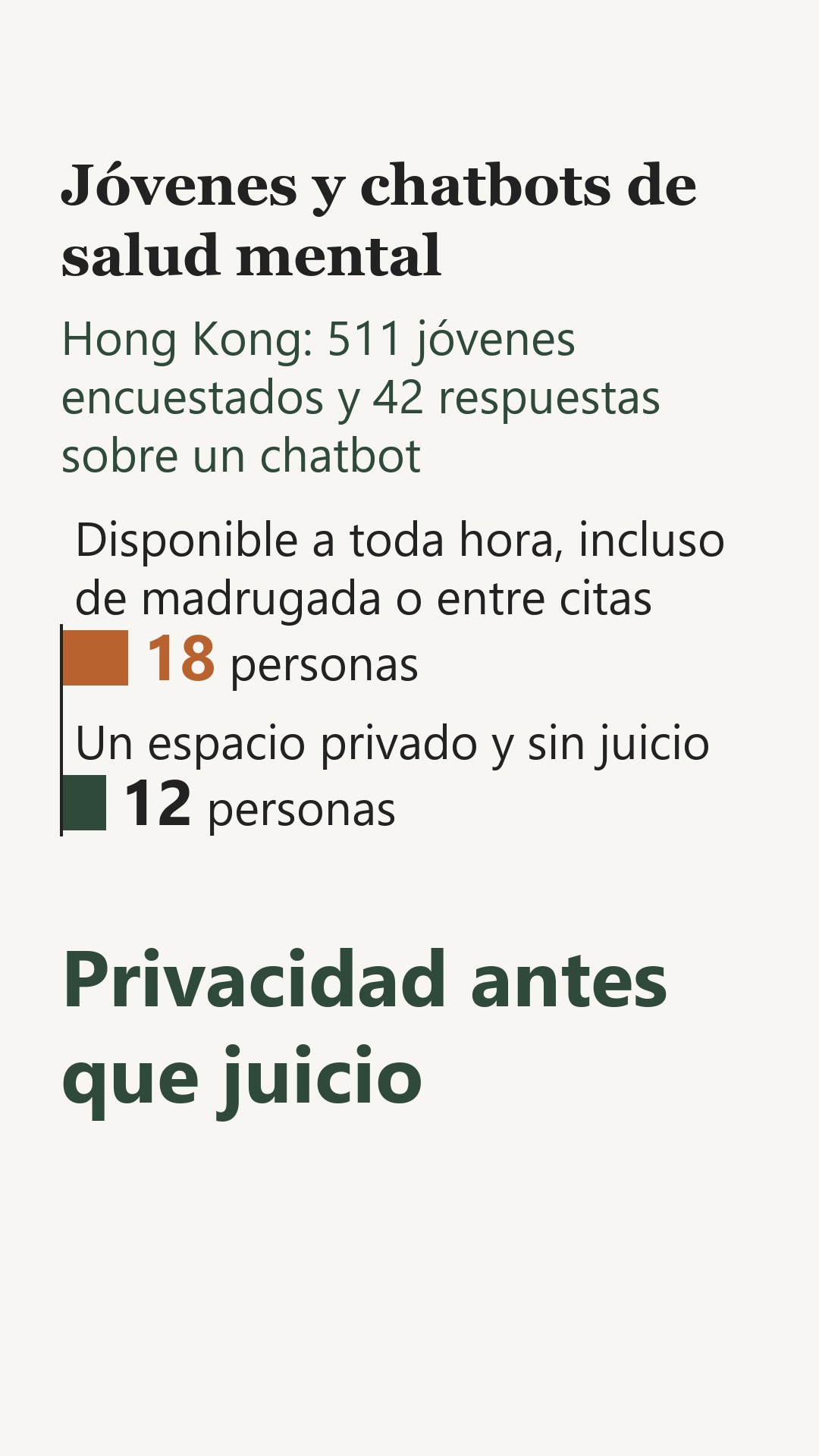
"Un asunto personal". Así explicó un paciente joven en Hong Kong por qué prefiere callar lo que siente antes de contarlo a otra persona. Tenía miedo de que sus problemas se convirtieran en chismes y prefirió guardárselos.
Investigadores de la Universidad de Hong Kong encuestaron a 511 jóvenes que acudían a consulta externa en una clínica psiquiátrica infantil y juvenil. Dos de cada tres, el 66.2%, dijeron que ya habían recurrido a programas de inteligencia artificial disponibles en internet para hablar de sus problemas emocionales. Entre los que ya los usaban, más de la mitad sólo los habían probado unas pocas veces, en menos de diez conversaciones en total.
Las respuestas abiertas dejaron ver los mismos motivos: el miedo al juicio de los demás y las ganas de no ser una carga para la familia o los amigos. Por eso pedían un espacio privado, disponible a toda hora, que hablara en su propio cantonés y diera sugerencias prácticas.
Con esas opiniones, diez adultos con depresión ayudaron a diseñar un prototipo llamado CARES-MDD y después lo probaron. Ocho profesionales de la salud formaron un grupo aparte que también dio su opinión. Es un sistema diseñado para responder en cantonés local y aplicar ejercicios de terapia cognitiva conductual. Si la persona escribe frases de peligro o daño, el programa deja a un lado por un momento sus respuestas habituales y muestra en pantalla un aviso para buscar ayuda urgente.
Las personas que lo probaron valoraron la privacidad y el tono cercano, pero señalaron fallas claras. El robot olvidaba detalles de charlas anteriores, el teclado resultaba agotador y las alertas de riesgo saltaban con expresiones cotidianas como "oh, no". Además, pidieron usar seudónimos para que sus datos no se confundieran con los de otra persona. También vieron con buenos ojos que el equipo clínico revise sus conversaciones de vez en cuando, porque eso les daba confianza frente a los errores del programa.
El estudio no evaluó si el sistema reduce los síntomas de la depresión ni si sirve como tratamiento médico. Los datos vienen de un solo grupo de personas en Hong Kong, así que no representan a todos los jóvenes que acuden a una consulta psiquiátrica. Tampoco se puede asegurar que el programa sea adecuado o seguro para menores de 18 años, pues las pruebas directas sólo se hicieron con adultos.
Cuando un programa en la pantalla le ofrezca escuchar sus penas más hondas, la pregunta que conviene llevarse es quién tiene acceso a lo que usted escribe y qué hace el sistema cuando decide que usted corre peligro.
Qué significa para usted
Ese programa se probó con diez adultos en Hong Kong y sólo con ellos, así que nada de lo que ahí se valoró permite concluir que sirva para tratar la depresión ni que sea seguro para menores de edad. Si algún día una aplicación así le ofrece escuchar lo que siente, pregunte quién puede leer esas conversaciones y qué ocurre cuando el sistema detecta peligro.
Lo, H. K. Y., Yu, M. S. Y., Sze, P. K. S. et al. (2026). From Needs Assessment to Pre-Trial Specification: Participatory Co-Design of a Generative AI Chatbot (CARES-MDD) for Persons Living with Depression in Hong Kong Psychiatric Care. Healthcare. https://doi.org/10.3390/healthcare14203547
Quién pagó: El estudio fue financiado por el Seed Fund for PI—Basic Research de la Universidad de Hong Kong (subvención 2502251716), y los autores declaran que los financiadores no tuvieron papel alguno en el diseño, el análisis, la redacción ni la decisión de publicar.
No tome esto como consejo médico profesional.
Versión detalladaLos pasajes copiados del artículo, las ilustraciones y cada fuente con cuánto leímos de ella · 1699 palabras · unos 8 minLeerla →Cerrar
Un chatbot confeccionado con usuarios de clínicas psiquiátricas de Hong Kong: lo que pidieron, lo que aprobaron y lo que nadie ha probado todavía
Sesenta y seis de cada cien jóvenes atendidos en una consulta psiquiátrica de Hong Kong ya habían usado un chatbot común para desahogarse. Un grupo pequeño de adultos con depresión ayudó a diseñar uno a la medida. Nadie ha medido si sirve.
Imagine la sala de espera de una consulta de psiquiatría infantil y adolescente en Hong Kong, un martes por la mañana. Ahí, entre el 22 de julio y el 21 de agosto de 2025, un equipo de la Universidad de Hong Kong encuestó a 511 jóvenes que acudían a consulta, con una edad promedio de casi 15 años. No todos tenían depresión: la clínica no separa a los pacientes por diagnóstico. De ese grupo, el 66.2% dijo que ya había usado chatbots de inteligencia artificial de uso general para hablar de sus preocupaciones emocionales12.
El dato viene con su margen: el estudio calcula que, en una población como esa, el porcentaje real estaría entre 61.9% y 70.1%1. Y hay un detalle que matiza el entusiasmo: de quienes ya los usaban, el 56.4% había tenido menos de diez conversaciones en total. Es decir, mucha curiosidad y poca costumbre.
Los investigadores también preguntaron, con preguntas abiertas, qué les impide contar lo que sienten. Solo 65 de los 511 contestaron, con frases cortas. Ahí aparecieron tres temas que se repiten: el miedo a que otros se enteren y lo comenten, el temor a que los juzguen y la idea de no querer cargar a nadie con sus problemas23. Otros 42 contestaron qué les gustaría de un chatbot de salud mental. Lo más pedido fue que esté disponible a toda hora, incluso de madrugada o entre una cita y otra; después, un espacio privado y sin juicio; luego, que hable como se habla en Hong Kong, no como un aparato; y, al final, consejos prácticos456.
Con esas respuestas, el equipo pasó a la segunda parte. Diez adultos con diagnóstico confirmado de depresión, de unos 23 años en promedio, y ocho profesionales clínicos participaron en talleres para diseñar y probar un prototipo llamado CARES-MDD. Es un chatbot de texto, en cantonés coloquial de Hong Kong, con contenido basado en terapia cognitivo-conductual, la que trabaja los pensamientos y las conductas que mantienen el malestar. Su función declarada es acompañar el tratamiento habitual, no sustituirlo7.
¿Cómo funciona por dentro? El sistema no fue pensado para diagnosticar la depresión, dar atención de emergencia, sustituir la evaluación profesional ni manejar por su cuenta el riesgo de suicidio7. Cuando detecta palabras relacionadas con el suicidio, la muerte o el daño a uno mismo, suspende lo que estaba generando y muestra una pantalla fija con recursos de crisis8. El problema es que esa detección se hace por palabras y el cantonés está lleno de exclamaciones que suenan a muerte sin serlo; los propios autores reconocen que el sistema no es una herramienta clínica validada y que es muy propenso a falsas alarmas9. Los participantes señalaron que el aviso a veces les caía de golpe, sobre todo cuando se activaba por exclamaciones coloquiales que no expresaban intención de hacerse daño10.
Un repaso de estudios sobre chatbots de salud mental hechos con inteligencia artificial generativa encontró 21 trabajos en 11 países; según el resumen, porque el texto completo no estaba disponible, la mayoría incluía alguna protección técnica, sobre todo ajustes finos del modelo y diseño de instrucciones, y solo un subconjunto menor combinaba varias capas de seguridad a la vez111213. Ese mismo repaso señala que la supervisión humana durante el uso era limitada, que los protocolos de derivación en crisis variaban mucho en rigor y que la vigilancia sistemática de efectos adversos era escasa1415. Entre las fallas documentadas aparecen casos de ideación suicida no detectada y de información clínica incorrecta16.
Hay otra revisión, esta vez sobre aplicaciones de salud mental para adolescentes, que buscó en cuatro bases de datos desde 2014 hasta mediados de 2026 y reunió 103 fuentes; solo pudimos leer el resumen, porque el artículo completo está detrás de una suscripción171819. De 95 estudios primarios, 83 reportaban qué tan bien predecía o diagnosticaba el sistema, y solo uno medía si mejoraba los síntomas20. Ninguno hizo una evaluación prospectiva dedicada a la seguridad21. Y ninguno midió el costo ni la puesta en marcha a escala en la atención habitual22.
También leímos un experimento con 768 estudiantes universitarios, del que solo tuvimos el resumen, en el que se les mostraron cuatro versiones de un chatbot con o sin dos mensajes: uno que prometía privacidad y otro que advertía que el chatbot no reemplaza al profesional23. La promesa de privacidad aumentó la sensación de protección; la advertencia sobre los límites aumentó la conciencia de que no es un terapeuta y se asoció con más intención de buscar ayuda profesional2425. Los propios autores advierten que esos mensajes no deben leerse como una invitación a usar más el chatbot, sino como una forma de que la persona lo trate como una herramienta limitada26.
En la prueba del prototipo, los participantes calificaron siete aspectos con una escala del 1 al 10. En general, las calificaciones fueron favorables. Los puntajes más altos fueron para la empatía y la comprensión del cantonés local, la exactitud y utilidad del contenido de terapia, y el equilibrio entre privacidad y supervisión clínica. Los más bajos, para el ritmo de acompañamiento y la duración de la intervención. Hubo mucha dispersión en las opiniones sobre las funciones de seguridad y sobre las preguntas socráticas, esas que guían con preguntas en lugar de dar respuestas: a algunos les parecieron exigentes en pleno malestar27.
Lo que los participantes valoraron fue un espacio privado para desahogarse, un "hueco en el árbol", como le dicen en cantonés a ese lugar donde uno guarda lo que no cuenta. Les gustó que hablara como un amigo local y no como un formulario. Varios pidieron usar seudónimos para que sus conversaciones no se confundieran con las de otros. Y, al mismo tiempo, quisieron que hubiera supervisión humana detrás: no como una amenaza, sino como un respaldo ante la posibilidad de que la máquina falle2829. La confianza, concluyen los autores, depende de que se diga con claridad qué se vigila, quién puede leer las conversaciones, qué se documenta y en qué casos se rompe la confidencialidad30.
Hay límites que conviene tener presentes. Esta prueba no tuvo grupo de comparación: todos los participantes usaron el prototipo, y los cambios que se observaron antes y después son solo descriptivos. Los propios autores escriben que el estudio no establece eficacia, seguridad ni equivalencia terapéutica, y que eso requiere ensayos controlados posteriores31. La muestra fue de conveniencia, en un solo servicio, sin registro de quiénes rechazaron participar, así que no se puede saber si quienes aceptaron se parecen al resto. Y hay una diferencia de edad importante: la encuesta incluyó a jóvenes de 14 a 19 años, pero el grupo de diseño fueron adultos; los autores dicen expresamente que la opinión de adultos no puede establecer si el sistema es aceptable o seguro para menores.
Así lo leemos nosotros. Lo que estos usuarios describen no es una novedad: es el viejo cuarto de confesión, ese lugar donde uno cuenta lo que no le cuenta a nadie, ahora instalado en una pantalla. Y lo que la pantalla guarda puede copiarse, revisarse o compartirse. Esperamos que mucha gente se sienta más libre frente a un chatbot justo porque no hay ojos humanos mirando, y que se sienta traicionada si descubre que sus conversaciones se revisan o llegan a su médico tratante, aunque esa revisión exista por seguridad. Sabríamos que nos equivocamos si los usuarios, al enterarse de que hay supervisión humana, se sintieran más tranquilos y no menos.
Es una advertencia sobre cuánto se puede trasladar un dato de un país a otro, no una duda sobre lo que ocurrió en esa clínica.
Otros trabajos que leímos coinciden en una idea incómoda: los sistemas como este pueden fallar en lo más delicado, y las protecciones que se les ponen suelen ser parciales. No es un defecto de este prototipo en particular; es un riesgo de la familia entera de herramientas. Y una cosa más: cuando una máquina habla con amabilidad, la gente tiende a tratarla como si tuviera criterio propio. Es probable que muchos acepten los avisos automáticos de crisis sin preguntar quién los decide, y que no sepan a quién reclamar si el sistema responde mal o no avisa a nadie cuando hace falta.
¿Qué haría falta para saber si esto sirve? Un ensayo controlado, con un grupo que reciba el chatbot y otro que reciba materiales de educación sobre salud mental, con seguimiento suficiente para ver si la gente lo usa, si le pasa algo y si mejora31. Los propios participantes pidieron que se les pague por su tiempo y que las evaluaciones puedan hacerse en línea, para no cargarlos. Y pidieron que el grupo de comparación también reciba algo útil, porque si no, se siente injusto.
Aquí está lo que usted puede hacer con esto, donde vive. Antes de contarle algo delicado a un chatbot, busque en la aplicación o en sus términos qué se guarda, quién lo puede leer y si se usa para entrenar el sistema o para vender. Pregunte a la empresa o al servicio de salud que lo ofrece quién revisa las conversaciones y en qué casos las comparte. Y cuando un chatbot le dé una indicación importante, pregunte quién la respalda y por qué vía puede reclamar. En varios países de la región ya existen autoridades de protección de datos a las que se puede acudir; si no sabe cuál es la suya, vale la pena averiguarlo antes de necesitarla.
Esa sala de espera de Hong Kong, con su pantalla y su promesa de privacidad, se parece a cualquier consultorio de América Latina: la misma necesidad de hablar sin miedo, la misma desconfianza de que alguien lo escuche. La diferencia es que ahora hay una máquina en medio, y lo que usted le cuente puede quedarse ahí. Vale la pena preguntar, antes de escribir la primera frase: ¿quién más va a leer esto?
De dónde sale cada dato de contexto, y cuánto leímos de cada documento
- Lo, H. K. Y., Yu, M. S. Y., Sze, P. K. S. et al. (2026). From Needs Assessment to Pre-Trial Specification: Participatory Co-Design of a Generative AI Chatbot (CARES-MDD) for Persons Living with Depression in Hong Kong Psychiatric Care. Healthcare. https://doi.org/10.3390/healthcare14203547 - el artículo del que trata esta nota — el artículo completo — el pasaje: "Among psychiatric outpatient attendees, 66.2% (CI 61.9–70.1%) reported prior use of generic AI chatbots for emotional concerns. Fear of negative judgment and burdening others were recurrent themes of barriers to sharing emotional concerns."
- Lo, H. K. Y., Yu, M. S. Y., Sze, P. K. S. et al. (2026). From Needs Assessment to Pre-Trial Specification: Participatory Co-Design of a Generative AI Chatbot (CARES-MDD) for Persons Living with Depression in Hong Kong Psychiatric Care. Healthcare. https://doi.org/10.3390/healthcare14203547 - el artículo del que trata esta nota — el artículo completo — el pasaje: "In Phase 1, 66.2% reported using generic AI chatbots for emotional concerns; privacy, anticipated negative evaluation, and concern about burdening others were recurring themes in the qualitative data."
- Lo, H. K. Y., Yu, M. S. Y., Sze, P. K. S. et al. (2026). From Needs Assessment to Pre-Trial Specification: Participatory Co-Design of a Generative AI Chatbot (CARES-MDD) for Persons Living with Depression in Hong Kong Psychiatric Care. Healthcare. https://doi.org/10.3390/healthcare14203547 - el artículo del que trata esta nota — el artículo completo — el pasaje: "Iterative thematic analysis identified Privacy concerns ( n = 22), characterizing emotional disclosure as “privacy” or a “personal matter” and expressing concern that their concerns can be gossiped about to others"
- Lo, H. K. Y., Yu, M. S. Y., Sze, P. K. S. et al. (2026). From Needs Assessment to Pre-Trial Specification: Participatory Co-Design of a Generative AI Chatbot (CARES-MDD) for Persons Living with Depression in Hong Kong Psychiatric Care. Healthcare. https://doi.org/10.3390/healthcare14203547 - el artículo del que trata esta nota — el artículo completo — el pasaje: "Localized empathy, non-judgmental, and 24/7 accessibility were the main themes of a desired mental health generative AI chatbot."
- Lo, H. K. Y., Yu, M. S. Y., Sze, P. K. S. et al. (2026). From Needs Assessment to Pre-Trial Specification: Participatory Co-Design of a Generative AI Chatbot (CARES-MDD) for Persons Living with Depression in Hong Kong Psychiatric Care. Healthcare. https://doi.org/10.3390/healthcare14203547 - el artículo del que trata esta nota — el artículo completo — el pasaje: "The category most frequently identified among the 42 respondents who provided comments was 24/7 immediate accessibility ( n = 18), with participants valuing on-demand emotional support between formal clinical appointments (e.g., “always available” and “immediate reply when I cannot sleep”)."
- Lo, H. K. Y., Yu, M. S. Y., Sze, P. K. S. et al. (2026). From Needs Assessment to Pre-Trial Specification: Participatory Co-Design of a Generative AI Chatbot (CARES-MDD) for Persons Living with Depression in Hong Kong Psychiatric Care. Healthcare. https://doi.org/10.3390/healthcare14203547 - el artículo del que trata esta nota — el artículo completo — el pasaje: "Privacy and non-judgmental space ( n = 12) reflected the preference to share vulnerable emotions without fear of human evaluation, characterized by comments like “no human judgment” and “completely confidential”."
- Lo, H. K. Y., Yu, M. S. Y., Sze, P. K. S. et al. (2026). From Needs Assessment to Pre-Trial Specification: Participatory Co-Design of a Generative AI Chatbot (CARES-MDD) for Persons Living with Depression in Hong Kong Psychiatric Care. Healthcare. https://doi.org/10.3390/healthcare14203547 - el artículo del que trata esta nota — el artículo completo — el pasaje: "It was not intended to diagnose MDD, provide emergency care, replace professional assessment, or autonomously manage suicidal risk."
- Lo, H. K. Y., Yu, M. S. Y., Sze, P. K. S. et al. (2026). From Needs Assessment to Pre-Trial Specification: Participatory Co-Design of a Generative AI Chatbot (CARES-MDD) for Persons Living with Depression in Hong Kong Psychiatric Care. Healthcare. https://doi.org/10.3390/healthcare14203547 - el artículo del que trata esta nota — el artículo completo — el pasaje: "Detection of these triggers initiates an automated safety interface,’ temporarily suspends the generation of routine chatbot content, and displays a static emergency interface with 24/7 direct-dial crisis hotlines."
- Lo, H. K. Y., Yu, M. S. Y., Sze, P. K. S. et al. (2026). From Needs Assessment to Pre-Trial Specification: Participatory Co-Design of a Generative AI Chatbot (CARES-MDD) for Persons Living with Depression in Hong Kong Psychiatric Care. Healthcare. https://doi.org/10.3390/healthcare14203547 - el artículo del que trata esta nota — el artículo completo — el pasaje: "Not a validated clinical risk assessment tool; highly susceptible to false positives from Cantonese colloquialisms"
- Lo, H. K. Y., Yu, M. S. Y., Sze, P. K. S. et al. (2026). From Needs Assessment to Pre-Trial Specification: Participatory Co-Design of a Generative AI Chatbot (CARES-MDD) for Persons Living with Depression in Hong Kong Psychiatric Care. Healthcare. https://doi.org/10.3390/healthcare14203547 - el artículo del que trata esta nota — el artículo completo — el pasaje: "Automated safety overrides were sometimes perceived as abrupt, particularly when triggered by non-suicidal colloquial exclamations such as “死啦” (“oh no”)."
- Olisaeloka L, Richardson CG, Wang AY, Munthali RJ, Vigo DV. (2026). Safety Mechanisms and Risk Mitigation in Generative AI Mental Health Chatbots: A Systematic Scoping Review. Healthcare. 10.3390/healthcare14101395 — solo el resumen - no se pudo obtener el texto completo — el pasaje: "Twenty-one studies across 11 countries were included."
- Olisaeloka L, Richardson CG, Wang AY, Munthali RJ, Vigo DV. (2026). Safety Mechanisms and Risk Mitigation in Generative AI Mental Health Chatbots: A Systematic Scoping Review. Healthcare. 10.3390/healthcare14101395 — solo el resumen - no se pudo obtener el texto completo — el pasaje: "Most interventions incorporated at least one technical safety mechanism, most commonly fine-tuning and prompt engineering."
- Olisaeloka L, Richardson CG, Wang AY, Munthali RJ, Vigo DV. (2026). Safety Mechanisms and Risk Mitigation in Generative AI Mental Health Chatbots: A Systematic Scoping Review. Healthcare. 10.3390/healthcare14101395 — solo el resumen - no se pudo obtener el texto completo — el pasaje: "A smaller subset implemented layered safety architectures combining retrieval systems, content filters or risk classifiers, and rule-based algorithms."
- Olisaeloka L, Richardson CG, Wang AY, Munthali RJ, Vigo DV. (2026). Safety Mechanisms and Risk Mitigation in Generative AI Mental Health Chatbots: A Systematic Scoping Review. Healthcare. 10.3390/healthcare14101395 — solo el resumen - no se pudo obtener el texto completo — el pasaje: "During intervention delivery, detailed onboarding with role clarification was common, but human oversight was limited."
- Olisaeloka L, Richardson CG, Wang AY, Munthali RJ, Vigo DV. (2026). Safety Mechanisms and Risk Mitigation in Generative AI Mental Health Chatbots: A Systematic Scoping Review. Healthcare. 10.3390/healthcare14101395 — solo el resumen - no se pudo obtener el texto completo — el pasaje: "Crisis referral protocols varied in rigour but were mostly underdeveloped, and systematic adverse event monitoring was sparse."
- Olisaeloka L, Richardson CG, Wang AY, Munthali RJ, Vigo DV. (2026). Safety Mechanisms and Risk Mitigation in Generative AI Mental Health Chatbots: A Systematic Scoping Review. Healthcare. 10.3390/healthcare14101395 — solo el resumen - no se pudo obtener el texto completo — el pasaje: "Documented safety failures included missed suicidal ideation and provision of inaccurate clinical information."
- Dhamayanti M, Susaldi S, Hanifa F, Agustini Y, Emilia O, Hardinsyah H, et al. (2026). Artificial intelligence-enabled mental health applications for adolescents: a scoping review of safety, effectiveness and clinical implementation. BMJ Open. 10.1136/bmjopen-2026-125586 — solo el resumen - el texto completo está tras una suscripción — el pasaje: "Scoping review conducted using Joanna Briggs Institute guidance and reported in accordance with the Preferred Reporting Items for Systematic Reviews and Meta-Analyses (PRISMA) extension for Scoping Reviews."
- Dhamayanti M, Susaldi S, Hanifa F, Agustini Y, Emilia O, Hardinsyah H, et al. (2026). Artificial intelligence-enabled mental health applications for adolescents: a scoping review of safety, effectiveness and clinical implementation. BMJ Open. 10.1136/bmjopen-2026-125586 — solo el resumen - el texto completo está tras una suscripción — el pasaje: "PubMed/MEDLINE, Scopus, the Cochrane Library and ScienceDirect were searched from 1 January 2014 to 17 June 2026."
- Dhamayanti M, Susaldi S, Hanifa F, Agustini Y, Emilia O, Hardinsyah H, et al. (2026). Artificial intelligence-enabled mental health applications for adolescents: a scoping review of safety, effectiveness and clinical implementation. BMJ Open. 10.1136/bmjopen-2026-125586 — solo el resumen - el texto completo está tras una suscripción — el pasaje: "The database searches identified 11 167 records, and 1 additional evidence synthesis was identified and assessed during revision; 103 sources were included, comprising 95 primary studies and 8 evidence syntheses."
- Dhamayanti M, Susaldi S, Hanifa F, Agustini Y, Emilia O, Hardinsyah H, et al. (2026). Artificial intelligence-enabled mental health applications for adolescents: a scoping review of safety, effectiveness and clinical implementation. BMJ Open. 10.1136/bmjopen-2026-125586 — solo el resumen - el texto completo está tras una suscripción — el pasaje: "Predictive or diagnostic performance was reported in 83 studies (87.4%), but symptom-level effectiveness in only 1 (1.1%)."
- Dhamayanti M, Susaldi S, Hanifa F, Agustini Y, Emilia O, Hardinsyah H, et al. (2026). Artificial intelligence-enabled mental health applications for adolescents: a scoping review of safety, effectiveness and clinical implementation. BMJ Open. 10.1136/bmjopen-2026-125586 — solo el resumen - el texto completo está tras una suscripción — el pasaje: "No primary study provided a dedicated prospective AI-safety evaluation."
- Dhamayanti M, Susaldi S, Hanifa F, Agustini Y, Emilia O, Hardinsyah H, et al. (2026). Artificial intelligence-enabled mental health applications for adolescents: a scoping review of safety, effectiveness and clinical implementation. BMJ Open. 10.1136/bmjopen-2026-125586 — solo el resumen - el texto completo está tras una suscripción — el pasaje: "No study evaluated sustained routine-care scale-up or implementation cost as a principal outcome."
- Zhang Z, Lu X, Zhang Y, Zhang H, Zhang M. (2026). Privacy assurances and professional-boundary warnings in generative AI mental health chatbots: a randomized vignette experiment on calibrated trust, overreliance risk, and professional help-seeking intentions. Frontiers in Psychology. 10.3389/fpsyg.2026.1934264 — solo el resumen - no se pudo obtener el texto completo — el pasaje: "We conducted a 2 × 2 randomized vignette experiment with 768 college students. Participants were assigned to one of four chatbot scenarios that either included or omitted privacy assurance and professional-boundary warning."
- Zhang Z, Lu X, Zhang Y, Zhang H, Zhang M. (2026). Privacy assurances and professional-boundary warnings in generative AI mental health chatbots: a randomized vignette experiment on calibrated trust, overreliance risk, and professional help-seeking intentions. Frontiers in Psychology. 10.3389/fpsyg.2026.1934264 — solo el resumen - no se pudo obtener el texto completo — el pasaje: "Privacy assurance increased perceived privacy protection, F (1, 764) = 159.30, p 2 = 0.172, d = 0.91. Professional-boundary warning increased boundary awareness, F (1, 764) = 176.40, p 2 = 0.188, d = 0.96."
- Zhang Z, Lu X, Zhang Y, Zhang H, Zhang M. (2026). Privacy assurances and professional-boundary warnings in generative AI mental health chatbots: a randomized vignette experiment on calibrated trust, overreliance risk, and professional help-seeking intentions. Frontiers in Psychology. 10.3389/fpsyg.2026.1934264 — solo el resumen - no se pudo obtener el texto completo — el pasaje: "Calibrated trust and perceived privacy protection were associated with safe-use intention, whereas boundary awareness was linked to lower overreliance risk and stronger professional help-seeking intention."
- Zhang Z, Lu X, Zhang Y, Zhang H, Zhang M. (2026). Privacy assurances and professional-boundary warnings in generative AI mental health chatbots: a randomized vignette experiment on calibrated trust, overreliance risk, and professional help-seeking intentions. Frontiers in Psychology. 10.3389/fpsyg.2026.1934264 — solo el resumen - no se pudo obtener el texto completo — el pasaje: "Such messages should not be understood as prompts for greater use. Rather, they may help users treat chatbots as limited tools for information and support navigation and recognize when professional help is needed."
- Lo, H. K. Y., Yu, M. S. Y., Sze, P. K. S. et al. (2026). From Needs Assessment to Pre-Trial Specification: Participatory Co-Design of a Generative AI Chatbot (CARES-MDD) for Persons Living with Depression in Hong Kong Psychiatric Care. Healthcare. https://doi.org/10.3390/healthcare14203547 - el artículo del que trata esta nota — el artículo completo — el pasaje: "Several LEEs also reported that abrupt safety override responses, while appropriate from a risk-management standpoint, interrupted the conversational flow at moments when continued empathic engagement may have been more therapeutically productive."
- Lo, H. K. Y., Yu, M. S. Y., Sze, P. K. S. et al. (2026). From Needs Assessment to Pre-Trial Specification: Participatory Co-Design of a Generative AI Chatbot (CARES-MDD) for Persons Living with Depression in Hong Kong Psychiatric Care. Healthcare. https://doi.org/10.3390/healthcare14203547 - el artículo del que trata esta nota — el artículo completo — el pasaje: "Participants did not frame privacy as the absence of clinical oversight. Rather, they supported proportionate human oversight when data governance arrangements were transparent and sensitive personal details were protected."
- Lo, H. K. Y., Yu, M. S. Y., Sze, P. K. S. et al. (2026). From Needs Assessment to Pre-Trial Specification: Participatory Co-Design of a Generative AI Chatbot (CARES-MDD) for Persons Living with Depression in Hong Kong Psychiatric Care. Healthcare. https://doi.org/10.3390/healthcare14203547 - el artículo del que trata esta nota — el artículo completo — el pasaje: "To ensure privacy, participants advocated for using pseudonyms to prevent data misattribution. However, they simultaneously supported backend clinician oversight, noting that human supervision of their conversations provided necessary reassurance against potential AI unreliability."
- Lo, H. K. Y., Yu, M. S. Y., Sze, P. K. S. et al. (2026). From Needs Assessment to Pre-Trial Specification: Participatory Co-Design of a Generative AI Chatbot (CARES-MDD) for Persons Living with Depression in Hong Kong Psychiatric Care. Healthcare. https://doi.org/10.3390/healthcare14203547 - el artículo del que trata esta nota — el artículo completo — el pasaje: "trust may depend on clearly communicating what is monitored, who can access information, what will be documented, and the circumstances under which confidentiality may be overridden because of safety concerns."
- Lo, H. K. Y., Yu, M. S. Y., Sze, P. K. S. et al. (2026). From Needs Assessment to Pre-Trial Specification: Participatory Co-Design of a Generative AI Chatbot (CARES-MDD) for Persons Living with Depression in Hong Kong Psychiatric Care. Healthcare. https://doi.org/10.3390/healthcare14203547 - el artículo del que trata esta nota — el artículo completo — el pasaje: "This mixed-methods study does not establish the efficacy, safety, or therapeutic equivalence of CARES-MDD; these questions require subsequent prospective controlled trials."
Lo, H. K. Y., Yu, M. S. Y., Sze, P. K. S. et al. (2026). From Needs Assessment to Pre-Trial Specification: Participatory Co-Design of a Generative AI Chatbot (CARES-MDD) for Persons Living with Depression in Hong Kong Psychiatric Care. Healthcare. https://doi.org/10.3390/healthcare14203547
Quién pagó: El estudio fue financiado por el Seed Fund for PI—Basic Research de la Universidad de Hong Kong (subvención 2502251716), y los autores declaran que los financiadores no tuvieron papel alguno en el diseño, el análisis, la redacción ni la decisión de publicar.
No tome esto como consejo médico profesional.
other · Healthcare (Basel, Switzerland) · the paper, 21 Oct 2026 · free
A Chatbot for Hard Feelings, and the Question of Who Reads Along
A survey at one Hong Kong clinic found about two in three young patients had already used a general AI chatbot for emotional concerns. A small group then helped build one; nothing shows it treats depression.
Short version · the longer version follows, about 7 min
Ask the weeklyAI chat
Ask me about AI in your life: I point you to the stories weeklyAI has published on it, this week and before.
Conversations are saved for as long as weeklyAI exists, to improve the publication. Answers come in the language you write in.
- The study at a glance
- Who
- young people attending a child and adolescent psychiatric outpatient clinic
- How many
- 511
- Where
- Hong Kong
- When
- over four weeks in the summer of 2025
- Kind of study
- survey
- Who did it
- University of Hong Kong researchers
- The limit that matters
- One clinic, one convenience sample; the numbers describe those people, not any country's population.
Counts of short comments from 42 volunteers at one Hong Kong clinic, not a vote; the same person could raise more than one wish.
The question to carry out of the clinic is short enough to ask any service before you type: who can read this, and what happens to it after?
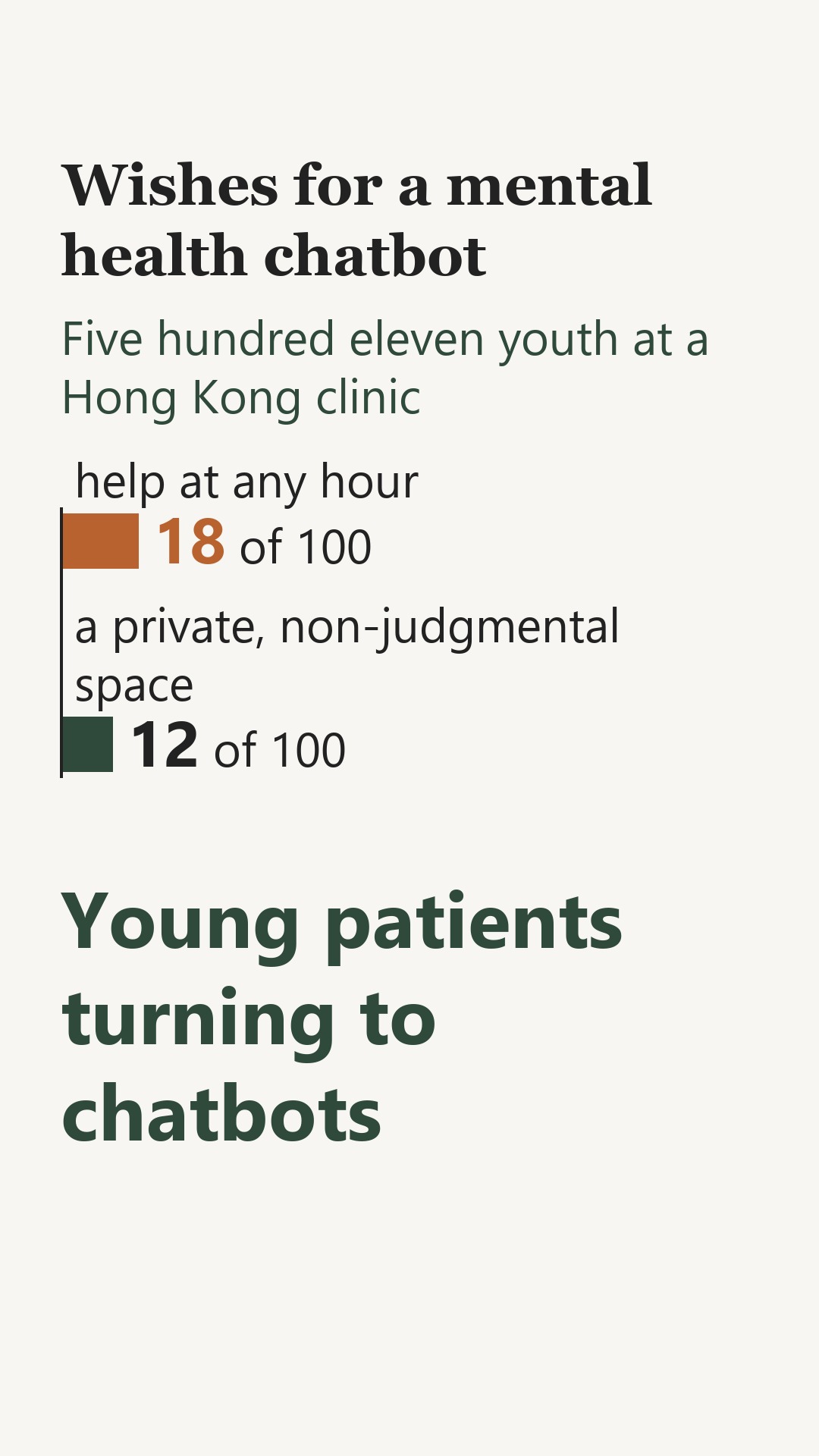
"Privacy," one young person wrote, explaining why they held back. "A personal matter." Others feared being gossiped about.
Researchers at the University of Hong Kong asked 511 young people at a child and adolescent psychiatric clinic what stops them from sharing hard feelings. The answers came down to fear of judgment and not wanting to burden anyone.
Many of them had already taken the risk somewhere else. In the survey, 66.2%, about two in three, said they had used a general AI chatbot for emotional concerns. A little over half of those had done it only a few times, fewer than 10 conversations in all.
The same wishes kept coming back: privacy, a chatbot that sounds like a local friend in Cantonese, help at any hour, and practical advice.
So 10 adults with depression and eight clinicians worked on a chatbot called CARES-MDD. It talks in Hong Kong-style Cantonese and offers exercises based on cognitive behavioral therapy, a talking treatment. The chatbot has a safety feature for messages that suggest a person may be at risk. When that happens, it stops the usual chat and points the person to urgent help.
The testers valued it as a private place to let feelings out, and liked the local language. They also found the safety alerts abrupt, sometimes set off by everyday exclamations. The chatbot sometimes failed to recall details from very early sessions. They wanted pseudonyms, and they wanted to be told clearly what is watched and who can see it.
This was one group, in one clinic, giving opinions. The study did not test whether the chatbot eases depression, and nothing here shows it could replace a therapist or a crisis line. The design group was adults; the authors say their feedback says nothing about whether the tool is safe or suitable for anyone under 18.
The survey was a convenience sample from a single Hong Kong clinic, so its numbers describe those people, not any country's population. They tell you nothing about what the law where you live allows a chatbot to do with what you type.
The last question the testers raised is the one to carry: when a chatbot offers to hold your hardest feelings, who can read what you type, and what happens the moment it decides you are at risk?
What this means for you
For now, nothing in this study tells you what the law where you live allows a chatbot to do with what you type, since the survey came from one Hong Kong clinic. What you can watch for is the question the testers raised: who can read your messages, and what happens when the software decides you are at risk. Those are the terms to ask about before you share anything hard.
Lo, H. K. Y., Yu, M. S. Y., Sze, P. K. S. et al. (2026). From Needs Assessment to Pre-Trial Specification: Participatory Co-Design of a Generative AI Chatbot (CARES-MDD) for Persons Living with Depression in Hong Kong Psychiatric Care. Healthcare. https://doi.org/10.3390/healthcare14203547
Who paid: The study was funded by the Seed Fund for PI—Basic Research of the University of Hong Kong (grant 2502251716), and the authors state the funders had no role in design, analysis, writing or the decision to publish.
Do not take this as professional medical advice.
The longer versionThe passages copied from the paper, the pictures, and every source with how much of it we read · 1466 words · about 7 minRead it →Close
A Chatbot for Depression Was Built With Patients. Its Makers Say It Has Not Been Shown to Work.
In a Hong Kong clinic survey, two in three young psychiatric outpatients said they had already used chatbots for emotional support. A small adult group then helped design one—and gave it good marks, not proof.
The waiting room of a child and adolescent psychiatric clinic is an odd place to find the future of care. Over four weeks in the summer of 2025, researchers in Hong Kong stationed themselves in the outpatient clinics of Queen Mary Hospital and asked young people attending routine visits to fill in a questionnaire. They got 511 of them, average age about 15, about half girls and half boys, with a range of diagnoses rather than depression alone. Two in three—66.2 percent, with a range the authors give as 61.9 to 70.1—said they had already used ordinary, general-purpose AI chatbots for emotional concerns. That is a large share, and it comes with a caveat the authors are careful about: this was a convenience sample at one clinic, not a count of young people in Hong Kong or anywhere else.
The rest of the survey is about why these young people do not say more to the people around them. Of the 511, 65 wrote a short comment when asked what stops them sharing emotional difficulties. The recurring themes were privacy—worrying that what they said could be gossiped about; fear of judgment—being misunderstood or looked down on; and not wanting to burden others, as one put it, not wanting to affect other people's mood. A separate question, answered by 42 of them, asked what they would most want from a mental health chatbot: being available at any hour, especially between appointments and at night; a private, non-judgmental space; Cantonese that sounds local rather than like a machine; and practical guidance. These were brief phrases from a handful of volunteers, not a vote.
Then came the second half. Ten adults with confirmed depression, average age about 23, and eight clinicians—two psychologists, three counselors, a psychiatrist and two psychiatric nurses—met in workshops and then tried a prototype called CARES-MDD: a text chatbot in Hong Kong-style Cantonese, built on a large language model, with its content written by psychiatrists and psychologists around cognitive behavioral therapy, the talking treatment that targets distorted thoughts and avoidance. They rated it on seven domains the researchers had drawn up for the study. Ratings were generally favorable, with the highest marks for empathy and Cantonese understanding, for accurate and useful therapy content, and for balancing privacy against clinical oversight. The authors state plainly what that is and is not: no efficacy was tested, and no preset standard was used to declare the prototype ready for a full trial.
Now consider what happens inside the machine when someone types something dark. The system scans the words for set phrases—wishing to die, wanting to disappear, references to self-harm. When one appears, it suspends the ordinary conversation and shows a fixed screen pointing the person to crisis help1. The authors also describe weekly clinical review of the chatbot's content and responses, and a pathway for escalating a case to the person's existing care team. The authors say the filter is not a validated tool for judging risk and is easily set off by ordinary Cantonese turns of phrase2. The testers noticed: some found the interruption abrupt, including when it fired on a harmless exclamation like "死啦," roughly "oh no"3. Some said the break came at moments when staying with the person might have helped more4.
The privacy question has a twist. You might expect people afraid of being watched to want no oversight at all. They did not. They wanted a pseudonym so their words could not be mixed up with another user's, and at the same time they wanted a clinician able to look in the background, because a human checking the machine was a comfort against its errors5. One idea they ranked highly was notable: intimate disclosures would be shielded from the patient's own treating psychiatrist, while the lead researcher could alert the case psychiatrist if symptoms worsened6. They also said trust depends on being told, in plain terms, what is monitored, who can see it, what gets written down, and when confidentiality could be broken for safety7. The authors' own boundary is firm: the chatbot was never meant to diagnose, give emergency care, replace professional assessment, or manage suicide risk on its own8.
Other work gives a sense of scale. A review of generative AI chatbots for mental health found 21 studies across 11 countries9; we could read only the summary, the full paper is behind a subscription. Most built in at least one technical safeguard, usually by tuning the model and shaping its instructions10, and a smaller group layered several together11. Human oversight during use was limited12, crisis referral rules varied and were mostly underdeveloped13, and documented failures included missed suicidal ideation and wrong clinical information14. A separate review of AI mental health apps for adolescents, also read only in summary, found that of 95 primary studies, symptom-level effectiveness was reported in one15, and no study ran a dedicated prospective safety evaluation16. A randomized experiment with 768 college students, again summary only, found that a visible privacy message and a visible warning about the chatbot's limits both shifted how students judged it17, and that the warning was linked to less overreliance18; the authors caution such messages are not a push to use chatbots more19.
Two groups sit inside this one paper, and the distance between them matters. The survey drew on 511 adolescents at a clinic; the design group was ten adults with depression plus eight clinicians. The authors say adult feedback cannot establish whether the tool is acceptable, usable or safe for anyone under 18. The chatbot's intended users are people attending psychiatric clinics in Hong Kong who speak Cantonese and carry a smartphone; nothing here describes a product for sale, a public service, or a rule that applies in the Americas. What would have to happen next is stated by the authors themselves: controlled trials, with safety and adverse-event monitoring built in20, and, in the wider field, regulation matched to the risk these systems carry21.
Here is how we read it. The pattern is that people open up to a machine partly because a person carries the risk of judgment or of becoming a burden—and then grow guarded the moment the machine starts to feel like a person who might evaluate them. We expect users in our countries to want a private, impersonal place to type, and to ask first who else can see it. You could prove us wrong by telling us a warm, human-sounding chatbot made you share more, and that a clinician reading your transcript reassured rather than silenced you. We also read that a machine which listens endlessly can start to feel like a relationship, so its forgetting and its sudden crisis screen land as slights rather than software faults. And we read, from other work, that the words people type into these tools are valuable to someone: the practical question is not whether the chatbot is kind but who holds the transcript. You could prove that wrong if the services you use plainly said what they keep, honored deletion, and you could confirm it without a lawyer. One boundary worth stating: the survey figures come from one Hong Kong clinic, and the authors give no comparison from anywhere else. That is about carrying over, not about this result.
What you can do with this does not require a diagnosis or a subscription. Before you type anything personal into a chatbot, ask whether you would be comfortable if a person read it, and look for the plain sentence saying who can see your messages and what is kept; if a service will not say, treat the silence as information. Notice when the tool starts to feel like a friend, and remember that the comfort of being heard is not the same as being helped. If it forgets what you told it or cuts you off, that is the machine's limit, not a judgment about you. Where your country's law gives you a right to see or erase your data, that request is the concrete step; ask for the answer in writing.
The waiting room is still the waiting room, and the phone in the young patient's hand is still the phone. What this study adds is a picture of what people want kept private, and a reminder that wanting it is not the same as having it. The question to carry out of the clinic is short enough to ask any service before you type: who can read this, and what happens to it after?
Where each piece of context comes from, and how much of it we read
- Lo, H. K. Y., Yu, M. S. Y., Sze, P. K. S. et al. (2026). From Needs Assessment to Pre-Trial Specification: Participatory Co-Design of a Generative AI Chatbot (CARES-MDD) for Persons Living with Depression in Hong Kong Psychiatric Care. Healthcare. https://doi.org/10.3390/healthcare14203547 - the article this story is about — the whole article — the passage: "Detection of these triggers initiates an automated safety interface,’ temporarily suspends the generation of routine chatbot content, and displays a static emergency interface with 24/7 direct-dial crisis hotlines."
- Lo, H. K. Y., Yu, M. S. Y., Sze, P. K. S. et al. (2026). From Needs Assessment to Pre-Trial Specification: Participatory Co-Design of a Generative AI Chatbot (CARES-MDD) for Persons Living with Depression in Hong Kong Psychiatric Care. Healthcare. https://doi.org/10.3390/healthcare14203547 - the article this story is about — the whole article — the passage: "Not a validated clinical risk assessment tool; highly susceptible to false positives from Cantonese colloquialisms"
- Lo, H. K. Y., Yu, M. S. Y., Sze, P. K. S. et al. (2026). From Needs Assessment to Pre-Trial Specification: Participatory Co-Design of a Generative AI Chatbot (CARES-MDD) for Persons Living with Depression in Hong Kong Psychiatric Care. Healthcare. https://doi.org/10.3390/healthcare14203547 - the article this story is about — the whole article — the passage: "Automated safety overrides were sometimes perceived as abrupt, particularly when triggered by non-suicidal colloquial exclamations such as “死啦” (“oh no”)."
- Lo, H. K. Y., Yu, M. S. Y., Sze, P. K. S. et al. (2026). From Needs Assessment to Pre-Trial Specification: Participatory Co-Design of a Generative AI Chatbot (CARES-MDD) for Persons Living with Depression in Hong Kong Psychiatric Care. Healthcare. https://doi.org/10.3390/healthcare14203547 - the article this story is about — the whole article — the passage: "Several LEEs also reported that abrupt safety override responses, while appropriate from a risk-management standpoint, interrupted the conversational flow at moments when continued empathic engagement may have been more therapeutically productive."
- Lo, H. K. Y., Yu, M. S. Y., Sze, P. K. S. et al. (2026). From Needs Assessment to Pre-Trial Specification: Participatory Co-Design of a Generative AI Chatbot (CARES-MDD) for Persons Living with Depression in Hong Kong Psychiatric Care. Healthcare. https://doi.org/10.3390/healthcare14203547 - the article this story is about — the whole article — the passage: "To ensure privacy, participants advocated for using pseudonyms to prevent data misattribution. However, they simultaneously supported backend clinician oversight, noting that human supervision of their conversations provided necessary reassurance against potential AI unreliability."
- Lo, H. K. Y., Yu, M. S. Y., Sze, P. K. S. et al. (2026). From Needs Assessment to Pre-Trial Specification: Participatory Co-Design of a Generative AI Chatbot (CARES-MDD) for Persons Living with Depression in Hong Kong Psychiatric Care. Healthcare. https://doi.org/10.3390/healthcare14203547 - the article this story is about — the whole article — the passage: "Shield intimate conversational disclosures from the patient’s primary treating psychiatrist while allowing PI to inform case psychiatrists if worsening symptoms."
- Lo, H. K. Y., Yu, M. S. Y., Sze, P. K. S. et al. (2026). From Needs Assessment to Pre-Trial Specification: Participatory Co-Design of a Generative AI Chatbot (CARES-MDD) for Persons Living with Depression in Hong Kong Psychiatric Care. Healthcare. https://doi.org/10.3390/healthcare14203547 - the article this story is about — the whole article — the passage: "trust may depend on clearly communicating what is monitored, who can access information, what will be documented, and the circumstances under which confidentiality may be overridden because of safety concerns."
- Lo, H. K. Y., Yu, M. S. Y., Sze, P. K. S. et al. (2026). From Needs Assessment to Pre-Trial Specification: Participatory Co-Design of a Generative AI Chatbot (CARES-MDD) for Persons Living with Depression in Hong Kong Psychiatric Care. Healthcare. https://doi.org/10.3390/healthcare14203547 - the article this story is about — the whole article — the passage: "It was not intended to diagnose MDD, provide emergency care, replace professional assessment, or autonomously manage suicidal risk."
- Olisaeloka L, Richardson CG, Wang AY, Munthali RJ, Vigo DV. (2026). Safety Mechanisms and Risk Mitigation in Generative AI Mental Health Chatbots: A Systematic Scoping Review. Healthcare. 10.3390/healthcare14101395 — only the abstract - the full text could not be fetched — the passage: "Twenty-one studies across 11 countries were included."
- Olisaeloka L, Richardson CG, Wang AY, Munthali RJ, Vigo DV. (2026). Safety Mechanisms and Risk Mitigation in Generative AI Mental Health Chatbots: A Systematic Scoping Review. Healthcare. 10.3390/healthcare14101395 — only the abstract - the full text could not be fetched — the passage: "Most interventions incorporated at least one technical safety mechanism, most commonly fine-tuning and prompt engineering."
- Olisaeloka L, Richardson CG, Wang AY, Munthali RJ, Vigo DV. (2026). Safety Mechanisms and Risk Mitigation in Generative AI Mental Health Chatbots: A Systematic Scoping Review. Healthcare. 10.3390/healthcare14101395 — only the abstract - the full text could not be fetched — the passage: "A smaller subset implemented layered safety architectures combining retrieval systems, content filters or risk classifiers, and rule-based algorithms."
- Olisaeloka L, Richardson CG, Wang AY, Munthali RJ, Vigo DV. (2026). Safety Mechanisms and Risk Mitigation in Generative AI Mental Health Chatbots: A Systematic Scoping Review. Healthcare. 10.3390/healthcare14101395 — only the abstract - the full text could not be fetched — the passage: "During intervention delivery, detailed onboarding with role clarification was common, but human oversight was limited."
- Olisaeloka L, Richardson CG, Wang AY, Munthali RJ, Vigo DV. (2026). Safety Mechanisms and Risk Mitigation in Generative AI Mental Health Chatbots: A Systematic Scoping Review. Healthcare. 10.3390/healthcare14101395 — only the abstract - the full text could not be fetched — the passage: "Crisis referral protocols varied in rigour but were mostly underdeveloped, and systematic adverse event monitoring was sparse."
- Olisaeloka L, Richardson CG, Wang AY, Munthali RJ, Vigo DV. (2026). Safety Mechanisms and Risk Mitigation in Generative AI Mental Health Chatbots: A Systematic Scoping Review. Healthcare. 10.3390/healthcare14101395 — only the abstract - the full text could not be fetched — the passage: "Documented safety failures included missed suicidal ideation and provision of inaccurate clinical information."
- Dhamayanti M, Susaldi S, Hanifa F, Agustini Y, Emilia O, Hardinsyah H, et al. (2026). Artificial intelligence-enabled mental health applications for adolescents: a scoping review of safety, effectiveness and clinical implementation. BMJ Open. 10.1136/bmjopen-2026-125586 — only the abstract - the full paper is behind a subscription — the passage: "Predictive or diagnostic performance was reported in 83 studies (87.4%), but symptom-level effectiveness in only 1 (1.1%)."
- Dhamayanti M, Susaldi S, Hanifa F, Agustini Y, Emilia O, Hardinsyah H, et al. (2026). Artificial intelligence-enabled mental health applications for adolescents: a scoping review of safety, effectiveness and clinical implementation. BMJ Open. 10.1136/bmjopen-2026-125586 — only the abstract - the full paper is behind a subscription — the passage: "No primary study provided a dedicated prospective AI-safety evaluation."
- Zhang Z, Lu X, Zhang Y, Zhang H, Zhang M. (2026). Privacy assurances and professional-boundary warnings in generative AI mental health chatbots: a randomized vignette experiment on calibrated trust, overreliance risk, and professional help-seeking intentions. Frontiers in Psychology. 10.3389/fpsyg.2026.1934264 — only the abstract - the full text could not be fetched — the passage: "Privacy assurance increased perceived privacy protection, F (1, 764) = 159.30, p 2 = 0.172, d = 0.91. Professional-boundary warning increased boundary awareness, F (1, 764) = 176.40, p 2 = 0.188, d = 0.96."
- Zhang Z, Lu X, Zhang Y, Zhang H, Zhang M. (2026). Privacy assurances and professional-boundary warnings in generative AI mental health chatbots: a randomized vignette experiment on calibrated trust, overreliance risk, and professional help-seeking intentions. Frontiers in Psychology. 10.3389/fpsyg.2026.1934264 — only the abstract - the full text could not be fetched — the passage: "Calibrated trust and perceived privacy protection were associated with safe-use intention, whereas boundary awareness was linked to lower overreliance risk and stronger professional help-seeking intention."
- Zhang Z, Lu X, Zhang Y, Zhang H, Zhang M. (2026). Privacy assurances and professional-boundary warnings in generative AI mental health chatbots: a randomized vignette experiment on calibrated trust, overreliance risk, and professional help-seeking intentions. Frontiers in Psychology. 10.3389/fpsyg.2026.1934264 — only the abstract - the full text could not be fetched — the passage: "Such messages should not be understood as prompts for greater use. Rather, they may help users treat chatbots as limited tools for information and support navigation and recognize when professional help is needed."
- Lo, H. K. Y., Yu, M. S. Y., Sze, P. K. S. et al. (2026). From Needs Assessment to Pre-Trial Specification: Participatory Co-Design of a Generative AI Chatbot (CARES-MDD) for Persons Living with Depression in Hong Kong Psychiatric Care. Healthcare. https://doi.org/10.3390/healthcare14203547 - the article this story is about — the whole article — the passage: "This mixed-methods study does not establish the efficacy, safety, or therapeutic equivalence of CARES-MDD; these questions require subsequent prospective controlled trials."
- Olisaeloka L, Richardson CG, Wang AY, Munthali RJ, Vigo DV. (2026). Safety Mechanisms and Risk Mitigation in Generative AI Mental Health Chatbots: A Systematic Scoping Review. Healthcare. 10.3390/healthcare14101395 — only the abstract - the full text could not be fetched — the passage: "Regulatory oversight proportional to the risks these systems carry is required to enable integration into stepped or blended mental healthcare."
Lo, H. K. Y., Yu, M. S. Y., Sze, P. K. S. et al. (2026). From Needs Assessment to Pre-Trial Specification: Participatory Co-Design of a Generative AI Chatbot (CARES-MDD) for Persons Living with Depression in Hong Kong Psychiatric Care. Healthcare. https://doi.org/10.3390/healthcare14203547
Who paid: The study was funded by the Seed Fund for PI—Basic Research of the University of Hong Kong (grant 2502251716), and the authors state the funders had no role in design, analysis, writing or the decision to publish.
Do not take this as professional medical advice.