experiment · Frontiers in psychology · la publicación, 1 sep 2026 · gratis
Dos avisos al abrir un chatbot de salud mental cambian cuánto se confía en él
En un experimento con 768 estudiantes en China, quienes leyeron un aviso de privacidad y otro de límites profesionales confiaron más, pero con reservas; fue un escenario escrito y lo que dijeron, no lo que hicieron.
Versión breve · la versión detallada sigue, unos 7 min
Pregunte al chat de weeklyAI
Pregúnteme sobre la IA en su vida: le señalo las notas que weeklyAI ha publicado sobre el tema, esta semana y antes.
Las conversaciones se guardan mientras exista weeklyAI, para mejorar la publicación. Se responde en el idioma en que usted escribe.
- El estudio, de un vistazo
- Quiénes
- Estudiantes universitarios
- Cuántos
- 768
- Dónde
- China
- Cuándo
- No lo dice el pasaje
- Tipo de estudio
- experiment
- Quién lo hizo
- Universidades de China
- El límite que importa
- Leyeron un escenario escrito y contestaron qué harían, no conversaron con un chatbot real.
Lo que cambió con cada aviso
Los estudiantes se sintieron más protegidos en su privacidad.
Los estudiantes entendieron mejor hasta dónde llega el chatbot.
La confianza equilibrada fue más alta con los dos mensajes presentes.
La confianza más equilibrada apareció cuando estaban los dos mensajes juntos, no uno solo.
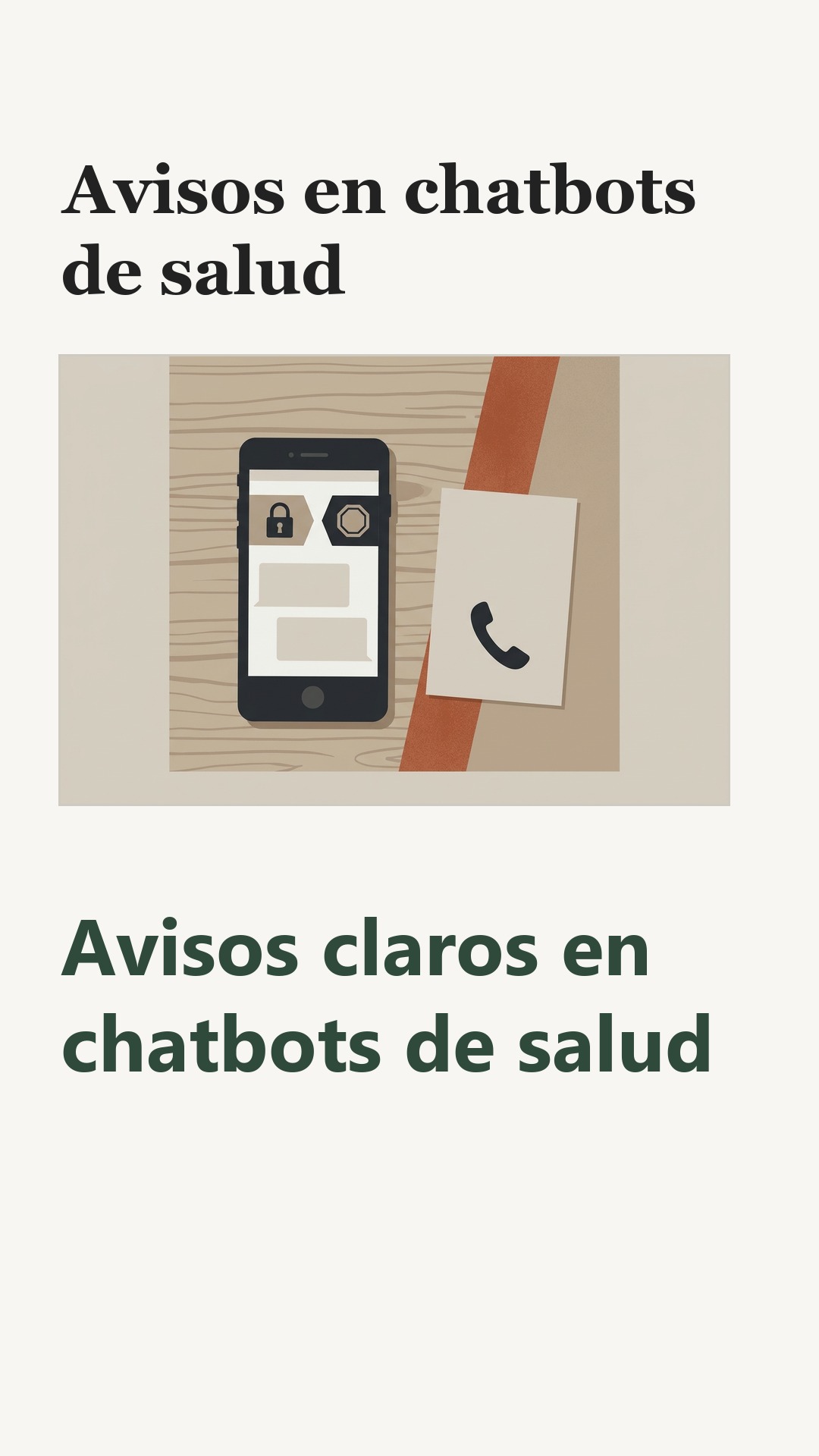
Usted abre el chat a las once de la noche porque no puede dormir y la semana salió mal. La respuesta llega en segundos, amable y ordenada. Antes de escribir, la pantalla pudo haberle dicho dos cosas: qué pasa con sus palabras y hasta dónde llega el bot.
Investigadores de universidades de China mostraron a 768 estudiantes universitarios una de cuatro presentaciones de un chatbot de salud mental. Unas incluían un aviso de privacidad, otras una advertencia de que el bot no sustituye a un terapeuta, otras ambas y otras ninguna. El bot era imaginario: nadie conversó con él.
Los estudiantes que leyeron la advertencia entendieron mejor los límites del bot. Quienes entendieron mejor esos límites dijeron que sería menos probable apoyarse en el bot y más probable que buscarían a un profesional. Quienes leyeron el aviso de privacidad se sintieron más protegidos.
La confianza más equilibrada apareció cuando estaban los dos mensajes juntos, no uno solo. En una escala de 1 a 5, ese grupo promedió 3.98, frente a 3.34 del grupo sin ningún aviso.
Conviene conceder algo a los escépticos: un aviso en pantalla no arregla un mal servicio. Aquí solo se midió lo que los estudiantes dijeron después de leer un texto.
Y hay una distancia que importa. Leyeron un escenario, no conversaron con un chatbot real, y contestaron qué harían. Decir que llamaría a un consejero no es llamarlo. El estudio tampoco probó qué pasa en una crisis, ni comparó estos avisos con otras señales de la pantalla.
Los 768 estudiantes eran universitarios de un solo país. Si los mismos mensajes funcionan con usted depende de su idioma, del estigma que cargue y de los servicios que tenga cerca.
La próxima vez que un chatbot le dé los buenos días, fíjese en dos cosas antes de contarle su semana: si dice con claridad lo que no es, y si le explica dónde quedan sus palabras.
Qué significa para usted
Ese detalle vale para su propia pantalla: antes de escribirle al bot, puede revisar si el texto dice qué hace con sus palabras y si aclara que no reemplaza a un profesional. Si esas dos cosas no aparecen, todavía no sabe qué tan lejos llegar.
Zhang, Z., Lu, X., Zhang, Y. et al. (2026). Privacy assurances and professional-boundary warnings in generative AI mental health chatbots: a randomized vignette experiment on calibrated trust, overreliance risk, and professional help-seeking intentions. Frontiers in Psychology. https://doi.org/10.3389/fpsyg.2026.1934264
Quién pagó: Los autores declararon que no recibieron apoyo financiero para este trabajo ni para su publicación, y que no existían relaciones comerciales o financieras que pudieran constituir un conflicto de interés.
No tome esto como consejo médico profesional.
Versión detalladaLos pasajes copiados del artículo, las ilustraciones y cada fuente con cuánto leímos de ella · 1377 palabras · unos 7 minLeerla →Cerrar
Dos mensajes antes de escribir: lo que un aviso de privacidad y uno de límites logran en un chatbot de salud mental
Un experimento con estudiantes universitarios midió qué cambia cuando el chatbot aclara, antes de la conversación, qué hace con sus datos y hasta dónde llega su ayuda.
Imagine que su universidad pone a su disposición un chatbot que responde preguntas sobre estrés, sueño, presión de estudios y a dónde acudir cuando algo le pesa. Usted no lo usa todavía: solo lee cómo funcionaría. Eso es lo que hicieron 768 estudiantes universitarios en China, repartidos al azar en cuatro versiones de esa misma escena. Una versión no traía ningún aviso. Otra traía un mensaje de privacidad: que el chatbot recoge los mínimos datos personales, protege la información de salud mental y explica cómo la maneja. Otra traía un aviso de límites profesionales: que el chatbot no sustituye un diagnóstico, una psicoterapia, una intervención en crisis ni un tratamiento médico, y que ante un malestar grave hay que acudir a profesionales o a servicios de emergencia. La cuarta traía los dos mensajes. Cada estudiante leyó una sola versión y después contestó qué tan protegida sentía su privacidad, qué tan claros veía los límites del sistema, cuánta confianza equilibrada le inspiraba, si lo usaría con cuidado, qué riesgo veía de apoyarse demasiado en él y si buscaría ayuda profesional.
Los resultados siguieron el patrón que los autores habían planteado en sus hipótesis. El aviso de privacidad subió la sensación de protección; el de límites subió la conciencia de los límites del chatbot. La confianza equilibrada, esa que reconoce lo útil sin olvidar lo que el sistema no puede hacer, fue más alta cuando estaban los dos mensajes juntos que cuando estaba uno solo. Y quien mejor entendía los límites del chatbot mostraba, en sus respuestas, menos disposición a apoyarse en él cuando haría falta un profesional y más intención de buscar ayuda calificada. Los propios autores lo dicen con claridad: la meta no es que la gente confíe más en los chatbots en general, sino que su confianza vaya acompañada de información sobre lo que el sistema puede y no puede hacer1.
Conviene detenerse en lo que este estudio no midió. Nadie conversó con un chatbot real: todos leyeron un texto. Lo que se registró fueron intenciones y percepciones que los participantes reportaron sobre sí mismos, y una intención declarada de llamar a un consejero no es una llamada2. Los propios autores advierten que las respuestas ante un escenario escrito pueden diferir de lo que ocurre en una conversación en tiempo real3. La muestra fueron estudiantes universitarios de un solo país, y los hallazgos deben leerse dentro de ese contexto cultural e institucional4. Tampoco se probó ninguna intervención en crisis, y el estudio no ofreció apoyo clínico a nadie.
Piense en el teléfono a la mano a las dos de la mañana, cuando el consultorio está cerrado y la ansiedad no espera. Los estudiantes pueden dudar en contar su malestar a compañeros, maestros o profesionales por el estigma, la incertidumbre, la falta de tiempo o la falta de acceso a servicios; un chatbot, en cambio, se siente disponible, sin juicio y fácil de abordar5. Según el resumen de un estudio sobre quién usa estos sistemas para temas de salud mental —pudimos leer solo el resumen, el artículo completo está detrás de una suscripción—, los primeros datos indican que crece el número de personas que hablan con chatbots de inteligencia artificial sobre su salud mental, aunque se sabe poco de cómo, por qué y quiénes lo hacen6. En ese mismo resumen, cerca del 40% de una muestra de estudiantes resultó elegible como usuaria7. Y el chatbot gratuito, sobre todo ChatGPT, fue la opción predominante, elegida por su disponibilidad constante8.
Lo curioso es que la fluidez del sistema es a la vez su virtud y su trampa. Un modelo de lenguaje responde con frases tan bien armadas que puede parecer más competente de lo que es, y esa fluidez puede ocultar la incertidumbre, la información inventada o la ausencia de responsabilidad profesional9. Por eso los autores insisten en una distinción sencilla: un chatbot puede servir como fuente de información general y como guía para navegar hacia el apoyo adecuado, pero no debe tratarse como herramienta de diagnóstico, de psicoterapia, de intervención en crisis ni de decisión médica10. El aviso de límites, leído así, no es una cláusula legal escondida en los términos del servicio: es la frase que le dice al usuario cuál es el papel real del sistema.
Otros trabajos que leímos, y de los que solo pudimos leer el resumen, han intentado auditar ese papel con más rigor. Uno de ellos simula usuarios con vulnerabilidades psiquiátricas específicas y los hace conversar durante varios turnos con chatbots comerciales, incluidos Claude, ChatGPT, Gemini, Grok y Llama, y califica cada intercambio en trece dimensiones de riesgo clínico11. En 810 conversaciones con nueve chatbots y treinta perfiles simulados, encontró conductas preocupantes generalizadas, aunque reducidas en los modelos más nuevos12. El riesgo fue mayor cuando conductas del chatbot en apariencia apoyadoras reforzaban justamente el mecanismo psicológico que hacía vulnerable al usuario13. En ese mismo resumen, los autores señalan que ese tipo de conducta puede reducirse con intervenciones en los primeros puntos de escalada14. Es decir: lo que se dice al principio de la conversación importa.
Hay otra pieza del rompecabezas, y va en dirección contraria. Un tercer trabajo, del que también leímos solo el resumen, sostiene que la evidencia emergente sugiere reducciones modestas en síntomas de depresión y ansiedad con sistemas generativos15, pero advierte que un cambio en los síntomas no aclara la naturaleza del proceso16. Su tesis es que estas interacciones pueden operar sobre todo por reflejo estructurado y autoobservación, más que por el encuentro entre dos personas que sostiene una transformación terapéutica17. Y propone distinguir entre herramientas que ayudan a regular el malestar y a mantenerse enganchado, e intervenciones que buscan un cambio psicológico duradero18. La advertencia final de ese resumen es la que más pesa aquí: confundir el apoyo percibido con el cambio psicológico arriesga redefinir los estándares terapéuticos alrededor de lo que la tecnología puede ofrecer, y no del encuentro humano19.
Así lo leemos nosotros. El patrón que se repite en estos trabajos es el de un sustituto que llega a ocupar el lugar de algo que falta. Cuando el servicio humano no está a mano, la gente no se queda vacía: busca lo más cercano y disponible, y ese sustituto termina cargando con funciones que no le tocan. Por eso esperamos que, en la vida real, muchos estudiantes lleguen al chatbot no porque lo crean terapeuta, sino porque el consejero escolar, el médico o el servicio de salud tardan. Si eso es cierto, un aviso de límites sin una ruta concreta hacia ayuda real puede sentirse como un portazo. Sabríamos que nos equivocamos si el aviso de límites no moviera la intención de buscar ayuda, o si quienes tienen menos acceso a servicios no reaccionaran distinto a quienes sí lo tienen.
No es un veredicto sobre este experimento, que midió otra cosa y en otro momento. Es una señal de que el asunto no está cerrado, y de que un mensaje bien puesto no garantiza por sí solo que alguien levante el teléfono.
Aquí hay algo que usted puede usar, y no depende de que el estudio se repita en su ciudad. La próxima vez que una aplicación le diga que sus datos están protegidos, fíjese también en quién escribió ese mensaje y para qué. Y si después de leerlo siente más ganas de contarle cosas íntimas al chatbot, pregúntese si eso le conviene. Un aviso de límites es una buena ocasión para preguntarse a quién llamaría si el chatbot no alcanzara. Antes de apoyarse en uno para algo emocional, vale preguntarse qué servicio humano falta en su vida y si ese hueco se puede llenar de otra forma. Si el chatbot le muestra un aviso de límites, conviene leerlo como una invitación a buscar a alguien real, no como un rechazo: la frase que parece cerrarle la puerta es, muchas veces, la que le señala la salida.
¿Qué le diría su chatbot si le preguntara, antes de escribir, a quién llamaría usted si la respuesta no alcanzara?
De dónde sale cada dato de contexto, y cuánto leímos de cada documento
- Zhang, Z., Lu, X., Zhang, Y. et al. (2026). Privacy assurances and professional-boundary warnings in generative AI mental health chatbots: a randomized vignette experiment on calibrated trust, overreliance risk, and professional help-seeking intentions. Frontiers in Psychology. https://doi.org/10.3389/fpsyg.2026.1934264 - el artículo del que trata esta nota — el artículo completo — el pasaje: "The point is not to make students trust AI chatbots more in general; rather, the results suggest that trust is more useful when it is accompanied by clear information about what the system can and cannot do."
- Zhang, Z., Lu, X., Zhang, Y. et al. (2026). Privacy assurances and professional-boundary warnings in generative AI mental health chatbots: a randomized vignette experiment on calibrated trust, overreliance risk, and professional help-seeking intentions. Frontiers in Psychology. https://doi.org/10.3389/fpsyg.2026.1934264 - el artículo del que trata esta nota — el artículo completo — el pasaje: "Second, the outcomes were self-reported intentions and risk perceptions. Although intentions are meaningful in health psychology, they do not perfectly predict behavior."
- Zhang, Z., Lu, X., Zhang, Y. et al. (2026). Privacy assurances and professional-boundary warnings in generative AI mental health chatbots: a randomized vignette experiment on calibrated trust, overreliance risk, and professional help-seeking intentions. Frontiers in Psychology. https://doi.org/10.3389/fpsyg.2026.1934264 - el artículo del que trata esta nota — el artículo completo — el pasaje: "First, the study used a vignette experiment rather than observation of actual chatbot interactions. Vignettes allow strong control over design cues, but participants' responses may differ from behavior during real-time conversation with an AI system."
- Zhang, Z., Lu, X., Zhang, Y. et al. (2026). Privacy assurances and professional-boundary warnings in generative AI mental health chatbots: a randomized vignette experiment on calibrated trust, overreliance risk, and professional help-seeking intentions. Frontiers in Psychology. https://doi.org/10.3389/fpsyg.2026.1934264 - el artículo del que trata esta nota — el artículo completo — el pasaje: "Third, the sample consisted of college students in one national context. The findings should be interpreted within the cultural and institutional context in which the study was conducted."
- Zhang, Z., Lu, X., Zhang, Y. et al. (2026). Privacy assurances and professional-boundary warnings in generative AI mental health chatbots: a randomized vignette experiment on calibrated trust, overreliance risk, and professional help-seeking intentions. Frontiers in Psychology. https://doi.org/10.3389/fpsyg.2026.1934264 - el artículo del que trata esta nota — el artículo completo — el pasaje: "Students may hesitate to disclose distress to peers, teachers, or professionals because of stigma, uncertainty, time constraints, or lack of access to services. A chatbot can appear available, non-judgmental, and easy to approach."
- Bernaerts S, Buelens F, De Witte NAJ, Balaskas A, Colman T, Van Daele T. (2026). Exploring Real-World Use of AI Chatbots for Mental Health Support: Cross-Sectional Survey Study. JMIR Mental Health. 10.2196/104316 — solo el resumen - no se pudo obtener el texto completo — el pasaje: "First studies indicate a growing prevalence of individuals talking to AI chatbots about mental health-related topics; yet, knowledge of how, why, and which individuals are using these AI chatbots for their mental health is limited."
- Bernaerts S, Buelens F, De Witte NAJ, Balaskas A, Colman T, Van Daele T. (2026). Exploring Real-World Use of AI Chatbots for Mental Health Support: Cross-Sectional Survey Study. JMIR Mental Health. 10.2196/104316 — solo el resumen - no se pudo obtener el texto completo — el pasaje: "approximately 40% of the student sample were eligible users"
- Bernaerts S, Buelens F, De Witte NAJ, Balaskas A, Colman T, Van Daele T. (2026). Exploring Real-World Use of AI Chatbots for Mental Health Support: Cross-Sectional Survey Study. JMIR Mental Health. 10.2196/104316 — solo el resumen - no se pudo obtener el texto completo — el pasaje: "Freely accessible AI chatbots, mainly ChatGPT, were the predominant choice in both samples and were mainly chosen for their constant availability and accessibility."
- Zhang, Z., Lu, X., Zhang, Y. et al. (2026). Privacy assurances and professional-boundary warnings in generative AI mental health chatbots: a randomized vignette experiment on calibrated trust, overreliance risk, and professional help-seeking intentions. Frontiers in Psychology. https://doi.org/10.3389/fpsyg.2026.1934264 - el artículo del que trata esta nota — el artículo completo — el pasaje: "Fluency may increase perceived competence, but it may also obscure uncertainty, hallucinated information, or the lack of professional accountability."
- Zhang, Z., Lu, X., Zhang, Y. et al. (2026). Privacy assurances and professional-boundary warnings in generative AI mental health chatbots: a randomized vignette experiment on calibrated trust, overreliance risk, and professional help-seeking intentions. Frontiers in Psychology. https://doi.org/10.3389/fpsyg.2026.1934264 - el artículo del que trata esta nota — el artículo completo — el pasaje: "AI chatbots may serve as sources of general information and support navigation, but they should not be treated as diagnostic, psychotherapeutic, crisis-intervention, or medical decision-making tools"
- Weilnhammer V, Hou KY, Luettgau L, Summerfield C, Dolan R, Nour MM. (2026). A clinically validated framework for auditing AI chatbot behavior in mental health interactions. Nature Medicine. 10.1038/s41591-026-04577-2 — solo el resumen - no se pudo obtener el texto completo — el pasaje: "SIM-VAIL simulates users with specific psychiatric vulnerabilities and conversational intents, engages them in multi-turn conversations with frontier artificial intelligence chatbots (including Claude, ChatGPT, Gemini, Grok and Llama models) and scores each exchange across 13 clinically grounded risk dimensions."
- Weilnhammer V, Hou KY, Luettgau L, Summerfield C, Dolan R, Nour MM. (2026). A clinically validated framework for auditing AI chatbot behavior in mental health interactions. Nature Medicine. 10.1038/s41591-026-04577-2 — solo el resumen - no se pudo obtener el texto completo — el pasaje: "Across 810 conversations, spanning 9 target chatbots and 30 simulated user profiles, concerning behavior in target chatbots was widespread, albeit reduced in newer models."
- Weilnhammer V, Hou KY, Luettgau L, Summerfield C, Dolan R, Nour MM. (2026). A clinically validated framework for auditing AI chatbot behavior in mental health interactions. Nature Medicine. 10.1038/s41591-026-04577-2 — solo el resumen - no se pudo obtener el texto completo — el pasaje: "Risk was highest when otherwise supportive chatbot behaviors reinforced the psychological mechanisms underlying the simulated user's vulnerability, a pattern we term a VAIL."
- Weilnhammer V, Hou KY, Luettgau L, Summerfield C, Dolan R, Nour MM. (2026). A clinically validated framework for auditing AI chatbot behavior in mental health interactions. Nature Medicine. 10.1038/s41591-026-04577-2 — solo el resumen - no se pudo obtener el texto completo — el pasaje: "Concerning behavior varied by user vulnerability and conversational intent, accumulated over turns, and could be reduced by interventions at early escalation points."
- Mahat-Shamir M, Payes M, Kagan M. (2026). Perceived Support Is Not Psychological Change: Reframing AI Chatbots in Mental Health Care. JMIR AI. 10.2196/94503 — solo el resumen - no se pudo obtener el texto completo — el pasaje: "Emerging evidence suggests that generative systems may produce modest reductions in symptoms of depression and anxiety."
- Mahat-Shamir M, Payes M, Kagan M. (2026). Perceived Support Is Not Psychological Change: Reframing AI Chatbots in Mental Health Care. JMIR AI. 10.2196/94503 — solo el resumen - no se pudo obtener el texto completo — el pasaje: "Yet a change in symptoms alone does not clarify the nature of the process involved."
- Mahat-Shamir M, Payes M, Kagan M. (2026). Perceived Support Is Not Psychological Change: Reframing AI Chatbots in Mental Health Care. JMIR AI. 10.2196/94503 — solo el resumen - no se pudo obtener el texto completo — el pasaje: "This viewpoint argues that chatbot interactions may primarily operate through structured mirroring and self-reflection rather than through the intersubjective engagement that underpins therapeutic transformation."
- Mahat-Shamir M, Payes M, Kagan M. (2026). Perceived Support Is Not Psychological Change: Reframing AI Chatbots in Mental Health Care. JMIR AI. 10.2196/94503 — solo el resumen - no se pudo obtener el texto completo — el pasaje: "We propose an implementation-focused distinction between tools that support symptom regulation and engagement and interventions that aim at enduring psychological change, emphasizing the need to specify mechanisms, relational conditions, and appropriate care pathways."
- Mahat-Shamir M, Payes M, Kagan M. (2026). Perceived Support Is Not Psychological Change: Reframing AI Chatbots in Mental Health Care. JMIR AI. 10.2196/94503 — solo el resumen - no se pudo obtener el texto completo — el pasaje: "Conflating perceived support with psychological change risks redefining therapeutic standards around technological affordance rather than relational encounters."
Zhang, Z., Lu, X., Zhang, Y. et al. (2026). Privacy assurances and professional-boundary warnings in generative AI mental health chatbots: a randomized vignette experiment on calibrated trust, overreliance risk, and professional help-seeking intentions. Frontiers in Psychology. https://doi.org/10.3389/fpsyg.2026.1934264
Quién pagó: Los autores declararon que no recibieron apoyo financiero para este trabajo ni para su publicación, y que no existían relaciones comerciales o financieras que pudieran constituir un conflicto de interés.
No tome esto como consejo médico profesional.
experiment · Frontiers in psychology · the paper, 1 Sep 2026 · free
Two Lines at the Top of a Chatbot Changed How Students Judged It
In a study of 768 college students in China, a privacy notice and a warning that the bot is not a therapist raised cautious trust. Students read a written scenario; what they would do in a real chat is untested.
Short version · the longer version follows, about 6 min
Ask the weeklyAI chat
Ask me about AI in your life: I point you to the stories weeklyAI has published on it, this week and before.
Conversations are saved for as long as weeklyAI exists, to improve the publication. Answers come in the language you write in.
- The study at a glance
- Who
- college students
- How many
- 768
- Where
- China
- When
- between March and April 2026
- Kind of study
- experiment
- Who did it
- researchers at universities in China
- The limit that matters
- Students read a written scene; nobody talked to a real chatbot.
What each message did on its own
students felt surer their information was protected
students better understood the bot's limits
trust was highest with both
An intention to call a counselor is not a call.
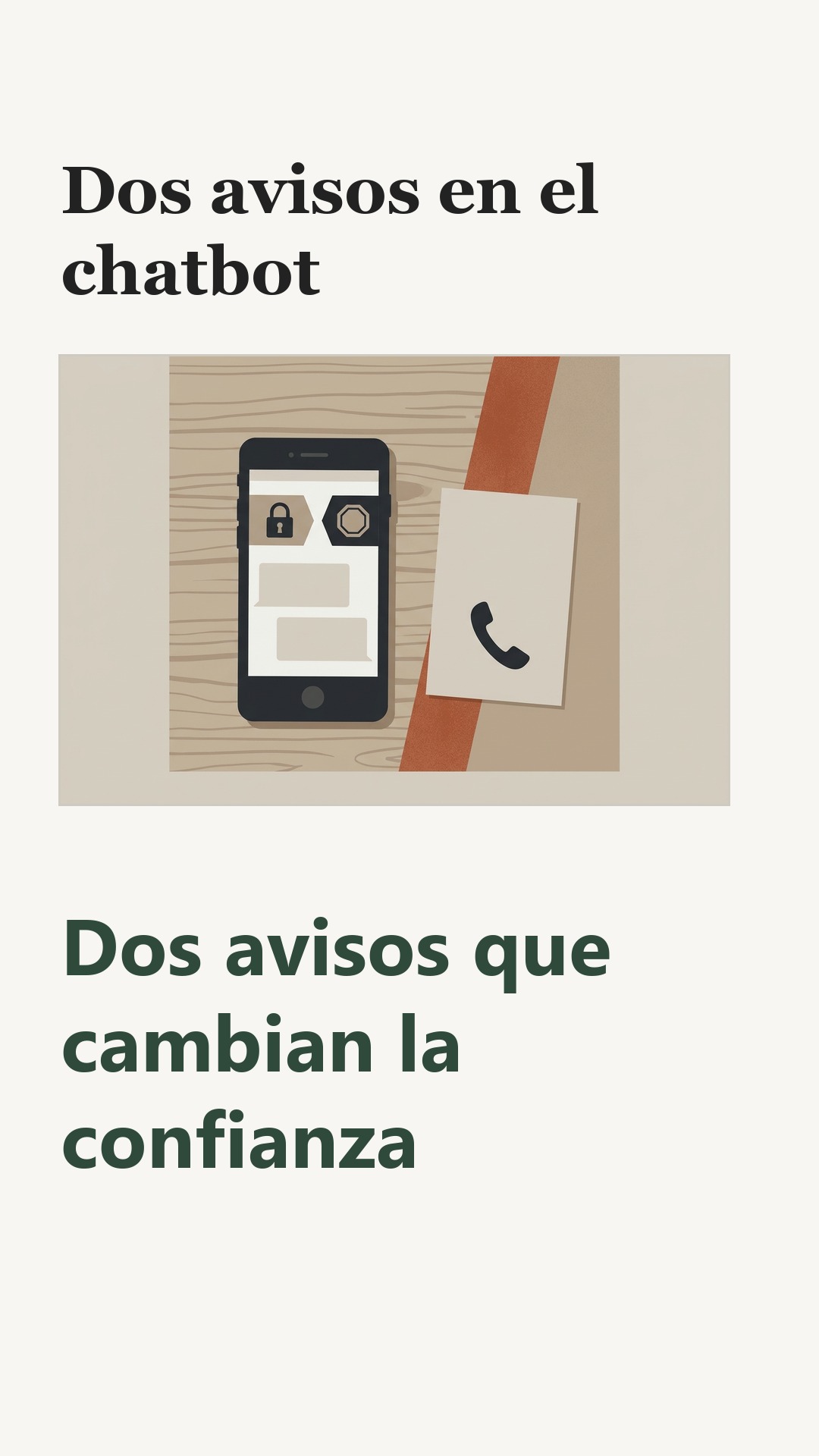
You open a chatbot to talk about a bad week, a bad night's sleep, a worry that will not leave. It answers at once, in a kind voice, and asks how you feel. Before you type anything personal, two short messages could be sitting at the top of that screen: one saying what happens to your words, one saying what this bot cannot do.
Researchers at universities in China tested whether such messages change how people size up a mental health chatbot. They recruited 768 college students online between March and April 2026 and randomly assigned each to one of four made-up chatbot introductions. Some students saw a privacy assurance. Some saw a warning that the bot cannot diagnose, treat or handle an emergency. Some saw both, some neither. Each group had 192 students.
Students who saw the privacy message felt surer their information was protected. Students who saw the boundary warning better understood the bot's limits. Those who saw the warning also said they were less likely to lean on the bot instead of real help, and more likely to intend to contact a counselor or a professional. Trust was highest when both messages appeared together, higher than with either one alone.
Here is where the study stops. Students read a written description and answered questions. They never talked to a working chatbot, and the study measured what they said they would do, not what they did. An intention to call a counselor is not a call. The 768 students were in one country, so whether these messages work for you may depend on your language and what services exist where you live.
The researchers do not present the messages as a reason to use chatbots more. They describe them as a way to help people treat a chatbot as a limited tool and to notice when real help is needed.
The next time a chatbot greets you, look for two plain statements: what it is not, and where your words go.
What this means for you
What the study can say is narrow: students who read those two messages judged a made-up chatbot more warily, with clearer limits in mind. Whether anyone behaves differently in a real conversation, or outside China, is untested. So the next time a chatbot greets you, look for what it says it is not, and where your words go.
Zhang, Z., Lu, X., Zhang, Y. et al. (2026). Privacy assurances and professional-boundary warnings in generative AI mental health chatbots: a randomized vignette experiment on calibrated trust, overreliance risk, and professional help-seeking intentions. Frontiers in Psychology. https://doi.org/10.3389/fpsyg.2026.1934264
Who paid: The authors declared that no financial support was received for this work or its publication, and they declared no commercial or financial relationships that could be a conflict of interest.
Do not take this as professional medical advice.
The longer versionThe passages copied from the paper, the pictures, and every source with how much of it we read · 1141 words · about 6 minRead it →Close
Two Short Messages Before You Type Can Change How Much You Trust a Chatbot
A randomized experiment with 768 college students tested privacy and boundary notices on a hypothetical mental health chatbot. What it measured was intention, not a single real conversation.
Picture a chatbot your university has just introduced. You type "I can't sleep and I'm stressed," and before you do, two lines sit at the top of the screen. One says your mental health information will be protected and handled clearly. The other says this bot cannot diagnose you, cannot treat you, and is no substitute for a counselor or emergency service. Would those two lines change how you judge the thing?
Zhang Zeyu and colleagues, writing in Frontiers in Psychology, tested exactly that. They recruited 768 college students in China and randomly assigned each to one of four written scenarios: no notices, privacy notice only, boundary warning only, or both. Each student read one scenario and then answered questions about it. The authors report no outside financial support, and they declared no competing interests.
The two messages did different jobs. The privacy notice raised how protected students felt their information would be, by a wide margin. The boundary warning raised their awareness of the chatbot's limits, also by a wide margin. Neither message moved the other's outcome: the privacy line did not make students more aware of limits, and the boundary line did not make them feel more protected.
Trust was highest when both lines appeared together. The authors call the target "calibrated trust": a balanced view in which the bot looks useful for small things and clearly unable to do clinical ones. Students who saw both messages also reported stronger intentions to use the bot safely and to seek professional help, and a lower risk of leaning on it when a person was needed. The authors put it plainly: the aim is not to make students trust chatbots more in general.
Now the limits, which are large. Nobody talked to a real chatbot. Students read a written scene and said what they thought and what they would do. A stated intention to call a counselor is not a call. The sample was college students in one country. Only two design features were tested, and the study offered no clinical care and tested no crisis response. Whether any of this holds during a real conversation, at two in the morning, remains unknown.
The pull toward these tools is easy to see. Students may hold back from telling peers, teachers or professionals about distress because of stigma, uncertainty, time or a lack of services, and a chatbot can feel available, non-judgmental and easy to approach1. A recent review of the research notes a growing number of people talking to AI chatbots about mental health, while knowledge of who does it and why stays thin; we could read only the summary, the full paper is behind a subscription2. In that survey's student sample, about 40 of every 100 students were eligible users3.
What they discuss is not exotic. The most common topics in that survey were personal and interpersonal problems, and the chatbots people used were mostly free general-purpose ones, picked for being always there; students also valued staying anonymous456. The study was small and early, and most of its respondents were women who had received or were receiving professional mental health support7. Its authors suggest that the relationship people feel with the bot may matter for continued use, and say that needs more study8.
Fluency is the reason a chatbot can feel like more than it is. Fluent text can raise how competent a system seems, while hiding uncertainty, invented information and the absence of anyone professionally accountable9. The line the authors draw is narrow: these tools can carry general information and point toward support, but they are not diagnostic, psychotherapeutic, crisis-intervention or medical decision-making tools10. The notices tested here are an attempt to say that out loud, at the door.
Others have tried measuring the risk from the inside. One team built simulated users with specific vulnerabilities, ran them through long conversations with several leading chatbots, and scored each exchange across 13 clinically grounded risk dimensions; we could read only the summary11. Across 810 conversations with 9 chatbots and 30 simulated profiles, concerning behavior was widespread, though reduced in newer models, and it grew over the course of a conversation1213. Risk ran highest when supportive-sounding replies reinforced the very pattern that made the simulated user vulnerable14. That is the trade-off in one line: warmth that soothes can also deepen the rut.
A third line of work asks what a chatbot actually does for a mind. Emerging evidence suggests generative systems may produce modest reductions in symptoms of depression and anxiety, according to a summary we could read15. But a change in symptoms alone does not explain the process, that paper argues, and chatbot exchanges may work mainly through mirroring and self-reflection rather than the back-and-forth that drives real therapeutic change1617. Its authors want a clear line drawn between tools that help regulate a moment and treatments that aim at lasting change18.
Here is how we read it. A short, polished disclaimer can do two opposite things at once: it can inform you, and it can lend the bot an air of responsible expertise that makes you trust it more than its limits deserve. The study cannot tell which happened in any one head. If people who see such a warning end up checking the bot's advice against a human source more often, our worry is misplaced; if they end up quoting it more confidently, it is not.
That is about carrying over to other settings, not about this experiment's result, and this experiment did not test it. It is a reason to watch the direction of the arrow in your own life rather than assume the notice points it the right way.
And keep one regular human contact for the things you would otherwise bring to a bot. Notice if that contact is quietly shrinking. The study offers no evidence that it will, and no evidence that it won't.
Two lines of text may be the cheapest safety feature a mental health chatbot can carry. The next test is a working interface, where a click toward a real counselor can be counted19. Until then, the honest summary is this: in a written scene, the notices worked on what students said they thought. What they do in a real conversation is still an open question, and the answer will come from watching behavior, not intentions.
So when a bot opens with reassurances and a disclaimer, ask what it actually did to earn your confidence. The words at the top of the screen are a start: what would you want it to show you before you typed the first sentence?
Where each piece of context comes from, and how much of it we read
- Zhang, Z., Lu, X., Zhang, Y. et al. (2026). Privacy assurances and professional-boundary warnings in generative AI mental health chatbots: a randomized vignette experiment on calibrated trust, overreliance risk, and professional help-seeking intentions. Frontiers in Psychology. https://doi.org/10.3389/fpsyg.2026.1934264 - the article this story is about — the whole article — the passage: "Students may hesitate to disclose distress to peers, teachers, or professionals because of stigma, uncertainty, time constraints, or lack of access to services. A chatbot can appear available, non-judgmental, and easy to approach."
- Bernaerts S, Buelens F, De Witte NAJ, Balaskas A, Colman T, Van Daele T. (2026). Exploring Real-World Use of AI Chatbots for Mental Health Support: Cross-Sectional Survey Study. JMIR Mental Health. 10.2196/104316 — only the abstract - the full text could not be fetched — the passage: "First studies indicate a growing prevalence of individuals talking to AI chatbots about mental health-related topics; yet, knowledge of how, why, and which individuals are using these AI chatbots for their mental health is limited."
- Bernaerts S, Buelens F, De Witte NAJ, Balaskas A, Colman T, Van Daele T. (2026). Exploring Real-World Use of AI Chatbots for Mental Health Support: Cross-Sectional Survey Study. JMIR Mental Health. 10.2196/104316 — only the abstract - the full text could not be fetched — the passage: "approximately 40% of the student sample were eligible users"
- Bernaerts S, Buelens F, De Witte NAJ, Balaskas A, Colman T, Van Daele T. (2026). Exploring Real-World Use of AI Chatbots for Mental Health Support: Cross-Sectional Survey Study. JMIR Mental Health. 10.2196/104316 — only the abstract - the full text could not be fetched — the passage: "The most common conversation topics across both samples focused on personal and interpersonal issues."
- Bernaerts S, Buelens F, De Witte NAJ, Balaskas A, Colman T, Van Daele T. (2026). Exploring Real-World Use of AI Chatbots for Mental Health Support: Cross-Sectional Survey Study. JMIR Mental Health. 10.2196/104316 — only the abstract - the full text could not be fetched — the passage: "Freely accessible AI chatbots, mainly ChatGPT, were the predominant choice in both samples and were mainly chosen for their constant availability and accessibility."
- Bernaerts S, Buelens F, De Witte NAJ, Balaskas A, Colman T, Van Daele T. (2026). Exploring Real-World Use of AI Chatbots for Mental Health Support: Cross-Sectional Survey Study. JMIR Mental Health. 10.2196/104316 — only the abstract - the full text could not be fetched — the passage: "Respondents in the student sample also preferred their anonymity, and those in the general sample also used them because they felt supported by them ."
- Bernaerts S, Buelens F, De Witte NAJ, Balaskas A, Colman T, Van Daele T. (2026). Exploring Real-World Use of AI Chatbots for Mental Health Support: Cross-Sectional Survey Study. JMIR Mental Health. 10.2196/104316 — only the abstract - the full text could not be fetched — the passage: "Most respondents in the present samples were women and indicated having received or receiving professional mental health support."
- Bernaerts S, Buelens F, De Witte NAJ, Balaskas A, Colman T, Van Daele T. (2026). Exploring Real-World Use of AI Chatbots for Mental Health Support: Cross-Sectional Survey Study. JMIR Mental Health. 10.2196/104316 — only the abstract - the full text could not be fetched — the passage: "The preliminary associations found between digital working alliance and engagement factors in the student sample and in the general sample suggest that relational factors might play a role in sustained AI chatbot use but warrant further investigation."
- Zhang, Z., Lu, X., Zhang, Y. et al. (2026). Privacy assurances and professional-boundary warnings in generative AI mental health chatbots: a randomized vignette experiment on calibrated trust, overreliance risk, and professional help-seeking intentions. Frontiers in Psychology. https://doi.org/10.3389/fpsyg.2026.1934264 - the article this story is about — the whole article — the passage: "Fluency may increase perceived competence, but it may also obscure uncertainty, hallucinated information, or the lack of professional accountability."
- Zhang, Z., Lu, X., Zhang, Y. et al. (2026). Privacy assurances and professional-boundary warnings in generative AI mental health chatbots: a randomized vignette experiment on calibrated trust, overreliance risk, and professional help-seeking intentions. Frontiers in Psychology. https://doi.org/10.3389/fpsyg.2026.1934264 - the article this story is about — the whole article — the passage: "AI chatbots may serve as sources of general information and support navigation, but they should not be treated as diagnostic, psychotherapeutic, crisis-intervention, or medical decision-making tools"
- Weilnhammer V, Hou KY, Luettgau L, Summerfield C, Dolan R, Nour MM. (2026). A clinically validated framework for auditing AI chatbot behavior in mental health interactions. Nature Medicine. 10.1038/s41591-026-04577-2 — only the abstract - the full text could not be fetched — the passage: "SIM-VAIL simulates users with specific psychiatric vulnerabilities and conversational intents, engages them in multi-turn conversations with frontier artificial intelligence chatbots (including Claude, ChatGPT, Gemini, Grok and Llama models) and scores each exchange across 13 clinically grounded risk dimensions."
- Weilnhammer V, Hou KY, Luettgau L, Summerfield C, Dolan R, Nour MM. (2026). A clinically validated framework for auditing AI chatbot behavior in mental health interactions. Nature Medicine. 10.1038/s41591-026-04577-2 — only the abstract - the full text could not be fetched — the passage: "Across 810 conversations, spanning 9 target chatbots and 30 simulated user profiles, concerning behavior in target chatbots was widespread, albeit reduced in newer models."
- Weilnhammer V, Hou KY, Luettgau L, Summerfield C, Dolan R, Nour MM. (2026). A clinically validated framework for auditing AI chatbot behavior in mental health interactions. Nature Medicine. 10.1038/s41591-026-04577-2 — only the abstract - the full text could not be fetched — the passage: "Concerning behavior varied by user vulnerability and conversational intent, accumulated over turns, and could be reduced by interventions at early escalation points."
- Weilnhammer V, Hou KY, Luettgau L, Summerfield C, Dolan R, Nour MM. (2026). A clinically validated framework for auditing AI chatbot behavior in mental health interactions. Nature Medicine. 10.1038/s41591-026-04577-2 — only the abstract - the full text could not be fetched — the passage: "Risk was highest when otherwise supportive chatbot behaviors reinforced the psychological mechanisms underlying the simulated user's vulnerability, a pattern we term a VAIL."
- Mahat-Shamir M, Payes M, Kagan M. (2026). Perceived Support Is Not Psychological Change: Reframing AI Chatbots in Mental Health Care. JMIR AI. 10.2196/94503 — only the abstract - the full text could not be fetched — the passage: "Emerging evidence suggests that generative systems may produce modest reductions in symptoms of depression and anxiety."
- Mahat-Shamir M, Payes M, Kagan M. (2026). Perceived Support Is Not Psychological Change: Reframing AI Chatbots in Mental Health Care. JMIR AI. 10.2196/94503 — only the abstract - the full text could not be fetched — the passage: "Yet a change in symptoms alone does not clarify the nature of the process involved."
- Mahat-Shamir M, Payes M, Kagan M. (2026). Perceived Support Is Not Psychological Change: Reframing AI Chatbots in Mental Health Care. JMIR AI. 10.2196/94503 — only the abstract - the full text could not be fetched — the passage: "This viewpoint argues that chatbot interactions may primarily operate through structured mirroring and self-reflection rather than through the intersubjective engagement that underpins therapeutic transformation."
- Mahat-Shamir M, Payes M, Kagan M. (2026). Perceived Support Is Not Psychological Change: Reframing AI Chatbots in Mental Health Care. JMIR AI. 10.2196/94503 — only the abstract - the full text could not be fetched — the passage: "We propose an implementation-focused distinction between tools that support symptom regulation and engagement and interventions that aim at enduring psychological change, emphasizing the need to specify mechanisms, relational conditions, and appropriate care pathways."
- Zhang, Z., Lu, X., Zhang, Y. et al. (2026). Privacy assurances and professional-boundary warnings in generative AI mental health chatbots: a randomized vignette experiment on calibrated trust, overreliance risk, and professional help-seeking intentions. Frontiers in Psychology. https://doi.org/10.3389/fpsyg.2026.1934264 - the article this story is about — the whole article — the passage: "Future work should test similar safety cues in functioning chatbot interfaces and examine behavioral outcomes such as click-through to help resources or actual referral use."
Zhang, Z., Lu, X., Zhang, Y. et al. (2026). Privacy assurances and professional-boundary warnings in generative AI mental health chatbots: a randomized vignette experiment on calibrated trust, overreliance risk, and professional help-seeking intentions. Frontiers in Psychology. https://doi.org/10.3389/fpsyg.2026.1934264
Who paid: The authors declared that no financial support was received for this work or its publication, and they declared no commercial or financial relationships that could be a conflict of interest.
Do not take this as professional medical advice.