experiment · Scientific reports · la publicación, 15 may 2026 · gratis
Un sistema para tomar asistencia con la cara alcanzó 97.8% de aciertos en pruebas; el salón donde se probó tenía 50 personas
Los investigadores lo diseñaron para que las fotos de los estudiantes no salgan de la escuela y para rechazar fotos y videos falsos. No es una ley ni un dictamen: no dice qué permite su país.
Versión breve · la versión detallada sigue, unos 8 min
Pregunte al chat de weeklyAI
Pregúnteme sobre la IA en su vida: le señalo las notas que weeklyAI ha publicado sobre el tema, esta semana y antes.
Las conversaciones se guardan mientras exista weeklyAI, para mejorar la publicación. Se responde en el idioma en que usted escribe.
- El estudio, de un vistazo
- Quiénes
- Un sistema de asistencia facial llamado LaED, probado por sus propios autores
- Cuántos
- 50 participantes
- Dónde
- Una sola escuela (los autores trabajan en Nigeria y Emiratos Árabes Unidos)
- Cuándo
- Publicado en 2026
- Tipo de estudio
- experiment
- Quién lo hizo
- Universidad de Abuya (Nigeria) y Universidad de Abu Dabi (Emiratos Árabes Unidos)
- El límite que importa
- El salón de prueba tuvo 50 personas de una sola escuela; los autores lo llaman prometedor, no concluyente.
Entrenamiento con los datos repartidos entre escuelas frente al entrenamiento con todos los datos en un solo lugar
El primero llegó a 97.0% de aciertos tras 20 rondas, apenas 0.5% por debajo del segundo
Cuando su escuela anuncie un sistema de asistencia con cámaras, pida ver quién lo autorizó, cuántos estudiantes se usaron para probarlo y si algún auditor externo revisó su trato de las caras.
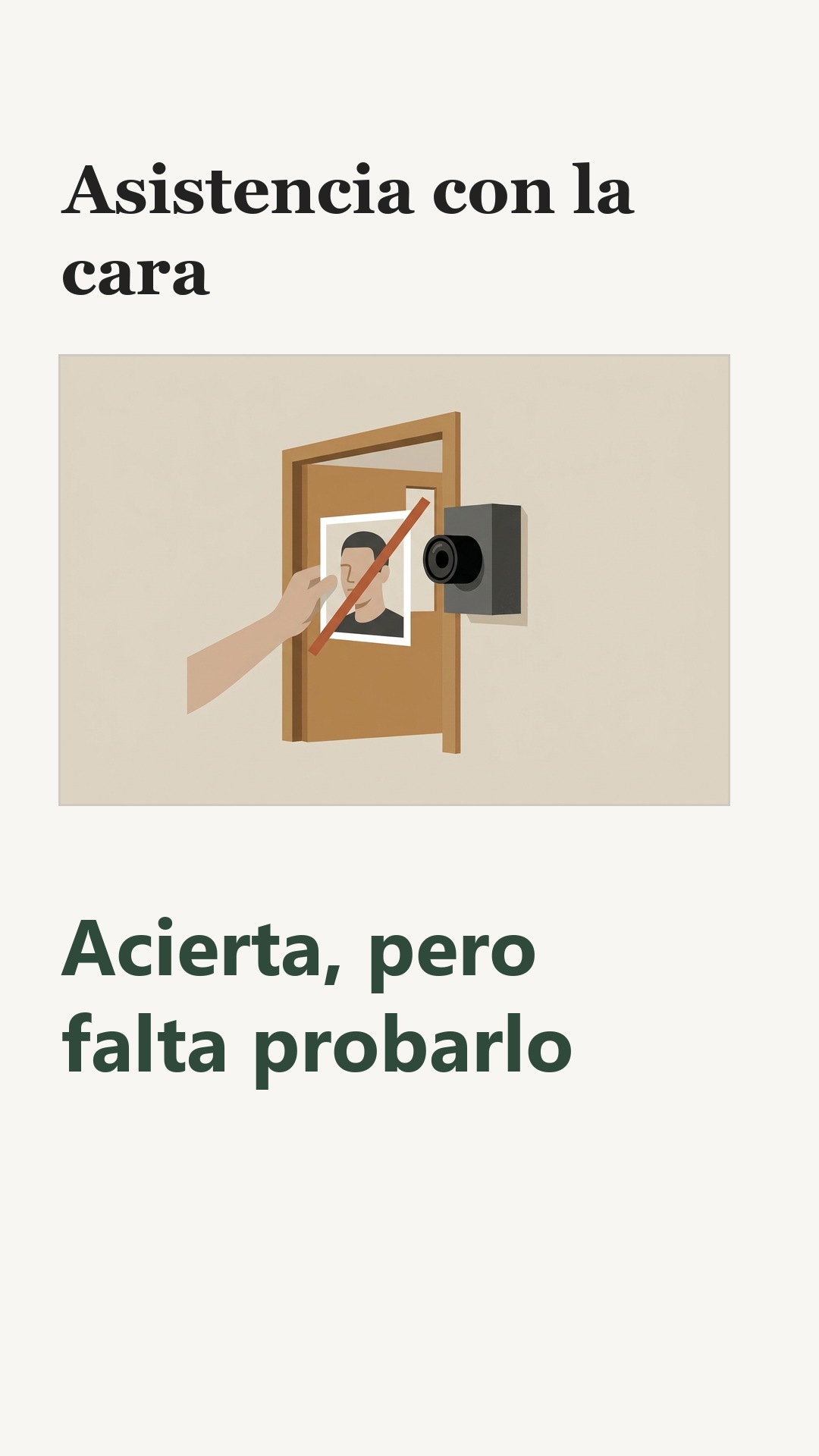
Imagine un salón con una cámara junto a la puerta. Cada estudiante entra y el sistema anota su nombre sin que nadie pase lista. Detrás de esa idea hay un problema: la cara de un menor es un dato sensible, y alguien podría engañar al sistema con la foto de un compañero o con un video.
Un grupo de investigadores construyó un programa llamado LaED para ese trabajo. Según el estudio, el programa analiza señales del rostro, como los cambios de color de la piel por el pulso, y no solo la imagen. Así distingue a una persona presente de una foto impresa, una pantalla que reproduce un video o un rostro hecho con inteligencia artificial. Las fotos de los estudiantes se procesan en el aparato de la escuela. Lo que se comparte entre escuelas son ajustes del programa, no las caras.
En pruebas con bases de datos públicas y con un salón real, el sistema acertó el 97.8% de las veces y mantuvo por debajo del 2% los errores al dejar pasar un engaño o al rechazar a un estudiante real. La diferencia de acierto entre grupos de sexo, edad y tono de piel fue de 1.8 puntos. En una computadora pequeña, respondió en 40 milisegundos, y en una aún más limitada tardó 67 milisegundos.
El salón donde se probó tenía 50 personas de una sola escuela. Con esa cantidad, los resultados de equidad no se pueden dar por ciertos para los estudiantes de otra escuela. El artículo tampoco informa de ninguna revisión independiente ni de la aprobación de una autoridad.
Los autores describen funciones de consentimiento y de registro de cada decisión, y presentan una tabla que relaciona esas funciones con leyes como el reglamento europeo de datos y la ley estadounidense de expedientes educativos. Esa tabla la escribieron ellos. Ninguna autoridad ha certificado que el sistema cumpla esas normas en la práctica.
Falta lo principal para una familia: qué exige su propio país. Este trabajo es una evaluación técnica. No es una ley, no es una sentencia y no dice qué puede exigir usted a una escuela que instale cámaras así.
Cuando su escuela anuncie un sistema de asistencia con cámaras, pida ver quién lo autorizó, cuántos estudiantes se usaron para probarlo y si algún auditor externo revisó su trato de las caras.
Qué significa para usted
Cuando su escuela o su trabajo anuncien un sistema así, pregunte quién lo autorizó, cuántas personas se usaron para probarlo y si alguien de fuera revisó cómo trata las caras. Las cifras del estudio valen para esos salones y esos aparatos, y ninguna autoridad ha confirmado que cumpla la ley de su país.
Abiodun, E. O., Abiodun, O. I., Alawida, M. et al. (2026). LaED: a novel lightweight, edge-aware and explainable deep learning model for privacy-preserving facial attendance tracking in resource-constrained educational environments. Scientific Reports. https://doi.org/10.1038/s41598-026-42051-8
Quién pagó: El estudio fue financiado en su totalidad por la Universidad de Abu Dabi con las subvenciones n.º 1930063 y 19300887; el artículo no indica si los financiadores tuvieron algún papel en el diseño, análisis o publicación.
Versión detalladaLos pasajes copiados del artículo, las ilustraciones y cada fuente con cuánto leímos de ella · 1601 palabras · unos 8 minLeerla →Cerrar
Una escuela puede tomar asistencia con la cara de su hijo sin mandar la foto a ningún lado. Así funciona el sistema que probaron.
Un grupo de cinco investigadores con afiliaciones en Nigeria y en los Emiratos Árabes Unidos publicó el diseño y las pruebas de un sistema que reconoce caras para pasar lista, con datos de varias bases públicas y un salón propio de 50 participantes en 12 sesiones. Los resultados son buenos en el laboratorio. El artículo no dice si alguna escuela lo usa, si alguien lo auditó por fuera o si alguna autoridad lo aprobó.
Un grupo de cinco investigadores de Nigeria y Emiratos Ángeles Unidos publicó en *Scientific Reports* el diseño y las pruebas de LaED, un sistema para tomar asistencia en salones de clase usando la cara de los alumnos. La prueba se hizo con datos de varias bases públicas y con un salón propio de 50 participantes en 12 sesiones. Los autores reportan una precisión en el reconocimiento por encima del 97.8%, errores de falsa aceptación y falsa rechazo por debajo del 2%, y diferencias de desempeño entre grupos demográficos por debajo del 2%. Todo eso lo midieron ellos, con sus propios datos y sus propios criterios.
El sistema tiene tres capas. La primera revisa la imagen: busca señales de que la cara es de una persona viva y no una foto impresa, un video repetido o una cara generada por computadora12. La segunda compara la cara con las caras registradas y, si no hay coincidencia suficiente, la rechaza en lugar de forzar una identificación. La tercera guarda cada decisión en un registro que no se puede alterar sin que se note, y maneja los permisos de cada alumno34.
Lo que hace distinto a este sistema es dónde ocurre el trabajo. En vez de mandar las fotos a un servidor central, el modelo se entrena en el mismo aparato de la escuela y solo comparte los ajustes matemáticos, no las caras5. A esos ajustes se les añade ruido antes de enviarlos, para que nadie pueda reconstruir un rostro a partir de ellos5. Los autores probaron el sistema en una computadora pequeña de placa (Jetson Nano) y en una Raspberry Pi 4, y reportan 26 cuadros por segundo con 4 watts de consumo en la Jetson6.
Piense en el salón de su hijo. Hoy la lista se pasa a mano, con nombre y apellido, y el error se corrige con una firma. Con un sistema como este, la lista se pasa sola y el error se corrige… ¿cómo? Los autores describen un registro verificable de cada decisión, con sello de tiempo y nivel de confianza, que una persona autorizada puede revisar después3. También describen un módulo de consentimiento que guarda quién autorizó qué y borra los datos biométricos cuando vence el plazo4. Eso es lo que el sistema *permite*. Lo que no está en el artículo es si alguna escuela lo usa, si alguien lo auditó por fuera o si alguna autoridad lo aprobó.
El problema que este sistema intenta resolver no es imaginario. Los propios autores citan dos casos: la recolección no autorizada de datos biométricos asociada con Microsoft Teams en Nueva Gales del Sur en 2025, y una acción regulatoria contra la escuela Chelmer Valley High School en el Reino Unido7. Los autores dicen que estos casos muestran cómo sistemas mal gobernados pueden violar derechos de estudiantes e incumplir las normas. Los autores lo dicen con claridad: los usuarios suelen ser menores de edad, las reglas son estrictas y la capacidad de las instituciones para vigilar puede ser limitada8.
Aquí está el límite que el lector debe tener presente. El salón propio del estudio tuvo 50 participantes de una sola escuela, y los autores reconocen que ese grupo no captura la diversidad demográfica, cultural ni de infraestructura de otros entornos educativos9. La robustez que muestran los resultados, escriben, "debe considerarse prometedora más que concluyente"10. La mejora en equidad entre grupos también queda limitada por el tamaño de la muestra: hacen falta muestras demográficas más amplias para validarla a largo plazo11.
Los propios autores piden lo que falta: estudios en varias escuelas, con distintas condiciones de luz, colocación de cámaras, composición demográfica y políticas de asistencia12. Y advierten algo que ningún sistema técnico resuelve solo: las salvaguardas técnicas no compensan una gobernanza institucional débil; las escuelas con poca alfabetización digital o prácticas de aplicación inconsistentes pueden tener problemas para mantener control de acceso, manejo de incidentes y comunicación con los padres13.
Conviene ver lo que otros documentos dicen sobre la gobernanza escolar de la inteligencia artificial. Un estudio sobre el Distrito Escolar de Chicago encontró que el distrito articuló una guía flexible, con supervisión humana, responsabilidad de proveedores y prohibiciones de usos de alto riesgo, pero también una brecha entre lo que se escribe y lo que se vigila: los compromisos están detallados, mientras que el monitoreo, la aplicación y los apoyos diferenciados están menos documentados14. Ese estudio solo pudimos leerlo en su resumen; el texto completo está detrás de una suscripción. Y añade algo que aplica aquí: la gobernanza de la IA debería juzgarse por la capacidad institucional, no por la sofisticación de la política escrita15.
Hay otra advertencia que viene de la investigación sobre integridad académica. Un análisis del discurso de políticas internacionales encontró que conceptos como responsabilidad, transparencia y confianza funcionan como significantes flotantes: dan coherencia normativa pero quedan operativamente indefinidos en cada institución1617. Es decir, una escuela puede decir "usamos IA de forma responsable" y no significar nada verificable con eso. También pudimos leer solo el resumen de ese trabajo.
Sobre la protección de datos de estudiantes, el artículo menciona dos marcos: el Reglamento General de Protección de Datos de Europa y la ley FERPA de Estados Unidos, que imponen requisitos estrictos sobre el manejo de datos escolares, y señala que el cumplimiento no es opcional: las instituciones que no cumplen se arriesgan a sanciones legales y daño reputacional18. Los autores incluyen una tabla que relaciona cada obligación legal con una función del sistema. Esa tabla es una interpretación de los autores, no un dictamen de ninguna autoridad.
¿Y en México, en Colombia, en Chile, en Texas o en Ontario? El artículo no evalúa el sistema en ninguno de esos lugares. No dice si cumple con la Ley Federal de Protección de Datos Personales en Posesión de los Particulares de México, ni con la Ley de Protección de Datos Personales de Argentina, ni con la ley de privacidad de menores de California. No lo puede decir, porque no lo estudió. Lo que sí ofrece es una lista de lo que una escuela *debería* poder responder si adopta algo así: qué datos guarda, dónde, por cuánto tiempo, con qué permiso y cómo se borran.
Así lo leemos nosotros. El patrón que se repite en la tecnología escolar es este: llega un aparato que promete eficiencia, la escuela lo compra, y nadie pregunta quién responde cuando el aparato se equivoca. Con la asistencia facial, el error tiene nombre y apellido: un alumno marcado ausente sin estarlo, o un alumno que no puede entrar porque el sistema no lo reconoce. En los sistemas de este tipo, el riesgo conocido es el de siempre: la herramienta se presenta como objetiva, y cuando su funcionamiento interno no se puede examinar, quien resulta afectado no tiene forma de discutir el resultado. No decimos que este sistema tenga ese problema; decimos que el lector debe poder comprobarlo antes de que su escuela lo adopte.
Lo que esperamos, si esto llega a un salón sin consulta previa, es que las familias lo acepten como un requisito más y no pregunten quién guarda las imágenes, cuánto tiempo las conservan ni cómo se borran, aunque el sistema técnicamente permita hacerlo. Sabríamos que nos equivocamos si las familias y el personal docente piden por escrito el consentimiento, el plazo de conservación y el procedimiento de borrado antes de que el sistema empiece a funcionar, y si la escuela responde con documentos y no con negativas. También esperamos que nadie en la institución se sienta responsable de un alumno marcado como ausente por error: la escuela culpará al software, el proveedor a la escuela y la autoridad educativa a ambos. Eso se desmiente fácil: basta con que el contrato o el reglamento escolar nombre a una persona o cargo responsable de revisar y corregir las decisiones del sistema, con un plazo y un procedimiento escritos.
Aquí está lo que usted puede hacer con esto, y es lo más útil que le vamos a decir. Antes de que su escuela adopte reconocimiento facial para cualquier cosa, pida por escrito qué datos se guardan, dónde, por cuánto tiempo y cómo se eliminan. Guarde copia de la respuesta. Si la escuela no contesta, eso mismo es información: plantéelo ante la autoridad educativa o de protección de datos de su país. Pregunte también si existe un registro auditable de cada marcación y quién puede revisarlo. Si le dicen que el sistema "simplemente funciona", pida que le expliquen cómo se corrige un error y ante quién se reclama. Y pida que le digan, por escrito, quién responde si el sistema se equivoca con su hijo.
Ninguna de estas preguntas requiere saber de computación. Requieren saber que se pueden hacer. Y ahí está la diferencia entre un sistema que protege y un sistema que solo promete proteger.
La lista de asistencia que hoy se firma a mano puede mañana generarse sola, con un registro que nadie revisó y un permiso que nadie pidió. ¿Quién, en la escuela de su hijo, tiene hoy la obligación de contestarle si eso pasa?
De dónde sale cada dato de contexto, y cuánto leímos de cada documento
- Abiodun, E. O., Abiodun, O. I., Alawida, M. et al. (2026). LaED: a novel lightweight, edge-aware and explainable deep learning model for privacy-preserving facial attendance tracking in resource-constrained educational environments. Scientific Reports. https://doi.org/10.1038/s41598-026-42051-8 - el artículo del que trata esta nota — el artículo completo — el pasaje: "LaED is organized as a three-layer architecture consisting of a Perception Layer, an Identity Layer, and a Trust Layer. Each layer performs a distinct functional role in the attendance pipeline, and together they form an edge-deployable system suitable for classroom environments."
- Abiodun, E. O., Abiodun, O. I., Alawida, M. et al. (2026). LaED: a novel lightweight, edge-aware and explainable deep learning model for privacy-preserving facial attendance tracking in resource-constrained educational environments. Scientific Reports. https://doi.org/10.1038/s41598-026-42051-8 - el artículo del que trata esta nota — el artículo completo — el pasaje: "Remote photoplethysmography (rPPG) is applied to extract subtle skin color variations associated with blood flow. These physiological signals are computed in parallel with face detection and are used to distinguish live subjects from static images, replayed videos, or synthetically generated faces."
- Abiodun, E. O., Abiodun, O. I., Alawida, M. et al. (2026). LaED: a novel lightweight, edge-aware and explainable deep learning model for privacy-preserving facial attendance tracking in resource-constrained educational environments. Scientific Reports. https://doi.org/10.1038/s41598-026-42051-8 - el artículo del que trata esta nota — el artículo completo — el pasaje: "Each attendance decision is recorded in a tamper-evident audit log constructed using cryptographic hash chaining. These logs enable post hoc verification of attendance records by authorized parties."
- Abiodun, E. O., Abiodun, O. I., Alawida, M. et al. (2026). LaED: a novel lightweight, edge-aware and explainable deep learning model for privacy-preserving facial attendance tracking in resource-constrained educational environments. Scientific Reports. https://doi.org/10.1038/s41598-026-42051-8 - el artículo del que trata esta nota — el artículo completo — el pasaje: "The Trust Layer maintains consent records, enforces data retention policies, and supports automated deletion of expired biometric data. These mechanisms regulate access to attendance records in accordance with applicable data protection requirements."
- Abiodun, E. O., Abiodun, O. I., Alawida, M. et al. (2026). LaED: a novel lightweight, edge-aware and explainable deep learning model for privacy-preserving facial attendance tracking in resource-constrained educational environments. Scientific Reports. https://doi.org/10.1038/s41598-026-42051-8 - el artículo del que trata esta nota — el artículo completo — el pasaje: "Model updates are trained locally on edge devices and aggregated using a federated learning protocol. Differential privacy noise is applied to model updates prior to aggregation, limiting the risk of reconstructing biometric information from transmitted parameters."
- Abiodun, E. O., Abiodun, O. I., Alawida, M. et al. (2026). LaED: a novel lightweight, edge-aware and explainable deep learning model for privacy-preserving facial attendance tracking in resource-constrained educational environments. Scientific Reports. https://doi.org/10.1038/s41598-026-42051-8 - el artículo del que trata esta nota — el artículo completo — el pasaje: "LaED achieved 26 FPS at 4 W on Jetson Nano, striking the best balance of throughput and efficiency. Raspberry Pi offered lower performance, while laptop-based deployments consumed significantly more energy."
- Abiodun, E. O., Abiodun, O. I., Alawida, M. et al. (2026). LaED: a novel lightweight, edge-aware and explainable deep learning model for privacy-preserving facial attendance tracking in resource-constrained educational environments. Scientific Reports. https://doi.org/10.1038/s41598-026-42051-8 - el artículo del que trata esta nota — el artículo completo — el pasaje: "Recent incidents, including unauthorized biometric data collection associated with Microsoft Teams in New South Wales in 2025 and regulatory action against Chelmer Valley High School in the United Kingdom, demonstrate how poorly governed systems can violate student rights and fail to meet regulatory compliance."
- Abiodun, E. O., Abiodun, O. I., Alawida, M. et al. (2026). LaED: a novel lightweight, edge-aware and explainable deep learning model for privacy-preserving facial attendance tracking in resource-constrained educational environments. Scientific Reports. https://doi.org/10.1038/s41598-026-42051-8 - el artículo del que trata esta nota — el artículo completo — el pasaje: "These cases highlight the sensitivity of biometric technologies in educational environments, where users are often minors, regulatory requirements are stringent, and institutional capacity for oversight may be limited."
- Abiodun, E. O., Abiodun, O. I., Alawida, M. et al. (2026). LaED: a novel lightweight, edge-aware and explainable deep learning model for privacy-preserving facial attendance tracking in resource-constrained educational environments. Scientific Reports. https://doi.org/10.1038/s41598-026-42051-8 - el artículo del que trata esta nota — el artículo completo — el pasaje: "The dataset includes 50 participants from a single school and does not capture the demographic, cultural or infrastructural diversity present across broader educational environments."
- Abiodun, E. O., Abiodun, O. I., Alawida, M. et al. (2026). LaED: a novel lightweight, edge-aware and explainable deep learning model for privacy-preserving facial attendance tracking in resource-constrained educational environments. Scientific Reports. https://doi.org/10.1038/s41598-026-42051-8 - el artículo del que trata esta nota — el artículo completo — el pasaje: "As a result, the robustness demonstrated here should be regarded as promising rather than conclusive."
- Abiodun, E. O., Abiodun, O. I., Alawida, M. et al. (2026). LaED: a novel lightweight, edge-aware and explainable deep learning model for privacy-preserving facial attendance tracking in resource-constrained educational environments. Scientific Reports. https://doi.org/10.1038/s41598-026-42051-8 - el artículo del que trata esta nota — el artículo completo — el pasaje: "While the fairness improved significantly, the small classroom dataset limits generalizability. Broader demographic samples are needed for long-term validation"
- Abiodun, E. O., Abiodun, O. I., Alawida, M. et al. (2026). LaED: a novel lightweight, edge-aware and explainable deep learning model for privacy-preserving facial attendance tracking in resource-constrained educational environments. Scientific Reports. https://doi.org/10.1038/s41598-026-42051-8 - el artículo del que trata esta nota — el artículo completo — el pasaje: "Future work will include multi-site studies involving classrooms with varied lighting conditions, camera placements, demographic composition, and attendance policies."
- Abiodun, E. O., Abiodun, O. I., Alawida, M. et al. (2026). LaED: a novel lightweight, edge-aware and explainable deep learning model for privacy-preserving facial attendance tracking in resource-constrained educational environments. Scientific Reports. https://doi.org/10.1038/s41598-026-42051-8 - el artículo del que trata esta nota — el artículo completo — el pasaje: "Even so, technical safeguards cannot fully compensate for weak institutional governance. Schools with limited digital literacy or inconsistent enforcement practices may struggle to maintain robust access control, incident handling and parental communication procedures."
- Wu E, Rodriguez L. (2026). From Articulation to Enforcement: District Governance of Generative AI Under Policy Ambiguity in Chicago Public Schools. Educational Policy. https://doi.org/10.1177/08959048261500084 — solo el resumen - no se pudo obtener el texto completo — el pasaje: "CPS articulated flexible guidance, human oversight, vendor accountability, and prohibitions on high-risk uses, alongside an articulation-enforcement gap: commitments are detailed, but monitoring, enforcement, and differentiated supports are less documented."
- Wu E, Rodriguez L. (2026). From Articulation to Enforcement: District Governance of Generative AI Under Policy Ambiguity in Chicago Public Schools. Educational Policy. https://doi.org/10.1177/08959048261500084 — solo el resumen - no se pudo obtener el texto completo — el pasaje: "It reframes policy ambiguity as a condition for governance articulation, distinguishes equity as harm prevention from capacity distribution, and concludes that AI governance should be judged by institutional capacity, not policy sophistication."
- Hashem R. (2026). Cheating or being cheated? Academic integrity and a changing cheating habitus in international AI governance discourse. Frontiers in Education. https://doi.org/10.3389/feduc.2026.1953305 — solo el resumen - no se pudo obtener el texto completo — el pasaje: "The findings suggest that responsibility, transparency, trust, authenticity and responsible use act as floating signifiers."
- Hashem R. (2026). Cheating or being cheated? Academic integrity and a changing cheating habitus in international AI governance discourse. Frontiers in Education. https://doi.org/10.3389/feduc.2026.1953305 — solo el resumen - no se pudo obtener el texto completo — el pasaje: "They provide normative coherence but remain operationally underdefined across institutional contexts."
- Abiodun, E. O., Abiodun, O. I., Alawida, M. et al. (2026). LaED: a novel lightweight, edge-aware and explainable deep learning model for privacy-preserving facial attendance tracking in resource-constrained educational environments. Scientific Reports. https://doi.org/10.1038/s41598-026-42051-8 - el artículo del que trata esta nota — el artículo completo — el pasaje: "Regulatory frameworks such as the General Data Protection Regulation in Europe and the Family Educational Rights and Privacy Act in the United States impose strict requirements on the handling of student data. Compliance with these regulations is not optional; institutions that fail to meet standards risk legal penalties and reputational harm."
Abiodun, E. O., Abiodun, O. I., Alawida, M. et al. (2026). LaED: a novel lightweight, edge-aware and explainable deep learning model for privacy-preserving facial attendance tracking in resource-constrained educational environments. Scientific Reports. https://doi.org/10.1038/s41598-026-42051-8
Quién pagó: El estudio fue financiado en su totalidad por la Universidad de Abu Dabi con las subvenciones n.º 1930063 y 19300887; el artículo no indica si los financiadores tuvieron algún papel en el diseño, análisis o publicación.
experiment · Scientific reports · the paper, 15 May 2026 · free
A Face System Built to Keep Student Data in School. Its Fairness Was Tested on 50 Students.
Researchers report high accuracy and a fairness gap under 2 percent in their tests, but the classroom data came from one unnamed school, so nothing is known about how it would treat students elsewhere.
Short version · the longer version follows, about 7 min
Ask the weeklyAI chat
Ask me about AI in your life: I point you to the stories weeklyAI has published on it, this week and before.
Conversations are saved for as long as weeklyAI exists, to improve the publication. Answers come in the language you write in.
- The study at a glance
- Who
- Students in a classroom face-attendance test, plus public face datasets
- How many
- 50 participants
- Where
- One unnamed school (authors in Nigeria and the United Arab Emirates)
- When
- Published 16 May 2026
- Kind of study
- experiment
- Who did it
- University of Abuja, Abu Dhabi University and Al Ain University
- The limit that matters
- Classroom data came from one school with 50 people, so fairness elsewhere is untested
Training that keeps faces on the school device versus training on one central copy
Reached 97.0% accuracy after 20 rounds, just 0.5% lower
When a school near you announces facial attendance, look for the approval it needed from your country's data authority, and ask to see any independent audit of how the system performs across its own students, not the vendor's.
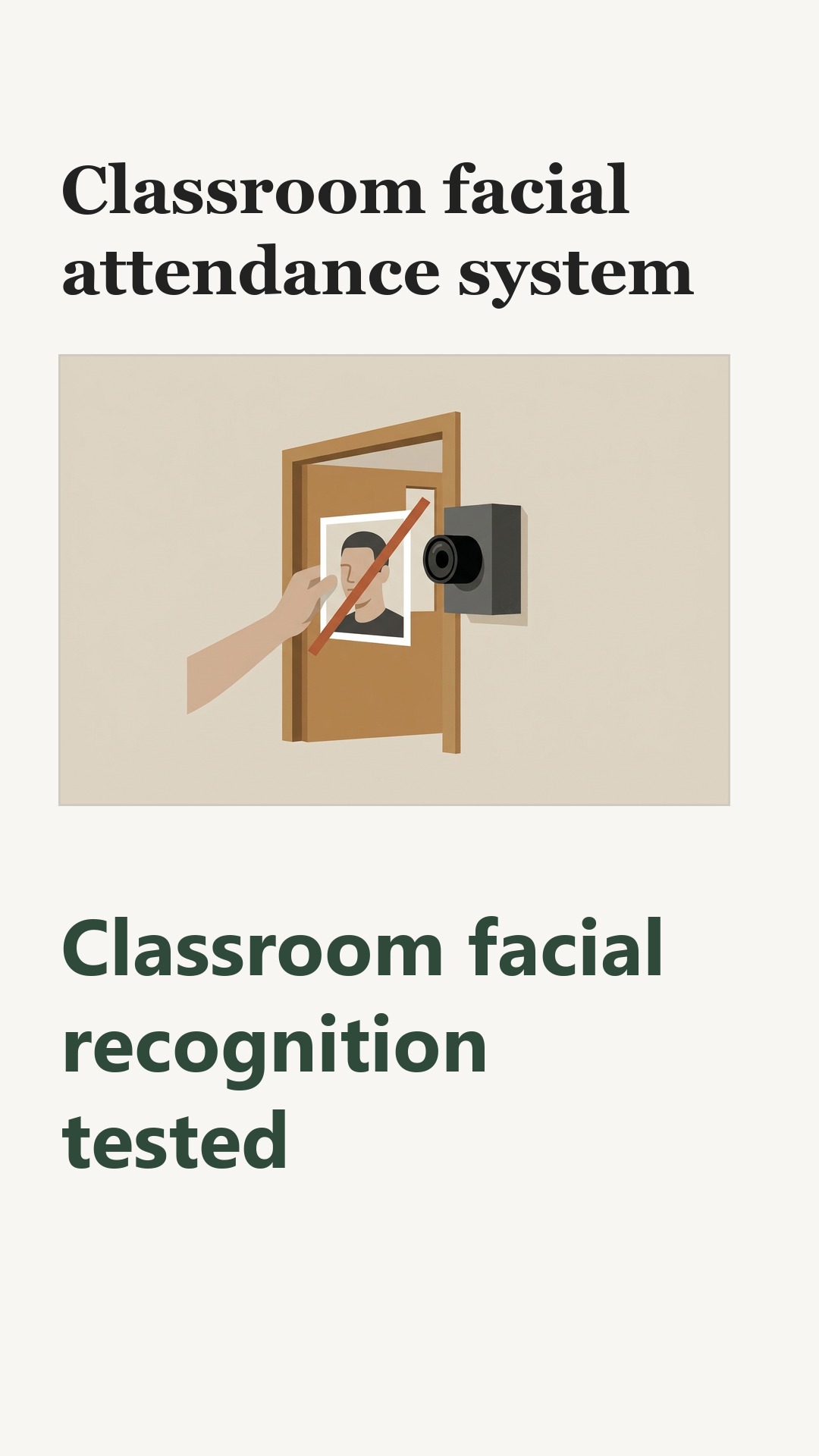
Picture a camera at the classroom door that takes attendance by itself. Your child walks in, the camera reads the face, and a name is marked present. That is what schools can now buy, and a group of researchers has published a design for one they say is built to protect students.
The system is called LaED. Researchers at the University of Abuja in Nigeria, Abu Dhabi University and Al Ain University wrote the paper describing it. The researchers tested it on cheap devices of the kind a school could own, such as a Raspberry Pi 4 or a Jetson Nano. The face images stay on that device. The school's device trains the program and shares only the numerical adjustments with a central server, with added noise that limits the risk of rebuilding a face from them.
The program also checks whether a live person is in front of the camera. It looks for tiny shifts in skin color caused by blood flow, and for signs of a replayed video or a computer-generated face. A printed photo or a phone screen showing a classmate's video should fail that check.
In tests on public face and spoofing datasets, the researchers report 97.8 percent recognition accuracy and error rates under 2 percent for detecting fake faces. Across skin tone, gender and age groups in a public fairness dataset, the widest gap between groups was 1.8 percentage points. On the Jetson Nano device, it answered in about 44 milliseconds.
The classroom test is the part to weigh. It came from one school, identified only as an in-house dataset, with 50 people across 12 sessions. Whether the fairness numbers hold for the students at your school, with different faces, lighting and cameras, the study cannot say.
What the study does not do is tell anyone what the law allows. It is a technical report, not a law, a regulator's decision or a court ruling. The authors map their features onto European and United States student-privacy rules on paper, and they say the system keeps consent records and tamper-evident logs. No independent auditor or regulator has checked those claims.
When a school near you announces facial attendance, look for the approval it needed from your country's data authority, and ask to see any independent audit of how the system performs across its own students, not the vendor's.
What this means for you
One thing to hold onto: these results describe one unnamed school with 50 people and a set of public test images, so they say nothing yet about the faces, cameras or lighting at your child's school. When a school near you announces a face-based attendance system, the useful questions are about who approved it and whether anyone outside the vendor has checked how it performs across its own students.
Abiodun, E. O., Abiodun, O. I., Alawida, M. et al. (2026). LaED: a novel lightweight, edge-aware and explainable deep learning model for privacy-preserving facial attendance tracking in resource-constrained educational environments. Scientific Reports. https://doi.org/10.1038/s41598-026-42051-8
Who paid: The study was fully supported by Abu Dhabi University under Grant No 1930063 and 19300887; the article does not state whether the funders had any role in the design, analysis, or reporting.
The longer versionThe passages copied from the paper, the pictures, and every source with how much of it we read · 1368 words · about 7 minRead it →Close
A Face-Scanning Attendance System Built to Keep Student Faces on the School's Own Device
Researchers in Nigeria and the United Arab Emirates tested a classroom attendance system on public face datasets and on 50 students at one unnamed school. It is a technical result, not a law.
Consider the morning roll call. A camera at the classroom door, a student's face, a name marked present. The paper version costs a minute of class time. The camera version costs something else: a biometric record of a child's face, held somewhere, used for something.
A team of five researchers — Abiodun Esther Omolara, Abiodun Oludare Isaac, Alawida Moatsum, Shawar Bayan Abu and Mehmood Abid — has published, in Scientific Reports, a design for a face-based attendance system they call LaED. The work was paid for by Abu Dhabi University under two grants. The authors declare no competing interests. The paper was published on 16 May 2026.
What they built is less a camera than a pipeline with three stages. The first stage checks whether the thing in front of the lens is a living person: it looks for the faint colour changes in skin that follow a heartbeat, and it looks for the small temporal and texture flaws that betray a replayed video or a synthetic face. The second stage recognises the student, using a compact vision model, and is built to say "unknown" rather than force a match when the face does not fit. The third stage handles the record: training happens on the school's own device, only mathematical updates travel to a central server with noise added to them, and every attendance decision is written into a log that is hard to alter after the fact.
The heartbeat check is the part worth pausing on. Remote photoplethysmography — the technique the authors use — reads the subtle skin-colour variation that blood flow produces, computed in parallel with face detection, and uses it to separate a live person from a still image, a replayed video or a generated face1. A printed photograph has no pulse. A silicone mask has no pulse. A deepfake has no pulse. That is the logic, and it is why the authors report their strongest margins against printed photos and replayed video.
The numbers come from public face datasets — CASIA-FASD, CelebA-Spoof, DFDC, FairFace — plus a classroom dataset gathered with consent, and 10,000 synthetic faces generated to balance demographic groups. On those, the authors report recognition accuracy above 97.8%, attack and bona-fide error rates below 2%, demographic fairness gaps under 2%, and inference under 150 milliseconds on edge hardware2. On a Jetson Nano the system ran at 26 frames per second drawing 4 watts3. Federated training — the version where data stays local — reached 97.0% after 20 rounds, just 0.5% lower than the centralised version4.
Now the limits, which the authors state themselves. The classroom dataset had 50 participants from a single school and does not capture the demographic, cultural or infrastructural diversity of broader education5. The authors call their robustness result "promising rather than conclusive"6, and say broader demographic samples are needed before the fairness findings can be relied on7. Six teachers and administrators rated the system's explanations; that is a formative check, not evidence of acceptance at scale. The adversarial tests were preliminary and left out attacks a real school could face — stickers, special glasses, infrared light. The federated training was tested across five classroom nodes. The authors say the system's rejection of unknown faces is meant to reduce proxy attendance, though they do not report attendance outcomes from a real school.
Why does any of this matter to a family? Because schools have already stumbled here. The authors open by citing two cases: unauthorised biometric data collection tied to Microsoft Teams in New South Wales in 2025, and regulatory action against Chelmer Valley High School in the United Kingdom8. They note what those cases have in common — the users are often minors, the rules are strict, and the institution's capacity to oversee the system may be thin9. A school is not a data company. It has a head teacher, a bursar and an IT contractor.
The law, meanwhile, does not wait for the technology to mature. Europe's General Data Protection Regulation and America's Family Educational Rights and Privacy Act impose strict requirements on student data, and the authors are blunt that compliance is not optional: institutions that fail risk legal penalties and reputational harm10. The paper includes a table mapping its features to those obligations — data minimisation, the right to erasure, records of processing. Read that table as the authors' own argument, not as a regulator's ruling. No independent audit or approval is reported.
The design choices themselves are worth understanding, because they are the kind of thing a parent can ask about. Federated learning means the model trains where the data lives and only updates travel11. Noise added to those updates makes it harder to reconstruct a face from them11. Consent records, retention rules and automatic deletion of expired biometric data sit in the same layer12. Each attendance decision goes into a hash-chained log that authorised parties can later verify13. Taken together, the system is an argument that privacy can be built in rather than bolted on.
There is a wider pattern in how schools govern AI, and it is thinner than the technology. A study of Chicago Public Schools' published AI governance, which we could read only in its summary, found detailed commitments to human oversight and vendor accountability alongside a gap: monitoring, enforcement and differentiated support were less documented14. A comparison with New York City, Philadelphia and Miami-Dade found that institutional anchors narrow gaps only in the domains they directly govern15. The same summary concludes that AI governance should be judged by institutional capacity, not policy sophistication16. A separate survey of accredited health-information programmes, also read only in summary, found most guidance emphasised academic integrity, with privacy and regulatory references present but less common17. The lesson travels: a school's written policy is not the same as a school's ability to enforce it.
Here is how we read it. A system like this one can be technically careful and still leave the hard question untouched — what happens to the child whose family says no. The authors themselves concede that technical safeguards cannot fully compensate for weak institutional governance, and that schools with limited digital literacy may struggle with access control, incident handling and parental communication18. That is not a flaw in the paper; it is the boundary of what a paper can settle.
So watch for this. When a school announces a camera-based roll call, the useful questions are not about accuracy percentages. They are: what happens to a child whose family refuses, and is there a real alternative? Which law, and which regulator, requires the school to protect that child's face data — or is the answer only "our policy"? What face images were used to build and test the system, and did anyone agree to that? A school that cannot answer is telling you something. You would know we are wrong if a school could answer all three, in writing, without penalty to the family that asked.
The authors' own next steps are modest and specific: multi-site studies across classrooms with different lighting, camera placement, demographics and attendance rules19. That is the work that would turn a single-school result into something a ministry could act on. Until then, the paper is a demonstration that the engineering is possible on cheap hardware — not a finding that it is safe, fair or lawful everywhere.
Which brings us back to the doorway and the camera. The paper shows that a small device can recognise a face, check for a pulse, refuse a stranger and keep the record on site. What it cannot show is who decided the camera should be there, and what a parent can do about it. That part is still being written, in your country, by your school board and your data authority — not in a journal.
Ask your school, in writing, what happens to a child whose family refuses the camera, and whether attendance can be taken another way.
Where each piece of context comes from, and how much of it we read
- Abiodun, E. O., Abiodun, O. I., Alawida, M. et al. (2026). LaED: a novel lightweight, edge-aware and explainable deep learning model for privacy-preserving facial attendance tracking in resource-constrained educational environments. Scientific Reports. https://doi.org/10.1038/s41598-026-42051-8 - the article this story is about — the whole article — the passage: "Remote photoplethysmography (rPPG) is applied to extract subtle skin color variations associated with blood flow. These physiological signals are computed in parallel with face detection and are used to distinguish live subjects from static images, replayed videos, or synthetically generated faces."
- Abiodun, E. O., Abiodun, O. I., Alawida, M. et al. (2026). LaED: a novel lightweight, edge-aware and explainable deep learning model for privacy-preserving facial attendance tracking in resource-constrained educational environments. Scientific Reports. https://doi.org/10.1038/s41598-026-42051-8 - the article this story is about — the whole article — the passage: "Experimental evaluation on CASIA-FASD, CelebA-Spoof, DFDC, FairFace, and a consent-driven classroom dataset shows that LaED achieves over 97.8% recognition accuracy, APCER and BPCER values below 2%, demographic fairness gaps under 2%, and inference latency below 150 milliseconds on edge hardware."
- Abiodun, E. O., Abiodun, O. I., Alawida, M. et al. (2026). LaED: a novel lightweight, edge-aware and explainable deep learning model for privacy-preserving facial attendance tracking in resource-constrained educational environments. Scientific Reports. https://doi.org/10.1038/s41598-026-42051-8 - the article this story is about — the whole article — the passage: "LaED achieved 26 FPS at 4 W on Jetson Nano, striking the best balance of throughput and efficiency. Raspberry Pi offered lower performance, while laptop-based deployments consumed significantly more energy."
- Abiodun, E. O., Abiodun, O. I., Alawida, M. et al. (2026). LaED: a novel lightweight, edge-aware and explainable deep learning model for privacy-preserving facial attendance tracking in resource-constrained educational environments. Scientific Reports. https://doi.org/10.1038/s41598-026-42051-8 - the article this story is about — the whole article — the passage: "The federated model converged to 97.0% accuracy after 20 rounds, just 0.5% lower than centralized training. This demonstrates that high recognition accuracy can be maintained without raw image sharing, providing compliance with legal frameworks such as GDPR."
- Abiodun, E. O., Abiodun, O. I., Alawida, M. et al. (2026). LaED: a novel lightweight, edge-aware and explainable deep learning model for privacy-preserving facial attendance tracking in resource-constrained educational environments. Scientific Reports. https://doi.org/10.1038/s41598-026-42051-8 - the article this story is about — the whole article — the passage: "The dataset includes 50 participants from a single school and does not capture the demographic, cultural or infrastructural diversity present across broader educational environments."
- Abiodun, E. O., Abiodun, O. I., Alawida, M. et al. (2026). LaED: a novel lightweight, edge-aware and explainable deep learning model for privacy-preserving facial attendance tracking in resource-constrained educational environments. Scientific Reports. https://doi.org/10.1038/s41598-026-42051-8 - the article this story is about — the whole article — the passage: "As a result, the robustness demonstrated here should be regarded as promising rather than conclusive."
- Abiodun, E. O., Abiodun, O. I., Alawida, M. et al. (2026). LaED: a novel lightweight, edge-aware and explainable deep learning model for privacy-preserving facial attendance tracking in resource-constrained educational environments. Scientific Reports. https://doi.org/10.1038/s41598-026-42051-8 - the article this story is about — the whole article — the passage: "While the fairness improved significantly, the small classroom dataset limits generalizability. Broader demographic samples are needed for long-term validation"
- Abiodun, E. O., Abiodun, O. I., Alawida, M. et al. (2026). LaED: a novel lightweight, edge-aware and explainable deep learning model for privacy-preserving facial attendance tracking in resource-constrained educational environments. Scientific Reports. https://doi.org/10.1038/s41598-026-42051-8 - the article this story is about — the whole article — the passage: "Recent incidents, including unauthorized biometric data collection associated with Microsoft Teams in New South Wales in 2025 and regulatory action against Chelmer Valley High School in the United Kingdom, demonstrate how poorly governed systems can violate student rights and fail to meet regulatory compliance."
- Abiodun, E. O., Abiodun, O. I., Alawida, M. et al. (2026). LaED: a novel lightweight, edge-aware and explainable deep learning model for privacy-preserving facial attendance tracking in resource-constrained educational environments. Scientific Reports. https://doi.org/10.1038/s41598-026-42051-8 - the article this story is about — the whole article — the passage: "These cases highlight the sensitivity of biometric technologies in educational environments, where users are often minors, regulatory requirements are stringent, and institutional capacity for oversight may be limited."
- Abiodun, E. O., Abiodun, O. I., Alawida, M. et al. (2026). LaED: a novel lightweight, edge-aware and explainable deep learning model for privacy-preserving facial attendance tracking in resource-constrained educational environments. Scientific Reports. https://doi.org/10.1038/s41598-026-42051-8 - the article this story is about — the whole article — the passage: "Regulatory frameworks such as the General Data Protection Regulation in Europe and the Family Educational Rights and Privacy Act in the United States impose strict requirements on the handling of student data. Compliance with these regulations is not optional; institutions that fail to meet standards risk legal penalties and reputational harm."
- Abiodun, E. O., Abiodun, O. I., Alawida, M. et al. (2026). LaED: a novel lightweight, edge-aware and explainable deep learning model for privacy-preserving facial attendance tracking in resource-constrained educational environments. Scientific Reports. https://doi.org/10.1038/s41598-026-42051-8 - the article this story is about — the whole article — the passage: "Model updates are trained locally on edge devices and aggregated using a federated learning protocol. Differential privacy noise is applied to model updates prior to aggregation, limiting the risk of reconstructing biometric information from transmitted parameters."
- Abiodun, E. O., Abiodun, O. I., Alawida, M. et al. (2026). LaED: a novel lightweight, edge-aware and explainable deep learning model for privacy-preserving facial attendance tracking in resource-constrained educational environments. Scientific Reports. https://doi.org/10.1038/s41598-026-42051-8 - the article this story is about — the whole article — the passage: "The Trust Layer maintains consent records, enforces data retention policies, and supports automated deletion of expired biometric data. These mechanisms regulate access to attendance records in accordance with applicable data protection requirements."
- Abiodun, E. O., Abiodun, O. I., Alawida, M. et al. (2026). LaED: a novel lightweight, edge-aware and explainable deep learning model for privacy-preserving facial attendance tracking in resource-constrained educational environments. Scientific Reports. https://doi.org/10.1038/s41598-026-42051-8 - the article this story is about — the whole article — the passage: "Each attendance decision is recorded in a tamper-evident audit log constructed using cryptographic hash chaining. These logs enable post hoc verification of attendance records by authorized parties."
- Wu E, Rodriguez L. (2026). From Articulation to Enforcement: District Governance of Generative AI Under Policy Ambiguity in Chicago Public Schools. Educational Policy. https://doi.org/10.1177/08959048261500084 — only the abstract - the full text could not be fetched — the passage: "CPS articulated flexible guidance, human oversight, vendor accountability, and prohibitions on high-risk uses, alongside an articulation-enforcement gap: commitments are detailed, but monitoring, enforcement, and differentiated supports are less documented."
- Wu E, Rodriguez L. (2026). From Articulation to Enforcement: District Governance of Generative AI Under Policy Ambiguity in Chicago Public Schools. Educational Policy. https://doi.org/10.1177/08959048261500084 — only the abstract - the full text could not be fetched — the passage: "A bounded comparison with New York City, Philadelphia, and Miami-Dade shows that institutional anchors narrow gaps only in domains they directly govern."
- Wu E, Rodriguez L. (2026). From Articulation to Enforcement: District Governance of Generative AI Under Policy Ambiguity in Chicago Public Schools. Educational Policy. https://doi.org/10.1177/08959048261500084 — only the abstract - the full text could not be fetched — the passage: "It reframes policy ambiguity as a condition for governance articulation, distinguishes equity as harm prevention from capacity distribution, and concludes that AI governance should be judged by institutional capacity, not policy sophistication."
- Eldredge C, Dolezel D, Jones J, Vooppala N, Bronsburg SE. (2026). Institutional approaches to artificial intelligence policy and guidance in health informatics and information management education: emerging trends and inconsistencies. Journal of the American Medical Informatics Association. 10.1093/jamia/ocag150 — only the abstract - the full text could not be fetched — the passage: "References to privacy, intellectual property, and regulatory concepts were present but less common than academic integrity-related themes."
- Abiodun, E. O., Abiodun, O. I., Alawida, M. et al. (2026). LaED: a novel lightweight, edge-aware and explainable deep learning model for privacy-preserving facial attendance tracking in resource-constrained educational environments. Scientific Reports. https://doi.org/10.1038/s41598-026-42051-8 - the article this story is about — the whole article — the passage: "Even so, technical safeguards cannot fully compensate for weak institutional governance. Schools with limited digital literacy or inconsistent enforcement practices may struggle to maintain robust access control, incident handling and parental communication procedures."
- Abiodun, E. O., Abiodun, O. I., Alawida, M. et al. (2026). LaED: a novel lightweight, edge-aware and explainable deep learning model for privacy-preserving facial attendance tracking in resource-constrained educational environments. Scientific Reports. https://doi.org/10.1038/s41598-026-42051-8 - the article this story is about — the whole article — the passage: "Future work will include multi-site studies involving classrooms with varied lighting conditions, camera placements, demographic composition, and attendance policies."
Abiodun, E. O., Abiodun, O. I., Alawida, M. et al. (2026). LaED: a novel lightweight, edge-aware and explainable deep learning model for privacy-preserving facial attendance tracking in resource-constrained educational environments. Scientific Reports. https://doi.org/10.1038/s41598-026-42051-8
Who paid: The study was fully supported by Abu Dhabi University under Grant No 1930063 and 19300887; the article does not state whether the funders had any role in the design, analysis, or reporting.