other · Nature communications · la publicación, 19 may 2026 · gratis
Un sistema que lee búsquedas en Google avisó de 98 de cada 100 arranques de gripe en Estados Unidos, unas cinco semanas antes
Las cifras son de la temporada 2024–2025 y solo de ese país. Uno de cada seis avisos no coincidió con un brote confirmado.
Versión breve · la versión detallada sigue, unos 6 min
Pregunte al chat de weeklyAI
Pregúnteme sobre la IA en su vida: le señalo las notas que weeklyAI ha publicado sobre el tema, esta semana y antes.
Las conversaciones se guardan mientras exista weeklyAI, para mejorar la publicación. Se responde en el idioma en que usted escribe.
- El estudio, de un vistazo
- Quiénes
- Sistema de alertas tempranas que combina búsquedas de Google con datos oficiales de vigilancia
- Cuántos
- 50 estados de Estados Unidos
- Dónde
- Estados Unidos
- Cuándo
- agosto de 2024 a la temporada 2024–2025
- Tipo de estudio
- analysis of what people did
- Quién lo hizo
- Universidad Northeastern, Boston, con los CDC
- El límite que importa
- Solo se probó en Estados Unidos y uno de cada seis avisos de inicio no se cumplió.
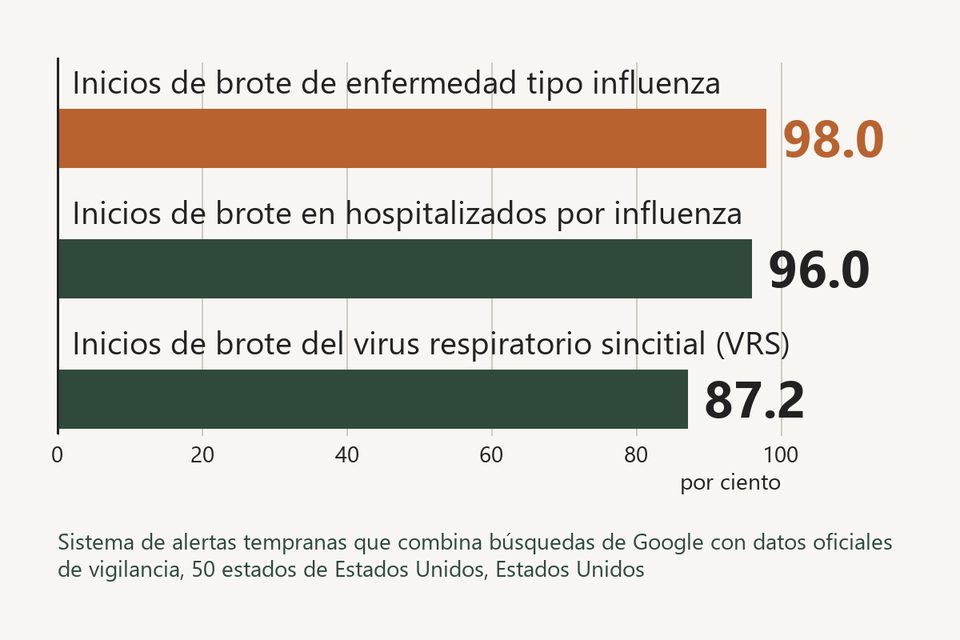
Porcentaje de arranques de brote que el sistema marcó antes de que ocurrieran, en la misma temporada; las cifras más bajas corresponden a enfermedades con menos años de datos para entrenar el sistema.
Qué tanto acertó el sistema en los inicios y en los picos de cada enfermedad
Marcó el 98.0% de los inicios y el 97.0% de los picos
Marcó el 96.0% de los inicios y solo el 60.8% de los picos
Marcó el 87.2% de los inicios y el 68.0% de los picos
Un aviso de este tipo es una señal para observar, no una certeza.
Los investigadores usaron búsquedas en Google como "virus de la influenza", "dolor de cabeza por gripe" y "cuánto dura la gripe". Junto a ella, los reportes oficiales de consultas por enfermedad respiratoria que publica el gobierno de Estados Unidos. Un grupo de investigadores de la Universidad Northeastern juntó las dos cosas y puso a prueba el sistema en vivo junto con el Centro de Pronóstico y Análisis de Brotes de los CDC.
La idea es simple. La gente busca en internet antes de ir al médico. Cada búsqueda es una señal que llega antes que el reporte del hospital.
Entre agosto de 2024 y la temporada 2024–2025, el sistema funcionó en vivo en los 50 estados. Marcó el 98% de los inicios de brotes de enfermedad tipo influenza, con unas cinco semanas de anticipación. También marcó el 97% de los picos, con unas dos semanas.
Para los hospitalizados por influenza, el sistema detectó el 96% de los arranques de brote, con cuatro semanas de aviso. Para el virus respiratorio sincitial (VRS), que ataca sobre todo a bebés y personas mayores, detectó el 87% de los arranques, con poco más de una semana de aviso.
Ahora, los picos de esas dos enfermedades fueron otra historia. En hospitalizados por influenza acertó el 61%. En VRS, el 68%. Esas cifras son de la misma temporada 2024–2025, pero con muy pocos años de datos para entrenar el sistema.
Todo esto ocurrió en Estados Unidos. Ningún país de América Latina ni Canadá participó en la prueba, y no hay resultados medidos para ellos.
Tampoco conviene leer cada alarma como una certeza. Una de cada seis alarmas de inicio de brote no fue seguida por un brote confirmado en las seis semanas siguientes. En los picos, fueron cerca de una de cada cinco. Y aunque el promedio de aviso fue de dos semanas, los tiempos variaron mucho: algunos avisos llegaron antes del pico y otros después.
El estudio no midió si estos avisos cambiaron decisiones de vacunación, de personal en hospitales o de camas disponibles. Solo se compartieron las predicciones con los CDC.
Vale la pena estar atento a una cosa: si su autoridad de salud local, en su país, empieza a publicar avisos tempranos de brotes respiratorios basados en búsquedas en internet. Ahí es donde algo así podría llegar a usted. Mientras tanto, la vacuna de la temporada sigue siendo la herramienta que sí está probada.
Qué significa para usted
Ese aviso de cinco semanas solo se midió en Estados Unidos durante la temporada 2024–2025, y no cambió por sí mismo ninguna decisión de vacunación ni de camas. Si en su país alguna autoridad de salud empieza a publicar avisos tempranos de brotes respiratorios basados en búsquedas en internet, pregunte con qué datos los probaron y cuántas alarmas resultaron falsas. Mientras eso no exista, la vacuna de la temporada sigue siendo la herramienta que sí está probada.
Garrido-Garcia, R., Clemente, L., Meyer, A. G. et al. (2026). A real-time early warning system to anticipate respiratory disease outbreaks using transfer learning. Nature Communications. https://doi.org/10.1038/s41467-026-72655-7
Quién pagó: El trabajo fue posible en parte gracias al acuerdo de cooperación CDC-RFA-FT-23-0069 del Centro para el Pronóstico y la Respuesta ante Brotes de los CDC; el artículo no indica si los financiadores tuvieron alguna influencia ni menciona proveedores de equipos o software.
No tome esto como consejo médico profesional.
Versión detalladaLos pasajes copiados del artículo, las ilustraciones y cada fuente con cuánto leímos de ella · 1157 palabras · unos 6 minLeerla →Cerrar
Un aviso de gripe con cinco semanas de ventaja: qué midió un sistema de alertas en Estados Unidos, y qué no
El sistema combinó búsquedas de Google con datos oficiales de vigilancia. Advirtió la mayoría de los inicios y picos de gripe en los 50 estados durante una temporada real. No se probó fuera de Estados Unidos, y uno de cada seis avisos no se cumplió.
Cada temporada de virus respiratorios en Estados Unidos deja más de un millón de hospitalizaciones, y los sistemas de vigilancia que existen hoy cuentan lo que ya pasó: van una o dos semanas atrás de la realidad1. En la temporada 2024–2025 el país tuvo unos 47 millones de casos de influenza, con 610 mil hospitalizaciones; el virus respiratorio sincitial aportó 190 mil y la COVID-19 otras 250 mil2. Con esas cifras, saber una o dos semanas antes dónde va a subir una curva deja de ser un detalle.
Un grupo de investigadores del Machine Intelligence Group for the Betterment of Health and the Environment, de la Universidad Northeastern, en Boston, construyó un sistema que mezcla dos fuentes: las búsquedas de Google sobre síntomas y tratamientos, y los datos epidemiológicos de siempre3. La idea que lo sostiene es sencilla: mucha gente busca en internet "síntomas de gripe" o "cuánto dura la gripe" antes de ir al médico, y esa búsqueda deja un rastro días antes de que la enfermedad aparezca en los registros clínicos4. El sistema no lee una búsqueda aislada: exige que varias señales se activen al mismo tiempo en la misma zona, y también mira lo que pasa en los estados vecinos.
La temporada 2024–2025 fue la prueba de fuego, con el sistema corriendo en tiempo real y sus predicciones compartidas con el Centro de Análisis de Pronósticos y Brotes de los CDC desde agosto de 2024. Detectó el 98% de los inicios de brote de enfermedad tipo influenza, con una anticipación promedio de unas cinco semanas, y el 97% de los picos, con unas dos semanas de anticipación5. Los aciertos de sus avisos, es decir, qué tanto de lo anunciado se cumplió, superaron el 82%5.
Hay que leer esos dos números con calma, porque miden cosas distintas. Los inicios se detectaron casi siempre muy temprano: la mayoría entre tres y seis semanas antes de que el brote comenzara de verdad6. Los picos fueron otra historia: aunque el promedio fue de dos semanas, las detecciones se repartieron entre avisos muy anticipados y avisos que llegaron después del pico7. Un promedio de dos semanas no significa que cada estado haya tenido dos semanas.
El sistema también se probó con otras dos enfermedades respiratorias, y ahí los resultados bajan. Para hospitalizaciones por influenza, con solo dos temporadas de datos de entrenamiento, detectó el 96% de los inicios con cuatro semanas de anticipación, pero solo el 60.8% de los picos8. Para el virus respiratorio sincitial, con una sola temporada de datos, detectó el 87.2% de los inicios con apenas 1.2 semanas de ventaja y un 100% de aciertos en sus avisos, sin falsas alarmas9. Ese 100% merece cautela: se apoya en una sola temporada de entrenamiento y en una muestra pequeña.
Piense en el calendario de un hospital: cuándo contrata personal extra, cuándo pide insumos, cuándo abre camas. Con cinco semanas de aviso sobre el inicio de la gripe, dice el estudio, se podría vacunar a los grupos de mayor riesgo antes de que la transmisión comunitaria se acelere; con dos semanas de aviso sobre el pico, se podría ajustar el personal y preparar la cadena de suministro10. Para el virus respiratorio sincitial, cuyos casos se concentran en bebés y personas mayores, el aviso de una a dos semanas podría servir para ajustar las fechas de inicio de la distribución de profilácticos o vacunas según cómo venga cada temporada11. Nada de esto se midió: solo se compartieron las predicciones con los CDC.
Lo que sí se midió es la incertidumbre de antes. Históricamente, el inicio de la temporada de gripe varía tanto entre estados que la diferencia promedio es de casi once semanas, y los picos pueden variar hasta 20 semanas. El sistema redujo la ventana de detección de los inicios a un rango constante de cuatro a seis semanas en casi todos los estados, lo que para los lugares más impredecibles representa entre dos y cuatro veces menos incertidumbre12.
El antecedente más cercano es el programa FluSight de los CDC, que reúne pronósticos de distintos equipos. Esos modelos se evalúan solo después de que los eventos ocurrieron, y aun así sus calificaciones indican que, en promedio, asignan entre 1% y 49% de probabilidad a la semana correcta, tanto para el inicio como para el pico1314. Los autores del nuevo sistema aclaran que esas cifras son referencias contextuales y no una comparación directa, porque las definiciones de evento y los protocolos de evaluación son distintos.
Así lo leemos nosotros: la ventaja de este sistema no está en adivinar el futuro, sino en leer algo que ya está pasando en la gente y que los registros clínicos tardan en mostrar. Nos lleva a esperar que, si el patrón se sostiene, las alertas lleguen a los sistemas de salud antes que las curvas de casos. Nos equivocaríamos si los avisos resultaran tan ruidosos que nadie los usara, o si los cambios en la manera en que la gente busca en internet apagaran la señal.
Las limitaciones están dichas por los propios autores. El sistema depende de que la gente busque en Google, y eso lo deja expuesto a cambios en los hábitos de búsqueda o en los algoritmos de la plataforma15. Además, se espera que su desempeño baje frente a enfermedades nuevas que se parezcan poco a las conocidas, o cuando no haya datos históricos con los que calibrarlo16. La transferibilidad internacional del método no se ha probado: todo lo medido aquí ocurrió en estados de Estados Unidos.
Aquí conviene una advertencia práctica. Un aviso de este tipo es una señal para observar, no una certeza. Pregunte quién emite la alerta, con qué datos la construyó y cuántas veces se equivocó antes; si no hay respuesta clara, trátela como una señal entre varias y consulte a su centro de salud. En casa, esas semanas de aviso sirven para revisar vacunas y planes de consulta antes de que suban los casos, no para sustituir la atención médica.
Lo que este trabajo deja en manos del lector es una pregunta que puede llevar a su clínica o a su autoridad sanitaria local: si reciben avisos de brotes respiratorios, qué hacen distinto cuando llegan. La respuesta dirá más sobre la utilidad real del sistema que cualquier porcentaje de detección.
Volvamos al calendario del hospital. Cinco semanas antes de que empiece la gripe, un aviso puede parecer poco; dos semanas antes de que llegue el pico, puede ser la diferencia entre prepararse y reaccionar. Ese es el terreno que este sistema abre, y el terreno que todavía falta medir.
De dónde sale cada dato de contexto, y cuánto leímos de cada documento
- Garrido-Garcia, R., Clemente, L., Meyer, A. G. et al. (2026). A real-time early warning system to anticipate respiratory disease outbreaks using transfer learning. Nature Communications. https://doi.org/10.1038/s41467-026-72655-7 - el artículo del que trata esta nota — el artículo completo — el pasaje: "Respiratory disease outbreaks burden American healthcare systems with over one million hospitalizations annually, yet current surveillance systems lag 1–2 weeks behind real-time conditions, preventing timely intervention."
- Garrido-Garcia, R., Clemente, L., Meyer, A. G. et al. (2026). A real-time early warning system to anticipate respiratory disease outbreaks using transfer learning. Nature Communications. https://doi.org/10.1038/s41467-026-72655-7 - el artículo del que trata esta nota — el artículo completo — el pasaje: "during the 2024–2025 season alone, the U.S. experienced an estimated 47 million influenza cases with 610,000 hospitalizations, while RSV contributed 190,000 hospitalizations and COVID-19 added 250,000 more"
- Garrido-Garcia, R., Clemente, L., Meyer, A. G. et al. (2026). A real-time early warning system to anticipate respiratory disease outbreaks using transfer learning. Nature Communications. https://doi.org/10.1038/s41467-026-72655-7 - el artículo del que trata esta nota — el artículo completo — el pasaje: "We present a machine learning early warning system that combines Google search trends with traditional epidemiological data using ensemble voting algorithms to predict outbreak timing across multiple respiratory pathogens."
- Garrido-Garcia, R., Clemente, L., Meyer, A. G. et al. (2026). A real-time early warning system to anticipate respiratory disease outbreaks using transfer learning. Nature Communications. https://doi.org/10.1038/s41467-026-72655-7 - el artículo del que trata esta nota — el artículo completo — el pasaje: "When people search for respiratory disease symptoms or treatments, they often do so before seeking clinical care, creating an early warning signal that our ensemble voting approach effectively captures"
- Garrido-Garcia, R., Clemente, L., Meyer, A. G. et al. (2026). A real-time early warning system to anticipate respiratory disease outbreaks using transfer learning. Nature Communications. https://doi.org/10.1038/s41467-026-72655-7 - el artículo del que trata esta nota — el artículo completo — el pasaje: "During operational real-time deployment from August 2024 through the 2024–2025 season, the system detects 98.0% of outbreak onsets and 97.0% of outbreak peaks, with average lead times of approximately 5 and 2 weeks, respectively, and positive predictive values exceeding 82%."
- Garrido-Garcia, R., Clemente, L., Meyer, A. G. et al. (2026). A real-time early warning system to anticipate respiratory disease outbreaks using transfer learning. Nature Communications. https://doi.org/10.1038/s41467-026-72655-7 - el artículo del que trata esta nota — el artículo completo — el pasaje: "For outbreak onset detection, lead times were tightly concentrated in the early range, with most detections occurring ~3–6 weeks prior to the realized onset and very few detections occurring during or after the onset week."
- Garrido-Garcia, R., Clemente, L., Meyer, A. G. et al. (2026). A real-time early warning system to anticipate respiratory disease outbreaks using transfer learning. Nature Communications. https://doi.org/10.1038/s41467-026-72655-7 - el artículo del que trata esta nota — el artículo completo — el pasaje: "Although many peaks were detected several weeks in advance, the distribution spanned both early and post-peak detections, with a non-negligible fraction occurring shortly after the realized peak."
- Garrido-Garcia, R., Clemente, L., Meyer, A. G. et al. (2026). A real-time early warning system to anticipate respiratory disease outbreaks using transfer learning. Nature Communications. https://doi.org/10.1038/s41467-026-72655-7 - el artículo del que trata esta nota — el artículo completo — el pasaje: "For influenza hospitalizations, where only two seasons of training data were available (2022–2024), the system achieved 96.0% onset detection during the 2024–2025 season with 4-week average lead time and 82.8% PPV."
- Garrido-Garcia, R., Clemente, L., Meyer, A. G. et al. (2026). A real-time early warning system to anticipate respiratory disease outbreaks using transfer learning. Nature Communications. https://doi.org/10.1038/s41467-026-72655-7 - el artículo del que trata esta nota — el artículo completo — el pasaje: "Despite this severe constraint, the transfer learning approach successfully detected 87.2% of RSV activity onsets during 2024–2025 with 1.2-week lead time and achieved 100% PPV with zero false alarms."
- Garrido-Garcia, R., Clemente, L., Meyer, A. G. et al. (2026). A real-time early warning system to anticipate respiratory disease outbreaks using transfer learning. Nature Communications. https://doi.org/10.1038/s41467-026-72655-7 - el artículo del que trata esta nota — el artículo completo — el pasaje: "Similar applications extend to influenza vaccination campaigns, where 5-week lead time of ILI onsets enables targeting of high-risk populations before community transmission accelerates. Hospital surge planning benefits from 2-week peak detection lead time, allowing for staffing adjustments, supply chain preparation, and patient flow optimization."
- Garrido-Garcia, R., Clemente, L., Meyer, A. G. et al. (2026). A real-time early warning system to anticipate respiratory disease outbreaks using transfer learning. Nature Communications. https://doi.org/10.1038/s41467-026-72655-7 - el artículo del que trata esta nota — el artículo completo — el pasaje: "Our system’s ability to predict RSV onsets with 1–2 weeks of lead time with high positive predictive value may enable health departments and hospitals to optimize distribution of prophylactics or vaccines by adjusting administration start dates for early seasons"
- Garrido-Garcia, R., Clemente, L., Meyer, A. G. et al. (2026). A real-time early warning system to anticipate respiratory disease outbreaks using transfer learning. Nature Communications. https://doi.org/10.1038/s41467-026-72655-7 - el artículo del que trata esta nota — el artículo completo — el pasaje: "The system narrowed the historically wide onset detection window to a consistent 4–6 week range across nearly all states, representing a 2–4 fold reduction in timing uncertainty for states with the highest historical variability."
- Garrido-Garcia, R., Clemente, L., Meyer, A. G. et al. (2026). A real-time early warning system to anticipate respiratory disease outbreaks using transfer learning. Nature Communications. https://doi.org/10.1038/s41467-026-72655-7 - el artículo del que trata esta nota — el artículo completo — el pasaje: "The CDC FluSight models are evaluated for their ability to identify the timing of onsets and peaks only after the events in question have occurred."
- Garrido-Garcia, R., Clemente, L., Meyer, A. G. et al. (2026). A real-time early warning system to anticipate respiratory disease outbreaks using transfer learning. Nature Communications. https://doi.org/10.1038/s41467-026-72655-7 - el artículo del que trata esta nota — el artículo completo — el pasaje: "Even in this retrospective mode, the forecast scores (ranging 0.08–0.49 for the peak week and 0.01–0.41 for onset week) indicate that these models, on average, assign a probability between 1% and 49% that these events occurred in the correct week"
- Garrido-Garcia, R., Clemente, L., Meyer, A. G. et al. (2026). A real-time early warning system to anticipate respiratory disease outbreaks using transfer learning. Nature Communications. https://doi.org/10.1038/s41467-026-72655-7 - el artículo del que trata esta nota — el artículo completo — el pasaje: "Additionally, our reliance on digital behavioral signals creates potential vulnerabilities to changes in search behavior patterns or platform algorithms"
- Garrido-Garcia, R., Clemente, L., Meyer, A. G. et al. (2026). A real-time early warning system to anticipate respiratory disease outbreaks using transfer learning. Nature Communications. https://doi.org/10.1038/s41467-026-72655-7 - el artículo del que trata esta nota — el artículo completo — el pasaje: "Performance is therefore expected to degrade in settings where emergent pathogens exhibit minimal symptomatic overlap with historically observed diseases or where no suitable historical proxy data exist for calibration."
Garrido-Garcia, R., Clemente, L., Meyer, A. G. et al. (2026). A real-time early warning system to anticipate respiratory disease outbreaks using transfer learning. Nature Communications. https://doi.org/10.1038/s41467-026-72655-7
Quién pagó: El trabajo fue posible en parte gracias al acuerdo de cooperación CDC-RFA-FT-23-0069 del Centro para el Pronóstico y la Respuesta ante Brotes de los CDC; el artículo no indica si los financiadores tuvieron alguna influencia ni menciona proveedores de equipos o software.
No tome esto como consejo médico profesional.
other · Nature communications · the paper, 19 May 2026 · free
A Flu Season That Announces Itself: 98% of Outbreaks Flagged Weeks Ahead
A US system reading Google searches caught nearly all flu-like outbreaks about five weeks before they began, though about one alarm in six was false and no other country was tested.
Short version · the longer version follows, about 6 min
Ask the weeklyAI chat
Ask me about AI in your life: I point you to the stories weeklyAI has published on it, this week and before.
Conversations are saved for as long as weeklyAI exists, to improve the publication. Answers come in the language you write in.
- The study at a glance
- Who
- Respiratory disease outbreaks in the United States
- How many
- all 50 states
- Where
- United States
- When
- August 2024 through the 2024–2025 season
- Kind of study
- analysis of what people did
- Who did it
- Northeastern University, with the CDC's Center for Forecasting and Outbreak Analytics
- The limit that matters
- No country in Latin America or Canada was tested, so no measured number exists for there.
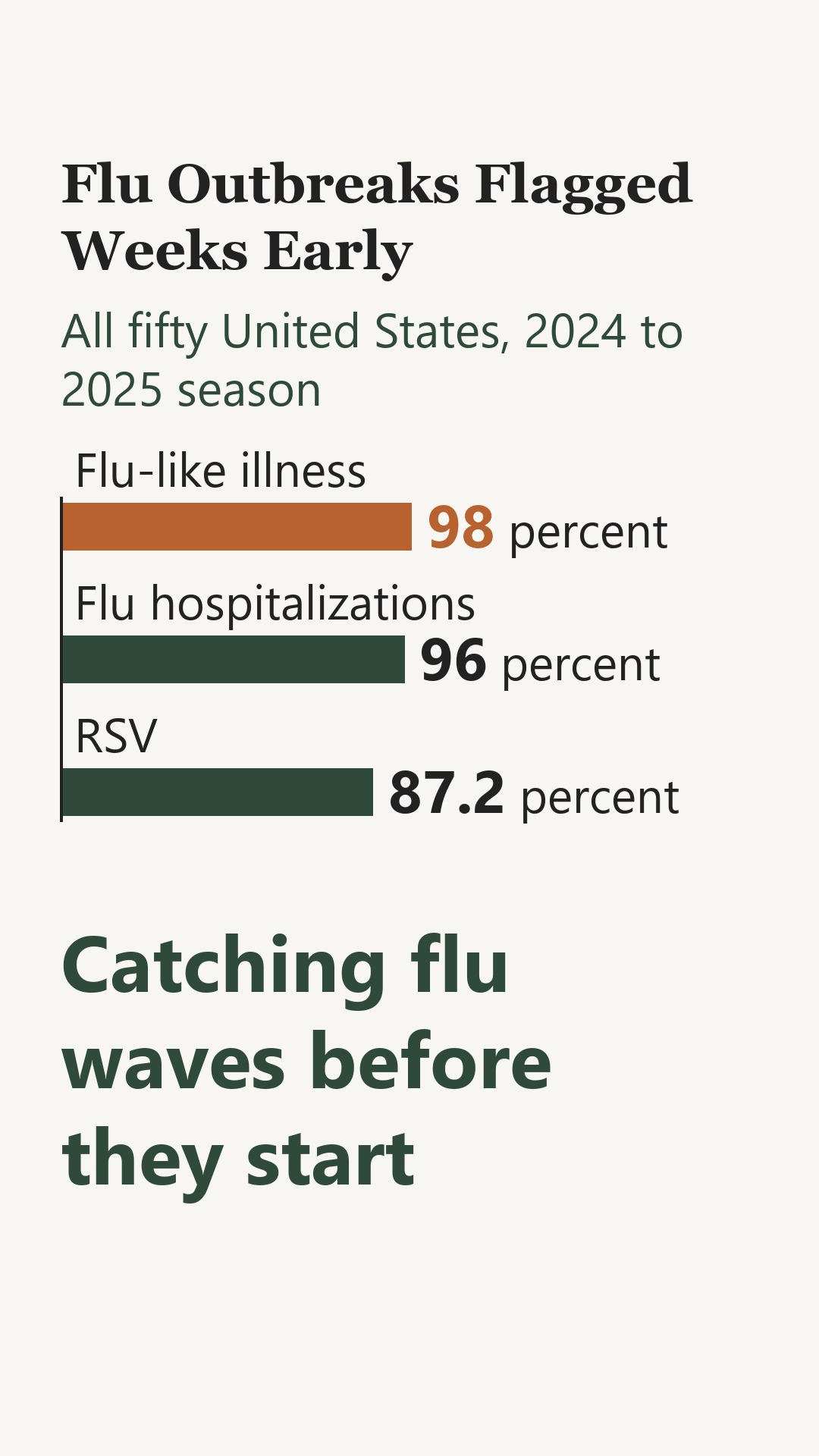
Share of outbreak starts the system flagged in advance during the 2024–2025 season; RSV rests on a single training season, so its number is the least settled.
This system against the CDC's FluSight forecasting models
This system caught 98.0% of outbreak starts and 97.0% of peaks; FluSight models assigned between 1% and 49% probability to the correct week.
The system flags a wave; it does not stop one, and no study here measured fewer hospital stays or illnesses.
Five weeks. That is roughly how far ahead of a flu season's start a computer system in the United States says it can ring a bell, based on what people type into Google.
Researchers at Northeastern University, working with the CDC's Center for Forecasting and Outbreak Analytics, built the system. It reads two things together: Google searches about flu symptoms and treatments, and reports of illness from nearby states. It combines many weak signals and raises an alarm when enough of them agree.
They first tested it against years of past data on influenza-like illness in all 50 states, then added flu hospitalizations and RSV using what it had learned about flu. In the 2024–2025 season, run live and shared with CDC officials before events happened, it caught 98% of outbreak starts about five weeks early, and 97% of peaks about two weeks early. For RSV, it caught 87% of starts.
That is a US result. No country in Latin America or Canada was part of this work, so there is no measured number for how it would perform there.
The alarms are yes or no. About one in seven of the start warnings did not lead to a confirmed outbreak, and about one in six of the peak warnings did not. Peak warnings also arrived at very different times in different states, so the two-week average does not mean every place gets two weeks. The system flags a wave; it does not stop one, and no study here measured fewer hospital stays or illnesses.
Watch whether your local health authority starts reporting early warnings like these. That is the path by which such a system would reach you.
What this means for you
For now the bell rings in the United States only, so a person in Canada or Latin America cannot yet point to a measured number for their own town. Watch whether your health authority reports warnings of this kind, and ask what it does with them when they come.
Garrido-Garcia, R., Clemente, L., Meyer, A. G. et al. (2026). A real-time early warning system to anticipate respiratory disease outbreaks using transfer learning. Nature Communications. https://doi.org/10.1038/s41467-026-72655-7
Who paid: The work was made possible in part by cooperative agreement CDC-RFA-FT-23-0069 from the CDC's Center for Forecasting and Outbreak Analytics; the article does not say whether the funders had any say, and names no equipment or software lenders.
Do not take this as professional medical advice.
The longer versionThe passages copied from the paper, the pictures, and every source with how much of it we read · 1212 words · about 6 minRead it →Close
A Flu Warning Arrived Five Weeks Early. Hospitals Still Had to Decide What to Do With It.
In a real-time test across all 50 U.S. states, a system built on Google searches flagged most flu-like outbreak starts about five weeks ahead. The harder question — what a clinic does with that — was not measured.
Consider the waiting room in early November. The posters are up, the flu shots are stacked by the desk, and the schedule looks like every other autumn. Somewhere in a state health office, a warning has already arrived: search traffic for fever and cough is climbing, and the system expects the wave in about five weeks.
That is the picture the new study is built around. The authors, from Northeastern University and collaborating institutions, describe a machine learning system that combines Google search trends with ordinary disease surveillance data to predict when respiratory outbreaks will start and peak1. The article describes a study in which people tend to look up symptoms and treatments before they go to a doctor, so the searches move first2.
The scale of the problem is not small. The article describes a study in which respiratory outbreaks send more than a million Americans to hospital in a typical year, and current surveillance runs one to two weeks behind real conditions3. The article describes a study in which, in the 2024–2025 season alone, there were an estimated 47 million influenza cases with 610,000 hospitalizations, plus 190,000 RSV hospitalizations and 250,000 for COVID-194.
Here is how the machine works, step by step. For each state, it collects search terms about flu, RSV, fever and treatments. It keeps only the terms that historically rose before that state's outbreaks did. It also watches neighboring states, on the theory that a wave often arrives next door first. When enough of these signals light up within a few weeks of each other, the system issues a yes-or-no alarm: an outbreak is expected within six weeks. No probability, just an alarm.
The team tested it in three stages. First, against ten years of past flu-like illness data. Then, on two seasons it had never seen. Finally, live: from August 2024 through the 2024–2025 season, predictions were shared continuously with the CDC's Center for Forecasting and Outbreak Analytics before events happened, across all 50 states.
In that live run, the system caught 98.0% of outbreak starts with an average lead of about five weeks, and 97.0% of peaks with about two weeks, with alarm reliability above 82%5. Most start-warnings landed three to six weeks before the actual onset, and very few came during or after it6. For states whose outbreak timing historically swung across a wide window, the system narrowed the warning to a consistent four-to-six week range7.
The article describes a study in which the comparison drawn is with the CDC's FluSight forecasting challenge, whose models are scored only after the events they predict have passed8. The article describes a study in which, even in that retrospective mode, those models assigned between 1% and 49% probability to the correct week for peaks and onsets9. The authors themselves call this a contextual benchmark rather than a head-to-head contest, and they are right to: the definitions and the targets differ.
The system was then stretched to other diseases using transfer learning — reusing the flu-trained machinery and recalibrating it with whatever little data existed. For influenza hospitalizations, with two seasons of training, it caught 96.0% of onsets about four weeks ahead10. For RSV, with a single season, it caught 87.2% of onsets about a week ahead, with no false alarms at all11. Peak detection was weaker for both: 60.8% for hospitalizations and 68.0% for RSV.
Now the limits, stated plainly. About 14.0% of start-warnings were false positives, and about 17.3% of peak warnings were false positives. Peak warnings were uneven: many came early, but a noticeable share arrived shortly after the peak had already passed12. RSV rests on one training season and a small sample, and the authors say so. And the article describes a study in which the whole approach leans on Google searches, which shift with news cycles and platform changes13. Where a new pathogen looks nothing like the old ones, performance is expected to drop14.
A different attempt at the same goal, in a very different place, is worth setting beside this one. In Andhra Pradesh, India, frontline health workers recorded coughs on smartphones and a platform called Swaasa analyzed the sound to flag tuberculosis risk, according to the summary of a study we could read only in abstract — the full paper was behind a subscription15. Over six weeks, 7,879 people were screened and 780 were referred for testing; TB was confirmed in 11 of them1617. That is a different kind of tool: it finds sick individuals rather than forecasting a wave. In Nigeria, portable chest X-rays read by AI flagged 3,166 of 9,585 scans as abnormal, and 204 people were diagnosed with confirmed TB, according to another abstract-only study1819. Both show the same pattern: the machine points, a person confirms. Neither replaces the clinic.
The trade-off in the U.S. system is deliberate. It gives up probabilities and gives back a plain yes or no, which the authors say decision-makers asked for. The cost is that an alarm is a signal to watch, not a certainty — and a false alarm that is never explained can wear down trust in the next real one.
Here is how we read it. A five-week warning only matters if someone changes something in week one. The study measured whether the alarm was right; it did not measure whether any hospital moved a shipment, added a shift or started a vaccination push earlier. You would know we are wrong if clinics near you say they acted on these warnings before the wave arrived. Until then, the fair question for your local health department is whether it receives these state-level warnings at all, and what it does when one arrives.
We also read the search-signal problem as unevenly distributed. Communities that search less, or in another language, or whose searches spike because of a news story rather than an illness, may get late or missing warnings — and nobody is told why their area stayed quiet. Ask whether the warnings are as timely in your neighborhood as the state average, and whether a missed alarm is ever explained. A human eye on clinic visits still counts.
When a warning reaches you, ask two plain questions: how often has this system been right, and who checked it. Those are fair questions for a health department, and the answers separate a useful tool from a habit of obedience.
What the study makes possible is concrete. A hospital that knows a peak is about two weeks out can plan staffing and supplies20. A health department that expects RSV early can adjust when it starts distributing preventive antibodies21. None of that has been shown to happen yet; it is what the warning window would allow.
So the next time a flu season is announced on the evening news, the useful question is not whether the wave is coming. It is whether anyone near you got the warning five weeks ago — and what they did with it.
Where each piece of context comes from, and how much of it we read
- Garrido-Garcia, R., Clemente, L., Meyer, A. G. et al. (2026). A real-time early warning system to anticipate respiratory disease outbreaks using transfer learning. Nature Communications. https://doi.org/10.1038/s41467-026-72655-7 - the article this story is about — the whole article — the passage: "We present a machine learning early warning system that combines Google search trends with traditional epidemiological data using ensemble voting algorithms to predict outbreak timing across multiple respiratory pathogens."
- Garrido-Garcia, R., Clemente, L., Meyer, A. G. et al. (2026). A real-time early warning system to anticipate respiratory disease outbreaks using transfer learning. Nature Communications. https://doi.org/10.1038/s41467-026-72655-7 - the article this story is about — the whole article — the passage: "When people search for respiratory disease symptoms or treatments, they often do so before seeking clinical care, creating an early warning signal that our ensemble voting approach effectively captures"
- Garrido-Garcia, R., Clemente, L., Meyer, A. G. et al. (2026). A real-time early warning system to anticipate respiratory disease outbreaks using transfer learning. Nature Communications. https://doi.org/10.1038/s41467-026-72655-7 - the article this story is about — the whole article — the passage: "Respiratory disease outbreaks burden American healthcare systems with over one million hospitalizations annually, yet current surveillance systems lag 1–2 weeks behind real-time conditions, preventing timely intervention."
- Garrido-Garcia, R., Clemente, L., Meyer, A. G. et al. (2026). A real-time early warning system to anticipate respiratory disease outbreaks using transfer learning. Nature Communications. https://doi.org/10.1038/s41467-026-72655-7 - the article this story is about — the whole article — the passage: "during the 2024–2025 season alone, the U.S. experienced an estimated 47 million influenza cases with 610,000 hospitalizations, while RSV contributed 190,000 hospitalizations and COVID-19 added 250,000 more"
- Garrido-Garcia, R., Clemente, L., Meyer, A. G. et al. (2026). A real-time early warning system to anticipate respiratory disease outbreaks using transfer learning. Nature Communications. https://doi.org/10.1038/s41467-026-72655-7 - the article this story is about — the whole article — the passage: "During operational real-time deployment from August 2024 through the 2024–2025 season, the system detects 98.0% of outbreak onsets and 97.0% of outbreak peaks, with average lead times of approximately 5 and 2 weeks, respectively, and positive predictive values exceeding 82%."
- Garrido-Garcia, R., Clemente, L., Meyer, A. G. et al. (2026). A real-time early warning system to anticipate respiratory disease outbreaks using transfer learning. Nature Communications. https://doi.org/10.1038/s41467-026-72655-7 - the article this story is about — the whole article — the passage: "For outbreak onset detection, lead times were tightly concentrated in the early range, with most detections occurring ~3–6 weeks prior to the realized onset and very few detections occurring during or after the onset week."
- Garrido-Garcia, R., Clemente, L., Meyer, A. G. et al. (2026). A real-time early warning system to anticipate respiratory disease outbreaks using transfer learning. Nature Communications. https://doi.org/10.1038/s41467-026-72655-7 - the article this story is about — the whole article — the passage: "The system narrowed the historically wide onset detection window to a consistent 4–6 week range across nearly all states, representing a 2–4 fold reduction in timing uncertainty for states with the highest historical variability."
- Garrido-Garcia, R., Clemente, L., Meyer, A. G. et al. (2026). A real-time early warning system to anticipate respiratory disease outbreaks using transfer learning. Nature Communications. https://doi.org/10.1038/s41467-026-72655-7 - the article this story is about — the whole article — the passage: "The CDC FluSight models are evaluated for their ability to identify the timing of onsets and peaks only after the events in question have occurred."
- Garrido-Garcia, R., Clemente, L., Meyer, A. G. et al. (2026). A real-time early warning system to anticipate respiratory disease outbreaks using transfer learning. Nature Communications. https://doi.org/10.1038/s41467-026-72655-7 - the article this story is about — the whole article — the passage: "Even in this retrospective mode, the forecast scores (ranging 0.08–0.49 for the peak week and 0.01–0.41 for onset week) indicate that these models, on average, assign a probability between 1% and 49% that these events occurred in the correct week"
- Garrido-Garcia, R., Clemente, L., Meyer, A. G. et al. (2026). A real-time early warning system to anticipate respiratory disease outbreaks using transfer learning. Nature Communications. https://doi.org/10.1038/s41467-026-72655-7 - the article this story is about — the whole article — the passage: "For influenza hospitalizations, where only two seasons of training data were available (2022–2024), the system achieved 96.0% onset detection during the 2024–2025 season with 4-week average lead time and 82.8% PPV."
- Garrido-Garcia, R., Clemente, L., Meyer, A. G. et al. (2026). A real-time early warning system to anticipate respiratory disease outbreaks using transfer learning. Nature Communications. https://doi.org/10.1038/s41467-026-72655-7 - the article this story is about — the whole article — the passage: "Despite this severe constraint, the transfer learning approach successfully detected 87.2% of RSV activity onsets during 2024–2025 with 1.2-week lead time and achieved 100% PPV with zero false alarms."
- Garrido-Garcia, R., Clemente, L., Meyer, A. G. et al. (2026). A real-time early warning system to anticipate respiratory disease outbreaks using transfer learning. Nature Communications. https://doi.org/10.1038/s41467-026-72655-7 - the article this story is about — the whole article — the passage: "Although many peaks were detected several weeks in advance, the distribution spanned both early and post-peak detections, with a non-negligible fraction occurring shortly after the realized peak."
- Garrido-Garcia, R., Clemente, L., Meyer, A. G. et al. (2026). A real-time early warning system to anticipate respiratory disease outbreaks using transfer learning. Nature Communications. https://doi.org/10.1038/s41467-026-72655-7 - the article this story is about — the whole article — the passage: "Additionally, our reliance on digital behavioral signals creates potential vulnerabilities to changes in search behavior patterns or platform algorithms"
- Garrido-Garcia, R., Clemente, L., Meyer, A. G. et al. (2026). A real-time early warning system to anticipate respiratory disease outbreaks using transfer learning. Nature Communications. https://doi.org/10.1038/s41467-026-72655-7 - the article this story is about — the whole article — the passage: "Performance is therefore expected to degrade in settings where emergent pathogens exhibit minimal symptomatic overlap with historically observed diseases or where no suitable historical proxy data exist for calibration."
- Nammi V, Rao Sripada N, De P, Palreddy SD, Pullae SRM. (2026). Prospective field deployment of Swaasa® AI for community-based screening of tuberculosis and other respiratory diseases in Andhra Pradesh: a feasibility and implementation study. Frontiers in Public Health. https://doi.org/10.3389/fpubh.2026.1951831 — only the abstract - the full text could not be fetched — the passage: "Swaasa ® uses machine learning (ML) algorithms to analyze acoustic cough patterns and gather information through guided questions about symptoms."
- Nammi V, Rao Sripada N, De P, Palreddy SD, Pullae SRM. (2026). Prospective field deployment of Swaasa® AI for community-based screening of tuberculosis and other respiratory diseases in Andhra Pradesh: a feasibility and implementation study. Frontiers in Public Health. https://doi.org/10.3389/fpubh.2026.1951831 — only the abstract - the full text could not be fetched — the passage: "Over a 6-week deployment, a total of 7,879 individuals from vulnerable populations were screened."
- Nammi V, Rao Sripada N, De P, Palreddy SD, Pullae SRM. (2026). Prospective field deployment of Swaasa® AI for community-based screening of tuberculosis and other respiratory diseases in Andhra Pradesh: a feasibility and implementation study. Frontiers in Public Health. https://doi.org/10.3389/fpubh.2026.1951831 — only the abstract - the full text could not be fetched — the passage: "Swaasa ® AI identified 780 individuals (~10%) at risk of TB and referred them for confirmatory testing. TB was confirmed in 11 of these individuals, yielding an observed TB yield of 1.41% (11/780)."
- Okoye C, Ilozumba J, Oko J, Effiong A, Oluokun Y, Eze C, et al. (2026). Implementing AI-enabled chest X-ray for community-based integrated screening for tuberculosis, chronic respiratory diseases, and cardiovascular diseases in Nigeria. BMC Global and Public Health. 10.1186/s44263-026-00313-7 — only the abstract - the full text could not be fetched — the passage: "In total, 9,585 individuals were screened through 93 outreach activities, and 3,166 (33%) chest radiographs were flagged as abnormal by AI."
- Okoye C, Ilozumba J, Oko J, Effiong A, Oluokun Y, Eze C, et al. (2026). Implementing AI-enabled chest X-ray for community-based integrated screening for tuberculosis, chronic respiratory diseases, and cardiovascular diseases in Nigeria. BMC Global and Public Health. 10.1186/s44263-026-00313-7 — only the abstract - the full text could not be fetched — the passage: "204 were diagnosed with bacteriologically confirmed TB, and 194 (95%) were initiated on treatment."
- Garrido-Garcia, R., Clemente, L., Meyer, A. G. et al. (2026). A real-time early warning system to anticipate respiratory disease outbreaks using transfer learning. Nature Communications. https://doi.org/10.1038/s41467-026-72655-7 - the article this story is about — the whole article — the passage: "Similar applications extend to influenza vaccination campaigns, where 5-week lead time of ILI onsets enables targeting of high-risk populations before community transmission accelerates. Hospital surge planning benefits from 2-week peak detection lead time, allowing for staffing adjustments, supply chain preparation, and patient flow optimization."
- Garrido-Garcia, R., Clemente, L., Meyer, A. G. et al. (2026). A real-time early warning system to anticipate respiratory disease outbreaks using transfer learning. Nature Communications. https://doi.org/10.1038/s41467-026-72655-7 - the article this story is about — the whole article — the passage: "Our system’s ability to predict RSV onsets with 1–2 weeks of lead time with high positive predictive value may enable health departments and hospitals to optimize distribution of prophylactics or vaccines by adjusting administration start dates for early seasons"
Garrido-Garcia, R., Clemente, L., Meyer, A. G. et al. (2026). A real-time early warning system to anticipate respiratory disease outbreaks using transfer learning. Nature Communications. https://doi.org/10.1038/s41467-026-72655-7
Who paid: The work was made possible in part by cooperative agreement CDC-RFA-FT-23-0069 from the CDC's Center for Forecasting and Outbreak Analytics; the article does not say whether the funders had any say, and names no equipment or software lenders.
Do not take this as professional medical advice.
The findings of other studies mentioned here are known to us through this document, which is the one we read; we did not open each of those studies.