experiment · Nature communications · la publicación, 20 may 2026 · gratis
Un programa de IA acertó en 837 de cada 1,000 imágenes de mama; fuera de China, bajó a 604
Investigadores chinos probaron su sistema en más de 64,000 imágenes de hospitales de su país y en dos conjuntos públicos de Egipto y España. Con el programa, los radiólogos leyeron mejor cuando el programa tenía razón, y peor cuando se equivocó.
Versión breve · la versión detallada sigue, unos 6 min
Pregunte al chat de weeklyAI
Pregúnteme sobre la IA en su vida: le señalo las notas que weeklyAI ha publicado sobre el tema, esta semana y antes.
Las conversaciones se guardan mientras exista weeklyAI, para mejorar la publicación. Se responde en el idioma en que usted escribe.
- El estudio, de un vistazo
- Quiénes
- mujeres sometidas a ultrasonido de mama
- Cuántos
- 6,817
- Dónde
- China
- Cuándo
- no lo dice el pasaje
- Tipo de estudio
- experiment
- Quién lo hizo
- hospitales e instituciones de China
- El límite que importa
- El estudio siguió sobre todo a las mujeres de riesgo alto; el diseño fue de viabilidad.
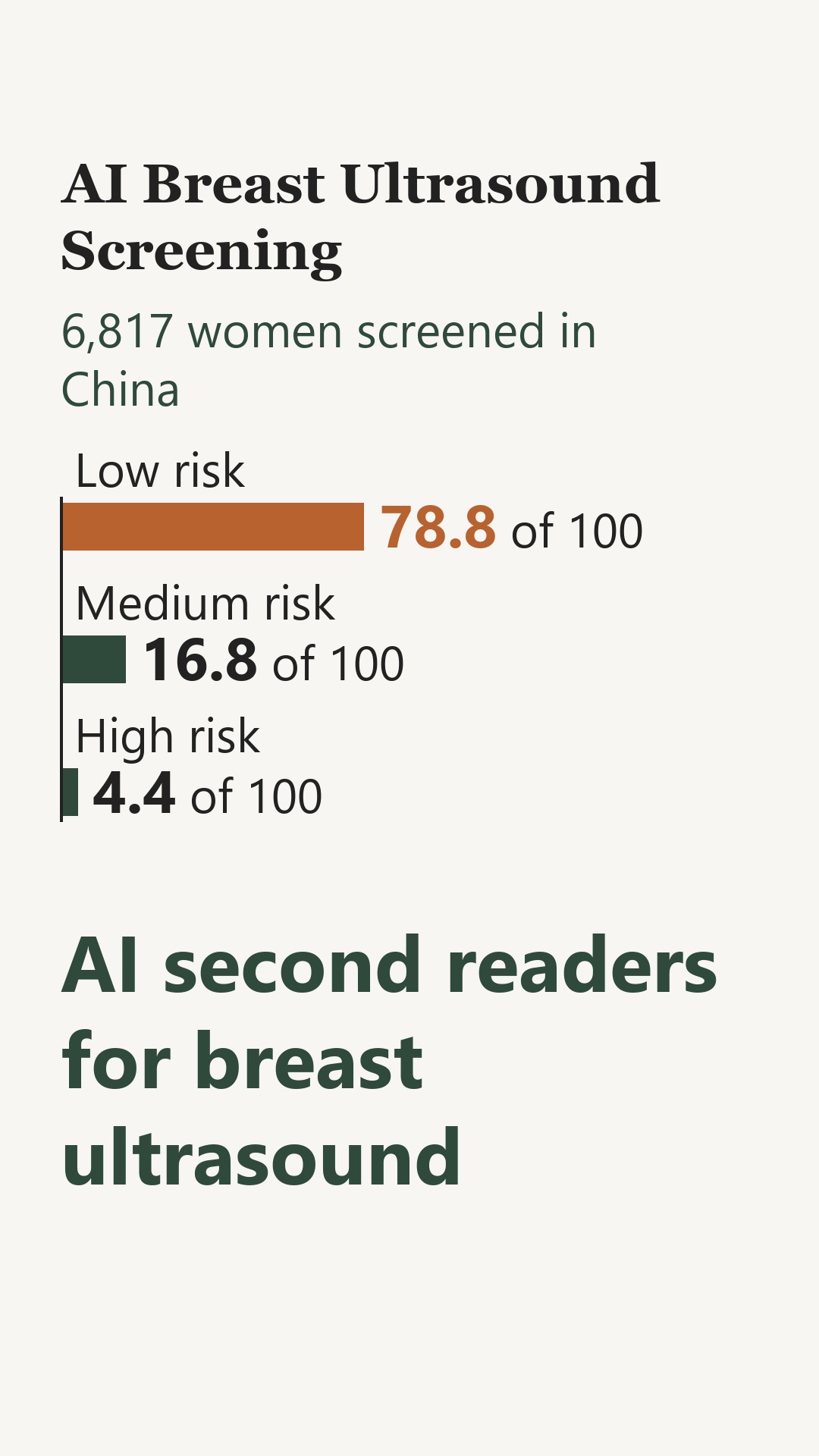
Porcentajes de 6,817 mujeres clasificadas por el programa; al grupo de riesgo alto se le dio seguimiento y ahí se diagnosticaron 3 cánceres, pero al grupo de riesgo bajo no se le siguió hasta el final en este estudio.
Radiólogos en formación leyendo con y sin el programa
el acierto pasó de 0.687 a 0.736
Una etiqueta de riesgo bajo no significa que no haya cáncer.
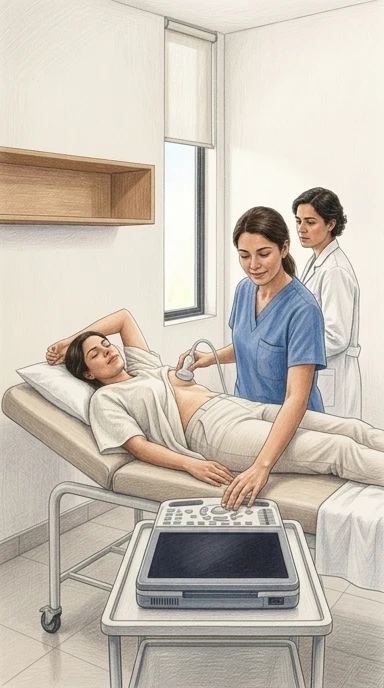
Imagine 1,000 imágenes de ultrasonido de mama. Un programa llamado BIRD, hecho en China, clasifica cada una en la escala que usan los radiólogos para decidir si hay que hacer una biopsia. En 837 de esas 1,000, la clasificación coincidió con la del equipo de especialistas que revisó las imágenes antes.
El programa también señala dónde está la lesión en la imagen. Lo probaron con 64,940 imágenes de hospitales de China y con dos conjuntos públicos de Egipto y España.
En ocho hospitales chinos, la coincidencia estuvo entre 708 y 913 de cada 1,000 imágenes.
En dos de esos estudios, los radiólogos leyeron las mismas imágenes con y sin el programa al lado. En un tercer estudio, el programa se comparó con radiólogos que leyeron sin ayuda. Cuando BIRD acertaba, ellos acertaban más. En el estudio en que los radiólogos leyeron con y sin el programa, cuando BIRD fallaba, tres radiólogos acertaban menos.
En las imágenes de Egipto y España la coincidencia cayó a 661 y 604 de cada 1,000. El programa todavía no está probado para usarse fuera de China.
En un tamizaje de 6,817 mujeres, el programa marcó 301 como de riesgo alto. Entre ellas se detectaron 3 cánceres. Al grupo de riesgo bajo, la mayoría, no se le siguió hasta el final en este estudio, así que no se sabe cuántos cánceres pudo haber ahí. Una etiqueta de riesgo bajo no significa que no haya cáncer.
En 38 hospitales, los investigadores midieron cuánto coincidían el programa y los radiólogos con un índice de acuerdo que llegó a 0.702 en promedio. Ese índice mide cuánto estuvieron de acuerdo, no cuántas veces cada uno tenía razón. Eso mide cuánto estuvieron de acuerdo, no cuántas veces cada uno tenía razón.
En otro estudio, cuatro radiólogos en formación leyeron mejor con el programa que sin él.
La próxima vez que una clínica anuncie un programa de IA que lee ultrasonidos de mama, pregunte si fue probado con pacientes como usted y si un radiólogo sigue revisando cada imagen.
Qué significa para usted
Cuando una clínica en su ciudad anuncie un programa de inteligencia artificial para leer ultrasonidos de mama, pregunte si lo probaron con pacientes como usted y si un radiólogo sigue revisando cada imagen. La ayuda que se midió fue en hospitales de China, y en imágenes de Egipto y España el programa acertó bastante menos. Una etiqueta de riesgo bajo de estos programas no descarta nada por sí sola.
Zhou, J., Si, P., Zhang, Y. et al. (2026). A non-invasive end-to-end intelligent assistance system for breast ultrasound. Nature Communications. https://doi.org/10.1038/s41467-026-73170-5
Quién pagó: El estudio fue financiado por el Programa Nacional Clave de Investigación y Desarrollo de China, las Comisiones de Salud de las provincias de Henan y Sichuan, el Departamento de Ciencia y Tecnología de Sichuan y un proyecto de cooperación escuela-ciudad de Dazhou; el artículo no indica si los financiadores tuvieron voz ni menciona equipos o programas prestados.
No tome esto como consejo médico profesional.
Versión detalladaLos pasajes copiados del artículo, las ilustraciones y cada fuente con cuánto leímos de ella · 1233 palabras · unos 6 minLeerla →Cerrar
Un programa chino lee ultrasonidos de mama y, cuando acertó, ayudó a los radiólogos a acertar más
Se probó en casi 65 mil imágenes y en un tamizaje de 6,817 mujeres. Fuera de China bajó el desempeño, y el propio estudio pide más pruebas antes de usarlo en otros países.
En una sala de ultrasonido, la imagen aparece en pantalla y alguien tiene que decidir qué ve: un quiste que no preocupa, un nódulo que hay que vigilar, una sombra que pide biopsia. Esa decisión no es un trámite. El cáncer de mama es el tumor más frecuente entre las mujeres en el mundo, y detectarlo temprano es la base para que el tratamiento funcione1. En mujeres asiáticas, que suelen tener tejido mamario denso, la mastografía pierde sensibilidad y el ultrasonido se volvió el estudio principal2.
El problema es quién lee esa imagen. La lectura del ultrasonido depende mucho de la persona que lo hace, y aunque existe una escala estándar para clasificar los hallazgos —la llamada BI-RADS, que va de lo claramente benigno a lo altamente sospechoso—, la escala sigue siendo subjetiva3. De ahí salen diferencias entre un radiólogo y otro, y de ahí salen biopsias que no hacían falta o diagnósticos que llegan tarde3.
Lo que probó este equipo es un programa llamado BIRD, desarrollado y evaluado en China con casi 65 mil imágenes de ultrasonido mamario4. No es un aparato nuevo: es software que se pone junto al ultrasonido que ya existe. Funciona en dos pasos. Primero un algoritmo localiza la lesión en la imagen; después otro algoritmo clasifica esa lesión dentro de la escala BI-RADS5.
En su prueba interna, con imágenes del hospital donde se desarrolló, el programa acertó en 0.837 de los casos, es decir, poco más de ocho de cada diez6. En ocho hospitales externos del país, el porcentaje de aciertos quedó entre 0.708 y 0.9136. La prueba que más importa para una mujer es otra: cuando el programa acertaba y se usaba como apoyo, los radiólogos mejoraban7. En un ensayo comparativo, un grupo de radiólogos en formación pasó de 0.687 de aciertos sin ayuda a 0.736 con el programa8.
Viene después el uso a gran escala. El programa se instaló en 107 hospitales de China y se comparó su clasificación con la de los radiólogos locales en 38 de ellos: la concordancia promedio fue de 0.7029. Conviene detenerse en esa palabra, concordancia. Mide qué tanto coincidieron el programa y el médico, no qué tanto acertó cada uno10. En el tamizaje, el programa repartió a 6,817 mujeres en tres grupos: 5,373 de bajo riesgo, 1,143 de riesgo medio y 301 de riesgo alto11. Al grupo de riesgo alto se le dio seguimiento durante una mediana de 13 meses, y ahí se diagnosticaron tres cánceres12.
Aquí hay que hacer una concesión al entusiasmo: el patrón general no es nuevo. Según el resumen de una revisión sobre diez años de inteligencia artificial en mastografía —pudimos leer solo el resumen, el texto completo está detrás de una suscripción—, la evidencia ha pasado de pruebas de concepto a ensayos aleatorizados13. Esa revisión juntó 14 estudios y más de un millón de exámenes, con un desempeño promedio alto pero muy disperso14. Y en los ensayos aleatorizados, la ganancia en detección fue modesta y sin certeza estadística, mientras que el ensayo MASAI, por sí solo, reportó una reducción de 44 por ciento en el tiempo de lectura15.
Otro resumen que leímos —también solo el resumen— señala que la inteligencia artificial en mastografía puede subir la detección entre 10 y 29 por ciento y bajar la carga de trabajo de los radiólogos entre 31 y 64 por ciento en programas de doble lectura, sin aumentar los falsos positivos16. La misma revisión advierte que casi toda esa evidencia viene de países de ingreso alto y de poblaciones poco diversas, y que todavía no hay datos de mortalidad17. Con el ultrasonido pasa algo parecido: otro resumen reporta mejoras en precisión y carga de trabajo, sobre todo en mujeres con mama densa, y pide validaciones grandes antes de adoptarlo1819.
Hay un detalle que ayuda a entender por qué este estudio se hizo en China y no en otro lado. En buena parte de América Latina el ultrasonido mamario es el estudio que hay, no el que se eligió: llega antes que la mastografía en clínicas donde no hay mastógrafo, y lo lee quien esté de turno. Lo curioso es que un programa que se instala junto al aparato y lee en el momento puede volverse la única puerta de entrada real donde no hay especialista cerca.
Los límites están dichos por los propios autores, y son serios. En dos conjuntos internacionales, uno de Egipto y otro de España, el acierto cayó a 0.661 y 0.60420. Los autores concluyen que el programa necesita validación adicional antes de usarse fuera de China21. Cuando el programa se equivocaba, el acierto de tres radiólogos bajó22. El tamizaje siguió sobre todo a las mujeres de riesgo alto, y su diseño fue de viabilidad; los autores dicen que las métricas definitivas tendrán que venir de ensayos aleatorizados23.
Así lo leemos nosotros. Hay una idea que se repite en los consultorios: si el estudio es barato y está cerca, la gente lo usa. No porque sea mejor, sino porque es lo que hay. Eso hace que un programa como este, montado en una laptop junto al ultrasonido, pueda terminar pesando más de lo que su evidencia sostiene. En su casa, eso significaría que le ofrezcan un estudio "con inteligencia artificial" en un centro modesto y usted suponga que eso ya lo vuelve confiable. Sabríamos que nos equivocamos si en esos centros el programa se usara solo como segunda opinión y el médico siguiera decidiendo por su cuenta.
También leemos una segunda cosa. Un aparato no se cansa ni se distrae, pero tampoco explica por qué eligió. Cuando una herramienta así se instala donde hay poco personal experto, es fácil que su lectura pese mucho en la decisión final y que la responsabilidad de un error quede repartida entre la máquina y quien firma. Usted puede despejar esa duda con una pregunta simple: ¿quién es el médico responsable de este informe, y la lectura del programa la confirmó una persona?
Y una tercera, que es la que más debería pesar. Los resultados globales esconden los casos difíciles. Un programa puede acertar mucho en lo evidente y fallar en lo sutil, o en imágenes tomadas con aparatos y técnicas distintas a las de su entrenamiento, y esos fallos no se ven a simple vista. Nos haría cambiar de idea saber que se probó con imágenes tomadas de muchas maneras y aun así mantuvo el desempeño en los casos difíciles, con seguimiento de las mujeres a quienes les dijo que no había nada.
El estudio también probó modelos que clasifican el tipo de tumor a partir de imágenes de ultrasonido. Sus modelos de subtipo molecular dieron valores de 0.753 a 0.8096. Son modelos de clasificación, no herramientas clínicas desplegadas.
Vuelva a la sala de ultrasonido del principio. La imagen sigue en pantalla, y ahora hay un programa que opina. La pregunta útil no es si el programa es bueno en general, sino si fue probado en su tipo de clínica y de aparato. Pregúntelo la próxima vez que le hagan un estudio así: ¿este programa se validó con imágenes como las mías, y quién revisó el resultado?
De dónde sale cada dato de contexto, y cuánto leímos de cada documento
- Zhou, J., Si, P., Zhang, Y. et al. (2026). A non-invasive end-to-end intelligent assistance system for breast ultrasound. Nature Communications. https://doi.org/10.1038/s41467-026-73170-5 - el artículo del que trata esta nota — el artículo completo — el pasaje: "Breast cancer is the most prevalent malignancy among women worldwide 1 , 2 , with early detection being the cornerstone of improved survival."
- Zhou, J., Si, P., Zhang, Y. et al. (2026). A non-invasive end-to-end intelligent assistance system for breast ultrasound. Nature Communications. https://doi.org/10.1038/s41467-026-73170-5 - el artículo del que trata esta nota — el artículo completo — el pasaje: "In Asian women, who tend to have dense breast tissue, mammography’s sensitivity is markedly reduced, and ultrasound has emerged as the primary screening modality 3 ."
- Zhou, J., Si, P., Zhang, Y. et al. (2026). A non-invasive end-to-end intelligent assistance system for breast ultrasound. Nature Communications. https://doi.org/10.1038/s41467-026-73170-5 - el artículo del que trata esta nota — el artículo completo — el pasaje: "However, ultrasound interpretation is highly operator-dependent, and although the Breast Imaging Reporting and Data System (BI-RADS) classification is standardized, it remains subjective 4 , 5 , leading to inter-reader variability that may cause unnecessary biopsies or delayed diagnosis."
- Zhou, J., Si, P., Zhang, Y. et al. (2026). A non-invasive end-to-end intelligent assistance system for breast ultrasound. Nature Communications. https://doi.org/10.1038/s41467-026-73170-5 - el artículo del que trata esta nota — el artículo completo — el pasaje: "Here, we develop and test an end-to-end breast intelligent recognition device (BIRD) for women across diverse institution/population datasets."
- Zhou, J., Si, P., Zhang, Y. et al. (2026). A non-invasive end-to-end intelligent assistance system for breast ultrasound. Nature Communications. https://doi.org/10.1038/s41467-026-73170-5 - el artículo del que trata esta nota — el artículo completo — el pasaje: "The BIRD utilized the YOLOv5 localization algorithm to identify lesions in breast ultrasound images and the EfficientNet classification algorithm for BI-RADS classification of the identified lesions"
- Zhou, J., Si, P., Zhang, Y. et al. (2026). A non-invasive end-to-end intelligent assistance system for breast ultrasound. Nature Communications. https://doi.org/10.1038/s41467-026-73170-5 - el artículo del que trata esta nota — el artículo completo — el pasaje: "The accuracy of BIRD in the internal test set is 0.837 (95% confidence interval: 0.827–0.846), which significantly improves radiologists’ accuracy in 2 reader studies ( P < 0.05)."
- Zhou, J., Si, P., Zhang, Y. et al. (2026). A non-invasive end-to-end intelligent assistance system for breast ultrasound. Nature Communications. https://doi.org/10.1038/s41467-026-73170-5 - el artículo del que trata esta nota — el artículo completo — el pasaje: "When BIRD was used for AI assistance and made correct predictions, the accuracy of the 6 radiologists was improved. Significant differences were observed in the performance of radiologists with and without AI assistance ( P = 1.02e-10)"
- Zhou, J., Si, P., Zhang, Y. et al. (2026). A non-invasive end-to-end intelligent assistance system for breast ultrasound. Nature Communications. https://doi.org/10.1038/s41467-026-73170-5 - el artículo del que trata esta nota — el artículo completo — el pasaje: "In the unassisted phase, the accuracy of group A2 radiologists was 0.687 (95% CI: 0.648–0.726). With AI assistance, accuracy significantly increased to 0.736 (95% CI: 0.696–0.776, P = 0.028)"
- Zhou, J., Si, P., Zhang, Y. et al. (2026). A non-invasive end-to-end intelligent assistance system for breast ultrasound. Nature Communications. https://doi.org/10.1038/s41467-026-73170-5 - el artículo del que trata esta nota — el artículo completo — el pasaje: "BIRD is applied in breast cancer screening for 6,817 individuals and shows high consistency (Cohen’s kappa: 0.702 (95% confidence interval: 0.628-0.777)) with clinical assessments in real-world application across 107 hospitals."
- Zhou, J., Si, P., Zhang, Y. et al. (2026). A non-invasive end-to-end intelligent assistance system for breast ultrasound. Nature Communications. https://doi.org/10.1038/s41467-026-73170-5 - el artículo del que trata esta nota — el artículo completo — el pasaje: "Furthermore, agreement (Cohen’s kappa) with local radiologists reflects implementation concordance rather than diagnostic accuracy."
- Zhou, J., Si, P., Zhang, Y. et al. (2026). A non-invasive end-to-end intelligent assistance system for breast ultrasound. Nature Communications. https://doi.org/10.1038/s41467-026-73170-5 - el artículo del que trata esta nota — el artículo completo — el pasaje: "Among them, 5373 individuals (78.82%) were classified as low risk (BI-RADS 1-2), 1143 (16.77%) as medium risk (BI-RADS 0 and 3), and 301 (4.42%) as high risk (BI-RADS 4-5)"
- Zhou, J., Si, P., Zhang, Y. et al. (2026). A non-invasive end-to-end intelligent assistance system for breast ultrasound. Nature Communications. https://doi.org/10.1038/s41467-026-73170-5 - el artículo del que trata esta nota — el artículo completo — el pasaje: "A subsequent follow-up of the high-risk group ( n = 301), which had a median follow-up of 13 months, found that 3 patients were diagnosed with breast cancer."
- Ciurescu S, Buciu V, Ilaș DG, Pârvănescu R, Șerban D. (2026). Ten Years of Artificial Intelligence in Screening Mammography: A Systematic Review and Meta-Analysis of Diagnostic Accuracy and Clinical Implementation (Literature Published 2015–2025). Diagnostics. 10.3390/diagnostics16183045 — solo el resumen - no se pudo obtener el texto completo — el pasaje: "Deep-learning artificial intelligence (AI) for mammographic screening moved from proof of concept to randomised evaluation in a single decade."
- Ciurescu S, Buciu V, Ilaș DG, Pârvănescu R, Șerban D. (2026). Ten Years of Artificial Intelligence in Screening Mammography: A Systematic Review and Meta-Analysis of Diagnostic Accuracy and Clinical Implementation (Literature Published 2015–2025). Diagnostics. 10.3390/diagnostics16183045 — solo el resumen - no se pudo obtener el texto completo — el pasaje: "Pooled standalone AUC across 14 studies and 1,214,885 examinations was 0.890 (95% CI 0.858-0.915), with I 2 = 97.4% and a 95% prediction interval of 0.731-0.960."
- Ciurescu S, Buciu V, Ilaș DG, Pârvănescu R, Șerban D. (2026). Ten Years of Artificial Intelligence in Screening Mammography: A Systematic Review and Meta-Analysis of Diagnostic Accuracy and Clinical Implementation (Literature Published 2015–2025). Diagnostics. 10.3390/diagnostics16183045 — solo el resumen - no se pudo obtener el texto completo — el pasaje: "Across randomised and paired prospective trials (k = 3), the pooled detection rate ratio was 1.13 (0.83-1.55), with the MASAI randomised trial alone reporting 1.29 (1.09-1.51) and a 44% reduction in screen reading."
- Kumar A, Lip G. (2026). Artificial Intelligence in Breast Imaging and Screening: Current Evidence, Applications, and Future Directions. Indian Journal of Radiology and Imaging. 10.1055/s-0046-1827249 — solo el resumen - no se pudo obtener el texto completo — el pasaje: "Current data demonstrate that AI-supported mammography screening can increase cancer detection rates by 10 to 29% and reduce interval cancer rates by up to 12% while reducing radiologist workload by 31 to 64% in double-reading screening settings, without increasing false-positive rates."
- Kumar A, Lip G. (2026). Artificial Intelligence in Breast Imaging and Screening: Current Evidence, Applications, and Future Directions. Indian Journal of Radiology and Imaging. 10.1055/s-0046-1827249 — solo el resumen - no se pudo obtener el texto completo — el pasaje: "However, the evidence base remains predominantly derived from nondiverse, high-income country populations, and long-term outcome data including breast cancer mortality are not yet available."
- Bothou A, Bolou A, Dinas K, Kyrkou G, Hardy D, Pappou P, et al. (2026). Artificial Intelligence in Early Breast Cancer Detection: A Systematic Review of Innovations in Preventive Women’s Healthcare. Healthcare. 10.3390/healthcare14121674 — solo el resumen - no se pudo obtener el texto completo — el pasaje: "AI applications in mammography and ultrasound reduced radiologists' workload and healthcare costs while enhancing cancer detection rates, particularly in women with high breast density."
- Bothou A, Bolou A, Dinas K, Kyrkou G, Hardy D, Pappou P, et al. (2026). Artificial Intelligence in Early Breast Cancer Detection: A Systematic Review of Innovations in Preventive Women’s Healthcare. Healthcare. 10.3390/healthcare14121674 — solo el resumen - no se pudo obtener el texto completo — el pasaje: "However, further large-scale clinical validation and real-world implementation studies are required before widespread clinical implementation."
- Zhou, J., Si, P., Zhang, Y. et al. (2026). A non-invasive end-to-end intelligent assistance system for breast ultrasound. Nature Communications. https://doi.org/10.1038/s41467-026-73170-5 - el artículo del que trata esta nota — el artículo completo — el pasaje: "For the international datasets BUSI and BUS, the accuracies of BIRD were 0.661 (95% CI: 0.625–0.697) and 0.604 (95% CI: 0.529–0.680)."
- Zhou, J., Si, P., Zhang, Y. et al. (2026). A non-invasive end-to-end intelligent assistance system for breast ultrasound. Nature Communications. https://doi.org/10.1038/s41467-026-73170-5 - el artículo del que trata esta nota — el artículo completo — el pasaje: "Performance variations across international datasets indicate that BIRD requires further validation before clinical deployment outside the development and domestic validation setting."
- Zhou, J., Si, P., Zhang, Y. et al. (2026). A non-invasive end-to-end intelligent assistance system for breast ultrasound. Nature Communications. https://doi.org/10.1038/s41467-026-73170-5 - el artículo del que trata esta nota — el artículo completo — el pasaje: "In cases in which the BIRD made incorrect predictions, the accuracies of 3 radiologists (1 trainee, 1 junior and 1 senior radiologist) decreased."
- Zhou, J., Si, P., Zhang, Y. et al. (2026). A non-invasive end-to-end intelligent assistance system for breast ultrasound. Nature Communications. https://doi.org/10.1038/s41467-026-73170-5 - el artículo del que trata esta nota — el artículo completo — el pasaje: "The screening program’s verification bias and follow-up duration reflect its feasibility study design; definitive efficacy metrics will be established through future randomized controlled trials."
Zhou, J., Si, P., Zhang, Y. et al. (2026). A non-invasive end-to-end intelligent assistance system for breast ultrasound. Nature Communications. https://doi.org/10.1038/s41467-026-73170-5
Quién pagó: El estudio fue financiado por el Programa Nacional Clave de Investigación y Desarrollo de China, las Comisiones de Salud de las provincias de Henan y Sichuan, el Departamento de Ciencia y Tecnología de Sichuan y un proyecto de cooperación escuela-ciudad de Dazhou; el artículo no indica si los financiadores tuvieron voz ni menciona equipos o programas prestados.
No tome esto como consejo médico profesional.
experiment · Nature communications · the paper, 20 May 2026 · free
An AI Second Reader for Breast Ultrasound Helped Doctors in China. It Has Not Been Shown to Work Elsewhere.
In reader studies, radiologists reading with the software were more accurate when it was right and less accurate when it was wrong. On image sets from Egypt and Spain, its accuracy fell to 0.661 and 0.604.
Short version · the longer version follows, about 7 min
Ask the weeklyAI chat
Ask me about AI in your life: I point you to the stories weeklyAI has published on it, this week and before.
Conversations are saved for as long as weeklyAI exists, to improve the publication. Answers come in the language you write in.
- The study at a glance
- Who
- Women having breast ultrasound, read by radiologists with and without AI help
- How many
- 6,817 individuals
- Where
- China (plus image sets from Egypt and Spain)
- When
- Screening between March 2022 and May 2023
- Kind of study
- experiment
- Who did it
- Researchers at Chinese hospitals and Sichuan University, China
- The limit that matters
- Mostly the high-risk women were followed, so missed cancers among low-risk women are unknown
Shares of 6,817 screened women by risk group; mainly the high-risk group was followed up, so cancers among the low-risk majority were not checked.
Radiologists reading alone versus reading with the software
Accuracy rose from 0.687 to 0.736
Accuracy improved for all 6 radiologists
Accuracy fell for 3 radiologists
The software can mislead as well as help.
Take 1,000 breast ultrasound images and ask four trainee radiologists to sort each one into a risk category, from normal to highly suspicious of cancer. Then let them read again, 20 days later, with a software program at their side. For one group of two readers on one set of images, accuracy went up from 0.687 to 0.736.
The program is called BIRD, short for breast intelligent recognition device. Researchers in China built it to read breast ultrasound images and assign each lesion a BI-RADS category, the standard scale radiologists use to describe how suspicious a lump looks. It also points to where the lesion is on the image.
They tested it on 64,940 images from hospitals across China, plus two public image sets from Egypt and Spain. On its own internal test set it reached 0.837 accuracy. Across eight Chinese hospitals it ranged from 0.708 to 0.913.
Three reader studies put radiologists and the software side by side. When BIRD was right, doctors reading with it did better than doctors reading alone. When BIRD was wrong, the accuracy of three radiologists fell. The software can mislead as well as help.
On the Egypt set, accuracy was 0.661. On the Spain set, it was 0.604. The researchers write that BIRD needs further validation before clinical use outside China, so do not expect it at your clinic soon.
The largest real-world test was a screening of 6,817 women at 10 sites. BIRD sorted 5,373 of them as low risk, 1,143 as medium and 301 as high. Among the 301 high-risk women, followed for a median of 13 months, three were diagnosed with breast cancer.
That screen cannot say how many cancers were missed among the low-risk majority, because mainly the high-risk women were followed. A low-risk label is not proof of no cancer.
The software was also deployed across 107 hospitals, and in 38 of them with usable records it agreed with local radiologists a moderate amount of the time. That figure measures how often the tool and the doctors agreed. It does not measure how often either was right.
Look for clinics that advertise an AI second reader for breast ultrasound, and ask two questions: was it tested on patients like you, and does a radiologist still read every image?
What this means for you
If a clinic near you starts advertising an AI second reader for breast ultrasound, the honest state of things is that it helped doctors in China and has not been shown to work in the wider world. Ask whether it was tested on women like you, and whether a radiologist still reads every image. A person with training remains the one to ask about your own scan.
Zhou, J., Si, P., Zhang, Y. et al. (2026). A non-invasive end-to-end intelligent assistance system for breast ultrasound. Nature Communications. https://doi.org/10.1038/s41467-026-73170-5
Who paid: The study was funded by China's National Key Research and Development Program, the Health Commissions of Henan and Sichuan Provinces, the Sichuan Science and Technology Department and a Dazhou City school-cooperation project; the article does not say whether funders had any say, and names no equipment or software lent.
Do not take this as professional medical advice.
The longer versionThe passages copied from the paper, the pictures, and every source with how much of it we read · 1378 words · about 7 minRead it →Close
A Chinese AI Read 64,940 Breast Ultrasound Images. In Reader Tests, Radiologists Did Better With It.
When the software was right, doctors improved. When it was wrong, some got worse — and on two foreign image sets it was far less accurate.
Consider the clinic visit. A woman lies on the table, gel on the skin, and a sonographer sweeps the probe across her breast. The screen shows gray shapes and shadows. Someone trained has to decide whether what she sees is a cyst, a harmless lump, or a cancer, and how suspicious it is on the scale doctors call BI-RADS. That judgment is subjective, the authors of a new study note, and different readers can reach different conclusions about the same picture, leading to unnecessary biopsies or delayed diagnosis1. Their answer is software that reads the same image and offers its own opinion.
The team built what they call the breast intelligent recognition device, or BIRD. It has two jobs: to find the lesion in the image, using one algorithm, and then to sort it into a BI-RADS category, using another2. They trained and tested it on images from Dazhou Central Hospital in Sichuan, and checked it against images from eight other Chinese hospitals, two public foreign datasets, and radiologists of varying experience. In the hospital's own held-back test set, BIRD classified images correctly 83.7 percent of the time3.
The part that matters for a patient is the reader studies. In one, six radiologists read 527 images without help, then again after a gap with BIRD's reading in front of them. When BIRD was right, their accuracy rose, and the difference was large by the study's own reckoning4. In a randomized trial of 1,000 images with four trainee radiologists, one group's accuracy went from 68.7 percent without help to 73.6 percent with it5. The authors also built separate models to guess, from the image alone, whether a lump is benign or malignant, whether a cancer is invasive or in situ, and which molecular subtype it belongs to. Those were never deployed; they were classification exercises.
The limits are as important as the finding. On the two foreign datasets, one from Egypt and one from Spain, accuracy fell to 66.1 percent and 60.4 percent, and the authors say plainly that BIRD needs more validation before use outside China67. When BIRD was wrong, three of the radiologists did worse with its help than without8. And the large real-world numbers measure something narrower than accuracy: across 38 hospitals, the tool and local radiologists agreed with each other at a level the authors score as 0.702, which they describe as how well the two got along, not how often either was right9.
A breast ultrasound is not the same as a mammogram. In Asian women, who tend to have denser breast tissue, mammography's sensitivity is markedly reduced, and ultrasound has become the main screening tool10. Breast cancer is the most common cancer among women worldwide, and early detection is the cornerstone of surviving it11. So a tool aimed at the reading of ultrasound images is aimed at a real bottleneck: the machine is everywhere, but the person who can read it well is not.
The broader field has mostly worked on mammograms. A review of ten years of that work, of which we could read only the summary, describes a move from proof of concept to randomized trials, with a pooled accuracy score of 0.890 across 14 studies and more than a million examinations1213. But the same summary warns that the results are too scattered to transfer to a new program, and that local validation is still needed before deployment14. Another summary, also read only in abstract, says the evidence comes mostly from non-diverse, high-income populations, and that data on whether AI actually reduces breast cancer deaths do not yet exist15.
The mechanism is worth picturing, because it explains both the promise and the failure. Imagine teaching someone to spot a tumor by showing them thousands of photographs — from one hospital, on one brand of machine, taken by a handful of sonographers with their own habits. The learner may pick up the disease. It may also pick up the habits: the way that machine renders shadow, the way those sonographers frame a lump. A picture from a different hospital then looks slightly foreign, and the learner stumbles. BIRD was developed on images from one hospital and tested on others, and the authors deliberately did not standardize the images across sites, to see whether it would hold up. Mostly it did inside China. Abroad, it did not7.
Here is the trade-off in one line: a tool that agrees with local doctors can make reporting more consistent across a country's hospitals, and it can also make a confident wrong answer spread faster. In the deployment analysis, agreement between BIRD and local radiologists was higher in tertiary hospitals than in secondary or community settings. And the screening program — 6,817 women at ten sites — sorted 78.82 percent as low risk, 16.77 percent as medium and 4.42 percent as high, then followed mainly the high-risk group, where three cancers were found over a median of 13 months1617. What it cannot tell you is how many cancers sat undetected among the women labeled low risk, because most of them were not followed to a diagnosis18.
Here is how we read it. The pattern we watch for in image-reading software is that it learns the photograph as much as the disease — the ruler beside the tumor, the drain already in place, the boat rather than the fish. That is why the foreign numbers matter more than they look: a tool trained on one hospital's machines and scanning habits should sag most where those habits differ, and that is exactly where this one sagged. We would expect a clinic near you, if it ever advertises AI-assisted ultrasound, to quote a number earned somewhere else. You can check us: ask whether the software was tested on images from machines and patients like the ones in your clinic, and whether the published accuracy came from a hospital like the one you are sitting in.
The second pattern is quieter. People defer to confident expertise, and a machine that prints a category looks like expertise. The study saw this in its own data: when BIRD was wrong, some readers followed it into error. Expect the pull to be strongest among the least experienced readers and in busy, understaffed rooms. You can check us: if readers overrode the software as readily when it was wrong as when it was right, we are wrong. What you can do with it is simple. If a report cites software, ask whether a radiologist read the images independently, and whether the software is shown as a second opinion or as a verdict.
We also read that agreement is not the same as truth. Two readers can nod at each other all day and both be wrong. So treat "the software agrees with your doctor" as a statement about consistency. Ask what the diagnosis was checked against — a biopsy, a follow-up scan, or nothing at all. And if you are screened in a small clinic, ask whether difficult cases are sent for a second read.
What would move this from a promising Chinese study to something your clinic could use? A randomized screening trial with complete follow-up, which the authors themselves say is needed for definitive answers18. Validation on images from other countries, taken on other machines, by other hands. And a clear answer to a question the study raises but does not settle: when the software and the doctor disagree, who should win?
The study was funded by Chinese government research programs — the National Key Research and Development Program, provincial health commissions and a city project — and the authors declare no competing interests. It was published in Nature Communications.
Back to the clinic table, the gel, the gray shapes on the screen. The woman on the table cannot read the image. But she can ask one question that did not exist a few years ago: was this picture read by a person alone, or by a person and a program — and was the program tested on women like me?
Where each piece of context comes from, and how much of it we read
- Zhou, J., Si, P., Zhang, Y. et al. (2026). A non-invasive end-to-end intelligent assistance system for breast ultrasound. Nature Communications. https://doi.org/10.1038/s41467-026-73170-5 - the article this story is about — the whole article — the passage: "However, ultrasound interpretation is highly operator-dependent, and although the Breast Imaging Reporting and Data System (BI-RADS) classification is standardized, it remains subjective 4 , 5 , leading to inter-reader variability that may cause unnecessary biopsies or delayed diagnosis."
- Zhou, J., Si, P., Zhang, Y. et al. (2026). A non-invasive end-to-end intelligent assistance system for breast ultrasound. Nature Communications. https://doi.org/10.1038/s41467-026-73170-5 - the article this story is about — the whole article — the passage: "The BIRD utilized the YOLOv5 localization algorithm to identify lesions in breast ultrasound images and the EfficientNet classification algorithm for BI-RADS classification of the identified lesions"
- Zhou, J., Si, P., Zhang, Y. et al. (2026). A non-invasive end-to-end intelligent assistance system for breast ultrasound. Nature Communications. https://doi.org/10.1038/s41467-026-73170-5 - the article this story is about — the whole article — the passage: "The accuracy of BIRD in the internal test set is 0.837 (95% confidence interval: 0.827–0.846), which significantly improves radiologists’ accuracy in 2 reader studies ( P < 0.05)."
- Zhou, J., Si, P., Zhang, Y. et al. (2026). A non-invasive end-to-end intelligent assistance system for breast ultrasound. Nature Communications. https://doi.org/10.1038/s41467-026-73170-5 - the article this story is about — the whole article — the passage: "When BIRD was used for AI assistance and made correct predictions, the accuracy of the 6 radiologists was improved. Significant differences were observed in the performance of radiologists with and without AI assistance ( P = 1.02e-10)"
- Zhou, J., Si, P., Zhang, Y. et al. (2026). A non-invasive end-to-end intelligent assistance system for breast ultrasound. Nature Communications. https://doi.org/10.1038/s41467-026-73170-5 - the article this story is about — the whole article — the passage: "In the unassisted phase, the accuracy of group A2 radiologists was 0.687 (95% CI: 0.648–0.726). With AI assistance, accuracy significantly increased to 0.736 (95% CI: 0.696–0.776, P = 0.028)"
- Zhou, J., Si, P., Zhang, Y. et al. (2026). A non-invasive end-to-end intelligent assistance system for breast ultrasound. Nature Communications. https://doi.org/10.1038/s41467-026-73170-5 - the article this story is about — the whole article — the passage: "For the international datasets BUSI and BUS, the accuracies of BIRD were 0.661 (95% CI: 0.625–0.697) and 0.604 (95% CI: 0.529–0.680)."
- Zhou, J., Si, P., Zhang, Y. et al. (2026). A non-invasive end-to-end intelligent assistance system for breast ultrasound. Nature Communications. https://doi.org/10.1038/s41467-026-73170-5 - the article this story is about — the whole article — the passage: "Performance variations across international datasets indicate that BIRD requires further validation before clinical deployment outside the development and domestic validation setting."
- Zhou, J., Si, P., Zhang, Y. et al. (2026). A non-invasive end-to-end intelligent assistance system for breast ultrasound. Nature Communications. https://doi.org/10.1038/s41467-026-73170-5 - the article this story is about — the whole article — the passage: "In cases in which the BIRD made incorrect predictions, the accuracies of 3 radiologists (1 trainee, 1 junior and 1 senior radiologist) decreased."
- Zhou, J., Si, P., Zhang, Y. et al. (2026). A non-invasive end-to-end intelligent assistance system for breast ultrasound. Nature Communications. https://doi.org/10.1038/s41467-026-73170-5 - the article this story is about — the whole article — the passage: "Furthermore, agreement (Cohen’s kappa) with local radiologists reflects implementation concordance rather than diagnostic accuracy."
- Zhou, J., Si, P., Zhang, Y. et al. (2026). A non-invasive end-to-end intelligent assistance system for breast ultrasound. Nature Communications. https://doi.org/10.1038/s41467-026-73170-5 - the article this story is about — the whole article — the passage: "In Asian women, who tend to have dense breast tissue, mammography’s sensitivity is markedly reduced, and ultrasound has emerged as the primary screening modality 3 ."
- Zhou, J., Si, P., Zhang, Y. et al. (2026). A non-invasive end-to-end intelligent assistance system for breast ultrasound. Nature Communications. https://doi.org/10.1038/s41467-026-73170-5 - the article this story is about — the whole article — the passage: "Breast cancer is the most prevalent malignancy among women worldwide 1 , 2 , with early detection being the cornerstone of improved survival."
- Ciurescu S, Buciu V, Ilaș DG, Pârvănescu R, Șerban D. (2026). Ten Years of Artificial Intelligence in Screening Mammography: A Systematic Review and Meta-Analysis of Diagnostic Accuracy and Clinical Implementation (Literature Published 2015–2025). Diagnostics. 10.3390/diagnostics16183045 — only the abstract - the full text could not be fetched — the passage: "Deep-learning artificial intelligence (AI) for mammographic screening moved from proof of concept to randomised evaluation in a single decade."
- Ciurescu S, Buciu V, Ilaș DG, Pârvănescu R, Șerban D. (2026). Ten Years of Artificial Intelligence in Screening Mammography: A Systematic Review and Meta-Analysis of Diagnostic Accuracy and Clinical Implementation (Literature Published 2015–2025). Diagnostics. 10.3390/diagnostics16183045 — only the abstract - the full text could not be fetched — the passage: "Pooled standalone AUC across 14 studies and 1,214,885 examinations was 0.890 (95% CI 0.858-0.915), with I 2 = 97.4% and a 95% prediction interval of 0.731-0.960."
- Ciurescu S, Buciu V, Ilaș DG, Pârvănescu R, Șerban D. (2026). Ten Years of Artificial Intelligence in Screening Mammography: A Systematic Review and Meta-Analysis of Diagnostic Accuracy and Clinical Implementation (Literature Published 2015–2025). Diagnostics. 10.3390/diagnostics16183045 — only the abstract - the full text could not be fetched — the passage: "Pooled accuracy is high on average but so dispersed that it cannot be transferred to a new programme; local validation before deployment remains necessary."
- Kumar A, Lip G. (2026). Artificial Intelligence in Breast Imaging and Screening: Current Evidence, Applications, and Future Directions. Indian Journal of Radiology and Imaging. 10.1055/s-0046-1827249 — only the abstract - the full text could not be fetched — the passage: "However, the evidence base remains predominantly derived from nondiverse, high-income country populations, and long-term outcome data including breast cancer mortality are not yet available."
- Zhou, J., Si, P., Zhang, Y. et al. (2026). A non-invasive end-to-end intelligent assistance system for breast ultrasound. Nature Communications. https://doi.org/10.1038/s41467-026-73170-5 - the article this story is about — the whole article — the passage: "Among them, 5373 individuals (78.82%) were classified as low risk (BI-RADS 1-2), 1143 (16.77%) as medium risk (BI-RADS 0 and 3), and 301 (4.42%) as high risk (BI-RADS 4-5)"
- Zhou, J., Si, P., Zhang, Y. et al. (2026). A non-invasive end-to-end intelligent assistance system for breast ultrasound. Nature Communications. https://doi.org/10.1038/s41467-026-73170-5 - the article this story is about — the whole article — the passage: "A subsequent follow-up of the high-risk group ( n = 301), which had a median follow-up of 13 months, found that 3 patients were diagnosed with breast cancer."
- Zhou, J., Si, P., Zhang, Y. et al. (2026). A non-invasive end-to-end intelligent assistance system for breast ultrasound. Nature Communications. https://doi.org/10.1038/s41467-026-73170-5 - the article this story is about — the whole article — the passage: "The screening program’s verification bias and follow-up duration reflect its feasibility study design; definitive efficacy metrics will be established through future randomized controlled trials."
Zhou, J., Si, P., Zhang, Y. et al. (2026). A non-invasive end-to-end intelligent assistance system for breast ultrasound. Nature Communications. https://doi.org/10.1038/s41467-026-73170-5
Who paid: The study was funded by China's National Key Research and Development Program, the Health Commissions of Henan and Sichuan Provinces, the Sichuan Science and Technology Department and a Dazhou City school-cooperation project; the article does not say whether funders had any say, and names no equipment or software lent.
Do not take this as professional medical advice.