survey · Frontiers in digital health · la publicación, 18 jun 2026 · gratis
Farmacéuticos de los Emiratos ven la IA rápida con los datos y lenta con el criterio clínico
En una encuesta a 340 farmacéuticos, la velocidad y el papeleo quedaron mejor calificados que la reducción de errores de medicación o de costos; es lo que esperan, no lo que se midió.
Versión breve · la versión detallada sigue, unos 6 min
Pregunte al chat de weeklyAI
Pregúnteme por este estudio: a quiénes se estudió, qué encontró y qué no dice.
Las conversaciones se guardan mientras exista weeklyAI, para mejorar la publicación. Se responde en el idioma en que usted escribe.
- El estudio, de un vistazo
- Quiénes
- farmacéuticos con licencia
- Cuántos
- 340
- Dónde
- Emiratos Árabes Unidos
- Cuándo
- entre enero y mayo de 2024
- Tipo de estudio
- survey
- Quién lo hizo
- investigadores de Al Ain University y Ajman University
- El límite que importa
- Una sola encuesta, en un solo país, con personas reclutadas por cercanía; mide lo que esperan, no lo que pasa.
Promedios de lo que 340 farmacéuticos de Emiratos dijeron esperar de la IA en su trabajo; no se probó ninguna herramienta, solo se preguntó qué esperan.
Si le venden rapidez y papeleo, va en la dirección de lo que estos farmacéuticos calificaron alto. Si le prometen decidir el tratamiento, ahí es donde ellos pusieron su desconfianza.
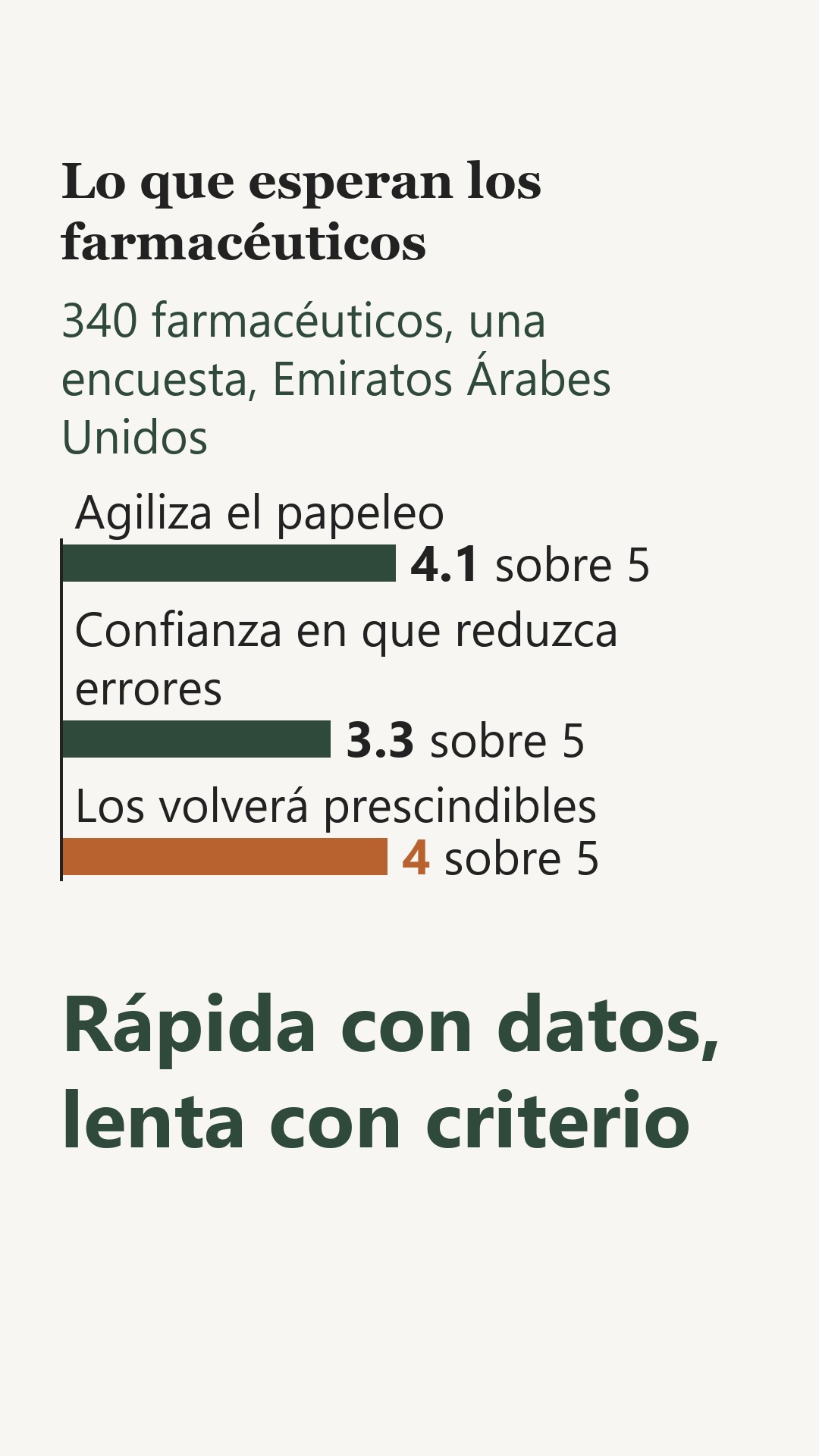
En los Emiratos Árabes Unidos, 340 farmacéuticos con licencia contestaron un cuestionario entre enero y mayo de 2024. Así ve su trabajo quien responde una encuesta. En los Emiratos Árabes Unidos, 340 farmacéuticos con licencia contestaron un cuestionario entre enero y mayo de 2024. Eran 400 invitados y respondieron 340, el 85%.
La mayor calificación fue para la rapidez: 4.1 de 5 para hacer varias tareas a la vez y analizar datos. Mejorar el servicio de farmacia sacó 3.9, y el seguimiento de pacientes, 3.8.
Con el fondo clínico fueron más cautos. Reducir errores de medicación quedó en 3.3 y bajar el costo de la atención, en 3.1. Nadie probó aquí ninguna herramienta: se preguntó qué esperan.
Lo que más les preocupa son los ataques informáticos y la privacidad de los datos del paciente. Los ataques informáticos sacaron 4.2; la privacidad de los datos del paciente, 4.1; que la IA vuelva prescindible al personal de salud, 4.0; y que se pierda el trato humano, 4.0. También pesó el costo alto de instalar estos sistemas, con 4.0.
Es una sola encuesta, hecha una vez y en un solo país, con personas reclutadas por cercanía. Describe lo que esperan esos 340 farmacéuticos de los Emiratos, no lo que pasará con el empleo ni con el sueldo en Estados Unidos, Canadá o América Latina. Nada aquí muestra que la IA haya cambiado un puesto de trabajo.
Quienes dijeron entender mejor la IA reportaron más beneficios y menos temores. Los de menos años de experiencia y quienes atienden a más de 50 personas al día también vieron más ventajas. El estudio no puede decir qué vino primero, el conocimiento o la buena disposición, ni descarta que otro factor explique esas diferencias.
Mire las herramientas que llegan a su mostrador. Si le venden rapidez y papeleo, va en la dirección de lo que estos farmacéuticos calificaron alto. Si le prometen decidir el tratamiento, ahí es donde ellos pusieron su desconfianza.
Qué significa para usted
Para su oficio, lo que puede hacer es escuchar cómo le presentan la herramienta: si le ofrecen rapidez para el papeleo, va en la dirección de lo que estos farmacéuticos calificaron alto; si le prometen decidir por usted en un asunto delicado, ahí ellos pusieron su desconfianza. Pregunte también quién responde si los datos de un cliente se filtran, porque esa fue su mayor preocupación. Y no concluya todavía que su puesto está en juego: nadie aquí midió eso.
Said, A. S. A., Al-Ahmad, M. M., Shanableh, S. et al. (2026). Artificial intelligence in pharmacy practice: pharmacists’ perceptions and concerns toward implementation. Frontiers in Digital Health. https://doi.org/10.3389/fdgth.2026.1797213
Quién pagó: La Universidad de Ajman, en los Emiratos Árabes Unidos, pagó la tasa de procesamiento del artículo; los autores declararon no tener relaciones comerciales ni financieras que pudieran constituir un conflicto de interés, y el artículo no menciona prestadores de equipos ni de software.
No tome esto como consejo médico profesional.
Versión detalladaLos pasajes copiados del artículo, las ilustraciones y cada fuente con cuánto leímos de ella · 1282 palabras · unos 6 minLeerla →Cerrar
Los farmacéuticos de Emiratos ven la IA como buena para los datos y mala para su empleo
Una encuesta a 340 farmacéuticos encontró confianza en las tareas operativas y miedo en las decisiones clínicas. Los investigadores piden formación y reglas claras.
Un mostrador de farmacia, una receta con tres medicamentos que se contradicen entre sí, y un farmacéutico que tiene diez minutos para revisarla. Ese es el lugar donde el estudio quiso mirar. Los investigadores preguntaron a farmacéuticos de Emiratos Árabes Unidos qué esperan de la inteligencia artificial en su trabajo, y lo mejor calificado fue su capacidad para hacer varias cosas a la vez y analizar datos rápido, seguida de la mejora de los servicios de farmacia y del apoyo al seguimiento de pacientes.1
El estudio fue una encuesta transversal adaptada de trabajos ya publicados para medir las percepciones de los farmacéuticos de Emiratos. Invitaron a 400 y les regresaron 340 cuestionarios completos, el 85 por ciento.23
Lo mejor calificado fue la capacidad de la IA para hacer varias cosas a la vez y analizar datos rápido: 4.1 sobre 5. Le siguieron la mejora de los servicios de farmacia, con 3.9, y el apoyo al seguimiento de pacientes, con 3.8.1 En cambio, las promesas clínicas quedaron a media tabla: mejorar los resultados de los pacientes, 3.5; reducir errores de medicación, 3.3; y bajar el costo de la atención, 3.1.4
Las preocupaciones más altas no fueron sobre la máquina, sino sobre lo que la rodea. La vulnerabilidad a ataques cibernéticos encabezó la lista con 4.2; la privacidad de los datos de pacientes llegó a 4.1.5 Y ahí no terminó: los encuestados temieron que la IA vuelva prescindibles a los profesionales de la salud, con 4.0, y que reduzca la comunicación y la empatía, también con 4.0.67 Que la IA sustituya al farmacéutico general promedió 3.9, y que vuelva la carrera menos atractiva, 3.5.6
Piense en lo que hace un farmacéutico hoy. El artículo describe que la farmacia dejó de ser un lugar donde solo se entregan cajas: ahora el farmacéutico revisa tratamientos, ajusta dosis y sigue a pacientes crónicos, tareas que exigen procesar mucha información y tomar decisiones clínicas.8 El artículo describe que la IA que se discute aquí hace justamente eso: simula análisis de datos, predice enfermedades y sugiere tratamientos personalizados.9 El artículo describe el atractivo para quien carga con un mostrador lleno: automatizar lo repetitivo y reducir el error humano.9 El problema es que la misma herramienta que ordena la fila también opina sobre el enfermo, y ahí es donde los encuestados frenaron.
No es la primera vez que se mide esta opinión en la región. El artículo describe estudios hechos en Jordania y Arabia Saudita que reportaron actitudes generalmente positivas hacia la IA, junto con preocupaciones por el costo, la capacitación y la confianza en las decisiones que toma el sistema.10 Lo que faltaba era justamente el dato de Emiratos, y por eso los autores armaron este cuestionario a partir de trabajos ya publicados.2
Vale la pena detenerse en quiénes respondieron. Solo un tercio dijo tener conocimientos básicos de IA; 46 por ciento admitió que no los tiene, y el resto se quedó en neutro.11 Es decir, una parte mayor de los encuestados dijo no tener conocimientos básicos de IA. El estudio encontró que quienes decían entender mejor la IA veían más beneficios y menos riesgos, y que quienes trabajaban en farmacias con más de 50 visitantes diarios también se mostraron más positivos.1213 Los farmacéuticos de comunidad, en cambio, expresaron más preocupación que los de hospital.14
Hay que decir con claridad lo que este estudio no puede mostrar. Fue una sola encuesta, en un solo momento, sin grupo de comparación y sin ningún sistema de IA puesto a prueba. Mide lo que la gente espera, no lo que ocurre. Los autores lo admiten: la muestra se reclutó por conveniencia y por redes profesionales, lo que puede sesgar quién respondió, y no se puede descartar que quienes no contestaron piensen distinto.15 Tampoco se hizo un análisis que separara el peso de cada factor, lo que limita la posibilidad de identificar qué variables predicen por sí solas la aceptación de la IA.
Para dimensionar el asunto: esto no es un debate sobre un aparato que llena frascos. La IA que se discute aquí entra en el terreno de las decisiones clínicas, y eso la coloca en la misma familia de discusiones que otros oficios calificados están teniendo. Un estudio cualitativo con 32 profesionales inmigrantes de entre 50 y 55 años en cuatro sectores afectados por la IA describió un patrón que llamó "doble desplazamiento": la exclusión de las redes profesionales locales se suma a la degradación de experto autónomo a validador pasivo de la máquina.1617 Otro trabajo, con 33 participantes de la industria del transporte de carga en Estados Unidos, encontró que los involucrados ven posibles mejoras de seguridad y eficiencia, pero también temen el desplazamiento laboral y los huecos regulatorios.1819
Así lo leemos nosotros. Lo que aparece en esta encuesta no es solo miedo a perder el empleo: es la incomodidad de que la herramienta cargue con las tareas que dan prestige y deje al profesional supervisando lo que ya no controla. Si eso se confirma, en los mostradores de farmacia de nuestra región veríamos primero la IA encargada de inventarios, interacciones y recordatorios, y después una presión creciente para que el farmacéutico firme lo que el sistema sugiere. Sabríamos que nos equivocamos si los propios farmacéuticos piden la herramienta para las decisiones delicadas, o si la adopción viene de ellos y no de la administración. Lo que usted puede hacer es concreto: cuando en su trabajo entre una herramienta automática, pregunte quién responde cuando falla y qué decisiones se están trasladando a la máquina sin que nadie lo diga. Anote qué tareas se delegan primero y quién las autoriza.
La otra parte de la lectura tiene que ver con lo que la encuesta capta y lo que no. Una encuesta recoge lo que la gente dice en un cuestionario, no lo que hace cuando el sistema falla a las once de la mañana con la fila llena. Los propios autores señalan que la muestra se reclutó por conveniencia, así que las voces de farmacias pequeñas o con poco personal pueden haber quedado cortas.15 Ante cualquier encuesta sobre su oficio, conviene preguntarse quién respondió y quién no; y en su propio trabajo, contrastar lo que dicen sus colegas con lo que hacen cuando la herramienta se equivoca.
Los autores del estudio no se quedan en el diagnóstico. Concluyen que atender estas preocupaciones exige que la IA complemente el papel del farmacéutico en lugar de reemplazarlo, y que eso requiere educación actualizada, capacitación específica y marcos regulatorios claros.20 Es una hoja de ruta razonable, aunque nadie en el estudio midió si esas medidas funcionan.
Aquí está lo que nos queda claro después de leer todo esto. La pregunta que un farmacéutico puede llevar a su próxima junta no es si la IA es buena o mala: es qué tareas de su jornada son puro procedimiento y cuáles exigen su criterio, y en cuáles la administración está pensando delegar. Si la herramienta le pide decidir, es una cosa; si le pide solo ejecutar, es otra. Esa distinción no la resuelve ninguna encuesta, pero cualquier trabajador puede hacerla por escrito y llevarla a la mesa.
Volvamos al mostrador con la receta de tres medicamentos. El farmacéutico de la encuesta confía en que la máquina le ordene los datos y desconfía de que le diga qué hacer con el paciente. Esa línea, entre ordenar y decidir, es la que va a definir su trabajo en los próximos años. ¿Usted sabe dónde está la suya?
De dónde sale cada dato de contexto, y cuánto leímos de cada documento
- Said, A. S. A., Al-Ahmad, M. M., Shanableh, S. et al. (2026). Artificial intelligence in pharmacy practice: pharmacists’ perceptions and concerns toward implementation. Frontiers in Digital Health. https://doi.org/10.3389/fdgth.2026.1797213 - el artículo del que trata esta nota — el artículo completo — el pasaje: "The highest mean scores were observed for AI's ability to multitask and analyse data efficiently (4.1 ± 0.9), improve pharmacy services (3.9 ± 1.0), and enhance the pharmacist's role in patient follow-up (3.8 ± 1.1)."
- Said, A. S. A., Al-Ahmad, M. M., Shanableh, S. et al. (2026). Artificial intelligence in pharmacy practice: pharmacists’ perceptions and concerns toward implementation. Frontiers in Digital Health. https://doi.org/10.3389/fdgth.2026.1797213 - el artículo del que trata esta nota — el artículo completo — el pasaje: "This was an observational cross-sectional study, utilizing a survey that was adapted from previously published studies ( 3 , 4 , 9 , 14 – 16 ) to assess UAE Pharmacists' perceptions of benefits, concerns, and barriers regarding AI implementation in pharmacy Practice."
- Said, A. S. A., Al-Ahmad, M. M., Shanableh, S. et al. (2026). Artificial intelligence in pharmacy practice: pharmacists’ perceptions and concerns toward implementation. Frontiers in Digital Health. https://doi.org/10.3389/fdgth.2026.1797213 - el artículo del que trata esta nota — el artículo completo — el pasaje: "A total of 400 pharmacists were invited to participate in the study; however, 340 completed questionnaires were returned and included in the final analysis, resulting in a response rate of 85%."
- Said, A. S. A., Al-Ahmad, M. M., Shanableh, S. et al. (2026). Artificial intelligence in pharmacy practice: pharmacists’ perceptions and concerns toward implementation. Frontiers in Digital Health. https://doi.org/10.3389/fdgth.2026.1797213 - el artículo del que trata esta nota — el artículo completo — el pasaje: "In contrast, more moderate perceptions were reported for improving patient satisfaction (3.5 ± 1.1), reducing medication errors (3.3 ± 1.2), and enhancing tailored pharmaceutical care plans (3.6 ± 1.0)."
- Said, A. S. A., Al-Ahmad, M. M., Shanableh, S. et al. (2026). Artificial intelligence in pharmacy practice: pharmacists’ perceptions and concerns toward implementation. Frontiers in Digital Health. https://doi.org/10.3389/fdgth.2026.1797213 - el artículo del que trata esta nota — el artículo completo — el pasaje: "Participants expressed considerable concerns regarding patient data privacy (4.1 ± 0.9) and the vulnerability of AI systems to cybersecurity threats, including hacking and data breaches (4.2 ± 0.8)."
- Said, A. S. A., Al-Ahmad, M. M., Shanableh, S. et al. (2026). Artificial intelligence in pharmacy practice: pharmacists’ perceptions and concerns toward implementation. Frontiers in Digital Health. https://doi.org/10.3389/fdgth.2026.1797213 - el artículo del que trata esta nota — el artículo completo — el pasaje: "the majority of participants expressed concerns that AI could replace pharmacists in the foreseeable future (3.9 ± 1.1), make healthcare professionals expendable ((4.0 ± 1.0), and make the pharmacy career less attractive to pursue (3.5 ± 1.2)."
- Said, A. S. A., Al-Ahmad, M. M., Shanableh, S. et al. (2026). Artificial intelligence in pharmacy practice: pharmacists’ perceptions and concerns toward implementation. Frontiers in Digital Health. https://doi.org/10.3389/fdgth.2026.1797213 - el artículo del que trata esta nota — el artículo completo — el pasaje: "A high level of concern was also reported regarding the potential dehumanization of the profession due to reduced communication and empathy (4.0 ± 0.9)."
- Said, A. S. A., Al-Ahmad, M. M., Shanableh, S. et al. (2026). Artificial intelligence in pharmacy practice: pharmacists’ perceptions and concerns toward implementation. Frontiers in Digital Health. https://doi.org/10.3389/fdgth.2026.1797213 - el artículo del que trata esta nota — el artículo completo — el pasaje: "The recent shift in pharmacy practice from a product-oriented model to a more patient-centred approach has expanded pharmacists' responsibilities. Pharmacists are now more involved in clinical services, including medication reviews, therapeutic optimization, and individualized patient care, which require efficient data processing and informed clinical decision-making"
- Said, A. S. A., Al-Ahmad, M. M., Shanableh, S. et al. (2026). Artificial intelligence in pharmacy practice: pharmacists’ perceptions and concerns toward implementation. Frontiers in Digital Health. https://doi.org/10.3389/fdgth.2026.1797213 - el artículo del que trata esta nota — el artículo completo — el pasaje: "The ability of AI to simulate intelligent human behaviour in healthcare, such as data analysis, disease prediction, and personalised therapeutic recommendations, is highly desirable as it can automate repetitive tasks, reduce human error, and provide high-quality patient care"
- Said, A. S. A., Al-Ahmad, M. M., Shanableh, S. et al. (2026). Artificial intelligence in pharmacy practice: pharmacists’ perceptions and concerns toward implementation. Frontiers in Digital Health. https://doi.org/10.3389/fdgth.2026.1797213 - el artículo del que trata esta nota — el artículo completo — el pasaje: "Several regional studies have explored pharmacists' perceptions of artificial intelligence (AI), particularly in Jordan and Saudi Arabia, reporting generally positive attitudes toward its adoption alongside concerns related to cost, training, and trust in AI-driven decisions"
- Said, A. S. A., Al-Ahmad, M. M., Shanableh, S. et al. (2026). Artificial intelligence in pharmacy practice: pharmacists’ perceptions and concerns toward implementation. Frontiers in Digital Health. https://doi.org/10.3389/fdgth.2026.1797213 - el artículo del que trata esta nota — el artículo completo — el pasaje: "The level of basic AI understanding varied among participants. A small percentage of participants strongly agreed/agreed that they have basic AI understanding (33%), compared to 46% who disagreed/strongly disagreed with the statement, and 21% who were neutral about AI understanding."
- Said, A. S. A., Al-Ahmad, M. M., Shanableh, S. et al. (2026). Artificial intelligence in pharmacy practice: pharmacists’ perceptions and concerns toward implementation. Frontiers in Digital Health. https://doi.org/10.3389/fdgth.2026.1797213 - el artículo del que trata esta nota — el artículo completo — el pasaje: "Pharmacists with higher levels of AI understanding demonstrated more positive perceptions and fewer concerns compared to those with lower levels of knowledge ( p < 0.05), suggesting that familiarity with AI enhances acceptance."
- Said, A. S. A., Al-Ahmad, M. M., Shanableh, S. et al. (2026). Artificial intelligence in pharmacy practice: pharmacists’ perceptions and concerns toward implementation. Frontiers in Digital Health. https://doi.org/10.3389/fdgth.2026.1797213 - el artículo del que trata esta nota — el artículo completo — el pasaje: "Similarly, pharmacists with fewer years of experience and those working in high-volume settings (>50 daily visitors) reported more positive perceptions toward AI implementation ( p < 0.05), which may reflect greater openness to technological innovation and the perceived usefulness of AI in managing workload demands."
- Said, A. S. A., Al-Ahmad, M. M., Shanableh, S. et al. (2026). Artificial intelligence in pharmacy practice: pharmacists’ perceptions and concerns toward implementation. Frontiers in Digital Health. https://doi.org/10.3389/fdgth.2026.1797213 - el artículo del que trata esta nota — el artículo completo — el pasaje: "In contrast, community pharmacists reported significantly higher levels of concern compared to hospital pharmacists ( p = 0.042), possibly due to differences in practice environment, infrastructure, and exposure to advanced healthcare technologies."
- Said, A. S. A., Al-Ahmad, M. M., Shanableh, S. et al. (2026). Artificial intelligence in pharmacy practice: pharmacists’ perceptions and concerns toward implementation. Frontiers in Digital Health. https://doi.org/10.3389/fdgth.2026.1797213 - el artículo del que trata esta nota — el artículo completo — el pasaje: "Second, convenience sampling and recruitment through professional networks may introduce selection bias and limit representativeness. Despite the high response rate, non-response bias cannot be excluded, as non-participants may differ from respondents in their perceptions or experiences with artificial intelligence."
- Mihajlov M, Pavleska T. (2026). Too old, too foreign, too replaceable? How AI shapes livelihood security of ageing immigrants. Frontiers in Sociology. 10.3389/fsoc.2026.1897614 — solo el resumen - no se pudo obtener el texto completo — el pasaje: "This qualitative study explored the lived experiences of 32 older immigrant professionals aged 50-55 across four AI-disrupted sectors: Healthcare, Finance, Marketing, and Information Technology."
- Mihajlov M, Pavleska T. (2026). Too old, too foreign, too replaceable? How AI shapes livelihood security of ageing immigrants. Frontiers in Sociology. 10.3389/fsoc.2026.1897614 — solo el resumen - no se pudo obtener el texto completo — el pasaje: "Ten themes revealed a pattern termed Double Displacement: the compounding of chronic socio-cultural exclusion from domestic professional networks with the acute techno-cognitive demotion from autonomous expert to passive machine validator."
- Wandenkolk I, Pamarthi J, Becic I, Lee H, Riessman R, Roberts SC. (2026). $Stakeholder perspectives on the future of trucking in an automated world. Transportation Research Interdisciplinary Perspectives. 10.1016/j.trip.2026.102309 — solo el resumen - no se pudo obtener el texto completo — el pasaje: "Semi-structured interviews were conducted with 33 U.S.-based participants representing five stakeholder groups: truck drivers, trucking companies, truck driving schools, technology developers, and policymakers."
- Wandenkolk I, Pamarthi J, Becic I, Lee H, Riessman R, Roberts SC. (2026). $Stakeholder perspectives on the future of trucking in an automated world. Transportation Research Interdisciplinary Perspectives. 10.1016/j.trip.2026.102309 — solo el resumen - no se pudo obtener el texto completo — el pasaje: "Stakeholders identified AI’s potential to improve safety and efficiency, but raised concerns about job displacement, regulatory gaps, and human oversight."
- Said, A. S. A., Al-Ahmad, M. M., Shanableh, S. et al. (2026). Artificial intelligence in pharmacy practice: pharmacists’ perceptions and concerns toward implementation. Frontiers in Digital Health. https://doi.org/10.3389/fdgth.2026.1797213 - el artículo del que trata esta nota — el artículo completo — el pasaje: "Addressing these concerns requires ensuring that AI complements, rather than replaces, pharmacists' roles, supported by updated education, targeted training, and clear regulatory frameworks."
Said, A. S. A., Al-Ahmad, M. M., Shanableh, S. et al. (2026). Artificial intelligence in pharmacy practice: pharmacists’ perceptions and concerns toward implementation. Frontiers in Digital Health. https://doi.org/10.3389/fdgth.2026.1797213
Quién pagó: La Universidad de Ajman, en los Emiratos Árabes Unidos, pagó la tasa de procesamiento del artículo; los autores declararon no tener relaciones comerciales ni financieras que pudieran constituir un conflicto de interés, y el artículo no menciona prestadores de equipos ni de software.
No tome esto como consejo médico profesional.
Los hallazgos de otros estudios que aquí se mencionan los conocemos por este documento, que fue el que leímos; no abrimos cada uno de esos estudios.
survey · Frontiers in digital health · the paper, 18 Jun 2026 · free
Pharmacists Expect AI to Speed Up the Paperwork. They Also Expect It to Make Them Expendable.
A 2024 survey of 340 pharmacists in the United Arab Emirates found high hopes for speed and high fears about privacy and jobs. It records what they expect, and it cannot show what will happen to anyone's job.
Short version · the longer version follows, about 6 min
Ask the weeklyAI chat
Ask me about this study: who was studied, what it found, and what it does not say.
Conversations are saved for as long as weeklyAI exists, to improve the publication. Answers come in the language you write in.
- The study at a glance
- Who
- licensed pharmacists in hospitals and community pharmacies
- How many
- 340 completed questionnaires
- Where
- United Arab Emirates
- When
- between January and May 2024
- Kind of study
- survey
- Who did it
- Al Ain University and Ajman University
- The limit that matters
- One snapshot, recruited by convenience; records expectations, not what happened to jobs or pay.
Shares of the 340 pharmacists surveyed in the UAE who agreed, disagreed or stayed neutral on having a basic understanding of AI.
Worry levels by pharmacy setting
community pharmacists reported significantly higher levels of concern
These pharmacists trusted AI most with the first and feared it most in the second.

If software is coming for your work, you want to know what it will do first. In pharmacy, the answer from the people who fill the prescriptions is paperwork and speed.
Researchers at Al Ain University and Ajman University asked 340 licensed pharmacists in the United Arab Emirates how they see AI entering their work. They sent the survey in 2024, through a web form and face to face. Four hundred pharmacists were invited; 340 completed it.
The highest agreement went to speed. Pharmacists rated AI's ability to handle several tasks at once and analyze data quickly at 4.1 out of 5. Improved pharmacy services scored 3.9, and better patient follow-up scored 3.8.
The clinical core drew less confidence. Fewer pharmacists believed AI would reduce medication errors (3.3) or lower the cost of care (3.1). This is how they rated the idea on a questionnaire. No AI system was put to work in a pharmacy for this study.
Their worries were sharper than their hopes. Cybersecurity threats scored 4.2, the highest number in the survey. Patient data privacy scored 4.1. The belief that AI will make healthcare professionals expendable scored 4.0, and so did the fear that it will reduce human contact and empathy. That AI could replace a general pharmacist scored 3.9.
This is one survey of 340 pharmacists in one country, taken once. It cannot show whether AI is adding jobs, cutting them or changing pay. It records what these workers expect.
Read the survey in a row and a pattern shows. Pharmacists who said they understood AI better reported more benefits and fewer fears. The study cannot say which came first. It also did not check whether other things, such as how much training a pharmacist had, explain the difference.
Those with one to five years of experience also reported more benefits than those with more than ten. They reported more concern as well. Community pharmacists, who fill prescriptions in neighborhood shops, reported more concern than hospital pharmacists. The study reports these as patterns in the answers, not causes.
So watch the tools that arrive at your workplace. Are they sold for speed and paperwork, or for clinical decisions? These pharmacists trusted AI most with the first and feared it most in the second.
What this means for you
Watch the tools that arrive where you work, and who is asked to trust them with what. These pharmacists rated the software highest for speed and paperwork and lower for clinical decisions, and their sharpest fears were about privacy and their own place in the job. Nobody has yet measured whether any of it happened.
Said, A. S. A., Al-Ahmad, M. M., Shanableh, S. et al. (2026). Artificial intelligence in pharmacy practice: pharmacists’ perceptions and concerns toward implementation. Frontiers in Digital Health. https://doi.org/10.3389/fdgth.2026.1797213
Who paid: Ajman University in the United Arab Emirates paid the article processing charge; the authors declared no commercial or financial relationships that could be a conflict of interest, and the article names no equipment or software lenders.
Do not take this as professional medical advice.
The longer versionThe passages copied from the paper, the pictures, and every source with how much of it we read · 1195 words · about 6 minRead it →Close
Pharmacists in the UAE Say AI Can Do the Counting. They Don't Trust It With the Judgment.
A survey of 340 pharmacists in the United Arab Emirates found them hopeful about speed and paperwork, and worried about privacy, errors, and their own place behind the counter.
The questionnaire went to 400 licensed pharmacists working in hospitals and community pharmacies across the United Arab Emirates, and 340 came back filled in, a response rate of 85%1. Between January and May 2024 they rated nine possible benefits and eighteen possible concerns of artificial intelligence in their work, each on a five-point scale from strongly disagree to strongly agree2.
The top benefit was not clinical at all. Pharmacists gave their highest average score, 4.1 out of 5, to AI's ability to handle several tasks at once and analyze data quickly3. Improved pharmacy services came next at 3.9, and help with patient follow-up at 3.83. The scores fell when the questions turned to medicine itself: 3.5 for better patient outcomes, 3.3 for fewer medication errors, 3.1 for lower costs of care4.
The concerns ran hotter than the hopes. Cybersecurity threats drew the highest average of the whole survey, 4.2, and patient data privacy 4.15. Pharmacists also feared that AI would make health professionals expendable, at 4.0, and that it could replace pharmacists outright, at 3.96. Reduced human contact and empathy scored 4.07. A separate item put the worry that AI makes a pharmacy career less attractive at 3.56.
The survey also asked how well people understood AI to begin with. About a third, 33%, agreed or strongly agreed they had a basic grasp of it; 46% disagreed or strongly disagreed, and 21% sat in the middle8. Those who claimed understanding reported more benefit and less concern9.
The patterns by workplace are worth a look. Community pharmacists, two-thirds of the sample, were significantly more worried than hospital pharmacists10. Pharmacists seeing more than 50 visitors a day, and those with fewer years on the job, were more positive11.
What this survey cannot do is just as important. It is one snapshot, taken once, from a survey adapted from earlier studies2. It records what pharmacists expect, not what happened to hiring, pay or error rates. The authors recruited by convenience and through professional networks, and say each of these may have skewed who answered; they could not rule out that people who skipped the survey differ from those who filled it in12. They ran no analysis to separate the influence of experience, setting and knowledge from one another, so the demographic patterns are associations, not causes.
Consider what has happened to the job itself. Pharmacy has moved from a product-based trade, handing over boxes, toward clinical services: medication reviews, adjusting therapy, following individual patients, all of which demand fast processing of a lot of information13. That is precisely the kind of work a data-hungry system can assist with. The technology described in the paper analyzes data, predicts disease, and suggests personalized treatment, automating repetitive tasks and, in principle, cutting human error14. Whether it does any of that in a real pharmacy is a separate question, and this survey did not ask it.
Other researchers have put the same question to pharmacists in the region. The article describes studies in Jordan and Saudi Arabia that found generally positive attitudes toward AI, alongside worries about cost, training and trusting a machine's decisions15. The UAE had no such study until this one, which is why the authors ran it.
A wider body of work suggests the worry about being replaced is not unique to pharmacy. A qualitative study of 32 older immigrant professionals, aged 50 to 55, across healthcare, finance, marketing and information technology described what its authors called "double displacement": exclusion from professional networks combined with a demotion from autonomous expert to passive validator of machine output1617. We could read only the summary of that study; the full paper is behind a subscription. It also found that the multicultural assets migration had given those workers were turned, by AI systems, into drivers of late-career obsolescence18.
The same tension shows up in trucking. Interviews with 33 people across five groups in the U.S. industry, drivers, companies, driving schools, technology developers and policymakers, found stakeholders expecting safety and efficiency gains while raising concerns about job displacement, regulatory gaps and human oversight1920. We could read only the summary of that study as well. Most of the themes crossed all five groups; some were raised by only one21.
And there is evidence that the fear itself carries weight. A study using a nationally representative sample of 6,247 employed workers in China, matched to industry robot data, found that workers who rated their own jobs as hard to replace were 15.7 percentage points more likely to report higher household income than the year before2223. We could read only the summary. The same study found the effect concentrated in occupations where the tasks are hard to write down as rules, and weakest where tasks are easily codified24.
Here is how we read it. The scores tell a story about where trust stops. Pharmacists were willing to hand over the counting, the sorting and the chasing of patients, and they balked at the deciding. That line is worth watching in any workplace where a new tool arrives: the tasks people surrender first are the ones they never considered the heart of the job.
We also read the training numbers as the real fault line. A pharmacist who says they understand the tool reports less fear. That does not prove the training caused the calm; it may be that calm people seek training. But it points to something an employer can act on, and something a worker can ask about. If a workplace buys the software and skips the teaching, expect the resistance the survey recorded. If it teaches on paid time, expect less.
We would also watch what gets measured. A pharmacist facing a queue of fifty patients is being judged, in most shops, on how fast that queue moves. A tool that speeds the queue looks like salvation and also raises the question of what part of the job goes uncounted. The survey cannot answer that; it can only tell you that the pharmacists in the busiest settings were the most hopeful and the community pharmacists the most worried, and let you decide which of those two you are.
For readers in the United States, Canada or Latin America, the honest limit is this: these were pharmacists in one country, recruited through networks, answering once. Nothing here measures what AI has done to pharmacy wages or staffing anywhere. What travels is the shape of the worry, not the numbers.
The authors' own prescription is modest: AI should complement pharmacists rather than replace them, backed by updated education, targeted training and clear rules25.
The next time a new system appears at your workplace, ask two questions before you judge it. Who can walk me through how it reached that answer, and who is answerable if it is wrong? The pharmacists in this survey trusted the machine with the paperwork and not with the prescription. That is a reasonable place to start.
Where each piece of context comes from, and how much of it we read
- Said, A. S. A., Al-Ahmad, M. M., Shanableh, S. et al. (2026). Artificial intelligence in pharmacy practice: pharmacists’ perceptions and concerns toward implementation. Frontiers in Digital Health. https://doi.org/10.3389/fdgth.2026.1797213 - the article this story is about — the whole article — the passage: "A total of 400 pharmacists were invited to participate in the study; however, 340 completed questionnaires were returned and included in the final analysis, resulting in a response rate of 85%."
- Said, A. S. A., Al-Ahmad, M. M., Shanableh, S. et al. (2026). Artificial intelligence in pharmacy practice: pharmacists’ perceptions and concerns toward implementation. Frontiers in Digital Health. https://doi.org/10.3389/fdgth.2026.1797213 - the article this story is about — the whole article — the passage: "This was an observational cross-sectional study, utilizing a survey that was adapted from previously published studies ( 3 , 4 , 9 , 14 – 16 ) to assess UAE Pharmacists' perceptions of benefits, concerns, and barriers regarding AI implementation in pharmacy Practice."
- Said, A. S. A., Al-Ahmad, M. M., Shanableh, S. et al. (2026). Artificial intelligence in pharmacy practice: pharmacists’ perceptions and concerns toward implementation. Frontiers in Digital Health. https://doi.org/10.3389/fdgth.2026.1797213 - the article this story is about — the whole article — the passage: "The highest mean scores were observed for AI's ability to multitask and analyse data efficiently (4.1 ± 0.9), improve pharmacy services (3.9 ± 1.0), and enhance the pharmacist's role in patient follow-up (3.8 ± 1.1)."
- Said, A. S. A., Al-Ahmad, M. M., Shanableh, S. et al. (2026). Artificial intelligence in pharmacy practice: pharmacists’ perceptions and concerns toward implementation. Frontiers in Digital Health. https://doi.org/10.3389/fdgth.2026.1797213 - the article this story is about — the whole article — the passage: "In contrast, more moderate perceptions were reported for improving patient satisfaction (3.5 ± 1.1), reducing medication errors (3.3 ± 1.2), and enhancing tailored pharmaceutical care plans (3.6 ± 1.0)."
- Said, A. S. A., Al-Ahmad, M. M., Shanableh, S. et al. (2026). Artificial intelligence in pharmacy practice: pharmacists’ perceptions and concerns toward implementation. Frontiers in Digital Health. https://doi.org/10.3389/fdgth.2026.1797213 - the article this story is about — the whole article — the passage: "Participants expressed considerable concerns regarding patient data privacy (4.1 ± 0.9) and the vulnerability of AI systems to cybersecurity threats, including hacking and data breaches (4.2 ± 0.8)."
- Said, A. S. A., Al-Ahmad, M. M., Shanableh, S. et al. (2026). Artificial intelligence in pharmacy practice: pharmacists’ perceptions and concerns toward implementation. Frontiers in Digital Health. https://doi.org/10.3389/fdgth.2026.1797213 - the article this story is about — the whole article — the passage: "the majority of participants expressed concerns that AI could replace pharmacists in the foreseeable future (3.9 ± 1.1), make healthcare professionals expendable ((4.0 ± 1.0), and make the pharmacy career less attractive to pursue (3.5 ± 1.2)."
- Said, A. S. A., Al-Ahmad, M. M., Shanableh, S. et al. (2026). Artificial intelligence in pharmacy practice: pharmacists’ perceptions and concerns toward implementation. Frontiers in Digital Health. https://doi.org/10.3389/fdgth.2026.1797213 - the article this story is about — the whole article — the passage: "A high level of concern was also reported regarding the potential dehumanization of the profession due to reduced communication and empathy (4.0 ± 0.9)."
- Said, A. S. A., Al-Ahmad, M. M., Shanableh, S. et al. (2026). Artificial intelligence in pharmacy practice: pharmacists’ perceptions and concerns toward implementation. Frontiers in Digital Health. https://doi.org/10.3389/fdgth.2026.1797213 - the article this story is about — the whole article — the passage: "The level of basic AI understanding varied among participants. A small percentage of participants strongly agreed/agreed that they have basic AI understanding (33%), compared to 46% who disagreed/strongly disagreed with the statement, and 21% who were neutral about AI understanding."
- Said, A. S. A., Al-Ahmad, M. M., Shanableh, S. et al. (2026). Artificial intelligence in pharmacy practice: pharmacists’ perceptions and concerns toward implementation. Frontiers in Digital Health. https://doi.org/10.3389/fdgth.2026.1797213 - the article this story is about — the whole article — the passage: "Pharmacists with higher levels of AI understanding demonstrated more positive perceptions and fewer concerns compared to those with lower levels of knowledge ( p < 0.05), suggesting that familiarity with AI enhances acceptance."
- Said, A. S. A., Al-Ahmad, M. M., Shanableh, S. et al. (2026). Artificial intelligence in pharmacy practice: pharmacists’ perceptions and concerns toward implementation. Frontiers in Digital Health. https://doi.org/10.3389/fdgth.2026.1797213 - the article this story is about — the whole article — the passage: "In contrast, community pharmacists reported significantly higher levels of concern compared to hospital pharmacists ( p = 0.042), possibly due to differences in practice environment, infrastructure, and exposure to advanced healthcare technologies."
- Said, A. S. A., Al-Ahmad, M. M., Shanableh, S. et al. (2026). Artificial intelligence in pharmacy practice: pharmacists’ perceptions and concerns toward implementation. Frontiers in Digital Health. https://doi.org/10.3389/fdgth.2026.1797213 - the article this story is about — the whole article — the passage: "Similarly, pharmacists with fewer years of experience and those working in high-volume settings (>50 daily visitors) reported more positive perceptions toward AI implementation ( p < 0.05), which may reflect greater openness to technological innovation and the perceived usefulness of AI in managing workload demands."
- Said, A. S. A., Al-Ahmad, M. M., Shanableh, S. et al. (2026). Artificial intelligence in pharmacy practice: pharmacists’ perceptions and concerns toward implementation. Frontiers in Digital Health. https://doi.org/10.3389/fdgth.2026.1797213 - the article this story is about — the whole article — the passage: "Second, convenience sampling and recruitment through professional networks may introduce selection bias and limit representativeness. Despite the high response rate, non-response bias cannot be excluded, as non-participants may differ from respondents in their perceptions or experiences with artificial intelligence."
- Said, A. S. A., Al-Ahmad, M. M., Shanableh, S. et al. (2026). Artificial intelligence in pharmacy practice: pharmacists’ perceptions and concerns toward implementation. Frontiers in Digital Health. https://doi.org/10.3389/fdgth.2026.1797213 - the article this story is about — the whole article — the passage: "The recent shift in pharmacy practice from a product-oriented model to a more patient-centred approach has expanded pharmacists' responsibilities. Pharmacists are now more involved in clinical services, including medication reviews, therapeutic optimization, and individualized patient care, which require efficient data processing and informed clinical decision-making"
- Said, A. S. A., Al-Ahmad, M. M., Shanableh, S. et al. (2026). Artificial intelligence in pharmacy practice: pharmacists’ perceptions and concerns toward implementation. Frontiers in Digital Health. https://doi.org/10.3389/fdgth.2026.1797213 - the article this story is about — the whole article — the passage: "The ability of AI to simulate intelligent human behaviour in healthcare, such as data analysis, disease prediction, and personalised therapeutic recommendations, is highly desirable as it can automate repetitive tasks, reduce human error, and provide high-quality patient care"
- Said, A. S. A., Al-Ahmad, M. M., Shanableh, S. et al. (2026). Artificial intelligence in pharmacy practice: pharmacists’ perceptions and concerns toward implementation. Frontiers in Digital Health. https://doi.org/10.3389/fdgth.2026.1797213 - the article this story is about — the whole article — the passage: "Several regional studies have explored pharmacists' perceptions of artificial intelligence (AI), particularly in Jordan and Saudi Arabia, reporting generally positive attitudes toward its adoption alongside concerns related to cost, training, and trust in AI-driven decisions"
- Mihajlov M, Pavleska T. (2026). Too old, too foreign, too replaceable? How AI shapes livelihood security of ageing immigrants. Frontiers in Sociology. 10.3389/fsoc.2026.1897614 — only the abstract - the full text could not be fetched — the passage: "This qualitative study explored the lived experiences of 32 older immigrant professionals aged 50-55 across four AI-disrupted sectors: Healthcare, Finance, Marketing, and Information Technology."
- Mihajlov M, Pavleska T. (2026). Too old, too foreign, too replaceable? How AI shapes livelihood security of ageing immigrants. Frontiers in Sociology. 10.3389/fsoc.2026.1897614 — only the abstract - the full text could not be fetched — the passage: "Ten themes revealed a pattern termed Double Displacement: the compounding of chronic socio-cultural exclusion from domestic professional networks with the acute techno-cognitive demotion from autonomous expert to passive machine validator."
- Mihajlov M, Pavleska T. (2026). Too old, too foreign, too replaceable? How AI shapes livelihood security of ageing immigrants. Frontiers in Sociology. 10.3389/fsoc.2026.1897614 — only the abstract - the full text could not be fetched — the passage: "A further finding, the foreignness premium, describes how AI systems expropriate the distinctive multicultural and regional professional assets that migration history conferred, turning these assets into drivers of late-career obsolescence."
- Wandenkolk I, Pamarthi J, Becic I, Lee H, Riessman R, Roberts SC. (2026). $Stakeholder perspectives on the future of trucking in an automated world. Transportation Research Interdisciplinary Perspectives. 10.1016/j.trip.2026.102309 — only the abstract - the full text could not be fetched — the passage: "Semi-structured interviews were conducted with 33 U.S.-based participants representing five stakeholder groups: truck drivers, trucking companies, truck driving schools, technology developers, and policymakers."
- Wandenkolk I, Pamarthi J, Becic I, Lee H, Riessman R, Roberts SC. (2026). $Stakeholder perspectives on the future of trucking in an automated world. Transportation Research Interdisciplinary Perspectives. 10.1016/j.trip.2026.102309 — only the abstract - the full text could not be fetched — the passage: "Stakeholders identified AI’s potential to improve safety and efficiency, but raised concerns about job displacement, regulatory gaps, and human oversight."
- Wandenkolk I, Pamarthi J, Becic I, Lee H, Riessman R, Roberts SC. (2026). $Stakeholder perspectives on the future of trucking in an automated world. Transportation Research Interdisciplinary Perspectives. 10.1016/j.trip.2026.102309 — only the abstract - the full text could not be fetched — the passage: "Most subthemes were shared across all five groups, while others were raised by a subset or a single group, revealing both convergence and divergence in how stakeholders understand AI integration."
- Nie R, Bai X, Ding J. (2026). Artificial Intelligence Exposure, Perceived Job Replaceability, and Perceived Income Change: The Moderating Role of Task Codifiability—Evidence from the China General Social Survey. Mathematics. 10.3390/math14152776 — only the abstract - the full text could not be fetched — the passage: "Using a nationally representative sample of 6247 employed workers from the 2021 China General Social Survey matched with industry-level robot penetration data"
- Nie R, Bai X, Ding J. (2026). Artificial Intelligence Exposure, Perceived Job Replaceability, and Perceived Income Change: The Moderating Role of Task Codifiability—Evidence from the China General Social Survey. Mathematics. 10.3390/math14152776 — only the abstract - the full text could not be fetched — the passage: "Second, workers reporting low Perceived Job Replaceability are 15.7 percentage points more likely to report higher household income than last year on the same probability scale."
- Nie R, Bai X, Ding J. (2026). Artificial Intelligence Exposure, Perceived Job Replaceability, and Perceived Income Change: The Moderating Role of Task Codifiability—Evidence from the China General Social Survey. Mathematics. 10.3390/math14152776 — only the abstract - the full text could not be fetched — the passage: "Third, task codifiability moderates this relationship: marginal-effect contrasts show that low Perceived Job Replaceability is associated with a 22.9 percentage-point increase in the probability of reporting higher household income than last year in low-codifiability occupations, compared with only 4.7 percentage points in high-codifiability occupations, indicating a polarization pattern in perceived income change outcomes."
- Said, A. S. A., Al-Ahmad, M. M., Shanableh, S. et al. (2026). Artificial intelligence in pharmacy practice: pharmacists’ perceptions and concerns toward implementation. Frontiers in Digital Health. https://doi.org/10.3389/fdgth.2026.1797213 - the article this story is about — the whole article — the passage: "Addressing these concerns requires ensuring that AI complements, rather than replaces, pharmacists' roles, supported by updated education, targeted training, and clear regulatory frameworks."
Said, A. S. A., Al-Ahmad, M. M., Shanableh, S. et al. (2026). Artificial intelligence in pharmacy practice: pharmacists’ perceptions and concerns toward implementation. Frontiers in Digital Health. https://doi.org/10.3389/fdgth.2026.1797213
Who paid: Ajman University in the United Arab Emirates paid the article processing charge; the authors declared no commercial or financial relationships that could be a conflict of interest, and the article names no equipment or software lenders.
Do not take this as professional medical advice.
The findings of other studies mentioned here are known to us through this document, which is the one we read; we did not open each of those studies.