analysis of texts · Revista da Associacao Medica Brasileira (1992) · la publicación, 24 ago 2026 · gratis
Un chatbot contestó diez preguntas sobre caídas: la mitad de las respuestas venía escrita más difícil de lo recomendable
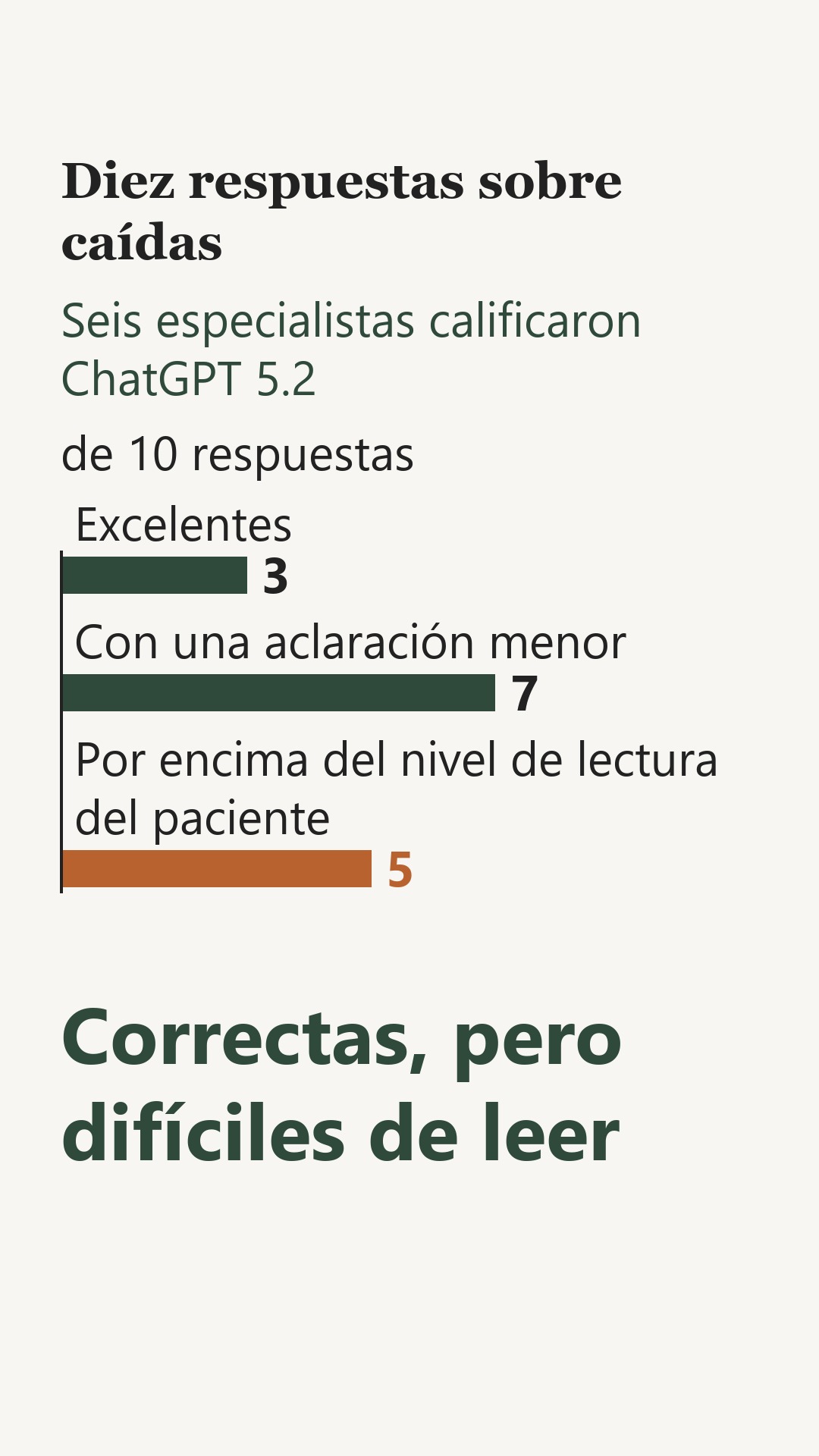
Seis especialistas calificaron las respuestas de ChatGPT 5.2. Tres fueron excelentes y siete satisfactorias con una aclaración menor, pero cinco de las diez superaron el nivel de lectura que se recomienda para materiales de pacientes.
Versión breve · la versión detallada sigue, unos 7 min
Pregunte al chat de weeklyAI
Pregúnteme por este estudio: a quiénes se estudió, qué encontró y qué no dice.
Las conversaciones se guardan mientras exista weeklyAI, para mejorar la publicación. Se responde en el idioma en que usted escribe.
- El estudio, de un vistazo
- Quiénes
- Respuestas de ChatGPT a preguntas sobre caídas en personas mayores
- Cuántos
- Diez preguntas
- Dónde
- Türkiye
- Cuándo
- Enero de 2026
- Tipo de estudio
- analysis of what people did
- Quién lo hizo
- Investigadores de Türkiye, en instituciones de Konya, İzmir y Denizli
- El límite que importa
- Nadie mayor leyó las respuestas: la claridad se estimó con una fórmula, no se probó con personas
Son las diez respuestas de ChatGPT sobre caídas, repartidas según si su nivel de lectura cabía o no en el que se recomienda para materiales de pacientes; la claridad se estimó con una fórmula, no la probó ninguna persona mayor.
Lo que no puede ser es el punto final.
Diez preguntas que cualquiera haría en su casa. ¿Por qué me caigo más fácil ahora que tengo más años? ¿Debo usar bastón o andador dentro de la casa? ¿Y si me caí y no me dolió, no pasa nada? Las diez preguntas se hicieron una por una en ChatGPT 5.2, sin repreguntar nada, y las respuestas se guardaron tal como salieron. Fue en enero de 2026.
Seis profesionales de la salud leyeron cada respuesta: dos fisioterapeutas, un geriatra, un especialista en medicina física y rehabilitación, un terapeuta ocupacional y un ortopedista. Las calificaron con una escala de cuatro niveles. Tres respuestas salieron excelentes. Siete salieron satisfactorias, con ganas de pedir una pequeña aclaración. Ninguna quedó marcada como insuficiente.
El otro número es el de la lectura. Un programa midió qué grado escolar hace falta para entender cada respuesta. El promedio fue 8.4, dentro de una escala que fue de 4.3 a 11.9. Los materiales para pacientes suelen pedirse entre sexto y octavo grado, y cinco de las diez respuestas quedaron por encima.
Los especialistas vieron dos límites en varias respuestas. Las respuestas sobre bastón y andador no siempre decían que la altura y el tipo de apoyo se ajustan a cada persona, con una valoración profesional. Y las respuestas sobre qué hacer después de una caída podían dejar la idea de que, sin dolor, no hay lesión grave. Los especialistas advirtieron que, sin dolor, alguien podría pensar que no hay lesión grave, aunque en una persona mayor puede haber fracturas ocultas o problemas que aparecen después.
Hay que decir qué se probó. Fueron diez preguntas, en una sola versión de ChatGPT y en una sola fecha. Otras preguntas, u otro chatbot, pueden contestar distinto. Nadie mayor leyó las respuestas para decir si las entendió: la claridad se estimó con una fórmula de lectura, y un texto que suena fácil no garantiza que alguien lo haya comprendido. Los especialistas sabían que las respuestas venían de una máquina, y eso pudo inclinar su calificación en un sentido o en otro.
Cuando le pida algo así a un chatbot, fíjese en el largo de las oraciones y en las palabras técnicas. Si la respuesta habla de un bastón, de un andador o de una caída sin dolor, llévela a su médico o a su fisioterapeuta antes de seguirla.
Qué significa para usted
Lo que se probó fueron diez preguntas sobre caídas, hechas a una sola versión de ChatGPT y en una sola fecha. Si en su casa alguien usa un programa así para preguntar por el bastón, el andador o qué hacer después de una caída, conviene llevar esa respuesta al médico o al fisioterapeuta, que son quienes pueden ajustarla a cada persona. Nadie mayor leyó esas respuestas para confirmar que las entendía.
Arı, M., İlçin, N., Yağcıoğlu, H. et al. (2026). Quality, readability, and patient safety of ChatGPT-generated responses to fall-related questions in older adults: a multidisciplinary evaluation. Revista da Associação Médica Brasileira. https://doi.org/10.1590/1806-9282.20260388
Quién pagó: El artículo indica que no hubo financiación y no menciona que ningún financiador ni proveedor de equipos o programas haya tenido participación.
No tome esto como consejo médico profesional.
Versión detalladaLos pasajes copiados del artículo, las ilustraciones y cada fuente con cuánto leímos de ella · 1337 palabras · unos 7 minLeerla →Cerrar
ChatGPT contestó bien sobre caídas, pero la mitad de las respuestas estaba escrita más difícil de lo recomendable
Un panel de seis especialistas calificó diez respuestas del chatbot sobre cómo evitar caídas en casa. Ninguna salió reprobada. Cinco quedaron por encima del nivel de lectura que se aconseja para materiales de pacientes.
Diez preguntas que cualquiera haría sobre caídas y seguridad en casa, escritas tal cual, y enviadas a ChatGPT. Las respuestas se guardaron sin pedirle nada más al programa. Después, seis profesionales las leyeron por separado: dos fisioterapeutas, un geriatra, un especialista en medicina física y rehabilitación, una terapeuta ocupacional y un ortopedista1. El estudio lo firma un equipo de investigadores de Türkiye, en instituciones de Konya, İzmir y Denizli, y no recibió financiamiento; los autores declaran que no tienen conflictos de interés.
El resultado: tres respuestas se consideraron "excelentes" y siete "satisfactorias, con necesidad de una aclaración mínima"2. Ninguna cayó en las categorías de "mediariamente satisfactoria" ni "insatisfactoria"2. En la parte de lectura, la calificación promedio de dificultad fue de 8.4, con un rango que iba de 4.3 a 11.93. Cinco de las diez respuestas se pasaron del nivel que se recomienda para material dirigido a pacientes4. Lo que se recomienda es que esos textos se escriban alrededor de un sexto grado escolar, para que se entiendan y se puedan usar5.
Hay que decir con claridad qué se midió y qué no. No hubo personas mayores leyendo estas respuestas: la comprensión se estimó con una fórmula de lectura, no se probó con nadie6. Se usó una sola versión de ChatGPT en un solo momento, enero de 2026, así que otras versiones u otros chatbots podrían responder distinto7. Los especialistas sabían que el texto venía de una inteligencia artificial, lo cual pudo influir en cómo calificaron. Y las respuestas no traían referencias, de modo que no se evaluó si las fuentes que menciona son reales.
Piense en una cocina cualquiera: el tapete que se corre, la lámpara del pasillo que lleva meses fundida, el baño sin barra junto al excusado. El artículo describe un estudio en el que la mayoría de las caídas en personas mayores ocurre ahí, y la falta de luz, los pisos resbalosos y la ausencia de agarraderas están entre los riesgos que más pesan8. El artículo describe un estudio en el que aproximadamente una de cada tres personas de 65 años o más se cae al menos una vez al año, y esas caídas dejan fracturas de cadera, lesiones, pérdida de independencia y necesidad de cuidados prolongados9.
Lo curioso es que mucha gente ya le pregunta esto a la computadora. Los adultos mayores usan cada vez más herramientas de inteligencia artificial para informarse sobre salud, y los chatbots pueden facilitar el acceso, aunque la calidad, la claridad y la seguridad de lo que responden sobre prevención de caídas siguen sin estar claras10. El artículo describe un estudio en el que un chatbot es un programa al que usted le escribe una pregunta en lenguaje normal y que arma una respuesta con lo que aprendió de enormes cantidades de texto; puede contestar rápido sobre temas médicos y por eso se le ve como una posible herramienta para educar a pacientes11.
No es el primer trabajo que revisa respuestas así. Un estudio que solo pudimos leer en su resumen comparó tres modelos de lenguaje con 90 preguntas sobre depresión en la vejez, repartidas en niveles de riesgo bajo, medio y alto, y dos psiquiatras calificaron las respuestas sin saber cuál modelo las había escrito1213. En ese trabajo hubo respuestas clínicamente aceptables para el 78.9% de las preguntas con ChatGPT, 72.2% con Gemini y 60.0% con Doubao14. Pero en las preguntas de riesgo alto el desempeño bajó, y hubo casos en que el programa no reconoció la gravedad de la situación15. Los propios autores concluyeron que ninguno de los tres modelos fue confiable de manera constante en escenarios complejos o de riesgo16.
Otra investigación, también leída solo en su resumen, entrevistó a 16 personas mayores con varias enfermedades crónicas en un centro de salud urbano del este de China, entre septiembre y diciembre de 202517. Ahí se vio que el uso de estas herramientas no sigue una línea recta: la gente intenta, interrumpe, retoma o abandona del todo18. Y que el buen uso casi nunca depende del esfuerzo de una sola persona, sino de apoyos familiares y sociales19. El estudio no incluyó ensayos clínicos20.
Sobre la confianza, otro trabajo que solo pudimos leer en su resumen encontró algo que vale la pena saber: pacientes, cuidadores y personal de enfermería coincidieron en que estos programas pueden cubrir necesidades de información que hoy no se atienden, pero manifestaron reservas sobre su precisión, su capacidad de personalizar y su transparencia21. Y no los vieron como una amenaza directa para la confianza entre enfermera y paciente22.
Aquí es donde el asunto se pone interesante para una familia. Una respuesta puede estar clínicamente bien y aun así dejar cabos sueltos: en varias de estas diez, la información era correcta pero le faltaba contexto sobre el riesgo de cada persona23. Las respuestas sobre bastones y andaderas no siempre insistían en la importancia de una valoración clínica individual. Las de ejercicios a veces no advertían que hace falta supervisión, que hay límites de equilibrio o que ciertas condiciones de fragilidad contraindican tal o cual movimiento24. Y una respuesta sobre qué hacer después de una caída podía leerse como que si no duele, no hay problema, cuando en una persona mayor puede haber fracturas ocultas o complicaciones que aparecen después25.
Así lo leemos nosotros: el problema no es que el chatbot invente caídas ni que recete de más. El problema es el tono parejo. Una respuesta bien escrita suena igual de segura cuando describe un ejercicio sencillo que cuando roza una decisión que debería pasar por un profesional. Si eso se sostiene, lo que podemos esperar en casa es que la respuesta más fácil de seguir no sea siempre la más indicada para esa persona en particular. Nos equivocaríamos si los estudios con personas mayores mostraran que leen estas respuestas sin confundir los casos simples con los delicados. Mientras tanto, lo que usted puede hacer es leer la respuesta con una pregunta fija: ¿esto me lo puede confirmar alguien que me haya visto caminar?
También leímos otros trabajos y conviene decirlos. Son advertencias generales sobre el consejo médico automatizado, no pruebas sobre las respuestas de este estudio.
¿Qué haría falta para que esto se pudiera usar con más tranquilidad? Los propios autores lo dicen: el contenido de salud generado por inteligencia artificial debería revisarse y adaptarse a las necesidades de comprensión de los adultos mayores antes de usarse en la clínica26. Y proponen que sirva como recurso informativo inicial, que después pasa por revisión profesional, simplificación y puesta en contexto27.
Hay otra cosa que conviene tener presente y que este estudio no resolvió: la comprensión no se probó con adultos mayores, se dedujo de una fórmula6. Y hay barreras conocidas: la baja alfabetización digital y la brecha digital que afecta a los pacientes mayores fueron señaladas como obstáculos importantes para integrar estos programas en la educación de pacientes, según el resumen de otro trabajo28.
Volvamos al tapete de la cocina. La próxima vez que alguien en la familia le pregunte al chatbot por las barras del baño o por los ejercicios para no caerse, la respuesta puede ser un buen punto de partida. Lo que no puede ser es el punto final. Léala en voz alta, en familia, y pida que cada quien diga con sus palabras qué entendió; si algo no se puede repetir con palabras propias, todavía no se entiende. Y antes de cambiar algo en casa o de empezar una rutina de ejercicio, llévelo a quien pueda ver a la persona caminar, levantarse y agacharse: el fisioterapeuta, el geriatra, el médico de cabecera. La pregunta que vale la pena llevar a esa consulta es sencilla: ¿esta recomendación aplica para mí, con mi equilibrio y mis medicamentos, o hay que ajustarla?
De dónde sale cada dato de contexto, y cuánto leímos de cada documento
- Arı, M., İlçin, N., Yağcıoğlu, H. et al. (2026). Quality, readability, and patient safety of ChatGPT-generated responses to fall-related questions in older adults: a multidisciplinary evaluation. Revista da Associação Médica Brasileira. https://doi.org/10.1590/1806-9282.20260388 - el artículo del que trata esta nota — el artículo completo — el pasaje: "Ten frequently asked fall-related questions were submitted to ChatGPT (version 5.2). Responses were independently assessed by a multidisciplinary panel including physiotherapists, a geriatrician, a physical medicine and rehabilitation physician, an occupational therapist, and an orthopedic specialist."
- Arı, M., İlçin, N., Yağcıoğlu, H. et al. (2026). Quality, readability, and patient safety of ChatGPT-generated responses to fall-related questions in older adults: a multidisciplinary evaluation. Revista da Associação Médica Brasileira. https://doi.org/10.1590/1806-9282.20260388 - el artículo del que trata esta nota — el artículo completo — el pasaje: "Three responses were rated as "excellent," while seven responses were rated as "satisfactory requiring minimal clarification." No response received a rating corresponding to "moderately satisfactory" or "unsatisfactory.""
- Arı, M., İlçin, N., Yağcıoğlu, H. et al. (2026). Quality, readability, and patient safety of ChatGPT-generated responses to fall-related questions in older adults: a multidisciplinary evaluation. Revista da Associação Médica Brasileira. https://doi.org/10.1590/1806-9282.20260388 - el artículo del que trata esta nota — el artículo completo — el pasaje: "The mean Flesch-Kincaid Grade Level was 8.4 (range 4.3–11.9). Five responses exceeded the readability levels commonly recommended for patient education materials."
- Arı, M., İlçin, N., Yağcıoğlu, H. et al. (2026). Quality, readability, and patient safety of ChatGPT-generated responses to fall-related questions in older adults: a multidisciplinary evaluation. Revista da Associação Médica Brasileira. https://doi.org/10.1590/1806-9282.20260388 - el artículo del que trata esta nota — el artículo completo — el pasaje: "According to the Flesch-Kincaid analysis, five responses (50%) fell within the recommended sixth–eighth grade readability range, while the remaining five responses (50%) exceeded this range ( Table 3 )."
- Arı, M., İlçin, N., Yağcıoğlu, H. et al. (2026). Quality, readability, and patient safety of ChatGPT-generated responses to fall-related questions in older adults: a multidisciplinary evaluation. Revista da Associação Médica Brasileira. https://doi.org/10.1590/1806-9282.20260388 - el artículo del que trata esta nota — el artículo completo — el pasaje: "These organizations generally recommend that health-related materials be written at approximately a sixth-grade reading level to maximize comprehension and accessibility."
- Arı, M., İlçin, N., Yağcıoğlu, H. et al. (2026). Quality, readability, and patient safety of ChatGPT-generated responses to fall-related questions in older adults: a multidisciplinary evaluation. Revista da Associação Médica Brasileira. https://doi.org/10.1590/1806-9282.20260388 - el artículo del que trata esta nota — el artículo completo — el pasaje: "Third, patient comprehension was inferred from readability formulas rather than direct testing with older adults."
- Arı, M., İlçin, N., Yağcıoğlu, H. et al. (2026). Quality, readability, and patient safety of ChatGPT-generated responses to fall-related questions in older adults: a multidisciplinary evaluation. Revista da Associação Médica Brasileira. https://doi.org/10.1590/1806-9282.20260388 - el artículo del que trata esta nota — el artículo completo — el pasaje: "Second, responses were generated using a single version of ChatGPT at a specific time point; therefore, findings may not be generalizable to other AI models or future versions."
- Arı, M., İlçin, N., Yağcıoğlu, H. et al. (2026). Quality, readability, and patient safety of ChatGPT-generated responses to fall-related questions in older adults: a multidisciplinary evaluation. Revista da Associação Médica Brasileira. https://doi.org/10.1590/1806-9282.20260388 - el artículo del que trata esta nota — el artículo completo — el pasaje: "However, the majority of falls occur in the home environment; inadequate lighting, slippery floors, inappropriate bathroom and toilet arrangements, and the lack of grab bars are among the significant environmental risks 5 ."
- Arı, M., İlçin, N., Yağcıoğlu, H. et al. (2026). Quality, readability, and patient safety of ChatGPT-generated responses to fall-related questions in older adults: a multidisciplinary evaluation. Revista da Associação Médica Brasileira. https://doi.org/10.1590/1806-9282.20260388 - el artículo del que trata esta nota — el artículo completo — el pasaje: "Approximately one-third of individuals aged 65 years and older fall at least once a year, resulting in hip fractures, traumatic injuries, loss of independence, and the need for long-term care 2 ."
- Arı, M., İlçin, N., Yağcıoğlu, H. et al. (2026). Quality, readability, and patient safety of ChatGPT-generated responses to fall-related questions in older adults: a multidisciplinary evaluation. Revista da Associação Médica Brasileira. https://doi.org/10.1590/1806-9282.20260388 - el artículo del que trata esta nota — el artículo completo — el pasaje: "Older adults increasingly use artificial intelligence-based tools to obtain health information. Although artificial intelligence chatbots such as ChatGPT may enhance access, the quality, readability, and patient safety of fall-prevention information remain uncertain."
- Arı, M., İlçin, N., Yağcıoğlu, H. et al. (2026). Quality, readability, and patient safety of ChatGPT-generated responses to fall-related questions in older adults: a multidisciplinary evaluation. Revista da Associação Médica Brasileira. https://doi.org/10.1590/1806-9282.20260388 - el artículo del que trata esta nota — el artículo completo — el pasaje: "Artificial intelligence (AI)-based chatbots can generate quick responses to users’ medical questions and are seen as a potential patient education tool 8 ."
- Xiao W, Zhang H, Chen X, Cai J, Luo X, Deng J. (2026). Large language models for late-life depression: a blinded benchmark of clinical safety, geriatric appropriateness, and triage. Frontiers in Psychiatry. 10.3389/fpsyt.2026.1956736 — solo el resumen - no se pudo obtener el texto completo — el pasaje: "We conducted a blinded, paired benchmarking study using 90 questions covering six geriatric psychiatry domains and equally distributed across low-, moderate-, and high-risk strata."
- Xiao W, Zhang H, Chen X, Cai J, Luo X, Deng J. (2026). Large language models for late-life depression: a blinded benchmark of clinical safety, geriatric appropriateness, and triage. Frontiers in Psychiatry. 10.3389/fpsyt.2026.1956736 — solo el resumen - no se pudo obtener el texto completo — el pasaje: "Two psychiatrists independently evaluated anonymized outputs against prespecified item-specific reference standards, with clinically important disagreements adjudicated by a third senior psychiatrist."
- Xiao W, Zhang H, Chen X, Cai J, Luo X, Deng J. (2026). Large language models for late-life depression: a blinded benchmark of clinical safety, geriatric appropriateness, and triage. Frontiers in Psychiatry. 10.3389/fpsyt.2026.1956736 — solo el resumen - no se pudo obtener el texto completo — el pasaje: "Clinically acceptable responses were generated for 78.9% of questions by ChatGPT, 72.2% by Gemini, and 60.0% by Doubao"
- Xiao W, Zhang H, Chen X, Cai J, Luo X, Deng J. (2026). Large language models for late-life depression: a blinded benchmark of clinical safety, geriatric appropriateness, and triage. Frontiers in Psychiatry. 10.3389/fpsyt.2026.1956736 — solo el resumen - no se pudo obtener el texto completo — el pasaje: "Among high-risk questions, clinically acceptable response rates were 63.3%, 50.0%, and 36.7%, while under-triage occurred in 16.7%, 26.7%, and 36.7% of responses, respectively."
- Xiao W, Zhang H, Chen X, Cai J, Luo X, Deng J. (2026). Large language models for late-life depression: a blinded benchmark of clinical safety, geriatric appropriateness, and triage. Frontiers in Psychiatry. 10.3389/fpsyt.2026.1956736 — solo el resumen - no se pudo obtener el texto completo — el pasaje: "The three models answered many late-life depression questions accurately and safely, but none demonstrated consistently reliable performance across complex or high-risk scenarios."
- Lin Q, Fu M, Chen P, Zhao J, Liu Y, Niu Y, et al. (2026). Dialoguing with algorithms: experiences of generative AI use in navigating complex health decisions among older adults with multimorbidity: a qualitative study. BMC Health Services Research. 10.1186/s12913-026-15158-x — solo el resumen - no se pudo obtener el texto completo — el pasaje: "From September to December 2025, 16 multimorbid seniors were recruited via purposive maximum variation sampling from an urban community health center in eastern China."
- Lin Q, Fu M, Chen P, Zhao J, Liu Y, Niu Y, et al. (2026). Dialoguing with algorithms: experiences of generative AI use in navigating complex health decisions among older adults with multimorbidity: a qualitative study. BMC Health Services Research. 10.1186/s12913-026-15158-x — solo el resumen - no se pudo obtener el texto completo — el pasaje: "The generative AI usage behavior of older adults with multimorbidity exhibited dynamic evolutionary characteristics; its trajectory was not linear acceptance and continuous use, but a complex process involving attempts, interruptions, resumption, or permanent abandonment."
- Lin Q, Fu M, Chen P, Zhao J, Liu Y, Niu Y, et al. (2026). Dialoguing with algorithms: experiences of generative AI use in navigating complex health decisions among older adults with multimorbidity: a qualitative study. BMC Health Services Research. 10.1186/s12913-026-15158-x — solo el resumen - no se pudo obtener el texto completo — el pasaje: "Resource mobilization: Successful use of generative AI rarely depended on independent individual effort but required the mobilization of diverse personal resources and social support."
- Lin Q, Fu M, Chen P, Zhao J, Liu Y, Niu Y, et al. (2026). Dialoguing with algorithms: experiences of generative AI use in navigating complex health decisions among older adults with multimorbidity: a qualitative study. BMC Health Services Research. 10.1186/s12913-026-15158-x — solo el resumen - no se pudo obtener el texto completo — el pasaje: "This study did not involve clinical trials."
- Liu Z, Li Y, Wang J, Liu Q, Chen F, Zhu L, et al. (2026). Integrating AI-Powered Chatbots Into Patient Education From the Perspectives of Patients, Caregivers, and Nurses: Qualitative Study. Journal of Medical Internet Research. 10.2196/87254 — solo el resumen - no se pudo obtener el texto completo — el pasaje: "All 3 stakeholder groups recognized the potential of AI-powered chatbots to address unmet information support needs in patient education but expressed reservations about their accuracy, personalization, and transparency."
- Liu Z, Li Y, Wang J, Liu Q, Chen F, Zhu L, et al. (2026). Integrating AI-Powered Chatbots Into Patient Education From the Perspectives of Patients, Caregivers, and Nurses: Qualitative Study. Journal of Medical Internet Research. 10.2196/87254 — solo el resumen - no se pudo obtener el texto completo — el pasaje: "AI-powered chatbots were not perceived as a direct threat to nurse-patient trust."
- Arı, M., İlçin, N., Yağcıoğlu, H. et al. (2026). Quality, readability, and patient safety of ChatGPT-generated responses to fall-related questions in older adults: a multidisciplinary evaluation. Revista da Associação Médica Brasileira. https://doi.org/10.1590/1806-9282.20260388 - el artículo del que trata esta nota — el artículo completo — el pasaje: "In several responses, the information provided was generally correct but lacked sufficient contextualization or risk stratification."
- Arı, M., İlçin, N., Yağcıoğlu, H. et al. (2026). Quality, readability, and patient safety of ChatGPT-generated responses to fall-related questions in older adults: a multidisciplinary evaluation. Revista da Associação Médica Brasileira. https://doi.org/10.1590/1806-9282.20260388 - el artículo del que trata esta nota — el artículo completo — el pasaje: "Similarly, exercise-related recommendations occasionally lacked clear guidance regarding supervision, balance limitations, or contraindications in frail older adults."
- Arı, M., İlçin, N., Yağcıoğlu, H. et al. (2026). Quality, readability, and patient safety of ChatGPT-generated responses to fall-related questions in older adults: a multidisciplinary evaluation. Revista da Associação Médica Brasileira. https://doi.org/10.1590/1806-9282.20260388 - el artículo del que trata esta nota — el artículo completo — el pasaje: "In addition, responses addressing post-fall situations could potentially be misinterpreted if users assume that the absence of pain excludes serious injury, despite the possibility of occult fractures or delayed complications in older individuals."
- Arı, M., İlçin, N., Yağcıoğlu, H. et al. (2026). Quality, readability, and patient safety of ChatGPT-generated responses to fall-related questions in older adults: a multidisciplinary evaluation. Revista da Associação Médica Brasileira. https://doi.org/10.1590/1806-9282.20260388 - el artículo del que trata esta nota — el artículo completo — el pasaje: "AI-generated health content should be reviewed and tailored to older adults’ health literacy needs before clinical use."
- Arı, M., İlçin, N., Yağcıoğlu, H. et al. (2026). Quality, readability, and patient safety of ChatGPT-generated responses to fall-related questions in older adults: a multidisciplinary evaluation. Revista da Associação Médica Brasileira. https://doi.org/10.1590/1806-9282.20260388 - el artículo del que trata esta nota — el artículo completo — el pasaje: "Instead, AI-generated information may serve as an initial informational resource that requires professional review, simplification, and contextualization to ensure safe and effective use in older adults."
- Liu Z, Li Y, Wang J, Liu Q, Chen F, Zhu L, et al. (2026). Integrating AI-Powered Chatbots Into Patient Education From the Perspectives of Patients, Caregivers, and Nurses: Qualitative Study. Journal of Medical Internet Research. 10.2196/87254 — solo el resumen - no se pudo obtener el texto completo — el pasaje: "Limited digital health literacy and the digital divide affecting older patients were major barriers to integrating AI-powered chatbots into patient education."
Arı, M., İlçin, N., Yağcıoğlu, H. et al. (2026). Quality, readability, and patient safety of ChatGPT-generated responses to fall-related questions in older adults: a multidisciplinary evaluation. Revista da Associação Médica Brasileira. https://doi.org/10.1590/1806-9282.20260388
Quién pagó: El artículo indica que no hubo financiación y no menciona que ningún financiador ni proveedor de equipos o programas haya tenido participación.
No tome esto como consejo médico profesional.
Los hallazgos de otros estudios que aquí se mencionan los conocemos por este documento, que fue el que leímos; no abrimos cada uno de esos estudios.
analysis of texts · Revista da Associacao Medica Brasileira (1992) · the paper, 24 Aug 2026 · free
ChatGPT's Fall Advice: Mostly Approved, Often Too Hard to Read
Six clinicians rated ten answers from ChatGPT 5.2. Three were excellent, seven needed a little explaining, and half were written above the reading level patient materials are usually held to.
Short version · the longer version follows, about 6 min
Ask the weeklyAI chat
Ask me about this study: who was studied, what it found, and what it does not say.
Conversations are saved for as long as weeklyAI exists, to improve the publication. Answers come in the language you write in.
- The study at a glance
- Who
- ChatGPT answers to common fall questions from older adults
- How many
- Ten questions
- Where
- Türkiye
- When
- January 2026
- Kind of study
- analysis of what people did
- Who did it
- Universities in Konya, İzmir and Denizli, Türkiye
- The limit that matters
- Reading scores came from a formula, not from older adults reading the answers.
Shares of the ten ChatGPT answers to fall questions, scored by a reading-level formula rather than by older adults reading them.
Anything about a cane, a walker, or a fall without pain belongs in a conversation with a clinician.

Take one number: five of ten. Half of ChatGPT's answers to common fall questions were written harder than patient handouts should be.
The questions were the kind a person asks at the kitchen table. Why do I fall more easily as I get older? Should I wear slippers or shoes inside the house? How can I get up from a chair more safely? Ten of them were typed into ChatGPT version 5.2, one at a time, with no follow-up prompts. The researchers recorded each answer as it came.
Six clinicians read them: two physiotherapists, an occupational therapist, a geriatrician, an orthopedic specialist and a physical medicine and rehabilitation physician. They rated each answer on a four-level scale. Three answers came back excellent. Seven were satisfactory with minor clarification. None were rated lower.
Then came the reading scores. The average answer needed grade 8.4 to read, on a scale running from 4.3 to 11.9. Patient education materials are usually held to grades six through eight. Five answers sat above that range. Answers about technical topics or where to find professional help scored highest.
The clinicians also found soft spots in the content. Advice on canes and walkers did not always say that a person needs an individual assessment. Exercise suggestions sometimes skipped guidance on supervision and balance limits. Answers about falling without pain could be read as all-clear, though serious injuries can hide.
The answers came from one chatbot version, tested in January 2026. Other versions, or other tools, may answer differently. The reading scores come from a formula, not from older adults reading the answers themselves. The six experts knew the answers came from AI, which may have shaped their ratings.
When a chatbot answers a fall question, look at the sentences. Long, technical ones are a sign the answer was not written for a person managing a cane in a narrow hallway. Anything about a cane, a walker, or a fall without pain belongs in a conversation with a clinician.
What this means for you
If a fall question comes up at home and someone reaches for a chatbot, the answers in this test were mostly rated acceptable by clinicians, though half were written harder than patient handouts should be. Read the sentences closely, and treat anything about a cane, a walker, or a fall without pain as a matter for a clinician rather than the last word from a machine.
Arı, M., İlçin, N., Yağcıoğlu, H. et al. (2026). Quality, readability, and patient safety of ChatGPT-generated responses to fall-related questions in older adults: a multidisciplinary evaluation. Revista da Associação Médica Brasileira. https://doi.org/10.1590/1806-9282.20260388
Who paid: The article states funding: none, and does not say that any funder, equipment or software provider had a role.
Do not take this as professional medical advice.
The longer versionThe passages copied from the paper, the pictures, and every source with how much of it we read · 1194 words · about 6 minRead it →Close
# A Chatbot Answered Ten Fall Questions Well. Half the Answers Were Written Too Hard.
Six clinicians rated ChatGPT's fall-prevention advice for older adults as acceptable or better. The reading level was another matter.
Consider the question a daughter types into a chatbot at eleven at night: her father has fallen twice in the bathroom this year, and she wants to know whether a cane would help him. The answer comes back in seconds, fluent and organized. What the study measured was whether that answer was any good, and whether it was written at a level he could actually use.
Falls are the backdrop. About one in three people aged 65 and older falls at least once a year, and the results include hip fractures, traumatic injuries, loss of independence and the need for long-term care1. Most falls happen at home, where poor lighting, slippery floors, awkward bathrooms and missing grab bars are named among the significant risks2. That makes home safety the center of prevention programs — and a subject families increasingly ask machines about. Older adults are turning to AI tools for health information, and whether the fall-prevention material they get is good, readable and safe remains uncertain3.
The study itself is small and specific. The authors are Merve Arı, Nursen İlçin, Hatice Yağcıoğlu and İlyas Akkar, working from universities in Konya, İzmir and Denizli, Türkiye; the work was published in the Revista da Associação Médica Brasileira, with no funding and no declared conflicts of interest. They posed ten frequently asked fall-related questions to ChatGPT version 5.2 — questions such as whether to wear slippers or shoes indoors, how to get up from a chair safely, whether a cane is at the right height, and whether it is fine to feel no pain after a fall4. Six experts rated each answer: two physiotherapists, an occupational therapist, a geriatric specialist, an orthopedic specialist and a physical medicine and rehabilitation physician4. One version of one chatbot, in January 2026. No patients took part.
Three answers were rated "excellent" and seven "satisfactory, requiring minimal clarification." None was rated moderately satisfactory or unsatisfactory5. On readability, the average score was 8.4 on a scale that estimates the US school grade needed to understand a text, with answers ranging from 4.3 to 11.96. Five of the ten fell inside the recommended sixth-to-eighth-grade range, and five exceeded it7. Patient-education guidelines generally call for about a sixth-grade reading level8.
What the ratings do not show matters as much as what they do. The experts knew the answers came from an AI, which may have colored their scoring either way. The rating scale was originally applied in the context of total hip arthroplasty and has not been specifically validated for fall questions. And comprehension was estimated from a formula, not tested with older adults9. Only one version of ChatGPT at one moment was tried, so other versions or other chatbots may answer differently10. No falls were counted. Nothing here shows that chatbot advice prevents a fall, or causes one.
AI-based chatbots can generate quick responses to users' medical questions and are seen as a potential patient education tool11. The smoothness is the point and the problem: the study found that answers about cane height and walker use did not consistently stress that a clinician should assess each person individually.
Other researchers have watched how this lands with the people involved. In one study of patients, caregivers and nurses — we could read only the summary — all three groups saw the potential of chatbots to fill gaps in patient education but raised doubts about accuracy, personalization and transparency12. Nurses were more alert to the strain on trust and to the extra explaining they would have to do13, and limited digital literacy among older patients was named as a major barrier14.
A second line of work tested the answers themselves. In a blinded comparison of three chatbots answering 90 questions about late-life depression — again, summary only — ChatGPT's responses were clinically acceptable 78.9 percent of the time, Gemini's 72.2 percent and Doubao's 60.0 percent15. On high-risk questions the rates fell to 63.3, 50.0 and 36.7 percent, and responses that underplayed how urgent a situation was ran at 16.7, 26.7 and 36.7 percent16. The authors' conclusion was blunt: none of the three was consistently reliable in complex or high-risk situations17. That study did not look at falls, and this study did not test urgency.
Older adults themselves describe a stop-and-start relationship with these tools. In interviews with 16 people managing several chronic conditions at an urban health center in eastern China — summary only — researchers found use that was not steady adoption but a process of trying, stopping, resuming or abandoning18. Successful use rarely rested on one person alone; it required help from family and others19. The authors argue that design must account for the needs of people with multiple conditions before the technology can be applied safely20.
Here is how we read it. A fluent answer feels like a considered one, and few of us stop to ask whether the machine weighed our father's balance, his blood pressure pills or the loose rug by his bed. What we expect, in homes like yours, is that a confident paragraph about using a walker will be treated as settled — even when it never says that a therapist should check the fit. You would know we were wrong if families routinely said, on their own, that the text sounded fine but might not suit their body or their home.
We also read other work worth keeping in view.
The useful habit is simple. When a chatbot answers a fall question, treat the answer as a first draft to bring to a person who can examine you: a doctor, a physiotherapist, a pharmacist who knows your medications. Ask whether the advice fits your strength, your prescriptions and your home. Notice, too, whether the answer tells you when to stop and get help — not only what to do. An answer that never mentions a warning sign is incomplete, however calm it reads.
The authors' own recommendation points the same way: AI-generated health content should be reviewed and tailored to older adults' literacy needs before clinical use21, and may serve as a starting resource that needs professional review and simplification22. In the answers they rated, information was often correct but lacked context or any sorting of risk23. Advice on getting up after a fall could be misread as meaning that no pain rules out serious injury, despite the possibility of hidden fractures24. Exercise suggestions occasionally skipped guidance on supervision and on limits for frail people25. And the authors say plainly what their method cannot do: they did not test understanding with older adults9.
So take the late-night answer as a beginning. Bring it to the next appointment, ask whether the cane is the right height for him and not for the average person, and ask what signs after a fall mean a call to the doctor that day. The chatbot gave a fluent answer in seconds. The question worth carrying into the clinic is the one it cannot ask: does this fit my father?
Where each piece of context comes from, and how much of it we read
- Arı, M., İlçin, N., Yağcıoğlu, H. et al. (2026). Quality, readability, and patient safety of ChatGPT-generated responses to fall-related questions in older adults: a multidisciplinary evaluation. Revista da Associação Médica Brasileira. https://doi.org/10.1590/1806-9282.20260388 - the article this story is about — the whole article — the passage: "Approximately one-third of individuals aged 65 years and older fall at least once a year, resulting in hip fractures, traumatic injuries, loss of independence, and the need for long-term care 2 ."
- Arı, M., İlçin, N., Yağcıoğlu, H. et al. (2026). Quality, readability, and patient safety of ChatGPT-generated responses to fall-related questions in older adults: a multidisciplinary evaluation. Revista da Associação Médica Brasileira. https://doi.org/10.1590/1806-9282.20260388 - the article this story is about — the whole article — the passage: "However, the majority of falls occur in the home environment; inadequate lighting, slippery floors, inappropriate bathroom and toilet arrangements, and the lack of grab bars are among the significant environmental risks 5 ."
- Arı, M., İlçin, N., Yağcıoğlu, H. et al. (2026). Quality, readability, and patient safety of ChatGPT-generated responses to fall-related questions in older adults: a multidisciplinary evaluation. Revista da Associação Médica Brasileira. https://doi.org/10.1590/1806-9282.20260388 - the article this story is about — the whole article — the passage: "Older adults increasingly use artificial intelligence-based tools to obtain health information. Although artificial intelligence chatbots such as ChatGPT may enhance access, the quality, readability, and patient safety of fall-prevention information remain uncertain."
- Arı, M., İlçin, N., Yağcıoğlu, H. et al. (2026). Quality, readability, and patient safety of ChatGPT-generated responses to fall-related questions in older adults: a multidisciplinary evaluation. Revista da Associação Médica Brasileira. https://doi.org/10.1590/1806-9282.20260388 - the article this story is about — the whole article — the passage: "Ten frequently asked fall-related questions were submitted to ChatGPT (version 5.2). Responses were independently assessed by a multidisciplinary panel including physiotherapists, a geriatrician, a physical medicine and rehabilitation physician, an occupational therapist, and an orthopedic specialist."
- Arı, M., İlçin, N., Yağcıoğlu, H. et al. (2026). Quality, readability, and patient safety of ChatGPT-generated responses to fall-related questions in older adults: a multidisciplinary evaluation. Revista da Associação Médica Brasileira. https://doi.org/10.1590/1806-9282.20260388 - the article this story is about — the whole article — the passage: "Three responses were rated as "excellent," while seven responses were rated as "satisfactory requiring minimal clarification." No response received a rating corresponding to "moderately satisfactory" or "unsatisfactory.""
- Arı, M., İlçin, N., Yağcıoğlu, H. et al. (2026). Quality, readability, and patient safety of ChatGPT-generated responses to fall-related questions in older adults: a multidisciplinary evaluation. Revista da Associação Médica Brasileira. https://doi.org/10.1590/1806-9282.20260388 - the article this story is about — the whole article — the passage: "The mean Flesch-Kincaid Grade Level was 8.4 (range 4.3–11.9). Five responses exceeded the readability levels commonly recommended for patient education materials."
- Arı, M., İlçin, N., Yağcıoğlu, H. et al. (2026). Quality, readability, and patient safety of ChatGPT-generated responses to fall-related questions in older adults: a multidisciplinary evaluation. Revista da Associação Médica Brasileira. https://doi.org/10.1590/1806-9282.20260388 - the article this story is about — the whole article — the passage: "According to the Flesch-Kincaid analysis, five responses (50%) fell within the recommended sixth–eighth grade readability range, while the remaining five responses (50%) exceeded this range ( Table 3 )."
- Arı, M., İlçin, N., Yağcıoğlu, H. et al. (2026). Quality, readability, and patient safety of ChatGPT-generated responses to fall-related questions in older adults: a multidisciplinary evaluation. Revista da Associação Médica Brasileira. https://doi.org/10.1590/1806-9282.20260388 - the article this story is about — the whole article — the passage: "These organizations generally recommend that health-related materials be written at approximately a sixth-grade reading level to maximize comprehension and accessibility."
- Arı, M., İlçin, N., Yağcıoğlu, H. et al. (2026). Quality, readability, and patient safety of ChatGPT-generated responses to fall-related questions in older adults: a multidisciplinary evaluation. Revista da Associação Médica Brasileira. https://doi.org/10.1590/1806-9282.20260388 - the article this story is about — the whole article — the passage: "Third, patient comprehension was inferred from readability formulas rather than direct testing with older adults."
- Arı, M., İlçin, N., Yağcıoğlu, H. et al. (2026). Quality, readability, and patient safety of ChatGPT-generated responses to fall-related questions in older adults: a multidisciplinary evaluation. Revista da Associação Médica Brasileira. https://doi.org/10.1590/1806-9282.20260388 - the article this story is about — the whole article — the passage: "Second, responses were generated using a single version of ChatGPT at a specific time point; therefore, findings may not be generalizable to other AI models or future versions."
- Arı, M., İlçin, N., Yağcıoğlu, H. et al. (2026). Quality, readability, and patient safety of ChatGPT-generated responses to fall-related questions in older adults: a multidisciplinary evaluation. Revista da Associação Médica Brasileira. https://doi.org/10.1590/1806-9282.20260388 - the article this story is about — the whole article — the passage: "Artificial intelligence (AI)-based chatbots can generate quick responses to users’ medical questions and are seen as a potential patient education tool 8 ."
- Liu Z, Li Y, Wang J, Liu Q, Chen F, Zhu L, et al. (2026). Integrating AI-Powered Chatbots Into Patient Education From the Perspectives of Patients, Caregivers, and Nurses: Qualitative Study. Journal of Medical Internet Research. 10.2196/87254 — only the abstract - the full text could not be fetched — the passage: "All 3 stakeholder groups recognized the potential of AI-powered chatbots to address unmet information support needs in patient education but expressed reservations about their accuracy, personalization, and transparency."
- Liu Z, Li Y, Wang J, Liu Q, Chen F, Zhu L, et al. (2026). Integrating AI-Powered Chatbots Into Patient Education From the Perspectives of Patients, Caregivers, and Nurses: Qualitative Study. Journal of Medical Internet Research. 10.2196/87254 — only the abstract - the full text could not be fetched — the passage: "However, nurses were more sensitive to potential trust tensions, increased explanation burden, and expanded professional responsibilities, highlighting the need for competency restructuring."
- Liu Z, Li Y, Wang J, Liu Q, Chen F, Zhu L, et al. (2026). Integrating AI-Powered Chatbots Into Patient Education From the Perspectives of Patients, Caregivers, and Nurses: Qualitative Study. Journal of Medical Internet Research. 10.2196/87254 — only the abstract - the full text could not be fetched — the passage: "Limited digital health literacy and the digital divide affecting older patients were major barriers to integrating AI-powered chatbots into patient education."
- Xiao W, Zhang H, Chen X, Cai J, Luo X, Deng J. (2026). Large language models for late-life depression: a blinded benchmark of clinical safety, geriatric appropriateness, and triage. Frontiers in Psychiatry. 10.3389/fpsyt.2026.1956736 — only the abstract - the full text could not be fetched — the passage: "Clinically acceptable responses were generated for 78.9% of questions by ChatGPT, 72.2% by Gemini, and 60.0% by Doubao"
- Xiao W, Zhang H, Chen X, Cai J, Luo X, Deng J. (2026). Large language models for late-life depression: a blinded benchmark of clinical safety, geriatric appropriateness, and triage. Frontiers in Psychiatry. 10.3389/fpsyt.2026.1956736 — only the abstract - the full text could not be fetched — the passage: "Among high-risk questions, clinically acceptable response rates were 63.3%, 50.0%, and 36.7%, while under-triage occurred in 16.7%, 26.7%, and 36.7% of responses, respectively."
- Xiao W, Zhang H, Chen X, Cai J, Luo X, Deng J. (2026). Large language models for late-life depression: a blinded benchmark of clinical safety, geriatric appropriateness, and triage. Frontiers in Psychiatry. 10.3389/fpsyt.2026.1956736 — only the abstract - the full text could not be fetched — the passage: "The three models answered many late-life depression questions accurately and safely, but none demonstrated consistently reliable performance across complex or high-risk scenarios."
- Lin Q, Fu M, Chen P, Zhao J, Liu Y, Niu Y, et al. (2026). Dialoguing with algorithms: experiences of generative AI use in navigating complex health decisions among older adults with multimorbidity: a qualitative study. BMC Health Services Research. 10.1186/s12913-026-15158-x — only the abstract - the full text could not be fetched — the passage: "The generative AI usage behavior of older adults with multimorbidity exhibited dynamic evolutionary characteristics; its trajectory was not linear acceptance and continuous use, but a complex process involving attempts, interruptions, resumption, or permanent abandonment."
- Lin Q, Fu M, Chen P, Zhao J, Liu Y, Niu Y, et al. (2026). Dialoguing with algorithms: experiences of generative AI use in navigating complex health decisions among older adults with multimorbidity: a qualitative study. BMC Health Services Research. 10.1186/s12913-026-15158-x — only the abstract - the full text could not be fetched — the passage: "Resource mobilization: Successful use of generative AI rarely depended on independent individual effort but required the mobilization of diverse personal resources and social support."
- Lin Q, Fu M, Chen P, Zhao J, Liu Y, Niu Y, et al. (2026). Dialoguing with algorithms: experiences of generative AI use in navigating complex health decisions among older adults with multimorbidity: a qualitative study. BMC Health Services Research. 10.1186/s12913-026-15158-x — only the abstract - the full text could not be fetched — the passage: "Only by fully considering the special needs of patients with multimorbidity in technology design and service provision can the safe and effective application of generative AI in elderly chronic disease management be truly realized."
- Arı, M., İlçin, N., Yağcıoğlu, H. et al. (2026). Quality, readability, and patient safety of ChatGPT-generated responses to fall-related questions in older adults: a multidisciplinary evaluation. Revista da Associação Médica Brasileira. https://doi.org/10.1590/1806-9282.20260388 - the article this story is about — the whole article — the passage: "AI-generated health content should be reviewed and tailored to older adults’ health literacy needs before clinical use."
- Arı, M., İlçin, N., Yağcıoğlu, H. et al. (2026). Quality, readability, and patient safety of ChatGPT-generated responses to fall-related questions in older adults: a multidisciplinary evaluation. Revista da Associação Médica Brasileira. https://doi.org/10.1590/1806-9282.20260388 - the article this story is about — the whole article — the passage: "Instead, AI-generated information may serve as an initial informational resource that requires professional review, simplification, and contextualization to ensure safe and effective use in older adults."
- Arı, M., İlçin, N., Yağcıoğlu, H. et al. (2026). Quality, readability, and patient safety of ChatGPT-generated responses to fall-related questions in older adults: a multidisciplinary evaluation. Revista da Associação Médica Brasileira. https://doi.org/10.1590/1806-9282.20260388 - the article this story is about — the whole article — the passage: "In several responses, the information provided was generally correct but lacked sufficient contextualization or risk stratification."
- Arı, M., İlçin, N., Yağcıoğlu, H. et al. (2026). Quality, readability, and patient safety of ChatGPT-generated responses to fall-related questions in older adults: a multidisciplinary evaluation. Revista da Associação Médica Brasileira. https://doi.org/10.1590/1806-9282.20260388 - the article this story is about — the whole article — the passage: "In addition, responses addressing post-fall situations could potentially be misinterpreted if users assume that the absence of pain excludes serious injury, despite the possibility of occult fractures or delayed complications in older individuals."
- Arı, M., İlçin, N., Yağcıoğlu, H. et al. (2026). Quality, readability, and patient safety of ChatGPT-generated responses to fall-related questions in older adults: a multidisciplinary evaluation. Revista da Associação Médica Brasileira. https://doi.org/10.1590/1806-9282.20260388 - the article this story is about — the whole article — the passage: "Similarly, exercise-related recommendations occasionally lacked clear guidance regarding supervision, balance limitations, or contraindications in frail older adults."
Arı, M., İlçin, N., Yağcıoğlu, H. et al. (2026). Quality, readability, and patient safety of ChatGPT-generated responses to fall-related questions in older adults: a multidisciplinary evaluation. Revista da Associação Médica Brasileira. https://doi.org/10.1590/1806-9282.20260388
Who paid: The article states funding: none, and does not say that any funder, equipment or software provider had a role.
Do not take this as professional medical advice.