analysis of texts · Journal of medical Internet research · la publicación, 2 jul 2026 · gratis
La letra pequeña del ensayo con inteligencia artificial
Un análisis de 114 formularios de consentimiento publicados en un registro de Estados Unidos halló que muchos no dicen qué hace la inteligencia artificial ni qué riesgos tiene; son los documentos del registro, y el que usted firma puede ser distinto.
Versión breve · la versión detallada sigue, unos 7 min
Pregunte al chat de weeklyAI
Pregúnteme por este estudio: a quiénes se estudió, qué encontró y qué no dice.
Las conversaciones se guardan mientras exista weeklyAI, para mejorar la publicación. Se responde en el idioma en que usted escribe.
- El estudio, de un vistazo
- Quiénes
- constancias de consentimiento de ensayos clínicos que usan inteligencia artificial
- Cuántos
- 114
- Dónde
- ClinicalTrials.gov, registro de Estados Unidos
- Cuándo
- búsqueda hecha el 21 de junio de 2025
- Tipo de estudio
- analysis of what people did
- Quién lo hizo
- Hospital Xiangya, Universidad Central del Sur, Changsha, China
- El límite que importa
- Solo se leyeron documentos del registro; el formulario final en la clínica puede ser distinto.
Porcentaje de las 114 constancias del registro según qué decían sobre los datos de quien abandona el estudio; son documentos publicados, no la versión final que se firma en la clínica.
Cuando le entreguen un formulario para un estudio que usa inteligencia artificial, busque tres cosas: qué hace esa inteligencia artificial, qué riesgos trae y qué pasará con sus datos si usted se retira.
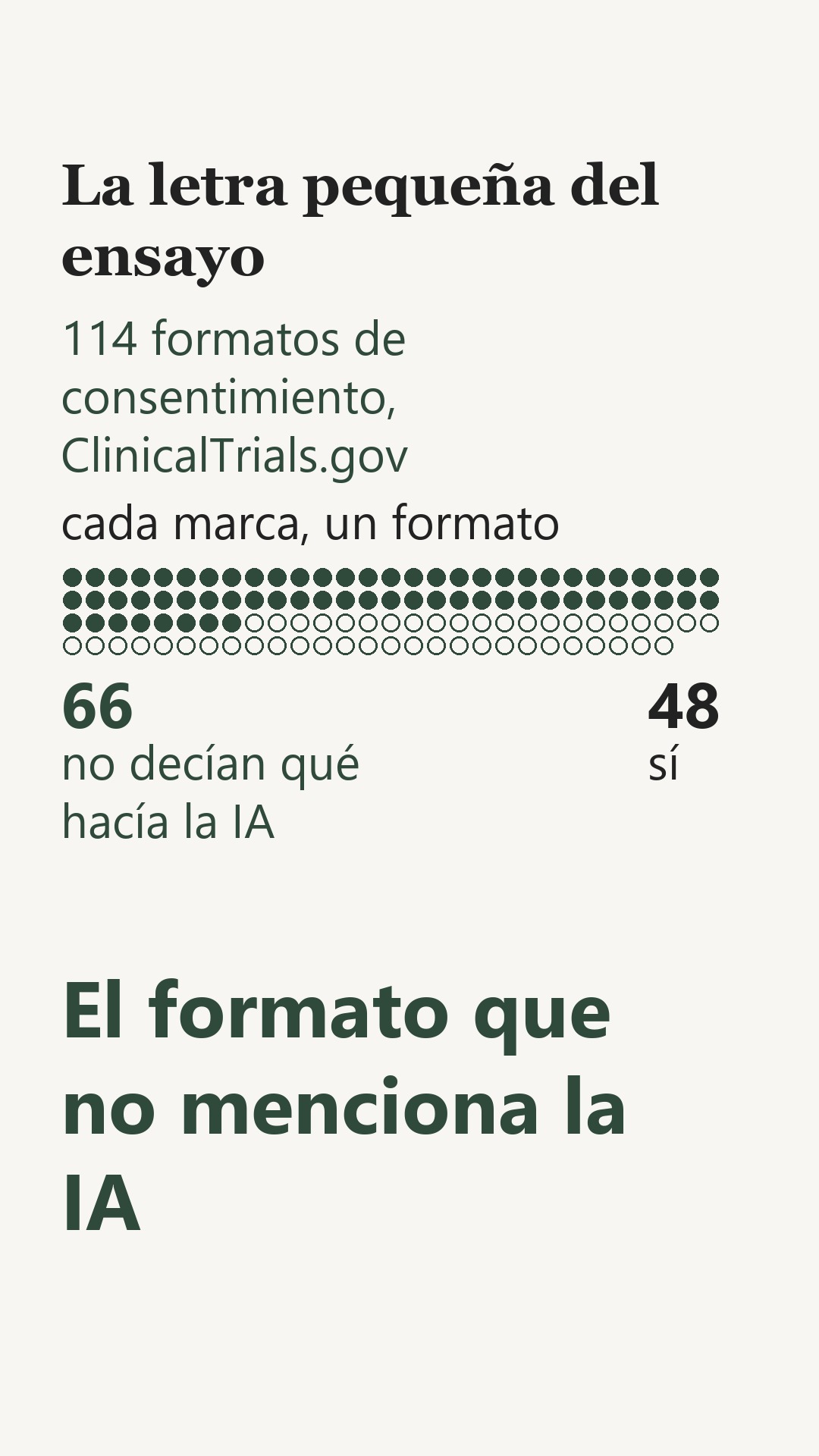
Un formulario de consentimiento, varias páginas grapadas o un archivo en el teléfono. Ahí se supone que el paciente lee qué le van a hacer, qué puede salir mal y qué pasa con sus datos. Un equipo del Hospital Xiangya, en Changsha, China, revisó 114 de esos formularios, todos de ensayos clínicos que usan inteligencia artificial y que estaban publicados en ClinicalTrials.gov, un registro de Estados Unidos. La búsqueda se hizo el 21 de junio de 2025.
En 66 de los 114 formularios, el tipo de inteligencia artificial y para qué se usaba no aparecían en ninguna parte. En 21 no se mencionaba ningún riesgo. Los beneficios sí figuraban en casi todos: 101 de 114.
Sólo 16 de los 114 eran a la vez cortos y sencillos: menos de 15,000 caracteres, unos diez minutos de lectura, y una medida de dificultad que los situaba en un nivel de universidad o menos.
Los ensayos con más riesgo no tenían formularios más fáciles de leer que los demás. Los formularios con dibujos explicativos no mostraron una lectura más fácil, y sólo 13 de los 114 traían alguno.
Lo que pasa con los datos de quien abandona el estudio es otra cosa. En 51 formularios no se decía nada. En 30 se indicaba que los datos se destruirían. En 29, que lo ya recogido se seguiría usando. Sólo 4 le daban a la persona la opción de elegir.
Todo esto describe documentos, no personas. Nadie fue entrevistado ni se midió si alguien entendió lo que leía. Que falte una frase es una señal de alarma, no la prueba de un daño.
El estudio leyó únicamente los formularios colgados en un registro de Estados Unidos, de 114 ensayos. El papel que le den en una clínica puede decir más, o menos. Y lo que hallaron ahí no dice cómo son los formularios de su país.
Los propios autores proponen una lista de mínimos para esos documentos. Un panel de cuatro expertos la revisó y la ajustó de palabra, y la lista final cuenta con su acuerdo.
Cuando le entreguen un formulario para un estudio que usa inteligencia artificial, busque tres cosas: qué hace esa inteligencia artificial, qué riesgos trae y qué pasará con sus datos si usted se retira. Si no están, pregunte antes de firmar.
Qué significa para usted
En un ensayo que usa inteligencia artificial, el formulario que le entreguen puede no decir qué hace el programa ni qué riesgos corre. Pregunte por esas dos cosas y por lo que pasará con sus datos si usted se retira, antes de firmar. Lo que el estudio revisó fueron documentos publicados en un registro de Estados Unidos, así que el papel de su clínica puede ser distinto.
Su, H., Xiao, F., Chau, H. et al. (2026). Informed Consent Disclosures and Minimum Requirements in AI Clinical Trials: Cross-Sectional Analysis. Journal of Medical Internet Research. https://doi.org/10.2196/94504
Quién pagó: El artículo no indica quién financió el estudio ni si algún financiador tuvo influencia, y no menciona equipos ni programas informáticos prestados a los investigadores.
No tome esto como consejo médico profesional.
Versión detalladaLos pasajes copiados del artículo, las ilustraciones y cada fuente con cuánto leímos de ella · 1477 palabras · unos 7 minLeerla →Cerrar
La IA en los estudios médicos: lo que firma usted puede no decirle qué hace la IA
Un análisis de 114 estudios registrados encontró que la mayoría de las constancias de consentimiento no explicaban el tipo de inteligencia artificial ni su uso, y muchas omitían los riesgos.
Imagine la escena: una hoja de consentimiento sobre la mesa de un hospital, una pluma, y un estudio que usará inteligencia artificial para diagnosticar o predecir algo sobre su salud. Un equipo de investigadores en China revisó 114 estudios clínicos que usan IA y que tienen su constancia de consentimiento publicada en ClinicalTrials.gov, el registro que ofrece esos documentos al público, y además hizo búsquedas en línea para encontrar otras constancias disponibles. La búsqueda se hizo el 21 de junio de 2025. Lo que encontraron: en 66 de los 114 estudios, es decir el 58 por ciento, la constancia no decía qué tipo de IA se usaba ni para qué1. Y en 21 constancias, el 18.4 por ciento, no se mencionaba ningún riesgo1.
El estudio lo firman Hankun Su, Fen Xiao, Hoksan Chau y otros colegas del Departamento de Medicina Reproductiva del Hospital Xiangya, de la Universidad Central del Sur, en Changsha, China. Se publicó en el Journal of Medical Internet Research el 2 de julio de 2026. No hubo personas participantes: lo que se analizó fueron documentos, no la comprensión de nadie.
Hay más huecos. Solo 16 de las 114 constancias, el 14 por ciento, cumplían a la vez con ser breves (menos de 15,000 caracteres) y legibles (una medida de dificultad de lectura por debajo de 13)2. Solo 13 constancias, el 11.4 por ciento, incluían algún apoyo visual, y su presencia no se relacionó con una lectura más fácil3. En cuanto a los datos después de que alguien se retira del estudio: 51 constancias, el 44.7 por ciento, no decían nada sobre qué pasaría con esa información; 30 decían que se destruiría; 29 que se seguiría usando lo ya recogido; y solo 4, el 3.5 por ciento, le daban al participante la opción de elegir4. Aunque el derecho a retirarse aparecía en todas5.
También había inconsistencias entre lo que dice el registro del estudio y lo que dice la constancia: el registro a veces describe la IA con más detalle que el documento que firma el paciente6. Y en 87 de las 114 constancias, el 76.3 por ciento, no se identificaba a ningún grupo vulnerable que necesitara protección especial7. Las leyes de protección de datos que se citaban variaban mucho, sin un estándar dominante8: la más mencionada fue el Certificado de Confidencialidad (15 constancias), luego el reglamento europeo GDPR (12), la ley estadounidense HIPAA (11) y la ley española Orgánica 3/2018 (6)9.
Los propios autores ponen límites claros. Solo leyeron las constancias publicadas en el registro, que pueden ser distintas de la versión final que se firma en el sitio10. Es una fotografía de 114 estudios, no de todos los ensayos con IA ni de las prácticas de ningún país en particular. Y midieron lo que dicen los documentos, no lo que los participantes entendieron.
Piense en el trámite: llega, lee, firma, y la hoja va al expediente. La firma queda como prueba de que usted aceptó, aunque no pruebe que le explicaron. Lo curioso es que la exigencia de transparencia sobre la IA no es un capricho de unos cuantos. El artículo describe una encuesta nacional hecha en Estados Unidos en la que más del 80 por ciento de las personas cree que deberían avisarle siempre que se use IA en su atención médica, sin importar el nivel de riesgo11. Y el artículo describe que las guías éticas actuales carecen de precisión sobre qué información relacionada con la IA debe revelarse, lo que produce prácticas distintas de una institución a otra y de una jurisdicción a otra12.
Esa falta de estándar se nota en la letra menuda. De las constancias que hablaban del uso futuro de los datos, 31 permitían usarlos sin pedir un consentimiento adicional, 23 lo exigían, y solo 8 prohibían expresamente ese uso futuro13. Ahí hay una decisión que se toma por usted y que casi nunca se le pregunta.
El problema no es solo de papeleo. La IA ya está entrando a la atención médica más rápido de lo que la evidencia alcanza a medir su seguridad en el mundo real, según el resumen de un estudio sobre un sistema conversacional para pacientes con enfermedad de Parkinson desplegado en Alemania; de ese trabajo pudimos leer solo el resumen14. Ese sistema atendió 2,035 conversaciones en sus primeros 129 días15, y una revisión con expertos encontró fallas clínicas graves16. Es un sistema distinto, en otro país y con otro propósito: no dice nada sobre los estudios de esta nota, pero muestra qué tipo de errores puede tener la IA cuando conversa con un paciente.
Hay otra razón para mirar con cuidado los datos que se piden. En oncología, la IA depende de integrar a gran escala datos genómicos, de imagen y clínicos, lo que intensifica las preocupaciones de privacidad, según el resumen de un análisis sobre autonomía informativa; también de ese trabajo leímos solo el resumen17. Y agrega algo incómodo: incluso datos considerados anonimizados, como perfiles moleculares o de imagen, pueden permitir inferir atributos sensibles mediante análisis de aprendizaje automático18. Los marcos regulatorios actuales, como el GDPR y el HIPAA, se centran sobre todo en la identificabilidad y en quitar los identificadores explícitos19, no en lo que la IA puede deducir de lo que queda.
También hay indicios de que el problema de las constancias no es exclusivo de los ensayos clínicos. Un estudio cualitativo con representantes de once empresas emergentes de biomarcadores de la voz encontró que las prácticas de consentimiento iban desde un permiso granular hasta el consentimiento implícito con revelaciones mínimas20; de nuevo, leímos solo el resumen21. Y que los datos de voz se reconocían como inherentemente no anonimizables22. Son empresas, no hospitales, y otro tipo de estudio; sirven para ver el mismo patrón en otra orilla.
Así lo leemos nosotros. El patrón es el de la ceremonia que tapa el contenido: un documento con membrete, un comité que lo aprobó, una firma al final. Todo sugiere que usted quedó informado, aunque el texto no diga qué hace la IA ni qué pasa con sus datos. En un estudio con IA, lo que esperaríamos ver es una constancia firmada y en regla que, sin embargo, no permita a la persona repetir con sus palabras qué se hará con su información. Nos equivocaríamos si encontráramos documentos que explican el tipo de IA, su papel y sus riesgos en lenguaje sencillo, y participantes que pueden contarlo sin ayuda.
Lo que usted puede hacer con eso es concreto. Antes de firmar, pida que le expliquen en voz alta qué hace la IA en el estudio y qué pasará con sus datos. Si no se lo pueden decir sin tecnicismos, anótelo y pregúntelo por escrito. Guarde copia de lo que firmó. Después de leer la constancia, intente explicársela a alguien de su familia: lo que no pueda explicar, pregúntelo al equipo del estudio y pida la respuesta por escrito antes de firmar. Y pregunte al comité de ética o al patrocinador qué reglas de IA se aplican a ellos mismos y dónde están publicadas; si exigen algo que ellos no cumplen, puede señalarlo por escrito.
Los autores proponen una lista de requisitos mínimos para las constancias en estudios con IA. Entre ellos: limitar el documento a unos 15,000 caracteres (unos 10 minutos de lectura), lograr una legibilidad de 13 o menos (10 o menos en estudios de alto riesgo), incluir al menos un apoyo visual probado con pacientes, y ofrecer opciones de consentimiento digital por capas si es posible23. También piden especificar qué datos se recogen, cómo se guardan, quién tiene acceso y cuánto tiempo se conservan; aclarar qué pasa con los datos tras el retiro y ofrecer una opción; informar sobre el uso futuro y citar las protecciones aplicables en lenguaje sencillo24. Cuatro expertos revisaron la propuesta y se hicieron ajustes menores de redacción.
Queda una pregunta que el estudio no responde: si las constancias finales que se firman en clínicas de América Latina o de América del Norte se parecen a las que se publican en el registro. El propio trabajo advierte que pueden diferir10. Así que lo que usted firme mañana en su consultorio puede ser mejor o peor que lo que aquí se describe. La única forma de saberlo es pedir la versión final y leerla.
Volvamos a la hoja sobre la mesa. Usted ya sabe que la firma no es la explicación, y que puede pedir las dos cosas: el documento y la conversación. La pregunta que puede llevar a su próxima cita es sencilla: ¿qué hace la IA en este estudio, y qué pasa con mis datos si decido retirarme?
De dónde sale cada dato de contexto, y cuánto leímos de cada documento
- Su, H., Xiao, F., Chau, H. et al. (2026). Informed Consent Disclosures and Minimum Requirements in AI Clinical Trials: Cross-Sectional Analysis. Journal of Medical Internet Research. https://doi.org/10.2196/94504 - el artículo del que trata esta nota — el artículo completo — el pasaje: "More than half (66/114, 58%) of ICs failed to disclose the AI type or its intended use, and 18.4% (n=21) omitted risks entirely."
- Su, H., Xiao, F., Chau, H. et al. (2026). Informed Consent Disclosures and Minimum Requirements in AI Clinical Trials: Cross-Sectional Analysis. Journal of Medical Internet Research. https://doi.org/10.2196/94504 - el artículo del que trata esta nota — el artículo completo — el pasaje: "Only 14% (n=16) of ICs met the dual criteria of brevity (<15,000 characters) and readability (Simple Measure of Gobbledygook <13)."
- Su, H., Xiao, F., Chau, H. et al. (2026). Informed Consent Disclosures and Minimum Requirements in AI Clinical Trials: Cross-Sectional Analysis. Journal of Medical Internet Research. https://doi.org/10.2196/94504 - el artículo del que trata esta nota — el artículo completo — el pasaje: "Only 11.4% (n=13) of ICs included visual aids, and their inclusion was not correlated with lower reading difficulty."
- Su, H., Xiao, F., Chau, H. et al. (2026). Informed Consent Disclosures and Minimum Requirements in AI Clinical Trials: Cross-Sectional Analysis. Journal of Medical Internet Research. https://doi.org/10.2196/94504 - el artículo del que trata esta nota — el artículo completo — el pasaje: "Data handling protocols after participant withdrawal were inconsistent: 51 (44.7%) ICs provided no information, 30 (26.3%) specified data destruction, 29 (25.4%) allowed continued use, and only 4 (3.5%) offered participants a choice."
- Su, H., Xiao, F., Chau, H. et al. (2026). Informed Consent Disclosures and Minimum Requirements in AI Clinical Trials: Cross-Sectional Analysis. Journal of Medical Internet Research. https://doi.org/10.2196/94504 - el artículo del que trata esta nota — el artículo completo — el pasaje: "Although the right to withdraw was universally guaranteed in all ICs, the protocols for handling participant data after withdrawal were inconsistent."
- Su, H., Xiao, F., Chau, H. et al. (2026). Informed Consent Disclosures and Minimum Requirements in AI Clinical Trials: Cross-Sectional Analysis. Journal of Medical Internet Research. https://doi.org/10.2196/94504 - el artículo del que trata esta nota — el artículo completo — el pasaje: "Additionally, we identified a significant discrepancy in the reporting of AI methods between trial registries and IC documents."
- Su, H., Xiao, F., Chau, H. et al. (2026). Informed Consent Disclosures and Minimum Requirements in AI Clinical Trials: Cross-Sectional Analysis. Journal of Medical Internet Research. https://doi.org/10.2196/94504 - el artículo del que trata esta nota — el artículo completo — el pasaje: "Identification of vulnerable populations was inadequate, with 76.3% (87/114) of ICs failing to specify any such groups, despite the need for special protections."
- Su, H., Xiao, F., Chau, H. et al. (2026). Informed Consent Disclosures and Minimum Requirements in AI Clinical Trials: Cross-Sectional Analysis. Journal of Medical Internet Research. https://doi.org/10.2196/94504 - el artículo del que trata esta nota — el artículo completo — el pasaje: "Cited data protection laws varied widely, with no dominant standard."
- Su, H., Xiao, F., Chau, H. et al. (2026). Informed Consent Disclosures and Minimum Requirements in AI Clinical Trials: Cross-Sectional Analysis. Journal of Medical Internet Research. https://doi.org/10.2196/94504 - el artículo del que trata esta nota — el artículo completo — el pasaje: "The most cited data protection laws and frameworks were the Certificate of Confidentiality (n=15, 13.2%), the General Data Protection Regulation (GDPR; n=12, 10.5%), the Health Insurance Portability and Accountability Act (HIPAA; n=11, 9.6%), and Spain’s Organic Law 3/2018 (n=6, 5.3%; Table 3)."
- Su, H., Xiao, F., Chau, H. et al. (2026). Informed Consent Disclosures and Minimum Requirements in AI Clinical Trials: Cross-Sectional Analysis. Journal of Medical Internet Research. https://doi.org/10.2196/94504 - el artículo del que trata esta nota — el artículo completo — el pasaje: "However, it should be noted that these findings are limited to publicly available consent documents in the registry and may differ from final onsite versions."
- Su, H., Xiao, F., Chau, H. et al. (2026). Informed Consent Disclosures and Minimum Requirements in AI Clinical Trials: Cross-Sectional Analysis. Journal of Medical Internet Research. https://doi.org/10.2196/94504 - el artículo del que trata esta nota — el artículo completo — el pasaje: "A recent US national survey found that more than 80% of respondents believe they should be notified whenever AI is used in their health care, regardless of risk level."
- Su, H., Xiao, F., Chau, H. et al. (2026). Informed Consent Disclosures and Minimum Requirements in AI Clinical Trials: Cross-Sectional Analysis. Journal of Medical Internet Research. https://doi.org/10.2196/94504 - el artículo del que trata esta nota — el artículo completo — el pasaje: "Current ethical guidelines lack specificity regarding what AI-related information should be disclosed, resulting in inconsistent practices across institutions and jurisdictions [ 3 ]."
- Su, H., Xiao, F., Chau, H. et al. (2026). Informed Consent Disclosures and Minimum Requirements in AI Clinical Trials: Cross-Sectional Analysis. Journal of Medical Internet Research. https://doi.org/10.2196/94504 - el artículo del que trata esta nota — el artículo completo — el pasaje: "For future research applications, data were most often designated for use without additional consent (n=31, 27.2%), with a smaller subset requiring such consent (n=23, 20.2%) and a minor portion explicitly barred from future use (n=8, 7%; Table 3)."
- Lange F, Mardi S, Binder T, Reich MM, Odorfer T, Volkmann J. (2026). Real-world use and evaluation of a generative AI chatbot for Parkinson's disease information: a prospective observational study. The Lancet Regional Health - Europe. 10.1016/j.lanepe.2026.101866 — solo el resumen - no se pudo obtener el texto completo — el pasaje: "Patient-facing medical AI chatbots are entering clinical use faster than evidence can characterise their real-world safety."
- Lange F, Mardi S, Binder T, Reich MM, Odorfer T, Volkmann J. (2026). Real-world use and evaluation of a generative AI chatbot for Parkinson's disease information: a prospective observational study. The Lancet Regional Health - Europe. 10.1016/j.lanepe.2026.101866 — solo el resumen - no se pudo obtener el texto completo — el pasaje: "We conducted a prospective, observational, conversation-level evaluation of jAImes, a retrieval-augmented AI information system for Parkinson's disease deployed publicly in Germany, across its first 129 days of operation (Nov 11, 2025-Mar 20, 2026), analysing all 2035 conversations (6146 messages)."
- Lange F, Mardi S, Binder T, Reich MM, Odorfer T, Volkmann J. (2026). Real-world use and evaluation of a generative AI chatbot for Parkinson's disease information: a prospective observational study. The Lancet Regional Health - Europe. 10.1016/j.lanepe.2026.101866 — solo el resumen - no se pudo obtener el texto completo — el pasaje: "Confirmed critical events-five flagged, four sampled-spanned three failure classes (knowledge boundary, robustness, and escalation failures) and included an inappropriate memantine recommendation in Parkinson's disease dementia and explicit suicidal ideation that did not trigger the intended emergency response."
- Jung M. (2026). Protecting Informational Self-determination in AI-driven Precision Oncology: Privacy, Ethics, and Governance Challenges. Journal of Preventive Medicine and Public Health. 10.3961/jpmph.26.094 — solo el resumen - no se pudo obtener el texto completo — el pasaje: "These advances depend on the large-scale integration of genomic, imaging, and clinical data, intensifying privacy and ethical concerns."
- Jung M. (2026). Protecting Informational Self-determination in AI-driven Precision Oncology: Privacy, Ethics, and Governance Challenges. Journal of Preventive Medicine and Public Health. 10.3961/jpmph.26.094 — solo el resumen - no se pudo obtener el texto completo — el pasaje: "Even data considered de-identified, including molecular and imaging profiles, may enable inference of sensitive attributes through machine-learning analytics."
- Jung M. (2026). Protecting Informational Self-determination in AI-driven Precision Oncology: Privacy, Ethics, and Governance Challenges. Journal of Preventive Medicine and Public Health. 10.3961/jpmph.26.094 — solo el resumen - no se pudo obtener el texto completo — el pasaje: "Current regulatory frameworks, including the General Data Protection Regulation and the Health Insurance Portability and Accountability Act, focus primarily on identifiability and the removal of explicit identifiers."
- Yuhan A, Swain S, Zhao R, Ramos J, Rameau A. (2026). The epistemic economy of vocal biomarker startups: a qualitative interview study of data practices and governance. Frontiers in Digital Health. 10.3389/fdgth.2026.1895383 — solo el resumen - no se pudo obtener el texto completo — el pasaje: "consent practices varied from granular opt-in to implied consent and minimal disclosures"
- Yuhan A, Swain S, Zhao R, Ramos J, Rameau A. (2026). The epistemic economy of vocal biomarker startups: a qualitative interview study of data practices and governance. Frontiers in Digital Health. 10.3389/fdgth.2026.1895383 — solo el resumen - no se pudo obtener el texto completo — el pasaje: "We performed a qualitative interview study using an interpretive framework. Virtual semi-structured interviews were conducted with representatives from eleven vocal biomarker startups identified through purposive sampling."
- Yuhan A, Swain S, Zhao R, Ramos J, Rameau A. (2026). The epistemic economy of vocal biomarker startups: a qualitative interview study of data practices and governance. Frontiers in Digital Health. 10.3389/fdgth.2026.1895383 — solo el resumen - no se pudo obtener el texto completo — el pasaje: "voice data were acknowledged as inherently non-anonymizable, creating unresolved privacy and re-identification risks"
- Su, H., Xiao, F., Chau, H. et al. (2026). Informed Consent Disclosures and Minimum Requirements in AI Clinical Trials: Cross-Sectional Analysis. Journal of Medical Internet Research. https://doi.org/10.2196/94504 - el artículo del que trata esta nota — el artículo completo — el pasaje: "Limit document length to ≤15,000 characters (approximately 10 minutes of reading time) Achieve a Simple Measure of Gobbledygook readability score ≤13 (≤10 for high-risk trials) Include at least 1 comprehension-tested visual aid Offer layered or interactive digital consent options, if feasible"
- Su, H., Xiao, F., Chau, H. et al. (2026). Informed Consent Disclosures and Minimum Requirements in AI Clinical Trials: Cross-Sectional Analysis. Journal of Medical Internet Research. https://doi.org/10.2196/94504 - el artículo del que trata esta nota — el artículo completo — el pasaje: "Specify data types, storage, access, and retention Clarify postwithdrawal data handling and offer choice Disclose future data use and consent mechanisms Cite applicable protections in plain language"
Su, H., Xiao, F., Chau, H. et al. (2026). Informed Consent Disclosures and Minimum Requirements in AI Clinical Trials: Cross-Sectional Analysis. Journal of Medical Internet Research. https://doi.org/10.2196/94504
Quién pagó: El artículo no indica quién financió el estudio ni si algún financiador tuvo influencia, y no menciona equipos ni programas informáticos prestados a los investigadores.
No tome esto como consejo médico profesional.
Los hallazgos de otros estudios que aquí se mencionan los conocemos por este documento, que fue el que leímos; no abrimos cada uno de esos estudios.
analysis of texts · Journal of medical Internet research · the paper, 2 Jul 2026 · free
The AI Form That Never Mentions the AI
Researchers read 114 consent forms posted for trials using AI. Most never said what the AI did, and many never mentioned a risk; these were the public copies, not the forms people sign in person.
Short version · the longer version follows, about 7 min
Ask the weeklyAI chat
Ask me about this study: who was studied, what it found, and what it does not say.
Conversations are saved for as long as weeklyAI exists, to improve the publication. Answers come in the language you write in.
- The study at a glance
- Who
- consent forms from AI trials on ClinicalTrials.gov
- How many
- 114
- Where
- ClinicalTrials.gov (US registry)
- When
- searched June 21, 2025
- Kind of study
- analysis of what people did
- Who did it
- Xiangya Hospital, Central South University, Changsha, China
- The limit that matters
- Only public registry copies were read; they may differ from forms signed on site.
Shares of 114 public consent forms for AI trials, by what each said about data already collected after a person withdraws; every form promised the right to withdraw.
How often the AI was described in the registry entry versus in the consent form
the form left it out more often than the registry did
When a form for an AI study is placed in front of you, look for three lines: what the AI does, what risks come with it, and where your data goes if you leave.
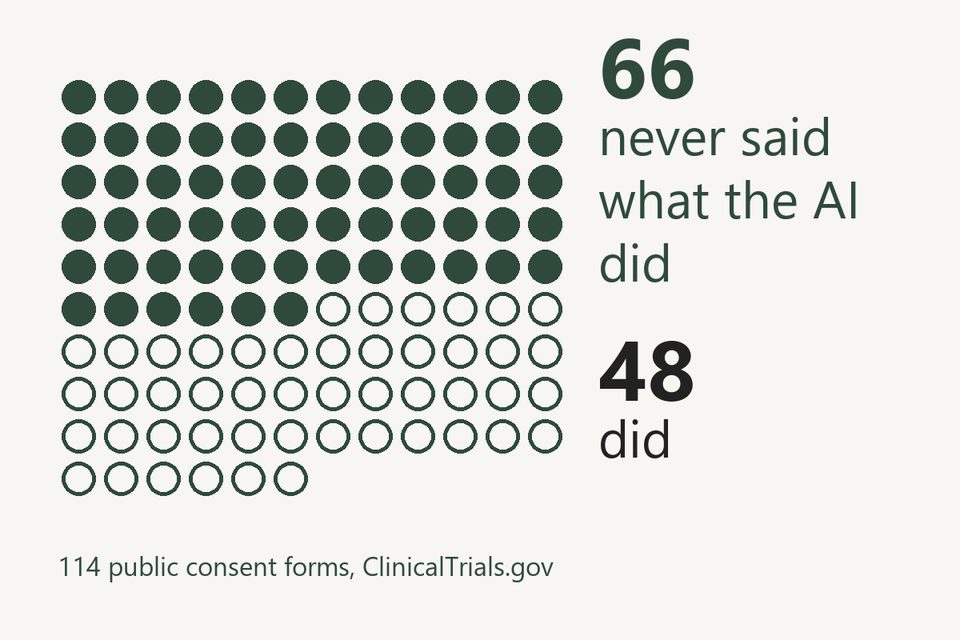
Take a consent form from a study that uses artificial intelligence. It is the page you would sign before anyone collects your scans, your history or your blood. Researchers at Xiangya Hospital in China read 114 of these forms, all posted on ClinicalTrials.gov, the US registry that makes such documents public. They searched the registry on June 21, 2025.
In 66 of the 114 forms, a little over half, the type of AI and what it was for were never stated. In 21 forms, 18.4%, no risk appeared at all. A form can describe every visit and still leave out the machine.
Consider what a reader could hold. Only 16 forms, 14%, were both short enough and plain enough. Short enough meant under 15,000 characters, about ten minutes of reading. Plain enough meant a reading level at or below the lowest college level. A form written above that level is unlikely to be fully understood by the general public.
Leaving a study raised its own silence. Every form guaranteed the right to withdraw, but 51, or 44.7%, said nothing about what happens to data already collected. Of the rest, 30 said the data would be destroyed, 29 said it would keep being used, and 4, just 3.5%, let the person decide.
Higher-risk trials did not offer easier forms; the link between risk level and ease of reading was tested and not significant. A picture did not make a form easier either: 13 forms had one, and the study found no link between pictures and easier reading.
What these documents show is what they say. The study did not test whether anyone understood them, and the posted copy may differ from the final one at the clinic. Your local hospital's forms may say more, or less; 114 registered trials cannot tell you which.
When a form for an AI study is placed in front of you, look for three lines: what the AI does, what risks come with it, and where your data goes if you leave.
What this means for you
For your own care, these forms were posted copies from one US registry, so ask the clinic for the final version and whether a person can explain what the AI does, what could go wrong, and what happens to your data if you leave. Watch whether future forms actually change.
Su, H., Xiao, F., Chau, H. et al. (2026). Informed Consent Disclosures and Minimum Requirements in AI Clinical Trials: Cross-Sectional Analysis. Journal of Medical Internet Research. https://doi.org/10.2196/94504
Who paid: The article does not state who funded the study or whether any funder had a say, and it names no equipment or software lent to the researchers.
Do not take this as professional medical advice.
The longer versionThe passages copied from the paper, the pictures, and every source with how much of it we read · 1411 words · about 7 minRead it →Close
The AI Is in the Trial. The Form May Not Say So.
A study of 114 registered medical studies found that most of their public consent documents never named the AI or what it was for, and many listed no risks at all.
Consider the clipboard they hand you at a clinic before you join a medical study. It carries a stack of pages, a signature line, and, in a growing number of trials, an artificial intelligence somewhere in the machinery. The signature is the same as it has always been.
The study looked at that stack of pages for 114 medical trials that use AI and are registered on ClinicalTrials.gov, the only major trial registry that posts consent documents publicly. In 66 of the 114, or 58 percent, the consent document did not say what type of AI was used or what it was meant to do1. In 21, or 18.4 percent, the document listed no risks at all1. The study was published in the *Journal of Medical Internet Research*; its authors work in the Department of Reproductive Medicine at Xiangya Hospital, part of Central South University in Changsha, China. The article does not state who funded the work.
Reading ease was measured with a standard formula that estimates the school grade needed to follow a text. Only 16 of the 114 documents, 14 percent, met both of the study's own targets: under 15,000 characters, about ten minutes of reading, and a readability score under 13, the lowest level of college reading demand2. Higher-risk trials did not produce easier forms: the study found no significant link between a trial's risk level and how hard its form was to read3. Visual aids appeared in 13 documents, 11.4 percent, and their presence did not track with easier reading4.
What happens to your data if you quit drew the sharpest picture. Every document promised the right to withdraw5. In 51 of them, 44.7 percent, nothing was said about what would happen to data already collected; 30 said the data would be destroyed; 29 said it would keep being used; and 4, 3.5 percent, let the participant choose6. Where laws were named, they varied widely, with no single standard7: the US Certificate of Confidentiality in 15 documents, Europe's General Data Protection Regulation in 12, the US health-privacy law known as HIPAA in 11, and Spain's data protection law in 68.
Two more gaps. In 87 documents, 76.3 percent, no vulnerable group was identified at all, even where special protections would be expected9. And the registry entry often described the AI in more detail than the form did, a mismatch between what the public record says and what the participant reads10. For future research, 31 documents allowed reuse of data without asking again, 23 required fresh consent, and 8 barred future use11.
The study read documents, not people. No participant was interviewed, and no one's understanding was tested. The authors say their findings cover only the consent forms posted publicly on the registry and may differ from the final versions used on site12.
To see why this matters, follow the trail of a single signature. A trial registers on the public database; the registry entry records the AI; the consent form is posted alongside. That form is the only version most outsiders will ever read, and the database is, in the authors' account, the only major trial registry that posts consent documents at all. The article describes a study noting that ethical guidelines today lack specificity about what AI information should be disclosed, which produces inconsistent practice across institutions and jurisdictions13. Where rules are vague, the form is where the vagueness lands, in front of the person signing.
The public, meanwhile, has been asking for more, not less. The article describes a US national survey in which more than 80 percent of respondents believe they should be notified whenever AI is used in their health care, whatever the risk level14. That is a broad expectation, and it sits against forms that, in most of this sample, did not name the AI at all.
Read alongside other recent work, the pattern widens. A separate review of cancer care notes that AI there depends on large-scale genomic, imaging and clinical data, and that even data stripped of names may allow sensitive details to be inferred through machine-learning analysis; we could read only the summary, the full paper is behind a subscription1516. The same summary reports that many patients support AI's clinical promise but worry about secondary use of their data without meaningful consent, about commercialization and about breaches17. And in a study of eleven companies building voice-based health tools, consent practices ranged from granular opt-in to implied consent with minimal disclosure; we could read only the summary18.
The risks are not only on paper. A German team evaluated a public AI information system for Parkinson's disease across its first 129 days and 2,035 conversations, according to the summary of their study; we could read only the summary, the full paper is behind a subscription19. Automated triage rated most conversations as good, yet expert review of flagged cases confirmed five critical events, and a re-check of 100 randomly sampled "good" conversations found four with clinically critical errors the triage had missed202122. The confirmed events included an inappropriate drug recommendation and a message expressing suicidal ideation that did not trigger the intended emergency response23. Deaths were not reported in that summary. The point for a reader is not that AI in medicine is dangerous; it is that a system can look fine by its own measures while failing in ways only a clinician's review catches24.
The authors' own proposal is a checklist of minimum requirements: name the AI's type, role and level of autonomy; state any departure from standard care; give risks equal prominence with benefits; keep the form under 15,000 characters with a readability score of 13 or lower, and 10 or lower for high-risk trials; include at least one tested visual aid25. On data, the checklist asks for the types collected, where they are stored, who has access, how long they are kept, what happens after withdrawal with a real choice, and any future use spelled out in plain language26. A panel of four experts, three in medicine and one in law, rated the checklist; no item scored below neutral. The checklist has not been tested in practice, and the study does not claim it improves anything yet.
Here is how we read it. The signature on a consent form is a small ceremony, and ceremonies run on trust: the document is long, the room is busy, and the person across the desk is the one who will answer questions anyway. So we expect the practical weight to sit on what a researcher says out loud, not on what the page says, and we expect the page's silence about post-withdrawal data to become a real problem only later, at the moment someone tries to leave. A reader could prove us wrong in the simplest way: if people routinely ask what the AI decides and what happens to their data, and get clear written answers, the worry fades. Until then, ask the study team to point to the exact sentence describing what the AI does and what happens to your data if you quit, and keep a copy of what you signed.
We also read the difficulty itself as a signal. A form dense with "model autonomy" and "algorithmic risk" can persuade by authority rather than inform, and the fix is to have the claim restated in words you can examine. Ask them to explain, plainly, what the AI decides and what it only advises; if they cannot, that is information about the study. And ask which risks are listed and which are left out.
We did not find other documents that settle whether this carries over to consent forms used in Latin America, Canada or anywhere outside this one registry. What we can say is narrower: this sample describes forms posted on a US-run database, and a gap there is a warning sign, not proof about your local hospital's paperwork.
The clipboard still comes at you with its stack of pages. What you now know is where to put your finger: on the sentence that names the AI, and on the one that says what happens to your data when you leave. If those sentences are missing, you can ask for them in writing before you sign.
Where each piece of context comes from, and how much of it we read
- Su, H., Xiao, F., Chau, H. et al. (2026). Informed Consent Disclosures and Minimum Requirements in AI Clinical Trials: Cross-Sectional Analysis. Journal of Medical Internet Research. https://doi.org/10.2196/94504 - the article this story is about — the whole article — the passage: "More than half (66/114, 58%) of ICs failed to disclose the AI type or its intended use, and 18.4% (n=21) omitted risks entirely."
- Su, H., Xiao, F., Chau, H. et al. (2026). Informed Consent Disclosures and Minimum Requirements in AI Clinical Trials: Cross-Sectional Analysis. Journal of Medical Internet Research. https://doi.org/10.2196/94504 - the article this story is about — the whole article — the passage: "Only 14% (n=16) of ICs met the dual criteria of brevity (<15,000 characters) and readability (Simple Measure of Gobbledygook <13)."
- Su, H., Xiao, F., Chau, H. et al. (2026). Informed Consent Disclosures and Minimum Requirements in AI Clinical Trials: Cross-Sectional Analysis. Journal of Medical Internet Research. https://doi.org/10.2196/94504 - the article this story is about — the whole article — the passage: "Stratification by trial risk level showed an even more concerning trend: consent forms for higher-risk trials were not easier to understand (Spearman P >.05; Figures 4 C and 4D)."
- Su, H., Xiao, F., Chau, H. et al. (2026). Informed Consent Disclosures and Minimum Requirements in AI Clinical Trials: Cross-Sectional Analysis. Journal of Medical Internet Research. https://doi.org/10.2196/94504 - the article this story is about — the whole article — the passage: "Only 11.4% (n=13) of ICs included visual aids, and their inclusion was not correlated with lower reading difficulty."
- Su, H., Xiao, F., Chau, H. et al. (2026). Informed Consent Disclosures and Minimum Requirements in AI Clinical Trials: Cross-Sectional Analysis. Journal of Medical Internet Research. https://doi.org/10.2196/94504 - the article this story is about — the whole article — the passage: "Although the right to withdraw was universally guaranteed in all ICs, the protocols for handling participant data after withdrawal were inconsistent."
- Su, H., Xiao, F., Chau, H. et al. (2026). Informed Consent Disclosures and Minimum Requirements in AI Clinical Trials: Cross-Sectional Analysis. Journal of Medical Internet Research. https://doi.org/10.2196/94504 - the article this story is about — the whole article — the passage: "Data handling protocols after participant withdrawal were inconsistent: 51 (44.7%) ICs provided no information, 30 (26.3%) specified data destruction, 29 (25.4%) allowed continued use, and only 4 (3.5%) offered participants a choice."
- Su, H., Xiao, F., Chau, H. et al. (2026). Informed Consent Disclosures and Minimum Requirements in AI Clinical Trials: Cross-Sectional Analysis. Journal of Medical Internet Research. https://doi.org/10.2196/94504 - the article this story is about — the whole article — the passage: "Cited data protection laws varied widely, with no dominant standard."
- Su, H., Xiao, F., Chau, H. et al. (2026). Informed Consent Disclosures and Minimum Requirements in AI Clinical Trials: Cross-Sectional Analysis. Journal of Medical Internet Research. https://doi.org/10.2196/94504 - the article this story is about — the whole article — the passage: "The most cited data protection laws and frameworks were the Certificate of Confidentiality (n=15, 13.2%), the General Data Protection Regulation (GDPR; n=12, 10.5%), the Health Insurance Portability and Accountability Act (HIPAA; n=11, 9.6%), and Spain’s Organic Law 3/2018 (n=6, 5.3%; Table 3)."
- Su, H., Xiao, F., Chau, H. et al. (2026). Informed Consent Disclosures and Minimum Requirements in AI Clinical Trials: Cross-Sectional Analysis. Journal of Medical Internet Research. https://doi.org/10.2196/94504 - the article this story is about — the whole article — the passage: "Identification of vulnerable populations was inadequate, with 76.3% (87/114) of ICs failing to specify any such groups, despite the need for special protections."
- Su, H., Xiao, F., Chau, H. et al. (2026). Informed Consent Disclosures and Minimum Requirements in AI Clinical Trials: Cross-Sectional Analysis. Journal of Medical Internet Research. https://doi.org/10.2196/94504 - the article this story is about — the whole article — the passage: "Additionally, we identified a significant discrepancy in the reporting of AI methods between trial registries and IC documents."
- Su, H., Xiao, F., Chau, H. et al. (2026). Informed Consent Disclosures and Minimum Requirements in AI Clinical Trials: Cross-Sectional Analysis. Journal of Medical Internet Research. https://doi.org/10.2196/94504 - the article this story is about — the whole article — the passage: "For future research applications, data were most often designated for use without additional consent (n=31, 27.2%), with a smaller subset requiring such consent (n=23, 20.2%) and a minor portion explicitly barred from future use (n=8, 7%; Table 3)."
- Su, H., Xiao, F., Chau, H. et al. (2026). Informed Consent Disclosures and Minimum Requirements in AI Clinical Trials: Cross-Sectional Analysis. Journal of Medical Internet Research. https://doi.org/10.2196/94504 - the article this story is about — the whole article — the passage: "However, it should be noted that these findings are limited to publicly available consent documents in the registry and may differ from final onsite versions."
- Su, H., Xiao, F., Chau, H. et al. (2026). Informed Consent Disclosures and Minimum Requirements in AI Clinical Trials: Cross-Sectional Analysis. Journal of Medical Internet Research. https://doi.org/10.2196/94504 - the article this story is about — the whole article — the passage: "Current ethical guidelines lack specificity regarding what AI-related information should be disclosed, resulting in inconsistent practices across institutions and jurisdictions [ 3 ]."
- Su, H., Xiao, F., Chau, H. et al. (2026). Informed Consent Disclosures and Minimum Requirements in AI Clinical Trials: Cross-Sectional Analysis. Journal of Medical Internet Research. https://doi.org/10.2196/94504 - the article this story is about — the whole article — the passage: "A recent US national survey found that more than 80% of respondents believe they should be notified whenever AI is used in their health care, regardless of risk level."
- Jung M. (2026). Protecting Informational Self-determination in AI-driven Precision Oncology: Privacy, Ethics, and Governance Challenges. Journal of Preventive Medicine and Public Health. 10.3961/jpmph.26.094 — only the abstract - the full text could not be fetched — the passage: "These advances depend on the large-scale integration of genomic, imaging, and clinical data, intensifying privacy and ethical concerns."
- Jung M. (2026). Protecting Informational Self-determination in AI-driven Precision Oncology: Privacy, Ethics, and Governance Challenges. Journal of Preventive Medicine and Public Health. 10.3961/jpmph.26.094 — only the abstract - the full text could not be fetched — the passage: "Even data considered de-identified, including molecular and imaging profiles, may enable inference of sensitive attributes through machine-learning analytics."
- Jung M. (2026). Protecting Informational Self-determination in AI-driven Precision Oncology: Privacy, Ethics, and Governance Challenges. Journal of Preventive Medicine and Public Health. 10.3961/jpmph.26.094 — only the abstract - the full text could not be fetched — the passage: "Although many patients support the clinical promise of AI, they express concerns about secondary data use without meaningful consent, commercialization, and security breaches."
- Yuhan A, Swain S, Zhao R, Ramos J, Rameau A. (2026). The epistemic economy of vocal biomarker startups: a qualitative interview study of data practices and governance. Frontiers in Digital Health. 10.3389/fdgth.2026.1895383 — only the abstract - the full text could not be fetched — the passage: "consent practices varied from granular opt-in to implied consent and minimal disclosures"
- Lange F, Mardi S, Binder T, Reich MM, Odorfer T, Volkmann J. (2026). Real-world use and evaluation of a generative AI chatbot for Parkinson's disease information: a prospective observational study. The Lancet Regional Health - Europe. 10.1016/j.lanepe.2026.101866 — only the abstract - the full text could not be fetched — the passage: "We conducted a prospective, observational, conversation-level evaluation of jAImes, a retrieval-augmented AI information system for Parkinson's disease deployed publicly in Germany, across its first 129 days of operation (Nov 11, 2025-Mar 20, 2026), analysing all 2035 conversations (6146 messages)."
- Lange F, Mardi S, Binder T, Reich MM, Odorfer T, Volkmann J. (2026). Real-world use and evaluation of a generative AI chatbot for Parkinson's disease information: a prospective observational study. The Lancet Regional Health - Europe. 10.1016/j.lanepe.2026.101866 — only the abstract - the full text could not be fetched — the passage: "AI-assisted triage classified 1803/2035 conversations (88·6%) as good, 224/2035 (11·0%) as partially adequate, and 8/2035 (0·4%) as inadequate."
- Lange F, Mardi S, Binder T, Reich MM, Odorfer T, Volkmann J. (2026). Real-world use and evaluation of a generative AI chatbot for Parkinson's disease information: a prospective observational study. The Lancet Regional Health - Europe. 10.1016/j.lanepe.2026.101866 — only the abstract - the full text could not be fetched — the passage: "Expert review of 45 flagged conversations confirmed five critical events."
- Lange F, Mardi S, Binder T, Reich MM, Odorfer T, Volkmann J. (2026). Real-world use and evaluation of a generative AI chatbot for Parkinson's disease information: a prospective observational study. The Lancet Regional Health - Europe. 10.1016/j.lanepe.2026.101866 — only the abstract - the full text could not be fetched — the passage: "Independent re-review of 100 randomly sampled 'good'-rated conversations identified four (4/100, 4%; 95% CI 1·6-9·8) with clinically critical errors missed by the triage-a conditional false-negative rate within the 'good' stratum, not an overall critical-event rate."
- Lange F, Mardi S, Binder T, Reich MM, Odorfer T, Volkmann J. (2026). Real-world use and evaluation of a generative AI chatbot for Parkinson's disease information: a prospective observational study. The Lancet Regional Health - Europe. 10.1016/j.lanepe.2026.101866 — only the abstract - the full text could not be fetched — the passage: "Confirmed critical events-five flagged, four sampled-spanned three failure classes (knowledge boundary, robustness, and escalation failures) and included an inappropriate memantine recommendation in Parkinson's disease dementia and explicit suicidal ideation that did not trigger the intended emergency response."
- Lange F, Mardi S, Binder T, Reich MM, Odorfer T, Volkmann J. (2026). Real-world use and evaluation of a generative AI chatbot for Parkinson's disease information: a prospective observational study. The Lancet Regional Health - Europe. 10.1016/j.lanepe.2026.101866 — only the abstract - the full text could not be fetched — the passage: "Tightly scoped, retrieval-augmented, patient-facing AI achieved favourable automated triage classifications while still harbouring clinically critical failures invisible to automated quality metrics alone; detecting them required conversation-level evaluation with clinical expert adjudication."
- Su, H., Xiao, F., Chau, H. et al. (2026). Informed Consent Disclosures and Minimum Requirements in AI Clinical Trials: Cross-Sectional Analysis. Journal of Medical Internet Research. https://doi.org/10.2196/94504 - the article this story is about — the whole article — the passage: "Limit document length to ≤15,000 characters (approximately 10 minutes of reading time) Achieve a Simple Measure of Gobbledygook readability score ≤13 (≤10 for high-risk trials) Include at least 1 comprehension-tested visual aid Offer layered or interactive digital consent options, if feasible"
- Su, H., Xiao, F., Chau, H. et al. (2026). Informed Consent Disclosures and Minimum Requirements in AI Clinical Trials: Cross-Sectional Analysis. Journal of Medical Internet Research. https://doi.org/10.2196/94504 - the article this story is about — the whole article — the passage: "Specify data types, storage, access, and retention Clarify postwithdrawal data handling and offer choice Disclose future data use and consent mechanisms Cite applicable protections in plain language"
Su, H., Xiao, F., Chau, H. et al. (2026). Informed Consent Disclosures and Minimum Requirements in AI Clinical Trials: Cross-Sectional Analysis. Journal of Medical Internet Research. https://doi.org/10.2196/94504
Who paid: The article does not state who funded the study or whether any funder had a say, and it names no equipment or software lent to the researchers.
Do not take this as professional medical advice.
The findings of other studies mentioned here are known to us through this document, which is the one we read; we did not open each of those studies.