experiment · The journal of pathology. Clinical research · la publicación, 1 sep 2026 · gratis
Una prueba de software encontró los 45 casos de un cáncer cervical raro que suele pasar inadvertido
El programa leyó portaobjetos teñidos de rutina en hospitales de China; nadie ha probado todavía si cambia el momento del diagnóstico en un laboratorio real.
Versión breve · la versión detallada sigue, unos 7 min
Pregunte al chat de weeklyAI
Pregúnteme por este estudio: a quiénes se estudió, qué encontró y qué no dice.
Las conversaciones se guardan mientras exista weeklyAI, para mejorar la publicación. Se responde en el idioma en que usted escribe.
- El estudio, de un vistazo
- Quiénes
- Láminas de tejido cervical con un cáncer raro (GAS) y tejidos parecidos
- Cuántos
- 7,056 láminas, entre ellas 45 casos de GAS
- Dónde
- China
- Cuándo
- de marzo de 2024 a abril de 2025
- Tipo de estudio
- experiment
- Quién lo hizo
- Patólogos del Hospital Tercero de la Universidad de Pekín y otras instituciones de China
- El límite que importa
- Se probó solo con láminas de China y sobre archivos guardados, no en un laboratorio en vivo.
Son las pacientes vivas a los cinco años en cada uno de los dos tipos de cáncer de cuello uterino; no son resultados del programa de computadora.
Lo que puede buscar donde usted vive es si el laboratorio de patología de su hospital, o el programa público de detección de cáncer cervical, ha probado alguna herramienta así con sus propios portaobjetos, teñidos y escaneados en sus propias máquinas.
En el microscopio, el tejido de este cáncer puede parecer casi normal. Se llama adenocarcinoma gástrico de tipo endocervical, GAS por sus siglas, y es una de las formas más agresivas de cáncer de cuello uterino. El artículo cita otro estudio en el que apenas 42 de cada 100 pacientes siguen vivas a los cinco años, frente a 91 de cada 100 con el tipo relacionado con el virus del papiloma humano. Según el artículo, al 59% de los casos se los detecta en una etapa avanzada.
Un equipo de patólogos de Pekín y de otras instituciones reunió 309 portaobjetos de 96 casos confirmados de GAS en el Hospital Tercero de la Universidad de Pekín. Otros 12 centros médicos de China aportaron 249 portaobjetos de GAS para una prueba aparte. Es la colección más numerosa de este tipo usada hasta ahora para entrenar inteligencia artificial. Añadieron 1,320 portaobjetos de afecciones que se parecen al GAS bajo el microscopio: mucosa normal, lesiones benignas, el adenocarcinoma asociado al virus y otro carcinoma con zonas mucinosas.
Con esas imágenes construyeron GASPath, un programa que lee portaobjetos teñidos con la coloración habitual, sin análisis adicionales, y señala las glándulas sospechosas. En la prueba interna, con imágenes que el programa no había visto al entrenarse, acertó el 98% de las veces.
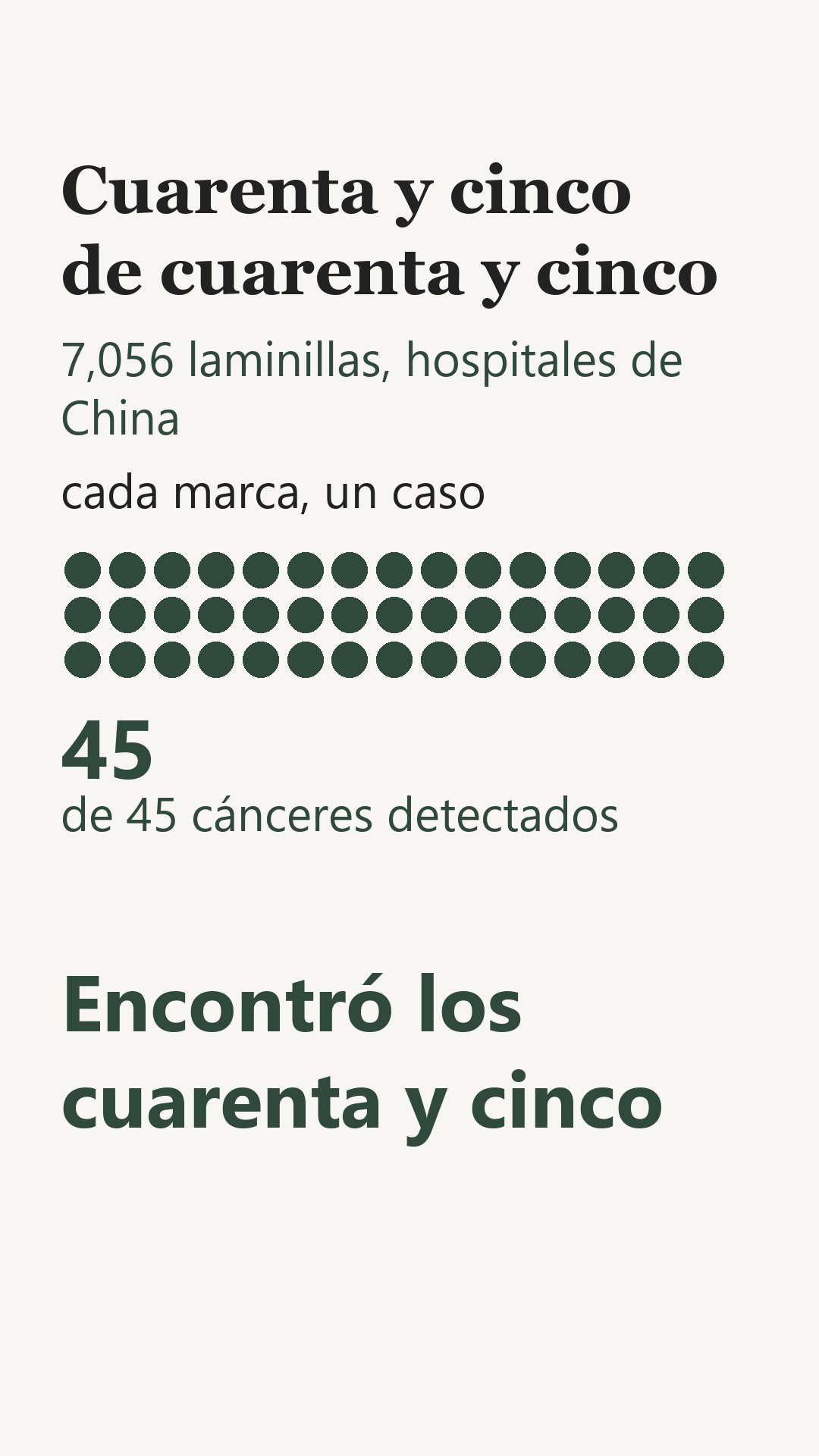
Después lo probaron con 7,056 portaobjetos de consultas de rutina, recogidos entre marzo de 2024 y abril de 2025. El GAS era apenas el 0.6% de esos casos. El programa marcó los 45 casos de GAS, todos.
Ese resultado tiene un borde. Las imágenes venían solo de hospitales de China, y muchos casos eran consultas derivadas, es decir, casos difíciles que alguien quiso revisar. La prueba se hizo sobre portaobjetos ya guardados, no dentro de un laboratorio donde un patólogo recibe la alerta y decide. Tampoco se ha medido si el diagnóstico llega antes ni si los pacientes viven más. El programa también confundió tejido normal con GAS en el 11.5% de esas muestras.
Un dato del tamaño del problema: en ese mismo conjunto de rutina, el GAS fue 45 casos entre 7,056.
GASPath no diagnostica a nadie. Señala regiones para que un patólogo las mire, y no sustituye su lectura ni las pruebas que ordene un médico. Lo que puede buscar donde usted vive es si el laboratorio de patología de su hospital, o el programa público de detección de cáncer cervical, ha probado alguna herramienta así con sus propios portaobjetos, teñidos y escaneados en sus propias máquinas. Sin esa prueba local, nadie sabe cómo leería las muestras de su región.
Qué significa para usted
Para que una herramienta así llegue a su consultorio hace falta que alguien la pruebe con los portaobjetos, las tinciones y los escáneres de su propio hospital, y ese paso nadie lo ha dado todavía fuera de China. Puede preguntar en el laboratorio de patología de su hospital si alguna vez se ha evaluado un programa semejante con muestras locales.
Yang, J., He, Q., Peng, J. et al. (2026). Artificial intelligence‐assisted histopathological diagnosis of endocervical gastric‐type adenocarcinoma: a multicenter model development and validation study. The Journal of Pathology: Clinical Research. https://doi.org/10.1002/2056-4538.70113
Quién pagó: El trabajo fue financiado por la Fundación Nacional de Ciencias Naturales de China, los Proyectos Clínicos Clave del Tercer Hospital de la Universidad de Pekín, el Programa Nacional Clave de I+D de China, el Centro de Ingeniería de Shenzhen, un programa gubernamental de formación de talento clínico, un fondo de la Escuela de Posgrado Internacional de Tsinghua en Shenzhen, una subvención de inicio de la Universidad de Fuzhou, la Fundación Provincial de Ciencias Naturales de Fujian y la Fundación de Ciencias Naturales de Tianjin; el artículo declara no tener conflictos de interés y no indica si los financiadores tuvieron alguna influencia.
No tome esto como consejo médico profesional.
Los hallazgos de otros estudios que aquí se mencionan los conocemos por este documento, que fue el que leímos; no abrimos cada uno de esos estudios.
Versión detalladaLos pasajes copiados del artículo, las ilustraciones y cada fuente con cuánto leímos de ella · 1441 palabras · unos 7 minLeerla →Cerrar
Un programa de computadora reconoció los 45 casos de un cáncer de cuello uterino poco frecuente entre 7,056 láminas
El sistema, todavía sin evaluar fuera de China, revisa las mismas láminas de tejido que ya se tiñen de rutina. Sus autores lo presentan como una red de seguridad, no como un diagnóstico.
Hay un cáncer de cuello uterino que se esconde. Se llama adenocarcinoma gástrico de endocérvix, o GAS por sus siglas en inglés, y es de los más agresivos: el artículo describe un estudio en el que la proporción de pacientes vivas a los cinco años es de 42 por ciento, frente a 91 por ciento en el adenocarcinoma relacionado con el virus del papiloma humano1. El artículo describe un estudio en el que 59 por ciento de los casos se descubre en etapa II o más avanzada2. El artículo describe un estudio en el que es la forma más común de adenocarcinoma cervical no relacionado con ese virus, y en poblaciones asiáticas llega a representar hasta 25 por ciento de todos los adenocarcinomas3. El artículo describe un estudio en el que, con la vacunación contra el virus extendiéndose, se espera que su peso relativo aumente4.
El problema es que al microscopio se parece a tejidos sanos y a otros tumores. Por eso un grupo de investigadores de China entrenó un programa de computadora para reconocerlo en las láminas de hematoxilina y eosina, las que ya se preparan en cualquier laboratorio de patología5.
El programa, llamado GASPath, parte la lámina en pedazos pequeños y los examina como si fueran un equipo de patólogos especializados: cada uno mira un rasgo distinto y luego comparan notas, mientras un filtro descarta las zonas que no aportan nada6. Al final entrega una probabilidad por cada una de cinco categorías y un mapa de calor que señala las regiones que pesaron en su decisión, para que un patólogo las revise7.
Los resultados que reportan los autores: en la validación interna, sobre 96 casos de GAS y otras cuatro categorías de tejido parecido, el sistema acertó 98 de cada 100 láminas8. En 12 hospitales externos, la sensibilidad —la proporción de casos reales que detecta— llegó a 0.902, y subió a 0.968 ajustando el umbral de decisión9. En muestras de biopsia, es decir, tejido escaso tomado con pinza, rindió casi igual que en piezas quirúrgicas completas10.
La prueba más grande fue sobre 7,056 láminas de consulta reales recogidas entre marzo de 2024 y abril de 2025. Entre ellas había 45 casos de GAS, apenas 0.6 por ciento del total. El sistema identificó los 451112. Su exactitud equilibrada fue de 0.95311. Los mapas de calor se fijaron en glándulas irregulares y anguladas, en la pérdida sutil de la polaridad del núcleo y en atipias leves, rasgos que se confunden con otras categorías13.
Conviene ver el tamaño de la tarea. En esas 7,056 láminas, el programa tenía que encontrar 45 agujas en un pajar sin dejar pasar ninguna. Lo logró en un archivo guardado, no en un laboratorio en vivo. La evaluación se hizo fuera de línea, no dentro de un flujo de diagnóstico prospectivo, y el efecto de la interacción con el patólogo, la fatiga por alertas y la integración con los sistemas del laboratorio quedan sin caracterizar14.
La especificidad también tiene su costado. En la prueba grande, el sistema identificó los 45 casos de GAS entre 7,056 láminas, con una exactitud equilibrada de 0.95311. Los propios autores señalan que la especificidad podría mejorar incorporando datos clínicos, radiológicos o de inmunohistoquímica. Y el impacto real sobre el flujo de trabajo, el costo y la supervivencia está sin cuantificar: apenas están iniciando un estudio aleatorizado multicéntrico para medirlo15.
Una advertencia más, y es grande: todo se entrenó y validó con cohortes de China, y falta verificar si funciona en otras poblaciones, etnias y protocolos de escaneo16. Las cohortes se armaron hacia atrás en el tiempo, y parte del material son consultas, lo que puede introducir un sesgo hacia casos difíciles o ambiguos que no representan del todo a la población que se revisa de rutina.
Piense en la escena: una mujer se hace una biopsia de cuello uterino en una clínica pública. El patólogo tiene un fragmento diminuto de tejido y, a veces, ni así logra distinguir si esas glándulas son benignas o un tumor que crece hacia adentro. El diagnóstico se retrasa, y con él el tratamiento.
Lo que se ha intentado antes en este terreno no es poca cosa. Un análisis que reunió 46 ensayos aleatorizados con 37,206 participantes encontró que la colonoscopia asistida por inteligencia artificial detecta más adenomas que la convencional; leímos solo el resumen, el texto completo está detrás de una suscripción171819. En mamografías, una revisión de diez años describe cómo la inteligencia artificial pasó de prueba de concepto a evaluación aleatorizada20. Pero esa misma revisión advierte que el rendimiento promedio es tan disperso que no se puede trasladar a un programa nuevo sin validarlo localmente21, y concluye que la herramienta sirve como segunda lectura, no como reemplazo del radiólogo22.
Hay otro ejemplo más cercano a la vida diaria de una clínica con pocos recursos. Un sistema para interpretar radiografías de tórax redujo el tiempo de lectura 18.3 por ciento y mejoró la calidad de los informes en un estudio prospectivo con 296 pacientes, según su resumen23. Funciona en equipo estándar, pensado para lugares con recursos limitados24. La mayoría de los sistemas parecidos, dicen esos autores, carecen de validación rigurosa en entornos clínicos reales25. GASPath está en la etapa anterior a eso.
La diferencia de GASPath con todo lo anterior es el material: no necesita tinciones especiales, pruebas de virus ni secuenciación genética. Trabaja sobre la lámina que ya existe. En un hospital de tercer nivel eso puede significar menos carga de trabajo. En uno de segundo nivel, donde no hay patólogo especializado, podría significar una alerta para mandar el caso a tiempo a quien sí sabe. Así lo plantean los autores. Falta comprobarlo.
Así lo leemos nosotros. Cuando una herramienta automática opina sobre personas, casi nunca queda claro quién responde si se equivoca. La institución señala al sistema y el sistema no habla. Si un hospital adopta este chequeo, el personal podría tomar la alerta como veredicto final y nadie cargaría con la responsabilidad de un error. Esperamos ver, si eso pasa, avisos que nadie revisa a fondo y pacientes con lesiones benignas parecidas que reciben una etiqueta que asusta. Sabríamos que nos equivocamos si el hospital publica quién revisa cada alerta, si un patólogo firma la decisión final y si los avisos falsos se auditan con nombre y fecha. Usted puede preguntar eso mismo cuando le hablen de un sistema así: quién firma el diagnóstico y qué pasa si la máquina se equivoca. Que la respuesta sea una persona, no "el sistema".
Y una segunda cosa que nos hace ruido: la promesa de "sin costo y sin pruebas caras" puede volverse la razón para no discutir el caso. El ahorro se celebra antes de que alguien mida cuántos avisos falsos genera en la práctica diaria de una clínica pública. Pida los falsos positivos, no solo los aciertos. Un sistema que avisa de más también cuesta tiempo, biopsias y miedo, y eso se puede pedir por escrito.
Aquí, en México o en cualquier país de la región, la cuenta es sencilla de plantear y difícil de responder: no hay ningún dato de que este programa lea bien láminas teñidas y escaneadas en un laboratorio local. Eso no le quita mérito al resultado chino. Solo dice que no se puede suponer el mismo rendimiento en otra parte. La pregunta que puede llevar a su clínica no es si la inteligencia artificial sirve, sino si el sistema que le ofrecen fue probado con las láminas de ese mismo hospital, con sus tinciones y sus escáneres.
El camino que falta está trazado por los propios autores. El estudio aleatorizado que están iniciando medirá si el sistema influye en la oportunidad del diagnóstico, en las decisiones de tratamiento y en la supervivencia15. Hasta que eso exista, GASPath es una herramienta que encontró lo que buscaba en un archivo, no una que haya cambiado el destino de una paciente.
Volvamos a la mujer de la clínica, la del fragmento diminuto de tejido. Lo que este trabajo deja sobre la mesa es una posibilidad concreta: que una alerta barata llegue antes que el diagnóstico tardío, en un lugar donde no hay pruebas caras. No está demostrado que llegue. Pero ya existe la pregunta que usted puede hacer en su consulta, y esa no cuesta nada: ¿este estudio se validó con nuestras láminas, o solo con las de otro país?
De dónde sale cada dato de contexto, y cuánto leímos de cada documento
- Yang, J., He, Q., Peng, J. et al. (2026). Artificial intelligence‐assisted histopathological diagnosis of endocervical gastric‐type adenocarcinoma: a multicenter model development and validation study. The Journal of Pathology: Clinical Research. https://doi.org/10.1002/2056-4538.70113 - el artículo del que trata esta nota — el artículo completo — el pasaje: "Endocervical gastric‐type adenocarcinoma (GAS) is a highly aggressive subtype of cervical adenocarcinoma, with a 5‐year survival rate markedly lower than that of HPV‐related adenocarcinoma (42% versus 91%; Figure 1A1 ) [ 1 , 2 , 3 ]."
- Yang, J., He, Q., Peng, J. et al. (2026). Artificial intelligence‐assisted histopathological diagnosis of endocervical gastric‐type adenocarcinoma: a multicenter model development and validation study. The Journal of Pathology: Clinical Research. https://doi.org/10.1002/2056-4538.70113 - el artículo del que trata esta nota — el artículo completo — el pasaje: "Diagnostic ambiguity is the central factor underlying GAS's clinical stealth (Figure 1A3 ), with 59% cases detected at stage II or later, leading to a substantial gap between its potential and actual clinical detection rate (Figure 1A4 ) [ 8 ]."
- Yang, J., He, Q., Peng, J. et al. (2026). Artificial intelligence‐assisted histopathological diagnosis of endocervical gastric‐type adenocarcinoma: a multicenter model development and validation study. The Journal of Pathology: Clinical Research. https://doi.org/10.1002/2056-4538.70113 - el artículo del que trata esta nota — el artículo completo — el pasaje: "GAS represents the most common subtype of non‐HPV‐associated cervical adenocarcinoma and the second most common cervical adenocarcinoma overall, accounting for approximately 10% of all adenocarcinomas in Western countries and up to 25% in Asian populations [ 4 ]."
- Yang, J., He, Q., Peng, J. et al. (2026). Artificial intelligence‐assisted histopathological diagnosis of endocervical gastric‐type adenocarcinoma: a multicenter model development and validation study. The Journal of Pathology: Clinical Research. https://doi.org/10.1002/2056-4538.70113 - el artículo del que trata esta nota — el artículo completo — el pasaje: "With the widespread adoption of HPV vaccination, the relative incidence of GAS is expected to increase (Figure 1A2 ) [ 5 , 6 , 7 ]."
- Yang, J., He, Q., Peng, J. et al. (2026). Artificial intelligence‐assisted histopathological diagnosis of endocervical gastric‐type adenocarcinoma: a multicenter model development and validation study. The Journal of Pathology: Clinical Research. https://doi.org/10.1002/2056-4538.70113 - el artículo del que trata esta nota — el artículo completo — el pasaje: "This study therefore proposes a highly sensitive artificial intelligence (AI)–assisted diagnostic system for GAS based exclusively on H&E‐stained histopathological images."
- Yang, J., He, Q., Peng, J. et al. (2026). Artificial intelligence‐assisted histopathological diagnosis of endocervical gastric‐type adenocarcinoma: a multicenter model development and validation study. The Journal of Pathology: Clinical Research. https://doi.org/10.1002/2056-4538.70113 - el artículo del que trata esta nota — el artículo completo — el pasaje: "Conceptually, this mechanism operates analogously to a panel of subspecialty pathologists: multiple ‘expert agents’ each attend to distinct morphological facets while residual connections allow iterative refinement of their assessments based on contextual feedback from neighboring regions, and a soft‐mask denoising filter suppresses irrelevant areas without discarding subtle diagnostic cues."
- Yang, J., He, Q., Peng, J. et al. (2026). Artificial intelligence‐assisted histopathological diagnosis of endocervical gastric‐type adenocarcinoma: a multicenter model development and validation study. The Journal of Pathology: Clinical Research. https://doi.org/10.1002/2056-4538.70113 - el artículo del que trata esta nota — el artículo completo — el pasaje: "GASPath inputs H&E‐stained whole‐slide images, processes them through a multi‐agent‐aware attention mechanism that jointly encodes local morphology and contextual dependencies, and outputs diagnostic probabilities with attention heatmaps highlighting regions of pathological interest for clinician review."
- Yang, J., He, Q., Peng, J. et al. (2026). Artificial intelligence‐assisted histopathological diagnosis of endocervical gastric‐type adenocarcinoma: a multicenter model development and validation study. The Journal of Pathology: Clinical Research. https://doi.org/10.1002/2056-4538.70113 - el artículo del que trata esta nota — el artículo completo — el pasaje: "In internal validation (Stage I), it achieved an accuracy of 0.980 (95% CI 0.977–0.983) and an ROC‐AUC of 0.995 (95% CI 0.994–0.997)."
- Yang, J., He, Q., Peng, J. et al. (2026). Artificial intelligence‐assisted histopathological diagnosis of endocervical gastric‐type adenocarcinoma: a multicenter model development and validation study. The Journal of Pathology: Clinical Research. https://doi.org/10.1002/2056-4538.70113 - el artículo del que trata esta nota — el artículo completo — el pasaje: "In external validation (Stage II), the sensitivity reached 0.902 and improved to 0.968 with proposed strategies. For biopsy samples, GASPath achieved an ROC‐AUC of 0.990 (95% CI 0.984–0.997)."
- Yang, J., He, Q., Peng, J. et al. (2026). Artificial intelligence‐assisted histopathological diagnosis of endocervical gastric‐type adenocarcinoma: a multicenter model development and validation study. The Journal of Pathology: Clinical Research. https://doi.org/10.1002/2056-4538.70113 - el artículo del que trata esta nota — el artículo completo — el pasaje: "This demonstrates that GASPath can achieve nearly equivalent performance on limited biopsy tissues compared to complete specimens (supplementary material, Table S10 )."
- Yang, J., He, Q., Peng, J. et al. (2026). Artificial intelligence‐assisted histopathological diagnosis of endocervical gastric‐type adenocarcinoma: a multicenter model development and validation study. The Journal of Pathology: Clinical Research. https://doi.org/10.1002/2056-4538.70113 - el artículo del que trata esta nota — el artículo completo — el pasaje: "In large‐scale real‐world deployment (Stage III, n = 7,056), GASPath achieved a balanced accuracy of 0.953, with 100% sensitivity for GAS (45/45 cases correctly identified)."
- Yang, J., He, Q., Peng, J. et al. (2026). Artificial intelligence‐assisted histopathological diagnosis of endocervical gastric‐type adenocarcinoma: a multicenter model development and validation study. The Journal of Pathology: Clinical Research. https://doi.org/10.1002/2056-4538.70113 - el artículo del que trata esta nota — el artículo completo — el pasaje: "Across all thresholds, it successfully identified all 45 GAS cases among 7,056 samples, achieving 100% sensitivity (Figure 5A–D )."
- Yang, J., He, Q., Peng, J. et al. (2026). Artificial intelligence‐assisted histopathological diagnosis of endocervical gastric‐type adenocarcinoma: a multicenter model development and validation study. The Journal of Pathology: Clinical Research. https://doi.org/10.1002/2056-4538.70113 - el artículo del que trata esta nota — el artículo completo — el pasaje: "The heatmaps highlight morphological features of GAS that are easily underestimated, such as irregular, angulated glands, subtle loss of nuclear polarity, and mild cytologic atypia, which show substantial morphological overlap with other diagnostic categories."
- Yang, J., He, Q., Peng, J. et al. (2026). Artificial intelligence‐assisted histopathological diagnosis of endocervical gastric‐type adenocarcinoma: a multicenter model development and validation study. The Journal of Pathology: Clinical Research. https://doi.org/10.1002/2056-4538.70113 - el artículo del que trata esta nota — el artículo completo — el pasaje: "Fourth, although Stage III involved large‐scale real‐world data, the evaluation was conducted offline rather than within prospective diagnostic workflows; the impact of pathologist‐in‐the‐loop interaction, alert fatigue, and laboratory information system integration on diagnostic behavior and outcomes remains uncharacterized."
- Yang, J., He, Q., Peng, J. et al. (2026). Artificial intelligence‐assisted histopathological diagnosis of endocervical gastric‐type adenocarcinoma: a multicenter model development and validation study. The Journal of Pathology: Clinical Research. https://doi.org/10.1002/2056-4538.70113 - el artículo del que trata esta nota — el artículo completo — el pasaje: "We are initiating a multicenter randomized study to assess GASPath's influence on diagnostic timeliness, therapeutic decision‐making, and survival outcomes."
- Yang, J., He, Q., Peng, J. et al. (2026). Artificial intelligence‐assisted histopathological diagnosis of endocervical gastric‐type adenocarcinoma: a multicenter model development and validation study. The Journal of Pathology: Clinical Research. https://doi.org/10.1002/2056-4538.70113 - el artículo del que trata esta nota — el artículo completo — el pasaje: "Second, GASPath was trained and validated using multicenter cohorts from China, and its generalizability across populations, ethnicities, and scanning protocols remains to be verified."
- Bananzadeh A, Bahadori M, Tadayon SMK, Shojaei-Zarghani S, Hosseini SV. (2026). The role of artificial intelligence in adenoma detection during colonoscopy: a systematic review and meta-analysis of randomized controlled trials—Artificial intelligence and adenoma detection. Techniques in Coloproctology. 10.1007/s10151-026-03323-7 — solo el resumen - no se pudo obtener el texto completo — el pasaje: "We aimed to provide an updated and comprehensive synthesis of evidence from randomized controlled trials (RCTs) on the efficacy of artificial intelligence (AI)-assisted versus conventional colonoscopy in detecting colorectal adenomas."
- Bananzadeh A, Bahadori M, Tadayon SMK, Shojaei-Zarghani S, Hosseini SV. (2026). The role of artificial intelligence in adenoma detection during colonoscopy: a systematic review and meta-analysis of randomized controlled trials—Artificial intelligence and adenoma detection. Techniques in Coloproctology. 10.1007/s10151-026-03323-7 — solo el resumen - no se pudo obtener el texto completo — el pasaje: "A total of 46 RCTs, involving 37,206 participants, were included."
- Bananzadeh A, Bahadori M, Tadayon SMK, Shojaei-Zarghani S, Hosseini SV. (2026). The role of artificial intelligence in adenoma detection during colonoscopy: a systematic review and meta-analysis of randomized controlled trials—Artificial intelligence and adenoma detection. Techniques in Coloproctology. 10.1007/s10151-026-03323-7 — solo el resumen - no se pudo obtener el texto completo — el pasaje: "This comprehensive meta-analysis confirms that AI-assisted colonoscopy significantly improves the detection of conventional adenomas and reduces miss rates."
- Ciurescu S, Buciu V, Ilaș DG, Pârvănescu R, Șerban D. (2026). Ten Years of Artificial Intelligence in Screening Mammography: A Systematic Review and Meta-Analysis of Diagnostic Accuracy and Clinical Implementation (Literature Published 2015–2025). Diagnostics. 10.3390/diagnostics16183045 — solo el resumen - no se pudo obtener el texto completo — el pasaje: "Deep-learning artificial intelligence (AI) for mammographic screening moved from proof of concept to randomised evaluation in a single decade."
- Ciurescu S, Buciu V, Ilaș DG, Pârvănescu R, Șerban D. (2026). Ten Years of Artificial Intelligence in Screening Mammography: A Systematic Review and Meta-Analysis of Diagnostic Accuracy and Clinical Implementation (Literature Published 2015–2025). Diagnostics. 10.3390/diagnostics16183045 — solo el resumen - no se pudo obtener el texto completo — el pasaje: "Pooled accuracy is high on average but so dispersed that it cannot be transferred to a new programme; local validation before deployment remains necessary."
- Ciurescu S, Buciu V, Ilaș DG, Pârvănescu R, Șerban D. (2026). Ten Years of Artificial Intelligence in Screening Mammography: A Systematic Review and Meta-Analysis of Diagnostic Accuracy and Clinical Implementation (Literature Published 2015–2025). Diagnostics. 10.3390/diagnostics16183045 — solo el resumen - no se pudo obtener el texto completo — el pasaje: "A decade of evidence supports AI as a second reader and triage tool in organised screening, not as an autonomous replacement for the radiologist."
- Bai Y, Zhang R, Lei Y, Duan X, Yao J, Ju S, et al. (2026). A DeepSeek-powered AI system for automated chest radiograph interpretation in clinical practice. Nature Communications. 10.1038/s41467-026-72680-6 — solo el resumen - no se pudo obtener el texto completo — el pasaje: "In real-world deployment involving 296 patients, AI assistance significantly improved report quality scores and reduced interpretation time by 18.3% compared with standard practice."
- Bai Y, Zhang R, Lei Y, Duan X, Yao J, Ju S, et al. (2026). A DeepSeek-powered AI system for automated chest radiograph interpretation in clinical practice. Nature Communications. 10.1038/s41467-026-72680-6 — solo el resumen - no se pudo obtener el texto completo — el pasaje: "The system operates efficiently on standard hardware, supporting practical implementation in resource-constrained settings."
- Bai Y, Zhang R, Lei Y, Duan X, Yao J, Ju S, et al. (2026). A DeepSeek-powered AI system for automated chest radiograph interpretation in clinical practice. Nature Communications. 10.1038/s41467-026-72680-6 — solo el resumen - no se pudo obtener el texto completo — el pasaje: "Although artificial intelligence systems can assist with report generation, most lack rigorous prospective validation in real clinical environments."
Yang, J., He, Q., Peng, J. et al. (2026). Artificial intelligence‐assisted histopathological diagnosis of endocervical gastric‐type adenocarcinoma: a multicenter model development and validation study. The Journal of Pathology: Clinical Research. https://doi.org/10.1002/2056-4538.70113
Quién pagó: El trabajo fue financiado por la Fundación Nacional de Ciencias Naturales de China, los Proyectos Clínicos Clave del Tercer Hospital de la Universidad de Pekín, el Programa Nacional Clave de I+D de China, el Centro de Ingeniería de Shenzhen, un programa gubernamental de formación de talento clínico, un fondo de la Escuela de Posgrado Internacional de Tsinghua en Shenzhen, una subvención de inicio de la Universidad de Fuzhou, la Fundación Provincial de Ciencias Naturales de Fujian y la Fundación de Ciencias Naturales de Tianjin; el artículo declara no tener conflictos de interés y no indica si los financiadores tuvieron alguna influencia.
No tome esto como consejo médico profesional.
Los hallazgos de otros estudios que aquí se mencionan los conocemos por este documento, que fue el que leímos; no abrimos cada uno de esos estudios.
experiment · The journal of pathology. Clinical research · the paper, 1 Sep 2026 · free
The Slides Looked Almost Normal. The Software Found All 45 Cancers.
A test on 7,056 stored slides from Chinese hospitals flagged every case of a rare cervical cancer, but the test ran offline, on slides from China alone.
Short version · the longer version follows, about 6 min
Ask the weeklyAI chat
Ask me about this study: who was studied, what it found, and what it does not say.
Conversations are saved for as long as weeklyAI exists, to improve the publication. Answers come in the language you write in.
- The study at a glance
- Who
- Stored cervical tissue slides, including 45 cases of a rare cervical cancer (GAS)
- How many
- 7,056 slides
- Where
- China
- When
- March 2024 to April 2025
- Kind of study
- analysis of what people did
- Who did it
- Peking University Third Hospital and Tsinghua University, China
- The limit that matters
- The software ran offline on stored slides in China; nobody has measured whether patients are diagnosed sooner.
Five-year survival: the rare cervical cancer (GAS) against the HPV-linked kind
42 of every 100 people with GAS were alive at five years, against 91 of every 100 with the HPV-linked kind
Until a lab near you does, the software's perfect record belongs to 45 slides in China.
The glands on it look mild, close to healthy tissue. They are a cancer called gastric-type adenocarcinoma, or GAS, and the tissue's calm face is part of why it is missed. The article describes a study in which fewer than half of patients live five years, 42 of every 100, against 91 for the HPV-linked kind.
Researchers gathered 309 slides from 96 confirmed GAS cases at Peking University Third Hospital, the largest collection of its kind for AI work. Twelve Chinese centers outside the first hospital provided a separate set of 249 GAS slides. They added 1,320 slides of look-alike conditions: normal tissue, harmless growths, the HPV-linked cancer, and another cancer that mimics it.
With those slides they built GASPath, software that reads an ordinary H&E-stained slide, the routine pink-and-purple stain, and marks the regions it finds suspicious. On the slides it trained and tested on, it agreed with the confirmed diagnosis 0.980 of the time.
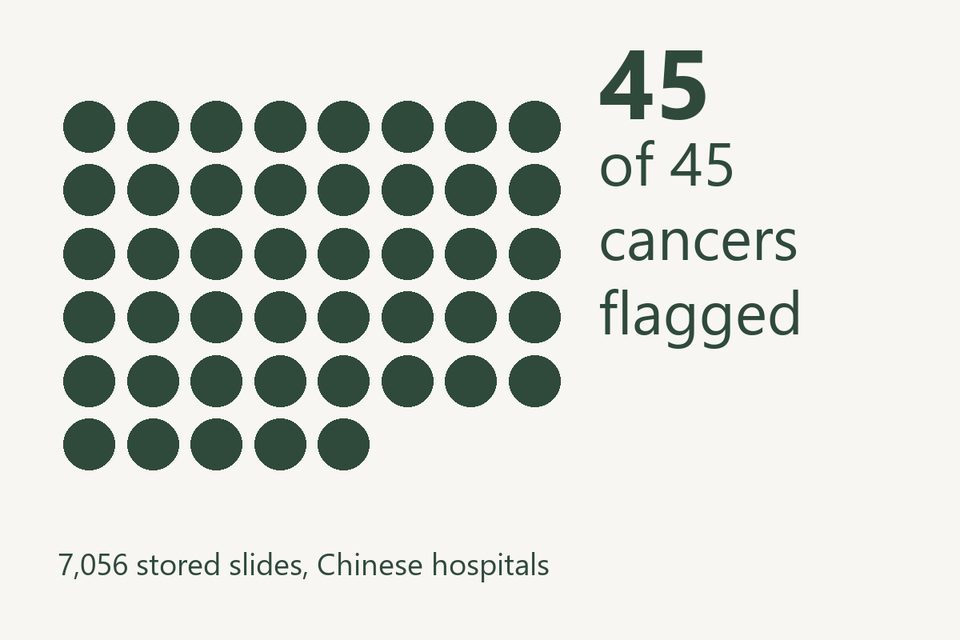
The firmer test came later. From March 2024 to April 2025, the software read 7,056 routine consultation slides. GAS made up just 0.6 percent of them, 45 cases. It flagged all 45.
Read that test carefully. It ran offline, on stored slides, with no pathologist acting on its alerts, so nobody has measured yet whether a lab using it catches cancers sooner. Every slide came from hospitals in China. How it reads slides stained and scanned in Latin America or North America is not yet known.
It also raises false alarms. Under its default setting, about one slide in ten that was not GAS was marked as GAS. Normal tissue was sometimes misread as GAS. The article also shows single examples of harmless growths, the HPV-linked cancer, and other conditions being misread as GAS. It is built to call attention to a pattern for a pathologist to check. It does not diagnose anyone, and it does not replace any test a doctor orders.
Its promise is cost. The usual backup tests, including immunohistochemistry and HPV testing, are expensive and not everywhere available. GASPath used nothing but the routine stain.
The thing to look for is whether pathology labs and cervical screening programs where you live put tools like this on their own slides and report what happens. Until a lab near you does, the software's perfect record belongs to 45 slides in China.
What this means for you
The software has read only slides from Chinese hospitals, and no pathologist has yet acted on its alerts, so nobody can say whether a lab using it catches this cancer sooner. If a screening program near you says it is trying a tool like this, ask whether it will report what happens to the people whose slides it reads. Until then, the perfect record belongs to 45 slides, and a pathologist is still the one to ask about any result.
Yang, J., He, Q., Peng, J. et al. (2026). Artificial intelligence‐assisted histopathological diagnosis of endocervical gastric‐type adenocarcinoma: a multicenter model development and validation study. The Journal of Pathology: Clinical Research. https://doi.org/10.1002/2056-4538.70113
Who paid: The work was supported by the National Natural Science Foundation of China, Key Clinical Projects of Peking University Third Hospital, the National Key R&D Program of China, Shenzhen Engineering Research Centre, a government-funded clinical talent training program, a Tsinghua Shenzhen International Graduate School fund, a Fuzhou University start-up grant, the Fujian Provincial Natural Science Foundation and the Tianjin Natural Science Foundation; the article states no conflicts of interest and does not say whether funders had any say.
Do not take this as professional medical advice.
The findings of other studies mentioned here are known to us through this document, which is the one we read; we did not open each of those studies.
The longer versionThe passages copied from the paper, the pictures, and every source with how much of it we read · 1231 words · about 6 minRead it →Close
An AI Check Caught All 45 Cases of a Rare Cervical Cancer. The Test Was on Stored Slides, in China.
A model reads ordinary tissue slides and flags a cancer that hides. The study shows what it caught; it does not yet show what changes for a patient.
Imagine a cancer that looks, under the microscope, almost like healthy tissue. Endocervical gastric-type adenocarcinoma, or GAS, is that kind of cancer: a fast-moving subtype of cervical cancer whose five-year survival rate is 42 percent, against 91 percent for the HPV-related kind1. The study's authors report that 59 percent of cases are found at stage II or later, which they blame chiefly on how hard the tumor is to recognize2. It is the most common cervical adenocarcinoma not linked to HPV, and the second most common cervical adenocarcinoma overall: about 10 percent of all adenocarcinomas in Western countries, up to 25 percent in Asian populations3. As HPV vaccination spreads, the authors expect its relative share to rise4.
The usual backup for a doubtful slide is a set of lab tests: stains that mark proteins, a test for HPV genetic material, gene sequencing. The authors describe these as expensive, labor-intensive and often unavailable where resources are thin, and even then not always conclusive. So the team tried something cheaper. GASPath, as they call it, takes a scanned slide stained with hematoxylin and eosin, the routine pink-and-purple stain every pathology lab already uses, and nothing else5.
How it works, step by step. The slide image is cut into small square patches. A pretrained model turns each patch into a compact numerical description, a kind of fingerprint of the tissue6. Then an attention mechanism weighs those patches against each other, so the software can judge a gland by the stroma around it and the neighborhood by the gland. The authors compare it to a panel of subspecialists: several "expert agents" each study a different feature, refine their reading in light of what the others see, and a filter discards irrelevant areas without throwing away subtle clues7. The output is a probability for each of five categories, plus a heatmap marking the regions the model leaned on, for a pathologist to review6.
The team trained and tested the model on slides from Peking University Third Hospital and twelve other centers across China. On the internal slides it scored an accuracy of 0.980, with a range of 0.977 to 0.983, and an ROC-AUC of 0.995, range 0.994 to 0.9978. The model was compared against three established AI methods of the same family. Then came the harder test: a set of 7,056 consultation slides from routine practice, collected between March 2024 and April 2025, in which GAS made up 45 cases9.
On the internal slides it scored an accuracy of 0.980, with a range of 0.977 to 0.983, and an ROC-AUC of 0.995, range 0.994 to 0.9978. On the twelve outside hospitals, sensitivity reached 0.902 under the default rule and 0.968 when the threshold was loosened10. On biopsy samples, the small snips taken in clinic, it reached an ROC-AUC of 0.990, range 0.984 to 0.997, which the authors call nearly equivalent to its performance on whole surgical specimens1011. And in the real-world set it identified all 45 GAS cases, a sensitivity of 100 percent, with a balanced accuracy of 0.9539. The heatmaps, the authors write, highlight features easily underestimated: irregular, angled glands, a subtle loss of nuclear order, mild cell abnormality, all of which overlap with other diagnoses12.
Consider what that real-world number covers. The model was run over stored slides, offline, after the diagnoses were already made. The authors say so plainly: the effect of a pathologist acting on the alerts, of alert fatigue, of wiring the tool into a hospital's lab system, all remain unmeasured13. Specificity, the share of non-cancers correctly left alone, was 0.905 at the default setting; 11.5 percent of normal samples were flagged as GAS. The training and testing all happened in China, and the authors state that how the model reads slides from other populations and other scanners remains to be verified14. The cohorts were assembled after the fact, and some came through a consultation service, which tilts them toward hard and ambiguous cases rather than ordinary screening.
Here is how we read it. A tool that shows its work invites argument; one that hands down a verdict does not. The heatmaps matter for that reason as much as for the numbers. When you hear of software catching a disease, ask whether a specialist can see why it flagged a case and can overrule it. At a clinic, ask who reviews the machine's alerts before anything is decided.
And watch how this number travels. Forty-five out of forty-five is the kind of figure that gets repeated alone. Hold it next to its setting: one country, stored slides, offline. When you see a dramatic catch rate, ask how many cases it rests on and where the testing happened. The answer does not shrink the result. It tells you what the result is.
What would have to happen next is a trial with people in the loop. The authors say they are starting a multicenter randomized study to measure the tool's influence on how quickly diagnoses are made, on treatment decisions, and on survival15. Until that reports, the claim is observed accuracy on slides, not proven benefit to a patient.
This belongs to a family of stories about AI as a second pair of eyes. A review of 46 randomized trials of AI-assisted colonoscopy, covering 37,206 participants, found it raised the detection of conventional adenomas and cut miss rates; we could read only the summary, the full paper is behind a subscription1617. A decade of mammography AI pooled across 14 studies and 1,214,885 examinations found a standalone AUC of 0.890, but so dispersed that the authors wrote it cannot be transferred to a new screening program without local validation; we could read only the summary1819. The same review concluded that AI belongs as a second reader and triage tool, not as an autonomous replacement for the radiologist; we could read only the summary20.
The pattern across these is consistent: the machine finds more, and the finding still needs a human to act on it and a local test to prove it works there. Expect the same here. You would know we were wrong if clinics adopting such tools reported that staff cannot see or challenge the reasoning, or that the marked regions go unread.
For a reader far from a Chinese pathology lab, what does this touch? A woman with a suspicious cervical biopsy, and a pathologist with a slide that looks almost normal. The tool's promise is a cheap second look on a stain that is already made. The study does not show that promise reaching a patient. It shows the check can be built and that, on slides it had never seen, it did not miss the cancer.
What you can carry from this is a question for your own clinic. When a tissue sample is read, is there a second, independent look, human or machine? And if a diagnosis comes late, ask what check would have caught it sooner. The software is not the answer yet. Knowing what to ask for is a start.
The pink-and-purple slide has not changed in a century. What may change is who looks at it twice.
Where each piece of context comes from, and how much of it we read
- Yang, J., He, Q., Peng, J. et al. (2026). Artificial intelligence‐assisted histopathological diagnosis of endocervical gastric‐type adenocarcinoma: a multicenter model development and validation study. The Journal of Pathology: Clinical Research. https://doi.org/10.1002/2056-4538.70113 - the article this story is about — the whole article — the passage: "Endocervical gastric‐type adenocarcinoma (GAS) is a highly aggressive subtype of cervical adenocarcinoma, with a 5‐year survival rate markedly lower than that of HPV‐related adenocarcinoma (42% versus 91%; Figure 1A1 ) [ 1 , 2 , 3 ]."
- Yang, J., He, Q., Peng, J. et al. (2026). Artificial intelligence‐assisted histopathological diagnosis of endocervical gastric‐type adenocarcinoma: a multicenter model development and validation study. The Journal of Pathology: Clinical Research. https://doi.org/10.1002/2056-4538.70113 - the article this story is about — the whole article — the passage: "Diagnostic ambiguity is the central factor underlying GAS's clinical stealth (Figure 1A3 ), with 59% cases detected at stage II or later, leading to a substantial gap between its potential and actual clinical detection rate (Figure 1A4 ) [ 8 ]."
- Yang, J., He, Q., Peng, J. et al. (2026). Artificial intelligence‐assisted histopathological diagnosis of endocervical gastric‐type adenocarcinoma: a multicenter model development and validation study. The Journal of Pathology: Clinical Research. https://doi.org/10.1002/2056-4538.70113 - the article this story is about — the whole article — the passage: "GAS represents the most common subtype of non‐HPV‐associated cervical adenocarcinoma and the second most common cervical adenocarcinoma overall, accounting for approximately 10% of all adenocarcinomas in Western countries and up to 25% in Asian populations [ 4 ]."
- Yang, J., He, Q., Peng, J. et al. (2026). Artificial intelligence‐assisted histopathological diagnosis of endocervical gastric‐type adenocarcinoma: a multicenter model development and validation study. The Journal of Pathology: Clinical Research. https://doi.org/10.1002/2056-4538.70113 - the article this story is about — the whole article — the passage: "With the widespread adoption of HPV vaccination, the relative incidence of GAS is expected to increase (Figure 1A2 ) [ 5 , 6 , 7 ]."
- Yang, J., He, Q., Peng, J. et al. (2026). Artificial intelligence‐assisted histopathological diagnosis of endocervical gastric‐type adenocarcinoma: a multicenter model development and validation study. The Journal of Pathology: Clinical Research. https://doi.org/10.1002/2056-4538.70113 - the article this story is about — the whole article — the passage: "This study therefore proposes a highly sensitive artificial intelligence (AI)–assisted diagnostic system for GAS based exclusively on H&E‐stained histopathological images."
- Yang, J., He, Q., Peng, J. et al. (2026). Artificial intelligence‐assisted histopathological diagnosis of endocervical gastric‐type adenocarcinoma: a multicenter model development and validation study. The Journal of Pathology: Clinical Research. https://doi.org/10.1002/2056-4538.70113 - the article this story is about — the whole article — the passage: "GASPath inputs H&E‐stained whole‐slide images, processes them through a multi‐agent‐aware attention mechanism that jointly encodes local morphology and contextual dependencies, and outputs diagnostic probabilities with attention heatmaps highlighting regions of pathological interest for clinician review."
- Yang, J., He, Q., Peng, J. et al. (2026). Artificial intelligence‐assisted histopathological diagnosis of endocervical gastric‐type adenocarcinoma: a multicenter model development and validation study. The Journal of Pathology: Clinical Research. https://doi.org/10.1002/2056-4538.70113 - the article this story is about — the whole article — the passage: "Conceptually, this mechanism operates analogously to a panel of subspecialty pathologists: multiple ‘expert agents’ each attend to distinct morphological facets while residual connections allow iterative refinement of their assessments based on contextual feedback from neighboring regions, and a soft‐mask denoising filter suppresses irrelevant areas without discarding subtle diagnostic cues."
- Yang, J., He, Q., Peng, J. et al. (2026). Artificial intelligence‐assisted histopathological diagnosis of endocervical gastric‐type adenocarcinoma: a multicenter model development and validation study. The Journal of Pathology: Clinical Research. https://doi.org/10.1002/2056-4538.70113 - the article this story is about — the whole article — the passage: "In internal validation (Stage I), it achieved an accuracy of 0.980 (95% CI 0.977–0.983) and an ROC‐AUC of 0.995 (95% CI 0.994–0.997)."
- Yang, J., He, Q., Peng, J. et al. (2026). Artificial intelligence‐assisted histopathological diagnosis of endocervical gastric‐type adenocarcinoma: a multicenter model development and validation study. The Journal of Pathology: Clinical Research. https://doi.org/10.1002/2056-4538.70113 - the article this story is about — the whole article — the passage: "In large‐scale real‐world deployment (Stage III, n = 7,056), GASPath achieved a balanced accuracy of 0.953, with 100% sensitivity for GAS (45/45 cases correctly identified)."
- Yang, J., He, Q., Peng, J. et al. (2026). Artificial intelligence‐assisted histopathological diagnosis of endocervical gastric‐type adenocarcinoma: a multicenter model development and validation study. The Journal of Pathology: Clinical Research. https://doi.org/10.1002/2056-4538.70113 - the article this story is about — the whole article — the passage: "In external validation (Stage II), the sensitivity reached 0.902 and improved to 0.968 with proposed strategies. For biopsy samples, GASPath achieved an ROC‐AUC of 0.990 (95% CI 0.984–0.997)."
- Yang, J., He, Q., Peng, J. et al. (2026). Artificial intelligence‐assisted histopathological diagnosis of endocervical gastric‐type adenocarcinoma: a multicenter model development and validation study. The Journal of Pathology: Clinical Research. https://doi.org/10.1002/2056-4538.70113 - the article this story is about — the whole article — the passage: "This demonstrates that GASPath can achieve nearly equivalent performance on limited biopsy tissues compared to complete specimens (supplementary material, Table S10 )."
- Yang, J., He, Q., Peng, J. et al. (2026). Artificial intelligence‐assisted histopathological diagnosis of endocervical gastric‐type adenocarcinoma: a multicenter model development and validation study. The Journal of Pathology: Clinical Research. https://doi.org/10.1002/2056-4538.70113 - the article this story is about — the whole article — the passage: "The heatmaps highlight morphological features of GAS that are easily underestimated, such as irregular, angulated glands, subtle loss of nuclear polarity, and mild cytologic atypia, which show substantial morphological overlap with other diagnostic categories."
- Yang, J., He, Q., Peng, J. et al. (2026). Artificial intelligence‐assisted histopathological diagnosis of endocervical gastric‐type adenocarcinoma: a multicenter model development and validation study. The Journal of Pathology: Clinical Research. https://doi.org/10.1002/2056-4538.70113 - the article this story is about — the whole article — the passage: "Fourth, although Stage III involved large‐scale real‐world data, the evaluation was conducted offline rather than within prospective diagnostic workflows; the impact of pathologist‐in‐the‐loop interaction, alert fatigue, and laboratory information system integration on diagnostic behavior and outcomes remains uncharacterized."
- Yang, J., He, Q., Peng, J. et al. (2026). Artificial intelligence‐assisted histopathological diagnosis of endocervical gastric‐type adenocarcinoma: a multicenter model development and validation study. The Journal of Pathology: Clinical Research. https://doi.org/10.1002/2056-4538.70113 - the article this story is about — the whole article — the passage: "Second, GASPath was trained and validated using multicenter cohorts from China, and its generalizability across populations, ethnicities, and scanning protocols remains to be verified."
- Yang, J., He, Q., Peng, J. et al. (2026). Artificial intelligence‐assisted histopathological diagnosis of endocervical gastric‐type adenocarcinoma: a multicenter model development and validation study. The Journal of Pathology: Clinical Research. https://doi.org/10.1002/2056-4538.70113 - the article this story is about — the whole article — the passage: "We are initiating a multicenter randomized study to assess GASPath's influence on diagnostic timeliness, therapeutic decision‐making, and survival outcomes."
- Bananzadeh A, Bahadori M, Tadayon SMK, Shojaei-Zarghani S, Hosseini SV. (2026). The role of artificial intelligence in adenoma detection during colonoscopy: a systematic review and meta-analysis of randomized controlled trials—Artificial intelligence and adenoma detection. Techniques in Coloproctology. 10.1007/s10151-026-03323-7 — only the abstract - the full text could not be fetched — the passage: "A total of 46 RCTs, involving 37,206 participants, were included."
- Bananzadeh A, Bahadori M, Tadayon SMK, Shojaei-Zarghani S, Hosseini SV. (2026). The role of artificial intelligence in adenoma detection during colonoscopy: a systematic review and meta-analysis of randomized controlled trials—Artificial intelligence and adenoma detection. Techniques in Coloproctology. 10.1007/s10151-026-03323-7 — only the abstract - the full text could not be fetched — the passage: "This comprehensive meta-analysis confirms that AI-assisted colonoscopy significantly improves the detection of conventional adenomas and reduces miss rates."
- Ciurescu S, Buciu V, Ilaș DG, Pârvănescu R, Șerban D. (2026). Ten Years of Artificial Intelligence in Screening Mammography: A Systematic Review and Meta-Analysis of Diagnostic Accuracy and Clinical Implementation (Literature Published 2015–2025). Diagnostics. 10.3390/diagnostics16183045 — only the abstract - the full text could not be fetched — the passage: "Pooled standalone AUC across 14 studies and 1,214,885 examinations was 0.890 (95% CI 0.858-0.915), with I 2 = 97.4% and a 95% prediction interval of 0.731-0.960."
- Ciurescu S, Buciu V, Ilaș DG, Pârvănescu R, Șerban D. (2026). Ten Years of Artificial Intelligence in Screening Mammography: A Systematic Review and Meta-Analysis of Diagnostic Accuracy and Clinical Implementation (Literature Published 2015–2025). Diagnostics. 10.3390/diagnostics16183045 — only the abstract - the full text could not be fetched — the passage: "Pooled accuracy is high on average but so dispersed that it cannot be transferred to a new programme; local validation before deployment remains necessary."
- Ciurescu S, Buciu V, Ilaș DG, Pârvănescu R, Șerban D. (2026). Ten Years of Artificial Intelligence in Screening Mammography: A Systematic Review and Meta-Analysis of Diagnostic Accuracy and Clinical Implementation (Literature Published 2015–2025). Diagnostics. 10.3390/diagnostics16183045 — only the abstract - the full text could not be fetched — the passage: "A decade of evidence supports AI as a second reader and triage tool in organised screening, not as an autonomous replacement for the radiologist."
Yang, J., He, Q., Peng, J. et al. (2026). Artificial intelligence‐assisted histopathological diagnosis of endocervical gastric‐type adenocarcinoma: a multicenter model development and validation study. The Journal of Pathology: Clinical Research. https://doi.org/10.1002/2056-4538.70113
Who paid: The work was supported by the National Natural Science Foundation of China, Key Clinical Projects of Peking University Third Hospital, the National Key R&D Program of China, Shenzhen Engineering Research Centre, a government-funded clinical talent training program, a Tsinghua Shenzhen International Graduate School fund, a Fuzhou University start-up grant, the Fujian Provincial Natural Science Foundation and the Tianjin Natural Science Foundation; the article states no conflicts of interest and does not say whether funders had any say.
Do not take this as professional medical advice.