other · Frontiers in Political Science · la publicación, 1 may 2026 · gratis
Antes de votar circularon imágenes y audios alterados con IA sobre candidatos en Ecuador; el estudio no puede decir si cambiaron algún voto.
Versión breve · la versión detallada sigue, unos 8 min
Pregunte al chat de weeklyAI
Pregúnteme por este estudio: a quiénes se estudió, qué encontró y qué no dice.
Las conversaciones se guardan mientras exista weeklyAI, para mejorar la publicación. Se responde en el idioma en que usted escribe.
- El estudio, de un vistazo
- Quiénes
- ciudadanos ecuatorianos en edad de votar, más expertos y grupos focales
- Cuántos
- 403 personas encuestadas, 12 entrevistas y 35 participantes en grupos focales
- Dónde
- Ecuador
- Cuándo
- encuesta del 27 de agosto al 21 de octubre de 2025
- Tipo de estudio
- survey
- Quién lo hizo
- Universidad Técnica Particular de Loja, Ecuador
- El límite que importa
- La encuesta fue en línea y no representa a todo el electorado.
Lo que la gente dice de su propio voto frente a lo que dice del sistema
El voto propio queda por debajo del punto neutro (2.52 de 5); el daño al sistema se percibe alto (3.83 de 5).
Antes de la próxima elección, busque la versión original de esa foto o ese audio que le llegó por WhatsApp. Si no la encuentra, no lo reenvíe.
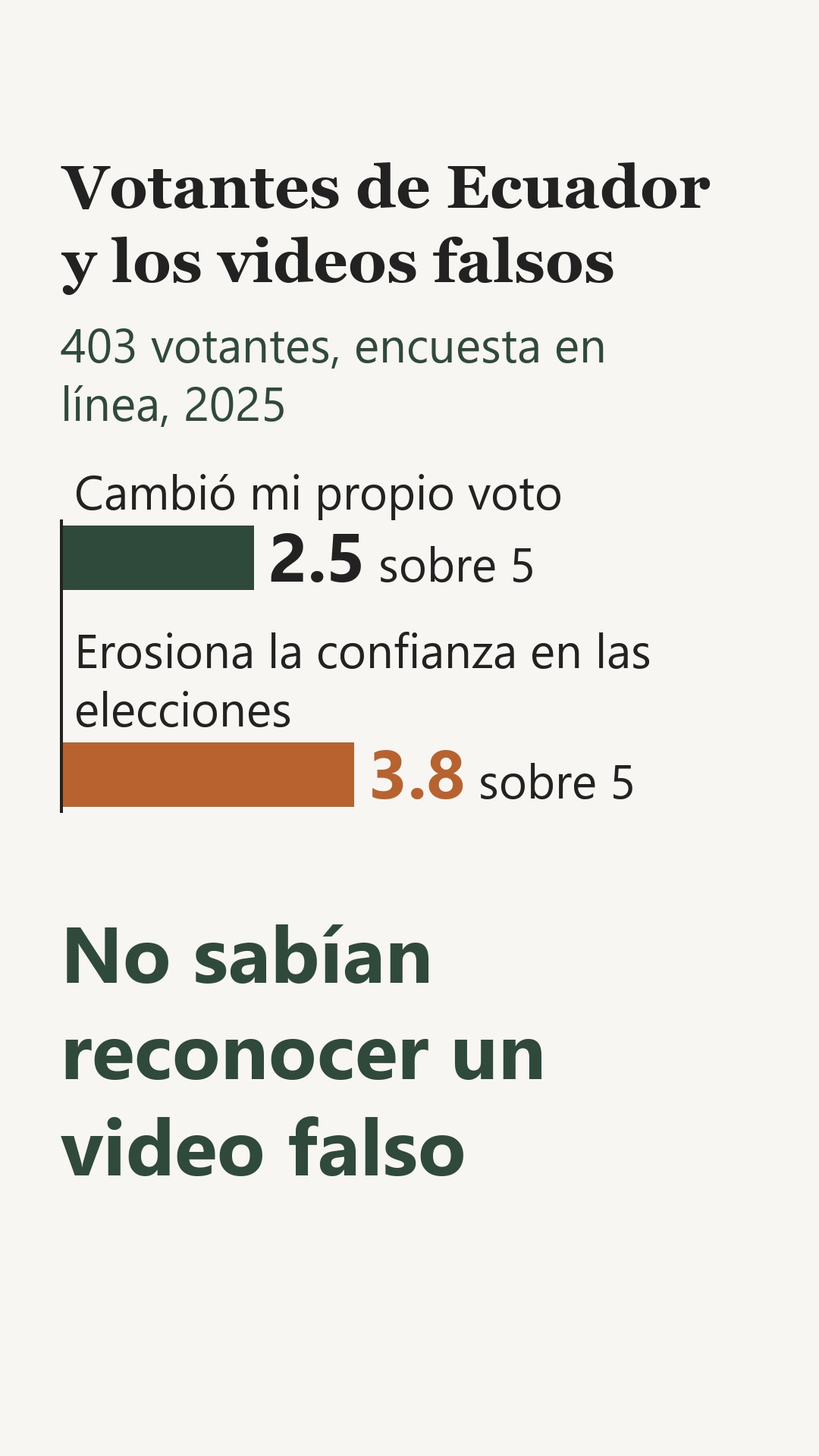
En la campaña presidencial de Ecuador de 2025 se documentaron fotos de Noboa y González alteradas con inteligencia artificial, videos falsos de un candidato y un noticiero inventado que elogió a Luisa González. La encuesta del estudio, hecha en línea entre agosto y octubre de 2025 a 403 personas, no representa a todo el electorado. En los grupos de discusión, los habitantes de zonas rurales dijeron que no se sienten capaces de detectar la información falsa. Los especialistas entrevistados señalaron que los adultos mayores son un grupo vulnerable.
El estudio no nombra una forma para que usted verifique esto.
Un profesor universitario entrevistado dijo que no hay obligaciones claras para que los partidos y las plataformas declaren el uso de IA. Varios especialistas pidieron una unidad del CNE y un observatorio nacional de IA electoral; el estudio no registra que se hayan creado.
Qué significa para usted
Los especialistas entrevistados en el estudio hablaron de una unidad dentro del CNE y de un observatorio nacional de inteligencia artificial electoral, y el estudio no registra que alguna de las dos exista hoy. Cuando llegue la próxima campaña, puede preguntar a su autoridad electoral si publicó normas sobre el uso de IA, si auditó el contenido de la contienda y qué encontró. El estudio no probó que enseñar a leer la información cambie un voto.
Suing, A., Ganazhapa, H., Medina, J. (2026). Media and information literacy in the face of election disinformation generated by artificial intelligence: experiences from Ecuador. Frontiers in Political Science. https://doi.org/10.3389/fpos.2026.1834093
Quién pagó: Los autores declararon que no recibieron apoyo financiero para este trabajo ni para su publicación, y no declararon relaciones comerciales o financieras que pudieran constituir un conflicto de interés; la herramienta de inteligencia artificial generativa Qwen3.5-Plus se utilizó para organizar los testimonios de las entrevistas y tabular las contribuciones de los grupos focales.
Versión detalladaLos pasajes copiados del artículo, las ilustraciones y cada fuente con cuánto leímos de ella · 1562 palabras · unos 8 minLeerla →Cerrar
La regla y la evidencia: antes de votar circularon imágenes y audios alterados con IA sobre candidatos en Ecuador; el estudio no puede decir si cambiaron algún voto
### EL ACTO
En Ecuador, al momento de publicarse este estudio, no hay una regla en vigor que obligue a los actores políticos ni a las plataformas digitales a declarar el uso de inteligencia artificial en campaña. Un entrevistado lo dice así: "There are no clear obligations for political actors or digital platforms to disclose the use of AI tools in the production of electoral content […]. The current regulation does not address the ethical dilemmas of AI use". Otro lo llama una carrera perdida: "The main challenge will be to overcome the lag between an AI that is already operational […], generating harmful effects in terms of disinformation, and, on the other hand, a slow, deficient legislative process".
Los doce expertos entrevistados coincidieron en que el marco regulatorio de Ecuador es insuficiente frente a la desinformación generada con IA en las elecciones. Ninguno de los pasajes verificados cita un proyecto de ley con número, un reglamento publicado ni una resolución del Consejo Nacional Electoral (CNE) que esté vigente sobre este punto. Lo que hay son propuestas: un "National Electoral AI Observatory, with the participation of all sectors, functioning as a space for monitoring, training, and rapid response to automated disinformation events"1, y una unidad especializada dentro del CNE1. Nada de eso está en vigor.
Para el votante, la consecuencia práctica es que el marco actual no obliga a los actores políticos ni a las plataformas a declarar el uso de IA en campaña, y tampoco aborda los dilemas éticos de ese uso. El propio CNE, según uno de sus directores, queda atrapado: los que legislan fueron antes candidatos. La regla que este estudio mide no es una ley: es la alfabetización mediática, que el artículo describe como la capacidad de acceder, analizar, evaluar y producir información de manera crítica.
### EL CASO QUE RESPONDE
Esta semana no se encontró ningún caso real verificado con nombre, lugar, fecha y segunda fuente.
### LO QUE SE MIDIÓ
Se encuestó a 403 personas en Ecuador, entre el 27 de agosto y el 21 de octubre de 2025, más 12 entrevistas a expertos y seis grupos focales con 35 participantes. El muestreo no fue probabilístico: se reclutó por organizaciones sociales, escuelas y redes comunitarias en Costa, Sierra y Amazonía. Los porcentajes describen a esas 403 personas, no al padrón electoral de 13,736,314 votantes.
La pregunta central: ¿la desinformación generada con IA influyó en su voto? La media fue 2.52 sobre 5, por debajo del punto neutro: los encuestados dicen que a ellos no los movió. Pero cuando se les pregunta si esa desinformación erosiona la confianza en el sistema electoral, la media sube a 3.83 sobre 5. La confianza en el sistema sí, el voto propio no. Esa distancia es el hallazgo.
La valoración de la alfabetización mediática como herramienta para mitigar la desinformación obtuvo 4.01 sobre 5, con 71.2% de respuestas en 4 o 5. Y la exigencia de que el CNE actúe fue la más alta de todas: 4.16 sobre 5, con 56.1% marcando el valor máximo. Quien se siente capaz de identificar contenido generado por IA tiende a valorar más la alfabetización mediática: la correlación es de 0.327, moderada pero significativa (p < 0.001). Quien cree que los deepfakes dañaron la credibilidad de los candidatos tiende a percibir daño a la democracia (0.403), y esa percepción activa la demanda de acción institucional (0.569).
Los grupos focales rurales y de adultos mayores dijeron no poder distinguir lo falso. "Frankly I do not feel capable of detecting false information" (participante del grupo rural). "It would be good for someone to explain it to us; nobody has ever explained it to me". Las mujeres líderes describieron montajes sexualizados contra candidatas: "The female candidate was alluded to by suggesting she had a romantic relationship with the leader of her party. Montages were produced showing them kissing—images that were evidently created with AI"2.
Una advertencia sobre la medición: la escala de percepción de desinformación tuvo consistencia interna cuestionable (alfa de Cronbach de 0.583). Y no aparecieron diferencias estadísticamente significativas entre hombres y mujeres en ninguna de las 15 variables medidas (p > 0.05 en todos los casos)3, lo cual choca con los relatos cualitativos de violencia digital con sesgo de género. El estudio midió lo que la gente dice percibir, no lo que realmente detectó ni cómo votó. No probó ninguna intervención, así que no puede decir que un programa de alfabetización reduzca la creencia en lo falso.
### LA RESPUESTA DE LA OTRA REGIÓN AL MISMO PROBLEMA
En Estados Unidos, un experimento preinscrito de dos olas con 4,293 votantes registrados probó si artículos generados por un modelo de lenguaje podían advertir a la gente, antes de que viera un rumor electoral, sobre lo que iba a encontrar4. Funcionó: redujo la creencia en rumores electorales, con efectos que persistieron, atenuados, una semana después, y sin reacción partidista en contra5. Los artículos escritos con ayuda humana no fueron más eficaces que los escritos solo por la máquina6. No se probó en Ecuador.
En Alemania, durante las cuatro semanas previas a las elecciones federales de 2025, se analizaron publicaciones de Facebook e Instagram de 37 partidos y se identificaron casi mil imágenes y videos generados con IA, publicados por unos 400 cuentas de partido7. Los partidos minoritarios usaron la herramienta a tasas más altas que los grandes8. Los partidos principales declararon el origen artificial de sus imágenes con más frecuencia que los minoritarios o que Alternativa para Alemania9. El contenido generado con IA obtuvo más interacción que el que no la tenía, pero esa ventaja fue igual para grandes y pequeños10.
### LA LECTURA DE LA REDITORIAL
Aquí es donde este diario pone su lectura. Lo que siempre ha hecho un rumor falso sobre un candidato es encontrar una grieta que ya existía en la conversación y meterla ahí hasta que revienta. Lo nuevo no es el engaño: es la velocidad y el acabado. Ahora una voz clonada o un rostro reacomodado llegan sin que nadie tenga que dibujar nada, y llegan por el canal donde nadie revisa: el grupo de la familia, el del barrio, el audio que se reenvía.
Lo que esperaríamos en casas como la suya es que lo que más confunda antes de votar no sea un video inventado de cero, sino una foto o un audio auténticos de un candidato, sacados de contexto y reacomodados para que digan otra cosa. Esperaríamos que eso circule primero por WhatsApp y no por un medio que verifica. Si nos equivocamos, lo sabríamos porque la mayoría del contenido engañoso detectado en la campaña habría sido fabricado por completo y habría circulado por medios abiertos antes que por canales privados.
También esperaríamos que la diferencia entre detectar o no un contenido manipulado dependa menos de tener internet o un celular que del hábito de comparar, dudar y buscar la fuente. Por eso los grupos rurales con varios teléfonos en casa seguirían sin poder detectar lo falso, y por eso un taller que solo entrega datos técnicos no cambiaría gran cosa. Si nos equivocamos, lo veríamos si quienes tienen más dispositivos detectan mejor lo manipulado sin haber recibido entrenamiento alguno.
Y una cosa más que esperaríamos: que la aclaración oficial, cuando llegue, se lea como encubrimiento y no como corrección, sobre todo cuando el montaje toca a una mujer candidata. El veredicto ya se dio en la conversación antes de que alguien verificara. Si nos equivocamos, veríamos que la gente espera la verificación antes de juzgar y que los ataques con imágenes manipuladas se reparten por igual entre hombres y mujeres.
### LO QUE NO SE SABE
No se sabe cuánto del contenido viral de la campaña ecuatoriana fue generado con IA. La única cifra que aparece en el artículo es la que un entrevistado atribuye a Lupa Media: 23% del contenido viral identificado como desinformación tenía componentes generados con IA. Es una cifra de segunda mano, sin metodología publicada en el estudio.
No se sabe si la desinformación cambió algún voto. Los propios encuestados dicen que a ellos no los movió. No se sabe si un programa de alfabetización mediática en Ecuador reduciría la creencia en lo falso, porque no se probó ninguna intervención.
No se sabe si estos hallazgos aplican a otros países. El estudio es de un solo país y de un solo momento, sin línea base ni seguimiento posterior. Y la encuesta se hizo por formulario digital, lo que deja fuera a los menos conectados: justo los votantes rurales y mayores de los que trata el estudio. De ellos se sabe por los 35 participantes de los grupos focales, no por la encuesta.
No se sabe qué pasará cuando llegue la próxima elección. El estudio no puede decir si el daño a la confianza en el sistema se traduce en abstención, en voto impugnado o en reclamos ante el CNE.
La pregunta que le queda al votante no es si puede detectar un video falso. Es si sabe a quién preguntarle cuando algo le parece raro, y si esa persona existe. Antes de la próxima elección, busque la versión original de esa foto o ese audio que le llegó por WhatsApp. Si no la encuentra, no lo reenvíe.
De dónde sale cada dato de contexto, y cuánto leímos de cada documento
- Suing, A., Ganazhapa, H., Medina, J. (2026). Media and information literacy in the face of election disinformation generated by artificial intelligence: experiences from Ecuador. Frontiers in Political Science. https://doi.org/10.3389/fpos.2026.1834093 - el artículo del que trata esta nota — el artículo completo — el pasaje: "Interviewee 8 proposed “the creation of a National Electoral AI Observatory, with the participation of all sectors, functioning as a space for monitoring, training, and rapid response to automated disinformation events” (Interviewee 8)."
- Suing, A., Ganazhapa, H., Medina, J. (2026). Media and information literacy in the face of election disinformation generated by artificial intelligence: experiences from Ecuador. Frontiers in Political Science. https://doi.org/10.3389/fpos.2026.1834093 - el artículo del que trata esta nota — el artículo completo — el pasaje: "“The female candidate was alluded to by suggesting she had a romantic relationship with the leader of her party. Montages were produced showing them kissing—images that were evidently created with AI” (Participant 1, FGD5)."
- Suing, A., Ganazhapa, H., Medina, J. (2026). Media and information literacy in the face of election disinformation generated by artificial intelligence: experiences from Ecuador. Frontiers in Political Science. https://doi.org/10.3389/fpos.2026.1834093 - el artículo del que trata esta nota — el artículo completo — el pasaje: "The gender analysis using the Mann–Whitney U test revealed no statistically significant differences between men and women on any of the 15 Likert variables (p > 0.05 in all cases)."
- Linegar M, Sinclair B, van der Linden S, Alvarez RM. (2026). Towards scalable AI-assisted pre-bunking of election misinformation: evidence from a pre-registered US panel experiment. Royal Society Open Science. 10.1098/rsos.252226 — solo el resumen - no se pudo obtener el texto completo — el pasaje: "In a pre-registered two-wave experiment with 4293 United States (US) registered voters, we test this framework against politically charged election misinformation—one of the most challenging domains for misinformation intervention."
- Linegar M, Sinclair B, van der Linden S, Alvarez RM. (2026). Towards scalable AI-assisted pre-bunking of election misinformation: evidence from a pre-registered US panel experiment. Royal Society Open Science. 10.1098/rsos.252226 — solo el resumen - no se pudo obtener el texto completo — el pasaje: "We find that large language model (LLM)-generated pre-bunking significantly reduced belief in election rumours (effects persisting, though attenuated, one week later) and modestly offset declines in confidence in national election administration, with no evidence of partisan backlash."
- Linegar M, Sinclair B, van der Linden S, Alvarez RM. (2026). Towards scalable AI-assisted pre-bunking of election misinformation: evidence from a pre-registered US panel experiment. Royal Society Open Science. 10.1098/rsos.252226 — solo el resumen - no se pudo obtener el texto completo — el pasaje: "After finalizing the prompt, articles written with human feedback were no more effective than articles using only AI, indicating that per-rumour human effort can be substantially reduced once the prompt is in place."
- Kruschinski S, Votta F. (2026). Party Equalization or Normalization Through Visual Generative AI in the 2025 German Federal Election. Media and Communication. 10.17645/mac.11859 — solo el resumen - no se pudo obtener el texto completo — el pasaje: "Using a semi-automated AI detection method combining automated classification with manual validation, we analyzed Facebook and Instagram posts from 37 German parties, identifying nearly 1,000 VGenAI images and videos published by approximately 400 party accounts during the four weeks preceding election day."
- Kruschinski S, Votta F. (2026). Party Equalization or Normalization Through Visual Generative AI in the 2025 German Federal Election. Media and Communication. 10.17645/mac.11859 — solo el resumen - no se pudo obtener el texto completo — el pasaje: "Regarding adoption, minor parties used VGenAI at higher rates than major parties, supporting the equalization hypothesis, which states that low-cost technologies enable resource-constrained actors to produce professional campaign visuals."
- Kruschinski S, Votta F. (2026). Party Equalization or Normalization Through Visual Generative AI in the 2025 German Federal Election. Media and Communication. 10.17645/mac.11859 — solo el resumen - no se pudo obtener el texto completo — el pasaje: "Content strategy analysis reveals a transparency divide, with mainstream major parties disclosing AI origins more frequently than minor parties or the right-wing Alternative for Germany (AfD)."
- Kruschinski S, Votta F. (2026). Party Equalization or Normalization Through Visual Generative AI in the 2025 German Federal Election. Media and Communication. 10.17645/mac.11859 — solo el resumen - no se pudo obtener el texto completo — el pasaje: "However, engagement analysis supports normalization: While VGenAI content is associated with higher user engagement than non-AI posts, this advantage accrues equally to major and minor parties rather than providing resource-constrained actors with competitive benefits."
Suing, A., Ganazhapa, H., Medina, J. (2026). Media and information literacy in the face of election disinformation generated by artificial intelligence: experiences from Ecuador. Frontiers in Political Science. https://doi.org/10.3389/fpos.2026.1834093
Quién pagó: Los autores declararon que no recibieron apoyo financiero para este trabajo ni para su publicación, y no declararon relaciones comerciales o financieras que pudieran constituir un conflicto de interés; la herramienta de inteligencia artificial generativa Qwen3.5-Plus se utilizó para organizar los testimonios de las entrevistas y tabular las contribuciones de los grupos focales.
other · Frontiers in Political Science · the paper, 1 May 2026 · free
Rural Ecuadorians in the study said they could not tell when election clips were faked
Short version · the longer version follows, about 5 min
Ask the weeklyAI chat
Ask me about this study: who was studied, what it found, and what it does not say.
Conversations are saved for as long as weeklyAI exists, to improve the publication. Answers come in the language you write in.
- The study at a glance
- Who
- Ecuadorian voters, with focus groups of rural residents, women leaders and older adults
- How many
- 403 valid respondents, plus 12 expert interviews and six focus groups with 35 participants
- Where
- Ecuador
- When
- survey 27 August to 21 October 2025, on the 2025 presidential elections
- Kind of study
- survey
- Who did it
- Communication and Arts department, Universidad Técnica Particular de Loja, Ecuador
- The limit that matters
- The survey ran online and was not a random sample, so the least-connected voters are under-represented.
What respondents said about disinformation's effect on their own vote versus on trust in elections
The first scored 2.52 on a 1-to-5 scale, below the midpoint; the second scored 3.83, above it
What you can do is small and repeatable: when a clip about a candidate feels complete, ask what it leaves out, and check the named person's own channel before you pass it on.
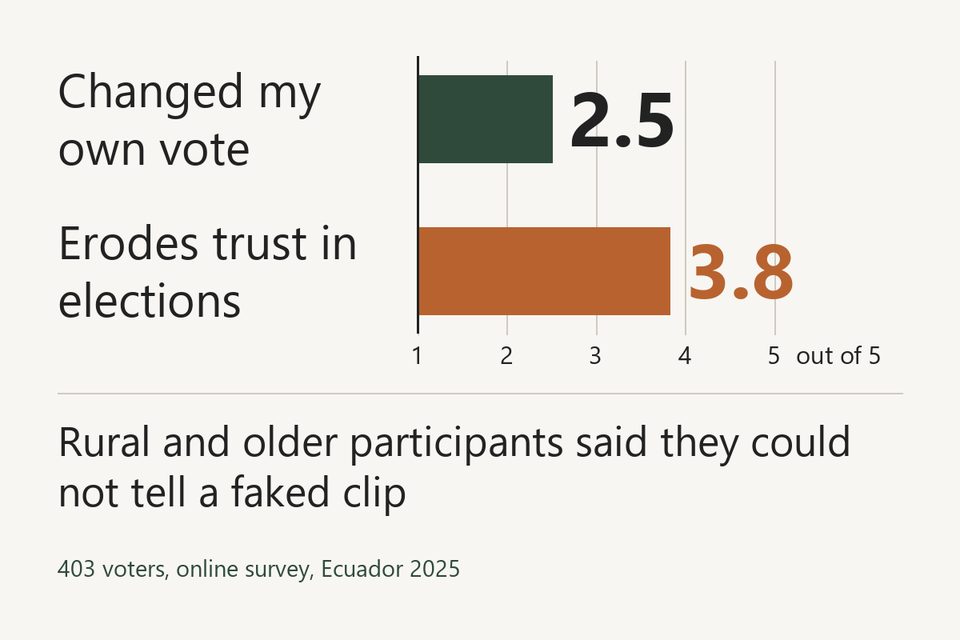
During Ecuador's 2025 presidential campaign, altered images and audio of candidates Noboa and González spread on social media. The EU's election observation mission reported AI-generated and AI-manipulated content, including paid content. In a survey of 403 voters, asked whether disinformation changed their own vote, the average answer was 2.52 on a 1-to-5 scale, below the midpoint. The same respondents agreed, on average 3.83, that it erodes trust in elections. The survey ran online from late August to late October 2025, so it under-represents the least-connected voters. Rural and older participants, mostly in focus groups, said they could not detect fakes. "Nobody has ever explained it to me," one rural participant said.
The article names no way for a voter to check a suspect video or to verify the voter register.
All twelve people interviewed agreed that Ecuador's rules are insufficient. One, a university lecturer, said there are no clear obligations on political actors or platforms to disclose AI use in campaign material.
What this means for you
For a voter in Ecuador, the lesson is narrow. The 403 people surveyed were not a representative sample, and no program was tested, so nothing here proves that media training would protect anyone's vote. What you can weigh is your own confidence: if you feel sure you would spot a faked clip, ask yourself what you actually did the last time one crossed your feed.
Suing, A., Ganazhapa, H., Medina, J. (2026). Media and information literacy in the face of election disinformation generated by artificial intelligence: experiences from Ecuador. Frontiers in Political Science. https://doi.org/10.3389/fpos.2026.1834093
Who paid: The authors declared that no financial support was received for this work or its publication, and declared no commercial or financial relationships that could be a conflict of interest; the generative AI tool Qwen3.5-Plus was used to organise interview testimonies and tabulate focus-group contributions.
The findings of other studies mentioned here are known to us through this document, which is the one we read; we did not open each of those studies.
The longer versionThe passages copied from the paper, the pictures, and every source with how much of it we read · 1062 words · about 5 minRead it →Close
The rule and the evidence: Ecuador's 2025 race ran on altered candidate clips, and rural voters said they couldn't tell what was real
### THE ACT
Ecuador has no rule in force that a voter can point to for AI in elections, and this study does not supply one. It states the absence plainly: one interviewee said that "the current regulation does not address the ethical dilemmas of AI use". No resolution, ruling, audit or bill is quoted in the record; nothing names an enforcement body, a date of effect, or a deadline by which a person may complain. What the record does carry is a demand. Asked whether the National Electoral Council should have stronger tools to detect and counter AI-driven disinformation, respondents gave that item the highest score of fifteen, a mean of 4.16 on a five-point scale, with 56.1% choosing the top value. The proposal that came closest to an institution was one expert's call for "the creation of a National Electoral AI Observatory, with the participation of all sectors, functioning as a space for monitoring, training, and rapid response to automated disinformation events"1. That is a recommendation from an interview, not a rule.
### THE CASE IT ANSWERS
No real instance was found this week: no deepfake, avatar, bot network or manipulated tally form with a name, a place, a date and a second source. What the record offers instead are accounts from interviews and focus groups, and they are short of that bar, so treat them as descriptions rather than as verified cases. One focus group described a female candidate, not named in the passage, depicted in AI-made montages suggesting a romantic relationship with her party's leader2. An interviewee described a falsified news broadcast in which a presenter appeared to praise Luisa González and endorse Maduro's leadership, later established to be AI-made. Another described a deepfake video attributed to a presidential candidate that circulated for 48 hours before being debunked, with no clear legal consequence. An interviewee, citing civil-society organisations such as Lupa Media, put AI components in 23% of viral content identified as disinformation. It would seem this is the kind of thing they mean. None of these accounts names a date or a second independent source in the record.
### WHAT WAS MEASURED
The study surveyed 403 valid respondents in Ecuador between 27 August and 21 October 2025, drawn from a voting-age population of 13,736,314, with a stated margin of error of plus or minus 5% at 95% confidence, though sampling was purposive rather than random. It added 12 expert interviews and six focus groups with 35 participants. On whether AI-generated disinformation shaped their own vote, respondents disagreed: a mean of 2.52, the only item below the neutral point. On whether it erodes trust in the democratic system, they agreed: a mean of 3.83. The capacity to identify AI content correlated with valuing media literacy at ρ = 0.327, and belief that deepfakes hurt credibility correlated with perceived democratic harm at ρ = 0.403, which in turn correlated with demanding the electoral council act at ρ = 0.569. All correlations are p < 0.001; no confidence intervals are reported. These are perceptions, measured in one country, in one election cycle. No passage in the record measures whether voters actually detected a fake, and none measures a change in a real vote.
### THE OTHER REGION'S ANSWER TO THE SAME THING
We found no court ruling, law or authority from another country on this method in the passages this week. The record mentions the European Union's AI Act and a United States approach based on platform collaboration with electoral agencies, described by one interviewee, while another said Ecuador could learn from both models, but no text of either is quoted. A separate study examined visual AI in the 2025 German federal election, finding that "mainstream major parties disclosing AI origins more frequently than minor parties or the right-wing Alternative for Germany (AfD)"3. That is a finding about disclosure practice, not a rule anyone enforced.
### THE LIBRARY'S READING
Here is how we read it. A false story about a candidate has always worked by leaving a residue: once a charge is loose, the accused spends more energy clearing it than the accuser spent making it. What is new is not the lie but the labour. A convincing face and voice used to require a studio, a willing insider, a budget; now it requires an afternoon. The old defence was time, the interval in which a rumour could be traced to its source and contradicted. That interval has shrunk to hours, and the correction arrives into the same feed, looking plainer than the thing it corrects.
Expect the same in homes like yours: the clip that travels will be the one with a clear villain and a tidy ending, and the correction will read like a form letter. You can tell we are wrong if the polished fakes your neighbours forward are the ones they shrug at, and the clumsy ones are the ones they believe. What you can do is small and repeatable: when a clip about a candidate feels complete, ask what it leaves out, and check the named person's own channel before you pass it on. A teacher or a poll worker can practise this on real campaign clips before election day, not after.
### WHAT IS NOT KNOWN
The record cannot say whether AI-generated disinformation changed a single vote in Ecuador, and the respondents themselves said it did not change theirs. It cannot say how many voters were fooled, because the survey was not representative and ran on a digital form that under-represents the least-connected people it is about. The disinformation perception scale had questionable internal consistency, with a Cronbach's alpha of 0.583. No significant difference appeared between men and women on any of the fifteen items, which sits uneasily with the focus-group accounts of gendered abuse4. The interviews describe a deepfake circulating for 48 hours and being debunked without consequence, and the record does not say how many people saw it, how many believed it, or whether anyone was ever held responsible. The study is single-country and cross-sectional, with no baseline and no follow-up.
Before you vote, ask of the next clip that reaches you: who is the only source for this, and what would it cost them if it were false?
Where each piece of context comes from, and how much of it we read
- Suing, A., Ganazhapa, H., Medina, J. (2026). Media and information literacy in the face of election disinformation generated by artificial intelligence: experiences from Ecuador. Frontiers in Political Science. https://doi.org/10.3389/fpos.2026.1834093 - the article this story is about — the whole article — the passage: "Interviewee 8 proposed “the creation of a National Electoral AI Observatory, with the participation of all sectors, functioning as a space for monitoring, training, and rapid response to automated disinformation events” (Interviewee 8)."
- Suing, A., Ganazhapa, H., Medina, J. (2026). Media and information literacy in the face of election disinformation generated by artificial intelligence: experiences from Ecuador. Frontiers in Political Science. https://doi.org/10.3389/fpos.2026.1834093 - the article this story is about — the whole article — the passage: "“The female candidate was alluded to by suggesting she had a romantic relationship with the leader of her party. Montages were produced showing them kissing—images that were evidently created with AI” (Participant 1, FGD5)."
- Kruschinski S, Votta F. (2026). Party Equalization or Normalization Through Visual Generative AI in the 2025 German Federal Election. Media and Communication. 10.17645/mac.11859 — only the abstract - the full text could not be fetched — the passage: "Content strategy analysis reveals a transparency divide, with mainstream major parties disclosing AI origins more frequently than minor parties or the right-wing Alternative for Germany (AfD)."
- Suing, A., Ganazhapa, H., Medina, J. (2026). Media and information literacy in the face of election disinformation generated by artificial intelligence: experiences from Ecuador. Frontiers in Political Science. https://doi.org/10.3389/fpos.2026.1834093 - the article this story is about — the whole article — the passage: "The gender analysis using the Mann–Whitney U test revealed no statistically significant differences between men and women on any of the 15 Likert variables (p > 0.05 in all cases)."
Suing, A., Ganazhapa, H., Medina, J. (2026). Media and information literacy in the face of election disinformation generated by artificial intelligence: experiences from Ecuador. Frontiers in Political Science. https://doi.org/10.3389/fpos.2026.1834093
Who paid: The authors declared that no financial support was received for this work or its publication, and declared no commercial or financial relationships that could be a conflict of interest; the generative AI tool Qwen3.5-Plus was used to organise interview testimonies and tabulate focus-group contributions.