experiment · PS Political Science & Politics · la publicación, 15 oct 2026 · gratis
Un sondeo hecho por un chatbot le dio 18.7 puntos de ventaja al Partido Demócrata, pero así responde una simulación, no votantes reales.
Versión breve · la versión detallada sigue, unos 5 min
Pregunte al chat de weeklyAI
Pregúnteme por este estudio: a quiénes se estudió, qué encontró y qué no dice.
Las conversaciones se guardan mientras exista weeklyAI, para mejorar la publicación. Se responde en el idioma en que usted escribe.
- El estudio, de un vistazo
- Quiénes
- Votantes falsos creados con un modelo de lenguaje para simular la intención de voto
- Cuántos
- 4,000 personajes sintéticos
- Dónde
- Estados Unidos
- Cuándo
- la semana del 31 de agosto al 6 de septiembre
- Tipo de estudio
- experiment
- Quién lo hizo
- Universidad de Ámsterdam y Nuffield College, Oxford
- El límite que importa
- Es una simulación, no votantes reales; los autores no establecen la precisión predictiva.
Son puntos porcentuales de ventaja demócrata en la misma semana; la cifra de la simulación no es una medición de votantes reales y sus propios autores no dan por establecida su precisión.
Personajes armados solo con datos demográficos frente al proceso completo por etapas
El proceso completo desplaza las estimaciones hacia los demócratas, en la misma dirección que sugieren las encuestas reales de esos días.
Una cifra que sale de una máquina llega con una autoridad que no se ganó.
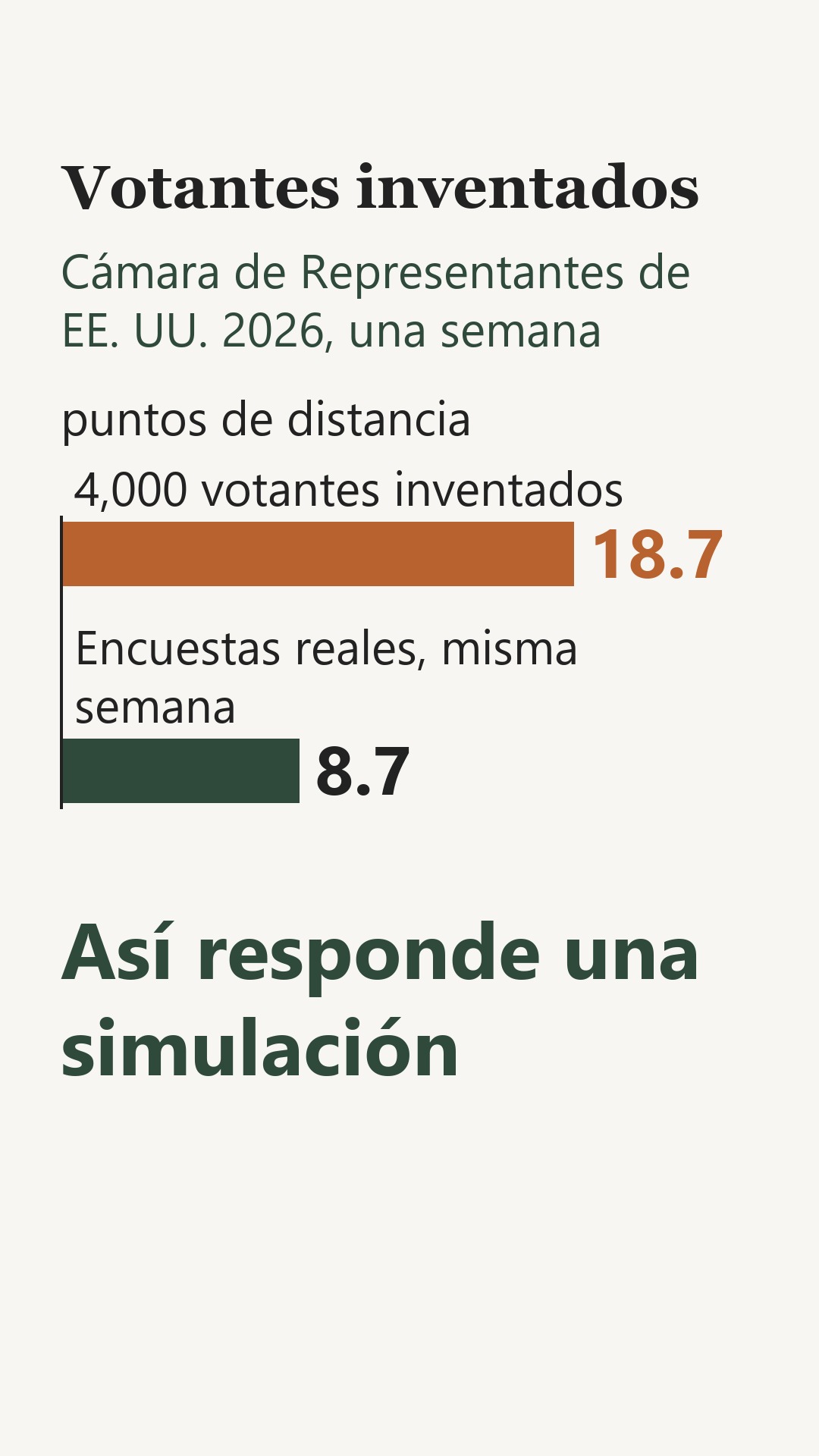
1. Un equipo de la Universidad de Ámsterdam y de Nuffield College, Oxford, creó 4,000 votantes falsos con un modelo de lenguaje (gpt-oss-120B) para simular la intención de voto en las elecciones de 2026 a la Cámara de Representantes de Estados Unidos. La semana del 31 de agosto al 6 de septiembre, esos personajes respondieron sobre su participación y su candidato. El resultado les dio a los demócratas 58.4% frente a 39.8% de los republicanos, una ventaja de 18.7 puntos, cuando el promedio de las encuestas de esa semana marcaba 8.7. Los propios autores dicen que esos números exactos probablemente no se cumplan y que sus rangos de confianza son demasiado estrechos: la duda real es mayor de lo que se imprime. Además, sus personajes no podían responder "indeciso".
2. Los documentos y datos del estudio están abiertos al público en Harvard Dataverse.
3. El documento no menciona ninguna autoridad electoral, regla ni auditoría. Tampoco la fecha de publicación del estudio.
Qué significa para usted
Para su propia decisión, ese 18.7 no le dice nada sobre cómo votará su vecino: son 4,000 personajes inventados por un programa, no votantes de carne y hueso, y el propio estudio no menciona autoridad electoral, regla ni auditoría. Cuando vea una encuesta de estas semanas, pregunte quién la hizo y si las personas contestaron de verdad. El conteo real lo tendrán que explicar los documentos de la autoridad electoral.
Jonaitis, D., Corcoran, B., Poudyal, B. et al. (2026). Polling Without People: Can Silicon Samples of CASM-Inspired LLM Personae Mimic Human Respondents in Pre-Election Polling?. PS: Political Science & Politics. https://doi.org/10.1017/s1049096526103084
Quién pagó: El artículo no indica quién financió el estudio ni si los financiadores tuvieron alguna influencia, y no menciona equipos o programas cedidos más allá del modelo gpt-oss-120B, GDELT, los registros de eventos de Wikipedia y la lista del American National Election Study.
Versión detalladaLos pasajes copiados del artículo, las ilustraciones y cada fuente con cuánto leímos de ella · 1037 palabras · unos 5 minLeerla →Cerrar
La regla y la evidencia: un sondeo hecho por un chatbot le dio 18.7 puntos de ventaja al Partido Demócrata, pero así responde una simulación, no votantes reales
### EL ACTO
Lo que hay en vigor esta semana no es una ley ni una resolución: es un artículo aceptado para su publicación, todavía en versión previa a la corrección final, que presenta un método para simular encuestas electorales con personajes generados por inteligencia artificial1. Los autores lo describen así: "We introduce a framework for simulating pre-election survey responses with large language model (LLM) synthetic personae"1.
El método combina biografías inventadas, recuerdos de sucesos recientes y una dieta de noticias asignada a cada personaje, y luego lo hace pasar por un proceso por etapas para responder dos preguntas: si va a votar y por quién2. Los personajes no son personas: son perfiles armados por el programa.
La aplicación es una sola semana, del 31 de agosto al 6 de septiembre, con 4,000 personajes sintéticos, para la elección de la Cámara de Representantes de Estados Unidos de 2026. Cada personaje se muestrea al azar según un marco de más de 1.5 millones de celdas, y las respuestas se proyectan a toda la población con un modelo estadístico. El artículo no fija fecha de publicación ni quién lo evaluó.
Nadie obliga a nada aquí. No hay autoridad que lo haga cumplir, ni plazo para el votante, ni recurso que presentar. Lo único que un lector puede hacer es leer el método y decidir cuánto peso le da.
### EL CASO QUE RESPONDE
Esta semana no se encontró ningún caso real que contar: ni un video falso, ni un avatar, ni una red de cuentas automáticas con nombre, lugar y fecha verificables.
### LO QUE SE MIDIÓ
Se midió una simulación, no una elección. En esa semana, el margen estimado a favor de los demócratas fue de 18.7 puntos porcentuales, frente a 8.7 puntos en el promedio de encuestas reales de la misma semana3.
Traducido a votos: los personajes dieron a los demócratas 58.4 por ciento y a los republicanos 39.8 por ciento. Según el artículo, las estimaciones colocan el apoyo demócrata 7.68 puntos por encima del promedio de encuestas, el republicano 2.19 puntos por debajo y la categoría "Otro" 5.57 puntos por debajo4. La participación estimada fue de 62.8 por ciento, contra 64.3 por ciento observado en 2024.
El modelo también repartió escaños: 292 demócratas y 143 republicanos, una ventaja de 1495. El rango va de 266 a 307 escaños demócratas y de 128 a 169 republicanos6.
Hay una comparación que ordena las cosas. El artículo señala que, frente a una base de personajes armada solo con datos demográficos, el proceso completo desplaza las estimaciones hacia los demócratas, en la misma dirección que sugieren las encuestas reales de esos días7.
El artículo mismo pone el límite: estas comparaciones "do not isolate the effects of all components or establish predictive accuracy conclusively"8. Es un ejercicio de simulación en Estados Unidos, en una elección con abundante información en inglés, y los propios autores la llaman comparativamente favorable9.
La diferencia con el promedio de encuestas tiene una parte construida. Los personajes que dicen que van a votar no pueden quedarse indecisos: tienen que elegir candidato, mientras que la categoría "Otro" del promedio sí incluye indecisos10. Esa categoría quedó 5.57 puntos abajo en la simulación4, y los autores no saben cuánto de la brecha viene de ahí11.
Los rangos de confianza impresos son demasiado angostos, y los autores lo admiten: reproducen un problema ya documentado en muestras sintéticas y no ven arreglo fácil en el corto plazo12.
### LA RESPUESTA DE LA OTRA REGIÓN AL MISMO ASUNTO
Esta semana no encontramos ningún tribunal, ley o autoridad de otro país que se haya pronunciado sobre este método.
### LA LECTURA DE LA REDACCIÓN
Así lo leemos nosotros. Una cifra que sale de una máquina llega con una autoridad que no se ganó. El 18.7 se lee como un dato del ánimo del país, y detrás hay un programa al que alguien le puso biografías, le escogió noticias y le prohibió decir "no sé". Es probable que muchos lo repitan sin preguntar quién armó el instrumento ni qué quedó fuera de la boleta simulada. Sabríamos que nos equivocamos si la prensa y las autoridades trataran este pronóstico como lo que es: una estimación discutible, con su margen y su letra chica.
Lo que siempre ha hecho un rumor es tomar algo verdadero y torcerlo. Lo nuevo es la escala y la ropa de método: ya no hace falta convencer a nadie de que un video es cierto, basta con que una tabla parezca medida. Lo que un público puede revisar es si le dicen de dónde salió el número; lo que no puede revisar es lo que el programa decidió no preguntar. Ahí no hay auditoría posible para el votante.
En nuestra región, donde tantas veces se discutió si el conteo era cierto, conviene separar dos cosas que se parecen: el conteo verificado y la proyección. Una proyección no es prueba de nada. Cuando vea "votantes" que contestaron una encuesta, pregunte si son personas o perfiles inventados, y exija que se diga en el titular. Ante cualquier pronóstico automático, compare la cifra con la encuesta real de la misma semana antes de repetirla.
### LO QUE NO SE SABE
No se sabe si el método acierta: los autores dicen que la precisión predictiva no quedó establecida8.
No se sabe qué parte del proceso causa el desplazamiento hacia los demócratas, porque no se hizo un desglose por componentes ni un análisis de sensibilidad de la redacción de las instrucciones13.
No se sabe si permitir la respuesta "indeciso" mejoraría las estimaciones11.
No se sabe si los rangos impresos son más angostos de lo que deberían; los propios autores dicen que sí y que no ven arreglo pronto12.
No se sabe qué pasará en la elección real. Los autores llaman a esa elección una prueba viva, y también un caso favorable9.
Usted tiene una fecha fija y un voto. Antes de creerle a una máquina que dice cómo votará el país, pida la encuesta real de esa misma semana y pregunte qué opciones les dieron a los que contestaron.
De dónde sale cada dato de contexto, y cuánto leímos de cada documento
- Jonaitis, D., Corcoran, B., Poudyal, B. et al. (2026). Polling Without People: Can Silicon Samples of CASM-Inspired LLM Personae Mimic Human Respondents in Pre-Election Polling?. PS: Political Science & Politics. https://doi.org/10.1017/s1049096526103084 - el artículo del que trata esta nota — el artículo completo — el pasaje: "We introduce a framework for simulating pre-election survey responses with large language model (LLM) synthetic personae."
- Jonaitis, D., Corcoran, B., Poudyal, B. et al. (2026). Polling Without People: Can Silicon Samples of CASM-Inspired LLM Personae Mimic Human Respondents in Pre-Election Polling?. PS: Political Science & Politics. https://doi.org/10.1017/s1049096526103084 - el artículo del que trata esta nota — el artículo completo — el pasaje: "Drawing on the Cognitive Aspects of Survey Methodology (CASM) literature, our approach combines synthetic biographies, salient-event memories and conditional news exposure with a staged cognitive process for answering turnout and candidate-choice questions."
- Jonaitis, D., Corcoran, B., Poudyal, B. et al. (2026). Polling Without People: Can Silicon Samples of CASM-Inspired LLM Personae Mimic Human Respondents in Pre-Election Polling?. PS: Political Science & Politics. https://doi.org/10.1017/s1049096526103084 - el artículo del que trata esta nota — el artículo completo — el pasaje: "However, the estimated Democratic margin is 18.7 percentage points, compared with 8.7 points in the polling average."
- Jonaitis, D., Corcoran, B., Poudyal, B. et al. (2026). Polling Without People: Can Silicon Samples of CASM-Inspired LLM Personae Mimic Human Respondents in Pre-Election Polling?. PS: Political Science & Politics. https://doi.org/10.1017/s1049096526103084 - el artículo del que trata esta nota — el artículo completo — el pasaje: "On average, our estimates place Democratic support 7.68 percentage points above the polling average, Republican support 2.19 points below it, and the residual ‘Other’ category 5.57 points below it."
- Jonaitis, D., Corcoran, B., Poudyal, B. et al. (2026). Polling Without People: Can Silicon Samples of CASM-Inspired LLM Personae Mimic Human Respondents in Pre-Election Polling?. PS: Political Science & Politics. https://doi.org/10.1017/s1049096526103084 - el artículo del que trata esta nota — el artículo completo — el pasaje: "The point estimate is 292 Democratic seats to 143 Republican seats, a 149-seat advantage."
- Jonaitis, D., Corcoran, B., Poudyal, B. et al. (2026). Polling Without People: Can Silicon Samples of CASM-Inspired LLM Personae Mimic Human Respondents in Pre-Election Polling?. PS: Political Science & Politics. https://doi.org/10.1017/s1049096526103084 - el artículo del que trata esta nota — el artículo completo — el pasaje: "The associated seat projections range from 266 to 307 Democratic seats and from 128 to 169 Republican seats, implying it is a certainty that Democrats will gain control of the House of Representatives, the question being just how large such a majority will be."
- Jonaitis, D., Corcoran, B., Poudyal, B. et al. (2026). Polling Without People: Can Silicon Samples of CASM-Inspired LLM Personae Mimic Human Respondents in Pre-Election Polling?. PS: Political Science & Politics. https://doi.org/10.1017/s1049096526103084 - el artículo del que trata esta nota — el artículo completo — el pasaje: "Relative to a demographics-only synthetic personae baseline, CASM-inspired enrichment shifts estimates towards Democrats, consistent with the direction suggested by contemporary polling."
- Jonaitis, D., Corcoran, B., Poudyal, B. et al. (2026). Polling Without People: Can Silicon Samples of CASM-Inspired LLM Personae Mimic Human Respondents in Pre-Election Polling?. PS: Political Science & Politics. https://doi.org/10.1017/s1049096526103084 - el artículo del que trata esta nota — el artículo completo — el pasaje: "These comparisons show that our enrichment strategy changes synthetic responses in the correct direction, but do not isolate the effects of all components or establish predictive accuracy conclusively."
- Jonaitis, D., Corcoran, B., Poudyal, B. et al. (2026). Polling Without People: Can Silicon Samples of CASM-Inspired LLM Personae Mimic Human Respondents in Pre-Election Polling?. PS: Political Science & Politics. https://doi.org/10.1017/s1049096526103084 - el artículo del que trata esta nota — el artículo completo — el pasaje: "The 2026 election for the House of Representatives will offer an important live test case for the CASM-inspired persona approach, although it is also a comparatively favourable one."
- Jonaitis, D., Corcoran, B., Poudyal, B. et al. (2026). Polling Without People: Can Silicon Samples of CASM-Inspired LLM Personae Mimic Human Respondents in Pre-Election Polling?. PS: Political Science & Politics. https://doi.org/10.1017/s1049096526103084 - el artículo del que trata esta nota — el artículo completo — el pasaje: "We must note here that our instrument is somewhat different from the reference polling average: we ask our personae about preferences relative to named candidates in each district, whereas the benchmark measures generic congressional-ballot preferences; our personae are not allowed to choose ‘undecided’ as an option, whilst the ‘Other’ category in the polling average typically includes those who claim to be undecided."
- Jonaitis, D., Corcoran, B., Poudyal, B. et al. (2026). Polling Without People: Can Silicon Samples of CASM-Inspired LLM Personae Mimic Human Respondents in Pre-Election Polling?. PS: Political Science & Politics. https://doi.org/10.1017/s1049096526103084 - el artículo del que trata esta nota — el artículo completo — el pasaje: "It remains an open question whether allowing undecideds in our responses would improve the quality of our estimates – ultimately we are making predictions for an election result, and ‘undecided’ is not on the ballot."
- Jonaitis, D., Corcoran, B., Poudyal, B. et al. (2026). Polling Without People: Can Silicon Samples of CASM-Inspired LLM Personae Mimic Human Respondents in Pre-Election Polling?. PS: Political Science & Politics. https://doi.org/10.1017/s1049096526103084 - el artículo del que trata esta nota — el artículo completo — el pasaje: "The overly narrow credible intervals must also be addressed, as they reproduce the underdispersion previously documented in synthetic samples (Bisbee et al. 2024; Barrie and Cerina 2026). For this defect, we see no easy fix in the short-run."
- Jonaitis, D., Corcoran, B., Poudyal, B. et al. (2026). Polling Without People: Can Silicon Samples of CASM-Inspired LLM Personae Mimic Human Respondents in Pre-Election Polling?. PS: Political Science & Politics. https://doi.org/10.1017/s1049096526103084 - el artículo del que trata esta nota — el artículo completo — el pasaje: "A full component ablation and systematic sensitivity analysis of prompt wording are left for future work."
Jonaitis, D., Corcoran, B., Poudyal, B. et al. (2026). Polling Without People: Can Silicon Samples of CASM-Inspired LLM Personae Mimic Human Respondents in Pre-Election Polling?. PS: Political Science & Politics. https://doi.org/10.1017/s1049096526103084
Quién pagó: El artículo no indica quién financió el estudio ni si los financiadores tuvieron alguna influencia, y no menciona equipos o programas cedidos más allá del modelo gpt-oss-120B, GDELT, los registros de eventos de Wikipedia y la lista del American National Election Study.
experiment · PS Political Science & Politics · the paper, 15 Oct 2026 · free
A simulation of 4,000 fake voters put one party about ten points higher than real polls, and its authors say it does not prove the method can predict an election.
Short version · the longer version follows, about 6 min
Ask the weeklyAI chat
Ask me about this study: who was studied, what it found, and what it does not say.
Conversations are saved for as long as weeklyAI exists, to improve the publication. Answers come in the language you write in.
- The study at a glance
- Who
- 4,000 made-up voters built with a chatbot
- How many
- 4,000
- Where
- United States
- When
- August 31 to September 6, for the 2026 US House elections
- Kind of study
- experiment
- Who did it
- University of Amsterdam and Oxford
- The limit that matters
- The authors say it does not prove the method can predict an election.
The simulated voters put one party about ten points further ahead than the polling average did; the authors say the gap is partly built in because their voters must pick a candidate while the polling average includes undecided voters.
What the simulation and the polling average each measured
The simulation asked about named candidates and did not allow 'undecided'; the polling average measured generic preferences and its 'Other' category includes undecided voters.
A simulation of 4,000 fake voters put one party about ten points higher than real polls, and its authors say it does not prove the method can predict an election.
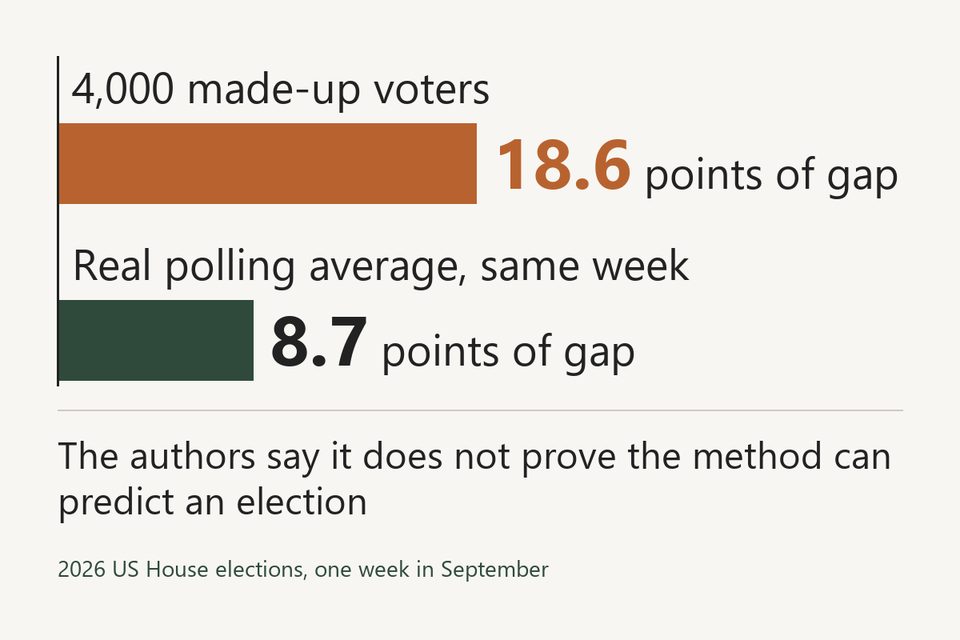
Researchers at the University of Amsterdam and Oxford built 4,000 made-up voters using a chatbot, each with an invented biography and a memory of recent events, and had them answer turnout and vote-choice questions for the 2026 US House elections in one week, August 31 to September 6. Some of the fake voters were also given news to read, and others were not. The fake voters gave Democrats 58.4 percent to Republicans' 39.8. The polling average for that week put the gap at 8.7 points. The authors call their district comparisons sanity checks, not tests against 2026 results.
The document names no way for a voter to check this. All answers came from software, not people.
The document states no rule, ruling or audit from any electoral authority. The authors write that the gap is partly built in: their fake voters who say they will vote must pick a candidate, while the polling average's 7.3 percent "Other" includes undecided voters. They also say their confidence ranges are too narrow.
What this means for you
When you see a party leading in a poll made by software, ask whether the made-up voters answered as people would. These fake voters had no option to say they were undecided, which the authors say helped widen the gap, so the 18.7-point margin is not a result to carry to the ballot box. The 2026 House race will be the real test.
Jonaitis, D., Corcoran, B., Poudyal, B. et al. (2026). Polling Without People: Can Silicon Samples of CASM-Inspired LLM Personae Mimic Human Respondents in Pre-Election Polling?. PS: Political Science & Politics. https://doi.org/10.1017/s1049096526103084
Who paid: The article does not say who funded the study or whether funders had any say, and names no equipment or software lent beyond the gpt-oss-120B model, GDELT, Wikipedia event logs and the American National Election Study list.
The longer versionThe passages copied from the paper, the pictures, and every source with how much of it we read · 1123 words · about 6 minRead it →Close
The rule and the evidence: A simulation of 4,000 fake voters put one party about ten points higher than real polls, and its authors say it does not prove the method can predict an election
### THE ACT
The act this week is a method, not a law, so there is no date on which it binds anyone and no office that enforces it. The authors describe their framework as one for "simulating pre-election survey responses with large language model (LLM) synthetic personae"1. The machinery combines "synthetic biographies, salient-event memories and conditional news exposure with a staged cognitive process for answering turnout and candidate-choice questions"2. The case for using it is stated plainly: responses "typically cost a fraction of a € cent, enabling inexpensive, high-frequency estimates at arbitrary granularity," and samples "can match desired socio-demographic distributions, and can be sampled from a population truly at random"3.
What a person can do about it is limited, and the authors say so themselves. Their comparisons "do not isolate the effects of all components or establish predictive accuracy conclusively"4. They name the "persistent challenges of leftward bias, uncertainty calibration and benchmarking novel methodologies during an election campaign"5. The 2026 House race will be "an important live test case for the CASM-inspired persona approach, although it is also a comparatively favourable one"6. No regulator, court or electoral authority appears anywhere in the article. Nothing here is in force for anyone.
### THE CASE IT ANSWERS
No real instance was found this week.
### WHAT WAS MEASURED
Consider what one week of this looks like. Four thousand invented respondents, each given a made-up life story, a memory of events and a reading list, are asked whether they will vote and whom they would choose. Their answers are then projected onto more than a million and a half cells until they become a national number. The number came out at a Democratic margin of 18.7 percentage points, "compared with 8.7 points in the polling average"7. On average, the estimates placed Democratic support 7.68 percentage points above the polling average, Republican support 2.19 points below it, and the residual "Other" category 5.57 points below it8.
The seat projection is the part that travels. The point estimate is "292 Democratic seats to 143 Republican seats, a 149-seat advantage"9, with a range of 266 to 307 Democratic seats and 128 to 169 Republican seats10. The authors then walk it back: it "remains on the whole unlikely that the exact percentages we assign the highest likelihood to will actually attain." The authors then walk it back: it "remains on the whole unlikely that the exact percentages we assign the highest likelihood to will actually attain."
The comparison that matters most sits underneath. A version of the same sample stripped down to demographics alone "produce[s] a D-R margin close to zero," which the authors read as the model reproducing the mood at its training cutoff rather than the current one. When respondents were randomly assigned to build a judgment from that week's news or simply retrieve one, the builders came out about 4.5 points further toward Democrats, though the intervals are very wide and significance cannot be established.
The measurement was made in the United States, on the 2026 House elections, by authors at the University of Amsterdam and Nuffield College, Oxford. It has never been tested against an actual election result. The district comparisons are called "plausibility or 'sanity' checks rather than direct tests of predictive accuracy." The authors also note their instrument differs from the benchmark: respondents are asked about named candidates rather than the generic ballot, and "are not allowed to choose 'undecided' as an option"11.
### THE OTHER REGION'S ANSWER TO THE SAME THING
We found none this week: no court, law or authority outside the United States is quoted in these passages on the use of synthetic respondents for election polling.
### THE LIBRARY'S READING
Here is how we read it. A false charge against a candidate has always done its work before it is answered: the suspicion arrives first and the correction arrives late, and by then the listener has already filed the person under a question mark. What is new is not the rumor but the machine that manufactures a crowd to carry it. A simulated electorate is a crowd with no one in it, and a forecast that leans ten points in one direction is a claim about what everyone is about to do, delivered with the flat confidence of a weather report.
We expect you will meet these numbers in the weeks before an election, quoted without the word "simulated" attached. You will be able to tell we are wrong if the same method, run with a different week of news or a different model, produces a different lean; if it holds steady regardless of what the respondents read, then the news feed is not doing the work and something else is. One thing you can do with this: ask any outlet quoting such a forecast three questions. What real poll was it checked against? How wide is the uncertainty really? Was "undecided" or "won't vote" an allowed answer? A very narrow range around a very bold number is a warning, not a comfort.
We also read the authors' own admission that the intervals are too narrow, and that they "see no easy fix in the short-run"12. Treat the printed ranges as wider than they look. When a forecast shifts from week to week, ask whether the news shifted or the voters did.
### WHAT IS NOT KNOWN
The article does not say who paid for the work, and no independent body has checked the method against a count. The authors concede that a full breakdown of which component causes the Democratic shift "and systematic sensitivity analysis of prompt wording are left for future work"13. Whether letting respondents say "undecided" would change the result "remains an open question"14.
The study comes from one country, in one language, in an election the authors themselves call favorable ground. That is a boundary, not a verdict: it tells you the finding has not been shown to carry over to a different electorate, and says nothing about whether it happened here.
The gap between 18.7 and 8.7 is partly built into the instrument. Respondents who say they will vote must pick a candidate, so the undecided are pushed into a party15, and the size of that push is untested. No party, candidate or campaign is endorsed or condemned by any of this.
When you see a poll with no people in it, ask what its makers fed the crowd and what they let it leave blank. Then look at the count, which is the only number on the ballot.
Where each piece of context comes from, and how much of it we read
- Jonaitis, D., Corcoran, B., Poudyal, B. et al. (2026). Polling Without People: Can Silicon Samples of CASM-Inspired LLM Personae Mimic Human Respondents in Pre-Election Polling?. PS: Political Science & Politics. https://doi.org/10.1017/s1049096526103084 - the article this story is about — the whole article — the passage: "We introduce a framework for simulating pre-election survey responses with large language model (LLM) synthetic personae."
- Jonaitis, D., Corcoran, B., Poudyal, B. et al. (2026). Polling Without People: Can Silicon Samples of CASM-Inspired LLM Personae Mimic Human Respondents in Pre-Election Polling?. PS: Political Science & Politics. https://doi.org/10.1017/s1049096526103084 - the article this story is about — the whole article — the passage: "Drawing on the Cognitive Aspects of Survey Methodology (CASM) literature, our approach combines synthetic biographies, salient-event memories and conditional news exposure with a staged cognitive process for answering turnout and candidate-choice questions."
- Jonaitis, D., Corcoran, B., Poudyal, B. et al. (2026). Polling Without People: Can Silicon Samples of CASM-Inspired LLM Personae Mimic Human Respondents in Pre-Election Polling?. PS: Political Science & Politics. https://doi.org/10.1017/s1049096526103084 - the article this story is about — the whole article — the passage: "LLM-generated synthetic data is attractive for pre-election polling (Clinton et al. 2026; Cerina and Duch 2026, 2025; Cerina 2025) for two reasons: i. responses typically cost a fraction of a € cent, enabling inexpensive, high-frequency estimates at arbitrary granularity (Cerina and Duch 2026); ii. samples can match desired socio-demographic distributions, and can be sampled from a population truly at random."
- Jonaitis, D., Corcoran, B., Poudyal, B. et al. (2026). Polling Without People: Can Silicon Samples of CASM-Inspired LLM Personae Mimic Human Respondents in Pre-Election Polling?. PS: Political Science & Politics. https://doi.org/10.1017/s1049096526103084 - the article this story is about — the whole article — the passage: "These comparisons show that our enrichment strategy changes synthetic responses in the correct direction, but do not isolate the effects of all components or establish predictive accuracy conclusively."
- Jonaitis, D., Corcoran, B., Poudyal, B. et al. (2026). Polling Without People: Can Silicon Samples of CASM-Inspired LLM Personae Mimic Human Respondents in Pre-Election Polling?. PS: Political Science & Politics. https://doi.org/10.1017/s1049096526103084 - the article this story is about — the whole article — the passage: "The framework offers a structured approach to studying synthetic survey responses whilst highlighting persistent challenges of leftward bias, uncertainty calibration and benchmarking novel methodologies during an election campaign."
- Jonaitis, D., Corcoran, B., Poudyal, B. et al. (2026). Polling Without People: Can Silicon Samples of CASM-Inspired LLM Personae Mimic Human Respondents in Pre-Election Polling?. PS: Political Science & Politics. https://doi.org/10.1017/s1049096526103084 - the article this story is about — the whole article — the passage: "The 2026 election for the House of Representatives will offer an important live test case for the CASM-inspired persona approach, although it is also a comparatively favourable one."
- Jonaitis, D., Corcoran, B., Poudyal, B. et al. (2026). Polling Without People: Can Silicon Samples of CASM-Inspired LLM Personae Mimic Human Respondents in Pre-Election Polling?. PS: Political Science & Politics. https://doi.org/10.1017/s1049096526103084 - the article this story is about — the whole article — the passage: "However, the estimated Democratic margin is 18.7 percentage points, compared with 8.7 points in the polling average."
- Jonaitis, D., Corcoran, B., Poudyal, B. et al. (2026). Polling Without People: Can Silicon Samples of CASM-Inspired LLM Personae Mimic Human Respondents in Pre-Election Polling?. PS: Political Science & Politics. https://doi.org/10.1017/s1049096526103084 - the article this story is about — the whole article — the passage: "On average, our estimates place Democratic support 7.68 percentage points above the polling average, Republican support 2.19 points below it, and the residual ‘Other’ category 5.57 points below it."
- Jonaitis, D., Corcoran, B., Poudyal, B. et al. (2026). Polling Without People: Can Silicon Samples of CASM-Inspired LLM Personae Mimic Human Respondents in Pre-Election Polling?. PS: Political Science & Politics. https://doi.org/10.1017/s1049096526103084 - the article this story is about — the whole article — the passage: "The point estimate is 292 Democratic seats to 143 Republican seats, a 149-seat advantage."
- Jonaitis, D., Corcoran, B., Poudyal, B. et al. (2026). Polling Without People: Can Silicon Samples of CASM-Inspired LLM Personae Mimic Human Respondents in Pre-Election Polling?. PS: Political Science & Politics. https://doi.org/10.1017/s1049096526103084 - the article this story is about — the whole article — the passage: "The associated seat projections range from 266 to 307 Democratic seats and from 128 to 169 Republican seats, implying it is a certainty that Democrats will gain control of the House of Representatives, the question being just how large such a majority will be."
- Jonaitis, D., Corcoran, B., Poudyal, B. et al. (2026). Polling Without People: Can Silicon Samples of CASM-Inspired LLM Personae Mimic Human Respondents in Pre-Election Polling?. PS: Political Science & Politics. https://doi.org/10.1017/s1049096526103084 - the article this story is about — the whole article — the passage: "We must note here that our instrument is somewhat different from the reference polling average: we ask our personae about preferences relative to named candidates in each district, whereas the benchmark measures generic congressional-ballot preferences; our personae are not allowed to choose ‘undecided’ as an option, whilst the ‘Other’ category in the polling average typically includes those who claim to be undecided."
- Jonaitis, D., Corcoran, B., Poudyal, B. et al. (2026). Polling Without People: Can Silicon Samples of CASM-Inspired LLM Personae Mimic Human Respondents in Pre-Election Polling?. PS: Political Science & Politics. https://doi.org/10.1017/s1049096526103084 - the article this story is about — the whole article — the passage: "The overly narrow credible intervals must also be addressed, as they reproduce the underdispersion previously documented in synthetic samples (Bisbee et al. 2024; Barrie and Cerina 2026). For this defect, we see no easy fix in the short-run."
- Jonaitis, D., Corcoran, B., Poudyal, B. et al. (2026). Polling Without People: Can Silicon Samples of CASM-Inspired LLM Personae Mimic Human Respondents in Pre-Election Polling?. PS: Political Science & Politics. https://doi.org/10.1017/s1049096526103084 - the article this story is about — the whole article — the passage: "A full component ablation and systematic sensitivity analysis of prompt wording are left for future work."
- Jonaitis, D., Corcoran, B., Poudyal, B. et al. (2026). Polling Without People: Can Silicon Samples of CASM-Inspired LLM Personae Mimic Human Respondents in Pre-Election Polling?. PS: Political Science & Politics. https://doi.org/10.1017/s1049096526103084 - the article this story is about — the whole article — the passage: "It remains an open question whether allowing undecideds in our responses would improve the quality of our estimates – ultimately we are making predictions for an election result, and ‘undecided’ is not on the ballot."
- Jonaitis, D., Corcoran, B., Poudyal, B. et al. (2026). Polling Without People: Can Silicon Samples of CASM-Inspired LLM Personae Mimic Human Respondents in Pre-Election Polling?. PS: Political Science & Politics. https://doi.org/10.1017/s1049096526103084 - the article this story is about — the whole article — the passage: "This discrepancy is likely concentrated in the allocation of undecided voters. Once CASM personae indicate that they will vote, they cannot remain undecided – whilst this category is included in the ‘Other’ label in the polling-average data."
Jonaitis, D., Corcoran, B., Poudyal, B. et al. (2026). Polling Without People: Can Silicon Samples of CASM-Inspired LLM Personae Mimic Human Respondents in Pre-Election Polling?. PS: Political Science & Politics. https://doi.org/10.1017/s1049096526103084
Who paid: The article does not say who funded the study or whether funders had any say, and names no equipment or software lent beyond the gpt-oss-120B model, GDELT, Wikipedia event logs and the American National Election Study list.