analysis of texts · Media and Communication · la publicación, 1 jul 2026 · gratis
Los partidos pequeños usaron imágenes hechas con IA más que los grandes en la campaña alemana de 2025
Versión breve · la versión detallada sigue, unos 8 min
Pregunte al chat de weeklyAI
Pregúnteme por este estudio: a quiénes se estudió, qué encontró y qué no dice.
Las conversaciones se guardan mientras exista weeklyAI, para mejorar la publicación. Se responde en el idioma en que usted escribe.
- El estudio, de un vistazo
- Quiénes
- Publicaciones de Facebook e Instagram de partidos políticos alemanes
- Cuántos
- 68,994 publicaciones orgánicas; unas 945 con imágenes o videos hechos con IA
- Dónde
- Alemania
- Cuándo
- Cuatro semanas antes de la elección federal del 24 de enero al 23 de febrero de 2025
- Tipo de estudio
- analysis of what people did
- Quién lo hizo
- GESIS – Leibniz Institute for the Social Sciences y University of Amsterdam
- El límite que importa
- Solo observa publicaciones; no prueba que las imágenes con IA causaran más interacción.
Porcentajes de las 945 publicaciones con imágenes o videos hechos con IA que el equipo confirmó; el estudio advierte que esa cifra es un piso y no un techo.
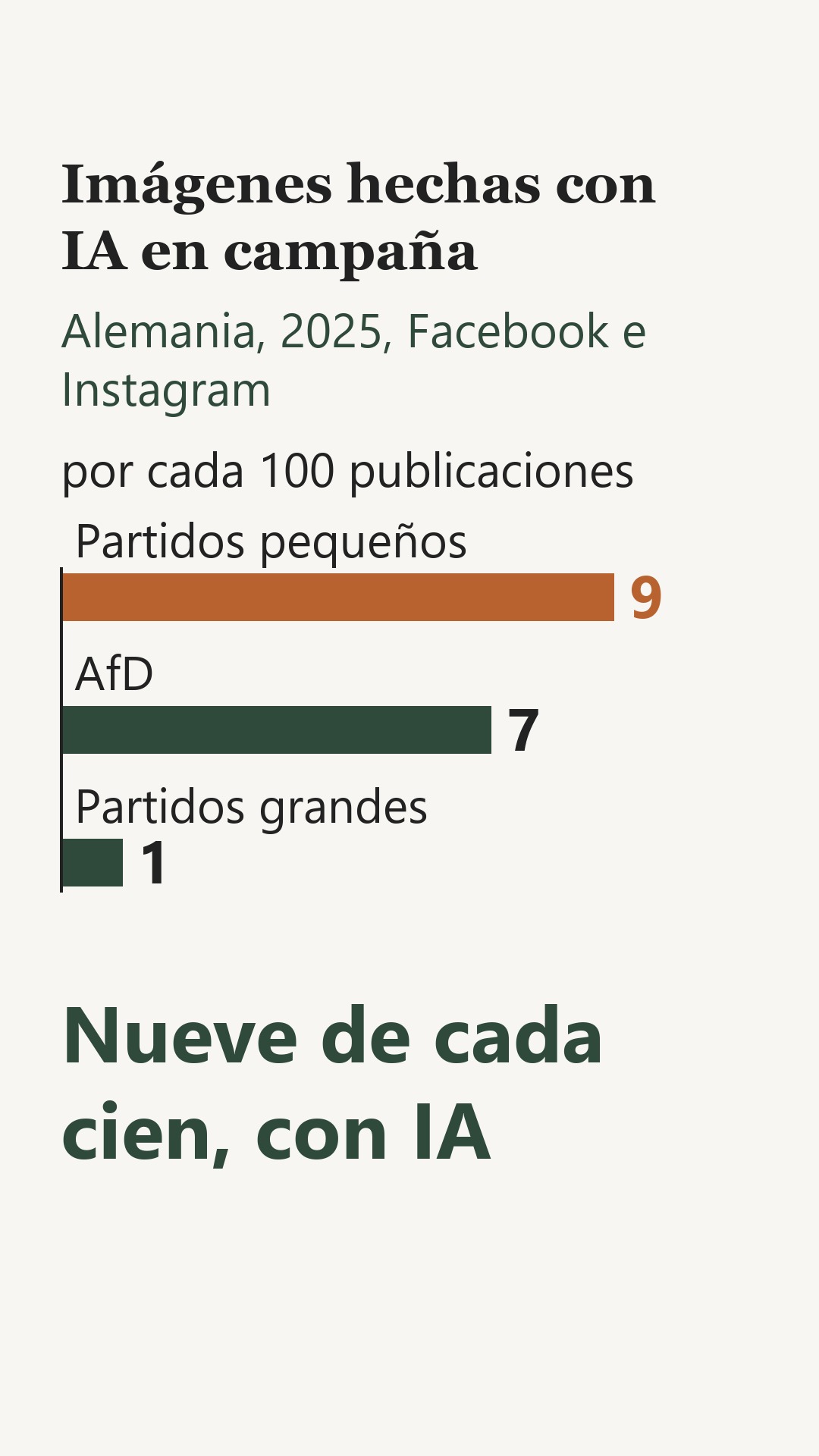
Uso de imágenes hechas con IA según el tamaño del partido
Los pequeños las usaron en el 9.2% de sus publicaciones; los grandes, en el 1.1%.
Los grandes sin ese partido pusieron aviso en el 36.7% de sus imágenes; los pequeños, en el 4.4%, y Alternativa para Alemania, en el 4.0%.
De las 945 publicaciones con imágenes o videos hechos con IA que el equipo confirmó, solo el 11.2% llevaba un aviso dentro de la imagen o el video, y solo el 1.9% lo llevaba en el texto del post.
Un equipo revisó unas 69,000 publicaciones de 37 partidos en las cuatro semanas previas a la elección federal alemana del 23 de febrero de 2025.
Unas 945 contenían imágenes o videos hechos con IA.
En los partidos grandes fueron el 1.1% de sus publicaciones; en los pequeños, el 9.2%.
Entre los grandes, solo el partido de extrema derecha Alternativa para Alemania (AfD) las usó de forma amplia, en cerca del 7% de sus publicaciones.
Apenas el 11.2% de esas imágenes llevaba un aviso dentro de la imagen o el video, y el 1.9% lo llevaba en el texto del post.
Esas publicaciones recibieron alrededor de un 34% más de interacciones que las demás, por igual en partidos grandes y pequeños.
Es una asociación observada, no una prueba de causa.
Lo que usted puede revisar esta noche: el aviso de contenido sintético o hecho con IA que la plataforma coloca en la publicación, y las etiquetas que el propio partido ponga en la imagen o en el texto.
El documento no dice si alguna autoridad electoral revisó estas publicaciones.
Solo cita la ley europea de IA (artículo 50), que exige etiquetar el contenido generado con IA, y un acuerdo voluntario de varios partidos para la campaña de 2025.
Qué significa para usted
Lo que vio en Alemania fue una asociación: esas publicaciones con imágenes hechas con IA recibieron más interacciones, pero el estudio no prueba que la IA las causara. Para su propia papeleta, revise si la publicación avisa que el contenido es sintético y quién lo firma. Ninguna autoridad electoral figura en el estudio revisando esas piezas.
Kruschinski, S., Votta, F. (2026). Party Equalization or Normalization Through Visual Generative AI in the 2025 German Federal Election. Media and Communication. https://doi.org/10.17645/mac.11859
Quién pagó: La Baden-Württemberg Stiftung financió el artículo mediante un premio Politechathon organizado con AI4Democracy, el acceso abierto lo cubrió el acuerdo institucional de GESIS con Cogitatio Press, y los autores declaran no tener conflictos de interés; no se indica ningún papel del financiador en la investigación.
Versión detalladaLos pasajes copiados del artículo, las ilustraciones y cada fuente con cuánto leímos de ella · 1672 palabras · unos 8 minLeerla →Cerrar
La regla y la evidencia: partidos pequeños usaron imágenes hechas con IA más que los grandes, y casi ninguna llevaba etiqueta
### LO QUE MANDA LA LEY
Hay una regla escrita para toda la Unión Europea: el artículo 50 de la Ley de Inteligencia Artificial ordena etiquetar el contenido hecho con inteligencia artificial1. El artículo 50 de la Ley de Inteligencia Artificial ordena etiquetar el contenido hecho con inteligencia artificial. Lo que este trabajo encontró es otra cosa: una distancia entre lo que la norma pide y lo que de hecho se hace en campaña1.
Piense en lo que eso significa para usted en la casilla. Una imagen de un candidato, de una familia o de una calle puede haber salido de un programa que la inventó. La norma dice que debe avisarse. El aviso, cuando aparece, puede estar dentro de la imagen, en el texto que la acompaña o en una etiqueta que pone la plataforma. Quien mira la publicación tiene que encontrar esa señal por su cuenta.
El estudio alemán midió qué tanto se cumple. De las publicaciones con imágenes hechas por inteligencia artificial, solo el 11.2% traía un aviso dentro de la imagen o el video, y solo el 1.9% lo traía en el texto que acompañaba la publicación2. Dicho de otro modo: de cada cien imágenes sintéticas que un votante vio circular, cerca de once llevaban alguna señal visible en la propia imagen, y apenas dos la llevaban escrita en el texto.
### EL CASO QUE RESPONDE
Esta semana no se encontró ningún caso real que contar con nombre, lugar, fecha y segunda fuente, así que esta parte se queda en una sola frase: no hubo caso esta semana.
### LO QUE SE MIDIÓ
El trabajo revisó 68,994 publicaciones orgánicas de Facebook e Instagram, publicadas por más de 5,000 cuentas de partidos políticos alemanes en las cuatro semanas previas a la elección federal del 24 de enero al 23 de febrero de 2025. De ese total, unas 945 publicaciones tenían imágenes o videos hechos con inteligencia artificial, y los autores advierten que esa cifra es un piso y no un techo3.
La proporción general fue de cerca del 1.4% de todas las publicaciones3. Entre los partidos grandes fue del 1.1%3. Entre los partidos pequeños llegó al 9.2%3. El partido de extrema derecha Alternativa para Alemania usó estas imágenes en cerca del 7% de sus publicaciones3.
Para que el lector se haga una idea: en un muro de campaña con cien publicaciones, una o dos venían hechas con inteligencia artificial si el partido era grande; en el de un partido pequeño, nueve de cada cien. Los partidos pequeños usaron estas imágenes mucho más que los grandes, y los autores lo atribuyen a que la herramienta abarata la producción de imágenes profesionales para quien tiene menos recursos, aunque en el caso de Alternativa para Alemania señalan que su uso intensivo también responde a una decisión estratégica y a su ideología, no solo a la falta de recursos.
Aquí hay un mecanismo que conviene entender, porque explica por qué la herramienta se volvió tan común. Los programas como DALL-E, Midjourney o Grok producen imágenes y videos profesionales en grandes cantidades con muy poco esfuerzo humano, poco dinero y poco tiempo4. Lo que antes pedía fotógrafo, diseñador y días de trabajo, ahora se resuelve en minutos. Eso abre la puerta a los partidos con menos recursos, y los partidos pequeños y Alternativa para Alemania casi no ponen aviso, algo que los autores explican por la falta de compromisos y de presión normativa sobre ellos.
El contenido fotorrealista tiene un problema propio. Una imagen hecha por inteligencia artificial puede dar la impresión de mostrar objetos, personas o hechos reales, y con eso una campaña puede reforzar una "prueba visual" o difundir falsedades5. El 70.4% de las imágenes sintéticas analizadas eran fotorrealistas; el 22.8% eran claramente dibujos, caricaturas o gráficos; y el 6.9% mezclaba ambos estilos6. El partido de extrema derecha fue el que más usó el estilo realista: 81.1% de sus imágenes sintéticas parecían reales7.
Sobre el aviso, la diferencia entre partidos es la parte más útil para un votante. Los partidos grandes, sin contar a Alternativa para Alemania, pusieron aviso en el 36.7% de sus imágenes hechas con inteligencia artificial8. Los partidos pequeños y Alternativa para Alemania casi nunca lo pusieron, muy por debajo del promedio de todos los partidos9. Los propios autores lo llaman una división de transparencia: los partidos establecidos avisan más; los retadores y la extrema derecha, casi nada9.
También se midió el tono. Alternativa para Alemania fue la que más recurrió a señales negativas, con 69.4% de sus publicaciones sintéticas10. Los partidos grandes sin contar a ese partido fueron los que menos las usaron, con 38.6%10. Y en las imágenes de personas señaladas como criminales, Alternativa para Alemania las empleó mucho más que cualquier otro grupo, mientras que los partidos grandes sin contar a ese partido casi nunca lo hicieron11.
La medición del alcance dio un resultado que conviene leer con cuidado. Las publicaciones con contenido hecho por inteligencia artificial recibieron cerca de 34% más interacciones que las que no lo tenían12. Pero esa ventaja no fue mayor para los partidos pequeños: la interacción entre usar inteligencia artificial y ser partido pequeño no fue estadísticamente significativa13. Es decir, el contenido sintético rinde más o menos igual para todos, y no le da al partido con menos recursos una ventaja especial.
El estudio tiene límites que el propio texto declara. El método de detección fue hecho para no dar falsas alarmas, así que se le escaparon imágenes reales: las cifras son un piso, no un techo14. El diseño es observacional y de corte transversal, de modo que no permite afirmar que el contenido sintético causó más interacción; factores como el gasto de campaña, la atención de los medios y la calidad del contenido pudieron coincidir con ambas cosas15. Y el trabajo solo miró a partidos institucionalizados, no a activistas ni a redes coordinadas.
### LA RESPUESTA DE LA OTRA REGIÓN AL MISMO ASUNTO
Un trabajo hecho en Estados Unidos probó si se puede vacunar al votante contra la desinformación electoral antes de que la vea. En un experimento con 4,293 votantes registrados, artículos generados por un modelo de lenguaje redujeron la creencia en rumores electorales, y el efecto seguía presente, aunque más débil, una semana después1617. El mismo ejercicio redujo un poco la caída de confianza en la administración electoral del país, sin que se viera un rechazo partidista18. Los autores señalan que los artículos escritos con ayuda humana no fueron más eficaces que los hechos solo por la máquina, lo que sugiere que el esfuerzo humano por rumor puede reducirse bastante una vez que la instrucción está lista19.
### ASÍ LO LEEMOS NOSOTROS
Aquí es donde conviene detenerse, porque la cifra del aviso casi inexistente deja al votante con todo el trabajo. Lo que hemos visto en otros trabajos que leímos es que una mentira repetida y envuelta en un formato que parece serio termina por aceptarse, y que las imágenes que más circulan son las que mezclan algo verdadero con algo alterado, no las inventadas de cero. Si eso se cumple también aquí, esperaríamos que muchas de esas imágenes de campaña sin etiqueta se hayan compartido como si fueran fotos reales de candidatos o de la vida cotidiana, y que buena parte de la gente las haya tomado por ciertas justamente porque venían en publicaciones de aspecto normal, sin ninguna señal de que eran sintéticas. Sabríamos que nos equivocamos si viéramos que las publicaciones sin aviso casi no se comparten, o que la gente las identifica como falsas sin ayuda, o que las imágenes más compartidas son las que sí llevan la etiqueta.
También leímos que mirar una pantalla con la guardia baja hace más difícil entender lo que pasa, y que entender un mensaje cargado de intención exige un esfuerzo que no se da solo. De ahí esperaríamos que quien ve las publicaciones de campaña en el celular, entre otras cosas del día, no note la diferencia entre una imagen sintética y una real, sobre todo si no hay etiqueta. La consecuencia práctica es sencilla: el aviso que casi nunca aparece deja la detección del lado del espectador. Lo que usted puede hacer con esto es concreto. Antes de reenviar una imagen de campaña, fíjese si trae algún aviso de que fue hecha con inteligencia artificial, y haga la búsqueda inversa de la foto; si no aparece el origen, trátela como no verificada. Y antes de votar, revise las cuentas de los partidos con atención deliberada: abra la publicación, lea el texto que la acompaña y busque la fuente original de la imagen en lugar de pasarla de largo.
### LO QUE NO SE SABE
No se sabe cuántas imágenes sintéticas se le escaparon al detector, porque el método fue hecho para no dar falsas alarmas y por eso las cifras quedan como un piso14. No se sabe si el contenido sintético cambió el voto de alguien: el estudio solo observó publicaciones y contó interacciones, y sus autores dicen que no permite hablar de causa15. No se sabe si el mismo patrón ocurre en Estados Unidos, en Canadá o en América Latina, ni en otras plataformas distintas de Facebook e Instagram; el trabajo cubre una sola elección alemana adelantada y dos redes. Tampoco se sabe qué pasa con los actores que no son partidos institucionalizados, como activistas o redes coordinadas, porque no fueron parte del estudio. Y el detector que usaron es propiedad de una empresa, lo que limita que otros puedan repetir la medición.
Lo que sí sabemos es lo que usted tiene en la mano la mañana de la elección: una imagen que puede ser real o puede ser inventada, y un aviso que probablemente no está. La pregunta que le queda es sencilla y la puede hacer en voz alta: ¿esta imagen trae algún aviso de que fue hecha con inteligencia artificial, y si no lo trae, quién me confirma de dónde salió?
De dónde sale cada dato de contexto, y cuánto leímos de cada documento
- Kruschinski, S., Votta, F. (2026). Party Equalization or Normalization Through Visual Generative AI in the 2025 German Federal Election. Media and Communication. https://doi.org/10.17645/mac.11859 - el artículo del que trata esta nota — el artículo completo — el pasaje: "Regarding alignment with the EU’s AI Act, Article 50 mandates labeling of AI‐generated content. Our findings document a gap between regulatory aspirations and actual practice."
- Kruschinski, S., Votta, F. (2026). Party Equalization or Normalization Through Visual Generative AI in the 2025 German Federal Election. Media and Communication. https://doi.org/10.17645/mac.11859 - el artículo del que trata esta nota — el artículo completo — el pasaje: "Of the 945 VGenAI posts, only 11.2% included an AI disclaimer in the image/video, and 1.9% in the post text."
- Kruschinski, S., Votta, F. (2026). Party Equalization or Normalization Through Visual Generative AI in the 2025 German Federal Election. Media and Communication. https://doi.org/10.17645/mac.11859 - el artículo del que trata esta nota — el artículo completo — el pasaje: "Only about 1.4% of all organic posts contained AI‐generated visuals (≈945 of 68,994). Among the major parties, the figure was comparatively lower, at 1.1% (≈764 of 67,018), whereas minor parties used VGenAI far more frequently, reaching around 9.2% (≈181 of 1,976)."
- Kruschinski, S., Votta, F. (2026). Party Equalization or Normalization Through Visual Generative AI in the 2025 German Federal Election. Media and Communication. https://doi.org/10.17645/mac.11859 - el artículo del que trata esta nota — el artículo completo — el pasaje: "VGenAI models such as DALL‐E, Midjourney, or Grok have the potential of transforming strategic campaign communication by enabling the automated production of professional visuals in large quantities with minimal human, monetary, and time resources"
- Kruschinski, S., Votta, F. (2026). Party Equalization or Normalization Through Visual Generative AI in the 2025 German Federal Election. Media and Communication. https://doi.org/10.17645/mac.11859 - el artículo del que trata esta nota — el artículo completo — el pasaje: "Photorealistic VGenAI content can create the impression of showing real objects, people, or events, enabling campaigns to enhance “visual evidence” or spread falsehoods"
- Kruschinski, S., Votta, F. (2026). Party Equalization or Normalization Through Visual Generative AI in the 2025 German Federal Election. Media and Communication. https://doi.org/10.17645/mac.11859 - el artículo del que trata esta nota — el artículo completo — el pasaje: "Regarding visual style, 70.4% depicted photorealistic content, 22.8% were clearly non‐realistic (graphics, drawings, cartoons, or illustrations), and 6.9% combined both."
- Kruschinski, S., Votta, F. (2026). Party Equalization or Normalization Through Visual Generative AI in the 2025 German Federal Election. Media and Communication. https://doi.org/10.17645/mac.11859 - el artículo del que trata esta nota — el artículo completo — el pasaje: "The AfD made the most extensive use of realistic imagery, with 81.1% of its synthetic visuals appearing realistic and a positive deviation from the all‐party average (Δ = +10.7 points, 𝑝< .001)."
- Kruschinski, S., Votta, F. (2026). Party Equalization or Normalization Through Visual Generative AI in the 2025 German Federal Election. Media and Communication. https://doi.org/10.17645/mac.11859 - el artículo del que trata esta nota — el artículo completo — el pasaje: "Major parties excluding the AfD used disclaimers most frequently, with 36.7% of their AI‐generated visuals carrying a transparency marker, which corresponds to a strong positive deviation from the all‐party reference level (Δ = +23.4 points, 𝑝< .001)."
- Kruschinski, S., Votta, F. (2026). Party Equalization or Normalization Through Visual Generative AI in the 2025 German Federal Election. Media and Communication. https://doi.org/10.17645/mac.11859 - el artículo del que trata esta nota — el artículo completo — el pasaje: "In contrast, minor parties (4.4%; Δ = −8.9 points, 𝑝< .001) and the AfD (4.0%; Δ = −9.3 points, 𝑝< .001) rarely labeled synthetic visuals. This pattern indicates a transparency divide, with established mainstream parties disclosing AI use more consistently than both challenger parties and the AfD."
- Kruschinski, S., Votta, F. (2026). Party Equalization or Normalization Through Visual Generative AI in the 2025 German Federal Election. Media and Communication. https://doi.org/10.17645/mac.11859 - el artículo del que trata esta nota — el artículo completo — el pasaje: "The AfD relied on negative tonal cues the most (69.4%; Δ = +11.3 points, 𝑝< .001), while major parties excluding the AfD were the least likely to use them (38.6%; Δ = −19.5 points, 𝑝< .001)."
- Kruschinski, S., Votta, F. (2026). Party Equalization or Normalization Through Visual Generative AI in the 2025 German Federal Election. Media and Communication. https://doi.org/10.17645/mac.11859 - el artículo del que trata esta nota — el artículo completo — el pasaje: "The AfD employed such depictions far more often than any other group (6.8%; Δ = +2.7 points, 𝑝< .001), whereas major parties excluding the AfD almost never did so (0.4%; Δ = −3.8 points, 𝑝< .001), and minor parties also fell below the system‐wide average (Δ = −1.9 points, 𝑝< .001)."
- Kruschinski, S., Votta, F. (2026). Party Equalization or Normalization Through Visual Generative AI in the 2025 German Federal Election. Media and Communication. https://doi.org/10.17645/mac.11859 - el artículo del que trata esta nota — el artículo completo — el pasaje: "AI‐generated content is associated with significantly higher engagement than non‐AI content (IRR = 1.34, 95% CI [1.15, 1.56], 𝑝< .001), indicating that VGenAI posts receive approximately 34% more user interactions than non‐AI posts."
- Kruschinski, S., Votta, F. (2026). Party Equalization or Normalization Through Visual Generative AI in the 2025 German Federal Election. Media and Communication. https://doi.org/10.17645/mac.11859 - el artículo del que trata esta nota — el artículo completo — el pasaje: "However, the interaction between AI‐generated content and minor party status is not statistically significant (IRR = 1.01, 95% CI [0.62, 1.65], 𝑝= .96), suggesting that the engagement advantage from VGenAI does not differ meaningfully between major and minor parties."
- Kruschinski, S., Votta, F. (2026). Party Equalization or Normalization Through Visual Generative AI in the 2025 German Federal Election. Media and Communication. https://doi.org/10.17645/mac.11859 - el artículo del que trata esta nota — el artículo completo — el pasaje: "First, our VGenAI detection approach, while validated, likely undercounts actual VGenAI prevalence due to the emphasis on precision over recall in the automated classification stage, meaning our estimates should be interpreted as conservative lower‐bound figures."
- Kruschinski, S., Votta, F. (2026). Party Equalization or Normalization Through Visual Generative AI in the 2025 German Federal Election. Media and Communication. https://doi.org/10.17645/mac.11859 - el artículo del que trata esta nota — el artículo completo — el pasaje: "Third, most fundamentally, the observational, cross‐sectional design does not permit causal inference regarding the relationship between VGenAI use and engagement outcomes. Unobserved confounders such as campaign spending, media attention, and content quality may co‐occur with both VGenAI adoption and engagement patterns."
- Linegar M, Sinclair B, van der Linden S, Alvarez RM. (2026). Towards scalable AI-assisted pre-bunking of election misinformation: evidence from a pre-registered US panel experiment. Royal Society Open Science. 10.1098/rsos.252226 — solo el resumen - no se pudo obtener el texto completo — el pasaje: "In a pre-registered two-wave experiment with 4293 United States (US) registered voters, we test this framework against politically charged election misinformation—one of the most challenging domains for misinformation intervention."
- Linegar M, Sinclair B, van der Linden S, Alvarez RM. (2026). Towards scalable AI-assisted pre-bunking of election misinformation: evidence from a pre-registered US panel experiment. Royal Society Open Science. 10.1098/rsos.252226 — solo el resumen - no se pudo obtener el texto completo — el pasaje: "We find that large language model (LLM)-generated pre-bunking significantly reduced belief in election rumours (effects persisting, though attenuated, one week later)"
- Linegar M, Sinclair B, van der Linden S, Alvarez RM. (2026). Towards scalable AI-assisted pre-bunking of election misinformation: evidence from a pre-registered US panel experiment. Royal Society Open Science. 10.1098/rsos.252226 — solo el resumen - no se pudo obtener el texto completo — el pasaje: "and modestly offset declines in confidence in national election administration, with no evidence of partisan backlash."
- Linegar M, Sinclair B, van der Linden S, Alvarez RM. (2026). Towards scalable AI-assisted pre-bunking of election misinformation: evidence from a pre-registered US panel experiment. Royal Society Open Science. 10.1098/rsos.252226 — solo el resumen - no se pudo obtener el texto completo — el pasaje: "After finalizing the prompt, articles written with human feedback were no more effective than articles using only AI, indicating that per-rumour human effort can be substantially reduced once the prompt is in place."
Kruschinski, S., Votta, F. (2026). Party Equalization or Normalization Through Visual Generative AI in the 2025 German Federal Election. Media and Communication. https://doi.org/10.17645/mac.11859
Quién pagó: La Baden-Württemberg Stiftung financió el artículo mediante un premio Politechathon organizado con AI4Democracy, el acceso abierto lo cubrió el acuerdo institucional de GESIS con Cogitatio Press, y los autores declaran no tener conflictos de interés; no se indica ningún papel del financiador en la investigación.
Los hallazgos de otros estudios que aquí se mencionan los conocemos por este documento, que fue el que leímos; no abrimos cada uno de esos estudios.
analysis of texts · Media and Communication · the paper, 1 Jul 2026 · free
Small German parties used AI-made campaign images more often than big parties
Short version · the longer version follows, about 6 min
Ask the weeklyAI chat
Ask me about this study: who was studied, what it found, and what it does not say.
Conversations are saved for as long as weeklyAI exists, to improve the publication. Answers come in the language you write in.
- The study at a glance
- Who
- German political party accounts on Facebook and Instagram
- How many
- 68,994 posts from 37 parties
- Where
- Germany
- When
- four weeks before the February 23, 2025 federal election
- Kind of study
- analysis of what people did
- Who did it
- GESIS – Leibniz Institute for the Social Sciences and University of Amsterdam
- The limit that matters
- The count is a floor: the detector missed some AI images, so the real share is higher.
Share of each group's AI-made visuals that carried a transparency marker; the study's detector missed some AI images, so these are floors, not full counts.
How often parties labeled their AI-made visuals
Major parties labeled 36.7% of their AI visuals; minor parties labeled 4.4%.
Major parties labeled 36.7% of their AI visuals; the AfD labeled 4.0%.
The authors call this a transparency divide.

In the four weeks before Germany's federal election, on February 23, 2025, political parties posted on Facebook and Instagram. About 1.4 out of every 100 posts carried an AI-generated image or video, and the authors say that figure is a floor, so the real share is higher. Small parties used these visuals much more (about 9 in 100 posts) than big parties (about 1 in 100), with one major party, the AfD, at about 7 in 100. About 11 in 100 of these AI posts carried a label inside the image or video, and about 2 in 100 carried one in the post text.
The article names no way for you to check a specific German campaign post yourself. It does point to CampAIgnTracker.de, a site the authors say they helped build to make detected AI campaign images public.
The article mentions a European Union law, the AI Act, which sorts AI uses by risk and treats AI used to sway voters as high-risk. The article also notes that the law asks for AI-made content to be labeled. It also names a voluntary AI fairness agreement several German parties signed for this campaign. The article reports no ruling or audit of these posts. It states that big parties labeled their AI visuals far more often than small parties or the AfD.
What this means for you
For your own country, this German study offers a question rather than a rule: when a party posts an AI-made image, does it say so? Big German parties labeled far more often than small ones, and the extra engagement such posts drew went to both alike, so the study cannot say AI gave small parties an edge.
Kruschinski, S., Votta, F. (2026). Party Equalization or Normalization Through Visual Generative AI in the 2025 German Federal Election. Media and Communication. https://doi.org/10.17645/mac.11859
Who paid: The Baden-Württemberg Stiftung funded the article through a Politechathon prize organized with AI4Democracy, open access was covered by GESIS's institutional agreement with Cogitatio Press, and the authors declare no conflict of interests; no funder role in the research is stated.
The longer versionThe passages copied from the paper, the pictures, and every source with how much of it we read · 1165 words · about 6 minRead it →Close
The rule and the evidence: AI-made campaign images went mostly unlabeled in Germany's 2025 snap election
### THE ACT
The rule in force is the European Union's AI Act. Its Article 50 requires that AI-generated content be labeled, and the study that supplies this week's evidence puts the requirement plainly: "Regarding alignment with the EU's AI Act, Article 50 mandates labeling of AI‐generated content"1. The same authors record what they found when they looked at the German campaign: "Our findings document a gap between regulatory aspirations and actual practice"1.
What a voter can do with that gap is narrow. The study does not report a penalty, a fine, an enforcement action or a deadline attached to the labeling duty; it reports only the duty and the shortfall against it1. The authors also note that several German parties signed a voluntary AI fairness agreement during the campaign and promised to label synthetic content and avoid synthetic impersonations, while parties that did not sign faced fewer constraints.
### THE CASE IT ANSWERS
No real instance was found this week.
### WHAT WAS MEASURED
Consider what the count actually covers: every organic post put out by German party accounts on Facebook and Instagram in the four weeks before election day, 24 January to 23 February 2025, from more than 5,000 accounts belonging to 37 parties, candidates, national and local branches and affiliated groups. Of 68,994 posts, about 945 carried visuals confirmed as AI-made — roughly one post in seventy2.
The split between party types is the finding that matters most. Major parties used AI visuals in about 1.1 percent of their posts, minor parties in about 9.2 percent2. The AfD stood apart among the established parties, at about 7 percent2. The authors call their own figures conservative lower bounds, because the detection method was tuned to avoid false alarms and therefore missed some AI images3. The authors say their figures should be read as a floor, not a full count.
The labeling numbers are the part a voter can act on. Of the 945 confirmed AI posts, only 11.2 percent carried an AI disclaimer inside the image or video, and 1.9 percent carried one in the post text4. Major parties outside the AfD labeled 36.7 percent of their AI visuals, a strong positive deviation from the all-party level5. Minor parties labeled 4.4 percent and the AfD 4.0 percent, both well below it6. The authors call this a transparency divide6.
On engagement, AI-made posts drew about 34 percent more interactions than ordinary posts, an incidence rate ratio of 1.34 with a 95 percent confidence interval from 1.15 to 1.567. The advantage did not differ meaningfully between major and minor parties: the interaction term was 1.01, with a confidence interval from 0.62 to 1.65 and a p-value of .968. The design is observational and cross-sectional, and the authors state it does not permit causal inference, because campaign spending, media attention and content quality may move together with both AI use and engagement9.
This was measured in Germany, in one snap election, on two platforms, and the authors themselves warn that platform dynamics differ on TikTok and that Germany's multi-party system and the EU's regulatory context may limit how far the findings travel. The study watched institutionalized parties only.
### THE OTHER REGION'S ANSWER TO THE SAME THING
We found none this week: no court, law or authority in another country, in the passages we read, has ruled on this method.
### THE LIBRARY'S READING
Here is how we read it. A false story about a candidate has always done its work before the ballot is cast, and it has always done it by leaving a residue that the accused cannot scrub away. What is new is not the rumor but the cost of making the picture that carries it. A party with almost no money can now produce a polished campaign image in minutes, and the study's own account of the technology says exactly that: professional visuals in large quantities with minimal human, monetary and time resources10. What a public can learn to check is a label, a source line, an account name. What it cannot check by looking is whether a photograph that looks real was ever in front of a camera.
We also read the labeling gap as a habit worth naming. A disclaimer is a small thing, easy to print and easy to skip, and the study found it skipped far more often by the parties with the least to lose from scrutiny. The study reports that major parties outside the AfD labeled their AI visuals far more often than minor parties or the AfD. The authors call this a transparency divide.
What this leads us to expect in homes like yours is a slow drift in how a genuine photograph is received. Once polished synthetic images arrive unlabeled in a feed, the ordinary viewer has no reliable way to sort them, and the doubt that follows does not stay politely with the fakes. We would expect real footage of a candidate or an event to be waved away as probably manufactured by people who dislike what it shows. We would know we were wrong if doubt stayed pinned to synthetic images and never spilled onto authentic ones, and if a labeled picture were believed no less than an unlabeled one.
What you can do with it is smaller and more useful than spotting a fake. When someone dismisses a real photo or video as machine-made, ask who gains from that doubt, and go to the original recording rather than argue about how it looks. Before you share a campaign image, check whether the post itself says how it was made. And when a campaign image floods your feed, ask whether you are seeing it because it convinces or because the platform pushed it: the study found AI posts drew more engagement equally for big and small parties, which tells you what the feed rewards, not what is true78.
### WHAT IS NOT KNOWN
The study does not show that an AI image changed a single vote; it counted interactions, and the authors say so plainly9. It does not cover activists, anonymous networks or coordinated campaigns, only parties with names and offices. Its detector is a commercial product the authors did not build, and it may miss images from newer generators or AI elements pasted into real photographs with logos and slogans on top3. The labeling duty exists on paper; whether anyone is fined for breaking it, the record does not say1. And a finding from one German snap election on two platforms is not a prediction for a campaign in your country.
You will meet more unlabeled synthetic images than these numbers suggest, because the count is a floor and not a ceiling3. The question to carry to the screen is not whether a picture looks real. It is who put it there, and what they were willing to tell you about how it was made.
Where each piece of context comes from, and how much of it we read
- Kruschinski, S., Votta, F. (2026). Party Equalization or Normalization Through Visual Generative AI in the 2025 German Federal Election. Media and Communication. https://doi.org/10.17645/mac.11859 - the article this story is about — the whole article — the passage: "Regarding alignment with the EU’s AI Act, Article 50 mandates labeling of AI‐generated content. Our findings document a gap between regulatory aspirations and actual practice."
- Kruschinski, S., Votta, F. (2026). Party Equalization or Normalization Through Visual Generative AI in the 2025 German Federal Election. Media and Communication. https://doi.org/10.17645/mac.11859 - the article this story is about — the whole article — the passage: "Only about 1.4% of all organic posts contained AI‐generated visuals (≈945 of 68,994). Among the major parties, the figure was comparatively lower, at 1.1% (≈764 of 67,018), whereas minor parties used VGenAI far more frequently, reaching around 9.2% (≈181 of 1,976)."
- Kruschinski, S., Votta, F. (2026). Party Equalization or Normalization Through Visual Generative AI in the 2025 German Federal Election. Media and Communication. https://doi.org/10.17645/mac.11859 - the article this story is about — the whole article — the passage: "First, our VGenAI detection approach, while validated, likely undercounts actual VGenAI prevalence due to the emphasis on precision over recall in the automated classification stage, meaning our estimates should be interpreted as conservative lower‐bound figures."
- Kruschinski, S., Votta, F. (2026). Party Equalization or Normalization Through Visual Generative AI in the 2025 German Federal Election. Media and Communication. https://doi.org/10.17645/mac.11859 - the article this story is about — the whole article — the passage: "Of the 945 VGenAI posts, only 11.2% included an AI disclaimer in the image/video, and 1.9% in the post text."
- Kruschinski, S., Votta, F. (2026). Party Equalization or Normalization Through Visual Generative AI in the 2025 German Federal Election. Media and Communication. https://doi.org/10.17645/mac.11859 - the article this story is about — the whole article — the passage: "Major parties excluding the AfD used disclaimers most frequently, with 36.7% of their AI‐generated visuals carrying a transparency marker, which corresponds to a strong positive deviation from the all‐party reference level (Δ = +23.4 points, 𝑝< .001)."
- Kruschinski, S., Votta, F. (2026). Party Equalization or Normalization Through Visual Generative AI in the 2025 German Federal Election. Media and Communication. https://doi.org/10.17645/mac.11859 - the article this story is about — the whole article — the passage: "In contrast, minor parties (4.4%; Δ = −8.9 points, 𝑝< .001) and the AfD (4.0%; Δ = −9.3 points, 𝑝< .001) rarely labeled synthetic visuals. This pattern indicates a transparency divide, with established mainstream parties disclosing AI use more consistently than both challenger parties and the AfD."
- Kruschinski, S., Votta, F. (2026). Party Equalization or Normalization Through Visual Generative AI in the 2025 German Federal Election. Media and Communication. https://doi.org/10.17645/mac.11859 - the article this story is about — the whole article — the passage: "AI‐generated content is associated with significantly higher engagement than non‐AI content (IRR = 1.34, 95% CI [1.15, 1.56], 𝑝< .001), indicating that VGenAI posts receive approximately 34% more user interactions than non‐AI posts."
- Kruschinski, S., Votta, F. (2026). Party Equalization or Normalization Through Visual Generative AI in the 2025 German Federal Election. Media and Communication. https://doi.org/10.17645/mac.11859 - the article this story is about — the whole article — the passage: "However, the interaction between AI‐generated content and minor party status is not statistically significant (IRR = 1.01, 95% CI [0.62, 1.65], 𝑝= .96), suggesting that the engagement advantage from VGenAI does not differ meaningfully between major and minor parties."
- Kruschinski, S., Votta, F. (2026). Party Equalization or Normalization Through Visual Generative AI in the 2025 German Federal Election. Media and Communication. https://doi.org/10.17645/mac.11859 - the article this story is about — the whole article — the passage: "Third, most fundamentally, the observational, cross‐sectional design does not permit causal inference regarding the relationship between VGenAI use and engagement outcomes. Unobserved confounders such as campaign spending, media attention, and content quality may co‐occur with both VGenAI adoption and engagement patterns."
- Kruschinski, S., Votta, F. (2026). Party Equalization or Normalization Through Visual Generative AI in the 2025 German Federal Election. Media and Communication. https://doi.org/10.17645/mac.11859 - the article this story is about — the whole article — the passage: "VGenAI models such as DALL‐E, Midjourney, or Grok have the potential of transforming strategic campaign communication by enabling the automated production of professional visuals in large quantities with minimal human, monetary, and time resources"
Kruschinski, S., Votta, F. (2026). Party Equalization or Normalization Through Visual Generative AI in the 2025 German Federal Election. Media and Communication. https://doi.org/10.17645/mac.11859
Who paid: The Baden-Württemberg Stiftung funded the article through a Politechathon prize organized with AI4Democracy, open access was covered by GESIS's institutional agreement with Cogitatio Press, and the authors declare no conflict of interests; no funder role in the research is stated.