experiment · Cureus · la publicación, 12 jul 2026 · gratis
Les enseñaron a cotejar el chatbot con el libro de texto. Los trabajos salieron mejores y en menos tiempo
En una escuela de medicina de la India, 83 estudiantes hicieron mejores módulos con ayuda de un chatbot, en 43 por ciento menos tiempo. No hubo grupo de comparación y nadie midió si lo aprendido duró.
Versión breve · la versión detallada sigue, unos 7 min
Pregunte al chat de weeklyAI
Pregúnteme por este estudio: a quiénes se estudió, qué encontró y qué no dice.
Las conversaciones se guardan mientras exista weeklyAI, para mejorar la publicación. Se responde en el idioma en que usted escribe.
- El estudio, de un vistazo
- Quiénes
- Estudiantes de segundo año de medicina (microbiología)
- Cuántos
- 83
- Dónde
- India (Kanpur Dehat)
- Cuándo
- 2026
- Tipo de estudio
- experiment
- Quién lo hizo
- Autonomous State Medical College, Kanpur Dehat, India
- El límite que importa
- Un solo plantel, sin grupo de comparación ni sorteo; no midió si el conocimiento se queda.
Son las respuestas de los 83 estudiantes de un solo plantel, sobre su propia experiencia; no son resultados de un examen ni se compararon con un grupo sin IA.
La misma tarea hecha a la antigua y hecha con IA
El puntaje promedio del trabajo subió de 57.1% a 86.2%
El promedio pasó de 5.2 a 8.8 sobre 10
Bajó de 44.5 a 25.4 minutos
Lo que separa a estos estudiantes de un grupo cualquiera con un chatbot abierto en el teléfono no es la herramienta: es la hora de formación y la regla de comprobar.
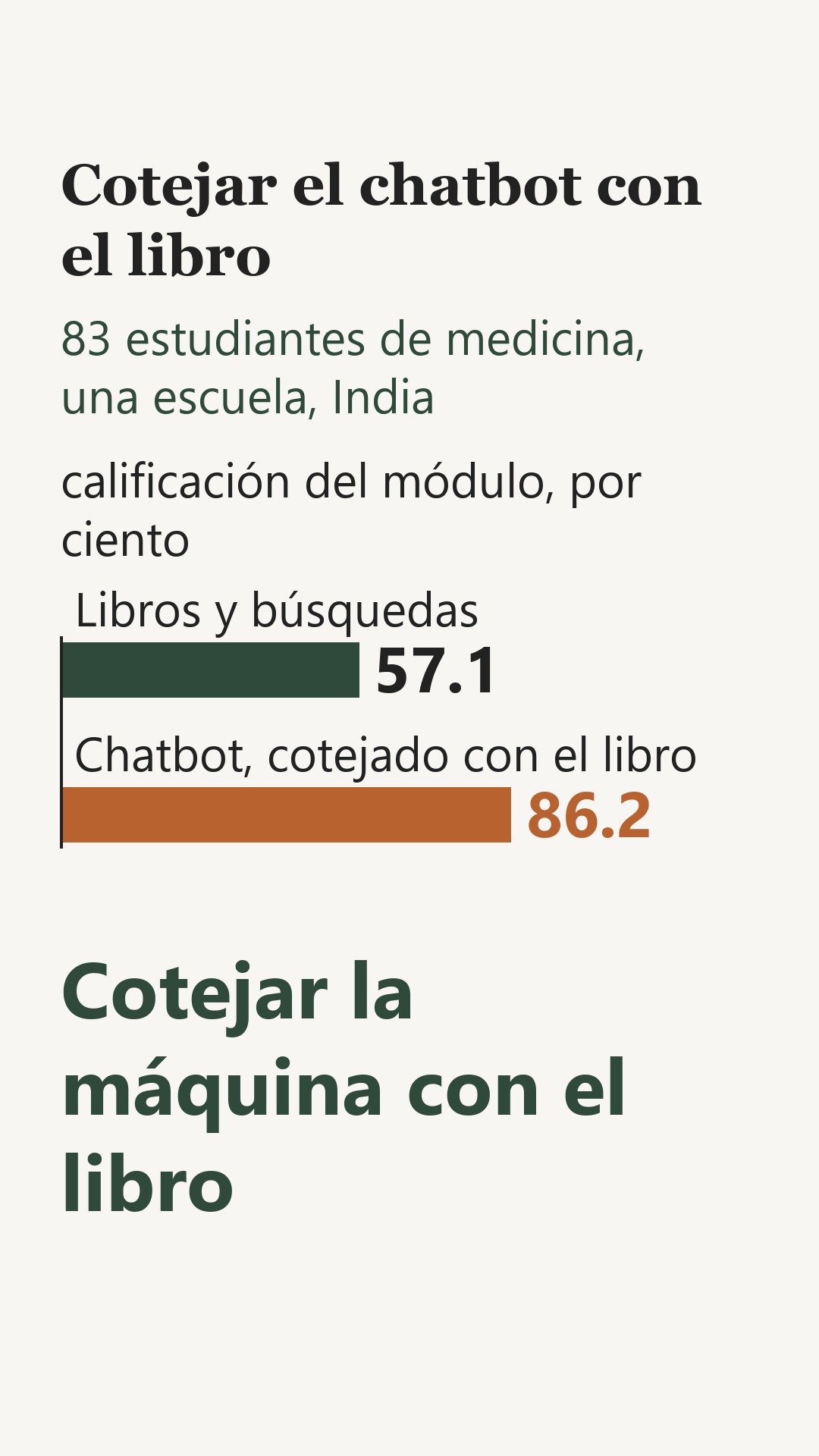
En el departamento de microbiología del Autonomous State Medical College, en Kanpur Dehat, India, 83 estudiantes de segundo año de medicina armaron dos módulos de estudio cada uno. El primero lo hicieron a la antigua, con libros de texto y búsquedas en internet. El segundo, con ChatGPT o Gemini.
Antes de la segunda tarea tomaron una hora de formación. Aprendieron a pedirle las cosas al chatbot paso por paso: decirle que actuara como profesor de medicina y pedirle secciones con el principio, la aplicación clínica y los límites. También recibieron una regla. Cada dato y cada referencia que diera el chatbot tenía que cotejarse con los libros de texto de Ananthanarayan y de Apurba Sastry.
Dos evaluadores independientes calificaron los dos juegos de módulos con la misma rúbrica de diez partes: exactitud, orden, claridad, ejemplos clínicos y otras. Coincidieron casi siempre.
Los módulos hechos con el chatbot sacaron mejor nota en las diez partes. El promedio subió de 57.1 a 86.2 por ciento. En un examen de diez preguntas, las calificaciones pasaron de 5.2 a 8.8. Las mejoras más grandes fueron en orden, en qué tan completo quedó el trabajo y en claridad.
El tiempo también bajó: de 44.5 minutos a 25.4 en promedio.
La mayoría dijo que siguió revisando. Setenta y uno de los 83, 85 por ciento, contaron que cotejaban por costumbre los datos del chatbot con sus libros. Sesenta y cinco, 78 por ciento, dijeron sentirse más seguros al preparar material de estudio. Los problemas que más nombraron fueron la duda sobre la exactitud y la dificultad para escribir buenas instrucciones.
Esa costumbre de revisar es el centro del asunto. A los estudiantes les enseñaron a comprobar, y los profesores vigilaron el uso. Lo que se puso a prueba fue ese arreglo completo, con su hora de formación y su regla.
Lo que el estudio no puede mostrar pesa igual. Cada estudiante fue su propia comparación, sin un grupo aparte ni sorteo, así que la mejora puede deberse en parte a la práctica o a que la segunda tarea siempre sale mejor. Fue un solo grupo en una sola escuela de la India. Y los exámenes vinieron justo después de las tareas. Nadie revisó semanas más tarde si el conocimiento seguía ahí.
La próxima vez que vea inteligencia artificial en un salón, busque el paso de verificación: si a los estudiantes les enseñan a cotejar la máquina con una fuente, y si se les exige hacerlo.
Qué significa para usted
Cuando vea que en un salón se usa un programa que escribe, pregunte si los alumnos reciben instrucción para usarlo y si alguien les pide comprobar cada dato con un libro de texto. En este estudio esa regla formó parte de la enseñanza y casi todos dijeron seguirla, aunque varios dudaron de la exactitud. El trabajo salió más rápido y con mejores calificaciones, pero fue un solo grupo en la India y nadie midió si lo aprendido duró.
Agarwal, R., Kumar, A., Agarwal, V. et al. (2026). Designing Self-Directed Learning Content for Medical Students: An AI-Driven Evaluation of Learning Outcomes. Cureus. https://doi.org/10.7759/cureus.112519
Quién pagó: Los autores declaran que no recibieron apoyo financiero de ninguna organización para el trabajo presentado, y ningún autor declara relaciones financieras con organizaciones que pudieran tener interés en él.
Versión detalladaLos pasajes copiados del artículo, las ilustraciones y cada fuente con cuánto leímos de ella · 1387 palabras · unos 7 minLeerla →Cerrar
Los estudiantes de medicina entregaron mejores trabajos con un chatbot y en menos tiempo
En un solo salón de una escuela médica de la India, los alumnos entregaron mejores trabajos en menos tiempo con ayuda de un chatbot. El estudio no prueba que la herramienta sea la causa, y no midió si lo aprendido se queda.
Ochenta y tres estudiantes de segundo año de medicina, en un salón de clases de la India, recibieron una tarea de estudio por su cuenta: armar un módulo de aprendizaje sobre un tema de microbiología. Primero lo hicieron a la antigua, con libros de texto y búsquedas normales de internet. Después, otra vez, con un chatbot de por medio. El mismo grupo, dos tareas, y una comparación entre ambas.
Los trabajos hechos con el chatbot salieron mejor calificados en los diez criterios con que se evaluaron: precisión, pertinencia, qué tan completos eran, orden, claridad, ejemplos clínicos, apoyo visual, pensamiento crítico, qué tanto correspondían al nivel del curso y originalidad. En promedio, el puntaje subió de 57.1% a 86.2%. Las mejoras más grandes fueron en orden, qué tan completo quedó el trabajo y claridad.
Los conocimientos también subieron: en un examen de diez preguntas, el promedio pasó de 5.2 a 8.8. El tiempo para terminar la tarea bajó de 44.5 a 25.4 minutos, alrededor de un 43% menos. Y la mayoría de los estudiantes dijo sentirse más segura al armar su material, sintetizar la información más rápido y revisar en el libro de texto lo que el chatbot les daba.
Hay que decir con cuidado qué se comparó. No fue un experimento con dos grupos sorteados: el mismo estudiante hizo las dos tareas, una tras otra, y por eso pudo haber aprendido de la primera para la segunda. Los autores lo reconocen. Tampoco hubo un grupo que trabajara en paralelo sin la herramienta. Fue un solo plantel, un solo grupo, y solo se midió el desempeño inmediato. Nadie comprobó si ese conocimiento seguía ahí semanas después.
Para entender qué es lo que se probó, conviene ver lo que hace un chatbot como ChatGPT o Gemini: resume montañas de información, arma apuntes ordenados y redacta casos clínicos con una soltura que parece humana1. En la escuela médica funciona como un andamio: carga con lo pesado de redactar y ordenar, y en teoría le deja al estudiante el trabajo de fondo, que es entender y comprobar1. El problema es que también inventa datos con total aplomo: cosas falsas escritas como si fueran ciertas, y eso es un riesgo directo si llegan al conocimiento del futuro médico sin revisión2.
Los docentes lo saben. Las dudas sobre la honestidad académica, sobre el deterioro del razonamiento clínico y sobre la opacidad de estas herramientas los han vuelto cautelosos3. Mientras tanto, los estudiantes ya las usan, muchas veces por debajo del agua, sin que nadie sepa cómo4. De ahí la pregunta que este estudio quiso responder: ¿un uso guiado y organizado, con una persona supervisando el proceso, rinde más que los métodos de siempre?5
La India exige el estudio por cuenta propia en la carrera de medicina, porque nadie puede cargar de memoria todo lo que la medicina produce cada año6. Así que el equipo no soltó a los estudiantes con un chatbot y ya. Les dio primero una hora de formación: cómo pedirle las cosas a la herramienta, paso por paso, para que el resultado saliera más preciso y con menos errores7. Y una regla que no se podía saltar: cada dato y cada referencia que diera la IA tenía que cruzarse contra los libros de texto de la materia8. Ese es el corazón del asunto: lo que se probó no fue el chatbot solo, sino el chatbot con una regla y con alguien que enseñó a aplicarla.
Vale la pena mirar otras experiencias parecidas, siempre con la advertencia de que de varias solo pudimos leer el resumen; el artículo completo está detrás de una suscripción. Una revisión de diecisiete estudios sobre escritura con IA en la escuela encontró que, en las seis comparaciones contra la enseñanza sin IA, la IA ganaba en calidad del texto o creatividad; pero en todos esos estudios los textos calificados se habían producido con acceso a la IA, y ninguno midió cómo escribían los alumnos sin ella ni tiempo después910. Otra investigación con universitarios de inglés probó un taller de seis horas sobre la herramienta y doce semanas de práctica guiada, con un flujo de escribir primero, pedirle crítica a la IA y luego evaluarla uno mismo; ese grupo superó al que siguió el mismo curso sin IA1112. Un tercer trabajo, con 120 estudiantes, encontró que enseñarles a interpretar la retroalimentación de la IA mejoraba la calidad de sus textos, y que un ejercicio de calibración reducía el exceso de confianza en sí mismos1314.
En los dos estudios con formación, el grupo que la recibió superó al que siguió el mismo curso sin IA; y en la revisión de diecisiete estudios, los textos calificados se habían producido con acceso a la IA. Es el mismo hueco que este estudio deja abierto. El propio equipo concluye que, para que la IA sirva de verdad, la carrera debe enseñar a validarla y a usarla con criterio, no solo a buscar información15.
Así lo leemos nosotros. Lo que separa a estos estudiantes de un grupo cualquiera con un chatbot abierto en el teléfono no es la herramienta: es la hora de formación y la regla de comprobar. Es la diferencia entre darle a alguien un buen cuchillo y enseñarle a cortar. Esperamos que, en un salón o en una casa donde se entregue la IA sin esa enseñanza previa, los trabajos salgan igual de vistosos y bastante menos confiables, y que el tiempo ganado se pague en errores que nadie detecta. Nos equivocaríamos si un grupo sin formación lograra calidad y verificación parecidas, o si los formados rindieran igual que los no formados. Para saberlo, habría que hacer justo la comparación que este estudio no hizo.
Hay un detalle que vale la pena subrayar: la confianza de los estudiantes creció, y también creció su criterio. Dos de cada tres mencionaron la exactitud como su principal preocupación, y eso sugiere que veían a la IA como una ayudante que redacta y a la que hay que vigilar, no como un oráculo16. El pensamiento crítico, medido con la rúbrica, también subió17. Pero conviene preguntarse qué clase de revisión hicieron: comprobar un dato contra el libro es una cosa; juzgar si una fuente es confiable o si el contenido sirve para el nivel real del curso es otra. La primera se aprende en una tarde. La segunda toma años. Si tuviéramos que apostar, diríamos que verificaron más lo fácil de contrastar que lo difícil de juzgar. Nos corregiría la evidencia si los hubieran visto detectar errores finos, no solo datos puntuales, y si su criterio para juzgar fuentes hubiera mejorado tanto como su velocidad.
Lo que un lector puede hacer con esto es concreto. Si usted enseña, antes de permitir o prohibir la herramienta, pregúntese qué les está enseñando a hacer con ella y quién va a acompañar ese uso. Si usted estudia, anote qué comprobó y qué dio por bueno sin revisar: esa lista vale más que la calificación. Y cuando reciba un trabajo hecho con IA, mire primero cómo se diseñó la tarea y quién la corrigió, porque una rúbrica improvisada puede confundir un texto pulido con un texto correcto. En casa, pida que le expliquen cómo llegaron a una respuesta, no solo que la entreguen.
Volvamos al salón de la India. Los estudiantes que trabajaron con la herramienta y la regla de verificación produjeron mejores módulos en menos tiempo. Ese resultado, en un solo plantel y sin grupo de comparación, no es una receta para su escuela ni para su casa. Es una pista de que el acompañamiento importa tanto como el aparato. Lo que sigue, si alguien quiere saber de verdad, es una prueba con dos grupos, uno formado y otro no, y una revisión semanas después, sin la herramienta a la mano.
La pregunta que le queda a usted, y que puede llevar a la próxima junta de maestros o a la mesa de su casa, es sencilla: ¿qué le estamos enseñando a hacer con esto, y quién lo va a acompañar?
De dónde sale cada dato de contexto, y cuánto leímos de cada documento
- Agarwal, R., Kumar, A., Agarwal, V. et al. (2026). Designing Self-Directed Learning Content for Medical Students: An AI-Driven Evaluation of Learning Outcomes. Cureus. https://doi.org/10.7759/cureus.112519 - el artículo del que trata esta nota — el artículo completo — el pasaje: "These algorithms can summarize extensive data, produce organized notes, and develop intricate case vignettes with near-human linguistic proficiency. In medical education, AI serves as a "cognitive scaffold," assisting learners with lower-order activities such as drafting and organizing content, which ideally enables them to concentrate more on synthesis and verification"
- Agarwal, R., Kumar, A., Agarwal, V. et al. (2026). Designing Self-Directed Learning Content for Medical Students: An AI-Driven Evaluation of Learning Outcomes. Cureus. https://doi.org/10.7759/cureus.112519 - el artículo del que trata esta nota — el artículo completo — el pasaje: ""Hallucinations," where AI models provide factually inaccurate yet seemingly credible material, pose a significant threat to patient safety if incorporated into a student's knowledge base without careful examination"
- Agarwal, R., Kumar, A., Agarwal, V. et al. (2026). Designing Self-Directed Learning Content for Medical Students: An AI-Driven Evaluation of Learning Outcomes. Cureus. https://doi.org/10.7759/cureus.112519 - el artículo del que trata esta nota — el artículo completo — el pasaje: "Moreover, apprehensions about academic integrity, the deterioration of fundamental clinical reasoning abilities, and the opaque nature of AI decision-making have instilled a sense of reluctance among educators"
- Agarwal, R., Kumar, A., Agarwal, V. et al. (2026). Designing Self-Directed Learning Content for Medical Students: An AI-Driven Evaluation of Learning Outcomes. Cureus. https://doi.org/10.7759/cureus.112519 - el artículo del que trata esta nota — el artículo completo — el pasaje: "Notwithstanding these apprehensions, student utilization of AI technologies is already prevalent, frequently taking place in an "underground" or unregulated fashion"
- Agarwal, R., Kumar, A., Agarwal, V. et al. (2026). Designing Self-Directed Learning Content for Medical Students: An AI-Driven Evaluation of Learning Outcomes. Cureus. https://doi.org/10.7759/cureus.112519 - el artículo del que trata esta nota — el artículo completo — el pasaje: "There is an immediate need for empirical investigation to ascertain whether organized, guided AI integration, referred to as the "Human-in-the-Loop" approach, can enhance learning outcomes in comparison to conventional methods"
- Agarwal, R., Kumar, A., Agarwal, V. et al. (2026). Designing Self-Directed Learning Content for Medical Students: An AI-Driven Evaluation of Learning Outcomes. Cureus. https://doi.org/10.7759/cureus.112519 - el artículo del que trata esta nota — el artículo completo — el pasaje: "In India, the National Medical Commission (NMC) has designated SDL as an essential element of the MBBS curriculum, acknowledging that the swift growth of medical knowledge requires future physicians to be lifelong learners capable of autonomously navigating extensive clinical information"
- Agarwal, R., Kumar, A., Agarwal, V. et al. (2026). Designing Self-Directed Learning Content for Medical Students: An AI-Driven Evaluation of Learning Outcomes. Cureus. https://doi.org/10.7759/cureus.112519 - el artículo del que trata esta nota — el artículo completo — el pasaje: "The second phase comprised an intervention consisting of a structured one-hour training session on AI-assisted learning. This course familiarized students with a systematic prompting approach aimed at improving the precision of AI-generated content and reducing inaccuracies"
- Agarwal, R., Kumar, A., Agarwal, V. et al. (2026). Designing Self-Directed Learning Content for Medical Students: An AI-Driven Evaluation of Learning Outcomes. Cureus. https://doi.org/10.7759/cureus.112519 - el artículo del que trata esta nota — el artículo completo — el pasaje: "An essential aspect of this training was the verification protocol, necessitating that students cross-verify all AI-generated facts and references against authoritative textbooks by Ananthanarayan and Apurba Sastry"
- Turós M, Beták N, Vargáné Vincze T, Kapusi V, Ceglédi S, Szűts Z. (2026). Generative AI in K-12 creative writing instruction: A systematic review and narrative synthesis. Acta Psychologica. 10.1016/j.actpsy.2026.108026 — solo el resumen - el texto completo está tras una suscripción — el pasaje: "Seventeen studies met the criteria (total N = 736)."
- Turós M, Beták N, Vargáné Vincze T, Kapusi V, Ceglédi S, Szűts Z. (2026). Generative AI in K-12 creative writing instruction: A systematic review and narrative synthesis. Acta Psychologica. 10.1016/j.actpsy.2026.108026 — solo el resumen - el texto completo está tras una suscripción — el pasaje: "All six comparisons of AI-supported with non-AI instruction favoured AI on text quality or creativity, but in every study the scored texts were produced with AI access or under unreported conditions; no study assessed AI-free or delayed writing performance."
- Chen J, Alibakhshi G. (2025). AI ‐Powered Applications’ Effects on English Language Learners’ Cognitive, Metacognitive, and Resource Management Strategies, and Language Achievement. Journal of Computer Assisted Learning. 10.1002/jcal.70171 — solo el resumen - no se pudo obtener el texto completo — el pasaje: "The AI group completed a 6-h AI-literacy workshop and 12 weeks of guided practice using ChatGPT, Poe, and Bard within a draft-first [right arrow] AI critique [right arrow] human evaluation workflow; the control group received the same curriculum without AI."
- Chen J, Alibakhshi G. (2025). AI ‐Powered Applications’ Effects on English Language Learners’ Cognitive, Metacognitive, and Resource Management Strategies, and Language Achievement. Journal of Computer Assisted Learning. 10.1002/jcal.70171 — solo el resumen - no se pudo obtener el texto completo — el pasaje: "The AI group outperformed the control across all four outcomes; a MANCOVA indicated a significant multivariate effect, with follow-up ANCOVAs showing partial [eta-squared] values of approximately 0.16-0.22."
- Dai Z. (2026). Rethinking AI-assisted writing instruction: feedback literacy scripts, calibration training, and student writing development. Frontiers in Psychology. 10.3389/fpsyg.2026.1829268 — solo el resumen - el texto completo está tras una suscripción — el pasaje: "FRAC had a stronger direct effect on writing quality, effective feedback uptake, and deep revision, suggesting that feedback literacy training primarily improved how students processed and enacted AI feedback."
- Dai Z. (2026). Rethinking AI-assisted writing instruction: feedback literacy scripts, calibration training, and student writing development. Frontiers in Psychology. 10.3389/fpsyg.2026.1829268 — solo el resumen - el texto completo está tras una suscripción — el pasaje: "APCA showed the clearest effect on self-assessment accuracy and overconfidence reduction, indicating that calibration training more directly strengthened students' internal judgment."
- Agarwal, R., Kumar, A., Agarwal, V. et al. (2026). Designing Self-Directed Learning Content for Medical Students: An AI-Driven Evaluation of Learning Outcomes. Cureus. https://doi.org/10.7759/cureus.112519 - el artículo del que trata esta nota — el artículo completo — el pasaje: "However, for AI to be effectively utilized, curriculum design must fundamentally shift from teaching students what to look for to teaching them how to validate and ethically use AI-generated content. It is now essential to formally include "AI Literacy" and "Verification Competency" in the MBBS curriculum to prepare future doctors for the digital era"
- Agarwal, R., Kumar, A., Agarwal, V. et al. (2026). Designing Self-Directed Learning Content for Medical Students: An AI-Driven Evaluation of Learning Outcomes. Cureus. https://doi.org/10.7759/cureus.112519 - el artículo del que trata esta nota — el artículo completo — el pasaje: "The fact that 65% of students mentioned accuracy issues as a problem suggests that they saw the AI as a drafting helper that needed human supervision rather than as an unfailing oracle"
- Agarwal, R., Kumar, A., Agarwal, V. et al. (2026). Designing Self-Directed Learning Content for Medical Students: An AI-Driven Evaluation of Learning Outcomes. Cureus. https://doi.org/10.7759/cureus.112519 - el artículo del que trata esta nota — el artículo completo — el pasaje: "Critical thinking scores, however, significantly improved (d = 1.54), according to our findings. This implies that students have more cognitive capacity to concentrate on synthesizing clinical applications and comprehending the limitations of the technology when they are released from the mechanical strain of "information hunting""
Agarwal, R., Kumar, A., Agarwal, V. et al. (2026). Designing Self-Directed Learning Content for Medical Students: An AI-Driven Evaluation of Learning Outcomes. Cureus. https://doi.org/10.7759/cureus.112519
Quién pagó: Los autores declaran que no recibieron apoyo financiero de ninguna organización para el trabajo presentado, y ningún autor declara relaciones financieras con organizaciones que pudieran tener interés en él.
experiment · Cureus · the paper, 12 Jul 2026 · free
They Checked the Chatbot Against the Textbook. The Work Got Better and Faster.
In one Indian medical college, 83 students wrote better modules with AI help, in 43 percent less time. There was no control group, and nobody checked whether the knowledge stayed.
Short version · the longer version follows, about 6 min
Ask the weeklyAI chat
Ask me about this study: who was studied, what it found, and what it does not say.
Conversations are saved for as long as weeklyAI exists, to improve the publication. Answers come in the language you write in.
- The study at a glance
- Who
- second-year medical students
- How many
- 83
- Where
- India
- When
- 2024-25 academic cohort
- Kind of study
- experiment
- Who did it
- Autonomous State Medical College, Kanpur Dehat, India
- The limit that matters
- No control group, no random assignment, and nobody checked whether the knowledge lasted.
Average marks on a ten-part rubric for the same 83 students' modules, first written the old way and then with AI help; the study had no control group and tested knowledge only right after the assignments.
Traditional study versus AI-assisted study, same students
Average rubric score rose from 57.1% to 86.2%
Knowledge test score rose from 5.2 to 8.8 out of 10
Average completion time fell from 44.5 to 25.4 minutes
Faster, better-looking work is not proof that learning stuck.

In the Department of Microbiology at the Autonomous State Medical College in Kanpur Dehat, India, 83 second-year medical students each wrote two learning modules. The first they built the old way, with textbooks and ordinary web searches. The second they built with ChatGPT or Gemini.
Before the second assignment, the students got one hour of training. They learned to prompt the chatbot step by step: tell it to act as a medical educator, ask for sections headed principle, clinical application and limitations. They also got a rule. Every fact and reference the chatbot produced had to be checked against the textbooks by Ananthanarayan and Apurba Sastry.
Two independent raters then scored both sets of modules on the same ten-part rubric, covering accuracy, organization, clarity, clinical examples and more. The raters agreed closely: the study reports a score of 0.94 for their agreement.
The AI-assisted modules scored higher in all ten parts. The average rose from 57.1 percent to 86.2 percent. On a ten-question knowledge test, scores went from 5.2 to 8.8 out of 10. Organization, completeness and clarity showed the largest jumps, at 71.3, 63.5 and 62.5 percent.
Time fell too, from 44.5 minutes to 25.4 minutes on average.
Most students said they still checked. Seventy-one of the 83, or 85 percent, reported routinely cross-checking AI facts against their textbooks. Sixty-five, or 78 percent, said they felt more confident making learning content. The problems students named most were worry about accuracy and difficulty in writing good prompts.
That habit of checking is the point. The students were taught how to verify, and faculty oversaw the use of AI. This study tested that setup, not a chatbot handed over with no instruction.
What the study cannot show matters as much. Each student served as their own comparison, with no separate control group and no random assignment, so the higher scores may owe something to practice or to simply doing the second task. It was one cohort at one college in India. And the tests came right after the assignments; nobody checked whether the knowledge lasted weeks later. Faster, better-looking work is not proof that learning stuck.
When you next see AI used in a classroom, look for the verification step: whether students are taught to check the machine against a source, and required to do it.
What this means for you
For a teacher or a student watching AI enter a classroom, the useful detail here is the checking, since the students were taught to compare the chatbot's facts against a textbook and most said they did. Nothing in this one college's before-and-after results proves the machine caused the better work, or that the knowledge lasted past the test, so watch whether a class builds that checking step in and requires it.
Agarwal, R., Kumar, A., Agarwal, V. et al. (2026). Designing Self-Directed Learning Content for Medical Students: An AI-Driven Evaluation of Learning Outcomes. Cureus. https://doi.org/10.7759/cureus.112519
Who paid: The authors declare that no financial support was received from any organization for the submitted work, and no author reports financial relationships with organizations that might have an interest in it.
The longer versionThe passages copied from the paper, the pictures, and every source with how much of it we read · 1199 words · about 6 minRead it →Close
AI-Assisted Study at One Indian Medical College: Better-Looking Work, in Less Time, Under Supervision
A before-after study of 83 second-year medical students found higher marks and faster completion when they used ChatGPT and Gemini under a trained, check-everything workflow. It cannot show the gains would hold without the training.
The assignment was a microbiology learning module. Each student made two: one with textbooks and ordinary web searches, no AI; then one with ChatGPT and Gemini, following a set of rules they had been taught. Two independent examiners marked both with the same ten-part rubric, and the same students took a knowledge test before and after. That is the whole comparison — same students, two tasks, one after the other.
The AI-assisted work scored higher on every one of the ten parts of the rubric. The average rose from 57.1% to 86.2%, and the researchers report a very large effect size for that jump. The biggest gains were in organization, completeness and clarity — the bones and the language of a module, not only its facts. Knowledge test scores went from 5.2 to 8.8 out of 10. Average completion time fell from 44.5 to 25.4 minutes, about 19 minutes less per task.
The students' own reports matter as much as the marks. Most said they felt more confident, and most said they routinely checked AI-generated facts against their textbooks. Fifty-four of the 83 students, or 65%, named accuracy worries or the difficulty of writing good prompts as their main problem. Read together, those two answers describe students who treated the tool as a drafting helper that needed watching, not as an oracle.
What the study cannot show is just as clear. It was one cohort at one college, with no control group and no randomization; each student did the traditional task first and the AI task second. The authors themselves say learning effects from doing two assignments in a row cannot be fully ruled out. Nobody checked whether the knowledge stuck weeks later. And every student had a one-hour training session in prompting and in checking facts against named textbooks; the authors say AI use was limited to developing academic content under faculty oversight. The gains belong to that setup.
Picture the training session, because it is the part most schools would skip. For one hour, students learned to give the AI a role, to feed it context tied to Indian medical standards, and to ask for output under headings such as principle, clinical application and limitations1. Then came the rule that shaped everything after: every fact and reference the AI produced had to be checked against standard microbiology textbooks2. The tool was never handed over bare.
Here is what the technology actually does. Large language models summarize large amounts of material, produce organized notes and build case examples in prose that reads like a person wrote it3. The authors describe the AI as a kind of scaffold: it carries the drafting and arranging, so the student can spend attention on synthesis and on checking3. That is a claim about where the effort goes, and the study's design cannot prove it. It does explain why organization and clarity, the drafting skills, moved furthest.
The pull toward these tools is not mainly top-down. In India, the National Medical Commission made self-directed learning a required part of the MBBS curriculum, on the argument that medical knowledge grows too fast for any degree to cover it and future doctors must navigate it alone4. Meanwhile students were already using AI widely, often quietly and without rules5. Educators' hesitations are specific: made-up facts that read as credible, worries about academic honesty, and the fear that clinical reasoning weakens67. This study was an attempt to bring that quiet use into the open under supervision, which the authors say was urgently needed8.
Other work points the same way, with a caveat. A review of AI in school writing instruction — we could read only the summary, the full paper is behind a subscription — found seventeen studies covering 736 students, and every comparison of AI-supported with non-AI instruction favored AI on text quality or creativity910. But in every one of those studies the scored texts were produced with AI access or under conditions the review could not pin down; none tested writing done without AI, or later10. Another small experiment — summary only again — gave students a six-hour AI-literacy workshop and twelve weeks of guided practice in a draft-first, AI-critique, human-evaluate loop, and the AI group beat the control group on all four measured outcomes1112. Its authors flagged the risk of students offloading thinking when nobody sets guardrails13.
The trade-off is worth naming plainly. What is gained is time — roughly nineteen minutes per task here — and a more organized draft. What is given up, or at least put at risk, is the slow struggle of finding and arranging material, which is where some learning may live. The study's own answer is that critical thinking scores rose rather than fell, and that students freed from hunting for information had room to weigh clinical applications14. That is one cohort's result, not a law.
Here is how we read it. The interesting ingredient may not be the chatbot at all. It may be the habit the training installed: write the prompt carefully, demand a structure, then go to the book and find the line that settles the point. If that is right, a class given the same tools with no such instruction would produce polished, unchecked pages, and the accuracy marks would not hold. You would know we were wrong if untrained students scored just as well on accuracy and critical thinking. Before your school rolls out an AI tool, budget the hour for the workflow and the checking habit, and ask students to state the rule they follow. Treat the tool alone as untested.
One more thing to watch. "I checked it against the textbook" can mean two very different acts: comparing a specific claim with a specific line, or trusting a book's reputation. The study counted the first only as a student report, so the reported checking rate tells us what students said they did. When you set an AI-assisted task, ask for the source and the exact line, not the title. And watch whether the improvement survives when the review step is removed — that is the test the study did not run.
The authors' own next step is a curriculum change: teach students less what to look for and more how to validate and ethically use what a machine gives them, and make that a formal part of medical training15. Whether that belongs in a microbiology course in Kanpur, a nursing program in Texas or a secondary classroom in Bogotá is a question each institution has to answer for itself.
So bring the question back to the desk where the assignment gets written. The students in this study did better work, faster, with a machine at their elbow and a textbook open beside it. What would you ask for, before you let a class work that way — the training hour, the checking rule, or the test weeks later that nobody here ran?
Where each piece of context comes from, and how much of it we read
- Agarwal, R., Kumar, A., Agarwal, V. et al. (2026). Designing Self-Directed Learning Content for Medical Students: An AI-Driven Evaluation of Learning Outcomes. Cureus. https://doi.org/10.7759/cureus.112519 - the article this story is about — the whole article — the passage: "The second phase comprised an intervention consisting of a structured one-hour training session on AI-assisted learning. This course familiarized students with a systematic prompting approach aimed at improving the precision of AI-generated content and reducing inaccuracies"
- Agarwal, R., Kumar, A., Agarwal, V. et al. (2026). Designing Self-Directed Learning Content for Medical Students: An AI-Driven Evaluation of Learning Outcomes. Cureus. https://doi.org/10.7759/cureus.112519 - the article this story is about — the whole article — the passage: "An essential aspect of this training was the verification protocol, necessitating that students cross-verify all AI-generated facts and references against authoritative textbooks by Ananthanarayan and Apurba Sastry"
- Agarwal, R., Kumar, A., Agarwal, V. et al. (2026). Designing Self-Directed Learning Content for Medical Students: An AI-Driven Evaluation of Learning Outcomes. Cureus. https://doi.org/10.7759/cureus.112519 - the article this story is about — the whole article — the passage: "These algorithms can summarize extensive data, produce organized notes, and develop intricate case vignettes with near-human linguistic proficiency. In medical education, AI serves as a "cognitive scaffold," assisting learners with lower-order activities such as drafting and organizing content, which ideally enables them to concentrate more on synthesis and verification"
- Agarwal, R., Kumar, A., Agarwal, V. et al. (2026). Designing Self-Directed Learning Content for Medical Students: An AI-Driven Evaluation of Learning Outcomes. Cureus. https://doi.org/10.7759/cureus.112519 - the article this story is about — the whole article — the passage: "In India, the National Medical Commission (NMC) has designated SDL as an essential element of the MBBS curriculum, acknowledging that the swift growth of medical knowledge requires future physicians to be lifelong learners capable of autonomously navigating extensive clinical information"
- Agarwal, R., Kumar, A., Agarwal, V. et al. (2026). Designing Self-Directed Learning Content for Medical Students: An AI-Driven Evaluation of Learning Outcomes. Cureus. https://doi.org/10.7759/cureus.112519 - the article this story is about — the whole article — the passage: "Notwithstanding these apprehensions, student utilization of AI technologies is already prevalent, frequently taking place in an "underground" or unregulated fashion"
- Agarwal, R., Kumar, A., Agarwal, V. et al. (2026). Designing Self-Directed Learning Content for Medical Students: An AI-Driven Evaluation of Learning Outcomes. Cureus. https://doi.org/10.7759/cureus.112519 - the article this story is about — the whole article — the passage: ""Hallucinations," where AI models provide factually inaccurate yet seemingly credible material, pose a significant threat to patient safety if incorporated into a student's knowledge base without careful examination"
- Agarwal, R., Kumar, A., Agarwal, V. et al. (2026). Designing Self-Directed Learning Content for Medical Students: An AI-Driven Evaluation of Learning Outcomes. Cureus. https://doi.org/10.7759/cureus.112519 - the article this story is about — the whole article — the passage: "Moreover, apprehensions about academic integrity, the deterioration of fundamental clinical reasoning abilities, and the opaque nature of AI decision-making have instilled a sense of reluctance among educators"
- Agarwal, R., Kumar, A., Agarwal, V. et al. (2026). Designing Self-Directed Learning Content for Medical Students: An AI-Driven Evaluation of Learning Outcomes. Cureus. https://doi.org/10.7759/cureus.112519 - the article this story is about — the whole article — the passage: "There is an immediate need for empirical investigation to ascertain whether organized, guided AI integration, referred to as the "Human-in-the-Loop" approach, can enhance learning outcomes in comparison to conventional methods"
- Turós M, Beták N, Vargáné Vincze T, Kapusi V, Ceglédi S, Szűts Z. (2026). Generative AI in K-12 creative writing instruction: A systematic review and narrative synthesis. Acta Psychologica. 10.1016/j.actpsy.2026.108026 — only the abstract - the full paper is behind a subscription — the passage: "Seventeen studies met the criteria (total N = 736)."
- Turós M, Beták N, Vargáné Vincze T, Kapusi V, Ceglédi S, Szűts Z. (2026). Generative AI in K-12 creative writing instruction: A systematic review and narrative synthesis. Acta Psychologica. 10.1016/j.actpsy.2026.108026 — only the abstract - the full paper is behind a subscription — the passage: "All six comparisons of AI-supported with non-AI instruction favoured AI on text quality or creativity, but in every study the scored texts were produced with AI access or under unreported conditions; no study assessed AI-free or delayed writing performance."
- Chen J, Alibakhshi G. (2025). AI ‐Powered Applications’ Effects on English Language Learners’ Cognitive, Metacognitive, and Resource Management Strategies, and Language Achievement. Journal of Computer Assisted Learning. 10.1002/jcal.70171 — only the abstract - the full text could not be fetched — the passage: "The AI group completed a 6-h AI-literacy workshop and 12 weeks of guided practice using ChatGPT, Poe, and Bard within a draft-first [right arrow] AI critique [right arrow] human evaluation workflow; the control group received the same curriculum without AI."
- Chen J, Alibakhshi G. (2025). AI ‐Powered Applications’ Effects on English Language Learners’ Cognitive, Metacognitive, and Resource Management Strategies, and Language Achievement. Journal of Computer Assisted Learning. 10.1002/jcal.70171 — only the abstract - the full text could not be fetched — the passage: "The AI group outperformed the control across all four outcomes; a MANCOVA indicated a significant multivariate effect, with follow-up ANCOVAs showing partial [eta-squared] values of approximately 0.16-0.22."
- Chen J, Alibakhshi G. (2025). AI ‐Powered Applications’ Effects on English Language Learners’ Cognitive, Metacognitive, and Resource Management Strategies, and Language Achievement. Journal of Computer Assisted Learning. 10.1002/jcal.70171 — only the abstract - the full text could not be fetched — the passage: "The journals illuminated mechanisms--planning/monitoring, time efficiency, confidence, and calibrated help-seeking--and flagged the risks of cognitive offloading without explicit guardrails."
- Agarwal, R., Kumar, A., Agarwal, V. et al. (2026). Designing Self-Directed Learning Content for Medical Students: An AI-Driven Evaluation of Learning Outcomes. Cureus. https://doi.org/10.7759/cureus.112519 - the article this story is about — the whole article — the passage: "Critical thinking scores, however, significantly improved (d = 1.54), according to our findings. This implies that students have more cognitive capacity to concentrate on synthesizing clinical applications and comprehending the limitations of the technology when they are released from the mechanical strain of "information hunting""
- Agarwal, R., Kumar, A., Agarwal, V. et al. (2026). Designing Self-Directed Learning Content for Medical Students: An AI-Driven Evaluation of Learning Outcomes. Cureus. https://doi.org/10.7759/cureus.112519 - the article this story is about — the whole article — the passage: "However, for AI to be effectively utilized, curriculum design must fundamentally shift from teaching students what to look for to teaching them how to validate and ethically use AI-generated content. It is now essential to formally include "AI Literacy" and "Verification Competency" in the MBBS curriculum to prepare future doctors for the digital era"
Agarwal, R., Kumar, A., Agarwal, V. et al. (2026). Designing Self-Directed Learning Content for Medical Students: An AI-Driven Evaluation of Learning Outcomes. Cureus. https://doi.org/10.7759/cureus.112519
Who paid: The authors declare that no financial support was received from any organization for the submitted work, and no author reports financial relationships with organizations that might have an interest in it.