analysis of texts · Journal of medical Internet research · la publicación, 19 ago 2026 · gratis
Su historial médico puede entrenar modelos comerciales aunque se cumplan las leyes de privacidad
Un grupo de investigadores propone que las autoridades revisen cuatro aspectos antes de permitir un nuevo uso de datos, y que no baste con un registro legal en orden. Es un análisis académico y no cambia ningún derecho actual.
Versión breve · la versión detallada sigue, unos 7 min
Pregunte al chat de weeklyAI
Pregúnteme por este estudio: a quiénes se estudió, qué encontró y qué no dice.
Las conversaciones se guardan mientras exista weeklyAI, para mejorar la publicación. Se responde en el idioma en que usted escribe.
- El estudio, de un vistazo
- Quiénes
- No se estudió a ninguna persona; es un artículo de opinión sobre reutilización de datos de salud
- Cuántos
- No aplica: el artículo no reporta población ni resultados medidos
- Dónde
- Estados Unidos y Nigeria (Universidad de Maryland y Centro de Bioética e Investigación de Ibadan)
- Cuándo
- Publicado en 2026 en el Journal of Medical Internet Research
- Tipo de estudio
- review of studies
- Quién lo hizo
- Universidad de Maryland y Centro de Bioética e Investigación de Ibadan, Nigeria
- El límite que importa
- No es ley ni derecho exigible: es una propuesta para comités, sin datos nuevos
Lo que un papel de aprobación sí verifica frente a lo que no puede mostrar
El papel responde preguntas reales sobre linaje, privacidad y responsabilidad, pero no cierra la pregunta ética
La trazabilidad no garantiza que las etiquetas sigan significando lo mismo
El acceso legal no equivale a que las comunidades afectadas tengan voz
Las garantías de procedencia y privacidad engañan sobre el riesgo residual
La autorización de vigilancia no viaja automáticamente a otro fin
Que el dato no se mueva no responde para qué se usa
La procedencia de sus datos debería iniciar la revisión ética, no terminarla.
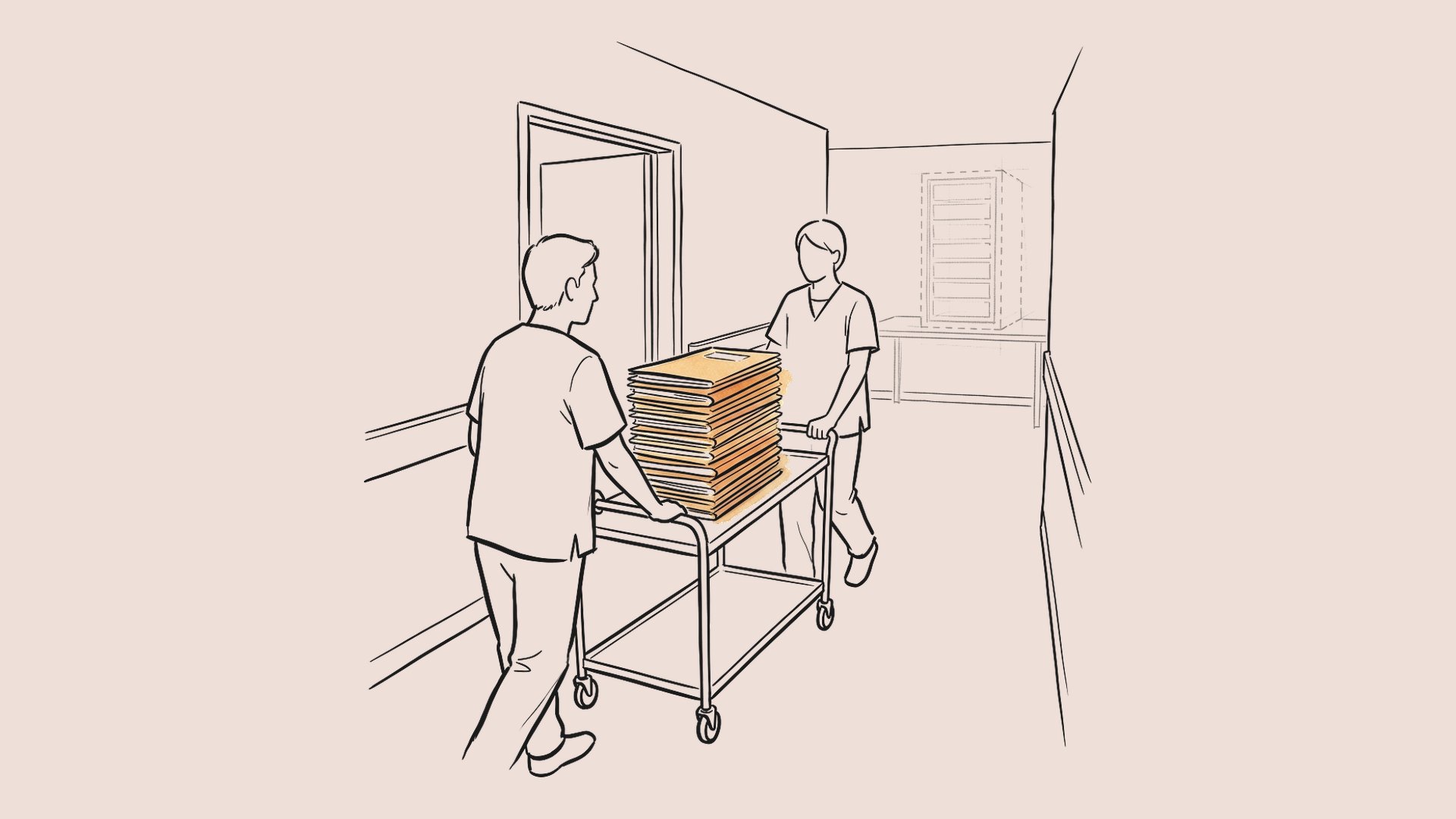
"Los antecedentes deben iniciar la revisión ética; no deben terminarla", escriben Clement Adebamowo y sus colegas del Proyecto BridgELSI, un grupo de trabajo sobre ética de datos en salud.
Esas palabras resumen un problema que describen en la revista Journal of Medical Internet Research. Hoy los hospitales, los bancos de muestras y las compañías reutilizan datos que se recolectaron para otra cosa: historias clínicas, imágenes, genomas, muestras de sangre guardadas. Con eso se entrenan modelos de inteligencia artificial.
Quien revisa suele mirar lo que se puede archivar: un formulario de consentimiento firmado, un registro de accesos, un contrato de uso, una aprobación de comité. Esos papeles responden preguntas reales sobre el origen y el manejo del dato.
El grupo sostiene que no alcanzan. La razón es que la ética de un uso posterior descansa en cuatro cosas a la vez: de dónde viene el dato, si las etiquetas siguen significando lo mismo, si el permiso cubre el uso nuevo y si las personas o comunidades afectadas tienen voz.
Los autores llaman "Trampa de la Continuidad" al error de revisión en que una sola señal visible se toma como prueba suficiente de que todo lo demás está bien. Esa señal suele ser el rastro del origen del dato, pero también puede ser un consentimiento, una aprobación de comité, la ubicación donde se guarda o la documentación de un modelo. Con ese gesto, la revisión se cierra antes de tiempo.
El artículo no reporta ningún estudio con personas, ni midió cuántas veces ocurre esto, ni en qué país. Es una propuesta ética para quienes deciden si un uso puede seguir adelante.
Los autores revisan, en cambio, cómo las reglas existentes pueden reducir riesgos y aun así producir el problema. Mencionan la ley de privacidad de Estados Unidos (HIPAA), el reglamento europeo de protección de datos, la normativa europea de datos de salud, guías de la FDA y marcos de gestión de riesgos de inteligencia artificial. Cumplir con una de esas reglas no responde por las otras tres dimensiones.
Proponen entonces una revisión por disparadores: se activa cuando el uso cambia de propósito, de alcance, de lo que permite deducir o de si genera derivados. En esos casos, el revisor identifica la dimensión más débil y pide una garantía hecha a su medida. La propuesta no fue probada, y el artículo no ofrece un derecho nuevo que usted pueda invocar hoy.
Cuando firme un consentimiento en un hospital o una clínica, busque si dice que sus datos podrán entrenar modelos comerciales de inteligencia artificial.
Qué significa para usted
El artículo no cambia ninguna regla vigente, así que usted no tiene hoy un trámite nuevo que exigir. Lo que sí puede hacer es leer con atención el formulario de consentimiento que le den en un hospital o una clínica, y fijarse en si allí se autoriza el uso de sus datos para entrenar modelos comerciales de inteligencia artificial. Si esa frase no aparece, pregunte antes de firmar.
Adebamowo, C., Adebamowo, S. N., Akintola, A. et al. (2026). The Continuity Trap in Data Science Health Research. Journal of Medical Internet Research. https://doi.org/10.2196/98699
Quién pagó: El estudio fue financiado por los Institutos Nacionales de la Salud de EE. UU. y el Programa del Fondo de Restitución del Tabaco del Departamento de Salud de Maryland, sin que las agencias financiadoras desempeñaran ningún papel en la publicación.
No tome esto como consejo médico profesional.
Versión detalladaLos pasajes copiados del artículo, las ilustraciones y cada fuente con cuánto leímos de ella · 1312 palabras · unos 7 minLeerla →Cerrar
Cuando sus datos de salud se reutilizan, un sello de aprobación no responde todas las preguntas
Un grupo de bioeticistas advierte que la verificación de permisos y registros puede cerrar demasiado pronto la discusión ética sobre el uso secundario de datos clínicos.
La reutilización de datos ya no es la excepción en la investigación en salud: es la condición ordinaria. Los registros clínicos electrónicos creados para la atención se convierten en herramientas de predicción e insumos para inteligencia artificial generativa; los archivos de imágenes se vuelven corpus para modelos fundacionales; los conjuntos genómicos alimentan puntajes de riesgo; y las muestras biológicas guardadas se transforman en líneas celulares renovables y distribuibles indefinidamente1. Así lo plantea un artículo de opinión publicado en el Journal of Medical Internet Research, firmado por Clement Adebamowo y colegas de la Universidad de Maryland y del Centro de Bioética e Investigación de Ibadan, Nigeria, con financiamiento del Instituto Nacional de Salud Mental de Estados Unidos y otros fondos públicos estadounidenses.
Los autores no presentan datos nuevos. Es un artículo de punto de vista, sin población ni resultados medidos. Su propuesta central es un concepto: la "Trampa de la Continuidad", definida como un error en la etapa de revisión en el que una señal visible de continuidad en un dominio se trata como prueba suficiente de continuidad ética general, lo que hace que la investigación sobre los dominios restantes se cierre prematuramente2.
El mecanismo funciona así: un comité de revisión institucional, un comité de acceso a datos, un repositorio o una oficina de transferencia de materiales puede verificar un formulario de consentimiento, una aprobación de acceso, un registro de custodia, un acuerdo de uso de datos o una tarjeta de modelo3. Estos instrumentos son necesarios y responden preguntas reales sobre linaje, privacidad, responsabilidad institucional y rendición de cuentas, pero no son suficientes para establecer que un uso presente siga siendo éticamente justificado4. No muestran, por sí solos, que el uso actual siga siendo éticamente continuo con las condiciones bajo las cuales las personas, comunidades, clínicos e instituciones públicas confiaron datos o materiales a la investigación en salud5.
Los dominios pueden divergir, y esa divergencia es lo que la trampa explota. Un modelo puede ser rastreable pero semánticamente inestable. Un conjunto de datos puede ser legalmente accesible pero relacionalmente extractivo. Un archivo anonimizado puede cumplir un estándar de privacidad y seguir siendo vulnerable a la reidentificación mediante vinculación o inferencia generativa, de modo que las garantías de procedencia y privacidad engañan sobre el riesgo residual6. Un registro de salud pública puede estar autorizado para vigilancia pero no para control migratorio. Una arquitectura federada puede preservar la localidad mientras transforma registros clínicos en insumos de entrenamiento para un modelo comercial7.
El riesgo regulatorio es específico: las instituciones tienden a optimizar hacia lo que los reguladores y auditores hacen más explícito, y tratan el cumplimiento de un requisito explícito como si respondiera preguntas que ese requisito nunca fue diseñado para alcanzar8. La HIPAA no es una teoría de validez semántica; la guía de dispositivos de la FDA no es un código de gobernanza comunitaria; el marco del NIST no sustituye la revisión de participantes humanos; y la guía de vigilancia de la OMS no es una licencia para uso de aplicación policial no relacionado9. El problema surge cuando el cumplimiento de un régimen se trata como si resolviera relaciones de continuidad que ese régimen no fue diseñado para evaluar10.
El aprendizaje federado ilustra bien la confusión. La afirmación de que los datos brutos permanecen en la institución local suele ser cierta y relevante para la privacidad, y ha hecho posible la colaboración multiinstitucional donde la transferencia de datos no lo sería. Pero no responde si los registros clínicos generados para la atención pueden legítimamente funcionar como insumos de entrenamiento distribuido para otro propósito11.
Así lo leemos nosotros: cuando algo que se produce en un lugar con reglas propias se vende después en muchos lugares distintos, el sentido original se desarma. Lo que significaba para quien lo hizo deja de coincidir con lo que significa para quien lo compra, y quien lo produjo pierde el control sobre ese significado. Esperamos que los datos clínicos, las imágenes y las muestras que una persona donó para su atención terminen alimentando modelos comerciales en países y mercados que esa persona nunca imaginó, y que el permiso que firmó siga siendo válido mientras el sentido de lo que autorizó ya cambió por completo. Sabríamos que nos equivocamos si los repositorios y las empresas informaran a cada persona, en términos concretos, en qué productos y en qué países terminó su muestra o su registro, y si esa información llegara antes del lanzamiento del producto, no después. Usted puede, al firmar un consentimiento para donar muestras o permitir el uso de sus datos, preguntar por escrito si esos materiales podrán venderse o licenciarse a terceros y en qué países, y guardar copia de la respuesta.
La reutilización de datos ya no es la excepción en la investigación en salud: es la condición ordinaria, y los registros clínicos creados para la atención se convierten en herramientas de predicción e insumos para inteligencia artificial generativa. Aunque un hospital cumpla con las normas de privacidad, un registro de procedencia puede ser exacto y no mostrar si el uso actual sigue siendo éticamente continuo con las condiciones bajo las cuales se confiaron los datos. Sabríamos que nos equivocamos si el paciente pudiera consultar, en un solo lugar y en lenguaje claro, cada institución y cada empresa que recibió sus datos, con la fecha y el motivo, y si pudiera retirar ese acceso de forma efectiva. Usted puede pedir a su hospital o clínica, por escrito, la lista de terceros con quienes comparte sus registros y el motivo, y preguntar si esos datos se usan para entrenar sistemas automáticos.
Los autores proponen una respuesta proporcionada: revisión de continuidad basada en disparadores. En lugar de revisar cada reutilización, los investigadores y revisores deben identificar el dominio de continuidad más débil en la etapa actual de los datos e imponer una salvaguarda que corresponda a ese dominio, registrada en una breve declaración de continuidad12. Si la continuidad semántica es débil, la respuesta debe ser justificación de descriptores, validación local, divulgación de incertidumbre, evaluación de desempeño por subgrupos o límites a las afirmaciones sobre poblaciones. Si la continuidad de autorización es débil, la respuesta puede ser aviso renovado, reincorporación, restricción de aplicaciones derivadas o limitación explícita de uso13.
El proyecto está financiado por la subvención BridgELSI (NIH/NIMH U01MH127693), con apoyo adicional del Programa de Fondos de Restitución del Cigarrillo del Departamento de Salud de Maryland, el proyecto CARDINAL (NIH/NHGRI 01HG011717), el proyecto ENRICH (R25TW011811-S1) y la subvención de apoyo del Centro Integral de Cáncer Greenebaum de la Universidad de Maryland (NIH/NCI P30CA134274). Las agencias financiadoras no tuvieron ningún papel en la publicación.
Aquí hay algo que conviene tener presente: este artículo propone un marco para comités de ética, repositorios y organismos de gobernanza, pero no es una ley, ni una sentencia, ni un derecho exigible hoy. Depende de que las instituciones decidan adoptarlo. Usted puede preguntar a su sistema de salud o a su obra social si los datos que aporta se usan para desarrollar productos que después se venden, y si su comunidad tendrá acceso a esos productos en condiciones justas. También puede preguntar quién revisa, y con qué criterios, cuando sus registros o sus muestras se reutilizan para un propósito distinto del original.
Lo que este trabajo hace posible es una pregunta concreta que usted puede llevar a cualquier consultorio, hospital o comité: cuando le pidan firmar un consentimiento para donar muestras o permitir el uso de sus datos, pregunte por escrito si esos materiales podrán venderse o licenciarse a terceros, en qué países y para qué productos, y guarde copia de la respuesta. La procedencia de sus datos debería iniciar la revisión ética, no terminarla.
De dónde sale cada dato de contexto, y cuánto leímos de cada documento
- Adebamowo, C., Adebamowo, S. N., Akintola, A. et al. (2026). The Continuity Trap in Data Science Health Research. Journal of Medical Internet Research. https://doi.org/10.2196/98699 - el artículo del que trata esta nota — el artículo completo — el pasaje: "Secondary use is now the ordinary condition of data science health research rather than an exception to it. Electronic health records collected for clinical care become prediction tools and inputs for generative AI; imaging archives become foundation-model corpora; genomic datasets become resources for polygenic risk scores; and legacy biospecimens become renewable, indefinitely distributable cell lines."
- Adebamowo, C., Adebamowo, S. N., Akintola, A. et al. (2026). The Continuity Trap in Data Science Health Research. Journal of Medical Internet Research. https://doi.org/10.2196/98699 - el artículo del que trata esta nota — el artículo completo — el pasaje: "The Continuity Trap as a review-stage governance error in which a salient signal of continuity in one domain is treated as sufficient evidence of ethical continuity overall, causing inquiry into the remaining domains to close prematurely."
- Adebamowo, C., Adebamowo, S. N., Akintola, A. et al. (2026). The Continuity Trap in Data Science Health Research. Journal of Medical Internet Research. https://doi.org/10.2196/98699 - el artículo del que trata esta nota — el artículo completo — el pasaje: "An institutional review board, data-access committee, repository, material-transfer office, or AI governance body can verify a consent form, access approval, chain-of-custody record, data-use agreement, source-data statement, model card, or locality-preserving architecture."
- Adebamowo, C., Adebamowo, S. N., Akintola, A. et al. (2026). The Continuity Trap in Data Science Health Research. Journal of Medical Internet Research. https://doi.org/10.2196/98699 - el artículo del que trata esta nota — el artículo completo — el pasaje: "Governance has responded by emphasizing verifiable instruments such as provenance logs, repository approvals, broad-consent forms, data-use agreements, model cards, records of processing, and locality-preserving architectures. These instruments are necessary, and they answer real questions about lineage, privacy, institutional responsibility, and accountability, but they are not sufficient to establish that a present use remains ethically justified."
- Adebamowo, C., Adebamowo, S. N., Akintola, A. et al. (2026). The Continuity Trap in Data Science Health Research. Journal of Medical Internet Research. https://doi.org/10.2196/98699 - el artículo del que trata esta nota — el artículo completo — el pasaje: "They do not, by themselves, show that the present use remains ethically continuous with the conditions under which persons, communities, clinicians, public institutions, and source organizations entrusted data or material to health research."
- Adebamowo, C., Adebamowo, S. N., Akintola, A. et al. (2026). The Continuity Trap in Data Science Health Research. Journal of Medical Internet Research. https://doi.org/10.2196/98699 - el artículo del que trata esta nota — el artículo completo — el pasaje: "A model may be traceable yet semantically unstable. A dataset may be legally accessible yet relationally extractive. A deidentified file may satisfy a privacy standard yet remain vulnerable to reidentification through linkage or generative inference, so that provenance and privacy assurances mislead about residual risk."
- Adebamowo, C., Adebamowo, S. N., Akintola, A. et al. (2026). The Continuity Trap in Data Science Health Research. Journal of Medical Internet Research. https://doi.org/10.2196/98699 - el artículo del que trata esta nota — el artículo completo — el pasaje: "A public-health registry may be authorized for surveillance but unauthorized for immigration enforcement. A federated architecture may preserve locality while transforming clinical records into training inputs for a commercial model."
- Adebamowo, C., Adebamowo, S. N., Akintola, A. et al. (2026). The Continuity Trap in Data Science Health Research. Journal of Medical Internet Research. https://doi.org/10.2196/98699 - el artículo del que trata esta nota — el artículo completo — el pasaje: "The risk is that institutions optimize toward what regulators and auditors make most explicit, and treat satisfaction of an explicit requirement as though it answered questions the requirement was never designed to reach."
- Adebamowo, C., Adebamowo, S. N., Akintola, A. et al. (2026). The Continuity Trap in Data Science Health Research. Journal of Medical Internet Research. https://doi.org/10.2196/98699 - el artículo del que trata esta nota — el artículo completo — el pasaje: "HIPAA is not a theory of semantic validity; Food and Drug Administration device guidance is not a community-governance code; the NIST framework is not a substitute for human-participant review; and World Health Organization surveillance guidance is not a license for unrelated enforcement use."
- Adebamowo, C., Adebamowo, S. N., Akintola, A. et al. (2026). The Continuity Trap in Data Science Health Research. Journal of Medical Internet Research. https://doi.org/10.2196/98699 - el artículo del que trata esta nota — el artículo completo — el pasaje: "The problem arises when compliance with one regime is treated as if it settled continuity relations that the regime was not designed to evaluate. A complete processing record, a valid waiver, a secure-aggregation protocol, or a model-governance template may be accurate and still leave the central ethical question unresolved."
- Adebamowo, C., Adebamowo, S. N., Akintola, A. et al. (2026). The Continuity Trap in Data Science Health Research. Journal of Medical Internet Research. https://doi.org/10.2196/98699 - el artículo del que trata esta nota — el artículo completo — el pasaje: "The statement that raw data remain at the local institution is often true and privacy-relevant, and it has made multi-institutional collaboration feasible where data transfer would not be. It does not answer whether clinical records generated for care may legitimately function as distributed training inputs for another purpose."
- Adebamowo, C., Adebamowo, S. N., Akintola, A. et al. (2026). The Continuity Trap in Data Science Health Research. Journal of Medical Internet Research. https://doi.org/10.2196/98699 - el artículo del que trata esta nota — el artículo completo — el pasaje: "The policy implication is trigger-based continuity review: rather than rereviewing every reuse, investigators and reviewers should identify the weakest continuity domain at the present data stage and impose a domain-matched safeguard, recorded in a short continuity statement."
- Adebamowo, C., Adebamowo, S. N., Akintola, A. et al. (2026). The Continuity Trap in Data Science Health Research. Journal of Medical Internet Research. https://doi.org/10.2196/98699 - el artículo del que trata esta nota — el artículo completo — el pasaje: "If semantic continuity is weak, the response should be descriptor justification, local validation, uncertainty disclosure, subgroup performance evaluation, or limits on population claims. If authorization continuity is weak, the response may be renewed notice, reengagement, restriction on derivative applications, or explicit limitation on use."
Adebamowo, C., Adebamowo, S. N., Akintola, A. et al. (2026). The Continuity Trap in Data Science Health Research. Journal of Medical Internet Research. https://doi.org/10.2196/98699
Quién pagó: El estudio fue financiado por los Institutos Nacionales de la Salud de EE. UU. y el Programa del Fondo de Restitución del Tabaco del Departamento de Salud de Maryland, sin que las agencias financiadoras desempeñaran ningún papel en la publicación.
No tome esto como consejo médico profesional.
Los hallazgos de otros estudios que aquí se mencionan los conocemos por este documento, que fue el que leímos; no abrimos cada uno de esos estudios.
analysis of texts · Journal of medical Internet research · the paper, 19 Aug 2026 · free
Your Medical Records Can Train an AI, Even When the Paperwork Is Perfect
A team of ethics researchers argues that a clean audit trail, a signed consent form or a privacy law check can hide a harder question about whether the new use is right.
Short version · the longer version follows, about 8 min
Ask the weeklyAI chat
Ask me about this study: who was studied, what it found, and what it does not say.
Conversations are saved for as long as weeklyAI exists, to improve the publication. Answers come in the language you write in.
- The study at a glance
- Who
- Not a study of people; an ethics viewpoint article about health data reuse
- How many
- No patients or systems were measured; no count is given
- Where
- Nigeria and the United States
- When
- Published 2026
- Kind of study
- review of studies
- Who did it
- University of Maryland, Nigerian institutions including Ibadan and Ilorin, George Washington University
- The limit that matters
- It is an argument, not a tested remedy, and creates no right you can invoke today
What a clean record proves, and what it leaves unasked
A model may be traceable yet semantically unstable
A dataset may be legally accessible yet relationally extractive
A deidentified file may satisfy a privacy standard yet remain vulnerable to reidentification through linkage or generative inference
A public-health registry may be authorized for surveillance but unauthorized for immigration enforcement
A federated architecture may preserve locality while transforming clinical records into training inputs for a commercial model
It does not answer whether clinical records generated for care may legitimately function as distributed training inputs for another purpose
Provenance should begin ethical review; it should not end it.
"Provenance should begin ethical review; it should not end it."
That is the sentence a group of researchers from the BridgELSI Project, working in Nigeria and the United States, uses to describe a mistake they see again and again in the committees that decide what happens to your health data. Provenance means the paper trail: where the data came from, who handled it, how it moved.
Their paper is published in the Journal of Medical Internet Research. It is an ethics viewpoint, which means it is an argument about how decisions should be made. It is not a study of patients, and it reports no numbers from any hospital or country.
The pattern they describe works like this. A hospital, a research board or a data committee looks at a record: a consent form, an approval letter, a chain-of-custody log, a privacy-law check. The record is real and correct. Then the review stops. Nobody asks whether the labels still mean what they meant, whether the permission covers this new purpose, or whether the people in the data have any say.
The authors call this the Continuity Trap. It can happen even when everyone involved is careful and honest.
Their examples reach into ordinary care. A hospital network can keep patient files on site and still use them to train a shared model that may later be licensed or sold to outside companies. A public health database built for immunization can be reused for immigration enforcement. Cell lines grown from a donated sample can keep multiplying and circulating in laboratories for a very long time. A health language model can be built from records collected for something else entirely.
None of that requires breaking a privacy law. The authors say the laws and rules they examine, including HIPAA in the United States, rules in Europe and guidance from the World Health Organization, do real work on security and traceability. Those rules were not built to answer whether a new use is right.
The paper proposes a fix: when a use changes in purpose, scope or reach, the reviewers should name the weakest part of the chain and ask for one safeguard aimed at it. This is a proposal, not a tested remedy.
For now, the practical question is a small one. When you sign a form about your records, look for the line that says whether they may train artificial intelligence, and for whom.
What this means for you
You will not find this trap named in any law or court ruling, because it comes from an ethics paper, not from a regulator. So when you sign a form about your records, the thing to look for is the line about artificial intelligence, and who may use it, since a clean paper trail can still leave that purpose unexamined.
Adebamowo, C., Adebamowo, S. N., Akintola, A. et al. (2026). The Continuity Trap in Data Science Health Research. Journal of Medical Internet Research. https://doi.org/10.2196/98699
Who paid: The study was funded by the US National Institutes of Health and the Maryland Department of Health's Cigarette Restitution Fund Program, with the funding agencies playing no role in the publication.
Do not take this as professional medical advice.
The longer versionThe passages copied from the paper, the pictures, and every source with how much of it we read · 1540 words · about 8 minRead it →Close
A Signed Consent Form Can End the Questions Too Soon
An ethics paper names the moment when a reviewer stops asking hard questions because one document looks convincing.
Your medical file was written for your care. The same file can become training material for software that predicts, sorts, or generates. The authors of a new paper in the *Journal of Medical Internet Research* state the situation plainly: using data a second time is no longer the exception in health data science, it is the ordinary condition. Clinical records become prediction tools, imaging archives become the raw material of large AI models, genomic datasets feed risk scores, and old tissue samples become cell lines that can be copied and shipped indefinitely12.
Their concern is not that this happens. It is what happens in the room where someone decides whether it may. Governance has answered with documents: consent forms, repository approvals, chain-of-custody records, data-use agreements, model cards, records of processing, and systems that keep data in place. The authors call these instruments necessary, and say they answer real questions about lineage, privacy and accountability. Then they say the harder thing: these instruments "are not sufficient to establish that a present use remains ethically justified"3.
They give the failure a name. The Continuity Trap is a review-stage error in which one clear signal of continuity — a traceable record, a signed form, an approval — is treated as enough proof that the whole ethical relationship still holds, so the inquiry into everything else closes too early4. A review board, a data-access committee, a repository, a material-transfer office or an AI governance body can verify any of those documents5. What none of them shows by itself is whether today's use still fits the conditions under which people, communities and institutions handed the material over6.
The authors split that relationship into four parts: where the data came from and how it moved; what its labels and categories actually mean now; what it was permitted for; and whether the people it describes still have a voice. They argue these four can drift apart. A model can be perfectly traceable and still rest on categories that no longer describe the people in front of it. A dataset can be legally accessible and still take value from a community that gets nothing back. A file with names removed can still be re-identified once it is linked to something else7. A public health registry can be authorized for disease surveillance and unauthorized for immigration enforcement8.
This is a viewpoint article, not a study. No patients were enrolled, no systems were measured, no country or hospital was examined. The authors are Clement Adebamowo and colleagues at the University of Maryland, at Nigerian institutions including Ibadan and Ilorin, and at George Washington University, writing as part of the BridgELSI Project. The work was funded by the BridgELSI grant from the US National Institute of Mental Health, the Maryland Department of Health's Cigarette Restitution Fund Program, the CARDINAL project of the US National Human Genome Research Institute, the ENRICH Project, and the University of Maryland Greenebaum Comprehensive Cancer Center Support Grant from the US National Cancer Institute, and the authors declare no conflicts of interest. What they offer is a framework, and the reader should hold it as one.
The mechanism they describe is worth following step by step, because it is not about careless people. A reviewer has limited time and limited authority. Documents can be filed, inspected and defended later; a judgement about what a category now means, or whether a community still consents in spirit, leaves no trace anyone can reward. So the filed thing carries more weight than the interpreted thing. That habit hardens into a rule: the strong record in one area is taken, without further argument, as licence to proceed. The authors name four forces behind it — the pull toward what is auditable, old labels that stay in forms and pipelines long after the people they named have changed, permissions that outlive the reasons they were granted, and communities that remain visible as sources of data but vanish from the decisions made about it.
The authors walk through the laws and guidance that already exist — US privacy rules for health information, Europe's data protection regulation and health data space, US device guidance for AI, the US standards institute's AI risk framework, World Health Organization guidance, and arrangements that keep data at each hospital instead of moving it. They say these regimes are genuinely strong and should not be weakened. Their warning is narrower: institutions optimise toward whatever a regulator makes most explicit, and then treat satisfying that requirement as though it answered a question the requirement was never built to reach9. A privacy law is not a theory of whether a label still means what it says; device guidance is not a community governance code; a surveillance mandate is not a licence for unrelated enforcement10. A complete processing record or a valid waiver can be accurate and still leave the central question open11.
The clearest example they give is the one that sounds most private. When hospitals train a shared model without moving the data — each site keeps its own records — the statement that the data never left is often true and does matter. It made collaboration possible where transfer would not have been12. But it does not answer whether records written for care may legitimately serve as training inputs for a different purpose12. The reassurance that nothing moved can stand in for the quite different claim that the governance problem is solved.
Here is how we read it. The pattern is not fraud and not a broken rule. It is that a procedure, once it exists, can quietly end the asking. A form gets signed, a box gets ticked, and everyone in the room relaxes — including people acting in good faith. What we would expect to follow, in a hospital or a clinic near you, is that a reuse of your records will be defended by pointing to a document rather than by explaining why this new use still counts as the same one. We would expect the practical ability to object or withdraw to be weakest exactly where the data has already been linked, modelled or distributed — and weakest of all for people with the least standing to push back. We could be wrong. We would need to see real routes for a patient or a community to withdraw, contest or have a derivative removed after it has been shared, and evidence that those routes get used and succeed, not just written into a policy. What you can do with this: the next time you sign a consent or a data-sharing form at a clinic or in a study, ask one plain question — can I take this back later, and how? Ask who to write to, and keep a copy of the answer.
We also read this as a story about paperwork that outlives its reason. So when an institution tells you a use is allowed because a form was signed, ask the second question: allowed for what purpose, and who decided that this new purpose still counts as the same one? Ask for that in writing.
The authors' proposal is deliberately modest, and it is a proposal, not a tested fix. Instead of re-reviewing every reuse, they want review triggered only when the data changes in kind — a hard-to-reverse transformation, a repurposing of categories across populations or sites, expansion into commercial or cross-border or law-enforcement use, outputs that create group-level claims, or the absence of any credible route to contest or benefit. When a trigger fires, the investigator writes a one- or two-page continuity statement naming which of the four areas is weakest and what safeguard matches it. Weak meaning calls for local validation and honest uncertainty. Weak permission calls for renewed notice or limits on use. Weak voice calls for shared oversight or benefit-sharing. They are explicit that adding another generic form, when the weak area is meaning or voice, is the very failure they are describing1314.
The limits matter for what you can do with this. Nothing here is a law, a court ruling or a right you can invoke today. The framework has not been tested across health systems, and it depends on committees choosing to adopt it. The authors also reject both easy answers: that every reuse needs full re-review, which would slow legitimate research and fall hardest on institutions with fewer administrators, and that legal access settles the ethics. And they are clear that the trap can spring even in careful, good-faith review.
So what does this make possible for you? Not a new right, but a better question, and one you can ask in any language at any counter. When someone tells you your data may be used because the paperwork is in order, you can ask which of the four things that paperwork actually proves — where it came from, what it now means, what it was permitted for, or whether the people it describes still have a say. That question costs nothing and needs no lawyer.
Where did the form stop, and what did it leave unasked?
Where each piece of context comes from, and how much of it we read
- Adebamowo, C., Adebamowo, S. N., Akintola, A. et al. (2026). The Continuity Trap in Data Science Health Research. Journal of Medical Internet Research. https://doi.org/10.2196/98699 - the article this story is about — the whole article — the passage: "Secondary use is now the ordinary condition of data science health research rather than an exception to it. Electronic health records collected for clinical care become prediction tools and inputs for generative AI; imaging archives become foundation-model corpora; genomic datasets become resources for polygenic risk scores; and legacy biospecimens become renewable, indefinitely distributable cell lines."
- Adebamowo, C., Adebamowo, S. N., Akintola, A. et al. (2026). The Continuity Trap in Data Science Health Research. Journal of Medical Internet Research. https://doi.org/10.2196/98699 - the article this story is about — the whole article — the passage: "Data science health research increasingly depends on data and materials generated for other purposes. Clinical records become prediction models; images become foundation-model corpora; genomic datasets become inputs for polygenic risk scores; and stored biospecimens become cell lines or other derivatives."
- Adebamowo, C., Adebamowo, S. N., Akintola, A. et al. (2026). The Continuity Trap in Data Science Health Research. Journal of Medical Internet Research. https://doi.org/10.2196/98699 - the article this story is about — the whole article — the passage: "Governance has responded by emphasizing verifiable instruments such as provenance logs, repository approvals, broad-consent forms, data-use agreements, model cards, records of processing, and locality-preserving architectures. These instruments are necessary, and they answer real questions about lineage, privacy, institutional responsibility, and accountability, but they are not sufficient to establish that a present use remains ethically justified."
- Adebamowo, C., Adebamowo, S. N., Akintola, A. et al. (2026). The Continuity Trap in Data Science Health Research. Journal of Medical Internet Research. https://doi.org/10.2196/98699 - the article this story is about — the whole article — the passage: "The Continuity Trap as a review-stage governance error in which a salient signal of continuity in one domain is treated as sufficient evidence of ethical continuity overall, causing inquiry into the remaining domains to close prematurely."
- Adebamowo, C., Adebamowo, S. N., Akintola, A. et al. (2026). The Continuity Trap in Data Science Health Research. Journal of Medical Internet Research. https://doi.org/10.2196/98699 - the article this story is about — the whole article — the passage: "An institutional review board, data-access committee, repository, material-transfer office, or AI governance body can verify a consent form, access approval, chain-of-custody record, data-use agreement, source-data statement, model card, or locality-preserving architecture."
- Adebamowo, C., Adebamowo, S. N., Akintola, A. et al. (2026). The Continuity Trap in Data Science Health Research. Journal of Medical Internet Research. https://doi.org/10.2196/98699 - the article this story is about — the whole article — the passage: "They do not, by themselves, show that the present use remains ethically continuous with the conditions under which persons, communities, clinicians, public institutions, and source organizations entrusted data or material to health research."
- Adebamowo, C., Adebamowo, S. N., Akintola, A. et al. (2026). The Continuity Trap in Data Science Health Research. Journal of Medical Internet Research. https://doi.org/10.2196/98699 - the article this story is about — the whole article — the passage: "A model may be traceable yet semantically unstable. A dataset may be legally accessible yet relationally extractive. A deidentified file may satisfy a privacy standard yet remain vulnerable to reidentification through linkage or generative inference, so that provenance and privacy assurances mislead about residual risk."
- Adebamowo, C., Adebamowo, S. N., Akintola, A. et al. (2026). The Continuity Trap in Data Science Health Research. Journal of Medical Internet Research. https://doi.org/10.2196/98699 - the article this story is about — the whole article — the passage: "A public-health registry may be authorized for surveillance but unauthorized for immigration enforcement. A federated architecture may preserve locality while transforming clinical records into training inputs for a commercial model."
- Adebamowo, C., Adebamowo, S. N., Akintola, A. et al. (2026). The Continuity Trap in Data Science Health Research. Journal of Medical Internet Research. https://doi.org/10.2196/98699 - the article this story is about — the whole article — the passage: "The risk is that institutions optimize toward what regulators and auditors make most explicit, and treat satisfaction of an explicit requirement as though it answered questions the requirement was never designed to reach."
- Adebamowo, C., Adebamowo, S. N., Akintola, A. et al. (2026). The Continuity Trap in Data Science Health Research. Journal of Medical Internet Research. https://doi.org/10.2196/98699 - the article this story is about — the whole article — the passage: "HIPAA is not a theory of semantic validity; Food and Drug Administration device guidance is not a community-governance code; the NIST framework is not a substitute for human-participant review; and World Health Organization surveillance guidance is not a license for unrelated enforcement use."
- Adebamowo, C., Adebamowo, S. N., Akintola, A. et al. (2026). The Continuity Trap in Data Science Health Research. Journal of Medical Internet Research. https://doi.org/10.2196/98699 - the article this story is about — the whole article — the passage: "The problem arises when compliance with one regime is treated as if it settled continuity relations that the regime was not designed to evaluate. A complete processing record, a valid waiver, a secure-aggregation protocol, or a model-governance template may be accurate and still leave the central ethical question unresolved."
- Adebamowo, C., Adebamowo, S. N., Akintola, A. et al. (2026). The Continuity Trap in Data Science Health Research. Journal of Medical Internet Research. https://doi.org/10.2196/98699 - the article this story is about — the whole article — the passage: "The statement that raw data remain at the local institution is often true and privacy-relevant, and it has made multi-institutional collaboration feasible where data transfer would not be. It does not answer whether clinical records generated for care may legitimately function as distributed training inputs for another purpose."
- Adebamowo, C., Adebamowo, S. N., Akintola, A. et al. (2026). The Continuity Trap in Data Science Health Research. Journal of Medical Internet Research. https://doi.org/10.2196/98699 - the article this story is about — the whole article — the passage: "The policy implication is trigger-based continuity review: rather than rereviewing every reuse, investigators and reviewers should identify the weakest continuity domain at the present data stage and impose a domain-matched safeguard, recorded in a short continuity statement."
- Adebamowo, C., Adebamowo, S. N., Akintola, A. et al. (2026). The Continuity Trap in Data Science Health Research. Journal of Medical Internet Research. https://doi.org/10.2196/98699 - the article this story is about — the whole article — the passage: "If semantic continuity is weak, the response should be descriptor justification, local validation, uncertainty disclosure, subgroup performance evaluation, or limits on population claims. If authorization continuity is weak, the response may be renewed notice, reengagement, restriction on derivative applications, or explicit limitation on use."
Adebamowo, C., Adebamowo, S. N., Akintola, A. et al. (2026). The Continuity Trap in Data Science Health Research. Journal of Medical Internet Research. https://doi.org/10.2196/98699
Who paid: The study was funded by the US National Institutes of Health and the Maryland Department of Health's Cigarette Restitution Fund Program, with the funding agencies playing no role in the publication.
Do not take this as professional medical advice.