analysis of texts · PLOS Digital Health · la publicación, 6 oct 2026 · gratis
La nota sobre su consulta es un borrador hasta que un médico la revisa
Un estudio leyó 74 documentos oficiales en inglés sobre herramientas que escuchan la consulta y escriben. No dice qué exige su país, ni si alguien cumple lo que dice.
Versión breve · la versión detallada sigue, unos 8 min
Pregunte al chat de weeklyAI
Pregúnteme por este estudio: a quiénes se estudió, qué encontró y qué no dice.
Las conversaciones se guardan mientras exista weeklyAI, para mejorar la publicación. Se responde en el idioma en que usted escribe.
- El estudio, de un vistazo
- Quiénes
- Documentos oficiales en inglés sobre escribientes de IA en salud
- Cuántos
- 74 documentos oficiales en inglés
- Dónde
- Reino Unido, Canadá, Australia, Nueva Zelanda y otros
- Cuándo
- La búsqueda cerró el 10 de mayo de 2026
- Tipo de estudio
- analysis of what people did
- Quién lo hizo
- Universidad de Aston, Birmingham, Reino Unido
- El límite que importa
- Solo documentos en inglés; no dice qué exige su país ni si alguien cumple
¿quién revisa esa nota, y qué pasa si usted dice que no?

Usted entra a la consulta. Un programa escucha, transcribe y redacta un resumen de lo que pasó. Ese resumen puede terminar en su historia clínica.
Un investigador de la Universidad de Aston, en el Reino Unido, leyó 74 documentos oficiales en inglés de reguladores, gobiernos, colegios médicos y organismos de salud. Trece hablaban directamente de estas herramientas; los otros 61 trataban el mismo terreno sin nombrarlas. El trabajo se cerró el 10 de mayo de 2026.
En casi todos aparece la misma idea: el texto que escribe la máquina sigue siendo un borrador hasta que un profesional lo revisa y lo firma. Un folleto para pacientes de Royal Devon, en el Reino Unido, dice que el médico "siempre revisa las notas". Ontario exige que el texto sin revisar no entre al expediente. Una guía de implementación dice que el programa no es responsable de las notas y que el médico debe confirmar que la información es verdadera, exacta y completa. El Consejo Médico de Nueva Zelanda dice que la inteligencia artificial no sustituye el juicio clínico.
El consentimiento aparece de forma desigual. Una lista de Saskatchewan pide un permiso por escrito antes de usar el programa y pregunta si hay personal para escribir la nota a mano cuando alguien se niega. Otra dice al paciente: "puede decir no", y añade que eso no afectará su atención. Pero pocos documentos dicen quién escribe esa nota manual, ni cuánto tiempo toma.
La voz recibe un trato aparte. Ontario advierte que puede ser "prácticamente imposible" borrar la identidad de una grabación de voz, porque la voz permite reconocer a una persona. Las reglas también alcanzan cuánto se guarda el audio, si el proveedor puede usarlo y qué pasa si el programa cambia de funciones más adelante.
El estudio no puede decirle qué exige su país. Leyó sólo documentos en inglés y cerró en mayo de 2026. Tampoco revisó si alguna clínica cumple esas guías, ni si algún producto es seguro. Y no todos esos papeles tienen la misma fuerza: un folleto, una lista de un regulador y un comunicado de un colegio médico no obligan igual.
Cuando un programa escriba sobre su visita, la pregunta que conviene llevarse es esta: ¿quién revisa esa nota, y qué pasa si usted dice que no?
Qué significa para usted
Cuando alguien le hable de estas herramientas, fíjese en un solo punto: quién revisa la nota antes de que quede en su historia clínica, y qué pasa si usted dice que no. El estudio no puede decirle qué exige su país, porque leyó sólo documentos en inglés y no revisó el cumplimiento de nadie. Ante una duda sobre su atención, consulte a un profesional.
Atiku, S. O. (2026). Regulating the drafting fiction: A qualitative content analysis of official guidance and regulator documents on AI scribe adoption and use in healthcare. PLOS Digital Health. https://doi.org/10.1371/journal.pdig.0001776
Quién pagó: El autor no recibió financiación específica para este trabajo y el artículo declara que no existen intereses en conflicto; no se reporta ningún equipo, software u otro apoyo.
No tome esto como consejo médico profesional.
Versión detalladaLos pasajes copiados del artículo, las ilustraciones y cada fuente con cuánto leímos de ella · 1563 palabras · unos 8 minLeerla →Cerrar
Un borrador que se firma: qué dicen las autoridades sobre los escribientes de IA y quién responde por sus errores
Un análisis de 74 documentos oficiales en inglés encuentra que casi todos coinciden en un punto: la nota generada por IA no cuenta hasta que un profesional la revisa. Casi ninguno dice cuánto tiempo, con qué criterio ni qué pasa si el paciente se niega.

El estudio analizó 74 documentos oficiales en inglés —guías de sistemas de salud, reguladores de privacidad, colegios médicos, reguladores de dispositivos y organismos internacionales— y no encontró un vacío regulatorio, sino una arquitectura dispersa. Trece de esos documentos hablan directamente de escribientes de IA; los otros 61 gobiernan los mismos mecanismos sin nombrarlos. La conclusión central es que casi todos convergen en una misma idea: el texto clínico generado por IA es provisional hasta que un profesional lo revisa y lo autentica1. El autor, Samuel Oluwatobi Atiku, de la Universidad de Aston, en Birmingham, no recibió financiación específica y declaró no tener conflictos de interés. La búsqueda cerró el 10 de mayo de 2026 y fue intencionada, no exhaustiva.
Vale la pena entender qué es la herramienta antes de discutir quién responde por ella. Un escribiente de IA escucha la consulta con reconocimiento automático del habla y usa modelos de lenguaje para producir una transcripción y un resumen estructurado que puede pasar al expediente electrónico2. Los proveedores se han multiplicado, y sus productos difieren en cómo manejan la entrada de audio, cómo se comportan al generar texto, cuánto tiempo retienen los datos y cómo se integran con los sistemas posteriores3. Es decir: no es una sola tecnología con un solo comportamiento, sino una familia de productos con reglas distintas.
El patrón que el autor llama "ficción del borrador" funciona así: la nota generada es tratada como borrador, y el acto de revisarla y firmarla la convierte en registro clínico. Los folletos para pacientes lo presentan como tranquilidad. El artículo describe un estudio en el que uno de ellos dice que los clínicos "siempre revisarán las notas" para mantener el expediente exacto, y otro afirma que el escribiente "no añade nada directamente" al expediente4. El artículo describe un estudio en el que Ontario lo convierte en regla de control del registro: la información de salud generada por IA debe ser "revisada por exactitud" antes de entrar al expediente5. El artículo describe un estudio en el que Manitoba añade trazabilidad y pide etiquetar las notas con fórmulas como "Generado por" el sistema nombrado6. La misma idea produce tres efectos distintos: tranquilidad para el paciente, regla técnica para el sistema, marca de auditoría para la organización.
La verificación es el punto donde más coinciden los documentos que hablan directamente de escribientes, pero no la definen igual. El artículo describe un estudio en el que la Comisión Australiana advierte que los escribientes ambientales pueden "fabricar diagnósticos", omitir o añadir pasos de tratamiento y confundir palabras como "medicación" y "mediación"7. El artículo describe un estudio en el que otra guía señala errores sutiles pero peligrosos, como invertir "hace" y "no hace"8. El artículo describe un estudio en el que NHS England añade el riesgo de conducta: la "dependencia excesiva o sesgo de automatización"9. Y el artículo describe un estudio en el que un informe de pruebas encontró que hubo "errores en los resúmenes" en todos los programas de voz ambiental probados, y concluyó que los resúmenes generados por IA "siempre deben revisarse" antes de guardarlos10. El estudio no midió si esa revisión ocurre en la práctica, ni si mejora los resultados clínicos.
El consentimiento es lo más desigual del conjunto. El artículo describe un estudio en el que Saskatchewan pide un protocolo para "obtener y documentar consentimiento expreso por escrito" antes de usar un escribiente de IA, y pregunta si hay personal disponible para tomar notas manuales cuando el consentimiento se niega11. El artículo describe un estudio en el que la guía para pacientes de Health PEI ofrece un guion directo —"puede decir no"— y añade que negarse no afectará la atención12. El artículo describe un estudio en el que Ontario exige que quien retira o niega el consentimiento reciba el "mismo o similar nivel de atención"13. Pero casi ningún documento dice quién escribe la nota manual, si cambian las plantillas de agenda o si la negativa reduce la eficiencia prometida. La transparencia avisa; el consentimiento obliga a una decisión; la negativa, sin personal asignado, queda en el aire.

La privacidad va más allá del almacenamiento seguro. El artículo describe un estudio en el que Ontario advierte que puede ser "virtualmente imposible desidentificar" las grabaciones de voz, porque las tecnologías de huella vocal y reconocimiento de hablante pueden inferir identidad y características personales14. Eso significa que el riesgo no es solo el texto guardado: es la voz, la inferencia, el uso del proveedor y los cambios futuros de capacidad. El estudio no evaluó ningún producto ni verificó si las organizaciones cumplen estas guías.
La clasificación como dispositivo médico cambia según lo que el software haga. El artículo describe un estudio en el que NHS England sostiene que los productos que solo generan transcripciones fácilmente verificables probablemente no son dispositivos médicos, mientras que la IA generativa usada para "resumir" es alta funcionalidad y probablemente sí lo sea. El estudio no ofrece cifras de precisión ni de errores de ningún producto.
Así lo leemos nosotros. El patrón es claro: cuando una herramienta produce texto automáticamente, la obligación de que ese contenido sea verdadero se desplaza hacia quien lo firma, aunque esa persona no haya participado en producirlo ni tenga forma de comprobarlo todo. En los países de la región, esto nos lleva a esperar que los médicos que usan un escribiente de IA carguen solos con la obligación de detectar errores del sistema, sin que nadie les haya asignado tiempo, criterios ni respaldo para hacerlo, y que los pacientes no sepan a quién reclamar cuando la nota sea falsa. Podríamos estar equivocados: si aparecen normas o contratos que asignen explícitamente tiempo protegido de revisión, criterios de verificación y responsabilidad compartida con el proveedor, o si los colegios médicos exigen condiciones antes de responsabilizar al clínico, el pronóstico cambia. Usted puede preguntar en su clínica quién revisa la nota, cuánto tiempo tiene para hacerlo y qué pasa si el sistema se equivoca. Puede pedir que le expliquen por escrito quién responde por un error en su expediente.
También conviene mirar el otro lado: la firma del médico convertirá en oficial una nota generada por IA aunque nadie haya cotejado el audio, el expediente o lo que usted dijo. El sello profesional funciona entonces como sello de verdad sin verificación efectiva. Sabremos que nos equivocamos si las guías exigen dejar rastro de la comparación hecha —audio, transcripción, confirmación del paciente— o si se auditan muestras de notas firmadas para medir si la revisión fue real. Mientras tanto, usted puede pedir copia de su nota y compararla con lo que recuerda de la consulta, y preguntar si se guardó como borrador o como registro final y quién la autorizó.

Hay un tercer punto, el de la negativa. Si el paciente no tiene una vía real para rechazar el escribiente, el consentimiento será aparente, y la carga de sostener esa negativa recaerá sobre el médico o simplemente no existirá. Eso nos lleva a esperar que en consultorios de la región la negativa se convierta en una conversación incómoda sin respaldo administrativo. Sabremos que estamos equivocados si las normas exigen y financian una ruta manual de documentación cuando el paciente se niega, o si los centros garantizan por escrito que la negativa no cambia la atención ni genera costo extra. Usted puede preguntar antes de la consulta si puede pedir que no se use el sistema y qué pasa si dice no, y pedir que su negativa quede registrada en su expediente.
El estudio tiene límites que importan para lo que usted puede concluir. La búsqueda fue intencionada y se restringió a documentos en inglés disponibles en PDF, y excluyó un documento oficial en francés. Los documentos difieren en fuerza legal: una lista de verificación de un comisionado de privacidad, una guía de implementación de un sistema de salud y una declaración de un colegio médico no obligan igual, aunque usen palabras parecidas. La codificación la hizo un solo autor, sin estadístico de fiabilidad entre codificadores. Las conclusiones son una interpretación de gobernanza documental, no un censo de toda la guía global y no asesoría legal para ningún país.
Lo que el estudio propone hacia adelante es concreto: que la guía futura defina estándares razonables de verificación, asigne tiempo protegido de revisión, provea recursos para las vías de negativa del consentimiento y exija monitoreo del desempeño según acentos, idioma y diferencias de habla15.
Aquí está lo que usted puede hacer con todo esto. No tenemos evidencia de que esto esté ocurriendo donde usted vive, ni de que su país tenga estas reglas. Lo que sí puede hacer es preguntar. Antes de una consulta, pregunte si se usa un escribiente de IA y si puede negarse. Después, pida su nota y léala. Si encuentra algo que no dijo, pregunte quién la revisó y cuándo. Y si le dicen que "el sistema lo generó", recuerde que alguien la firmó. La pregunta que puede llevar consigo es sencilla: ¿quién revisó esta nota, cuánto tiempo tuvo para hacerlo y qué pasa si está mal?
De dónde sale cada dato de contexto, y cuánto leímos de cada documento
- Atiku, S. O. (2026). Regulating the drafting fiction: A qualitative content analysis of official guidance and regulator documents on AI scribe adoption and use in healthcare. PLOS Digital Health. https://doi.org/10.1371/journal.pdig.0001776 - el artículo del que trata esta nota — el artículo completo — el pasaje: "We developed the analytic concept of a “drafting fiction” to describe a recurrent cross-document pattern in which artificial intelligence-generated clinical text remains provisional until clinician review and authentication."
- Atiku, S. O. (2026). Regulating the drafting fiction: A qualitative content analysis of official guidance and regulator documents on AI scribe adoption and use in healthcare. PLOS Digital Health. https://doi.org/10.1371/journal.pdig.0001776 - el artículo del que trata esta nota — el artículo completo — el pasaje: "AI scribes use automatic speech recognition and large language models to listen to consultations, produce transcripts and generate structured summaries that can be written into the electronic health record."
- Atiku, S. O. (2026). Regulating the drafting fiction: A qualitative content analysis of official guidance and regulator documents on AI scribe adoption and use in healthcare. PLOS Digital Health. https://doi.org/10.1371/journal.pdig.0001776 - el artículo del que trata esta nota — el artículo completo — el pasaje: "Vendors have multiplied, although their products differ in input handling, output behaviour, retention defaults and integration with downstream systems."
- Atiku, S. O. (2026). Regulating the drafting fiction: A qualitative content analysis of official guidance and regulator documents on AI scribe adoption and use in healthcare. PLOS Digital Health. https://doi.org/10.1371/journal.pdig.0001776 - el artículo del que trata esta nota — el artículo completo — el pasaje: "Patient leaflets frame the draft as reassurance. Royal Devon tells patients that clinicians will “always review the notes” to keep the medical record accurate [ 17 , p. 2], while North East London states that the artificial intelligence scribe “does not add anything directly” to the medical record [ 16 , p. 1]."
- Atiku, S. O. (2026). Regulating the drafting fiction: A qualitative content analysis of official guidance and regulator documents on AI scribe adoption and use in healthcare. PLOS Digital Health. https://doi.org/10.1371/journal.pdig.0001776 - el artículo del que trata esta nota — el artículo completo — el pasaje: "Ontario's scribe-specific privacy guidance translates the same idea into a record-control rule, requiring artificial intelligence-generated personal health information to be “reviewed for accuracy” before entry into an EMR or EHR [ 12 , p. 24]."
- Atiku, S. O. (2026). Regulating the drafting fiction: A qualitative content analysis of official guidance and regulator documents on AI scribe adoption and use in healthcare. PLOS Digital Health. https://doi.org/10.1371/journal.pdig.0001776 - el artículo del que trata esta nota — el artículo completo — el pasaje: "Manitoba adds traceability, directing that artificial intelligence-generated notes should be labelled with words such as “Generated by” the named scribe system [ 10 , p. 3]."
- Atiku, S. O. (2026). Regulating the drafting fiction: A qualitative content analysis of official guidance and regulator documents on AI scribe adoption and use in healthcare. PLOS Digital Health. https://doi.org/10.1371/journal.pdig.0001776 - el artículo del que trata esta nota — el artículo completo — el pasaje: "The Australian Commission gives the clearest clinical examples, warning that ambient artificial intelligence scribes can “fabricate diagnosis,” omit or add treatment steps, and confuse words such as “medication” and “mediation” [ 3 , p. 3]."
- Atiku, S. O. (2026). Regulating the drafting fiction: A qualitative content analysis of official guidance and regulator documents on AI scribe adoption and use in healthcare. PLOS Digital Health. https://doi.org/10.1371/journal.pdig.0001776 - el artículo del que trata esta nota — el artículo completo — el pasaje: "Hywel Dda narrows the risk to a subtle but dangerous documentation error, warning of reversals such as “does” and “does not” [ 15 , p. 2]."
- Atiku, S. O. (2026). Regulating the drafting fiction: A qualitative content analysis of official guidance and regulator documents on AI scribe adoption and use in healthcare. PLOS Digital Health. https://doi.org/10.1371/journal.pdig.0001776 - el artículo del que trata esta nota — el artículo completo — el pasaje: "NHS England adds the behavioural risk of “overreliance or automation bias” [ 1 , p. 7], while Manitoba's adjacent professional guidance similarly warns about complacency [ 29 , p. 5]."
- Atiku, S. O. (2026). Regulating the drafting fiction: A qualitative content analysis of official guidance and regulator documents on AI scribe adoption and use in healthcare. PLOS Digital Health. https://doi.org/10.1371/journal.pdig.0001776 - el artículo del que trata esta nota — el artículo completo — el pasaje: "The South West Healthcare CoDE report found that “errors in summaries” occurred across all tested ambient voice technology software packages and concluded that artificial intelligence-generated consultation summaries “must always be checked” before saving to the patient record [ 18 , p. 4]."
- Atiku, S. O. (2026). Regulating the drafting fiction: A qualitative content analysis of official guidance and regulator documents on AI scribe adoption and use in healthcare. PLOS Digital Health. https://doi.org/10.1371/journal.pdig.0001776 - el artículo del que trata esta nota — el artículo completo — el pasaje: "Saskatchewan's scribe-specific checklist requires a protocol for “obtaining and documenting express written consent” before using an artificial intelligence scribe and asks whether staff are available for manual notes if consent is withheld [ 14 , pp. 2–3]."
- Atiku, S. O. (2026). Regulating the drafting fiction: A qualitative content analysis of official guidance and regulator documents on AI scribe adoption and use in healthcare. PLOS Digital Health. https://doi.org/10.1371/journal.pdig.0001776 - el artículo del que trata esta nota — el artículo completo — el pasaje: "Health PEI gives a patient-facing script, “you can say no,” and adds that refusal will not affect care [ 11 , p. 1]."
- Atiku, S. O. (2026). Regulating the drafting fiction: A qualitative content analysis of official guidance and regulator documents on AI scribe adoption and use in healthcare. PLOS Digital Health. https://doi.org/10.1371/journal.pdig.0001776 - el artículo del que trata esta nota — el artículo completo — el pasaje: "Ontario requires patients who withhold or withdraw consent to receive the “same or similar level of care” [ 12 , p. 25], while the Australian Commission asks organisations to manage non-consent consistently across clinicians [ 3 , p. 2]."
- Atiku, S. O. (2026). Regulating the drafting fiction: A qualitative content analysis of official guidance and regulator documents on AI scribe adoption and use in healthcare. PLOS Digital Health. https://doi.org/10.1371/journal.pdig.0001776 - el artículo del que trata esta nota — el artículo completo — el pasaje: "Ontario states that it may be “virtually impossible to de-identify” voice recordings because voiceprint and speaker-recognition technologies can infer identity and personal characteristics [ 12 , p. 26]."
- Atiku, S. O. (2026). Regulating the drafting fiction: A qualitative content analysis of official guidance and regulator documents on AI scribe adoption and use in healthcare. PLOS Digital Health. https://doi.org/10.1371/journal.pdig.0001776 - el artículo del que trata esta nota — el artículo completo — el pasaje: "Future guidance should define reasonable verification standards, allocate protected review time, resource consent refusal pathways and require monitoring of performance across accents, language and speech differences."
Atiku, S. O. (2026). Regulating the drafting fiction: A qualitative content analysis of official guidance and regulator documents on AI scribe adoption and use in healthcare. PLOS Digital Health. https://doi.org/10.1371/journal.pdig.0001776
Quién pagó: El autor no recibió financiación específica para este trabajo y el artículo declara que no existen intereses en conflicto; no se reporta ningún equipo, software u otro apoyo.
No tome esto como consejo médico profesional.
Los hallazgos de otros estudios que aquí se mencionan los conocemos por este documento, que fue el que leímos; no abrimos cada uno de esos estudios.
analysis of texts · PLOS Digital Health · the paper, 6 Oct 2026 · free
Your Visit, Written by a Machine, Checked by a Person
Researchers read 74 official documents in English from regulators and health bodies. The note stays a draft until a clinician checks it. None of this tells you what your own country requires.
Short version · the longer version follows, about 6 min
Ask the weeklyAI chat
Ask me about this study: who was studied, what it found, and what it does not say.
Conversations are saved for as long as weeklyAI exists, to improve the publication. Answers come in the language you write in.
- The study at a glance
- Who
- official documents from regulators, governments, medical colleges and health-system bodies
- How many
- 74
- Where
- English-language documents from multiple countries
- When
- search closed on 10 May 2026
- Kind of study
- analysis of what people did
- Who did it
- Aston University, Birmingham, United Kingdom
- The limit that matters
- English-language only; documents differ in legal force; no product or clinic was tested
What the documents say about consent and refusal
Saskatchewan requires a protocol for obtaining and documenting express written consent before using a scribe, and asks whether staff are available for manual notes if consent is withheld; Health PEI tells patients 'you can say no' and that refusal will not affect care
Ontario requires patients who withhold or withdraw consent to receive the 'same or similar level of care'; the Australian Commission asks organisations to manage non-consent consistently across clinicians
You sit in a consultation. A tool listens, transcribes and writes a draft note about your visit.
One researcher at Aston University in Birmingham read 74 official documents in English from regulators, governments, medical colleges and health-system bodies. Only 13 spoke directly about AI scribes. The rest governed them sideways, through privacy, professional and device rules.
One idea runs through the documents. The note is a draft until a clinician reviews it and signs it. A patient leaflet from Royal Devon tells patients that clinicians will always review the notes to keep the record accurate. Ontario's privacy guidance says AI-generated information must be reviewed for accuracy before it enters a health record, and unreviewed text must not be disclosed. An implementation information sheet from the Australasian Institute of Digital Health says the scribe is not responsible for the notes, and the clinician must confirm the information is true, accurate and complete.
Consent is uneven. Health PEI gives patients a script: you can say no, and refusal will not affect your care. Manitoba says patients may refuse, withdraw or modify consent over time. Saskatchewan asks whether staff are available for manual notes if consent is withheld. Few documents say who writes that manual note, or how refusing affects the promised time savings.
Voice gets its own treatment. Ontario states it may be virtually impossible to de-identify voice recordings, because voiceprint technology can infer identity and personal characteristics. Privacy duties reach beyond storage into retention, vendor use and future capability change. Saskatchewan warns about contract terms allowing secondary use, and names function creep as a risk.
The study cannot tell you what your own country requires. It is English-language only and closed in May 2026, and documents differ in legal force: a patient leaflet, a privacy commissioner checklist and a medical council statement are not the same kind of obligation. Similar wording does not mean the same thing is enforceable where you are seen. The researchers did not check whether any organisation follows the guidance or whether any scribe product is safe.
So when a tool writes about your visit, who checks it, and what happens if you say no?
What this means for you
What this means for you is narrower than it sounds. These official documents were written in English by regulators abroad, and the study cannot say what your own country requires, so read the ending as a question to carry into your next visit rather than a rule: ask whether a tool is writing about your consultation, who reviews that note before it enters your record, and what happens if you say no. Watch for whether anyone can answer you plainly.
Atiku, S. O. (2026). Regulating the drafting fiction: A qualitative content analysis of official guidance and regulator documents on AI scribe adoption and use in healthcare. PLOS Digital Health. https://doi.org/10.1371/journal.pdig.0001776
Who paid: The author received no specific funding for this work, and the article declares no competing interests; no equipment, software or other support is reported.
Do not take this as professional medical advice.
The longer versionThe passages copied from the paper, the pictures, and every source with how much of it we read · 1265 words · about 6 minRead it →Close
Your Doctor's AI Notes Are Only a Draft Until a Human Checks Them. A Review of 74 Official Documents Finds No One Has Said How Long That Check Should Take.
The guidance exists in many places. What it does not do is say who has the time to catch a fabricated diagnosis or a dropped instruction.
A new review of official guidance and regulator documents about AI scribes finds that the rules are not missing. They are scattered. The author, Samuel Oluwatobi Atiku of Aston University in Birmingham, United Kingdom, read 74 official English-language documents from health departments, privacy regulators, medical regulators, device regulators and health-system organisations. Thirteen of them dealt with AI scribes directly; 61 governed the same ground indirectly. No patients, clinicians or products were tested. The author received no specific funding and declared no competing interests.
An AI scribe listens to a consultation using automatic speech recognition, produces a transcript, and uses a large language model to generate a structured summary that can be written into the electronic health record1. Vendors have multiplied, and their products differ in how they handle input, how they behave on output, how long they keep data by default and how they connect to the systems that come after them2.
Across the documents, one pattern recurred. The author calls it the "drafting fiction": the AI-generated text stays provisional until a clinician reviews and authenticates it3. It is the author's own label for a pattern he saw across documents, not a phrase any of the issuing bodies uses.
What that draft status means depends entirely on who is speaking. Patient leaflets use it as reassurance: one tells patients that clinicians will "always review the notes" to keep the record accurate, and another says the scribe "does not add anything directly" to the medical record4. Ontario's privacy guidance turns the same idea into a gatekeeping rule, requiring AI-generated personal health information to be "reviewed for accuracy" before it enters a record system5. Manitoba adds a label, directing that AI-generated notes carry words such as "Generated by" the named system6. The same draft is a promise to the patient, a technical control for the organisation, and a liability threshold for the clinician.
Verification is the clearest point of agreement in the guidance that addresses scribes directly7. The documents also name what verification is supposed to catch. One safety authority warns that ambient scribes can "fabricate diagnosis," omit or add treatment steps, and confuse words such as "medication" and "mediation"8. Another warns of reversals such as "does" and "does not"9. NHS England adds the risk of "overreliance or automation bias"10. A testing report found that errors in summaries occurred across all the ambient voice software packages it tested and concluded that AI-generated consultation summaries "must always be checked" before saving11.
Consent is where the documents part company. A Saskatchewan checklist requires a protocol for "obtaining and documenting express written consent" before using a scribe, and asks whether staff are available for manual notes if consent is withheld12. A Prince Edward Island script tells patients "you can say no" and adds that refusal will not affect care13. Ontario requires patients who withhold or withdraw consent to receive the "same or similar level of care"14. Transparency, the author found, is common; consent is uneven7.
Privacy runs further than storage. Ontario states that it may be "virtually impossible to de-identify" voice recordings, because voiceprint and speaker-recognition technologies can infer identity and personal characteristics15. A voice, in other words, is not just words on a page.
Device classification turns on what the software does. Transcription and summarisation are treated differently, because summarising selects and restructures clinical meaning7.
Here is the gap. The documents make verification the central safeguard, then leave the conditions of verification largely unwritten. The author's proposed next steps are specific: future guidance should define reasonable verification standards, allocate protected review time, resource consent refusal pathways, and require monitoring of performance across accents, language and speech differences16. Until that happens, the safety promise rests on work that no document has costed.
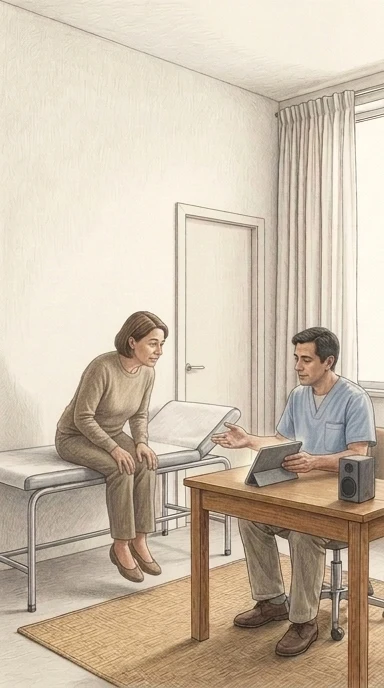
Here is how we read it. When a machine writes down what was said in a room, the spoken exchange becomes a fixed text — partial, selective, smoothed. The written version then travels and gets acted on as if it were the thing itself. If that is how this goes, we would expect that in a clinic using a scribe, your own account of what you said and meant may not survive into the record, and you may have no practical way to see or correct the draft before it becomes the official note. Refusal may exist on paper while the alternative is nobody's assigned job. How would you know we are wrong? If patients are routinely shown the draft, if their corrections are recorded, and if saying no is met with a real, staffed alternative rather than a promise. None of that is impossible. It is simply not what these documents describe.
And there is a second reading. Work that looks automated usually still rests on people doing the hard part out of sight, and the appearance of automation depends on that work not being counted. The clinician checking the note is doing labour the guidance names but does not resource. Where review time is not protected, the checking gets rushed, and the errors that slip through land on the clinician rather than on the workflow that made careful checking impossible. What would show we are wrong? Clinics that schedule protected review time, track how often drafts get corrected, and treat repeated note errors as a workflow problem rather than an individual lapse. If you are a patient, the useful question is not whether the machine is good. It is whether the person checking it had the time to do it properly. If you work in a clinic, the useful question is whether anyone has been given that time — and who is answerable when a draft is wrong.
What this study cannot tell you is important. It did not test any product in any clinic. It cannot say whether documentation accuracy improves, whether clinicians burn out less, or whether any organisation follows the guidance it is reading. The documents differ in legal force: a patient leaflet, a privacy commissioner's checklist and a medical council statement are not the same kind of obligation, and similar wording does not mean the same thing is enforceable where you live. The search was targeted rather than exhaustive, restricted to English-language documents available as readable PDFs; one French official document was excluded. Coding was done by one person, with no second coder to check the judgements, and 344 of 714 initial positive assignments were removed on re-audit. For 39 documents added later, the record cannot separate targeted searching from following citations. The corpus closed on 10 May 2026. It is a picture of what official documents say, not a census of global guidance and not legal advice for any one country.
So what does this make possible for you? A question you can carry into your next appointment, wherever you are: who writes the note about this visit, was a machine involved in drafting it, and can I see it or correct it before it is saved? And if you are told you may refuse, a second question follows: what happens instead, and whose job is that? You will not get a legal answer from the front desk. But you will learn something the documents themselves do not settle — whether the draft is treated as a draft in the room where you are sitting.
Where each piece of context comes from, and how much of it we read
- Atiku, S. O. (2026). Regulating the drafting fiction: A qualitative content analysis of official guidance and regulator documents on AI scribe adoption and use in healthcare. PLOS Digital Health. https://doi.org/10.1371/journal.pdig.0001776 - the article this story is about — the whole article — the passage: "AI scribes use automatic speech recognition and large language models to listen to consultations, produce transcripts and generate structured summaries that can be written into the electronic health record."
- Atiku, S. O. (2026). Regulating the drafting fiction: A qualitative content analysis of official guidance and regulator documents on AI scribe adoption and use in healthcare. PLOS Digital Health. https://doi.org/10.1371/journal.pdig.0001776 - the article this story is about — the whole article — the passage: "Vendors have multiplied, although their products differ in input handling, output behaviour, retention defaults and integration with downstream systems."
- Atiku, S. O. (2026). Regulating the drafting fiction: A qualitative content analysis of official guidance and regulator documents on AI scribe adoption and use in healthcare. PLOS Digital Health. https://doi.org/10.1371/journal.pdig.0001776 - the article this story is about — the whole article — the passage: "We developed the analytic concept of a “drafting fiction” to describe a recurrent cross-document pattern in which artificial intelligence-generated clinical text remains provisional until clinician review and authentication."
- Atiku, S. O. (2026). Regulating the drafting fiction: A qualitative content analysis of official guidance and regulator documents on AI scribe adoption and use in healthcare. PLOS Digital Health. https://doi.org/10.1371/journal.pdig.0001776 - the article this story is about — the whole article — the passage: "Patient leaflets frame the draft as reassurance. Royal Devon tells patients that clinicians will “always review the notes” to keep the medical record accurate [ 17 , p. 2], while North East London states that the artificial intelligence scribe “does not add anything directly” to the medical record [ 16 , p. 1]."
- Atiku, S. O. (2026). Regulating the drafting fiction: A qualitative content analysis of official guidance and regulator documents on AI scribe adoption and use in healthcare. PLOS Digital Health. https://doi.org/10.1371/journal.pdig.0001776 - the article this story is about — the whole article — the passage: "Ontario's scribe-specific privacy guidance translates the same idea into a record-control rule, requiring artificial intelligence-generated personal health information to be “reviewed for accuracy” before entry into an EMR or EHR [ 12 , p. 24]."
- Atiku, S. O. (2026). Regulating the drafting fiction: A qualitative content analysis of official guidance and regulator documents on AI scribe adoption and use in healthcare. PLOS Digital Health. https://doi.org/10.1371/journal.pdig.0001776 - the article this story is about — the whole article — the passage: "Manitoba adds traceability, directing that artificial intelligence-generated notes should be labelled with words such as “Generated by” the named scribe system [ 10 , p. 3]."
- Atiku, S. O. (2026). Regulating the drafting fiction: A qualitative content analysis of official guidance and regulator documents on AI scribe adoption and use in healthcare. PLOS Digital Health. https://doi.org/10.1371/journal.pdig.0001776 - the article this story is about — the whole article — the passage: "Across guidelines, transparency is common, consent is uneven, verification is treated as the central safeguard in direct AI-scribe guidance, privacy governance extends from secure storage to voice identifiability, and medical device classification shifts when transcription becomes summarisation."
- Atiku, S. O. (2026). Regulating the drafting fiction: A qualitative content analysis of official guidance and regulator documents on AI scribe adoption and use in healthcare. PLOS Digital Health. https://doi.org/10.1371/journal.pdig.0001776 - the article this story is about — the whole article — the passage: "The Australian Commission gives the clearest clinical examples, warning that ambient artificial intelligence scribes can “fabricate diagnosis,” omit or add treatment steps, and confuse words such as “medication” and “mediation” [ 3 , p. 3]."
- Atiku, S. O. (2026). Regulating the drafting fiction: A qualitative content analysis of official guidance and regulator documents on AI scribe adoption and use in healthcare. PLOS Digital Health. https://doi.org/10.1371/journal.pdig.0001776 - the article this story is about — the whole article — the passage: "Hywel Dda narrows the risk to a subtle but dangerous documentation error, warning of reversals such as “does” and “does not” [ 15 , p. 2]."
- Atiku, S. O. (2026). Regulating the drafting fiction: A qualitative content analysis of official guidance and regulator documents on AI scribe adoption and use in healthcare. PLOS Digital Health. https://doi.org/10.1371/journal.pdig.0001776 - the article this story is about — the whole article — the passage: "NHS England adds the behavioural risk of “overreliance or automation bias” [ 1 , p. 7], while Manitoba's adjacent professional guidance similarly warns about complacency [ 29 , p. 5]."
- Atiku, S. O. (2026). Regulating the drafting fiction: A qualitative content analysis of official guidance and regulator documents on AI scribe adoption and use in healthcare. PLOS Digital Health. https://doi.org/10.1371/journal.pdig.0001776 - the article this story is about — the whole article — the passage: "The South West Healthcare CoDE report found that “errors in summaries” occurred across all tested ambient voice technology software packages and concluded that artificial intelligence-generated consultation summaries “must always be checked” before saving to the patient record [ 18 , p. 4]."
- Atiku, S. O. (2026). Regulating the drafting fiction: A qualitative content analysis of official guidance and regulator documents on AI scribe adoption and use in healthcare. PLOS Digital Health. https://doi.org/10.1371/journal.pdig.0001776 - the article this story is about — the whole article — the passage: "Saskatchewan's scribe-specific checklist requires a protocol for “obtaining and documenting express written consent” before using an artificial intelligence scribe and asks whether staff are available for manual notes if consent is withheld [ 14 , pp. 2–3]."
- Atiku, S. O. (2026). Regulating the drafting fiction: A qualitative content analysis of official guidance and regulator documents on AI scribe adoption and use in healthcare. PLOS Digital Health. https://doi.org/10.1371/journal.pdig.0001776 - the article this story is about — the whole article — the passage: "Health PEI gives a patient-facing script, “you can say no,” and adds that refusal will not affect care [ 11 , p. 1]."
- Atiku, S. O. (2026). Regulating the drafting fiction: A qualitative content analysis of official guidance and regulator documents on AI scribe adoption and use in healthcare. PLOS Digital Health. https://doi.org/10.1371/journal.pdig.0001776 - the article this story is about — the whole article — the passage: "Ontario requires patients who withhold or withdraw consent to receive the “same or similar level of care” [ 12 , p. 25], while the Australian Commission asks organisations to manage non-consent consistently across clinicians [ 3 , p. 2]."
- Atiku, S. O. (2026). Regulating the drafting fiction: A qualitative content analysis of official guidance and regulator documents on AI scribe adoption and use in healthcare. PLOS Digital Health. https://doi.org/10.1371/journal.pdig.0001776 - the article this story is about — the whole article — the passage: "Ontario states that it may be “virtually impossible to de-identify” voice recordings because voiceprint and speaker-recognition technologies can infer identity and personal characteristics [ 12 , p. 26]."
- Atiku, S. O. (2026). Regulating the drafting fiction: A qualitative content analysis of official guidance and regulator documents on AI scribe adoption and use in healthcare. PLOS Digital Health. https://doi.org/10.1371/journal.pdig.0001776 - the article this story is about — the whole article — the passage: "Future guidance should define reasonable verification standards, allocate protected review time, resource consent refusal pathways and require monitoring of performance across accents, language and speech differences."
Atiku, S. O. (2026). Regulating the drafting fiction: A qualitative content analysis of official guidance and regulator documents on AI scribe adoption and use in healthcare. PLOS Digital Health. https://doi.org/10.1371/journal.pdig.0001776
Who paid: The author received no specific funding for this work, and the article declares no competing interests; no equipment, software or other support is reported.
Do not take this as professional medical advice.