other · Quantitative imaging in medicine and surgery · la publicación, 10 ago 2026 · gratis
Un sistema de IA leyó mamografías en Moscú y acertó más con el tiempo
El estudio midió lo que hacía el programa, no si las mujeres vivieron más; se hizo en una sola institución y con una muestra inicial de 100 mamografías.
Versión breve · la versión detallada sigue, unos 6 min
Pregunte al chat de weeklyAI
Pregúnteme por este estudio: a quiénes se estudió, qué encontró y qué no dice.
Las conversaciones se guardan mientras exista weeklyAI, para mejorar la publicación. Se responde en el idioma en que usted escribe.
- El estudio, de un vistazo
- Quiénes
- mamografías de mujeres
- Cuántos
- 404,502 mamografías
- Dónde
- Moscú
- Cuándo
- junio de 2023
- Tipo de estudio
- análisis de lo que hizo un programa de inteligencia artificial
- Quién lo hizo
- centros de investigación de Moscú y la empresa que creó el programa
- El límite que importa
- La prueba de calibración fue de solo 100 mamografías y no hubo validación externa.
Estos números son de las lecturas del programa de inteligencia artificial en Moscú, medidos antes y después de dos años y cinco meses de pruebas y vigilancia; no indican si las mujeres vivieron más.
Lo que decía la inteligencia artificial frente a lo que decían los radiólogos
el desacuerdo grave promedió 0.08%
Cuando oiga que la inteligencia artificial lee mamografías en su ciudad, pregunte si la probaron y la vigilaron así, durante años, y si publicaron los resultados.
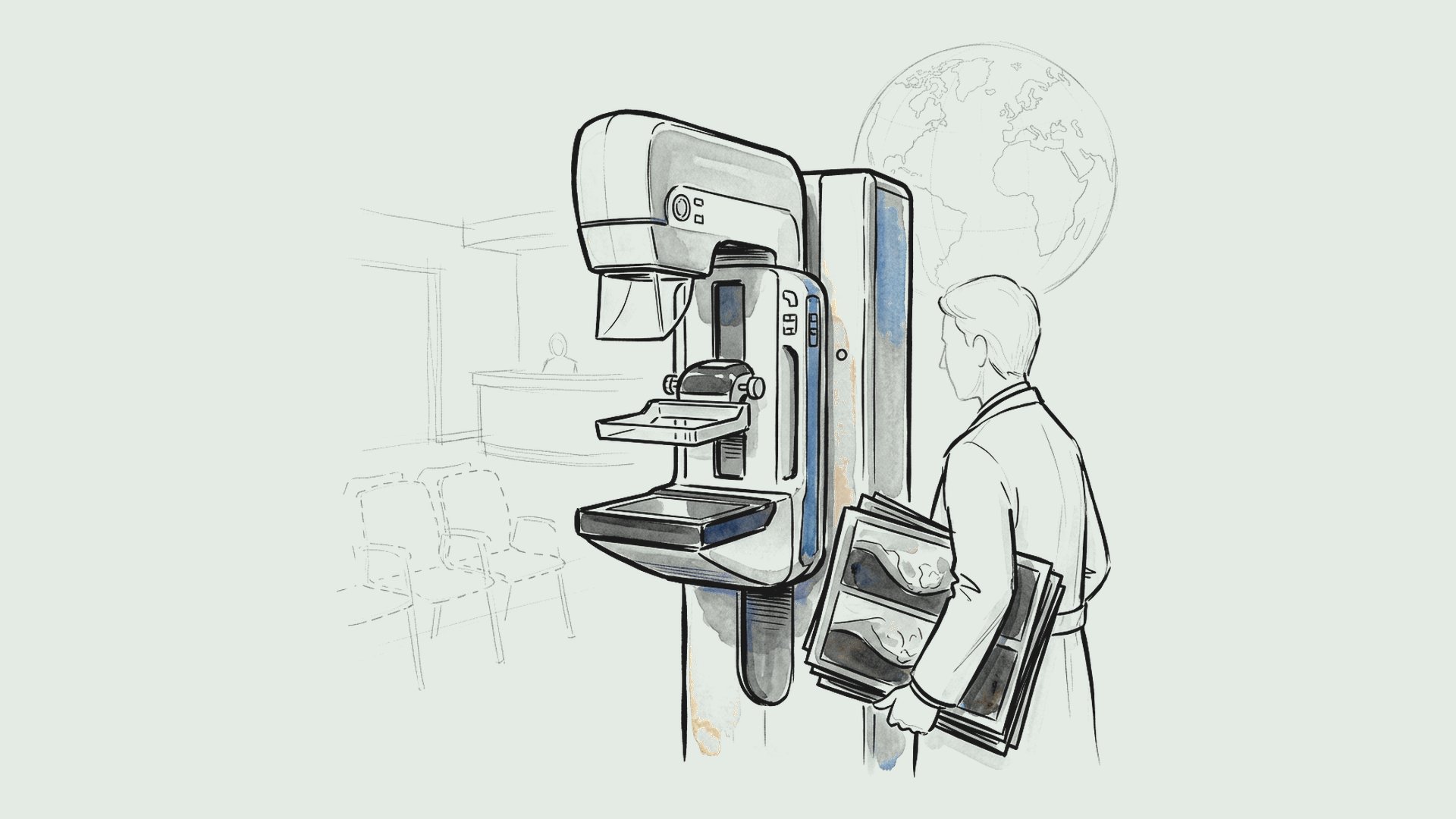
En Moscú, varios centros de investigación y la empresa que creó el programa se propusieron probar una inteligencia artificial que lee mamografías, las radiografías de seno. No lo probó una vez. Lo probó y lo siguió vigilando mientras ya se usaba dentro del seguro médico público.
Primero revisó cuatro mamografías y encontró una que el programa no leyó completa. Los desarrolladores lo corrigieron.
Después vinieron las pruebas de calibración, con 100 mamografías de mujeres con una edad promedio de 63 años. Las dos primeras no alcanzaron el mínimo que el estudio se había fijado. La tercera sí.
Luego siguieron dos años y un mes de vigilancia en marcha, sobre 429,027 mamografías. En ese tiempo el programa cambió seis veces. La exactitud de sus lecturas subió de 0.77 a 0.90. Su capacidad de descartar lo que no era cáncer pasó de 0.70 a 0.91. Las fallas técnicas, lecturas que se cortaban o no terminaban, bajaron de 3.0% a 0.8%.
En junio de 2023 el sistema entró al programa de seguro médico obligatorio de Moscú. Allí se compararon 547,909 mamografías. La desacuerdo grave entre lo que decía la inteligencia artificial y lo que decían los radiólogos promedió 0.08%.
El estudio tiene un límite que pesa. La muestra de calibración fue de sólo 100 mamografías, así que las cifras no garantizan lo que pasará en una clínica cualquiera. Todo salió de una sola institución en Moscú, y el estudio no muestra que estos resultados se repitan en otros sistemas de salud ni en otras regiones.
Tampoco dice que las mujeres hayan vivido más. Midió qué tan bien leía el programa, no los resultados de las pacientes. Tampoco midió los costos ni cómo cambia el trabajo diario en el hospital.
Cuando oiga que la inteligencia artificial lee mamografías en su ciudad, pregunte si la probaron y la vigilaron así, durante años, y si publicaron los resultados. Esa es la diferencia entre un anuncio y un registro.
Qué significa para usted
Cuando oiga que una inteligencia artificial lee mamografías en su ciudad, pregunte si la probaron y la vigilaron durante años, y si publicaron esos resultados. En Moscú esa vigilancia acompañó al sistema dentro del seguro público y las lecturas mejoraron, pero fue un solo lugar y la prueba inicial reunió apenas 100 mamografías. El estudio no muestra que las mujeres vivieran más, así que conviene esperar datos de su propio país antes de sacar conclusiones.
Vasilev, Y., Rumyantsev, D., Vladzymyrskyy, A. et al. (2026). Implementation of an artificial intelligence-based system for mammography in the compulsory medical insurance program: results of a 3-year study. Quantitative Imaging in Medicine and Surgery. https://doi.org/10.21037/qims-2026-0864
Quién pagó: El trabajo fue financiado por el Departamento de Salud de Moscú como parte de un esfuerzo de investigación y desarrollo sobre IA multimodal; cuatro autores son empleados de Third Opinion Platform, la desarrolladora del sistema de IA evaluado, y aportaron información sobre el sistema pero no participaron en la realización del estudio, el análisis de datos ni la interpretación de los resultados.
No tome esto como consejo médico profesional.
Versión detalladaLos pasajes copiados del artículo, las ilustraciones y cada fuente con cuánto leímos de ella · 1102 palabras · unos 6 minLeerla →Cerrar
La IA leyó casi medio millón de mamografías en Moscú. La precisión del sistema mejoró con el tiempo.
Un estudio de tres años describe cómo un programa público de seguros incorporó un sistema de IA para leer mamografías — y qué no alcanzó a demostrar.
El cáncer de mama es el tumor más frecuente entre las mujeres y la principal causa de muerte por cáncer en esa población, según el estudio que hoy comentamos1. Por eso muchos países tienen programas de mamografía: la idea es encontrar la enfermedad temprano y tratarla a tiempo1. El problema es que revisar cada mamografía exige mucho trabajo. En muchos lugares se leen dos veces, por dos radiólogos distintos, y faltan especialistas mientras el volumen de imágenes no deja de crecer2.
Lo que se probó en Moscú fue un programa de computadora llamado Third Opinion Mammograms®. Funciona con redes neuronales — el tipo de inteligencia artificial que aprende de ejemplos — y hace dos cosas a la vez: señala dónde hay algo sospechoso en la imagen y clasifica qué tipo de hallazgo es3. Se entrenó con unas 4,000 mamografías4. El estudio duró dos años y cinco meses, reunió 404,502 mamografías de 206 organizaciones médicas y contó con 336 radiólogos5.
Los resultados, según lo que el propio estudio reporta: la capacidad del sistema para distinguir un caso de otro (el área bajo la curva) subió de 0,83 a 0,92; la precisión general, de 0,77 a 0,90; la sensibilidad — cuántos casos reales detecta — de 0,84 a 0,88; y la especificidad — cuántos casos sanos no marca por error — de 0,70 a 0,916. La tasa de fallas técnicas bajó de 3.0% a 0.8%, y la puntuación clínica que le dieron los radiólogos subió de 54.38% a 80.36%7. En junio de 2023, el sistema se incorporó al programa público de seguro médico de Moscú8.
Conviene entender qué significa eso en la práctica. El sistema no reemplazó al radiólogo: analizaba las imágenes y el diagnóstico final lo hacía siempre una persona3. En un programa de mamografías, una lectura adicional puede significar la diferencia entre una derivación a tiempo y una espera. Los autores también señalan que el desacuerdo entre dos radiólogos humanos fue notable: coincidieron solo en 49.9% de los casos9.
Este tipo de tecnología no es nueva. Una revisión que abarcó diez años de investigación — que solo pudimos leer en su resumen, porque el texto completo está detrás de una suscripción — encontró que la IA para mamografías pasó de ser una prueba de concepto a evaluarse en ensayos aleatorizados10. Esa revisión agrupó 14 estudios con más de 1,2 millones de exámenes y encontró un rendimiento promedio alto, pero tan disperso entre estudios que no se puede trasladar a un programa nuevo sin validarlo localmente11. Otra investigación sobre un dispositivo distinto que se probó en 107 hospitales reportó alta consistencia con las evaluaciones clínicas12.
Lo que distingue al estudio de Moscú es el método: no fue una prueba única, sino un ciclo de exámenes repetidos, actualizaciones del programa y monitoreo continuo7. El sistema se actualizó seis veces durante el período de monitoreo. Esa forma de trabajar — probar, corregir, volver a probar — es la que los autores presentan como su aporte principal.
Hay límites que el propio estudio reconoce y que conviene tener presentes. La prueba de calibración — la que produce los números de precisión más citados — se hizo con solo 100 mamografías13. Los resultados provienen de una sola institución en Moscú y no se validaron con datos de otras regiones o países13. El estudio reconoce que el número limitado de radiólogos expertos impidió evaluar bien las diferencias entre observadores y pudo introducir sesgos. Y el estudio no midió si las mujeres vivieron más o mejor: no evaluó resultados en pacientes, ni flujos de trabajo, ni costos14.
Así lo leemos nosotros. Cuando una herramienta automática participa en una decisión médica, la pregunta que casi nunca se responde es quién responde cuando se equivoca. En un programa público, los errores técnicos y las discrepancias clínicas tienden a golpear más a quienes se atienden en centros con equipos viejos o con poco personal. Este estudio no presenta sus tasas de error separadas por tipo de centro ni por región, así que no podemos saber si el promedio favorable se reparte por igual. Usted puede preguntar en su centro de salud quién revisa el resultado de la IA, quién responde si hay un error y si existen registros públicos de fallas por centro.
Esa evidencia va en dirección contraria a la idea de que las pruebas repetidas producen por sí solas un sistema muy preciso. No invalida lo que ocurrió en Moscú; señala que el mismo tipo de herramienta puede comportarse muy distinto según dónde y con qué datos se use.
Y hay otro punto que el estudio deja abierto: la aprobación regulatoria y la entrada al seguro público pueden hacer que muchos asuman que el sistema ya está probado del todo. El propio estudio dice que no. Su muestra de calibración fue pequeña y no hubo validación externa. Si en su país se anuncia un programa así, vale preguntar si el sistema fue probado con imágenes de mujeres parecidas a usted y si esos resultados son públicos. También puede pedir que le expliquen su resultado en palabras claras, sin depender solo del informe automático, y pedir una segunda lectura humana cuando algo no le cuadre.
¿Qué haría falta para que esto llegue más lejos? Los autores planean ampliar la muestra de calibración y llevar el enfoque a escala nacional dentro del mismo sistema de seguro15. Otros trabajos que leímos, sobre costos en Australia — que solo pudimos leer en su resumen, porque el artículo completo está detrás de una suscripción —, concluyen que hace falta evaluar el flujo real de trabajo con IA y los resultados a largo plazo para las pacientes antes de determinar el valor de estos programas16.
Para una familia en América Latina, Estados Unidos o Canadá, lo importante es lo siguiente: este estudio muestra que un sistema de IA puede mejorar con el tiempo cuando alguien lo prueba, lo corrige y lo vigila. No muestra que eso vaya a ocurrir en su clínica. Lo que usted puede hacer es concreto: cuando le toque una mamografía, pregunte si la imagen la lee una persona, si hay apoyo de IA y quién firma el resultado final. Pregunte también si el sistema que usan fue evaluado con mujeres de su edad y su contexto, y si esos resultados se publican. La tecnología puede ser una aliada; la pregunta es quién la vigila donde usted vive.
De dónde sale cada dato de contexto, y cuánto leímos de cada documento
- Vasilev, Y., Rumyantsev, D., Vladzymyrskyy, A. et al. (2026). Implementation of an artificial intelligence-based system for mammography in the compulsory medical insurance program: results of a 3-year study. Quantitative Imaging in Medicine and Surgery. https://doi.org/10.21037/qims-2026-0864 - el artículo del que trata esta nota — el artículo completo — el pasaje: "Breast cancer is the most prevalent malignancy among women and the leading cause of cancer-related mortality in this population ( 2 ). Consequently, numerous countries implement mammography screening programs, facilitating early detection and timely intervention to reduce mortality ( 3 )."
- Vasilev, Y., Rumyantsev, D., Vladzymyrskyy, A. et al. (2026). Implementation of an artificial intelligence-based system for mammography in the compulsory medical insurance program: results of a 3-year study. Quantitative Imaging in Medicine and Surgery. https://doi.org/10.21037/qims-2026-0864 - el artículo del que trata esta nota — el artículo completo — el pasaje: "However, screening entails substantial resource demands, including double-reading by radiologists ( 4 ). Unfortunately, radiologists remain scarce facing widespread overwork and burnout as mammography volumes steadily increase ( 5 , 6 )."
- Vasilev, Y., Rumyantsev, D., Vladzymyrskyy, A. et al. (2026). Implementation of an artificial intelligence-based system for mammography in the compulsory medical insurance program: results of a 3-year study. Quantitative Imaging in Medicine and Surgery. https://doi.org/10.21037/qims-2026-0864 - el artículo del que trata esta nota — el artículo completo — el pasaje: "This solution simultaneously performs computer-aided detection (CADe) to localize target findings and computer-aided diagnosis (CADx) for classifying them. Its clinical task was detecting and classifying breast cancer signs on mammograms, analyzing images only."
- Vasilev, Y., Rumyantsev, D., Vladzymyrskyy, A. et al. (2026). Implementation of an artificial intelligence-based system for mammography in the compulsory medical insurance program: results of a 3-year study. Quantitative Imaging in Medicine and Surgery. https://doi.org/10.21037/qims-2026-0864 - el artículo del que trata esta nota — el artículo completo — el pasaje: "The mammography AI system utilized U-Net++ and Mask2Former architectures, trained on ~4,000 mammograms."
- Vasilev, Y., Rumyantsev, D., Vladzymyrskyy, A. et al. (2026). Implementation of an artificial intelligence-based system for mammography in the compulsory medical insurance program: results of a 3-year study. Quantitative Imaging in Medicine and Surgery. https://doi.org/10.21037/qims-2026-0864 - el artículo del que trata esta nota — el artículo completo — el pasaje: "The test dataset comprised 404,502 mammograms from 206 medical organizations and three mammography equipment manufacturers. A total of 336 radiologists participated. The testing and monitoring period lasted 2 years and 5 months."
- Vasilev, Y., Rumyantsev, D., Vladzymyrskyy, A. et al. (2026). Implementation of an artificial intelligence-based system for mammography in the compulsory medical insurance program: results of a 3-year study. Quantitative Imaging in Medicine and Surgery. https://doi.org/10.21037/qims-2026-0864 - el artículo del que trata esta nota — el artículo completo — el pasaje: "Over this time, AUC increased by 10.8% (from 0.83 to 0.92), accuracy by 16.9% (from 0.77 to 0.90), sensitivity by 4.8% (from 0.84 to 0.88), and specificity by 30.0% (from 0.70 to 0.91)."
- Vasilev, Y., Rumyantsev, D., Vladzymyrskyy, A. et al. (2026). Implementation of an artificial intelligence-based system for mammography in the compulsory medical insurance program: results of a 3-year study. Quantitative Imaging in Medicine and Surgery. https://doi.org/10.21037/qims-2026-0864 - el artículo del que trata esta nota — el artículo completo — el pasaje: "The average technical defect rate decreased by 26.7% (from 3.0% to 0.8%), and the clinical assessment score rose by 47.8% (from 54.38% to 80.36%). The study culminated in the integration of the AI system into the regional CMI program."
- Vasilev, Y., Rumyantsev, D., Vladzymyrskyy, A. et al. (2026). Implementation of an artificial intelligence-based system for mammography in the compulsory medical insurance program: results of a 3-year study. Quantitative Imaging in Medicine and Surgery. https://doi.org/10.21037/qims-2026-0864 - el artículo del que trata esta nota — el artículo completo — el pasaje: "In June 2023 (6 months post-testing initiation), AI mammography analysis was first integrated into Moscow’s territorial CMI program. CMI monitoring lasted 9 months. Mean critical BI-RADS discrepancies between AI and radiologists was 0.08% ( Figure 5A )."
- Vasilev, Y., Rumyantsev, D., Vladzymyrskyy, A. et al. (2026). Implementation of an artificial intelligence-based system for mammography in the compulsory medical insurance program: results of a 3-year study. Quantitative Imaging in Medicine and Surgery. https://doi.org/10.21037/qims-2026-0864 - el artículo del que trata esta nota — el artículo completo — el pasaje: "Notably, inter-reader agreement between the expert and end-user radiologists reached only 49.9%, which aligns with established levels of reader variability and highlights the critical need for clinical decision support systems."
- Ciurescu S, Buciu V, Ilaș DG, Pârvănescu R, Șerban D. (2026). Ten Years of Artificial Intelligence in Screening Mammography: A Systematic Review and Meta-Analysis of Diagnostic Accuracy and Clinical Implementation (Literature Published 2015–2025). Diagnostics. 10.3390/diagnostics16183045 — solo el resumen - no se pudo obtener el texto completo — el pasaje: "Deep-learning artificial intelligence (AI) for mammographic screening moved from proof of concept to randomised evaluation in a single decade. We reviewed and meta-analysed its diagnostic accuracy and its effect on screening programmes, covering the literature published between 2015 and 2025."
- Ciurescu S, Buciu V, Ilaș DG, Pârvănescu R, Șerban D. (2026). Ten Years of Artificial Intelligence in Screening Mammography: A Systematic Review and Meta-Analysis of Diagnostic Accuracy and Clinical Implementation (Literature Published 2015–2025). Diagnostics. 10.3390/diagnostics16183045 — solo el resumen - no se pudo obtener el texto completo — el pasaje: "Pooled accuracy is high on average but so dispersed that it cannot be transferred to a new programme; local validation before deployment remains necessary."
- Zhou J, Si P, Zhang Y, Song J, He T, Liu Q, et al. (2026). A non-invasive end-to-end intelligent assistance system for breast ultrasound. Nature Communications. 10.1038/s41467-026-73170-5 — solo el resumen - no se pudo obtener el texto completo — el pasaje: "BIRD is applied in breast cancer screening for 6,817 individuals and shows high consistency (Cohen's kappa: 0.702 (95% confidence interval: 0.628-0.777)) with clinical assessments in real-world application across 107 hospitals."
- Vasilev, Y., Rumyantsev, D., Vladzymyrskyy, A. et al. (2026). Implementation of an artificial intelligence-based system for mammography in the compulsory medical insurance program: results of a 3-year study. Quantitative Imaging in Medicine and Surgery. https://doi.org/10.21037/qims-2026-0864 - el artículo del que trata esta nota — el artículo completo — el pasaje: "A key limitation of this study is the relatively small retrospective calibration testing dataset (100 mammograms) and the lack of external validation on independent datasets from other regions or countries."
- Vasilev, Y., Rumyantsev, D., Vladzymyrskyy, A. et al. (2026). Implementation of an artificial intelligence-based system for mammography in the compulsory medical insurance program: results of a 3-year study. Quantitative Imaging in Medicine and Surgery. https://doi.org/10.21037/qims-2026-0864 - el artículo del que trata esta nota — el artículo completo — el pasaje: "Finally, the study lacked a formal assessment of the AI system’s impact on patient-centered clinical outcomes, organizational workflows, or economic efficiency."
- Vasilev, Y., Rumyantsev, D., Vladzymyrskyy, A. et al. (2026). Implementation of an artificial intelligence-based system for mammography in the compulsory medical insurance program: results of a 3-year study. Quantitative Imaging in Medicine and Surgery. https://doi.org/10.21037/qims-2026-0864 - el artículo del que trata esta nota — el artículo completo — el pasaje: "Future work will focus on expanding the retrospective calibration testing dataset and scaling the approach to a national level within the CMI framework."
- Scarfe J, Marinovich ML, Houssami N, Pearce A. (2026). Artificial intelligence in population breast cancer screening: A two-year cost-effectiveness analysis. Social Science & Medicine. 10.1016/j.socscimed.2026.119704 — solo el resumen - el texto completo está tras una suscripción — el pasaje: "Prospective evaluation incorporating real-world AI-assisted screening workflow and longer-term patient outcomes will be critical to determining the value of AI in population breast screening programs."
Vasilev, Y., Rumyantsev, D., Vladzymyrskyy, A. et al. (2026). Implementation of an artificial intelligence-based system for mammography in the compulsory medical insurance program: results of a 3-year study. Quantitative Imaging in Medicine and Surgery. https://doi.org/10.21037/qims-2026-0864
Quién pagó: El trabajo fue financiado por el Departamento de Salud de Moscú como parte de un esfuerzo de investigación y desarrollo sobre IA multimodal; cuatro autores son empleados de Third Opinion Platform, la desarrolladora del sistema de IA evaluado, y aportaron información sobre el sistema pero no participaron en la realización del estudio, el análisis de datos ni la interpretación de los resultados.
No tome esto como consejo médico profesional.
other · Quantitative imaging in medicine and surgery · the paper, 10 Aug 2026 · free
A Moscow Clinic Ran an AI Mammogram Reader for Two and a Half Years. Its Accuracy Rose. That Is the Software, Not Your Clinic.
The test sample was 100 mammograms from one institution, and nobody measured whether women did better.
Short version · the longer version follows, about 7 min
Ask the weeklyAI chat
Ask me about this study: who was studied, what it found, and what it does not say.
Conversations are saved for as long as weeklyAI exists, to improve the publication. Answers come in the language you write in.
- The study at a glance
- Who
- women aged 18 and over who had mammograms
- How many
- 404,502 mammograms
- Where
- Moscow, Russia
- When
- testing and monitoring lasted 2 years and 5 months; AI entered the insurance program in June 2023
- Kind of study
- analysis of what people did
- Who did it
- Research and Practical Clinical Center for Diagnostics and Telemedicine Technologies of the Moscow Department of Health
- The limit that matters
- Only 100 mammograms were used to check accuracy, all from one Moscow institution.
These are the software's reading scores at the start and end of the whole testing and monitoring period; the accuracy check used only 100 mammograms from one Moscow institution, so treat the numbers as promising, not as a promise for any single clinic.
When you next hear that AI reads mammograms where you live, one thing is worth looking for: whether it was tested before use and watched over time, with the results published.
A research center in Moscow set out to test software that reads breast X-rays, and to keep testing it while it was in use in the public insurance system. The center is the Research and Practical Clinical Center for Diagnostics and Telemedicine Technologies of the Moscow Department of Health.
They first checked the basics on four mammograms. One was read incompletely. The developers fixed it.
Then came the calibration tests, on 100 mammograms, half with confirmed cancer and half without. The first two failed the researchers' own bar of 0.80 for accuracy. The third passed. That is a small sample, and the researchers say so.
Then came two years and one month of watching the software work on real exams, 429,027 mammograms, with no exclusions. Six updates arrived from the developers along the way. Over the whole testing and monitoring period, which lasted two years and five months, accuracy rose from 0.77 to 0.90, and the share of exams the software failed to process properly fell from 3.0 percent to 0.8 percent.
In June 2023 the system entered Moscow's compulsory medical insurance program. Across 547,909 mammograms, the software and the radiologists who used it disagreed in a way that mattered in about 8 exams out of every 10,000.
Here is what the numbers do not say. The calibration sample was 100 mammograms, so treat the accuracy figures as promising, not as a promise for any single clinic. All the data came from one institution in Moscow, so a clinic in Latin America, the United States or Canada may see different results. And no one measured whether women actually did better: the study tracked the software's readings, not lives saved, and not cost.
In every stage, radiologists made the final call. The software's output was labeled for research use only.
When you next hear that AI reads mammograms where you live, one thing is worth looking for: whether it was tested before use and watched over time, with the results published. That is the difference between a claim and a record.
What this means for you
Nadie midió si una mujer vivió más años ni si el examen salió más barato, así que de su clínica todavía no puede afirmarse nada. Cuando escuche que la inteligencia artificial lee mamografías cerca de usted, pregunte quién probó ese programa antes de usarlo, quién lo vigila mes a mes y dónde se publicaron esos resultados. Si no hay respuestas, no hay nada que decidir hoy; solo algo que observar.
Vasilev, Y., Rumyantsev, D., Vladzymyrskyy, A. et al. (2026). Implementation of an artificial intelligence-based system for mammography in the compulsory medical insurance program: results of a 3-year study. Quantitative Imaging in Medicine and Surgery. https://doi.org/10.21037/qims-2026-0864
Who paid: The work was funded by the Moscow Health Care Department as part of a research and development effort on multimodal AI; four authors are employees of Third Opinion Platform, the developer of the AI system evaluated, and they provided information about the system but were not involved in conducting the study, data analysis or interpretation of results.
Do not take this as professional medical advice.
The longer versionThe passages copied from the paper, the pictures, and every source with how much of it we read · 1389 words · about 7 minRead it →Close
AI Read Mammograms Better Over Three Years in Moscow. Then It Entered the Insurance System.
In a public screening program, a mammography tool's readings improved with each round of testing — and radiologists still disagreed with it, and each other, more than the headline numbers suggest.
Breast cancer is the most common cancer in women and the leading cause of cancer death among them1. Many countries run mammography screening programs to catch it early and reduce deaths1. Those programs are heavy work: each mammogram is normally read twice by radiologists, and radiologists are scarce and increasingly burned out as volumes rise2. Human factors contribute to errors — cancers diagnosed late, or biopsies done on women who turn out to have no malignancy3.
The system studied here is called Third Opinion Mammograms. It is a convolutional neural network that does two jobs at once: it points to where suspicious findings are on the image, and it classifies what it found4. It looks at images only4. It was built on U-Net++ and Mask2Former architectures and trained on about 4,000 mammograms5.
The study ran in Moscow, at a single institution that gathered mammograms referred from 238 medical organizations, and the authors say the single-center design is a critical limitation. The test and monitoring dataset covered 404,502 mammograms from 206 medical organizations and three equipment manufacturers; 336 radiologists took part; the testing and monitoring period lasted 2 years and 5 months6. Over that time, the measured accuracy figures rose: the area under the curve from 0.83 to 0.92, accuracy from 0.77 to 0.90, sensitivity from 0.84 to 0.88, and specificity from 0.70 to 0.917. The average technical defect rate fell from 3.0% to 0.8%, and the clinical assessment score rose from 54.38% to 80.36%8. The result was that the AI system was integrated into the regional compulsory medical insurance program8.
In June 2023 — six months after testing began — AI mammography analysis was first integrated into Moscow's territorial compulsory medical insurance program. Monitoring inside that program lasted 9 months, and the mean rate of critical disagreements between the AI and radiologists over BI-RADS categories was 0.08%9.
One finding deserves its own sentence: agreement between the expert radiologist and the end-user radiologists reached only 49.9%10. The authors note this matches established levels of reader variability and argue it highlights the need for decision support10. The study also reports that applying the AI algorithm allowed a 66.4% reduction in the duration of double reading11. That last figure comes from earlier work by the same group, cited inside this paper, not from the monitoring described here11.
The study has limits the authors state plainly. The calibration testing dataset was only 100 mammograms, and there was no external validation on independent datasets from other regions or countries12. The whole study came from one institution12. A limited pool of expert radiologists meant interobserver variability could not be robustly assessed, introducing potential observer bias. The design cannot separate the effect of specific model updates from concurrent changes in data distribution and workflow. And the study did not formally assess the AI's impact on patient-centered clinical outcomes, organizational workflows, or economic efficiency13.
This study belongs to a family of work asking whether AI can read mammograms as well as people. A review and meta-analysis of the literature from 2015 to 2025 pooled 14 studies and 1,214,885 examinations and found a standalone area under the curve of 0.89014 — we could read only the summary, the full paper was not available to us. In that analysis, a bivariate model gave a summary sensitivity of 73.3% at a specificity of 92.4%15. Across randomized and paired prospective trials, the pooled detection rate ratio was 1.13, with the MASAI randomized trial alone reporting 1.29 and a 44% reduction in screen reading16. Non-randomized implementation studies pooled to 1.2217. Recall changed little overall18. The reviewers rated certainty very low for accuracy outcomes and moderate for the single randomized trial19, and concluded that pooled accuracy is so dispersed it cannot be transferred to a new program — local validation before deployment remains necessary20. They also noted that the larger and more precise detection gains come from non-randomized designs, the pattern confounding would produce21, and that a decade of evidence supports AI as a second reader and triage tool, not as an autonomous replacement for the radiologist22.
Other approaches are being tested. One group developed an end-to-end breast recognition device for women across diverse institution and population datasets23; its accuracy on the internal test set was 0.837 and it significantly improved radiologists' accuracy in two reader studies24. Applied in screening for 6,817 individuals across 107 hospitals, it showed high consistency with clinical assessments25. Its developers acknowledge that AI still faces generalization challenges and that its clinical potential remains underutilized in complex real-world scenarios26 — again, we could read only the summary.
Cost matters too. A study investigated the cost-effectiveness of integrating AI into breast cancer screening in Australia27, comparing standard double reading with three AI-human strategies28, including one where AI sorts mammograms into low-risk and not-low-risk before human review29 and one where low-risk mammograms get no human reading at all30. In the base case, the strategy that skipped human reading for low-risk mammograms saved an average of $4 per person screened but detected 0.521 fewer cancers per 1,000 people screened31, and sensitivity analyses indicated it is unlikely to be cost-effective32. AI-supported screening that kept humans in the loop was more effective, though more costly, than standard practice33; the full paper is behind a subscription, so we could read only the summary. The authors conclude that prospective evaluation incorporating real-world workflow and longer-term patient outcomes will be critical34.
Here is how we read it. The pattern in this study is a tool that got better as it was tested and updated, inside a system that kept a human in the loop and kept checking. That is not the same as a tool that arrived finished. When a system is trained on a narrow slice of the world, it can latch onto incidental features of that slice and mistake them for the real thing, so its apparent success in testing may not carry over to the messier situations it will meet in use. We would expect a mammography AI trained on a few thousand images from a handful of clinics to look strong early and then stumble when it meets the equipment, image quality and patient mix of a large public screening program. If the accuracy, sensitivity and specificity held steady or improved from the very first real-world months, with no dip when it met new machines, new clinics or new patient groups, then that worry would not apply here.
We also read other work. And when a tool is updated repeatedly, its past results no longer describe what it will do next, and the people who use it can lose track of which version produced which reading and who is answerable when something goes wrong. So what can you do with this? If a clinic near you adopts an AI reading tool, ask how many and whose images it learned from, and whether its accuracy was checked on images from your own region and equipment, not just the developer's test set. Ask whether the tool keeps a record of which version read which image, and whether a radiologist remains the one who signs off on every report. If you work in a clinic using AI reads, ask whether there is a routine way to flag and review cases where the human and the machine disagree, and whether that review is independent of the AI's own output.
What this study makes possible is narrower than it sounds. It shows that in one city, inside one public insurance program, a mammography AI's readings improved over years of testing and monitoring, and that the system was accepted into routine use. It does not show that women lived longer, that the program saved money, or that the same results would appear in a clinic in Latin America, the United States or Canada. The authors themselves say future work will focus on expanding the calibration dataset and scaling the approach nationally35. The next time you or someone you love is handed a mammogram report, the question worth carrying is not whether AI read it — it is who checked the machine, and how.
Where each piece of context comes from, and how much of it we read
- Vasilev, Y., Rumyantsev, D., Vladzymyrskyy, A. et al. (2026). Implementation of an artificial intelligence-based system for mammography in the compulsory medical insurance program: results of a 3-year study. Quantitative Imaging in Medicine and Surgery. https://doi.org/10.21037/qims-2026-0864 - the article this story is about — the whole article — the passage: "Breast cancer is the most prevalent malignancy among women and the leading cause of cancer-related mortality in this population ( 2 ). Consequently, numerous countries implement mammography screening programs, facilitating early detection and timely intervention to reduce mortality ( 3 )."
- Vasilev, Y., Rumyantsev, D., Vladzymyrskyy, A. et al. (2026). Implementation of an artificial intelligence-based system for mammography in the compulsory medical insurance program: results of a 3-year study. Quantitative Imaging in Medicine and Surgery. https://doi.org/10.21037/qims-2026-0864 - the article this story is about — the whole article — the passage: "However, screening entails substantial resource demands, including double-reading by radiologists ( 4 ). Unfortunately, radiologists remain scarce facing widespread overwork and burnout as mammography volumes steadily increase ( 5 , 6 )."
- Vasilev, Y., Rumyantsev, D., Vladzymyrskyy, A. et al. (2026). Implementation of an artificial intelligence-based system for mammography in the compulsory medical insurance program: results of a 3-year study. Quantitative Imaging in Medicine and Surgery. https://doi.org/10.21037/qims-2026-0864 - the article this story is about — the whole article — the passage: "Human factors contribute to diagnostic errors like delayed cancer diagnoses or unnecessary biopsies in malignancy-free women ( 7 , 8 )."
- Vasilev, Y., Rumyantsev, D., Vladzymyrskyy, A. et al. (2026). Implementation of an artificial intelligence-based system for mammography in the compulsory medical insurance program: results of a 3-year study. Quantitative Imaging in Medicine and Surgery. https://doi.org/10.21037/qims-2026-0864 - the article this story is about — the whole article — the passage: "This solution simultaneously performs computer-aided detection (CADe) to localize target findings and computer-aided diagnosis (CADx) for classifying them. Its clinical task was detecting and classifying breast cancer signs on mammograms, analyzing images only."
- Vasilev, Y., Rumyantsev, D., Vladzymyrskyy, A. et al. (2026). Implementation of an artificial intelligence-based system for mammography in the compulsory medical insurance program: results of a 3-year study. Quantitative Imaging in Medicine and Surgery. https://doi.org/10.21037/qims-2026-0864 - the article this story is about — the whole article — the passage: "The mammography AI system utilized U-Net++ and Mask2Former architectures, trained on ~4,000 mammograms."
- Vasilev, Y., Rumyantsev, D., Vladzymyrskyy, A. et al. (2026). Implementation of an artificial intelligence-based system for mammography in the compulsory medical insurance program: results of a 3-year study. Quantitative Imaging in Medicine and Surgery. https://doi.org/10.21037/qims-2026-0864 - the article this story is about — the whole article — the passage: "The test dataset comprised 404,502 mammograms from 206 medical organizations and three mammography equipment manufacturers. A total of 336 radiologists participated. The testing and monitoring period lasted 2 years and 5 months."
- Vasilev, Y., Rumyantsev, D., Vladzymyrskyy, A. et al. (2026). Implementation of an artificial intelligence-based system for mammography in the compulsory medical insurance program: results of a 3-year study. Quantitative Imaging in Medicine and Surgery. https://doi.org/10.21037/qims-2026-0864 - the article this story is about — the whole article — the passage: "Over this time, AUC increased by 10.8% (from 0.83 to 0.92), accuracy by 16.9% (from 0.77 to 0.90), sensitivity by 4.8% (from 0.84 to 0.88), and specificity by 30.0% (from 0.70 to 0.91)."
- Vasilev, Y., Rumyantsev, D., Vladzymyrskyy, A. et al. (2026). Implementation of an artificial intelligence-based system for mammography in the compulsory medical insurance program: results of a 3-year study. Quantitative Imaging in Medicine and Surgery. https://doi.org/10.21037/qims-2026-0864 - the article this story is about — the whole article — the passage: "The average technical defect rate decreased by 26.7% (from 3.0% to 0.8%), and the clinical assessment score rose by 47.8% (from 54.38% to 80.36%). The study culminated in the integration of the AI system into the regional CMI program."
- Vasilev, Y., Rumyantsev, D., Vladzymyrskyy, A. et al. (2026). Implementation of an artificial intelligence-based system for mammography in the compulsory medical insurance program: results of a 3-year study. Quantitative Imaging in Medicine and Surgery. https://doi.org/10.21037/qims-2026-0864 - the article this story is about — the whole article — the passage: "In June 2023 (6 months post-testing initiation), AI mammography analysis was first integrated into Moscow’s territorial CMI program. CMI monitoring lasted 9 months. Mean critical BI-RADS discrepancies between AI and radiologists was 0.08% ( Figure 5A )."
- Vasilev, Y., Rumyantsev, D., Vladzymyrskyy, A. et al. (2026). Implementation of an artificial intelligence-based system for mammography in the compulsory medical insurance program: results of a 3-year study. Quantitative Imaging in Medicine and Surgery. https://doi.org/10.21037/qims-2026-0864 - the article this story is about — the whole article — the passage: "Notably, inter-reader agreement between the expert and end-user radiologists reached only 49.9%, which aligns with established levels of reader variability and highlights the critical need for clinical decision support systems."
- Vasilev, Y., Rumyantsev, D., Vladzymyrskyy, A. et al. (2026). Implementation of an artificial intelligence-based system for mammography in the compulsory medical insurance program: results of a 3-year study. Quantitative Imaging in Medicine and Surgery. https://doi.org/10.21037/qims-2026-0864 - the article this story is about — the whole article — the passage: "Finally, the application of the AI algorithm allowed for a 66.4% reduction in the duration of double reading (P<0.0001) ( 69 ). These findings align with the current literature, suggesting that AI performance is statistically non-inferior to that of human experts."
- Vasilev, Y., Rumyantsev, D., Vladzymyrskyy, A. et al. (2026). Implementation of an artificial intelligence-based system for mammography in the compulsory medical insurance program: results of a 3-year study. Quantitative Imaging in Medicine and Surgery. https://doi.org/10.21037/qims-2026-0864 - the article this story is about — the whole article — the passage: "A key limitation of this study is the relatively small retrospective calibration testing dataset (100 mammograms) and the lack of external validation on independent datasets from other regions or countries."
- Vasilev, Y., Rumyantsev, D., Vladzymyrskyy, A. et al. (2026). Implementation of an artificial intelligence-based system for mammography in the compulsory medical insurance program: results of a 3-year study. Quantitative Imaging in Medicine and Surgery. https://doi.org/10.21037/qims-2026-0864 - the article this story is about — the whole article — the passage: "Finally, the study lacked a formal assessment of the AI system’s impact on patient-centered clinical outcomes, organizational workflows, or economic efficiency."
- Ciurescu S, Buciu V, Ilaș DG, Pârvănescu R, Șerban D. (2026). Ten Years of Artificial Intelligence in Screening Mammography: A Systematic Review and Meta-Analysis of Diagnostic Accuracy and Clinical Implementation (Literature Published 2015–2025). Diagnostics. 10.3390/diagnostics16183045 — only the abstract - the full text could not be fetched — the passage: "Pooled standalone AUC across 14 studies and 1,214,885 examinations was 0.890 (95% CI 0.858-0.915), with I 2 = 97.4% and a 95% prediction interval of 0.731-0.960."
- Ciurescu S, Buciu V, Ilaș DG, Pârvănescu R, Șerban D. (2026). Ten Years of Artificial Intelligence in Screening Mammography: A Systematic Review and Meta-Analysis of Diagnostic Accuracy and Clinical Implementation (Literature Published 2015–2025). Diagnostics. 10.3390/diagnostics16183045 — only the abstract - the full text could not be fetched — the passage: "The bivariate model (k = 9) gave a summary sensitivity of 73.3% (64.5-80.6) at a specificity of 92.4% (86.8-95.8)."
- Ciurescu S, Buciu V, Ilaș DG, Pârvănescu R, Șerban D. (2026). Ten Years of Artificial Intelligence in Screening Mammography: A Systematic Review and Meta-Analysis of Diagnostic Accuracy and Clinical Implementation (Literature Published 2015–2025). Diagnostics. 10.3390/diagnostics16183045 — only the abstract - the full text could not be fetched — the passage: "Across randomised and paired prospective trials (k = 3), the pooled detection rate ratio was 1.13 (0.83-1.55), with the MASAI randomised trial alone reporting 1.29 (1.09-1.51) and a 44% reduction in screen reading."
- Ciurescu S, Buciu V, Ilaș DG, Pârvănescu R, Șerban D. (2026). Ten Years of Artificial Intelligence in Screening Mammography: A Systematic Review and Meta-Analysis of Diagnostic Accuracy and Clinical Implementation (Literature Published 2015–2025). Diagnostics. 10.3390/diagnostics16183045 — only the abstract - the full text could not be fetched — the passage: "Non-randomised implementation studies (k = 5), which include a 463,094-women German programme evaluation, pooled to 1.22 (1.08-1.37) with little dispersion (I 2 = 19.0%)."
- Ciurescu S, Buciu V, Ilaș DG, Pârvănescu R, Șerban D. (2026). Ten Years of Artificial Intelligence in Screening Mammography: A Systematic Review and Meta-Analysis of Diagnostic Accuracy and Clinical Implementation (Literature Published 2015–2025). Diagnostics. 10.3390/diagnostics16183045 — only the abstract - the full text could not be fetched — the passage: "Recall changed little overall (0.95, 0.81-1.12)."
- Ciurescu S, Buciu V, Ilaș DG, Pârvănescu R, Șerban D. (2026). Ten Years of Artificial Intelligence in Screening Mammography: A Systematic Review and Meta-Analysis of Diagnostic Accuracy and Clinical Implementation (Literature Published 2015–2025). Diagnostics. 10.3390/diagnostics16183045 — only the abstract - the full text could not be fetched — the passage: "Certainty was very low for accuracy outcomes and moderate for the single randomised trial."
- Ciurescu S, Buciu V, Ilaș DG, Pârvănescu R, Șerban D. (2026). Ten Years of Artificial Intelligence in Screening Mammography: A Systematic Review and Meta-Analysis of Diagnostic Accuracy and Clinical Implementation (Literature Published 2015–2025). Diagnostics. 10.3390/diagnostics16183045 — only the abstract - the full text could not be fetched — the passage: "Pooled accuracy is high on average but so dispersed that it cannot be transferred to a new programme; local validation before deployment remains necessary."
- Ciurescu S, Buciu V, Ilaș DG, Pârvănescu R, Șerban D. (2026). Ten Years of Artificial Intelligence in Screening Mammography: A Systematic Review and Meta-Analysis of Diagnostic Accuracy and Clinical Implementation (Literature Published 2015–2025). Diagnostics. 10.3390/diagnostics16183045 — only the abstract - the full text could not be fetched — the passage: "The larger and more precise detection gains come from non-randomised designs, which is the pattern confounding would produce, so the randomised evidence remains the anchor."
- Ciurescu S, Buciu V, Ilaș DG, Pârvănescu R, Șerban D. (2026). Ten Years of Artificial Intelligence in Screening Mammography: A Systematic Review and Meta-Analysis of Diagnostic Accuracy and Clinical Implementation (Literature Published 2015–2025). Diagnostics. 10.3390/diagnostics16183045 — only the abstract - the full text could not be fetched — the passage: "A decade of evidence supports AI as a second reader and triage tool in organised screening, not as an autonomous replacement for the radiologist."
- Zhou J, Si P, Zhang Y, Song J, He T, Liu Q, et al. (2026). A non-invasive end-to-end intelligent assistance system for breast ultrasound. Nature Communications. 10.1038/s41467-026-73170-5 — only the abstract - the full text could not be fetched — the passage: "Here, we develop and test an end-to-end breast intelligent recognition device (BIRD) for women across diverse institution/population datasets."
- Zhou J, Si P, Zhang Y, Song J, He T, Liu Q, et al. (2026). A non-invasive end-to-end intelligent assistance system for breast ultrasound. Nature Communications. 10.1038/s41467-026-73170-5 — only the abstract - the full text could not be fetched — the passage: "The accuracy of BIRD in the internal test set is 0.837 (95% confidence interval: 0.827-0.846), which significantly improves radiologists' accuracy in 2 reader studies (P < 0.05)."
- Zhou J, Si P, Zhang Y, Song J, He T, Liu Q, et al. (2026). A non-invasive end-to-end intelligent assistance system for breast ultrasound. Nature Communications. 10.1038/s41467-026-73170-5 — only the abstract - the full text could not be fetched — the passage: "BIRD is applied in breast cancer screening for 6,817 individuals and shows high consistency (Cohen's kappa: 0.702 (95% confidence interval: 0.628-0.777)) with clinical assessments in real-world application across 107 hospitals."
- Zhou J, Si P, Zhang Y, Song J, He T, Liu Q, et al. (2026). A non-invasive end-to-end intelligent assistance system for breast ultrasound. Nature Communications. 10.1038/s41467-026-73170-5 — only the abstract - the full text could not be fetched — the passage: "Although artificial intelligence enhances medical image classification to effectively improve lesion diagnosis accuracy and efficiency, it still faces generalization challenges in breast ultrasound and its clinical potential remains underutilized in complex real-world scenarios."
- Scarfe J, Marinovich ML, Houssami N, Pearce A. (2026). Artificial intelligence in population breast cancer screening: A two-year cost-effectiveness analysis. Social Science & Medicine. 10.1016/j.socscimed.2026.119704 — only the abstract - the full paper is behind a subscription — the passage: "To investigate the cost-effectiveness of integrating artificial intelligence (AI) into breast cancer screening in Australia."
- Scarfe J, Marinovich ML, Houssami N, Pearce A. (2026). Artificial intelligence in population breast cancer screening: A two-year cost-effectiveness analysis. Social Science & Medicine. 10.1016/j.socscimed.2026.119704 — only the abstract - the full paper is behind a subscription — the passage: "Standard screening practice (independent assessment of mammograms by two radiologists, with a third resolving discordance) was compared with three AI-human screen reading strategies"
- Scarfe J, Marinovich ML, Houssami N, Pearce A. (2026). Artificial intelligence in population breast cancer screening: A two-year cost-effectiveness analysis. Social Science & Medicine. 10.1016/j.socscimed.2026.119704 — only the abstract - the full paper is behind a subscription — the passage: "Triage Single (AI classifies mammograms as 'low-risk' or 'not low-risk' before human review, with standard reading for 'not low-risk' mammograms, single-radiologist reading for 'low-risk' mammograms)"
- Scarfe J, Marinovich ML, Houssami N, Pearce A. (2026). Artificial intelligence in population breast cancer screening: A two-year cost-effectiveness analysis. Social Science & Medicine. 10.1016/j.socscimed.2026.119704 — only the abstract - the full paper is behind a subscription — the passage: "Triage Only (AI used to classify mammograms as 'low-risk' or 'not low-risk', standard reading for 'not low-risk' mammograms, no human reading for 'low-risk' mammograms)"
- Scarfe J, Marinovich ML, Houssami N, Pearce A. (2026). Artificial intelligence in population breast cancer screening: A two-year cost-effectiveness analysis. Social Science & Medicine. 10.1016/j.socscimed.2026.119704 — only the abstract - the full paper is behind a subscription — the passage: "In the base-case analysis, Triage Only was the most efficient strategy, saving an average of $4 per person screened but detecting 0.521 fewer cancers per 1000 people screened compared to standard practice"
- Scarfe J, Marinovich ML, Houssami N, Pearce A. (2026). Artificial intelligence in population breast cancer screening: A two-year cost-effectiveness analysis. Social Science & Medicine. 10.1016/j.socscimed.2026.119704 — only the abstract - the full paper is behind a subscription — the passage: "Sensitivity analyses indicated Triage Only is unlikely to be cost-effective (cost-effective in <1% of simulations)."
- Scarfe J, Marinovich ML, Houssami N, Pearce A. (2026). Artificial intelligence in population breast cancer screening: A two-year cost-effectiveness analysis. Social Science & Medicine. 10.1016/j.socscimed.2026.119704 — only the abstract - the full paper is behind a subscription — the passage: "Scenario analyses showed AI-supported screening was more effective, though more costly, than standard practice (ICER $1123 per additional cancer detected) and may be cost-effective."
- Scarfe J, Marinovich ML, Houssami N, Pearce A. (2026). Artificial intelligence in population breast cancer screening: A two-year cost-effectiveness analysis. Social Science & Medicine. 10.1016/j.socscimed.2026.119704 — only the abstract - the full paper is behind a subscription — the passage: "Prospective evaluation incorporating real-world AI-assisted screening workflow and longer-term patient outcomes will be critical to determining the value of AI in population breast screening programs."
- Vasilev, Y., Rumyantsev, D., Vladzymyrskyy, A. et al. (2026). Implementation of an artificial intelligence-based system for mammography in the compulsory medical insurance program: results of a 3-year study. Quantitative Imaging in Medicine and Surgery. https://doi.org/10.21037/qims-2026-0864 - the article this story is about — the whole article — the passage: "Future work will focus on expanding the retrospective calibration testing dataset and scaling the approach to a national level within the CMI framework."
Vasilev, Y., Rumyantsev, D., Vladzymyrskyy, A. et al. (2026). Implementation of an artificial intelligence-based system for mammography in the compulsory medical insurance program: results of a 3-year study. Quantitative Imaging in Medicine and Surgery. https://doi.org/10.21037/qims-2026-0864
Who paid: The work was funded by the Moscow Health Care Department as part of a research and development effort on multimodal AI; four authors are employees of Third Opinion Platform, the developer of the AI system evaluated, and they provided information about the system but were not involved in conducting the study, data analysis or interpretation of results.
Do not take this as professional medical advice.