analysis of texts · Frontiers in public health · la publicación, 30 jul 2026 · gratis
La IA que diagnostica a niños: quién responde cuando falla
Un estudio en un solo hospital de China halló que la mayoría de los documentos no definen la propiedad del sistema y que casi la mitad de los algoritmos son opacos. Esas cifras describen esa institución, no las leyes de su país.
Versión breve · la versión detallada sigue, unos 5 min
- El estudio, de un vistazo
- Quiénes
- documentos hospitalarios y casos de disputa médica sobre sistemas de IA para diagnosticar enfermedades infantiles
- Cuántos
- 89 documentos y 17 casos de disputa
- Dónde
- un solo hospital terciario de China
- Cuándo
- entre 2021 y 2025
- Tipo de estudio
- análisis de documentos y casos de disputa
- Quién lo hizo
- Facultad de Derecho de la Universidad de Shanxi y Christus Health
- El límite que importa
- Todo viene de un solo hospital chino y no puede generalizarse sin verificación multicéntrica
Son dos porcentajes distintos, no partes de un mismo total: uno se refiere a los 89 documentos y el otro a los algoritmos, y ambos describen un solo hospital chino.
Lo que el estudio calcula que cambiaría si el algoritmo sube por encima de 0.85
La eficiencia mejora un 64.9% y la relación con disputas baja un 30.6%
El umbral de 0.85 que los autores exploran tampoco es una norma obligatoria.
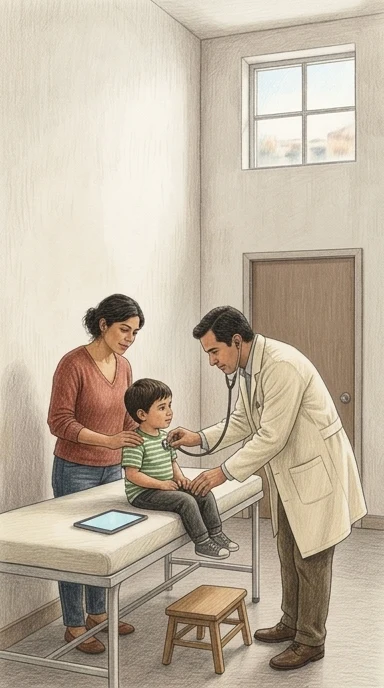
Cuando un niño pequeño enferma, su cuerpo compensa poco y los síntomas graves avanzan rápido. Por eso los sistemas de diagnóstico asistidos por inteligencia artificial se están extendiendo en pediatría: prometen detectar antes y aliviar la falta de especialistas. Pero cuando fallan, ¿quién responde?
El 64.7% de los casos de disputa por diagnóstico erróneo con IA involucró a lactantes de 0 a 3 años.
Los investigadores analizaron 89 documentos hospitalarios sobre sistemas de diagnóstico con IA y 17 casos de disputa médica ocurridos entre 2021 y 2025. Usaron análisis de publicaciones, revisión de expedientes, consulta a 15 expertos y modelos estadísticos. El estudio se publicó en Frontiers in Public Health.
Encontraron que el 73.0% de los documentos no fijaba cláusulas claras sobre a quién pertenecen los derechos del sistema. El 47.1% de los algoritmos obtuvo menos de 0.8 en "interpretabilidad": la capacidad de explicar cómo llegó a su conclusión. Y el tiempo promedio para determinar quién era responsable fue de 66.8 días.
Todos los datos provienen de un único hospital terciario en China. Nada de esto describe lo que dicen los tribunales o los reguladores de América Latina, Estados Unidos o Canadá. Si su hijo es diagnosticado con ayuda de IA en su país, este estudio no le dice qué puede exigir ni a quién.
El umbral de 0.85 que los autores exploran tampoco es una norma obligatoria. Es un valor de corte exploratorio de un solo centro y no puede servir como estándar industrial obligatorio universal.
Además, los 17 casos de disputa son demasiados pocos para sacar conclusiones firmes. Los porcentajes son tendencias dentro de esa muestra diminuta, no predicciones sobre un caso concreto. No permiten anticipar qué pasará con el suyo.
Los autores proponen separar responsabilidades: la empresa que desarrolla el algoritmo responde por sus defectos; el hospital, por el uso clínico. También sugieren que reglas más claras de propiedad y de interpretabilidad podrían acortar la espera de las familias y reducir los casos en que se culpa a la parte equivocada.
Ese debate apenas comienza, y en su país las reglas pueden ser distintas.
¿Sabe usted quién responde si el software que revisa a su hijo se equivoca?
Qué significa para usted
Por ahora, lo que puede hacer es preguntar en su país quién responde si el sistema que revisa a un niño se equivoca, y pedir por escrito qué datos se usan y quién es dueño del programa. Ese estudio chino no responde por las leyes de su país, así que no saque conclusiones sobre lo que le corresponde exigir.
Yang, Z., Yang, W. (2026). Research on intellectual property rights and legal liability definition of artificial intelligence-assisted pediatric disease diagnosis system. Frontiers in Public Health. https://doi.org/10.3389/fpubh.2026.1922644
Quién pagó: Los autores declararon que no recibieron apoyo financiero para este trabajo ni para su publicación, y declararon no tener relaciones comerciales o financieras que pudieran constituir un conflicto de interés.
No tome esto como consejo médico profesional.
Versión detalladaLos pasajes copiados del artículo, las ilustraciones y cada fuente con cuánto leímos de ella · 977 palabras · unos 5 minLeerla →Cerrar
Cuando la IA diagnostica a un niño y algo sale mal, ¿a quién se reclama?
Un estudio chino examina qué pasa con los derechos y las responsabilidades cuando un sistema automático participa en el diagnóstico de enfermedades infantiles. Lo que encontró vale solo para un hospital, pero las preguntas son universales.
Los niños son la población que más protección necesita en salud pública: su desarrollo fisiológico es inmaduro, sus síntomas se esconden y su margen de tolerancia a un diagnóstico equivocado es estrecho1. La inteligencia artificial pediátrica puede aliviar la escasez de recursos médicos, pero la falta de claridad sobre quién es dueño de qué y quién responde por qué obstaculiza su desarrollo ordenado2. Esa es la tensión que un equipo de investigadores, Zhijun Yang y Wensi Yang, quiso medir.
Los autores revisaron 89 documentos de un solo hospital terciario chino —contratos de desarrollo, acuerdos de datos, informes de verificación— y 17 casos de disputas médicas por diagnóstico asistido por IA en niños. Encontraron que el 73 % de esos documentos no tenía cláusulas claras sobre la propiedad intelectual, y que el 47,1 % de los algoritmos obtenía menos de 0,8 en explicabilidad3. El ciclo promedio para atribuir responsabilidad llegó a 66,8 días, y el 55,2 % de los casos superó lo que el estudio considera un plazo razonable4. En los casos de bebés de 0 a 3 años, la tasa de responsabilidad mal asignada fue del 76,2 %5. Las causas principales se repartieron casi por igual: defectos del algoritmo y negligencia hospitalaria, 41,2 % cada una, y la tasa de responsabilidad mal asignada alcanzó el 64,7 %6.
En cuanto a la propiedad, el estudio describe un reparto: los datos clínicos pertenecen a los hospitales, y los algoritmos y el software a las empresas7. Y calcula que si la explicabilidad del algoritmo sube por encima de 0,85, la eficiencia para identificar responsabilidades mejora un 64,9 % y la correlación con disputas baja un 30,6 %8.
Aquí conviene entender qué significa "explicabilidad". Un sistema de diagnóstico por IA es, en la práctica, un programa entrenado con miles de casos que produce una conclusión. Cuando ese programa no puede mostrar en qué se basó —qué dato pesó más, por qué descartó una enfermedad, con qué nivel de confianza afirma lo que afirma—, nos encontramos ante lo que los autores llaman una caja negra9. La consecuencia es concreta: si un diagnóstico falla, los peritos judiciales no pueden distinguir si el error vino del algoritmo, de los datos con que fue entrenado o de un uso clínico inadecuado10. Sin esa distinción, la responsabilidad queda en el aire.
El estudio también describe dónde chocan los intereses. En la cooperación entre hospitales y empresas, los porcentajes de propiedad ambiguos —con el hospital como proveedor de datos y anotaciones clínicas— generan disputas frecuentes sobre licencias, transferencias y regalías11. Y en la práctica judicial, la responsabilidad suele atribuirse simplemente a los hospitales, lo que dificulta el resarcimiento oportuno de los pacientes y desalienta a las instituciones médicas a adoptar la tecnología12. Es un círculo: si el hospital teme ser el único responsable, piensa dos veces antes de usar el sistema; si no lo usa, los niños pierden acceso a una herramienta que podría compensar la escasez de especialistas.
¿Qué haría falta para que esto cambie? Los propios autores proponen que el umbral de 0,85 sirva como referencia exploratoria para la autoevaluación interna de hospitales terciarios, pero advierten que para convertirlo en estándar nacional obligatorio de dispositivos médicos haría falta verificación externa con múltiples centros y muestras grandes13. También sugieren acelerar la creación de normas específicas para dispositivos médicos pediátricos de IA, que aclaren tres cosas: las reglas de propiedad intelectual, los estándares de explicabilidad de los algoritmos y los mecanismos de reparto de responsabilidad14.
Y aquí está el límite más importante para cualquier lector fuera de China: los 89 documentos y los 17 casos provienen de un solo hospital terciario chino, y los hallazgos no pueden generalizarse sin verificación multicéntrica15. Además, el umbral de 0,85 es solo un valor de corte exploratorio de un único centro y no puede servir como estándar industrial obligatorio universal16. Nada de lo que aquí se describe dice lo que los tribunales o los reguladores de América Latina, Estados Unidos o Canadá hacen o dirán.
Así lo leemos nosotros. El patrón que aparece en este estudio no es exclusivo de China: cuando las decisiones importantes se dejan en manos de sistemas automáticos que no se entienden, la gente pierde la capacidad de discutir y de exigir explicaciones, y la responsabilidad se diluye entre muchos actores. Esperamos que en otros países ocurra algo parecido: que los padres de niños afectados por un error de un sistema de diagnóstico pediátrico no sepan a quién reclamar primero, y que los tribunales tarden más en decidir porque no pueden separar la falla del programa de la falla del hospital. ¿Cómo sabríamos que nos equivocamos? Si en la práctica los padres encuentran rápidamente un responsable claro y los tribunales deciden en pocos días, sin peritajes técnicos complicados, entonces nuestra expectativa no se cumple.
Lo que usted puede hacer con esto es concreto. Si un hijo recibe un diagnóstico asistido por inteligencia artificial, pida por escrito qué parte del diagnóstico salió del sistema y quién lo revisó. Pregunte si el programa fue entrenado con niños similares a su hijo y si existe una segunda opinión humana disponible. Guarde todos los documentos clínicos. Y si su hijo es menor de tres años, no deje pasar el tiempo: los plazos son más largos y la opacidad del sistema puede ser un obstáculo. No se trata de rechazar la tecnología, sino de saber qué preguntar cuando está en juego la salud de un niño que no puede preguntar por sí mismo.
¿Qué le preguntaría usted al médico la próxima vez que un diagnóstico venga con ayuda de un programa?
De dónde sale cada dato de contexto, y cuánto leímos de cada documento
- Yang, Z., Yang, W. (2026). Research on intellectual property rights and legal liability definition of artificial intelligence-assisted pediatric disease diagnosis system. Frontiers in Public Health. https://doi.org/10.3389/fpubh.2026.1922644 - el artículo del que trata esta nota — el artículo completo — el pasaje: "Children's physiological development is immature, their symptoms are hidden and their diagnostic fault tolerance window is low, so they are the key protected population of public health."
- Yang, Z., Yang, W. (2026). Research on intellectual property rights and legal liability definition of artificial intelligence-assisted pediatric disease diagnosis system. Frontiers in Public Health. https://doi.org/10.3389/fpubh.2026.1922644 - el artículo del que trata esta nota — el artículo completo — el pasaje: "Although pediatric AI can alleviate the shortage of medical resources, the unclear definition of ownership and responsibility hinders its standardized development."
- Yang, Z., Yang, W. (2026). Research on intellectual property rights and legal liability definition of artificial intelligence-assisted pediatric disease diagnosis system. Frontiers in Public Health. https://doi.org/10.3389/fpubh.2026.1922644 - el artículo del que trata esta nota — el artículo completo — el pasaje: "The data indicate that 73.0% of documents lack clear intellectual property ownership clauses, while 47.1% of algorithms score below 0.8 in interpretability."
- Yang, Z., Yang, W. (2026). Research on intellectual property rights and legal liability definition of artificial intelligence-assisted pediatric disease diagnosis system. Frontiers in Public Health. https://doi.org/10.3389/fpubh.2026.1922644 - el artículo del que trata esta nota — el artículo completo — el pasaje: "The average liability attribution cycle reaches 66.8 days, with 55.2% of cases exceeding the reasonable time limit."
- Yang, Z., Yang, W. (2026). Research on intellectual property rights and legal liability definition of artificial intelligence-assisted pediatric disease diagnosis system. Frontiers in Public Health. https://doi.org/10.3389/fpubh.2026.1922644 - el artículo del que trata esta nota — el artículo completo — el pasaje: "64.7% of infants aged 0 ~ 3 years are involved in AI misdiagnosis disputes, and the medical adverse damage consequences with higher severity."
- Yang, Z., Yang, W. (2026). Research on intellectual property rights and legal liability definition of artificial intelligence-assisted pediatric disease diagnosis system. Frontiers in Public Health. https://doi.org/10.3389/fpubh.2026.1922644 - el artículo del que trata esta nota — el artículo completo — el pasaje: "Among the main causes of misdiagnosis, algorithm defects and hospital negligence accounted for 41.2% respectively, and the responsibility mismatch rate reached 64.7%."
- Yang, Z., Yang, W. (2026). Research on intellectual property rights and legal liability definition of artificial intelligence-assisted pediatric disease diagnosis system. Frontiers in Public Health. https://doi.org/10.3389/fpubh.2026.1922644 - el artículo del que trata esta nota — el artículo completo — el pasaje: "In terms of ownership, clinical data belongs to hospitals, and algorithms and software belong to enterprises."
- Yang, Z., Yang, W. (2026). Research on intellectual property rights and legal liability definition of artificial intelligence-assisted pediatric disease diagnosis system. Frontiers in Public Health. https://doi.org/10.3389/fpubh.2026.1922644 - el artículo del que trata esta nota — el artículo completo — el pasaje: "The calculation shows that if the interpretability of the algorithm rises above 0.85, the identification efficiency can be improved by 64.9% and the dispute correlation can be reduced by 30.6%."
- Yang, Z., Yang, W. (2026). Research on intellectual property rights and legal liability definition of artificial intelligence-assisted pediatric disease diagnosis system. Frontiers in Public Health. https://doi.org/10.3389/fpubh.2026.1922644 - el artículo del que trata esta nota — el artículo completo — el pasaje: "The black-box property of AI diagnostic algorithms causes insufficient interpretability. Ambiguous liability attribution rules further hinder fault identification and lead to frequent liability mismatch in medical disputes"
- Yang, Z., Yang, W. (2026). Research on intellectual property rights and legal liability definition of artificial intelligence-assisted pediatric disease diagnosis system. Frontiers in Public Health. https://doi.org/10.3389/fpubh.2026.1922644 - el artículo del que trata esta nota — el artículo completo — el pasaje: "When the algorithm output lacks feature basis, decision-making path and confidence tips, judicial authentication institutions can't distinguish whether the misdiagnosis stems from algorithm defects, data deviation or improper clinical use"
- Yang, Z., Yang, W. (2026). Research on intellectual property rights and legal liability definition of artificial intelligence-assisted pediatric disease diagnosis system. Frontiers in Public Health. https://doi.org/10.3389/fpubh.2026.1922644 - el artículo del que trata esta nota — el artículo completo — el pasaje: "In hospital-enterprise R&D cooperation, ambiguous ownership ratios for hospitals (as data and annotation suppliers) frequently trigger disputes over IP licensing, transfer and royalty distribution"
- Yang, Z., Yang, W. (2026). Research on intellectual property rights and legal liability definition of artificial intelligence-assisted pediatric disease diagnosis system. Frontiers in Public Health. https://doi.org/10.3389/fpubh.2026.1922644 - el artículo del que trata esta nota — el artículo completo — el pasaje: "the responsibility is often simply attributed to hospitals in judicial practice, which is not conducive to timely relief of patients' rights and interests, and also inhibits the enthusiasm of medical institutions to apply AI technology"
- Yang, Z., Yang, W. (2026). Research on intellectual property rights and legal liability definition of artificial intelligence-assisted pediatric disease diagnosis system. Frontiers in Public Health. https://doi.org/10.3389/fpubh.2026.1922644 - el artículo del que trata esta nota — el artículo completo — el pasaje: "it is suggested that 0.85 can be used as an exploratory reference threshold for internal clinical self-examination in single-center 3A hospitals. If it is necessary to upgrade to the national compulsory evaluation standard for medical devices, it is necessary to carry out multi-center and large-sample external verification"
- Yang, Z., Yang, W. (2026). Research on intellectual property rights and legal liability definition of artificial intelligence-assisted pediatric disease diagnosis system. Frontiers in Public Health. https://doi.org/10.3389/fpubh.2026.1922644 - el artículo del que trata esta nota — el artículo completo — el pasaje: "it is suggested to speed up the formulation of the Management Measures for Pediatric Artificial Intelligence Medical Devices, clarify the three core contents of intellectual property rights rules, interpretable standards of algorithms and responsibility division mechanism"
- Yang, Z., Yang, W. (2026). Research on intellectual property rights and legal liability definition of artificial intelligence-assisted pediatric disease diagnosis system. Frontiers in Public Health. https://doi.org/10.3389/fpubh.2026.1922644 - el artículo del que trata esta nota — el artículo completo — el pasaje: "This study is limited to single-center data, and its findings cannot be generalized without multi-center verification."
- Yang, Z., Yang, W. (2026). Research on intellectual property rights and legal liability definition of artificial intelligence-assisted pediatric disease diagnosis system. Frontiers in Public Health. https://doi.org/10.3389/fpubh.2026.1922644 - el artículo del que trata esta nota — el artículo completo — el pasaje: "The 0.85 interpretability threshold is only an exploratory single-center cutoff value and cannot serve as a universal mandatory industrial standard."
Yang, Z., Yang, W. (2026). Research on intellectual property rights and legal liability definition of artificial intelligence-assisted pediatric disease diagnosis system. Frontiers in Public Health. https://doi.org/10.3389/fpubh.2026.1922644
Quién pagó: Los autores declararon que no recibieron apoyo financiero para este trabajo ni para su publicación, y declararon no tener relaciones comerciales o financieras que pudieran constituir un conflicto de interés.
No tome esto como consejo médico profesional.
analysis of texts · Frontiers in public health · the paper, 30 Jul 2026 · free
AI Is Helping Diagnose Children. When It Gets It Wrong, Who's Responsible?
In one small Chinese hospital study, nearly two-thirds of AI misdiagnosis disputes involved infants. The figures describe that single institution only, and the blame rules researchers propose are suggestions, not law anywhere.
Short version · the longer version follows, about 4 min
- The study at a glance
- Who
- hospital documents and medical dispute cases about AI-assisted child diagnosis
- How many
- 89 documents and 17 dispute cases
- Where
- a single tertiary hospital in China
- When
- 2021 through 2025
- Kind of study
- analysis of what people did
- Who did it
- Law School of Shanxi University, China; Christus Health, United States
- The limit that matters
- All from one hospital; cannot be generalized without multi-center verification.
These shares come from one Chinese hospital's own files and 17 dispute cases only, so they describe that single institution and not any other place.
What the researchers calculated would change if an algorithm's explainability rose above 0.85
would improve by 64.9%
would drop by 30.6%
The interpretability cutoff of 0.85 is an exploratory value from this single center—not a mandatory standard.
A computer program suggests a diagnosis for a sick child. The doctor weighs it. Then something goes wrong, and a family wants an answer.
In the disputes researchers examined, 64.7 percent of infants from birth to age 3 were involved in AI misdiagnosis disputes. Children that age have little physical reserve, and their illnesses can move fast.
The small study came from one tertiary hospital in China. Researchers there reviewed 89 hospital documents about AI diagnosis systems and 17 medical dispute cases from 2021 through 2025, using literature analysis, case review, expert consultation and regression.
They found 73.0 percent of the documents lacked clear clauses on who owns what. Nearly half the algorithms—47.1 percent—scored below 0.8 on a scale measuring whether a person can follow how the software reached its answer. And the average wait to decide who was responsible ran 66.8 days; cases without clear ownership clauses took 55.2 percent longer than cases with clear agreements.
But every document and every case came from that one Chinese hospital. These numbers describe that institution alone. They say nothing about what courts, regulators or health authorities in Latin America, the United States or Canada require, permit or decide. Nothing here tells you what the law says where you live.
The interpretability cutoff of 0.85 is an exploratory value from this single center—not a mandatory standard. No regulator has adopted it as a rule. It is a research observation, not a requirement any company must meet.
The 17 dispute cases are also too few for firm conclusions. The percentages are trends inside this sample, not predictions for any individual case.
Still, the researchers sketch what clearer ownership rules and more transparent algorithms could make possible: shorter waits before a family learns who is responsible, and fewer cases where blame lands on the wrong party—the hospital held responsible for a software defect, or the software maker blamed for a doctor's misjudgment.
In their sample, when algorithms were more transparent, decisions came faster.
If a hospital near you starts using AI to help diagnose your child, ask: who reviewed the result, and who answers if it's wrong?
What this means for you
That question is the one thing you can carry from this study, and only as a question: ask who reviewed the result and who answers if it is wrong. What that person is obligated to tell you, and what a court or regulator where you live would require, is not something this single Chinese hospital study can tell you, so weigh the answer you get against your own country's rules rather than against these figures.
Yang, Z., Yang, W. (2026). Research on intellectual property rights and legal liability definition of artificial intelligence-assisted pediatric disease diagnosis system. Frontiers in Public Health. https://doi.org/10.3389/fpubh.2026.1922644
Who paid: The authors declared that no financial support was received for this work or its publication, and they declared no commercial or financial relationships that could be a conflict of interest.
Do not take this as professional medical advice.
The longer versionThe passages copied from the paper, the pictures, and every source with how much of it we read · 897 words · about 4 minRead it →Close
Hospital AI contracts often don't say who owns the data or the algorithm, study finds
One hospital's files show most AI deals never say who owns what, and most disputes take months to assign fault. Here is what that means for a family.
A new study about artificial intelligence used to help diagnose sick children asks a question that sounds like it belongs in a law office, not a clinic: when the tool is wrong, who is responsible? The authors—Zhijun Yang of the Law School of Shanxi University in China and Wensi Yang of Christus Health in the United States—examined 89 hospital documents and 17 medical dispute cases, all from a single tertiary hospital in China, and reported that 73.0% of those documents lacked clear intellectual property ownership clauses, while 47.1% of the algorithms scored below 0.8 on a measure of how well their reasoning can be explained1.
The average time to assign responsibility in those disputes was 66.8 days, and 55.2% of cases went past what the authors call a reasonable time limit2. Infants aged 0 to 3 years were involved in 64.7% of the AI misdiagnosis disputes, and their injuries tended to be more severe3. Among the causes of misdiagnosis, algorithm defects and hospital negligence each accounted for 41.2%, and the rate at which responsibility was assigned to the wrong party reached 64.7%4.
On ownership, the study's own framing is simple: clinical data belongs to hospitals, algorithms and software belong to companies5. The authors calculate that if an algorithm's interpretability rises above 0.85, the efficiency of identifying responsibility improves by 64.9% and the correlation with disputes drops by 30.6%6. But they are careful to say this is a single-center exploratory cutoff, not a mandatory industry standard7, and that the findings cannot be generalized without multi-center verification8.
To understand why this matters, you have to understand what an "interpretable" algorithm actually is. When an AI diagnostic tool reaches a conclusion, it can either show its work—which clinical features it weighed, what path it followed, how confident it is—or it can simply output an answer. The study describes the problem this way: when the algorithm output lacks feature basis, decision-making path and confidence tips, judicial authentication institutions can't distinguish whether the misdiagnosis stems from algorithm defects, data deviation or improper clinical use9. In plain terms, if the machine just says "pneumonia" without saying why, nobody downstream can tell whether the machine was wrong, the data was bad, or the doctor used the tool badly.
That confusion has consequences. The black-box property of AI diagnostic algorithms causes insufficient interpretability, and ambiguous liability attribution rules further hinder fault identification and lead to frequent liability mismatch in medical disputes10. The study found that in judicial practice, responsibility is often simply attributed to hospitals—which the authors say is not conducive to timely relief of patients' rights and interests and also inhibits the enthusiasm of medical institutions to apply AI technology11.
The tension between hospitals and technology companies is not incidental. In hospital-enterprise research and development cooperation, ambiguous ownership ratios for hospitals—which supply data and annotations—frequently trigger disputes over intellectual property licensing, transfer and royalty distribution12. Hospitals contribute patient data, clinical expertise, and verification; companies contribute code, architecture, and iteration. When the contract does not say who owns what, the argument starts later.
The authors recommend that 0.85 be used as an exploratory reference threshold for internal clinical self-examination in single-center 3A hospitals, and that upgrading it to a national compulsory evaluation standard for medical devices would require multi-center and large-sample external verification13. They also suggest speeding up the formulation of Management Measures for Pediatric Artificial Intelligence Medical Devices, clarifying three core contents: intellectual property rules, interpretable standards of algorithms, and responsibility division mechanism14.
Here is how we read it. The pattern in this study is not really about China, and not really about children. It is about what happens when a decision is made by a system that many people built and nobody fully understands. The study shows a hospital and a company each holding a piece of the puzzle, a dispute process that takes months, and a mismatch rate that suggests the wrong party often pays. What we expect, in homes like yours, is that when an AI tool is involved in a child's care, the family will not know whom to ask for an explanation—and the hospital and the company will each point at the other. How could you tell we are wrong? If you ask who reviewed the AI's output and you get a clear answer, quickly, with a name and a record, then the system is working better than this study suggests.
What can you do with this? When an AI tool is used in your child's care—or in anyone's care you are responsible for—ask three questions. Who owns this tool? Can its reasoning be explained to me in writing? Who reviewed its output before the doctor acted on it? You are not asking for a favor. You are asking for the record that a dispute would need, and asking early is easier than asking later. If the answers are vague, you have learned something important about the system. If they are clear, you have learned something reassuring. Either way, you are no longer waiting for someone else to decide what happened.
What would you ask for first: the algorithm's decision record, or the doctor's review notes?
Where each piece of context comes from, and how much of it we read
- Yang, Z., Yang, W. (2026). Research on intellectual property rights and legal liability definition of artificial intelligence-assisted pediatric disease diagnosis system. Frontiers in Public Health. https://doi.org/10.3389/fpubh.2026.1922644 - the article this story is about — the whole article — the passage: "The data indicate that 73.0% of documents lack clear intellectual property ownership clauses, while 47.1% of algorithms score below 0.8 in interpretability."
- Yang, Z., Yang, W. (2026). Research on intellectual property rights and legal liability definition of artificial intelligence-assisted pediatric disease diagnosis system. Frontiers in Public Health. https://doi.org/10.3389/fpubh.2026.1922644 - the article this story is about — the whole article — the passage: "The average liability attribution cycle reaches 66.8 days, with 55.2% of cases exceeding the reasonable time limit."
- Yang, Z., Yang, W. (2026). Research on intellectual property rights and legal liability definition of artificial intelligence-assisted pediatric disease diagnosis system. Frontiers in Public Health. https://doi.org/10.3389/fpubh.2026.1922644 - the article this story is about — the whole article — the passage: "64.7% of infants aged 0 ~ 3 years are involved in AI misdiagnosis disputes, and the medical adverse damage consequences with higher severity."
- Yang, Z., Yang, W. (2026). Research on intellectual property rights and legal liability definition of artificial intelligence-assisted pediatric disease diagnosis system. Frontiers in Public Health. https://doi.org/10.3389/fpubh.2026.1922644 - the article this story is about — the whole article — the passage: "Among the main causes of misdiagnosis, algorithm defects and hospital negligence accounted for 41.2% respectively, and the responsibility mismatch rate reached 64.7%."
- Yang, Z., Yang, W. (2026). Research on intellectual property rights and legal liability definition of artificial intelligence-assisted pediatric disease diagnosis system. Frontiers in Public Health. https://doi.org/10.3389/fpubh.2026.1922644 - the article this story is about — the whole article — the passage: "In terms of ownership, clinical data belongs to hospitals, and algorithms and software belong to enterprises."
- Yang, Z., Yang, W. (2026). Research on intellectual property rights and legal liability definition of artificial intelligence-assisted pediatric disease diagnosis system. Frontiers in Public Health. https://doi.org/10.3389/fpubh.2026.1922644 - the article this story is about — the whole article — the passage: "The calculation shows that if the interpretability of the algorithm rises above 0.85, the identification efficiency can be improved by 64.9% and the dispute correlation can be reduced by 30.6%."
- Yang, Z., Yang, W. (2026). Research on intellectual property rights and legal liability definition of artificial intelligence-assisted pediatric disease diagnosis system. Frontiers in Public Health. https://doi.org/10.3389/fpubh.2026.1922644 - the article this story is about — the whole article — the passage: "The 0.85 interpretability threshold is only an exploratory single-center cutoff value and cannot serve as a universal mandatory industrial standard."
- Yang, Z., Yang, W. (2026). Research on intellectual property rights and legal liability definition of artificial intelligence-assisted pediatric disease diagnosis system. Frontiers in Public Health. https://doi.org/10.3389/fpubh.2026.1922644 - the article this story is about — the whole article — the passage: "This study is limited to single-center data, and its findings cannot be generalized without multi-center verification."
- Yang, Z., Yang, W. (2026). Research on intellectual property rights and legal liability definition of artificial intelligence-assisted pediatric disease diagnosis system. Frontiers in Public Health. https://doi.org/10.3389/fpubh.2026.1922644 - the article this story is about — the whole article — the passage: "When the algorithm output lacks feature basis, decision-making path and confidence tips, judicial authentication institutions can't distinguish whether the misdiagnosis stems from algorithm defects, data deviation or improper clinical use"
- Yang, Z., Yang, W. (2026). Research on intellectual property rights and legal liability definition of artificial intelligence-assisted pediatric disease diagnosis system. Frontiers in Public Health. https://doi.org/10.3389/fpubh.2026.1922644 - the article this story is about — the whole article — the passage: "The black-box property of AI diagnostic algorithms causes insufficient interpretability. Ambiguous liability attribution rules further hinder fault identification and lead to frequent liability mismatch in medical disputes"
- Yang, Z., Yang, W. (2026). Research on intellectual property rights and legal liability definition of artificial intelligence-assisted pediatric disease diagnosis system. Frontiers in Public Health. https://doi.org/10.3389/fpubh.2026.1922644 - the article this story is about — the whole article — the passage: "the responsibility is often simply attributed to hospitals in judicial practice, which is not conducive to timely relief of patients' rights and interests, and also inhibits the enthusiasm of medical institutions to apply AI technology"
- Yang, Z., Yang, W. (2026). Research on intellectual property rights and legal liability definition of artificial intelligence-assisted pediatric disease diagnosis system. Frontiers in Public Health. https://doi.org/10.3389/fpubh.2026.1922644 - the article this story is about — the whole article — the passage: "In hospital-enterprise R&D cooperation, ambiguous ownership ratios for hospitals (as data and annotation suppliers) frequently trigger disputes over IP licensing, transfer and royalty distribution"
- Yang, Z., Yang, W. (2026). Research on intellectual property rights and legal liability definition of artificial intelligence-assisted pediatric disease diagnosis system. Frontiers in Public Health. https://doi.org/10.3389/fpubh.2026.1922644 - the article this story is about — the whole article — the passage: "it is suggested that 0.85 can be used as an exploratory reference threshold for internal clinical self-examination in single-center 3A hospitals. If it is necessary to upgrade to the national compulsory evaluation standard for medical devices, it is necessary to carry out multi-center and large-sample external verification"
- Yang, Z., Yang, W. (2026). Research on intellectual property rights and legal liability definition of artificial intelligence-assisted pediatric disease diagnosis system. Frontiers in Public Health. https://doi.org/10.3389/fpubh.2026.1922644 - the article this story is about — the whole article — the passage: "it is suggested to speed up the formulation of the Management Measures for Pediatric Artificial Intelligence Medical Devices, clarify the three core contents of intellectual property rights rules, interpretable standards of algorithms and responsibility division mechanism"
Yang, Z., Yang, W. (2026). Research on intellectual property rights and legal liability definition of artificial intelligence-assisted pediatric disease diagnosis system. Frontiers in Public Health. https://doi.org/10.3389/fpubh.2026.1922644
Who paid: The authors declared that no financial support was received for this work or its publication, and they declared no commercial or financial relationships that could be a conflict of interest.
Do not take this as professional medical advice.