survey · BMC Pediatrics · la publicación, 18 may 2026 · gratis
Los padres que usan más el celular también crían niños más conectados al celular
Un estudio en Turquía encontró que los padres que usan herramientas de inteligencia artificial o dejan que sus bebés vean el celular en los primeros meses tienen puntajes más altos de adicción al teléfono.
Versión breve · la versión detallada sigue, unos 9 min
- El estudio, de un vistazo
- Quiénes
- Padres y madres con al menos un hijo de 3 a 6 años
- Cuántos
- 1.543 padres
- Dónde
- Bingöl, en el este de Türkiye
- Cuándo
- No lo dice el pasaje
- Tipo de estudio
- survey
- Quién lo hizo
- Universidad de Bingöl y Universidad de Hacettepe
- El límite que importa
- Miró un solo momento en el tiempo y se hizo en una sola provincia
Porcentajes de 1.543 padres y madres en una sola provincia de Türkiye, según lo que ellos mismos reportaron; no son medidas exactas ni prueban causa.
Grupos de padres que sacaron puntajes más altos de dependencia al teléfono
Los de 40 o más sacaron puntajes más bajos
Los de un solo hijo sacaron puntajes más altos
Los que los usaban mostraron mayor potencial de dependencia
Los que lo dejaron mostraron mayor potencial de dependencia
Los que no prestaban atención tenían puntajes más altos
Los primeros tenían puntajes más altos
Esta semana, antes de entregarle el teléfono a su hijo para que coma o se calme, pregúntese: ¿lo hago por él o por mí?

En una ciudad del este de Turquía, 1,543 padres de niños de 3 a 6 años respondieron preguntas sobre su propio uso del celular y sobre los hábitos tecnológicos de sus hijos. La mayoría eran madres de entre 30 y 39 años, y casi la mitad tenía estudios universitarios.
Los padres reportaron cuántas horas al día usan el celular, qué plataformas de redes sociales revisan, si conocen o usan herramientas de inteligencia artificial y de qué manera recurren a lo digital para cuidar a sus hijos: desde información sobre el crecimiento y el desarrollo del niño o sobre su salud hasta tareas como la alimentación complementaria, el cambio de pañales, los eructos o el baño. Se trata de un estudio descriptivo realizado por investigadores de una universidad turca.
Quienes usaban herramientas como ChatGPT o Google Bard/Gemini tenían puntajes más altos de adicción al teléfono. Lo mismo ocurría con los padres que dejaron que sus bebés miraran el celular durante los primeros seis meses de vida. Lo mismo ocurría con los padres que permitían el celular para calmar al bebé o para que comiera, y con aquellos que lo usaban frente a sus hijos.
Pero el estudio solo miró un momento en el tiempo, así que no puede probar que los hábitos de los padres causen el uso del celular por parte de los niños ni sus reacciones. Solo muestra que ambas cosas aparecen juntas.
También ocurría con los padres cuyos hijos reaccionaban con violencia, llanto o berrinche cuando les quitaban el celular: esos padres tenían puntajes más altos de adicción al teléfono. Investigadores citados en el estudio señalan que usar el celular como distractor puede contribuir a la adicción tecnológica de los niños más adelante.
Toda la información vino de lo que los propios padres reportaron, así que los números son estimaciones, no mediciones exactas. Y el estudio se hizo solo en una provincia de Turquía, con mayoría de madres, así que los patrones podrían no ser iguales para familias en América Latina, Estados Unidos o Canadá.
Los padres también reportaron problemas físicos: dificultad para dormir por la noche, dolor de cuello y de muñeca o mano, y más horas diarias de celular. Los autores recomiendan que los profesionales de enfermería pediátrica eduquen a los padres sobre los efectos del uso del celular en la salud física, que expliquen la relación entre el celular e insomnio, y que aconsejen no usar el teléfono como chupón ni como distracción en las comidas.
Conocer estos patrones puede ayudarle a observar sus propios hábitos y decidir cuándo y cómo usar el celular o la inteligencia artificial cerca de sus hijos. Esta semana, antes de entregarle el teléfono a su hijo para que coma o se calme, pregúntese: ¿lo hago por él o por mí?
Qué significa para usted
Más que una causa, lo que verá en su casa es una costumbre que acompaña a otra: si usted revisa mucho el celular, es probable que su hijo también pase más tiempo frente a una pantalla. Ninguna investigación puede decirle todavía si eso le hará daño, así que no saque conclusiones apresuradas; obsérvese esta semana y note cuándo le entrega el teléfono para que coma o se calme, y si lo hace por él o por usted.
Tuncay S, Sarman A, Zirek E, Güngör İ. Connected parents, connected children: the relationship of smartphone, social media, and AI with parenting and children’s tech consumption in Türkiye. BMC Pediatrics. May 2026.
Quién pagó: No se recibió financiación de ninguna institución u organización durante la realización de la investigación.
No tome esto como consejo médico profesional.
Los hallazgos de otros estudios que aquí se mencionan los conocemos por este documento, que fue el que leímos; no abrimos cada uno de esos estudios.
Versión detalladaLos pasajes copiados del artículo, las ilustraciones y cada fuente con cuánto leímos de ella · 1767 palabras · unos 9 minLeerla →Cerrar
Los padres que más usan el celular también son los que más lo usan para criar, según un estudio en Türkiye
El trabajo halló que las mismas familias que consultan redes e inteligencia artificial para alimentar o calmar a un bebé son las que sacan puntajes más altos de dependencia al teléfono. No prueba causa: solo muestra que van juntas.
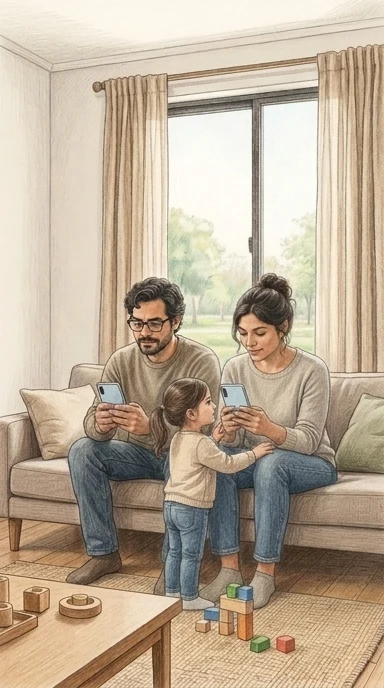
Un estudio con autores de la Universidad de Bingöl, en el este de Türkiye, y de la Universidad de Hacettepe encuestó a 1,543 padres y madres con al menos un hijo de entre 3 y 6 años y al menos seis años de uso de celular1. El estudio se hizo en una sola provincia, Bingöl2. No hubo financiamiento de ninguna institución ni organización. Se les preguntó por sus hábitos con el teléfono, por su sueño, por dolores de cuello y muñeca, por su uso de redes y de herramientas de inteligencia artificial, y por cómo sus hijos usan pantallas.
La escala que midió la dependencia tiene diez preguntas y da un puntaje de 10 a 60; más alto, más riesgo. Los padres y madres de 40 años o más sacaron puntajes más bajos que los más jóvenes, y quienes tenían un solo hijo sacaron más alto que quienes tenían varios34. El puntaje también subió con el nivel educativo5. Quienes dormían mal por el celular, tenían dolor de cuello o de muñeca, pasaban más horas al día con el aparato y lo usaban sobre todo para redes sociales mostraron puntajes más altos6. Lo mismo ocurrió con quienes pasaban más tiempo en Instagram, YouTube y WhatsApp7.
El dato que más llama la atención tiene que ver con la inteligencia artificial. Los padres que usaban herramientas como ChatGPT y Google Bard/Gemini mostraron mayor potencial de dependencia8. Casi nueve de cada diez dijeron que nunca las habían usado para cuidar a un hijo, pero un 8.3% sí las consultó para seguir el crecimiento y el desarrollo del niño, y los autores señalan que una parte de los padres también las incorporó a rutinas de cuidado físico, como alimentar, cambiar pañales o bañarlo. Y quienes dejaron que un bebé de entre el primer y el sexto mes de vida mirara contenido en el celular —a menudo para calmarlo mientras comía— también mostraron mayor potencial de dependencia9. Los padres que no prestaban atención al uso del celular delante de sus hijos, y los padres de niños que reaccionaban con violencia cuando les quitaban el teléfono, tenían puntajes más altos10. En total, un 20.8% de los chicos reaccionaba con malestar cuando se lo sacaban11, y un 14.3% lo usaba más de tres horas por día12. La conclusión de los autores es que los hijos de padres con alta dependencia tienden a usar el celular por más tiempo13.
Conviene frenar aquí. El estudio miró un solo momento en el tiempo, así que no puede decir que los hábitos de los padres causen el uso o las reacciones de los chicos: solo muestra que aparecen juntos. Toda la información salió de lo que los propios padres contestaron, así que los números son estimaciones, no medidas exactas. Se hizo en una sola provincia de Türkiye, con más mujeres que hombres entre los participantes14, y con una muestra de conveniencia, no al azar, lo que limita cuánto se puede generalizar. Los autores tampoco calcularon de antemano cuántos participantes necesitaban para detectar efectos pequeños, así que puede que algunos se les hayan escapado. El diseño de un solo corte impide cualquier conclusión sobre causas15. Y los propios autores piden estudios que sigan a las familias en el tiempo para aclarar hacia dónde va la relación16.

Vale la pena entender de qué tamaño es el terreno donde cae este trabajo. La inteligencia artificial ya está metida en las actividades diarias de los chicos: aprender, jugar, y hasta interactuar con servicios del Estado como salud, bienestar social y justicia, según el resumen de un análisis sobre regulación; solo pudimos leer el resumen, el texto completo está detrás de una suscripción17. Ese mismo análisis advierte preocupaciones serias sobre los efectos de la IA en derechos básicos como la privacidad y la libertad de expresión, y en valores como la creatividad y la empatía18, y señala que, pese a los esfuerzos por regularla en el mundo, hay huecos notables justo en las formas más intrusivas, sobre todo en lo que toca a los derechos de los niños19.
¿Y qué se ha intentado? Bastante, pero desparejo. Según el resumen de un trabajo sobre el panorama regulatorio de la IA generativa en educación —también leímos solo el resumen—, las grandes economías están construyendo marcos legales, pero falta evaluar si alcanzan para proteger el desarrollo psicológico de los estudiantes20. Ese análisis encuentra un desajuste: el enfoque europeo, basado en el riesgo, regula bien las decisiones de alto impacto, como las calificaciones automáticas, pero pasa por alto los riesgos psicológicos acumulativos de los asistentes conversacionales cotidianos, esos con los que un chico charla todos los días21. El enfoque chino, basado en el contenido, filtra bien lo ilegal, pero no logra regular diseños de interacción legales y a la vez manipuladores, como los mecanismos adictivos de gamificación22. La conclusión de esos autores es que los marcos actuales priorizan en exceso la seguridad física, la privacidad de datos y la seguridad ideológica, y dejan de lado la "seguridad del proceso" psicológico23. Su propuesta: evaluaciones obligatorias de impacto en la salud mental para las herramientas educativas y más transparencia sobre la lógica pedagógica de los algoritmos24.
En redes sociales el debate es parecido. Según el resumen de una revisión sobre evidencia y políticas —solo accesible en su resumen—, el uso creció rápido, sobre todo entre adolescentes, con riesgos como el uso problemático y beneficios como la conexión social, lo que complica la tarea de quien legisla25. Esa revisión buscó estudios y propuestas legislativas desde agosto de 2003 hasta marzo de 2026 y encontró 672 artículos, de los cuales 39 cumplían los criterios2627. Los temas más tratados fueron el consentimiento y la supervisión de los padres, los deepfakes y las imágenes íntimas no consentidas, la verificación de edad y el diseño de las plataformas28. Un dato útil para las familias: la supervisión y el consentimiento de los padres aparecieron asociados a menor uso problemático de redes y a mejores resultados en los adolescentes, en los estudios basados en encuestas29. En cambio, las medidas de verificación de edad se sorteaban con frecuencia30, y sobre las políticas que restringen el celular en las escuelas, aunque se adoptaron ampliamente, la evidencia sobre efectos académicos, sociales o de salud mental era limitada31. Las etiquetas de advertencia pueden aumentar la conciencia del riesgo, pero los datos eran en gran parte opiniones de expertos32.
Así lo leemos nosotros. Cuando una tarea de crianza se vuelve repetitiva y agotadora, las familias buscan el atajo que ya tienen a mano y que exige el menor esfuerzo en ese momento. El atajo se elige por lo fácil, no por lo que enseñe o fortalezca a quien lo recibe. Por eso esperaríamos que el teléfono y las aplicaciones se usen sobre todo en los momentos de mayor cansancio y prisa: dar de comer, bañar, calmar un berrinche, lograr que se duerma. Y esperaríamos que quien más recurre a esos atajos sea también quien más pegado está a su propio teléfono. Nos equivocaríamos si usted ve que en su casa se usa el celular igual en los ratos tranquilos que en los difíciles, o si quienes más lo usan para criar son justamente los que menos dependen de él. Lo que puede hacer con esto: fíjese cuáles son sus propios momentos de mayor desgaste y decida de antemano, con calma, qué va a hacer ahí en lugar de improvisar. Y pregúntese si la aplicación que consulta le está resolviendo el momento o solo tapándolo.

Hay una segunda cosa que nos parece más silenciosa. Los saberes sobre cómo criar pasaban de los mayores a los jóvenes dentro de la familia y la comunidad, y quien los recibía no los cuestionaba. Cuando ese canal se rompe, la gente busca respuestas en otro lado, y las herramientas nuevas ocupan el lugar que antes tenía la experiencia de los cercanos. Esperaríamos entonces que muchas familias consulten a la inteligencia artificial o a las redes para tareas concretas no porque confíen más en ellas que en sus madres o vecinas, sino porque el consejo cercano ya no está disponible o ya no se considera válido, y que ese reemplazo pase casi sin que nadie lo note. Nos equivocaríamos si usted ve que las familias que sí tienen a mano consejo de personas mayores igual prefieren la aplicación, o que quienes la consultan lo hacen por desconfianza explícita hacia sus mayores y no por falta de acceso a ellos. Lo que puede hacer: pregúntese a quién le consulta hoy lo que antes se preguntaba en familia, y si vale la pena recuperar esa conversación. Cuando use una aplicación para algo de salud o de alimentación, contrástelo con alguien de confianza.
Y una tercera, que es la que más nos importa para lo cotidiano. Las tecnologías que prometen cercanía también pueden producir distancia: estar conectado con alguien a lo lejos mientras se está ausente de quien se tiene al lado. Lo que se gana en alcance se pierde en presencia. Esperaríamos que los padres que más usan el teléfono delante de sus hijos sean también los que más lo usan para informarse sobre ellos, y que los chicos respondan con berrinches o violencia cuando se los separa del aparato. Nos equivocaríamos si usted ve que quienes más consultan información sobre sus hijos en el teléfono son también quienes menos lo usan delante de ellos, o que los chicos reaccionan con calma cuando se les quita el aparato sin importar cuánto lo usen sus padres. Lo que puede hacer: observe cuánto tiempo pasa con el teléfono en la mano estando con sus hijos, sin culparse, solo para saberlo. Y anticipe que quitar el teléfono de golpe suele generar conflicto, así que conviene acordar las reglas antes, no en el momento.
Para las familias de América Latina, Estados Unidos y Canadá, este estudio no dice que sus hijos vayan a terminar igual. Dice que el patrón que encontró —las mismas personas que más consultan la pantalla para criar son las que más pegadas están a ella— vale la pena mirarlo en casa. Empiece por una sola cosa esta semana: elija el momento del día en que más le pesa criar, y decida ahora qué va a hacer ahí en vez de sacar el teléfono. ¿Cuál es ese momento en su casa?
De dónde sale cada dato de contexto, y cuánto leímos de cada documento
- Tuncay S, Sarman A, Zirek E, Güngör İ. Connected parents, connected children: the relationship of smartphone, social media, and AI with parenting and children’s tech consumption in Türkiye. BMC Pediatrics. May 2026. - el artículo del que trata esta nota — el artículo completo — el pasaje: "Parents with at least one child aged 3–6 years and a minimum of six years of smartphone use were eligible. A total of 1,543 parents participated."
- Tuncay S, Sarman A, Zirek E, Güngör İ. Connected parents, connected children: the relationship of smartphone, social media, and AI with parenting and children’s tech consumption in Türkiye. BMC Pediatrics. May 2026. - el artículo del que trata esta nota — el artículo completo — el pasaje: "This cross-sectional study was conducted in Bingöl Province, located in the eastern region of Türkiye, among parents of children aged 3–6 years."
- Tuncay S, Sarman A, Zirek E, Güngör İ. Connected parents, connected children: the relationship of smartphone, social media, and AI with parenting and children’s tech consumption in Türkiye. BMC Pediatrics. May 2026. - el artículo del que trata esta nota — el artículo completo — el pasaje: "The study found that parents aged 40 years and older had lower smartphone addiction scores compared with younger parents, and this difference was statistically significant ( p < 0.05)."
- Tuncay S, Sarman A, Zirek E, Güngör İ. Connected parents, connected children: the relationship of smartphone, social media, and AI with parenting and children’s tech consumption in Türkiye. BMC Pediatrics. May 2026. - el artículo del que trata esta nota — el artículo completo — el pasaje: "Furthermore, parents with only one child demonstrated higher smartphone addiction scores than those with multiple children ( p < 0.05)."
- Tuncay S, Sarman A, Zirek E, Güngör İ. Connected parents, connected children: the relationship of smartphone, social media, and AI with parenting and children’s tech consumption in Türkiye. BMC Pediatrics. May 2026. - el artículo del que trata esta nota — el artículo completo — el pasaje: "Additionally, the study revealed a significant correlation between parents’ smartphone addiction scores and their level of education, indicating that scores increased with higher levels of education ( p < 0.05; Table 1 )."
- Tuncay S, Sarman A, Zirek E, Güngör İ. Connected parents, connected children: the relationship of smartphone, social media, and AI with parenting and children’s tech consumption in Türkiye. BMC Pediatrics. May 2026. - el artículo del que trata esta nota — el artículo completo — el pasaje: "Furthermore, the study found that parents who frequently used smartphones, experienced high levels of neck and hand-wrist pain, spent extended periods on their devices, and used them primarily for social media, exhibited higher scores indicating smartphone addiction."
- Tuncay S, Sarman A, Zirek E, Güngör İ. Connected parents, connected children: the relationship of smartphone, social media, and AI with parenting and children’s tech consumption in Türkiye. BMC Pediatrics. May 2026. - el artículo del que trata esta nota — el artículo completo — el pasaje: "Furthermore, the study revealed that parents with prolonged usage of Instagram, YouTube, and WhatsApp tended to have higher smartphone addiction scores, a finding supported by statistical analysis ( p < 0.05; Table 3 )."
- Tuncay S, Sarman A, Zirek E, Güngör İ. Connected parents, connected children: the relationship of smartphone, social media, and AI with parenting and children’s tech consumption in Türkiye. BMC Pediatrics. May 2026. - el artículo del que trata esta nota — el artículo completo — el pasaje: "Parents utilizing artificial intelligence applications such as Google Bard/Gemini and ChatGPT demonstrated a higher potential for addiction."
- Tuncay S, Sarman A, Zirek E, Güngör İ. Connected parents, connected children: the relationship of smartphone, social media, and AI with parenting and children’s tech consumption in Türkiye. BMC Pediatrics. May 2026. - el artículo del que trata esta nota — el artículo completo — el pasaje: "Those who allowed their infants to watch content on their smartphones between the first and sixth months of life showed a greater potential for addiction, with such content often utilized to soothe the baby during feeding."
- Tuncay S, Sarman A, Zirek E, Güngör İ. Connected parents, connected children: the relationship of smartphone, social media, and AI with parenting and children’s tech consumption in Türkiye. BMC Pediatrics. May 2026. - el artículo del que trata esta nota — el artículo completo — el pasaje: "It was determined that parents who did not pay attention to the use of smartphones in the presence of their children and parents of children who reacted violently when the phone was taken away had higher phone addiction scores."
- Tuncay S, Sarman A, Zirek E, Güngör İ. Connected parents, connected children: the relationship of smartphone, social media, and AI with parenting and children’s tech consumption in Türkiye. BMC Pediatrics. May 2026. - el artículo del que trata esta nota — el artículo completo — el pasaje: "Notably, 20.8% of children exhibited distress when smartphones were taken away, and this was significantly associated with higher parental smartphone addiction scores ( p < 0.05; Table 5 )."
- Tuncay S, Sarman A, Zirek E, Güngör İ. Connected parents, connected children: the relationship of smartphone, social media, and AI with parenting and children’s tech consumption in Türkiye. BMC Pediatrics. May 2026. - el artículo del que trata esta nota — el artículo completo — el pasaje: "It was found that 14.3% of the parents gave the smartphone to their children for more than 3 h. Allowing children more than three hours of smartphone usage was significantly associated with higher parental smartphone addiction scores ( p < 0.05; Table 5 )."
- Tuncay S, Sarman A, Zirek E, Güngör İ. Connected parents, connected children: the relationship of smartphone, social media, and AI with parenting and children’s tech consumption in Türkiye. BMC Pediatrics. May 2026. - el artículo del que trata esta nota — el artículo completo — el pasaje: "It was concluded that children of parents with high smartphone addiction tend to have longer durations of smartphone usage."
- Tuncay S, Sarman A, Zirek E, Güngör İ. Connected parents, connected children: the relationship of smartphone, social media, and AI with parenting and children’s tech consumption in Türkiye. BMC Pediatrics. May 2026. - el artículo del que trata esta nota — el artículo completo — el pasaje: "Moreover, given that more than half of the participants were women, potential gender bias should be considered when interpreting the results."
- Tuncay S, Sarman A, Zirek E, Güngör İ. Connected parents, connected children: the relationship of smartphone, social media, and AI with parenting and children’s tech consumption in Türkiye. BMC Pediatrics. May 2026. - el artículo del que trata esta nota — el artículo completo — el pasaje: "The cross-sectional design of this study, coupled with its restriction to parents in a single province, represents a significant limitation."
- Tuncay S, Sarman A, Zirek E, Güngör İ. Connected parents, connected children: the relationship of smartphone, social media, and AI with parenting and children’s tech consumption in Türkiye. BMC Pediatrics. May 2026. - el artículo del que trata esta nota — el artículo completo — el pasaje: "In this way, the study contributes descriptive evidence to an emerging area of research on digital parenting practices, while emphasizing the need for future longitudinal and experimental studies to clarify directionality."
- Lynch N. (2026). Children and Regulation of Artificial Intelligence. The International Journal of Children's Rights. https://doi.org/10.1163/15718182-20262005 — solo el resumen - no se pudo obtener el texto completo — el pasaje: "AI is increasingly integrated into children’s daily activities, from learning and playing to interacting with state services like healthcare, social welfare and criminal justice."
- Lynch N. (2026). Children and Regulation of Artificial Intelligence. The International Journal of Children's Rights. https://doi.org/10.1163/15718182-20262005 — solo el resumen - no se pudo obtener el texto completo — el pasaje: "There are significant concerns about AI’s effects on fundamental rights such as privacy and freedom of expression, legal interests like intellectual property, and broader societal values such as creativity and empathy."
- Lynch N. (2026). Children and Regulation of Artificial Intelligence. The International Journal of Children's Rights. https://doi.org/10.1163/15718182-20262005 — solo el resumen - no se pudo obtener el texto completo — el pasaje: "Despite substantial efforts to regulate AI globally, there are notable gaps in addressing the most intrusive forms of AI, particularly regarding children’s human rights."
- Zhang S, Wang J. (2026). The regulatory landscape of generative AI in education and the future of student psychological well-being — a comparative analysis of EU and Chinese legislation. Frontiers in Education. https://doi.org/10.3389/feduc.2026.1800061 — solo el resumen - no se pudo obtener el texto completo — el pasaje: "Although major economies are actively building regulatory frameworks, there is still a lack of systematic evaluation regarding the adequacy of these frameworks in protecting the psychological development of students."
- Zhang S, Wang J. (2026). The regulatory landscape of generative AI in education and the future of student psychological well-being — a comparative analysis of EU and Chinese legislation. Frontiers in Education. https://doi.org/10.3389/feduc.2026.1800061 — solo el resumen - no se pudo obtener el texto completo — el pasaje: "The EU's “risk-based” approach effectively regulates high-stakes decision-making (such as automated grading systems), but completely overlooks the cumulative psychological risks latent in “limited risk” conversational agents (like daily companion chatbots)."
- Zhang S, Wang J. (2026). The regulatory landscape of generative AI in education and the future of student psychological well-being — a comparative analysis of EU and Chinese legislation. Frontiers in Education. https://doi.org/10.3389/feduc.2026.1800061 — solo el resumen - no se pudo obtener el texto completo — el pasaje: "Conversely, China's “content-based” strategy successfully filters explicit illegal information, but cannot effectively regulate lawful yet psychologically manipulative adaptive interaction designs in hybrid AI systems (e.g., addictive, high-pressure gamification mechanisms)."
- Zhang S, Wang J. (2026). The regulatory landscape of generative AI in education and the future of student psychological well-being — a comparative analysis of EU and Chinese legislation. Frontiers in Education. https://doi.org/10.3389/feduc.2026.1800061 — solo el resumen - no se pudo obtener el texto completo — el pasaje: "Current global regulatory frameworks overly prioritize physical safety, data privacy, and ideological security, while severely marginalizing psychological “process safety”."
- Zhang S, Wang J. (2026). The regulatory landscape of generative AI in education and the future of student psychological well-being — a comparative analysis of EU and Chinese legislation. Frontiers in Education. https://doi.org/10.3389/feduc.2026.1800061 — solo el resumen - no se pudo obtener el texto completo — el pasaje: "Policymakers must immediately introduce mandatory “Mental Health Impact Assessments” (MHIA) for educational tools, and expand algorithm transparency requirements, shifting from mere “technical explainability” to a complete disclosure of “algorithmic pedagogical logic”."
- Nagata JM, Nayak S, Huang OH, Li EJ, Wong JH, Memon Z, et al. (2026). Evidence for Social Media Legislation Strategies. JAMA Network Open. https://doi.org/10.1001/jamanetworkopen.2026.26965 — solo el resumen - no se pudo obtener el texto completo — el pasaje: "Importance: Social media use has grown rapidly, with particularly high adoption among adolescents. These patterns carry both risks, such as problematic use, and potential benefits, such as social connection, creating challenges for policymakers developing regulatory approaches."
- Nagata JM, Nayak S, Huang OH, Li EJ, Wong JH, Memon Z, et al. (2026). Evidence for Social Media Legislation Strategies. JAMA Network Open. https://doi.org/10.1001/jamanetworkopen.2026.26965 — solo el resumen - no se pudo obtener el texto completo — el pasaje: "Evidence was identified through database searches from PubMed and Web of Science focused on policies and legislative proposals from August 1, 2003, to March 22, 2026, targeting adolescent social media use."
- Nagata JM, Nayak S, Huang OH, Li EJ, Wong JH, Memon Z, et al. (2026). Evidence for Social Media Legislation Strategies. JAMA Network Open. https://doi.org/10.1001/jamanetworkopen.2026.26965 — solo el resumen - no se pudo obtener el texto completo — el pasaje: "The search yielded 672 articles, of which 39 met inclusion criteria."
- Nagata JM, Nayak S, Huang OH, Li EJ, Wong JH, Memon Z, et al. (2026). Evidence for Social Media Legislation Strategies. JAMA Network Open. https://doi.org/10.1001/jamanetworkopen.2026.26965 — solo el resumen - no se pudo obtener el texto completo — el pasaje: "Most publications addressed parental consent and monitoring (n = 12), deepfakes and nonconsensual intimate images (n = 8), age restrictions and assurance (n = 7), and design bills (n = 6), with fewer articles examining school phone policies (n = 4) and warning labels (n = 2)."
- Nagata JM, Nayak S, Huang OH, Li EJ, Wong JH, Memon Z, et al. (2026). Evidence for Social Media Legislation Strategies. JAMA Network Open. https://doi.org/10.1001/jamanetworkopen.2026.26965 — solo el resumen - no se pudo obtener el texto completo — el pasaje: "Parental monitoring and consent were associated with lower problematic social media use and positive adolescent outcomes in survey-based publications."
- Nagata JM, Nayak S, Huang OH, Li EJ, Wong JH, Memon Z, et al. (2026). Evidence for Social Media Legislation Strategies. JAMA Network Open. https://doi.org/10.1001/jamanetworkopen.2026.26965 — solo el resumen - no se pudo obtener el texto completo — el pasaje: "Age assurance measures were commonly circumvented, and proposed biometric or artificial intelligence (AI)-based verification methods had unresolved challenges."
- Nagata JM, Nayak S, Huang OH, Li EJ, Wong JH, Memon Z, et al. (2026). Evidence for Social Media Legislation Strategies. JAMA Network Open. https://doi.org/10.1001/jamanetworkopen.2026.26965 — solo el resumen - no se pudo obtener el texto completo — el pasaje: "School phone restriction policies were widely adopted, but evidence regarding academic, social, or mental health effects was limited."
- Nagata JM, Nayak S, Huang OH, Li EJ, Wong JH, Memon Z, et al. (2026). Evidence for Social Media Legislation Strategies. JAMA Network Open. https://doi.org/10.1001/jamanetworkopen.2026.26965 — solo el resumen - no se pudo obtener el texto completo — el pasaje: "Warning labels may increase awareness of potential risks, although data largely consisted of expert opinion."
Tuncay S, Sarman A, Zirek E, Güngör İ. Connected parents, connected children: the relationship of smartphone, social media, and AI with parenting and children’s tech consumption in Türkiye. BMC Pediatrics. May 2026.
Quién pagó: No se recibió financiación de ninguna institución u organización durante la realización de la investigación.
No tome esto como consejo médico profesional.
survey · BMC Pediatrics · the paper, 18 May 2026 · free
Parents Who Hand a Phone to a Crying Child May Be More Hooked on Their Own
A one-time survey of parents in Türkiye links heavier phone habits with children who use phones longer and react strongly when devices are taken away. It cannot prove which came first.
Short version · the longer version follows, about 6 min
- The study at a glance
- Who
- Parents of children aged 3 to 6 who had used smartphones for at least six years
- How many
- 1,543 parents
- Where
- Bingöl Province, eastern Türkiye
- When
- Not stated in the passages
- Kind of study
- survey
- Who did it
- Bingöl University and Hacettepe University
- The limit that matters
- One snapshot in time; cannot show that one thing caused another
Groups the study itself compared on parental phone-addiction scores
Older parents had lower scores
Parents of one child had higher scores
AI users showed a higher potential for addiction
Those who allowed it showed a greater potential for addiction
Longer child phone use went with higher parental addiction scores
Distress went with higher parental addiction scores
If you hand a phone to a crying child, or ask an AI chatbot how to bathe a newborn, you are not alone — and those habits tend to travel with heavier phone use overall.
In one eastern Turkish city, researchers asked 1,543 parents of children aged 3 to 6 about their phones — and about their children's.
The parents answered questions about their own smartphone habits, how much time they spend on social media, which artificial intelligence tools they know, and how they use digital tools for childcare tasks like feeding, diaper changes, burping and bathing. They also reported when their children first watched a phone, how long children use phones now, and what happens when a phone is taken away.
Parents who used AI tools such as Google Bard/Gemini and ChatGPT had a higher potential for addiction. Parents who let their babies watch or listen to something on a phone in the first month of life also showed a greater potential for addiction, and so did those who started from six months onward. So did parents who said they often use their phone next to their child. Parents who gave a child a phone to buy time for themselves scored highest of all.
The study only looked at one moment in time. It cannot say that parents' phone habits caused children's phone use, or that children's reactions caused parents' habits. It shows the two go together — nothing more.
Another pattern: parents whose children reacted violently or cried when a phone was taken away also had higher addiction scores. About one child in five reacted that way, according to their parents. About 30 percent of children watched cartoons and about 29 percent played games on smartphones.
All of this information came from the parents themselves, so the numbers are estimates rather than exact measurements. Parents may not recall accurately or may answer in ways that make them look better.
The study was also done in only one province in Türkiye, and most participants were mothers. The patterns may not be the same for families in Latin America, the United States or Canada, where family routines, screen habits and childcare support differ.
What the findings offer is a mirror. If you hand a phone to a crying child, or ask an AI chatbot how to bathe a newborn, you are not alone — and those habits tend to travel with heavier phone use overall.
One question worth asking yourself this week: when my child reaches for my attention and I reach for my phone instead, what am I modeling?
What this means for you
If you hand a phone to a crying child, or ask an AI chatbot how to bathe a newborn, you are not alone, and those habits tend to travel with heavier phone use overall. Notice what you reach for when your child wants your attention, and treat that as something to watch rather than a verdict.
Tuncay S, Sarman A, Zirek E, Güngör İ. Connected parents, connected children: the relationship of smartphone, social media, and AI with parenting and children’s tech consumption in Türkiye. BMC Pediatrics. May 2026.
Who paid: No funding was received from any institution or organization during the conduct of the research.
Do not take this as professional medical advice.
The longer versionThe passages copied from the paper, the pictures, and every source with how much of it we read · 1180 words · about 6 minRead it →Close
Parents Who Lean on AI for Parenting Advice Score Higher on a Phone-Addiction Scale
A study in eastern Türkiye finds phone use, AI parenting help and children's screen time travelling together — while warning it cannot say which comes first.
Parents who used artificial intelligence tools such as ChatGPT and Google Bard/Gemini for child-rearing showed a higher potential for phone addiction1. Separately, parents who let infants watch content on a phone between the first and sixth months of life also showed a greater potential for addiction, and such content was often used to soothe the baby during feeding2. Parents who paid little attention to their own phone use in front of their children, and parents whose children reacted violently when the phone was taken away, also scored higher3.
The study ran in Bingöl Province, in eastern Türkiye, among parents of children aged 3 to 6. To take part, a parent needed at least one child in that age range and at least six years of smartphone use. In total, 1,543 parents took part45. The authors are Suat Tuncay, Abdullah Sarman, Emrah Zirek and İbrahim Güngör, working from Bingöl University and Hacettepe University; no institution or organization funded the research.
Higher scores also went with longer daily phone use, neck and hand-wrist pain, and using the phone mainly for social media6. Longer stretches on Instagram, YouTube and WhatsApp went with higher scores7. Younger parents scored higher than those aged 40 and over8; parents of a single child scored higher than parents of several9; and scores rose with level of education10.
The children's side of the picture: 14.3 percent of parents handed a phone to their child for more than three hours a day, and that went with higher parental addiction scores11. About one child in five showed distress when a phone was taken away, also linked to higher parental scores12. The study concluded that children of parents with high addiction scores tend to use phones for longer13.
Read the limits before the numbers. This was one snapshot in time, so it can show that things travel together but not that one causes another14. Everything came from parents describing themselves, so the figures are estimates rather than measurements. More than half the participants were women, which the authors say may bias the results15. It was one province, chosen partly because the team could reach people there, and the authors say the sample may not represent all parents in Türkiye14. No power calculation was done in advance, so the study may have missed small effects.
The bigger picture is that AI has moved into children's ordinary days — learning, playing, and dealing with services like healthcare and social welfare — and researchers raising the alarm say the rules meant to protect children have not kept up with the most intrusive uses1617. The concerns named include privacy, freedom of expression and values like creativity and empathy18. One proposal is to build regulation around children's rights and to involve children in shaping it, rather than deciding everything for them; we could read only the summary of that paper, the full text sits behind a subscription1920.
The same gap shows up in education. According to the summary of one 2026 analysis we could read only in abstract, generative AI is now woven into personalized teaching, and the slow, cumulative psychological effects on minors — including leaning too hard on automated answers and giving up on trying — have become an urgent regulatory problem21. That analysis found a mismatch between the two big rulebooks: Europe's risk-based approach handles high-stakes decisions such as automated grading but overlooks the quiet risks of everyday companion chatbots, while China's content-based strategy filters illegal material but struggles with lawful designs that are psychologically manipulative, such as addictive gamified pressure222324. Its authors say today's frameworks prioritize physical safety and data privacy while marginalizing psychological "process safety"25.
Legislatures have been busy, though mostly on the older problem. A 2026 review of social-media policy, which we could read only as a summary, screened 672 articles and kept 39, sorting the proposals into warning labels, age checks, parental consent and monitoring, school phone rules, platform design rules, and laws on deepfakes and non-consensual intimate images262728. The most-studied categories were parental consent and monitoring, deepfakes, age restrictions and design bills; school phone policies and warning labels got the least attention29. Age checks were commonly worked around, and the biometric or AI-based verification ideas came with unresolved problems30. Parental monitoring and consent went with lower problematic social-media use and better adolescent outcomes in survey-based work, warning labels seemed to raise awareness though mostly on expert opinion, and school phone bans were widespread with little evidence on what they actually change313233. The reviewers' own caution: most of this evidence is preliminary, and systematic evaluation of what works and what backfires is missing34.
Compare the two ends of this week's reading. The Turkish study asked parents about their own habits and their children's, at one moment, in one place — a photograph of a household414. The policy work asks what rules should exist and whether anyone has tested them, across years and countries2634. Neither answers the other's question, and that is the honest state of things. What would have to happen next is a study that follows the same families over time, which the Turkish authors themselves call for35.

Here is how we read it. When a tool becomes the standard way to handle a task that comes back every day, it stops being a choice and becomes a reflex — and the slower alternatives fade from practice. So we would expect that in homes where the phone calms the toddler, finishes the meal or answers the feeding question, parents will describe more phone use overall and will find it genuinely hard to remember what they did before. You would know we are wrong if those parents scored the same as parents who never do it, or if they could name a routine they still fall back on. Pick one recurring moment this week — mealtime, bedtime, a meltdown — and handle it without the phone once. Not to change anything. Just to see whether the phone is a decision or an automatic reach.
A second thing we notice: a new tool does not simply add a task to a household, it rearranges who does what, when and beside whom, and that rearrangement usually gets noticed only after it has settled. So we would expect families where a phone or an AI assistant now answers childrearing questions to describe a different division of labor than a few years ago — and possibly never to have discussed it as a change. Ask your household out loud who now handles which childrearing question, and whether that shifted when the phone arrived. Naming the shift is the first step to deciding whether you want it.
What this makes possible for you is a smaller, cheaper experiment than any of these studies could run: one task, one week, one deliberate reach. What would you find out about your own household if you tried it?
Where each piece of context comes from, and how much of it we read
- Tuncay S, Sarman A, Zirek E, Güngör İ. Connected parents, connected children: the relationship of smartphone, social media, and AI with parenting and children’s tech consumption in Türkiye. BMC Pediatrics. May 2026. - the article this story is about — the whole article — the passage: "Parents utilizing artificial intelligence applications such as Google Bard/Gemini and ChatGPT demonstrated a higher potential for addiction."
- Tuncay S, Sarman A, Zirek E, Güngör İ. Connected parents, connected children: the relationship of smartphone, social media, and AI with parenting and children’s tech consumption in Türkiye. BMC Pediatrics. May 2026. - the article this story is about — the whole article — the passage: "Those who allowed their infants to watch content on their smartphones between the first and sixth months of life showed a greater potential for addiction, with such content often utilized to soothe the baby during feeding."
- Tuncay S, Sarman A, Zirek E, Güngör İ. Connected parents, connected children: the relationship of smartphone, social media, and AI with parenting and children’s tech consumption in Türkiye. BMC Pediatrics. May 2026. - the article this story is about — the whole article — the passage: "It was determined that parents who did not pay attention to the use of smartphones in the presence of their children and parents of children who reacted violently when the phone was taken away had higher phone addiction scores."
- Tuncay S, Sarman A, Zirek E, Güngör İ. Connected parents, connected children: the relationship of smartphone, social media, and AI with parenting and children’s tech consumption in Türkiye. BMC Pediatrics. May 2026. - the article this story is about — the whole article — the passage: "This cross-sectional study was conducted in Bingöl Province, located in the eastern region of Türkiye, among parents of children aged 3–6 years."
- Tuncay S, Sarman A, Zirek E, Güngör İ. Connected parents, connected children: the relationship of smartphone, social media, and AI with parenting and children’s tech consumption in Türkiye. BMC Pediatrics. May 2026. - the article this story is about — the whole article — the passage: "Parents with at least one child aged 3–6 years and a minimum of six years of smartphone use were eligible. A total of 1,543 parents participated."
- Tuncay S, Sarman A, Zirek E, Güngör İ. Connected parents, connected children: the relationship of smartphone, social media, and AI with parenting and children’s tech consumption in Türkiye. BMC Pediatrics. May 2026. - the article this story is about — the whole article — the passage: "Furthermore, the study found that parents who frequently used smartphones, experienced high levels of neck and hand-wrist pain, spent extended periods on their devices, and used them primarily for social media, exhibited higher scores indicating smartphone addiction."
- Tuncay S, Sarman A, Zirek E, Güngör İ. Connected parents, connected children: the relationship of smartphone, social media, and AI with parenting and children’s tech consumption in Türkiye. BMC Pediatrics. May 2026. - the article this story is about — the whole article — the passage: "Furthermore, the study revealed that parents with prolonged usage of Instagram, YouTube, and WhatsApp tended to have higher smartphone addiction scores, a finding supported by statistical analysis ( p < 0.05; Table 3 )."
- Tuncay S, Sarman A, Zirek E, Güngör İ. Connected parents, connected children: the relationship of smartphone, social media, and AI with parenting and children’s tech consumption in Türkiye. BMC Pediatrics. May 2026. - the article this story is about — the whole article — the passage: "The study found that parents aged 40 years and older had lower smartphone addiction scores compared with younger parents, and this difference was statistically significant ( p < 0.05)."
- Tuncay S, Sarman A, Zirek E, Güngör İ. Connected parents, connected children: the relationship of smartphone, social media, and AI with parenting and children’s tech consumption in Türkiye. BMC Pediatrics. May 2026. - the article this story is about — the whole article — the passage: "Furthermore, parents with only one child demonstrated higher smartphone addiction scores than those with multiple children ( p < 0.05)."
- Tuncay S, Sarman A, Zirek E, Güngör İ. Connected parents, connected children: the relationship of smartphone, social media, and AI with parenting and children’s tech consumption in Türkiye. BMC Pediatrics. May 2026. - the article this story is about — the whole article — the passage: "Additionally, the study revealed a significant correlation between parents’ smartphone addiction scores and their level of education, indicating that scores increased with higher levels of education ( p < 0.05; Table 1 )."
- Tuncay S, Sarman A, Zirek E, Güngör İ. Connected parents, connected children: the relationship of smartphone, social media, and AI with parenting and children’s tech consumption in Türkiye. BMC Pediatrics. May 2026. - the article this story is about — the whole article — the passage: "It was found that 14.3% of the parents gave the smartphone to their children for more than 3 h. Allowing children more than three hours of smartphone usage was significantly associated with higher parental smartphone addiction scores ( p < 0.05; Table 5 )."
- Tuncay S, Sarman A, Zirek E, Güngör İ. Connected parents, connected children: the relationship of smartphone, social media, and AI with parenting and children’s tech consumption in Türkiye. BMC Pediatrics. May 2026. - the article this story is about — the whole article — the passage: "Notably, 20.8% of children exhibited distress when smartphones were taken away, and this was significantly associated with higher parental smartphone addiction scores ( p < 0.05; Table 5 )."
- Tuncay S, Sarman A, Zirek E, Güngör İ. Connected parents, connected children: the relationship of smartphone, social media, and AI with parenting and children’s tech consumption in Türkiye. BMC Pediatrics. May 2026. - the article this story is about — the whole article — the passage: "It was concluded that children of parents with high smartphone addiction tend to have longer durations of smartphone usage."
- Tuncay S, Sarman A, Zirek E, Güngör İ. Connected parents, connected children: the relationship of smartphone, social media, and AI with parenting and children’s tech consumption in Türkiye. BMC Pediatrics. May 2026. - the article this story is about — the whole article — the passage: "The cross-sectional design of this study, coupled with its restriction to parents in a single province, represents a significant limitation."
- Tuncay S, Sarman A, Zirek E, Güngör İ. Connected parents, connected children: the relationship of smartphone, social media, and AI with parenting and children’s tech consumption in Türkiye. BMC Pediatrics. May 2026. - the article this story is about — the whole article — the passage: "Moreover, given that more than half of the participants were women, potential gender bias should be considered when interpreting the results."
- Lynch N. (2026). Children and Regulation of Artificial Intelligence. The International Journal of Children's Rights. https://doi.org/10.1163/15718182-20262005 — only the abstract - the full text could not be fetched — the passage: "AI is increasingly integrated into children’s daily activities, from learning and playing to interacting with state services like healthcare, social welfare and criminal justice."
- Lynch N. (2026). Children and Regulation of Artificial Intelligence. The International Journal of Children's Rights. https://doi.org/10.1163/15718182-20262005 — only the abstract - the full text could not be fetched — the passage: "Despite substantial efforts to regulate AI globally, there are notable gaps in addressing the most intrusive forms of AI, particularly regarding children’s human rights."
- Lynch N. (2026). Children and Regulation of Artificial Intelligence. The International Journal of Children's Rights. https://doi.org/10.1163/15718182-20262005 — only the abstract - the full text could not be fetched — the passage: "There are significant concerns about AI’s effects on fundamental rights such as privacy and freedom of expression, legal interests like intellectual property, and broader societal values such as creativity and empathy."
- Lynch N. (2026). Children and Regulation of Artificial Intelligence. The International Journal of Children's Rights. https://doi.org/10.1163/15718182-20262005 — only the abstract - the full text could not be fetched — the passage: "The article argues that regulations centred on children’s human rights would effectively mitigate AI-related risks for children, while allowing for innovation with appropriate safeguards and prioritising the child’s best interests."
- Lynch N. (2026). Children and Regulation of Artificial Intelligence. The International Journal of Children's Rights. https://doi.org/10.1163/15718182-20262005 — only the abstract - the full text could not be fetched — the passage: "It advocates for a regulatory approach that involves children’s participation and considers their evolving capacities, rather than relying on protectionist and paternalistic methods."
- Zhang S, Wang J. (2026). The regulatory landscape of generative AI in education and the future of student psychological well-being — a comparative analysis of EU and Chinese legislation. Frontiers in Education. https://doi.org/10.3389/feduc.2026.1800061 — only the abstract - the full text could not be fetched — the passage: "As Generative AI deeply intervenes in personalized education systems as a core driving force, the subtle, cumulative psychological harm it may cause to minors (such as triggering automation bias and learned helplessness) has evolved into an urgent regulatory issue of global prominence."
- Zhang S, Wang J. (2026). The regulatory landscape of generative AI in education and the future of student psychological well-being — a comparative analysis of EU and Chinese legislation. Frontiers in Education. https://doi.org/10.3389/feduc.2026.1800061 — only the abstract - the full text could not be fetched — the passage: "Analysis indicates that both jurisdictions exhibit a structural “Regulatory Mismatch”."
- Zhang S, Wang J. (2026). The regulatory landscape of generative AI in education and the future of student psychological well-being — a comparative analysis of EU and Chinese legislation. Frontiers in Education. https://doi.org/10.3389/feduc.2026.1800061 — only the abstract - the full text could not be fetched — the passage: "The EU's “risk-based” approach effectively regulates high-stakes decision-making (such as automated grading systems), but completely overlooks the cumulative psychological risks latent in “limited risk” conversational agents (like daily companion chatbots)."
- Zhang S, Wang J. (2026). The regulatory landscape of generative AI in education and the future of student psychological well-being — a comparative analysis of EU and Chinese legislation. Frontiers in Education. https://doi.org/10.3389/feduc.2026.1800061 — only the abstract - the full text could not be fetched — the passage: "Conversely, China's “content-based” strategy successfully filters explicit illegal information, but cannot effectively regulate lawful yet psychologically manipulative adaptive interaction designs in hybrid AI systems (e.g., addictive, high-pressure gamification mechanisms)."
- Zhang S, Wang J. (2026). The regulatory landscape of generative AI in education and the future of student psychological well-being — a comparative analysis of EU and Chinese legislation. Frontiers in Education. https://doi.org/10.3389/feduc.2026.1800061 — only the abstract - the full text could not be fetched — the passage: "Current global regulatory frameworks overly prioritize physical safety, data privacy, and ideological security, while severely marginalizing psychological “process safety”."
- Nagata JM, Nayak S, Huang OH, Li EJ, Wong JH, Memon Z, et al. (2026). Evidence for Social Media Legislation Strategies. JAMA Network Open. https://doi.org/10.1001/jamanetworkopen.2026.26965 — only the abstract - the full text could not be fetched — the passage: "Evidence was identified through database searches from PubMed and Web of Science focused on policies and legislative proposals from August 1, 2003, to March 22, 2026, targeting adolescent social media use."
- Nagata JM, Nayak S, Huang OH, Li EJ, Wong JH, Memon Z, et al. (2026). Evidence for Social Media Legislation Strategies. JAMA Network Open. https://doi.org/10.1001/jamanetworkopen.2026.26965 — only the abstract - the full text could not be fetched — the passage: "The search yielded 672 articles, of which 39 met inclusion criteria."
- Nagata JM, Nayak S, Huang OH, Li EJ, Wong JH, Memon Z, et al. (2026). Evidence for Social Media Legislation Strategies. JAMA Network Open. https://doi.org/10.1001/jamanetworkopen.2026.26965 — only the abstract - the full text could not be fetched — the passage: "Policy categories included warning labels, age restrictions and assurance (eg, verification), parental consent and monitoring, school phone policies, platform design regulations, and legislation addressing deepfakes and nonconsensual intimate images."
- Nagata JM, Nayak S, Huang OH, Li EJ, Wong JH, Memon Z, et al. (2026). Evidence for Social Media Legislation Strategies. JAMA Network Open. https://doi.org/10.1001/jamanetworkopen.2026.26965 — only the abstract - the full text could not be fetched — the passage: "Most publications addressed parental consent and monitoring (n = 12), deepfakes and nonconsensual intimate images (n = 8), age restrictions and assurance (n = 7), and design bills (n = 6), with fewer articles examining school phone policies (n = 4) and warning labels (n = 2)."
- Nagata JM, Nayak S, Huang OH, Li EJ, Wong JH, Memon Z, et al. (2026). Evidence for Social Media Legislation Strategies. JAMA Network Open. https://doi.org/10.1001/jamanetworkopen.2026.26965 — only the abstract - the full text could not be fetched — the passage: "Age assurance measures were commonly circumvented, and proposed biometric or artificial intelligence (AI)-based verification methods had unresolved challenges."
- Nagata JM, Nayak S, Huang OH, Li EJ, Wong JH, Memon Z, et al. (2026). Evidence for Social Media Legislation Strategies. JAMA Network Open. https://doi.org/10.1001/jamanetworkopen.2026.26965 — only the abstract - the full text could not be fetched — the passage: "Parental monitoring and consent were associated with lower problematic social media use and positive adolescent outcomes in survey-based publications."
- Nagata JM, Nayak S, Huang OH, Li EJ, Wong JH, Memon Z, et al. (2026). Evidence for Social Media Legislation Strategies. JAMA Network Open. https://doi.org/10.1001/jamanetworkopen.2026.26965 — only the abstract - the full text could not be fetched — the passage: "Warning labels may increase awareness of potential risks, although data largely consisted of expert opinion."
- Nagata JM, Nayak S, Huang OH, Li EJ, Wong JH, Memon Z, et al. (2026). Evidence for Social Media Legislation Strategies. JAMA Network Open. https://doi.org/10.1001/jamanetworkopen.2026.26965 — only the abstract - the full text could not be fetched — the passage: "School phone restriction policies were widely adopted, but evidence regarding academic, social, or mental health effects was limited."
- Nagata JM, Nayak S, Huang OH, Li EJ, Wong JH, Memon Z, et al. (2026). Evidence for Social Media Legislation Strategies. JAMA Network Open. https://doi.org/10.1001/jamanetworkopen.2026.26965 — only the abstract - the full text could not be fetched — the passage: "In this review of legislative approaches to adolescent social media, observational and expert-opinion publications provided preliminary insights into potential benefits and risks, but systematic evidence evaluating the effectiveness and unintended consequences was lim"
- Tuncay S, Sarman A, Zirek E, Güngör İ. Connected parents, connected children: the relationship of smartphone, social media, and AI with parenting and children’s tech consumption in Türkiye. BMC Pediatrics. May 2026. - the article this story is about — the whole article — the passage: "In this way, the study contributes descriptive evidence to an emerging area of research on digital parenting practices, while emphasizing the need for future longitudinal and experimental studies to clarify directionality."
Tuncay S, Sarman A, Zirek E, Güngör İ. Connected parents, connected children: the relationship of smartphone, social media, and AI with parenting and children’s tech consumption in Türkiye. BMC Pediatrics. May 2026.
Who paid: No funding was received from any institution or organization during the conduct of the research.
Do not take this as professional medical advice.