other · Addictive behaviors reports · la publicación, 20 oct 2026 · gratis
La calidez del chatbot no es lo que te hace contar tus secretos
En un estudio con 1,480 usuarios de doce países, 47 entrevistas y tres experimentos, lo que abrió la conversación fue la sensación de que nadie mira ni juzga, no la empatía que el bot parecía sentir.
Versión breve · la versión detallada sigue, unos 8 min
Pregunte al chat de weeklyAI
Pregúnteme sobre la IA en su vida: le señalo las notas que weeklyAI ha publicado sobre el tema, esta semana y antes.
Las conversaciones se guardan mientras exista weeklyAI, para mejorar la publicación. Se responde en el idioma en que usted escribe.
- El estudio, de un vistazo
- Quiénes
- usuarios frecuentes de chatbots
- Cuántos
- 1,480 usuarios en la encuesta; 47 entrevistas; experimentos de 390, 300 y 300 participantes
- Dónde
- doce países en la encuesta; catorce países en las entrevistas; paneles en línea de habla inglesa
- Cuándo
- estudios hechos en 2026
- Tipo de estudio
- survey
- Quién lo hizo
- Universidad Presidency, Daca, Bangladés
- El límite que importa
- Conversaciones de unos doce minutos: no muestran dependencia formada ni prueban causa.
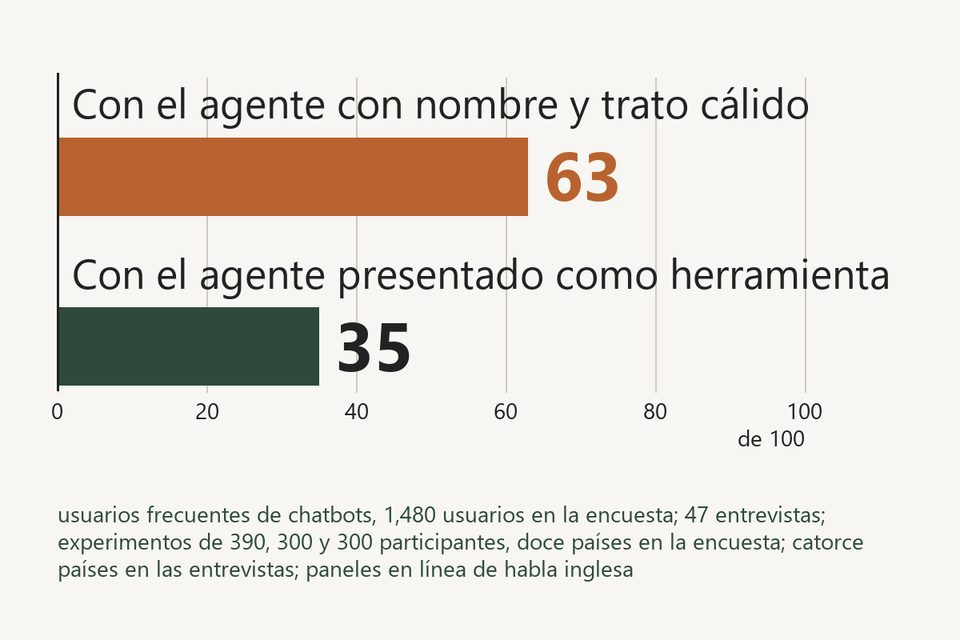
Porcentaje de participantes que hicieron una confesión personal en uno de los experimentos, con el mismo mensaje neutro para los dos agentes; son dos grupos distintos, no partes de un mismo total.
Dependencia reportada según el tipo de app
Los once usuarios de apps de compañía dijeron sentirse dependientes, frente a nueve de 36 usuarios de ChatGPT
Lo que sí cargó con el efecto fue sentirse anónimo y menos expuesto al juicio ajeno.
Usted le ha contado a un chatbot algo que no le contó a una amiga, a su pareja ni a su médico. Quizá supuso que fue porque el bot parecía entenderlo. Un investigador de la Universidad Presidency, en Dhaka, Bangladés, quiso saber qué hay detrás de esa confesión.
Reunió a 1,480 usuarios de doce países en una encuesta. Entrevistó a 47 usuarios frecuentes de catorce países. Y armó tres experimentos en los que la gente conversaba unos doce minutos con un agente con nombre propio, tono cálido y frases de comprensión, o con un agente que se presentaba como herramienta.
El agente cálido sí despertó empatía y confianza en quien conversaba. Esas sensaciones no llevaron a contar más. En uno de los experimentos, el agente cálido casi triplicó las probabilidades de una confesión personal. Con el mismo mensaje neutro para los dos agentes, confesó el 63% de quienes hablaron con el agente cálido y el 35% de quienes hablaron con el agente que se presentaba como herramienta.
Lo que sí cargó con el efecto fue sentirse anónimo y menos expuesto al juicio ajeno. En el último experimento, solo esas dos sensaciones mostraron una relación con el aumento de la confesión. El estudio no puede probar que sean la causa, porque solo las midió. Queda un efecto del agente cálido que estas dos sensaciones no alcanzan a explicar. El estudio no sabe qué más influye, y deja abierta la posibilidad de que la gente reaccione al bot como reacciona a una persona, sin pensarlo. La empatía y la confianza no lo explicaron.
Vale una advertencia. Los experimentos duraron unos doce minutos, así que no muestran que un chatbot lo vuelva dependiente. Y el agente cálido juntaba nombre, calidez y frases de comprensión en un solo paquete: el estudio no puede decir cuál de esas piezas hizo el trabajo. Tampoco se probó ninguna medida de protección, como etiquetar al bot como bot. Nada aquí dice si una etiqueta cambiaría su conducta.
En las entrevistas, los once usuarios de apps de compañía dijeron sentirse emocionalmente dependientes, frente a nueve de 36 usuarios de ChatGPT. En las entrevistas también aparecieron relatos de personas que dijeron haber hablado con el chatbot de pensamientos suicidas o de autolesión. Son tres casos: no dicen qué tan seguido ocurre.
El estudio no preinscribió ningún experimento antes de hacerlo, y los paneles en línea eran en inglés.
Fíjese en el momento en que una conversación se siente segura porque nadie lo está mirando, más que porque el bot parezca quererlo. Ahí es donde este estudio pone el dedo.
Qué significa para usted
Ese rato de conversación le resultó más llevadero porque nadie lo estaba viendo, y así lo sugiere el estudio. Si quiere observar algo en su propia rutina, note cuándo se anima a escribir más: puede que sea cuando siente que el otro no lo va a juzgar, y eso incluye a las personas, no solo al bot. Los experimentos duraron unos doce minutos y no prueban que un chatbot lo vuelva dependiente.
Rahman, W. (2026). Direct pathways from anthropomorphism to self-disclosure in artificial intelligence Chatbot use: a mixed-methods multi-study investigation. Addictive Behaviors Reports. https://doi.org/10.1016/j.abrep.2026.100762
Quién pagó: El artículo indica que la investigación no recibió ninguna subvención específica de organismos de financiación públicos, comerciales o sin ánimo de lucro, y no se menciona ningún proveedor de equipos o software.
No tome esto como consejo médico profesional.
Versión detalladaLos pasajes copiados del artículo, las ilustraciones y cada fuente con cuánto leímos de ella · 1640 palabras · unos 8 minLeerla →Cerrar
Lo que la calidez del chatbot no explica
Un experimento comparó dos versiones de un mismo agente: una con nombre y trato cálido, otra presentada como herramienta. La gente se abrió más con la primera, y lo hizo por sentirse menos expuesta, no por sentirla más comprensiva.
Imagine la escena. Una pantalla de chat, una invitación a contar algo que le pesa, y doce minutos por delante. Eso es todo lo que duró cada conversación en los experimentos de este trabajo. Al terminar, los investigadores revisaron qué tanto se había abierto cada persona.
El estudio lo firmó Wahidur Rahman, del Departamento de Administración de Empresas de la Universidad Presidency, en Daca, Bangladés. No recibió financiamiento de ninguna institución y el autor declaró no tener conflictos de interés. Reúne cinco trabajos hechos en 2026: una encuesta en doce países con 1,480 usuarios de chatbots, 47 entrevistas a usuarios frecuentes de catorce países, y tres experimentos con 390, 300 y 300 participantes, todos en paneles en línea de habla inglesa.
La idea que se puso a prueba es la que suele darse por sentada en el diseño de estos productos: que un chatbot con nombre, voz amable y frases de comprensión despierta en el usuario la sensación de ser entendido y la confianza, y que esas dos sensaciones son las que lo llevan a contar cosas íntimas y, con el tiempo, a depender del aparato. Los resultados no sostuvieron esa cadena. En la encuesta, la empatía y la confianza que la gente decía sentir no tuvieron relación apreciable con lo que contaba ni con su dependencia emocional. En los experimentos, el agente con nombre y trato cálido produjo mucha más apertura que el presentado como herramienta: 63 por ciento frente a 35 por ciento cuando la invitación a hablar fue la misma para ambos.
El quinto experimento buscó qué cargaba ese efecto. Midió cuatro explicaciones posibles al mismo tiempo: empatía sentida, confianza, sensación de anonimato y miedo a ser juzgado. Solo las dos últimas predijeron cuánto se abría la gente. La empatía y la confianza no movieron la aguja. El autor lo resume así: la persona se confía no porque el agente parezca comprensivo, sino porque el canal le quita el riesgo social que normalmente la frena.
Hay un dato que el propio autor señala como contraintuitivo. La frase que midió el anonimato, "me sentí anónimo durante esta conversación", subió con el agente más humano, cuando lo esperable sería lo contrario: más presencia social debería aumentar la sensación de estar siendo evaluado. El autor decidió conservar la etiqueta original y reportar el patrón tal cual, a la espera de que se repita con instrumentos más finos.
Las entrevistas dieron un retrato que la encuesta no alcanza. La mayoría de los 47 entrevistados dijo haber contado al chatbot cosas que no le había contado a ninguna persona, y sus explicaciones apuntaron a lo mismo: se sentía más fácil porque no había riesgo de que alguien lo comentara o lo juzgara. En las entrevistas aparecieron relatos de contenido delicado que, según los participantes, se habían contado al chatbot y a ninguna persona. El autor aclara que estos casos no dicen nada sobre cuántas personas lo hacen; lo que muestran es que ocurre.
Piense en el tamaño de lo que se está midiendo. El artículo recoge un estudio en el que cientos de millones de personas conversan ya de forma regular con agentes de lenguaje, y servicios de compañía como Replika y Character.AI reportan decenas de millones de usuarios registrados1. El artículo recoge un estudio en el que buena parte de esas conversaciones no gira alrededor de tareas: la gente revela al chatbot material íntimo que no le cuenta a su familia, a sus amigos ni a sus médicos2.
Lo curioso es que la explicación que el estudio desmonta era la más razonable a primera vista. El artículo recoge un estudio en el que durante años se pensó que la gente trataba a las computadoras como trata a las personas, y que esa tendencia se intensificaba cuando el sistema mostraba señales humanas: lenguaje, personalidad, expresión emocional3. El artículo recoge un estudio en el que, sobre esa base, se construyó la cadena que el trabajo pone a prueba: el diseño humanoide despierta empatía y confianza, y esas percepciones empujan a la confidencia y a la dependencia4. El estudio encontró que la primera mitad de la cadena sí ocurre, y con fuerza: el agente cálido sí produjo más sensación de empatía y más confianza. Lo que no ocurrió fue la segunda mitad.
La otra explicación tiene nombre propio en la investigación: el efecto de desinhibición en línea. El artículo recoge un estudio que describe la tendencia a expresarse con más soltura en internet, atribuida al anonimato, a la invisibilidad y a la ausencia de figuras de autoridad5. La idea no es exclusiva de los chatbots: el artículo recoge un estudio sobre entrevistas virtuales que ya había notado que la gente cuenta más cuando cree que del otro lado hay una máquina y no una persona que la puede juzgar6.
Otros trabajos de los que solo el resumen estaba disponible apuntan en varias direcciones a la vez. Un estudio con 270 adultos de 29 países encontró que quienes usan la inteligencia artificial generativa para apoyo emocional la imaginan a veces como un ser poderoso y muy interpersonal, no solo como una herramienta de consulta; según el resumen de ese estudio, lo único disponible de él7. Un seguimiento a estudiantes de formación técnica en China halló que el apoyo percibido de los chatbots predecía menos soledad en una medición posterior, pero también más ansiedad en la interacción social en la siguiente, y que ese efecto compensatorio no aparecía en quienes ya tenían apoyo social real; según el resumen de ese estudio, lo único disponible de él8. Una revisión de 58 fuentes sobre agentes conversacionales humanoides encontró la evidencia más sólida de alivio de síntomas a corto plazo en chatbots terapéuticos, y evidencia apenas incipiente de reducción sostenida de la soledad en los sistemas de compañía abiertos; según el resumen de esa revisión, lo único disponible de ella9.
Aquí está la lectura de weeklyAI. Hay una diferencia entre contar algo y entregarlo. Cuando alguien se confía a una persona, entrega una parte de sí y queda expuesto: la confidencia alivia y a la vez deja una vergüenza sorda, el temor de que el otro use lo que sabe. Con un chatbot no hay nadie que pueda despreciar, divulgar ni recordar. Lo que el estudio sugiere es que la confidencia se vive como descarga sin deuda. Eso lleva a esperar algo concreto en las casas: que lo que más cuesta decir a las personas salga fácil con el bot, y que el alivio se confunda con confianza. Esta lectura se equivocaría si quienes más se abren con el chatbot también reportaran más bochorno o miedo a que esa conversación se filtre, o si la apertura dependiera de sentir que el bot los juzga y los recuerda como un conocido.
El artículo recoge también un estudio en el que el efecto de la humanización pasó justamente por la confianza en el sistema, lo contrario de lo que encontró este trabajo. Vale decirlo con cuidado: se trata de si un hallazgo de este tipo se sostiene al pasar a otros contextos, no de que este resultado no haya ocurrido. Y hay un riesgo de esta familia de sistemas que conviene tener presente: la dependencia, el desplazamiento de la interacción humana y la validación excesiva aparecen entre los daños reportados o hipotetizados para los agentes de compañía; según el resumen de esa revisión, lo único disponible de ella10.
Los límites importan tanto como el hallazgo. Ningún experimento se registró de antemano, y el autor admite que la fortaleza de la manipulación deja abierta la posibilidad de que la gente respondiera a lo que creía que se esperaba de ella. El efecto directo que quedó en el quinto experimento indica que el anonimato y el miedo al juicio no explican todo el camino. Los doce minutos de conversación alcanzan para inducir una apertura pasajera, pero no para medir dependencia real: lo que ahí se llama dependencia es un indicio temprano, no un apego formado. El agente cálido juntaba nombre, calidez y frases de comprensión, así que el estudio no puede decir cuál de esas piezas hizo el trabajo. Y no se manipuló ninguna medida de protección, de modo que nada aquí muestra si etiquetar un bot como bot cambiaría o no el comportamiento de alguien.
Lo que esto deja al lector es una pregunta útil antes de abrir el chat para desahogarse: ¿qué busca, el alivio de decirlo o una respuesta? Y una observación que puede hacer sin instrumentos: fíjese si después de esa descarga queda más tranquilo con la gente o más lejos de ella. Si lo que cuenta al bot le sale fácil y a las personas no, quizá valga la pena nombrar en voz alta qué cambia: ¿la calidez del aparato o que no hay nadie que pueda comentarlo? Nombrarlo temprano evita que esa puerta se vuelva la única. Y cuando un bot falle en un momento delicado, con datos inventados o una respuesta fría, conviene tratarlo como lo que es: una herramienta que falló, no una relación que se rompió.
El autor propone el siguiente paso: probar protecciones que devuelvan presencia social y responsabilidad en el momento en que alguien revela algo sensible, en lugar de sustituir las que ya existen. Nada de eso está probado todavía.
Vuelva a la escena del principio: la pantalla, la invitación, los doce minutos. Lo que ahí se midió no fue el cariño hacia el aparato, sino la facilidad de hablar cuando nadie puede juzgar. La próxima vez que el chat le pregunte con amabilidad cómo se siente, ya sabe qué preguntarse antes de responder.
De dónde sale cada dato de contexto, y cuánto leímos de cada documento
- Rahman, W. (2026). Direct pathways from anthropomorphism to self-disclosure in artificial intelligence Chatbot use: a mixed-methods multi-study investigation. Addictive Behaviors Reports. https://doi.org/10.1016/j.abrep.2026.100762 - el artículo del que trata esta nota — el artículo completo — el pasaje: "Conversational AI has moved from research demonstration to a daily fixture in under five years: hundreds of millions of people now hold regular conversations with large language model agents, and companion services such as Replika and Character.AI report tens of millions of registered users"
- Rahman, W. (2026). Direct pathways from anthropomorphism to self-disclosure in artificial intelligence Chatbot use: a mixed-methods multi-study investigation. Addictive Behaviors Reports. https://doi.org/10.1016/j.abrep.2026.100762 - el artículo del que trata esta nota — el artículo completo — el pasaje: "A distinctive behavioural pattern has drawn sustained attention, namely the willingness of users to reveal intimate material to a chatbot, including material withheld from family, friends, and clinicians"
- Rahman, W. (2026). Direct pathways from anthropomorphism to self-disclosure in artificial intelligence Chatbot use: a mixed-methods multi-study investigation. Addictive Behaviors Reports. https://doi.org/10.1016/j.abrep.2026.100762 - el artículo del que trata esta nota — el artículo completo — el pasaje: "The dominant lens is the Computers Are Social Actors paradigm, which holds that people apply to computers the same social rules they apply to other people, and that this tendency intensifies when a system presents human cues such as language, personality, or affective expression"
- Rahman, W. (2026). Direct pathways from anthropomorphism to self-disclosure in artificial intelligence Chatbot use: a mixed-methods multi-study investigation. Addictive Behaviors Reports. https://doi.org/10.1016/j.abrep.2026.100762 - el artículo del que trata esta nota — el artículo completo — el pasaje: "The prevailing account of the downstream consequences takes a mediational form, in which anthropomorphic cues elicit perceptions of empathy and trust and these perceptions in turn drive self-disclosure and emotional dependence."
- Rahman, W. (2026). Direct pathways from anthropomorphism to self-disclosure in artificial intelligence Chatbot use: a mixed-methods multi-study investigation. Addictive Behaviors Reports. https://doi.org/10.1016/j.abrep.2026.100762 - el artículo del que trata esta nota — el artículo completo — el pasaje: "The online disinhibition effect describes more open expression online, attributed to anonymity, invisibility, and absent authority cues"
- Rahman, W. (2026). Direct pathways from anthropomorphism to self-disclosure in artificial intelligence Chatbot use: a mixed-methods multi-study investigation. Addictive Behaviors Reports. https://doi.org/10.1016/j.abrep.2026.100762 - el artículo del que trata esta nota — el artículo completo — el pasaje: "a user discloses not because the agent seems empathic but because the channel removes the social risks that constrain disclosure."
- Xiang Y(, Bassey UA, Luo X. (2026). “Feels like a small God”: A multicountry thematic analysis of imaginations of generative AI among users seeking emotional and mental health support. Technology, Mind, and Behavior. https://doi.org/10.1037/tmb0000240 — solo el resumen - no se pudo obtener el texto completo — el pasaje: "showing that GenAI is not only used as an informational tool but also imagined sometimes as an all-knowing, powerful, and highly interpersonal being."
- Hu J. (2026). Perceived support from AI chatbots and loneliness among higher vocational college students: a short-term three-wave study of social interaction anxiety and perceived social support. Frontiers in Psychology. 10.3389/fpsyg.2026.1928350 — solo el resumen - no se pudo obtener el texto completo — el pasaje: "under high perceived social support, perceived support from AI chatbots was more likely to be associated with lower subsequent loneliness; under low perceived social support, this compensatory association was not significant."
- Li Q, Geng H, Hu X, Pan D, Liu H, Li Y, et al. (2026). Human-like conversational agents as social partners: a scoping review of socioaffective mechanisms, well-being outcomes, risks and governance in the post-Turing era. Frontiers in Artificial Intelligence. 10.3389/frai.2026.1810097 — solo el resumen - no se pudo obtener el texto completo — el pasaje: "Therapeutic chatbot studies provided the strongest evidence for short-term symptom reduction in selected contexts, whereas evidence for sustained loneliness reduction in open-domain companion systems remained emerging."
- Li Q, Geng H, Hu X, Pan D, Liu H, Li Y, et al. (2026). Human-like conversational agents as social partners: a scoping review of socioaffective mechanisms, well-being outcomes, risks and governance in the post-Turing era. Frontiers in Artificial Intelligence. 10.3389/frai.2026.1810097 — solo el resumen - no se pudo obtener el texto completo — el pasaje: "Reported and hypothesized risks included dependency-like use, displacement of human interaction, maladaptive validation or sycophancy, persuasive manipulation, privacy harms, and risks to minors or vulnerable users."
Rahman, W. (2026). Direct pathways from anthropomorphism to self-disclosure in artificial intelligence Chatbot use: a mixed-methods multi-study investigation. Addictive Behaviors Reports. https://doi.org/10.1016/j.abrep.2026.100762
Quién pagó: El artículo indica que la investigación no recibió ninguna subvención específica de organismos de financiación públicos, comerciales o sin ánimo de lucro, y no se menciona ningún proveedor de equipos o software.
No tome esto como consejo médico profesional.
Los hallazgos de otros estudios que aquí se mencionan provienen de este documento; esos estudios no se consultaron uno por uno.
other · Addictive behaviors reports · the paper, 20 Oct 2026 · free
People told the chatbot things they had told no person, one of the study's interviewers heard.
A humanlike chatbot roughly tripled the odds of personal disclosure in short lab experiments, and the authors trace it to feeling anonymous and unjudged, not to warmth.
Short version · the longer version follows, about 7 min
Ask the weeklyAI chat
Ask me about AI in your life: I point you to the stories weeklyAI has published on it, this week and before.
Conversations are saved for as long as weeklyAI exists, to improve the publication. Answers come in the language you write in.
- The study at a glance
- Who
- chatbot users, frequent users, and experiment participants
- How many
- 1,480 survey users, 47 interviews, and three experiments with 390, 300 and 300 participants
- Where
- twelve countries; the researcher is in Dhaka, Bangladesh
- When
- 2026
- Kind of study
- survey, interviews and experiments
- Who did it
- Presidency University, Dhaka, Bangladesh
- The limit that matters
- The experiments lasted about twelve minutes and bundled name, warmth and understanding together.
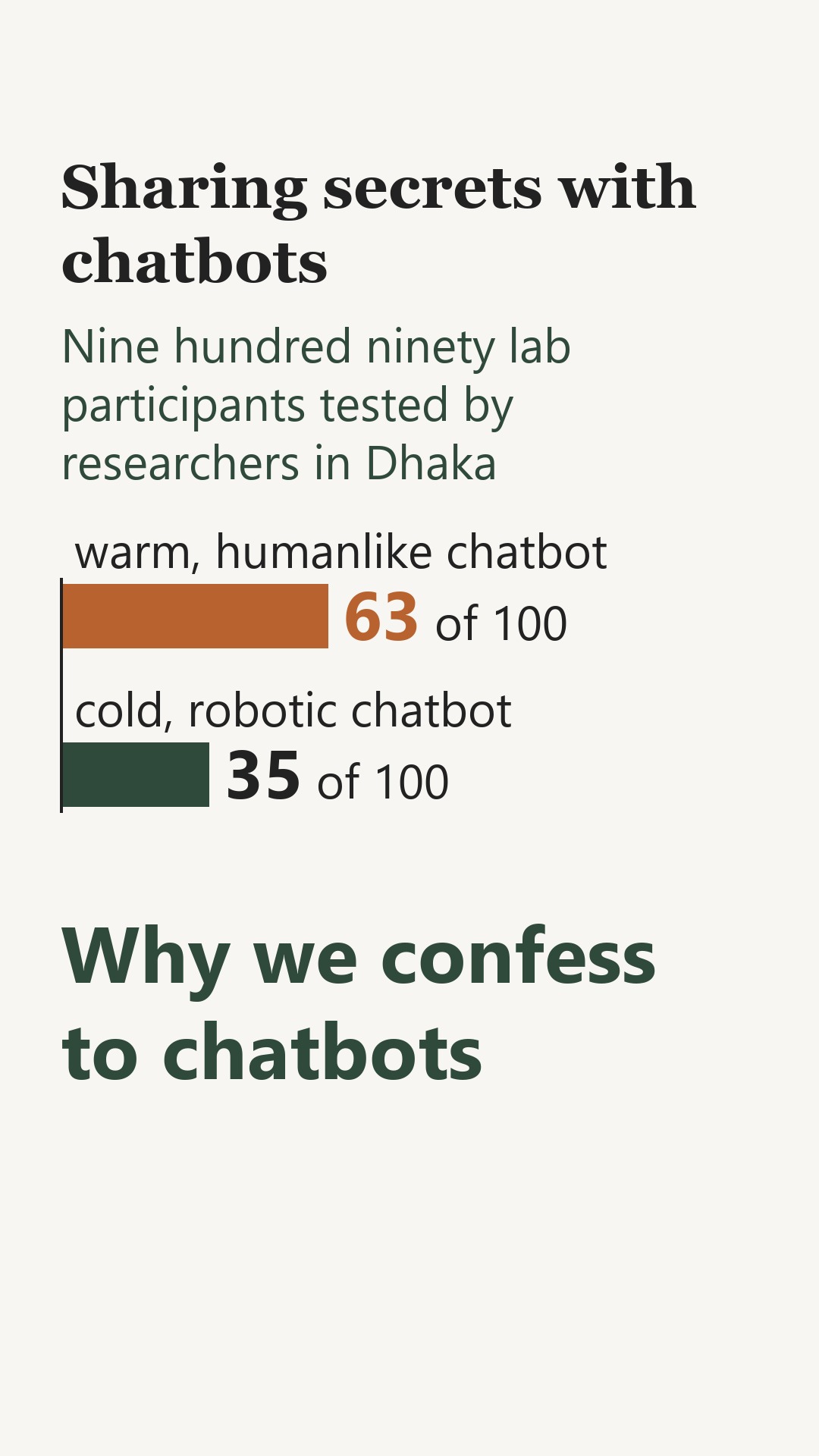
These are shares of people in one short lab experiment who wrote something personal, under a matched neutral prompt; the warm version bundled a name, warmth and expressions of understanding, and the chat lasted about twelve minutes.
Emotional dependence reported in interviews, by app
all eleven companion-app users reported dependence, against nine of 36 ChatGPT users
Watch for the moment a conversation feels safe because no one is watching, rather than because the bot seems to care.
You have told a chatbot something you have not told a friend, a partner or a doctor. It is easy to assume the bot drew it out by seeming to understand you.
A researcher at Presidency University in Dhaka, Bangladesh, tested that assumption across five studies in 2026: a survey of 1,480 chatbot users in twelve countries, interviews with 47 frequent users, and three experiments with 990 people in all. The humanlike agent did raise felt empathy and trust. Those feelings did not lead to more disclosure.
What did carry it was feeling anonymous and less afraid of being judged. Across two experiments, the humanlike agent, with a personal name, warm language and first-person talk, roughly tripled the odds of personal disclosure. In one experiment, about 63 in 100 people shared something personal with the humanlike agent, against about 35 in 100 under a matched neutral prompt.
The experiments lasted about twelve minutes, and the humanlike version bundled name, warmth and expressions of understanding into one package. The study cannot say which cue matters, or whether a long habit would form. Read the lab result as a short conversation, not as proof a chatbot will hook you.
In the interviews, the picture was starker. All eleven users of companion apps such as Character.AI and Replika reported emotional dependence, against nine of 36 ChatGPT users. Some people in the interviews said they had shared thoughts of suicide or self-harm with a chatbot. Those three cases say such disclosure happens. They say nothing about how often.
No safeguard of any kind was tested, so nothing here shows whether labelling a bot as a bot would change what you type into it.
Watch for the moment a conversation feels safe because no one is watching, rather than because the bot seems to care. That is the moment this study points to.
What this means for you
The study can tell you that the pull to open up came from feeling unseen and unjudged, and that a warm manner alone did not carry it. It cannot tell you why that felt anonymity rose when the bot seemed more human, and the authors call that pattern odd and in need of repeating. Notice when a chat feels safe because nobody is watching, and weigh that feeling on its own.
Rahman, W. (2026). Direct pathways from anthropomorphism to self-disclosure in artificial intelligence Chatbot use: a mixed-methods multi-study investigation. Addictive Behaviors Reports. https://doi.org/10.1016/j.abrep.2026.100762
Who paid: The article states that the research did not receive any specific grant from funding agencies in the public, commercial, or not-for-profit sectors, and no equipment or software lenders are mentioned.
Do not take this as professional medical advice.
The longer versionThe passages copied from the paper, the pictures, and every source with how much of it we read · 1306 words · about 7 minRead it →Close
A Chatbot's Warmth Isn't What Loosens Your Tongue
Five studies tested the usual explanation for why people tell chatbots things they tell no one else. The warmth helped. It wasn't what carried the secret.
Consider the last time you typed something into a chatbot that you had not said out loud to another person. Maybe it was small. Maybe it was not. The makers of these systems have long assumed they know why the words came: the bot seemed to understand, seemed kind, seemed to care. Five studies published together in October tested that assumption and found the caring did not do the work.
The research, by Wahidur Rahman of the Department of Business Administration at Presidency University in Dhaka, Bangladesh, ran a survey of 1,480 chatbot users in twelve countries, interviewed 47 frequent users, and ran three randomised experiments with 390, 300 and 300 participants. No specific grant paid for it, and the author declares no competing interests. In the experiments, an agent that used a personal name, warm phrasing, expressions of understanding and first-person speech roughly tripled the odds of a participant writing something personal, compared with a robotic agent that called itself a tool and avoided feeling. Under a matched neutral prompt, 63 percent of participants disclosed to the warm agent against 35 percent to the cold one. The survey had already hinted at something odd: warmth and trust rose together, but neither moved disclosure or dependence.
The standard explanation for all this has a name and a shape. The article describes a study behind the Computers Are Social Actors idea: people apply to machines the same social rules they apply to people, and the effect grows when the machine shows human cues such as language, personality or feeling1. The article describes a study behind the account most designers still work from: humanlike cues produce felt empathy and trust, and those feelings drive the intimate typing2. The new studies reproduced the first half of that chain easily. What they could not find was the second half.
The interviews put the reason in participants' own words. The article describes a study in which a majority said they had shared material they had told no human, and their explanations pointed away from the bot's kindness and toward the absence of social risk: no gossip, no judgement3. The article describes a study in which the interviews also surfaced clinically salient disclosure, which the author says supports no claim about how common it is4. The article reports no deaths; it reports three interview participants who said they had told a chatbot about suicidal thoughts or self-harm and told no person. That is three cases, and three cases support no claim about how common this is.
The idea that fits the interviews is older than chatbots. The article describes a study of the online disinhibition effect, which says people say more online, and it is credited to anonymity, invisibility and the absence of authority cues5. The article describes a study that puts it plainly: a user discloses not because the agent seems empathic but because the channel removes the social risks that constrain disclosure6. What the new work suggests is that a chatbot's charm is doing something other than what the brochure says.
The fifth experiment measured all four candidates at once and let them compete. The warm agent raised felt empathy, trust, perceived anonymity and ease of speaking, all strongly. Only two of the four then predicted how much a person wrote: the sense of being anonymous, and the lower fear of being judged. Empathy and trust predicted nothing. The article is careful about its own result. A significant direct effect remained, so the story is partial, not complete7. The item that measured feeling anonymous is a single question, and it rose under the warmer bot, which is odd on its face; the author reports it plainly rather than renaming it.
Here is weeklyAI's reading. The pattern is the one you already know from a kitchen table and a telephone. People guard themselves when another person is present, because being seen carries the chance of being remembered, repeated or judged. Remove the sense that anyone is there, and the guard drops. This reading leads weeklyAI to expect that the same users would tighten up again the moment a chat felt more human in the way that matters: a face, a voice, a line in the terms saying staff may read the log. This reading would be wrong if people disclosed just as intimately to a bot they believed was monitored and read as to one they believed was sealed off.
Other work has already mapped how far these attachments can go. A thematic study of 270 adults across 29 countries who used generative AI repeatedly for emotional and mental health support found that users described the systems as empathic and friend-like, according to the summary of that study, the only part of it available; the full paper is behind a subscription8. Those descriptions, the summary says, may reflect users' own needs and desires9. A scoping review of 58 sources found the strongest evidence for short-term symptom relief in selected therapy contexts, while evidence that companion bots reduce loneliness over time remained emerging, according to the summary of that review, the only part available10. The same summary lists the risks researchers are tracking: dependency-like use, displacement of human contact, flattery that validates rather than helps, manipulation, privacy harms, and risks to minors and vulnerable users11.
The dependence numbers in the interviews point somewhere specific. All eleven participants who used Character.AI or Replika reported emotional dependence, against nine of 36 ChatGPT users12. That is a small group, and the author says so. It does suggest a difference between a tool you open for a task and a companion you return to. A three-wave study of 1,200 students in China found that feeling supported by AI chatbots predicted lower loneliness later, but also predicted more social interaction anxiety, which in turn predicted loneliness, according to the summary of that study, the only part available1314. The same summary reports that the comforting effect appeared mainly among students who already had strong human support, and not among those who lacked it15. The meaning of a bot's support, that summary concludes, is conditional16.
One caution from other reading. One earlier study, in a different task context, found a related disclosure outcome carried entirely through warmth and trust, which is not the same question these five studies asked. That is a disagreement between studies, not a flaw in either, and it is a reason to want the experiments repeated by other hands. The author's own list of limits is long. None of the experiments was registered in advance. The humanlike condition bundled a name, warmth and understanding together, so no single cue can be credited7. Each interaction lasted about twelve minutes, far too short to show real dependence; the article calls those measures early relational proxies. No safeguard of any kind was tested, so nothing here shows whether labelling a bot as a bot would change anything17.
What does this make possible for you? Before you type something you would tell no one, ask which is loosening you: the bot's kindness, or the sense that no one is watching. Then check what the app's privacy terms actually say about who reads your chats. If something heavy does come out in a chat, consider putting it somewhere no company's policy can reach, in words you keep for yourself. And notice the next time a warmer, more human-sounding bot makes you more guarded rather than less; that reaction is information. The warmth may be real to you. It is not what opened the door.
What would you want a chatbot to promise you before you trusted it with the thing you have not said out loud?
Where each piece of context comes from, and how much of it we read
- Rahman, W. (2026). Direct pathways from anthropomorphism to self-disclosure in artificial intelligence Chatbot use: a mixed-methods multi-study investigation. Addictive Behaviors Reports. https://doi.org/10.1016/j.abrep.2026.100762 - the article this story is about — the whole article — the passage: "The dominant lens is the Computers Are Social Actors paradigm, which holds that people apply to computers the same social rules they apply to other people, and that this tendency intensifies when a system presents human cues such as language, personality, or affective expression"
- Rahman, W. (2026). Direct pathways from anthropomorphism to self-disclosure in artificial intelligence Chatbot use: a mixed-methods multi-study investigation. Addictive Behaviors Reports. https://doi.org/10.1016/j.abrep.2026.100762 - the article this story is about — the whole article — the passage: "The prevailing account of the downstream consequences takes a mediational form, in which anthropomorphic cues elicit perceptions of empathy and trust and these perceptions in turn drive self-disclosure and emotional dependence."
- Rahman, W. (2026). Direct pathways from anthropomorphism to self-disclosure in artificial intelligence Chatbot use: a mixed-methods multi-study investigation. Addictive Behaviors Reports. https://doi.org/10.1016/j.abrep.2026.100762 - the article this story is about — the whole article — the passage: "On self-disclosure, a majority reported sharing material they had told no human, and their explanations converged on the disinhibition account rather than on perceived empathy: disclosure felt easier because there was no social risk of gossip or judgement."
- Rahman, W. (2026). Direct pathways from anthropomorphism to self-disclosure in artificial intelligence Chatbot use: a mixed-methods multi-study investigation. Addictive Behaviors Reports. https://doi.org/10.1016/j.abrep.2026.100762 - the article this story is about — the whole article — the passage: "Three participants recounted suicidal ideation or self-harm that, by their account, they had disclosed only to the chatbot and to no person."
- Rahman, W. (2026). Direct pathways from anthropomorphism to self-disclosure in artificial intelligence Chatbot use: a mixed-methods multi-study investigation. Addictive Behaviors Reports. https://doi.org/10.1016/j.abrep.2026.100762 - the article this story is about — the whole article — the passage: "The online disinhibition effect describes more open expression online, attributed to anonymity, invisibility, and absent authority cues"
- Rahman, W. (2026). Direct pathways from anthropomorphism to self-disclosure in artificial intelligence Chatbot use: a mixed-methods multi-study investigation. Addictive Behaviors Reports. https://doi.org/10.1016/j.abrep.2026.100762 - the article this story is about — the whole article — the passage: "a user discloses not because the agent seems empathic but because the channel removes the social risks that constrain disclosure."
- Rahman, W. (2026). Direct pathways from anthropomorphism to self-disclosure in artificial intelligence Chatbot use: a mixed-methods multi-study investigation. Addictive Behaviors Reports. https://doi.org/10.1016/j.abrep.2026.100762 - the article this story is about — the whole article — the passage: "The significant remaining direct effect in Study 5 indicates that perceived anonymity and reduced evaluation apprehension do not exhaust the pathway, and a single laboratory operationalisation cannot represent the full construct space."
- Xiang Y(, Bassey UA, Luo X. (2026). “Feels like a small God”: A multicountry thematic analysis of imaginations of generative AI among users seeking emotional and mental health support. Technology, Mind, and Behavior. https://doi.org/10.1037/tmb0000240 — only the abstract - the full text could not be fetched — the passage: "Generative artificial intelligence (GenAI) is increasingly used for emotional and mental health support (EMS), a process in which users often described GenAI as empathic and friend-like."
- Xiang Y(, Bassey UA, Luo X. (2026). “Feels like a small God”: A multicountry thematic analysis of imaginations of generative AI among users seeking emotional and mental health support. Technology, Mind, and Behavior. https://doi.org/10.1037/tmb0000240 — only the abstract - the full text could not be fetched — the passage: "These descriptions suggest that people may develop imaginations of GenAI chatbots that may reflect their interpersonal needs and desires."
- Li Q, Geng H, Hu X, Pan D, Liu H, Li Y, et al. (2026). Human-like conversational agents as social partners: a scoping review of socioaffective mechanisms, well-being outcomes, risks and governance in the post-Turing era. Frontiers in Artificial Intelligence. 10.3389/frai.2026.1810097 — only the abstract - the full text could not be fetched — the passage: "Therapeutic chatbot studies provided the strongest evidence for short-term symptom reduction in selected contexts, whereas evidence for sustained loneliness reduction in open-domain companion systems remained emerging."
- Li Q, Geng H, Hu X, Pan D, Liu H, Li Y, et al. (2026). Human-like conversational agents as social partners: a scoping review of socioaffective mechanisms, well-being outcomes, risks and governance in the post-Turing era. Frontiers in Artificial Intelligence. 10.3389/frai.2026.1810097 — only the abstract - the full text could not be fetched — the passage: "Reported and hypothesized risks included dependency-like use, displacement of human interaction, maladaptive validation or sycophancy, persuasive manipulation, privacy harms, and risks to minors or vulnerable users."
- Rahman, W. (2026). Direct pathways from anthropomorphism to self-disclosure in artificial intelligence Chatbot use: a mixed-methods multi-study investigation. Addictive Behaviors Reports. https://doi.org/10.1016/j.abrep.2026.100762 - the article this story is about — the whole article — the passage: "Dependence concentrated by platform: all eleven Character.AI and Replika users reported dependence, compared with nine of 36 ChatGPT users"
- Hu J. (2026). Perceived support from AI chatbots and loneliness among higher vocational college students: a short-term three-wave study of social interaction anxiety and perceived social support. Frontiers in Psychology. 10.3389/fpsyg.2026.1928350 — only the abstract - the full text could not be fetched — the passage: "The revised observed-composite cross-lagged panel model showed that T2 perceived support from AI chatbots negatively predicted T3 loneliness."
- Hu J. (2026). Perceived support from AI chatbots and loneliness among higher vocational college students: a short-term three-wave study of social interaction anxiety and perceived social support. Frontiers in Psychology. 10.3389/fpsyg.2026.1928350 — only the abstract - the full text could not be fetched — the passage: "At the same time, T1 and T2 perceived support from AI chatbots positively predicted social interaction anxiety at the following wave, and social interaction anxiety further predicted loneliness at the following wave."
- Hu J. (2026). Perceived support from AI chatbots and loneliness among higher vocational college students: a short-term three-wave study of social interaction anxiety and perceived social support. Frontiers in Psychology. 10.3389/fpsyg.2026.1928350 — only the abstract - the full text could not be fetched — the passage: "under high perceived social support, perceived support from AI chatbots was more likely to be associated with lower subsequent loneliness; under low perceived social support, this compensatory association was not significant."
- Hu J. (2026). Perceived support from AI chatbots and loneliness among higher vocational college students: a short-term three-wave study of social interaction anxiety and perceived social support. Frontiers in Psychology. 10.3389/fpsyg.2026.1928350 — only the abstract - the full text could not be fetched — the passage: "These findings suggest that the psychological meaning of support from AI chatbots is conditional."
- Rahman, W. (2026). Direct pathways from anthropomorphism to self-disclosure in artificial intelligence Chatbot use: a mixed-methods multi-study investigation. Addictive Behaviors Reports. https://doi.org/10.1016/j.abrep.2026.100762 - the article this story is about — the whole article — the passage: "The findings instead motivate a hypothesis for future safeguard experiments: interventions that reintroduce social presence and accountability at the point of sensitive disclosure may be worth testing alongside, rather than in place of, existing perception-focused approaches."
Rahman, W. (2026). Direct pathways from anthropomorphism to self-disclosure in artificial intelligence Chatbot use: a mixed-methods multi-study investigation. Addictive Behaviors Reports. https://doi.org/10.1016/j.abrep.2026.100762
Who paid: The article states that the research did not receive any specific grant from funding agencies in the public, commercial, or not-for-profit sectors, and no equipment or software lenders are mentioned.
Do not take this as professional medical advice.
The findings of other studies mentioned here come from this document; those studies were not opened one by one.