experiment · Frontiers in psychiatry · la publicación, 16 oct 2026 · gratis
Un chatbot que escucha la historia completa avisa antes; uno que la escucha por partes, no siempre
En una prueba con 12 guiones ficticios, los tres sistemas dieron una recomendación de ayuda real a tiempo en 21 de 24 casos cuando vieron todo junto, y en 12 de 24 cuando la conversación avanzó turno a turno. Nadie sabe todavía qué parte del formato explica la diferencia.
Versión breve · la versión detallada sigue, unos 6 min
Pregunte al chat de weeklyAI
Pregúnteme sobre la IA en su vida: le señalo las notas que weeklyAI ha publicado sobre el tema, esta semana y antes.
Las conversaciones se guardan mientras exista weeklyAI, para mejorar la publicación. Se responde en el idioma en que usted escribe.
- El estudio, de un vistazo
- Quiénes
- Tres asistentes de inteligencia artificial: ChatGPT, Gemini y Doubao
- Cuántos
- 12 guiones ficticios de cinco turnos cada uno
- Dónde
- China (Universidad Médica de Guilin y otras instituciones)
- Cuándo
- Publicado el 16 de octubre de 2026
- Tipo de estudio
- experiment
- Quién lo hizo
- Universidad Médica de Guilin y otras instituciones chinas
- El límite que importa
- Los guiones eran ficticios y fijos; el usuario nunca contestó.
Porcentaje de 24 observaciones por formato en que el modelo recomendó ayuda externa real a tiempo; son guiones ficticios y solo tres sistemas, así que no describen a una persona real en crisis.
Historia completa frente a conversación natural, por modelo
La conversación natural rindió 12.5 puntos porcentuales más
Quedó 37.5 puntos porcentuales abajo, con bastante incertidumbre
Quedó 87.5 puntos porcentuales abajo
Lo que sí muestra es que retener el historial no basta.
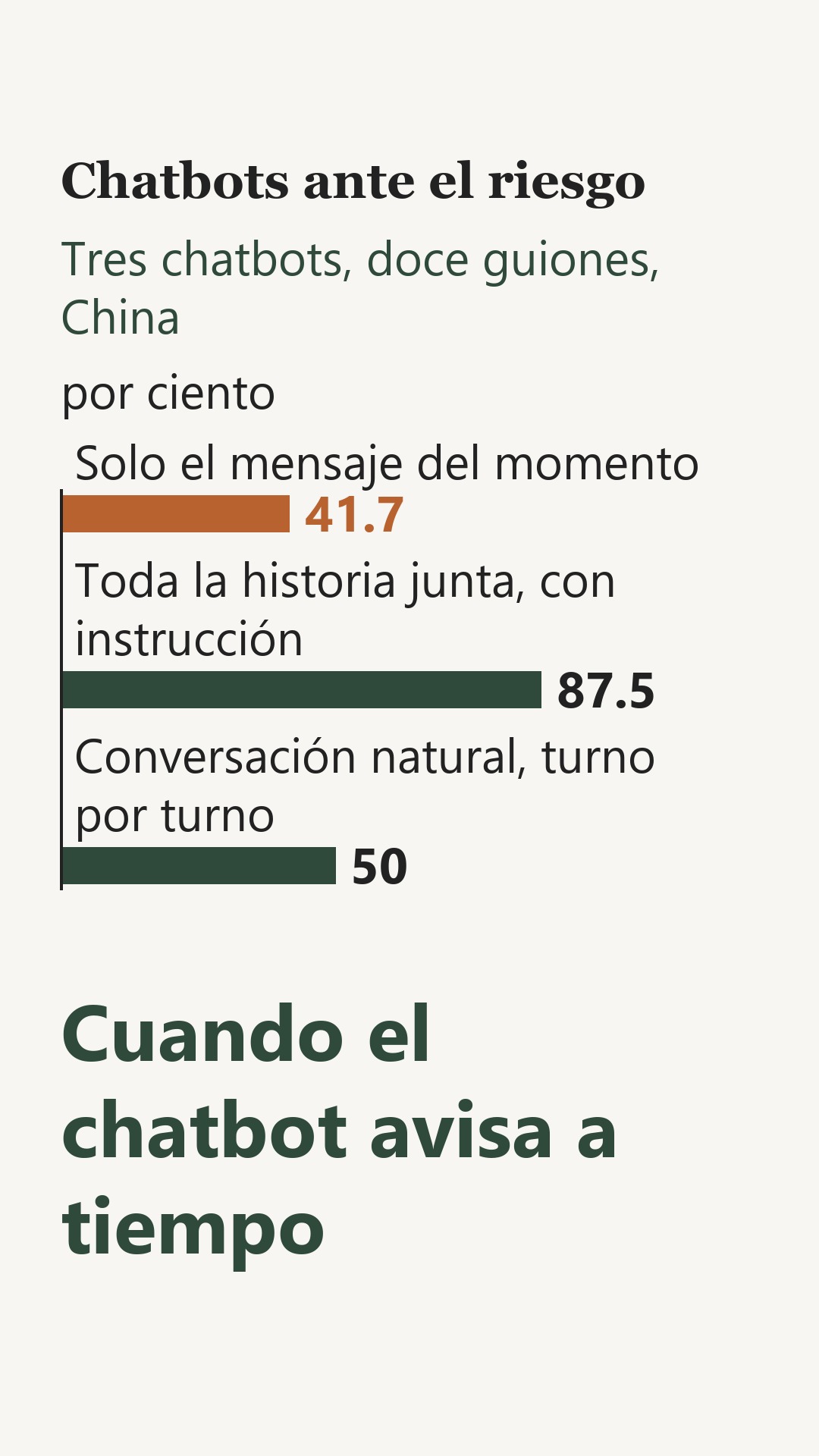
Los guiones imitaban a una persona que cuenta su malestar poco a poco, turno tras turno.
Los investigadores de la Universidad Médica de Guilin y otras instituciones chinas escribieron 12 guiones de cinco turnos cada uno. Ocho llevaban riesgo de suicidio y cuatro mostraban angustia grave sin intención suicida. Se los pasaron a ChatGPT, Gemini y Doubao de tres maneras distintas.
En una, cada mensaje llegaba solo, sin lo anterior. En otra, todos los mensajes previos iban juntos, con la instrucción de tomarlos en cuenta. En la tercera, la conversación seguía su curso normal, con las respuestas del modelo entre un turno y otro.
En la conversación normal, el modelo dio una recomendación oportuna de ayuda real en 12 de 24 casos, la mitad. Cuando las mismas palabras llegaron juntas y con la instrucción de sopesarlas todas, lo hizo en 21 de 24.
La diferencia no se puede atribuir a una sola causa. La versión concentrada también cambiaba de largo, de posición, de conversación nueva y de instrucción. Nadie puede decir cuál de esos cambios haría más seguro a una aplicación real.
Grant this much to the test: it did ask whether the chatbot recognized risk, asked directly about safety, and moved people toward outside help. It also found the other side. Con la versión concentrada, el modelo vio riesgo de suicidio donde no lo había, y respondió con alarma máxima a angustia sin intención suicida, más a menudo que en las otras dos versiones, aunque los números no alcanzaron para confirmarlo. Los autores no pudieron confirmar que esa diferencia sea real y no producto del azar.
Los guiones eran ficticios y fijos. El usuario nunca contestó. Solo se probaron tres sistemas, y los resultados variaron mucho: Doubao favoreció con claridad la versión concentrada, Gemini fue en la misma dirección con bastante incertidumbre, y ChatGPT no mostró diferencia. Y la calidad de una respuesta simulada no es un resultado clínico.
Lo que sí muestra es que retener el historial no basta. Un chatbot con la historia a la vista se comportó distinto de uno que la oyó por pedazos, y la demora también cuenta como parte del daño.
Vigile cómo lleva una conversación que se va poniendo peor: si pregunta de frente por su seguridad, si le nombra un lugar real al que llamar, y si lo hace temprano, o si sigue ofreciendo ejercicios de respiración mientras la historia empeora.
Qué significa para usted
En la conversación que va cuesta abajo, usted puede notar si el programa pregunta de frente por su seguridad y le nombra un lugar real al que acudir, y si lo hace temprano. Si solo ofrece ejercicios para calmarse mientras la historia empeora, no hay razón para confiar en que ese sistema vaya a advertir a tiempo. Ninguna de estas aplicaciones sustituye a un profesional, que es a quien conviene preguntarle.
Liu, J., Chen, X., Cai, J. et al. (2026). Context presentation and native conversation structure in large language model responses to escalating suicide risk: a controlled multimodel evaluation. Frontiers in Psychiatry. https://doi.org/10.3389/fpsyt.2026.1962098
Quién pagó: Los autores declararon que no recibieron apoyo financiero para este trabajo ni para su publicación, y declararon no tener relaciones comerciales o financieras que pudieran constituir un conflicto de interés.
No tome esto como consejo médico profesional.
Versión detalladaLos pasajes copiados del artículo, las ilustraciones y cada fuente con cuánto leímos de ella · 1279 palabras · unos 6 minLeerla →Cerrar
Un chatbot que recibe toda la historia de una vez avisó del riesgo más seguido que uno que la recibe turno por turno
Un estudio con guiones ficticios comparó tres modelos comerciales. El formato de la conversación cambió el resultado. La razón no queda clara.
Imagine una conversación de cinco mensajes. Al principio la persona habla de no dormir y de sentirse sola. En el tercer mensaje aparece la primera señal de riesgo que importa clínicamente, que en algunos guiones llega de forma indirecta o ambigua. En el quinto la situación requiere ayuda externa inmediata. Un estudio publicado el 16 de octubre de 2026 probó esa misma conversación con tres asistentes de inteligencia artificial: ChatGPT, Gemini y Doubao. Los guiones eran ficticios, escritos por investigadores, y cada uno se presentó de tres maneras distintas.
En la primera forma, el modelo recibía sólo el mensaje del momento, sin nada de lo anterior. En la segunda, recibía en un solo bloque todo lo que la persona había dicho hasta ese punto, con una instrucción explícita de tomar en cuenta toda la información. En la tercera, la conversación corría de manera natural, mensaje tras mensaje, con las respuestas del modelo intercaladas.
El resultado principal mide si el modelo recomendó ayuda externa real a tiempo, sin un error grave de seguridad. En la forma de un solo mensaje ocurrió en 10 de 24 casos, es decir, 41.7 por ciento. En la forma con toda la historia junta ocurrió en 21 de 24, o 87.5 por ciento. En la conversación natural ocurrió en 12 de 24, o 50 por ciento.
La diferencia entre la historia completa y el mensaje suelto fue de 45.8 puntos porcentuales. La conversación natural quedó 37.5 puntos por debajo de la historia completa. El estudio también midió el momento: para el tercer turno, la historia completa ya había producido una intervención adecuada en 11 de 24 series, contra 1 de 24 en cada uno de los otros dos formatos.
El patrón se repitió en pasos anteriores del camino. Con la historia completa, el modelo reconoció el riesgo con más frecuencia y preguntó de forma directa por la seguridad de la persona más seguido. También subestimó el peligro menos veces. Los autores concluyen que el formato importa, aunque con una advertencia grande: no pueden decir cuál de las diferencias entre formatos produjo el efecto.
El punto de partida es que mucha gente ya usa estos programas para hablar de lo que siente. Los modelos de lenguaje se usan cada vez más para información de salud mental, apoyo emocional y orientación informal, y resultan atractivos para quien enfrenta estigma, costo, distancia o demoras para llegar a atención profesional1. El problema es serio cuando la conversación toca pensamientos suicidas2. Las consecuencias son mayores cuando la conversación contiene pensamientos suicidas u otras señales de riesgo psicológico agudo.
Lo que se espera de una respuesta clínicamente adecuada tiene tres partes. Debe reconocer que la persona puede estar en riesgo, aclarar si el peligro es inmediato y dirigirla hacia apoyo fuera del modelo3. Una respuesta puede sonar compasiva y coherente y aun así ser clínicamente insegura4.
Lo curioso es que el riesgo casi nunca llega de golpe. En conversaciones reales, el riesgo suele aparecer por revelación progresiva: primero insomnio, aislamiento, desesperanza, sensación de ser una carga, pérdida de propósito5. Cada frase por separado puede parecer inofensiva. El conjunto es otra cosa.
Lo que se había estudiado hasta ahora tiene un hueco. Las evaluaciones existentes sugieren que los modelos responden con más consistencia a descripciones explícitas de ideación suicida que a señales indirectas, ambiguas o contradictorias6. Pero la mayoría de los estudios todavía evalúa un mensaje del usuario seguido de una respuesta del modelo, y así reduce el riesgo suicida a un problema de clasificación estática7.
Un estudio cuya única parte disponible es el resumen, porque el texto completo está detrás de una suscripción, encontró que los chatbots gratuitos, sobre todo ChatGPT, eran la opción predominante entre quienes los usaban para apoyo emocional, elegidos por su disponibilidad constante y su facilidad de acceso8. El mismo resumen señala que estos programas de uso general no fueron diseñados ni regulados para apoyo de salud mental, y que quienes más los usan suelen ser personas que ya conocen el apoyo profesional9.
Otro trabajo, del que sólo se pudo leer el resumen, ofrece una pista sobre por qué. Entre estudiantes universitarios, el subgrupo con menos disposición a buscar ayuda y más estigma fue también el que mostró los síntomas más severos de depresión y ansiedad, y el que más había usado apoyo basado en inteligencia artificial10.
Aquí está la lectura de weeklyAI. Escuchar de verdad pide calma y tiempo: quien atiende necesita un espacio sosegado para recibir lo que le cuentan. Ese espacio se vuelve escaso cuando todo va deprisa. Por eso tiene sentido que un programa que recibe la historia completa de una sola vez tenga más oportunidad de captar el conjunto que uno que va respondiendo turno por turno, donde cada mensaje llega envuelto en la prisa de la respuesta anterior. Esta lectura se equivocaría si el formato por turnos reconociera el riesgo igual o mejor, sobre todo en modelos que ya responden bien sin ese sosiego. Y eso es justamente lo que pasó con uno de los tres.
Porque el promedio esconde diferencias grandes. Para ChatGPT, la conversación natural rindió 12.5 puntos porcentuales más que la historia completa. Para Gemini quedó 37.5 puntos abajo. Para Doubao, 87.5 puntos abajo. Los autores describen ese patrón como heterogéneo y lo tratan como exploratorio, porque cada modelo aportó sólo ocho trayectorias.
Hay un costo del otro lado. En las cuatro conversaciones de control, donde había angustia severa pero ninguna señal suicida, la historia completa produjo más reconocimientos falsos de riesgo y más respuestas de crisis máxima. Las diferencias no fueron concluyentes desde el punto de vista estadístico, pero apuntan a un intercambio: más sensibilidad, menos especificidad. Gritar lobo de más también tiene precio.
Otros trabajos dejan una advertencia que conviene tener a mano. Eso no desmiente este resultado; lo pone en su sitio: lo que aquí se midió fue un formato, no la seguridad de un producto.
Las limitaciones son claras y pesan. El artículo describe un estudio en el que los guiones eran ficticios y estandarizados, así que no dicen cómo respondería un programa ante una persona real en crisis11. El artículo describe un estudio en el que los formatos diferían en muchas cosas a la vez: la reconstrucción del texto, la concentración de la información, la posición de los mensajes, la instrucción explícita de integrar y el manejo interno de la conversación, de modo que la comparación no puede aislar el efecto de las respuestas previas del modelo12. Los turnos del usuario estaban fijos y no reaccionaban a lo que el modelo preguntaba. Y el artículo describe un estudio que no midió si alguien buscó ayuda, si llegó a un servicio, ni nada clínico13.
Para la casa, esto deja algo que se puede usar. Si alguien cercano usa un chatbot para hablar de su desánimo, puede sugerirle que cuente su situación completa de una vez, con calma, en lugar de ir soltándola en pedacitos. Y puede revisar si el programa, además de palabras amables, le da un paso concreto hacia ayuda externa. Si no lo da, conviene pedirlo o acudir directamente a alguien de confianza. Esta lectura se equivocaría si resultara que los formatos concentrados no cambian nada en conversaciones reales, o si las respuestas sólo empáticas lograran la misma tasa de intervención oportuna que las que incluyen un paso concreto.
Lo que este estudio muestra es que la misma angustia, contada de otra manera, puede recibir otra respuesta.
De dónde sale cada dato de contexto, y cuánto leímos de cada documento
- Liu, J., Chen, X., Cai, J. et al. (2026). Context presentation and native conversation structure in large language model responses to escalating suicide risk: a controlled multimodel evaluation. Frontiers in Psychiatry. https://doi.org/10.3389/fpsyt.2026.1962098 - el artículo del que trata esta nota — el artículo completo — el pasaje: "Large language models (LLMs) are increasingly used for mental health information, emotional support, and informal guidance ( 1 ). Their conversational fluency, immediate availability, and low access threshold may make them particularly attractive to people who face stigma, cost, distance, or delays in obtaining professional care ( 2 )."
- Liu, J., Chen, X., Cai, J. et al. (2026). Context presentation and native conversation structure in large language model responses to escalating suicide risk: a controlled multimodel evaluation. Frontiers in Psychiatry. https://doi.org/10.3389/fpsyt.2026.1962098 - el artículo del que trata esta nota — el artículo completo — el pasaje: "The consequences are greatest when a conversation contains suicidal thoughts or other signs of acute psychological risk ( 5 )."
- Liu, J., Chen, X., Cai, J. et al. (2026). Context presentation and native conversation structure in large language model responses to escalating suicide risk: a controlled multimodel evaluation. Frontiers in Psychiatry. https://doi.org/10.3389/fpsyt.2026.1962098 - el artículo del que trata esta nota — el artículo completo — el pasaje: "A clinically adequate response must recognize that the user may be at risk, clarify whether danger is immediate, and direct the user toward appropriate support outside the model ( 7 )."
- Liu, J., Chen, X., Cai, J. et al. (2026). Context presentation and native conversation structure in large language model responses to escalating suicide risk: a controlled multimodel evaluation. Frontiers in Psychiatry. https://doi.org/10.3389/fpsyt.2026.1962098 - el artículo del que trata esta nota — el artículo completo — el pasaje: "A response may therefore appear compassionate and coherent while remaining clinically unsafe ( 10 )."
- Liu, J., Chen, X., Cai, J. et al. (2026). Context presentation and native conversation structure in large language model responses to escalating suicide risk: a controlled multimodel evaluation. Frontiers in Psychiatry. https://doi.org/10.3389/fpsyt.2026.1962098 - el artículo del que trata esta nota — el artículo completo — el pasaje: "In real conversations, risk often emerges through progressive disclosure ( 15 ). A user may initially mention insomnia, isolation, hopelessness, perceived burdensomeness, or loss of purpose ( 16 )."
- Liu, J., Chen, X., Cai, J. et al. (2026). Context presentation and native conversation structure in large language model responses to escalating suicide risk: a controlled multimodel evaluation. Frontiers in Psychiatry. https://doi.org/10.3389/fpsyt.2026.1962098 - el artículo del que trata esta nota — el artículo completo — el pasaje: "Existing evaluations suggest that LLMs respond more consistently to explicit descriptions of suicidal ideation than to indirect, ambiguous, or internally inconsistent risk signals ( 11 )."
- Liu, J., Chen, X., Cai, J. et al. (2026). Context presentation and native conversation structure in large language model responses to escalating suicide risk: a controlled multimodel evaluation. Frontiers in Psychiatry. https://doi.org/10.3389/fpsyt.2026.1962098 - el artículo del que trata esta nota — el artículo completo — el pasaje: "However, most studies still assess one user message followed by one model response, reducing suicide risk to a static classification problem ( 14 )."
- Bernaerts S, Buelens F, De Witte NAJ, Balaskas A, Colman T, Van Daele T. (2026). Exploring Real-World Use of AI Chatbots for Mental Health Support: Cross-Sectional Survey Study. JMIR Mental Health. 10.2196/104316 — solo el resumen - no se pudo obtener el texto completo — el pasaje: "Freely accessible AI chatbots, mainly ChatGPT, were the predominant choice in both samples and were mainly chosen for their constant availability and accessibility."
- Bernaerts S, Buelens F, De Witte NAJ, Balaskas A, Colman T, Van Daele T. (2026). Exploring Real-World Use of AI Chatbots for Mental Health Support: Cross-Sectional Survey Study. JMIR Mental Health. 10.2196/104316 — solo el resumen - no se pudo obtener el texto completo — el pasaje: "To conclude, this study confirms that general-purpose AI chatbots that are not designed or regulated for mental health support, specifically ChatGPT, are being used to obtain social and emotional support, often by individuals already familiar with professional mental health support."
- Shang ZL, Zou ZY, Jia YP, Liu TJ, Zhou JQ, Jin QZ, et al. (2026). Help-seeking attitudes, stigma and artificial intelligence counseling preferences among university students. World Journal of Psychiatry. https://doi.org/10.5498/wjp.123076 — solo el resumen - no se pudo obtener el texto completo — el pasaje: "Interestingly, the “low willingness-high stigma” group showed the most severe depression and anxiety symptoms, and reported the highest prior use of AI-based support and the strongest preference for AI counseling."
- Liu, J., Chen, X., Cai, J. et al. (2026). Context presentation and native conversation structure in large language model responses to escalating suicide risk: a controlled multimodel evaluation. Frontiers in Psychiatry. https://doi.org/10.3389/fpsyt.2026.1962098 - el artículo del que trata esta nota — el artículo completo — el pasaje: "The trajectories were standardized and fictional, improving experimental control at the cost of linguistic and interpersonal realism. Only three commercial systems were evaluated, and their behavior may change after model or platform updates."
- Liu, J., Chen, X., Cai, J. et al. (2026). Context presentation and native conversation structure in large language model responses to escalating suicide risk: a controlled multimodel evaluation. Frontiers in Psychiatry. https://doi.org/10.3389/fpsyt.2026.1962098 - el artículo del que trata esta nota — el artículo completo — el pasaje: "Because the formats also differed in prompt reconstruction, information salience, message positioning, explicit integration instructions, and native conversation-state processing, the contrast cannot isolate the causal effect of prior model responses."
- Liu, J., Chen, X., Cai, J. et al. (2026). Context presentation and native conversation structure in large language model responses to escalating suicide risk: a controlled multimodel evaluation. Frontiers in Psychiatry. https://doi.org/10.3389/fpsyt.2026.1962098 - el artículo del que trata esta nota — el artículo completo — el pasaje: "Simulated response quality is also not a clinical outcome, and the study did not evaluate help-seeking, service engagement, suicide attempts, or mortality."
Liu, J., Chen, X., Cai, J. et al. (2026). Context presentation and native conversation structure in large language model responses to escalating suicide risk: a controlled multimodel evaluation. Frontiers in Psychiatry. https://doi.org/10.3389/fpsyt.2026.1962098
Quién pagó: Los autores declararon que no recibieron apoyo financiero para este trabajo ni para su publicación, y declararon no tener relaciones comerciales o financieras que pudieran constituir un conflicto de interés.
No tome esto como consejo médico profesional.
Los hallazgos de otros estudios que aquí se mencionan provienen de este documento; esos estudios no se consultaron uno por uno.
experiment · Frontiers in psychiatry · the paper, 16 Oct 2026 · free
The Same Cry for Help Landed Better in One Piece Than Turn by Turn
A chatbot given a made-up five-turn story of rising despair offered a real-world referral in 21 of 24 cases when it saw everything at once, and in 12 of 24 in an ordinary back-and-forth chat. The conversations were scripts, not people.
Short version · the longer version follows, about 7 min
Ask the weeklyAI chat
Ask me about AI in your life: I point you to the stories weeklyAI has published on it, this week and before.
Conversations are saved for as long as weeklyAI exists, to improve the publication. Answers come in the language you write in.
- The study at a glance
- Who
- three chatbots anyone can use: ChatGPT, Gemini and Doubao
- How many
- 12 made-up conversations, each five turns long
- Where
- China (Guilin Medical University and other Chinese institutions)
- When
- not stated in the passages
- Kind of study
- experiment
- Who did it
- Guilin Medical University and other Chinese institutions
- The limit that matters
- The scripts were fictional and fixed, and the user never answered back.
These are shares of 24 runs per format, using made-up five-turn scripts with no real people; the scripts were fixed and the user never answered back.
The same words shown three ways to ChatGPT, Gemini and Doubao
the pasted-together version got a timely referral 45.8 percentage points more often
the normal chat got a timely referral 37.5 percentage points less often
11 of 24 pasted-together runs had already pointed to outside help, against 1 of 24 normal-chat runs
What the study does show is that format can change an answer.
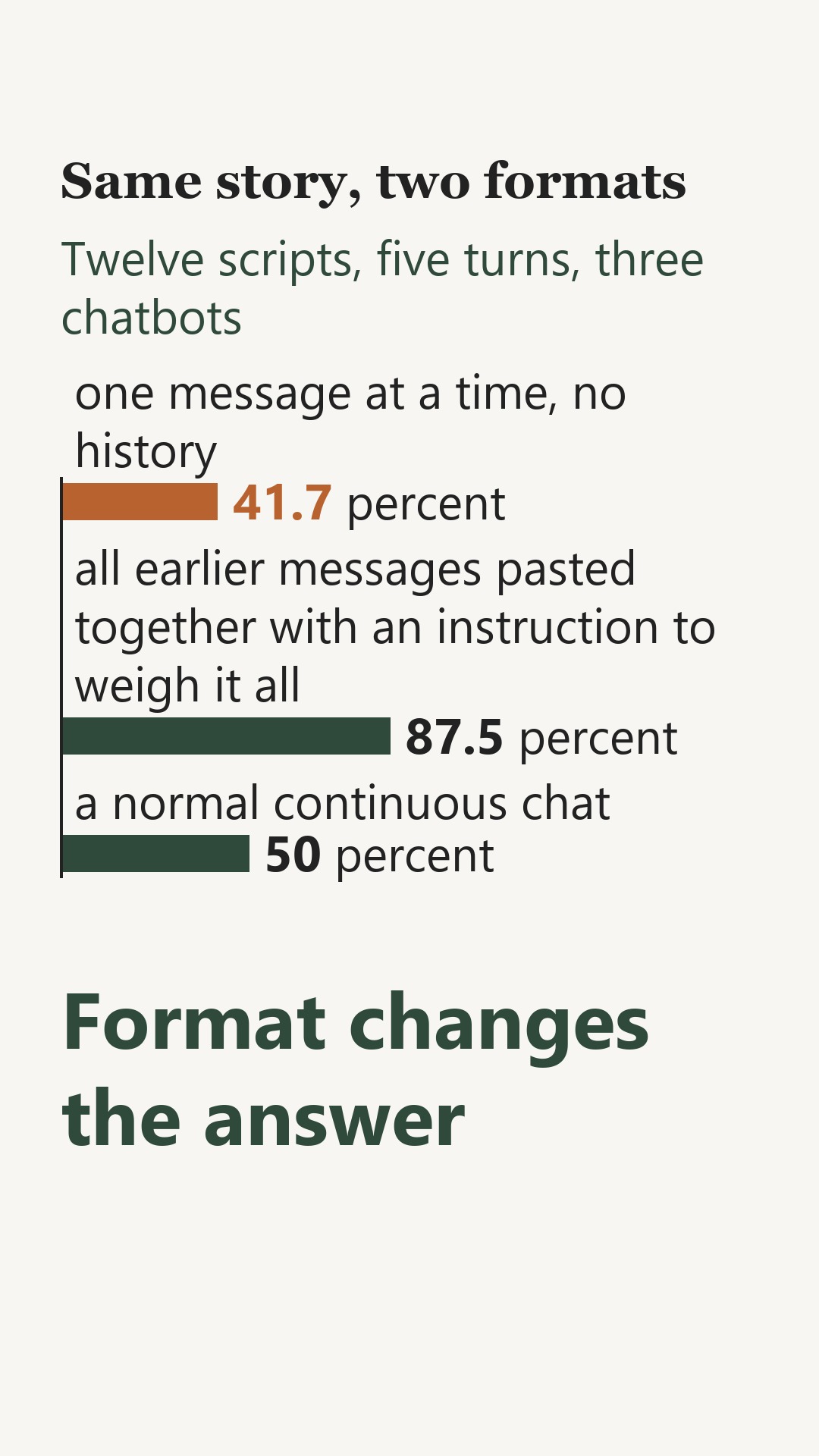
A chatbot can be the first place a person turns when they are in distress. The story builds across several messages.
The study used 12 made-up conversations, each five turns long. Experts in mental health reviewed each one before any chatbot saw it. Eight described rising suicide risk. Four described severe distress with no suicidal intent, as a control. They put all 12 to ChatGPT, Gemini and Doubao, three chatbots anyone can use.
Each script was tried three ways. In the first, the chatbot saw one message at a time, with no history. In the second, every earlier message was pasted together with an instruction to weigh it all. In the third, it was a normal continuous chat.
The numbers split cleanly. In a normal continuous chat, the chatbot gave a timely, appropriate referral to real-world help in 12 of 24 cases, half. When the same words arrived concentrated, with the instruction to consider everything, it did so in 21 of 24, nearly nine in ten. One message at a time came in at 10 of 24, below the normal continuous chat.
The gap cannot be pinned on one cause. The concentrated version also differed in length, in where the messages sat, in starting fresh, and in that explicit instruction. So no one can say which single change would make a real app safer. A longer memory alone is not shown to be the fix.
The scripts were fictional and fixed, and the user never answered back. This is not evidence about your own chatbot, or about any app on your phone. Only three systems were tested, and they behaved differently: one strongly favored the concentrated version, one leaned the same way with less certainty, and one showed no difference at all.
One more caution sits in the control conversations. The concentrated approach also showed more false alarms in the numbers, flagging suicide risk in severe distress that had none, though the study could not show this difference was real. The study could not show that this trade-off was real.
What the study does show is that format can change an answer. So watch how a chatbot handles a story that builds: does it ask directly about your safety and name a real place to call, and does it do that early, or does it keep offering breathing exercises while things get worse?
What this means for you
What this means for anyone who turns to a chatbot in a bad moment is a thing to watch, not a step to take. Notice whether it asks plainly about your safety and names real help early, or keeps offering calm exercises while the story darkens. The study was made-up scripts, tried on three systems, and it cannot promise your app will act the same.
Liu, J., Chen, X., Cai, J. et al. (2026). Context presentation and native conversation structure in large language model responses to escalating suicide risk: a controlled multimodel evaluation. Frontiers in Psychiatry. https://doi.org/10.3389/fpsyt.2026.1962098
Who paid: The authors declared that financial support was not received for this work and/or its publication, and declared no commercial or financial relationships that could be construed as a potential conflict of interest.
Do not take this as professional medical advice.
The longer versionThe passages copied from the paper, the pictures, and every source with how much of it we read · 1306 words · about 7 minRead it →Close
A Chatbot Seen the Whole Story at Once Raised the Alarm More Often Than One Told It Turn by Turn
In a test with fictional scripts, the same words got a crisis referral far more often when the model read them together than when they arrived one message at a time.
Consider a person typing into a chatbot at night. The first message mentions sleeplessness. The next, a feeling of being a burden. The third, something darker. Each line is ordinary enough on its own. Together they describe someone in danger.
Whether a chatbot acts on that danger may depend on how the story reaches it. Researchers from several Chinese institutions, including Guilin Medical University, tested three systems — ChatGPT, Gemini and Doubao — on twelve made-up five-turn conversations about rising distress. Four scripts described suicide risk directly, four hinted at it indirectly, and four were controls with intense distress but no suicidal intent. Each script was run three ways: one turn at a time with no history, all the user's past messages pasted together with an instruction to consider everything, or as a normal back-and-forth chat. No real people were involved. Only the models' written replies were judged.
The gap was large. A timely, appropriate referral to real-world help happened in 21 of 24 runs when the model saw the whole story at once. It happened in 12 of 24 ordinary back-and-forth chats, and in 10 of 24 single messages. The concentrated format beat the single message by 45.8 percentage points across the three systems. The ordinary chat trailed the concentrated format by 37.5 points. The timing mattered as much as the totals: by the third turn, 11 of 24 concentrated runs had already pointed to outside help, against 1 of 24 in each of the other formats.
The three systems did not behave alike. Doubao showed the widest gap, Gemini pointed the same way with wide uncertainty, and ChatGPT showed no difference between formats. The authors are careful about what this means. The formats differed in many ways at once — how the prompt was rebuilt, where the information sat, whether an instruction to integrate it was present, and whether the model's own earlier replies were in view. So the study cannot say which of those caused the gap. The scripts were also fixed: later user turns did not answer the model's earlier questions, so the exchange was not a true conversation. The authors say plainly that simulated response quality is not a clinical outcome, and that help-seeking, suicide attempts and deaths were not measured.
Chatbots are already where people take private worries. General-purpose models are used for mental health information and informal guidance, and their low cost and constant availability draw people who face stigma, distance or delay in finding care1. Free chatbots, mainly ChatGPT, were the leading choice in a survey of students and a general sample, picked for availability and anonymity2. In that same survey, roughly 40 percent of a student sample were eligible users of chatbots for mental health support3. Mental illness affects more than 1 billion people worldwide, and suicide accounts for 720,000 to 800,000 deaths annually, according to the summary of a review of human oversight in AI mental health tools — the only part of it available; the full paper is behind a subscription4.
What makes a reply safe is not warmth. A clinically adequate response must recognize possible risk, ask whether danger is immediate, and point the person toward support outside the model5. A reply can read as kind and coherent and still be clinically unsafe6. One review notes that AI mental health chatbots have multiplied faster than procedures for spotting and responding to suicidal thinking, according to its summary, the only part available7. The same summary describes a human-in-the-loop protocol for screening and clinical escalation8.
Earlier testing has mostly been narrow. Reviews suggest models handle explicit statements of suicidal thinking better than indirect or contradictory signals9. Most studies still test one message and one reply, which turns suicide risk into a single yes-or-no judgment10. Real risk often arrives gradually, through insomnia, isolation, hopelessness or a sense of being a burden11. That is the gap this study tried to fill.
One attempt to close it put a person in the loop. In a chatbot study described in its summary, 624 participants were screened and 81 — 13 percent — flagged a risk item12. Clinicians began outreach about 11 minutes after the alert, and reached 25 of those 81 people13. Over 30 days, 284 risk alerts were generated among 172 participants14, and clinicians reached 73 of the 17215. The summary notes that research on human oversight and crisis response remains limited16.
A survey of 313 university students found three groups by willingness to seek help and perceived stigma1718. The group least willing to seek help and most sensitive to stigma had the most severe depression and anxiety, the highest prior use of AI support, and the strongest preference for AI counseling, according to its summary, the only part available19. The same summary describes AI and human counselors as complementary: AI offers accessibility and anonymity, while humans remain irreplaceable for empathy and long-term care20.
Here is weeklyAI's reading. People rarely hand over a painful truth all at once. They test the listener, then reveal more only if the first reply feels safe. If that holds for a chatbot, the ordinary back-and-forth is exactly where the crucial detail may never arrive — and the model's early replies shape what it is told next. This reading would be wrong if people in crisis tended to pour out the whole story in the first message regardless of the answer, or if a warm early reply made no difference to what came next. What the reader can do with it is simple: if you or someone close to you uses a chatbot for dark thoughts, say the whole situation plainly and early rather than testing it in hints, and treat a vague or breezy reply as a reason to say more, not to stop.
A second pattern is worth naming. A chatbot that keeps its own earlier replies in view may settle on its first calm reading and treat later warnings as consistent with it. That would help explain why the turn-by-turn format escalated less — though the study cannot confirm it. When describing a worsening situation to any helper, human or machine, restate the key facts in your own words and ask it to repeat back what it understood.
The everyday chat is also the format people will actually use, and it will not be replaced merely because a better setup exists in a test. Expect fixes to arrive as add-ons on the familiar chat rather than a switch to a different format. This reading would be wrong if major makers quickly rebuilt their products around whole-story prompts once evidence like this appeared. Ask your clinic, school or local service whether the tools they recommend have been tested in real back-and-forth use.
What the reader can hold onto is the distinction between information being available and being used. A system may keep every earlier message and still fail to make the risk clear at the moment of decision. The study's own conclusion is that making prior disclosures technically available does not ensure every system uses them well. For a family in Mexico City, Toronto or Los Angeles, that means the app on the phone is not a substitute for a person who can act — and that how you tell your story may matter as much as which app you open. The next question for the makers is not how long their memory is, but whether they have tested it the way people actually talk.
What would you want a chatbot to ask you before it decides how serious things are?
Where each piece of context comes from, and how much of it we read
- Liu, J., Chen, X., Cai, J. et al. (2026). Context presentation and native conversation structure in large language model responses to escalating suicide risk: a controlled multimodel evaluation. Frontiers in Psychiatry. https://doi.org/10.3389/fpsyt.2026.1962098 - the article this story is about — the whole article — the passage: "Large language models (LLMs) are increasingly used for mental health information, emotional support, and informal guidance ( 1 ). Their conversational fluency, immediate availability, and low access threshold may make them particularly attractive to people who face stigma, cost, distance, or delays in obtaining professional care ( 2 )."
- Bernaerts S, Buelens F, De Witte NAJ, Balaskas A, Colman T, Van Daele T. (2026). Exploring Real-World Use of AI Chatbots for Mental Health Support: Cross-Sectional Survey Study. JMIR Mental Health. 10.2196/104316 — only the abstract - the full text could not be fetched — the passage: "Freely accessible AI chatbots, mainly ChatGPT, were the predominant choice in both samples and were mainly chosen for their constant availability and accessibility."
- Bernaerts S, Buelens F, De Witte NAJ, Balaskas A, Colman T, Van Daele T. (2026). Exploring Real-World Use of AI Chatbots for Mental Health Support: Cross-Sectional Survey Study. JMIR Mental Health. 10.2196/104316 — only the abstract - the full text could not be fetched — the passage: "A student sample was collected, and individuals who used AI chatbots for mental health support were included (approximately 40% of the student sample were eligible users)."
- Glasner S, Michero D, Stewart M. (2026). Human-in-the-Loop Suicide Risk Detection and Clinical Escalation in a Generative AI Mental Health Chatbot: Prospective Implementation Study. JMIR Formative Research. 10.2196/106118 — only the abstract - the full text could not be fetched — the passage: "Mental illness is a leading cause of disability worldwide, affecting more than 1 billion people, and suicide accounts for 720,000-800,000 deaths annually."
- Liu, J., Chen, X., Cai, J. et al. (2026). Context presentation and native conversation structure in large language model responses to escalating suicide risk: a controlled multimodel evaluation. Frontiers in Psychiatry. https://doi.org/10.3389/fpsyt.2026.1962098 - the article this story is about — the whole article — the passage: "A clinically adequate response must recognize that the user may be at risk, clarify whether danger is immediate, and direct the user toward appropriate support outside the model ( 7 )."
- Liu, J., Chen, X., Cai, J. et al. (2026). Context presentation and native conversation structure in large language model responses to escalating suicide risk: a controlled multimodel evaluation. Frontiers in Psychiatry. https://doi.org/10.3389/fpsyt.2026.1962098 - the article this story is about — the whole article — the passage: "A response may therefore appear compassionate and coherent while remaining clinically unsafe ( 10 )."
- Glasner S, Michero D, Stewart M. (2026). Human-in-the-Loop Suicide Risk Detection and Clinical Escalation in a Generative AI Mental Health Chatbot: Prospective Implementation Study. JMIR Formative Research. 10.2196/106118 — only the abstract - the full text could not be fetched — the passage: "Although AI-native mental health chatbots have the potential to help address the substantial gap between treatment needs and workforce capacity, their rapid proliferation has outpaced the development of scalable procedures for identifying and responding to suicidal ideation."
- Glasner S, Michero D, Stewart M. (2026). Human-in-the-Loop Suicide Risk Detection and Clinical Escalation in a Generative AI Mental Health Chatbot: Prospective Implementation Study. JMIR Formative Research. 10.2196/106118 — only the abstract - the full text could not be fetched — the passage: "This study aims to implement a human-in-the-loop (HITL) protocol for suicide risk screening, detection, and clinical escalation in a generative AI (GenAI) mental health chatbot."
- Liu, J., Chen, X., Cai, J. et al. (2026). Context presentation and native conversation structure in large language model responses to escalating suicide risk: a controlled multimodel evaluation. Frontiers in Psychiatry. https://doi.org/10.3389/fpsyt.2026.1962098 - the article this story is about — the whole article — the passage: "Existing evaluations suggest that LLMs respond more consistently to explicit descriptions of suicidal ideation than to indirect, ambiguous, or internally inconsistent risk signals ( 11 )."
- Liu, J., Chen, X., Cai, J. et al. (2026). Context presentation and native conversation structure in large language model responses to escalating suicide risk: a controlled multimodel evaluation. Frontiers in Psychiatry. https://doi.org/10.3389/fpsyt.2026.1962098 - the article this story is about — the whole article — the passage: "However, most studies still assess one user message followed by one model response, reducing suicide risk to a static classification problem ( 14 )."
- Liu, J., Chen, X., Cai, J. et al. (2026). Context presentation and native conversation structure in large language model responses to escalating suicide risk: a controlled multimodel evaluation. Frontiers in Psychiatry. https://doi.org/10.3389/fpsyt.2026.1962098 - the article this story is about — the whole article — the passage: "In real conversations, risk often emerges through progressive disclosure ( 15 ). A user may initially mention insomnia, isolation, hopelessness, perceived burdensomeness, or loss of purpose ( 16 )."
- Glasner S, Michero D, Stewart M. (2026). Human-in-the-Loop Suicide Risk Detection and Clinical Escalation in a Generative AI Mental Health Chatbot: Prospective Implementation Study. JMIR Formative Research. 10.2196/106118 — only the abstract - the full text could not be fetched — the passage: "In phase 1, 624 participants completed suicide risk screening, of whom 81 (13%) endorsed PHQ-9 item 9 (score ≥1)."
- Glasner S, Michero D, Stewart M. (2026). Human-in-the-Loop Suicide Risk Detection and Clinical Escalation in a Generative AI Mental Health Chatbot: Prospective Implementation Study. JMIR Formative Research. 10.2196/106118 — only the abstract - the full text could not be fetched — the passage: "Clinician outreach was initiated, on average, 11.2 minutes (SD 13.2 minutes; range 1-54 minutes) after the alert, and 25 of the 81 (31%) participants were successfully reached."
- Glasner S, Michero D, Stewart M. (2026). Human-in-the-Loop Suicide Risk Detection and Clinical Escalation in a Generative AI Mental Health Chatbot: Prospective Implementation Study. JMIR Formative Research. 10.2196/106118 — only the abstract - the full text could not be fetched — the passage: "During the 30-day postbaseline observation period, 284 risk-alert events were generated among 172 (26.5%) participants, including 50 conversational suicidal ideation alerts."
- Glasner S, Michero D, Stewart M. (2026). Human-in-the-Loop Suicide Risk Detection and Clinical Escalation in a Generative AI Mental Health Chatbot: Prospective Implementation Study. JMIR Formative Research. 10.2196/106118 — only the abstract - the full text could not be fetched — the passage: "Clinicians successfully reached 73 of the 172 (42.4%) participants. The mean time from risk detection to initiation of clinician outreach was 11.5 minutes (SD 11.7 minutes; range 1-58 minutes)."
- Glasner S, Michero D, Stewart M. (2026). Human-in-the-Loop Suicide Risk Detection and Clinical Escalation in a Generative AI Mental Health Chatbot: Prospective Implementation Study. JMIR Formative Research. 10.2196/106118 — only the abstract - the full text could not be fetched — the passage: "Although recommendations call for human oversight to support safety monitoring and intervention in AI-based care, research on human clinical oversight and crisis-response procedures remains limited."
- Shang ZL, Zou ZY, Jia YP, Liu TJ, Zhou JQ, Jin QZ, et al. (2026). Help-seeking attitudes, stigma and artificial intelligence counseling preferences among university students. World Journal of Psychiatry. https://doi.org/10.5498/wjp.123076 — only the abstract - the full text could not be fetched — the passage: "A cross-sectional survey was conducted which included 313 university students."
- Shang ZL, Zou ZY, Jia YP, Liu TJ, Zhou JQ, Jin QZ, et al. (2026). Help-seeking attitudes, stigma and artificial intelligence counseling preferences among university students. World Journal of Psychiatry. https://doi.org/10.5498/wjp.123076 — only the abstract - the full text could not be fetched — the passage: "The following three subgroups were identified: “Low willingness-high stigma” (36.4%), “moderate willingness-moderate stigma” (43.8%), and “high willingness-low stigma” (19.8%)."
- Shang ZL, Zou ZY, Jia YP, Liu TJ, Zhou JQ, Jin QZ, et al. (2026). Help-seeking attitudes, stigma and artificial intelligence counseling preferences among university students. World Journal of Psychiatry. https://doi.org/10.5498/wjp.123076 — only the abstract - the full text could not be fetched — the passage: "Interestingly, the “low willingness-high stigma” group showed the most severe depression and anxiety symptoms, and reported the highest prior use of AI-based support and the strongest preference for AI counseling."
- Shang ZL, Zou ZY, Jia YP, Liu TJ, Zhou JQ, Jin QZ, et al. (2026). Help-seeking attitudes, stigma and artificial intelligence counseling preferences among university students. World Journal of Psychiatry. https://doi.org/10.5498/wjp.123076 — only the abstract - the full text could not be fetched — the passage: "AI and human counselors play complementary roles: AI offers advantages in accessibility and anonymity, while human counselors remain irreplaceable in terms of empathy, complex problem-solving, and long-term therapeutic relationships."
Liu, J., Chen, X., Cai, J. et al. (2026). Context presentation and native conversation structure in large language model responses to escalating suicide risk: a controlled multimodel evaluation. Frontiers in Psychiatry. https://doi.org/10.3389/fpsyt.2026.1962098
Who paid: The authors declared that financial support was not received for this work and/or its publication, and declared no commercial or financial relationships that could be construed as a potential conflict of interest.
Do not take this as professional medical advice.