experiment · JMIR formative research · la publicación, 23 oct 2026 · gratis
Un chatbot para la salud mental avisó a un humano en 11 minutos. Solo 4 de cada 10 contestaron.
En un estudio con 650 adultos de Estados Unidos, el protocolo se pudo llevar a cabo. No se midió si evita suicidios.
Versión breve · la versión detallada sigue, unos 8 min
Pregunte al chat de weeklyAI
Pregúnteme sobre la IA en su vida: le señalo las notas que weeklyAI ha publicado sobre el tema, esta semana y antes.
Las conversaciones se guardan mientras exista weeklyAI, para mejorar la publicación. Se responde en el idioma en que usted escribe.
- El estudio, de un vistazo
- Quiénes
- Adultos que usaron Sona, un chatbot de salud mental con inteligencia artificial
- Cuántos
- 650 participantes en la segunda etapa
- Dónde
- Estados Unidos
- Cuándo
- julio de 2026
- Tipo de estudio
- analysis of what people did
- Quién lo hizo
- Digital Therapeutics, Inc., la empresa dueña de Sona
- El límite que importa
- No se sabe si esas llamadas evitan suicidios; más de la mitad de los alertados nunca fue alcanzada.
Son los 172 participantes de la segunda etapa que activaron al menos una alerta de riesgo; el resto de los 650 no activó ninguna.
Cuántos alertados logró alcanzar el equipo humano en cada etapa
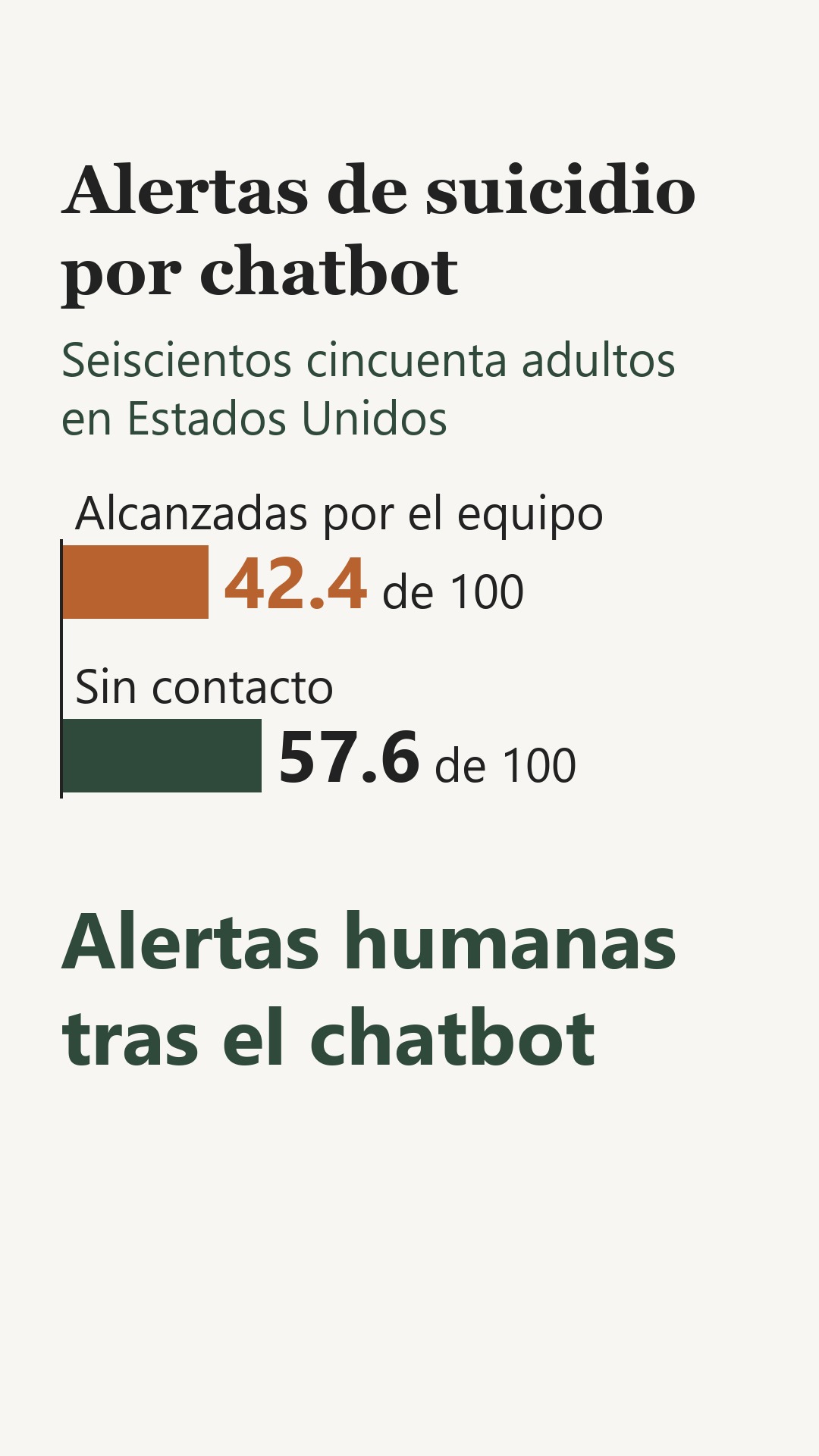
En la primera se alcanzó a 25 de 81 (31%); en la segunda, a 73 de 172 (42.4%).
Lo que sí muestra es que la cadena existe y que, cuando alguien contesta, el tiempo se cuenta en minutos y no en días.
Sona es un chatbot de salud mental hecho con inteligencia artificial. Lo desarrolló la empresa Digital Therapeutics, Inc. En julio de 2026, 650 adultos de Estados Unidos contestaron el cuestionario inicial del estudio.
Cuando el sistema detectaba riesgo de suicidio, avisaba a un equipo de personas. Una persona del equipo empezaba a buscar al participante, en promedio, unos 11 minutos después del aviso. Hubo casos de 1 minuto y casos de 58.
La pregunta es si la llamada llegó a alguien.
Los avisos salieron de dos lugares. Uno fue una pregunta fija de un cuestionario de depresión, la que pregunta si uno ha pensado que estaría mejor muerto o en hacerse daño. El otro fue un programa aparte que leía cada conversación al terminar y buscaba señales de que la persona pensaba en quitarse la vida o en hacerse daño. Entre los 650 participantes, 172 hicieron que el sistema mandara al menos un aviso al equipo de personas.
De esos 172, un equipo humano logró hablar con 73. Son 42 de cada 100. Con los otros 99 el equipo no logró comunicarse.
Con los otros 99 el equipo no logró comunicarse.
El estudio tampoco puede decir si esas llamadas evitaron un suicidio o mejoraron los síntomas de alguien. Midió si el sistema se podía poner en marcha, no si servía para salvar vidas.
Los participantes eran adultos que hablaban inglés, tenían empleo o seguro médico y se inscribieron por internet. Los resultados pueden no ser los mismos para otras personas, en América Latina o en cualquier otro lugar.
Los propios autores señalan otra duda. No pudieron medir cuántas señales de riesgo el chatbot dejó pasar en las conversaciones. Tampoco saben qué pasó después de esos 30 días.
Varias personas contaron en entrevistas que la llamada les dio confianza. Varias personas contaron en entrevistas que la llamada les dio confianza. Una dijo: "Me hizo respetar más la app, porque supe que lo que le contaba a la IA, de alguna manera, estaba siendo vigilado". Otra dijo que no esperaba que alguien la llamara de verdad.
Los autores proponen avisar desde el principio, de forma clara, que una persona real puede llamarle.
Qué significa para usted
Si algún día usa un chatbot de salud mental, pregunte desde el principio si hay una persona real detrás y en cuánto tiempo podría llamarle. En este estudio, la llamada empezó unos 11 minutos después del aviso, aunque más de la mitad de los alertados no contestó. Nadie le ha medido todavía si esa llamada evita un suicidio, así que no lo dé por hecho.
Glasner, S., Michero, D., Stewart, M. (2026). Human-in-the-Loop Suicide Risk Detection and Clinical Escalation in a Generative AI Mental Health Chatbot: Prospective Implementation Study. JMIR Formative Research. https://doi.org/10.2196/106118
Quién pagó: El estudio fue financiado por Digital Therapeutics, Inc., la empresa que emplea a los tres autores; el artículo afirma que el financiador no tuvo ningún papel en el diseño, la realización, el análisis, la interpretación ni la redacción.
No tome esto como consejo médico profesional.
Versión detalladaLos pasajes copiados del artículo, las ilustraciones y cada fuente con cuánto leímos de ella · 1624 palabras · unos 8 minLeerla →Cerrar
Un chatbot de salud mental avisó a un clínico en unos 11 minutos; a más de la mitad de los alertados nunca los alcanzaron
Un estudio midió si se puede sostener una cadena de seguridad con personas reales detrás de una app. No midió si esa cadena salva vidas.
El estudio se hizo en dos etapas, con dos grupos distintos de adultos en Estados Unidos que usaron Sona, un chatbot de salud mental hecho con inteligencia artificial generativa. En la primera etapa, 624 personas completaron el tamizaje inicial de riesgo suicida; 81 de ellas, el 13%, marcaron la pregunta 9 del cuestionario de depresión PHQ-9, la que indaga pensamientos de muerte o de hacerse daño. En la segunda etapa, 650 personas completaron el mismo tamizaje y 133, el 20.5%, salieron positivas al inicio.
Lo que se midió fue la operación, no el efecto. Cuando alguien marcaba esa pregunta, el sistema mandaba un aviso al equipo clínico y un clínico intentaba llamarle por teléfono. En la primera etapa, la llamada se inició en promedio 11.2 minutos después del aviso1. En la segunda, el tiempo medio hasta el primer intento de contacto fue de 11.5 minutos2. La mediana, el punto donde queda la mitad de los casos, fue más corta todavía: 5.4 minutos en la primera etapa y 7 minutos en la segunda12. Hay que decirlo con precisión: eso es el tiempo hasta iniciar la llamada, no hasta hablar con la persona.
Hablar con la persona resultó otra cosa. En la primera etapa se logró contactar a 25 de los 81 alertados, el 31%; los otros 56, el 69%, no contestaron3. En la segunda se alcanzó a 73 de los 172 que activaron alguna alerta, el 42.4%; los 99 restantes, el 57.6%, quedaron sin contacto3. Más de la mitad, en ambas etapas, nunca fue alcanzada.
Los propios autores lo escriben sin adornos: como no se completó el contacto clínico ni la evaluación en una proporción considerable de los alertados, hace falta más investigación para mejorar las estrategias de seguimiento de quienes no se dejan localizar y para caracterizar el impacto de estos procedimientos en los desenlaces clínicos4. Y añaden una frase que conviene retener: los hallazgos no establecen si esa vigilancia y ese contacto son clínicamente eficaces para esta población5. El estudio no tuvo grupo de comparación ni probó hipótesis de eficacia. No puede decir que previno nada.
Hubo un caso que llegó más lejos. Hubo un caso en el que el clínico juzgó que el riesgo podía ser inminente y contactó al servicio de crisis del condado, que organizó una verificación en persona6. Entre las evaluaciones de ese cuestionario que se registraron, una sola salió con riesgo agudo, y el estudio aclara que esa cifra tiene un margen de error muy amplio.
Los autores trabajan en Digital Therapeutics, Inc., la empresa dueña de Sona, y tres de ellos tienen opciones sobre acciones de la compañía7; el estudio lo pagó la misma empresa. Los participantes vivían en Estados Unidos, hablaban inglés y tenían empleo o seguro médico8, y fueron reclutados por plataformas en línea. Nada de esto se probó en adolescentes, en personas sin seguro ni en otros países. Tampoco se pudo medir cuántas conversaciones de riesgo pudo dejar pasar el clasificador que lee los chats: esa tasa de falsos negativos no se pudo cuantificar con estos datos.
Piense en el recorrido completo, paso por paso, porque ahí está lo interesante. La app hace una pregunta fija de un cuestionario, no la inventa el modelo. Si la respuesta indica riesgo, aparece un aviso en pantalla que dice que alguien del equipo se va a comunicar, junto con recursos de crisis disponibles a toda hora9. Al mismo tiempo, el sistema manda una notificación a un canal interno del equipo clínico, y el primer clínico libre llama. Eso es lo que la literatura llama "human in the loop", o humano en el circuito: un profesional con licencia interpreta e interviene cuando la herramienta de inteligencia artificial topa con una necesidad clínica o una crisis que no le toca evaluar ni manejar10. En la segunda etapa se sumó otra vía: después de cada conversación, un modelo lee la transcripción completa y genera una alerta cuando encuentra señales de ideación suicida, de autolesión actual o inminente, o de daño inminente a otras personas11. Esa alerta no decide nada: solo dispara la llamada de un humano.
El clasificador se probó aparte, con conversaciones que no eran del estudio y que cuatro expertos clínicos habían etiquetado por su cuenta. De los 58 diálogos que los expertos marcaron como ideación suicida activa en curso, los 58 generaron alerta12. De los 309 diálogos que los expertos consideraron sin crisis, 307 no generaron alerta13. Son cifras altas. Y aun así, el estudio reconoce que con sus propios datos no puede saber cuánto se le escapó.
El tamaño del asunto está en otra parte. El artículo recoge un estudio según el cual las condiciones de salud mental son la primera causa de discapacidad en el mundo y afectan a 1170 millones de personas, y se calcula que el suicidio cobra más de 720 000 vidas al año14. El artículo recoge un estudio según el cual la demanda de servicios de salud mental casi se duplicó en las últimas décadas y la capacidad del personal que atiende no creció al mismo ritmo15. Ahí cabe una app. Y ahí cabe también el riesgo de que la app quede sola.
¿Por qué la gente le cuenta esto a una máquina? El artículo no lo estudió. Según el resumen de una encuesta en dos muestras belgas, lo único disponible de ese trabajo, los chatbots de uso general, sobre todo ChatGPT, eran la opción predilecta y se elegían por su disponibilidad constante y su accesibilidad16, y los estudiantes valoraban además el anonimato17. Según el resumen de otro estudio, también solo en su resumen, entre universitarios el grupo con menos disposición a buscar ayuda y más estigma era justamente el que mostraba los síntomas más severos y el mayor uso previo de apoyo basado en inteligencia artificial18. La misma fuente apunta lo obvio: la inteligencia artificial gana en accesibilidad y anonimato, y el consejero humano sigue siendo irremplazable en empatía y en relaciones terapéuticas de largo plazo19.
Así lo lee weeklyAI: lo que este estudio muestra no es una máquina que cuida, sino una máquina que avisa. El valor está en el eslabón humano, y el eslabón humano tiene un costo: sueldos, turnos, guardias de fin de semana. De las 284 alertas de la segunda etapa, 11 cayeron en fin de semana y fuera de horario: tres venían del cuestionario y ocho de conversaciones. Un chatbot atiende a las tres de la mañana; un equipo clínico, solo si alguien lo paga para estar despierto. Esa es la cuenta que ningún usuario ve en la pantalla de descarga.
Es razonable esperar que en su ciudad aparezcan apps de bienestar que ofrezcan "acompañamiento" sin decir quién responde detrás. También es razonable esperar que muchas personas que ya ven a un profesional usen estas herramientas como apoyo extra: en la segunda etapa, de los 73 contactados, 44 ya recibían atención de salud mental. Esta lectura se equivocaría si resulta que la mayoría de quienes activan una alerta no tiene ningún servicio y el chatbot es su única vía.
Hay un detalle que dice mucho y que los propios autores reportan. Varios de los entrevistados dijeron haberse sorprendido con la llamada, incluso algunos que recordaban haber leído el aviso de que un clínico podría contactarlos. La sorpresa no fue desagrado: varios describieron el contacto como tranquilizador y como señal de un cuidado compasivo, y algunos dijeron que la llamada les hizo confiar más en la app20. Lo curioso es que la confianza subió justo cuando el aviso falló. Una empresa puede leer eso como buena noticia; un usuario debería leerlo como una advertencia sobre la letra chica.
El equipo también probó la vía del correo electrónico para quienes no contestaban el teléfono. De 56 personas contactadas así en la primera etapa, dos respondieron acusando recibo. En la segunda etapa, cuando se agregó el mensaje de texto, de 98 contactos exitosos, 58 fueron por teléfono, 28 por mensaje de texto, 5 por correo y 7 por una vía no especificada. El patrón es claro: el teléfono y el mensaje funcionan; el correo, casi no.
Para quien usa o recomienda una de estas apps, hay tres preguntas que se pueden hacer hoy mismo y que no requieren saber nada de tecnología. La primera: ¿hay una persona real detrás de las alertas, con nombre y licencia, y en qué horario contesta? La segunda: ¿dónde está escrito, de forma visible al registrarse y no escondido en los términos de servicio, que alguien podría llamarle? La tercera: ¿qué pasa si no contesto? Saber que una app avisa no es lo mismo que saber que alguien va a llegar. Esta lectura se equivocaría si un servicio demostrara que el aviso y el seguimiento funcionan igual sin personas de guardia.
Y una advertencia que va en la otra dirección: ninguna de estas cifras es una promesa de que a usted lo van a llamar. Más de la mitad de los alertados en este estudio nunca fue alcanzada, y el estudio no puede mostrar que esa llamada haya evitado una muerte. Lo que sí muestra es que la cadena existe y que, cuando alguien contesta, el tiempo se cuenta en minutos y no en días.
La app hace la pregunta, alguien contesta, el reloj corre. Lo que todavía no se sabe es si ese minuto once, del otro lado del teléfono, alcanza para lo que de verdad importa.
¿Sabe usted quién está del otro lado cuando su chatbot de salud mental manda una alerta?
De dónde sale cada dato de contexto, y cuánto leímos de cada documento
- Glasner, S., Michero, D., Stewart, M. (2026). Human-in-the-Loop Suicide Risk Detection and Clinical Escalation in a Generative AI Mental Health Chatbot: Prospective Implementation Study. JMIR Formative Research. https://doi.org/10.2196/106118 - el artículo del que trata esta nota — el artículo completo — el pasaje: "Among the 81 participants who screened positive on the PHQ-9 suicidal ideation item, human clinician outreach by telephone for further assessment was initiated after a mean of 11.2 minutes (SD 13.2 minutes; median 5.4 minutes; range 1-54 minutes)."
- Glasner, S., Michero, D., Stewart, M. (2026). Human-in-the-Loop Suicide Risk Detection and Clinical Escalation in a Generative AI Mental Health Chatbot: Prospective Implementation Study. JMIR Formative Research. https://doi.org/10.2196/106118 - el artículo del que trata esta nota — el artículo completo — el pasaje: "Time to the first clinician outreach attempt was calculable for 91 alerts (mean 11.5 minutes; SD 11.7 minutes; median 7 minutes; range 1-58 minutes)."
- Glasner, S., Michero, D., Stewart, M. (2026). Human-in-the-Loop Suicide Risk Detection and Clinical Escalation in a Generative AI Mental Health Chatbot: Prospective Implementation Study. JMIR Formative Research. https://doi.org/10.2196/106118 - el artículo del que trata esta nota — el artículo completo — el pasaje: "In phase 1, 25 of the 81 (31%) participants who screened positive on the PHQ-9 were successfully reached, whereas 56 (69%) were not. In phase 2, 73 of the 172 (42.4%) participants who triggered a safety alert were successfully reached, whereas the remaining 99 (57.6%) were not."
- Glasner, S., Michero, D., Stewart, M. (2026). Human-in-the-Loop Suicide Risk Detection and Clinical Escalation in a Generative AI Mental Health Chatbot: Prospective Implementation Study. JMIR Formative Research. https://doi.org/10.2196/106118 - el artículo del que trata esta nota — el artículo completo — el pasaje: "Given that clinical contact and assessment were not completed for a substantial proportion of alerted participants, further research is needed to optimize assessment and follow-up strategies for individuals who cannot be reached and to characterize the impact of these procedures on clinical outcomes."
- Glasner, S., Michero, D., Stewart, M. (2026). Human-in-the-Loop Suicide Risk Detection and Clinical Escalation in a Generative AI Mental Health Chatbot: Prospective Implementation Study. JMIR Formative Research. https://doi.org/10.2196/106118 - el artículo del que trata esta nota — el artículo completo — el pasaje: "Although these findings suggest that, with a standardized HITL protocol, individuals with clinically significant psychiatric symptoms can be monitored and contacted to address safety concerns while using a GenAI mental health chatbot, they do not establish whether such monitoring and outreach are clinically effective for this population."
- Glasner, S., Michero, D., Stewart, M. (2026). Human-in-the-Loop Suicide Risk Detection and Clinical Escalation in a Generative AI Mental Health Chatbot: Prospective Implementation Study. JMIR Formative Research. https://doi.org/10.2196/106118 - el artículo del que trata esta nota — el artículo completo — el pasaje: "The acute-positive assessment prompted the clinician to contact the local county crisis service, which arranged an in-person welfare check."
- Glasner, S., Michero, D., Stewart, M. (2026). Human-in-the-Loop Suicide Risk Detection and Clinical Escalation in a Generative AI Mental Health Chatbot: Prospective Implementation Study. JMIR Formative Research. https://doi.org/10.2196/106118 - el artículo del que trata esta nota — el artículo completo — el pasaje: "SG, DM, and MS are employed by and received stock options from Digital Therapeutics, Inc."
- Glasner, S., Michero, D., Stewart, M. (2026). Human-in-the-Loop Suicide Risk Detection and Clinical Escalation in a Generative AI Mental Health Chatbot: Prospective Implementation Study. JMIR Formative Research. https://doi.org/10.2196/106118 - el artículo del que trata esta nota — el artículo completo — el pasaje: "First, participants resided in the United States, were English-speaking, and were employed and insured."
- Glasner, S., Michero, D., Stewart, M. (2026). Human-in-the-Loop Suicide Risk Detection and Clinical Escalation in a Generative AI Mental Health Chatbot: Prospective Implementation Study. JMIR Formative Research. https://doi.org/10.2196/106118 - el artículo del que trata esta nota — el artículo completo — el pasaje: "Participants who screened positive for suicidality immediately received a pop-up message informing them that a member of the Sona team would contact them to provide support. The message also provided 24/7 crisis and suicidality intervention resources (ie, Lifeline or 988) that participants could call or SMS text message at any time if they needed or wanted support."
- Glasner, S., Michero, D., Stewart, M. (2026). Human-in-the-Loop Suicide Risk Detection and Clinical Escalation in a Generative AI Mental Health Chatbot: Prospective Implementation Study. JMIR Formative Research. https://doi.org/10.2196/106118 - el artículo del que trata esta nota — el artículo completo — el pasaje: "In practice, HITL involves engaging licensed clinicians to interpret and intervene when an AI tool encounters a clinical care need or crisis that falls outside its scope of competence to evaluate or manage."
- Glasner, S., Michero, D., Stewart, M. (2026). Human-in-the-Loop Suicide Risk Detection and Clinical Escalation in a Generative AI Mental Health Chatbot: Prospective Implementation Study. JMIR Formative Research. https://doi.org/10.2196/106118 - el artículo del que trata esta nota — el artículo completo — el pasaje: "The classifier was instructed to generate a risk alert labeled CRISIS_988 when the current transcript contained evidence of suicidal ideation, current or imminent self-harm, or imminent harm to others."
- Glasner, S., Michero, D., Stewart, M. (2026). Human-in-the-Loop Suicide Risk Detection and Clinical Escalation in a Generative AI Mental Health Chatbot: Prospective Implementation Study. JMIR Formative Research. https://doi.org/10.2196/106118 - el artículo del que trata esta nota — el artículo completo — el pasaje: "In the external validation analysis, all 58 dialogues independently classified as containing ongoing active suicidal ideation generated a suicidal ideation safety alert, corresponding to a sensitivity of 100% (58/58; 95% CI 93.8%-100%)."
- Glasner, S., Michero, D., Stewart, M. (2026). Human-in-the-Loop Suicide Risk Detection and Clinical Escalation in a Generative AI Mental Health Chatbot: Prospective Implementation Study. JMIR Formative Research. https://doi.org/10.2196/106118 - el artículo del que trata esta nota — el artículo completo — el pasaje: "Among the 309 strict-negative comparison dialogues, 307 did not generate a suicidal ideation safety alert, corresponding to a specificity of 99.4% (307/309; 95% CI 97.7%-99.8%)."
- Glasner, S., Michero, D., Stewart, M. (2026). Human-in-the-Loop Suicide Risk Detection and Clinical Escalation in a Generative AI Mental Health Chatbot: Prospective Implementation Study. JMIR Formative Research. https://doi.org/10.2196/106118 - el artículo del que trata esta nota — el artículo completo — el pasaje: "Mental health conditions are the leading cause of disability worldwide, affecting 1.17 billion individuals [ 1 ], and suicide remains a major contributor to premature mortality, accounting for more than 720,000 deaths annually."
- Glasner, S., Michero, D., Stewart, M. (2026). Human-in-the-Loop Suicide Risk Detection and Clinical Escalation in a Generative AI Mental Health Chatbot: Prospective Implementation Study. JMIR Formative Research. https://doi.org/10.2196/106118 - el artículo del que trata esta nota — el artículo completo — el pasaje: "With the prevalence of mental illness nearly doubling over the past several decades, there is a growing mismatch between the demand for mental health services and the capacity of the behavioral health workforce [ 1 ]."
- Bernaerts S, Buelens F, De Witte NAJ, Balaskas A, Colman T, Van Daele T. (2026). Exploring Real-World Use of AI Chatbots for Mental Health Support: Cross-Sectional Survey Study. JMIR Mental Health. 10.2196/104316 — solo el resumen - no se pudo obtener el texto completo — el pasaje: "Freely accessible AI chatbots, mainly ChatGPT, were the predominant choice in both samples and were mainly chosen for their constant availability and accessibility."
- Bernaerts S, Buelens F, De Witte NAJ, Balaskas A, Colman T, Van Daele T. (2026). Exploring Real-World Use of AI Chatbots for Mental Health Support: Cross-Sectional Survey Study. JMIR Mental Health. 10.2196/104316 — solo el resumen - no se pudo obtener el texto completo — el pasaje: "Respondents in the student sample also preferred their anonymity, and those in the general sample also used them because they felt supported by them ."
- Shang ZL, Zou ZY, Jia YP, Liu TJ, Zhou JQ, Jin QZ, et al. (2026). Help-seeking attitudes, stigma and artificial intelligence counseling preferences among university students. World Journal of Psychiatry. https://doi.org/10.5498/wjp.123076 — solo el resumen - no se pudo obtener el texto completo — el pasaje: "Interestingly, the “low willingness-high stigma” group showed the most severe depression and anxiety symptoms, and reported the highest prior use of AI-based support and the strongest preference for AI counseling."
- Shang ZL, Zou ZY, Jia YP, Liu TJ, Zhou JQ, Jin QZ, et al. (2026). Help-seeking attitudes, stigma and artificial intelligence counseling preferences among university students. World Journal of Psychiatry. https://doi.org/10.5498/wjp.123076 — solo el resumen - no se pudo obtener el texto completo — el pasaje: "AI and human counselors play complementary roles: AI offers advantages in accessibility and anonymity, while human counselors remain irreplaceable in terms of empathy, complex problem-solving, and long-term therapeutic relationships."
- Glasner, S., Michero, D., Stewart, M. (2026). Human-in-the-Loop Suicide Risk Detection and Clinical Escalation in a Generative AI Mental Health Chatbot: Prospective Implementation Study. JMIR Formative Research. https://doi.org/10.2196/106118 - el artículo del que trata esta nota — el artículo completo — el pasaje: "Several participants described the outreach as reassuring and indicative of compassionate care, and some reported that clinician contact increased their trust in the Sona platform overall."
Glasner, S., Michero, D., Stewart, M. (2026). Human-in-the-Loop Suicide Risk Detection and Clinical Escalation in a Generative AI Mental Health Chatbot: Prospective Implementation Study. JMIR Formative Research. https://doi.org/10.2196/106118
Quién pagó: El estudio fue financiado por Digital Therapeutics, Inc., la empresa que emplea a los tres autores; el artículo afirma que el financiador no tuvo ningún papel en el diseño, la realización, el análisis, la interpretación ni la redacción.
No tome esto como consejo médico profesional.
Los hallazgos de otros estudios que aquí se mencionan provienen de este documento; esos estudios no se consultaron uno por uno.
experiment · JMIR formative research · the paper, 23 Oct 2026 · free
A Chatbot Flagged Suicide Risk. A Clinician Started Calling 11 Minutes Later.
In a study of US adults recruited online, most who were flagged were never reached, and the study did not test whether the calls saved lives.
Short version · the longer version follows, about 6 min
Ask the weeklyAI chat
Ask me about AI in your life: I point you to the stories weeklyAI has published on it, this week and before.
Conversations are saved for as long as weeklyAI exists, to improve the publication. Answers come in the language you write in.
- The study at a glance
- Who
- US adults recruited online who used a mental health chatbot
- How many
- 624 in phase 1 and 650 in phase 2
- Where
- United States
- When
- 2026
- Kind of study
- analysis of what people did
- Who did it
- Digital Therapeutics, Inc.
- The limit that matters
- No comparison group; study did not test whether calls saved lives or improved symptoms.
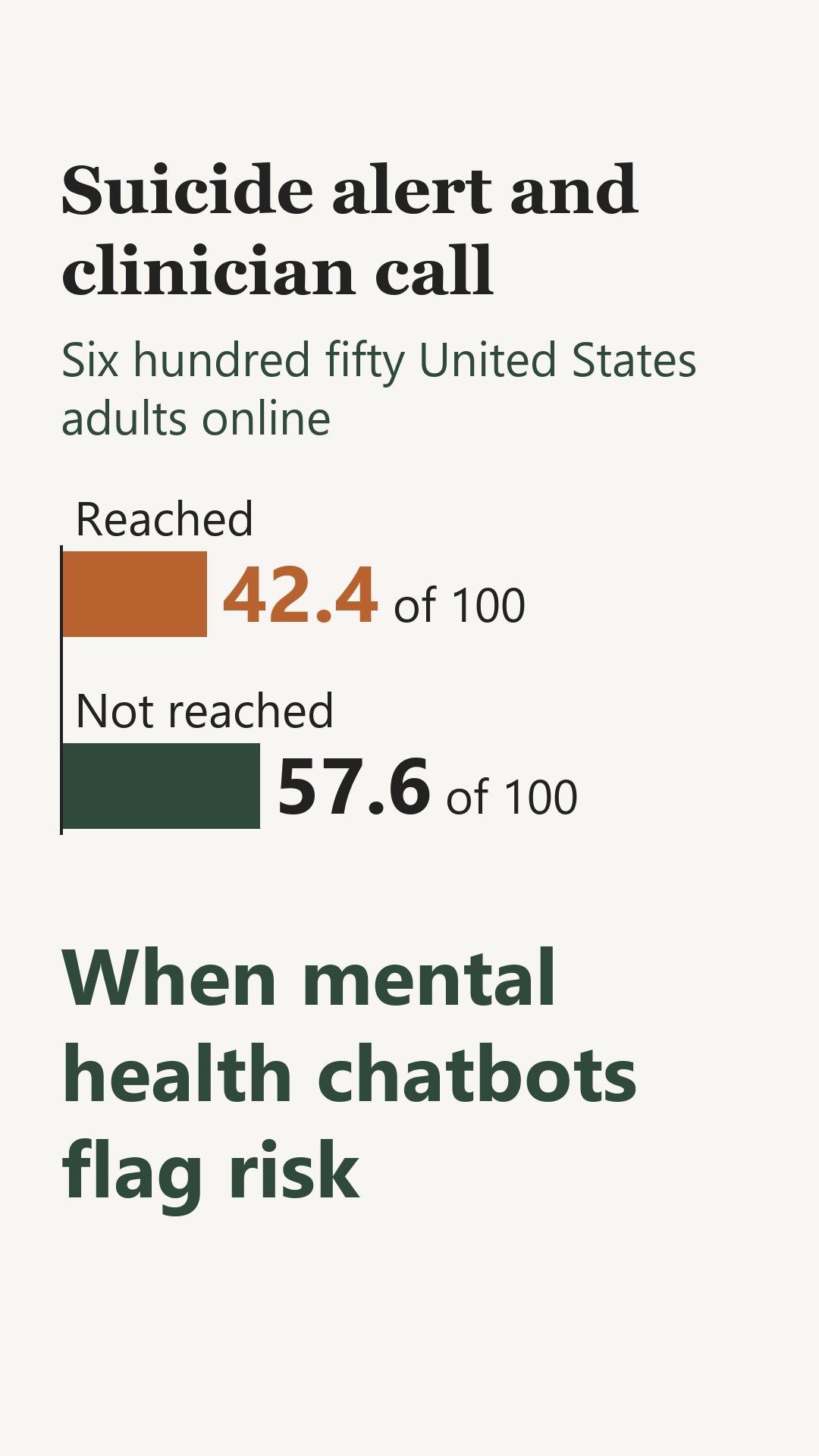
Share of the 172 participants who triggered a safety alert in phase 2; more than half were never reached, and the study did not test whether the calls saved lives.
A system can work exactly as designed and still leave most flagged people without a conversation.
When the system flagged a suicide risk, a clinician began calling soon after.
That was the average time in a study of Sona, a mental health chatbot built by Digital Therapeutics, Inc. When the system flagged a suicide risk, a trained clinician began trying to call about 11 minutes later, on average. In the first part it was 11.2 minutes, and in the second part 11.5 minutes.
The study ran in two parts. In the first, 624 adults completed a standard depression questionnaire, and 81 of them, 13 percent, answered yes to the question that asks about thoughts of being better off dead or of hurting yourself. In the second part, 650 adults took the same questionnaire and used the chatbot. After each conversation ended, a computer program read the whole conversation for signs of suicidal thinking. Over 30 days, 172 of those 650 participants, about one in four, triggered at least one alert. The alerts came from two sources: 234 from the questionnaire and 50 from the computer program that read the conversations.
Did the calls reach people? Some of them. In the second part, clinicians reached 73 of the 172 flagged participants, 42.4 percent. More than half were never reached, 99 people, so an alert does not mean someone will always get through to you.
The study also cannot show that the calls prevented suicide or improved anyone's symptoms. It measured whether the protocol could be carried out, and the authors say plainly that its effect on clinical outcomes is unknown.
The people studied were US adults, English-speaking, employed or insured, and recruited through online platforms. The rates may not match people in other countries, or people without a job or insurance.
Some participants who were contacted after a positive screen said the contact reassured them. Others said the contact surprised them. One told the researchers: "At the very least, it is reassuring to know that there's a human on the other side of this."
The authors say chatbots should tell people clearly, before they start, that a clinician may try to contact them.
What this means for you
The study shows a mental health chatbot can be built to hand a flagged conversation to a trained person quickly, and that is worth asking about before you trust any such app. Whether those calls helped anyone is not known, and most flagged people were never reached. Ask the app, before you start, how it handles a crisis and who calls.
Glasner, S., Michero, D., Stewart, M. (2026). Human-in-the-Loop Suicide Risk Detection and Clinical Escalation in a Generative AI Mental Health Chatbot: Prospective Implementation Study. JMIR Formative Research. https://doi.org/10.2196/106118
Who paid: The study was funded by Digital Therapeutics, Inc., the company that employs all three authors; the article says the funder had no role in the design, conduct, analysis, interpretation or writing.
Do not take this as professional medical advice.
The longer versionThe passages copied from the paper, the pictures, and every source with how much of it we read · 1130 words · about 6 minRead it →Close
A Mental Health Chatbot Sent an Alert. A Clinician Called About 11 Minutes Later.
In a two-phase US study, a human-in-the-loop safety protocol was carried out as designed. More than half of the people flagged were never reached.
A phone rings about eleven minutes after a chatbot notices something in a conversation. That is the short version of what researchers at Digital Therapeutics, Inc. reported on October 23, 2026, in JMIR Formative Research. In a two-phase implementation study of an AI mental health chatbot called Sona, clinician outreach was started a mean of 11.2 minutes after a positive screen in phase 11 and 11.5 minutes after a risk alert in phase 22. The team measured whether the safety protocol could be carried out: screening completed, alerts delivered, calls made, people reached. It did not test whether the protocol saves lives.
The scale of the problem it addresses is large. The article describes a study in which mental health conditions are the leading cause of disability worldwide, affecting 1.17 billion people, and suicide accounts for more than 720,000 deaths annually3. The article describes a study in which demand for mental health services has grown while the behavioral health workforce has not kept pace4. The study's authors are Javad Sarvestan, Junichi Fujita, Michael H Allen, Suzette Glasner, Darcy Michero and Matthew Stewart. All three are employed by Digital Therapeutics, Inc. and received stock options from the company, which also funded the study.
Consider what the safety net actually looks like from the inside. Sona is a chatbot that holds conversations about well-being by voice or text. When a participant's answers to a standard depression questionnaire flagged thoughts of being better off dead or of self-harm, a pop-up told them a team member would contact them, and gave crisis resources they could call or message at any time5. At the same time, a notification went to a clinical team's messaging channel. The first clinician to begin outreach posted a digital marker to claim the case, then called the participant and used a short screening questionnaire to sort risk into acute and nonacute, with a safety plan made where needed. The article describes a study in which "human-in-the-loop" means a licensed clinician steps in when the AI meets something outside its scope6.
Phase 2 added a second pathway. After each conversation ended, a language model read the transcript and raised an alert labeled CRISIS_988 when it found evidence of suicidal ideation, current or imminent self-harm, or imminent harm to others7. The article describes a study in which, on an external test set of conversations independently classified by clinical experts, all 58 dialogues containing ongoing active suicidal ideation generated an alert8; of 309 comparison dialogues with no crisis, 307 did not9. That is a strong showing on a test set. The study could not measure how many real disclosures the system missed in its own users.
In phase 1, 624 adults completed the baseline screening, and 81 of them, 13 percent, endorsed the suicidal-ideation item. Clinicians reached 25 of those 81, or 31 percent; 56 were not reached10. In phase 2, 650 adults completed screening, 133 of them, 20.5 percent, screened positive at baseline. Over the following 30 days, 172 participants, 26.5 percent, triggered at least one of 284 risk alerts, including 50 from conversations. Clinicians reached 73 of the 172, or 42.4 percent; the other 99, 57.6 percent, were not reached10. One participant was classified as at acute risk and the clinician contacted the local county crisis service, which arranged an in-person welfare check11.
The study's own authors are direct about the gap. Because clinical contact and assessment were not completed for a substantial share of alerted participants, they write that more research is needed on how to follow up with people who cannot be reached12. They also state that the findings do not establish whether the monitoring and outreach are clinically effective13. Participants were US adults, English-speaking, employed and insured, recruited through online platforms14. The observation period was 30 days. The study had no comparison group.
Here is weeklyAI's reading. The number worth holding onto is not the eleven minutes. It is the 99 people in phase 2 who were flagged and never reached, more than half of those alerted10. A system can work exactly as designed and still leave most flagged people without a conversation. The authors themselves raise the possibility that some who did not respond were avoiding contact rather than unavailable. That is a different problem from a missed call, and it needs a different fix.
This reading would be wrong if the unreached were simply people who had moved on, changed numbers or stopped using the app for ordinary reasons. It would also be wrong if the alerts were mostly false alarms. The study does not settle either question. What it does show is that a chatbot can hand a safety concern to a real person quickly. Whether that person gets through is another matter.
There is a trade-off in the design itself. The screening question captures passive thoughts as well as active ones, so a low threshold catches more people and also generates many calls to people already in care. In both phases, most participants whose care status was known were already receiving mental health treatment. For them, a call from a stranger may add little; for someone with no provider, it may be the only contact that day. The study cannot say which is which.
What the participants themselves said offers a clue. In optional interviews, several described the outreach as reassuring and indicative of compassionate care, and some said the clinician contact increased their trust in the platform15. Others were surprised to be called at all, even when they remembered being told it could happen. The authors suggest that clearer, earlier disclosure might help people feel prepared. What the interviews cannot show is whether being called changed anyone's symptoms or safety.
The reader can use this. If you or someone you know talks to a mental health chatbot, look before you start typing for a plain statement of what happens when the chat raises concern: who is alerted, how they will contact you, and whether a real person is behind the alarm. Decide in advance whether you are willing to give a phone number and an emergency contact. And if a service ever flags you, answer the call or reply to the message, even briefly. A system that reaches 42 percent of the people it flags10 is a system where the reply matters.
The phone still rings about eleven minutes after the alert. The question for anyone relying on a chatbot for support is simpler than the technology: if it rings, will you pick up, and does the service know what to do when you don't?
Where each piece of context comes from, and how much of it we read
- Glasner, S., Michero, D., Stewart, M. (2026). Human-in-the-Loop Suicide Risk Detection and Clinical Escalation in a Generative AI Mental Health Chatbot: Prospective Implementation Study. JMIR Formative Research. https://doi.org/10.2196/106118 - the article this story is about — the whole article — the passage: "Among the 81 participants who screened positive on the PHQ-9 suicidal ideation item, human clinician outreach by telephone for further assessment was initiated after a mean of 11.2 minutes (SD 13.2 minutes; median 5.4 minutes; range 1-54 minutes)."
- Glasner, S., Michero, D., Stewart, M. (2026). Human-in-the-Loop Suicide Risk Detection and Clinical Escalation in a Generative AI Mental Health Chatbot: Prospective Implementation Study. JMIR Formative Research. https://doi.org/10.2196/106118 - the article this story is about — the whole article — the passage: "Time to the first clinician outreach attempt was calculable for 91 alerts (mean 11.5 minutes; SD 11.7 minutes; median 7 minutes; range 1-58 minutes)."
- Glasner, S., Michero, D., Stewart, M. (2026). Human-in-the-Loop Suicide Risk Detection and Clinical Escalation in a Generative AI Mental Health Chatbot: Prospective Implementation Study. JMIR Formative Research. https://doi.org/10.2196/106118 - the article this story is about — the whole article — the passage: "Mental health conditions are the leading cause of disability worldwide, affecting 1.17 billion individuals [ 1 ], and suicide remains a major contributor to premature mortality, accounting for more than 720,000 deaths annually."
- Glasner, S., Michero, D., Stewart, M. (2026). Human-in-the-Loop Suicide Risk Detection and Clinical Escalation in a Generative AI Mental Health Chatbot: Prospective Implementation Study. JMIR Formative Research. https://doi.org/10.2196/106118 - the article this story is about — the whole article — the passage: "With the prevalence of mental illness nearly doubling over the past several decades, there is a growing mismatch between the demand for mental health services and the capacity of the behavioral health workforce [ 1 ]."
- Glasner, S., Michero, D., Stewart, M. (2026). Human-in-the-Loop Suicide Risk Detection and Clinical Escalation in a Generative AI Mental Health Chatbot: Prospective Implementation Study. JMIR Formative Research. https://doi.org/10.2196/106118 - the article this story is about — the whole article — the passage: "Participants who screened positive for suicidality immediately received a pop-up message informing them that a member of the Sona team would contact them to provide support. The message also provided 24/7 crisis and suicidality intervention resources (ie, Lifeline or 988) that participants could call or SMS text message at any time if they needed or wanted support."
- Glasner, S., Michero, D., Stewart, M. (2026). Human-in-the-Loop Suicide Risk Detection and Clinical Escalation in a Generative AI Mental Health Chatbot: Prospective Implementation Study. JMIR Formative Research. https://doi.org/10.2196/106118 - the article this story is about — the whole article — the passage: "In practice, HITL involves engaging licensed clinicians to interpret and intervene when an AI tool encounters a clinical care need or crisis that falls outside its scope of competence to evaluate or manage."
- Glasner, S., Michero, D., Stewart, M. (2026). Human-in-the-Loop Suicide Risk Detection and Clinical Escalation in a Generative AI Mental Health Chatbot: Prospective Implementation Study. JMIR Formative Research. https://doi.org/10.2196/106118 - the article this story is about — the whole article — the passage: "The classifier was instructed to generate a risk alert labeled CRISIS_988 when the current transcript contained evidence of suicidal ideation, current or imminent self-harm, or imminent harm to others."
- Glasner, S., Michero, D., Stewart, M. (2026). Human-in-the-Loop Suicide Risk Detection and Clinical Escalation in a Generative AI Mental Health Chatbot: Prospective Implementation Study. JMIR Formative Research. https://doi.org/10.2196/106118 - the article this story is about — the whole article — the passage: "In the external validation analysis, all 58 dialogues independently classified as containing ongoing active suicidal ideation generated a suicidal ideation safety alert, corresponding to a sensitivity of 100% (58/58; 95% CI 93.8%-100%)."
- Glasner, S., Michero, D., Stewart, M. (2026). Human-in-the-Loop Suicide Risk Detection and Clinical Escalation in a Generative AI Mental Health Chatbot: Prospective Implementation Study. JMIR Formative Research. https://doi.org/10.2196/106118 - the article this story is about — the whole article — the passage: "Among the 309 strict-negative comparison dialogues, 307 did not generate a suicidal ideation safety alert, corresponding to a specificity of 99.4% (307/309; 95% CI 97.7%-99.8%)."
- Glasner, S., Michero, D., Stewart, M. (2026). Human-in-the-Loop Suicide Risk Detection and Clinical Escalation in a Generative AI Mental Health Chatbot: Prospective Implementation Study. JMIR Formative Research. https://doi.org/10.2196/106118 - the article this story is about — the whole article — the passage: "In phase 1, 25 of the 81 (31%) participants who screened positive on the PHQ-9 were successfully reached, whereas 56 (69%) were not. In phase 2, 73 of the 172 (42.4%) participants who triggered a safety alert were successfully reached, whereas the remaining 99 (57.6%) were not."
- Glasner, S., Michero, D., Stewart, M. (2026). Human-in-the-Loop Suicide Risk Detection and Clinical Escalation in a Generative AI Mental Health Chatbot: Prospective Implementation Study. JMIR Formative Research. https://doi.org/10.2196/106118 - the article this story is about — the whole article — the passage: "The acute-positive assessment prompted the clinician to contact the local county crisis service, which arranged an in-person welfare check."
- Glasner, S., Michero, D., Stewart, M. (2026). Human-in-the-Loop Suicide Risk Detection and Clinical Escalation in a Generative AI Mental Health Chatbot: Prospective Implementation Study. JMIR Formative Research. https://doi.org/10.2196/106118 - the article this story is about — the whole article — the passage: "Given that clinical contact and assessment were not completed for a substantial proportion of alerted participants, further research is needed to optimize assessment and follow-up strategies for individuals who cannot be reached and to characterize the impact of these procedures on clinical outcomes."
- Glasner, S., Michero, D., Stewart, M. (2026). Human-in-the-Loop Suicide Risk Detection and Clinical Escalation in a Generative AI Mental Health Chatbot: Prospective Implementation Study. JMIR Formative Research. https://doi.org/10.2196/106118 - the article this story is about — the whole article — the passage: "Although these findings suggest that, with a standardized HITL protocol, individuals with clinically significant psychiatric symptoms can be monitored and contacted to address safety concerns while using a GenAI mental health chatbot, they do not establish whether such monitoring and outreach are clinically effective for this population."
- Glasner, S., Michero, D., Stewart, M. (2026). Human-in-the-Loop Suicide Risk Detection and Clinical Escalation in a Generative AI Mental Health Chatbot: Prospective Implementation Study. JMIR Formative Research. https://doi.org/10.2196/106118 - the article this story is about — the whole article — the passage: "First, participants resided in the United States, were English-speaking, and were employed and insured."
- Glasner, S., Michero, D., Stewart, M. (2026). Human-in-the-Loop Suicide Risk Detection and Clinical Escalation in a Generative AI Mental Health Chatbot: Prospective Implementation Study. JMIR Formative Research. https://doi.org/10.2196/106118 - the article this story is about — the whole article — the passage: "Several participants described the outreach as reassuring and indicative of compassionate care, and some reported that clinician contact increased their trust in the Sona platform overall."
Glasner, S., Michero, D., Stewart, M. (2026). Human-in-the-Loop Suicide Risk Detection and Clinical Escalation in a Generative AI Mental Health Chatbot: Prospective Implementation Study. JMIR Formative Research. https://doi.org/10.2196/106118
Who paid: The study was funded by Digital Therapeutics, Inc., the company that employs all three authors; the article says the funder had no role in the design, conduct, analysis, interpretation or writing.
Do not take this as professional medical advice.
The findings of other studies mentioned here come from this document; those studies were not opened one by one.