experiment · Frontiers in psychology · la publicación, 15 sep 2026 · gratis
Sigue el consejo equivocado del chatbot 6 de cada 10 veces. Tres preguntas antes de decidir lo bajan a 4
En un experimento con 342 estudiantes de una universidad china, una pausa breve antes de responder redujo la aceptación de consejos erróneos de ChatGPT. No prueba nada sobre conversaciones largas ni sobre decisiones personales.
Versión breve · la versión detallada sigue, unos 7 min
Pregunte al chat de weeklyAI
Pregúnteme sobre la IA en su vida: le señalo las notas que weeklyAI ha publicado sobre el tema, esta semana y antes.
Las conversaciones se guardan mientras exista weeklyAI, para mejorar la publicación. Se responde en el idioma en que usted escribe.
- El estudio, de un vistazo
- Quiénes
- estudiantes universitarios de pregrado
- Cuántos
- 342
- Dónde
- una universidad de China
- Cuándo
- 2026
- Tipo de estudio
- experiment
- Quién lo hizo
- un investigador de la Universidad de Ciencia y Tecnología de Anhui
- El límite que importa
- Fueron tareas cortas, en un solo campus, y no prueba que el hábito dure.
Porcentaje de veces que los estudiantes siguieron una recomendación incorrecta de ChatGPT; son tareas cortas de un solo campus y no dicen nada sobre conversaciones largas ni decisiones personales.
Qué tan seguros quedaron de su respuesta final
Los que no hicieron la pausa quedaron más confiados: 76.1 puntos sobre 100 frente a 72.3.
Los que consultaron al chatbot sin pausa quedaron más confiados: 76.1 puntos sobre 100 frente a 68.4.
Antes de aceptar como suya una respuesta de un chatbot, diga primero en voz alta su propia razón.
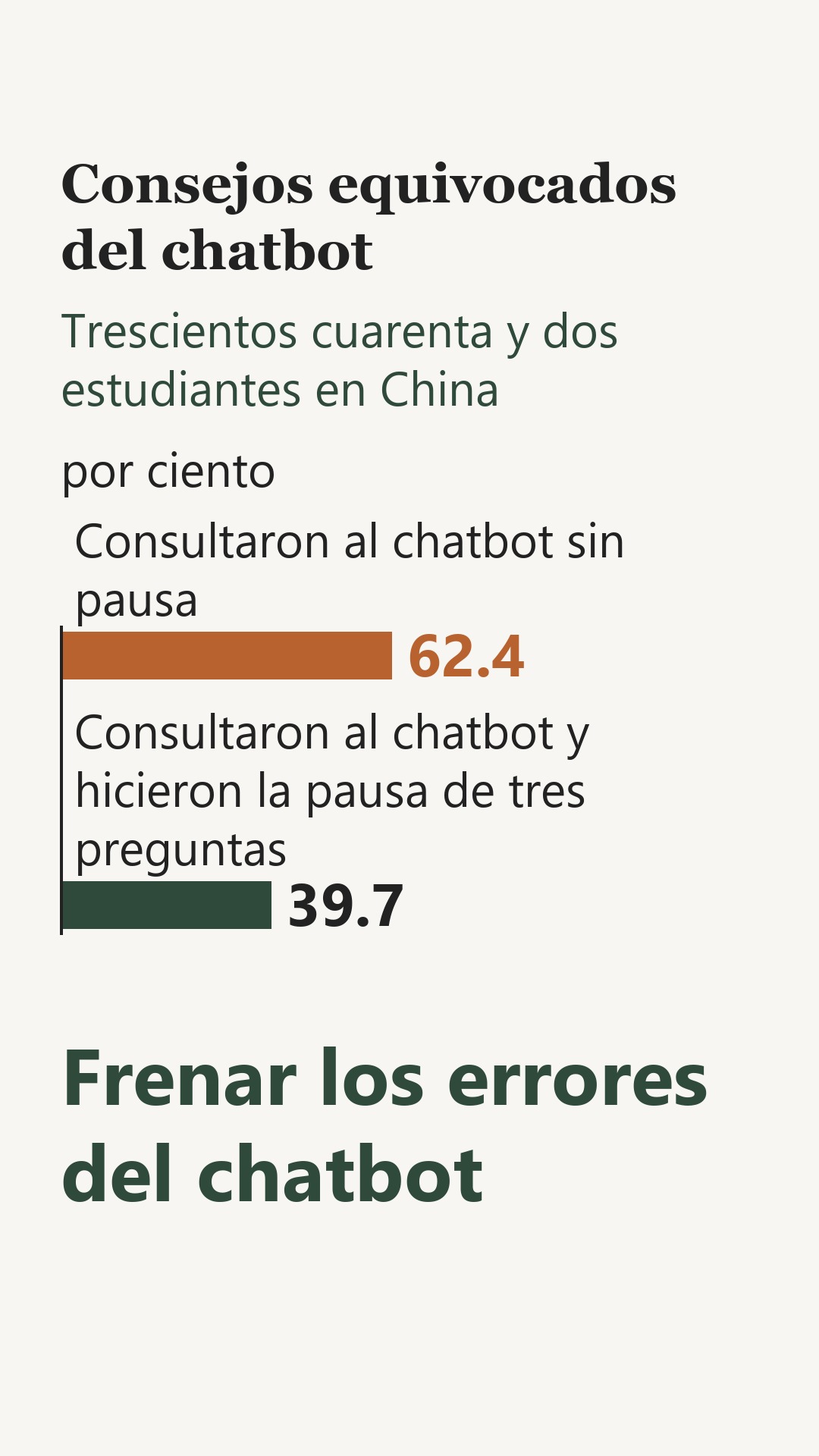
Imagine que le pide a un chatbot que resuelva un problema y le contesta con seguridad. Usted lo copia. En un experimento con estudiantes de una universidad china, eso pasó con un consejo equivocado en 62 de cada 100 casos entre los que consultaron al chatbot sin hacer la pausa.
Participaron 342 estudiantes de entre 18 y 24 años, de una sola universidad. Cada uno hizo 24 tareas cortas: razonamiento, lectura de tablas y evaluación de fuentes, con una respuesta correcta entre cuatro opciones. Primero respondían solos. Después, algunos consultaban a ChatGPT, con hasta tres turnos de conversación por tarea.
Cuando el chatbot daba la respuesta incorrecta, el grupo que lo consultó sin más la siguió el 62.4% de las veces. El otro grupo, antes de entregar su respuesta final, contestó tres preguntas: cuál era mi propia razón, qué parte de la explicación se apoya en pruebas y no en la fluidez, y qué me haría rechazar la recomendación. En ese grupo, la aceptación de consejos erróneos bajó a 39.7%.
El chatbot acertó en cerca de dos de cada tres tareas en ambos grupos. Con los aciertos, ambos lo siguieron con frecuencia parecida. La pausa sirvió para distinguir: seguían usándolo cuando tenía razón y lo resistían cuando no.
Los estudiantes que no hicieron la pausa también salieron más confiados. Su confianza final promedio fue de 76.1 puntos sobre 100, frente a 72.3 con la pausa y 68.4 sin chatbot. Y mostraron un patrón más marcado de quedarse con el mérito de los aciertos y de cargar la culpa de los errores hacia afuera.
Conviene ver lo que el estudio no midió. Fueron tareas cortas con una respuesta correcta y conocida, en una sola sesión y en una sola universidad. No dice nada sobre conversaciones largas, consejos personales o decisiones de la vida diaria. Tampoco muestra si el hábito de pausar dura semanas o meses.
Antes de aceptar como suya una respuesta de un chatbot, diga primero en voz alta su propia razón. Después pregúntese qué tendría que ver para rechazarla.
Qué significa para usted
Ese experimento fue con estudiantes universitarios de una sola universidad de China, en tareas cortas con una respuesta correcta. No muestra qué pasa en conversaciones largas ni en decisiones personales. Para su propio uso, lo que puede observar es si usted mismo reconoce cuánto pesó el chatbot en su respuesta: en el estudio, los que no hicieron la pausa tendían a creer que se apoyaron menos de lo que en realidad se apoyaron.
Ren, S. (2026). College students' metacognitive awareness of generative-AI reliance: an experimental study of decision confidence and attribution bias. Frontiers in Psychology. https://doi.org/10.3389/fpsyg.2026.1926110
Quién pagó: El estudio fue financiado por programas de investigación del gobierno chino (un proyecto de humanidades del Ministerio de Educación, un proyecto nacional de educación de la industria del carbón, un programa de talento de la provincia de Anhui y un proyecto de ciencias sociales de Anhui); el artículo no indica si los financiadores tuvieron algún papel, y no se prestó equipo ni software más allá de la interfaz de ChatGPT usada en el experimento.
Versión detalladaLos pasajes copiados del artículo, las ilustraciones y cada fuente con cuánto leímos de ella · 1414 palabras · unos 7 minLeerla →Cerrar
Unos minutos antes de entregar la respuesta: lo que cambió cuando los estudiantes tuvieron que explicarse a sí mismos
Un experimento con 342 universitarios en China encontró que una pausa breve, con tres preguntas, redujo mucho la aceptación de consejos equivocados de ChatGPT. También muestra los límites: fueron tareas cortas, en un solo campus, y nada de eso prueba que el hábito dure.
Un grupo de estudiantes resolvió 24 tareas cortas de razonamiento, lectura de datos y evaluación de fuentes. Antes de ver a la máquina, cada uno anotó su respuesta y qué tan seguro estaba. Después, unos recibieron apoyo abierto de ChatGPT, otros el mismo apoyo más una pausa con tres preguntas, y otros resolvieron solos. Entre quienes consultaron al chatbot sin pausa, el 62.4 por ciento terminó aceptando un consejo que estaba equivocado1. Con la pausa, esa cifra bajó a 39.7 por ciento2.
Piense en la escena: un joven copia el problema en la ventana del chat, lee una explicación ordenada, con sus pasos y su tono de profesor paciente, y luego marca su respuesta final. Lo que el estudio midió fue justamente eso, en un campus de China, con estudiantes de entre 18 y 24 años3. El experimento se hizo en línea, en una plataforma aprobada por la universidad, y cada participante fue asignado al azar a una sola de las tres condiciones, no por elección propia. Los autores son un solo investigador, Shaowei Ren, de la Escuela de Ingeniería Civil y Arquitectura de la Universidad de Ciencia y Tecnología de Anhui, y el trabajo lo pagaron proyectos del Ministerio de Educación de China y de la provincia de Anhui, sin intereses comerciales declarados.
La herramienta no era un aparato raro: era ChatGPT, con la etiqueta de modelo que el registro del estudio anota como GPT-5.4, de OpenAI. La conversación tenía un límite: un mensaje inicial estándar y hasta dos preguntas de seguimiento por tarea. Los estudiantes podían pedir aclaraciones, pedir otra explicación o discutir con el chat. No estaban obligados a aceptar lo que decía. Y aquí está el punto que explica por qué una respuesta puede sentirse como la de un colega y no como la de una calculadora: el sistema produce lenguaje natural, se adapta a lo que se le pregunta y a veces suena seguro aunque el contenido esté incompleto o mal4. Esa fluidez hace que el consejo se sienta menos como una salida mecánica y más como el de alguien que sabe5.
La pausa consistió en tres preguntas escritas, respondidas después de la conversación y antes de la respuesta final: cuál era la razón propia antes de apoyarse en la IA, qué parte de la explicación estaba sostenida por evidencia y no por fluidez, y qué haría falta para rechazar la recomendación del chat6. Los resultados: además de la caída en la aceptación de consejos erróneos, la correspondencia entre lo que la gente decía que había dependido de la IA y lo que de hecho copió de ella subió de 0.41 a 0.59 en una escala de 0 a 12. También bajó un índice de atribución de culpas y méritos, de 0.42 a 0.212. Y la confianza final quedó así: 76.1 puntos sobre 100 en el grupo con chat sin pausa, 72.3 en el grupo con pausa y 68.4 en el grupo sin IA1.
Hay un detalle que evita la lectura fácil. Cuando el consejo del chat era correcto, los dos grupos con IA lo siguieron con frecuencia parecida7. La pausa no volvió desconfiados a los estudiantes: los volvió más selectivos. El propio autor lo resume así: mejoró la distinción inmediata entre consejo útil y consejo engañoso, sin un rechazo general de la IA8. En el grupo sin pausa, además, la dependencia real superaba a la percibida: la gente siguió al chat más de lo que creía9. Y los estudiantes de ese grupo se atribuyeron el mérito de los aciertos y le cargaron la culpa a la IA cuando se equivocaron10.
Lo que el estudio no puede decir es igual de importante. Fue un solo campus11. Fueron tareas cortas, con una respuesta correcta conocida, y midieron la decisión inmediata, no el aprendizaje a lo largo de un semestre12. La relación entre la calibración de la conciencia y la menor aceptación de errores no se interpreta como causal, porque las medidas se traslapan y se tomaron en el mismo episodio12. Y "dependencia metacognitiva" no es un rasgo validado: es una etiqueta descriptiva que el autor usa para ordenar el problema.
Esta historia tiene familia. El artículo describe un estudio sobre el sesgo de automatización: darle peso excesivo a una sugerencia automática y pasar por alto la evidencia contraria o el propio juicio correcto13. El artículo describe otro estudio sobre el internet: el acceso a información externa puede inflar lo que la gente cree saber14. Y hay trabajos recientes sobre el desgaste cognitivo. Un estudio con 87 estudiantes iraníes de inglés, del que solo pudimos leer el resumen, encontró que el grupo con IA escribió mejor pero usó menos estrategias de composición, y los propios autores advierten que el exceso de apoyo puede frenar el desarrollo de habilidades críticas1516. Otro, con 589 universitarios y profesionistas jóvenes, distingue entre delegar el pensamiento a la IA y usarla como andamio: ambos modos dieron beneficios inmediatos parecidos, pero solo el primero se asoció con menor motivación y peores resultados percibidos después17181920. Un tercero, en seis clases de redacción en China durante ocho semanas, encontró que la colaboración abierta con IA tuvo la media más alta en los textos escritos con apoyo, aunque la diferencia fue imprecisa, y que al final de la semana ocho el grupo con apoyo acotado mostró mejores resultados que la colaboración abierta, con valores que quedaron en el límite de la significancia212223. Son estudios distintos, con diseños distintos, y ninguno prueba lo que este encontró; apuntan en la misma dirección sobre dónde está el riesgo.
Así lo leemos nosotros. El patrón es viejo y no necesita máquinas: cuando alguien habla con seguridad, tendemos a dejar de revisar lo que dice. La firmeza del que habla se confunde con la validez de lo que afirma. En una casa como la suya, eso puede significar que un hijo, o usted mismo, consulte al chat para una tarea, sienta que entendió, y no vuelva a comprobar. Esperamos que la pausa funcione no porque enseñe datos, sino porque obliga a escribir primero lo que uno piensa. Sabríamos que nos equivocamos si, en la vida diaria, quienes más usan el chat revisaran igual o más sus respuestas, o si su sensación de entender coincidiera con acertar más.
También leímos otros trabajos sobre este mismo asunto, y conviene decirlo: el riesgo de fondo no es que la IA se equivoque, sino que su comodidad apague la costumbre de dudar. Un chatbot que explica con soltura y a veces falla puede generar una confianza que no se apoya en su desempeño real, y esa confianza no se corrige sola con el uso repetido. Lo que se gana es velocidad; lo que se da a cambio es la práctica de sostener una idea propia. Nadie le está pidiendo que deje el chat.
¿Qué haría falta para saber si esto sirve más allá del salón de clases? Los propios autores piden estudios en actividades largas, como escribir, investigar, programar o evaluar fuentes; probar la pausa en varias instituciones; y medir retención y transferencia tiempo después24. Mientras eso no exista, la pausa de tres preguntas es una hipótesis prometedora, no una receta probada para la vida diaria.
Aquí está lo que usted puede hacer con esto, y es poco y concreto. Antes de dar por buena una respuesta, pregúntese si la acepta porque la comprobó o porque suena segura. Escriba su propia respuesta primero, aunque sea en una servilleta, y compare después. Lleve una cuenta sencilla de cuántas veces la IA acertó y cuántas se equivocó en temas que usted puede verificar, y ajuste su confianza a esa cuenta, no al tono. De vez en cuando intente responder de memoria antes de consultar, y anote qué tuvo que buscar: así ve qué parte del saber quedó en usted y qué parte quedó solo en la herramienta. Si nos equivocamos, lo notará cuando esas pequeñas cuentas no cambien nada en su manera de decidir.
La próxima vez que abra el chat con una duda, pruebe esto: escriba primero lo que usted cree, y pregúntese después si la respuesta le cambió la idea o solo le puso palabras bonitas.
De dónde sale cada dato de contexto, y cuánto leímos de cada documento
- Ren, S. (2026). College students' metacognitive awareness of generative-AI reliance: an experimental study of decision confidence and attribution bias. Frontiers in Psychology. https://doi.org/10.3389/fpsyg.2026.1926110 - el artículo del que trata esta nota — el artículo completo — el pasaje: "Open ChatGPT support increased final confidence and was associated with 62.4% acceptance of incorrect AI advice."
- Ren, S. (2026). College students' metacognitive awareness of generative-AI reliance: an experimental study of decision confidence and attribution bias. Frontiers in Psychology. https://doi.org/10.3389/fpsyg.2026.1926110 - el artículo del que trata esta nota — el artículo completo — el pasaje: "Reflection reduced incorrect-advice acceptance to 39.7% (OR = 0.40, 95% CI [0.28, 0.56], p < 0.001), improved awareness calibration (0.59 vs. 0.41, p < 0.001), and reduced the attribution-bias index (0.21 vs. 0.42, p = 0.002)."
- Ren, S. (2026). College students' metacognitive awareness of generative-AI reliance: an experimental study of decision confidence and attribution bias. Frontiers in Psychology. https://doi.org/10.3389/fpsyg.2026.1926110 - el artículo del que trata esta nota — el artículo completo — el pasaje: "A total of 360 undergraduate students were recruited from Anhui University of Science and Technology through course announcements and online campus notices."
- Ren, S. (2026). College students' metacognitive awareness of generative-AI reliance: an experimental study of decision confidence and attribution bias. Frontiers in Psychology. https://doi.org/10.3389/fpsyg.2026.1926110 - el artículo del que trata esta nota — el artículo completo — el pasaje: "Generative AI may increase confidence because its outputs are fluent, structured, and apparently authoritative even when the content is incomplete or incorrect."
- Ren, S. (2026). College students' metacognitive awareness of generative-AI reliance: an experimental study of decision confidence and attribution bias. Frontiers in Psychology. https://doi.org/10.3389/fpsyg.2026.1926110 - el artículo del que trata esta nota — el artículo completo — el pasaje: "These features can make AI advice feel less like a mechanical output and more like a knowledgeable collaborator."
- Ren, S. (2026). College students' metacognitive awareness of generative-AI reliance: an experimental study of decision confidence and attribution bias. Frontiers in Psychology. https://doi.org/10.3389/fpsyg.2026.1926110 - el artículo del que trata esta nota — el artículo completo — el pasaje: "In the reflection condition, participants also responded to three metacognitive prompts after the ChatGPT interaction and before finalizing their answers: (a) “What is my own reason for the answer before relying on AI?”; (b) “Which part of the AI explanation is supported by evidence rather than fluency?”; and (c) “What would make me reject the ChatGPT recommendation?”"
- Ren, S. (2026). College students' metacognitive awareness of generative-AI reliance: an experimental study of decision confidence and attribution bias. Frontiers in Psychology. https://doi.org/10.3389/fpsyg.2026.1926110 - el artículo del que trata esta nota — el artículo completo — el pasaje: "When the final ChatGPT recommendation was correct, both AI-assisted groups frequently aligned their final answers with the recommendation across analytical reasoning, data interpretation, and information-credibility tasks."
- Ren, S. (2026). College students' metacognitive awareness of generative-AI reliance: an experimental study of decision confidence and attribution bias. Frontiers in Psychology. https://doi.org/10.3389/fpsyg.2026.1926110 - el artículo del que trata esta nota — el artículo completo — el pasaje: "Brief metacognitive reflection improved immediate discrimination between useful and misleading AI advice without producing blanket rejection of AI."
- Ren, S. (2026). College students' metacognitive awareness of generative-AI reliance: an experimental study of decision confidence and attribution bias. Frontiers in Psychology. https://doi.org/10.3389/fpsyg.2026.1926110 - el artículo del que trata esta nota — el artículo completo — el pasaje: "The open ChatGPT condition had a negative mean signed discrepancy ( M = −0.22, SD = 0.71), indicating that behavioral reliance tended to exceed perceived reliance"
- Ren, S. (2026). College students' metacognitive awareness of generative-AI reliance: an experimental study of decision confidence and attribution bias. Frontiers in Psychology. https://doi.org/10.3389/fpsyg.2026.1926110 - el artículo del que trata esta nota — el artículo completo — el pasaje: "In the open ChatGPT condition, students showed stronger self-serving attribution bias: they were more likely to claim credit for correct responses while assigning responsibility to AI when errors occurred."
- Ren, S. (2026). College students' metacognitive awareness of generative-AI reliance: an experimental study of decision confidence and attribution bias. Frontiers in Psychology. https://doi.org/10.3389/fpsyg.2026.1926110 - el artículo del que trata esta nota — el artículo completo — el pasaje: "First, the sample was drawn from one university."
- Ren, S. (2026). College students' metacognitive awareness of generative-AI reliance: an experimental study of decision confidence and attribution bias. Frontiers in Psychology. https://doi.org/10.3389/fpsyg.2026.1926110 - el artículo del que trata esta nota — el artículo completo — el pasaje: "The exploratory association between calibration and overreliance is not interpreted as causal mediation, and the findings concern bounded academic decision tasks rather than long-term learning."
- Ren, S. (2026). College students' metacognitive awareness of generative-AI reliance: an experimental study of decision confidence and attribution bias. Frontiers in Psychology. https://doi.org/10.3389/fpsyg.2026.1926110 - el artículo del que trata esta nota — el artículo completo — el pasaje: "Automation bias occurs when people give excessive weight to automated suggestions, sometimes overlooking contradictory evidence or their own correct judgment ( Parasuraman and Riley, 1997 ; Parasuraman and Manzey, 2010 )."
- Ren, S. (2026). College students' metacognitive awareness of generative-AI reliance: an experimental study of decision confidence and attribution bias. Frontiers in Psychology. https://doi.org/10.3389/fpsyg.2026.1926110 - el artículo del que trata esta nota — el artículo completo — el pasaje: "Prior work on the Internet's effects on perceived knowledge suggests that access to external information can inflate people's estimates of their own knowledge ( Sparrow et al., 2011 ; Fisher et al., 2015 )."
- Hosseinpur RM. (2026). Generative AI and Composing Strategies Employed by EFL Writers: Is AI a Double-edged Sword?. Teaching English as a Second or Foreign Language--TESL-EJ. https://doi.org/10.55593/ej.30119a2 — solo el resumen - no se pudo obtener el texto completo — el pasaje: "Results showed the AI group achieved significantly higher post-test scores but employed fewer cognitive, rhetorical, metacognitive, communicative, and socio-affective writing strategies, indicating reduced strategic engagement."
- Hosseinpur RM. (2026). Generative AI and Composing Strategies Employed by EFL Writers: Is AI a Double-edged Sword?. Teaching English as a Second or Foreign Language--TESL-EJ. https://doi.org/10.55593/ej.30119a2 — solo el resumen - no se pudo obtener el texto completo — el pasaje: "The findings suggest that while AI can enhance writing performance, over-reliance may hinder critical skill development."
- Zhu Q, Li X, Dong Y, Chang P, Fan M. (2026). Not all cognitive offloading is equal: distinguishing dependent and autonomous offloading to generative AI. Frontiers in Psychology. 10.3389/fpsyg.2026.1878629 — solo el resumen - no se pudo obtener el texto completo — el pasaje: "In a three-wave time-lagged survey study ( N = 589 university students and early-career knowledge workers), we tested a dual-pathway model linking the two offloading modes to four perceived downstream cognitive outcomes-autonomous capability, creativity, deep processing, and independent judgment-through cognitive agency transfer and intrinsic motivation."
- Zhu Q, Li X, Dong Y, Chang P, Fan M. (2026). Not all cognitive offloading is equal: distinguishing dependent and autonomous offloading to generative AI. Frontiers in Psychology. 10.3389/fpsyg.2026.1878629 — solo el resumen - no se pudo obtener el texto completo — el pasaje: "Dependent offloading was positively associated with cognitive agency transfer and negatively associated with intrinsic motivation, which in turn were linked to poorer perceived outcomes."
- Zhu Q, Li X, Dong Y, Chang P, Fan M. (2026). Not all cognitive offloading is equal: distinguishing dependent and autonomous offloading to generative AI. Frontiers in Psychology. 10.3389/fpsyg.2026.1878629 — solo el resumen - no se pudo obtener el texto completo — el pasaje: "Autonomous offloading was positively associated with intrinsic motivation and more favorable perceived outcomes."
- Zhu Q, Li X, Dong Y, Chang P, Fan M. (2026). Not all cognitive offloading is equal: distinguishing dependent and autonomous offloading to generative AI. Frontiers in Psychology. 10.3389/fpsyg.2026.1878629 — solo el resumen - no se pudo obtener el texto completo — el pasaje: "Notably, both offloading modes yielded comparable immediate benefits despite divergent downstream correlates, suggesting that potentially maladaptive AI engagement may be difficult for users to detect from immediate experience."
- Chen X. (2026). Layer-sensitive cognitive offloading in generative AI-assisted writing: supported performance and independent no-AI outcomes. Frontiers in Psychology. 10.3389/fpsyg.2026.1906199 — solo el resumen - no se pudo obtener el texto completo — el pasaje: "Two classes were assigned to each of three conditions: no-AI writing, bounded AI support with compulsory reflection, and open AI collaboration."
- Chen X. (2026). Layer-sensitive cognitive offloading in generative AI-assisted writing: supported performance and independent no-AI outcomes. Frontiers in Psychology. 10.3389/fpsyg.2026.1906199 — solo el resumen - no se pudo obtener el texto completo — el pasaje: "Open AI collaboration had the highest observed supported-writing mean ( M = 4.02), although the class-clustered open-bounded contrast was imprecise (adjusted difference = 0.21, 95% CI [0.06, 0.36], wild-cluster p = 0.064)."
- Chen X. (2026). Layer-sensitive cognitive offloading in generative AI-assisted writing: supported performance and independent no-AI outcomes. Frontiers in Psychology. 10.3389/fpsyg.2026.1906199 — solo el resumen - no se pudo obtener el texto completo — el pasaje: "At Week 8, the bounded-support condition showed higher adjusted outcomes than open collaboration in writing quality (difference = 0.27), higher-order thinking (0.35), argument depth (0.42), and independent revision quality (0.39); exact wild-cluster p values ranged from 0.050 to 0.063."
- Ren, S. (2026). College students' metacognitive awareness of generative-AI reliance: an experimental study of decision confidence and attribution bias. Frontiers in Psychology. https://doi.org/10.3389/fpsyg.2026.1926110 - el artículo del que trata esta nota — el artículo completo — el pasaje: "Future research should also examine longer academic activities such as writing, research synthesis, programming, and source evaluation; test reflection interventions across multiple institutions; and include delayed retention and transfer assessments."
Ren, S. (2026). College students' metacognitive awareness of generative-AI reliance: an experimental study of decision confidence and attribution bias. Frontiers in Psychology. https://doi.org/10.3389/fpsyg.2026.1926110
Quién pagó: El estudio fue financiado por programas de investigación del gobierno chino (un proyecto de humanidades del Ministerio de Educación, un proyecto nacional de educación de la industria del carbón, un programa de talento de la provincia de Anhui y un proyecto de ciencias sociales de Anhui); el artículo no indica si los financiadores tuvieron algún papel, y no se prestó equipo ni software más allá de la interfaz de ChatGPT usada en el experimento.
Los hallazgos de otros estudios que aquí se mencionan provienen de este documento; esos estudios no se consultaron uno por uno.
experiment · Frontiers in psychology · the paper, 15 Sep 2026 · free
A Three-Question Pause Cut How Often Students Followed Bad Chatbot Advice
In a randomized experiment with 342 undergraduates at one Chinese university, a short reflection before deciding reduced acceptance of wrong AI answers from about 62 in 100 to about 40 in 100. The tasks were short, with one right answer, and the study cannot say whether the habit lasts.
Short version · the longer version follows, about 6 min
Ask the weeklyAI chat
Ask me about AI in your life: I point you to the stories weeklyAI has published on it, this week and before.
Conversations are saved for as long as weeklyAI exists, to improve the publication. Answers come in the language you write in.
- The study at a glance
- Who
- Undergraduate students using ChatGPT for short reasoning tasks
- How many
- 342
- Where
- One university in China (Anhui University of Science and Technology)
- When
- Not stated in the passages
- Kind of study
- experiment
- Who did it
- Anhui University of Science and Technology, China
- The limit that matters
- One university, short tasks with a known right answer; no proof the habit lasts
Share of students who accepted incorrect ChatGPT advice, in short tasks with one right answer at a single university; both groups got advice of similar accuracy.
ChatGPT alone versus ChatGPT with a short pause before deciding
Wrong advice was accepted less often after the pause (39.7% vs 62.4%)
Sense of how much they leaned on the bot matched their actual behaviour better after the pause (0.59 vs 0.41)
Taking credit for right answers and blaming the bot for wrong ones was lower after the pause (0.21 vs 0.42)
When the bot was right, both groups often followed it, so the pause did not mean rejecting good advice
When ChatGPT was right, both groups followed it at similar rates.
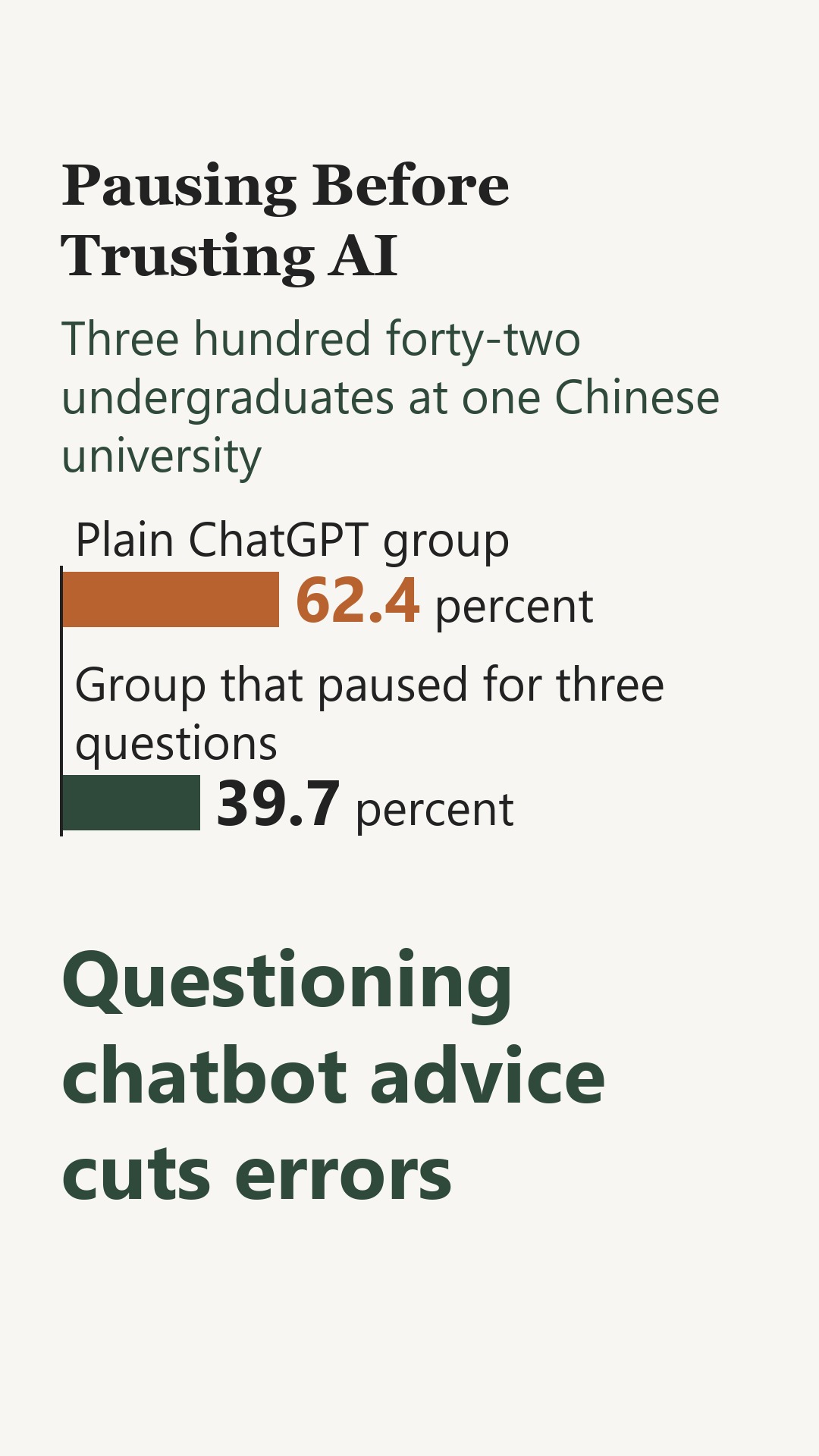
Researchers at Anhui University of Science and Technology in China put 342 undergraduates through short reasoning and information-checking tasks, each with one correct answer. Some students worked alone. Others could consult ChatGPT, asking up to two follow-up questions. A third group did the same, then answered three questions before committing to a final answer.
The three questions asked: What is my own reason for the answer before relying on AI? Which part of the AI explanation is supported by evidence rather than fluency? What would make me reject the ChatGPT recommendation?
When ChatGPT gave a wrong answer, 62 out of every 100 students in the plain ChatGPT group went along with it. In the group that paused for the three questions, about 40 out of 100 did. The researchers calculate that the pause cut the odds of accepting wrong advice by more than half.
The pause did not make students reject good advice. When ChatGPT was right, both groups followed it at similar rates. Students who reflected were pickier about bad answers, not hostile to the tool.
Students who paused were also more accurate about how much they had leaned on the chatbot. In the plain group, students underestimated how often their final answers matched the AI's. The pause narrowed that gap. The study cannot show that this better self-awareness is what caused the change in behavior; the two moved together.
Grant the students who skipped the pause something: the chatbot's wrong answers were plausible. They overgeneralized from a graph or treated a weak source as stronger than it was. Fluent wrong answers are hard to catch in the moment.
This was one sitting, on short tasks with a known right answer, among students at a single university. It says nothing yet about long conversations, personal advice, or everyday decisions. It cannot show whether the habit of pausing sticks for weeks or months.
Before you take a chatbot's answer as your own, say your own reason out loud first, then ask what would make you reject its answer.
What this means for you
One useful thing to carry from this: before you let a chatbot's answer become yours, give your own reason first, then ask what would make you reject its answer. That small pause is what the students did, and it helped them on short tasks in one sitting, at one university. Whether the habit holds over weeks, or in long personal conversations where there is no right answer to check, is not known yet.
Ren, S. (2026). College students' metacognitive awareness of generative-AI reliance: an experimental study of decision confidence and attribution bias. Frontiers in Psychology. https://doi.org/10.3389/fpsyg.2026.1926110
Who paid: The study was funded by Chinese government research programs (a Ministry of Education humanities project, a national coal-industry education project, an Anhui Province talent program and an Anhui social-science project); the article does not say whether funders had any role, and no equipment or software was lent beyond the ChatGPT interface used in the experiment.
The longer versionThe passages copied from the paper, the pictures, and every source with how much of it we read · 1200 words · about 6 minRead it →Close
A Brief Pause Before the Answer Cut Students' Belief in ChatGPT's Wrong Advice
In one Chinese university, 342 undergraduates used a chatbot for short reasoning tasks. A few questions before deciding made them harder to fool — and just as willing to follow the bot when it was right.
A logic problem, four answer choices, and a chatbot that answers in complete sentences, with reasons. That is the setup of a new experiment at Anhui University of Science and Technology, in Huainan, China, published in Frontiers in Psychology.
The study recruited 360 undergraduates through course announcements and online campus notices, and the survey platform randomly assigned them to three groups: working alone, working with ChatGPT, and working with ChatGPT plus a short reflection prompt before the final answer1. Eighteen were excluded for failing attention checks or finishing too fast; 342 remained, aged 18 to 24, each completing 24 short tasks on reasoning, tables and graphs, and the trustworthiness of claims. Open ChatGPT support raised final confidence and was linked to accepting incorrect AI advice 62.4 percent of the time2. In the reflection group that fell to 39.7 percent3.
What makes a fluent machine answer persuasive is not only its content. Generative AI may raise confidence because its outputs are fluent, structured and apparently authoritative even when the content is incomplete or wrong4. These features can make AI advice feel less like a mechanical output and more like a knowledgeable collaborator5. The longer version of that idea has been tested before. The article describes a study in which access to outside information can inflate people's estimates of their own knowledge6. The article describes a study in which people give excessive weight to automated suggestions, sometimes overlooking contradictory evidence or their own correct judgment7.
The reflection was not elaborate. After the chat and before committing, students answered three questions: what is my own reason for the answer before relying on AI; which part of the AI explanation is supported by evidence rather than fluency; and what would make me reject the recommendation8. That was enough to move several measures at once. Awareness calibration, a score for how well students' sense of their own reliance matched their actual behaviour, rose from 0.41 to 0.593. The attribution-bias index, which tracks taking credit for right answers and blaming the machine for wrong ones, fell from 0.42 to 0.213. Under open ChatGPT, students tended to underestimate how much they leaned on the bot9, and they claimed credit for correct responses while assigning responsibility to the AI when errors occurred10.
The pause did not turn students against the tool. When the final ChatGPT recommendation was correct, both AI-assisted groups frequently aligned their final answers with it across all three task types11, and the two groups received advice of comparable accuracy12. The author's own summary: brief reflection improved immediate discrimination between useful and misleading advice without producing blanket rejection of AI13. Final confidence tells the same story. It averaged 76.1 in the open ChatGPT group, 72.3 with reflection, and 68.4 for students working alone.
Other studies of students and chatbots point the same direction, with the same caution. One mixed-methods study of 87 Iranian learners of English as a foreign language found the AI group scored higher on a writing test but used fewer cognitive, rhetorical, metacognitive, communicative and socio-affective strategies while writing, which the authors read as reduced strategic engagement; we could read only the summary, the full paper is behind a subscription14. That summary concludes that while AI can enhance writing performance, over-reliance may hinder critical skill development15. A survey of 589 university students and early-career workers drew a distinction between delegating core thinking to AI and using it as a scaffold while keeping your own judgment in the loop; both produced similar immediate benefits, which the authors say makes the harmful pattern hard to notice from the inside16. An eight-week classroom study of 180 Chinese undergraduates found that open collaboration with AI produced the highest supported-writing scores but weaker higher-order thinking and independent revision than bounded support with compulsory reflection17; its conditions were whole classes, so its authors call the results classroom-level associations rather than proof of cause18. One thing that study states plainly: writing with AI can improve a supported product without necessarily strengthening the competence that remains after the support is removed19.
The limits are stated by the author, not discovered by critics. The sample came from one university1. The tasks were short, with a known correct answer. The findings concern bounded academic decision tasks rather than long-term learning20. The link between better calibration and less overreliance is an association, not proof that one caused the other, and the author says so directly20. The interaction was bounded too: one starter prompt, at most two follow-up questions per task, a controlled online environment, and a hosted model whose behaviour changes over time.
Here is how we read it. The pattern is authority by tone. A machine that answers in tidy, confident paragraphs gets treated like a knowledgeable colleague, and the pull is strongest when you were unsure to begin with. We expect that to hold outside a university too: someone asking a chatbot about a symptom, a contract clause or a child's school problem will accept a wrong answer at rates in the neighbourhood of these students, or higher, because nothing in everyday life supplies an answer key. We could be wrong. If ordinary users, unprompted, caught most of a chatbot's errors or accepted wrong advice far less often than these students did, the explanation would be weak. You can test it yourself in one move. Before you accept an answer, ask whether you would have accepted the same claim from a stranger at a bus stop. If the only thing backing it is a confident tone, that is a warning, not a reason.
There is a second pattern worth naming, because it is the one that makes the problem invisible. People credit themselves for what goes right and blame the tool for what goes wrong, so the lesson never lands where it is needed. We expect heavy users to keep doing this, and to keep learning the wrong thing from their mistakes. The check is cheap: after a chatbot-assisted decision goes well or badly, say plainly what you contributed and what the machine contributed. One sentence, once per decision. And when you notice you are asking because you feel unsure, write your own guess first, then compare. That way the machine's certainty is not the only voice in the room.
What the study makes possible is small and portable. Three questions, asked before a final answer, moved behaviour in a single sitting. Whether the habit survives a semester, or carries into open-ended conversations where no one knows the right answer, is untested. The author calls for longer activities such as writing, research synthesis, programming and source evaluation, tested across institutions, with delayed checks on what is retained21. Until then, treat the pause as a cheap experiment of your own.
The next time a chatbot hands you a confident answer, you will know what the students did not: the fluency is not the evidence. Ask yourself what your own reason was before you asked.
Where each piece of context comes from, and how much of it we read
- Ren, S. (2026). College students' metacognitive awareness of generative-AI reliance: an experimental study of decision confidence and attribution bias. Frontiers in Psychology. https://doi.org/10.3389/fpsyg.2026.1926110 - the article this story is about — the whole article — the passage: "First, the sample was drawn from one university."
- Ren, S. (2026). College students' metacognitive awareness of generative-AI reliance: an experimental study of decision confidence and attribution bias. Frontiers in Psychology. https://doi.org/10.3389/fpsyg.2026.1926110 - the article this story is about — the whole article — the passage: "Open ChatGPT support increased final confidence and was associated with 62.4% acceptance of incorrect AI advice."
- Ren, S. (2026). College students' metacognitive awareness of generative-AI reliance: an experimental study of decision confidence and attribution bias. Frontiers in Psychology. https://doi.org/10.3389/fpsyg.2026.1926110 - the article this story is about — the whole article — the passage: "Reflection reduced incorrect-advice acceptance to 39.7% (OR = 0.40, 95% CI [0.28, 0.56], p < 0.001), improved awareness calibration (0.59 vs. 0.41, p < 0.001), and reduced the attribution-bias index (0.21 vs. 0.42, p = 0.002)."
- Ren, S. (2026). College students' metacognitive awareness of generative-AI reliance: an experimental study of decision confidence and attribution bias. Frontiers in Psychology. https://doi.org/10.3389/fpsyg.2026.1926110 - the article this story is about — the whole article — the passage: "Generative AI may increase confidence because its outputs are fluent, structured, and apparently authoritative even when the content is incomplete or incorrect."
- Ren, S. (2026). College students' metacognitive awareness of generative-AI reliance: an experimental study of decision confidence and attribution bias. Frontiers in Psychology. https://doi.org/10.3389/fpsyg.2026.1926110 - the article this story is about — the whole article — the passage: "These features can make AI advice feel less like a mechanical output and more like a knowledgeable collaborator."
- Ren, S. (2026). College students' metacognitive awareness of generative-AI reliance: an experimental study of decision confidence and attribution bias. Frontiers in Psychology. https://doi.org/10.3389/fpsyg.2026.1926110 - the article this story is about — the whole article — the passage: "Prior work on the Internet's effects on perceived knowledge suggests that access to external information can inflate people's estimates of their own knowledge ( Sparrow et al., 2011 ; Fisher et al., 2015 )."
- Ren, S. (2026). College students' metacognitive awareness of generative-AI reliance: an experimental study of decision confidence and attribution bias. Frontiers in Psychology. https://doi.org/10.3389/fpsyg.2026.1926110 - the article this story is about — the whole article — the passage: "Automation bias occurs when people give excessive weight to automated suggestions, sometimes overlooking contradictory evidence or their own correct judgment ( Parasuraman and Riley, 1997 ; Parasuraman and Manzey, 2010 )."
- Ren, S. (2026). College students' metacognitive awareness of generative-AI reliance: an experimental study of decision confidence and attribution bias. Frontiers in Psychology. https://doi.org/10.3389/fpsyg.2026.1926110 - the article this story is about — the whole article — the passage: "In the reflection condition, participants also responded to three metacognitive prompts after the ChatGPT interaction and before finalizing their answers: (a) “What is my own reason for the answer before relying on AI?”; (b) “Which part of the AI explanation is supported by evidence rather than fluency?”; and (c) “What would make me reject the ChatGPT recommendation?”"
- Ren, S. (2026). College students' metacognitive awareness of generative-AI reliance: an experimental study of decision confidence and attribution bias. Frontiers in Psychology. https://doi.org/10.3389/fpsyg.2026.1926110 - the article this story is about — the whole article — the passage: "The open ChatGPT condition had a negative mean signed discrepancy ( M = −0.22, SD = 0.71), indicating that behavioral reliance tended to exceed perceived reliance"
- Ren, S. (2026). College students' metacognitive awareness of generative-AI reliance: an experimental study of decision confidence and attribution bias. Frontiers in Psychology. https://doi.org/10.3389/fpsyg.2026.1926110 - the article this story is about — the whole article — the passage: "In the open ChatGPT condition, students showed stronger self-serving attribution bias: they were more likely to claim credit for correct responses while assigning responsibility to AI when errors occurred."
- Ren, S. (2026). College students' metacognitive awareness of generative-AI reliance: an experimental study of decision confidence and attribution bias. Frontiers in Psychology. https://doi.org/10.3389/fpsyg.2026.1926110 - the article this story is about — the whole article — the passage: "When the final ChatGPT recommendation was correct, both AI-assisted groups frequently aligned their final answers with the recommendation across analytical reasoning, data interpretation, and information-credibility tasks."
- Ren, S. (2026). College students' metacognitive awareness of generative-AI reliance: an experimental study of decision confidence and attribution bias. Frontiers in Psychology. https://doi.org/10.3389/fpsyg.2026.1926110 - the article this story is about — the whole article — the passage: "Recommendation accuracy was comparable between the two AI-assisted groups."
- Ren, S. (2026). College students' metacognitive awareness of generative-AI reliance: an experimental study of decision confidence and attribution bias. Frontiers in Psychology. https://doi.org/10.3389/fpsyg.2026.1926110 - the article this story is about — the whole article — the passage: "Brief metacognitive reflection improved immediate discrimination between useful and misleading AI advice without producing blanket rejection of AI."
- Hosseinpur RM. (2026). Generative AI and Composing Strategies Employed by EFL Writers: Is AI a Double-edged Sword?. Teaching English as a Second or Foreign Language--TESL-EJ. https://doi.org/10.55593/ej.30119a2 — only the abstract - the full text could not be fetched — the passage: "Results showed the AI group achieved significantly higher post-test scores but employed fewer cognitive, rhetorical, metacognitive, communicative, and socio-affective writing strategies, indicating reduced strategic engagement."
- Hosseinpur RM. (2026). Generative AI and Composing Strategies Employed by EFL Writers: Is AI a Double-edged Sword?. Teaching English as a Second or Foreign Language--TESL-EJ. https://doi.org/10.55593/ej.30119a2 — only the abstract - the full text could not be fetched — the passage: "The findings suggest that while AI can enhance writing performance, over-reliance may hinder critical skill development."
- Zhu Q, Li X, Dong Y, Chang P, Fan M. (2026). Not all cognitive offloading is equal: distinguishing dependent and autonomous offloading to generative AI. Frontiers in Psychology. 10.3389/fpsyg.2026.1878629 — only the abstract - the full text could not be fetched — the passage: "Notably, both offloading modes yielded comparable immediate benefits despite divergent downstream correlates, suggesting that potentially maladaptive AI engagement may be difficult for users to detect from immediate experience."
- Chen X. (2026). Layer-sensitive cognitive offloading in generative AI-assisted writing: supported performance and independent no-AI outcomes. Frontiers in Psychology. 10.3389/fpsyg.2026.1906199 — only the abstract - the full text could not be fetched — the passage: "At Week 8, the bounded-support condition showed higher adjusted outcomes than open collaboration in writing quality (difference = 0.27), higher-order thinking (0.35), argument depth (0.42), and independent revision quality (0.39); exact wild-cluster p values ranged from 0.050 to 0.063."
- Chen X. (2026). Layer-sensitive cognitive offloading in generative AI-assisted writing: supported performance and independent no-AI outcomes. Frontiers in Psychology. 10.3389/fpsyg.2026.1906199 — only the abstract - the full text could not be fetched — the passage: "Because conditions were allocated by only six intact classes and the bounded condition combined delegation restrictions with compulsory reflection, the results are interpreted as classroom-level, mechanism-consistent associations rather than definitive causal effects."
- Chen X. (2026). Layer-sensitive cognitive offloading in generative AI-assisted writing: supported performance and independent no-AI outcomes. Frontiers in Psychology. 10.3389/fpsyg.2026.1906199 — only the abstract - the full text could not be fetched — the passage: "Writing with generative artificial intelligence (GenAI) can improve a supported product without necessarily strengthening the competence that remains after support is removed."
- Ren, S. (2026). College students' metacognitive awareness of generative-AI reliance: an experimental study of decision confidence and attribution bias. Frontiers in Psychology. https://doi.org/10.3389/fpsyg.2026.1926110 - the article this story is about — the whole article — the passage: "The exploratory association between calibration and overreliance is not interpreted as causal mediation, and the findings concern bounded academic decision tasks rather than long-term learning."
- Ren, S. (2026). College students' metacognitive awareness of generative-AI reliance: an experimental study of decision confidence and attribution bias. Frontiers in Psychology. https://doi.org/10.3389/fpsyg.2026.1926110 - the article this story is about — the whole article — the passage: "Future research should also examine longer academic activities such as writing, research synthesis, programming, and source evaluation; test reflection interventions across multiple institutions; and include delayed retention and transfer assessments."
Ren, S. (2026). College students' metacognitive awareness of generative-AI reliance: an experimental study of decision confidence and attribution bias. Frontiers in Psychology. https://doi.org/10.3389/fpsyg.2026.1926110
Who paid: The study was funded by Chinese government research programs (a Ministry of Education humanities project, a national coal-industry education project, an Anhui Province talent program and an Anhui social-science project); the article does not say whether funders had any role, and no equipment or software was lent beyond the ChatGPT interface used in the experiment.
The findings of other studies mentioned here come from this document; those studies were not opened one by one.