analysis of texts · Frontiers in psychiatry · la publicación, 13 ago 2026 · gratis
Una etiqueta propuesta para las apps de salud mental con IA
Un equipo de la Asociación Psiquiátrica Estadounidense diseñó ocho secciones para informar riesgos y datos. Ninguna app está obligada a mostrarla y nadie ha probado todavía que cambie decisiones.
Versión breve · la versión detallada sigue, unos 8 min
Pregunte al chat de weeklyAI
Pregúnteme sobre la IA en su vida: le señalo las notas que weeklyAI ha publicado sobre el tema, esta semana y antes.
Las conversaciones se guardan mientras exista weeklyAI, para mejorar la publicación. Se responde en el idioma en que usted escribe.
- El estudio, de un vistazo
- Quiénes
- Un grupo de trabajo de la Asociación Psiquiátrica Estadounidense (siete miembros de Norteamérica)
- Cuántos
- siete miembros
- Dónde
- Norteamérica (Estados Unidos)
- Cuándo
- 2026
- Tipo de estudio
- review of studies
- Quién lo hizo
- Asociación Psiquiátrica Estadounidense, comité de tecnología en salud mental
- El límite que importa
- Nadie la ha probado con usuarios ni pacientes, y ninguna app está obligada a mostrarla.
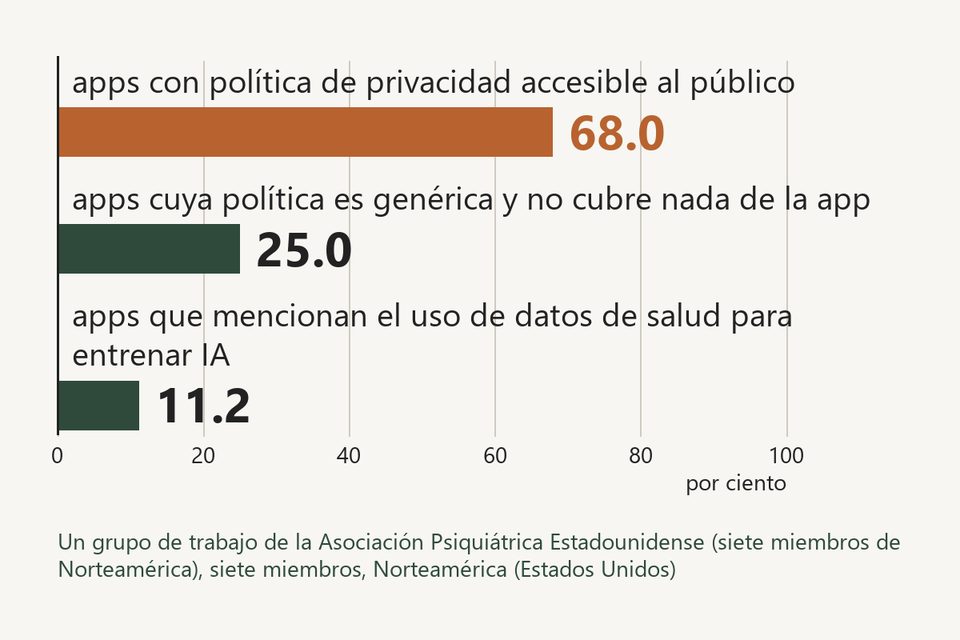
Son porcentajes de apps de salud mental con inteligencia artificial revisadas en un estudio sobre sus políticas de privacidad; no miden si la app funciona ni si es segura.
La confianza no nace de la frase amable; nace de que la frase coincida con lo que la app declara por escrito.
Abra una aplicación que dice acompañar la salud mental y use inteligencia artificial. Puede que no encuentre en ninguna parte qué hace, con quién se probó ni qué pasa con lo que usted escribe. Un equipo de la Asociación Psiquiátrica Estadounidense (APA, por sus siglas en inglés) propone una etiqueta de datos para llenar ese hueco.
Son siete personas del comité de tecnología de la información en salud mental de la APA, con formación en psiquiatría, derecho, salud pública, ingeniería y sociología. La etiqueta tiene ocho secciones.
La primera dice quién hizo la tecnología y quién puede responder a sus dudas. Otra explica para qué sirve y si es apta para personas con enfermedad mental grave. Una tercera advierte si puede usarse en una crisis y qué recursos buscar cuando la app no alcanza. Las demás cubren riesgos y límites del modelo, información técnica, pruebas clínicas, accesibilidad y manejo de datos.
El equipo la afinó con una presentación en el congreso anual de la APA en 2025, una encuesta en un seminario por internet y la revisión del comité de ética de la asociación. Se apoyó en la ley europea de inteligencia artificial, en el marco de riesgos del NIST estadounidense y en la literatura sobre consentimiento informado.
La etiqueta está pensada para leerse con un nivel de sexto grado, con detalles técnicos aparte para el personal clínico.
No es una ley: ningún regulador la exige, y hoy cada empresa decidiría si la usa o no. Tampoco hay pruebas de que la etiqueta mejore la comprensión de nadie. Los autores dicen que probarla con personas es una tarea pendiente.
Queda otro problema. Nadie verifica de forma independiente lo que el desarrollador escribe en la etiqueta, y las apps cambian rápido, así que lo publicado puede quedar atrás.
Cuando abra una app de salud mental con inteligencia artificial, busque tres cosas: con qué datos se entrenó, qué hace si usted está en crisis y cómo trata su información de salud. Si no las encuentra, ya sabe algo.
Qué significa para usted
La etiqueta que propone la APA no es una ley: ninguna autoridad la exige y cada empresa decide si la muestra. Nadie ha comprobado todavía que ayude a entender mejor una app ni que cambie una decisión. Cuando abra una de estas aplicaciones, puede preguntar quién la hizo, con qué datos se entrenó, qué hace en una crisis y cómo trata su información de salud; si esas respuestas no aparecen, conviene detenerse antes de confiar.
Moon, K., Tamura, M., Redmond, J. R. et al. (2026). Facts label for transparent communication of AI Risks in mental health technology. Frontiers in Psychiatry. https://doi.org/10.3389/fpsyt.2026.1887887
Quién pagó: Los autores declararon que no se recibió apoyo financiero para este trabajo ni para su publicación, y declararon no tener relaciones comerciales o financieras que pudieran constituir un conflicto de interés.
No tome esto como consejo médico profesional.
Los hallazgos de otros estudios que aquí se mencionan provienen de este documento; esos estudios no se consultaron uno por uno.
Versión detalladaLos pasajes copiados del artículo, las ilustraciones y cada fuente con cuánto leímos de ella · 1617 palabras · unos 8 minLeerla →Cerrar
Una etiqueta para saber qué riesgos trae una app de salud mental; nadie está obligado a mostrarla todavía
Un grupo de trabajo de la Asociación Psiquiátrica Estadounidense propone ocho apartados para que estas aplicaciones declaren sus riesgos, sus datos y su evidencia. No se ha probado con usuarios ni con pacientes.
Abra la tienda de aplicaciones de su teléfono y busque "salud mental". Van a salir decenas de apps con nombres amables y colores suaves. Ninguna trae, en la ficha de la tienda, una etiqueta que le diga qué tan seguido se equivoca, con qué datos la entrenaron o qué pasa con lo que usted le escribe a las tres de la mañana. Un grupo de trabajo de la Asociación Psiquiátrica Estadounidense propone una: una etiqueta de datos, al estilo de la que llevan los alimentos, con ocho apartados: información básica de identificación, uso previsto, advertencias, riesgos y limitaciones, información del modelo, evidencia clínica, accesibilidad y usabilidad, y privacidad y seguridad12.
La idea es que la misma etiqueta sirva para dos públicos. En su primer nivel trae lo esencial en palabras sencillas, pensado para un lector de sexto de primaria; los detalles técnicos y clínicos van aparte, para quien los necesite3. El equipo que la elaboró tiene siete miembros de Norteamérica: tres con formación en psiquiatría, dos en derecho, uno en salud pública, uno en ingeniería y uno en sociología. Trabajaron por revisión iterativa entre expertos y consulta con clínicos externos, a partir de estudios sobre comunicación de riesgos y consentimiento informado, y de marcos internacionales de gobernanza de la inteligencia artificial. Los autores declararon que no recibieron financiamiento para este trabajo y que no tienen relaciones comerciales que representen un conflicto de interés.
Aquí conviene detenerse, porque la palabra "propone" pesa. No hubo ningún estudio que midiera si la etiqueta mejora algo. No se probó con pacientes, ni con cuidadores, ni con grupos de defensa, ni con desarrolladores; los propios autores dicen que esas voces todavía faltan. Nadie la ha adoptado como obligación: por ahora, que una app la muestre depende de la voluntad de quien la hace4. Y algunos campos podrían quedarse vacíos porque el desarrollador no sepa medir lo que se le pide. La verificación independiente de lo que declare tampoco está resuelta.
Piense en lo que hoy encuentra cuando quiere saber algo de una app. La revisión recoge un estudio en el que se revisaron 27 políticas de privacidad de apps de salud mental: 24 de ellas pedían al lector al menos estudios universitarios para entenderse5. La revisión recoge otro estudio en el que solo el 68 por ciento de estas aplicaciones tenía una política de privacidad accesible al público, una cuarta parte eran genéricas y no cubrían nada de la app, y apenas el 11.2 por ciento mencionaba que los datos de salud del usuario se usaban para entrenar sistemas de inteligencia artificial6. La app le pide su intimidad; la letra chica, cuando existe, no se la explica.
El problema no es solo de letra chica. La revisión recoge una investigación de STAT de 2021 en la que se revisaron 161 dispositivos médicos con inteligencia artificial que la Administración de Alimentos y Medicamentos de Estados Unidos (FDA) había autorizado recientemente: solo 7 declaraban el desglose racial de los datos con que fueron entrenados, y solo 13 declaraban datos de género7. Son aparatos que ya se usan en clínicas. La información sobre a quién representan simplemente no estaba.
¿Y quién usa estas herramientas? El artículo retoma un dato: el 33 por ciento de los adolescentes usa compañeros de inteligencia artificial para interactuar socialmente, y el 12 por ciento lo hace específicamente para apoyo emocional o de salud mental8. No es un fenómeno de laboratorio. Es una conversación que ya ocurre en teléfonos de menores de edad, muchas veces sin que un adulto lo sepa.
Hay una razón para preocuparse en particular por quien busca apoyo de salud mental. El artículo señala que estas personas pueden ser especialmente vulnerables a daños de la inteligencia artificial, como información falsa, sesgos algorítmicos o inseguridad de sus datos9. Y las filtraciones de datos sensibles de salud mental en modelos de lenguaje, que pueden no estar sujetos a la ley estadounidense de privacidad médica conocida como HIPAA, pueden tener repercusiones duraderas10. Lo que usted le cuenta a una app no siempre queda bajo las mismas protecciones que lo que le cuenta a su médico.
Otros trabajos que leímos, y de los que solo pudimos consultar el resumen, dibujan el mismo hueco desde otro ángulo. Una revisión de 21 estudios en 11 países sobre chatbots de salud mental con inteligencia artificial generativa encontró que la mayoría incorporaba al menos un mecanismo técnico de seguridad, casi siempre ajuste fino y diseño de instrucciones, pero que la supervisión humana era limitada; los protocolos de derivación en crisis variaban en rigor y estaban en su mayoría poco desarrollados, y el monitoreo sistemático de eventos adversos era escaso; entre las fallas documentadas figuraron ideación suicida no detectada y datos clínicos incorrectos11121314. La misma revisión apunta que estos sistemas, a diferencia de los anteriores, generan respuestas abiertas que pueden ser inexactas y peligrosas15.
Otra revisión, esta sobre inteligencia artificial en salud mental de adolescentes, halló 95 estudios primarios y 8 síntesis de evidencia, y encontró que el desempeño predictivo o diagnóstico se reportaba en 83 estudios, pero la efectividad sobre los síntomas en uno solo; ningún estudio primario ofreció una evaluación prospectiva dedicada a la seguridad de la inteligencia artificial, y ninguno evaluó el costo de implementación a escala de atención rutinaria161718. Del resumen de un trabajo hecho en Hong Kong supimos de un prototipo conversacional en cantonés, diseñado junto con diez personas con experiencia vivida de depresión y ocho profesionales clínicos, pensado como apoyo adicional al tratamiento psiquiátrico habitual, y no como sustituto1920. Son señales de un campo que construye rápido y mide despacio.
Los marcos regulatorios existen, pero son generales. La FDA estadounidense, Health Canada y la agencia reguladora del Reino Unido identificaron juntos la transparencia como principio central de las buenas prácticas de aprendizaje automático, y piden que los dispositivos médicos con inteligencia artificial den información clara y contextualmente relevante sobre su propósito e integración clínica21. La ley europea de inteligencia artificial obliga a divulgar información en los sistemas de alto riesgo, y el marco de gestión de riesgos del NIST estadounidense recomienda supervisión multidisciplinaria y evaluación iterativa durante todo el ciclo de vida del sistema22. El artículo lo dice sin rodeos: estos marcos exigen transparencia, pero les falta un mecanismo práctico y estandarizado para comunicar la información directamente a clínicos y pacientes, sobre todo en salud mental23.
Ya hay etiquetas parecidas en medicina, y el artículo las compara. La etiqueta del Duke y la de CHAI contienen métricas y jerga complejas que resultan difíciles para el clínico típico y para el paciente24. La de Bramstedt carece de guía para llenar cada campo, lo que estorba su puesta en práctica. Y a otras etiquetas les faltan las consideraciones prácticas del flujo de trabajo clínico, el manejo de datos por terceros y las salvaguardas para poblaciones vulnerables. De ahí la propuesta de ocho apartados.
Así lo leemos nosotros. Una empresa puede decir "su privacidad es nuestra prioridad" en la pantalla de bienvenida y, en el mismo producto, no decirle con qué datos la entrenaron ni qué hacer si le responde algo peligroso. La confianza no nace de la frase amable; nace de que la frase coincida con lo que la app declara por escrito. Lo que esperamos, y lo decimos como expectativa y no como hallazgo, es que una app que se presenta como segura y humana pero no muestra sus riesgos vaya perdiendo la confianza de quienes la usan. Nos equivocaríamos si resultara que la gente confía igual aunque descubra que le ocultan información sobre riesgos o sobre el uso de sus datos. Usted puede hacer una prueba sencilla: compare lo que promete la publicidad con lo que la app declara sobre riesgos, datos y responsables. Si no coinciden, pida explicaciones por escrito.
Hay otra parte del asunto que no se ve. Sin una etiqueta estándar, lo que pesa en la decisión es el nombre, el diseño y el tono amable, y uno cree que eligió con información. Pasa lo mismo con cualquier empaque: el mismo producto parece distinto según cómo se presente. Fíjese en qué le atrae de una app y sepárelo de lo que dice sobre riesgos, datos y evidencia clínica. Y si una respuesta le hace daño, la pregunta práctica es a quién le reclama: si la app no revela quién la desarrolló ni cómo funciona su modelo, no habrá a quién dirigirse ni con qué argumentos. Guarde capturas de las respuestas que le den, averigüe quién está detrás y pregunte a la autoridad de su país si esa app está regulada.
El siguiente paso, según los autores, es probar la etiqueta con personas: evaluar su usabilidad y su eficacia para mejorar la comprensión y la toma de decisiones, con métodos de diseño participativo25. También hacen un llamado a desarrolladores y reguladores para que la evalúen críticamente y la integren en sus procesos operativos y de política26. Mientras eso no ocurra, usted no tiene derecho a exigir esta etiqueta en ninguna app. Lo que sí puede hacer es pedir por escrito lo que la etiqueta pediría: quién desarrolló la app, si se probó con personas parecidas a usted, cómo se manejan sus datos y a dónde se dirige una queja. Esa lista de cuatro preguntas ya existe; solo falta que alguien se la conteste. La próxima vez que abra la tienda de aplicaciones, la ficha seguirá igual de callada. La diferencia es que ahora usted sabe qué preguntar.
De dónde sale cada dato de contexto, y cuánto leímos de cada documento
- Moon, K., Tamura, M., Redmond, J. R. et al. (2026). Facts label for transparent communication of AI Risks in mental health technology. Frontiers in Psychiatry. https://doi.org/10.3389/fpsyt.2026.1887887 - el artículo del que trata esta nota — el artículo completo — el pasaje: "We propose a standardized facts label for AI-DMHTs designed to enhance transparency and awareness about these tools and their risks to users, patients, and clinicians."
- Moon, K., Tamura, M., Redmond, J. R. et al. (2026). Facts label for transparent communication of AI Risks in mental health technology. Frontiers in Psychiatry. https://doi.org/10.3389/fpsyt.2026.1887887 - el artículo del que trata esta nota — el artículo completo — el pasaje: "The resulting facts label framework is composed of 8 sections: key identifying information, intended use, warnings, risks and limitations, model information, clinical evidence, accessibility and usability considerations, and privacy and security."
- Moon, K., Tamura, M., Redmond, J. R. et al. (2026). Facts label for transparent communication of AI Risks in mental health technology. Frontiers in Psychiatry. https://doi.org/10.3389/fpsyt.2026.1887887 - el artículo del que trata esta nota — el artículo completo — el pasaje: "Recognizing distinct information needs and varying health and technical literacy among users and clinicians, our single facts label provides a layered approach with essential, comprehendible information at its primary level, designed for a 6th-grade equivalent reading level ( 37 , 39 , 40 ), and more clinically and technically detailed information separately accessible, ensuring both user approachability and clinician depth."
- Moon, K., Tamura, M., Redmond, J. R. et al. (2026). Facts label for transparent communication of AI Risks in mental health technology. Frontiers in Psychiatry. https://doi.org/10.3389/fpsyt.2026.1887887 - el artículo del que trata esta nota — el artículo completo — el pasaje: "Some limitations require acknowledgement. The willingness of developers to provide potentially unfavorable label information may vary, and adoption would presently remain at developer discretion."
- Moon, K., Tamura, M., Redmond, J. R. et al. (2026). Facts label for transparent communication of AI Risks in mental health technology. Frontiers in Psychiatry. https://doi.org/10.3389/fpsyt.2026.1887887 - el artículo del que trata esta nota — el artículo completo — el pasaje: "A 2022 study found 24 out of 27 mental health app privacy policies required at least a college-level education to understand them ( 18 )."
- Moon, K., Tamura, M., Redmond, J. R. et al. (2026). Facts label for transparent communication of AI Risks in mental health technology. Frontiers in Psychiatry. https://doi.org/10.3389/fpsyt.2026.1887887 - el artículo del que trata esta nota — el artículo completo — el pasaje: "A study investigating privacy policies of AI-DMHTs revealed just 68% of apps have publicly accessible privacy policies, 25% are generic and cover no app-related scope, and only 11.2% mention the use of user health data for training AI systems ( 19 )."
- Moon, K., Tamura, M., Redmond, J. R. et al. (2026). Facts label for transparent communication of AI Risks in mental health technology. Frontiers in Psychiatry. https://doi.org/10.3389/fpsyt.2026.1887887 - el artículo del que trata esta nota — el artículo completo — el pasaje: "A 2021 STAT investigation found that among 161 recently FDA-cleared AI-based medical devices, only 7 disclosed the racial breakdown of their training data, and only 13 disclosed gender demographics ( 17 )."
- Moon, K., Tamura, M., Redmond, J. R. et al. (2026). Facts label for transparent communication of AI Risks in mental health technology. Frontiers in Psychiatry. https://doi.org/10.3389/fpsyt.2026.1887887 - el artículo del que trata esta nota — el artículo completo — el pasaje: "Large Language Models (LLMs) are increasingly used for self-help, with 33% of teenagers using AI companions for social interaction and 12% specifically for emotional or mental health support ( 2 , 3 )."
- Moon, K., Tamura, M., Redmond, J. R. et al. (2026). Facts label for transparent communication of AI Risks in mental health technology. Frontiers in Psychiatry. https://doi.org/10.3389/fpsyt.2026.1887887 - el artículo del que trata esta nota — el artículo completo — el pasaje: "Individuals seeking mental health support may be especially susceptible to potential AI harms, such as misinformation, algorithmic bias, or data insecurity ( 7 )."
- Moon, K., Tamura, M., Redmond, J. R. et al. (2026). Facts label for transparent communication of AI Risks in mental health technology. Frontiers in Psychiatry. https://doi.org/10.3389/fpsyt.2026.1887887 - el artículo del que trata esta nota — el artículo completo — el pasaje: "Privacy breaches of sensitive mental health data from LLMs, which may not be subject to HIPAA regulation, can have long-lasting repercussions ( 12 )."
- Olisaeloka L, Richardson CG, Wang AY, Munthali RJ, Vigo DV. (2026). Safety Mechanisms and Risk Mitigation in Generative AI Mental Health Chatbots: A Systematic Scoping Review. Healthcare. 10.3390/healthcare14101395 — solo el resumen - no se pudo obtener el texto completo — el pasaje: "Most interventions incorporated at least one technical safety mechanism, most commonly fine-tuning and prompt engineering."
- Olisaeloka L, Richardson CG, Wang AY, Munthali RJ, Vigo DV. (2026). Safety Mechanisms and Risk Mitigation in Generative AI Mental Health Chatbots: A Systematic Scoping Review. Healthcare. 10.3390/healthcare14101395 — solo el resumen - no se pudo obtener el texto completo — el pasaje: "During intervention delivery, detailed onboarding with role clarification was common, but human oversight was limited."
- Olisaeloka L, Richardson CG, Wang AY, Munthali RJ, Vigo DV. (2026). Safety Mechanisms and Risk Mitigation in Generative AI Mental Health Chatbots: A Systematic Scoping Review. Healthcare. 10.3390/healthcare14101395 — solo el resumen - no se pudo obtener el texto completo — el pasaje: "Crisis referral protocols varied in rigour but were mostly underdeveloped, and systematic adverse event monitoring was sparse."
- Olisaeloka L, Richardson CG, Wang AY, Munthali RJ, Vigo DV. (2026). Safety Mechanisms and Risk Mitigation in Generative AI Mental Health Chatbots: A Systematic Scoping Review. Healthcare. 10.3390/healthcare14101395 — solo el resumen - no se pudo obtener el texto completo — el pasaje: "Documented safety failures included missed suicidal ideation and provision of inaccurate clinical information."
- Olisaeloka L, Richardson CG, Wang AY, Munthali RJ, Vigo DV. (2026). Safety Mechanisms and Risk Mitigation in Generative AI Mental Health Chatbots: A Systematic Scoping Review. Healthcare. 10.3390/healthcare14101395 — solo el resumen - no se pudo obtener el texto completo — el pasaje: "Unlike earlier rule-based and retrieval-based systems, GenAI chatbots generate open-ended outputs that can be inaccurate and unsafe."
- Dhamayanti M, Susaldi S, Hanifa F, Agustini Y, Emilia O, Hardinsyah H, et al. (2026). Artificial intelligence-enabled mental health applications for adolescents: a scoping review of safety, effectiveness and clinical implementation. BMJ Open. 10.1136/bmjopen-2026-125586 — solo el resumen - el texto completo está tras una suscripción — el pasaje: "Predictive or diagnostic performance was reported in 83 studies (87.4%), but symptom-level effectiveness in only 1 (1.1%)."
- Dhamayanti M, Susaldi S, Hanifa F, Agustini Y, Emilia O, Hardinsyah H, et al. (2026). Artificial intelligence-enabled mental health applications for adolescents: a scoping review of safety, effectiveness and clinical implementation. BMJ Open. 10.1136/bmjopen-2026-125586 — solo el resumen - el texto completo está tras una suscripción — el pasaje: "No primary study provided a dedicated prospective AI-safety evaluation."
- Dhamayanti M, Susaldi S, Hanifa F, Agustini Y, Emilia O, Hardinsyah H, et al. (2026). Artificial intelligence-enabled mental health applications for adolescents: a scoping review of safety, effectiveness and clinical implementation. BMJ Open. 10.1136/bmjopen-2026-125586 — solo el resumen - el texto completo está tras una suscripción — el pasaje: "No study evaluated sustained routine-care scale-up or implementation cost as a principal outcome."
- Lo HKY, Yu MSY, Sze PKS, Wong RWK, Ku MCT, Cheng YYH, et al. (2026). From Needs Assessment to Pre-Trial Specification: Participatory Co-Design of a Generative AI Chatbot (CARES-MDD) for Persons Living with Depression in Hong Kong Psychiatric Care. Healthcare. 10.3390/healthcare14203547 — solo el resumen - no se pudo obtener el texto completo — el pasaje: "This process informed the development of CARES-MDD, a Hong Kong Cantonese, CBT-informed generative AI conversational-agent prototype intended to provide adjunctive support alongside usual psychiatric care."
- Lo HKY, Yu MSY, Sze PKS, Wong RWK, Ku MCT, Cheng YYH, et al. (2026). From Needs Assessment to Pre-Trial Specification: Participatory Co-Design of a Generative AI Chatbot (CARES-MDD) for Persons Living with Depression in Hong Kong Psychiatric Care. Healthcare. 10.3390/healthcare14203547 — solo el resumen - no se pudo obtener el texto completo — el pasaje: "Phase 2 involved a participatory co-design and test-run experiences with 10 lived-experience experts with MDD and eight multidisciplinary clinical professionals."
- Moon, K., Tamura, M., Redmond, J. R. et al. (2026). Facts label for transparent communication of AI Risks in mental health technology. Frontiers in Psychiatry. https://doi.org/10.3389/fpsyt.2026.1887887 - el artículo del que trata esta nota — el artículo completo — el pasaje: "The U.S. FDA, Health Canada, and UK MHRA jointly identified transparency as a core principle of Good Machine Learning Practice (GMLP), calling for AI medical devices to provide clear, contextually relevant information on intended purpose and clinical integration ( 20 )."
- Moon, K., Tamura, M., Redmond, J. R. et al. (2026). Facts label for transparent communication of AI Risks in mental health technology. Frontiers in Psychiatry. https://doi.org/10.3389/fpsyt.2026.1887887 - el artículo del que trata esta nota — el artículo completo — el pasaje: "The EU AI Act mandates transparency disclosures for high-risk AI systems ( 21 ). The NIST AI Risk Management Framework (AI RMF) recommends multidisciplinary oversight and iterative risk assessment throughout the AI lifecycle ( 22 )."
- Moon, K., Tamura, M., Redmond, J. R. et al. (2026). Facts label for transparent communication of AI Risks in mental health technology. Frontiers in Psychiatry. https://doi.org/10.3389/fpsyt.2026.1887887 - el artículo del que trata esta nota — el artículo completo — el pasaje: "While these frameworks mandate transparency, they lack a practical, standardized mechanism for communicating information directly to clinicians and patients, particularly in regarding mental health."
- Moon, K., Tamura, M., Redmond, J. R. et al. (2026). Facts label for transparent communication of AI Risks in mental health technology. Frontiers in Psychiatry. https://doi.org/10.3389/fpsyt.2026.1887887 - el artículo del que trata esta nota — el artículo completo — el pasaje: "The Duke and CHAI frameworks contain complex metrics and jargon, proving difficult for typical clinicians and patients ( 31 )."
- Moon, K., Tamura, M., Redmond, J. R. et al. (2026). Facts label for transparent communication of AI Risks in mental health technology. Frontiers in Psychiatry. https://doi.org/10.3389/fpsyt.2026.1887887 - el artículo del que trata esta nota — el artículo completo — el pasaje: "Future work should empirically evaluate usability and effectiveness in improving understanding and decision-making through usability testing, consistent with established co-design methodologies for digital mental health intervention ( 44 – 46 )."
- Moon, K., Tamura, M., Redmond, J. R. et al. (2026). Facts label for transparent communication of AI Risks in mental health technology. Frontiers in Psychiatry. https://doi.org/10.3389/fpsyt.2026.1887887 - el artículo del que trata esta nota — el artículo completo — el pasaje: "We issue a call to action for developers and regulators to critically assess and integrate this framework into operational and policy development processes."
Moon, K., Tamura, M., Redmond, J. R. et al. (2026). Facts label for transparent communication of AI Risks in mental health technology. Frontiers in Psychiatry. https://doi.org/10.3389/fpsyt.2026.1887887
Quién pagó: Los autores declararon que no se recibió apoyo financiero para este trabajo ni para su publicación, y declararon no tener relaciones comerciales o financieras que pudieran constituir un conflicto de interés.
No tome esto como consejo médico profesional.
Los hallazgos de otros estudios que aquí se mencionan provienen de este documento; esos estudios no se consultaron uno por uno.
analysis of texts · Frontiers in psychiatry · the paper, 13 Aug 2026 · free
No App Has to Tell You What It Does to Your Mind
A mental health group has drafted an eight-part label for AI mental health apps. It is voluntary, untested, and no company has to show it to you.
Short version · the longer version follows, about 8 min
Ask the weeklyAI chat
Ask me about AI in your life: I point you to the stories weeklyAI has published on it, this week and before.
Conversations are saved for as long as weeklyAI exists, to improve the publication. Answers come in the language you write in.
- The study at a glance
- Who
- AI mental health apps and the people who use them
- How many
- 8 sections in the proposed label
- Where
- United States and Canada (American Psychiatric Association working group)
- When
- 2026
- Kind of study
- review of studies
- Who did it
- American Psychiatric Association committee members, North American team
- The limit that matters
- No regulator requires the label and no app has to show it to you.
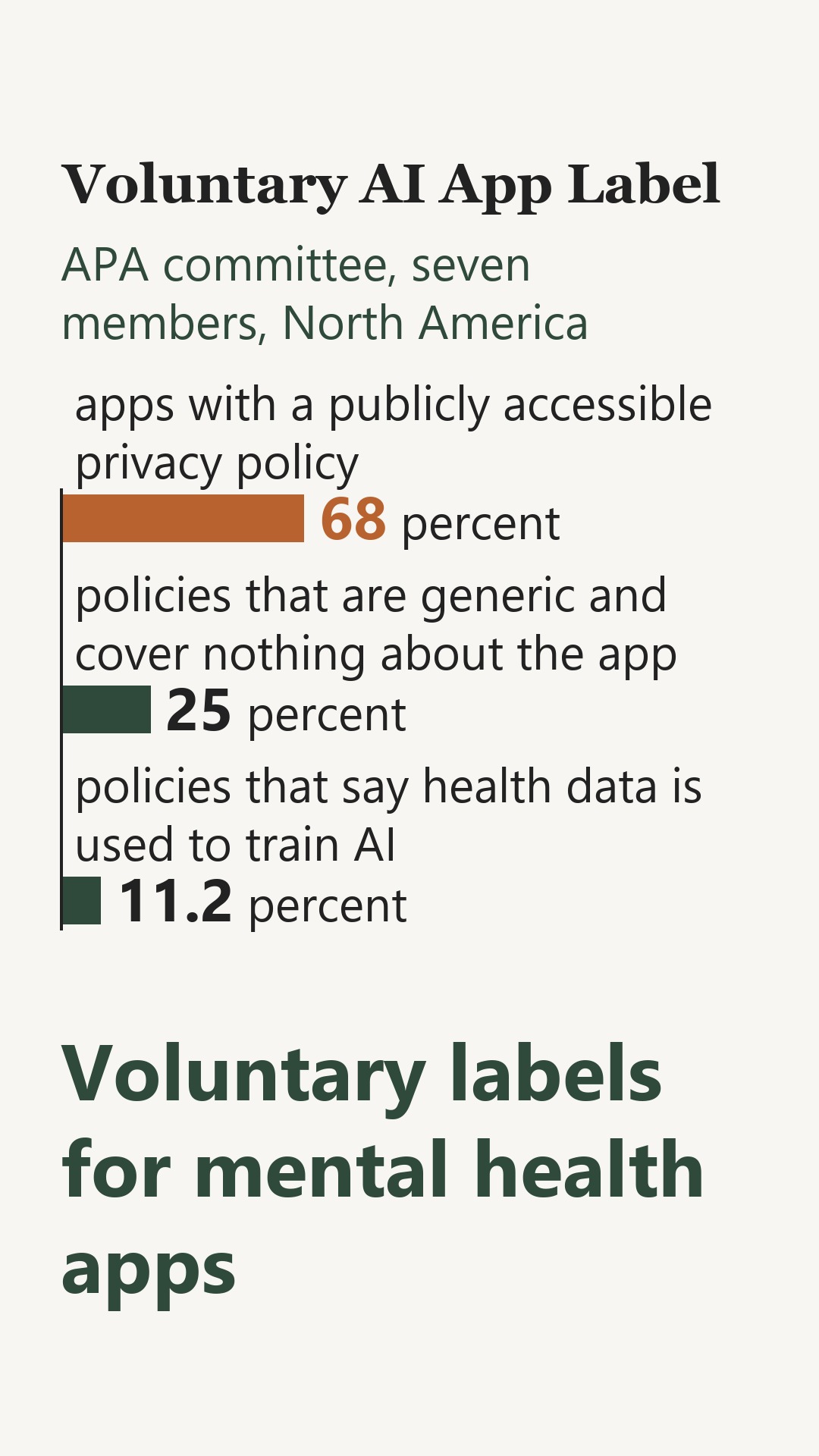
Shares of AI mental health apps studied for their privacy policies; each figure comes from that one study, not from all apps everywhere.
What 161 FDA-cleared AI medical devices disclosed about their training data
only 7 disclosed it
only 13 disclosed it
Ask the developer for those three things, and treat a missing answer as one.
Open an AI mental health app and type what is worrying you. Nothing on the screen has to say what the app does with those words, what it was tested on, or what could go wrong.
A team of seven people on the American Psychiatric Association's committee on mental health information technology has written a proposed fix. They call it a facts label, with eight sections.
The sections run from developer information and intended use to warnings, risks and limitations, model information, clinical evidence, accessibility, and privacy and security.
Under warnings, the label asks whether an app is appropriate to use during a crisis and what resources to offer if a crisis falls outside what the app can handle. Under privacy, it asks whether health data is shared with third parties and how users can control it.
The draft was refined through an APA annual meeting presentation and a webinar survey, and reviewed by the APA Ethics Committee. It draws on the EU AI Act, a US risk framework from NIST, and scholarship on informed consent.
The label has two layers. The first is written for a sixth-grade reading level. The second, with more technical detail, is aimed at clinicians.
It has not been tested in a study. The authors say empirical validation is a priority for future work, so it is unproven that the label changes what anyone decides. Adoption would presently remain at developer discretion: no regulator requires it, and you will not find it on an app store today.
Even a printed label would depend on developers reporting on themselves. The authors name independent verification of developer information as an open problem, so a label could be filled out and still be wrong.
A label is also a living document, meant to be updated as models change. The copy you see may lag behind the product in your hand.
The authors say patients, caregivers, advocacy groups and developers should still be consulted. Their views could still change the draft.
When you next open a mental health app, look for a plain statement of what data it was trained on, what it cannot handle in a crisis, and where your health data goes. Ask the developer for those three things, and treat a missing answer as one.
What this means for you
For now the label is a draft, and no app has to show it, so the thing to watch is whether developers start publishing these sections on their own. Until a study tests it, a label you see would tell you what a company chose to say about itself, not what an outside check confirmed. For anything touching your own care, a clinician is the one to ask.
Moon, K., Tamura, M., Redmond, J. R. et al. (2026). Facts label for transparent communication of AI Risks in mental health technology. Frontiers in Psychiatry. https://doi.org/10.3389/fpsyt.2026.1887887
Who paid: The authors declared that financial support was not received for this work and/or its publication, and declared no commercial or financial relationships that could be a conflict of interest.
Do not take this as professional medical advice.
The longer versionThe passages copied from the paper, the pictures, and every source with how much of it we read · 1645 words · about 8 minRead it →Close
A Mental-Health App With No Label: Psychiatrists Propose One, No One Is Required to Show It
A working group of the American Psychiatric Association has published an eight-part "facts label" for AI mental-health tools. It has not been tested with a single user.
Open a mental-health app on a phone and the screen will tell you it is here for you, twenty-four hours a day. It will not tell you whose data trained it, who was left out of that data, whether it was ever tested on people like you, or what happens to what you type. A working group of the American Psychiatric Association's Committee on Mental Health Information Technology wants that to change. It has proposed a standardized facts label for AI-enabled digital mental health technologies, an eight-section sheet modelled on the panels printed on food and medical devices12. The paper is a framework development paper: no patients were enrolled, no app was tested, and no comparison was made. Its claim is a design, not a result.
The eight sections are, in order: key identifying information, intended use, warnings, risks and limitations, model information, clinical evidence, accessibility and usability, and privacy and security2. Read the warnings section alone and you see what the group thinks is missing from the app store. It asks whether the tool is appropriate to use during a crisis, whether its responses could place a user in a dangerous situation, and what resources should be offered when a crisis falls outside the tool's scope. The privacy section asks where data is stored, whether it is shared with advertisers, and whether users can delete it. The clinical evidence section asks for the research basis; if none exists, the label says, that should be stated plainly.
The scale of use is not small. Among teenagers, 33 percent use AI companions for social interaction and 12 percent specifically for emotional or mental health support, the authors report3. Picture a school corridor: of thirty students, roughly ten are talking to a chatbot for company, and three or four for support with how they feel. Adults are not counted here; the figures are about teenagers.
What those tools disclose is thin. A 2021 STAT investigation found that among 161 recently FDA-cleared AI-based medical devices, only 7 disclosed the racial breakdown of their training data and only 13 disclosed gender demographics4. Put another way: of 161 devices cleared for medical use, fewer than one in twenty told anyone who had been in the data that shaped them. Privacy notices fare no better. A 2022 study found that 24 of 27 mental health app privacy policies required at least a college-level education to understand5. A separate study of AI mental-health app policies found that 68 percent of apps had publicly accessible policies, 25 percent were generic and covered nothing specific to the app, and only 11.2 percent mentioned that user health data was used to train AI systems6. The pattern is not secrecy exactly. It is disclosure written by the company, about the company, for the company's protection.
Regulators have named the principle without building the instrument. The U.S. FDA, Health Canada and the UK MHRA jointly identified transparency as a core principle of Good Machine Learning Practice, calling for AI medical devices to give clear, contextually relevant information on intended purpose and clinical integration7. The EU AI Act mandates transparency disclosures for high-risk AI systems, and the NIST AI Risk Management Framework recommends multidisciplinary oversight and iterative risk assessment across the AI lifecycle8. What these frameworks lack, the authors argue, is a practical, standardized way of communicating directly to clinicians and patients, particularly in mental health9. Here is the gap in one image: a law that says "be transparent" and a company that decides what transparent means.
Earlier labels exist, and the paper measures itself against them. The Duke Model Facts Label and the CHAI Nutrition Label contain complex metrics and jargon that prove difficult for typical clinicians and patients, the authors write10. Bramstedt's patient-centered label, they add, offers no guidance on how to fill in its own fields. The proposed label tries a layered design: plain-language essentials at a sixth-grade reading level, with more technical detail separately accessible for clinicians11. That is a design choice, not a demonstrated result.
The group behind the label was multidisciplinary: seven members from North America, with backgrounds in psychiatry, law, public health, engineering and sociology. It was refined through an APA annual meeting presentation and Q&A, an exploratory survey at an APA webinar, a presentation to the APA Ethics Committee, and committee review. The authors declared no financial support for the work and no commercial or financial relationships that could be a conflict of interest. The framework draws on risk communication and informed consent scholarship and on international AI governance frameworks.
What the paper does not contain is any test of whether the label works. The authors say so themselves. The willingness of developers to provide potentially unfavorable information may vary, and adoption would presently remain at developer discretion12. Some fields may be hard to fill, because developers may lack the knowledge to measure and report AI performance and risks. Independent verification of what developers write is unresolved. The label is meant as a living document updated as models change. Formal empirical validation has not been done, and the authors list patients, non-clinical caregivers, advocacy groups and developers as core populations still to be consulted13. No regulator has adopted it and no app is required to show it.
Other work on these tools points the same way. A review of generative AI mental-health chatbots, which we could read only in its summary, covered twenty-one studies across eleven countries and found that most incorporated at least one technical safety mechanism, most commonly fine-tuning and prompt engineering1415. Pre-deployment safeguards included clinical expert and user co-design, research ethics procedures and data privacy measures16. During delivery, detailed onboarding with role clarification was common, but human oversight was limited17. Crisis referral protocols varied in rigor but were mostly underdeveloped, and systematic monitoring for adverse events was sparse18. Documented safety failures included missed suicidal ideation and inaccurate clinical information19.
The same summary notes that unlike earlier rule-based systems, these chatbots generate open-ended outputs that can be inaccurate and unsafe20. Its authors call for a sociotechnical approach that integrates technical safeguards with user co-design, procedural controls and human oversight, and for regulatory oversight proportional to the risks these systems carry2122. A review of adolescent mental-health AI, which we could read only in its summary, found that predictive or diagnostic performance was reported in 83 studies, but symptom-level effectiveness in only 1, and that no primary study provided a dedicated prospective safety evaluation2324. A Hong Kong co-design study, again read only in summary, found that 66.2 percent of surveyed participants reported using generic AI chatbots for emotional concerns, and that local empathy, a non-judgmental tone and 24/7 access were the main things people wanted2526.
Here is how we read it. A label is a promise that someone will be able to check the product against a written standard. What this paper offers is the standard: a list of questions a developer would have to answer in public. Whether anyone answers is a separate matter, and the authors are candid that adoption would presently remain at developer discretion12. So expect the next mental-health app you see to arrive as it always has: a friendly screen, a few testimonials, a clinician's name in the marketing. Expect the training data, the gaps in it and the way the app decides what to say to stay out of sight. We would be wrong if app makers began routinely publishing, unprompted and in plain words, who was left out of their training and how their answers are chosen, and if people actually read it.
There is a second thing to watch for in yourself. An app that sounds clinical, or that carries a regulatory badge, can borrow the authority of medicine without having earned it. Notice when you accept an answer because it sounds medical. Ask what testing stands behind a specific claim. Ask whether your clinician feels free to disagree with the tool. And keep your own record of how you feel and what you notice; bring it to an appointment as evidence in its own right, because an app's summary is one input, not the verdict.
We also read work that suggests where the ground is soft. One summary of chatbot safety research found that human oversight was limited during delivery and that adverse-event monitoring was sparse, which is the kind of thing a label is meant to surface before a person downloads rather than after. Another found that the field is dominated by prediction and internal validation, with symptom-level benefit and prospective safety largely untested. A third, from Hong Kong, found that co-design with people who have lived with depression produced favorable feedback, while noting that evidence remains limited on how such design informs later trials. None of this is a verdict on the proposed label. It is a reminder of how much a label would have to say.
What can you do with a sheet that no one is required to show you? Ask for it anyway. When a clinic recommends an app, or a family member forwards one, the question "Does it come with a facts label?" is a reasonable one, and so is "What happened to the people it was tested on, and who was left out?" The authors themselves issue a call to action for developers and regulators to assess and integrate the framework27. Until one of them does, the label is a form waiting at the counter.
The screen is still there, still friendly, still open at three in the morning. What you now know is what to ask it, and its maker, before you type: what is in this, and who decided?
Where each piece of context comes from, and how much of it we read
- Moon, K., Tamura, M., Redmond, J. R. et al. (2026). Facts label for transparent communication of AI Risks in mental health technology. Frontiers in Psychiatry. https://doi.org/10.3389/fpsyt.2026.1887887 - the article this story is about — the whole article — the passage: "We propose a standardized facts label for AI-DMHTs designed to enhance transparency and awareness about these tools and their risks to users, patients, and clinicians."
- Moon, K., Tamura, M., Redmond, J. R. et al. (2026). Facts label for transparent communication of AI Risks in mental health technology. Frontiers in Psychiatry. https://doi.org/10.3389/fpsyt.2026.1887887 - the article this story is about — the whole article — the passage: "The resulting facts label framework is composed of 8 sections: key identifying information, intended use, warnings, risks and limitations, model information, clinical evidence, accessibility and usability considerations, and privacy and security."
- Moon, K., Tamura, M., Redmond, J. R. et al. (2026). Facts label for transparent communication of AI Risks in mental health technology. Frontiers in Psychiatry. https://doi.org/10.3389/fpsyt.2026.1887887 - the article this story is about — the whole article — the passage: "Large Language Models (LLMs) are increasingly used for self-help, with 33% of teenagers using AI companions for social interaction and 12% specifically for emotional or mental health support ( 2 , 3 )."
- Moon, K., Tamura, M., Redmond, J. R. et al. (2026). Facts label for transparent communication of AI Risks in mental health technology. Frontiers in Psychiatry. https://doi.org/10.3389/fpsyt.2026.1887887 - the article this story is about — the whole article — the passage: "A 2021 STAT investigation found that among 161 recently FDA-cleared AI-based medical devices, only 7 disclosed the racial breakdown of their training data, and only 13 disclosed gender demographics ( 17 )."
- Moon, K., Tamura, M., Redmond, J. R. et al. (2026). Facts label for transparent communication of AI Risks in mental health technology. Frontiers in Psychiatry. https://doi.org/10.3389/fpsyt.2026.1887887 - the article this story is about — the whole article — the passage: "A 2022 study found 24 out of 27 mental health app privacy policies required at least a college-level education to understand them ( 18 )."
- Moon, K., Tamura, M., Redmond, J. R. et al. (2026). Facts label for transparent communication of AI Risks in mental health technology. Frontiers in Psychiatry. https://doi.org/10.3389/fpsyt.2026.1887887 - the article this story is about — the whole article — the passage: "A study investigating privacy policies of AI-DMHTs revealed just 68% of apps have publicly accessible privacy policies, 25% are generic and cover no app-related scope, and only 11.2% mention the use of user health data for training AI systems ( 19 )."
- Moon, K., Tamura, M., Redmond, J. R. et al. (2026). Facts label for transparent communication of AI Risks in mental health technology. Frontiers in Psychiatry. https://doi.org/10.3389/fpsyt.2026.1887887 - the article this story is about — the whole article — the passage: "The U.S. FDA, Health Canada, and UK MHRA jointly identified transparency as a core principle of Good Machine Learning Practice (GMLP), calling for AI medical devices to provide clear, contextually relevant information on intended purpose and clinical integration ( 20 )."
- Moon, K., Tamura, M., Redmond, J. R. et al. (2026). Facts label for transparent communication of AI Risks in mental health technology. Frontiers in Psychiatry. https://doi.org/10.3389/fpsyt.2026.1887887 - the article this story is about — the whole article — the passage: "The EU AI Act mandates transparency disclosures for high-risk AI systems ( 21 ). The NIST AI Risk Management Framework (AI RMF) recommends multidisciplinary oversight and iterative risk assessment throughout the AI lifecycle ( 22 )."
- Moon, K., Tamura, M., Redmond, J. R. et al. (2026). Facts label for transparent communication of AI Risks in mental health technology. Frontiers in Psychiatry. https://doi.org/10.3389/fpsyt.2026.1887887 - the article this story is about — the whole article — the passage: "While these frameworks mandate transparency, they lack a practical, standardized mechanism for communicating information directly to clinicians and patients, particularly in regarding mental health."
- Moon, K., Tamura, M., Redmond, J. R. et al. (2026). Facts label for transparent communication of AI Risks in mental health technology. Frontiers in Psychiatry. https://doi.org/10.3389/fpsyt.2026.1887887 - the article this story is about — the whole article — the passage: "The Duke and CHAI frameworks contain complex metrics and jargon, proving difficult for typical clinicians and patients ( 31 )."
- Moon, K., Tamura, M., Redmond, J. R. et al. (2026). Facts label for transparent communication of AI Risks in mental health technology. Frontiers in Psychiatry. https://doi.org/10.3389/fpsyt.2026.1887887 - the article this story is about — the whole article — the passage: "Recognizing distinct information needs and varying health and technical literacy among users and clinicians, our single facts label provides a layered approach with essential, comprehendible information at its primary level, designed for a 6th-grade equivalent reading level ( 37 , 39 , 40 ), and more clinically and technically detailed information separately accessible, ensuring both user approachability and clinician depth."
- Moon, K., Tamura, M., Redmond, J. R. et al. (2026). Facts label for transparent communication of AI Risks in mental health technology. Frontiers in Psychiatry. https://doi.org/10.3389/fpsyt.2026.1887887 - the article this story is about — the whole article — the passage: "Some limitations require acknowledgement. The willingness of developers to provide potentially unfavorable label information may vary, and adoption would presently remain at developer discretion."
- Moon, K., Tamura, M., Redmond, J. R. et al. (2026). Facts label for transparent communication of AI Risks in mental health technology. Frontiers in Psychiatry. https://doi.org/10.3389/fpsyt.2026.1887887 - the article this story is about — the whole article — the passage: "Future work should empirically evaluate usability and effectiveness in improving understanding and decision-making through usability testing, consistent with established co-design methodologies for digital mental health intervention ( 44 – 46 )."
- Olisaeloka L, Richardson CG, Wang AY, Munthali RJ, Vigo DV. (2026). Safety Mechanisms and Risk Mitigation in Generative AI Mental Health Chatbots: A Systematic Scoping Review. Healthcare. 10.3390/healthcare14101395 — only the abstract - the full text could not be fetched — the passage: "Most interventions incorporated at least one technical safety mechanism, most commonly fine-tuning and prompt engineering."
- Olisaeloka L, Richardson CG, Wang AY, Munthali RJ, Vigo DV. (2026). Safety Mechanisms and Risk Mitigation in Generative AI Mental Health Chatbots: A Systematic Scoping Review. Healthcare. 10.3390/healthcare14101395 — only the abstract - the full text could not be fetched — the passage: "Twenty-one studies across 11 countries were included."
- Olisaeloka L, Richardson CG, Wang AY, Munthali RJ, Vigo DV. (2026). Safety Mechanisms and Risk Mitigation in Generative AI Mental Health Chatbots: A Systematic Scoping Review. Healthcare. 10.3390/healthcare14101395 — only the abstract - the full text could not be fetched — the passage: "Pre-deployment safeguards included clinical expert and user co-design approaches, research ethics procedures, and data privacy measures."
- Olisaeloka L, Richardson CG, Wang AY, Munthali RJ, Vigo DV. (2026). Safety Mechanisms and Risk Mitigation in Generative AI Mental Health Chatbots: A Systematic Scoping Review. Healthcare. 10.3390/healthcare14101395 — only the abstract - the full text could not be fetched — the passage: "During intervention delivery, detailed onboarding with role clarification was common, but human oversight was limited."
- Olisaeloka L, Richardson CG, Wang AY, Munthali RJ, Vigo DV. (2026). Safety Mechanisms and Risk Mitigation in Generative AI Mental Health Chatbots: A Systematic Scoping Review. Healthcare. 10.3390/healthcare14101395 — only the abstract - the full text could not be fetched — the passage: "Crisis referral protocols varied in rigour but were mostly underdeveloped, and systematic adverse event monitoring was sparse."
- Olisaeloka L, Richardson CG, Wang AY, Munthali RJ, Vigo DV. (2026). Safety Mechanisms and Risk Mitigation in Generative AI Mental Health Chatbots: A Systematic Scoping Review. Healthcare. 10.3390/healthcare14101395 — only the abstract - the full text could not be fetched — the passage: "Documented safety failures included missed suicidal ideation and provision of inaccurate clinical information."
- Olisaeloka L, Richardson CG, Wang AY, Munthali RJ, Vigo DV. (2026). Safety Mechanisms and Risk Mitigation in Generative AI Mental Health Chatbots: A Systematic Scoping Review. Healthcare. 10.3390/healthcare14101395 — only the abstract - the full text could not be fetched — the passage: "Unlike earlier rule-based and retrieval-based systems, GenAI chatbots generate open-ended outputs that can be inaccurate and unsafe."
- Olisaeloka L, Richardson CG, Wang AY, Munthali RJ, Vigo DV. (2026). Safety Mechanisms and Risk Mitigation in Generative AI Mental Health Chatbots: A Systematic Scoping Review. Healthcare. 10.3390/healthcare14101395 — only the abstract - the full text could not be fetched — the passage: "GenAI chatbot interventions require a robust sociotechnical approach that integrates technical safeguards with user co-design, procedural controls, and human oversight."
- Olisaeloka L, Richardson CG, Wang AY, Munthali RJ, Vigo DV. (2026). Safety Mechanisms and Risk Mitigation in Generative AI Mental Health Chatbots: A Systematic Scoping Review. Healthcare. 10.3390/healthcare14101395 — only the abstract - the full text could not be fetched — the passage: "Regulatory oversight proportional to the risks these systems carry is required to enable integration into stepped or blended mental healthcare."
- Dhamayanti M, Susaldi S, Hanifa F, Agustini Y, Emilia O, Hardinsyah H, et al. (2026). Artificial intelligence-enabled mental health applications for adolescents: a scoping review of safety, effectiveness and clinical implementation. BMJ Open. 10.1136/bmjopen-2026-125586 — only the abstract - the full paper is behind a subscription — the passage: "Predictive or diagnostic performance was reported in 83 studies (87.4%), but symptom-level effectiveness in only 1 (1.1%)."
- Dhamayanti M, Susaldi S, Hanifa F, Agustini Y, Emilia O, Hardinsyah H, et al. (2026). Artificial intelligence-enabled mental health applications for adolescents: a scoping review of safety, effectiveness and clinical implementation. BMJ Open. 10.1136/bmjopen-2026-125586 — only the abstract - the full paper is behind a subscription — the passage: "No primary study provided a dedicated prospective AI-safety evaluation."
- Lo HKY, Yu MSY, Sze PKS, Wong RWK, Ku MCT, Cheng YYH, et al. (2026). From Needs Assessment to Pre-Trial Specification: Participatory Co-Design of a Generative AI Chatbot (CARES-MDD) for Persons Living with Depression in Hong Kong Psychiatric Care. Healthcare. 10.3390/healthcare14203547 — only the abstract - the full text could not be fetched — the passage: "In Phase 1, 66.2% reported using generic AI chatbots for emotional concerns; privacy, anticipated negative evaluation, and concern about burdening others were recurring themes in the qualitative data."
- Lo HKY, Yu MSY, Sze PKS, Wong RWK, Ku MCT, Cheng YYH, et al. (2026). From Needs Assessment to Pre-Trial Specification: Participatory Co-Design of a Generative AI Chatbot (CARES-MDD) for Persons Living with Depression in Hong Kong Psychiatric Care. Healthcare. 10.3390/healthcare14203547 — only the abstract - the full text could not be fetched — the passage: "Localized empathy, non-judgmental, and 24/7 accessibility were the main themes of a desired mental health generative AI chatbot."
- Moon, K., Tamura, M., Redmond, J. R. et al. (2026). Facts label for transparent communication of AI Risks in mental health technology. Frontiers in Psychiatry. https://doi.org/10.3389/fpsyt.2026.1887887 - the article this story is about — the whole article — the passage: "We issue a call to action for developers and regulators to critically assess and integrate this framework into operational and policy development processes."
Moon, K., Tamura, M., Redmond, J. R. et al. (2026). Facts label for transparent communication of AI Risks in mental health technology. Frontiers in Psychiatry. https://doi.org/10.3389/fpsyt.2026.1887887
Who paid: The authors declared that financial support was not received for this work and/or its publication, and declared no commercial or financial relationships that could be a conflict of interest.
Do not take this as professional medical advice.
The findings of other studies mentioned here come from this document; those studies were not opened one by one.