survey · Behavioral sciences (Basel, Switzerland) · la publicación, 4 oct 2026 · gratis
Un estudio en Corea del Sur halló que quien ve poco riesgo en la IA para videos tiende a reportar más intención de usarla para engañar
Versión breve · la versión detallada sigue, unos 5 min
Pregunte al chat de weeklyAI
Pregúnteme sobre la IA en su vida: le señalo las notas que weeklyAI ha publicado sobre el tema, esta semana y antes.
Las conversaciones se guardan mientras exista weeklyAI, para mejorar la publicación. Se responde en el idioma en que usted escribe.
- El estudio, de un vistazo
- Quiénes
- adultos surcoreanos de 20 a 59 años con experiencia subiendo videos
- Cuántos
- 400
- Dónde
- Corea del Sur
- Cuándo
- junio de 2023
- Tipo de estudio
- survey
- Quién lo hizo
- Sookmyung Women's University y Korea University
- El límite que importa
- Mide intención declarada, no videos falsos hechos ni vistos, y no examina ninguna elección.
Son casos reportados de incidentes de deepfake, no votos cambiados ni videos que llegaron a una elección.
A menor riesgo percibido, mayor intención declarada en las tres modalidades.
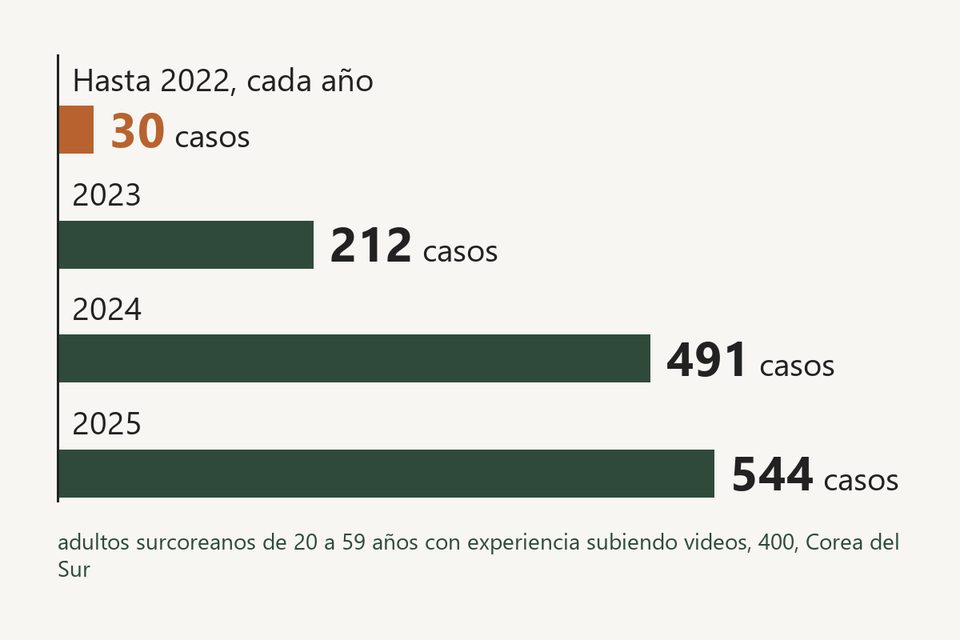
Un grupo de 400 adultos surcoreanos de 20 a 59 años, todos con experiencia subiendo videos, contestó en junio de 2023 un cuestionario en línea. Vieron videos hechos con inteligencia artificial que imita voces, subtítulos y presentadores humanos. A mayor favorabilidad hacia el presentador falso, mayor intención declarada de usarlo para desinformar. A menor riesgo percibido, mayor intención declarada en las tres modalidades. El sondeo midió intención, no videos falsos hechos ni vistos.
El artículo no menciona ninguna página oficial, registro ni verificador al que usted pueda acudir. No ofrece forma de comprobar esto por su cuenta esta noche.
No hay autoridad electoral citada, ni norma, ni resolución, ni auditoría. El estudio no dice qué permitió Corea del Sur sobre estas herramientas. Tampoco examina una elección. Si quiere saber qué se permite donde usted vota, pregunte a su autoridad electoral.
Qué significa para usted
Ese mismo sondeo no midió si alguien llegó a hacer un video falso, solo lo que la gente decía que haría, y se hizo en Corea del Sur con personas que ya subían videos. Para su voto, conviene mirar el material que publica su autoridad electoral y las actas que se auditan después de la jornada, y preguntar qué revisó y qué encontró.
Oh, R., Kim, S. (2026). Factors Influencing Individuals’ Intentions to Misuse LLM-Based Generative AI in Video Content Creation. Behavioral Sciences. https://doi.org/10.3390/bs16101816
Quién pagó: El trabajo fue financiado por el Ministerio de Educación de la República de Corea a través de la National Research Foundation of Korea (50%) y por la subvención IITP-ITRC del Instituto de Planificación y Evaluación de Tecnologías de la Información y las Comunicaciones, financiada por el gobierno de Corea (50%); el artículo no indica si los financiadores tuvieron algún papel, y no se reporta préstamo de equipos ni de software.
Versión detalladaLos pasajes copiados del artículo, las ilustraciones y cada fuente con cuánto leímos de ella · 929 palabras · unos 5 minLeerla →Cerrar
La regla y la evidencia: un sondeo en Corea del Sur: quienes vieron poco riesgo dijeron que sí usarían voces, subtítulos y presentadores falsos
### EL ACTO
Este documento no pone en vigor ninguna resolución, ningún fallo ni ninguna ley. Es un artículo científico sobre las intenciones de mal uso de la inteligencia artificial generativa, publicado el 4 de octubre de 2026, con datos recogidos entre el 8 y el 14 de junio de 2023. No hay autoridad que lo haga cumplir ni fecha límite para el ciudadano.
Lo que el artículo sí registra es un encuadre: estudia tres maneras de generar información lingüística en un video, la voz sintética, el subtítulo automático y el presentador humanoide. Las llama modalidades y las trata por separado. No hay norma que las prohíba ni permiso que las autorice en el texto.
El documento tampoco nombra a una autoridad electoral, ni un tribunal, ni una auditoría. Su límite es ese: describe percepciones declaradas en una encuesta, no reglas vigentes.
### EL CASO QUE RESPONDE
No se encontró esta semana ningún caso real que encaje con lo que el artículo describe.
### LO QUE SE MIDIÓ
Cuatrocientos adultos surcoreanos, de entre 20 y 59 años, hombres y mujeres por partes iguales, contestaron una encuesta en línea. Todos habían subido videos propios antes. Vieron materiales generados por las tres herramientas y respondieron un cuestionario de cinco puntos1.
Lo que se midió fue la intención declarada de fabricar desinformación, no la fabricación misma. Los autores lo dicen con claridad: la intención autoinformada no debe tomarse como prueba de conducta real.
El hallazgo central, en palabras de los autores: cuanto menor era el riesgo percibido de mal uso, mayor era la intención de mal usar la herramienta, en las tres modalidades2. La voz sintética mostró además una relación positiva entre riesgo percibido y resistencia a la tecnología3. El presentador humanoide mostró que a mayor simpatía hacia la herramienta, mayor intención de mal uso4.
Para dimensionar el fenómeno que el artículo discute, la propia fuente cita cifras de incidentes de deepfake: unos 30 casos al año hasta 2022, y después 212 en 2023, 491 en 2024 y 544 en 20255. Son incidentes reportados, no votos cambiados.
El artículo menciona dos ejemplos que ilustran el tipo de daño: en febrero de 2024, en Hong Kong, una voz falsa combinada con imágenes hizo que una empresa perdiera 25 millones de dólares6; en 2023 circuló un video con imágenes viejas y subtítulos falsos que lo presentaban como un bombardeo en Gaza7. Parecería que es la clase de cosa que tienen en mente, aunque el artículo no los liga a ninguna ley.
Sobre la dificultad de detectar: en una prueba citada, los participantes identificaron correctamente una voz como generada por IA solo alrededor del 60 por ciento de las veces8. El subtítulo manipulado, dice el artículo, es más difícil de notar que una imagen alterada9.
No se midió en ninguna elección. Fue una encuesta en línea con panel, en un solo país, en una sola fecha. La pregunta de si algo de esto se traduce en votos queda fuera del alcance del estudio.
### LA RESPUESTA DE LA OTRA REGIÓN AL MISMO ASUNTO
No encontramos esta semana ningún fallo, ley o autoridad de otra región que trate el mismo método con fecha verificable en los pasajes disponibles.
### LA LECTURA DE LA REDACCIÓN
Así lo leemos nosotros. El patrón que describe el estudio tiene una forma reconocible: cuando una herramienta barata permite imitar una voz o un rostro, la gente no deja de distinguir entre lo auténtico y la copia; lo que se pierde es la costumbre de comprobarlo. Esa pereza, a la larga, se vuelve una forma de complicidad con el engaño. En casas como la del lector, esperaríamos que quien ve poco riesgo en fabricar desinformación sea también quien menos se detenga a verificar si un audio o un presentador es real. Sabríamos que nos equivocamos si esos mismos creadores resultaran los más exigentes al contrastar antes de reenviar.
Lo que el lector puede hacer con esto es concreto. Ante un video de campaña con voz o presentador llamativo, pregunte quién lo produjo y busque la versión original del audio o del discurso antes de compartirlo. Puede pedir a su autoridad electoral que publique ejemplos de verificaciones hechas y no hechas. En casa o en el aula, practique comparar un video con su fuente original antes de opinar.
Una advertencia sobre el alcance: el estudio es de una sola vez, en Corea del Sur, con personas que ya hacían videos, y midió intención, no conducta. No dice cuánto video falso circula ni si cambió un voto. Tampoco puede mostrarse que subir la percepción de riesgo baje el mal uso; los autores insisten en que son asociaciones, no causas10.
### LO QUE NO SE SABE
No se sabe si estos patrones se repiten en otros países ni en personas sin experiencia en video1. No se sabe cuánto de lo que se ve circular es falso ni cuánto de eso llega a un votante. No se sabe si las herramientas actuales, más avanzadas que las de junio de 2023, producen las mismas percepciones11. El registro guarda silencio sobre todo eso.
Tampoco se sabe cuántos de los incidentes reportados en las cifras citadas llegaron a una elección o a un votante concreto: la fuente no lo desglosa5.
Cuando llegue el día de votar y vea un video con una voz conocida, pregunte primero quién lo subió y dónde está el audio original: esa pregunta no necesita que nadie la mida por usted.
De dónde sale cada dato de contexto, y cuánto leímos de cada documento
- Oh, R., Kim, S. (2026). Factors Influencing Individuals’ Intentions to Misuse LLM-Based Generative AI in Video Content Creation. Behavioral Sciences. https://doi.org/10.3390/bs16101816 - el artículo del que trata esta nota — el artículo completo — el pasaje: "Second, the study focused on South Korean adults aged 20–59 with prior experience in creating and uploading video content. This sampling criterion was intentionally adopted to examine individuals who could evaluate GAI technologies in relation to video-production activities."
- Oh, R., Kim, S. (2026). Factors Influencing Individuals’ Intentions to Misuse LLM-Based Generative AI in Video Content Creation. Behavioral Sciences. https://doi.org/10.3390/bs16101816 - el artículo del que trata esta nota — el artículo completo — el pasaje: "Among the most interesting findings was that, for all modalities, lower perceived misuse risk was associated with greater intention to misuse LLM-based GAI. Contrary to the expectation that higher perceived risk would be associated with lower misuse intention, our findings highlighted the relevance of low perceived misuse risk."
- Oh, R., Kim, S. (2026). Factors Influencing Individuals’ Intentions to Misuse LLM-Based Generative AI in Video Content Creation. Behavioral Sciences. https://doi.org/10.3390/bs16101816 - el artículo del que trata esta nota — el artículo completo — el pasaje: "Resistance exhibited a positive correlation with perceived risk concerning AI voice and a negative correlation with perceived favorability toward AI voice. These results suggest that negative experiences or memories related to voice manipulation may be associated with heightened risk perception and resistance."
- Oh, R., Kim, S. (2026). Factors Influencing Individuals’ Intentions to Misuse LLM-Based Generative AI in Video Content Creation. Behavioral Sciences. https://doi.org/10.3390/bs16101816 - el artículo del que trata esta nota — el artículo completo — el pasaje: "Higher favorability and lower perceived misuse risk toward AI human were associated with greater intentions to misuse GAI. The tendency for misuse intention to be higher, particularly when favorability concerning the technology is higher, highlights the potential for AI misuse."
- Oh, R., Kim, S. (2026). Factors Influencing Individuals’ Intentions to Misuse LLM-Based Generative AI in Video Content Creation. Behavioral Sciences. https://doi.org/10.3390/bs16101816 - el artículo del que trata esta nota — el artículo completo — el pasaje: "Reported deepfake-related incidents remained at approximately 30 cases annually until 2022 but increased dramatically to 212 in 2023, 491 in 2024, and 544 in 2025, reflecting the rapid escalation of deepfake misuse ( OECD, 2026 )."
- Oh, R., Kim, S. (2026). Factors Influencing Individuals’ Intentions to Misuse LLM-Based Generative AI in Video Content Creation. Behavioral Sciences. https://doi.org/10.3390/bs16101816 - el artículo del que trata esta nota — el artículo completo — el pasaje: "In February 2024, a video was created in Hong Kong using a cleverly combined generated fake voice with images, impersonating a company official and giving detailed instructions to financial officers; this led to a loss of $25 million for that company ( Milmo, 2024 )."
- Oh, R., Kim, S. (2026). Factors Influencing Individuals’ Intentions to Misuse LLM-Based Generative AI in Video Content Creation. Behavioral Sciences. https://doi.org/10.3390/bs16101816 - el artículo del que trata esta nota — el artículo completo — el pasaje: "In 2023, a video circulated on social media, purportedly showing footage of bombings in Gaza and shocking viewers with scenes of devastation; this was later revealed to be disinformation, a combination of old video footage with fake captions labeling the site as Gaza ( Bond, 2023 )."
- Oh, R., Kim, S. (2026). Factors Influencing Individuals’ Intentions to Misuse LLM-Based Generative AI in Video Content Creation. Behavioral Sciences. https://doi.org/10.3390/bs16101816 - el artículo del que trata esta nota — el artículo completo — el pasaje: "Recent evidence indicates that listeners may have difficulty distinguishing AI-generated voice clones from their real counterparts: participants perceived an AI-generated voice as having the same identity as its real counterpart approximately 80% of the time and correctly identified a voice as AI-generated only about 60% of the time ( Barrington et al., 2025 )."
- Oh, R., Kim, S. (2026). Factors Influencing Individuals’ Intentions to Misuse LLM-Based Generative AI in Video Content Creation. Behavioral Sciences. https://doi.org/10.3390/bs16101816 - el artículo del que trata esta nota — el artículo completo — el pasaje: "Modifying the components responsible for conveying linguistic information (e.g., voice and captions) in videos can more effectively transmit disinformation through visual and auditorial channels. If the generation technology is insufficient, image manipulation may disclose noticeable inconsistencies. However, linguistic manipulation is more difficult to detect and frequently more sophisticated and realistic than image manipulation."
- Oh, R., Kim, S. (2026). Factors Influencing Individuals’ Intentions to Misuse LLM-Based Generative AI in Video Content Creation. Behavioral Sciences. https://doi.org/10.3390/bs16101816 - el artículo del que trata esta nota — el artículo completo — el pasaje: "First, the study employed a cross-sectional survey design, which does not establish the temporal ordering or causal direction of the observed relationships. Accordingly, the significant indirect associations identified in the mediation analyses should not be interpreted as evidence of causal mediation."
- Oh, R., Kim, S. (2026). Factors Influencing Individuals’ Intentions to Misuse LLM-Based Generative AI in Video Content Creation. Behavioral Sciences. https://doi.org/10.3390/bs16101816 - el artículo del que trata esta nota — el artículo completo — el pasaje: "Third, the data were collected in June 2023. Since then, GAI technologies for video production have advanced considerably, particularly in the quality and accuracy of generated outputs."
Oh, R., Kim, S. (2026). Factors Influencing Individuals’ Intentions to Misuse LLM-Based Generative AI in Video Content Creation. Behavioral Sciences. https://doi.org/10.3390/bs16101816
Quién pagó: El trabajo fue financiado por el Ministerio de Educación de la República de Corea a través de la National Research Foundation of Korea (50%) y por la subvención IITP-ITRC del Instituto de Planificación y Evaluación de Tecnologías de la Información y las Comunicaciones, financiada por el gobierno de Corea (50%); el artículo no indica si los financiadores tuvieron algún papel, y no se reporta préstamo de equipos ni de software.
Los hallazgos de otros estudios que aquí se mencionan provienen de este documento; esos estudios no se consultaron uno por uno.
survey · Behavioral sciences (Basel, Switzerland) · the paper, 4 Oct 2026 · free
A survey of 400 Korean video creators found that those who saw less risk in AI voice, caption and presenter tools said they were more likely to use them for fake videos. It measured what people said they would do, not what anyone actually made.
Short version · the longer version follows, about 6 min
Ask the weeklyAI chat
Ask me about AI in your life: I point you to the stories weeklyAI has published on it, this week and before.
Conversations are saved for as long as weeklyAI exists, to improve the publication. Answers come in the language you write in.
- The study at a glance
- Who
- South Korean adults with experience creating and uploading video content
- How many
- 400
- Where
- South Korea
- When
- 8 to 14 June 2023
- Kind of study
- survey
- Who did it
- Sookmyung Women's University and Korea University
- The limit that matters
- It measured what people said they would do, not what anyone actually made
Reported deepfake-related incidents counted by the OECD AI Incidents Monitor, as cited in the paper; these are reported cases, not a count of all fakes made.
A confident voice is a manner, not a source.
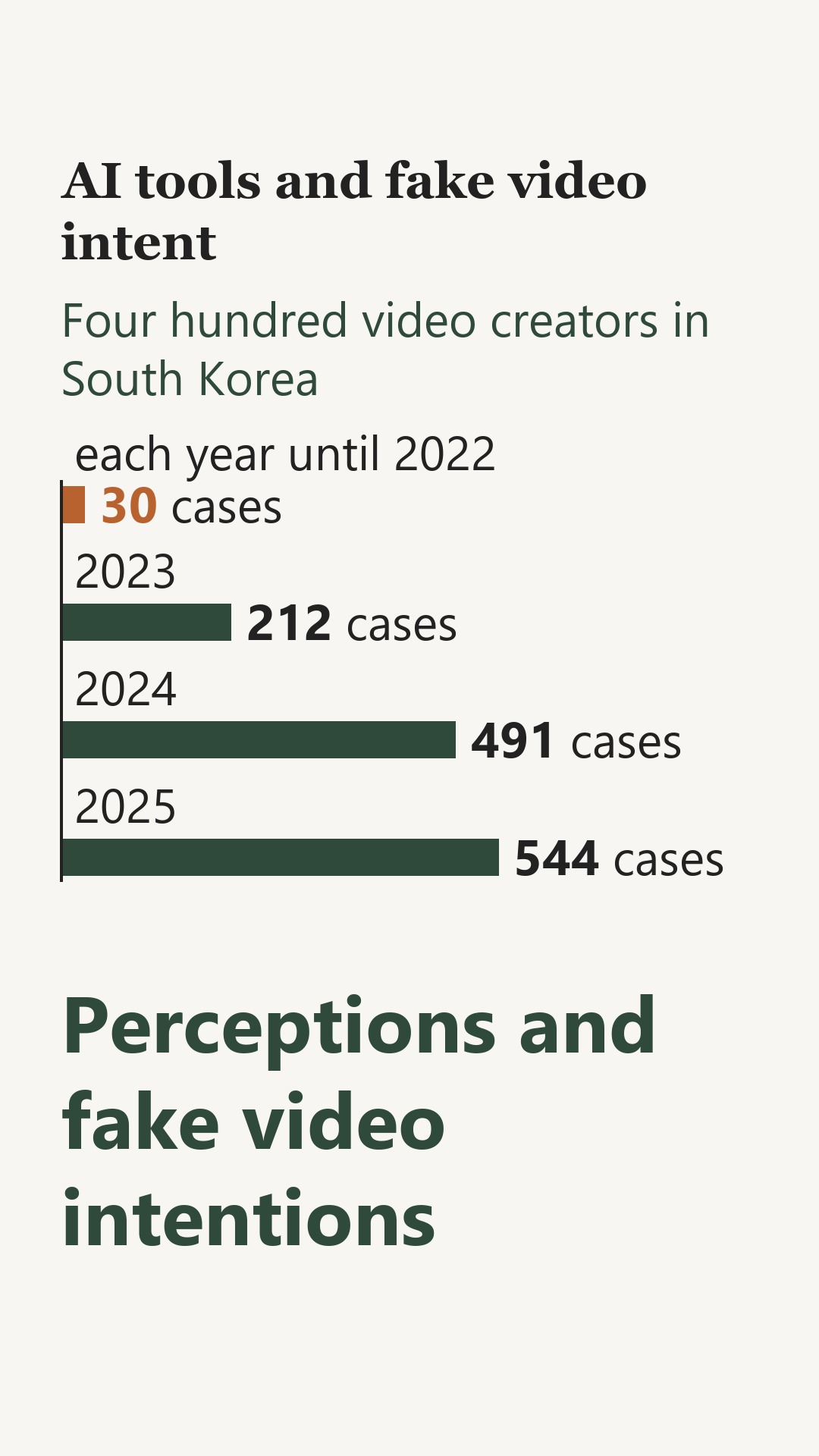
The survey ran from 8 to 14 June 2023 among South Korean adults aged 20 to 59 who had uploaded videos. Each had watched clips made with three tools: CLOVA Voice, Vrew captions and Deep Brain's AI presenter, all available in Korea at the time. On a five-point scale, lower perceived risk of misuse went with a stated intention to misuse the tools, for all three. Higher favorability toward the AI presenter went with greater stated misuse intention, and higher risk perception of the AI voice went with more resistance to it. The authors call these associations, not effects.
The article names no way for a voter to check where a video came from, and it gives no fact-checking service or register page.
The article reports no electoral authority, rule, ruling or audit. The authors say a survey like this cannot show that changing how risky people think these tools are would change what they do.
What this means for you
For anyone weighing whether a video's voice or on-screen presenter is real, the survey offers no check and no test, since it only asked people what they said they would do. What you can do is ask who made a clip and whether the electoral authority has said anything about synthetic media. Watch for clear labeling before you share.
Oh, R., Kim, S. (2026). Factors Influencing Individuals’ Intentions to Misuse LLM-Based Generative AI in Video Content Creation. Behavioral Sciences. https://doi.org/10.3390/bs16101816
Who paid: The work was funded by the Ministry of Education of the Republic of Korea through the National Research Foundation of Korea (50%) and by the Institute of Information & Communications Technology Planning & Evaluation (IITP)-ITRC grant from the Korea government (50%); the article does not say whether the funders had any role, and no equipment or software was reported as lent.
The longer versionThe passages copied from the paper, the pictures, and every source with how much of it we read · 1295 words · about 6 minRead it →Close
The rule and the evidence: A survey of 400 Korean video creators found that those who saw less risk in AI voice, caption and presenter tools said they were more likely to use them for fake videos
### THE ACT
No resolution, ruling, audit or bill is quoted in this document. The paper is a survey study, not an instrument of law, and the verified passages carry no operative text: nothing here says what is in force, for whom, from when, who enforces it, or what a person may do and by when. What the paper records instead is a measurement of stated intention, made under an ethics approval from Sookmyung Women's University dated 20 March 2023, with data collected from 400 South Korean adults between 8 and 14 June 202312.
The nearest thing to a finding with the shape of a rule is this: in that sample, lower perceived misuse risk was associated with greater intention to misuse LLM-based generative AI for all three modalities studied — AI voice, AI caption and AI human presenter3. The authors are careful about what that means. A cross-sectional survey, they write, "does not establish the temporal ordering or causal direction of the observed relationships"1. The paper does not propose that raising anyone's sense of risk would lower anyone's intention to misuse. It reports an association and stops.
### THE CASE IT ANSWERS
No real instance was found this week.
What the paper does describe are documented incidents, not cases its survey answers. Reported deepfake-related incidents stayed at roughly 30 a year until 2022, then rose to 212 in 2023, 491 in 2024 and 544 in 20254. In February 2024, a video made in Hong Kong combined a generated fake voice with images, impersonated a company official, gave detailed instructions to financial officers, and cost that company $25 million5. In 2023, a video circulated on social media purporting to show bombings in Gaza; it turned out to be old footage with fake captions labeling the site as Gaza6. It would seem these are the kind of thing the authors mean when they write about linguistic manipulation, but the paper does not name any of them as the case its survey was built to explain.
The mechanism is worth setting out plainly, because it explains why the authors chose the modalities they did. A video carries meaning through voice, through captions and through the person on screen. Image manipulation, when the generation is poor, leaves visible inconsistencies; linguistic manipulation is "more difficult to detect and frequently more sophisticated and realistic than image manipulation"7. AI captions read the speech or text and offer fonts to choose from8; AI presenters are built by synchronizing a generated face and its movements to speech, and companies such as Synthesia and Deep Brain sell the service9. In one cited test, listeners judged an AI-generated voice to have the same identity as the real person about 80 percent of the time, and correctly identified a voice as AI-generated only about 60 percent of the time10. The ear is not a reliable guard.
### WHAT WAS MEASURED
The study surveyed 400 South Korean adults aged 20 to 59, all of them with prior experience creating and uploading video content2. They were shown videos generated with three services available in Korea in June 2023 and answered a questionnaire on a five-point scale. The authors describe the sample as chosen deliberately to reach people who could judge these tools in relation to video making, not to represent the general population2.
For each modality, lower perceived misuse risk went with greater stated intention to misuse: for AI voice the unstandardized coefficient was −0.327, for AI caption −0.152, for AI human −0.362. Perceived risk for AI voice was positively associated with resistance, at 0.111. Favorability toward AI human was positively associated with misuse intention, at 0.320. Favorability toward AI voice was negatively associated with resistance, at −0.13031112. The indirect paths through attitude, subjective norm and perceived behavioral control were tested with a correction for multiple comparisons, and after that correction no significant indirect effects involving AI caption remained.
What was measured was stated intention, not behavior. The paper says self-reported misuse intention "should not be interpreted as evidence of actual misuse behavior." The data are from June 2023, and the authors note that generation quality has advanced considerably since13. No passage in this document reports a measurement of this kind taken during an election rather than in a survey panel.
### THE OTHER REGION'S ANSWER TO THE SAME THING
We found none this week: no passage in this document gives another country's court, law or authority ruling on the same method.
### THE LIBRARY'S READING
Here is how we read it. A false story about a person in public life has always worked by leaving a residue: once a charge is in the air, the accused spends the rest of the campaign clearing smoke, and the clearing is never quite finished. What is new is not the appetite for the charge but the cost of manufacturing it. A voice, a caption, a face on screen used to require a studio and a willing accomplice. Now it requires a text box and an afternoon.
This leads us to expect something in homes like the reader's. When a clip of a familiar voice or a calm presenter is shared widely, the sharing itself will start to feel like evidence, and the pull will be strongest in a close race or a contested count, when no authority has said anything yet and everyone is looking at everyone else. We would be wrong if voters, shown a widely shared fake, went to their electoral authority's published notice before believing or forwarding it, and did so as readily in a confused week as in a calm one. That is a testable thing, and we would be glad to fail it.
What the reader can do with this: judge an announcement by whether it traces back to the electoral authority's own resolution or report, not by how assured the speaker sounds. A confident voice is a manner, not a source. When a clip is going around, ask who is repeating it and whether any of them checked. Treat a crowd of sharers as a crowd. And notice how many times you have met a claim, not just whether it now sounds familiar; repetition is doing work that feels like memory.
### WHAT IS NOT KNOWN
The study cannot say that changing anyone's perception of risk would change anyone's behavior; the authors call these associations, not causal effects1. It cannot speak for people without video-making experience, for ages outside 20 to 59, or for any country but South Korea2. It measured a stated intention, not a fake made or a vote moved, and it says nothing about how much fabricated political video is circulating.
The paper itself is candid about the thin ice under its own feet: perceived risk and favorability were each measured with a single item per modality, so the exact size of any one association should be read as rough; the modality-by-modality analyses were not tested against each other statistically; and the data predate the current generation of tools13. A rule with no enforcement behind it is not in this document at all. What is here is a snapshot of what 400 Korean video makers said they would do, taken three years before you read it. The date on your ballot is fixed by law; the date on this evidence is June 2023.
Before you share the next clip of a familiar voice, open your electoral authority's page and see whether it says the same thing. That check takes a minute, and it is the one thing in this story you can do alone.
Where each piece of context comes from, and how much of it we read
- Oh, R., Kim, S. (2026). Factors Influencing Individuals’ Intentions to Misuse LLM-Based Generative AI in Video Content Creation. Behavioral Sciences. https://doi.org/10.3390/bs16101816 - the article this story is about — the whole article — the passage: "First, the study employed a cross-sectional survey design, which does not establish the temporal ordering or causal direction of the observed relationships. Accordingly, the significant indirect associations identified in the mediation analyses should not be interpreted as evidence of causal mediation."
- Oh, R., Kim, S. (2026). Factors Influencing Individuals’ Intentions to Misuse LLM-Based Generative AI in Video Content Creation. Behavioral Sciences. https://doi.org/10.3390/bs16101816 - the article this story is about — the whole article — the passage: "Second, the study focused on South Korean adults aged 20–59 with prior experience in creating and uploading video content. This sampling criterion was intentionally adopted to examine individuals who could evaluate GAI technologies in relation to video-production activities."
- Oh, R., Kim, S. (2026). Factors Influencing Individuals’ Intentions to Misuse LLM-Based Generative AI in Video Content Creation. Behavioral Sciences. https://doi.org/10.3390/bs16101816 - the article this story is about — the whole article — the passage: "Among the most interesting findings was that, for all modalities, lower perceived misuse risk was associated with greater intention to misuse LLM-based GAI. Contrary to the expectation that higher perceived risk would be associated with lower misuse intention, our findings highlighted the relevance of low perceived misuse risk."
- Oh, R., Kim, S. (2026). Factors Influencing Individuals’ Intentions to Misuse LLM-Based Generative AI in Video Content Creation. Behavioral Sciences. https://doi.org/10.3390/bs16101816 - the article this story is about — the whole article — the passage: "Reported deepfake-related incidents remained at approximately 30 cases annually until 2022 but increased dramatically to 212 in 2023, 491 in 2024, and 544 in 2025, reflecting the rapid escalation of deepfake misuse ( OECD, 2026 )."
- Oh, R., Kim, S. (2026). Factors Influencing Individuals’ Intentions to Misuse LLM-Based Generative AI in Video Content Creation. Behavioral Sciences. https://doi.org/10.3390/bs16101816 - the article this story is about — the whole article — the passage: "In February 2024, a video was created in Hong Kong using a cleverly combined generated fake voice with images, impersonating a company official and giving detailed instructions to financial officers; this led to a loss of $25 million for that company ( Milmo, 2024 )."
- Oh, R., Kim, S. (2026). Factors Influencing Individuals’ Intentions to Misuse LLM-Based Generative AI in Video Content Creation. Behavioral Sciences. https://doi.org/10.3390/bs16101816 - the article this story is about — the whole article — the passage: "In 2023, a video circulated on social media, purportedly showing footage of bombings in Gaza and shocking viewers with scenes of devastation; this was later revealed to be disinformation, a combination of old video footage with fake captions labeling the site as Gaza ( Bond, 2023 )."
- Oh, R., Kim, S. (2026). Factors Influencing Individuals’ Intentions to Misuse LLM-Based Generative AI in Video Content Creation. Behavioral Sciences. https://doi.org/10.3390/bs16101816 - the article this story is about — the whole article — the passage: "Modifying the components responsible for conveying linguistic information (e.g., voice and captions) in videos can more effectively transmit disinformation through visual and auditorial channels. If the generation technology is insufficient, image manipulation may disclose noticeable inconsistencies. However, linguistic manipulation is more difficult to detect and frequently more sophisticated and realistic than image manipulation."
- Oh, R., Kim, S. (2026). Factors Influencing Individuals’ Intentions to Misuse LLM-Based Generative AI in Video Content Creation. Behavioral Sciences. https://doi.org/10.3390/bs16101816 - the article this story is about — the whole article — the passage: "AI captions analyze the input text or speech recognition from videos and offer a selection of elegantly designed fonts from which to choose. Adobe Premiere Pro (version 23.4), a well-known video editing software, provides an automatic captioning service that utilizes Adobe Sensei GAI."
- Oh, R., Kim, S. (2026). Factors Influencing Individuals’ Intentions to Misuse LLM-Based Generative AI in Video Content Creation. Behavioral Sciences. https://doi.org/10.3390/bs16101816 - the article this story is about — the whole article — the passage: "AI presenters can be created using advances in audio-driven talking-head generation, which enable the synthesis of human-like facial videos in which facial appearance and movements are generated or synchronized with speech ( Rakesh et al., 2026 ). Companies like Synthesia and Deep Brain offer services for customizing these AI presenters to meet specific needs."
- Oh, R., Kim, S. (2026). Factors Influencing Individuals’ Intentions to Misuse LLM-Based Generative AI in Video Content Creation. Behavioral Sciences. https://doi.org/10.3390/bs16101816 - the article this story is about — the whole article — the passage: "Recent evidence indicates that listeners may have difficulty distinguishing AI-generated voice clones from their real counterparts: participants perceived an AI-generated voice as having the same identity as its real counterpart approximately 80% of the time and correctly identified a voice as AI-generated only about 60% of the time ( Barrington et al., 2025 )."
- Oh, R., Kim, S. (2026). Factors Influencing Individuals’ Intentions to Misuse LLM-Based Generative AI in Video Content Creation. Behavioral Sciences. https://doi.org/10.3390/bs16101816 - the article this story is about — the whole article — the passage: "Higher favorability and lower perceived misuse risk toward AI human were associated with greater intentions to misuse GAI. The tendency for misuse intention to be higher, particularly when favorability concerning the technology is higher, highlights the potential for AI misuse."
- Oh, R., Kim, S. (2026). Factors Influencing Individuals’ Intentions to Misuse LLM-Based Generative AI in Video Content Creation. Behavioral Sciences. https://doi.org/10.3390/bs16101816 - the article this story is about — the whole article — the passage: "Resistance exhibited a positive correlation with perceived risk concerning AI voice and a negative correlation with perceived favorability toward AI voice. These results suggest that negative experiences or memories related to voice manipulation may be associated with heightened risk perception and resistance."
- Oh, R., Kim, S. (2026). Factors Influencing Individuals’ Intentions to Misuse LLM-Based Generative AI in Video Content Creation. Behavioral Sciences. https://doi.org/10.3390/bs16101816 - the article this story is about — the whole article — the passage: "Third, the data were collected in June 2023. Since then, GAI technologies for video production have advanced considerably, particularly in the quality and accuracy of generated outputs."
Oh, R., Kim, S. (2026). Factors Influencing Individuals’ Intentions to Misuse LLM-Based Generative AI in Video Content Creation. Behavioral Sciences. https://doi.org/10.3390/bs16101816
Who paid: The work was funded by the Ministry of Education of the Republic of Korea through the National Research Foundation of Korea (50%) and by the Institute of Information & Communications Technology Planning & Evaluation (IITP)-ITRC grant from the Korea government (50%); the article does not say whether the funders had any role, and no equipment or software was reported as lent.
The findings of other studies mentioned here come from this document; those studies were not opened one by one.